



Abstract
This research examines the effect of globalization on poverty and inequality in Thailand during the period 2015 to 2021, using provincial level data from 77 provinces. The study investigates the effect of overall globalization and its different types, namely economic globalization, social globalization and political globalization. The results from System-GMM estimation show that overall globalization reduces poverty and inequality. Regarding different types of globalization, economic globalization in terms of financial globalization, and social globalization in terms of interpersonal and information globalization, can help reduce both poverty and inequality. However, political globalization only reduces poverty in Thailand but does not influence inequality. The results also indicate that economic growth, unemployment, inflation, health service, and technological infrastructure are important related factors. The research findings can be beneficial for policy makers in developing policy and economic planning to reduce poverty and inequality.
Keywords
Introduction
Globalization represents the increasing interconnectedness of the world through economic systems, social and cultural exchanges, political influences, technological advancements, and the flow of information. It fosters a multicontinental connection among nations and populations, transforming economies and societies on a global scale. According to Gygli et al. (2019) and Dreher (2006), globalization can be categorized into three main dimensions: economic, social, and political. First, economic globalization encompasses the flow of goods, services, and capital between countries, including trade globalization, which facilitates international trade policies and agreements, and financial globalization, which involves foreign direct investment, portfolio investment, international transfers, and investment agreements. Second, social globalization involves the world’s convergence through interpersonal, information, and cultural globalization. Interpersonal globalization connects people via communication, travel, migration, and transportation. Information globalization links economies through technology, communication, and patent transfers. Cultural globalization facilitates the exchange and integration of cultures across countries. Lastly, political globalization reflects the influence of international organizations, treaties, and non-governmental organizations on domestic and global policies.
Globalization generates widespread debate regarding its economic and social impacts. Extensive research highlights its role in shaping economic growth, social dynamics, and cultural change (Dreher, 2006). Among these, its influence on poverty and income inequality has drawn considerable attention (Agénor, 2004; Aisbett et al., 2006; Anetor et al., 2020; Asteriou et al., 2013; Çelik & Basdas, 2010; Chakrabarti, 2000; Dhrifi et al., 2019; Huh & Park, 2019; Li et al., 2022; Topalova, 2005). However, much of the existing literature focuses predominantly on the economic aspects of globalization, with limited examination of the social and political dimensions (Kharlamova et al., 2018; Munir & Bukhari, 2019). Additionally, many studies assess globalization’s overall effects without distinguishing its subcategories, such as trade and financial globalization or cultural and interpersonal globalization. Related research often focuses on country groups, such as developed, developing, or Southern African nations, with limited attention to specific country such as Thailand. Most studies are descriptive, exploring globalization’s relationship with poverty and inequality, its social impacts, or factors influencing poverty and inequality in Thailand.
According to the KOF Swiss Economic Institute (2023a), Thailand’s globalization index has shown an upward trend, rising from 62.96 in 2015 to 65.94 in 2021, with an average of 66.59 for the period. This is notably higher than many other regions, including the Middle East and North Africa (62.53); East Asia and the Pacific (59.17); Latin America and the Caribbean (59.32); South Asia (49.82); and Sub-Saharan Africa (49.74). Among the different types of globalization in Thailand, political globalization ranks the highest at 80.87, followed by economic globalization at 66.40, and social globalization at 52.72. Thailand has demonstrated notable progress in political and economic globalization, with their indices increasing by 4.5% and 2.58%, respectively, between 2015 and 2021. This growth is driven by trade expansion in electronics, air conditioning, and circuit boards, as well as significant foreign direct investments, particularly from China, Europe, and the United States in automobile and smartphone components and hard disk drives. Additionally, investments in Foreign Investment Funds and international collaborations through free trade and investment agreements such as ASEAN-EU, China, and the Asia Pacific and the Eastern Economic Corridor development plan have driven Thailand’s economic globalization. Political integration has advanced through initiatives such as the ASEAN Political-Security Community and e-payment collaborations between the Bank of Thailand and other central banks, highlighting Thailand’s growing integration into political globalization (Bank of Thailand, 2020, 2023). Social globalization grew by 4.98% from 54.59 in 2015 to 57.31 in 2019 before the Covid-19 pandemic. This was supported by increased tourism, foreign labor migration, and policies supporting technological and international communication, such as the ASEAN Single Window and National Single Window; development plans for telecommunications systems and technology in the Greater Mekong Subregion (GMS), ACMECS, BIMSTEC, and other regions. However, the pandemic caused a sharp decline in social globalization, dropping to 39.58 in 2021 due to travel restrictions and reduced international communication (ASEAN Secretariat, 2024; Office of the National Economic and Social Development Council, 2021, 2023).
Thailand has witnessed a reduction in poverty and income inequality, with the poverty headcount ratio declining from 7.19% in 2015 to 6.32% in 2021, and the Gini index measuring income inequality improving from 44.50 to 37.50 during the same period. These achievements are attributed to government initiatives such as long-term socio-economic development plans and targeted measures during the Covid-19 pandemic, including soft loan projects, SME lending, and support for debt payment among vulnerable groups (Office of the National Economic and Social Development Council, 2022). Additionally, the growing integration into global networks through economic, social, and political globalization has likely contributed to a reduction in poverty and inequality.
The increasing globalization levels in Thailand, alongside declining poverty and income inequality trends, have prompted this study to explore the relationship between globalization and these socioeconomic outcomes. Using comprehensive provincial-level data from all 77 provinces, this research analyzes the impact of overall globalization, and its economic, social, and political dimensions on poverty and inequality. This research contributes to the literature by addressing the relatively underexplored case of Thailand, analyzing multiple facets of globalization, and simultaneously investigating its effects on both poverty and income inequality.
The following section comprises the literature review and is followed by presentation of the data and methodology, results, and discussion. The conclusion and recommendations are presented in the final section.
Literature Review
Concept of the Effect of Globalization on Poverty and Income Inequality
The concept of the effect of globalization on poverty and income inequality can be divided based on the different aspects of globalization:
Effect of Economic Globalization on Poverty and Income Inequality
Different aspects of globalization can affect poverty and income inequality. Economic globalization, characterized by increased interconnections through international trade and investment, stimulates net exports, capital flow, employment, and production. This heightened economic activity expands opportunities for individuals to access goods and services, thereby reducing poverty and income inequality within countries (Nissanke & Thorbecke, 2010; Rudra & Tobin, 2017). Trade and financial globalization, components of economic globalization, promote trade openness and foreign and portfolio investment, bolstering income and spending opportunities and further diminishing poverty and income inequality. However, economic globalization can exacerbate poverty and income inequality. Economic globalization, through trade globalization, can lead to a disproportionate income distribution in capital-intensive countries, where capital and highly skilled labor-intensive production garner greater international demand compared to labor-intensive and low-skilled labor production, thus increasing poverty and income inequality (Harrison & McMillan, 2007). Trade openness resulting from trade globalization intensifies competition for domestic producers, especially from foreign capital- and technology-based production, potentially reducing profits and income for domestic producers and consequently exacerbating poverty and income inequality. Higher financial globalization can create more short-term capital movement for speculation and a rise in the short-term credit of financial institutions. This may possibly lead to higher default risk and risky project investment, creating financial instability and possible crises, subsequently increase poverty and income inequality (Bharadwaj, 2014; Harrison & McMillan, 2007; Lee et al., 2019).
Effect of Social Globalization on Poverty and Income Inequality
Social globalization strengthens interconnections through interpersonal globalization, which creates connections between people through travel, migration, and transportation; through information globalization via the flow of information, communication and technology; and through cultural globalization, which can lead to new production and investment, resulting in an increase in productivity, output, income, and spending, which subsequently reduce poverty and income inequality (Nissanke & Thorbecke, 2010). However, social globalization can also lead to more poverty and inequality as it can create more movement and transfer of people, labor, technology, information, and cultural exchange between countries. This situation can lead to a more competitive labor market and production sector domestically due to the international transfer of highly skilled labor, together with high quality and highly technical production. This will reduce income, employment, and domestic market share, thus increasing poverty and income inequality.
Effect of Political Globalization on Poverty and Income Inequality
Political globalization, influencing international organizations and non-governmental entities, enhances social benefits and political power, thereby fostering equality in income distribution and poverty reduction (Bergh & Nilsson, 2010; Dorn et al., 2018). Nevertheless, political globalization may also lead to an increase if the domestic country is excessively controlled by international organizations, or if specific groups have connections with international organizations. International integration caused by political globalization can create more economic fluctuation, as countries will depend more on international markets. These conditions can create a heightened risk of poverty and income inequality (Roser & Cuaresma, 2016).
Empirical Literature
Several empirical studies have highlighted the significant effects of economic globalization on poverty and income inequality, often yielding mixed results. Agénor (2004) examined 59 countries from 1980 to1990, finding that economic globalization could increase poverty, while higher economic growth and literacy rates reduced it. Similarly, Tabash et al. (2024) found that globalization reduced income inequality in 18 developing countries, whereas Huh and Park (2019) showed that economic globalization increased income inequality in 158 high- and middle-income countries, though economic growth and government spending improved income distribution. Studies on trade globalization also show varying effects. Aisbett et al. (2006) found that reducing import restrictions in OECD countries lowered poverty, while Chakrabarti (2000) reported reduced income inequality across different country groups. However, Topalova (2005) demonstrated that trade globalization increased poverty in India and South Africa, and Roser and Cuaresma (2016) found that it heightened income inequality in both underdeveloped and developed countries, though economic growth and low inflation mitigated this effect. The impact of financial globalization is similarly mixed. Dhrifi et al. (2019) found that foreign direct investment raised poverty in Latin America and Asia but reduced it in Southern Africa. Li et al. (2022) observed that trade and financial globalization reduced poverty in 25 Asian countries, while Bharadwaj (2014) reported an increase in poverty in 35 developing nations. Anetor et al. (2020) noted that trade globalization lowered poverty in 29 African countries, but financial globalization worsened it. Regarding income inequality, Ravinthirakumaran and Ravinthirakumaran (2018) showed that financial globalization through foreign investment reduced income inequality in 13 APEC and emerging market countries, whereas Lee et al. (2019) found it increased income inequality in both developed and developing nations. Çelik and Basdas (2010) and Asteriou et al. (2013) further reported that trade globalization heightened inequality, while financial globalization reduced it, in both developing and European Union countries.
Research on the effects of social globalization remains limited. Kharlamova et al. (2018) found that information globalization reduced income inequality in European countries. Similarly, Mohanty (2017) showed that information and financial globalization reduced income inequality in developed and developing countries. Munir and Bukhari (2019) reported that information globalization reduced income inequality in emerging markets. Lerskullawat and Puttitanun (2023) demonstrated that various forms of globalization—including economic, trade, social and information—contributed to reduced income inequality in nine Asian countries.
Studies on political globalization and its effects show mixed results. Nwosa and Adeoye (2021) and Khan and Majeed (2018) found that economic, social and political globalization reduced poverty in 113 developing countries, with higher economic growth and education further lowering poverty levels. In contrast, Bergh and Nilsson (2010), in a study of 114 countries, reported an insignificant effect of political globalization on poverty, though social globalization, through interpersonal and information globalization channels, reduced it. Naz (2023) demonstrated that political globalization reduced poverty and income inequality in 129 countries, while economic and social globalization increased inequality. Similarly, Tayebi and Esfahani (2009) found that political, trade, and financial globalization reduced income inequality in developed and developing countries. However, Neutel and Heshmati (2006) indicated that political globalization might increase inequality, whereas economic and social globalization, via interpersonal and information globalization, reduced income inequality. Supporting this, Lee et al. (2019) and Dorn et al. (2018) concluded that political, financial and overall globalization increased income inequality in developed and developing nations.
Recent studies, including those focused on Thailand, have explored various factors influencing poverty and income inequality. These include economic factors (Amponasah et al., 2023; Blau, 2018; Mcknight, 2019), social and political factors (Chotikhamjorn, 2021; Douch et al., 2022; Kaewpitak et al., 2020; Kou & Yasin, 2024; Techaniyom et al., 2021), and crises such as the Covid-19 pandemic (Burlina & Rodríguez-Pose, 2023; Meyer et al., 2024; Saxegaard et al., 2023; Sowels, 2023). However, these studies often overlook the impact of globalization on poverty and inequality. Additionally, much of the prior research has been only descriptive in explaining the relationship between globalization and economic conditions without delving deeper into its effects (Chotidhammo et al., 2019; Jansarn, 2009; Saranjit, 2015).
Therefore, previous research has yielded mix findings on the effects of various types of globalization on poverty and income inequality. While most studies have concentrated on the economic dimensions of globalization, less attention has been given to its social and political aspects. Furthermore, there is a scarcity of research addressing the impacts of globalization on both poverty and income inequality simultaneously. Many studies only focus on specific country groups, with limited attention to Thailand as a case study.
Data and Methodology
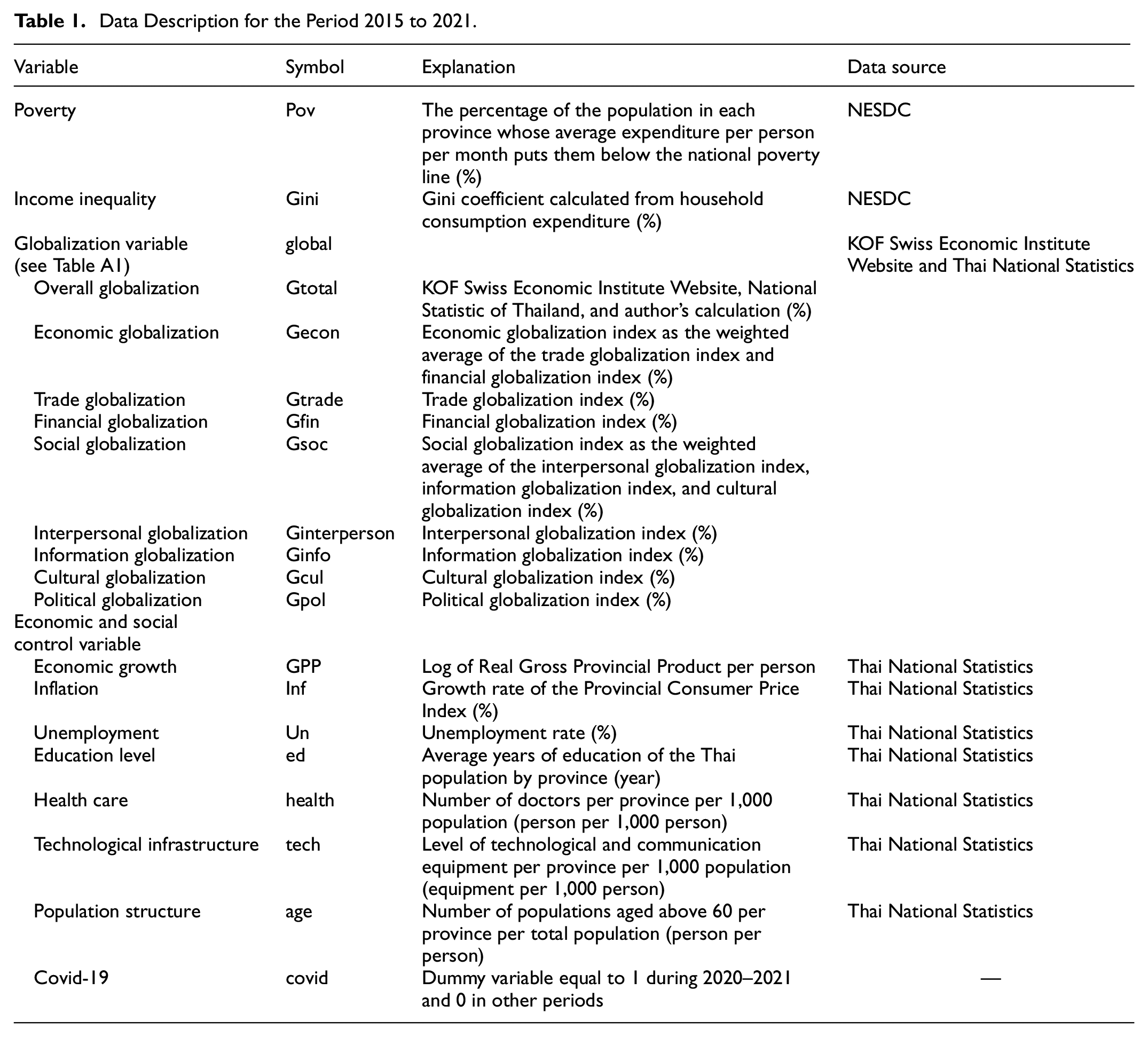
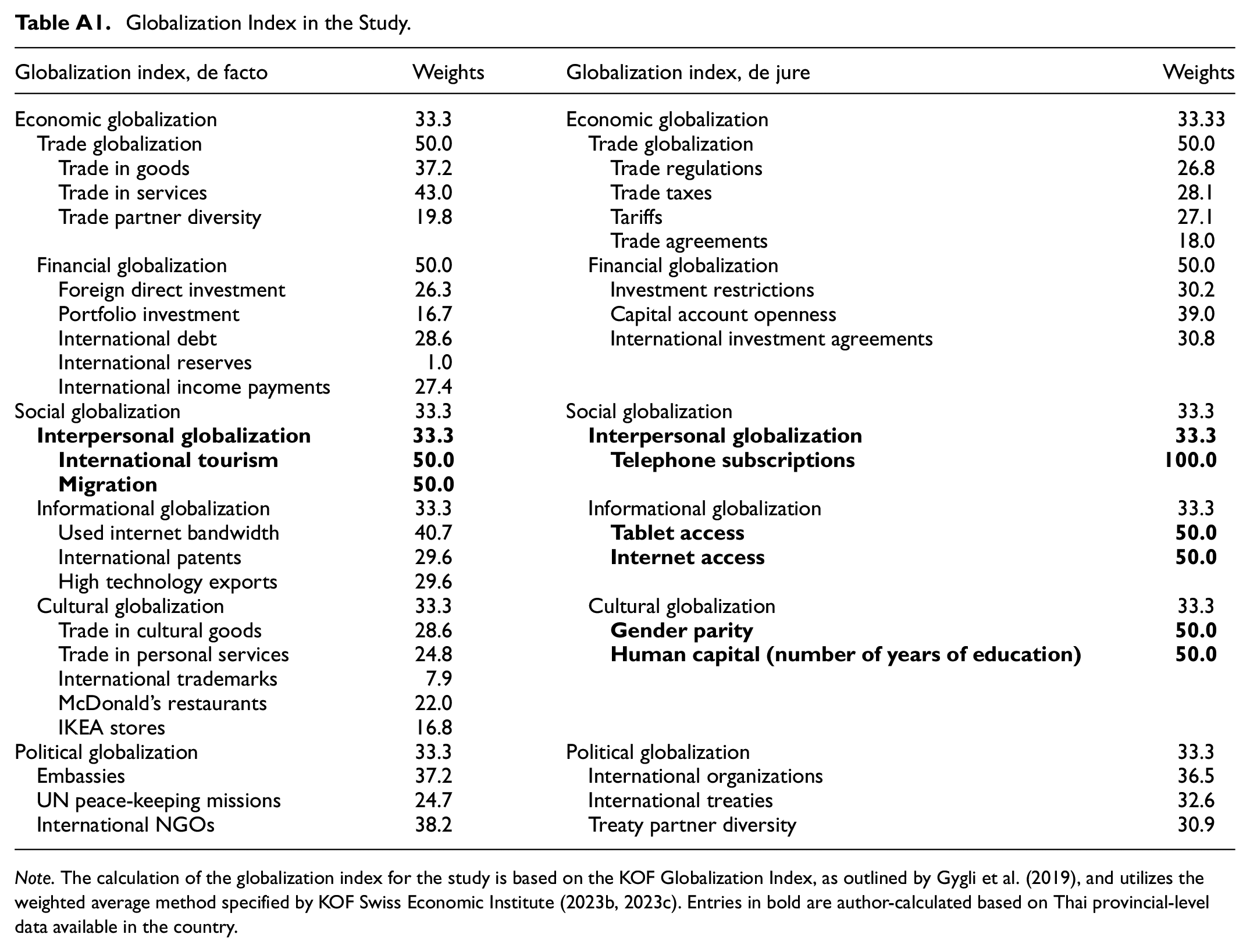
The study uses provincial-level data from 2015 to 2021, covering all 77 provinces of Thailand. This period was chosen because provincial-level inequality data in Thailand has been available only since 2015. Poverty and inequality data were obtained from the Office of the National Economic and Social Development Council (NESDC), while globalization data were retrieved from the KOF Swiss Economic Institute Website as detailed in Table A1. The globalization index is calculated based on the KOF Globalization Index methodology (Gygli et al., 2019) using the weighted average approach specified by the KOF Swiss Economic Institute (2023b, 2023c). This index has been widely used in studies to measure globalization levels (Dorn et al., 2018; Lee et al., 2019). Control variables, including economic and social factors, were obtained from the Thai National Statistical Office. Data descriptions are presented in Table 1, with summary statistics provided in Table 2.
Data Description for the Period 2015 to 2021.
Summary Statistics.

To investigate the effect of globalization on poverty and income inequality in Thailand, the following model specification was used:

where i is the province i in Thailand; t is year t; and
Pov i,t , the percentage of the population in each province whose average expenditure per month is below the national poverty line. A rise in this indicator shows an increased level of poverty in the province.
Gini i,t , the Gini coefficient by province. Due to the limitation of this coefficient calculated from the income distribution in each province in Thailand, this study instead uses the Gini coefficient calculated from the household consumption expenditure distribution in each province. A rise in this indicator shows increased inequality in the consumption expenditure of the population in a province.
Since the levels of poverty and inequality in the prior period can influence their current levels, the lagged dependent variable (
To examine the effects of overall globalization and its various dimensions on poverty and inequality, the model specified in Equation 1 is estimated separately for each of the globalization indices,
Gtotal
i,t
, the overall globalization index, which is the weighted average of the economic, social and political globalization indices. An increase in this index can have either a positive or negative effect on poverty and inequality. A rise in overall globalization fosters interconnections in economic, trade, and financial activities, potentially increasing production and income, thereby reducing poverty and income inequality. However, it could also exacerbate disparities depending on the distribution of benefits. Thus, the expected sign of the coefficient for this variable could be either positive or negative (
Various aspects of globalization, including the economic, social, and political globalization indices, are as follows:
- The economic globalization index comprising:
Gecon i,t , the economic globalization index calculated from the weighted average of the trade globalization index and financial globalization index.
Gtrade i,t , the trade globalization index.
Gfin i,t , the financial globalization index.
With a rise in economic, trade and financial globalization, more interconnection through international trade and investment occurs, leading to higher trade openness and foreign and portfolio investment. This results in increased employment, production, and income, together with more opportunities to access funding sources, thus reducing poverty and inequality. However, these types of globalization can also create more competition for domestic producers, especially from capital and hi-tech based production in foreign countries. Higher financial globalization can create more short-term capital movement and high lending, possibly leading to higher default risk, creating financial instability and crises, which can increase poverty and inequality. Thus, the expected sign of the coefficient for this variable could be either positive or negative (
- The social globalization index comprising:
Gsoc i,t the social globalization index calculated from the weighted average of the interpersonal, information and cultural globalization index.
Ginterperson i,t the interpersonal globalization index.
Ginfo i,t the information globalization index.
Gcul i,t the cultural globalization index.
Higher social globalization, together with interpersonal, information, and cultural globalization, will create interconnection between people through travel and transportation and a flow of information, communication, and technology, which can lead to new production and investment opportunities, resulting in an increase in output, income, and spending, consequently reducing poverty and inequality. Nevertheless, social globalization can also create a more competitive domestic labor market and production sector due to the international transfer of highly skilled labor, and high quality hi- tech production, causing strong competition among domestic producers. This will reduce domestic income, thus increasing poverty and inequality. Thus, the expected sign of the coefficient for this variable could be either positive or negative (
- The political globalization index, comprising:
Gpol i,t the political globalization index.
Higher political globalization signifies greater influence from international organizations, international integration, and non-government organizations on the internal economy. This can foster greater equity in social benefits, promoting equity in income distribution and poverty reduction. However, political globalization may also make a country overly dependent on other nations, or be subject to excessive control by international organizations, leading to more economic fluctuations and increases poverty and inequality. Thus, the expected sign of the coefficient for this variable could be either positive or negative (
This study also controls for economic and social conditions that can affect poverty and inequality.
GPP
i,t
, denoting the log of Real Gross Provincial Product per capita, which serves as an indicator of the economic situation within a province. An increase in GPP signifies an improvement in economic conditions, contributing to higher levels of employment, production and income, and increased opportunities for spending, thus reducing poverty and inequality. However, a rise in economic growth may result in increased poverty and inequality if the growth rate is disproportionately higher in specific sectors. Thus, the expected sign of the coefficient for this variable could be either positive or negative (
inf
i,t
, the inflation rate by province. An increase in this results in a reduction in purchasing power, leading to lower consumption and spending, and thus raising poverty and inequality. Thus, the expected sign of the coefficient for this variable is positive (
un
i,t
represents the unemployment rate by province. A rise in this rate signifies fewer opportunities for individuals to access funding sources and to spend, thus raising poverty and inequality. Thus, the expected sign of the coefficient for this variable is positive (
ed
i,t
is the average years of education of the Thai population by province. A higher level of education creates higher opportunities for individuals to achieve higher levels of income and spending, thereby reducing poverty and inequality. However, if there exists inequality in access to education, this may result in lower human capital in certain sectors, leading to reduced employment, income for specific groups to access sources of funds. This situation can lead to higher levels of poverty and inequality. Thus, the expected sign of the coefficient for this variable could be either positive or negative (
health
i,t
denotes the proportion of the number of doctors by province per 1,000 population, reflecting the healthcare infrastructure in the province. A higher proportion indicates better healthcare, contributing to increased labor productivity, higher income, and greater consumption spending, hence reducing poverty and inequality. Nevertheless, if the healthcare infrastructure is accessible primarily to specific groups, such as high-income individuals, it may exacerbate poverty and inequality issues. Thus, the expected sign of the coefficient for this variable could be either positive or negative (
tech
i,t
represents the level of technological and communication equipment per 1,000 population by province, reflecting the technological infrastructure. A higher level indicates technological development in the province, leading to a rise in production, investment, income, and consumption spending, thereby reducing poverty and inequality. However, if the technological infrastructure is at a low level or is inaccessible in remote areas, this can result in increased poverty and inequality. Thus, the expected sign of the coefficient for this variable could be either positive or negative (
age
i,t
denotes the proportion of the population aged above 60 to the total population. An increase in this proportion indicates a higher share of the aging population, which can create shortage of workers, and placing additional burdens on the government in terms of healthcare and potentially increasing welfare expenditure, which could lead to more poverty and inequality. Therefore, the expected sign of the coefficient for this variable is negative (
covid
i,t
is a dummy variable taking a value of 1 during the years 2020 to 2021 and 0 otherwise, serving as a control for the Covid-19 pandemic, which tend to increase poverty and inequality. Thus, the expected sign of the coefficient for this variable is positive (
ε i,t is the error term where ε i,t = μ i + ui, t ,. μ i is the individual province’s fixed effect and ui, t is the random disturbance.
To estimate Equation 1, a dynamic panel data model and the Generalized Method of Moments (GMM) estimation was employed. Since the model specification includes lagged dependent variables (
Therefore, the first-difference GMM estimation, introduced by Arellano and Bond (1991), can address the endogeneity problem by adding additional moment condition to the first-differenced equations. This method uses all lagged values of the dependent variable as instrumental variables, under the assumption that the dependent and independent variables are not correlated with the random disturbance term. This effectively resolves the endogeneity issue. However, the first-difference GMM estimation can introduce an instrument bias in the level variables, leading to finite sample bias in the model. To address this limitation, the System-GMM estimation method, as introduced by Blundell and Bond (1998), was employed. This technique not only addresses endogeneity by incorporating lagged dependent variables and instrumental variables to control for the correlation between the lag of the endogenous variables and the error term, but also accounts for external factors that may impact the model. Unlike the first-difference GMM, the System-GMM estimation includes control variables in both the first-difference and the level equations, thereby reducing potential finite sample bias and improving the efficiency of parameter estimation. This dual inclusion of control variables enhances the reliability of the results and provides a more robust framework for analyzing dynamic panel data models (Arellano & Bover, 1995; Baltagi, 2008; Blundell & Bond, 1998;). Before performing the System-GMM estimation, this study tested for the endogeneity problem, as the lagged dependent variable (
Moreover, to ensure the robustness of the findings, this study also conducted a robustness check using the first-difference GMM estimation. The results were consistent with those obtained from the System-GMM estimation. Given the System-GMM’s advantages in providing more efficient parameter estimation and mitigating potential finite sample bias, it is the primary estimation method presented in the results.
Results and Discussion
The results of the effect of overall globalization and other variables on poverty and inequality in Thailand are shown in Table 3. The dataset passed the panel unit root tests, confirming the absence of unit root problems. Multicollinearity tests conducted on the independent variables demonstrate no significant multicollinearity among them. Column (1) presents the effect of overall globalization on poverty, while column (2) shows the effect on income inequality.
Effect of Overall Globalization on Poverty and Inequality in Thailand.

Note. β coefficients are reported along with the standard errors in parentheses. *, **, and *** signify 10%, 5%, and 1% levels of significance respectively.
The results from Table 3 show that the overall globalization index has a significant negative effect on both poverty and inequality in Thailand. As expected, a rise in overall globalization (Gtotal) leads to more interconnections with other countries in international trade and investment; a greater flow of communication, information, and technology; and political and international cooperation between countries, raising production, income and spending, and subsequently reducing poverty and inequality. This result is in line with previous research, which has found an equally significant effect on poverty (Bergh & Nilsson, 2010; Khan & Majeed, 2018; Naz, 2023; Nwosa & Adeoye, 2021) and on income inequality (Heshmati, 2005; Tayebi & Esfahani, 2009). This is due to a rise in overall globalization in Thailand since 2015, with an increase from 62.96 in 2015 to 65.94 in 2021, a level which is higher than other countries, such as in the Middle East and North Africa, East Asia and the Pacific, Latin America and the Caribbean, South Asia, and Sub-Saharan Africa, which will possibly lead to a rise in production, employment, income, and consumption spending in the country, thus causing a reduction in poverty and inequality.
The results show that a rise in poverty and income inequality in the previous period clearly results in a rise in these variables in the current period, indicating that a previous change in poverty and income inequality will continue to influence current poverty and income inequality levels. Regarding economic control variables, the results show that economic growth (GPP) has a significant negative effect on both poverty and income inequality. As expected, an increase in GPP represents a better economic situation, raising levels of employment, production and income, and providing more opportunities for people to access goods and services via consumption spending, thus reducing poverty and inequality. A rise in the inflation rate (inf) has a significantly negative effect on poverty, as shown in column (1). Although this result is not in line with expectations, it is probably because such a rise will result in a reduction in consumer spending, causing more poverty in terms of more restricted access to goods and services. In addition, higher inflation may demonstrate that the country is still in a period of economic expansion, which creates business expansion, employment, and income, thus reducing poverty. The result related to the unemployment rate (un) shows that a higher level of unemployment has a significant positive influence on both poverty and income inequality. This result is in line with expectations, as a rise in unemployment will result in lower income and spending, and creating difficulties in accessing funds, thus raising poverty and inequality.
In relation to the social control variables, the healthcare system infrastructure (health) shows a significant positive effect on income inequality, as indicated in column (2). Although this result is not in line with expectations, it demonstrates that a higher assessment of people in the healthcare system, as represented by a greater number of doctors, will probably raise in some specific area or only be able to be accessed by certain specific groups, such as those with more means to spend, or people living in the city center. This will restrict the access of others to the healthcare system, meaning they will continue to face health problem. This situation will result in a fall in productivity and production, and an unequal ability for people to spend, thus increasing inequality. The Covid-19 (covid) dummy has a negative effect on both poverty and inequality. This unexpected result was probably due to the economic downturn and travel restrictions during the pandemic, which led to a reduction in consumption spending. In addition, there are many government bailout plans, such as soft loan projects, SME support lending projects, and policies for helping the debt payments of valuable groups, which help to reduce both poverty and inequality.
Regarding other economic and social variables, including education level (ed), technological infrastructure (tech), and age structure (age), these variables have an insignificant effect on both poverty and income inequality. This suggests that they do not significantly influence poverty or income inequality in the context of this study. We then conducted robustness tests using alternative indicators for provincial-level education (high school and vocational education enrolment rate) and technological infrastructure (internet access rate of the population). The estimation results remained consistent, confirming that these variables are insignificant to poverty and inequality in Thailand.
Regarding the age structure variable, the proportion of the elderly population (aged 60 and older) remained consistently below 20%, ranging from 14.48% in 2015 to 18.34% in 2021. The limited growth in the elderly population proportion may explain why its impact on poverty and inequality appears negligible during the study period. Moreover, migrants have been filling gaps in Thailand’s labor force in recent decades (World Bank Blogs, 2021).
Based on the Hansen test statistics, the null hypothesis—that the overidentifying restrictions are valid—cannot be rejected. This indicates that the instruments are uncorrelated with the error terms, suggesting that the model employs suitable and sufficient instrumental variables. A second order serial correlation (AR(2)) statistics also show that the null hypothesis of no autocorrelation cannot be rejected, confirming that the models in Table 3 have no autocorrelation problem.
To understand the effects of different types of globalization on poverty and inequality in Thailand, the results are shown in Table 4. Columns (1) to (8) present the effects on poverty, while columns (9) to (16) show the corresponding ones on inequality.
Results of the Effects of Different Types of Globalization on Poverty and Inequality in Thailand.
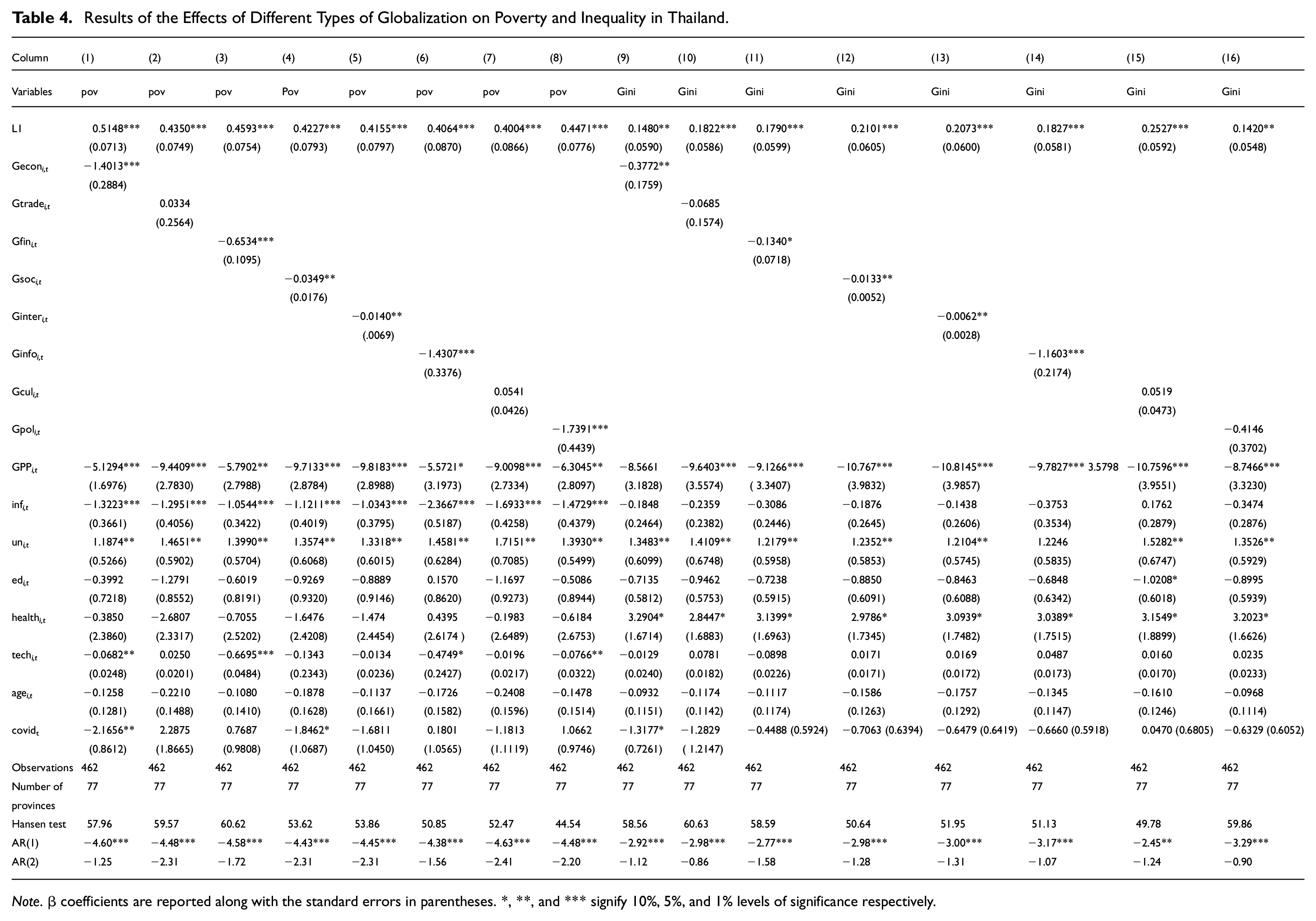
Note. β coefficients are reported along with the standard errors in parentheses. *, **, and *** signify 10%, 5%, and 1% levels of significance respectively.
Regarding the effect of economic globalization, comprising trade and financial globalization, on poverty in Thailand (columns 1–3), and on income inequality (columns 9–11), the results show that overall economic globalization (Gecon) has a significantly negative effect both on poverty (column 1) and income inequality (column 9). This is in line with expectations, as a rise in economic globalization will create more interconnections through international trade and investment, hence increasing employment, production, income, and spending, and thus reducing poverty and inequality. The finding is also similar to those of previous research in relation to the effect on poverty (Agénor, 2004; Khan & Majeed, 2018; Naz, 2023; Neutel & Heshmati, 2006) and to the effect on income inequality (Heshmati, 2005). In addition, the level of economic globalization index in Thailand continued to show an increasing trend, from 64.66 in 2015 to 67.58 in 2021, a situation which can cause a reduction in both poverty and inequality (KOF Swiss Economic Institute, 2023a). Moreover, the effect of financial globalization (Gfin) also shows a significant negative effect on both poverty (column 3) and inequality (column 11) in Thailand. This result shows that a rise in financial globalization can reduce poverty and inequality, which is in line with expectations, as an increase in financial globalization will result in a rise in foreign and portfolio investment, creating more production and income, and providing more opportunities for people to access funding sources, hence reducing poverty and inequality. The finding is also in line with previous studies on the effect on poverty (Li et al., 2022) and on income inequality (Asteriou et al., 2013; Ravinthirakumaran & Ravinthirakumaran, 2018). This is due to an expansion of trade in Thailand since 2015, especially in the electricity, electronics, air conditioning, and circuit board industries, together with a rise in foreign direct investment, particularly from China in the automobile industry and from Europe and United States for smart phone parts and hard disk drives. This has been accompanied by high investment in Foreign Investment Funds, and cooperation with other countries through free trade and investment agreements, such as the liberalization of customs rates and duties between Thailand and India, Japan and China; regional Free Trade Agreements between ASEAN-EU, China and Asia Pacific, and the Greater Mekong Subregion; and an Eastern Economic Corridor investment development plan.
Nevertheless, the study finds that trade globalization (Gtrade) does not have a significant effect on either poverty (column 2) or inequality (column 10) in Thailand. This suggests that the effect of economic globalization in the country primarily stems from financial globalization. This finding may be attributed to the statistics shown in Table 2, which indicate that trade globalization is already at a relatively high level, with an average of 72.83, compared to financial globalization, which averages 59.33. As a result, increase in financial globalization are more likely to significantly impact poverty and inequality, whereas changes in trade globalization, which was already high, do not exhibit a comparable influence. Similar findings regarding the insignificant contribution of trade globalization to poverty and inequality have been reported in other studies (see MacDonald & Majeed, 2010; Tica et al., 2021).
Regarding the effect of social globalization, which comprises interpersonal, information and cultural globalization, on poverty in Thailand (columns 4–7) and on income inequality (columns 12–15), the results show that overall globalization (Gsoc) has a significant negative impact on both poverty (column 4) and income inequality (column 12). This is in line with expectations, as an increase in social globalization can create interconnections through traveling and transportation and through communication and technology, leading to new production and investment. This will result in an increase in output and income, and increased opportunities to access goods and services, leading to a rise in spending, which will consequently reduce poverty and inequality. Similar results were also obtained by Khan and Majeed (2018), Naz (2023), and Neutel and Heshmati (2006) in relation to the effect on poverty, and by Heshmati (2005) and Zhou et al. (2011) regarding the effect on income inequality. Considering the different types of social globalization, the results show that interpersonal globalization (Ginterperson) and information globalization (Ginfo) have a significant negative influence on both poverty (columns 5–6) and inequality (columns 13–14). This is In line with expectations, as a rise in interpersonal globalization will increase connections internationally via transportation, travel, and migration, causing movement in the factors of productions in order to increase production and investment. In addition, an increase in information globalization will lead to more communication and technological transfer, which can create more productivity and the expansion of new goods and services in the market. This situation results in more production, employment, and investment opportunities, hence enhancing income and expenditure, and consequently reducing poverty and income inequality. Similar results were obtained by Bergh and Nilsson (2010), Heshmati (2005), Kharlamova et al. (2018), Mohanty (2017), Munir and Bukhari (2019), and Zhou et al. (2011) regarding the effect on inequality. However, in this study the effect of cultural globalization (Gcul) was found to have an insignificant effect on both poverty (column 7) and inequality (column 15) in Thailand.
Therefore, the results show that interpersonal and information globalization are the main influences of social globalization on poverty and income inequality in Thailand. This is possibly because the level of these types of globalization presented in Table 2 remain at a low level, equal to 52.62 and 31.29 for interpersonal and information globalization respectively, compared to the cultural globalization index, which has a higher level of 74.41. This situation leads to a significant effect of interpersonal and information globalization on both poverty and income inequality compared to that of cultural globalization, which has achieved a high level of globalization in the country. Moreover, since 2015, Thailand has continued to develop interpersonal and information globalization through cooperation with several foreign countries, such as a supporting plan for foreign migration; a development plan for logistics and transportation between Asian regions; an ASEAN Single Window; a development plan for supporting telecommunication systems and technology in GMS, ACMECS, BIMSTEC, and other regions; and collaboration between the ASEAN Socio-Cultural Community (ASEAN Secretariat, 2024; Office of the National Economic and Social Development Board, 2021, 2023). Such support from these types of globalization can help improve levels of poverty and inequality in Thailand.
Regarding the effect of political globalization (Gpol) on poverty in Thailand (column 8) and on income inequality (column 16), the results show that political globalization has a significant negative effect on poverty. This is because higher political globalization leads to greater influence from international organizations, international integration, and non-government organizations. This increases equality in social benefits and income distribution, together with poverty reduction. Similar findings were made by Khan and Majeed (2018) and Neutel and Heshmati (2006). Nevertheless, it was found that this type of globalization does not significantly influence income inequality, thus demonstrating that political globalization in Thailand only affects poverty. Moreover, political globalization shows an increasing trend, from 79.85 in 2015 to 81.92 in 2021. exemplified by government support to collaborate with other countries and organizations, such as the Greater Mekong Subregion and Eastern Economic Corridor investment development plan and the ASEAN Political-Security Community; such support is also evident in the Thai Economic and Social Development Plan No. 11-12 (Bank of Thailand, 2019, 2020). However, the insignificant effect of this type of globalization on inequality is possibly because it does not directly affect income inequality, but does so indirectly through cooperation with countries, leading to a longer-term or lower effect on the economy and inequality compared to poverty.
The results in Table 4 show that a previous change in the level of poverty and income inequality will significantly influence current levels. In relation to economic control variables, economic growth (GPP) has a significant negative effect on both poverty and income inequality; as expected, this is shown in all the columns. A rise in the inflation rate (inf) also has a significantly negative effect on poverty (columns 1–7), but an insignificant one on inequality (columns 8–16). This is probably because a rise in inflation will result in a reduction in consumer spending, causing more poverty in terms of lower access to goods and services. Higher inflation probably indicates a period of economic expansion, with a resulting reduction in poverty. The unemployment rate (un) had a significantly positive effect on both poverty and income inequality, an effect which is shown in all columns.
Concerning the social control variables, education level (ed), represented by the number of years in education, has a significant negative effect on income inequality (column 15). More years in education gives greater opportunities for the population to achieve higher income and spending, thus reducing income inequality. However, this variable has an insignificant effect on poverty (columns 1–8). Healthcare system infrastructure (health) has a significant positive effect on income inequality (columns 9–15), but not on poverty (columns 1–8). This indicates that a higher quality healthcare system, represented by a greater number of doctors, is only available in specific areas or can only be accessed by certain groups, meaning the remainder of the population continue to face health problems. This lowers productivity and production and results in an unequal ability for people to spend, thus increasing inequality. Technological infrastructure (tech) has a negative effect on poverty (columns 1, 3, 6, and 8). This is in line with expectations, as higher proportion of this present leads to a technological access of people in the country, causing a rise in production, investment, income, and consumption spending, thus reducing inequality. However, this variable does not have a significant effect on income inequality (columns 9–16). The Covid-19 dummy (covid) has a negative effect on both poverty (columns 1 and 4) and inequality (column 9). This unexpected result was probably due to the economic downturn and travel restrictions imposed during the pandemic, which led to a reduction in consumption spending. Several government bailout plans during this period can have cause a reduction in both poverty and inequality in the country.
The age structure variable (age) exhibits an insignificant effect on both poverty and income inequality all equations. Based on the Hansen test statistics, the null hypothesis—that the overidentifying restrictions are valid—cannot be rejected. This indicates that the instruments are uncorrelated with the error terms, suggesting that the models employs suitable and sufficient instrumental variables. A second order serial correlation (AR(2)) statistics also show that the null hypothesis of no autocorrelation cannot be rejected, confirming that the models in Table 4 have no autocorrelation problem.
Conclusion and Suggestions
The study has examined the effect of globalization on poverty and income inequality in Thailand using data from the 77 provinces of the country from the period 2015 to 2021. Both the effect of overall globalization and its different types, economic, social, and political globalization, on poverty and inequality have been investigated. The System-GMM estimation results show that overall globalization reduces both poverty and income inequality in Thailand. Regarding the different types of globalization, economic globalization, and its components including financial globalization, can reduce poverty and inequality. Social globalization, and its constituent’s interpersonal globalization and information globalization, can also help reduce both poverty and inequality. On the other hand, political globalization was found to only reduce poverty. Economic growth, unemployment, inflation, the health service, and technological infrastructure are important factors which affect poverty and inequality.
As previous research in Thailand has paid limited attention to the issue of globalization and its impact on poverty and inequality, it is hoped that the findings of this study will be beneficial for policymakers and the government in Thailand in their support for globalization in the country. Not only overall globalization, but specific types need to be considered. Economic globalization, especially financial globalization, should be considered by the government, as the study has found that this type of globalization can significantly reduce poverty and inequality. In this case, the government should support foreign direct investment, especially in the industrial sector and electronic components, which are expected to continue to enjoy greater demand in the future. In addition, this support should be in line with the current Thai Economic and Social Development Plan No. 13 (2023–2027), which aims to support the S-curve industrial sectors, such as those in next generation automotive, smart electronics, robotics, aviation, logistics, and digital fields. This will increase productivity, employment, and income, resulting in a reduction in poverty and income inequality. Cooperation with other countries, such as in the Greater Mekong Subregion and Eastern Economic Corridor investment development plan, and measurements for supporting portfolio investment and the trading of foreign funds, should be continued to develop a higher level of financial globalization. In addition, social globalization, particularly interpersonal and information, should be focused by policymakers, as it was found in this study that these types of globalization have a negative relationship with poverty and income inequality. The government should further develop these through support for international tourism; development of infrastructure and logistics between regions; support for foreign labor migration; and technological and international communication between countries through policies such as the ASEAN Single Window and Information and Communications Technology Single Market (ICT single market) between Asian regions. This should be developed in association with plan no. 13. Furthermore, political globalization has been shown to have a negative effect on poverty in this study. This finding supports the contention that the current political cooperation between Thailand and other countries should be continued and further developed, for example, through the Free Trade and Investment Agreement and international integration. These should be developed in line with transparent government support and management efficiency.
Finally, the study found that economic and social control variables, including economic growth, unemployment, inflation, the health service, and technological infrastructure, can affect poverty and inequality. The government should therefore consider these factors in its development plans to support globalization in the future.
The limitations of this study stem from the availability of provincial-level inequality data in Thailand, which is only available for the period 2015 to 2021. This constraint restricts the analysis to a short time frame, preventing a more dynamic exploration of the long-term effects of globalization on the variables. Future research could revisit these effects when data becomes available for a longer time range. Additionally, further studies could investigate other aspects of globalization’s impact, such as its influence on education or economic growth, to offer a more comprehensive understanding of its broader implications.
Footnotes
Appendix
Globalization Index in the Study.
| Globalization index, de facto | Weights | Globalization index, de jure | Weights |
|---|---|---|---|
| Economic globalization | 33.3 | Economic globalization | 33.33 |
| Trade globalization | 50.0 | Trade globalization | 50.0 |
| Trade in goods | 37.2 | Trade regulations | 26.8 |
| Trade in services | 43.0 | Trade taxes | 28.1 |
| Trade partner diversity | 19.8 | Tariffs | 27.1 |
| Trade agreements | 18.0 | ||
| Financial globalization | 50.0 | Financial globalization | 50.0 |
| Foreign direct investment | 26.3 | Investment restrictions | 30.2 |
| Portfolio investment | 16.7 | Capital account openness | 39.0 |
| International debt | 28.6 | International investment agreements | 30.8 |
| International reserves | 1.0 | ||
| International income payments | 27.4 | ||
| Social globalization | 33.3 | Social globalization | 33.3 |
| |
|
|
|
| |
|
|
|
| |
|
||
| Informational globalization | 33.3 | Informational globalization | 33.3 |
| Used internet bandwidth | 40.7 | |
|
| International patents | 29.6 | |
|
| High technology exports | 29.6 | ||
| Cultural globalization | 33.3 | Cultural globalization | 33.3 |
| Trade in cultural goods | 28.6 | |
|
| Trade in personal services | 24.8 | |
|
| International trademarks | 7.9 | ||
| McDonald’s restaurants | 22.0 | ||
| IKEA stores | 16.8 | ||
| Political globalization | 33.3 | Political globalization | 33.3 |
| Embassies | 37.2 | International organizations | 36.5 |
| UN peace-keeping missions | 24.7 | International treaties | 32.6 |
| International NGOs | 38.2 | Treaty partner diversity | 30.9 |
Note. The calculation of the globalization index for the study is based on the KOF Globalization Index, as outlined by Gygli et al. (2019), and utilizes the weighted average method specified by KOF Swiss Economic Institute (2023b, 2023c). Entries in bold are author-calculated based on Thai provincial-level data available in the country.
Funding
The author(s) received no financial support for the research, authorship, and/or publication of this article.
Declaration of Conflicting Interests
The author(s) declared no potential conflicts of interest with respect to the research, authorship, and/or publication of this article.

Data Availability Statement
The datasets generated during and/or analyzed during the current study are available from the corresponding author on a reasonable request.