




Abstract
The internationalization of higher education (IoHE) is a crucial component of China’s double first-class initiatives, driving universities to adopt effective leadership and cultural strategies. This research investigates the relationship between deans’ transformational leadership (TFL) and IoHE in 22 Chinese universities, focusing on the mediating role of adhocracy culture. Using proportionate stratified random sampling, data from 410 academic staff were analyzed via structural equation modeling and bootstrapping. Results reveal moderate levels of IoHE and adhocracy culture, alongside a high TFL prevalence. TFL significantly influences IoHE directly (β = .517, p < .001) and indirectly through adhocracy culture (β = .169, p < .001), with both factors explaining 56% of IoHE variance. Subdimensions, such as developing shared visions, building goal consensus, and modeling values exhibit strong direct effects, whereas adhocracy culture’s moderate effect (f2 = 0.151) highlights its complementary role. Notably, subdimension building collaborative structures unexpectedly correlates negatively with IoHE, potentially reflecting tensions between hierarchical norms and adaptive internationalization strategies. Limitations include sample exclusion of vocational colleges and exclusive focus on adhocracy culture within the competing values framework. Future research should explore hybrid cultural models and contextual factors to advance holistic IoHE strategies in Chinese hierarchical institutional contexts.
Plain language summary
The research emphasizes the importance of fostering transformational leadership among university deans to support the development of internationalization of higher education. It underscores the role of adhocracy culture as a critical link in this relationship, ultimately contributing to the overall development of universities towards internationalization.
Introduction
Higher education has undergone significant transformations in recent decades, driven by increased competition, funding constraints, and the emergence of a knowledge-driven society (Zhu & Zayim-Kurtay, 2018). In response to these challenges, higher education institutions (HEIs) have been compelled to reassess their governance structures, leadership practices, and internationalization strategies. The internationalization of higher education (IoHE) has become an undistributed trend shaping the process of higher education (Cai, 2021; Jian, 2019; Liu et al., 2020), fostering global collaboration, enhancing research capabilities, and improving institutional prestige in a competitive global market (Altbach & Knight, 2007). Consequently, global universities have escalated their internationalization efforts, integrating them into teaching, research, and institutional governance (Bowles & Murphy, 2020; Soler, 2019).
This trend is also evident in Chinese universities, as China aims to enhance its university competitiveness through internationalization under the double first-class initiatives (Hammond, 2016). Chinese university’s centralized governance model, characterized by the party committee leadership system, exerts a profound influence on the study of IoHE. On one hand, this model offers substantial policy support for universities to engage in international cooperation. On the other hand, China’s cultural norms, such as collectivism and hierarchy, which are deeply rooted in the management of universities, present opportunities and challenges for IoHE. The traditional hierarchical system may conflict with the flexibility and innovation required by internationalization, as decision-making processes in such structures often involve multiple administrative layers that slow down the adoption of new internationalization strategies.
Amid these transformative changes, academic leadership plays a pivotal role in shaping an institution’s internationalization strategies. Deans, as key academic leaders, are instrumental in navigating IoHE complexities, guiding their institutions toward enhanced global engagement and competitiveness (Lo et al., 2020). In this context, transformational leadership (TFL), rooted in Bass and Avolio’s (1994) theory of leadership that emphasizes vision, motivation, and intellectual stimulation, has gained considerable attention. This style is recognized as effective in fostering innovation, motivating followers, and addressing individual needs to inspire institutional change, which are critical for driving the organizational transformations required by IoHE. By inspiring a shared vision of international engagement, transformational leaders create institutional environments conductive to internationalization efforts. This approach renders TFL a vital component in the leadership strategies of universities, enhancing their international standards.
However, leadership alone cannot sufficiently ensure successful internationalization. Organizational culture plays a critical role in determining how leadership practices translate into institutional outcomes. Drawing on Cameron and Quinn’s (2006) competing values framework (CVF), adhocracy culture is characterized by flexibility, creativity, and a strong emphasis on innovation and change. This cultural type is particularly well-suited to IoHE, as it aligns with the need for institutions to adapt to global trends and foster experimental approaches to internationalization. An adhocracy culture fosters an environment where risk-taking and experimentation are encouraged, enabling universities to adopt and implement internationalization strategies that require adaptability to global trends and changes. It creates a dynamic setting where new ideas can thrive, crucial for institutions seeking to compete internationally. However, this characteristic of adhocracy culture, inherently conflicts with China’s traditional hierarchical academic structures. This conflict may have implications for the study findings. In a hierarchical structure, decision-making follows a top-down approach, whereas adhocracy culture encourages bottom-up innovation. Therefore, in the context of this study, an excessively rigid hierarchical structure may impede the development of adhocracy culture in universities, thereby weakening its positive impact on IoHE. However, if the two can be effectively integrated, the positive influence of adhocracy culture on IoHE may be enhanced.
Although leadership and culture have been discussed and scrutinized by different organizations in studies conducted on IoHE, studies on the intertwinement of leadership and culture variables in IoHE have been unreached. Specifically, our literature review shows that the connection among TFL, adhocracy culture, and IoHE is still in its infancy, requiring full exploration. In particular, specific empirical studies investigating the roles that adhocracy culture plays as a mediating role in the TFL–IoHE relationship are scant.
The selection of adhocracy culture as a mediator in this study is grounded in its alignment with TFL and IoHE. Transformational leaders thrive in environments that promote innovation and change, which are the hallmarks of adhocracy culture. Consequently, this type of organizational culture facilitates the internationalization process by enabling institutions to be more agile and open to new global opportunities. Therefore, adhocracy culture is expected to mediate the relationship between TFL and IoHE by creating organizational conditions necessary for transformational leaders to effectively drive internationalization. Without such a culture, the innovative and forward-thinking aspects of TFL might not fully translate into tangible international outcomes.
This study aims to address these gaps by investigating how deans’ TFL and adhocracy culture jointly influence IoHE in selected 22 Chinese universities. These universities were carefully selected to represent different scales, rankings, and regions, including elite, regional, and specialized institutions. This selection aims to ensure a diverse representation. However, the research findings may have limitations when generalized to other types of universities, such as vocational colleges or those with short-term internationalization efforts. The research questions guiding this study are as follows:
What are the levels of TFL, adhocracy culture, and IoHE at 22 Chinese universities?
What are the relationships among TFL, adhocracy culture, and IoHE at 22 Chinese universities?
Is the mediating effect of adhocracy culture on TFL and IoHE significant at 22 Chinese universities?
Answering these research questions is highly important. For Chinese universities striving to enhance their international competitiveness under the double first-class initiatives, understanding the relationship among TFL, adhocracy culture, and IoHE can provide valuable insights for formulating effective internationalization strategies.
Literature Review and Hypotheses Construction
Internationalization of Higher Education and Transformational Leadership
Since its introduction in the 1980s, internationalization has been extensively debated within and across geography and the social sciences (Adriansen & Madsen, 2021; de Wit & Hunter, 2015; Spangler & Adriansen, 2021; Teichler, 2004; Waters et al., 2024). Knight (2003) defined IoHE as the process of integrating an international, intercultural, or global dimensions into the purpose, functions, or delivery of postsecondary education at the national, sector, and institutional levels. As a multifaceted initiative, internationalization aims to enhance all higher education missions and can be implemented in various contexts, including student and scholar exchange, program transfer, founds, international exchanges, external partnerships, curriculum development, and institutional commitment (de Wit & Deca, 2020; Hudzik, 2015; Knight, 2012; Schuerholz-Lehr et al., 2007). IoHE is often considered essential for institutions adapting to globalization (Kotorov et al., 2021).
Despite the extensive studies on IoHE, the literature predominantly reflects theoretical and conceptual framework, with limited empirical studies (De Bot et al., 2007). This lack of measurement complicates the understanding of internationalization, as it involves multiple interrelated patterns. For example, Beckford (2003) surveyed 238 participants to determine how international education is integrated into curriculum, study abroad programs, and other international initiatives. The findings indicated that community college leaders struggled to establish robust international initiatives, indicating a gap in practical application. In a more comprehensive study, Bendriss (2007) demonstrated strong positive relationships among six dimensions of internationalization: articulated commitment (AC), academic offerings (AO), external funding (EF), institutional investment in faculty (IIF), organizational infrastructure (OI), and international students and student programs (ISSP), reinforcing the notion that internationalization is a multifaceted organizational adaptation (Bendriss, 2007; Green, 2005). Overall, IoHE has evolved from ad hoc, negligible, and bitty to a more extensive and integrated component of higher education policy (de Wit & Rumbley, 2017).
Understanding the complexities of IoHE is essential, particularly as it intersects with TFL, which can cultivate supportive organizational cultures conducive to successful internationalization initiatives.
TFL, as defined by Bass and Bass Bernard (1985), involves influencing followers’ attitudes and values to drive organizational change, align individual and institutional goals, and inspire high performance—attributes critical for advancing IoHE strategies. Leithwood (1994) identified eight dimensions through which TFL can motivate followers to engage in decision-making processes: developing shared visions (DSV) refers to leaders advancing practices to search new opportunities to express and motivate the future versions of subordinates; building school goal consensus (BSGC) refers to the goals established by leaders to address school needs; holding high-performance expectations (HHPE) refers to leaders maintaining high expectations for excellence, quality, and staff performance; offering individualized supports (OIS) refers to respecting individual faculty members, addressing their concerns and acknowledging their feels and needs; providing intellectual stimulations (PIS) entails the degree to which the leader challenges assumptions, takes risks, and solicits followers’ ideas; modeling desirable practices and values (MDPV) involves demonstrating highly ethical behavior model, instilling pride, respecting, and believing in teachers, and exhibiting a willingness to change based on new understanding and evolving environment; building collaborative structures (BCS) refers to highlighting faculty collaboration as part of the institution vision and care, and showing respect to students and staff to reinforce the culture; strengthening school cultures (SSC) refers to common standards, beliefs, values, and assumptions that are constituted by faculty members (Bush, 2011; Leithwood & Jantzi, 2006; Sun & Leithwood, 2012). Leithwood is recognized as the pioneer in introducing TFL into the field of education, although his work primarily focused on primary education (Hallinger & Heck, 2011; Hoy & Miskel, 2012). Based on these definitions, the concept of TFL in the context of Chinese universities not only embodies the general characteristics of inspiring followers and promoting innovation, but also needs to adapt to the unique educational environment in China. Chinese universities are influenced by the national education policy system and cultural traditions. Therefore, TFL in this context should also considers integrating national and local characteristics into internationalization strategies.
In the context of higher education, TFL is widely recognized as one of the most effective leadership styles (Altynbassov et al., 2024; Hyde-Clarke, 2023; Thanh et al., 2022; Zacher & Johnson, 2015). Research shows that TFL positively influences faculty and student engagement, organizational commitment, academic performance, job satisfaction, innovation, and organizational culture (Balwant et al., 2019; Fenech et al., 2024; Habeeb & Eyupoglu, 2024; Huang et al., 2021; Nelly et al., 2024; Saif et al., 2024; Southgate et al., 2023; Yu & Jang, 2024). Its emphasis on vision-building and collaboration creates a conducive environment for motivating diverse stakeholders to work toward common institutional goals (Kezar & Holcombe, 2017). For example, Khan et al. (2023) found that TFL has a significant higher association with employee performance in HEIs of Pakistan. They recommended that HEIs should prioritize TFL style among their leaders. Mwesigwa et al. (2020) found that TFL presents a strong correlation with job satisfaction at five public universities in Uganda. Saif et al. (2024) examined the correlations among TFL, innovative work behavior, and performance, discovering a direct relationship between TFL and innovation and performance among leaders and employees in HEIs. Overall, the extensive research supports the importance of TFL in higher education, a powerful catalyst for inspiring and motivating faculty.
Leadership is widely recognized as essential to internationalization (Heyl & Tullbane, 2012; Kahn, 2016; Nolan & Hunter, 2012; Ratliff, 2013), as leaders translate internationalization goals into effective strategies and foster institutional cultures aligned with internationalization objectives (Cotae, 2013; Egekvist et al., 2017; Jones & Oleksiyenko, 2011). However, empirical studies about the intersection of leadership and internationalization are limited (Kraus et al., 2018). The lack of effective leadership can hinder these efforts, as unskilled or inconsistent leadership often results in poor internationalization outcomes (Dewey & Duff, 2009). The need for adaptable, forward-looking leadership styles has grown as institutions face evolving demands within international education (Green & Ferguson, 2011; Ogundimu, 2020).
TFL has been identified as particularly effective in the context of IoHE. It enables institutions to adapt to constantly evolving external and internal environments while inspiring and empowering faculty to pursue innovative internationalization goals (Nurtjahjani et al., 2020). For example, Kraus et al. (2018) conducted a qualitative study on examining the influence of leadership styles on internationalization. The result suggested that TFL can lead to high level of internationalization. Colpitts (2023) investigated the role of leadership in facilitating IoHE in Japan, and the findings indicated that Japanese and non-Japanese faculty and leaders identify TFL as the most effective in facilitating IoHE. Yaro (2023) found that TFL approach is widely used by senior international officers for an effective and successful internationalization in the United States. These findings confirmed TFL’s role as a key driver in achieving IoHE. Based on this discussion, the following hypothesis is proposed:
Internationalization of Higher Education and Adhocracy Culture
Organizational culture encompasses the collective beliefs, thinking styles, and values of its members. It has been widely discussed among scholars within the context of HEIs (Adeinat & Abdulfatah, 2019; Afrifa et al., 2022; Chidambaranathan & Regha, 2016; Haffar et al., 2023). Research indicates that adhocracy culture is the strongest predictor of service quality and notably prevalent in higher education (Chidambaranathan & Regha, 2016; Trivellas & Dargenidou, 2009). This culture is regarded as the most successful and desirable in universities because it fosters attributes such as innovation, flexibility, and strategic changes (Cameron & Quinn, 2006; Dan & Ngoc, 2024; Öztürk & Tetik, 2021). Adhocracy culture has been proven to significantly influence university performance, strategic management, university innovation, and knowledge management (Adeinat & Abdulfatah, 2019; Gorzelany et al., 2021; Kokt & Makumbe, 2020).
Internationalization approaches vary by institution, and these differences stem from higher education culture (de Wit, 2002; Hudzik, 2015). Researchers have investigated that culture might foster or inhibit internationalization (Agnew & VanBalkom, 2009; Delgado-Márquez et al., 2012; Xuan, 2015). Reedstrom (2005) proposed that commitment to mission, vision, and culture has been the key to Dickinson’s successful 45-year internationalization. Schein (2004) suggested that a lake of understanding of organizational culture by leaders hinders their ability to effectively guide institutions in addressing challenges. Tanhueco-Nepomuceno (2019) found that a lack of a supportive culture at institutional level impeded the internationalization process.
When applying Cameron and Quinn’s (2006) findings to university internationalization, Bartell (2003) suggested that adhocracy culture is likely to facilitate a successful internationalization process due to its external adaptation, system openness, and community interaction. For example, universities with adhocracy cultures undergoing internationalization view external challenges as opportunities rather than threats (Volkova & Plakhotnik, 2023). Mchaizi et al. (2023) found that adhocracy culture had a positive and significant influence on performance of public universities in western Kenya. Gorzelany et al. (2021) suggested that adhocracy culture contributed the most to university innovativeness in German and Ukrainian. Moreover, Bartell (2003) found that strong, outward-oriented organizational culture adapted best to internationalization changes. By contrast, adhocracy culture values external positioning and flexibility (Berrio, 2003); it is an outward-focused culture. Hence, the following hypothesis is provided:
Transformational Leadership and Adhocracy Culture in Higher Education
Leadership and culture are interconnected (Dastmalchian et al., 2000; Schein, 2004). Many scholars have studied TFL and organizational culture. Theoretical and empirical studies showed a strong link between TFL and organizational culture (Al-Shibami et al., 2019; Bass & Avolio, 1993; Hartnell & Walumbwa, 2011; Jati et al., 2015; Pratama et al., 2020; Veiseh et al., 2014). Transformational leaders motivate followers to collaborate, be creative, and perform well, substantially influencing adhocracy culture (Ogbonna & Harris, 2000; Xenikou & Simosi, 2006). Leaders in adhocracy culture are expected to be visionary, innovative, and risk oriented to succeed. Transformational leaders can foster adhocracy culture through specific behavior. In the Chinese context, TFL’s influence on adhocracy culture is further shaped by institutional hierarchies. Deans often leverage party committee support to pilot adhocracy-oriented initiatives within bureaucratic structures, rather than challenging them directly. This allows TFL to foster innovation while maintaining hierarchical stability, a dynamic not fully captured by Western leadership theories. Deans with TFL traits often decentralize decision-making by empowering faculty to lead international partnership initiatives and implement international cooperation courses independently. They can also foster a supportive environment that encourages risk-taking. These practices align with adhocracy’s emphasis on flexibility and innovation, as demonstrated in studies where TFL was found to enhance organizational agility in adapting to global challenges (Al Issa, 2019; Yildiz & Gul, 2016). Therefore, we proposed the following hypothesis:
Adhocracy Culture as a Mediator
Multiple studies have demonstrated that organizational culture mediates TFL and various outcomes, such as organizational learning, citizenship, psychological empowerment, change management, and resource planning (Al-Ali et al., 2017; Esmi et al., 2017; Hosseini et al., 2020; Pradhan et al., 2017; Shao et al., 2012). For example, Zoghbi-Manrique-de-Lara and Viera-Armas (2017) found that adhocracy culture can fully mediate the leadership and cybercivism relations. Adhocracy culture has also been found to exhibit a positive mediating effect on the relationships between corporate social responsibility and reputation, as well as performance and innovation (Ali et al., 2023; Noone et al., 2024). Despite this finding, no empirical articles to date have examined the mediation effect of adhocracy culture specifically on the TFL–IoHE relationship. Therefore, this article seeks to address this gap. Based on prior research on TFL and adhocracy culture and their interaction effects, we hold the view that TFL and adhocracy culture are well-aligned in fostering an environment conductive to internationalization. By creating a culture that promotes innovation, risk-taking, and adaptability, TFL can encourage faculty to actively engage in and support IoHE initiatives. Adhocracy culture can thus enhance the impact of TFL on IoHE by motivating faculty to embrace and implement innovative practices in internationalization. Therefore, building on the theoretical alignment between TFL’s emphasis on innovation and adhocracy culture’s role in fostering adaptive environments, we propose the following hypothesis.
Figure 1 presents a structural model, with IoHE as the dependent variable, TFL as the independent variable, and adhocracy culture as the mediating variable. TFL and adhocracy culture directly and indirectly affect IoHE, respectively.

Structural model of the research. A1, A2, A3, A4, A5, and A6 represent six items of adhocracy culture. The blue dashed arrow represents the mediating effect.
Materials and Research Methods
This research is descriptive and correlational.
Population and Sample
The population consists of 39,702 academic staff from 22 Chinese universities. The 22 universities were carefully selected to represent different scales, rankings, and regions, including elite, regional, and specialized institutions. Elite universities, such as Nanchang University, were included to represent institutions from double first-class universities and disciplines. Regional universities, including Jiangxi University of Science and Technology and Gannan Normal University, were selected to reflect the internationalization of regional universities. These universities face unique challenges and opportunities in internationalization development, providing a more comprehensive understanding of the national-level IoHE landscape. Specialized institutions, such as Gannan Medical Universities and Jiangxi Agricultural University, were also included in the sample to cover the diversity of higher education in China. Moreover, the selected universities comprise School of International Education or Division of International Exchange and Cooperation, which ensured that internationalization efforts have been conducted at universities. However, given that vocational colleges have different educational goals and resource constraints and universities with short-term internationalization efforts may not be well structured in IoHE development, these two types of universities were excluded. Through proportionate stratified random sampling, a minimum of 380 academic staff were selected using Cochran (1977) formula. Given the difficulty in obtaining responses from faculty and staff, a 30% dropout rate was added (Israel, 1992), achieving a final sample size of 494. After a three-month collection period, 410 (83% response rate) valid samples were collected.
Demographics include gender, educational background, highest academic attainment, and teaching experience. Among them, 225 (54.9%) are female and 185 (45.1%) are male; 258 (62.9%) have master degrees, 123 (30%) have PhD degrees, and 29 (7.1%) have bachelor degrees; 173 (42.2%) are lecturers, 122 (29.8%) are associate professors, 74 (18%) are assistants, and 41 (10%) are professors; 101 (24.6%) have worked in their institutions for less than 5 years and 309 (75.4%) have worked for more than 6 years. Detailed demographic information is outlined in Table 1.
Information on Participants (n = 410).

Note. Assistant refers to entry-level academic staff, whereas lecturer denotes mid-career professionals with teaching and research responsibilities.
Data Collection
The data were collected through online platform SoJump (wjx.cn). The link was sent to the participants via e-mail between September and December 2023. The email addresses were obtained from the official internet addresses of HEIs.
Instruments
IoHE
To measure IoHE, Green’s (2005) institutional internationalization survey (IIS) was used in this study. The survey includes 30 items in total regarding the six dimensions of IoHE: AC, AO, EF, IIF, OI, and ISSP, employing a five-point Likert scale. After removing AO dimension with its factor loading of less than 0.5 (Byrne, 2010; Hair et al., 2010), the reliability of the scale is achieved with α = .948 for 27 items. The reliabilities for subdimensions are: α = .860 for AC; α = .826 for EF; α = .852 for IIF; α = .833 for OI; and α = .919 for ISSP. Exploratory factor analysis (EFA) with Varimax rotation produced six factors with eigenvalues above 1, explaining 64.80% of the variance. An example of IoHE items is: “My institution’s mission statement specifically refers to international education.”
Deans’ TFL
TFL is measured by Leithwood and Jantzi’s (1999) TFL questionnaire (TLQ). The TFL scale, originally developed for K-12 settings, was adapted for higher education by replacing school-specific items with university contexts. For example, the item “my principal regularly encourages us to evaluate our progress toward achieving school goals” under building school goal consensus (BSGC) dimension, was revised to “my dean regularly encourages us to evaluate our progress toward achieving university internationalization goals.” A pre-test with 50 faculty university confirmed construct validity (Cronbach’s α = .938), demonstrating its suitability for measuring leadership in higher education contexts. A total of 42 items are categorized into eight dimensions of TFL: DSV, BSGC, HHPE, MDPV, OIS, PIS, SSC, and BCS, employing a five-point Likert scale. The reliability of the scale is achieved with α = .948, and the reliabilities for subdimensions are: α = .812 for DSV; α = .839 for BSGC; α = .837 for HHPE; α = .894 for MDPV; α = .876 for OIS; α = .870 for PIS; α = .881 for SSC; α = .864 for BCS. Eight factors with eigenvalues above 1 explained 64.84% of the variance in EFA with Varimax rotation. An example of TFL items is: “My dean shows respect for staff by treating us as professionals (SSC).”
Adhocracy culture is measured by Cameron and Quinn’s (2006) organizational culture assessment instrument. Six items are used to measure adhocracy culture, applying a five-point Likert scale. The reliability of the scale is achieved with α = .868 for six items. One factor with eigenvalues above 1 explained 60.32% of the variance in EFA with Varimax rotation. An example of adhocracy culture items is: “The management style in my institution is characterized by individual risk taking, innovation, freedom, and uniqueness.”
The data collection tools are valid (IIS index values: χ2/df = 1.395, GFI = 0.927, NFI = 0.931, CFI = 0.979, IFI = 0.979, TLI = 0.977, RMSEA = 0.031; TLQ index values: χ2/df = 1.341, GFI = 0.887, NFI = 0.877, CFI = 0.966, IFI = 0.966, TLI = 0.963, RMSEA = 0.029; adhocracy culture index values: χ2/df = 1.261, GFI = 0.991, NFI = 0.988, CFI = 0.997, IFI = 0.998, TLI = 0.996, RMSEA = 0.025).
Analysis of Data
The normality distribution of the data was checked through skewness and kurtosis values in Appendix 1. The results suggested that the data are normally distributed.
Two statistical techniques were employed to address common method bias. First, the variance inflation factor (VIF) was tested, with values ranging from 1.33 and 2.15, which were below the cut-off point of 5, as suggested by Hair et al. (2013), indicating no severe multicollinearity. Second, Harman’s single-factor test was conducted (Harman, 1967; Podsakoff et al., 2003), revealing that the first unrotated factor explained 33.17% of the total variance, which was below the 50% cutoff. Therefore, results suggested that these data had no common bias.
Data were analyzed via IBM SPSS statistics (Version 25.0) and AMOS (version 24.0). Descriptive statistical analysis was used to compute levels of IoHE, TFL, and adhocracy culture used to answer research question 1. Confirmatory factor analysis (CFA) was used to measure model fit, whereas structural equation modeling (SEM) was employed to test the research hypotheses. Specifically, path analysis, which measured direct correlations, was used to verify hypotheses 1, 2, and 3, and to solve research question 2. Bootstrapping analysis, which measured adhocracy culture’s mediating effect, was applied to verify hypothesis 4, and to answer research question 3.
Model of the Research
The structural model of the research is combined with the conceptual model created according to latent variables (Figure 1).
Results
The findings from the results of the data analysis are presented as follows.
Descriptive Analysis
Table 2 presents the data descriptive statistics. Mean, standard deviation (SD), and three levels of low, moderate, and high were employed to address research question 1. Nunnally and Bernstein (1994) stated that for a five-point Likert scale, the mean score between 1 and 2.33 is considered low, 2.34 to 3.66 is moderate, and 3.67 to 5 is high.
Descriptive Statistics for Study Variables (n = 410).
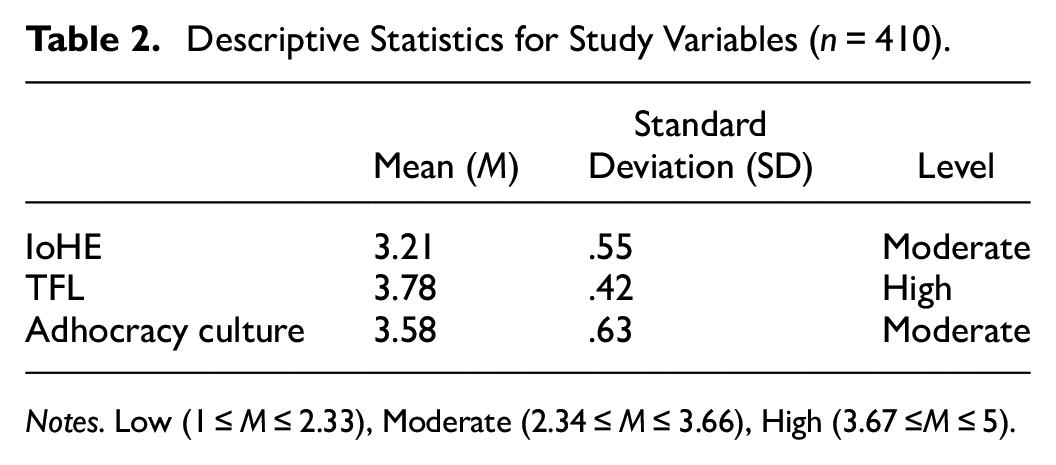
Notes. Low (1 ≤ M ≤ 2.33), Moderate (2.34 ≤ M ≤ 3.66), High (3.67 ≤M ≤ 5).
According to Table 2, the mean of the IoHE in this study suggested a moderate level (M = 3.21, SD = .55), and the mean of adhocracy culture was also at a moderate level (M = 3.58, SD = .63). The mean score of TFL was at a high level (M = 3.78, SD = .42).
Confirmatory Factor Analysis and Structural Equation Modeling
The CFA results of the structural model suggested a good model fit (χ2/df: 1.204; GFI: 0.832; NFI: 0.823; CFI: 0.965; TLI: 0.963; IFI: 0.965; RMSEA: 0.022). Table 3 displays the SEM results.
SEM Analysis Results for Direct Effect.

Note. SE = standard error; C.R. = critical ratio. B = unstandardized regression weight; β = standardized regression weight; R = .748; R2 = .56.
p < .001
Hypotheses Testing
Path coefficients in Table 3 showed the correlations among TFL dimensions, IoHE dimensions, and adhocracy culture. The results suggested that OIS and PIS were not significantly correlated with all dimensions of IoHE. DSV was significantly correlated with OI, EF, and IIF. HHPE was significantly correlated with OI and ISSP. BSGC and MDPV were significantly correlated with all dimensions of IoHE. However, SSC played significant negative correlation with EF and ISSP. BCS played significant negative correlation with all dimensions of IoHE. All dimensions of TFL were significantly correlated with adhocracy culture, except for MDPV, OIS, PIS, and BCS. Adhocracy culture was significantly correlated with all dimensions of IoHE. Overall, a significant positive correlation existed between TFL and IoHE (β = .517, p < .001) and adhocracy culture (β = .487, p < .001). Adhocracy culture was significantly and positively related to IoHE (β = .346, p < .001). Therefore, hypotheses 1, 2, and 3 were confirmed.
Mediating Effect of Adhocracy Culture on TFL and IoHE
Table 4 displays the total, direct, and indirect effects. The standardized indirect effect indicates that adhocracy culture (β = .169, p < .001) significantly and positively mediates TFL and IoHE. Therefore, hypothesis 4 was supported. Given that the standardized total effect (β = .686, p < .001) and the standardized direct effect (β = .517, p < .001) of TFL on IoHE were statistically significant, adhocracy culture partially mediated the relationship between TFL and IoHE. Figure 2 shows the mediation results.
SEM Results with Standardized Coefficients.

Notes. β = standardized regression weight; CI = confidence interval; BC = bias corrected; LB = lower bounds; UB = upper bounds; Based on 2,000 bootstrapped samples. SIE = 95% CI does not include zero.
p < .001.

Standardized parameter estimates of the mediation model.
Contributions of TFL and Adhocracy Culture on IoHE
The effect size (f2) was calculated to assess the contributions of TFL and adhocracy culture to IoHE (Table 5). Cohen (1988) defines effect sizes of 0.35, 0.15, and 0.02 as large, medium, and small, respectively.
Contributions of TFL and Adhocracy Culture on IoHE.
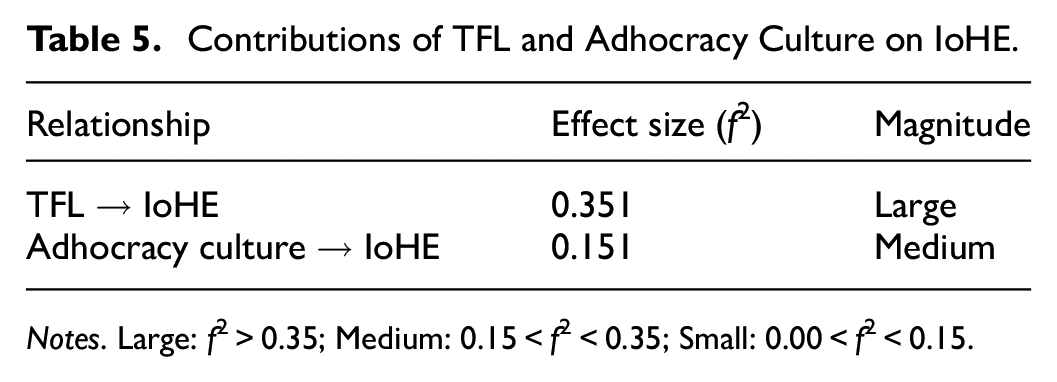
Notes. Large: f2 > 0.35; Medium: 0.15 < f2 < 0.35; Small: 0.00 < f2 < 0.15.
Overall, TFL and adhocracy culture explain 56% of IoHE variation (R2 = .56). Specifically, an increase of 1 SD in TFL increases IoHE by 0.517 SD, whereas an increase of 1 SD in adhocracy culture increases IoHE by 0.346. TFL (f2 = 0.351) exhibited large effect size on IoHE, whereas adhocracy culture (f2 = 0.151) exhibited medium effect size on IoHE.
Discussion and Conclusion
The study examines the relationship between TFL and the IoHE with adhocracy culture as a mediating factor, focusing on 22 Chinese universities. It also assesses the current state of IoHE in these universities. Descriptive analysis revealed moderate levels of IoHE and adhocracy culture, alongside a high level of TFL. Despite 80% of universities engaging in internationalization activities (Department, 2022), IoHE remains at a moderate level, suggesting that internationalization efforts do not yet yield proportional results. Kim et al. (2018) argued that Chinese universities, in their pursuit of world-class universities, overemphasize international experiences at the expense of other faculty roles. Similarly, Xu and Jiang (2018) demonstrated that Chinese institutions increasingly adopt strategies and incentives for international publications, reflecting a complex IoHE system that requires cross-sector collaboration. Effective IoHE calls for unified efforts from students, faculty, institutional leaders, and governmental policymakers, integrating global, national, and local strategies.
Hypothesis 1 found that TFL sub-dimensions, such as DSV, BSGC, MDPV, and BCS present a significant direct effect on IoHE (β = .517, p < .001). However, the non-significant correlations of OIS, and PIS with IoHE may stem from the macro-level nature of internationalization efforts in Chinese universities. As Kraus et al. (2018) noted, institutional-level internationalization strategies often rely more on leadership-driven vision and resource allocation (e.g., DSV, BSGC) than on individual faculty development. For example, large-scale international partnerships require coordinated institutional frameworks, where individual faculty needs are secondary to strategic alignment. This finding highlights that TFL’s impact on IoHE is context-dependent, with different subdimensions varying in relevance across organizational scales.
BCS played a negative impact on IoHE. This finding contrasts with Western studies where collaboration typically enhances internationalization (Kraus et al., 2018), but aligns with Zhang et al. (2018)’s argument that hierarchical norms in Chinese universities may prioritize internal coordination over adaptive strategies. Traditional hierarchical collaboration in Chinese universities, which often requires multi-layered administrative approval, may hinder agile internationalization efforts. Overly focusing on BCS may result in more emphasis on bureaucratic collaboration among faculty members, thereby extending their resistance to change and leading to impeding IoHE development (Song, 2022). These findings highlight the importance of carefully considering the role of TFL subdimensions in the IoHE context. For Chinese universities, when promoting internationalization, they should focus on cultivating positive traits of TFL dimensions. Therefore, deans can create an inclusive and diverse environment that encourages faculty creativity and innovation (Brown et al., 2019). To advance IoHE, deans should articulate a clear vision for internationalization, cultivate consensus around internationalization goals among faculty, and model active involvement in international activities, thereby uniting the institution toward a common goal.
Hypothesis 2 revealed a significant positive relationship between adhocracy culture and IoHE (β = .346, p < .001), supporting Bartell (2003) and Nussbaumer’s (2013) idea that adhocracy culture’s emphasis on external adaptation and flexibility enables universities to treat global challenges as opportunities. For example, in Nanchang University, a double first-class university in the sample, the adoption of adhocracy culture has facilitated the rapid launch of joint international degree programs and faculty-led global research initiatives. The university has established exchange and cooperation relationships with over 230 international universities and scientific research institutions in over 40 countries within 5 years. The university has also carried out various international programs including public-funded study abroad programs, winter and summer camps, and other long-term and short-term overseas exchange and study programs. These results imply that in an environment dominated by adhocracy culture, the emphasis on flexibility, innovation, and risk-taking encourages faculty members to seek external challenges. They may be more willing to participate in international academic exchange and cooperation and enhance their international skills, consequently strengthening their institution’s international influence. This approach not only benefits individual faculty members, but also improves the overall international standing of the university.
Hypothesis 3 demonstrated a significant positive correlation between TFL and adhocracy culture (β = .487, p < .001), consistent with previous research (Kim, 2014; Xie et al., 2020; Yildiz & Gul, 2016), suggesting that TFL shapes organizational culture by fostering a dynamic and external-oriented climate conducive to change (Hoon Song et al., 2012). For example, at Jiangxi University of Science and Technology, a regional university in the sample, deans of School of International Education have implemented decentralized decision-making in international student recruitment, allowing academic departments to design specialized programs for global audiences. As a result, the university has signed joint training programs, exchange programs among faculty members and students, as well as credit recognition programs with multiple international universities like University of Prince Edward Island, Prince of Songkla University and Moscow State University. The results also suggested that Leithwood’s TFL is a powerful driver in shaping an adhocracy culture within universities, and is suitable for higher education context. By adopting TFL, deans can encourage their faculty members to explore new teaching and research models, international collaboration programs, and opportunities, promoting the development of adhocracy culture that supports IoHE.
The mediating result showed that adhocracy culture partially mediated TFL and IoHE (β = .169, p < .001), indicating that TFL influences IoHE through two distinct paths. First, deans with TFL directly impact on IoHE through developing shared visions, and playing as role models. Contrary to Western contexts, where adhocracy culture is more naturally aligned with organizational structures, Chinese universities must navigate hierarchical norms while fostering bottom-up innovation (Anderson, 2023). For instance, deans at Chinese universities should balance the national strategic planning with decentralized decision-making in international program design, reflecting a unique adaption of TFL to China’s institutional context. Second, transformational leaders can shape an adhocracy culture environment to promote internationalization goals. Under such an environment, leaders may empower faculty members by delegating decision-making power. This delegation aligns with adhocracy culture’s emphasis on flexibility, innovation, and adaptability. They may feel more motivated to explore international collaboration opportunities, design international-oriented teaching programs, and integrate global perspectives into the curriculum.
TFL and adhocracy culture accounted for 56% of IoHE variance, indicating their strong explanations toward IoHE; other factors account for the remaining 44%. TFL had large effect size on IoHE, whereas that of adhocracy culture was medium. The results further proved TFL and adhocracy culture’s influence in supporting internationalization initiatives in universities.
In summary, TFL influences IoHE directly and through adhocracy culture, suggesting that universities can advance their internationalization efforts by promoting TFL and fostering an adhocracy culture. Policymakers should consider integrating leadership training programs that emphasize vision-setting and cultural innovation, whereas institutional leaders should balance hierarchical stability with adaptive norms. To promote double first-class initiatives, universities may set flexible funding mechanisms for international projects. This study contributes to the broader debate on leadership theories in different cultural and governance contexts. It reveals how TFL can navigate China’s hierarchical structures in promoting IoHE. In the context of hierarchical organizations, TFL can play an active role by encouraging adhocracy culture. It enriches our understanding of how leadership styles can adapt and be effective in diverse settings. Specifically, TFL can break through the limitations of the hierarchical structure to a certain extent by inspiring innovation and flexibility, which aligns with the exploration of leadership innovation in hierarchical organizations in previous studies. Our findings can also guide leadership development programs in universities, suggesting that training should focus not only on leadership skills but also on the ability to foster an organizational culture conducive to internationalization. Given the complexity of IoHE, various stakeholders should be involved in this process and be directed by transformational leaders to effectively navigate and advance internationalization (Bendriss, 2007; De Bot et al., 2007; Green, 2005).
Research Implications
This study highlights its theoretical implications in the context of leadership, culture, and internationalization. First, this study attempted to experimentally investigate the relationships among TFL, adhocracy culture, and IoHE. TFL and adhocracy culture exerted significant impacts on internationalization. Second, it attempted to apply TFL theory and organizational culture theory to Chinese universities. TFL and IoHE were also examined in this research, although the focus was on the higher-order construct rather than the behavioral dimensions of IoHE. This approach enables us to theorize and evaluate the overall concept that encompasses several aspects of a certain theory, rather than its individual components (Alsaad et al., 2015). Finally, the partial mediating effect of adhocracy culture confirmed the complexity of internationalization conducted at universities, implying that future research could examine its components and how they influence TFL and IoHE.
The findings about the internationalization level and relationships among TFL, IoHE, and adhocracy culture provide universities with references for internationalization efforts and suggest adopting TFL and adhocracy culture to implement internationalization. Deans should prioritize TFL dimensions that directly drive internationalization, ensuring internationalization strategies align with national objectives. To address the challenges of hierarchical collaboration, institutions should implement project-based autonomy for international initiatives, allowing faculty to lead cross-disciplinary projects without multi-layered approvals while maintaining strategic oversight. This approach would provide a more comprehensive understanding and thorough direction for future internationalization endeavors of universities.
Limitations and Future Directions
Despite the contributions and implications of this study, several limitations must be recognized and addressed. First, the research sample is confined to 22 Chinese universities, excluding vocational colleges and institutions with short-term internationalization initiatives. This exclusion limits the generalizability of the findings, as these omitted institutions have distinct educational objectives and resource allocations that may influence the dynamics among leadership, culture, and internationalization. Second, the study focuses exclusively on adhocracy culture within the CVF, ignoring the potential roles of clan, hierarchy, and market cultures. The impact of these unexamined cultural types on the TFL–IoHE relationship, as well as how integrating all four cultural types into a single model might alter the observed mechanisms, remains unclear. Moreover, the research does not account for other contextual factors, such as policy support, disciplinary diversity, and institutional resources, which may moderate the relationship between TFL and IoHE. Furthermore, the analysis used only five of the six IoHE dimensions, potentially providing an incomplete picture of the multifaceted internationalization process.
Future research should address these limitations by exploring hybrid cultural models within the CVF to understand how adhocracy culture coexists and interacts with hierarchical, clan, or market cultures in driving IoHE, particularly in state-driven university contexts. Longitudinal studies could track how TFL influences IoHE through multiple cultural pathways over time, whereas mixed-methods combining quantitative analysis with qualitative interviews could shed light on how academic leaders navigate cultural tensions during internationalization initiatives. Expanding the sample to include vocational colleges and universities at various stages of internationalization would enhance the generalizability of the findings. Moreover, incorporating overlooked factors, such as policy environments, institutional resources, and disciplinary characteristics into the analytical framework would provide a more comprehensive understanding of the complex interplay of variables affecting higher education internationalization.
Footnotes
Appendix
Assessment of normality.

| Variable | Dimension | Min | Max | Skewness | C.R. | Kurtosis | C.R. |
|---|---|---|---|---|---|---|---|
| Internationalization of Higher Education | AC | 1.333 | 4.667 | −0.030 | −0.249 | −0.140 | −0.580 |
| AO | 1.000 | 5.000 | −0.222 | −1.837 | −0.276 | −1.142 | |
| OI | 1.400 | 4.600 | −0.259 | −2.144 | −0.273 | −1.127 | |
| EF | 1.000 | 4.750 | −0.429 | −3.545 | 0.370 | 1.531 | |
| IIF | 1.000 | 5.000 | −0.366 | −3.028 | −0.230 | −0.950 | |
| ISSP | 1.125 | 4.625 | −0.367 | −3.037 | −0.639 | −2.640 | |
| Transformational Leadership | BCS | 1.500 | 4.833 | −0.695 | −5.741 | 1.310 | 5.416 |
| SSC | 1.571 | 5.000 | −0.495 | −4.093 | 0.985 | 4.071 | |
| PIS | 1.286 | 5.000 | −0.646 | −5.339 | 0.800 | 3.307 | |
| OIS | 1.250 | 5.000 | −0.659 | −5.446 | 1.206 | 4.985 | |
| MDPV | 1.400 | 5.000 | −0.533 | −4.403 | 1.191 | 4.923 | |
| HHPE | 1.250 | 5.000 | −0.176 | −1.456 | 0.499 | 2.061 | |
| BSGC | 1.600 | 5.000 | −0.374 | −3.095 | 0.624 | 2.577 | |
| DSV | 1.500 | 5.000 | −0.494 | −4.086 | 1.460 | 6.033 | |
| Adhocracy culture | 1.500 | 5.000 | −0.406 | −3.353 | −0.033 | −0.136 |
Note. C.R. = critical ratio.
Acknowledgements
The authors would like to acknowledge the individuals who participated in the survey and the language editing services provided by Knowledge/Growth Support (KGS), which helped improve the clarity and accuracy of the manuscript.

Ethical Considerations
This study received ethics approval from the Ethics Committee for Research involving Human Subjects of University Putra Malaysia (JKEUPM) with ethics approval number: JKEUPM-2023-272.
Consent to Participate
Informed consent was waived for this anonymous survey due to the minimal risk involved, as approved by the Ethics Committee for Research involving Human Subjects of University Putra Malaysia (JKEUPM) (No. JKEUPM-2023-272).
Author Contributions
Zhu Zehao: data collection, software analysis, original draft writing, funding raising, review & editing. Suhaida Abdul Kadir: supervision, conceptualization, and review & editing. Arnida Abdullah: supervision, and review & editing.
Funding
The author(s) disclosed receipt of the following financial support for the research, authorship, and/or publication of this article: This study was supported by the 2024 Guangdong Provincial Social Sciences “Foreign Language Project”: Research on the Industry and Education Collaboration in TVET for Interdisciplinary Talents Training: International Experiences and China’s Path (
Declaration of Conflicting Interests
The author(s) declared no potential conflicts of interest with respect to the research, authorship, and/or publication of this article.
Data Availability Statement
Data are available from the corresponding author upon reasonable request.