




Abstract
This study reports on an investigate study about using simulation in business English teaching with 66 English-major advanced learners, using two-stage surveys. This study addresses the three research questions focusing on the needs and challenges, effectiveness and learning outcomes and suggestions for improvement of simulation in business English teaching. The study found that participants most favored employment related simulation and workplace scenarios. They preferred both Chinese and global corporate simulation cases, as well as unique industrial and familiar cases. The lack of language skills, knowledge, thinking skills, practice skills, and mentality could be the challenges for simulation. The majority of the participants agreed that simulation activities were effective and had positive impact. Through simulation, participants could acquire writing skills, corporate and business knowledge, and business vocabulary knowledge. Participants were concerned about the simulation process and the roles to play. Lack of adequate language, knowledge, experience, and social skills, inappropriate grouping and timing could be unproductive factors for simulation. On the other hand, more interactions, presentation, expanded language and knowledge, and linking with practice could be facilitating factors for simulation. For improvement, participants suggested adding more case content and context, having longer preparation time and better grouping, as well as clearer simulation instructions. This study provides empirical evidences for refining the simulation approach in business English courses from China’s English majors’ perspectives. The study has important implications for business English simulation teaching design and implementations in both Chinese and international contexts.
Plain Language Summary
This study reports an investigation about using simulation approach in business English teaching with 66 English-major undergraduates, based on surveys administered in two stages. This study covers their needs and challenges, effectiveness and learning achievements. It also provides suggestions to improve simulation in business English teaching. The study reveals that English-majors preferred simulation relevant to workplace situations. They also liked Chinese and international simulation cases. The fact that they did not have enough language skills, knowledge, thinking skills, practice skills and mentality could bring challenges. Most of the participants considered the simulation approach as effective and brought positive influence. Simulation could bring improvement in language skills and knowledge. Participants considered simulation process and the roles in to play as important. Lack of adequate language, knowledge, experience and social skills, inappropriate grouping and timing could be constraints factors for simulation. The contributing factors included more interactions, presentation, expanded language and knowledge, and linking with practice. To improve simulation approach, participants’ suggestions included more case content and context, having longer preparation time and better grouping, as well as clearer simulation instructions. This study offers first-hand data support for further developing the simulation approach in business English teaching, which could benefit teachers and researchers in both Chinese and international contexts.
Introduction
In the higher education context, there has been the problem that university teaching may not meet the workplace demands for talents. For example, in the documented literature, Morley and Jamil (2021) indicate that in higher education sectors, there has been a mismatch between teaching and learning programs and students’ needs as well as employability. Therefore, their work calls for such pedagogical innovation as real-world learning, which could cultivate students’ employability in the real-world practice context. Under this background, Lean et al. (2021) indicate that simulation is one kind of real-world learning pedagogy, which offers a safe environment for students to solve problems and make decisions, with low risks in implementation. Simulation could be “computer (including various immersion simulation sessions) or non-computer based (role plays)” (p. 189). The challenges in using simulation in higher education contexts include “the risks of unknown, lack of resources and suitability” in the implementation process (Lean et al., 2021, p. 203).
In business English teaching, Ellis and Johnson (2002, p. 196) also indicate that role play is different from simulation. Role plays are based on ready-made materials. In simulation, students would be immersed in a situation, which could also be based on available materials and learn to solve problems. Strategies for reducing the risks in simulation are also available. Frendo (2005, p. 54) also explains that in role plays, learners can only act based on the instructions on the role cards. In simulation, Frendo (2005, p. 56) mentions that it is providing learners with a situation in the safe classroom environment, in which learners can act out and express their own opinions in simulated workplace contexts. It particularly suits good English speakers to participate in simulated meetings, negotiations or communicating with visitors or bosses. Materials for simulation in business English teaching can also be found in various coursebooks.
In order to solve the problem of the mismatch between classrooms and real workplaces, this study uses simulation as a pedagogical innovation case. Moreover, there has been very limited empirical research on using simulation in business English teaching, especially with the Chinese English-major learners. This study would thus address this research gap and center on the following aims:
To investigate the needs and challenges in using simulation in business English teaching for China’s English-majors;
To investigate the effectiveness of using simulation in business English teaching and the learning outcomes;
To identify how business English teachers refine and improve simulation in business English teaching.
This study may have important implications for business English teachers and researchers to bridge the gap between classrooms and real-world workplaces, so that the learners could meet the business requirements.
Literature Review
Review of Studies in the International Context on Simulation
The international studies focus on the application of simulation in the instructional contexts. In the context of a Spanish university, Muñoz et al. (2018) use pre-test and post-test to measure the effectiveness of simulation in improving oral production skills. Through online questionnaire, the learning progress and simulation’s unique contributions are interpreted, and the results show positive learning outcomes. In another study also in Spain, Carrió-Pastor and Skorczynska (2015, p. 32) report the merits of online collaboration simulation at both undergraduate and postgraduate levels. Students report higher level of motivation in learning and praised the online simulation as “enriching.” In the Ukraine context, the study of Devos et al. (2021) empirically investigate the use of simulation methods in combination with the cognitive linguistic approach in foreign language teaching. The researchers use experimental and control groups to compare the teaching effects. The study reports positive outcomes in experimental group, which significantly improves English proficiency using simulation methods. In the context of Vietnam, Vo (2022) reports on the development of online workplace simulation tasks and an initial evaluation with learners. The evaluation results of this study report positive outcomes in relation with enhancing learners’ business English communicative competence. The online workplace simulation tasks developed by Vo (2022) could be useful for future business English programs. It can be seen that prior studies in the international contexts mostly reap positive learning outcomes from simulation-based pedagogical activities.
In learning and teaching in international business and management, simulation-based pedagogical activities contribute to the development of soft skills and analytical models. For example, Lofgren et al. (2019, p. 541) indicate that business simulation has been seen as an important part of experiential learning. In the Finnish and a U.S. university context, students are asked to rate about their teamwork experiences in business simulation activities as well as respond to open-ended questions. The results from both quantitative and qualitative data are similar and positive that business simulation would contribute to “teamwork” and “learning.” In the teaching of production engineering, Ishihara et al. (2021) compare 16 simulation games using content analyses and document analyses, from both “general and operational aspects.” The study mainly contributes an analysis model for simulation games produced by different companies from different countries. In the context of Portugal, the study of Capelo et al. (2021) reveals that transparent simulations can have positive impact on business learners’ understandings about “dynamics” of the growth of business ventures. In Hungary, Koltai and Tamás (2022, p. 1) propose “data envelopment analysis” as an alternative for evaluating team performance in business simulation, which also provides suggestions for improving the team performance. It can be seen that simulation in the international business and management contexts can also bring positive impact.
Review of Studies in the Chinese Context on Simulation
In the Chinese context studies, simulation has been linked to various pedagogical innovation. The study of Xu (2022) reports using virtual reality technology in immersion-based teaching of business English and the simulation of negotiation. The study reports positive learning outcomes of simulation in improving English proficiency. The study of Shi (2011) reports the research results of three Chinese students’ simulated negotiations with Americans. The research shows the roles of the Chinese concept of “face,” which could significantly influence the outcomes of the simulation. The study of Tan (2019) compares the use of traditional approach and simulation approach in business negotiation courses. The comparative study indicates that the simulation approach could be more engaging for learners and generate higher levels of negotiation skills. The study of Zhou (2020, p. 155) indicates that in implementing simulated negotiation activities, the business English teachers could face such problems as “deficiencies in listening and speaking, distance from reality, lack of teamwork, inadequate preparation and students not engaging in the tasks.” To resolve the problems, the teacher should improve the curriculum and assessment standards as well as increase the teaching hours in simulation activities. It can be seen that prior studies in the Chinese contexts explore the implementation of simulation-based activities, learning outcomes and the impact factors.
Other studies in the Chinese context focus on the application of real-world samples and technological innovations in the simulation activities. In the context of Hong Kong, China, Evans (2013) in his study suggests using simulation-based approach in business English courses, based on written samples of E-mails and reports, as well as oral samples of meeting and telephoning. The oral and written samples are collected from Hong Kong workplace professionals. In another Evans’s (2012, p. 202) study, based on the written samples of emails, interviews and case studies, simulation-based pedagogical approach is also suggested, integrated with “speaking, listening, reading and writing” skills development. In the context of Taiwan, China, Chen et al. (2011, p. 2126) investigate the business English negotiation simulation in the virtual space and identify that “level of abstraction” in the design of virtual space would influence “feelings of presence” in the simulation activities. The virtual space in this study provides a good context for practicing negotiation simulation. In another study in Taiwan, China, Luo et al. (2014) develop a simulation system for international trade and business letter writing. This simulation-based approach overcomes the shortcomings of traditional teaching approach and improves considerably international trade and business English knowledge, based on learners’ reports. In a recent study also in Taiwan, China, Huang et al. (2022) apply business simulation games in a flipped classroom in an undergraduate entrepreneurship course. The results of the study show business simulation games have positive impact on learner engagement and higher order thinking skills development. It can be seen that innovations based on technology and real-world materials in simulation also have very positive impact.
Research Questions
In reviewing the literature, it is found that though studies have been conducted in different cultural and pedagogical context, there has been a dearth of comprehensive empirical investigation about using simulation in business English teaching, particularly with Chinese advanced English major learners. The study would address this research gap and answer the following three main research questions:
1) What are the needs and challenges in using simulation in business English teaching for China’s English-majors?
2) How effective is using simulation in business English teaching and what are the learning outcomes?
3) How should business English teachers refine and improve simulation in business English teaching?
Methodology
Research Design Overview
The study follows both quantitative and qualitative paradigms, as the study about using simulation in business English teaching needs both numerical and non-numerical information. The research instruments selected are two-stage surveys, which would generate both quantitative and qualitative information. The data collection, participants, and data analysis processes are explained in the following sections.
Participants
The participants were recruited based on convenience sampling, as the researcher was also the business English teacher for the participants. There were 66 participants for the study, who enrolled in Business English courses in the autumn semester in 2022. There were 60 (90.9%) female participants and 6 (9%) male participants. There average age was 19 years old. Their age range was 18 to 21 years old. The participants were in their second year of the study in the English language and literature program in a public top discipline university in the east of China.
For business English proficiency, more than 87% of the participants self-assessed themselves as beginners. More than 6% rated themselves as high beginners. More than 4% rated themselves at lower intermediate level. More than 1% was self-assessed at upper intermediate level. For previous English tests, more than 39% of the participants passed or took College English Test Band 4. More than 3% of the participants passed College English Test Band 6.
The mean of the participants self-assessed levels of motivation was 3.55 out of 5. The standard deviation was around 0.84. This showed that participants had intermediate level of motivation in learning business English. For the motivating factors of learning business English, more than 57% of participants mentioned learning and improving new knowledge and language skills, including writing and speaking in the business contexts. More than 28% mentioned interesting and practical curriculum. More than 22% of participants pointed out teacher’s positive encouragement, careful teaching and good oral English. Over 16% of the participants were motivated by career preparation. More than 6% of participants hoped to pass Business English Certificate (BEC) Test.
Data Collection
The data collection instruments for this study included two-stage surveys. Stage one survey (see Appendix A) was administered in the beginning of business English courses in September 2022. There were nine rating and open-ended questions, adapted from Thoumrungroje et al. (2019, p. 530), Sobkowiak (2018, p. 127), Frendo (2005, p. 52), Chan (2018, p. 44) and Nunan (2011, p. 174). The questions were about needed simulation genres, challenges, and difficulties in business simulation, the real-world contexts, and real-world companies for business simulation as well as assistance needed for business simulation.
Based on the stage one survey results, a series of business simulation tasks and activities were designed and implemented based on the business English materials in Further Ahead: A communication skills course for business English (Jones-Macziloa & White, 2021). The simulation tasks and activities were relevant to the themes of meeting people, describing companies, describing job responsibilities, market research, making telephone calls, discussing about transportation, dealing with orders, talking about import and export, talking about arrangements, describing products and services, marketing, and statistics etc. The business simulations mostly were based on two-student interactions or four-student group discussions. For some simulation tasks, both listening and speaking practices were integrated.
Stage two survey (see Appendix B) was administered in the end of business English courses in December 2022. There were nine rating and open-ended questions, adapted from Thoumrungroje et al. (2019, p. 530), Muñoz et al. (2018, p. 160), and Xie (2016, p. 250). The questions were about perceptions of business simulation, feelings and concerns about business simulation, unproductive and beneficial factors, specific business habits, knowledge, and/or skills acquired, impact of the course, effectiveness of simulation-based business English teaching, suggestions for improvement and benefits of using simulation in business English teaching.
The two-stage survey instruments were initially designed and developed in English. The questions were later translated into Chinese for participants’ better understandings. The Chinese wording of the questions was checked and revised by a senior Chinese-English bilingual researcher. The questions were mostly adapted from exiting studies, which could generate meaningful and reliable results. This ensured the reliability and validity of the two-stage survey instruments. Though ethical approval was not required in the research context, the study followed the ethical principles of second language research. Participants’ consent was obtained and it was assured that the study would bring benefits to business English teaching and learning.
Data Analysis
For rating questions, means and standard deviations were calculated and analyzed, shown in Tables 1 and 2. For responses to the open-ended questions, most participants used Chinese. The major themes of the responses were identified. The frequencies and percentage of the participants were then calculated. The results of analyses were presented in Figures 1 to 10. The researcher also selected typical quotes, which provided insights and explanations for using simulation in business English teaching. To protect the confidentiality of participants, pseudonyms were used.
Participants’ Most Needed Simulation Activities.

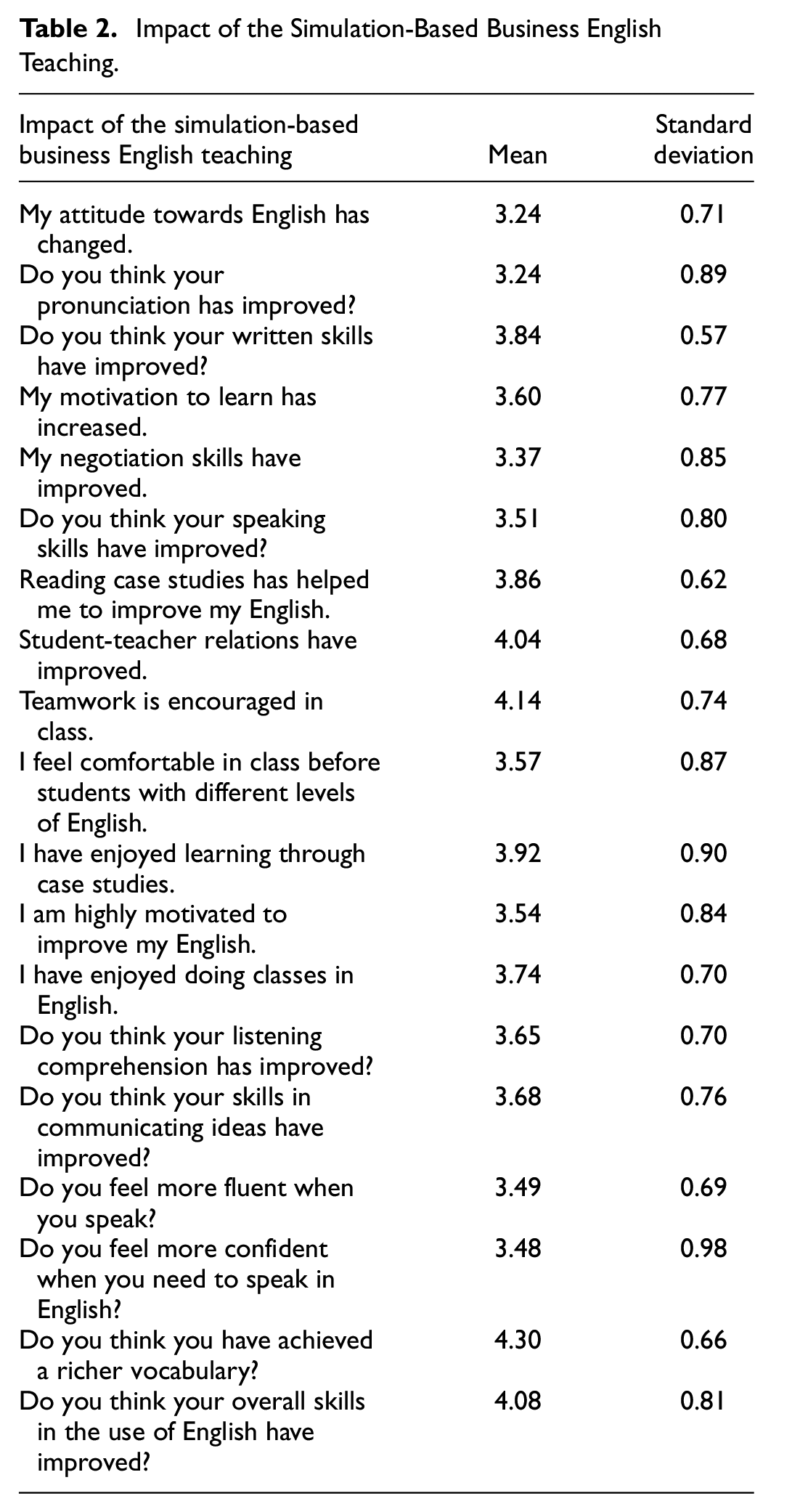
Impact of the Simulation-Based Business English Teaching.
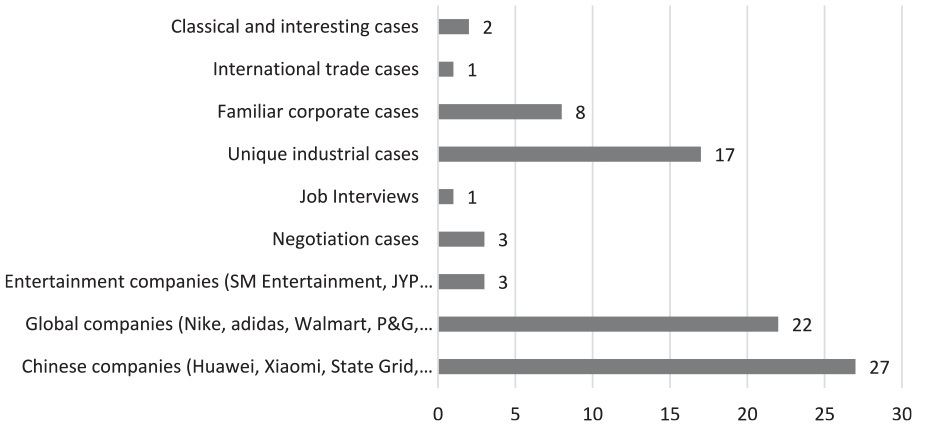
Participants’ preferred simulation cases.

Challenges and difficulties in business simulation activities.

Needs for assistance in business simulation activities.
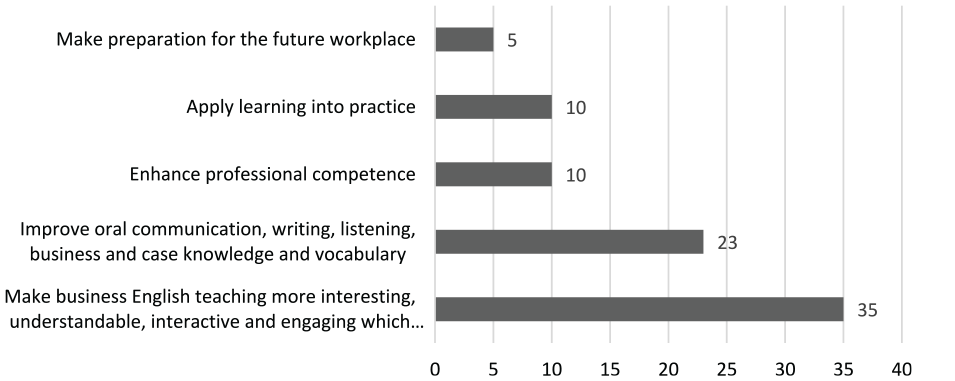
Benefits of using simulation in business English teaching.

Specific business habits, knowledge and skills acquired.
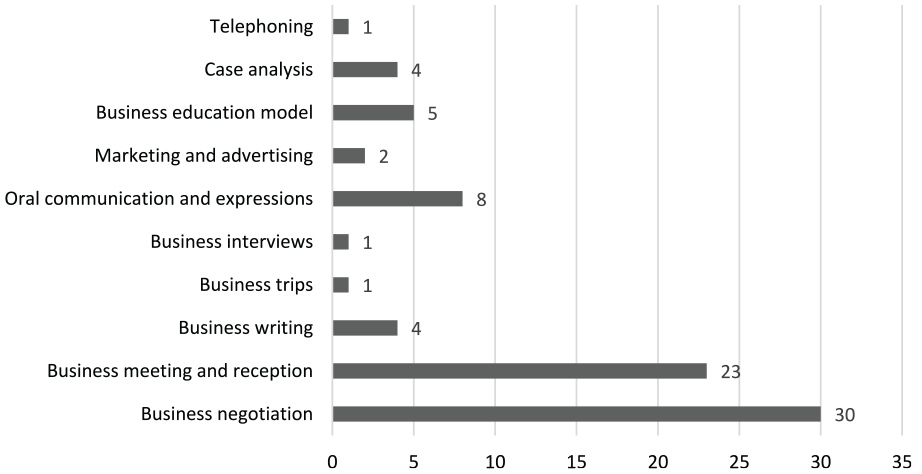
Participants’ perceptions of simulation in business English teaching.

Participants’ feelings and concerns about simulation in business English teaching.

Unproductive factors of using simulation in business English teaching.

Facilitating factors of using simulation in business English teaching.
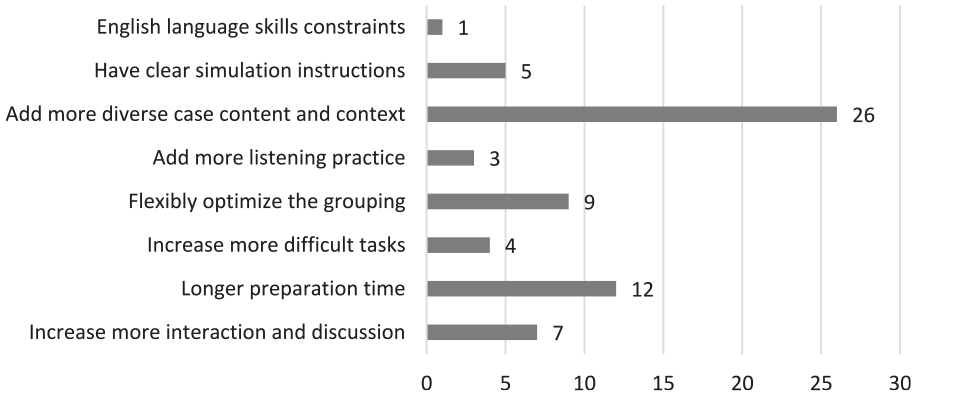
Participants’ suggestions to improve simulation in business English teaching.
Results
Chinese English-Majors’ Needs and Challenges in Using Simulation in Business English Teaching
Participants’ most needed simulation activities are summarized in Table 1. Participants rated the activities in a rating scale of 1 to 5, where 1 was the least needed and 5 was the most needed. The means for the rating were calculated. It can be seen that attending job interviews had the highest mean of over 4.5. Attending job fair was close at over 4.4. International trade, meetings, and negotiations were over 4.3. Introducing products and services, marketing, talking about companies, and talking about jobs were all over 4, which were needed by the participants. On the other hand, writing memo was below 3, at about 2.8, which was the least needed by the participants. All the other simulation activities were above 3 and below 4, which were modestly needed by the participants. It can be summarized that participants most needed employment related simulation activities, as well as those related to the real practical business scenarios.
Participants’ preferred simulation corporate cases are shown in Figure 1. More than 40% of the participants mentioned that they preferred to have simulation with Chinese companies, such as Huawei, Xiaomi, China Mobile, China Telecom, and sports brands etc. On the other hand, more than 33% of participants indicated that they preferred to simulate in the global corporation contexts, such as those Fortune 500 multinationals, including Walmart, Apple, and sports companies such as adidas and Nike.
Moreover, more than a quarter of the participants mentioned that they liked unique industrial cases. These included “unique companies, business culture, ethics and newly emerging small companies” (Participant 1, Translation), “high-tech companies with good development prospect” (Participant 2, Translation) as well as industrial cases of “foreign trade, automobile, fast consumption corporate cases which can provide more positions for English majors” (Participant 3, Translation). More than 12% of the participants hoped to incorporate familiar simulation cases. These could “include some common business brands, which they were in touch as consumers” as participants were more willing to understand these brands (Participant 4, Translation). Participant 5 also commented that “the cases should be close to life, such as electronic products, clothes and daily commodities” (Translation). Other unique preferred simulation cases included negotiation (4.5%), job interview (1.5%), entertainment companies (4.5%), international trade (1.5%), and those classical and interesting cases (3%).
More than 92% of the participants considered that the business simulation activities would reflect the real-world situations to very large extents. Participant 6 described the scenarios that “in heated discussions, they can generate thinking about the scenarios and learn knowledge. This can enhance application in simulation and deepen the memory” (Translation). “Business simulation was virtual, which reflects the real situations for 80%. However, through simulation, they can understand the business processes and develop confidence” (Participant 7, Translation). Other participants also thought that business simulation was close to real life and offered practice. Simulation activities were interesting and based on business work needs, which could motivate them to learn more knowledge.
Participants’ perceived challenges and difficulties in business simulation activities are summarized in Figure 2. More than two thirds of the participants mentioned lack of professional terms and language skills to complete the simulation tasks. Participants commented that this included deficiencies in oral English communication and business terms. Participant 13 further explained “she could not express herself well due to lack of vocabulary and sentence patterns” (Translation).
More than 59% of the participants said they did not have enough business and practice knowledge. Participant 14 commented that “she did not understand the real simulation scenarios. She could not know the real standards and requirements as well as the professional terms” (Translation). Participants also had problem in business rules and knowledge. More than 16% of the participants added they did not have logical thinking and practice skills and mentality. This could include the spontaneous speaking skills and quick responses in business simulation activities.
Participants’ needs for assistance in business simulation activities are explained in Figure 3. More than 63% of the participants hoped to have more learning resources and materials, including videos, cases, business knowledge, and background input. This could help with “full understanding about then industry, market needs, market size, main products and services” (Participant 16, Translation) as well as accumulation of experience (Participant 18, Translation). Participants could also gain “examples and sample expressions” (Participant 19, Translation).
More than 42% of the participants needed prior preparation and business simulation activity plans. Participant 20 said the process included “understanding the activity materials and finalize the activity framework” (Translation). Participants also added “prior information collection and preparation of plans and strategies” (Participant 21, Translation), as well as “drafting the simulation proposals and preparing with plan B if there were emergencies” (Participant 22, Translation).
More than 9% of the participants hoped to have more practice. Participant 23 explained “once there was the situation and topic, they could use the knowledge to practice” (Translation). More than 7% of the participants also hoped to have more teacher guidance and feedback in the business simulation activities.
The Effectiveness of Using Simulation in Business English Teaching and the Learning Outcomes
The impact of the simulation-based business English teaching is summarized in Table 2. Participants rated about the specific impact of using simulation in business English teaching at a scale of 1 to 5, where 1 was the least improved while 5 was the most improved. Achieving a richer vocabulary had the highest mean at over 4.3, with standard deviation at over 0.66. Teamwork encouraged had the second highest mean at over 4.1, with standard deviation at over 0.7. Improving overall skills in the use of English had the third highest mean of over 4.07, with standard deviation at over 0.8. Student-teacher relations improved had the fourth highest mean at over 4.04, with standard deviation at over 0.68. All other items relevant to the positive impact of the simulation-based business English teaching had the means over 3, which showed the good outcomes.
More than 93% of the participants considered simulation as an effective approach in improving their future workplace competence. For the specific reasons, more than 71% of the participants mentioned that simulation could enable them to make various prior preparations for the future workplace with the language and knowledge acquired. Over 16% of the participants mentioned simulation enabled them to develop professional competence such as business etiquette, negotiation, quick response and logical thinking skills. More than 12% of the participants said simulation improved their business communicative competence. Participant 24 commented “business simulation enabled them to understand workplace communication language and issues relevant to conversation modes” (Translation). Participants also mentioned that simulation provided cases for learning (4.5%) and enhanced their business writing skills (4.5%).
From the participants’ perspectives, the major benefits of using simulation in business English teaching are summarized in Figure 4. More than 53% of the participants commented that through simulation, business English teaching could become more interesting, understandable, interactive and engaging which encourages expressions without feeling nervous. Participants further explained that business simulation offered a holistic learning environment with full participation from teachers and learners. Learners would be motivated to express themselves and get familiar with business English themes while improving their English skills. Moreover, the classroom learning would be more dynamic and students could enhance interests and abilities in the learning process.
More than 34% of the participants mentioned that it could improve oral communication, writing, listening, business and case knowledge, and vocabulary development. Over 15% of the participants also enhanced their professional competence, such as problem solving, response, thinking skills, negotiation, and interpersonal skills. Another around 15% of the participants applied learning into practice. Participant 30 added that “she could enhance the ability to use the acquired knowledge and transform it into practical value” (Translation). Participant 31 further added that “simulation as a practice would evaluate the theories while improving oral communication skills” (Translation). More than 7% of the participants said through business simulation they could make preparation for the future workplace.
The specific business habits, knowledge, and skills acquired by the participants through simulation in business English teaching are presented in Figure 5. More than 53% of the participants mentioned that they improved writing skills, including different kinds of business documents, such as emails. More than half of the participants improved business communication and etiquette. This included “social expressions and being familiar with interpersonal interaction” (Participant 32, Translation). Participant 33 further added that “the business practice in Britain and U.S. and China were different. We should pay attention to meeting with strangers and socialization” (Participant 33, Translation). Participants were also acquiring the skills and tactics for interpersonal interactions in the business scenarios, such as conversations and appropriate language uses.
More than one third of the participants mentioned understanding of corporate functions and business knowledge. Participant 36 added that “she learned the corporate function, corporate positions and job in different industries as well as English expressions” (Translation). This also included “some special business practice in different countries or regions, which could be helpful for future international development” (Participant 37, Translation).
More than 28% of the participants acquired business vocabulary knowledge. This included “different expressions facing various situations” (Participant 38, Translation) and “could expand the knowledge base” (Participant 39, Translation). Other learning gains covered professional competence, for example teamwork, logical thinking (6.06%), listening skills (3.03%), and data processing skills (1.5%).
Chinese English-Majors’ Suggestions for Refining and Improving Simulation in Business English Teaching
Participants’ perceptions about simulation in business English teaching are shown in Figure 6. Over 45% of the participants perceived the simulation to be more related with business negotiation simulation. This included “the two sides discussing about the products’ strength and weaknesses, prices and finally reaching a deal” (Translation, Participant 40). This may also include “the two sides having professional dialogues, and recommending the product and having further cooperation” (Translation, Participant 41).
More than one third of the participants would perceive simulation as business meeting and reception. These included “business discussion, drawing an agreement and cooperation in the companies” (Translation, Participant 42). This was also imagined as “business people dressing formally, using English to discuss professional issues, especially orders” (Translation, Participant 43). Participants also mentioned product promotion and reception of customers, as well as relevant videos to make the learning more impressive.
More than 12% of the participants mentioned oral communication and expressions. More than 7% of the participants added simulation was a business education model. Participant 46 commented “through simulating the business environment and activities, people can enhance their response abilities and competition awareness, which was typical of business and management education.” Over 6% of the participants said simulation was relevant to case analysis. “This included case knowledge and analysis about corporate strategies, marketing, product evaluation and manufacturing” (Participant 47, Translation).
Other perceptions included business writing for example email writing (6.06%), marketing and advertising (3.03%), business interviews (1.5%), business trips (1.5%), and telephoning (1.5%).
Participants’ feelings and concerns about simulation in business English teaching are shown in Figure 7. More than 57% of the participants were concerned about the simulation process and the roles to play as well as the preparations needed for the activities. Participant 48 commented that “she was concerned with who to have simulation with and the process as well as the roles to play” (Translation). Participants also mentioned the concern for the business negotiation process and the required knowledge.
More than 39% of the participants were feeling excited, expecting the simulation activities. Participant 50 described “it was interesting and I did not experience. It could be fresh and I would expect it” (Translation). On the other hand, more than 13% of the participants were concerned about the difficulties in simulation due to low English proficiency. Participant 51 added “he feared face-to-face communication and the simulation could be difficult” (Translation). Participant 52 also commented that “she was worried about her oral English, as she did not know how to react and lacked business knowledge” (Translation).
For the simulation topics, more than 24% mentioned business negotiation, marketing, and communication. Participant 53 said “she was concerned with business negotiation tactics and how to make negotiation more efficient” (Translation). More than 6% of the participants mentioned popular negotiation cases. Participants mentioned “practical and familiar cases such as TV drama in cooperation with game companies and Sino-US communication” (Participant 51, Translation) as well as cases “related to various companies and topics in the workplaces” (Participant 54, Translation). Only one participant mentioned writing correspondence.
Participants’ perceived unproductive factors of using simulation in business English teaching are summarized in Figure 8. More than one third of the participants mentioned insufficient English language skills, including speaking, listening, vocabulary, and syntax preparation. These included the needs to learn professional terms, oral communication, and the ability to speak in public confidently.
More than 22% of the participants mentioned lack of business knowledge, experience, context, and social skills. Participant 58 said it depended on “the topic’s content if it could be easy or acceptable for us.” Participants also mentioned the needs to be familiar with the situation and use learnt knowledge in interactions in business simulation activities.
Other unproductive factors included too long preparation and group work time without positive outcomes (15.1%) and fixed simulation format (6.06%).
The facilitating factors of using simulation in business English teaching are summarized in Figure 9. More than half of the participants mentioned oral interactions and presentations in English. Participants could “learn about corporate history, background and operation, as well as think about how to use expressions which audience could understand” (Participant 61, Translation). Participant 62 added “polite expressions, manners, spoken English and public speaking skills.” Participants also mentioned the needs to acquire spoken English expressions, conversation models, and content, to be competent in interpersonal communication.
More than 34% of the participants could expand their business knowledge and language in simulation. Participant 61 said “she learnt many business-related sentences and expressions” (Translation). Participant 65 added she “expanded her horizon and had better knowledge about business, which helped with the future career choice” (Translation).
Over 21% of the participants mentioned linking with practice and immersion learning. Participant 40 said “this was close to reality and combine learning with workplace practice” (Translation). Participant 41 also added “this broke the barriers with practice and she could experience real business activities.” More than 12% of the participants mentioned the development of professional qualities and skills.
Other facilitating factors included information search (1.5%), suitable and familiar topics (3.03%), preparing for future career (4.5%), development of writing skills (1.5%), and being practical and generating learner interests (4.5%).
Participants’ suggestions to improve simulation in business English teaching are shown in Figure 10. More than 39% of the participants suggested adding more diverse case content and context. These included videos and popular knowledge, real and corporate cases, more current tasks, examples close to lives as well as practical scenarios and detailed knowledge.
More than 18% of the participants needed longer preparation time. Over 13% of the participants suggested flexibly optimizing the grouping. Participant 19 mentioned “the groups could be fixed. The simulation activities could be based on different groups and random partnering. It could be conducted in the whole class, rather than just two or three partners” (Translation).
More than 7.5% of the participants needed clear simulation instructions. Participant 20 said “at the end of the simulation, teachers should give summaries and offer suggestions” (Translation). More than 6% of the participants suggested adding more difficult tasks. Participant 50 explained “this could increase the difficulty levels and better cultivate and improve students’ competence” (Translation).
Other suggestions included adding more listening practice (4.5%) and the simulation activities could be constrained by not adequate English language skills (1.5%).
Discussion
Chinese English-Majors’ Needs and Challenges in Using Simulation in Business English Teaching
For participants’ most needed simulation activities, it can be found that attending job interview was the most needed. It was followed by international trade, meetings, and negotiations, introducing products and services, marketing, talking about companies, and talking about jobs. The most needed simulation was employment related and all others were relevant to workplace scenarios. As Frendo (2005) explains, the teacher should always design simulation activities which are relevant to student needs. This study offers insights into unique needs of Chinese English majors.
For the preferred corporate simulation cases, participants most preferred Chinese corporate cases. This was followed by global corporation cases. They also liked unique industrial cases and familiar simulation cases. Moreover, most participants considered that simulation could reflect real-world context. This extended the findings from prior research of Xie (2020) on Chinese English-major undergraduates’ preferred cases and seemed to be more diverse in the simulation case preferences.
For perceived challenges and difficulties, most participants mentioned lack of professional terms and language skills to fulfill the simulation requirements. Other challenges came from not having enough business and practice knowledge and not having logical thinking and practice skills and mentality. These findings were providing more details compared to the study results from Zhou (2020, p. 150). The assistances needed include more learning resources and materials, prior preparation and business simulation activity plans, more practice, more teacher guidance, and feedback. Frendo (2005, p. 57) also confirms that prior to simulation, the developer should consider whether the learners can make use of their knowledge and language skills, whether the simulation is challenging enough and whether every learner can make contributions to the activity. And this study provides evidence about the potential challenges and barriers in implementing simulation in business English teaching.
The Effectiveness of Using Simulation in Business English Teaching and the Learning Outcomes
For the impact of using simulation in business English teaching and learning, participants perceived that the most improved was achieving a richer vocabulary. It was followed by teamwork encouraged, improving overall skills, and improved student-teacher relations. The majority of the participants considered simulation as effective in improving their future workplace competence. Most participants mentioned that simulation could help them make prior preparation for their future career, with the learnt language and knowledge. Through simulation, participants thought that they also developed professional competence and business communicative competence. The results of the study extend the outcomes of Lofgren et al. (2019, p. 541), which add more dimensions about the specific potential impact of simulation in business English teaching on both teamwork, relationship-building and skills development.
For the benefits of using simulation in business English teaching, most participants mentioned that it helped improve business English teaching by making it more interesting, understandable, interactive, and engaging. It could also improve oral communication, writing, listening, business and case knowledge, and vocabulary development. For the acquired business habits, knowledge, and skills, participants perceived that they improved writing skills, had more understandings of corporate functions and business knowledge and acquired business vocabulary knowledge. Ellis and Johnson (2002, p. 197) add that simulation creates an opportunity for learners to fully engage or act out in the specific scenario, which could be “meetings, telephoning or social situations.” This could be helpful activity to develop all kinds of skills and knowledge proactively. Moreover, the results of the study imply that the positive impact and outcomes from using simulation in business English teaching may have long-term effects as it tends to bridge the gap between classrooms and workplaces while participants could make better preparation for their future career. This to some extent is also beneficial for the sustainability of classroom teaching in a higher education institution, which echoes the prior studies of Crawford and Cifuentes-Faura (2022) and Faura-Martínez et al. (2022) in the international contexts.
Chinese English-Majors’ Suggestions for Refining and Improving Simulation in Business English Teaching
For participants’ perceptions about simulation in business English teaching, participants mentioned the simulation to be more related with business negotiation simulation, business meeting and reception, using oral communication and expressions. It was also perceived as a business education model and was relevant to case analysis. For participants’ feelings and concerns about using simulation in business English teaching, participants were concerned about simulation process and the roles to play as well as the preparations needed. They were mostly feeling excited, expecting the simulation activities. For simulation topics, they mentioned business negotiation, marketing, and communication. Ellis and Johnson (2002, p. 199) also mention that when teacher is designing simulation, it is feasible also to discuss with learners about the topics, plan, and procedures of simulation activities. The teacher could also fill in the knowledge gap and provide plenty of practice time for learners. The insights of Chinese English majors could offer routes and space for further adaptation of simulation-based teaching in business English curriculum.
For unproductive factors of using simulation in business English teaching, these included insufficient English language skills, lack of business knowledge, experience, context, and social skills, too long preparation and group work time without positive outcomes and fixed simulation format. For facilitating factors of using simulation in business English teaching, these mostly covered oral interaction and presentation in English, expanding their business knowledge and language in simulation and linking with practice and immersion learning. It implies that teacher should optimize the resources in simulation and help learners to overcome the challenges brought from unproductive factors, supporting the findings from Lean et al. (2021, p. 203). And these findings offer possible pathways for implementing and evaluating simulation in business English courses.
Participants’ suggestions for improving simulation in business English teaching included adding more diverse case content and context, having longer preparation time, flexibly optimizing the grouping, and having more clear simulation instructions. Frendo (2005, p. 57) also indicates that in implementing simulation, learners should be given enough time to prepare for the simulation. Learners should fully understand the simulation background and should be clear about the aims and plans of simulation. The teacher can also give feedback in both content and language. These results add more empirical evidence and enrich the theories for simulation in business English teaching.
Conclusion
The study reports on an investigative study about using simulation in business English teaching with 66 English-major advanced learners, using two-stage surveys. The study focuses on the needs and challenges, effectiveness and learning outcomes and suggestions for improvement of simulation in business English teaching.
The study finds that participants most favored employment related simulation and workplace scenarios. They preferred both Chinese and global corporate simulation cases, as well as unique industrial and familiar cases. The lack of language skills, knowledge, thinking skills, practice skills, and mentality could be the challenges for simulation. The majority of the participants agreed that simulation activities were effective and the positive impact of the course could include perceived improvement in vocabulary, teamwork, and relations with teachers. Through simulation, they may also make early preparation for their career and develop professional competence. Additionally, participants suggested that simulation could make business English teaching more interesting and interactive, as well as improve language skills such as oral communication. Participants suggested that they could acquire writing skills, corporate and business knowledge, and business vocabulary knowledge. Most participants perceived simulation as relevant to business communication activities, such as negotiation, meetings, and reception, as well as business education model. Participants were concerned about the simulation process and the roles to play. They were excited about simulation and expected it. Lack of adequate language, knowledge, experience and social skills, inappropriate grouping and timing could be unproductive factors for simulation. On the other hand, more interactions, presentations, expanded language and knowledge, and linking with practice could be facilitating factors for simulation. For improvement, participants suggested adding more case content and context, having longer preparation time and better grouping, as well as clearer simulation instructions.
This study is providing empirical evidence of using simulation in business English teaching and learning in a Chinse university context. It enriches the pedagogical theories and knowledge of business English simulation, drawn from real world practice. Particularly, the study contributes to literature with nuanced insights about the design and implementation of simulation in business English teaching, from mostly advanced learners’ perspectives. For practice, business English teachers could adapt their simulation practice accordingly. For policymakers, they could add more simulation cases into the best practice case banks. This study is offering a unique case in the Chinese pedagogical context. Researchers from other cultural contexts may follow similar routes in finetuning the process of developing, implementing, and evaluating the simulation activities in business English curriculum with diverse learner groups.
The limitations of the study lie in that the research was conducted in only one university English language program context, without investigations in different universities and different points in students’ careers. However, the research process could be replicated in other cultural contexts. Future research could consider exploring tailoring simulation content to different types of learners with diverse cultural and disciplinary backgrounds.
Footnotes
Appendix A
Adapted from Thoumrungroje et al. (2019, p. 530), Sobkowiak (2018, p. 127), Frendo (2005, p. 52), Chan (2018, p. 44), Nunan (2011, p. 174)
Appendix B
Acknowledgements
The authors would like to express heartfelt thanks to the participants for their helpful contributions to the study. The authors are also grateful for the expert comments from editors and reviewers for revising this article.
Declaration of Conflicting Interests
The author declared no potential conflicts of interest with respect to the research, authorship, and/or publication of this article.
Funding
The author disclosed receipt of the following financial support for the research, authorship, and/or publication of this article: This work was funded by 2022 World Language and Culture Research Project [WYZL2022JS0002] and Higher Education Research Association Foreign Language Education Branch project [21WYJYYB05].
An Ethics Statement
Ethical approval is not required in the research context. The study follows the ethical principles of second language research. Participants’ consent was obtained and it was assured that the study would bring benefits to business English teaching and learning.
