



Abstract
With the Chinese government’s dedication to equalizing the development of vocational and general education, it is significant to examine how macro-environmental factors in vocational education impact learning processes and outcomes. The paper examines whether social acceptance of vocational education influences learning gains via learning strategies, and investigates the moderating role of social economic status. A survey was completed by 1,323 vocational college students in China, assessing social economic status, social acceptance of vocational education, learning strategies, and learning gains. The results indicated a positive association between social acceptance of vocational education and learning gains. Both deep and surface learning strategies mediated the relationship, with the deep learning strategy accounted for a larger portion of variance. Furthermore, social economic status positively moderated this relationship, reducing reliance on surface learning and enhancing learning gains. The findings underscore the profound influence of social acceptance and social economic status on learning process and outcomes, providing valuable insights for vocational education policy-making and the enhancement of instructional strategies.
Keywords
Introduction
Learning quality, which refers to the gains and development of students after learning takes place, is a key issue in vocational education (Yu, 2020). In China’s education system, students often attend vocational-technical colleges due to lower academic performance in the national college entrance examination. Consequently, there is a subconscious perception that vocational education is inferior to general undergraduate education in the Chinese society. The perception of vocational education’s inferiority can lead to a lack of confidence among students, which may deter them from fully engaging in their studies and pursuing the development of advanced skills (Alenezi, 2022; Mancini & Raggi, 2022; Zhu & Wang, 2018). As the labor market demands more high-quality and highly-skilled individuals, the Chinese government has attached more and more importance to vocational education, even enacting a formal law concerning vocational education in 2022. The Vocational Education Law defines vocational education as education implemented to cultivate highly skilled technical talents, enabling learners to possess the professional ethics, scientific and cultural knowledge, professional knowledge, and technical skills required for a specific occupation or a career development (Ministry of Education of the People’s Republic of China, 2022). As an essential part of China’s national education system and human resource development, vocational education is a significant force in achieving Chinese-style modernization. A panel data study based on 31 provinces in China has shown that vocational education significantly promotes common prosperity, with an overall contribution rate of 36.74% (Hou et al., 2024). Vocational education also significantly contributes to the high-quality development of regional economies (Y. Li & He, 2024). According to the statistical report of the Ministry of Education in 2021, there were 1,518 vocational and technical colleges with over 16.3 million enrolled students, comprising 45.85% of higher education enrollment in China (Ministry of Education of the People’s Republic of China, 2021). Considering the substantial student population in vocational-technical colleges and the critical role of vocational education in matching labor market demands, it is essential to explore how social acceptance affects students’ learning gains in these institutions. Understanding the underlying impact mechanisms is crucial for devising strategies that not only enhance the perception of vocational education but also elevate learning quality, thus empowering students with the competencies to thrive in the modern workforce.
Learning Gains
Learning gains encompass the knowledge, skills, attitudes, and values students acquire by the end of their education experiences (Kuh et al., 1997). Originally, learning gains referred to the abilities and competencies that students should possess upon the completion of their education or training. The European education sector categorizes these gains into three levels: (1) Knowing and understanding, which involves theoretical knowledge and comprehension; (2) Knowing how to act, applying knowledge to practical situations; and (3) Knowing how to be, integrating values and social interaction methods within a social context (González et al., 2003). Learning gains are crucial for ensuring goal-oriented education system focused on student achievement, guiding educators in aligning instruction with desired competencies and skills. Thus, learning gains are pivotal in enhancing the quality of education.
Social Acceptance of Vocational Education
In March 2021, the Ministry of Education reported that skilled workers in China accounted for only 26% of the total employed population, with highly skilled talents comprising a mere 28% of the skilled workforce (Ministry of Education of the People’s Republic of China, 2021). The “technician shortage” is attributed to the structural imbalances in China’s labor market. Concurrently, public sentiment analysis regarding the divergence policy of general and vocational education reveals social panic toward vocational education, perceiving it as an elimination option and a starting point for social status differentiation (Xu et al., 2024). A recent survey on the development of vocational education in China revealed that 68.62% of the participants identified the main challenge for its development as society’s acceptance of vocational education (X. Wang et al., 2021). The perception of vocational education poses significant challenges to the development of skilled talents, thus exacerbates the “technician shortage.” A key to addressing these challenges is enhancing individuals’ self-identification with vocational education (Y. Liu & Xu, 2024). Following the enactment of “Vocational Education Law” in 2022, the Chinese government has committed to equalizing the development of vocational and general education. Scholars widely view this legislation as a pivotal shift, redefining vocational education from a stratified “level” to a distinct “type,” marking a significant milestone in its evolution (S. Wang, 2023). In the “Opinions on Deepening the Reform of Modern Vocational Education System Construction” issued by the State Council of the People’s Republic of China (2022), it is explicitly proposed to significantly enhance the quality, adaptability, and attractiveness of vocational education, thereby strengthening its social acceptance. These initiatives are designed to dispel the public biases and improve the social identification of vocational education, which is essential for addressing the “technician shortage” and supporting the upgrading of industries.
Chinese researchers, such as M. Li and He (2019) and M. Li and Xu (2018), have conducted extensive explorations into the causes behind the low social acceptance of vocational education, such as educational models, student quality, enrollment systems, employment environment, vocational education quality, traditional ideologies. It is also necessary to further clarify the significant importance and role of social acceptance of vocational education, which is also greatly valuable in reducing the cognitive bias against vocational education and enhancing social identification. However, there is a relative scarcity of studies examining the impact of this social acceptance. According to Biggs’ 3P model of learning (Biggs, 1978), students’ learning may be conceived in terms of the three stages of presage, process, and product, namely the 3P model. Presage variables concern experiences before learning takes place, including personal and institutional factors; process variables concern strategies while learning is taking place; product variables pertain to the outcomes of learning. Prior research has predominantly concentrated on individual and institutional factors affecting learning processes and outcomes (Sun et al., 2022; L. Zhang, 2000), yet it has not fully addressed the underlying factors within the broader social macro-environment.
As individuals participate in social activities, they assume various social roles. According to social identity theory (Tajfel & Turner, 1985), individuals classify themselves into social groups. Once their social identity is activated, they strive to affirm its value through social interactions (Burke, 1991). Social acceptance, which arises from public perception, indicates a favorable or positive response (Mancini & Raggi, 2022). Empirical research has demonstrated that a strong social identity and acceptance can improve academic performance and boost satisfaction (Alenezi, 2022; Zhu & Wang, 2018). Therefore, the social acceptance of vocational education could potentially motivate and enhance the learning gains of students at vocational-technical colleges as they identify with the vocational education system.
Learning Strategy as a Mediator
Learning strategies are crucial antecedents influencing learning outcomes. The evaluation of the learning process is increasingly recognized as essential for enhancing the quality of learning, as learning outcomes alone may not provide a complete assessment of learning enhancement (P. Zhang & Wen, 2015). According to Biggs’ 3P model of learning (Biggs, 1978), process variables, such as surface and deep learning strategies, pertain to the learning strategies employed during the learning process and are often considered essential precursors to learning outcomes. Biggs et al. (2001) define deep learning strategies as those characterized by intrinsic motivation, initiative thinking and effective time management, while surface learning strategies are driven by extrinsic motivation and may involve less constructive study habits. A multitude of studies have demonstrated a positive association between the use of learning strategies and increased learning satisfaction and academic performance (Choi, 2016; Reyes et al., 2023; Wu et al., 2021). Consequently, learning strategies are widely regarded as fundamental to learning gains.
Moreover, learning strategies are closely linked to social identity and acceptance, as they are integral to the learning process and shape how individuals engage with educational content. Learning is an identity-shaping experience, social identification is closely connected to learning (Wenger, 1998). According to social cognitive theory (Zimmerman, 1989), learning strategies are influenced by a combination of cognitive, environmental, and behavioral factors. Support and acceptance from the social environment can enhance an individual’s self-efficacy, which exhibits a positive correlation with deep learning strategies and a negative correlation with surface learning strategies (X. Hu & Yeo, 2020). Alenezi (2022) emphasizes the substantial influence of social elements like social identity and support on students’ learning processes. When individuals perceive social acceptance and support, their psychological fulfillment and intrinsic motivation are often enhanced, thereby prompting them to be more inclined to adopt deep learning strategies (M. Li & Xu, 2018; R. Zhang et al., 2015). Therefore, social acceptance of vocational education may exert a positive influence on students’ learning strategies. Given that learning strategies are established as antecedent variables affecting learning gains, with deep learning strategies leading to better academic achievement and surface learning strategies resulting in poorer academic achievement (Biggs, 1978; L. Zhang, 2000), and considering the positive influence of social acceptance of vocational education on students’ learning strategies, this study hypothesizes that learning strategies may function as a significant mediating process variable in the relationship between social acceptance of vocational education and learning gains.
Social Economic Status as a Moderator
In examining the influence of external environments on students’ learning processes and outcomes beyond the institutional context, it is imperative to consider both the social and family environments. From the perspective of environmental psychology (Gifford, 2014), the interactions between individuals and their environments are reciprocal and significant. Individuals not only shape their micro- and macro-environments but are also shaped by them. Students exist within a nested ecological system that includes the classroom, school, family, and broader society. The family environment, in particular, is a critical external factor that significantly influences students’ learning processes and outcomes. A supportive family environment can provide the necessary resources and emotional support that enhance students’ learning.
Individuals of higher social economic status typically possess higher education levels, occupational status, and income, providing greater access to resources that can prevent stressors and enhance coping skills, leading to improved health, cognitive, and socioemotional outcomes (Kraus & Keltner, 2009; Zang & Bardo, 2019). Social economic status plays a key role in determining the availability of social support and perceived acceptance among college students transitioning to adulthood (Tinajero et al., 2015). Lower social economic status is often associated with feelings of social inadequacy and shame (Bosma et al., 2015). Numerous studies highlight the positive association between social economic status and academic achievement as well as academic self-concept (e.g., Butler & Le, 2018; J. Liu et al., 2020). A global report from the Organization for Economic Co-operation and Development (2018) emphasizes the academic challenges faced by adolescents from economically disadvantaged families. Therefore, a higher social economic status is likely to result in better learning gains.
Parents with ample resources tend to invest in their children’s cognitive development through financial, educational, and occupational means (Conger & Donnellan, 2007), which may enhance their children’s cognitive abilities and academic achievement (Finn et al., 2017). This investment not only provides children with more learning opportunities but also fosters a positive attitude toward education. In contrast, poverty hampers the development of self-regulation skills (Trias et al., 2021), which are crucial for effective learning strategies. Research indicates that a growth mindset positively impacts academic achievement mainly in students from privileged backgrounds rather than those from less advantaged families (King & Trinidad, 2021). These studies suggest that individuals from higher socioeconomic status backgrounds may exhibit more favorable attitudes toward vocational education, and their children demonstrate enhanced cognitive capabilities, including self-regulation skills and growth mindsets, which facilitate the adoption of more effective learning strategies. Hence, the connection between the social acceptance of vocational education and learning strategies could be affected by social economic status.
Literature Review and Research Hypothesis
Vocational education plays a significant role in promoting the cultivation of high-quality skilled talents and industrial upgrading in China. However, vocational education in China is currently facing common cognitive biases, which presents substantial challenges to the development of skilled talents and further exacerbates the “technician shortage” phenomenon. Existing research has explored the reasons for the low social acceptance of vocational education (M. Li & He, 2019; M. Li & Xu, 2018). However, it is equally important to further elucidate the significance of social acceptance of vocational education, as this is crucial for reducing biases and enhancing social identification, particularly in terms of how it affects the learning experience of vocational school students. According to Biggs’ 3P model of learning (Biggs, 1978), existing researchers have mainly focused on exploring the impact of individual variables and institutional environmental variables on students’ learning processes and outcomes (Sun et al., 2022; L. Zhang, 2000). Few studies have explored the impact of broader social environmental variables on students’ learning processes and outcomes, such as family and social environments. Based on social identity theory (Tajfel & Turner, 1985), the present study focuses on understanding how social acceptance of vocational education in China impacts students’ learning processes and outcomes, and then examines the moderating role of family economic status in this relationship.
Initially, we assessed how social acceptance of vocational education affects learning strategies and learning gains, recognizing learning strategies as key to learning gains. We propose that learning strategies mediate the impact of social acceptance of vocational education on learning gains. Specifically, individuals with higher perceived social acceptance of vocational education are more inclined to adopt deep learning strategies and less likely to use surface learning strategies, leading to enhanced learning gains (Hypothesis 1). Subsequently, to clarify the interplay between social acceptance of vocational education and social economic status on students’ learning processes and outcomes, we investigated the moderating effect of social economic status. Furthermore, we propose individuals with higher SES who perceive greater social acceptance of vocational education are more likely to employ deep learning strategies and less likely to use surface learning strategies (Hypothesis 2), and achieve higher learning gains (Hypothesis 3). To analyze this moderated mediation model (see Figure 1), a questionnaire was utilized to measure social acceptance of vocational education, social economic status, learning strategy, and learning gains. Additionally, we controlled for variables known to affect learning outcomes, including gender, age, college year, family location, number of siblings, and last semester’s academic performance (Biggs, 1978; Richardson et al., 2012; Q. H. Shi & Wang, 2015).

The theoretical model of social acceptance of vocational education and learning gains.
Methods
Participants
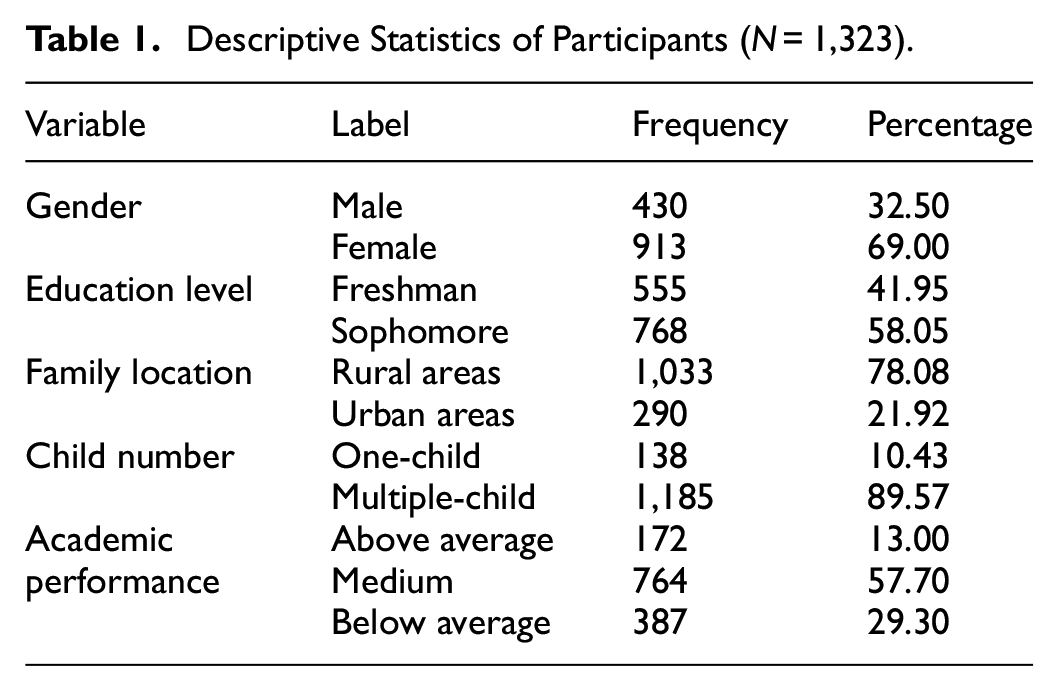
The sample initially comprised 1,340 participants from 6 vocational-technical colleges across Henan (north), Jiangxi (central), and Guangdong (south), China. After excluding seventeen participants due to invalid responses, the final sample encompassed 1,323 individuals aged 17 to 25 years (Mean age = 19.81, SD = 1.23 years). The demographic characteristics of the participants are detailed in Table 1. The sample had sufficient statistical power for us to observe even small association, linear multiple regression would require 1,229 observations to detect an effect as small as f2 = 0.02 at 95% statistical power.
Descriptive Statistics of Participants (N = 1,323).
Measures
Social Economic Status
After providing consent, participants provided demographic details (e.g., gender, age, grade) and evaluated their socioeconomic status by reporting family income, parental education level, and parental occupation (Bradley & Corwyn, 2002; L. Shi et al., 2013). Family income responses were rated on a 4-point Likert scale: 1 (below RMB 3,500 yuan), 2 (RMB 3,500–7,000 yuan), 3 (RMB 7,000–10,000 yuan), 4 (above RMB 10,000 yuan). Education level was indicated on a 4-point Likert scale: 1 (primary school or below), 2 (middle school), 3 (high school or technical secondary school), 4 (junior college or higher). Occupation was assessed on an 11-point Likert scale: 1 (unemployment), 2 (farmer), 3 (factory worker), 4 (equipment operator), 5 (service staff, e.g., waiter, receptionist), 6(individual businessman, e.g., self-employed), 7 (office clerks, e.g., administrative support), 8 (professional/technical staff, e.g., engineers, scientists), 9 (private entrepreneur, e.g., owner of a small to medium-sized business), 10 (company CEO), 11 (management personnel, e.g., senior executives, public officials). Z-score standardization transforms variables measured in different units, such as family income, education level, and occupational status, into a common standardized metric, facilitating the summation of these variables into a composite score. Accordingly, a composite SES score was calculated from five items using Z-scores, with higher values indicating a higher social economic status. The internal consistency reliability of these items in this study was acceptable (α = .64).
Social Acceptance of Vocational Education
Participants then completed a questionnaire adapted from the social acceptance scale (Pan, 2018) to assess their perception of social acceptance toward vocational education, encompassing family acceptance and public acceptance. Students formed their perceptions by gauging the attitudes of those around them toward vocational education. Six items were presented, with responses ranging from 1 (not at all) to 5 (extremely). Some statements included: “My family actively supports my vocational education endeavors,”“My family anticipates my success in vocational-technical college”; “My parents endorse vocational education and back my enrollment”; “Vocational college students are viewed as having promising career paths”; “Vocational education is widely accepted by society”; “Many companies are open to hiring vocational college graduates.” Higher scores indicated a more positive perception of vocational education’s social acceptance. The internal consistency reliability of these items was strong (α = .94). Furthermore, a confirmatory factor analysis conducted in the present study supported the two-factor structure, confirming the questionnaire’s construct validity (χ2 = 65.67, χ2/df = 9.38, p < .001, RMSEA = 0.08, CFI = 0.99, TLI = 0.98, SRMR = 0.01).
Learning Strategy
Subsequently, participants were requested to rate their agreement level regarding learning strategies based on previous studies (Biggs et al., 2001; Q. H. Shi & Wang, 2015). The learning strategy scale encompassed two key dimensions: deep learning strategy with fourteen items, like “I exhibit curiosity towards new learning material”; and surface learning strategy with eleven items, like “Engaging deeply with certain concepts seems futile to me.” Participants rated the 25 statements on a scale from 1 (strongly disagree) to 6 (strongly agree). The reliability of these indices was robust in this study (α = .98 for deep learning strategy; α = .90 for surface learning strategy). A confirmatory factor analysis confirmed the satisfactory fit of the two-factor learning strategy model to the current data set (χ2 = 1,729.88, χ2/df = 6.43, p < .001, RMSEA = 0.06, CFI = 0.96, TLI = 0.96, SRMR = 0.03), ensuring the validity of the construct.
Learning Gains
Finally, participants completed a scale assessing learning gains among vocational-technical college students. This scale includes three dimensions: cognitive gains, skills gains, and emotional and values gains (Krathwohl, 2002; F. Wang, 2014). For instance, one item reads, “My self-understanding has improved through college learning.” Participants rated twelve items on a scale from 1 (strongly disagree) to 6 (strongly agreed), with higher scores indicating greater learning gains. These twelve items demonstrated good internal consistency in this study (α = .98). A confirmatory factor analysis indicated that the three-factor learning gains model fit well with the current data (χ2 = 499.29, χ2/df = 9.79, p < .001, RMSEA = 0.08, CFI = 0.98, TLI = 0.97, SRMR = 0.01), confirming its construct validity. Finally, participants were fully debriefed.
Analysis
Initially, we commenced our analysis with Harman’s single-factor test to assess the presence of common method variance (Podsakoff et al., 2003), and we utilized established criteria (CFI ≥ 0.90, TLI ≥ 0.90, RMSEA ≤ 0.80, and SRMR ≤ 0.08) to evaluate the goodness of fit (L. Hu & Bentler, 1999). Subsequently, we proceeded with preliminary data analysis, encompassing descriptive statistics and correlation analysis. To delve deeper into the study, we explored the mediating effect of learning strategy and the moderating effect of social economic status. For this purpose, we employed mediation analysis with Mplus 7 and performed moderated mediation analysis, utilizing the Bootstrap procedure with 5,000 resamples and Hayes’ PROCESS macro (Hayes, 2013).
Results
Common Method Variance Test
Data collected from the same source may cause common method variance, thus, we used Mplus8.0 to perform the confirmatory factor analysis to test it. The results showed that the five-factor model (χ2 = 5,713.35, χ2/df = 5.34, p < .001, RMSEA = 0.05, CFI = 0.94, TLI = 0.93, SRMR = 0.04), including social economic status, social acceptance of vocational education, deep learning strategy, surface learning strategy, and learning acquisition, produced a better fit to the data than did the single-factor model (χ2 = 13,924.19, χ2/df = 12.89, p < .001, RMSEA = 0.09, CFI = 0.82, TLI = 0.81, SRMR = 0.08). These results indicate confounding by common method variance was not a severe concern in this study.
The Preliminary Analysis
The Pearson correlation results presented in Table 2 indicate that social acceptance of vocational education and social economic status exhibit positive and moderate correlations with two types of learning strategies: deep and surface learning strategies. These strategies, in turn, show positive associations with learning gains. Additionally, variables such as gender, age, college year, geographical location of the family home, number of siblings, and academic performance in the previous semester were found to be correlated with these key variables, and thus will be considered as covariates in our analysis.
The Descriptive Statistic and Correlations of the Study Variables.

Note. *p < .05, **p < .01, ***p < .001. SAVE = social acceptance of vocational education; SES = social economic status; DLS = deep learning strategy; SLS = surface learning strategy; LG = learning gains; GLFH = geographical location of the family home; APLS = academic performance of last semester.
Given these correlations, we proceeded with linear regression analyses to assess multicollinearity, deemed severe when variance inflation factors exceed 5, tolerance values fall below 0.10, and condition indices surpass 100. The regression using learning gains as the dependent variable revealed variance inflation factors ranging from 1.03 to 4.48, with the lowest tolerance at 0.22 and condition indices from 1.00 to 70.18, suggesting no significant multicollinearity issues.
The Mediation Test of Learning Strategies
After dummy coding gender (1 = male, 0 = female), geographical location of the family home (1 = city, 0 = town), number of siblings (1 = one-child family, 0 = multiple child families), and standardizing social acceptance of vocational education, social economic status, learning strategies, learning gains, academic performance in the previous semester, age, and college year, a mediation analysis was conducted using the Bootstrap procedure with M plus 7. Results indicated that social acceptance of vocational education significantly predicted learning gains (b = 0.80, p < .001; 95% CI [0.76, 0.83]). Additionally, social acceptance of vocational education was a significant predictor of both deep learning strategy (b = 0.81, p < .001; 95% CI [0.78, 0.83]) and surface learning strategy (b = 0.30, p < .001; 95% CI [0.26, 0.35]). Furthermore, after introducing learning strategies, social acceptance of vocational education significantly predicted learning gains (b = 0.13, p < .001; 95% CI [0.10, 0.17]). Notably, deep learning strategy (b = 0.84, p < .001; 95% CI [0.80, 0.87]) and surface learning strategy (b = −0.03, p < .001; 95% CI [−0.05, −0.003]) were also significant predictors of learning gains.
Moreover, the indirect effects of deep learning strategy (b = 0.67; 95% CI [0.63, 0.71]) and surface learning strategy (b = −0.008; 95% CI [−0.02, −0.001]) in the relationship between social acceptance of vocational education and learning gains were statistically significant. The proportions of the indirect effect of deep learning strategy and surface learning strategy to the total effect of learning gains were 83.75% and 1%, respectively. Thus, hypothesis 1 was partially supported.
The Moderation Test of Social Economic Status in the Relationship Between Social Acceptance of Vocational Education and Learning Strategy
After standardizing social economic status scores, a moderated mediation analysis was conducted using Hayes’ PROCESS macro, specifically employing Model 8 with the Bootstrap procedure (Hayes, 2013). Initially, we examined the impacts of social acceptance of vocational education and social economic status on deep and surface learning strategies, while controlling for covariates. The results from Model 1 in Table 3 indicated that social acceptance of vocational education was a positive predictor of both deep and surface learning strategies. Conversely, social economic status positively influenced deep learning strategy but had a negative impact on surface learning strategy. In addition, an interaction effect between social acceptance of vocational education and social economic status was observed solely concerning the surface learning strategy. Simple slope analysis in Figure 2 further revealed that the predictability of social acceptance of vocational education for surface learning strategy was weaker in high social economic status (b = 0.24, 95% CI [0.17, 0.31]) compared to low social economic status (b = 0.36, 95% CI [0.30, 0.43]). Thus, hypothesis 2 was partially supported.
The Moderated Mediation Analysis Between Social Acceptance of Vocational Education and Learning Gains.

Note. *p < .05, **p < .01, ***p < .001. SAVE = social acceptance of vocational education; SES = social economic status; DLS = deep learning strategy; SLS = surface learning strategy; LG = learning gains; GLFH = geographical location of the family home; APLS = academic performance of last semester.

The interaction effect of social acceptance of vocational education and social economic status (SES) on surface learning strategy.
The Moderation Test of Social Economic Status in the Relationship Between Social Acceptance of Vocational Education and Learning Gains
We then examined the impact of social acceptance of vocational education, social economic status, and learning strategy on learning gains. The results from Model 2 in Table 3 revealed that both social acceptance of vocational education and deep learning strategy positively influenced learning gains. Additionally, social economic status was found to have a positive effect on learning gains. Most importantly, a significant interaction effect between social acceptance of vocational education and social economic status on learning gains was observed. Further analysis through simple slope analysis in Figure 3 indicated that social acceptance of vocational education exhibited a stronger influence on learning gains in individuals from high social economic status (b = 0.16, 95% CI [0.12, 0.20]) compared to those from low social economic status (b = .11, 95% CI [0.07, 0.15]). Thus, hypothesis 3 was supported.
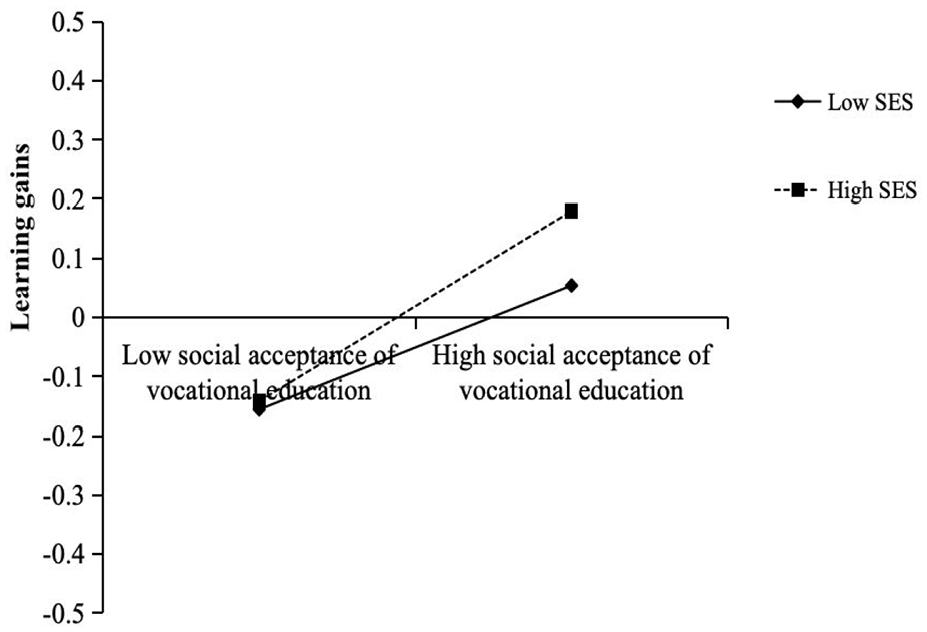
The interaction effect of social acceptance of vocational education and social economic status (SES) on learning gains.
Discussion
The study revealed that higher levels of perceived social acceptance of vocational education among students correlated with increased utilization of learning strategies and enhanced learning gains. Aligning with prior research (Alenezi, 2022; Zhu & Wang, 2018), acceptance and identification within a social group can stimulate individual engagement, performance, and satisfaction. Social identification strengthens intra-group bonds and enhances individual dedication to studies and academic performance (Alenezi, 2022). Additionally, a counterintuitive finding showed that social acceptance of vocational education positively influenced both deep and surface learning strategies. This could be because the effectiveness of learning strategies is highly contingent on the learning content and stage; surface learning strategies can be beneficial for certain tasks or during the early phases of learning (Alexander & Murphy, 1998), such as those requiring minimal effort like fact gathering and basic information processing, without necessitating the high-level cognitive engagement required for meaningful learning (Biggs et al., 2001). These results underscore the significant role that broader social contexts, such as the social acceptance of vocational education, can play in prompting learning process and outcomes for students in vocational-technical colleges.
The findings revealed that both deep learning strategies and surface learning strategies acted as mediators in the relationship between social acceptance of vocational education and learning gains. Moreover, deep learning strategy accounted for a larger proportion of the variance. Previous studies have confirmed the significant role of deep learning strategies in bolstering learning outcomes. Students who adopt a deep learning approach often employ meta-cognitive skills and seek solutions from an inquisitive-critical viewpoint, fostering self-discovery (Beishuizen & Stoutjesdijk, 1999). Research indicates that deep learning strategy is positively associated with self-efficacy, in contrast to surface learning, and can even predict future growth in mathematical achievement over an extended period (Murayama et al., 2013). Surface learning strategies, characterized by rote memorization and a focus on passing exams rather than understanding, have been shown to have a less positive impact on learning outcomes. Students employing deep learning strategies tend to achieve higher grades, while those using surface strategies often score lower; Importantly, students who could transfer or maintain effective deep learning strategies across courses achieved higher scores and were less likely to revert to surface strategies (Saqr et al., 2023). This suggests that surface learning strategies may provide short-term gains, they do not contribute significantly to the long-term learning gains. In summary, the study highlights the importance of deep learning strategies in enhancing learning gains in vocational education, while also acknowledging the limited role of surface learning strategies.
Furthermore, social economic status was found to moderate the impact of social acceptance of vocational education on surface learning strategies. Research indicates that children from higher social economic backgrounds exhibit greater meta-cognitive skills compared to their peers from medium and low social economic backgrounds (Pappas et al., 2003). Lower social economic status relates to diminished inhibitory control and heightened stress and impulsiveness (He et al., 2021), which are known to adversely impact cognitive development (von Stumm & Plomin, 2015). Cognitive functioning encompasses a variety of skills such as abstract reasoning, memory, executive function, attention, language, and processing speed, which involve the mental processes of storing, retrieving, and processing information. These cognitive skills have been extensively studied for their potential influence on the relationship between socioeconomic status (SES) and academic achievement (Langensee et al., 2024). Hence, individuals from lower social economic status backgrounds frequently confront significant obstacles in cognitive development, which may predispose them to prioritize immediate over long-term educational objectives. This propensity is often a consequence of the restricted resources and support they receive, which in turn fosters a greater dependence on surface learning strategies. Such strategies, being less cognitively demanding and more readily adopted, may impede the development of deeper learning competencies and undermine long-term academic achievement.
Additionally, social economic status moderated the impact of social acceptance of vocational education on learning gains. Students from low social economic status often face a cycle of disadvantages, including lower cognitive and social skills at school entry and a slower development of learning skills (Crespo et al., 2019; Dietrichson et al., 2017). These factors can lead to lower academic achievement, affecting their educational prospects and future livelihoods (van Zwieten et al., 2020). Conversely, higher social economic status is linked to increased achievement motivation (F. Zhang et al., 2020). A higher social economic status signifies greater access to resources and advanced cognitive strategies, which aid in the development of cognition, skills, and values. A recent meta-analysis examining the influence of social economic status on academic performance corroborates these findings, revealing a moderate to strong correlation between SES and academic achievement (Selvitopu & Kaya, 2023).
Theoretical and Practical Implications
Our findings offer several theoretical implications. This study shows that the macro-environment, including social acceptance of vocational education, can positively influence learning quality, underscoring the importance of fostering social acceptance within the Chinese vocational education system. Most importantly, social acceptance of vocational education impacts learning gains through learning strategies, particularly the deep learning approach. Furthermore, this study illustrates the interaction between social economic status and social acceptance of vocational education, showing that higher economic status can reduce surface learning strategies and encourage learning gains. These findings extend the environmental presage factors in Biggs’s 3P model to include family and broader social contexts, in addition to institutional factors, and clarify the mediating and moderating mechanisms of social acceptance on learning gains.
In practice, firstly, social acceptance of vocational education strongly predicts learning gains, highlighting the importance of policymakers prioritizing its promotion. The Chinese government can bolster vocational education through favorable policies and increased advocacy efforts. For example, it has been working to break through the “ceiling” of vocational education by establishing a vertical integration and horizontal connectivity of the vocational education system, thus forming a distinctive development path for vocational education (Peng & Zhang, 2023). Schools must enhance the quality of vocational education to meet the educational needs of the people (Yu, 2020). Meanwhile, teachers need to help students explore the unique attributes and strengths of the in-group among vocational students, thereby enhancing their identification with vocational education (Peng & Zhang, 2023). Secondly, deep learning strategies play a crucial intermediary role in connecting social acceptance of vocational education with improved learning outcomes. Educators should emphasize teaching these strategies during learning activities. A deeper understanding of these strategies can empower students to make more effective choices regarding their learning approaches (X. Hu & Yeo, 2020). Thirdly, social economic status significantly influences learning strategy and gains, prompting schools to implement interventions targeting cognitive skill enhancement in students from low-income families. Research suggests that narrative-based programs in schools effectively enhance self-regulated strategies and academic performance among children from economically disadvantaged backgrounds (Azevedo et al., 2023). In addition, school staffs should guide parents with lower social economic status to enhance parental involvement, such as school-based involvement, academic socialization, and home-based involvement, which can effectively improve students’ academic achievement (F. Zhang et al., 2021).
Limitations and Future Orientations
Our findings should be extended in several ways. Firstly, as this study was correlational, we were limited in drawing causal conclusions about the relationship between social acceptance of vocational education and learning gains, despite controlling for numerous covariates. Subsequent studies might employ an experimental design to investigate the potential causal effects of social acceptance of vocational education on learning processes and outcomes. For instance, mindset priming could be utilized to manipulate perceptions of social acceptance of vocational education (Piff et al., 2015). Secondly, future research could assess objective indexes of learning outcomes, such as academic performance, to determine the consistent impact of the social environment of vocational education on students’ learning outcomes. Thirdly, further studies should clarify alternative mechanisms linking social acceptance of vocational education to learning gains, including self-efficacy (Scherer et al., 2019). Lastly, future research should consider the potential influence of additional confounding variables on learning gains, such as cognitive abilities, personality, learning motivation, and institutional factors (Biggs, 1978; Hertel & Karlen, 2021; Lehmann, 2022; Mornar et al., 2022).
Conclusion
Social acceptance of vocational education significantly influences the adoption of learning strategies and enhances learning gains. Our study reveals that both deep and surface learning strategies mediate the relationship between social acceptance of vocational education and learning gains, with deep learning strategies playing a more substantial role. Furthermore, family economic status positively moderates this relationship by reducing the reliance on surface learning strategies and promoting learning gains. These findings underscore the crucial role of the social environment as a precursor to learning processes and outcomes in vocational education. Theoretically, our study extends Biggs’s 3P model by incorporating broader social environmental variables, enriching the understanding of factors influencing learning quality in vocational education. Practically, the findings suggest significant policy implications for enhancing the social acceptance of vocational education, which can lead to more effective learning strategies and better educational outcomes. Additionally, the results also highlight the educational importance of interventions targeting deep learning strategies among vocational students. Furthermore, for students from lower socioeconomic backgrounds, interventions that reduce the reliance on surface learning strategies are necessary to improve learning outcomes.
Footnotes
Acknowledgements
Acknowledgments we would like to thank Dr. Zuochen Zhang for proofreading this paper. Dr. Zhang is a professor in the Faculty of Education at the University of Windsor.

Ethical Considerations
This study was approved by the Research Ethics Committee of Institute of Vocational & Technical Teacher Education, Shanghai Polytechnic University.
Consent to Participate
Informed consent was obtained from all participants involved in this study.
Funding
The author(s) disclosed receipt of the following financial support for the research, authorship, and/or publication of this article: The project was supported by 2024 Philosophy and Social Sciences Special Project in Shanghai Universities (2024ZSD017) and the 2023 Youth Mentor Fund of Shanghai Polytechnic University (EGD23QD06).
Declaration of Conflicting Interests
The author(s) declared no potential conflicts of interest with respect to the research, authorship, and/or publication of this article.
Data Availability Statement
The data that support the findings of this study are available on request from the first author.