



Abstract
The present experiment examines the effect of carbon labels on dish choices and their corresponding greenhouse gas emissions in restaurants. Moreover, it was determined how the Theory of Planned Behavior’s concepts of attitude, subjective norm, and perceived behavioral control relate to dish choices in the presence versus absence of carbon labels. By applying the experimental conditions within participants, we investigated further how dish choice behavior modulates after removing carbon labels from menus. The online participants (N = 254) chose one dish each from eight hypothetical menus that either did or did not include numeric traffic-light carbon labels. As expected, carbon labels reduced the proportion of high-emission dish choices and the mean greenhouse gas emission per chosen dish. However, this effect is mainly attributed to an increase in high-emission dish choices after removing the carbon labels, thus indicating a rebound effect. Attitude and perceived behavioral control contributed to the explanation of dish choices following carbon labels, whereas subjective norm did not, indicating that the correlation of perceived social pressure with dining intention overlaps with the effect of carbon labels. We discuss that the usefulness of carbon labels on restaurant menus is rather limited.
Introduction
In the face of the climate crisis, greenhouse gas (GHG) emissions caused by activities of all industrial sectors need to be radically cut within the next few years (Intergovernmental Panel on Climate Change, 2023). It has been determined that, by 2015, food systems had caused a third of global GHG emissions by 2015 (Crippa et al., 2021) and nutrition accounts for about 15% of consumer-level GHG emissions in industrialized societies (e.g., Federal Environmental Agency, 2017; Lettenmeier et al., 2014). Tilman and Clark (2014) have pointed out that the share of the food sector in global GHG emissions will increase dramatically within the next decades if trends toward climate-intensive diets are not reversed. GHG emissions, as measured in kilograms of carbon dioxide equivalents (CO2-eq.) per kilogram, differ considerably between food items, ranging from vegetables such as white cabbage (0.1 CO2-eq.) to ruminant meat such as beef (between 11 and more than 30 CO2-eq.; Reinhardt et al., 2020). Therefore, encouraging climate-friendly individual food choices (e.g., by using carbon labels) could contribute substantially to the reduction of GHG emissions.
Considering the climate impact of one’s diet falls within the extensively studied field of ecologically responsible consumption (ERC; Nangia et al., 2023). In this field, there has been comprehensive work on various types of eco labels and their effects on ecologically responsible food choices (e.g., Edenbrandt & Lagerkvist, 2021; Gerini et al., 2016; Thøgersen et al., 2019). Another line of research has studied the effects of factors from socio-psychological action research, such as personal norms (van der Werff & Steg, 2015), social norms (Cialdini et al., 1990), or behavioral attitudes (Fishbein & Ajzen, 2009) on the willingness to practice ERC (Nangia et al., 2023). The present experiment aims to quantify the influence of carbon labels on food choice and their associated carbon impact, and examine how factors derived from social psychological action research moderate this influence.
There is considerable evidence for the effectiveness of carbon labels in grocery shopping situations, indicating that the share of low-emission food choices increases when carbon labels are added to the offered food items (e.g., Edenbrandt & Lagerkvist, 2021; Kühne et al., 2023; Suchier et al., 2023; Vanclay et al., 2011). However, such findings are rather scarce for settings such as restaurants or canteens, where people consume dishes prepared by other people. As far as we know, two field studies in university canteens (Brunner et al., 2018; Spaargaren et al., 2013) and two online studies using hypothetical dining situations (Betz, 2022; Osman & Thornton, 2019) report a significant shift toward more climate-friendly dish choices in the presence of carbon labels, while another online study (Babakhani et al., 2020) does not.
Adding more evidence to this area of food consumption is relevant for three reasons. First, dining settings are practically relevant due to the considerable prevalence of dining. For example, the German Federal Ministry of Food and Agriculture (2022) reports that about half of German residents eat out at restaurants or canteens, or have prepared meals delivered at least once a week. Second, a growing interest in menu information enabling customers to consider the ecological impact of their dish choices has been expressed among diners (Lo et al., 2017) as well as restaurant operators (Pulkkinen et al., 2016). Third, dining out behaviors are expected to differ considerably from grocery shopping and home-cooking in terms of their socio-psychological antecedents such as customers’ needs, goals, or cognitive resources. For example, grocery shopping is often associated with time pressure (Panzone et al., 2020; Thøgersen & Nielsen, 2016), while guests at restaurants may be slow to read the menu and decide on their orders. If the effects of carbon labels on grocery shopping can be replicated in restaurant settings, this would add to the generalizability of the effectiveness of carbon labels in terms of ERC. Beyond this, we expect novel insights into ERC patterns by scrutinizing socio-psychological antecedents of dish choices in the presence of carbon labels, and investigating how dish choices are modified when previously presented carbon labels are removed.
Climate-Friendly Dining as Planned Behavior
Since its proposal in the late 20th century (e.g., Ajzen, 1991), the Theory of Planned Behavior (TPB) has been used to explain and foster various types of ERC (Si et al., 2019) and food consumption in particular (Shen et al., 2022). Accordingly, a planned behavior is predicted by a related intention, which is itself determined by three belief structures: attitude, subjective norm, and perceived behavioral control (PBC). In line with this, an attitude results from the perceived benefits of the target behavior and the likelihood of these benefits (Ajzen, 1991; Fishbein & Ajzen, 2009). Various correlational studies on food-related ERC found that the attitude toward a specific ERC (e.g., buying organic food, eating less meat) is the strongest predictor of ERC intention (Çoker & van der Linden, 2022; Dorce et al., 2021; Seffen & Dohle, 2023; Teixeira et al., 2022; Vermeir & Verbeke, 2008; Zhou et al., 2013). However, this does not necessarily imply that ERC-specific attitudes are determined by environmentalism (Seffen & Dohle, 2023; Teixeira et al., 2022). In Seffen and Dohle’s survey study, for instance, German consumers revealed that their attitude toward meat reduction was more motivated by health- than by environment-related beliefs.
Similarly, subjective norm is rationally defined; in its original version (Ajzen, 1991), it is determined by the likelihood that others approve or disapprove of the target behavior and the significance of these others to oneself. The subjective norm significantly predicts food-related ERC intentions in many (e.g., Çoker & van der Linden, 2022; Fleşeriu et al., 2020; Liu et al., 2022; Seffen & Dohle, 2023), but not all cases (Teixeira et al., 2022; Zhou et al., 2013). As with attitude, the subjective norms is behavior-specific and do not necessarily imply that significant others who approve the behavior do so for pro-environmental reasons. Hansmann et al. (2020) showed that a health-related subjective norm more strongly predicts organic food consumption than its pro-environmental counterpart.
Finally, PBC comprises an evaluation of the difficulty of the target behavior. In the present case, this can be determined by asking the participants whether they can spend the time to travel a longer way to a restaurant that offers climate-friendly dishes, for instance. While the attitude and subjective norm are theorized to have a relationship with behavior that is fully mediated by intention, the TPB assumes a partial mediation of intention for the PBC-behavior relationship (e.g., Fishbein & Ajzen, 2009). In the aforementioned example, diners may have had the intention to go to a climate-friendly restaurant but were not able to actually dine there because it was fully booked. Correlational studies of food-related ERC mostly reveal that PBC predicts intention (Fleşeriu et al., 2020; Seffen & Dohle, 2023) or behavior (Castellini & Graffigna, 2024; Çoker & van der Linden, 2022), while some studies also replicate the assumed partial mediation effect (Alam et al., 2020; Dorce et al., 2021).
In the literature that applies the TPB to eating behaviors as a variant of ERC, we identified two research gaps. First, while there is a host of research on grocery shopping, dining behaviors have yet been rarely addressed. We found only three studies that applied the TPB to ecologically responsible dining (Liu et al., 2022; Moon, 2021; Shin et al., 2018). Of these, Moon (2021) has determined that PBC is the strongest predictor for visiting restaurants that offer organic food. Focusing on climate-friendly dish choices within restaurant menus, both Liu et al. (2022) and Shin et al. (2018) found that these were significantly predicted by attitude, subjective norm, and PBC. Liu et al.’s (2022) findings further suggest that attitude is positively predicted by environmental knowledge, environmental concern, and the perceived benefit of the target behavior. Second, the TPB has not yet been employed to particularly predict dish choices in the presence of carbon labels. Given the strong correlational evidence for the TPB in the area of food-related ERC (Shen et al., 2022), it would be interesting to adopt the TPB to an experiment that investigates food choices in the presence versus absence of carbon labels. Such an experiment allows for establishing a causal relationship between adding a label to a food item and changes in choice behavior and its associated ecological impact (e.g., Brunner et al., 2018). Additionally, such an experiment will enable us to estimate the specific contributions of attitude, subjective norm, and PBC to this behavior change.
Functions of Carbon Labels
Carbon labels are used to indicate the GHG emissions of a product. In many cases, these labels provide a number showing the emitted mass of CO2-eq., thus disclosing the climate impact of the product to customers. Additionally, traffic-light colors are often used with red signaling high- and green signaling low-emission options, the purpose being to warn consumers of how their choices affect the climate (Reisch et al., 2021). It has been reported that consumers choose climate-friendly product versions more frequently when these are accompanied by traffic-light rather than black-and-white carbon labels (Holenweger et al., 2023; Thøgersen & Nielsen, 2016), suggesting that the labels are more effective when they serve combined disclosure and warning purposes rather than disclosure alone.
In their disclosure function, carbon labels can provide three types of ecological knowledge that, if combined, particularly support ERC (Frick et al., 2004). First, system knowledge, referring to the climate crisis caused by industrial GHG emissions, is covered if the menu includes a brief and accurate explanation of the carbon labels’ purpose (Filimonau et al., 2017; Osman & Thornton, 2019). Second, the carbon labels provide action knowledge by pointing out behavioral options to mitigate the climate crisis. Third, effectiveness knowledge is given by the numerical indicator (CO2-eq.) included in the label; this enables diners to quantify and compare the GHG emissions of the offered dishes. In terms of the TPB, it can be argued that action- and effectiveness-related information provided by a carbon label can be integrated into the rational consideration process that makes up a diner’s attitude toward a specific dish.
The warning function of traffic-light carbon labels can be associated with the subjective norm component of the TPB. Green labels for low-emission dishes are assumed to signal social approval, while red labels for high-emission dishes are expected to denote social disapproval. Beyond this, the colors can contribute to carbon labels being salient because these labels compete for a diner’s attention with other information such as a product’s price (Thøgersen & Nielsen, 2016). Lack of salience can account particularly for cases where carbon labels do not support ERC. For instance, Babakhani et al. (2020) have shown via eye-tracking that their participants did not pay attention to the rather small carbon labels in restaurant menus that contained comparably large (and thus, more salient) colored pictures of the meals. In a study using an online grocery setting (de Bauw et al., 2021), products were provided with carbon labels appearing below health-related nutrition labels with both labels using the same color scheme. In this combined labelling condition, nutrition labels had an effect on consumption while carbon labels did not.
Post-Exposure Effects of Carbon Labels on Food Choice
Most of the previous investigations of climate-friendly dish choices were conducted either with walk-in customers in field settings (e.g., Brunner et al., 2018; Spaargaren et al., 2013) or in laboratory or online settings where carbon labels were varied between participants (e.g., Babakhani et al., 2020; Betz, 2022; Holenweger et al., 2023; Kühne et al., 2023). To our knowledge, only two experiments have varied carbon labels within their participants (Osman & Thornton, 2019; Thøgersen & Nielsen, 2016). However, neither of these report how food choices under specific labeling or non-labeling conditions influence subsequent food choices. Particularly, there is a lack of investigations into food choices that follow the removal of previously presented carbon labels. Such post-exposure effects of carbon labels are practically relevant, given that carbon labels are still uncommon for food items in general and restaurant menus in particular.
Compared to food choices before being exposed to carbon labels, it is conceivable that food choices after being exposed to labels are either more or less climate-friendly. Assuming that carbon labels lead to increased action- and effectiveness-related knowledge (Frick et al., 2004; Liu et al., 2022), one may expect that diners learn what dish they should have to reduce the carbon impact of their meal. On the other hand, participants may use climate-friendly dish choices in the presence of carbon labels to legitimate more carbon-intensive dish choices in subsequent restaurant visits where no carbon labels are present. This negative spillover effect between subsequent ERC behaviors is commonly referred to as moral licensing and classified as a variant of the rebound effect (Dütschke et al., 2018). It has been observed for ERC behaviors across (e.g., Clot et al., 2022; Nash et al., 2017) and within specific domains of ecological behavior (e.g., energy use; Dütschke et al., 2018; Noblet & McCoy, 2018). With the present experiment, we aim to get a first understanding in the contribution of carbon labels to subsequent dish choices without such labels.
Rationale of the Present Study
With this preregistered experiment (https://doi.org/10.17605/OSF.IO/5CR8B), we aimed to quantify the effect of carbon labels on high- and low-emission dish choices and their associated GHG emissions. For this purpose, we implemented an online survey that included simulated menus of eight different cuisines. Each of these offers two low-, two medium-, and two high-emission dishes. The carbon labels were designed in traffic-light colors (green for low-, yellow for medium-, and red for high-emission dishes) and indicated the GHG emission in kilograms of CO2-eq. (kg CO2-eq). It was predicted that the presence (vs. absence) of carbon labels on menus would lead to a more frequent selection of low- (Hypothesis 1a) and a less frequent selection of high-emission dishes (Hypothesis 1b), and to lower (hypothetical) GHG emissions associated with dish choices (Hypothesis 1c).
Additionally, we wanted to determine the extent to which diners’ attitude, subjective norm, and PBC in relation to climate-friendly dish choices explain the effect of carbon labels on dish choice intentions and associated GHG emissions, thus replicating Liu et al.’s (2022) correlative findings in an experimental setting. It was expected that the attitude toward climate-friendly dish choices in restaurants (Hypothesis 2a), the corresponding subjective norm (Hypothesis 2b), and the corresponding PBC (Hypothesis 2c) would be significant positive predictors of climate-friendly dish choices and negative predictors of associated GHG emissions. Moreover, we explored the extent to which the shared variance of TPB predictors and dish choice intentions (or their associated climate impact) overlaps with the experimental effect of carbon labels on dish choice (or GHG emissions), indicating whether the effect of carbon labels on dish choice is exhaustively explained by the TPB (Research Question 1).
We explored further how the exposure to carbon labels affects subsequent dish choices in the absence of labels. On the one hand, increased action- and effectiveness-related knowledge may lead to lower GHG emissions: participants provided with carbon labels in the first part of the experiment may remember that certain ingredients are associated with high GHG emissions and thus decide against dishes containing these ingredients in the second part where carbon labels are not provided. On the other hand, a rebound effect may occur, suggesting that GHG emissions associated with dish choice increase when previously presented carbon labels are removed. As Barkemeyer et al. (2023) have recently argued, behavioral rebound effects in the context of eco-labels are likely accounted for by moral licensing; accordingly, consumers use past ERC to legitimate less responsible subsequent behaviors. Therefore, we explored whether dish choices after being exposed to carbon labels are associated with higher or lower GHG emissions, compared to pre-exposure dish choices (Research Question 2).
Finally, the willingness to dine in restaurants that use carbon labels (WDC) was also addressed here. This was included for practical reasons, based on the notion that carbon labels are still uncommon among restaurants—a potential reason for this being that restaurant operators might be afraid of scaring their customers away by adding carbon labels to their menus. Findings from a qualitative field study indicate a rather positive attitude towards carbon labels on restaurant menus (Filimonau et al., 2017); to our knowledge, there has not yet been a quantitative attempt to replicate these findings with a larger sample. Therefore, we explored on the descriptive level whether diners are willing to eat out in restaurants that have carbon labels included in their menus (Research Question 3).
Method
In the present online experiment, the participants selected one dish from each of eight menus representing different cuisines. For each participant, four menus presented within one block were supplemented with numeric carbon labels in traffic-light colors, while the menus in the other block were not. Thus, the presence versus absence of carbon labels was varied within participants and within items (i.e., restaurants). Regarding the order of labelled and non-labelled menus, the participants were randomly assigned to one of two conditions. The participants formed a convenience sample recruited on social media and within the authors’ personal acquaintances. The items (menus) were adapted from our previous study (Betz, 2022).
Sample
To determine the sample size needed for a reliable replication of the effect of carbon labels on dish choice intentions, we ran a priori power analyses based on Betz (2022) results using G*Power 3.1 (Faul et al., 2007). Using linear-mixed model (LMM) analyses, we had obtained a determination coefficient of ρ2 = .1. Carbon labels had been associated with a mean reduction of 0.31 kg CO2-eq. (SD = .772), corresponding to an effect size of f = .125. Due to the lack of appropriate power analyses for LMM in G*Power, a power analysis for a linear regression model with five predictors was run with α = .05, power = .95, and ρ2 = .1, revealing a minimum sample size of 214. Another power analysis for a 2 * 2 mixed analysis of variance with the same error parameters and f = .125 yielded a minimum of 210 participants. Presuming that we would have to exclude about 10% of the sample, we attempted to obtain at least 240 complete datasets.
This research was approved by the Ethics Review Board of our institution. The participants were recruited through social media platforms and from the authors’ circle of acquaintances, thus forming a convenience sample. The advertising text said that participants would be asked for their eating preferences without disclosing the ecological purpose of the study. All participants provided written consent before starting the online experiment and were fully debriefed about the experiment’s purpose after having it completed.
Within 1 week (November 14–21, 2022), the online questionnaire was accessed 607 times and completed by 285 people (47.0%). Of these, 18 (6.3%) were excluded because they did not identify the purpose of the carbon labels throughout the experiment. We excluded another 13 participants (4.6%) because they indicated following a vegan diet and were hence expected to choose only low-emission dishes because none of the medium- or high-emission dishes were vegan. The final sample was N = 254, leaning toward the female gender (68.1%), a young age (M = 27.9; SD = 11.9), and high formal education (60.2% undergraduate or graduate students). Sample details are summarized in Table 1. The participants did not receive any compensation.
Demographic and Descriptive Data of the Final Sample.

Frequency rating with 1 = rarely or never; 2 = 5 to 10 times a year; 3 = monthly; 4 = more than once per month; 5 = weekly; 6 = more than once per week; 7 = daily.
Kilograms of carbon dioxide equivalents (kg CO2-eq.).
Agreement rating with 1 = do not at all agree; 2 = do not agree; 3 = rather do not agree; 4 = partly agree; 5 = rather agree; 6 = agree; 7 = totally agree. CL = carbon labels; TPB = theory of planned behavior.
Materials
Eight prototypical menus of different cuisines were constructed: each had a version with carbon labels and a corresponding one without. Each menu contained 6 dishes, with 2 each associated with low, medium, or high GHG emissions and thus accompanied by green, yellow, or red carbon labels. The GHG emission of each dish was based on the data provided by Reinhardt et al. (2020). The high-emission dishes contained ruminant meat (e.g., lamb on a skewer, beef roast with onions), the medium-emission dishes contained either pork, chicken, or dairy products (e.g., spaghetti carbonara, bulgur salad with feta cheese), and the low-emission dishes were all vegetarian or vegan (e.g., chili sin carne, falafel wrap). This classification was made to obtain clear distinctions between the emission categories (see Table 2) and to provide a clear-cut behavioral indicator (i.e., ruminant meat products always have a red label, vegan products always have a green label). The two medium-emission dishes always appeared at the top and bottom of the menu to prevent primacy or recency effects for high- or low-emission dishes. In line with Thøgersen and Nielsen’s (2016) suggestion, the carbon labels were composed of a traffic-light color symbol and a number indicating the GHG emissions expressed in kg CO2-eq. All labelled menus included a short explanation of the carbon labels. Table 2 describes the GHG emissions of dishes per restaurant type and label category.
Greenhouse Gas (GHG) Emissions in Kilograms of Carbon Dioxide Equivalents (kg CO2-eq.) Per Label Category and Restaurant Type.

The scales for the TPB components of attitude (7 items; Cronbach’s α = .87), subjective norm (4 items; α = .83), and PBC (6 items; α = .79), each with ordering low-emission dishes in restaurants as the target behavior, were adapted from Liu et al. (2022). For WDC, a new scale was constructed (6 items; α = .90). All scales used a 7-point Likert rating (1 = totally disagree; 7 = do totally agree). All experimental materials and scales are published in an open science repository (https://osf.io/gn79m).
Procedure and Design
The survey was hosted on the SoSciSurvey platform (version 3.4; Leiner & Leiner, 2022) and took about 15 min. After providing informed consent, the participants were randomly assigned to one of 16 conditions in which the order of menus and their versions (with vs. without carbon labels) were varied and balanced systematically. The 8 menus were presented in 2 blocks of 4, with 1 block including labelled and 1 block including non-labelled menus. Participants started by seeing a picture showing the typical atmosphere of a specific restaurant, accompanied by the sentence “Welcome to (e.g.) the Italian restaurant Il Colosseo.” After a minimum dwelling time of 10 s, the participants proceeded to the next page containing the menu of the corresponding restaurant. They were instructed to “order” one of 6 dishes by clicking on an arbitrary position in the corresponding dish description. This “ordering” function was locked for 30 s; this we determined as a minimum time to make an informed dish choice. After the dish choice trials, the participants were asked to explain the meaning of the colored symbols used for the carbon labels. This item was used as a manipulation check to ensure that participants noticed and understood the carbon labels. Participants who provided answers unrelated to the climate or environment were excluded from the analysis. After this, the participants responded to the questionnaires measuring TPB attitude, subjective norm, PBC, and WDC. Demographic items were provided at the end of the survey.
This study followed a 2 × 2 mixed design with carbon labels (with vs. without) varied within participants and within items, and labelling blocks (menus with vs. without carbon labels presented in the first block) varied between participants and within items. The dependent variables were dish choice (low- vs. medium- vs. high-emission dishes) as an indicator of ERC and associated GHG emissions (in kg CO2-eq.) as an indicator of its ecological impact. Attitude, subjective norm, and PBC in relation to climate-friendly dining were analyzed as covariates, while a descriptive analysis of WDC was provided separately.
Results
R software (version 4.2.2; R Core Team, 2022) was used for data analysis. The data, code, and output are available online (https://osf.io/asvr7). Prior to the main analyses, we examined whether dish choices and associated GHG emissions correlated with gender, age, attitude, subjective norm, PBC, WDC, and frequency of eating out. For gender, we reported Welch t-tests if variances were heterogeneous between groups (as indicated by Levene’s test). The results indicate that male participants chose high-emission dishes more often than female participants, t(105.61) = −5.549, p < .001, while an opposite pattern of results emerged for low-emission dish choices, t(246) = 4.982, p < .001. Correspondingly, mean GHG emissions per dish choice were higher among male compared to female participants, t(114.39) = −5.751, p < .001. Also, attitude (p < .001), subjective norm (p = .02), and PBC (p = .04) for climate-friendly dining were higher among females than males; the same applies to WDC (p < .001). Product-moment correlations (see Table 3) show that attitude, subjective norm, PBC, and WDC were associated positively with low-emission dish choices and negatively with high-emission dish choices and GHG emissions. A similar, but weaker pattern of results emerged for age: younger people leaned toward less high-emission dish choices and lower GHG emissions. Following this, we included gender, age, and the TPB factors in the main analyses.
Pearson Correlations Between Dish Choices, Greenhouse Gas Emissions, Rational-Choice Predictors, and Age.
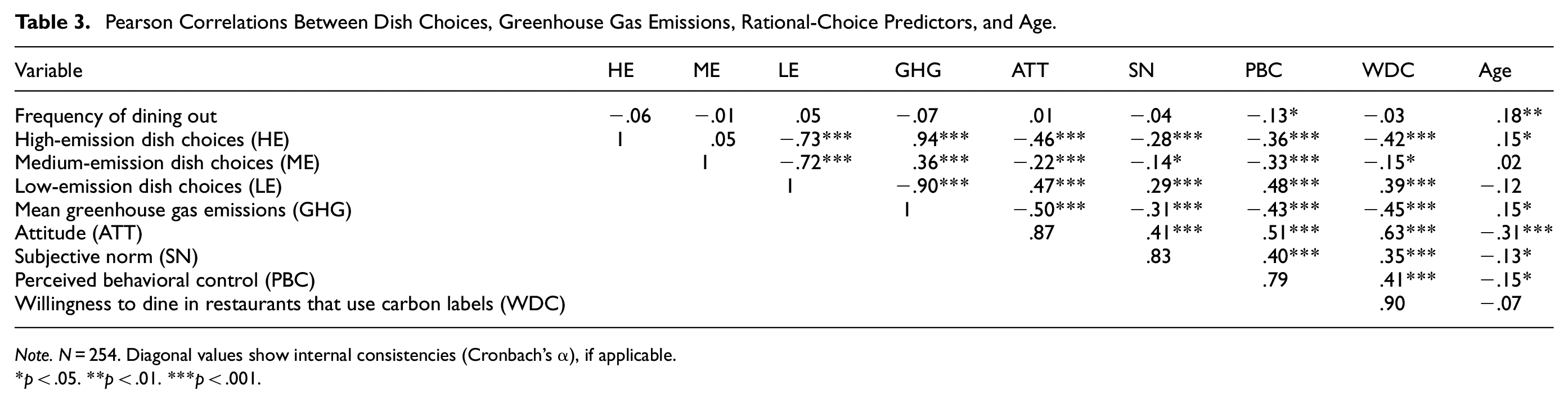
Note. N = 254. Diagonal values show internal consistencies (Cronbach’s α), if applicable.
p < .05. **p < .01. ***p < .001.
Using boxplot analyses, we identified 12 participants with mean attitude or PBC values of 3 or below as outliers. Therefore, we tested the robustness of the following main analyses by running parallel analyses where these participants were excluded. Significance decisions were not affected in any of the models reported below, indicating that our results are relatively robust to outliers.
Dish Choice
Within 2,032 dish choice trials, 365 (18.0%) high-, 832 (36.0%) medium-, and 935 (46.0%) low-emission dishes were chosen. We calculated hierarchical multinomial logit models running the mlogit package (version 1.1-1; Croissant, 2020) on response-level data. As in our previous work (Betz, 2022), we selected medium-emission dish choices as the reference level both for high- and low-emission dish choices. A baseline model with random effects of persons and items (menus) was significant, χ2(6) = 15.02, p = .005, McFadden R2 = .004, with menus (i.e., restaurant types) predicting low-emission dish choices (p < .001).
In the next step, the carbon label and labelling block conditions were added, including their interaction. The predictive power of this experimental model (McFadden R2 = .011) significantly exceeded that of the baseline model, χ2(6) = 33.35, p < .001. Carbon labels were associated with a significant decrease in high-emission dish choices (5.7%, p = .044), thus confirming Hypothesis 1a. Contrary to Hypothesis 1b, carbon labels did not affect low-emission dish choices (p = .457). Moreover, there was a significant effect of labelling block conditions on high-emission dish choices (p = .012). Accordingly, the likelihood of choosing high-emission dishes was 2.6% higher among those who were presented with carbon labels in the first rather than the second block. The interaction between carbon labels and labelling blocks was also significant for high-emission dish choices (p = .004), the critical effect being that among those who were presented with the carbon labels first, the likelihood of choosing high-emission dishes increased by 11.4% in the second block where no labels were presented. In the other experimental group, there was virtually no decrease in high-emission dish choices when carbon labels were added in the second block. This provides an answer to Research Question 2, indicating that there was a negative post-exposure effect of carbon labels for subsequent dish choices from menus without carbon labels. Figure 1 depicts the number of dish choices as a function of carbon labels and labelling blocks.
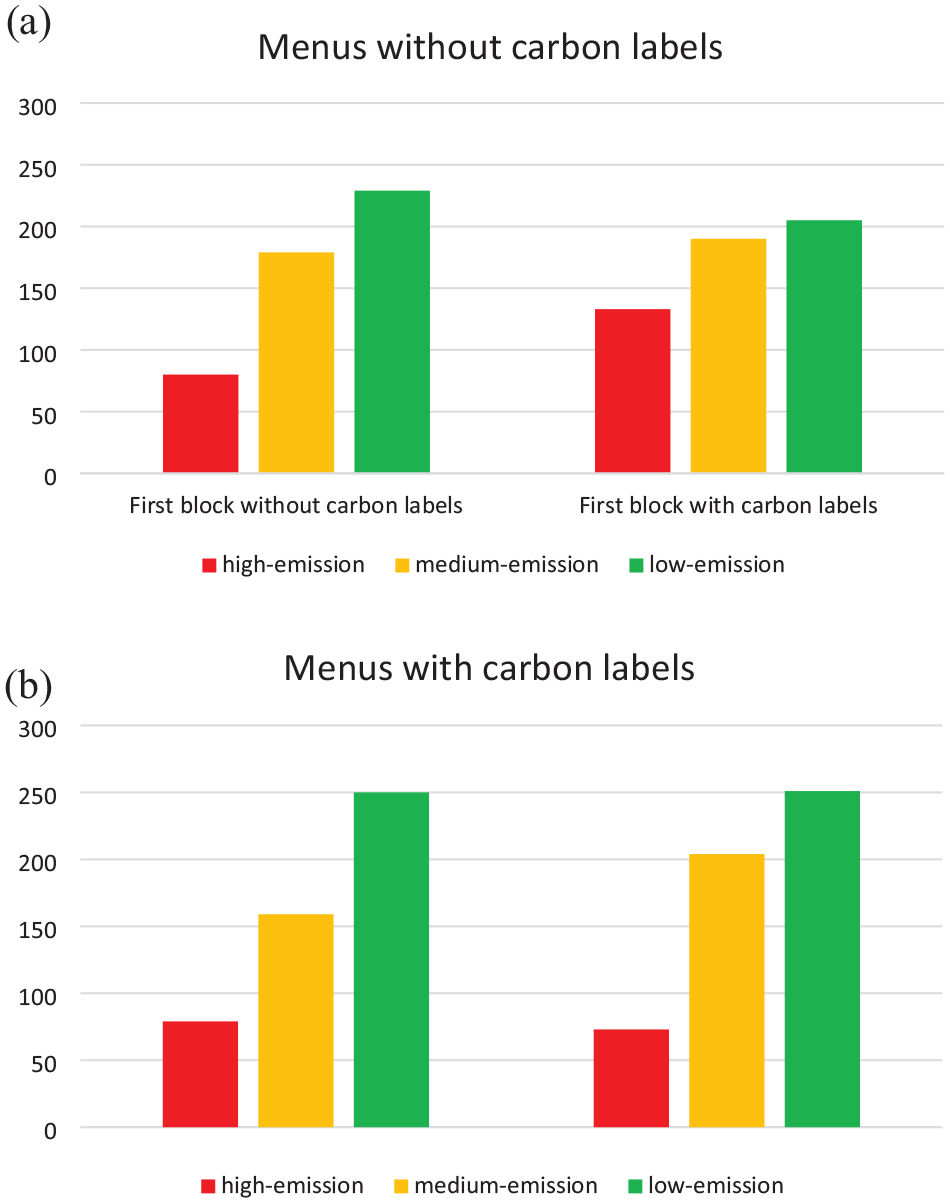
Number of dish choices as a function of experimental group for menus without (a) and with (b) carbon labels.
In the final step, we added covariates to the previous model. The predictive power (McFadden R2 = .093) of this covariate model surpassed that of the experimental model significantly, χ2(10) = 381.36, p < .001. TPB attitude was a significant predictor of both high- (p < .001) and low-emission dish choices (p < .001), thus confirming Hypothesis 2a. Subjective norm neither predicted high- (p = .12) nor low-emission dish choices (p = .34); therefore, Hypothesis 2b was rejected. Hypothesis 2c was confirmed partly, with PBC predicting low- (p < .001) but not high-emission dish choices (p = .75). The effects reported in the experimental model remained significant in the covariate model, indicating that the predictive power of the TPB variables did not overlap with the effects of carbon labels on high-emission dish choices. With reference to Research Question 1, this implies that the effect of carbon labels on dish choices is not exhaustively covered by the TPB.
Carbon Impact
On average, dish choices were associated with GHG emissions of 1.04 kg CO2-eq. A hierarchical LMM procedure was run on this data using the R packages lme4 (version 1.1-31; Bates et al., 2015) for model construction, lmerTest for significance testing (version 3.1-3; Kuznetsova et al., 2017), and MuMIn (version 1.47.1; Barton, 2020) to calculate explained variances (R2) at the model level. As recommended by the package developers, we used a restricted maximum-likelihood method with generalized least-square estimation for modelling (Bates et al., 2015) and Satterthwaite’s method for estimating the degrees of freedom (Kuznetsova et al., 2017).
For the first (experimental) model, we included random intercepts for persons and items, and contrasts for the experimental conditions and their interaction. The explained variance of this model was R2 = .01 for fixed effects only and R2 = .45 for fixed and random effects combined. Carbon label was significant, t(1769.09) = −4.798, p < .001, b = −.053, indicating an average reduction of 116 g CO2-eq. (10.5%) for dish choices from menus with (vs. without) carbon labels. This confirms Hypothesis 1c. There was a significant interaction between the carbon label and labelling block conditions, t(1769.07) = −3.946, p < .001, b = −.044, mirroring the results obtained for the dish choice data. Among participants that were presented with carbon labels in the first block, GHG emissions increased by an average 190 g CO2-eq. in the second block where no labels were provided. In the other condition, introducing carbon labels in the second block led to a reduction of merely 20 g CO2-eq. compared to the first block without labels (Figure 2). This suggests a negative post-exposure effect in terms of ecological impact.

Mean greenhouse gas (GHG) emissions in kilograms of carbon dioxide equivalents (kg CO2-eq.) per dish choice as a function of carbon labels and experimental groups.
For the second (covariate) model, we included the same covariates as in the analysis of dish choice behavior. The results were similar, with GHG emissions being negatively predicted by attitude (p < .001) and PBC (p = .002), but not subjective norm (p = .18). This supports Hypotheses 2a and 2c, but not Hypothesis 2b. The effects reported in the experimental model remained significant in the covariate model, indicating that the reduction of GHG emissions associated with carbon labels is not exhaustively covered by the TPB.
Willingness to Dine in Restaurants that Use Carbon Labels
On the descriptive level, the WDC tended to be high, with 78.5% of the participants yielding an average ≥5 (out of 7; i.e., tending to agree) and 10.4% yielding an average ≤3 (i.e., tending to disagree). Importantly (but not surprisingly), WDC was negatively correlated with high- (r = −.42) and medium-emission dish choices (r = −.15; see Table 3), indicating that people who order climate-intensive dishes are rather reluctant to support carbon labels on menus. In response to Research Question 3, we conclude that while diners are generally open to carbon labels, people with carbon-intensive diets might show reactance against these. An item-level analysis of the WDC data is provided online (https://osf.io/asvr7).
Discussion
With this experiment, we investigated whether carbon labels included in restaurant menus increase the share of low-emission dish choices and reduce the share of high-emission dish choices and the amount of associated GHG emissions among diners. We further examined how attitude, subjective norm, and PBC correspond with these dish choices, and whether there are spillover effects within the target behavior, particularly from menus with carbon labels to subsequent menus without these labels.
Carbon Labels and the Theory of Planned Behavior
It appears that diners are less likely to choose high-emission dishes, but not more likely to choose low-emission dishes when carbon labels are added to the menus. This mirrors previous findings, according to which consumers who tend to have high-emission (ruminant) meat products are likely to substitute them with medium-emission meat (e.g., chicken) or dairy products rather than low-emission (i.e., mostly plant-based) alternatives (Betz, 2022; Edenbrandt & Lagerkvist, 2021; Stremmel et al., 2024). Another explanation for this finding could be that diners experience high social pressure (i.e., a relevant subjective norm in terms of the TPB) not to choose dishes with red warning labels (Reisch et al., 2021) that signal social disapproval. In contrast, diners who tend to have medium-emission dishes do not necessarily associate the yellow labels of these dishes with social disapproval, the consequence being that they do not feel a strong urge to have dishes with green labels instead.
In line with the TPB (Fishbein & Ajzen, 2009), attitude towards ecologically responsible dining predicted low-emission dish choices positively, and high-emission dish choices and associated GHG emissions negatively. This replicates Liu et al.’s (2022) findings on climate-friendly dining intentions and extends them by indicating that this attitude-intention relationship does not overlap substantially with the effect of carbon labels on dish choices. Participants who showed a higher attitude toward ecologically responsible dining were more likely to choose low-emission dishes, regardless of whether there were carbon labels on the menus. On the other hand, carbon labels reduced the proportion of high-emission dish choices irrespectively of attitude.
Contrary to what was expected, subjective norm did not predict dish choice behavior beyond the influence of carbon labels, suggesting that the correlation between subjective norm and dish choice intention is superimposed by the effect of carbon labels. This corroborates our earlier assumption that carbon labels constitute signs of social approval or disapproval and thus exert social pressure on diners (Betz, 2022). However, the subjective norm covariate generally shows weaker correlations with dish choice than attitude or PBC and is thus more likely to become non-significant in regression models. This could be explained by the notion that people tend to underestimate the relevance of social norms in self-report settings (Nolan et al., 2008).
For the control component of the TPB, the results were mixed, with PBC predicting GHG emissions and low-emission dish choices, but not high-emission dish choices. It appears that control beliefs were particularly relevant for the low-emission dishes that are mostly plant-based, perhaps reflecting the (lack of) availability of such dishes in restaurants. In other words, people perceive it to be easier to avoid particularly carbon-intensive food rather than to have particularly climate-friendly dishes when eating out. There was also no overlap between the influence of carbon labels and PBC on GHG emissions: while the former reduced GHG emissions by reducing the proportion of high-emission dish choices, the latter reduced GHG emissions by increasing the proportion of low-emission dish choices. However, as the proportion of emission categories was held constant in this study, we are unsure if this finding would be replicated in natural settings where the proportion of these categories is more diverging.
Negative Post-Exposure Effect of Carbon Labels
As outlined above, the presence of carbon labels was associated with a higher share of low-emission dish choices, a lower share of high-emission dish choices, and a reduction of associated GHG emissions by 10.5%. However, it has to be noted that this difference is not mainly caused by reduced GHG emissions after adding carbon labels, but rather by increased GHG emissions after removing these. In short, the present results indicate a rebound effect. As reasoned earlier, moral licensing (Barkemeyer et al., 2023; Dütschke et al., 2018) may account for this finding, suggesting that people use a previous ERC (i.e., choosing medium- or low-emission dishes in the presence of carbon labels) to justify subsequent non-ERC (i.e., choosing high-emission dishes). However, this explanation is rather unspecific and needs to be substantiated with more detailed research. For instance, Nash et al. (2017) point out that moral licensing can be reduced by making pro-environmental personal norms (van der Werff & Steg, 2015) and values (Mullen & Monin, 2016) more salient. Neither of these concepts were included here, allowing for no decisive conclusion in terms of moral licensing.
A more specific explanation for the negative post-exposure effect draws upon recent insights from self-determined motivation (Ryan & Deci, 2000), which holds that TPB attitude, but not subjective norm, mediates between internalized or intrinsic motivation and behavioral intention (Arnautovska et al., 2019). In line with this, it can be expected that participants showing a lower attitude towards and a lower behavioral tendency to choose low-emission dishes are also less internally motivated to do so. However, they still experience the social pressure not to choose dishes tagged with red warning labels. When these labels are removed, the social pressure disappears; while there is no increase in internalized motivation in the short run. The consequence is that ecologically responsible dining intentions decline. When studying post-exposure effects, future research on the influence of carbon labels on ERC should account for internalized and externalized forms of motivation.
Limitations
We identified two shortcomings of the present study that limit the generalizability of our results. First, we recruited a convenience sample with an overrepresentation of the female gender, high formal education, and vegetarian diet. These three sample features are associated positively with ecologically responsible dining (e.g., Meier & Christen, 2012). It is worth noting that the intentional changes and GHG savings are only minimal in the group where carbon labels were introduced in the second block. One possible explanation is that participants do not pay attention to the carbon labels (Babakhani et al., 2020) after being exposed to similar menus without labels. However, we deem it more likely that many participants may have the climate impact of their dish choices in mind when reading the menu without labels although the ERC focus of our study was not disclosed in the initial study description. In total, the results obtained in our sample cannot be inferred to the general population, thus calling for a replication study with a representative sample.
This limitation of generalizability also affects WDC, which appears to be relatively high in the present study. Given the negative correlation between WDC and high-emission dish choices, previous notions that there is a large support for carbon labels in restaurants (e.g., Lo et al., 2017; Pulkkinen et al., 2016) should also be taken with caution.
Second, our online setting does not necessarily generalize to actual restaurants. For replication studies in the field, we would expect effect sizes on dish choice behavior and GHG emissions to be lower (Brunner et al., 2018; Spaargaren et al., 2013). In terms of the TPB, it can be argued that the hypothetical dish choices in online settings reflect intentions rather than actual behavior. Future research on ecologically responsible dining should validate the present findings and those of Liu et al. (2022) against dish choice behavior in real restaurants. We further encourage researchers to seek insights on the operation mode of carbon labels by extending the rational choice framework to other socio-psychological antecedents of ERC such as personal moral norms (e.g., Shin et al., 2018) or self-determined motivation (Arnautovska et al., 2019). We acknowledge further that the present experiment is unrealistic in a way that participants chose dishes from eight different menus within a short time span. The post-exposure effect found here might be specific to this setting and cannot be generalized to realistic time lags between a person’s dish orders (e.g., one or several days). Therefore, it would be interesting to study long-term effects of carbon labels on menus.
Third, there is a number of covariates that are worth considering for investigations into the effects of carbon labels on dining. Noting that the usefulness of self-report measures is limited for social norms (Nolan et al., 2008), experimental variations of these should be considered to understand social norms more deeply. These could be realized in scenario-based approaches, for instance, where participants listen to other diners’ (dis)approval of certain dish options (injunctive norm), or their actual ordering behavior (descriptive norm). A body of research has suggested that injunctive and descriptive norms have divergent and complementary impacts on ERC (e.g., Cialdini et al., 1990; Nolan et al., 2008), including food consumption (Schubert et al., 2021; Severijns et al., 2023; Zhou et al., 2013). Within the area of injunctive norms, conflicting social norms and personal norms should be taken into account (Aasen et al., 2024; Severijns et al., 2023). To obtain generalizable insights here, future research should address social influences to food-related ERC also across social groups and cultural contexts.
It is also worth noting that we did not address the relative influence of a product’s price in the presence (vs. absence) of carbon labels. Various instances of ERC, such as staying in eco-labeled hotels (González-Rodríguez et al., 2020), are associated with higher prices than their “conventional” counterparts. In contrast, prices of vegetarian dishes in restaurants are often lower than those of meat dishes; this was also the case in the present study, following the idea that we wanted to design the online setting as naturalistic as possible. We cannot rule out that the observed rebound effect partly owes to price differences between high- and low-emission dishes. Participants who were not exposed to carbon labels in the first block may have had a particular focus on the menu prices, implying that they tended to choose the low-emission options that were cheaper. Thus, their potential to limit GHG emissions after adding the labels in the second block was limited.
Conclusion and Practical Implications
According to the present results, carbon labels exert a rebound effect, indicating that subsequent dish choices based on menus without these labels are associated with higher GHG emissions than dish choices based on the same menus when no labels had been presented before. In line with this, we argue that carbon labels operate largely through perceived social pressure. We suggest further that dish choices following carbon labels are largely externally motivated (Arnautovska et al., 2019) or subject to moral licensing (Dütschke et al., 2018). These two accounts are not mutually exclusive and deserve further investigations.
From a practical point of view, such a rebound effect does not appear very encouraging, given that carbon labels are still uncommon on restaurant menus. If carbon labels operate mostly through social pressure, their acceptance is assumed to be rather low, particularly among diners that tend not to take climate change into account when making their food choices. The present finding on WDC suggests that carbon labels will be mostly accepted among people who have been willing to reduce their ecological impact beforehand. Therefore, we encourage restaurant and canteen operators to implement carbon labels on their menus only if they can expect that the majority of their customers are willing to learn about the carbon impact of their eating decisions. If using them at all, carbon labels should not be introduced as a single measure, but as part of a more comprehensive environmental communication strategy (e.g., Filimonau et al., 2017) that also appeals to moral norms, value orientations, and intrinsic motivation.
Footnotes
Acknowledgements
We thank all participants of the experiment for their indispensable support.
Ethical Considerations
The Ethics Review Board of the Department of Psychology at University of Würzburg approved this research (approval no. GZEK 2021-79) on December 8, 2021.
Consent to Participate
Participants gave written consent before starting the online experiment.
Funding
The author(s) received no financial support for the research, authorship, and/or publication of this article.
Declaration of Conflicting Interests
The author(s) declared no potential conflicts of interest with respect to the research, authorship, and/or publication of this article.
Data Availability Statement
The data associated with this experiment are freely available on the Open Science Framework platform, https://osf.io/asvr7/. The experimental material is available at https://osf.io/gn79m/. This experiment has been preregistered at  .
.