




Abstract
This research addresses the complex dynamics between self-perceived affections, school performance, and the effectiveness of a didactic intervention among fifth and sixth graders. The sample encompassed 403 males and females age-ranged between 11 (n = 247) and 12 (n = 156), from nine public schools in Spain. To measure affections while assessing academic performance throughout grades in physical education, mathematics, and English, the Positive and Negative Affects for Children and Adolescents questionnaire was implemented. Results showed significantly higher positive affect and academic achievement in Physical Education, but not in Mathematics or English. The correlation between both affects and performance emphasised the positive influence of positive affect and the negative influence of negative affect. The use of multilevel models that accounted for grades highlighted the differentiated influence of affections on academic performance in each subject. The obtained results contribute to a more nuanced understanding of the complex interplay between affection and academic performance and highlight the need for tailored interventions in education settings.
Plain Language Summary
This study looks at how feeling loved and cared for by family affects primary school students’ performance in school. Researchers found that children who feel more affection and support from their families tend to do better in their studies. These children are more motivated, have higher self-esteem, and participate more in class. The study highlights the importance of emotional support at home for a child’s academic success. Understanding this connection can help parents and teachers create a nurturing environment that helps children do well in school and in their personal lives.
Introduction
Because human affect involves physiological, cognitive, behavioral, cultural, and social mechanisms (Feldman-Barrett, 2017), the study of affects is a complex issue to handle. This complexity is perceptible in the different interrelationships arising from the disciplines involved in the study of such matter—namely, Psychology, Philosophy, Pedagogy, Neuroscience, and Medicine (Arthur, 2021; Cifor & Gilliland, 2015; Fraga, 2016; Goicoechea & Fernández, 2014; Immordino-Yang & Damasio, 2007; Lang, 1994; Osti & Porto, 2017; Zembylas, 2007). As affective and cognitive factors correlate, in education settings, it is convenient to offer a comprehensive training in an equally pleasant environment (Marina, 2017; Wicke, 2021). Learning takes place not only in the minds of individuals, but also in the structural relationships of the context in interaction with teachers, classroom resources, and technologies (OCDE, 2015). Thus, early education teachers not only should focus themselves on the mere transmission of knowledge but also consider contextual and individual aspects (Frijda, 2012; Singer et al., 2022; Vélaz de Medrano, 1990).
In a study by Hattie (2017), it was found that what the school community expects from a formal institution is a sense of vocation from teachers so that students are motivated to learn. According to this author, a climate of affection and respect should also be promoted, and students’ potential should be fostered in a way that facilitates their integration into society—making them feel alive and happy. In this regard, knowing the motivational characteristics of pupils beyond mere intuition (to say, scientifically) would imply a more accurate perception of their motivation/demotivation (Rodríguez-Moneo, 2009), so instructional (re)adaptations can be considered. Though—due to social, contextual, technical, and life-hectic changes—current education seems to be more complex than in the past due to social, contextual, technical, and life-hectic changes (Damasio, 2012a), despite that affections may remain the same in humans. In other words, individuals learn in formal settings under the influence of external and internal elements that condition their learning in some way.
Based on the research by Cambursano and Andrada (2013), this study aims to shed light on whether more importance should be given in school settings to intelligence quotient (IQ), memory, reasoning, and the content of core subject matters (Mathematics, Language, English), or to affectivity—understood as the primary precursor of motivation, emotions, creativity, and the learning of more kinesthetic-bodily competencies (Physical Education, Music, and Arts and Crafts)—instead of the aforementioned core subjects. This study also seeks to discover how affectivity influences pupils and whether it has any impact on improving school performance. In other words, it aims to explore emotional aspects and their influence on students’ daily lives at a personal, social, and educational level (Durán et al., 2015; Fernández-Berrocal & Extremera, 2006; Gil-Madrona & Martínez, 2015; MacCann et al., 2019; Santamaría, 2011).
Affections, Emotions, and Neuroeducation
In education, the identification of affects represents a somewhat complexity in educational research (Alcalá et al., 2006; Cazalla-Luna & Molero, 2018; Rivas et al., 2021; Simón, 1997; Simon & Nath, 2004). To Lorimer (2008), affects are properties, competencies, modalities, energies, attainments, arrangements, and intensities with different temporal, speed, and spatial characteristics that act on bodies—being produced and transmitted through them. Deleuze (quoted in Massumi, 2002a) defines emotion as qualified intensity, the conventional and consensual point of insertion of intensity in semantically and semiotically formed progressions in circuits of action-reaction comparable in function and meaning. Thus, motion functions at the discursive level in relation to which the felt intensity of experience (not affect) is articulated. The virtual dimension of affects—antagonistic to emotions—is explained by the fact that much of what happens in a world occurs before it is registered by conscious thought (Massumi, 2002b). Likewise, Bisquerra (2006) states that, although affect and emotion are related terms, they represent distinct phenomena: emotion is an internal individual response to stimuli that may occur in a given situation, and affect is a process of social interaction.
Emotional intelligence is defined as the ability to connect with others, to know oneself, and to manage one’s affect and emotions (Goleman, 1996). To Watson and Clark (1994), the emotional experiences are often categorised into two major dominant factors: positive and negative affects. This constitutes a two-dimensional model of the basic structure of affect, described as having two independent dimensions (Cazalla-Luna & Molero, 2018; Panayiotou et al., 2019). The higher dimensional end represents a state of elevated affect, while the lower end reflects the relative absence of affective involvement (Watson & Tellegen, 1985). For example, positive affect signifies a level of engagement, enthusiasm, and activation, while negative affect indicates dimensions of guilt, fear, shame, nervousness, and introspection (Ispas, 2012). According to Extremera and Fernández-Berrocal (2002), a proper affective development would enable students to cope more successfully with challenging classroom situations. Thus, instructors may need to consider issues related to knowledge of one’s own emotions and the causes or reasons that give rise to certain forms of behavior or conduct in various classroom situations (Bisquerra et al., 2015). However, it is worth noting that the effective transmission of such values and knowledge to students implies prior internalisation by the teachers themselves (Bisquerra, 2000).
As of neuroeducation, it is a discipline that posits the improvement of teaching and learning processes through the understanding of how students’ brain function (Immordino-Yang & Damasio, 2007; Mora, 2013; Rivas et al., 2021; Sousa, 2017). From this neuroscientific-educational perspective, it is acknowledged that affect is an integral aspect of brain functioning and is inseparable from rationality. Inmordino-Yang and Damasio (2007) presented neurobiological evidence suggesting that emotion encompasses cognitive and sensory processes crucial in decision-making, motivation, learning, and social functioning. The outcomes in decision-making are determined by either rejection or approach depending on whether the emotion is negative or positive (Damasio, 2012b). Consequently, cognitive and socio-emotional skills not only interact and mutually stimulate each other but also serve as a fundamental foundation for learning. Although, cognitive and affective aspects can be conceptually separated, they are commonly integrated (Gray, 2004). As the brain has a tendency to repeat pleasurable experiences, associating learning experiences with positive affect encourages students to replicate them (Caballo, 2018).
School Performance, Affectivity, and Gender
In general terms, school performance corresponds to the knowledge demonstrated in an area or subject by a given student (Jiménez, 2000). Individual student performance is sometimes influenced by peers, the teacher, the classroom environment, or the educational, social, and cultural context itself (Day, 2017; Day et al., 2017). The specific design of the examination test would also influence the results. In a study on academic achievement, Cominetti and Ruiz (1997) suggest that family, teacher, or student expectations regarding learning achievement reveal biases, attitudes, and behaviors (beneficial or not) reflected by students in school performance. Therefore, it is difficult to state categorically that the improvement in such performance is due only to affective aspects, although it is known that such factors are present (Baena-Extremera & Granero-Gallegos, 2015; Edel, 2003; Lavega et al., 2013; Páez & Castaño, 2015). An example of this is reflected in a study by Andión et al. (2017), where they observed that students’ self-awareness about their ability to solve a task is fundamental for the adequate performance of the task (even more so than affect and performance or learning goals). Other studies, however, conclude that affectivity interferes negatively in the teaching-learning processes only if the affects are negative or positively only if the affects manifested are positive (Davidson et al., 2009; Fernández-Abascal, 2015; Gómez-Chacón, 2000)—aspects that may also influence the greater or lesser performance of students.
According to Bandura (1993) and Vygotsky (1979), interrelationships with peers play a qualitative role in enhancing learners’ academic performance in the teaching-learning process. The peer effect is a factor that typically exerts a notable influence on students’ academic performance (McEwan, 2003). Serrano et al. (2016) and (Simón-Piqueras et al., 2023) assert that emotions, particularly in children aged 3 to 7, are closely related to students’ school performance. These emotions do also correlate with age, gender, socioeconomic status, and certain dimensions of self-esteem. At the university level, Moreta-Herrera et al. (2018) indicate that negative emotions and low academic performance are variables affecting procrastination. Additionally, a relationship between intrapersonal intelligence (Gardner, 2005) and academic performance (Fernández-Berrocal & Extremera, 2006) has been verified in secondary school students. In other words, the way students think, feel, and act influences their mental health, which, in turn, is linked to final academic performance and the attitudes manifested in the classroom (Ferragut & Fierro, 2012; Páez & Castaño, 2015). As mentioned earlier, understanding students’ opinions and assessments of certain variables would aid in predicting their future academic performance (García-Llamas, 1986).
Since instructors’ expectations and students’ motivations, beliefs, interests, and social behavior relate to affectivity (Jiménez Morales & López Zafra, 2013), Sousa (2017) suggests that part of such teaching staff believes that variations in learning between males and females are not due to cognitive gender differences. Thus, it appears that females spend more time studying, while males are more likely to participate in sports and engage in both indoor and outdoor activities (Du et al., 2003). Males are also less likely to form academically oriented groups (Van Houtte, 2004), although they learn better among peers than from a teacher (Honigsfeld & Dunn, 2003). Females are more likely to revise errors and correct mistakes, possibly due not only to perceptual speed but also to their lower impulsivity, whereas males tend to use familiar learning strategies even if the method is inadequate (Stumpf, 1998). Studies on the influence of individual characteristics on learning have identified gender as a key factor in explaining students’ academic performance (McCreary & Chrisler, 2010; DiPrete & Jennings, 2012). Some studies go further, claiming that females perform better in reading than males (Fernández-Enguita et al., 2010; Huang, 2013; Mullis et al., 2007; Voyer & Voyer, 2014), but these results seem to be reversed when the skill tested is mathematics or science (Hyde et al., 1990; García-Montalvo, 2012).
Affects and the Study of School Subjects
Physical Education: Physical activity not only contributes to healthy growth but also yields positive socio-emotional effects in childhood, youth, and adulthood (Donnelly et al., 2009). When children engage in play, they embody their entire human, cognitive, and affective personality (Lagardera & Lavega, 2001). Play, defined as any recreational activity within a given social and cultural context (Navarro, 2002), is a pleasurable and spontaneous endeavour involving anticipation and surprise (Barnett & Owens, 2015; Brown, 2009; Csikszentmihalyi, 1990; Eberle, 2014; Gray, 2015; Hirsh-Pasek et al., 2010). It encompasses observable qualities of behavior and enjoyment that play a crucial role in motivating and engaging students in Physical Education (Cox et al., 2008; Cox & Ullrich-French, 2010). Thus, in physical activities students often exhibit satisfaction, enjoyment, and effort, contributing to enhanced school performance and emotional well-being (Ardoy et al., 2013; Booth et al., 2014; Castañer et al., 2006; Granero-Gallegos et al., 2012; Motos, 2003; Ruano, 2004; Ruiz et al., 2013). Studies also highlight the correlation between enthusiasm, emotions, cognition, perceived competence, and attitudes toward participation in physical activity programmes (Hashim et al., 2008). To Ratey (2008), physical exercise programmes can improve students’ curricular achievement and physical well-being.
Mathematics: Mathematics is omnipresent in everyday life, essential for various activities. McLeod (1989, 1992, 1994) emphasises the crucial role of affect in the teaching and learning processes of mathematics. Both McLeod (1989, 1992) and Gómez-Chacon (1997) contend that self-concept, a fundamental descriptor of affect within beliefs, significantly influences students’ learning of mathematics. Exploring emotions in science education, no human action occurs without an underlying emotion, while the latter delves into how teachers’ emotions in science education impact their teaching and, consequently, students’ performance (Otero, 2006; Zembylas, 2007). Although the study of the affective domain in mathematics is relatively recent, it is evident that emotions play a decisive role in shaping students’ success or failure in this domain (Gil et al., 2005; Lebrija et al., 2010; Sousa, 2018). Cárdenas Castro et al. (2016) underscore the scarcity of assessment practices focusing on the affective domain, despite teachers acknowledging their importance. This scarcity may be linked to teachers’ beliefs and conceptions about assessment, mathematics, or problem-solving, as well as certain social and pedagogical circumstances influencing their assessment decisions. Garritz (2010) and Otero (2006) assert, regarding science learning, that no human action occurs without an underlying emotion.
English: The European Union, in promoting language learning as a key objective for its collaborative project acknowledges the significant impact of acquiring a new language on students’ affective domain. The initial stages of learning a new language, as highlighted by Heron (1989), Hubert and Monleón (2017), and Rojas and Arcos (2014), can pose challenges that alter affectivity. An ill-suited teaching methodology, as emphasised by Monleón (2015), further disrupts the learning process. Additional factors in second language acquisition (SLA), such as pronunciation challenges and frequent mistakes, may subject learners to ridicule and mockery (Hubert & Monleón, 2017). Recognising the importance of motivation in fostering English language learning and its enjoyment, Monleón (2015) and Hubert and Monleón (2017) assert its pivotal role. Arnold (2000) expands on this, noting that both intrinsic and extrinsic motivation, along with enhanced self-esteem and the prospect of achieving inner peace, contribute positively to SLA.
In line with the above, Krashen’s Affective Filter Hypothesis is one of the key theories in second language acquisition. It proposes that emotional factors such as motivation, self-confidence, and anxiety can facilitate or hinder language learning (Krashen, 1981). A low affective filter allows for improved language acquisition, while a high filter hinders it (Yaoqing, 2022). According to this hypothesis, motivation, self-confidence, and anxiety are the three main factors that influence the affective filter. High motivation and self-confidence, along with low anxiety, favor language acquisition, while low motivation and high anxiety hinder it. Some studies suggest that confidence and motivation are especially important in skills such as listening and grammar, where anxiety can be a significant barrier (Yaoqing, 2022).
Purpose of the Present Study
The purpose of this study was to explore the dynamics among self-perceived affections, school performance, and the effectiveness of a didactic intervention within the context of 5th and 6th graders. Utilising the Positive Affects and Negative Affects for Children and Adolescents questionnaire, the study assessed the students’ affections. School performance was gauged through the collection of final marks from the chosen subjects: Physical Education, Mathematics, and English. The primary research question sought to establish the correlation between affections and school performance influenced by positive or negative affects. Beyond participants’ marks, the multilevel model also considered the gender variable and the influence of affections on school performance in each subject. Additionally, the study aimed to examine the self-perceived affections in each of the subjects. The research further addressed whether differences exist in the affections students bring to these curricular areas. The research question aimed at finding the correlation between affections and school performance influenced by positive or negative affects displayed by students.
Method
Sample
This study was approved by the the Social Research Ethics Committee of the University of Castilla-La Mancha approval under reference number (CEIS-2024-32176). All data were collected anonymously, and participation was voluntary. No identifying information was recorded. The research aimed to better understand the role of self-perceived affection in educational outcomes, which may inform supportive educational practices. Participants and/or their guardians received an explanation of the study and gave written consent before participation.
The sample for this study was incidentally selected (naturally given), encompassing a total participation of 403 males and females with ages ranging between 11 (n = 247) and 12 (n = 156) years old from nine public schools in the city of Albacete. Albacete is a city in southeastern Spain with approximately 180,000 inhabitants, with a middle-class and working-class population. All data were collected anonymously, and participation was voluntary. No identifying information was recorded. The research aimed to better understand the role of self-perceived affection in educational outcomes, which may inform supportive educational practices. Participants and/or their guardians received an explanation of the study and gave written consent before participation. The mean age of the participants was 11.39, with a standard deviation of 0.48. The gender distribution within the sample revealed that 54.6% of participants were males and 45.4% participants were females. It is noteworthy that the study ensured the fulfilment of the minimum participation requirement, as detailed in the next paragraph and section.
The incidental selection of the sample underscores a pragmatic approach to participant recruitment, allowing for the inclusion of 403 children within the specified age range. The deliberate inclusion of both males and females enhances the representativeness of the sample, fostering a more comprehensive exploration of the targeted age group. The mean age and standard deviation statistics provide a succinct summary of the participants’ age distribution, offering insights into the central tendency and variability within the chosen sample. Additionally, the study’s commitment to meeting the minimum participation requirement attests to the methodological rigor employed in securing a robust dataset for analysis.
Instrument and Procedure
The Positive and Negative Affect Schedule for Children and Adolescents, PANASN (Watson et al., 1988; Sandín et al., 1999), was employed as the primary instrument. This questionnaire comprises 20 items, with 10 items dedicated to assessing positive affect and another ten focused on negative affect. Participants, primary education apprentices, completed the questionnaire by reflecting on their typical feelings and behaviours. The instrument utilises a Likert scale with three response alternatives. They filled out the instrument in relation to the areas of Physical Education, Mathematics, and English. The instrument demonstrated good reliability, with a reliability index of .746 (acceptable-good) for positive affects and .810 (good) for negative affects. This reliability index, indicating the consistency and stability of the instrument, falls within the acceptable to good range for both positive and negative affect evaluations. A confirmatory factor analysis was conducted to verify whether the defined positive and negative items exhibited correlations and were indicative of the same underlying dimension. This analysis further contributes to establishing the validity and robustness of the PANASN instrument for assessing affective states in children and adolescents across the specified domains of Physical Education, Mathematics, and English.
The students participating in the study take three assessments each year, in December, March, and June. The PANASN instrument was administered throughout January. Final grades were used for academic performance. Participants completed the PANASN questionnaire before attending regular classes in Physical Education (PE), Mathematics (MA), and English (EN). The assessments were administered by the tutors or subject teachers in the respective curricular areas, within the participants’ ordinary educational institutions/schools, attended throughout the academic year. The instrument was completed by the students following the instructions provided by its authors, without providing any further information. This was done to minimize the effect of social desirability by preventing students from responding to what they consider socially acceptable. Other effects that can affect a self-report, such as memory recall, are minimized by asking about current affect. In any case, these are limitations to consider. Prior to data collection, teachers received instructions on the proper use of the assessment tools. Information about the research project was communicated to both families and students, and the educational institution, through the school principal, providing informed consent. Regarding academic performance data, final grades achieved by the participants in the three subject areas during the academic year were collected. These final grades are the result of a final knowledge test, which carries significant weight, but also assesses aspects such as participation, complementary activities, homework, attitude, etcétera. All information obtained from the various instruments used was stored in a database for subsequent statistical analysis.
Design
This study employed an empirical, descriptive-observational design to investigate the profile of positive and negative affects in students, refraining from manipulating the studied variables. The chosen approach aimed to comprehensively understand phenomena related to students’ affects without directly intervening in conditions or factors that could influence these emotional states. The descriptive nature of the design facilitated a holistic view of affect patterns within the student population without imposing any artificial changes in the educational environment. By meticulously observing positive and negative affects without altering natural conditions, the study aimed to provide a more authentic and faithful perspective on the emotional reality of students.
The decision to avoid variable manipulation was driven by the goal of genuinely capturing the diversity and complexity of affects experienced by students, and the natural settings of schools, all of them essential for a comprehensive understanding of the phenomenon. This descriptive-observational approach contributed to generating findings that authentically reflect the emotional dynamics in the educational contexts, without introducing artificial distortions into participants’ experiences. Prior to the study, the sample size was determined using the G*Power 3.1 application. After data collection, a confirmatory factor analysis was conducted using R 3.0.2 software to verify that items within each sub-scale belonged to the same underlying dimension.
For statistical analyses, initial assessments included checking if the sample followed a normal distribution pattern (Kolmogorov–Smirnov) and met the requirements of homoscedasticity (Levene) and sphericity (Mauchly). Subsequently, using IBM SPSS 29.0 software for Mac, the following analyses were performed:
Mixed-design Repeated Measures Analysis of Variance (rANOVA): (1.1) Using the PANASN instrument scales as the repeated measures factor. (1.2) Considering academic performance as covariates. (1.3) Differentiating sample groupings (Physical Education, Mathematics, English, and Gender) acted as between-group factors. (1.4) Calculating significant differences between positive and negative affects in each academic area and gender. Regression model was computed to examine the significant influence of school performance in the affections in the areas shown as significant by the rANOVA.
Mixed-design Repeated Measures Analysis of Variance (rANOVA): (2.1) Using academic areas (Physical Education, Mathematics, English) as the repeated measures factor. (2.2) Considering academic level and gender served as covariates. (2.3) Taking the PANASN positive affect scale was considered as between-group factors. (2.4) Calculating significant differences in positive affects among different academic areas and exploring the potential influence of student gender and academic performance. Regression model was computed to examine the significant influence of school performance in the affections in the areas shown as significant by the rANOVA.
Mixed-design Repeated Measures Analysis of Variance (rANOVA): (3.1) Similar to the previous analysis but using the PANASN negative affect scale as between-group factors. (3.2) Calculating significant differences in negative affects among different academic areas and exploring the potential influence of student gender and academic performance. Regression model was computed to examine the significant influence of school performance in the affections in the areas shown as significant by the rANOVA.
Additionally, using G*Power 3.1 statistical software, the effect size and power of each test were calculated with an
Results
Calculation of the Minimum Sample Size for the Conducted Tests
To establish the minimum sample size for study participation, the number of required participants was calculated using the G*Power 3.1 statistical software. The expected effect size
Confirmatory Factor Analysis to Verify Item Dimensionality in the Employed Sample
To confirm that the 10 items conventionally defined as positive, and the 10 items defined as negative exhibited significant correlations within their respective groups and were expressions of the same underlying dimension, a confirmatory factor analysis was conducted (Table 1). The results suggested that the items demonstrated significant correlations among themselves
Appropriateness of a Factorial Analysis for the Pre-Physical Education Questionnaire.
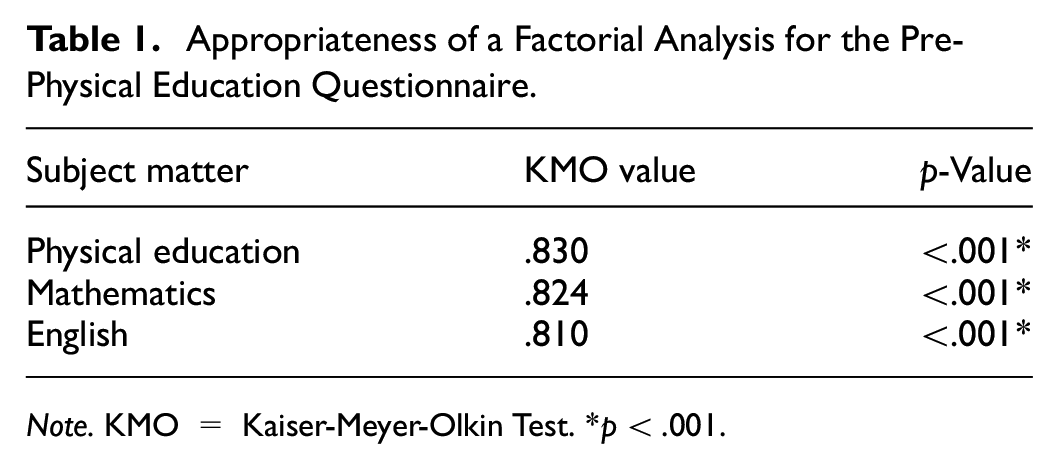
Note. KMO = Kaiser-Meyer-Olkin Test. *p < .001.
Sample Size Calculation Results and Preliminary Analysis of Normality, Homogeneity, and Sphericity
Preliminary results before the rANOVA tests indicated that the sample followed a normal distribution pattern for the variables used, regarding Positive and Negative Affects: (1, 395) = .045, p > .200, (1, 395) = .035, p > .200. The Levene test confirmed homogeneity in the sample for positive ([1, 395] = .32, p = .570) and negative affects ([1, 395]) = .60). Finally, the Mauchly test was calculated to verify sphericity, revealing non-significant results, thus, leading to obviate the need for corrections in the rANOVA calculations.
Analysis of Significant Differences Between Positive and Negative Affects in Each School Subject
Significant differences were found between positive and negative affects with high power in the areas of Physical Education (F[1, 3.194] = 25.67, p < .001, η2 = .61, 1 − β = .99) and mathematics (F[1, 1.82] = 15.39, p < .001, η2 = .44, 1 − β = .98). In these two subjects, positive affects were significantly higher than negative affects (Table 2 and Figure 1). No differences, however, were observed between positive and negative affects concerning the English subject (F[1, .01] = .010, p = .92), as displayed in Table 1. As for participants’ gender, no differences were found between positive and negative affects in any of the three subjects nor the interactions. Regarding school performance, the statistical analyses (Table 2 and Figure 1) demonstrated an influence on affects between both Mathematics (F[1, 2.96] = 25.1, p < .001, η2 = .07, 1 − β = .99) and the English subject (F[1, .98] = 15.12, p < .001, η2 = .047, 1 − β = .97).
Comparisons of Positive and Negative Affects in Each School Subject.

Note. (
p < .001. **p < .01.

Comparisons of positive and negative affects in each subject.
To examine the significant influence of school performance in Mathematics on affects, a linear regression model was computed. Participants’ school performance in the area of Mathematics did not exhibit a significant effect on negative affects in such domain (F[1, 332] = 3.438, p > .05). However, it did demonstrate a significant impact on positive affects in mathematics (F[2, 331] = 15.607, p = .01), Albeit ith small percentage of positive affects in this subject being explained by academic performance (R = .079). The regression equation was 3.395 + 1.48.
To analyse the significant influence of academic performance in Mathematics and English on affects, a linear regression model was calculated. School performance in Mathematics did not show a significant effect on negative affects in the domain (F[1, 332] = 3.438, p > .05). However, it did have a significant impact on positive affects in Mathematics (F[1, 331] = 15.607, p = .01), notwithstanding a small percentage of positive affects in this subject could be explained by the school performance (R = .079) of participants. The regression equation was 3.395 + 1.48.
Students’ school performance in English demonstrated a significant effect on negative affects in the area (F[1, 370] = 5.083, p = .025), explaining a percentage of them (R = .116). The regression equation was 5.40 + .80. It also manifested a significant effect on positive affects in the same subject matter (F[1, 309] = 37.96, p < .001). The percentage of explained negative affects is over 33% (R = .331). The regression equation was 2.930 + 1.73.
Analysis of Significant Differences Between Areas Regarding Positive and Negative Affects
Through the analysis of mixed-design repeated measures analysis of variance (rANOVA), using all school areas (Physical Education, Mathematics, English) as the repeated measures factor, school level and gender as covariates, and the PANASN positive affect scale as between-group factors, significant differences were found among the three areas concerning positive (F[2, 1.098] = 4.48, p = .012, η2 = .15, 1 − β = .30) and negative affects (F[2, .629) = 11.978, p < .001, η2 = .63, 1 − β = .99). No differences by gender nor their interactions, or influence of overall academic performance were found between their interactions though. Post hoc tests (Bonferroni) revealed that students exhibited higher scores in positive affects in Physical Education than in either Mathematics or English. No differences were found in the assessment of positive affects between Mathematics and English (Table 3 and Figure 2).
Comparisons Between Subjects for Positive and Negative Affects.

Note. (
p < .001. **p < .01. ***p < .05.
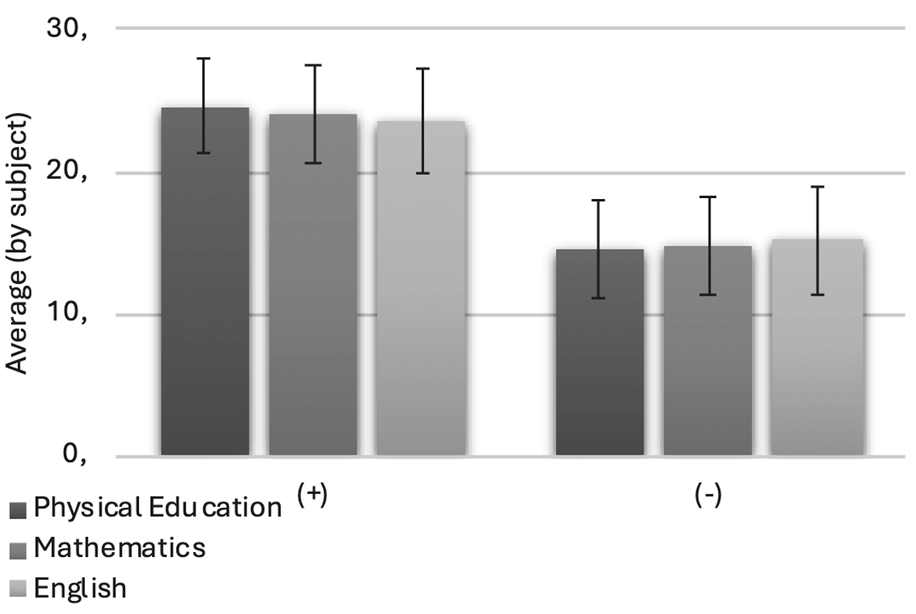
Comparisons between areas for positive and negative affects.
Regarding negative affects, significant differences with moderate power were found between Physical Education and Mathematics, with slightly higher negative affects in Mathematics. However, the English subject showed the highest results in negative affects, displaying significant differences both with Physical Education and Mathematics—these results demonstrated high power (Table 3 and Figure 2).
To analyse the significant influence of academic performance in mathematics on affects, a linear regression model was estimated. Academic performance in mathematics did not show a significant effect on negative affect in the area F(1, 332) = 3.438, p > .05, but it did have a significant effect on positive affect in mathematics F(2, 331) = 15.607, p = .01, although a small percentage of positive affect in this subject can be explained by academic performance R = .079. The regression equation was 3.395 + 1.48.
Discussion
Based on the obtained results, it can be confirmed that the PANASN scale is suitable for the sample in which it was implemented. This is because its psychometric properties are satisfactory, the results are consistent, and they align with previous literature (Ebesutani et al., 2011; González & Valdez, 2015; Laurent et al., 1999; Sandín, 2003; Sandín et al., 1999). It is also worth mentioning that, in our case, the scale has proven advantageous in that (1) it provided relevant and concise information about students’ affects, (2) its interpretation was straightforward, (3) response options were understandable for students, so it required minimum time for administration. Thus, the scale yielded structured, defined, and robust affectivity indicators (moderately high Cronbach’s alpha [Positive Affect: .746 vs. Negative Affect: .810]). The consistency of results and alignment with established literature underline the robustness of our findings.
Additionally, the obtained results indicate that the frequency of positive affects significantly exceeds negative affects for any of the analysed subjects. These findings align with studies by Almond (1997), Anderson and Bourke (2000), Prusak et al. (2004), suggesting that affectivity has a significant influence on students’ desire to learn, as well as on their cognitive and motor learning. Our study results also coincide with others indicating that school satisfaction is linked to positive affects (mostly toward the Physical Education subject) and to recognise the motor, pedagogical, and motor play potential in the development of these positive affects—always considering the influence of affectivity on students’ socialization (Baena-Extremera & Granero-Gallegos, 2015; Etxebeste et al., 2014). In all the analyses conducted, no influence of gender was found on any of the variables analysed or their interactions. Although gender was analysed in the hope of finding an influence, the results showed the opposite. This can be considered desirable, as teaching should tend toward gender equality and prevent gender stereotypes from generating differences, including emotional ones, simply because of belonging to a specific gender (Jagers et al., 2019; Simón-Piqueras et al., 2023).
Regarding the justification of how motivational behaviors (intrinsic motivation, autonomy, interest, satisfaction, and pleasure) are key elements for the development of positive affects towards the Physical Education subject, our study aligns with that of Sanchez-Oliva et al. (2014), who establish identical considerations. In comparison with the English subject, where it is noteworthy that there is a slightly higher percentage of positive affects expressed by students towards the mathematics subject. In this regard, there are some authors affirm that, contrary to expectations, there is a significant portion of students interested in and attracted to the Mathematics subject and, what is more, they do not experience excessive aversion to it (Gil et al., 2006; Gómez-Chacón, 2000; Jagers et al., 2019; McLeod, 1989; Nortes & Nortes-Checa, 2017). Therefore, the affective-emotional responses (positive or negative) expressed by students towards a particular subject are conditioned by their interactions in various problem-solving situations, disciplinary perception, self-concept, causal attributions, academic performance, and achievement expectations.
Considering the generalizability of our findings, we address external validity concerning the target population and contextual factors. Sampling validity is discussed, and considerations of setting, measurement, and time are explored to ensure ecological validity. The implications of our study extend to future research, educational programs, and policy. Recognizing the impact of affectivity on learning, our findings advocate for incorporating affective considerations into educational strategies. This study lays the groundwork for further research exploring the nuanced interplay between affectivity, motivation, and academic performance, with potential implications for educational policies and interventions. The educational community (especially teachers and families) can be warned about the importance of affect in the teaching-learning process. This would explain the importance of understanding the student in a holistic sense and establishing affective education programs in teacher and family training. If self-esteem as a value favors higher academic performance, understanding students’ assessments of the subject in certain variables of interest can be useful for guiding and orienting the teaching-learning process and improving their academic performance. This could help prevent dropouts.
Affective factors, such as interest, satisfaction, and motivation, play a fundamental role in students’ academic performance (Kobicheva et al., 2022). Pedagogical interest and affect directly influence perceptions of learning and academic performance, while faculty interaction and concern indirectly impact student motivation and engagement (Rivas et al., 2021). Furthermore, satisfaction with the educational experience is a key predictor of academic performance, especially in blended learning environments, where perceived benefits and satisfaction differentially affect undergraduate and graduate students (Li et al., 2023).
Therefore, it is recommended to include social-emotional education (SEL) programs in school curricula, adapted to cultural realities, to strengthen these competencies and improve academic performance (Panayiotou et al., 2019). Strategies such as emotional support, promoting positive school environments, and collaboration between parents, teachers, and students are essential and should be considered in educational policies (Portela-Pino et al., 2021). To achieve this, it is advisable to implement social-emotional competencies such as emotional intelligence, empathy, and emotional self-regulation. Emotional intelligence, understood as the ability to understand and manage emotions, is an important predictor of academic performance, surpassed only by intelligence and responsibility. Decision-making and relationship management are key social-emotional skills associated with achieving good grades (MacCann et al., 2019).
As limitations of the study, it should be noted that the instrument used is a self-report and is sensitive to effects such as social desirability and memory recall, although these effects were minimized as explained in the procedure section. As a future line of research, we must emphasize the importance of conducting longitudinal studies to analyse the evolution and establish clear causal relationships of this type of studies.
Conclusion
In conclusion, this scientific inquiry gets into the multifaceted interplay of affection, emotions, and academic performance among primary education students, giving light on the intricate connections within the educational landscape. The comprehensive exploration of affective factors, encompassing physiological, cognitive, behavioral, cultural, and social dimensions, emphasises their pivotal role in shaping students’ learning experiences. The findings underscore the paramount importance of cultivating a conducive and pleasant learning environment to optimise educational outcomes, recognising that the affective domain significantly influences the overall educational experience. This study contributes to the growing body of knowledge by highlighting the profound impact of emotions on students’ daily lives across personal, social, and educational domains. Affections, emotions, and neuro-education emerge as integral components in educational research, defined as properties, competencies, energies, and intensities that intricately shape individuals’ behaviors and interactions. The insights gained from this research can inform educational practices, encouraging a more holistic approach that recognises and integrates the affective dimensions of learning.
Additionally, the study elucidates the influential role of affectivity in students’ motivation to learn, as well as its effects on cognitive and motor learning abilities [T4]. Positive affects, particularly in subjects like Physical Education, are identified as catalysts for higher levels of school satisfaction, contributing significantly to students’ socialisation and overall development [T4]. These findings underscore the importance of fostering positive emotional experiences in educational contexts, recognising their far-reaching impact on various facets of student well-being. Furthermore, the research extends its focus to the realm of science and language learning, emphasising the intricate relationship between emotions and academic performance [T5]. By exploring the connection between self-perceived affections and school performance through the use of questionnaires in subjects like Physical Education, Mathematics, and English, the study provides valuable insights into the nuanced dynamics of affectivity in specific academic domains.
In sum, this study not only reaffirms the complexity of the connections between affection, emotions, and academic performance but also highlights the critical need to consider affective factors in educational settings. By acknowledging the multifaceted influence of affections on learning experiences and outcomes, educators and policymakers can develop strategies to create supportive environments that nurture the holistic development of students. The implications of this research extend beyond the confines of the study, urging a holistic paradigm shift in educational practices that places due emphasis on the intricate interplay of emotions in the learning journey.
Footnotes
Correction (June 2026):
This article has been updated to correct two references cited. Two citations of the same reference has been removed in introduction and discussion. The article text has been updated
ORCID iDs

Ethical Considerations
This study was approved by the Social Research Ethics Committee of the University of Castilla-La Mancha approval under reference number (CEIS-2024-32176).
Consent to Participate
Participants and/or their guardians received an explanation of the study and gave written consent before participation.
Funding
Article linked to the research project “Physical Activity and Health” (2022-GRIN-34290), UCLM's own plan. Article written within the framework of the Doctoral Thesis of the University of Castilla-La Mancha by Pilar Codina Lorente.
Declaration of Conflicting Interests
Authors have no conflicts of interest to disclose. This study was approved by the the Social Research Ethics Committee of the University of Castilla-La Mancha approval under reference number [CEIS-2024-32176]. Participants and/or their guardians received an explanation of the study and gave written consent before participation.
Data Availability Statement
Data sharing not applicable to this article as no datasets were generated or analyzed during the current study.