




Abstract
This survey research describes English language arts teachers’ comfort levels in integrating literature with lesbian, gay, bisexual, or transgender (LGBT) themes or characters into their curricula and classroom practices. Significant relationships were found between teachers’ age, comfort, awareness of resources, and implementation levels. Although younger teachers had higher comfort levels with LGBT texts, they displayed lower resource awareness levels and static implementation rates. In addition, comfort, awareness, and implementation of LGBT curriculum materials were also correlated with teacher location and with strength of religious belief, with rural teachers and strongly religious teachers displaying lower comfort and implementation levels. Availability of supportive resources such as gay–straight alliances (GSAs) and library holdings, as well as teachers’ awareness of these resources, is also examined. Specific barriers rural teachers encounter when implementing LGBT-inclusive literature/curriculum are identified. A call for future research and professional development is extended.
Keywords
As a teacher educator, I work closely with preservice teachers and also with in-service teachers working in public schools. All of these dedicated instructors would state that they want students to feel comfortable and safe in school. Most teachers believe that schools are for everyone and all students deserve the opportunity to learn. We want all students to have caring and respectful relationships with other students and with school staff. However, not all students are having the experiences that teachers hope for them. Specifically, students who identify as lesbian, gay, bisexual, or transgender (LGBT) 1 report feeling less safe, less respected, and less valued in our schools than do their heterosexual and cisgender peers, leading to lower engagement and achievement (Kosciw, Gretak, Giga, Villenas, & Danischewski, 2016; Lecesne, 2012; Robinson & Espelage, 2011).
The National School Climate Survey (NSCS) conducted by the Gay, Lesbian, and Straight Education Network (GLSEN; Kosciw et al., 2016) reports that though progress has been made since the survey was first administered in 1999, LGBTQ students still frequently hear homophobic remarks and negative comments about gender expression, hear homophobic remarks from school staff, feel unsafe at school because of their sexual orientation, have been verbally harassed at school, have been physically harassed, and have been physically assaulted because of their sexual orientation or gender expression. Other studies document the correlation between these kinds of victimization and health issues such as adolescent depression (see, for example, Martin-Storey & Crosnoe, 2012).
Negative school environments not only affect students’ health and well-being but also adversely affect LGBT students’ academic achievement and goals, leading, for example, to higher absenteeism, lower grade point averages, and lower educational aspirations (Kosciw et al., 2016; Wimberly, Wilkinson, & Pearson, 2015). For example, “the reported grade point average (GPA) for students who had higher levels of victimization based on their sexual orientation or gender expression was significantly lower than for students who experienced less harassment and assault (2.9 vs. 3.3)” (Kosciw et al., 2016, p. 45) and LGBTQ students who were more frequently victimized based on sexual orientation or gender expression “were twice as likely to report that they did not plan to pursue postsecondary education (e.g., college or trade school) than those who experienced lower levels (10.0% vs. 5.2%)” (p. xviii). Not only is the victimization of one segment of the student body of concern due to the moral imperative of providing safe spaces for learning for all students, it is of concern because it directly affects the learning and educational outcomes for these students.
While the issue of bullying has received national attention, teachers and teacher educators must also attend to other aspects of educational systems to support LGBTQIA students. Although bullying and victimization of youth, and specifically LGBTQ youth, is indeed a very important issue, recent research suggests that bullying alone may not fully explain the psychological and educational risks that LGBTQ students encounter. In one study, Robinson and Espelage (2012) found that Although victimization does explain a portion of the LGBTQ–heterosexual risk disparities, substantial differences persist even when the differences in victimization are taken into account . . . . This consistent pattern of findings suggests that policies aimed simply at reducing bullying may not be effective in bringing LGBTQ youth to the level of their heterosexual peers in terms of psychological and educational outcomes. Additional policies may be needed to promote safe, supportive school environments. (p. 309)
Rather, researchers attribute some of the risk/disparities to “stigmatizing, macro-level messages . . . that persist even in the absence of direct individual-level peer victimization” (p. 316). In addition, Crosnoe (2011) describes factors other than victimization, such as negative impacts of not fitting into adolescent social structures (which are largely formed by schools), and Martin-Storey, Cheadle, Skalamera, and Crosnoe (2015) cite stigmatization of sexual minority youth as contributing to challenges facing LGBTQIA youth.
Such findings support the idea that approaches to creating a positive school environment for LGBTQIA students that go beyond antibullying programs are vitally imperative. Michael Sadowski points out that providing safety for LGBTQIA students is not enough; we must also “create schools that affirm LGBTQ students and integrate respect for LGBTQ identities through multiple aspects of school life” (Sadowski, 2017, p. 9). Some facets that might be considered are the “supportive resources” included in the NSCS. These resources include students’ access to supportive staff members, the presence of gay–straight alliances (GSAs) or similar clubs in schools, access to library resources, and exposure to inclusive curriculum. The NSCS reports that only about half the students had the opportunity to participate in a GSA, only 22.4% of students reported exposure to inclusive (queer-positive) school curriculum, and fewer than half (42.4%) had access to resources on LGBT issues in their libraries (including online resources and physical holdings; Kosciw et al., 2016).
English language arts (ELA) teachers have the opportunity to make a difference in the lives of LGBTQIA students and to help stem the tide of harassment, violence, depression, and other issues often experienced by LGBTQIA learners. Inclusive curriculum can have a large impact. For example, in schools where students report usage of an inclusive curriculum, LGBTQ students feel more safe, are absent less frequently, and feel more connected to their schools; they also feel more accepted by their peers (GLSEN, 2011; Kosciw et al., 2016). Clark and Blackburn (2009) assert that ELA teachers can be powerful instruments in curbing homophobia and heterosexism in schools. They underscore the reading of LGBT-themed literature as one mechanism for accomplishing this.
In my own professional experiences, I have observed a disconnect between the lives and practices of the teachers with whom I work and the professional conversations at a national level. For example, there are more and more queer-themed resources and sessions available at national conferences and The National Council of Teachers of English (2007) has spoken out in favor of “strengthening teacher knowledge of lesbian, gay, bisexual, and transgender (LGBT) issues.” However, the teachers with whom I interact do not find such resources easily available and, as reported by GLSEN, few students have actually experienced inclusive curriculum. Other studies also report a hesitance on the part of teachers to implement curriculum related to LGBTQIA issues (e.g., Puchner & Klein, 2011; Thein, 2013). The possibilities seem to remain just that—possibility rather than reality.
There are competing perceptions related to visibility of gender and sexual minorities. On one hand, many argue that there is greater visibility for LGBTQIA people in society than ever before, as indicated by media portrayals. But on the other hand, as Mayo (2009) and others argue (Page, 2017), there remains a profound silence around LGBTQIA people and issues in schools. Given this apparent national queer ambivalence, and given the importance of the curriculum and how it represents and constitutes knowledge, I wanted to explore how teachers are (or are not) enacting a queer-inclusive curriculum and to gauge their comfort levels and awareness of resources. I also wanted to hear directly from practicing teachers as the NSCS’ respondents are students. We know that students and teachers often perceive schools, classrooms, and teaching and learning differently. Few students surveyed in the NSCS reported experiencing inclusive curriculum; I wondered if ELA teachers perceived this the same way. Did they feel comfortable incorporating LGBT themes into their teaching and curriculum? Did they do so? Were teachers aware of resources and texts that contained LGBT characters, themes, or story lines? Did teachers’ comfort level correlate with a particular educational philosophy or view of schooling? Because such a small proportion of students reported that they had experienced inclusive/positive curriculum in school (both nationally and in the state where this research was conducted [GLSEN, 2013; GLSEN, 2011]), and because of my interest in literature and literacy, I posed the preceding as research questions. These questions gave rise to the survey research I describe in this article.
Method
I sent an electronic invitation to participate in an online survey to all ELA teachers in middle and secondary schools in my state for whom public directory information was available, hoping to invite every ELA teacher in the state to participate. 2 The online survey was open for 8 weeks. In total, 2,804 invitations to participate were sent; 577 survey responses were submitted for a response rate of 20.6%. Of 87 counties in the state, 83 were represented in the responses. The four unrepresented counties are very small with low population. The focal state has one large metropolitan center with four additional urban areas of more than 50,000 residents while the bulk of the state could be characterized as rural. In terms of race, according to 2015 demographic data, the state is 81% White (non-Hispanic), 5.8% Black/African American, 1.1% American Indian, 4.8% Asian, 0.04% Native Hawaiian/Pacific Islander, 2.1% two or more races, and 5.2% Hispanic (Minnesota State Demographic Center, 2015).
The survey was developed by the researcher and centered on the questions above as well as questions related to other topics for future research. Survey items related to this study are included in data charts and figures that appear throughout the discussion. The survey inquired about ELA teachers’ experiences with their media center, their views on curriculum, their instructional purposes, their comfort levels related to LGBT young adult literature in the classroom, 3 their awareness of LGBT resources, their priorities regarding literature selection, and other topics such as school policies (67 items total). Most survey items were Likert-type scale items, but also several open-ended items asked participants to offer a narrative response, providing additional detail and nuance to complement closed question responses. Finally, respondents were given the opportunity to volunteer for follow-up interviews so that survey responses could be probed and expanded upon. I conducted follow-up interviews with over 30 participants. Concurrently with the teacher survey, I also surveyed librarians and media specialists about LGBT literature use in library holdings and reviewed library holdings by examining online catalogs and databases.
In this article, I will focus on the segments of the teacher survey that related to comfort level and awareness of LGBT issues and resources. I was particularly interested in relationships within the data, whether comfort level or awareness was related to teachers’ age, school/community size, religious belief, level of experience, educational philosophy, and so forth. Survey items were cross tabulated and chi-square tests conducted on the data to determine statistical significance. A threshold of .05 was used to determine significance. Only data and topics with statistical significance are discussed in the findings. Data from open-ended items and follow-up interviews were analyzed through an iterative coding process that uncovered prominent themes.
Demographics of the respondents in this study were as follows: 75% female/25% male 4 ; 55% taught in Grades 9 to 12; 25% in Grades 7 to 8; and 20% had other assignments (e.g., both middle and secondary grades). The majority of teachers were younger than 51 years of age (20.9% 20-30 years, 32.5% 31-40 years, 27.2% 41-50 years). The majority of respondents had taught from 0 to 20 years, with the largest proportion teaching from 11 to 15 years (25.2%). Rural teachers were more highly represented among the respondents (46.7%), followed by suburban (38.8%), and then urban (14.5%). In terms of race, respondents were primarily White (98.3%). The respondents generally had a religious faith, with only 10% identifying as atheist and 28.3% as Catholic, 52.2% as Protestant, 8.5% as Evangelical, 0.2% Muslim, 0.5% Buddhist, and 10.2% as other. Survey respondents identified themselves primarily as straight/heterosexual (97.0%), with 2.6% identifying as gay/lesbian/homosexual, 0.2% bisexual, and 0.2% as questioning. 5 Participants were permitted to choose whether or not to respond to each survey item; therefore, numbers of responses reported for items varied.
Results
When one examines the demographics of the respondents, the homogeneity of the participants is striking, especially in terms of sexual orientation and also race, with the teacher respondent group being less racially diverse than the state as a whole. This, in itself, may form the foundation of an argument for working toward greater diversity in teaching. However, this discussion will focus primarily on the findings with the greatest statistical significance: general comfort level and awareness of LGBT issues and resources, age and length of time teaching, religious beliefs, and community/school size. In addition, significant findings related to supportive resources such as GSAs and library holdings will be addressed.
Teachers’ General Comfort Level and Awareness
Several Likert-type scale items were posed to survey participants related to comfort level in utilizing LGBTQ literature in various ways in their classrooms. Over half of teachers responded that they felt comfortable using literature that contains LGBT characters or story lines in the curriculum and that they felt comfortable discussing LGBT issues in the classroom. In addition, more than 60% felt comfortable promoting LGBT literature for pleasure or choice reading. Table 1 summarizes data related to teachers’ comfort levels. Some readers will be encouraged that more than half of teachers reported these comfort levels, whereas others will be disappointed that only about half of teachers display such comfort.
Summary of Participants’ Comfort Levels Related to LGBT Integration into Teaching and Awareness of Resources.

Note. LGBT = lesbian, gay, bisexual, or transgender.
Teachers were also asked to rate their agreement with the statements, “I am aware of resources (including fiction, nonfiction, web) in our school library/media center related to sexual orientation issues” and “I am aware of at least 5 young adult works (novels, short story compilations, etc.) containing LGBT characters or storylines.” Only 28.1% of respondents strongly agreed or agreed with the statement about being familiar with library resources while 33.2% strongly agreed or agreed with the statement related to familiarity with young adult works. While teachers may feel comfortable using such works in their teaching, they are not familiar with texts and resources that may be available to them.
While 52.6% of respondents agreed that they felt comfortable using LGBT literature in the curriculum, only 23.7% reported actually integrating this literature when asked about this in an open-ended item. This percentage is higher than the 22% of students who reported experiencing inclusive curriculum in the NSCS; it is possible that respondents to my research inquiries represented teachers who were more “open” to this topic or that teachers and students were interpreting classroom practices differently. It is also possible that this difference reflects the culture of the state where the survey was administered (rather than the nation, which is surveyed through the NSCS). The respondents reporting inclusion of queer texts in their teaching is a small proportion of teachers, showing educators’ inhibition in this area. The most common method of including LGBT literature in the classroom was allowing it or promoting it for pleasure or choice reading (see Table 2). Few teachers reported explicitly teaching about sexual orientation or gender or including these topics in whole-class activities. Despite proclaiming a strong comfort level in discussing LGBT issues and incorporating LGBT texts, in actual practice a small proportion of teachers are explicitly attending to gender and sexual orientation in teacher-led classroom activities.
Approaches to Using LGBT Texts in the Classroom, as Reported in an Open-Ended Survey Item.

Note. LGBT = lesbian, gay, bisexual, transgender.
In subsequent sections, I will examine how teachers’ comfort levels in integrating LGBT literature related to other categories such as religious belief and school size.
Teacher Age and Experience
Survey participants were asked about their age and about the length of time they had been teaching ELA. To better understand whether teacher age and experience affected their comfort levels related to LGBT literature, demographic information was cross tabulated with responses to survey items related to comfort level integrating LGBT literature in the curriculum, comfort discussing LGBT issues in the classroom, and the items about awareness of resources. The relationship between teacher age and comfort level using LGBT literature in the curriculum was significant, χ2(4, N = 527) = 35.33, p = .018. In general, comfort level seemed related to age—the older the teacher, the lesser the comfort level; however, the oldest teachers (older than 60 years) did not fit this pattern, displaying a higher comfort level that was comparable to the 20 to 30 years age group. This is demonstrated in Figure 1.

Relationship between age of teacher and comfort level integrating LGBT curriculum.
The same trend is displayed in the data related to comfort-level promoting literature with LGBT characters and story lines with students for pleasure reading or choice reading, χ2(4, N = 521) = 44.68, p = .001. There seems to be a general relationship with older teachers becoming less comfortable engaging in this activity, with the exception of the oldest category of teachers who display a slightly higher comfort level than their colleagues in the adjacent group. Data about teachers’ level of experience also yielded this pattern, with more experienced teachers feeling less comfortable promoting this literature and less experienced teachers feeling more comfortable, χ2(6, N = 519) = 68.64, p < .001.
Participants were asked in open-ended items whether they used LGBT literature with their students or in their classes. They were asked to elaborate on how they used such texts (if they responded affirmatively) as well as the reasons why they did not do so (if they responded in the negative). The proportion of those who responded affirmatively to this item as compared with respondents from their overall age group were as follows: 26% of the 20 to 30 years old group reported using LGBT literature in some way, 28% of the 31 to 40 years old group, 26% of the 41 to 50 years old group, 23% of the 51 to 60 years old group, and 35% of the older than 60 years old group. The rate of implementation of LGBT literature in their instruction was not significantly higher for younger teachers, suggesting that higher comfort level did not necessarily translate to increased curricular inclusion.
Teachers were asked whether they would feel more comfortable suggesting LGBT works to students (for choice or pleasure reading) if they had more guidance themselves in choosing quality texts. Results show a relationship between teacher age and feeling a need for support in text selection, χ2(4, N = 521) = 44.44, p = .001. Proportionally, younger teachers were more likely to strongly agree or agree that receiving guidance in text selection would increase their comfort level with suggesting students’ readings. Older teachers were less likely to agree with this statement. The value of guidance in text selection was also significantly related to length of time teaching, χ2(6, N = 519) = 54.60, p = .003. Teachers with 0 to 15 years’ experience were more likely to agree that their comfort level would be enhanced if they had guidance in text selection than were more experienced teachers of 16 to 30+ years. It appears that more experienced teachers may feel more confident about text selection or that guidance would not affect their comfort levels.
Teacher age also was statistically significant in relation to awareness of resources available to teachers regarding LGBT issues, χ2(4, N = 510) = 34.33, p = .023. Younger teachers tended to be only half as aware of the resources available to them and to students in the library/media center than were the oldest teachers.
Teachers’ Religious Beliefs
Most respondents (89.7%) claimed a religious faith. Teachers were asked about the strengths of their religious beliefs and their beliefs’ impact on their lives. There were significant relationships found between strength of religious belief and other factors.
When asked about their comfort levels integrating LGBT literature into the curriculum, those who held very strong religious beliefs were more likely to disagree or strongly disagree, displaying a lower comfort level than their colleagues whose religious beliefs were not held as strongly, χ2(5, N = 523) = 64.61, p < .001. Likewise, respondents reporting high strength of religious belief also displayed, proportionally, a lower comfort level with discussing LGBT issues in the classroom, χ2(5, N = 520) = 43.72, p = .011. This finding is not surprising, but what is of note here is that simply having a religious faith was not closely correlated with discomfort in exploring LGBTQIA issues and identities in the classroom or curriculum; rather, the degree to which religious faith affected day-to-day actions was the correlating factor. Respondents who stated that their religious beliefs were not as strong or had less impact on their day-to-day lives were more likely to agree or strongly agree that they were comfortable integrating LGBT literature or discussing LGBT issues (see Figure 2).

Relationship between holding strong religious beliefs and comfort level discussing LGBT issues in the classroom.
In general, more than half of all respondents (53.4%) agreed that they would feel more comfortable integrating LGBT literature into their teaching if they had more guidance in selecting such texts. This includes teachers with strong religious beliefs. However, there were teachers who did NOT desire guidance or did not feel that it would modify their comfort level. More frequently, these were teachers who identified themselves as having strong religious beliefs, χ2(5, N = 518) = 56.24, p < .001.
Denomination
Religious sects do not have uniform views on gender or sexual minority people. Therefore, I examined data related to type of religion, what I refer to as denomination. Data for respondents who identified as Buddhist, Muslim, Jewish, and Other were not included in this comparison due to the small number of respondents who claimed those faiths. Table 3 shows the ratings data for statements related to comfort level in using LGBT literature, discussing LGBT issues, and other items. In general, respondents felt most comfortable utilizing LGBT literature for pleasure or choice reading.
Religious Groups’ Ratings of Agreement With Statements Related to Comfort Levels Utilizing LGBT Literature and/or Dealing With LGBT Topics.

Note. Numerical equivalents to answer options were strongly agree = 6, agree = 5, somewhat agree = 4, somewhat disagree = 3, disagree = 2, strongly disagree = 1. Therefore, a higher average rating indicates more agreement with the statement while a lower rating indicates stronger disagreement. All items are significant at a level of p < .001. LGBT = lesbian, gay, bisexual, or transgender.
Of all groups, the Evangelical and Atheist 6 groups varied the most often and the most widely from the average rating for all respondents, while both Catholics and Protestants tended to be closer to the mean. Evangelicals were less likely to agree that they were comfortable using LGBT literature, whereas Atheists reported more agreement. The same pattern recurs when asked about comfort discussing LGBT issues in class—Atheists were more likely to agree while Evangelicals were less likely to display comfort in this area. While there was less variety in ratings of the item “I feel comfortable using LGBT literature in my classroom but only if those characters and storylines are in the background of the text/story (not featured prominently),” both Evangelicals and Atheists were less likely to agree than were those who classified themselves as Catholic or Protestant. It is unknown whether this indicates that the teachers disagree because they do not feel comfortable using such literature in general or that the teachers disagree with relegating LGBT characters and story lines to the background. Evangelicals were less likely to feel comfortable promoting LGBT literature for pleasure or choice reading while Atheists were more likely to feel comfortable doing so. Evangelicals were less likely to agree that they would feel more comfortable using LGBT literature if they had guidance in selecting texts, perhaps indicating that no amount of guidance would sway their opinions.
Unique Challenges for Rural Teachers: Comfort, Awareness, Insecurity, and Resources
Comfort and awareness
One of the strongest relationships to emerge from the data was that between teachers’ school/community size and teachers’ comfort levels, awareness of resources, and feelings of fear or insecurity. Multiple demographic questions were asked (Is your community rural, suburban, or urban? How large is your school? How many residents are there in your community?) as a means of verifying the trends and patterns that might emerge. Therefore, some representations of data have been condensed in the following sections.
Generally, teachers in larger communities (more than 25,000 residents) were more likely to agree that they were comfortable integrating LGBT literature into their curriculum, χ2(7, N = 511) = 96.33, p < .001, and discussing LGBT issues in the classroom, χ2(7, N = 507) = 65.07, p < .001. Likewise, school size was significant to comfort integrating LGBT literature, χ2(5, N = 527) = 58.88, p = .001, and comfort discussing LGBT issues, χ2(5, N = 523) = 54.45, p = .004. Teachers who taught in schools of more than 1,000 pupils were more likely to state that they were comfortable discussion LGBT issues and integrating LGBT literature in their classrooms.
Teachers in rural schools, proportionally, felt less comfortable using LGBT literature in their curricula than did their suburban and urban counterparts, χ2(2, N = 508) = 72.41, p < .001. Figure 3 demonstrates the proportional disparity in comfort level. Likewise, rural teachers’ comfort levels with discussion on LGBT issues were also lower, χ2(2, N = 504) = 54.19, p < .001. Urban teachers were approximately twice as likely to report a higher comfort level in discussing LGBT issues.

Relationship between nature of school (rural, suburban, urban) and comfort level integrating LGBT texts into curriculum.
Rural teachers also believed themselves to be less aware of LGBT young adult literature, χ2(2, N = 489) = 39.23, p < .001. Urban teachers were almost twice as likely to report being aware of LGBT young adult literature works than were their rural peers (see Figure 4). This trend is verified by data related to school size and community size. Teachers in smaller schools were less likely to agree that they were aware of available resources and teachers in smaller communities also were less likely to agree that they were aware of resources, χ2(7, N = 493) = 63.30, p = .002.
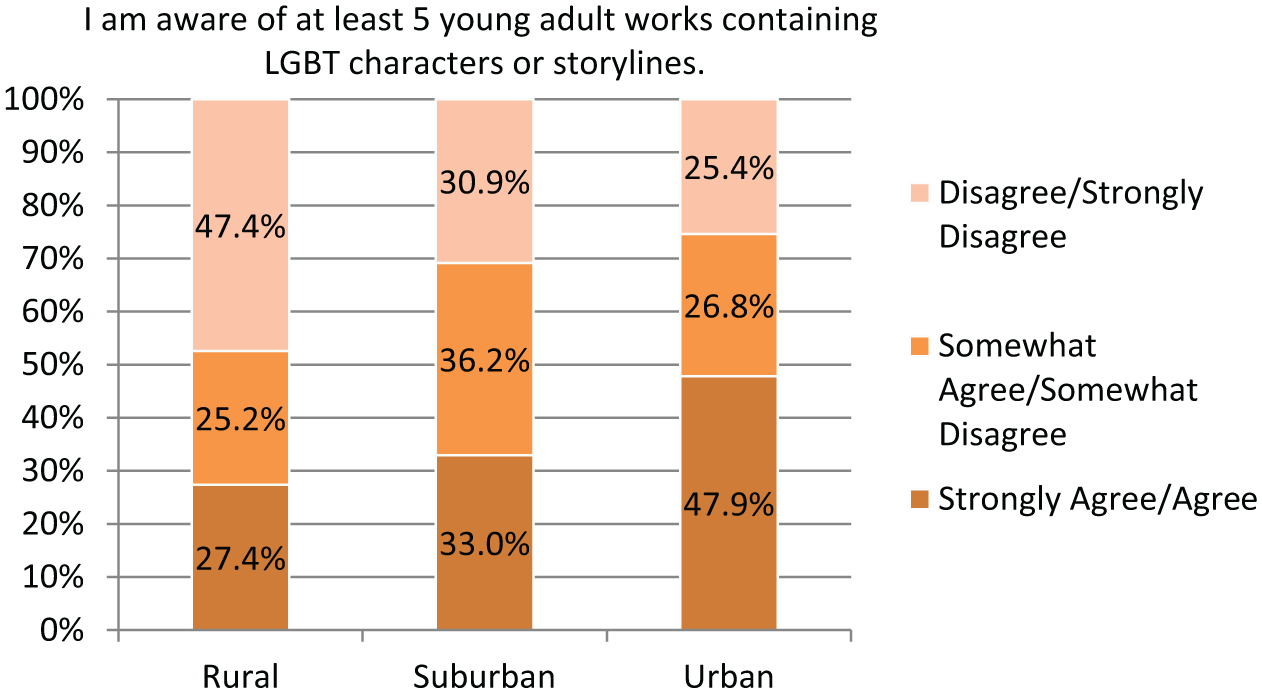
Relationship between nature of school (rural, suburban, urban) and awareness of LGBT young adult literature.
Rural teachers’ lower comfort levels and lower awareness of resources coincide with a lower rate of curricular diversification. While 28% of suburban respondents and 46% of urban respondents reported using LGBT literature in the classroom, only 18% of rural teachers used such literature. The correlation of rurality with implementation was statistically significant, χ2(2, N = 532) = 26.26, p < .001. Rural teachers may feel less comfortable in this aspect of their work due to increased feelings of fear or insecurity, discussed in the next section.
Teacher insecurity
As stated previously, though a high proportion of respondents generally reported feeling comfortable integrating LGBT literature into their teaching or discussing LGBTQIA issues in their classrooms, a significantly smaller portion of them were actually doing so (less than 25%). In the case of young adult LGBT literature, dispositions are not being translated into action. When asked why LGBT literature is not used, the most common response (31%) was that teachers were afraid of challenges or confrontations with parents or other community members. Other common reasons included a lack of awareness or education about such texts (21%) and lack of budget or resources to purchase texts (18%). Few teachers cited a conflict with their values system as a reason to not integrate this literature (4%). All of these concerns were more pronounced among rural teachers.
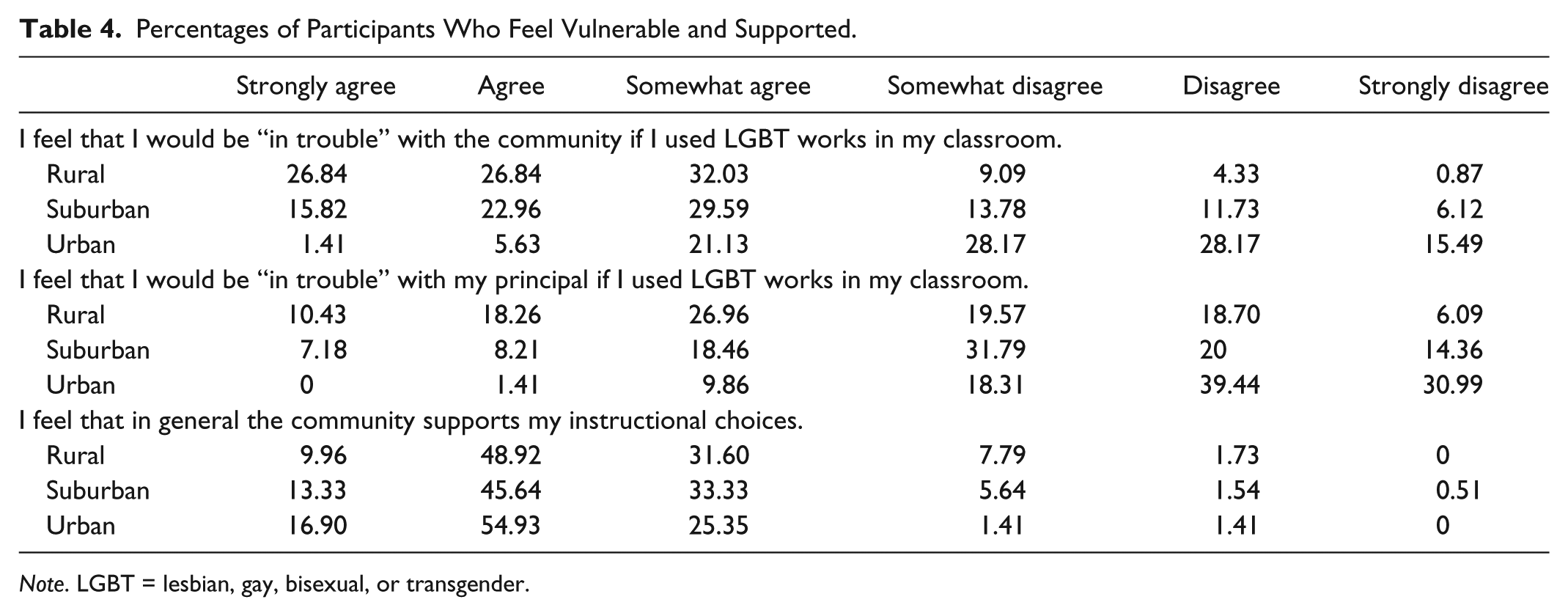
Participants were asked in the survey whether they felt they would be “in trouble” with the community if they integrated LGBT literature into the curriculum. (Participants defined for themselves what it would mean to be “in trouble” and who the community is). The data show that rural teachers were much more likely to feel that they would be “in trouble” with their communities if they used LGBT literature in their classrooms, χ2(2, N = 498) = 101.19, p < .001 (see Figure 5). This concern was elaborated upon in follow-up interviews. One participant related, There is always a level of fear that one will lose one’s job. However, I think most teachers do not want to be the ones rocking the boat for fear of being undermined as a teacher, labeled a deviant, or being challenged as fit to teach. So whether or not a teacher can actually be fired for including specific texts, there is a very real concern that his or her reputation and ultimately, career, could be ruined. So the question becomes, is it worth it to include this text?

Proportion of rural, suburban, and urban teachers who feel they would be in trouble with the community for using LGBT literature.
Another participant explained their fear, stating, In this community, I am fairly certain that using literature with LGBT themes would upset many parents, and potentially cause me to lose my job. It is one of the reasons I feel a little uncomfortable in this district; I believe that curriculum should address these voices instead of silencing them, but I’m not sure I’m brave enough to deal with 90% of my students’ parents being angry with me.
Likewise, rural teachers were more likely than their urban and suburban counterparts to feel that they would be “in trouble” with their principals for making such choices, χ2(2, N = 496) = 78.55, p < .001. One participant explained in her interview, Most teachers are afraid that they will get in trouble for not following a protocol that maybe they don’t know about. They are also afraid that there will be some kind of reprimand that would go into the permanent file. Unfortunately, I think there is a real danger that there could be danger of losing one’s job or at least having to defend oneself in front of a board that can feel like a “witch hunt.”
Another participant had fears over being driven out of the district rather than fired, saying, I am tenured and the likelihood of being fired is remote. However, I can see where my classroom would come under the gun by the administration and I would find myself being micromanaged by my principal and superintendent. I can also see where the school board would get involved as well.
Rural and suburban teachers had the same rates of agreement that their instructional choices were supported by their communities. However, urban teachers displayed a higher level of agreement. Generally, it appears that rural teachers feel more insecure and less supported than do teachers in other settings (see Table 4). This pattern is evident when examining school size and community size as well, with teachers in smaller schools and in smaller communities showing higher levels of agreement with the statement that they would be “in trouble” with their communities if they utilized LGBT literature in the classroom. Generally, teachers in communities of 25,000 residents or less, χ2(7, N = 501) = 130.53, p < .001, and schools of 1,000 pupils or less, χ2(3, N = 444) = 31.12, p = .033, felt more vulnerable.
Percentages of Participants Who Feel Vulnerable and Supported.
Note. LGBT = lesbian, gay, bisexual, or transgender.
Insecurity and gender
While this section pertains to findings related to rural teachers, it must be noted here that gender is also a significant factor in feelings of teacher insecurity. Gender generally was not significant in this study except for this item. Female teachers were significantly more likely to feel “in trouble” with their communities, χ2(1, N = 509) = 16.97, p = .004, and their principals, χ2(1, N = 507) = 256.72, p < .0001. Women were slightly more likely to work in rural and suburban schools (47.5% and 40.25%, respectively, compared with 43.2% and 36.8% for men) while men were more likely to work in urban schools (20% compared with women at 13%), though these data were not statistically significant. Correlation between gender and feelings of vulnerability may be an important topic for future research.
Supportive resources
Supportive resources named by GLSEN include library holdings related to LGBTQ issues, faculty who are supportive of gender and sexual minority students, GSAs or similar clubs, comprehensive bullying policies (that specifically attend to issues of gender and sexual orientation), and inclusive curriculum. The NSCS indicated that students in schools with GSAs felt more safe, experienced less victimization, heard fewer homophobic remarks, and had a greater sense of connectedness to their schools (Kosciw et al., 2016). A study conducted by the Family Acceptance Project showed that LGBT adolescents who attend schools with GSAs experience greater mental health as young adults, are less likely to drop out of school, and are more likely to pursue postsecondary education (i.e., attend college; Toomey, Ryan, Diaz, & Russell, 2011). Nationally, approximately 54% of students reported having a GSA or similar club in their school (Kosciw et al., 2016). In the survey described in this article, approximately 39% of teachers reported having a GSA or similar club at their school. Rural schools were far less likely to have a GSA or similar club than were urban schools, χ2(2, N = 493) = 112.74, p < .001. While 46.5% of urban respondents reported having an active GSA in their school, only 7.8% of rural respondents had this resource.
In this study, respondents who reported having a GSA at their school were more likely than their peers to feel comfortable integrating LGBT literature in their curricula, χ2(4, N = 507) = 80.87, p < .001, more likely to feel comfortable discussing LGBT issues, χ2(4, N = 506) = 66.14, p < .001, and more likely to feel comfortable promoting LGBT literature as choice reading, χ2(4, N = 505) = 55.79, p < .001. Table 5 illustrates the data.
Relationship Between Presence of Gay–Straight Alliances (or Similar Clubs) and Comfort Levels and Feelings of Vulnerability.
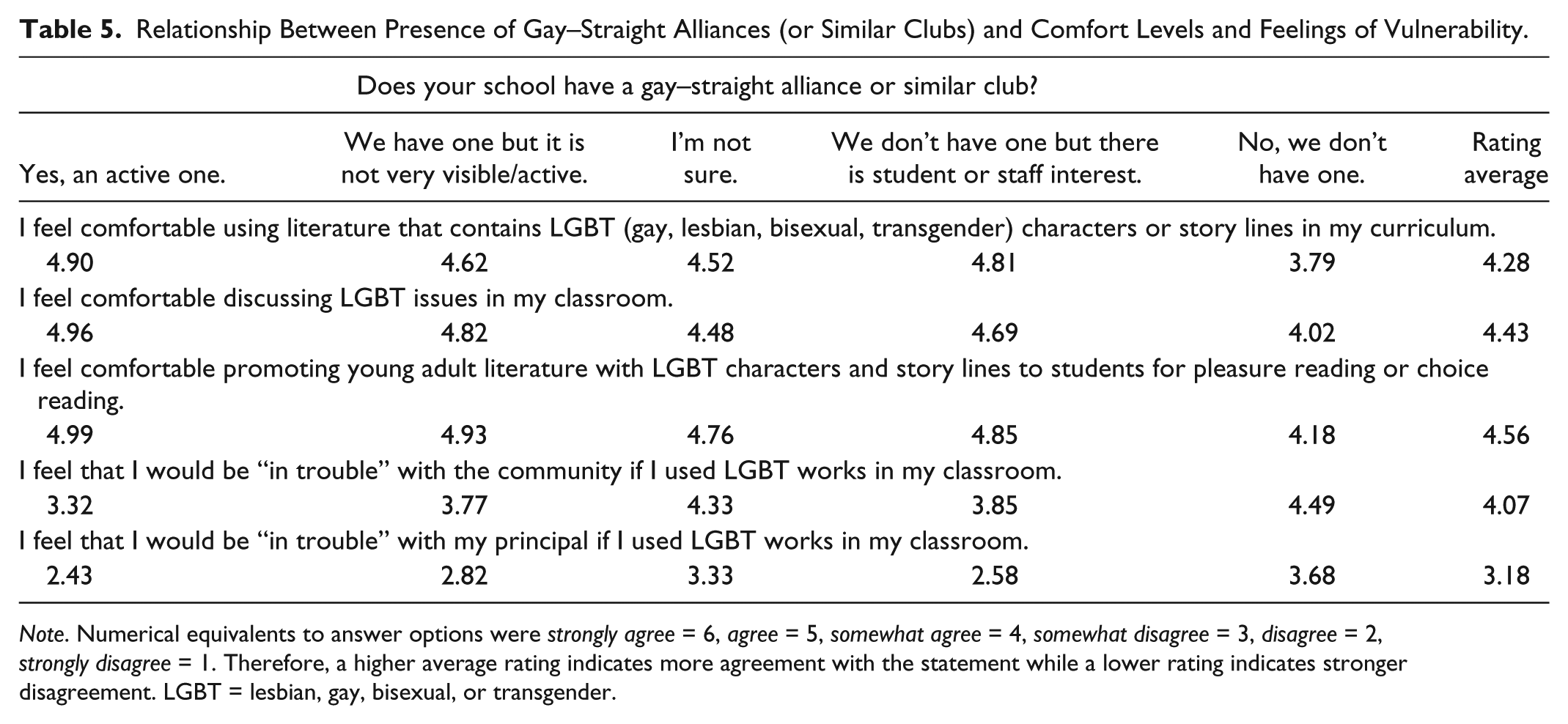
Note. Numerical equivalents to answer options were strongly agree = 6, agree = 5, somewhat agree = 4, somewhat disagree = 3, disagree = 2, strongly disagree = 1. Therefore, a higher average rating indicates more agreement with the statement while a lower rating indicates stronger disagreement. LGBT = lesbian, gay, bisexual, or transgender.
In addition to higher comfort levels, ELA teachers in schools with active GSAs were more likely to report being aware of library resources, χ2(4, N = 508) = 85.53, p < .001, and being aware of LGBT young adult works than teachers in schools with no GSA (see Table 6). Teachers in schools with active GSAs were also more likely to report having comprehensive bullying policies, χ2(4, N = 508) = 33.45, p = .005, and more consistent implementation of such policies, χ2(4, N = 506) = 28.59, p = .005. The lack of GSAs in rural schools may be both constitutive and reflective of teachers’ feelings of vulnerability and the resultant lack of support for gender and sexual minority students.
Relationship Between Presence of GSAs and Awareness of Resources.

Note. Numerical equivalents to answer options were strongly agree = 6, agree = 5, somewhat agree = 4, somewhat disagree = 3, disagree = 2, strongly disagree = 1. Therefore a higher average rating indicates more agreement with the statement while a lower rating indicates stronger disagreement. GSA = gay–straight alliance.
Library holdings are considered by GLSEN to be another supportive resource. As one thread of the larger research project, online catalogs of approximately 50 school libraries were randomly selected and examined for availability of fiction and nonfiction titles that contained information or story lines related to LGBTQIA people or issues. Four senior high schools in populous urban areas had 100 or more books available to students. Though 100 books may seem a large number, as a point of comparison, the same large urban schools had numerous books related to other minority groups—for example, over 1,000 titles pertaining to African Americans. Thirty-two (32) of the 50 schools’ libraries/media centers recorded 20 or fewer books related to LGBT people or issues and one school district had zero books in any school library related to LGBT topics. The majority of schools that had a dearth of resources were located in small, rural communities.
Discussion and Implications
Data from this study reveal that although ELA teachers reported a relatively high level of comfort in utilizing LGBT texts, discussing LGBT issues, and promoting LGBT literature for pleasure reading, there was a low level of implementation—the literature curriculum is not being widely diversified in terms of the texts included. Few teachers reported actually using queer texts in their classrooms at all and even fewer still reported using such texts for purposes other than student pleasure or choice reading. The most common reason given for not using LGBT texts in the classroom was a fear of confrontations or challenges by parents or other community members. This mirrors Thein’s (2013) findings related to teachers’ justifications for failing to teach queer-inclusive curriculum. One of the most common negative claims in Thein’s study was concern over others’ (students, parents, community) potential protests.
In an effort to avoid conflict, teachers often only use LGBTQ books for choice reading. Although the visibility of queer literature as a choice reading may contribute to creating a safer and more welcoming environment for LGBTQIA students and may help to promote acceptance among all students, it still places LGBT literature in the margins rather than as a central part of the curriculum. Very few teachers reported addressing LGBT issues specifically and intentionally in their practice, demonstrating that feeling comfortable is not enough—We must take action to make our curricula more inclusive. Including queer literature in choice reading is a start and is preferable to complete erasure of sexual and gender minorities; however, many teachers can do more, even within constraining circumstances. In addition, merely including LGBTQ literature does not necessarily disrupt heteronormative discourses (Blackburn & Clark, 2011; Schieble, 2012).
Relegating queer texts to choice reading may feel safer for teachers, but this is not necessarily the safest route for students. In addition, using queer texts solely for pleasure reading limits what kinds of discussions students can have about these texts and the kinds of discourses that surround the texts (Blackburn & Clark, 2011) and provides no instructional support. An additional value to using LGBTQ literature in whole-class settings is an increased visibility: “Using LGBTQ-inclusive literature and film erodes the silence—these characters, their lives and experiences, deserve textual and discursive space in the classroom” (Kenney, 2010, p. 66). Kenney continues, describing how such readings enhance all students’ empathy as well as literacy skills.
While some research studies and advocacy pieces mention teacher fear as a given (e.g., Caillouet, 2008), data are rarely reported. Findings from this study support the assumption that ELA teachers hesitate to integrate LGBT literature due to feelings of insecurity or fear. This seems to indicate that, in general, ELA teachers at all levels (preservice and in-service) would benefit from assistance in establishing and maintaining positive relationships with parents and the community, guidance in creating rationales for chosen texts, and help in defending their instructional choices if necessary. This need is particularly acute in rural areas, as rural teachers had amplified levels of fear and related concrete experiences that justified their concerns. Teachers need to be guided to resources such as the National Council of Teachers of English intellectual freedom websites and rationales, the Children’s Cooperative Book Center (CCBC) intellectual freedom and censorship resources, and local resources that may be available through educational cooperatives. Discussions of how to build supportive relationships with principals and superintendents are also very helpful.
In this study, older teachers tended to be less comfortable integrating LGBT texts into their teaching than were younger teachers. One precipitating cause may be our changing society. Sexual minority and gender nonbinary characters are becoming much more prominent in television and film, public figures and professional athletes are coming out as LGBTQIA (though this number remains small in athletics), and the political environment is changing, with the legalization of same-sex marriage. Younger teachers are living in a culture that is more open to LGBTQIA people earlier in their lives than what older teachers have experienced.
However, though younger teachers reported a higher general comfort level in using LGBT literature than their more experienced counterparts, younger instructors did not have a significantly higher level of implementation. Furthermore, they were less aware of queer literature and resources than were other teachers. This points to a need for experience and professional development related to resources. Younger teachers may hesitate to implement LGBTQIA-friendly curriculum due to less experience in working with parents and communities or a feeling of less job security than older colleagues, particularly in rural locations. Although this study found that younger teachers generally felt more comfortable integrating LGBT literature into their curricula, we cannot assume that generational shift will remedy the problem of excluding LGBTQIA content from schools. As young teachers become acculturated to a school or community context, their levels of comfort might change and shift. We must assist teachers in being change agents rather than simply accepting community constraints and becoming assimilated. While the insecurity that teachers feel should be taken seriously, instructors should also remember that teachers are not separate from the community. Teachers are part of the community, not antithetical to it. Preservice and in-service teachers may find that they are able to make change by becoming active and respected in their communities beyond school.
This study found that simply having a religious faith did not correlate with comfort levels or resource awareness. Rather, significant differences in comfort levels related to LGBT texts and issues correlated to strength of religious belief and to type of faith or denomination. In particular, respondents who identified themselves as Evangelicals seemed to display the least comfort related to LGBT texts and issues. Many evangelical groups believe that sexual orientation is a choice and believe that homosexuality is sinful. Reconciling religious beliefs with the need to represent all students equitably in the curriculum is a difficult challenge for many teachers, administrators, and students alike. It is not the teacher’s place to proselytize or to change students’ religious beliefs but it is the teacher’s role to prepare students to live in a diverse society and to create safe spaces for all students in schools (Banks, 2008). Opportunities for professional discussions and trainings that include attention to spirituality and religious values (such as Safe Zone training) may be helpful for teachers working through these personal and professional dilemmas.
Like strongly religious teachers, teachers in smaller, rural schools and communities displayed lower comfort levels related to LGBT issues and text integration. They also had displayed higher levels of fear and job insecurity than peers in larger schools and communities. It is possible that teachers in small communities and schools feel more visible and therefore more vulnerable. Rural teachers are known in their communities, as demonstrated by one participant’s comment: We can provide a network of support for each other, but the real conflicts come at the grocery store and in church in a small town. I used to live in [a small town], and parent-teacher conferences were civil, but meetings on the street were awkward.
Like their students, rural teachers experience little anonymity and this can make them targets for negativity. However, they also have the opportunity to use the relationships they create within their communities to shift community culture. Rural teachers who are respected and have already built a level of trust with families can be powerful in creating a “new normal.” Avenues of communication in rural communities are often perceived as more open; teachers can communicate their reasoning behind potentially controversial instructional decisions in a proactive manner. Rural teachers may need support (both moral and material) in doing the delicate work of turning a perceived negative into a productive positive.
Rural schools in this study had fewer GSAs, fewer library holdings in general, and much fewer library holdings related to LGBTQIA people and issues. Rural teachers need resources that can be accessed remotely and inexpensively to support their work. In addition, rural teachers may need more opportunities for professional development and discussion centered on concerns unique to their circumstances. One of the resources that most teachers in this study desired was guidance in selecting texts. There are many resources for teachers to find text recommendations and book summaries, but these need to be more widely circulated so that they reach teachers easily (see Caillouet, 2011; Cart & Jenkins, 2006; Cart & Jenkins, 2015; Clyde & Lobban, 2001; Comment, 2009; Curwood, Schliesman, & Horning, 2009; Hartman, 2009; Mason, Brannon, & Yarborough, 2012; Meyers, 2009; Norton & Vare, 2004; Vare & Norton, 2010). Having wide access to reviews and recommendations might buttress teachers’ efforts to build more inclusive curricula.
Conclusion
If teachers and teacher educators care about concepts such as justice and fairness, the texts we use matter because it is fundamentally not just or equitable for some students to be excluded from the curriculum and made invisible. One of the key ways that schools tacitly condone homophobia is by failing to include LGBT literature in the curriculum (Curwood et al., 2009). Invisibility is, in effect, invalidation. McLean (1997) reminds us, Whether texts structure the reader’s experience or whether the reader’s experience structures the text, the fact is that the ignoring or denial of a group’s existence in literature invalidates the experience and self-identity of members of that group by rendering them invisible, not only to themselves, but to all other groups in a society. (p. 182)
Ultimately, the curriculum is dialogic, a metaconversation—between society and schools, among educators, between social classes, among political viewpoints. Critical pedagogues and multicultural educators alike point out that the curriculum is not neutral, but is political and ideological (see, for example, Apple, 1979; Apple, 1990; Banks, 1995; Freire, 1993/1970; Giroux, 1983; Giroux, 1984; McLaren, 1998; Shor, 1992). The curriculum, framed within teachers’ pedagogical practices, conveys what is valued; it both is a site of and reflection of political struggle and knowledge creation. What is said and discussed and what is swept under the rug both convey value-laden messages.
In speaking of disability in education, Robert Anderson (2006) insightfully and poignantly asks, “Who decides which stories are worth being told?” (p. 368). The curriculum is a mechanism for crafting social narrative and for telling stories about individuals, groups, and society. As such, it is important that all members of society be represented within the narrative. Inclusive texts that represent a diversity of students must be present in the curriculum if we are to work toward a more equitable and just society. Yet Mayo (2009) states, There is a loud silence in curricula that indicates to all students that there are some people in the school who do not deserve to be spoken about and that even some interested in protecting sexual minority youth appear willing to use a community agreement on civil silence as protection. (p. 267)
Although adding LGBT literature to the ELA curriculum is a foundational and important step toward equitable representation of LGBTQIA students, such inclusion in and of itself will not necessarily change the status quo. As Banks (1995) points out, curriculum is one dimension of the schooling system that can and should be reformed. In discussing multicultural education, Banks (2008) emphasizes curriculum transformation versus additive curriculum. Likewise, Winans (2006) stated that . . . simply adding materials about “the other” does not challenge our pedagogy or conceptual framework in meaningful ways; the additive approach of inclusivity or celebration of difference tends to leave dominant cultural assumptions and their complex relationships to power unexamined. (p. 104)
In addition, she suggests that instructors need to craft a queer pedagogy that disrupts “binary models of sexuality in ways that engage with power, rather than obscuring such models within a language of tolerance with which we might seek to ‘cure’ homophobic students” (p. 107). More models of inclusive teaching practices must be researched and discussed (e.g., Page, 2016). Case studies and unit plans that demonstrate how teachers can integrate LGBT young adult literature into their teaching should be widely disseminated. Such portraits of teaching should include instruction that specifically focuses on LGBTQIA issues, instruction that focuses on meeting standards through using diverse texts, instruction that attempts to “speak back” to heteronormative practices, and other models.
The curriculum reflects who and what are valued in schools. If teachers and administrators truly respect and care for all students, we must be willing to transform our curricula to address issues of sexual orientation and gender identity. And if language arts teachers are to engage in this process, colleagues, scholars, and teacher educators must provide assistance. Preservice and in-service education opportunities that address intellectual freedom, how to respond to challenges of texts, and curriculum selection should be made plentiful and accessible, particularly in rural areas. Online workshops can be created and offered free of charge or at low cost for teachers. Rural education centers should attend particularly to topics of intellectual freedom as well as topics of sexual orientation and gender identity. Education and advocacy groups should promote the establishment of GSAs and provide resources that help students and teachers to get started with these initiatives. Advocacy centers for sexual orientation (such as GLSEN) and literacy (such as library organizations) could provide grants for the purpose of expanding library holdings and provide and promote resources related to text selection. Guidelines and rationales for literary texts could be provided free of charge to teachers by professional organizations. Educational leadership organizations should provide support to principals and superintendents so that they can be advocates for their teachers and their students.
Future research that explores how to help teachers reduce their fear and discomfort and increase their efficacy is required. ELA teachers could be a powerful resource to support students who are often marginalized and alienated in schools, but they must be equipped with tools, ideas, and allies that will help them to feel empowered so that they, in turn, can empower their students.
Footnotes
Declaration of Conflicting Interests
The author(s) declared no potential conflicts of interest with respect to the research, authorship, and/or publication of this article.
Funding
The author(s) disclosed receipt of the following financial support for the research, authorship, and/or publication of this article: The author received financial support for the research from the University of Minnesota, Morris Faculty Research Enhancement Fund.