



Abstract
The profession of SLPs in China has garnered escalating interest across diverse sectors of society. However, there is a lack of research concerning exploring their professional identity. This study aims to depict the current status and specific manifestations of the professional identity of Chinese SLPs through in-depth interviews. This study employed a qualitative research method, specifically utilizing content analysis. In-depth one-on-one face-to-face interviews were conducted with 28 Chinese SLPs. Subsequently, the analysis of the data involved categorizing interview content into main themes and subthemes following established research protocols. This systematic approach facilitated a comprehensive exploration of the professional identity of SLPs. Through a detailed analysis of the interview content, we delineated the current status and distinct manifestations of the professional identity of SLPs. This exploration yielded five main themes, including career motivations, occupational cognition, sense of belonging, occupational stress and challenges, and future career planning, and 13 subthemes. The professional identity of Chinese SLPs demonstrated multifaceted attributes. They navigated between the desire for social recognition, the quest for high-quality career advancement prospects, and the challenge of unsatisfactory working conditions. This juxtaposition reflected a blurred state of both professional identity and non-identity. The intricacy of this dynamic was intricately linked to the developmental stage and distinctive characteristics of the speech-language therapy sector in China, further shaped by the influences of unique cultural backgrounds.
The concept of health has evolved beyond mere physical well-being to encompass the human spirit and the healthy progression of social interactions (M. Zhang et al., 2023). This paradigm shift has given rise to the emergence of speech-language pathologist (SLP) as a professional cohort, with speech-language therapy becoming an increasingly pivotal component of the healthcare domain. Chinese SLPs have encountered a multitude of influences in their practice, leading to a complex and variable landscape in terms of career development (Tian et al., 2015). Therefore, a systematic exploration of the professional identity of Chinese SLPs has far-reaching practical significance, offering a distinctive perspective on the current scenario, challenges, and developmental requisites of this professional cohort. Such an investigation can furnish robust theoretical underpinnings and practical guidance for fortifying professional identity, augmenting job satisfaction, and catalyzing the sustained advancement of the speech-language therapy profession.
Background
What is Speech-Language Pathologist?
SLP is a professional specializing in communication and swallowing across all age groups (American Speech-Language-Hearing Association [ASHA], 2025d). In general, their scope of practice includes speech disorders, language disorders, cognitive disorders, social communication disorders, swallowing disorders, and others. Additionally, five domains of professional practice are delineated: advocacy and outreach, supervision, education, research, and administration/leadership (ASHA, 2025b). However, SLPs typically do not practice across all health service domains for every age group. As specified by the American Speech-Language-Hearing Association (ASHA) Code of Ethics, SLPs are only authorized to work in areas where they have the requisite knowledge, and experience, such as pediatric speech-language disorders or adult communication disorders (ASHA, 2025a).
Speech-language therapy is highly developed and well-established in developed countries such as the United States and the United Kingdom. In the United States, for instance, over 300 universities offer undergraduate programs in speech-language therapy, with more than 200 institutions providing graduate education at the master’s and doctoral levels. Candidates seeking SLP certification undergo a rigorous process defined by ASHA, encompassing degree completion, educational programs, course curricula, knowledge outcomes, and skill competencies (ASHA, 2020). Once certified, SLPs embark on careers in diverse settings, including private clinics, hospitals, schools, universities, rehabilitation centers, long-term care facilities, and residential healthcare institutions (ASHA, 2025c). Throughout their careers, SLPs’ practices are regulated by ASHA, ensuring they consistently update their theoretical knowledge and clinical skills to enhance service quality and grow their professional competencies (ASHA, 2020).
SLPs in China
Compared to the United States, China’s speech-language therapy industry is currently in a phase of rapid development, with various stakeholders working collaboratively to establish a standardized framework for the field. Academic programs in speech-language therapy, clinical linguistics, and speech pathology, alongside talent development structures, are currently being developed (Ma & Su, 2023). At present, SLPs in China primarily consist of professionals from related fields such as speech and hearing science, special education, linguistics, and rehabilitation medicine (Shi & Yang, 2020). Knowledge and skills relevant to speech-language therapy are integrated within these disciplines. These disciplines provide a solid foundation of specialized knowledge and skills for SLPs, as they have developed relatively mature systems in China, thereby ensuring that SLPs receive essential theoretical guidance and practical training (D. Wu & Peng, 2019). Upon completion of their studies in these disciplines, students are awarded degrees in Medicine, Education, and related fields.
The diversity of academic backgrounds has resulted in a division of SLP candidates into various employment sectors based on their educational experiences (Luo et al., 2024). Candidates with medical training generally have a broader range of employment opportunities, working in medical and clinical settings and serving individuals with communication and swallowing disorders, including children with special needs and adults. Those with an educational background typically work in schools, private clinics, and rehabilitation centers affiliated with disability organizations, primarily providing clinical services for children and adolescents with communication disorders. In addition, numerous Chinese universities and research institutions have made substantial contributions to the advancement of speech-language therapy. Researchers from Linguistics, Education, and Medicine backgrounds are engaged in exploring not only the therapy and characteristics of communication disorders but also developing corresponding clinical intervention techniques and methods. Furthermore, they have played a critical role in establishing industry standards, promoting disciplinary advancements, and cultivating expertise in the field of speech-language therapy (Li & Wang, 2024; Shi & Yang, 2020).
Due to the fragmented structure of the industry, particularly the diversity of organizations and affiliations of SLPs, China has yet to establish a unified operational model and regulatory framework comparable to that of the United States (Luo et al., 2024). This fragmentation not only constrains the professional identity of SLPs but also significantly influences their career choices and advancement opportunities. However, during this transitional phase, China has developed a management system unique to its context: SLPs are directly managed by their respective governing entities, while government departments and the China Disabled Persons’ Federation indirectly supervise and regulate industry practices through evaluation and feedback mechanisms that assess the intervention outcomes for children undergoing training, thereby demonstrating the flexibility and practicality of the regulatory model.
In summary, with the growing demand for healthcare, the role of SLPs has become increasingly prominent within the healthcare system. While speech-language therapy is still in its nascent stages in China, its rapid growth reflects a high level of societal recognition and demand for the profession (Mu & Li, 2017). Policy support has further enhanced the social status and professional identity of SLPs (Liao & Gao, 2017). However, compared to developed countries, the speech-language therapy industry in China is relatively underdeveloped, with limited employment opportunities. Furthermore, some medical and educational institutions adopt a conservative approach to recruitment (Liao & Gao, 2017), resulting in increased pressure on SLPs in the job market. Additionally, the profession lacks a clear definition within the national occupational classification system and a unified certification and title framework. This has made career advancement challenging for SLPs (Liao & Gao, 2017), leading to a lack of professional belonging and hindering the development of a robust professional identity, thereby impeding the industry’s further growth in China.
Therefore, it is essential to conduct a systematic study on the current professional identity of SLPs in China. This investigation will identify the factors shaping speech-language pathologists’ professional identity, including their educational background, work experience, career development opportunities, and work environment. With these insights and considering China’s unique context, practical strategies can be developed to enhance SLPs’ professional identity, expand their career prospects, and ultimately foster the growth and maturity of the speech-language therapy industry in China.
Literature Review
General Manifestations and Mechanism of Professional Identity
Professional identity is a product of individual occupational socialization (Kasperiuniene & Zydziunaite, 2019), characterized by a dynamic developmental process. Within this process, individuals navigate three key stages: identity formation, identity construction, and identity negotiation through professional practice, role positioning, and interaction within the professional environment (Hansson et al., 2022). This iterative process allows practitioners to gradually clarify their professional identity (Cruess et al., 2019) and solidify their sense of professional identity. Professional identity embodies a relatively stable state involving the specific performance of practitioners in their professional identity at a given moment or phase (Samuel & Stephens, 2000). Consequently, the existing research involves two aspects: the specific performance of the professional identity displayed by practitioners in their day-to-day work and the mechanisms underpinning the formation of professional identity and its influencing factors.
When exploring the specific manifestations of professional identity, existing studies mainly focus on a particular occupation, emphasizing two states of professional identity: professional identification and non-identification among practitioners. A robust professional identity not only bolsters job satisfaction and retention but also fosters the ongoing enhancement of professional competencies, thereby nurturing the healthy advancement of the industry (Hanum et al., 2023; Mak et al., 2022; C. Wu et al., 2022). On the contrary, a lack of professional identity can trigger negative emotions, such as self-doubt and burnout, potentially culminating in practitioners contemplating resignation from their roles (Cruess et al., 2019; M. Zhang et al., 2023). Moreover, some scholars posit that professional identity is a continuous process rather than a stark dichotomy (Ashforth et al., 2013). Even when practitioners exhibit heightened levels of professional identity, they may concurrently harbor elements of professional non-identification. Such instances of non-identification prompt practitioners to introspect and address their deficiencies at work, leading to heightened job satisfaction and self-efficacy, thereby gradually mitigating sentiments and experiences of professional non-identification (Gong et al., 2023).
In addition, researchers have focused on various factors that influence professional identity. External factors such as salary level, practice environment, and social status have an impact on the formation of the professional identity of practitioners through mediating variables such as self-efficacy and occupational satisfaction, which in turn affects their tendency to engage in professional behaviors (Philippa et al., 2021; Richardson, 2023; Traynor & Buus, 2016). In addition, certain regulating factors also play an important role in professional identity. For example, professional capital, professional stress, and professional resilience can moderate practitioners’ level of professional identity through professional satisfaction and subjective well-being (Han et al., 2021; Srivastava & Madan, 2020; Xu et al., 2023). In addition, demographic information such as practitioners’ religious affiliation, years of professional experience, educational background, and gender also have a significant impact on the formation of professional identity (Batool & Ghayas, 2020).
The Professional Identity of SLPs
While the significance of professional identity in healthcare professions is widely recognized (Fitzgerald, 2020), research on the professional identity of SLPs remains relatively scarce in comparison to healthcare professionals within the medical rehabilitation team (Mak et al., 2022). Existing studies explore the professional development and identity of SLPs, examining the challenges and opportunities they encounter as they progress in their careers in various fields, such as education and medicine, and offering corresponding strategies to address these challenges. SLPs actively shape their professional identity through continuous learning and practical experience, committed to acquiring new knowledge and skills and refining their expertise through further education and relevant qualifications, once they have met the basic requirements of their job (Atherton et al., 2017; Stansfield, 2022).
However, throughout their careers, SLPs, especially those new to the profession, may experience fluctuations in professional confidence and a reduction in their role. Therefore, international supervision and mutual support among colleagues are essential for their success (Atherton et al., 2017; Ehren, 2000). In addition to the aforementioned challenges and coping strategies, researchers have provided insights into the factors that influence SLPs’ professional identity. For instance, Osborne et al. (2024) point out that the clinical learning practice environment has a significant impact on the career satisfaction and retention intentions of rehabilitation professionals, including SLPs. Moreover, gender stereotyping is a significant factor influencing the professional identity of SLPs. Litosseliti and Leadbeater (2013) show that the stereotype of female SLPs as caregivers and nurturers not only qualifies their professional roles but also influences their career choices, resulting in a lower level of social identity for male SLPs, which in turn affects their level of professional identity.
To summarize, while research on the professional identity of SLPs has advanced, there are still deficiencies. Existing studies focus on one aspect of professional identity specific aspects of professional identity, lacking a comprehensive and detailed examination. Moreover, these studies are primarily conducted in non-Chinese-speaking countries, offering valuable insights but potentially overlooking unique characteristics that may arise due to different cultural backgrounds, healthcare systems, and educational systems. Given these disparities, investigating the professional identity of Chinese SLPs becomes crucial.
Current Study
Compared to adults, children exhibit distinct educational needs and clinical challenges in speech-language therapy. Childhood constitutes a critical period for the development of language and communication skills (Berko & Ratner, 2022). During this time, children’s abilities in language expression, comprehension, social interaction, and non-verbal communication evolve rapidly and dynamically, characterized by significant individual variability (Saxton, 2017). These factors highlight the necessity for SLPs to possess exceptional diagnostic skills to accurately identify potential speech and language disorders in children, such as articulation disorders and pragmatic language difficulties. SLPs must then create intervention strategies that foster children’s linguistic abilities while aligning with their developmental paths. To meet these demands, SLPs need a strong grounding in linguistics and educational psychology, as well as the ability to adapt a wide array of intervention techniques to effectively address the complexities and variabilities in children’s communication development (ASHA, 2025d).
Furthermore, during this developmental stage, children with speech and language disorders may encounter additional challenges in the development of other cognitive and social abilities (Berko & Ratner, 2022). Consequently, SLPs face heightened professional expectations when working with these children. They must continuously expand their expertise, stay updated on the latest research and clinical methods, and maintain a high level of empathy and patience, which allow SLPs to offer personalized, effective, and compassionate language and communication support, tailoring their interventions to each child’s unique needs in a flexible and innovative manner (Al-Omary et al., 2024).
This study aims to employ content analysis to explore the distinct manifestations of the professional identity of SLPs working with children in China. We seek to gain an understanding of their professional perspectives and growth requirements, offer systematic theoretical underpinnings for their development, bolster their professional identity, and foster the robust advancement of the speech-language therapy industry in mainland China.
Research Design and Methods
This study was approved by the Ethics Review Committee of the School of Basic Medical Sciences, Shandong University. Before conducting formal interviews, we obtained written informed consent from all participants to ensure that the data would be used only for research.
Study Design
Employing inductive content analysis as the research method, this study aimed to investigate Chinese SLPs’ perceptions and expectations of their professional identity (Elo et al., 2014). Drawing insights from a systematic review of existing literature, we designed interview questions to capture relevant aspects. To facilitate a comprehensive and candid exchange of views and experiences, we adopted open-ended questions (Kallio et al., 2016) and employed a semi-structured interview format to delve into SLPs’ professional journeys, motivations for choosing this career path, and aspirations.
Before the main study, a pretest involving five SLPs was carried out to refine the interview questions by incorporating feedback received. After the pretest, we evaluated and adjusted questions that did not align effectively with the research goals. Furthermore, we engaged in correspondence to invite two experts to assess the scientific validity, reasonableness, and feasibility of the interview questions. Consequently, 5 questions (see Figure 1) were selected for our formal interviews.
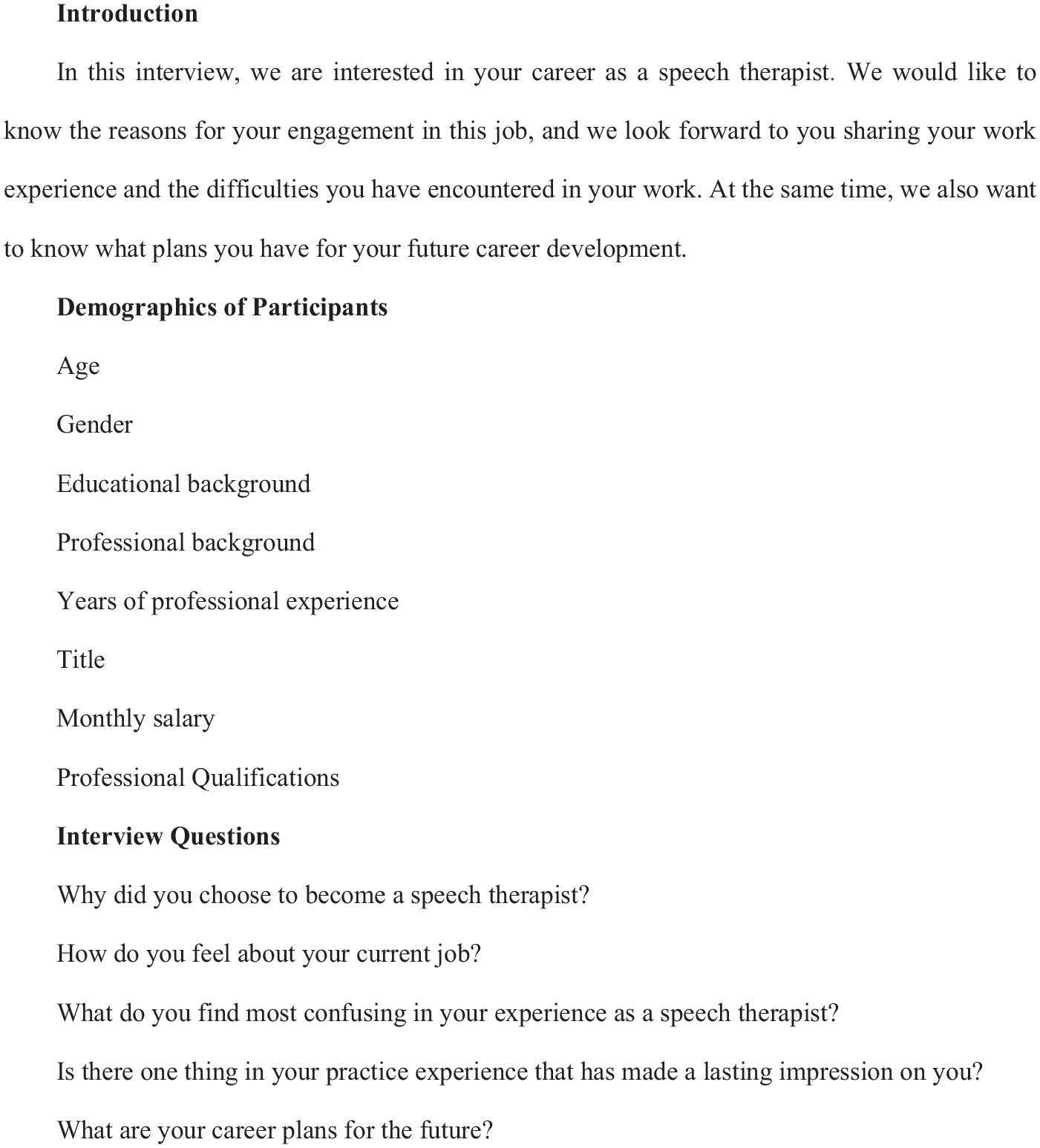
The interview guide.
Data Collection
We recruited participants from three tertiary hospitals in Shandong Province. Before conducting formal interviews, interviewers introduced the purpose of the interview to the interviewees and obtained their written consent. Participants were invited to share their reasons for choosing the profession of SLPs, their experiences in the field, and to discuss their career expectations based on these experiences.sss
Homogeneous sampling is a common purposive sampling method (Patton, 2014). Our inclusion criteria are: (1) formal employees of the hospital; (2) full-time clinical practitioners specializing in pediatric speech-language therapy; (3) non-administrative and non-management personnel. We recruited 28 participants (see Table 1), including seven males and 21 females. The participants’ ages ranged from 22 to 48 years, with an average age of 29.9. All 28 participants held at least a bachelor’s degree, with two possessing master’s degrees. Their professional backgrounds encompassed Rehabilitation Medicine, Special Education, Preschool Education, Pedagogy, Chinese language and literature, Landscape Architecture, and Art Education. The participants had varying years of work experience, from 1 to 13 years, with an average of 5.3 years. Among these 28 participants, one held the title of intermediate therapist, 16 were junior therapists, and 11 did not possess a professional and related title. Salaries ranged from 2,000 to 10,000 RMB, with an average of 4,236 RMB.
Participant Characteristics (N = 28).

Note. Relevant professional qualifications only include certificates issued uniformly by the state. Training organized by institutions or units is not included.
We collected data through audio recordings, obtaining a total of 28 segments. Each interview lasted between 15 and 35 min, totaling 704 min. Data reached saturation at the 23rd interview, where no new information emerged (Guest et al., 2006). Subsequently, upon the emergence of redundant information from participant responses, further recruitment for interviews was discontinued. To ensure the reliability of the survey, we interviewed five participants to validate the absence of new information (Boddy, 2016).
Data Analysis
Utilizing inductive content analysis, this study aimed to provide a detailed description of Chinese SLPs’ perceptions and experiences regarding their professional identity. This method enabled the presentation of authentic, qualitative insights into Chinese SLPs’ perspectives and experiences of their profession. Through systematically analyzing the coded data, it offers a comprehensive understanding of the current status of professional identity among Chinese SLPs.
Throughout the data collection and processing phases, we adhered rigorously to relevant privacy protection regulations and ensured the anonymization of all participants’ personal information. All collected data were securely stored, accessible only to the research team during the study period, and were disposed of by relevant regulations upon completion of the study. Furthermore, we provided participants with a comprehensive explanation of the study’s objectives, data usage, and confidentiality measures, ensuring that participation was voluntary and based on a full understanding of the procedures.
To ensure reliability and validity, three authors independently transcribed the corpus and imported all textual information into Nvivo 11.0 for open coding. During the data coding and analysis process, a multi-round review and verification mechanism was implemented to ensure consistency and accuracy. Transcription and coding results from 30% of the data were compared between two authors, yielding a similarity rate of 91%. Any discrepancies were re-coded by a third author, and the final decisions were made collectively through discussion among all three authors. Categories were also adjusted based on the specific context as necessary. Additionally, all researchers reviewed and evaluated the coding, and further revisions were made as needed (Mayring, 2019).
In this study, sentences were designated as the unit of analysis (Elo et al., 2014). Subsequently, the open coding was categorized into different sub-themes. Finally, sub-themes with the same category were grouped into four main themes (see Table 2).
Key Themes and Subthemes.

The identified themes and sub-themes underwent thorough discussion among all authors. Simultaneously, we repeatedly assessed the corpus, reflected on the analysis process, and revised the codes and categories when needed to ensure the credibility of this study. The subsection will present a comprehensive overview of all themes and sub-themes.
Results
Five major themes and 13 sub-themes that were mutually exclusive were identified (see Table 2), which will be elaborated on in the following sections.
Motivation for Employment
Motivation for employment is a key factor influencing the professional identity of practitioners. In our interviews with 28 participants, their employment motivations exhibited diverse and complex characteristics, which can be categorized into three types: active choice, passive choice, and passive-active choice.
Active Choice
Active choice reflects the participants’ enthusiasm and pursuit of their profession. Some respondents indicated that they actively chose the career of SLPs based on their professional background and interests. They hoped to use their professional knowledge and skills to help children with special needs, and this internal drive firmly led them to choose this profession. For example: “I felt that there is a specialty dedicated to this technique, and I felt that I should learn about it and see if I could make a difference in this area.” (P15) “Just do this work with a passion.” (P6)
In addition, some participants expressed that their choice to engage in speech-language therapy is inseparable from their personal experiences. They have personally experienced the troubles and challenges brought about by speech-language and social communication disorders. These experiences have deeply impressed upon them the negative impact of such obstacles on individuals and families, thus igniting their determination to engage in language rehabilitation work. For example: “It’s because my son is atypical, and later I opened my own institution, and now I have been employed in the hospital.” (P7) “I just feel that this is a doctor’s responsibility, including the fact that I, myself, am a disabled person.” (P9)
Passive Choice
Passive choice reflects the compromises made by some participants in the process of employment. Some participants mentioned that they were directly assigned to their positions during departmental adjustments by their superiors, without much opportunity or autonomy in choosing. Most of these interviewees had transitioned from other professions such as occupational therapy (OT), physical therapy (PT), early childhood education teachers, special education teachers, etc.
“At first, I didn’t start out doing speech-language therapy; I was transferred from another position.” (P8) “I entered the hospital because they were implementing early education programs, but since the early education program didn’t go smoothly, I was transferred to a special education position.” (P21)
Passive-Active Choice
The passive-active choice is a more complex type of motivation. Some participants indicated that their current engagement in this profession is a combination of passive and active choices. Deciding to pursue a career as a SLP was influenced by external factors and thus the passive aspect was emphasized. However, unlike a purely passive choice, these external factors not only compelled participants to change careers but also provided them with multiple options. In this context, the practitioners actively selected the profession of speech-language therapy from a range of alternatives, thereby incorporating an active element into their decision. That is to say, within the context of hospital and departmental reforms and adjustments, participants actively adapt to the organizational changes and engage in the work of children’s speech and language rehabilitation, as exemplified by the following statements: “Currently in our workplace, there is actually a greater need for SLPs, specifically in our field.” (P1) “Because in terms of the speech aspect for children, their articulation and such, I feel that the effects might be more noticeable compared to other forms of physical therapy.” (P4)
Furthermore, with the shift in traditional medical rehabilitation concepts, parents are increasingly valuing children’s language and communication abilities. In order to meet this growing demand, institutions have introduced relevant intervention courses. Some participants mentioned that they recognized this market demand and professional development trend, and therefore actively catered to the practical needs of parents. Against the backdrop of hospital reforms, they transitioned from other rehabilitation disciplines into speech-language therapy, as illustrated by the following statements: “It means that parents have this demand, and the institution takes advantage of the situation and sets up these classes.” (P2) “Some parents would raise this issue, and I’ve heard so many people say, ‘can’t you specialize in speech-language therapy?’ We start adding extra classes again.” (P12)
Occupational Cognition
Occupational cognition, as the bedrock of professional identity, encompasses various dimensions including job content, values and responsibilities, and role orientation. It serves as a fundamental element in shaping an individual’s professional identity. The cognitive framework of participants regarding their occupation is characterized by three key dimensions: work content, values and responsibilities, and role orientation.
Work Content
In-depth interviews have shown that all participants had a clear understanding of their work content. They not only accurately grasped the core work of SLPs, such as assessing and intervening in speech-language disorders, communication and social disorders, in order to improve the children’s phonological abilities and develop their phonological and pragmatic language skills, but also paid keen attention to the needs of parents as an integral part of their work.
Although participants did not frequently use terminology such as speech-language disorders, communication disorders and social disorders, their narratives clearly reflected these priorities. They are committed to helping people with speech-language disorders through a variety of intervention and helping children with special needs gradually overcome communication problems and better integrate into society through various interventions. Such as: “I think the first thing is that the child should be taught a correct pronunciation…If that child his oral language skills are developed, it should be more about teaching the child how to socialize, how to use the language to communicate and socialize with people.” (P1) “We use medical and educational methods, including techniques in medicine and education, to help them with pronunciation, language formation, language development, and subsequently facilitate communication and interaction.” (P11)
The role of the parent is equally important in their perception of the profession. A few participants specifically pointed out that their work was not only limited to the children themselves, but they also needed to be sensitive and responsive to the parents’ emotional changes and to alleviate the parents’ anxiety and stress with their professional attitudes and skills, so as to create a more harmonious and supportive rehabilitation environment for the children. As: “Being a teacher is not only about educating the child, but it is also important to psychologically counsel their parents.” (P3) “It is important not only to educate the child, but also to counsel their parents, and even to guide a family on educational methods.” (P14)
Strong Sense of Mission
Sense of mission is another indispensable component of occupational cognition, closely linked with participants’ professional values, jointly forming the core of their career choices and work motivation. Through in-depth interactions with the interviewees, the majority of participants clearly expressed their ultimate goal in work to help children achieve life independence, better engage in social activities, and gradually integrate into mainstream society. For example: “Everything we do is for the children, to help them gradually become self-sufficient individuals.” (P1) “Helping patients improve speech and language issues, enhancing their communication abilities, enabling them to better participate in social activities.” (P13)
Furthermore, a few participants also discussed the allure of the profession based on personal experiences. They believe that through their work, they can effectively enhance the quality of life for children and their families, bringing positive changes and profound impacts to their lives. For instance: “I hope to help these families undergo a more positive transformation.” (P7) “It’s about making life better and of higher quality for these individuals with disabilities.” (P9)
Complex Characterization
Due to the diverse professional backgrounds of the participants, they present a “seeking common ground while preserving differences” attitude in their professional role positioning. Some consider themselves as special “teachers” belonging to the education system, while others see themselves as belonging to the medical and health field. However, they all clearly identify special populations or non-healthy populations as their service targets, demonstrating a high degree of consistency in role positioning. For example: “SLPs are a special group of ‘teachers’ who are teachers for the recovery of language disorders, communication disorders, and social disorders." (P20) “In fact, therapists are not doctors, nor teachers, but belong to the health field as special education professionals.”(P8)
The Sense of Belonging
The sense of belonging, as a core manifestation of professional identity, presents a complex and subtle state in the narratives of the participants.
Higher Self-Efficacy
As the most direct manifestation of SLPs’ work, the recovery effects and significance of children’s progress directly impact the participants’ self-efficacy. Specifically, during the speech-language therapy process, participants can gain a higher sense of self-efficacy, whether facing breakthrough progress or subtle improvements in children. For example: “If you look at these children, many of them have made progress, which makes you feel that this job is meaningful.” (P1) “When I see a child go from not speaking to calling out ‘mom’, I feel immensely proud, that is a sense of achievement.” (P5)
Furthermore, this self-efficacy stems from the satisfaction brought by the work itself and the recognition from parents and positive feedback on the recovery effects of the children. Participants expressed that when parents observe significant improvements in their children, such as enhanced language expression and increased social interaction, they often express genuine gratitude and appreciation for their work. For instance: “‘Dear Miss. Li, I feel like my child has improved a lot since coming here’, even though it’s just a simple sentence, it makes me feel that my efforts are worthwhile.” (P8) “But when you see that your efforts have some effects on the children, and then the parents acknowledge it, it gives you a high sense of happiness.” (P17)
Positive Work Environment
A positive work environment is crucial in shaping the participants’ sense of professional belonging. Specifically, a harmonious work atmosphere, abundant professional development opportunities, and a relatively stable job nature collectively constitute strong support. A harmonious work atmosphere is the most commonly mentioned factor when participants talk about the work environment, such as: “The work atmosphere and job nature match my expectations.” (P10) This atmosphere mainly originates from the care and support of their leaders, as well as positive interactions among colleagues. For example: “Leaders will actively approach you to have a heart-to-heart talk, understand your work situation, ask if there are any potential issues, or if you are facing any difficulties in life.” (P2) “We have teaching and research every week. For example, during the period when classes were suspended due to the pandemic, we would revise our lessons. One teacher would simulate a child in class, and after the lesson, another senior teacher would give us guidance and suggestions.” (P7)
Additionally, participants mentioned that the workplace provided ample learning opportunities and platforms through external expert lectures and organizing speech-language therapy training sessions outside, aiming to enhance participants’ professional skills and knowledge. For instance: “In fact, our leader has put a lot of effort into external training, regardless of coordinating funds from various aspects, he has done a great job.” (P6) “Our workplace is actually pretty good, because in the past two years, due to the epidemic, we didn’t invite experts. This year, expert lectures and training were organized for us.” (P16)
Furthermore, all participants are working in medical system. The stable work environment of hospitals provides strong security for their professional development. They generally express a high level of stability in their work, which relieves them from excessive worries about livelihood issues. For example: “I think having a stable job is not easy, you don’t have to worry too much about survival.” (P12) “Because this job is relatively stable.” (P18)
Occupational Challenges and Stress
Occupational challenges and stress are inevitable realities that participants encounter. These challenges and stress mainly stem from negative feedback, such as slow or obstructed progress of children, lack of recognition from parents for the work, as well as unreasonable work conditions concerning class hours, salary levels, and career development paths.
Negative Work Feedback
Given their unique characteristics, children may find it challenging to cooperate with therapists to complete intervention tasks. Consequently, participants frequently need to demonstrate increased patience and effort, yet the outcomes may not meet expectations. The majority of participants highlighted that therapists commonly encounter negative emotions, such as frustration, when confronted with these scenarios. For example: “This child sits across from you, no matter what you do, he won’t look at you. It’s a bit frustrating; you’ve tried everything, but he just wandered as if his soul had departed.” (P1) “But some children may have difficulty making progress, or the progress is not obvious. Parents may be slightly dissatisfied, although they may not express it explicitly, but teachers can sense it. But some children do lack the ability despite the desire.” (P13)
After a period of intervention, due to individual differences, delayed adjustments to the rehabilitation plan, or external factors, there may be little or no progress, leading to frustration and anxiety among participants. For instance: “For a period, I felt this child had reached a bottleneck, which made me quite depressed.” (P12) “If a child is stuck in a bottleneck, I will feel anxious.” (P18)
High expectations and misunderstandings from parents also contribute to participants’ feelings of frustration and helplessness. The ultimate goal of language rehabilitation is to help children reintegrate into mainstream society. While means to assist children in communicating before they can speak verbally are considered by therapists, parents’ excessive focus on verbal expression and rejection of other forms of communication can be challenging. For instance: “I went to learn that communication system with the help of pictures, and later I also thought that I could hold a class or that I could teach parents to make something for their children, but they didn’t seem to be very receptive to it.” (P4) “Even though it’s for the good of the child, using these methods, adopting these educational concepts, teaching the child, some parents may say they don’t agree with you.” (P22)
Furthermore, the progress of children varies individually, closely related to their intellectual and cognitive levels as well as speech organs. If a child’s abilities are severely limited, their progress may be slow and imperceptible in the short term, leading to parental dissatisfaction with the current intervention effects.
“We don’t get the parents’ understanding, um, we don’t get their support… we’re also anxious.” (P1) “Parents may say, they gave you a negative score as soon as they saw it.” (P13)
Unreasonable Work Conditions
Unreasonable work conditions significantly impact participants’ professional identities, characterized by overloaded work hours, inadequate salary levels relative to effort, and unclear career development paths. The overloaded class hours pose a significant challenge for participants. Due to a severe shortage of SLPs in China and a serious imbalance in the ratio of SLPs to children, therapists often bear a heavy workload. Tight class schedules make it difficult for them to find a balance between work and personal life. Prolonged work not only exhausts SLPs physically and mentally, depriving them of sufficient rest and relaxation time, but can also lead to injuries and illnesses, as expressed by participants: “The amount of classroom time is larger than general education, and that wears us out.” (P11) “I got chronic pharyngitis because of the amount of class time per day.” (P23)
Additionally, low salary levels are another crucial manifestation of unreasonable work conditions. Despite investing significant effort and time, participants’ salaries often do not match their contributions. Many participants mentioned dissatisfaction with their salary and performance mechanisms, indicating low wages.
“It’s dissatisfaction with affirmation and performance, the pay is so low.” (P5) “Dissatisfied with the unit, dissatisfied with the salary.” (P23)
Moreover, unclear career development paths leave participants feeling confused and worried. As stated by P4, “As a teacher working in the medical system, everyone is most concerned about the issue of professional titles.” Participants come from diverse professional backgrounds, but the existing medical system’s promotion system only caters to practitioners with medical backgrounds, leaving non-medical participants feeling that “there is no hope for promotion (P5)” and “no promotion opportunities (P23).”
Future Career Planning
Future career planning is a significant aspect of practitioners’ professional identity in their career behavioral tendencies. Participants exhibit varying attitudes toward career planning: the majority are actively engaged in self-improvement and expect external assistance, while a minority express potential contemplation of resignation.
Self-Initiated Improvement
Most participants demonstrate a proactive professional attitude, recognizing a need for improvement in both theoretical knowledge and practical skills. As a result, they actively seek various learning opportunities to enhance their capabilities through continuous learning and practical experience. For example: “In terms of personal development, I think there is a need for updating concepts, and of course, teaching skills urgently need improvement.” (P1) “I should put more effort into learning.” (P15) “Enhance myself through part-time postgraduate study and action research.” (P20)
Furthermore, although current laws and regulations, industry standards, etc., have not yet specified which type of qualification certificate can be used to assess and classify the professional skills of SLPs, obtaining qualifications and certification such as special education teacher, SLP, primary (intermediate, advanced) therapist, is considered by participants as an important means to enhance personal competitiveness. For instance: “In the future, I can still obtain some other certificates.” (P7) “Will take exams and learn.” (P19)
Expectation of Support from the Organization and Relevant Departments
In addition to their own efforts, participants commonly mention their expectation of support from their organizations and relevant departments. They believe that the support of the organization and relevant departments is a crucial external factor in driving personal career development. Among these, providing more training and learning opportunities is the most anticipated form of support by the participants. They generally believe that by participating in professional training and learning courses, they can systematically acquire the latest theoretical knowledge and practical skills, thereby enhancing their work abilities. For example: “Provide us with more opportunities for off-site learning. Like training, the exchange between hospitals is also a learning opportunity.” (P3) “Hold more practical and targeted training seminars.” (P9)
Additionally, valid professional qualification certificates can provide strong support for participants’ career development. Most participants hope that their organizations and relevant departments can issue valid and universally recognized professional qualification certificates. For example: “I think it’s important to issue some convincing certificates to us.” (P1) “Establish more professionally oriented qualification certificates.” (P10)
Participants’ emphasis on career development is reflected in their pursuit of personal skill enhancement, and in their expectation of organizations or relevant departments to give them full attention and support for their professional growth. At the core of this expectation is the desire for more open channels for title promotion and clear opportunities for advancement. For example: “I hope the education bureau can provide some title quotas for rehabilitation teachers in hospitals.” (P9) “I hope the organization can provide more opportunities for promotion to novice and veteran teachers.” (P23)
Resignation
However, there are also very few participants who indicate a possibility of considering resignation. This is mainly due to career anxiety, stress, and other reasons. They may seek other more challenging opportunities within the same industry or transition to another industry through examinations, among other means, in search of better career development prospects. For example: “It’s just that the pay is too low, so I am considering leaving.” (P5) “If there is an opportunity, I will try the civil service exam. I don’t want to do this anymore; it’s too oppressive.” (P22)
Discussion
This study showed that the professional identity of Chinese SLPs exhibited complexity, with individuals experiencing mixed feelings toward their profession, leading to a state of ambiguous identity characterized by both identification and non-identification. This complexity was primarily reflected in two main aspects: while therapists possessed a deep understanding of their profession, actively chose it, and exhibited a strong sense of self-efficacy in their work, they also faced challenges, such as limited career development opportunities, difficulty in receiving positive feedback, and unreasonable work conditions, resulting in a sense of uncertainty and confusion in their professional identity. This diverse and complex identity state influenced the professional behaviors of therapists and impacted the healthy growth of the speech-language therapy industry.
This study demonstrated that SLPs were situated in an environment full of contradictions in China, seeking social recognition while often facing misunderstanding in reality, resulting in a state of ambiguous professional identity. Similar to professions such as occupational therapists and teachers, the humanistic nature of the speech-language therapy profession strongly appealed to practitioners (Osborne et al., 2024). Motivated by personal interests or prior experiences, they opted to pursue this career and actively involved themselves in evaluating and addressing speech disorders, language impairments, and communication and social interaction challenges as core facets of their practice (Fitzgerald, 2020). SLPs delivered tailored language services for children with special needs utilizing their expertise while compassionately considering the requirements and circumstances of the children’s parents, aiming to assist children and their families in overcoming obstacles and imbue the field of speech-language therapy with profound significance. This empathetic approach echoed the caring practices observed in studies of nursing staff and special education educators (Yazdannik et al., 2012). Moreover, the successful progress of children’s therapy that met SLPs’ expectations and the acknowledgment of SLPs’ unique contributions to children’s well-being by parents were crucial sources of therapists’ self-efficacy and played a pivotal role in shaping their professional identity (Beita-Ell & Boyle, 2020; Gold & Gold, 2024). This viewpoint was similar to the studies of professions such as music therapists and occupational therapists (Byers & Meadows, 2022; Walder et al., 2022). However, despite their dedication, SLPs’ endeavors did not always lead to significant outcomes, and they might not always receive the understanding and support they seek from parents, presenting challenges to their professional identity.
The contradictions encountered by SLPs might stem from the current state of the speech-language therapy industry in China. China grappled with a significant scarcity of professional SLPs. Although there are currently 206,771 certified SLPs in the United States (ASHA, 2024), the speech-language therapy industry in the United States continues to face significant pressure. In contrast, in China, the number of SLPs is reported to be below 10,000 (Shi & Yang, 2020). International benchmarks suggested a ratio of 20 SLPs per 100,000 individuals, indicating a need for approximately 280,000 SLPs in China to meet demand. This stark therapist-to-patient imbalance resulted in a shortage of speech-language therapy services, presenting an urgent issue that requires attention. Moreover, compared to the educational experiences and qualifications of SLPs in the United States, this study revealed that most staff in departments lacked backgrounds in speech-language therapy, often transitioning to these roles following brief training periods, and lacking comprehensive professional education and training of speech-language therapy (Ma & Su, 2023). This deficiency impeded their capacity to adeptly manage intricate clinical tasks and effectively engage with parents, potentially casting them as inadequate and incompetent (T. Zhang et al., 2021). Additionally, speech-language therapy remained an emerging field in China, with its developmental stage yet to reach maturity. Public familiarity with speech-language therapy concepts, methodologies, techniques, and tools remained inadequate (Shi & Yang, 2020), potentially impacting the acceptance and efficacy of speech-language therapy services. Consequently, parents might harbor skepticism toward SLPs’ work, find it challenging to embrace all facets, or express discontent due to excessively high or misguided expectations regarding recovery outcomes.
This study showed that when confronted with industry challenges and work pressure, SLPs exhibited proactive inclinations toward professional conduct. They displayed initiative by actively addressing these challenges through continual learning and self-enhancement. This proactive endeavor could enrich therapists’ professional knowledge and bolster their confidence in their work, aligning with the escalating skill requisites and resulting in mitigating professional burnout and fortifying therapists’ professional identity (Kelly et al., 2021). This was different from the previous study that showed negative emotions might hinder SLPs’ personal growth and weaken their sense of professional identity (Gold & Gold, 2024), making it difficult for them to maintain a competitive advantage in the demanding competition (Turner & Knight, 2015). Additionally, the optimistic outlook and proactive endeavors of SLPs in navigating challenges and pursuing self-improvement served as catalysts for elevating the industry’s overall professionalism and SLPs’ professional identity (Atherton et al., 2017). Our research extended the insights of Stansfield (2022) by revealing that the motivational evolution of SLPs transcended mere job satisfaction; professional challenges impelled them to take proactive measures to enhance their professional skills, thereby continually reinforcing their professional identity. This finding underscored SLPs’ proactive and resilient stance in their professional growth, offering a new perspective for a deeper understanding of their professional identity.
Furthermore, this study demonstrated that SLPs encountered significant tensions between career development and job circumstances, exacerbating their conflicted professional identity state. Factors, such as resource allocation in the workplace, working hours, and salary levels, were closely linked to the formation of a professional identity (Cornett et al., 2023). A positive and supportive work environment could foster the formation of SLPs’ professional identity, whereas an unsupportive setting might impede this development. Additionally, in comparison to private institutions, this study showed that SLPs in healthcare settings often benefited from richer resource support and educational opportunities. This milieu offered increased job security (Mu & Li, 2017) and frequently accompanied relatively higher salary levels (J. Zhang et al., 2017). Moreover, the positive interaction network established among supervisors, colleagues, and subordinates within the unit engendered a harmonious workplace atmosphere for therapists, further providing strong support for their career development (Byers & Meadows, 2022). On the other hand, escalating workloads, generally subpar industry salary standards, and deficient career advancement frameworks significantly impeded the establishment of a professional identity among Chinese SLPs. This predicament diminished therapists’ passion and commitment to their vocation and heightened the likelihood of resignation (Skinner et al., 2021). The severe challenge of talent shortages made SLPs shoulder a substantial workload, particularly within the healthcare sector, where extended working hours were commonplace.
The generally low salary levels for SLPs, often falling below the national average wage, did not align with their endeavors, consistent with the results of the surveys conducted in non-healthcare sectors such as civil affairs, disability federations, and education (J. Zhang et al., 2017). In the United States, the median annual salary for full-time SLPs working in healthcare settings is $87,000 (ASHA, 2023). In contrast, the average monthly salary for SLPs interviewed in this study is 4,326 yuan, which corresponds to an annual salary of approximately 50,000 yuan. This figure is lower than the average salary in the healthcare and social work sectors in China (National Bureau of Statistics, 2024) and is significantly below the salary levels for SLPs in the United States. Furthermore, in the United States, full-time SLPs’ salaries tend to increase with years of experience, reflecting the accumulation of professional experience and skill enhancement. Through certification by ASHA, SLPs in the United States can continuously advance their qualifications, which in turn correlates with higher salary levels. In contrast, the certification system for SLPs in China is still under development, and as a result, the link between professional qualifications and salary remains unclear. Moreover, compensation structures differ between the two countries. In the United States, 67% of SLPs are compensated on an hourly or per-session basis, enabling their workload to be directly reflected in their earnings (ASHA, 2023). In contrast, SLPs in China typically receive a base salary supplemented by performance-based pay, which is determined by the number of cases handled. However, the generally lower performance levels in China may restrict the potential earnings of SLPs compared to their counterparts in the United States.
Moreover, professional education and qualifications played vital roles in delineating the professional identity of SLPs and bolstering their sense of professional belonging (Cornett et al., 2023). Nevertheless, the current landscape of the speech-language therapy industry in China was in its nascent phase of rapid expansion, with related disciplines, talent cultivation frameworks, industry entry criteria, and certification standards gradually ameliorating but lacking unified, comprehensive educational management, market entry protocols, and certification mechanisms (Shi & Yang, 2020). This deficiency curtailed the professional advancement of SLPs and impacted their sense of professional belonging.
Practice Implications
Developing a support system that both aligns with international standards and is tailored to the specific context of China is essential for the professional development of SLPs and the sustainable growth of the industry. We propose a comprehensive approach to create a more positive and supportive working environment for SLPs. This approach includes enhancing industry standards, establishing a robust certification system, optimizing clinical supervision mechanisms, strengthening the support provided by academic institutions, fostering deeper collaboration between universities and the industry, and improving the overall working conditions for SLPs.
Firstly, to regulate industry practices and enhance service quality, we recommend that relevant departments and organizations expedite the process of improving industry standards and implement a scientific and standardized certification system. This system should encompass not only the professional knowledge, skills, and practical experience of SLPs but also align with international standards to ensure that their professional competence is widely recognized. Moreover, it is vital to establish a robust clinical supervision system that fosters the continuous improvement of SLPs’ professional skills through regular evaluations, feedback, and guidance. Furthermore, industry regulations should be enforced to ensure that every SLP delivers services with a high level of professionalism and responsibility toward patients.
Secondly, regarding the development of relevant disciplines in academic institutions, we suggest that relevant departments enhance their support through policy incentives aimed at optimizing academic structures, improving the quality of talent cultivation, and expanding enrollment. This approach will contribute to the cultivation of high-level speech-language professionals with international perspectives and innovative capabilities, while also establishing a solid foundation for the long-term growth of the industry. Universities, as key institutions in talent development, should actively fulfill their social responsibilities by forging close collaborations with relevant industry organizations to jointly undertake continuing education, advanced training, and social training programs for SLPs. By adopting diversified training models, these efforts can address the self-improvement needs of therapists, alleviate the shortage of professionals in the industry, and promote the overall advancement of the field.
In addition, hospitals, as the primary workplace for SLPs, play a critical role in creating a positive and supportive work environment. We recommend that hospitals ensure more equitable working conditions by removing biases and restrictions against therapists with non-medical backgrounds, thereby providing them with equal opportunities for professional development. Moreover, it is crucial to refine performance evaluation and professional title promotion systems to ensure that SLPs’ efforts and contributions are adequately recognized and rewarded. These measures will facilitate the creation of a more conducive environment for the career advancement of SLPs.
Conclusion
This study adopted content analysis, a qualitative research method, to conduct an in-depth examination of the current state of the professional identity of SLPs in China’s healthcare system. Compared to studies on professional identity in other occupations, this paper is innovative in proposing the paradoxical state of professional identity among SLPs working with children in China, rather than merely categorizing it as either affirmation or disaffirmation. Additionally, it emphasizes that this situation is closely linked to China’s social system and the current state of development in speech-language therapy. However, professional identity was not merely a static representation at a singular point in time; it embodied a dynamic process that evolved over time. Therefore, future research could scrutinize the developmental mechanisms underpinning the professional identity of Chinese SLPs. In addition, further research could expand the scope of the study to include therapists from other systems, such as education and civil affairs, in order to obtain more comprehensive and in-depth data and perspectives, and a nuanced dataset, enriched with varied perspectives. Incorporating SLPs working with adults into the study would enrich the dataset with diverse perspectives, thereby enhancing our understanding of the dynamics of professional identity among SLPs in China.
Footnotes
Acknowledgements
We would like to thank all participants who participated in this project. This study was supported by the Clinical Neurolinguistics Research Center, Shandong University. The views expressed in this study are only those of the authors and not necessarily those of the institutions.

Ethical Approval and Informed Consent
The School of Basic Medical Sciences Ethics Review Committee at Shandong University University approved our interviews (approval: ECSBMSSDU2019-1-056). Respondents gave written consent for review and signature before starting interviews.
CRediT Authorship Contribution Statement
Xiuxiu Shen: Conceptualization, Formal analysis, Writing-original draft, Writing-review & editing. Shuai Zhang: Conceptualization, Investigation, Methodology, Writing-review & editing. Bingqing Nie and Yanxiang Wang: Data curation, Formal analysis, Investigation. Lu Liu: Project administration, Supervision, Resources, Writing-review & editing. Wen Ma: Funding acquisition, Project administration, Supervision, Writing-review & editing.
Funding
The author(s) disclosed receipt of the following financial support for the research, authorship, and/or publication of this article: This work was supported by the National Office for Philosophy and Social Sciences, China [grant number 22AZD155], Humanities and Social Sciences Youth Foundation, Ministry of Education of the People’s Republic of China (grant number 22YJC740100), and Shandong Provincial Humanities and Social Science Research Project (grant number 2024-QNRC-07).
Declaration of Conflicting Interests
The author(s) declared no potential conflicts of interest with respect to the research, authorship, and/or publication of this article.
Data Availability Statement
The datasets generated during and analyzed during the current study are not publicly available due to informed consent of participants but are available from the corresponding author on reasonable request.