



Abstract
In the 21st century, ABA has gained prominence in educational research in Western countries because of the evidence supporting its efficacy. However, the volume of research and the usage of ABA among teachers of students with ASD in the Kingdom of Saudi Arabia (KSA) remains considerably low despite its popularity in other regions globally. Aims: This study aimed to explore the perspectives and experiences of teachers of students with autism in Riyadh and Jeddah related to the use of applied behavior analysis (ABA) to improve social skills. A qualitative method was used to analyze phenomena under inquiry from two different data points: surveys (n = 51) and interviews (n = 6). Results: The findings of this study revealed that some of the main factors affecting how teachers view and utilize evidence-based practice (EBP) in their scope of practice are refresher training, skills, knowledge, peer support, and institutional policies. Discussion and conclusion were discussed.
Introduction
The occurrence of Autism Spectrum Disorder (ASD) in the Kingdom of Saudi Arabia (KSA) presents a complex and evolving public health challenge. Research studies reveal varied rates, ranging from 3 to 25 cases per 1,000 children, with a consistent male-to-female ratio of 3:1. These figures highlight the nuanced understanding of ASD diagnosis in the region (AlBatti et al., 2022; Fageeh et al., 2021; Sabbagh et al., 2021). Comparative regional data illustrates KSA’s unique position in ASD rates. While lower than rates in some developed nations, the country’s ASD occurrence surpasses those of neighboring Middle Eastern countries, such as Oman (1.4 cases per 1,000), Bahrain (4.3 cases), and the United Arab Emirates (29 cases). This context underscores the growing importance of specialized educational and intervention strategies (Khalil et al., 2020).
Students with ASD characteristically experience significant challenges in social interaction, communication, and emotional regulation. Senouci et al. (2021) reported significant social deficits from a young age. Research consistently documents complex behavioral patterns, including low levels of social interaction, disruptive and repetitive behaviors, and emotional dysregulation. These characteristics demand sophisticated, targeted educational approaches and specialized professional expertise (Gangi et al., 2021; Martínez-González et al., 2021; Morris et al., 2021).
Applied Behavior Analysis (ABA) has emerged as a critical evidence-based intervention for addressing the developmental needs of students with ASD. ABA is especially beneficial because it has been shown to enhance communication, socialization, and expressive skills across multiple studies. Gitimoghaddam et al. (2022) note that ABA is most effective when teachers work one-on-one with children to identify and resolve challenges affecting social skill development (Yu et al., 2020; Anderson & Carr, 2021; Ashour & Bagadood, 2022; Rodgers et al., 2021).
The Saudi Arabian educational system has made significant strides in supporting students with ASD. The Right to Education Law, enacted in 2016, and the Right to Education Initiative, introduced by the Ministry of Education in 2017, represent pivotal developments in creating an inclusive educational infrastructure. These efforts reflect a commitment to developing adaptive, responsive learning environments that recognize students’ potential with diverse neurological profiles (Alharbi & Madhesh, 2018; Ministry of Education, 2024). Educational approaches for students with ASD in Saudi Arabia have diversified, offering multiple integration models. These range from partial mainstreaming, where students attend general education classes with support services, to full integration in regular classrooms. This flexible strategy emphasizes personalized learning and comprehensive support systems (Almughyiri, 2021).
Despite progress, challenges persist in implementing effective ABA and inclusive educational practices. Alhossein et al. (2016) reported a consistent research-to-practice gap that impedes teachers’ ability to manage emotional, behavioral, and social disorders associated with ASD. Alghamdi (2021) suggests that while teachers have access to evidence-based practices during their degree programs, there remains a need for ongoing professional development and advanced skills training (Alghamdi, 2021; Alhossein et al., 2016).
The field of ASD intervention continues to evolve, balancing scientific understanding with ethical considerations. Critics have challenged ABA since the 1970s, particularly after Lovaas’s controversial methods involving electroshock therapy. However, Anderson and Carr (2021) contend that contemporary criticisms stem from misconceptions, as researchers have developed more humane and ethical behavioral intervention strategies (Bottema-Beutel & Crowley, 2021; Leaf et al., 2022). This comprehensive overview explores the multifaceted nature of ASD in the Kingdom of Saudi Arabia, examining the intricate relationships between prevalence, education, intervention strategies, and ongoing developmental research.
Research Questions
The research questions underlying this study are as follows:
What are the perceptions and experiences of teachers of students with ASD with ABA interventions in Saudi Arabia?
What factors affect the perceptions of and experiences with ABA among teachers of students with ASD in Saudi Arabia?
How can ABA be mainstreamed as an EBP in the manageming and improveming the challenges in social and communication skills among students with ASD?
Methods
The inquiry into teachers’ perceptions and experiences with Applied Behavior Analysis (ABA) in Saudi Arabia, specifically among teachers of students with Autism Spectrum Disorder (ASD), utilized a qualitative methodology. This approach allows researchers to explore complex social issues and interpret individuals’ beliefs, attitudes, experiences, and interactions. Consequently, nonnumerical data was essential for examining how ABA informs teachers’ approaches to supporting students with ASD. The study incorporated a triad of qualitative research methods (interviews and surveys) to capture these experiences comprehensively. Qualitative research seeks to capture participants’ lived experiences through their own narratives, thereby offering in-depth perspectives. Interviews and surveys, as straightforward methods, allow researchers to obtain data directly related to participants’ insights. I chose these methods to achieve the study’s objectives, mainly to gather in-depth data relevant to the research questions.
Participants, Context, Site, and Scope of the Study
The study was conducted in Saudi Arabia, focusing on elementary special education teachers working with students with ASD in Jeddah and Riyadh, two major cities in the Kingdom. This study aimed to explore the perspectives and experiences of teachers of students with autism in Riyadh and Jeddah related to the use of applied behavior analysis (ABA) to improve social skills. None of the participating teachers held ABA certification.
A total of 51 teachers were selected using a purposive sampling technique, which ensures participants have relevant experience with the topic. These teachers completed an online questionnaire, and their demographics revealed a relatively balanced gender distribution (49% male, 51% female). The majority of participants (41.2%) were between 45 and 54 years, while smaller percentages represented other age groups: 24 years and younger (3.9%), 25 to 34 years (5.9%), 35 to 44 years (29.4%), and 55 to 64 years (19.6%). Regarding educational attainment, 23.5% had college-level education, 47.1% held bachelor’s degrees, 23.5% had master’s degrees, and 5.9% held postgraduate degrees (PhD). Figure 1 displays the demographic breakdown for male and female respondents.
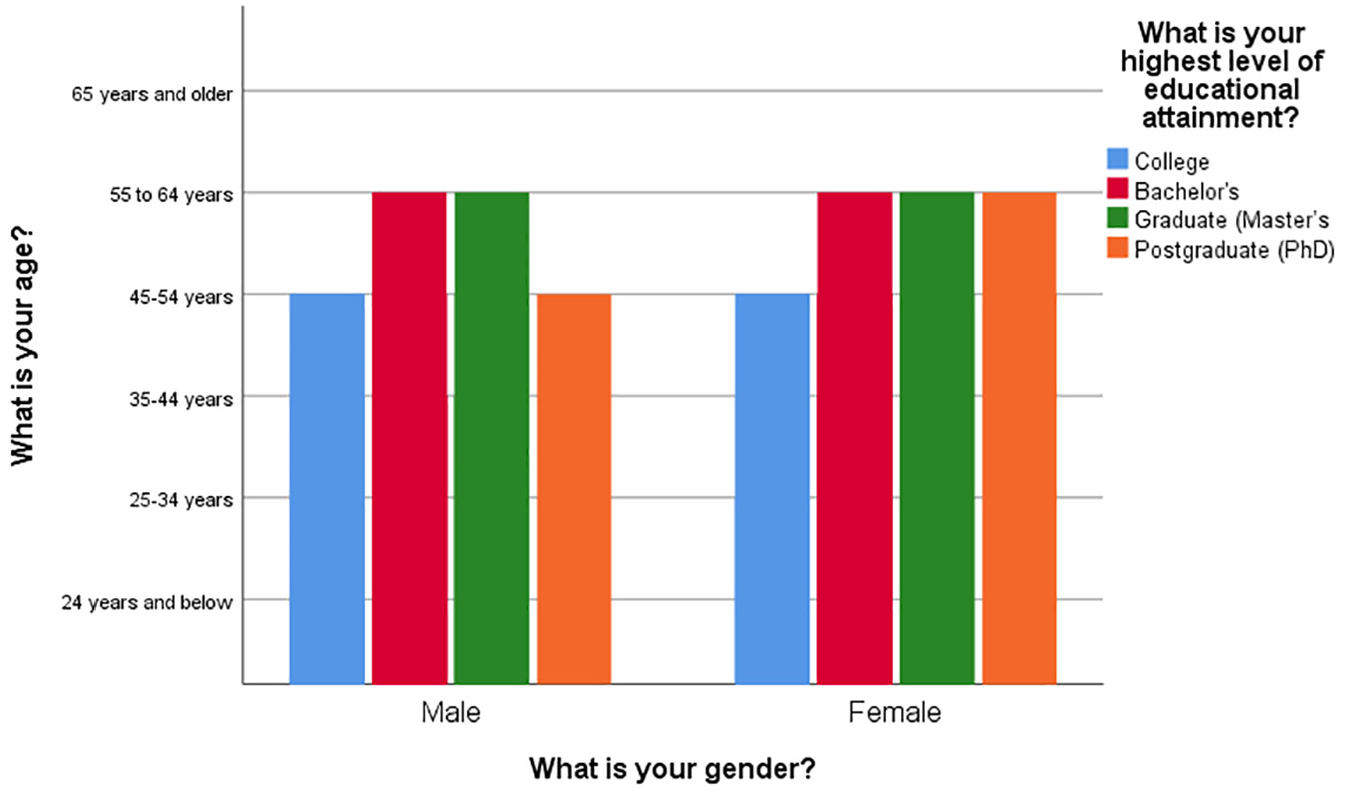
A G-graph summary of participant’s demographic data.
The purposive sampling method was critical for selecting participants capable of providing detailed insights into ABA. Advertisements and invitations were shared on social media and with special education programs in Riyadh and Jeddah. Eligible participants included teachers who had worked with students with ASD for at least 6 months within the previous 2 years and were 18 years or older. Gender, school type (public or private), and educational level were not exclusion factors. Screening processes helped increase the study’s rigor and reliability. Individuals under 18, those without sufficient experience, and those whose work extended beyond Jeddah and Riyadh were excluded. Figure 2 summarizes the participant screening process used to recruit 51 respondents to the study.

Participant selection process.
Data collection
I collected data in two phases, following the triad of qualitative research designs outlined earlier. In the first phase, successful recruits completed a questionnaire on the SurveyMonkey platform via an emailed link. In the second phase, I conducted semi-structured interviews with six of the 51 participants. I selected the interviewees through purposive sampling based on their ability to provide relevant and in-depth insights into issues arising from the questionnaire. Questionnaires and interviews are reliable data-gathering tools in qualitative research because they facilitate the collection of specific and targeted responses.
Data Analysis and Trustworthiness
The data analysis methods used to scrutinize the data were complementary even though they varied from one dataset to another. Responses to the questionnaire were synthesized via a color-coded thematic approach using the qualitative data analysis software Nvivo by QSR International (NVivo—Powerful research, simplified. (n.d.)). I presented the data analysis phase results as a word cloud, mind map, and snippets of responses derived from the study population.
To enhance the credibility of this research, I employed member checks and thick descriptions. To improve credibility, validity, and trustworthiness. I used member checks, where participants reviewed the transcriptions and results to confirm data accuracy (Creswell & Miller, 2000). After analyzing the data, I shared the transcripts and study materials with participants for review. Participants provided feedback, which I then incorporated into the study.
Results
Understanding of Social Learning Processes and EBPs
First, I asked the participants about their understanding of social learning processes and the use of EBPs in managing or improving the social functioning of students with ASD. I then summarized the responses using a color-coded thematic analysis technique. This study aimed to explore the perspectives and experiences of teachers of students with autism in Riyadh and Jeddah related to the use of applied behavior analysis (ABA) to improve social skills. Based on the responses, the participants generally perceived socialization as integral to learning for all students, not just for students with ASD. The recurring themes in their responses to question 5 (appreciating the role of social learning processes among students with ASDs in the questionnaire included “communication,”“cooperation,”“disruptions,”“enjoy,” and “play.” One of the respondents stated that social skills “help my students communicate with me and their peers whenever they learn something new.” Another added that “disruptions are few when students develop advanced social skills because they can cooperate with the teacher and other students in the classroom.” His views were complimented by another respondent who indicated that teachers perceive the role of social skills positively “because they help students with ASD to play with their friends and enjoy learning.” A review of all responses to the questionnaire helped me establish the benefits of using EBPs, such as ABA, to improve the social and communication skills of students with ASD.
Use of EBPs in Managing the Social Functioning of Students with ASD
I then analyzed responses to questions on the role of EBPs in the management and improvement of social skills among students with ASD. Question 6 specifically asked respondents to state the EBPs they had used in class to cope with social functioning challenges among students with ASD. The most commonly mentioned interventions or themes related to the sixth question were “Applied Behavioral Analysis (ABA),”“Functional Behavior Assessment (FBA),” and “Social Skills Training (SST).” However, not all of the respondents had positive perceptions or experiences with EBPs in the management of social functioning among students with ASD. One participant stated that she “had stopped using all recommended approaches after discovering they were ineffective and too standardized for the subjective challenges experienced by students today.” Nevertheless, most of the respondents mentioned at least one EBP, with ABA being the most commonly utilized intervention for students with ASD with social skills challenges.
Experiences with ABA
The seventh item in the questionnaire asked respondents about their experience with ABA over the last 2 years. More than 40 participants stated that they had seldom used the intervention over the given period. However, five of the 51 participants described experiences with ABA as sufficient in the study population. One participant stated that they had used ABA infrequently based on the immediate needs of his students. One respondent stated that “ABA is one of the core EBPs championed by my institution for students with ASD.” They indicated that they use ABA frequently because it is part of their official school policies and pedagogies for students with ASD.
In the eighth and ninth questions, I asked the respondents to state their perceptions of and experiences with training on using ABA for students with ASD. Many respondents reported a lack of institutional or government-mandated training for ABA effectively in students with ASD. One participant stated the following: Despite advancements in ABA for teaching students with ASD, our training program has remained unchanged for over five years. Even though I often read about cutting-edge research on the management of ASD, such novel findings rarely form part of our training. The school administration seems out of touch with new-age pedagogy for students with ASD, especially those with social difficulties. (Questionnaire respondent)
The sentiments were echoed by a participant who stated, “I received more institutional and government support in the implementation of ABA when I taught students with ASD outside of the country than I do now in KSA.” Additionally, one of the respondents reported that “training affects how I view and apply ABA in my teaching practices.” The recurring themes in the responses to the two questions (8 and 9) were “policies,”“current knowledge,” and “refresher training.”
Results from Software-Based Analysis of Interview Responses
I interviewed six of the 51 respondents who completed the online questionnaire. I interviewed five participants online, and one interview was in person. The length of each interview varied. The average length was one hour. I presented the findings to color-coded thematic analysis using NVivo software. Therefore, this section of the results shows the major themes or nodes from the data and selects narratives relevant to the study. The interview scheme was based on the findings from the baseline questionnaire applied to all the respondents. Hence, the interview aimed to derive in-depth insights into the perceptions and experiences of teachers of students with ASD with ABA in Saudi Arabia. The main themes emanating from the interview data included “social learning processes,”“self-directed learning,”“refresher training,”“ethics,”“reinforcement,”“COVID-19”“curriculum,” and “peer-based learning.” Figure 3 visually summarizes the main themes and phrases from the interview data through a word cloud.

A wordcloud of the main themes from the interview data.
Questions 3, 4, and 5 in the interview scheme were related to the perceptions and experience with ABA in managing and improving social skills among students with ASD. The respondents stated in question 3 that they had prior experience with ABA and other EBPs in the last 2 years. However, the most notable trend in their responses to this question was the increased application of ABA after the outbreak of the COVID-19 pandemic. Of interviewee 2, “During the COVID-19 era, the need for social skills interventions has increased,” was echoed by interviewee 3, who contended that “my reliance on ABA has increased in the last 2 years because online learning increased social difficulties among my students further.” Based on the findings, I realized that students with ASD were experiencing unprecedented learning challenges in the pandemic era. All respondents to the interview questions had positive perceptions and experiences with ABA in improving social functioning among students with ASD. However, interviewee 6 stated, “It is effective for some students.” Other participants, such as the fifth interviewee, stated that they usually combine ABA with other EBPs.
In question 5, all respondents except interviewee 5 reported a lack of sufficient or regular refresher training. The fifth participant stated that their school administration had mandated ABA-based training and pedagogy during the COVID-19 pandemic. However, interviewee 3 reported that the lack of refresher training had affected their perceptions of and experiences with ABA. A considerable proportion of the respondents attributed their application of ABA to self-directed and peer-based learning. For example, the second interviewee reported, “I mostly rely on my learning to improve my knowledge and understanding of ABA.” Such views were echoed by the third participant, who contended that “I have mostly relied on my research and peer-based learning to improve my ability to apply ABA to students with challenges in social and communication skills.” The findings indicate that teachers have had to rely on autonomous learning to address skills and knowledge deficits in using ABA caused by a lack of institutional support strategies, such as refresher training.
The sixth and seventh questions focused mainly on teachers’ views and experiences with training on the use of ABA. A survey of the responses to question 6 (Appendix Section “Qualitative Interview Scheme”) revealed that teachers generally had positive perceptions of the role of training in skills acquisition, knowledge transfer, and the application of EBPs. Interviewee 2 emphasized the importance of training and development by stating, “We teachers gain our skills and knowledge mostly through refresher training.” Her views were echoed by interviewee 3, who contended that “Without training, especially regularly scheduled training, we would not be good at what we do.” In question seven, which asked respondents about the training frequency, only one respondent had a positive experience. Interviewee 5 said, “Currently, training is more frequent than before.” The other participants reported a lack of sufficient and regular training on the use of ABA in the improvement of social skills among students with ASD.
The responses to question 8 indicated that none of the teachers had any concerns with the ethical foundations of ABA. They mostly emphasized that the moral value of EBP depends on its subjective implementation and the strategies that teachers use to reinforce behaviors. Interviewee 1 stated, “I have learned that any intervention can be ethical or immoral based on the practical strategies used in its implementation.” Therefore, ethics was not one of the main factors affecting the perceptions and experiences of teachers of students with ASD in the KSA regarding the use of ABA. Figure 4 summarizes the main factors affecting the perceptions and experiences of teachers of students with ASD with the application of ABA in the KSA.

A mind map of the main themes and factors affecting teacher’s perceptions and experiences.
The answers to questions 9 and 10 attributed the widespread application of ABA to peer-based learning. A proportion of the respondents indicated that they rely extensively on the skill and knowledge-sharing frameworks among their fellow professionals. For example, interviewee 5 reported, “Since our training, peer discussions have become common. We talk and share ideas frequently in the teacher’s lounge.” Additionally, interviewee 4 stated, “I am increasingly meeting people who know, are applying, and are willing to discuss the strategy.” The views indicated that peer-based learning was integral to applying ABA in the KSA. Interviewee 4 asserted, “I have already started telling my friends in other schools about ABA. Therefore, yes, I would” in response to their plans to share skills and knowledge with other teachers if they had trained sufficiently. A generalized summary of the responses to question 10 revealed a willingness among participants to sustain peer-based learning for the benefit of other teachers applying ABA.
Institutional Barriers to Implementing Applied Behavior Analysis in schools
In this step, I mainly observed the role of institutional support in applying ABA. During my week-long visit to the programs, I asked teachers about their role in determining the pedagogical approaches they applied. One respondent respond that the school’s academic committee reviews the practices and EBPs they are allowed to apply in class because the administration is determined to avoid costly lawsuits by all means necessary. Even though she has worked at the institution for over 5 months, she has yet to utilize ABA because the approach is still under review before approval. She qualified for inclusion in the study based on her experience in the past year at another school. Another teacher stated that schools rarely regularly train teachers on using EBPs for students with social skills challenges and disruptive behaviors. However, the school administration promised to review its policies and grant them greater autonomy in pedagogy in the next year. In one of the class sessions, one teacher had to retract his offer of additional time to a student for communicating and collaborating with a classmate during playtime. The reward, which would have reinforced prosocial behavior through the ABA, directly contradicted the school policy against preferential treatment. Therefore, institutional barriers and policies, such as the ABA, were noted as significant obstacles to the implementation of EBPs, such as ABA.
Discussion
The first objective of this research was to establish the perceptions and experiences of teachers in Saudi Arabia. Mainly, I wanted to establish the following:
1. What are the perceptions and experiences of teachers of students with ASD with ABA interventions in Saudi Arabia?
An analysis of data collected from participants in Saudi Arabia indicated that teachers of students with ASD generally have positive perceptions of and experiences with ABA. The findings correspond with literature on the application of EBPs in Saudi Arabia and other regions of the world. Multiple studies have documented the use of ABA as an effective EBP to improve the social skills of students with ASD (Yu et al., 2020; Anderson & Carr, 2021; Rodgers et al., 2021). The results from the data analysis revealed that teachers were aware of the efficacy of ABA. Additionally, teachers’ understanding of the correlation between social learning processes, well-being, and academic achievement demonstrated that they understand the importance of EBPs, such as ABA, in the improvement of social skills among students with ASD (Bolourian et al., 2021; Bradshaw et al., 2021). The perceptions and experiences of ABA were so strongly optimistic that the lack of institutional support did not impede teachers.
For the second research question, which was scrutinized thoroughly through data triangulation, I wanted to investigate the following:
2. What factors affect the perceptions and experiences with ABA among teachers of students with ASD in Saudi Arabia?
A lack of skills, knowledge, and training was a recurring theme when I asked the participants to identify the main factors impeding the implementation of ABA. These findings corroborate the literature and indicate that teachers lack of sufficient institutional support and training in implementing EBPs for students with ASD (Bottema-Beutel & Crowley, 2021; Leaf et al., 2022). According to Ashour and Bagadood (2022), their study on the perceptions of ABA in Saudi Arabia revealed that many special education schools in the country have failed to include ABA as part of their curriculum and recommended pedagogies despite the plethora of evidence of its efficacy.
The third research question sought to identify and describe the following:
3. How can ABA be mainstreamed as an EBP in the management and improvement of social functioning among students with ASD?
I established that the participants used learning approaches extensively to address the lack of training and institutional support. The findings showed that teachers’ perspectives and experiences with ABA improved when they relied on peer information-sharing networks. Professional collaborative frameworks improve the pedagogy and experiences of students with ASD by facilitating the efficient dissemination of EBPs (Anthony & Campbell, 2020; Holmqvist & Lelinge, 2021). The effectiveness of peer-based learning among teachers can be enhanced by including parents and students in their collaborative frameworks (Vlcek et al., 2020). Consequently, professional networks can complement official school and government policies on implementing ABA.
Practice Implications
The findings have significant practical implications because of the close relationships between perceptions and practice unearthed from the findings. The respondents in the study reported feeling “anxious” and “lost” because of the insufficient institutional support and training offered to teachers of students with ASD. A lack of training and development opportunities for using ABA affects teachers’ perceptions, practices, and motivation (Tantawy, 2020). In the future, teachers should receive regularly scheduled refresher training designed to improve their ability to apply EBPs to students with ASD and ABA-certified programs. ABA should be the preferred intervention for children with ASD, especially those with challenges in social and communication skills, because of its proven efficacy.
Practical Implications of ABA in Saudi Arabia
The discussion on practical implications, mainly focusing on policy and training, is essential to effectively implement Applied Behavior Analysis (ABA) for students with autism in Saudi Arabia. The following insights will underscore the relevance of this study and its potential impact on educational practices and support for students with autism.
Certification and Accreditation
Developing clear certification standards is crucial for ensuring high-quality ABA services. Policy reforms will create rigorous professional credentials that validate the skills and knowledge of educators working with students with ASD. These standards will help guarantee that professionals can effectively support and interventionally assist students with autism (Ashour & Bagadood, 2022).
Curriculum Integration
Expand and modify teacher preparation programs to incorporate ABA principles systematically. This integration will equip future educators with the tools to implement ABA strategies in their classrooms (Alexander, Ayres, Smith, 2015).
Collaboration for Access
Improving nationwide access to ABA services requires cooperation between government and educational institutions. Current challenges include a shortage of trained professionals and limited service availability in rural areas. By working together, stakeholders can develop strategies to overcome these barriers and expand behavioral support (Alhossein, 2021; Almughyiri, 2023).
Ongoing Professional Development
Implement regular refresher training and professional development workshops for current educators, ensuring they remain informed about the latest research and methodologies in ABA ( Alexander et al., 2015).
Support Networks
Establish mentorship and support networks for educators, allowing them to share experiences and best practices in applying ABA techniques (Almughyiri, 2021)
By focusing on these policy and training initiatives, Saudi Arabian educational settings can enhance the effective implementation of ABA, ultimately benefiting students with autism. These changes will improve individual educational outcomes and create a more inclusive and supportive educational system.
Conclusion
The findings indicate that teachers’ perceptions and experiences with implementing ABA vary significantly. Some main factors affecting how teachers view and utilize EBPs in their practice are refresher training, skills, knowledge, peer support, and institutional policies. The respondents surveyed in the research reported that they rarely received assistance from policymakers or institutional leaders in applying ABA. In the future, allocate resources for refresher training and research applying Applied Behavior Analysis (ABA) to students with Autism Spectrum Disorder (ASD) in Saudi Arabia.
Footnotes
Appendix

Funding
The author disclosed receipt of the following financial support for the research, authorship, and/or publication of this article: The author extend his appreciation to Prince Sattam bin Abdulaziz University for funding this research work through the project number (PSAU/2025/02/32768).
Declaration of Conflicting Interests
The author declared no potential conflicts of interest with respect to the research, authorship, and/or publication of this article.
Data Availability Statement
Data sharing not applicable to this article as no datasets were generated or analyzed during the current study.