




Abstract
Access to quality education is crucial for children from different social strata to achieve upward mobility. Understanding how family income differences translate into disparities in academic achievement is increasingly urgent amidst rigid social stratification. This study focuses on families from various income levels, exploring the relationship between parental income and children’s academic performance. Through in-depth interviews with parents and grounded theory analysis, it identifies four core categories: “economic resource endowment” “cultural capital” “emotional attitudes” and “social resources.” This study finds that high-income parents can provide high-quality educational resources, foster a positive family environment, offer ample emotional support, and integrate social networks. These factors contribute to their children’s academic development. Conversely, low-income parents often lack these advantages, hindering their children’s academic performance. However, the study reveals this relationship is not deterministic, as evidenced by cases of academic success in low-income families and underperformance in high-income ones. This underscores the importance of cultural capital and personal motivation alongside economic factors. This study constructs a multidimensional impact model of parental income levels on children’s academic achievement, revealing how income disparities create educational inequalities. Addressing these disparities requires collaborative efforts from the state, society, schools, and families to create a more equitable educational environment. This study enriches research on the factors influencing educational attainment and offers guidance for promoting educational equity.
Introduction
Education has become a pivotal force in shaping individual futures and restructuring social frameworks. As a crucial education domain, the family’s multifaceted capital endowments are closely linked to children’s academic achievements. Numerous studies have shown that parental income levels significantly impact children’s academic performance. Meta-analysis results indicate a moderate to strong correlation between family socioeconomic status (SES) and children’s academic achievement (Niu et al., 2024). Children from high-income families exhibit significant advantages in academic performance, with this achievement gap widening in recent years (Şengönül, 2022).
However, the relationship between parental income and children’s academics is a dynamic process involving various complex factors (Candel & Escote, 2024). In the Chinese context, this relationship is even more complex and uncertain. On one hand, social transformation and economic development have made education a key pathway for social mobility, emphasizing the growing influence of parental income on children’s academics. On the other hand, rapid social changes have disrupted the simple fixed pattern of “parental income - children’s academics.” Traditional family structures are evolving due to urbanization and internal migration, while intense educational competition creates distinctive challenges across income levels (Zhou & Fang, 2023). Besides income level, factors like family cultural environment, parental education, social resources, and parent-child interactions have been proven to enhance academic success significantly. Parental involvement, particularly in fostering enriching cultural environments, can increase academic outcomes by over 40% (Claudia & Paun, 2024), while regular parent-child interactions also play a critical role in secondary education achievement (Quijano et al., 2023). This calls for a comprehensive examination of how family income influences academic achievement in China.
Existing research mainly explores the relationship between parental income and children’s academics from perspectives like unequal distribution of educational resources (Jianu et al., 2024), parental cultural capital (Kukulska-Hulme et al., 2023), and parenting styles (Tong et al., 2022). However, most existing studies focus on one or two variables or perspectives, making it difficult to comprehensively portray the relationship between parental income levels and children’s academic achievements. Moreover, most studies adopt quantitative approaches, examining the correlations between variables. While research confirms correlations between family income and academic outcomes, the specific mechanisms through which economic advantages translate into educational success remain unclear. Furthermore, many theoretical models, predominantly developed in Western settings, may not fully account for the distinct characteristics of educational inequality in rapidly changing societies like China. Understanding these complex dynamics requires a methodological approach that can capture multiple interacting factors simultaneously. Grounded theory methodology offers unique advantages for this investigation by enabling systematic analysis of how various factors combine to influence academic outcomes. This approach allows for theory development directly from empirical data, particularly valuable in contexts where existing theoretical frameworks prove inadequate.
This study uses Grounded Theory to construct a multidimensional influence model. Through in-depth interviews with parents from various income strata in China, it aims to uncover key factors and mechanisms influencing children’s academics. This study aims to address the following questions:
(1) What key mechanisms mediate the relationship between family income and academic achievement in China’s current social context?
(2) How do these mechanisms operate differently across income levels?
(3) What factors enable or constrain the translation of economic resources into academic success?
By constructing a multidimensional influence model based on the Chinese context, this study enriches the theoretical framework of the relationship between family income and children’s academic performance. It also provides significant insights for guiding educational practice, promoting educational equity, and optimizing educational policy.
Literature Review
Academic achievement is a significant topic in educational research. Current research considers the reasons influencing students’ academic achievement from multiple perspectives, primarily focusing on social, school, individual, and family levels.
Social Factors and Environmental Influences
Social resources and conditions impact academic achievement. Community educational and cultural environments are critical for creativity development (Mészáros & Vass, 2024). Similarly, positive social relationships and school atmosphere promote academic success (Kiuru et al., 2020). Racial and cultural factors also influence achievement levels, where fostering positive identity can mitigate disadvantages (Khotinets & Shishova, 2023). Furthermore, cultural conflicts within educational environments can hinder student achievement and creativity development, necessitating integrative approaches (Yeshenkulova et al., 2022). Beyond community and cultural factors, in education, such as infrastructure and teacher salaries, correlates with higher achievement (Qahl & Sohaib, 2023). While research covers various aspects, including community, relationships, identity, and policies, further exploration of their connections is still needed.
School Resources and Educational Practices
Schools significantly influence academic achievement through the school environment, classroom teaching, teacher-student interaction, and student services. High-quality teaching and engaging methods enhance students’ professional competence and academic levels (Estévez et al., 2021). Effective teacher-student communication and positive peer relationships further promote learning performance (Gebresilase & Zhao, 2023). The overall quality of the institutional environment impacts learning outcomes, with universities offering doctoral programs having a more significant effect (Zysberg & Schwabsky, 2021). Although much research exists on school influences, there is limited focus on the interaction between schools and families, and how home-school cooperation varies across different family backgrounds.
Individual Traits and Psychological Attributes
Personal characteristics of students are also considered crucial factors influencing academic achievement. These are divided into cognitive (e.g., intelligence, memory, language skills) and non-cognitive factors (e.g., personality traits, motivation, engagement). Intelligence levels and cognitive abilities correlate positively with academic success (Tolibas et al., 2024). Among personality traits, neuroticism is negatively correlated, while conscientiousness shows a positive correlation (Rodrigues et al., 2022). Learning engagement enhances performance and cognitive development (Majeed et al., 2023). Emotional intelligence (MacCann et al., 2020), self-efficacy (Hajovsky et al., 2023), and psychological capital (Adil et al., 2020) are also key predictors. Existing research highlights the importance of both cognitive and non-cognitive characteristics but often lacks comprehensive consideration of multiple traits and cross-cultural contexts. Future studies should integrate diverse personal characteristics and background factors.
Family Background and Parental Involvement
Family factors are recognized as key influences on students’ academic achievement. Family socioeconomic status, mother’s education level, resource investment, and parental expectations are positively correlated with student performance (J. Zhao & Bodovski, 2020). High-income families generally see better academic outcomes for their children (Haelermans et al., 2022). Moreover, family cultural capital also profoundly impacts academic achievement. Parents’ education levels not only directly reflect the level of family cultural capital but also indirectly affect children’s academic performance. In addition to education levels, parental educational expectations (Qahl & Sohaib, 2023) and the quality of parent-child interaction (Rathee & Kumari, 2022) are also confirmed as important variables influencing academic achievement. Some studies have also highlighted the role of genetic inheritance, suggesting that parents with higher education levels may pass on stronger learning abilities to their children (Dvoinin & Trotskaya, 2022). However, the relationship between family income and academic achievement involves complex interactions between genetic and environmental factors. Studies suggest that socioeconomic status can moderate the expression of genetic potential through mechanisms, including access to educational resources, quality of learning environments, and stress levels (Badini et al., 2024; Romeo et al., 2022).
Gaps in Current Research
Research on academic achievement spans multiple levels: society, school, individual, and family, offering significant theoretical and empirical insights. However, several critical gaps remain in our understanding. Analysis of recent literature reveals significant limitations in current approaches to studying educational inequality. Contemporary studies have primarily adopted compartmentalized perspectives, examining social resources, school factors, individual characteristics, or family background in isolation. This compartmentalized perspective often results in an incomplete understanding of educational outcomes.
Research on family background and educational inequality faces similar challenges. Studies consistently show a link between socioeconomic status and academic achievement. However, many rely on simplified models that focus on the direct effects of economic and cultural capital. This approach often ignores key mechanisms through which family resources shape academic success. Traditional frameworks often fail to explain how families dynamically mobilize and transform various forms of capital in educational settings. Recent studies emphasize the need to move beyond static models to better capture the relationship between family resources and academic success (Escol & Alcopra, 2024). Similarly, Majeed et al. (2023) identified overlooked patterns in the role of social networks and parent-child interactions in connecting family resources to academic performance.
Perhaps most critically, current research lacks theoretical frameworks capable of explaining educational inequality in dynamic social contexts. Theoretical frameworks developed in stable Western societies often fail to account for the distinctive patterns observed in transforming societies. Recent studies on Chinese education highlight phenomena that challenge these conventional theories. For instance, rapid wealth accumulation in urban China due to large-scale housing demolitions has created unexpected educational outcomes, such as reduced investments in children’s human capital (F. Li & Xiao, 2020). Similarly, unique mechanisms of social capital activation in Chinese families, shaped by urban-rural wealth disparities, demonstrate resource mobilization patterns that traditional models fail to anticipate (Hu & Gao, 2023). These discrepancies are especially evident in China, where rapid social changes generate educational patterns that traditional frameworks struggle to address.
Another limitation lies in the predominant reliance on quantitative methods in educational research. Statistical analyses are effective in identifying correlations but often fall short in uncovering the processes through which family background shapes academic outcomes. Hajovsky et al. (2023) emphasize that understanding these processes requires methodologies capable of revealing how families navigate educational challenges within their socioeconomic constraints. This study aims to address these gaps by focusing on Chinese families of different income levels. Using qualitative methods, it will analyze the dynamic mechanisms through which multidimensional factors influence academic achievement, providing new perspectives and theoretical support for educational equity and best practices, particularly in understanding disparities across social strata.
Methodology
Grounded Theory as a Methodological Choice
The complex dynamics of educational inequality in contemporary Chinese society demand methodological approaches capable of identifying emerging patterns and mechanisms that existing theories overlook. While previous studies establish correlations between socioeconomic status and academic achievement, understanding these relationships’ operation in China’s rapidly transforming social context requires tools tailored to this complexity. This study employs grounded theory methodology to address these theoretical challenges.
Grounded Theory is a scientific qualitative research method proposed by scholars Straus and Glaser (1967). Unlike traditional deductive research that starts from existing theories, Grounded Theory adopts an inductive approach. It emphasizes the bottom-up construction of theory from empirical data (A. L. Strauss, 1987). This methodological characteristic proves particularly valuable for understanding educational inequality in China.
The selection of grounded theory for investigating educational inequality in China is justified by several distinctive characteristics of the Chinese context. China’s unprecedented pace and scale of social transformation have created educational patterns that existing theories, developed primarily in stable Western contexts, cannot adequately explain. The country’s rapid transition from a planned to a market economy, coupled with massive urbanization, has altered how families approach education. These changes have generated combinations of traditional values and modern aspirations that shape educational practices in ways Western theories fail to capture. The methodology’s emphasis on building theory from empirical data proved particularly valuable in uncovering mechanisms specific to China’s context. For instance, it has been used to analyze cultural openness and its influence on educational inequality, revealing how regional economic disparities shape resource distribution and outcomes (Yao, 2024).
China’s vast regional variations in economic development and educational resources further necessitate a methodological approach that can account for diverse social contexts. While China’s size and diversity might seem to preclude qualitative approaches, grounded theory’s structured approach makes it well-suited for this context. Its focus on theoretical sampling allows researchers to select and analyze cases that reflect a wide range of patterns across China’s social landscape. Recent studies have used this approach to identify shared mechanisms underlying regional inequality in higher education development, even amidst vast provincial differences (Han et al., 2023). Additionally, grounded theory has been employed to examine the logical pathways of talent cultivation in urban and rural contexts, shedding light on systemic challenges and practical solutions to disparities (Y. Li, 2023).
Regarding the multidimensional impact of parents from different income levels on their children’s academic performance, the advantages of Grounded Theory are particularly significant. Firstly, existing research has covered factors such as schools, teachers, and individual students. However, attention to the deeper variable of family socioeconomic status remains relatively insufficient. Grounded Theory does not rely on a priori theoretical assumptions but is based on the living practices of the research subjects. By systematically exploring factors such as parental income and educational concepts, it helps identify critical influencing factors ignored by mainstream theories. Secondly, preliminary interview data shows significant differences in the recognition of key factors influencing children’s academic performance among different families. Traditional deductive research is constrained by preset theoretical frameworks and cannot fully cover this subjective diversity. Grounded Theory employs a theoretical saturation sampling strategy. This strategy can fully present the viewpoints of different groups, enhancing the applicability of the theory. Additionally, academic performance is a complex result of the interaction of multiple factors such as family, school, and society. Previous research often focuses on examining the independent effects of certain variables. It lacks a comprehensive grasp of the interactive influences among factors. Grounded Theory, through systematic coding and category extraction, not only identifies key factors affecting academic performance but also reveals the internal logical relationships between different factors. This process outlines a theoretical framework that reflects complex realities. Therefore, this paper adopts the qualitative research method of Grounded Theory. It aims to break through the limitations of existing theoretical perspectives. The study explores the key factors and mechanisms by which parents from different income levels influence their children’s academic performance in the context of Chinese education. Through systematic qualitative analysis, we strive to construct a localized theoretical model grounded in empirical facts. This model is considerate of different stakeholders’ viewpoints, providing new ideas for understanding the phenomenon of educational inequality.
Data Collection and Sampling
The selection of interview subjects ensured representativeness and heterogeneity by considering income levels, cultural backgrounds, job positions, and children’s academic performance. To establish a comprehensive understanding of educational investment patterns across different socioeconomic strata, interviewees were categorized into three levels based on household annual income: low-income (below RMB 9,215 /USD 1,280), middle-income (RMB 9,215–95,055 /USD 1,280–13,200), and high-income (above RMB 95,055 /USD 13,200), according to the national quintile income group data in the 2023 China Statistical Yearbook (National Bureau of Statistics of China, 2024).
The study focused on parents of middle school students (grades 7–9) in urban areas, ensuring participants shared similar educational contexts and faced comparable academic pressures in China’s compulsory education system. This targeted focus on middle school parents was chosen because this period represents a critical transition in Chinese education, where academic performance begins to significantly influence future educational opportunities.
Students’ academic performance was evaluated using a relative ranking system that captures achievement within comparable educational contexts. Based on the ranking percentage from the average ranking of multiple final exams, students were grouped into four levels: excellent (top 25% of the class), good (25%–50% of the class), average (50%–75% of the class), and poor (bottom 25% of the class). This relative ranking approach was chosen because it accounts for the standardized nature of the Chinese education system, where class rankings are a prevalent method for evaluating student performance. In most Chinese schools, particularly during compulsory education, students are assigned to relatively stable and homogeneous classes, with standardized exam content and relatively consistent assessment standards. Consequently, the class ranking system provides a consistent and relative measure of performance.
Purposive and theoretical sampling methods were used, resulting in 30 interviewees. Previous research has demonstrated that in qualitative studies examining common experiences, data saturation often occurs within the first 12 interviews, with 94% of thematic codes typically emerging from the first six interviews (Guest et al., 2006). The sample size of 30 in this study allowed for comprehensive coverage across different income groups while ensuring adequate data saturation. The sample deliberately included parents from various professional sectors (including educators, business owners, civil servants, and manual workers), educational backgrounds (ranging from middle school to postgraduate degrees), and geographical locations across four major regions of China (East, West, South, and North).
Semi-structured interviews were conducted, flexibly asking around the research topics to deeply interview the subjects. The interview outline included 10 main questions such as: What are your expectations for your children’s learning? What specific efforts and investments have you made in academics? Each interview lasted 40 to 60 min, allowing for in-depth exploration of participants’ experiences and perspectives. The study followed standard ethical procedures for social science research, with all participants providing written informed consent. The research protocol ensured participant confidentiality through data anonymization, and participants were informed of their right to withdraw from the study at any time. With the interviewees’ consent, the interview content was recorded and archived. The interviews were recorded, transcribed, and coded, amount to about 320,000 Chinese characters. Coding saturation testing was performed on 24 records, with 6 records used for theoretical saturation testing. While the sample size might be considered limited for broad generalization, it aligns with the study’s primary aim of theory development rather than statistical representation. Moreover, the findings offer a foundation for larger-scale quantitative studies that could further validate and extend these findings across broader populations and contexts. Information related to the interviewees is shown in Table 1.
Information Related to Interviewees.

Coding Process
Open Coding
Open coding is the first step in Grounded Theory research. Researchers adopt an open mindset, suspend their biases and existing theories, and decompose, conceptualize, and reorganize the original data into initial categories (Corbin & Strauss, 2015). Using interviewees’ original statements, researchers extracted 475 phenomenon labels, such as “He attends a public school where the tuition is affordable, so we manage the fees without much difficulty.” These labels underwent contextual and categorical analysis, forming 97 initial concepts. Rigorous open coding distilled these into 15 initial categories. Examples of the coding process are shown in Table 2.
Examples of Open Coding.

Axial Coding
Axial coding aims to discover and establish the internal connections between different conceptual categories on the basis of open coding and to develop main categories (Charmaz, 2014).
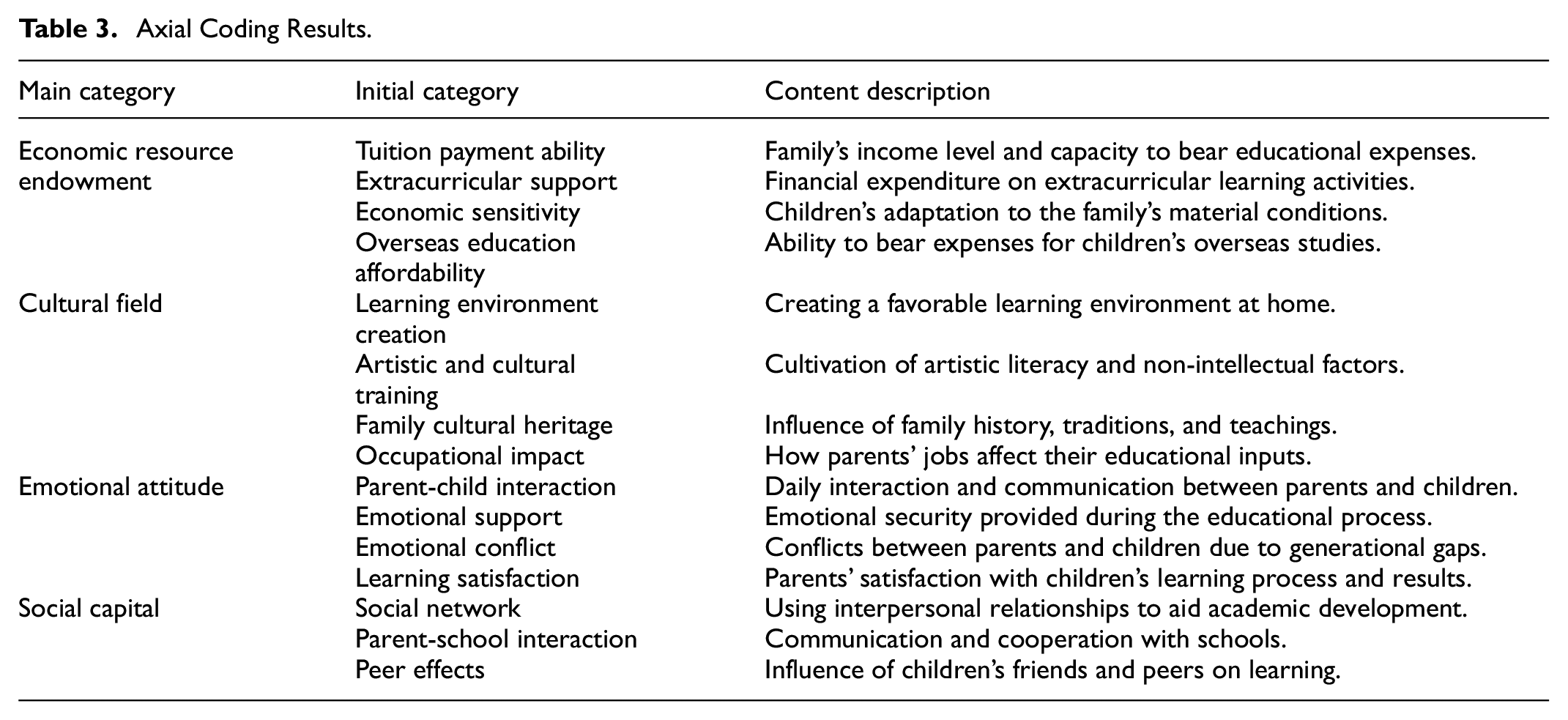
In this study, the original statements were further analyzed according to semantic relevance, logical relationships, and theoretical relevance. Four main categories were extracted: economic resource endowment, cultural field, emotional attitude, and social capital. These categories together constitute the internal logical chain of how parents of different income levels influence their children’s academic performance. Through axial coding, the scattered initial concepts were integrated into a hierarchical, interlinked category system. This process revealed the internal structure and operational mechanisms of the research theme. The specific coding results are shown in Table 3.
Axial Coding Results.
Selective Coding
Selective coding is the final step of the third-level coding in Grounded Theory, aiming to extract a core category from the main categories, systematically analyze its relationships with other categories, and ultimately form a theoretical framework (A. Strauss & Corbin, 1998). Researchers repeatedly compare and contemplate the main categories, subcategories, and original data to select a core category and outline a comprehensive storyline.
In this study, the main categories obtained through axial coding were economic resource endowment, cultural field, social capital, and emotional attitude. In-depth analysis revealed that these four categories represent different aspects of how families influence children’s academic performance. Each is indispensable, but none directly highlight the differences between income levels. Therefore, researchers identified “the differences in the impact of parents from different income levels on their children’s academic achievements” as the core category, summarizing the phenomena into a model of influencing factors.
Around this core category, the following storyline was extracted: The family’s income level determines the total amount of disposable economic resources. This affects the material conditions provided for children’s educational development, such as learning materials, reference books, and extracurricular tutoring. These form the basis of children’s academic achievements. The family’s economic condition also influences the creation of the family cultural environment and family style. High-income families are more likely to create a good learning environment, emphasize knowledge and education, and set positive values for children. Family economic strength and cultural capital influence the accumulation of social resources. High-income families hold advantageous positions in social networks, striving for more educational opportunities and development platforms for children. Family income, cultural background, and social status affect parenting style and parent-child interaction. Middle and high-income families’ parents are more enlightened and communicate more with their children, helping to cultivate children’s interest and independence in learning. Ultimately, under the interaction of economic, cultural, social, and emotional factors, children’s academic performance in families of different income levels shows differentiated characteristics. Based on this storyline, the study constructed the “Multidimensional Model of the Impact of Parents from Different Income Levels on Children’s Academic Achievement” (see Figure 1).

Multidimensional model of the impact of parents from different income levels on children’s academic achievement.
Theoretical Saturation Test
The theoretical saturation test is the criterion for stopping coding. It indicates that no new categories emerge from additional data, confirming conceptual completeness (Corbin & Strauss, 2015).
This study implemented a rigorous three-stage theoretical saturation testing process. The first stage involved initial coding analysis of 24 interview records, which yielded the preliminary theoretical framework. During this phase, the emergence of new concepts and categories was systematically tracked, documenting when each new theme first appeared and how it evolved through subsequent interviews. After completing the initial coding process, six additional interviews were conducted. These interviews were purposefully chosen from diverse backgrounds to enhance the representativeness of the data and to rigorously test whether the coding had achieved saturation. The additional interview data were subjected to the same coding procedures (open, axial, and selective coding) that were applied to the original dataset. During this process, the analysis focused on identifying whether any new concepts, categories, or relationships emerged.
The results of the saturation testing provided strong evidence for theoretical completeness. All 475 concepts that emerged from the validation interviews could be effectively categorized within the existing conceptual framework. No new categories emerged beyond the 15 initial categories and four main categories previously identified. The relationships between categories remained stable. This confirms that the “Multidimensional Model of the Impact of Parents from Different Income Levels on Children’s Academic Achievement” is theoretically saturated, demonstrating high reliability and completeness.
Results: Multidimensional Mechanisms of Family Influence
Economic Resource Endowment: Core Driving Force of Academic Achievement
Economic resource endowment is a core driving force influencing children’s academic achievement. It directly determines the material foundation of family investment in education. Numerous studies have shown a positive correlation between family income levels and children’s academic performance; higher income often leads to better academic outcomes (Bhandari & Timsina, 2024). Bourdieu theorized that cultural capital exists in three forms: embodied, objectified, and institutionalized. Economic capital is a prerequisite for acquiring cultural capital, and the two can be converted into each other. High-income families, with abundant economic capital, are more likely to obtain high-quality cultural products and afford quality education costs. This promotes the accumulation of various forms of cultural capital, benefiting children’s academic development. Conversely, a lack of economic capital restricts the ways families can acquire cultural capital, reducing their ability to invest in education, and hindering academic progress (K. Yang, 2023).
Specifically, the ability to pay tuition directly determines whether children can receive quality basic education. High-income families can afford the high tuition fees of quality private schools, securing better educational conditions and learning environments. “Our school’s tuition is several times higher than regular schools, running into hundreds of thousands annually. It’s well beyond what typical working-class families can afford” (A3). Lower-income families struggle with tuition burdens and cannot afford expensive private education, limiting their choices to public schools.
Besides domestic education, with China’s economic rise, many families are looking overseas. They hope to enhance their children’s global competitiveness through international education. However, the high cost of overseas education is affordable only for high-income families. They can support their children studying abroad, obtaining diplomas from prestigious universities, and preparing them for elite positions (Leukhina, 2023). Most middle- and low-income families cannot afford these costs, limiting their children’s educational horizons and competitiveness.
Economic sensitivity also affects educational expenditure. Low-income families, during economic difficulties, often reduce spending on extracurricular education to maintain basic needs, decreasing opportunities for their children. High-income families, less affected by economic fluctuations, maintain stability in educational funding. Additionally, economic sensitivity affects children’s attitudes toward educational resources. High-income children are accustomed to affluent conditions and may develop wasteful habits. “I bought books and materials for my child, but they’ve never been read. It’s just money down the drain” (A23). In contrast, children from low-income families, understanding their parents’ sacrifices, often use resources more efficiently.
In summary, economic resource endowment profoundly influences educational investment and academic development through tuition payment ability, extracurricular tutoring expenditure, overseas education affordability, and economic sensitivity. As Bourdieu said, economic capital is essential for educational attainment and plays a crucial role in social reproduction (Bourdieu & Passeron, 1990). High-income families can convert their advantages into cultural capital, passing on their social status through education. Middle- and low-income families, constrained by limited economic capital, face disadvantages in accessing quality education and extracurricular opportunities. As a result, structural barriers in competitive academic environments are created.
Cultural Field: Environmental Shaping in Academic Performance
The cultural field is a key environmental factor influencing children’s academic achievement. It provides favorable cultural soil for their academic development through the creation of a family learning atmosphere, cultivation of cultural and artistic literacy, inheritance of family traditions, guidance of educational concepts, and subtle influence of occupational models. Middle- and upper-class families often adopt a concerted cultivation approach. They organize children’s extracurricular activities in a structured manner, emphasize ability development, and actively participate in school affairs. This approach synchronizes family nurturing with school education, aiding comprehensive development in various skills (Y. Zhao et al., 2023). In contrast, poor families, constrained by cultural capital, often adopt a “natural growth” approach. They intervene less in children’s growth, have simpler parent-child interactions, and fewer extracurricular activities, which hinder academic development (Jin et al., 2022).
High-income families often have higher educational levels and pay attention to creating a strong learning atmosphere in daily life. “We have books everywhere at home, hoping the child will develop a love for reading” (A31). Parents engage in learning discussions and jointly develop academic plans with their children, forming a family culture that values education. In contrast, low-income families have parents with lower educational levels, “We’re too busy making ends meet to set up a reading corner for our child” (A88). Differences in creating learning atmospheres exacerbate the differentiation of academic achievements.
Cultural and artistic training reflects the family’s emphasis on children’s humanistic literacy and esthetic interests. High-income families generally have higher artistic literacy, “often taking children to museums, art exhibitions, to cultivate their artistic vision” (A35). Low-income families lack this investment. “Art lessons won’t improve grades. We’re satisfied as long as our child does well academically” (A68). Their children have fewer opportunities to receive good artistic education. Research shows that artistic literacy enhances creativity, improves memory, and language expression, which positively impacts academic performance (Ruppert, 2006). The continuous gap in family artistic cultivation translates into an accumulation gap in academic advantages.
Family cultural inheritance reflects the values and behavioral norms upheld by a family. High-income families emphasize cultural heritage, such as thrift and diligence, motivating children to study hard. “We often tell the child our struggle stories, how we came from poor backgrounds, and how grandparents worked hard to support us through college” (A43). Some affluent families, however, lack educational values. As one business owner stated, “I didn’t study much myself. Financial success matters more than academic degrees. My child will inherit the family business, so we don’t set high academic expectations” (A50). Affluent conditions foster complacency and a utilitarian view of education. Low-income families often lack cultural capital, valuing immediate work over education. “After finishing middle school, my child can go out to work and help with household expenses” (A42). Although there are hardworking students from poor backgrounds, the transmission of cultural capital is sparse. They often pass down simple values like “hard work pays off” but lack guidance for specific learning behaviors.
Parents’ occupations also influence children’s academics. Professional parents often provide role models and resources. “I teach at a school and often take my child to my classes, letting him experience the classroom atmosphere early” (A49). In contrast, parents in working-class families often engage in mechanical and repetitive work. As one such parent explained, “We often lack the energy to actively engage with our children’s education. At most, we might tell our kids to ‘study hard’ and leave the rest to the school” (A52). Additionally, limited information resources provide scant developmental assistance. Furthermore, children from migrant worker families are often separated from their parents for extended periods. They face issues under grandparental care. “My wife and I both work long hours away from home, so our child has been raised primarily by their grandparents. The grandparents often spoil the child, which has affected their studies. I deeply regret not spending more time with my child” (A61). This absence of parental upbringing leads to a lax attitude and poor academic progress.
In summary, the cultural field affects academic achievement through learning atmosphere, art and culture cultivation, family traditions, educational concepts, and occupational influences. Family upbringing subtly and lastingly influences children’s growth, converting class advantages and disadvantages into educational outcomes. This affects occupational attainment and social mobility, leading to the reproduction of inequality. Society should pay close attention to the role of the cultural field and cultural capital in education, reflecting on their broader social significance.
Emotional Attitudes: Internal Motivation Influencing Academic Success
Emotional attitudes are a crucial internal driving force affecting children’s academic achievement. Family emotional capital shapes parent-child interaction patterns and emotional atmosphere. It regulates learning motivation and influences academic performance. Baumrind’s theory, revised and elaborated by recent researchers, categorizes parenting styles into four types: authoritative, authoritarian, permissive, and neglectful (Hayek et al., 2022). Authoritative parenting is characterized by warmth, support for autonomy, guidance, and reasonable demands. It is most conducive to children’s academic development. Studies show children from authoritative families have stronger motivation, higher self-efficacy, and better stress-coping mechanisms (J. Yang & Zhao, 2020). Conversely, the other three parenting styles lack affection and behavioral guidance, harming good learning attitudes and habits.
Parent-child interaction patterns reflect family emotional communication. Most studies show that parental involvement has a significant positive impact on children’s academic performance (Nawaz Laghari et al., 2024). The quality of involvement is crucial. High-quality involvement guides children in forming correct study habits, stimulates learning interest, and predicts academic performance positively. Generally, high-income families tend to adopt an affiliative parenting style, “We often talk about her future, daily life, and listen to her worries” (A310). A close, democratic parent-child relationship makes children feel understood and respected. This stimulates intrinsic learning motivation. In contrast, low-income families struggle to ensure quality parent-child communication, “I’m exhausted from work and have no time to talk with my child” (A278). “When the child disobeys, it’s easy to scold them” (A60). Lack of listening and understanding leads to alienated relationships or an authoritarian approach. This triggers rebellious psychology and weakens intrinsic motivation.
However, some high-income parents are deeply involved in their careers, with limited time and energy to accompany their children emotionally. “As senior executives, we’re so busy that we barely have time to talk with our child. It’s affecting their interest in learning, and we feel powerless” (A177). The absence of emotional companionship means material advantages do not translate into emotional belonging. This fosters loneliness and rebellious emotions, affecting learning status. Additionally, some parents, though providing materially, fall short in emotional expression. “I work hard to provide everything for him, but he doesn’t seem grateful. He gets irritated when I remind him to study, avoiding us and deliberately acting out” (A344). A lack of emotional empathy makes children perceive concern as control, leading to resistance and declining performance.
Parental educational expectations influence their motivation for emotional provision to their children. Generally, high-income parents value education and have high expectations for their children. “We want our child to have access to the best education possible, hoping they’ll become a successful and influential member of society” (A123). Lower-income families have lower expectations due to their own limitations. “As long as our child completes basic schooling and learns a practical trade, that’s sufficient. University isn’t necessarily the goal - we just want them to be able to support themselves” (A101). Moreover, some low-income parents pin their hopes on their children’s academic success for social mobility, which in turn causes excessive pressure and anxiety.
Emotional support reflects the level of care, encouragement, and comfort parents provide in their children’s academic careers. High-income families are adept at creating an atmosphere of trust, respect, and tolerance. On the other hand, parents from lower-income families, influenced by life pressures, have poor emotional control, which provokes rebellious psychology and fosters a defeatist attitude. Positive emotional feedback cultivates self-esteem and resilience. Hence, parental emotional support styles influence children’s psychological patterns in dealing with academic difficulties, thus affecting their behavioral choices.
Emotional conflict management reflects parents’ ability to resolve parent-child conflicts and handle negative emotions. High-income families often use open and consultative methods to alleviate conflicts, “Teenagers can be stubborn and slam doors when angry. After an argument, I take time to cool off before having a calm, honest conversation with him” (A167). Low-income families often use avoidance or harsh methods, even physical punishment. This could only exacerbate conflicts. Negative interactions increase rebellion, self-denial, and aggressive tendencies, and reduce academic focus.
Parental satisfaction expectations show the degree of acceptance of their children’s academic performance. Higher-income parents emphasize progress and allow trial and error. “We don’t set strict grade expectations for our child. As long as they put in their best effort, we’re satisfied with the results” (A355). Lower-income parents, however, focus on short-term results and are eager for quick success. “Not giving your all in exams is like betraying the hard work your parents have put in” (A388). Utilitarian orientations suppress learning interest. Moreover, the disparity between overly idealistic expectations and actual performance easily damages learning confidence, leading to frustration and academic avoidance.
Overall, high-income families are more inclined to adopt affiliative interactions. Through high-quality emotional provision, they create a positive family atmosphere. This converts advantages into strong academic drivers. Disadvantaged groups, constrained by cultural capital deficiency and life difficulties, lack substantial emotional input. This leads to distant relationships, short-sighted views, and improper conflict handling. Negative experiences internalize into self-doubt, weakening academic focus. However, regardless of income, emotional absence and estrangement hinder progress. Authoritative parenting, with high responsibility and responsiveness, mitigates emotional deficiencies (Garcia & Serra, 2019). In exam-oriented Chinese education, psychological issues often stem from improper upbringing. Accumulating emotional capital through democratic relationships and scientific parenting promotes holistic development.
Social Capital: Bridging Link in Academic Achievement Impact
Social capital is crucial for children’s academic achievement. It provides information, resources, and opportunities through family social networks, reciprocity norms, and school interactions. Bourdieu’s theory of social capital, further expanded in recent years, defines it as the resources embedded in durable networks of mutual acquaintance and recognition (Stanojevic, 2024). High-income families hold advantageous positions in social networks, possessing more diverse resources. This provides broader information and opportunities for their children. In contrast, low-income families have homogeneous networks with limited access to key information and opportunities. High-income families also establish mutually beneficial relationships. They follow the logic of investment-return to accumulate high-quality social capital. Disadvantaged groups are constrained by survival pressures, and have narrow social circles. As a result, it is harder to form reciprocal networks conducive to educational attainment.
Parents’ social network heterogeneity reflects the breadth of information and resources they can access. High-income parents accumulate many weak ties in their professional and social circles. These diverse networks provide rich and timely information for children’s academic development. “Through a college friend’s connections, my daughter joined a reputable competition training class, which greatly helped her secure a place in a prestigious school” (A85). Lower-income families often have homogeneous circles, with limited educational insights. Such seemingly distant and heterogeneous but complementary relationships often bring innovative information, which becomes a key to gaining a competitive advantage. Therefore, social network heterogeneity influences the richness of educational resources and academic development opportunities.
Parents’ social networks also influence children’s growth through peer group effects. High-income parents selectively participate in social activities, exposing their children to proactive and ambitious peers. “I deliberately arranged for my daughter to attend summer camps with top achievers” (A189). High-quality peer groups create positive incentives and establish norms that make diligent study a conscious pursuit. In contrast, children from low-income families are often confined to their living communities. “There aren’t many studious kids around, they mostly play games or watch videos, so I just followed suit” (A256). Under negative pressure, learning motivation and perseverance erode, making it difficult to break through growth bottlenecks.
The interaction between home and school plays an important role in children’s education. Affluent parents prioritize this, regularly communicating with teachers to understand their children’s performance and secure resources. “I arrange for teachers to visit our home, discuss strengths and weaknesses, and communicate via WeChat regularly” (A95). This close interaction facilitates resource sharing, creating a personalized growth environment. In contrast, parents with limited resources often struggle to contact schools regularly and only attend mandatory meetings. Without timely feedback, they remain less informed about their children’s academic status, making targeted assistance challenging. Research indicates that the frequency and quality of home-school interaction affect educational resource allocation. Families engaging in high-level interaction receive more school support, while those with weak interactions risk being marginalized (Şengonul, 2022). Thus, home-school interaction significantly impacts educational equity.
In conclusion, social capital converts family capital advantages and disadvantages into relational network advantages and disadvantages. This occurs through mechanisms such as social network heterogeneity, reciprocity norms, home-school interaction quality, and peer effects. Resource-rich families excel at utilizing diverse networks, positive school interactions, and supportive peer environments, transforming capital into academic success. Conversely, less affluent families lack these networks, limiting educational attainment and reinforcing class barriers. This confirms Bourdieu’s (2020) view that social capital depends on social networks within unequal structures. High-quality social capital enhances educational advantages for affluent classes, while disadvantaged groups face “relationship poverty” and struggle in educational competition. Addressing “relationship scarcity” and creating fair growth opportunities for all children is essential.
Mechanism Analysis: The Translation Process From Income Differences to Academic Achievement Gap
This research reveals how family income shapes academic achievement through systematic mechanisms of capital conversion and accumulation. The process begins with economic resources creating initial advantages or constraints in educational investment capacity. However, the relationship between income and academic outcomes operates through complex pathways rather than simple economic determinism.
The fundamental mechanism involves how economic resources enable or restrict access to educational opportunities. High-income families can invest in quality schools, learning materials, and extracurricular activities, establishing a strong material foundation for academic development. These initial economic advantages create environments conducive to learning, from well-equipped study spaces to diverse educational experiences. However, the research reveals that economic resources must be effectively activated to generate educational benefits.
Economic advantages translate into academic outcomes through cultural capital accumulation. Families with strong financial resources can create enriched learning environments, expose children to cultural activities, and transmit beneficial educational values. This cultural enrichment shapes children’s learning dispositions and academic engagement. Yet the study demonstrates that this conversion process requires active parental mediation—merely possessing economic resources does not automatically generate cultural advantages.
The interaction between economic and cultural capital facilitates social capital development. Affluent families leverage their resources to build diverse social networks, maintain strong school relationships, and create beneficial peer environments for their children. These social connections provide valuable information, opportunities, and support for academic development. However, the research shows that effective utilization of social networks matters more than network size alone.
Emotional capital emerges as a crucial mediating factor in this process. Family income influences parents’ capacity to provide consistent emotional support, manage academic stress, and maintain constructive parent-child relationships. Strong emotional capital can amplify the benefits of other resources, while its absence can neutralize apparent advantages. The study reveals how emotional engagement quality often proves more important than quantity of time or material provision.
This complex mechanism helps explain seemingly paradoxical cases where economic advantages fail to translate into academic success, or where resource-constrained families achieve unexpected educational outcomes. The research demonstrates that while economic resources initiate the process, the ultimate impact on academic achievement depends on how families integrate and deploy different forms of capital. Understanding these specific pathways through which income differences create educational disparities provides crucial insights for promoting more equitable educational outcomes.
To further validate these mechanisms, supplementary classroom observations and document analysis were conducted. Classroom observations of students from different income backgrounds confirmed the patterns identified through interviews. For example, observations of parent-teacher meetings validated the distinct patterns of home-school interaction across income groups. Additionally, analysis of students’ academic records and family communication materials provided supporting evidence for the identified mechanisms of capital conversion. These supplementary data sources reinforced the findings about how different forms of capital interact to influence academic outcomes.
Discussion and Conclusion
Summary of Key Findings
Using grounded theory, this paper constructs the relational concepts of economic resource endowment, cultural field, social resources, and emotional attitudes. While previous research has examined these factors separately, this study innovatively demonstrates their dynamic interactions and conversion processes. It derives a multidimensional impact model of how parents’ income levels affect children’s academic achievement. The following conclusions are drawn:
First, the concepts of economic resource endowment, cultural field, social resources, and emotional attitudes are defined. Their dimensions are categorized within the context of educational inequality. Second, a theoretical model is constructed to reveal how family income differences impact academic achievement through multiple pathways. Third, economic resource endowment, cultural field, social resources, and emotional attitudes have direct impacts on academic performance. Forth, some counterintuitive cases transcend economic determinism, showing that the relationship between family income and academic achievement is not simply linear. These findings align with previous work on multidimensional educational inequality (e.g., Claudia & Paun, 2024; Niu et al., 2024). Counterintuitive findings also challenge economic determinism, as seen in studies by Georgescu and Herman (2020) and Yu et al. (2022), which report similar patterns of resourcefulness among disadvantaged families. This study extends existing theories by revealing how initial economic differences cascade through various channels to create compound educational effects. This provides new insights for expanding the paths to educational equity. The validity of these findings was strengthened through triangulation with classroom observations and document analysis. These additional data sources corroborated the interview findings, particularly regarding how families deploy different forms of capital in educational settings. Observation of actual parent-child and teacher-student interactions confirmed the patterns of emotional and social capital utilization identified through interviews. Document analysis of school records and family communication materials further supported the identified mechanisms of capital conversion and interaction.
Innovative Contributions
Linking Income and Academic Achievement Through an Integrated Perspective
While previous research has often examined factors influencing academic performance in isolation, recent studies have adopted a more holistic approach. For instance, Suleiman et al. (2024) identified key determinants of students’ academic performance, emphasizing the interplay of educational, socioeconomic, and individual characteristics. Their findings suggest that families with greater financial resources can invest in quality educational materials and create environments that promote cultural enrichment, thereby enhancing academic outcomes. This study extends the findings and reveals their interconnected nature. The findings illustrate how economic advantages set off a chain reaction across multiple domains. Families with greater financial resources invest in quality educational materials, create environments that promote cultural enrichment, build extensive social networks, and provide consistent emotional support. Yet, the study also highlights that these advantages are not absolute. Some families overcome economic limitations by leveraging cultural and social strengths, or by offering exceptional emotional support, effectively compensating for gaps in financial resources. These findings align with recent work by Y. Chen et al. (2024), who documented similar compensation patterns in urban Chinese families.
Paradoxical Patterns in Capital Conversion
Another particularly novel insight is its identification of contradictory dynamics in how resources translate to academic outcomes. On one hand, paradoxical cases were observed where material affluence undermined educational motivation, as some wealthy business-owner parents prioritized inheritance over academic success, devaluing scholastic attainment in favor of financial pragmatism. This matches findings from Georgescu and Herman (2020), who noted similar attitudes among entrepreneurial families. On the other hand, some students from modest backgrounds develop impressive learning strategies. They stretch limited resources creatively, often outperforming more privileged peers. Yu et al. (2022) reported comparable cases of resourcefulness among rural students.
Emotional Capital as Mediator
While previous research has predominantly focused on economic and cultural determinants, recent studies underscore the significance of emotional investment. Hassan et al. (2022) found that authoritative parenting, characterized by emotional support and guidance, positively influences students’ academic achievement orientation, particularly when coupled with digital literacy. Similarly, Fute et al. (2024) reported that parents’ emotional acceptance positively impacts adolescents’ academic performance, whereas rejection and overprotection have detrimental effects. This study deepens the findings by documenting cases where emotional engagement in low-income families compensated for material constraints, resulting in strong academic performance. Conversely, cases of career-focused high-income parents demonstrated how emotional absence could negate material advantages, leading to poor academic outcomes despite abundant resources. By situating emotional capital as a mediating factor, this study expands the scope of educational inequality research and challenges the prevailing focus on economic and cultural determinants.
Cross-Generational Educational Value Transmission
This research uncovers an unexpected pattern in how educational values transmit across generations in Chinese families. Traditional theories suggest linear transmission of educational values from parents to children. This study challenge this linear model by revealing active two-way exchanges. The study documents how children’s academic experiences reshape parental views, particularly in low-income families. This pattern supports Inmaculada Gonzalez Falcon et al. (2022) observations of bidirectional influence in immigrant families, while extending their framework to the Chinese context. Several cases in the study demonstrate this reciprocal process. Children from resource-constrained backgrounds showed remarkable academic drive, which transformed their parents’ educational perspectives. These findings align with Valentini’s (2024) work on educational mobility, yet add crucial insights about the mechanism of value transformation.
Intergenerational Educational Influence in Modern Chinese Families
This study offers a fresh look at intergenerational dynamics shaping education in modern Chinese society. Most research examines parent-child relationships in education. This work expands the view to include three generations. It highlights the role of grandparents, especially in migrant worker families, in creating different learning environments that affect academic performance.
In many migrant households, grandparents often take over caregiving duties when parents move away for work. This shift leads to unique educational practices influenced by the grandparents’ own experiences and values. Some emphasize traditional discipline, others favor practical skills. These varying approaches affect academic outcomes differently. In some cases, grandparents’ emphasis on education motivates children to excel, even when parents are absent. In other situations, generational gaps in educational values create conflicts, making it harder for children to stay on track. Zeng et al. (2024) found similar mixed effects of grandparental care. K. Chen (2024) highlighted comparable generational tensions in educational values. By including grandparents in the analysis, this study reveals patterns often missed in studies that focus only on parents. This three-generational perspective offers a deeper understanding of the changes in family roles and their impact on education in today’s China.
Practical Implications
Based on the research conclusions, several measures can be considered to promote educational equity and support students from different backgrounds.
Policies should address resource disparities directly. Governments can establish funding models that allocate resources based on school needs rather than uniform formulas. For example, additional funding could be provided to schools in rural areas or low-income urban neighborhoods, enabling investments in infrastructure, modern teaching materials, and extracurricular activities. Moreover, financial aid systems should be restructured to provide targeted support, not only covering tuition but also offering resources like books, technology, and extracurricular opportunities. Moving beyond a score-centric evaluation system, policymakers should introduce diverse assessment methods that recognize multiple forms of talent and skills, fostering more inclusive development pathways.
Schools are on the frontline of addressing educational inequality. Establishing collaboration networks between schools in high- and low-resource areas can encourage the sharing of experienced teachers, specialized courses, and extracurricular opportunities. For instance, virtual teaching platforms can be used to deliver advanced lessons to underserved schools, minimizing resource gaps. Schools should also implement personalized learning plans, catering to the unique needs of students from diverse backgrounds. Mentorship programs could further bridge gaps. Pairing students with teachers, older peers, or community volunteers can provide both academic guidance and emotional support. Additionally, schools should develop outreach programs for parents, including workshops on supporting their children’s learning at home and regular communication channels to strengthen the family-school relationship.
Families can take practical steps to enhance their children’s learning, even with limited resources. Parents should be encouraged to engage in their children’s education through practical actions, such as creating designated study times, discussing academic goals, and fostering curiosity. Schools and local organizations can provide resources and training to parents, helping them learn how to support their children effectively despite financial constraints. For low-income families, community resource centers can serve as hubs for accessing free or affordable educational materials, such as books, stationery, and digital tools. Libraries could offer workshops on self-learning techniques, while public institutions might provide structured programs for parents to improve their understanding of modern educational requirements.
Communities also play a critical role in bridging resource gaps and creating support networks. NGOs and community organizations can establish low-cost or free tutoring programs for disadvantaged students. These programs could be delivered in community centers, libraries, or even online, ensuring accessibility for all families. Subsidized extracurricular activities, such as art classes, sports programs, and coding workshops, can enrich students’ learning experiences and broaden their horizons. Local businesses could partner with schools and community organizations to provide resources like laptops, learning software, and even transportation for students who face logistical challenges. Public-private partnerships might also create scholarship funds to assist students in pursuing advanced education or specialized training. Besides, public awareness campaigns could shift societal attitudes about educational inequality. Success stories of students overcoming barriers can inspire others and foster a collective commitment to creating equitable opportunities.
In summary, narrowing the educational gap requires efforts across all sectors of society. By combining material support, cultural nurturing, and emotional interaction, a fair growth environment can be created for children from diverse backgrounds.
Limitations and Future Directions
This study acknowledges several limitations that suggest directions for future research. First, the multidimensional theoretical model constructed in this study is based on a small sample. Although theoretical saturation tests ensure the reliability of the results, further verification with larger samples is needed. Future research should test validity and reliability by collecting more extensive parental data. Quantitative analysis methods should be used to examine the strength of relationships among various dimensions, deepening and refining the study’s findings.
Secondly, the study primarily focused on family income as a key variable influencing academic achievement. While the presence of other factors, such as genetic inheritance of cognitive abilities and biological predispositions to learning is acknowledged, space constraints necessitated a focused approach on socioeconomic mechanisms. Future research should explore these additional dimensions more comprehensively.
The study also revealed several unexpected findings that merit further investigation. For instance, some low-income families showed great enthusiasm for their children’s education, contrary to general impressions. Cases were observed where children from families with modest means but strong educational values outperformed their peers from higher-income backgrounds. Besides, in-depth interviews revealed that factors such as intergenerational upbringing and the educational behaviors of migrant families also impact children’s academic achievement. Due to space and time constraints, this article could not explore these phenomena further. Future research should conduct more in-depth investigations on these issues.
Footnotes

Ethical Considerations
No animal studies are presented in this manuscript. Ethical review and approval was not required for the study on human participants in accordance with the local legislation and institutional requirements. All participants provided written informed consent prior to taking part in the study. Participants were informed of their right to withdraw from the study at any time without penalty.
Funding
The author received no financial support for the research, authorship, and/or publication of this article.
Declaration of Conflicting Interests
The author declared no potential conflicts of interest with respect to the research, authorship, and/or publication of this article.
Data Availability Statement
Data sharing not applicable to this article as no datasets were generated or analyzed during the current study.