




Abstract
The loneliness and sense of belonging of left-behind children have garnered significant scholarly attention due to their socio-emotional significance. However, the mechanisms underlying the relationship between these constructs remain underexplored. Drawing on ecological systems theory, attachment theory, and self-determination theory, this study explored the relationship between a preference for solitude and school belongingness among left-behind children, as well as the influencing mechanisms of academic engagement and academic stress on this relationship. Using data collected from 1,289 left-behind children, our findings reveal that preference for solitude exerts a significant negative influence on school belongingness. Academic engagement partially mediates the relationship between preference for solitude and school belonging, indirectly enhancing the latter. Additionally, academic stress positively moderates the relationship between preference for solitude and academic engagement, while negatively moderating the relationship between academic engagement and school belongings. These results contribute to the theoretical understanding of the psychological and academic factors that influence left-behind children, offering practical implications for fostering positive behaviors, improving psychological well-being, and guiding equitable educational interventions. By elucidating these mechanisms, this study provides actionable insights for designing effective strategies to support the holistic development of children left behind.
Plain Language Summary
In China, left-behind children have become a special social group due to a large number of rural laborers leaving their families and children working outside the home alone. These children are prone to loneliness and lack of belonging due to long-term separation from their parents. This study surveyed 1,289 left-behind children to explore how loneliness affects their sense of belonging in school, as well as the role of academic engagement and academic pressure. The study found that a preference for being alone significantly weakened the sense of belonging in school for left-behind children, but academic engagement could partially alleviate this negative impact. Moderate academic pressure can motivate children to study harder, but excessive pressure may be counterproductive and weaken the positive impact of academic engagement on school belonging. Therefore, schools can help left-behind children better integrate into school life and enhance their sense of belonging by enhancing academic engagement and reasonably managing academic pressure. This will not only help improve their mental health, but also provide theoretical support for education management departments to develop fair and effective intervention measures.
Keywords
Introduction
Amidst the continuous deepening of economic reforms and the accelerated pace of urbanization, a significant proportion of China’s young and middle-aged labor force has opted to leave their children and hometowns to seek employment in economically developed areas (Ash, 2006). According to the seventh National Population Census, the total number of Chinese migrants in 2020 reached 376 million, representing 26.6% of the national population for that year (National Bureau of Statistics of China, 2020). Such massive migration has led to the emergence of the social group known as left-behind children, and the phenomenon of left-behind children in China has become a significant social issue. In line with the 2020 Ministry of Civil Affairs and Ministry of Education definition, left-behind children are defined as minors under the age of 16 whose parents have both migrated away from home for 6 months or longer, or whose remaining guardian lacks the capacity to provide adequate care, and who are thus left in the custody of relatives at their place of household registration (Lyu et al., 2024).
According to the definitions provided by China’s Ministry of Education and Ministry of Civil Affairs, left-behind children are defined as “minors under the age of sixteen whose parents have both gone to work away from home for more than half a year, or one parent has gone to work away from home and the other cannot provide care, and who are left in the care of able relatives at their place of household registration” (Lyu et al., 2024). As of 2020, there were 66.93 million left-behind children in China, accounting for 22.5% of the total child population (National Bureau of Statistics of China, UNICEF China, UNFPA China, 2023). As a distinct social group, left-behind children have garnered widespread attention from the government and academic circles. Numerous studies have stated that the negative emotional issues, such as depression and anxiety, among left-behind children tend to increase with age (Cheng & Sun, 2015; Shuang et al., 2022), resulting in a notably lower quality of healthy living compared to non-left-behind children who live with their parents (Jia et al., 2010). Although their guardians are both capable and willing to provide care in everyday life, the lack of long-term cohabitation with parents leads these children to exhibit lower levels of social affinity behaviors (W. Li et al., 2021), as well as a diminished sense of familial affection and responsibility (Gheaus, 2013). This asocial state can be understood as a form of alienation from the environment, manifesting in a willingness to spend more time alone (Coplan et al., 2019). However, previous studies have suggested that this preference for solitude can help left-behind children regulate most of the emotional stress brought on by life (Gao et al., 2022).
July 24, 2021, Chinese State Council issued “Opinions on Further Reducing the Homework and After-school Tutoring Burden on Students at the Compulsory Education Stage,” which once again clarified the principal status and role of school education, namely, emphasizing the importance of enhancing students’ sense of school belongingness during the compulsory education stage (Cai et al., 2023; Wang, 2023). Here, school belongings refers to being accepted, respected, and supported by teachers and peers within the school environment, and feeling that one is an integral part of the school’s academic life and classroom activities (Goodenow & Grady, 1993). According to ecological systems theory, family and school are the two primary micro-systems on which children depend for survival and which influence their development (Bronfenbrenner, 1994; King & Kraemer, 1995). For left-behind children, long-term “split-type family” living has come at the cost of separation from parents and a loss of familial affection (Duan et al., 2014; Gheaus, 2013), making the school objectively replace and transcend the “complete family” that exists only in a legal sense, thus becoming the most critical environment for their life and learning. School support and guidance are significant factors that affect their emotions and behaviors (Jia et al., 2010). This support can help them establish camaraderie with fellow students, receive love from teachers, and access crucial social support beyond their family (Yang et al., 2016). Studies have shown that left-behind children with higher school belongingness exhibit greater feelings of achievement and autonomy in their studies (Wei et al., 2016), can accurately assess their own value (Kia-Keating & Ellis, 2007), are less willing to develop various negative behaviors (D. Li et al., 2013), and significantly reduce the likelihood of developing emotional issues such as anxiety and depression (Allen et al., 2024).
Research on left-behind children has predominantly featured school belongingness as a moderating or mediating variable to assist left-behind children in obtaining higher quality teacher-student relationships and friendships (Yang et al., 2016), or to moderate the adverse effects brought about by their poor academic performance (Song et al., 2023), among other factors. The present study aims to investigate the impact of left-behind children’s preference for solitude on their school belongings, with a particular focus on the mechanisms of influence exerted by academic engagement and academic stress within this relationship. This enriches the research on the school belongings of this special group of left-behind children and provides practical significance for improving the school belongingness of left-behind children, while supplementing research on the healthy development of left-behind children as a social issue. The specific research questions are as follows:
(1) Do preference for solitude, academic engagement, and academic stress among left-behind children affect their school belongingness?
(2) How do academic engagement and academic stress influence the relationship between preference for solitude and school belonging among left-behind children?
Literature Review and Hypothesis Development
Preference for Solitude
Preference for solitude refers to an individual’s degree of preference for being alone and is composed of low approach motivation and high avoidance motivation (Coplan et al., 2004). Individuals with a preference for solitude often retreat due to their inclination toward solitary activities and belong to a subtype of social withdrawal (Bowker et al., 2012). Solitude is not merely being physically alone; it often involves being amidst a busy crowd without establishing connections with others, lacking information exchange, and emotional interaction (Burger, 1995). Coplan et al. (2019) have used the time-effect model to describe the maladaptive effects of social aloofness brought about by a preference for solitude, showing that such maladaptive effects peak during adolescence.
It is essential to distinguish between Coplan’s concepts of unsociability and social avoidance. While both involve reduced peer interaction, unsociability reflects a preference for solitary activity without intense social fear, whereas social avoidance combines low social approach with high social avoidance motivation. These motivational differences are theoretically meaningful and should not be conflated. This study focus on the preference for solitude, which more closely aligns with unsociability, and acknowledge that social avoidance represents a distinct construct that requires separate investigation (Nguyen et al., 2022; Zava, 2019).
According to attachment theory, individuals from well-functioning families experience greater psychological need satisfaction due to parental understanding, support, and positive responsiveness, resulting in more security and positive self-experiences in group settings, and they also tend to feel less rejection and other negative emotions, positively influencing their adaptability (Magnusson & Stattin, 2007). Due to the particularity of their families, left-behind children often lack effective and affectionate communication with their parents over long periods, leading to lower social motivation (Y. Zhou & Liu, 2016), a preference for solitude, and an increase in this preference with age (Coplan et al., 2019; Zhou et al., 2021a). Adaptation issues faced by left-behind children in the school environment, such as behavioral deviations (Y. Lu et al., 2019) and declining academic performance (Liang & Li, 2021), are related to feelings of solitude and being unsupported during their time as left-behind children (S. Lu et al., 2016). The negative impacts arising can further translate into poor school adaptation (Fontaine et al., 2009; Xie et al., 2022). Studies have confirmed that left-behind children’s level of school adaptation is lower than that of non-left-behind children, due to their preference for solitude in school without gaining much peer support, leading to low school identification and thus affecting their school adaptability, especially in academic, psychological, and behavioral aspects (Peng et al., 2012; Yang et al., 2016). At the same time, a significant positive relationship has been established between school adaptation and school belongingness (Allen et al., 2022; Kuperminc et al., 2008), and this low adaptability may be a crucial factor contributing to weak school belongingness among left-behind children. Therefore, the following hypothesis is proposed.
Children who were abandoned for relatively briefer periods (e.g., less than a year) would potentially develop different patterns of adjustment psychologically and socially when compared to children who were abandoned for extended periods (e.g., more than 3 years). Although not tested in the present model, the omission of this variable represents a limitation that future studies should help alleviate by investigating whether duration of absence operates as a moderator in the relationships between preference for alone time, stress in higher education, and belongingness at higher education institutions (Bühler & Orth, 2024).
Academic Engagement
Academic engagement encompasses a specific set of classroom behaviors, including writing, participating in tasks, reading aloud, silent reading, discussing academic topics, and asking and responding to questions (Greenwood et al., 2002). It primarily focuses on the learner’s active involvement and emotional commitment to learning (Chapman, 2003). According to the central tenets of self-determination theory, behaviors can be categorized into autonomous (internally driven) and non-autonomous (controlled), emphasizing an interactive relationship between the agent of action and the social context. The degree of autonomy over one’s behavior is determined by the interplay between individual and environmental factors (Ryan & Deci, 2002). Due to the unique familial circumstances of left-behind children, when faced with life’s difficulties, they are more likely to adopt passive coping strategies (J. Li et al., 2020). The absence of timely guidance and companionship from parents can lead to doubts about their own learning abilities (Liang & Li, 2021). Additionally, due to their preference for solitude or small group interactions, classroom environments can cause them to feel tense and anxious, thereby reducing their behavioral engagement (Hughes & Coplan, 2018). Furthermore, because they are more concerned about others’ perceptions of them, they are not inclined to proactively seek help from teachers or peers (Casuso-Holgado et al., 2013), potentially interfering with their ability to participate in classroom activities (Hughes & Coplan, 2018). Most importantly, the majority of left-behind children lack the social capital associated with success that comes from their parents’ higher education, leading them to be less willing to engage in interactions with teachers and peers, and even to utilize support services provided by schools (Fredricks et al., 2004). These behaviors might lead to exclusion by peers (Coplan et al., 2018), resulting in poor academic engagement, which in turn affects their academic performance.
Research results indicate that children’s academic engagement has a significantly positive impact on their academic achievement (Hanus & Fox, 2015). Higher academic achievement can buffer the adverse effects of solitude, such as improving poor peer relationships (Ding et al., 2022), and help them gain a sense of security (Spriggs et al., 2007). These factors enable them to better cope with problems that arise in the learning process (Bruce et al., 2010), increase their satisfaction with school (Lewis et al., 2011), and consequently enhance their sense of school belonging (C. Zhang et al., 2022). Thus, the following hypothesis is formulated:
Academic Stress
Academic stress refers to the psychological stress experienced by individuals when facing academic challenges. It is a concrete reflection of the contradiction between various external academic demands—including those from school, family, and society and the learner’s own academic abilities (Evans & English, 2002). Its primary sources include learning tasks, study time, educational expectations, and interpersonal relationships (Martin & Dowson, 2009). According to the phenomenological variant of ecological systems theory, when children perceive stress, if they possess sufficient positive psychological resources to cope and form adaptive identifications, their development will not be compromised. Conversely, a lack of such resources can lead to maladaptive outcomes (Spencer et al., 2003).
Personal growth initiative represents children’s conscious and proactive tendency to enhance and perfect themselves during their growth process, serving as a principal positive psychological resource (Robitschek et al., 2012). When children experience academic stress, it indicates that their current resources are insufficient to overcome its negative impacts, and they should utilize their personal growth initiative as a positive psychological resource to help alleviate their stress (Meyers et al., 2015; Zaman & Naqvi, 2018). According to Robitschek et al. (2012), personal growth initiative encompasses proactive self-change and general skills across personal growth domains. Left-behind children can promote their school adaptability and subsequently enhance their school belongingness (Peng et al., 2012) by engaging in proactive self-change, which improves their out-of-group group image (W. Li et al., 2021).
As a significant microsystem in the lives and development of left-behind children, academic stress is a pervasive presence in the school environment (H. D. Lu, 2008). By motivating children to participate in school and classroom activities and to develop adaptive identities, the process essentially cultivates general skills that span personal growth domains (Amerstorfer & Freiin von Münster-Kistner, 2021). During this process, academic achievement is enhanced, leading to increased academic engagement (Hanus & Fox, 2015), which in turn may strengthen their sense of school belonging (Allen et al., 2022). Therefore, the following hypotheses are proposed:
Research Gap and the Current Study
To date, extensive research has focused on the healthy development of left-behind children, with school belongingness being identified as a critical factor influencing their healthy development (Allen et al., 2024; D. Li et al., 2013; Wei et al., 2016). However, few studies have explored the impact of left-behind children’s preference for solitude on their school belongingness. Thus, a moderated mediation model is developed to examine the relationship between preference for solitude and school belongingness among left-behind children and to investigate the mechanisms through which academic engagement and academic stress influence this relationship. The study can provide theoretical guidance and practical significance for cultivating positive behaviors and improving the mental health levels of left-behind children, and offer new directions and suggestions for education management departments to formulate fair and effective education intervention strategies. The framework of the research is presented as in Figure 1.

Research framework.
Methods
Participants and Procedures
The research commenced in the spring semester of 2024, with participants drawn from the northeastern region of China encompassing Liaoning, Jilin, and Heilongjiang provinces. The area is relatively underdeveloped economically, with per capita income below the national average and significant labor force outmigration, making the issue of left-behind children particularly acute (Ma et al., 2020). Two primary and secondary schools were selected in the urban areas of each province for the questionnaire survey. Before the formal investigation began, informed consent was obtained from the participants and their guardians, resulting in a total of 6,852 participants. After excluding responses with overly short completion times and incomplete questionnaires, a total of 6,489 validated samples achieved a validation rate of 94.7%. The valid sample consisted of 3,205 males (49.4%) and 3,284 females (50.6%), with a mean age of 11.51 ± 2.40 years. There were 1,289 questionnaires from left-behind children (with a rate of 19.86%), including 652 males (50.6%) and 637 females (49.4%), aged 7 to 15 years, with an average age of 12.11 ± 2.19.
Measures
All items in this study were rated using a 5-point Likert scale, ranging from 1 (strongly disagree) to 5 (strongly agree). The scales for academic engagement and academic stress underwent a back-translation procedure from English to Chinese (Brislin, 1970).
Preference for Solitude Scale (PSS)
The PSS was developed by Burger (1995) and later revised into a Chinese version by Chen and Song (2012). The Chinese scale encompasses three factors: the need/enjoyment of solitude, valuing solitude, and a preference for solitary activities, with 11 items, such as “I enjoy being alone” and “I often have a strong desire to be alone.” The scale’s Cronbach’s alpha was .92, with a test-retest reliability of .942 in this study, and the alphas for the three factors were .901, .895, and .830, respectively.
Psychological Sense of School Membership (PSSM)
To measure the structure of school belongingness, Goodenow (1993) developed a unidimensional PSSM scale, which was subsequently translated into Chinese and tested for reliability and validity by Pan et al. (2011). The Chinese version consists of 18 items, five of which are reverse-scored, including statements such as “It’s hard for people like me to be accepted at school” and “I wish I were going to a different school.” The scoring for PSSM is thus obtained through reverse coding of these items. The scale’s Cronbach’s alpha was .873, with a test-retest reliability of .883 in the present study.
Academic Engagement Scale (AES)
The AES was measured using a scale developed by Skinner et al. (2009). This scale comprises eight items and is divided into two sub-factors: behavioral engagement and emotional engagement. The content includes “I am working hard to do well at school,”“I like doing schoolwork,” etc. The scale’s Cronbach’s alpha was .870, and the test-retest reliability in this study was .955, with alphas for the two factors being .922 and .951, respectively.
Academic Stress Questionnaire (ASQ)
Liu and Lu (2012) developed ASQ, which consists of seven items, including “To finish my homework makes me feel pressure” and “My homework is a burden for me.” The scale’s Cronbach’s alpha was .830, with a test-retest reliability of .943 in this study.
The ASQ used in this study contains seven items, five of which focus on homework, which may limit the breadth of the construct captured. To address this, we calculated the Content Validity Index (CVI) through expert review, which yielded a satisfactory score (CVI = 0.89), indicating acceptable content coverage. Nonetheless, future studies should consider more comprehensive instruments to capture academic stress across multiple domains.
Data Analysis
Data for the study were processed with SPSS 27.0 and AMOS 22.0. Initially, statistical descriptive analysis, inclusive of means and standard deviations, was conducted for all study variables to ensure sample adequacy. Subsequently, the research scales underwent reliability and validity testing, with all participating scales’ Kaiser-Meyer-Olkin (KMO) coefficients exceeding 0.8, indicating normal data distribution and good reliability. Hypothetical model underwent confirmatory factor analysis (CFA), with the following results: χ2/df = 4.706; RMSEA = 0.054; CFI = 0.939; GFI = 0.885; TLI = 0.932. These metrics indicate a good fit for the model (Thompson, 2004). Following this, SPSS’s Process macro model 4 was employed to test the mediating role of academic engagement, using 5,000 bootstrap samples and assessing mediation effects within a 95% confidence interval. Finally, Process Macro Model 59 was used to test the moderating role of academic stress, and simple slope plots were generated to illustrate the moderating effect.
It is worth noting that potential confounders, such as family socioeconomic status (SES), grandparents’ education levels, and inter-provincial migration distance, were not included as covariates in this model. Their omission may limit the comprehensiveness of the analysis, and future studies should include such contextual variables to better isolate the effects under investigation.
This research did not test configural or metric invariance across gender or parental separation duration groups, which represents a limitation. Future research should apply multi-group confirmatory factor analysis to examine measurement invariance, ensuring that the constructs are comparable across subgroups.
This study did not conduct additional robustness checks such as bootstrap versus robust ML estimation comparisons, heteroskedasticity tests, or residual normality diagnostics. Incorporating these procedures in future studies would strengthen the robustness of parameter estimates and the reliability of model fit.
Results
Descriptive and Correlation Analysis
SPSS 27.0 was utilized for correlational analysis of all study variables. As indicated in Table 1, left-behind children’s age was a significant positive association with preference for solitude (β = .095, p < .001) and academic stress (β = .105, p < .001), while a significant negative correlation was school belongingness (β = −.129, p < .001) and academic engagement (β = −.181, p < .001). Left-behind children’s gender was significantly positively correlated with academic engagement (β = .062, p < .001) and significantly negatively correlated with academic stress (β = −.100, p < .001). Subsequently, gender and age were included as control variables in the following analyses. Other correlations revealed that preference for solitude was significantly negatively related to school belongingness (β = −.107, p < .001), and positively associated with academic engagement (β = .127, p < .001) and academic stress (β = .499, p < .001). School belongingness was significantly positively related to academic engagement (β = .672, p < .001), and both school belongingness and academic engagement were significantly negatively related to academic stress (β = −.364, p < .001 and β = −.160, p < .001, respectively).
Descriptive Statistics and Correlations of All Study Variables.

Note. N = 1,289.
p < .001.
It is worth noting that the mean academic stress score in this study was 2.66 on a 5-point scale, indicating a relatively moderate level of perceived academic pressure. This does not imply endorsement of heavier academic workloads but rather describes the average stress levels reported by pupils in the sample.
Independent Samples t-Test
An independent t-test was conducted to compare preference for solitude and school belongingness between left-behind and non-left-behind children living with their parents. The test for preference for solitude yielded t = −3.023, p = .078, indicating no significant difference in preference for solitude between left-behind children and non-left-behind children. However, the test for school belongingness yielded a t-value of 4.959, p = .005, indicating a significant difference in school belongingness between the two groups, with non-left-behind children exhibiting higher levels of school belongingness than left-behind children. These findings lead to a subsequent examination of mediating and moderating effects as potential measures to enhance school belongingness in left-behind children.
Path Analysis
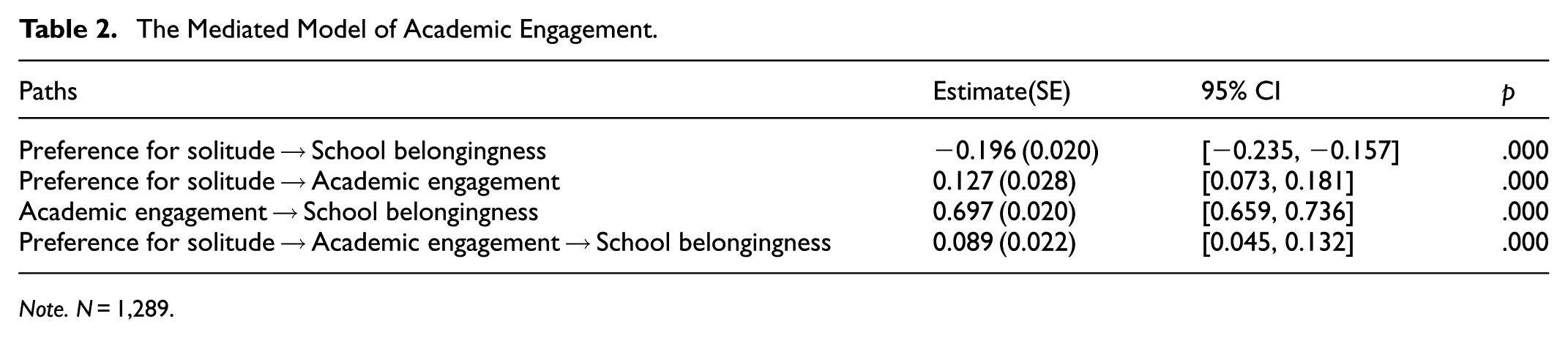
All variables were standardized, and a Process macro model 4 was used for path analysis. As shown in Table 2, preference for solitude had a significant adverse effect on left-behind children’s school belongingness (β = −.196, p < .001), supporting
The Mediated Model of Academic Engagement.
Note. N = 1,289.
Note that the coefficient, ranging from preference for loneliness to the level of academic involvement (β = .127, p < .001), did not control for previous academic achievement (e.g., Chinese and Mathematics scores). This exclusion may have had some effect on the size of the coefficient; future studies should include previous accomplishment as a covariate to be more precise.
In addition to establishing statistical significance, we examined the effect size of the mediating pathway. The indirect effect of academic engagement (β = .089, p < .001) accounted for approximately 31.2% of the total impact of preference for solitude on school belongingness. This finding suggests that, although the direct effect remained stronger, academic engagement explains nearly one-third of the overall relationship, underscoring its meaningful role as a partial mediator.
Moderating Analysis
Building on the path analysis, this study investigates and verifies the moderating role of academic stress among left-behind children using Model 59 in the Process macro for moderation effects analysis. The results, displayed in Table 3, indicate that while preference for solitude significantly negatively impacts left-behind children’s school belongingness, academic stress does not moderate the direct relationship between left-behind children’s preference for solitude and school belongingness (β = .027, p = .118), suggesting that academic stress does not facilitate left-behind children in enhancing their school belongingness by altering their preference for solitude.
The Moderated Mediation Model of Academic Stress.

Note. Bold denotes an interaction item.
Academic stress positively moderates the relationship between preference for solitude and academic engagement (β = .194, p < .001), implying that when left-behind children experience a certain level of academic stress, it helps to increase the positive impact of preference for solitude on academic engagement (β = 0127, p < .001), for instance, by modifying study habits, increasing communication with teachers, and engaging in peer interactions as part of learning activities. The moderating effect of academic stress is depicted using simple slope graphs, with academic stress at mean levels plus or minus one standard deviation, as shown in Figure 2.

Moderated mediating effects of preference for solitude on academic engagement.
Furthermore, the results demonstrate that academic stress weakens the positive influence of academic engagement on school belongingness (β = −.041, p = .048), indicating that academic stress moderates the positive impact of academic engagement on school belongingness (β = .639, p < .001). To better understand the moderating effect of academic stress, the study utilizes simple slope graphs to examine the interaction, considering academic stress at mean levels plus or minus one standard deviation, as presented in Figure 3. The simple slope test reveals that while academic stress can elevate the level of academic engagement, it does not produce a positive effect on school belongingness. In summary, academic stress does not moderate the direct relationship between preference for solitude and school belongingness; thus,

Moderated mediating effects of academic engagement on school belongingness.
However, it does moderate the indirect relationship between preference for solitude and school belongingness through academic engagement, supporting

Simplified final model.
Discussion
This study examines the relationship between a preference for solitude and school belongingness among left-behind children and discusses the roles of academic engagement and academic stress in this process. According to the results of independent samples T-tests, left-behind children’s school belongingness is significantly lower than that of non-left-behind children, consistent with previous research findings (Xie et al., 2022; H. Zhang et al., 2021). The study also indicates that left-behind children’s preference for solitude has a significantly negative impact on their school belongingness. Furthermore, academic engagement mediates the relationship between left-behind children’s preference for solitude and their sense of school belonging, thereby enhancing their sense of school belonging. Through the moderating effects of academic stress, the positive impact of preference for solitude on academic engagement is increased. Still, the positive effect of academic engagement on school belonging is diminished.
Relationship Between Preference for Solitude and School Belongingness
The results of this study further validate previous research (Hagerty & Williams, 1999; Ren et al., 2016), which suggests that a preference for solitude negatively affects the school belongingness of left-behind children. They resonate with other studies on left-behind children, which indicate that the particular social aversion of left-behind children is detrimental to their healthy development (Yuan et al., 2014). The significance of school belongingness for left-behind children has been established in related research (Allen et al., 2024; Wei et al., 2016). Building upon this, the current study explicitly proposes that left-behind children’s preference for solitude weakens their sense of school belongingness, which could potentially affect their healthy development. Therefore, educational administrators at all levels need to carefully consider the conditions and needs of this unique group when formulating and implementing academic policies. To ensure educational equity, they should help left-behind children genuinely integrate into the school environment, reducing their preference for solitude and its negative consequences, thereby enhancing their school belongingness.
The Mediating Role of Academic Engagement
The results of this study indicate that the preference for solitude among left-behind children has a positive influence on academic engagement, and academic engagement, in turn, positively affects school belongingness. This suggests that academic engagement plays a crucial role in helping left-behind children attain a higher sense of school belongingness. These findings corroborate prior research on the importance of academic engagement in children’s learning and school life (Bruce et al., 2010; Lewis et al., 2011). Additionally, the results enhance the understanding of the meaning of academic engagement, suggesting that left-behind children can improve their academic engagement through emotional identification, even if they are not actively participating in classroom activities. This reinforces the findings of Hughes and Coplan (2018), which suggest that a positive classroom atmosphere serves as a protective factor for children who prefer solitude. For left-behind children, developing academic engagement could involve increasing their visibility in the classroom, such as encouraging more frequent questions and participation in specific classroom segments. Moreover, fostering their involvement in collaborative learning tasks with peers can also enhance academic engagement. This requires teachers to observe and understand the characteristics of left-behind children carefully, and to guide them in actively participating in learning activities tailored to their diverse needs, thereby strengthening their sense of school belonging.
The Moderating Role of Academic Stress
According to the research findings, academic stress can enhance the positive effect of preference for solitude on academic engagement, suggesting that an appropriate level of academic stress can positively impact children’s academic engagement. This is supported by the works of Deci et al. (1991) and Nguyen et al. (2018), which suggest that moderate academic stress can stimulate learners’ emotions, serving as an external motivator for learning. Therefore, appropriate academic stress within the school teaching process can positively influence learners’ behaviors and emotions (Osterman, 2000). However, the positive role of academic stress is not sustained indefinitely (Bandura et al., 1996), as the results show that academic stress reduces the positive impact of academic engagement on school belongingness. Given the unique family circumstances of left-behind children, which include a lack of timely and effective communication with parents, their psychological resilience may not consistently offer the necessary support (Zhou et al., 2021b). Consequently, relying solely on their own resources when facing academic stress-related challenges makes it difficult for them to maintain positive behaviors and emotions over time. While academic stress can temporarily stimulate left-behind children to initiate personal growth, it is insufficient for long-term intervention (Meyers et al., 2015). In school educational activities, teachers should not only correct the deficiencies of left-behind children but also encourage and assist them in discovering and establishing their strengths. This ensures the sustainability of their personal growth initiative, enabling them to cope with the adverse effects of academic stress, enhance academic engagement, and thereby promote their school belongingness.
This research provides evidence that modest amounts of educational stress correlate with school belongingness; it must not be taken as a blanket prescription for instructors to push students. The interpretation depends on the context and is subject to local, cultural, and moral factors. Educators and policy planners must strike a delicate balance between expectations in the classroom and the mental health of students, especially the left-behind children.
The positive interaction of academic stress and preference for solitude on academic engagement (β = .194, p < .001) can be explained by the active coping principle of the biopsychosocial model of challenge. When left-behind children encounter moderate, performance-contingent stress (e.g., impending test, oral recitation in front of the class), the sympathetic nervous system increases noradrenergic activity, which reduces attentional breadth and enhances persistence at tasks. For students who already exhibit preference for solitude, such a “boost” from the body isn’t sidetracked by social monitoring or distraction by fellow students; instead, it’s directed at solitary rehearsal, memorizing, or problem-solving. The conditional-effect simple slopes provide supporting interpretation: at +1SD of academic stress, a one-unit increase in preference for solitude increases engagement by 0.303 standard deviations roughly twice the impact observed at low-stress levels (0.109). Therefore, stress acts as a magnification device transforming the previously neutral tendency for solitude into a tangible behavioral investment in study work.
In comparison, the negative interaction between academic stress and academic engagement on school belonging (β = –0.041, p = .048) suggests that the same stressor shifts the attributional lens by which teachers and peers judge engaged behavior. According to the effort-approval trade-off model, highly stressed students who display over effort tend to be perceived by their peers as either competitors or teacher-pleasers, thereby reducing peer acceptance, a critical facet of school belonging. For left-behind children, who already lack parental advocacy, such a reputational cost is compounded by emotional exhaustion: the HPA-axis activation, which facilitates solitary study, simultaneously reduces the oxytocin-mediated reward that would accrue from being recognized by people-interpersonally. As such, the very engagement that was negotiated under stress yields a weaker socio-emotional return, resulting in a dampened conditional indirect effect (0.598 at high stress vs. 0.680 at low stress). In other words, academic stress precipitates a “more work, less warmth” process: solitary practice is intensified, but the relational benefits that practice would yield are diminished. The pathway by which engagement contributes to belonging is hindered.
Main Contributions
From a theoretical perspective, this study examines the impact mechanism of preference for solitude on school belongingness among left-behind children, highlighting the mediating role of academic engagement and the moderating role of academic stress. These findings enhance our understanding of the factors influencing left-behind children’s sense of belonging in school and shift the research focus from the characteristics and impacts of children’s families to the personal attributes of left-behind children themselves. This provides valuable theoretical guidance for fostering positive behaviors and enhancing psychological well-being among left-behind children, as well as robust theoretical support for educational management departments at all levels to develop fair and effective academic and intervention strategies.
From a practical standpoint, although prior research has validated the importance of school belongingness for the healthy development of left-behind children, there is a lack of empirical research on how to enhance their sense of school belonging. This study supplements the existing research in this area and provides practical recommendations. Based on the results, teachers can enhance the school belongingness of left-behind children by improving their academic engagement, specifically by utilizing appropriate levels of academic stress to stimulate their personal growth initiative. This approach can mitigate the adverse effects of their unique circumstances, enhance the educational achievement of left-behind children, and ultimately promote their psychological and behavioral health development.
To enhance school belongingness and academic engagement for left-behind children, we provide operationalizable suggestions. Firstly, school administrators should utilize peer mentorship programs to assign peers to left-behind children, facilitating collaborative learning and increasing feelings of school belonging. Secondly, teacher training should focus on intervention strategies for students who prefer to work alone, so that they participate more actively in classroom activities. To manage academic stress professionally, schools should provide personalized stress management programs that enable students to effectively manage academic pressures by incorporating mindfulness and time management strategies. Moreover, education policies should balance academic workloads to ensure stress does not adversely affect school belongingness. Finally, schools should provide specialized psychological support services for left-behind children and facilitate better communication among teachers and caregivers to address children’s emotional and academic needs. The suggestions offer pragmatic steps for adopting positive academic behaviors, promoting emotional well-being, and fostering school belongingness among left-behind children.
These results can be more fully clarified by applying Ecological Systems Theory and Attachment Theory. Based on Ecological Systems Theory, children’s progress is shaped by the various environmental systems in which they engage, such as family and school (Bronfenbrenner, 1994). For left-behind children, the lack of either one or both parents significantly impedes their primary system of support, and they become more dependent on the school setting for emotional and peer support. Our results demonstrate that preference for being alone, which left-behind children tend to utilize as a means of coping, has a detrimental influence on school belongingness. This isolation is further compounded by the absence of emotional support from wayward parents, and the school’s role as a supporting environment is correspondingly more vital. The school becomes a critical system in which left-behind children must manage their social and academic pursuits, and school belongingness emerges as a significant determinant of overall well-being.
Furthermore, Attachment Theory provides a valuable insight into how family separation affects the attachment of left-behind children to other individuals, such as teachers and peers. According to Bowlby (1969), children with secure attachment relationships with caregivers tend to have positive relationships in various areas, including school. Conversely, the absence of parental figures, for instance, as faced by left-behind children, yields insecure patterns of attachment, which manifest in symptoms of difficulty connecting with others and withdrawal from society. Our study confirms that the absence of secure attachment relationships with parents is associated with reduced school belongingness among left-behind children. This points to a role for schools to offer emotional support and build attachment relationships that are secure with teachers and peers, and offer a sense of stability and attachment that these children may not have at home.
The report provides only 20% of the data collected because all the children who were not left behind have only been used on the margin in the current report. Another restriction concerns sample recruitment and missing data handling. Although the resulting dataset size was large and robust, a few hundred children were eliminated as non-responders. Multiple imputation methods, increasingly suggested by recent research studies to mitigate informative bias and permit analysis on the whole sample while contrasting outcomes with complete cases, were not employed by us. Lastly, the sample was not taken by probability sampling from a clearly defined population but was recruited by selected schools across few selected regions. Consequently, the representativeness of the findings may be restricted even among the sampled provinces. Future studies should attempt the use of probability sampling approaches and multiple imputation methods to handle non-response and enhance the generalizability of the findings.
The research drew participants from only a few schools, which may limit the study’s generalizability. It may be the case that the within-school variation varies differently from the between-school variation, such that students cannot be viewed as entirely independent of the school context. Our analyses, however, did not explicitly model this hierarchical structure. More rigorously, multilevel modeling should be used to distinguish between the school- and individual-level impacts, thereby providing more precise estimates of the associations among preference for solitude, academic engagement, academic stress, and school belongingness. Future research should thus adopt multilevel statistical methods to investigate whether the identified impacts generalize across different schools and to capture the nested nature of educational data more effectively.
Moreover, the correlational and cross-sectional nature of the data prevents the degree to which practical application can be directly made from this research. Although the study identifies key associations, it cannot permit robust causal inferences regarding how a change in preference for solitariness, academic engagement, or academic stress would affect school belonging. To provide firmer evidence to support education practice, policy, or clinical intervention, experimental or longitudinal studies are necessary. Such studies would permit the independent variables to be manipulated and tested for the effect on the dependent variables while also elucidating the mediators that serve as mechanisms of change. Because the value of caring for left-behind children warrants investment in research that employs more robust designs and richer measures to provide actionable insights, future research should prioritize stronger designs and richer measures to inform practical educational and policy approaches.
Finally, the sample was drawn exclusively from urban schools in Northeast China. As such, the findings may not be generalizable to rural populations or other regions of China with different educational systems, cultural contexts, or socioeconomic conditions. Future research should examine more diverse samples to strengthen external validity.
Conclusion
Drawing on ecological system theory, attachment theory, and self-determination theory, this study examined the relationship between left-behind children’s preference for solitude and school belongingness, as well as the influencing mechanisms of academic engagement and academic stress on this relationship, through a questionnaire survey and structural equation modeling. The findings reveal several key conclusions: First, preference for solitude significantly and negatively impacts left-behind children’s sense of school belongingness. Second, academic engagement serves as a partial mediator in the relationship between preference for solitude and school belongingness, indirectly enhancing school belongingness. Third, academic stress positively moderates the relationship between preference for solitude and academic engagement, while negatively moderating the relationship between academic engagement and school belongingness. However, academic stress does not directly moderate the impact of preference for solitude on school belongingness, suggesting that its influence is indirect and mediated through academic engagement.
While these findings contribute to the understanding of psychological and academic factors influencing left-behind children, several limitations warrant consideration. The study variables were limited to those commonly examined within school environments. Real-world factors, such as caregiver relationships, family social capital, and family background, which were not comprehensively addressed, may also significantly influence the experiences of left-behind children. Additionally, the reliance on questionnaire-based data collection may introduce biases, particularly given the sensitivity of certain items and the necessity of guardian assistance for completion.
Moreover, the study depended on a cross-sectional survey design by using a sole self-reported scale questionnaire filled in by pupils. Consequently, data were obtained at one time and using a single method, and by a single informant. This method may introduce possible response biases (e.g., social desirability or self-perception) and limit the ability to draw causal inferences. Beyond this, confounders not taken into consideration may have impacted observed associations. The prospective studies should overcome the above confining points through utilizing multiple informants (e.g., teacher, parent, peer) and longitudinal or experimental design to capture temporal and causal relations and the employment of mixed-method studies to confirm findings and enhance validity.
Moreover, using a cross-sectional design presents additional limitations for mediation path interpretation. Structural models require data that reflect a precise sequential pattern to adequately specify the temporal order of independent, mediating, and dependent variables. Because all variables in our investigation were assessed at a single observation point, the possibility of reversed or reciprocal causality cannot be adequately ruled out. For instance, while a preference for solitude and school belongingness were modeled as moderately influencing academic engagement, other causal orientations may also be tenable. Because a longitudinal aspect did not exist, numerous alternate models may fit the data differently or differently order mediators and dependent and independent variables. Future research, such as longitudinal or experimental studies, would permit stronger causal inference and better interpretation of mediated effects.
A further limitation is the high correlation between school belongingness and academic engagement. Although these constructs were operationalized as different variables in our analysis, the high correlation allows for conceptual overlap. It may account for similar outcomes across interaction effects (e.g., in Table 3). Additionally, we did not statistically correct for multiple testing, which may increase the likelihood of a Type I error. These considerations should be taken into account when concluding the findings. Future research may improve the measurement and modeling of such constructs, for example, by utilizing higher-order latent variables or structural equation modeling with parceling techniques, or by applying corrections for multiple comparisons to achieve more conservative and reliable findings.
Future research could address these limitations by incorporating alternative methodologies, such as semi-structured interviews or experimental designs, to enhance the validity and depth of data collection. Furthermore, future studies could investigate left-behind children from a more multidimensional perspective, exploring temporal factors (e.g., the age at which parental absence occurs, duration of separation, and temporal status of being left behind) and spatial variations (e.g., domestic vs. international parental migration). Such refinements would provide a more comprehensive theoretical and empirical framework for addressing the challenges faced by this population. Overall, this study underscores the importance of understanding the interplay between preference for solitude, academic engagement, and school belongingness, while highlighting avenues for further exploration to better support left-behind children.
Footnotes
Acknowledgements
We express our sincerest gratitude to all the students and their parents who participated and supported this research project survey. Without their active participation and valuable responses, this study would not have been possible.

Ethical Considerations
This study strictly followed ethical guidelines and regulations. Before the survey began, it was approved by the Research Ethics Committee of Jiangsu University (Approval No.: JSDX20231115092). All procedures were conducted in accordance with relevant local legislation, institutional requirements, the ethical standards of the American Psychological Association, and the tenets of the 1964 Declaration of Helsinki and its later amendments.
Consent to Participate
Informed consent was obtained from all individual participants included in the study, as well as from their parents or legal guardians. For the minor participants (students in grades 4 to 9), the purpose, procedures, potential risks, and benefits of the study were clearly explained by their homeroom teachers. Communication between the research team and participants/guardians was primarily facilitated through convenient channels such as WeChat and email. All parties were explicitly informed that participation was voluntary, anonymous, and that all personal information would be kept strictly confidential. Participants were assured that the collected data would be used solely for scientific research purposes and accessed only by authorized members of the research team. Furthermore, participants and their guardians were informed of the right to withdraw from the study at any point without any negative consequences.
Funding
The authors received no financial support for the research, authorship, and/or publication of this article.
Declaration of Conflicting Interests
The authors declared no potential conflicts of interest with respect to the research, authorship, and/or publication of this article.
Data Availability Statement
The datasets generated and analyzed during the current study are available from the corresponding author on reasonable request.
Consent Procedures
Before data collection, written informed consent was obtained from all legal guardians of participating children. Assent was also obtained from the children themselves, who were provided age-appropriate explanations of the study’s purpose, procedures, and their right to withdraw at any time without consequence.
Data Privacy and Transparency
All survey responses were anonymized and de-identified prior to analysis. Personally identifying information was removed, and datasets were stored on encrypted, password-protected servers accessible only to the research team. To further protect participant confidentiality, the data cannot be made publicly available on open repositories such as OSF. However, de-identified datasets and study materials are available upon reasonable request from the corresponding author.