



Abstract
The study investigates EFL learners’ perceptions of using Grammarly to enhance their writing proficiency in Bangladesh. English writing skills are vital for EFL learners, particularly in a globalized context where proficiency in English plays a significant role among non-native speakers. The study aims to explore and analyze learners’ perspectives on the benefits of Grammarly for improving writing skills. This study employs a mixed-method approach, utilizing a questionnaire survey and semi-structured interviews, with participants from Daffodil International University in Dhaka, Bangladesh. The quantitative survey data were analyzed descriptively using SPSS software, while directed qualitative content analysis was applied to the interview data. The findings reveal that Grammarly is perceived positively by learners, who report improvements in various aspects of their writing, including grammar, coherence, and vocabulary usage. However, the study is not without limitations. The sample size is relatively small and limited to one university, which may not represent the broader EFL learner population in Bangladesh. Despite these limitations, the study provides valuable insights into the potential of technological tools in language education, emphasizing the need for further studies with larger and more diverse samples to validate and extend these findings. Future implications include the recommendation for educators to incorporate Grammarly and similar tools into their teaching practices to enhance EFL learners’ writing skills.
Introduction
English as a Foreign Language (EFL) plays a crucial role in international communication, bridging diverse linguistic backgrounds and creating global opportunities. Since Bangladesh’s independence in 1971, there has been a significant evolution in EFL writing instruction. Initially overlooked, there’s a growing recognition of writing as a crucial skill for language development (Yundayani & Ardiasih, 2021). Mastery of English, particularly writing, is essential for personal and professional advancement. Writing, a fundamental component of language learning, has garnered attention in recent research studies, emphasizing its complexity and the need for effective instructional strategies (Shahid et al., 2022). Effective writing instruction must accommodate the multifaceted nature of writing, integrating various processing models tailored to specific writing purposes (Bai et al., 2023). Proficiency in writing is linked to academic success and improved future prospects, yet it remains a challenging skill, particularly in a second or foreign language (Jiang et al., 2022). Advancements in technology have transformed writing practices. Learners now benefit from AI-powered writing assistants like Grammarly, which provides real-time feedback, spelling suggestions, and grammar corrections, enhancing the writing experience (Sari, 2020). Grammarly’s AI-driven capabilities offer immediate corrections and contextual suggestions, enriching vocabulary and fostering active language use (Koltovskaia, 2020; Perdana et al., 2021). This tool represents a significant development in writing instruction, aiding learners to express themselves with greater accuracy and effectiveness (Reguig & Mouffok, 2023). Despite the advancements in technology, writing remains one of the most challenging skills for EFL learners. Therefore, an examination of current practices and tools is necessary. This study aims to evaluate the impact of the AI-driven writing tool Grammarly on EFL learners’ writing proficiency, seeking to understand how these tools influence learners’ writing skills, vocabulary expansion, and overall language acquisition. The findings of this study will enhance the understanding of Grammarly in writing instruction and its effectiveness in improving EFL learners’ writing skills. By addressing gaps in the current research study, this study aims to provide insights into integrating technological tools in language education and their potential benefits for learners. The study is organized as follows: The literature review will discuss previous research studies on writing instruction, AI tools, and Grammarly. The methodology section will outline the study design and data collection methods. Results will present findings on the impact of AI tools. The discussion will interpret these results, and the conclusion will summarize the study’s contributions and implications for future research studies.
Literature Review
Bangladesh’s Current and Conventional EFL Learning Scenario at the Tertiary Level
Bangladesh’s EFL learning scenario at the tertiary level faces significant challenges. M. M. Rahman et al. (2019) emphasize that learners struggle to acquire English proficiency due to limited exposure and traditional teaching methods. Limited exposure means students have few opportunities to practice English outside the classroom, such as through conversations with native speakers or immersion in English-speaking environments. This lack of real-world practice hampers their ability to develop fluency and proficiency. Shohel and Power (2010) highlight additional challenges, such as the lack of resources and trained educators in many institutions. These issues underscore the need for innovative solutions, like digital tools, to enhance English language learning.
Persistent Challenges in EFL Education in Bangladesh
Despite developments in EFL education, persistent challenges remain. Sultana (2018) points out that Bangladesh faces issues like limited resources, insufficient qualified teachers, and outdated teaching methodologies. H. Seyedi and Farahani (2014) and S. H. Seyedi and Farahani (2014) note that traditional grammar-focused instruction often hinders effective writing skills development. Writing is particularly difficult for learners due to the cognitive demands of developing ideas and expressing them effectively (Rahmani et al., 2016). Students commonly struggle with grammatical errors and poor sentence structuring (Afrin, 2016; A Rahman, 2022). The prevalent grammar-translation approach is often ineffective, lacking emphasis on critical writing strategies like pre-writing and revising (Hossain, 2021; Shahariar et al., 2022). Teachers in rural areas face additional challenges due to low salaries, inadequate resources, and limited training, contributing to a gap between teachers’ perceptions and actual practices (Hossain, 2021). Moreover, students often view English as a subject to pass rather than a language to master, affecting their engagement with writing strategies (Shahariar et al., 2022). Addressing these issues requires comprehensive reforms, including curriculum improvements, enhanced teacher training, and a more engaging learning environment (Shahariar et al., 2022).
The Integration of Digital Tools in Language Education
The integration of digital tools in language education has become a prominent trend. Mahmuda (2016) discussed the growing reliance on technology in overcoming educational barriers in Bangladesh, noting how digital tools provide resource access and create interactive learning environments. Similarly, Kacetl and Klímová (2019) examined the effectiveness of various digital platforms in language acquisition, emphasizing their potential to enhance learner engagement and motivation. Anis (2023) emphasizes the ability of technology to identify learning needs and foster an inclusive and efficient language learning environment. This is particularly relevant in EFL instruction, where learners face challenges due to diverse linguistic backgrounds. Grammarly and similar tools have utilized this potential, offering more than grammar checks to help learners improve their writing skills. Due to technological advancements, Ahmadi (2018) emphasized the increasing importance of practical English writing skills across various professions. Durga and Rao (2018) also noted that technology is continually evolving, with Grammarly emerging as a popular tool for English learners. Raheem et al. (2023) found that Grammarly helps improve accuracy and overall writing skills by providing real-time feedback, which assists learners in identifying and correcting grammatical errors, enhancing sentence structure, and expanding vocabulary.
Grammarly’s Impact on EFL Writing Skills
Recent studies have explored the efficacy of Grammarly in improving writing skills among non-native English speakers. El Ebyary (2022) found that Grammarly provides significant real-time feedback, aiding writing improvement. Educators have noted the tool’s effectiveness (O’Neill & Russell, 2019), with grammar checkers like Grammarly being useful for identifying errors (Cavaleri & Dianati, 2016). Study shows positive impacts on grammatical accuracy and writing fluency for Vietnamese (Pham & Iwashita, 2018) and Chinese learners (Geng & Razali, 2022). Thi and Nikolov (2022) highlighted Grammarly’s error detection capabilities, though its effectiveness varies. Guo et al. (2022) demonstrated improved writing skills in Chinese EFL students, while Dizon and Gayed (2021) observed better sentence structure and vocabulary in Korean students. J Huang et al. (2020) reported significant improvements among Malaysian undergraduates using Grammarly. Fitria (2021a) noted Grammarly’s popularity among learners, and other studies emphasized technology’s role in enhancing writing skills (Rao et al., 2019). Grammarly’s AI-driven features promise to enhance writing quality by providing personalized feedback and increasing motivation (Rejeki, 2023). Significant improvements in writing quality were observed by Karyuatry (2018). However, challenges like over-reliance and data privacy need to be addressed. Integrating Grammarly responsibly into Bangladesh’s EFL curriculum can potentially improve writing skills and academic outcomes at the tertiary level.
Prospects of Using Grammarly in Bangladesh to Improve EFL Writing Skills
The current condition of EFL learning in Bangladesh highlights a need for innovative solutions to enhance writing skills among tertiary-level students. In this context, M. Ahmed (2019) demonstrated that Grammarly significantly improved grammatical accuracy and writing fluency among students. Nipun et al. (2023) emphasized Grammarly’s accessibility, aligning with the growing integration of technology in Bangladeshi education. While Grammarly offers clear advantages, Hattna (2023) cautions against potential over-reliance, which could impede the development of independent writing skills. Yeşilel (2023) noted that Grammarly’s personalized feedback is especially beneficial in large classes where individual attention is limited. However, concerns about data privacy and the security of students’ work when using online tools like Grammarly are important considerations (Prasetya & Raharjo, 2023). To ensure the responsible and effective integration of Grammarly into the EFL curriculum, a balanced approach is necessary. This approach should combine the use of Grammarly with efforts to improve students’ intrinsic writing abilities (A Ersanlı & Yeşilel, 2023). By addressing concerns about over-reliance and data privacy, Grammarly can significantly improve writing skills and academic outcomes for EFL learners in Bangladesh.
Global Perspectives on Using Grammarly to Improve Writing Skills
The global perspective also needed to be reviewed to get the overall scenario of using Grammarly to improve learners’ writing skills. Warschauer (2016) articulated the significant role of technology inclusion in language education, marking a change of thoughts in teaching and learning methods and paving the way for adaptable learning experiences. This perspective aligns with the global context of Grammarly’s use in enhancing writing skills. Marwa et al. (2023) emphasize Grammarly’s potential to significantly improve the quality of students’ writing through advanced grammar and style suggestions, a critical element in environments where English proficiency is key to academic and professional success. This is especially crucial when written communication in English is essential for academic and professional advancement. Samosa et al. (2021) found that the gamification elements integrated into Grammarly can boost motivation among students, making writing practice more engaging and enjoyable, which can be a crucial factor in improving writing skills. In addition, Rahmadani (2022) notes Grammarly’s effectiveness in detecting and correcting grammatical errors, aiding learners in producing more accurate and polished written content. Nova (2018) emphasizes the importance of ongoing study to understand Grammarly’s long-term impact on EFL learners’ writing skills, as technology becomes increasingly central in language education.
Research Gap
An insufficient study has been conducted in Bangladesh regarding the effectiveness of Grammarly in improving the writing skills of EFL learners. Currently, there is a lack of data available to understand EFL learners’ perceptions of using Grammarly to enhance their writing abilities. Although similar studies have been conducted in other countries, the unique technological facilities, cultural orientations, educational backgrounds, mindset, motivation, Proficiency levels, and circumstances of Bangladeshi EFL learners require a comprehensive and well-structured study. As a result, the authors believe extensive study is necessary to understand learners’ perceptions and the effectiveness and limitations of using Grammarly to improve writing skills at the tertiary level in Bangladesh. This study aims to gather intuition from learners to determine the advantages and disadvantages of using Grammarly from different perspectives.
Objectives of the Study
Analyzing the literature review and the research gap, the study formulated the following objectives.
To investigate the role of AI-assisted software “Grammarly” in improving the English writing skills of EFL learners.
To explore the effects of “Grammarly” on EFL learners’ performance.
To examine the impact of “Grammarly” and how it helps increase EFL learners’ written accuracy.
Research Questions
How does Grammarly affect vocabulary, error avoidance, and writing style for EFL learners?
What are EFL learners’ experiences with Grammarly regarding writing speed and overall effectiveness?
The study questions were formulated based on the analysis of the literature review, which highlights the educational benefits of AI tools like Grammarly, particularly in enhancing vocabulary, reducing errors, and improving the writing style for EFL learners. The first question aims to quantify improvements in language proficiency, while the second explores subjective user experiences, including writing speed and perceived effectiveness. These questions are logically connected, providing a comprehensive assessment of Grammarly’s impact by examining both tangible language improvements and broader user satisfaction. This dual approach ensures a holistic understanding of Grammarly’s educational and practical implications for EFL learners.
Methodology
The research methodology of this study is designed to gain insights into English as Foreign Language (EFL) learners’ perceptions regarding the use of technology, specifically focusing on “Grammarly,” in their learning processes. The study used the mixed-method approach, comprising quantitative (questionnaire) and qualitative (interviews) methods. The research study explored EFL students’ perceptions, preferences, opinions, and attitudes about using Grammarly to improve their writing skills. The data was processed using descriptive analysis through (SPSS) version 23.
Study Instrument
The first study tool was a questionnaire designed to assess students’ use of Grammarly in writing, adapted from Fitria (2021b). It includes Likert-scale questions addressing key aspects of Grammarly’s impact on EFL learners, focusing on functional benefits and user experiences. The questions gauge overall preference for AI tools, effectiveness in enhancing vocabulary and reducing grammatical errors, and improvements in writing efficiency, clarity, and style. Additionally, the questionnaire assesses awareness of writing errors, self-editing skills, and technical accuracy, providing comprehensive insights into Grammarly’s impact and user satisfaction among EFL learners.
Data Collection
The data collection process was meticulously planned and executed, involving a structured questionnaire to gather detailed information about participants’ experiences and attitudes toward using Grammarly to improve their writing skills. The questionnaire was piloted with a small group of students to ensure clarity and was refined based on their feedback, achieving a reliability score of Cronbach’s Alpha .87. It was distributed online, with responses anonymized to maintain confidentiality and encourage honesty. Questions were provided in both English and Bengali to accommodate language preferences. Additionally, semi-structured interviews (The Interview Questions are added in the Appendix) were conducted to gain deeper insights into participants’ perceptions and feelings about Grammarly.
Data Analysis
To analyze the quantitative data from the questionnaire, statistical analysis was conducted using SPSS 23. The study also employed qualitative interviews to enhance validity and reliability, utilizing a qualitative content analysis (QCA) tool adapted from Rasool et al. (2023). QCA helps develop conceptual frameworks, schematic models, and theories and is a frequently used approach in data analysis (Vaismoradi & Snelgrove, 2013), further refined using Qualitative Content Analysis (Elo & Kyngäs, 2008). The unit of analysis comprised interviews and responses from 20 participants, each interviewed separately for approximately 8 to 10 minutes. These semi-structured interviews, guided by predetermined open-ended questions, allowed for flexible responses while maintaining focus on the study’s objectives. Sessions were audio-recorded with participants’ consent, and transcriptions were made for thorough analysis.
Participants
The study was conducted on 171 university students, with 90 male and 81 female participants, all first-year students from Daffodil International University in Dhaka, Bangladesh. Recognized for its academic excellence and diverse student population, the study focused on students enrolled in English as a Foreign Language (EFL) courses, a key part of their curriculum. The participants, primarily aged 18 to 20, had Bangla as their first language and learned English as a foreign language throughout their academic years. The authors provided an online explanation of the study’s purpose, tasks involved, and expected duration, ensuring voluntary participation. Students were assured that their information would be kept confidential and that their performance would not affect their grades. The authors expressed appreciation for their participation.
Findings
The results and findings of the perception questionnaire and interview responses were analyzed in this section.
Findings From Questionnaire Data
The analysis of questionnaire and interview responses (Table 1) reveals significant insights into students’ perceptions of Grammarly as a tool for learning English as a foreign language. A notable 66.7% of students (M = 3.71, SD = 0.79) preferred using Grammarly for learning English, with only 4.6% disagreeing. This indicates a general comfort and preference for using AI tools in language learning. Similarly, 66.7% (M = 3.71, SD = 0.78) of students expressed enjoyment in using Grammarly, while 7.0% disagreed, suggesting that students find AI tools enjoyable for learning English. Regarding the frequency of utilizing Grammarly’s vocabulary recommendations, 74.8% (M = 3.82, SD = 0.80) reported frequent use, with only 5.9% disagreeing. This suggests that a majority of students rely on Grammarly for vocabulary enhancement in their writing. Additionally, 77.8% (M = 3.96, SD = 0.79) of students reported that Grammarly helps them avoid grammatical errors, making them more aware of their mistakes, while only 4.7% disagreed. In terms of vocabulary improvement, 76.0% (M = 3.88, SD = 0.73) of students found Grammarly helpful, with only 4.1% feeling it did not make a significant difference. These findings indicate that Grammarly enhances students’ vocabulary acquisition, contributing positively to their writing skills. However, when asked about changes in writing speed and effectiveness, 87.1% (M = 3.95, SD = 0.78) did not notice substantial improvements, with only 5.3% reporting any enhancement. This suggests that Grammarly’s impact on writing speed may be limited. Moreover, 76.7% (M = 3.90, SD = 0.72) of students reported improvements in writing clarity and overall style after using Grammarly, with only 4.1% seeing no impact. This highlights Grammarly’s positive effect on students’ writing skills. Additionally, 74.3% (M = 3.84, SD = 0.78) reported increased attentiveness to writing errors when using Grammarly, while 5.3% disagreed. This indicates that Grammarly helps students recognize and address their errors.
Questionnaire Analysis.
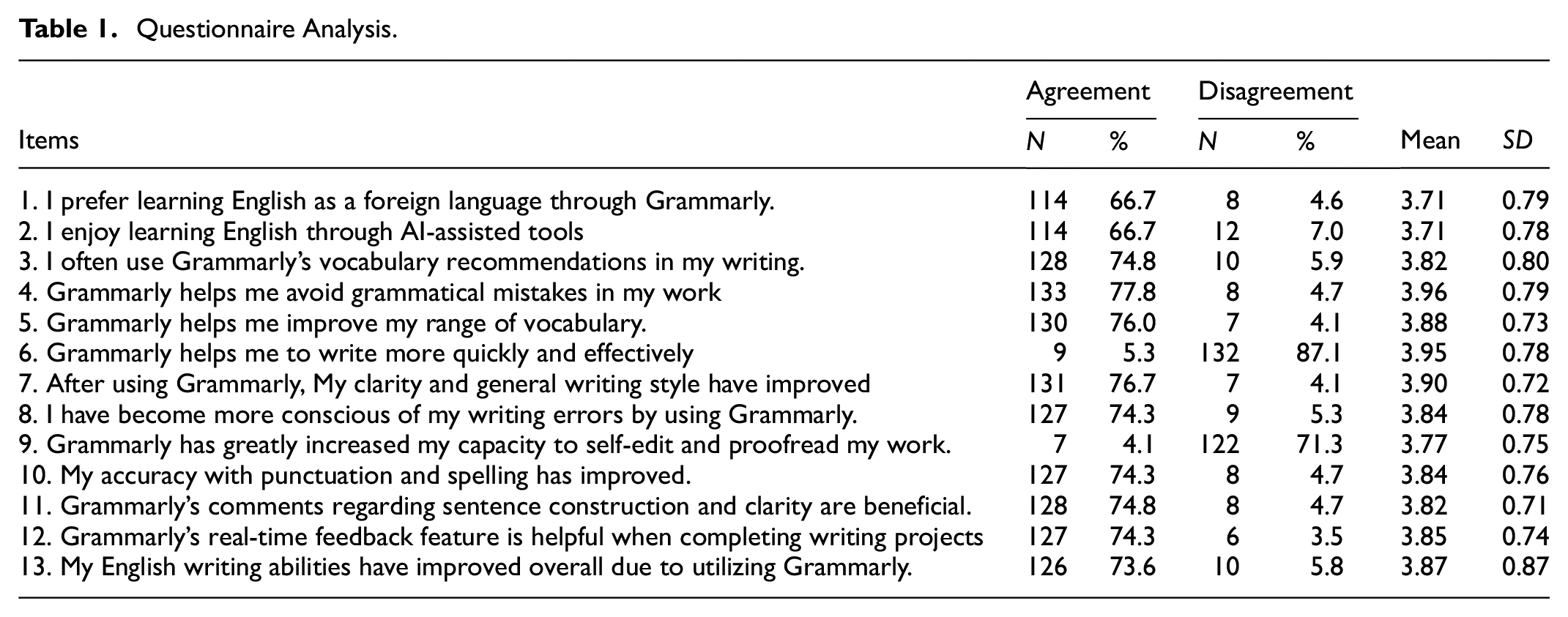
Despite these benefits, students’ opinions on Grammarly’s effectiveness for self-editing and proofreading were varied. Only 4.1% (M = 3.77, SD = 0.75) felt it significantly improved their editing capacity, while 71.3% disagreed. This suggests that Grammarly may not enhance students’ self-editing abilities. However, 74.3% (M = 3.84, SD = 0.76) reported improved accuracy in punctuation and spelling, with only 4.7% disagreeing. This indicates that Grammarly is a valuable resource for maintaining accurate writing mechanics. Furthermore, 74.4% (M = 3.82, SD = 0.71) found Grammarly’s comments on sentence construction and clarity beneficial, with only 4.7% disagreeing. This suggests that Grammarly aids in enhancing sentence structure and language refinement. Additionally, 74.3% (M = 3.85, SD = 0.74) found Grammarly’s real-time feedback feature useful for writing projects, with only 3.5% disagreeing. This highlights the value of Grammarly’s immediate feedback in the writing process. Finally, 73.6% (M = 3.87, SD = 0.87) reported that using Grammarly improved their English writing abilities, while 5.8% felt it did not make a difference. Overall, these findings demonstrate that Grammarly is an effective tool for enhancing writing skills among EFL learners, though its impact on editing abilities and writing speed may be limited.
Interview Data Findings
As part of this study, detailed interviews with 20 students, each lasting 8 to 10 minutes, were conducted to understand their perspectives on using Grammarly, a widely used writing assistant tool. The interviews focused on the student’s experiences, reasons for choosing Grammarly, perceived benefits, and encountered problems. The transcribed data were analyzed to identify common themes and viewpoints, and categorized into three groups: reasons for using Grammarly, advantages of using Grammarly, and disadvantages of using Grammarly. This structured categorization provided insights into Grammarly’s impact on students’ writing and language skills.
Category One: Reasons to Use Grammarly
Elimination of Grammatical Mistakes
Many students, like Student Participant 1, rely heavily on Grammarly to find and fix grammatical errors, ensuring their writing is correct and error-free. Student Participant 1 stated, “Yes, I use Grammarly to check the accuracy of my grammatical errors.”
Better Vocabulary Suggestions
Grammarly helps users enhance their vocabulary by suggesting alternative words. Student Participant 2 shared, “It has had a positive impact on my language skills, particularly on my vocabulary and writing style.”
Time Effectiveness
Students appreciate Grammarly for its prompt feedback, which saves time and optimizes the writing process. Student Participant 3 mentioned, “Within a brief timeframe, we can verify and correct our writing.”
Simple and Easy to Use
Grammarly’s ease of use and accessibility on various devices make it a popular tool. Student Participant 4 emphasized, “Grammarly is an online writing tool that offers great accessibility and convenience to users.”
Improvement in Writing Skills
Grammarly is seen as a comprehensive tool for improving all aspects of writing. Student Participant 17 noted, “Grammarly improves writing by providing real-time grammar and spell check, improving clarity, coherence, and overall writing quality.”
Category Two: Advantages of Grammarly Usage
Versatility
Grammarly and similar online tools have revolutionized language learning by providing valuable support. Student Participant 5 stated, “I am very glad to use online applications while learning a foreign language.”
Grammar Error Correction
Grammarly’s precision in correcting grammar and spelling errors is highly valued. Student Participant 3 mentioned, “It corrects our spelling and grammatical mistakes, Grammarly can paraphrase writing, plagiarize our writing, and set the right tone.”
Quick Feedback
Grammarly provides swift and real-time feedback, which enhances writing efficiency. Participant 7 said, “Grammarly enhances writing by providing real-time grammar and spell check improving clarity, coherence, and overall writing quality.”
Discovering New Words for Writing
Grammarly helps students enrich their vocabulary by suggesting synonyms and alternatives. Student Participant 2 stated, “Grammarly helps to catch current grammar mistakes and spelling errors, rover style suggestions, and enriching vocabulary.”
Linguistic Clarity
Grammarly’s contextual suggestions help users understand the appropriate usage of words, improving overall communication clarity. Student Participant 7 noted, “Grammarly enhances writing by providing real-time grammar and spell check improving clarity, coherence, and overall writing quality.”
Category Three: Disadvantages of Using Grammarly
Technology Dependence
Students expressed concerns about over-reliance on Grammarly, which might hinder their ability to learn grammar independently. Student Participant 4 said, “Sometimes, a person using Grammarly daily for their reading or writing almost forgets their grammar knowledge entirely.”
Contextual Errors
Grammarly sometimes makes inappropriate suggestions that do not align with the intended context, leading to misunderstandings. Student Participant 2 mentioned, “Well, sometimes they cannot use proper words to contribute to the context.”
Economic Burden
The cost of Grammarly’s premium subscription is a significant concern for students with limited budgets. Student Participant 11 said, “To me, the subscription cost is one of the disadvantages.”
Discussion
The extensive analysis of questionnaire and interview data provides a comprehensive view of students’ interactions with Grammarly in their EFL learning journey. This discussion explores Grammarly’s effectiveness, benefits, and limitations in improving EFL learning, addressing two key study questions.
To address Research Question 1 on how Grammarly affects vocabulary, error avoidance, and writing style for EFL learners the finding EFL Learners’ Experience with Grammarly Regarding Writing Speed and Overall Effectiveness: The data from the questionnaires and interviews reveal that Grammarly has a significant positive impact on vocabulary, error avoidance, and writing style for EFL learners. A substantial majority of students, 74.8%, reported enhanced vocabulary after using Grammarly. This improvement aligns with Zhou and Wei’s (2018) assertion that digital tools provide extensive language exposure, essential for building language skills. Grammarly’s real-time suggestions for word choices and synonyms help students expand their vocabulary, making their writing more varied and expressive. The tool’s capacity to identify and correct grammatical errors is particularly beneficial. Ghufron et al. (2018) found that 76.0% of students felt their writing skills, especially in vocabulary and grammar, improved due to Grammarly. This corroborates other studies indicating that AI writing tools significantly enhance language accuracy and richness. Furthermore, Grammarly aids in improving writing style by offering suggestions to make writing clearer and more coherent. About 76.7% of students felt that Grammarly improved their writing style, making their texts more polished and professional. Saman et al. (2023) support this view, noting that Grammarly AI tools can enhance overall writing quality, not just grammatical correctness. Grammarly’s ability to refine writing style by addressing clarity, tone, and formality ensures that students produce more coherent and professionally styled texts. These improvements in vocabulary, error avoidance, and writing style collectively contribute to a more robust command of the English language for EFL learners.
To address Research Question 2 on EFL learners’ experiences with Grammarly regarding writing speed and overall effectiveness, the findings EFL Learners’ Experience with Grammarly Regarding Writing Speed and Overall Effectiveness: While the data indicates that Grammarly significantly benefits vocabulary and grammar, its impact on writing speed is less pronounced. Survey data shows that 87.1% of students did not experience significant changes in their writing speed. Shadiev and Feng (2023) suggest that the time spent reviewing and applying Grammarly’s suggestions may counteract any potential speed benefits. Despite this, Grammarly is generally seen as effective in enhancing the clarity and quality of writing. About 76.7% of students reported that Grammarly made their writing clearer and stylistically better, supporting the tool’s overall effectiveness in improving writing quality. However, there are mixed feelings regarding Grammarly’s role in improving self-editing and proofreading skills. Ranalli (2021) found that 71.3% of students did not find Grammarly particularly effective in these areas, potentially due to over-reliance on the tool. This suggests a need for a balanced approach, where Grammarly is used as a supplementary aid rather than a crutch. Despite the tool’s proficiency in providing immediate feedback, which three-quarters of the students found helpful (Y. Huang & Wang, 2020), concerns about over-dependence and context-related errors highlight the necessity of integrating AI tools like Grammarly thoughtfully in educational settings. Interviews further reveal that students appreciate Grammarly for spotting errors, enhancing vocabulary, and saving time (Alexander et al., 2019). However, there is a consensus that Grammarly should complement rather than replace traditional learning methods to develop independent editing skills effectively.
Grammarly significantly aids in improving vocabulary, error avoidance, and writing style for EFL learners. However, its impact on writing speed is less evident. EFL learners generally find Grammarly effective in enhancing writing clarity and quality, although its role in developing independent editing skills is debatable. A balanced approach, combining AI tools with traditional learning methods, is essential to maximize Grammarly’s benefits while mitigating its limitations. This study underscores the importance of integrating technological tools thoughtfully into language education to foster a comprehensive and effective learning experience. Furthermore, Grammarly, while a powerful tool for enhancing writing, has notable limitations that warrant critical examination. Its effectiveness varies across different types of writing tasks; for instance, while it excels in identifying grammatical errors and suggesting vocabulary improvements in straightforward writing, it may struggle with nuanced academic writing or creative tasks that require a more sophisticated understanding of context and style (O’Neill & Russell, 2019). Additionally, there is a risk of users becoming overly dependent on Grammarly, potentially hindering the development of their writing skills (Li & Kim, 2022). On the other hand, Grammarly’s strengths lie in its accessibility and user-friendly interface, which can significantly aid non-native speakers and those with limited writing proficiency by providing immediate feedback and educational explanations. Balancing these strengths and weaknesses, it is essential to use Grammarly as a supplementary tool rather than a primary means of learning to write effectively.
The study’s findings align with the literature, suggesting that digital tools like Grammarly significantly enhance English writing proficiency through real-time feedback and vocabulary enhancement (Kacetl & Klímová, 2019; Mahmuda, 2016). Study indicates that Grammarly positively impacts grammar correction, vocabulary enrichment, and writing style, although concerns about over-reliance and data privacy persist (El Ebyary, 2022; Shahriar & Laboni, 2023). Global study supports Grammarly’s role in improving writing outcomes by offering immediate feedback and vocabulary suggestions (Kacetl & Klímová, 2019; Mahmuda, 2016). In Western educational settings, Grammarly is recognized for its ability to enhance writing skills more effectively than traditional methods alone (Marwa et al., 2023; Warschauer, 2016). This broad acceptance underscores Grammarly’s capacity to provide personalized, real-time assistance, facilitating significant improvements in writing proficiency (Dizon & Gayed, 2021; Karyuatry, 2018). Conversely, European study emphasizes the potential drawbacks of over-reliance on digital tools, suggesting that it can undermine the development of independent writing skills (C. Y. Ersanlı & Yeşilel, 2023; Prasetya & Raharjo, 2023). These studies highlight the need for a balanced approach, integrating digital tools with traditional pedagogical methods to prevent dependency. Implementation and impact of Grammarly can vary across cultural and educational environments. For example, studies in Asian contexts like South Korea report significant improvements in writing skills due to the use of similar digital tools (J. Huang et al., 2020). This variability underscores the importance of context-specific approaches when integrating digital tools in education, ensuring they complement rather than replace traditional teaching methods.
Contrasting studies highlight Grammarly’s multifaceted impact on writing proficiency, with some reporting significant improvements in grammar and vocabulary (Dizon & Gayed, 2021; J. Huang et al., 2020; Karyuatry, 2018), while others emphasize the need for a balanced approach to avoid over-dependence (Hattna, 2023; Yeşilel, 2023). Overall, integrating Grammarly into the EFL curriculum in Bangladesh offers a promising avenue for enhancing writing skills, however, this study indicates that to maximize effectiveness, Grammarly should be used to complement rather than replace traditional teaching methods (Rahnuma, 2023; Shahriar & Laboni, 2023). The detailed interviews and survey results indicate that Grammarly is a valuable tool for improving writing skills among EFL learners in Bangladesh. The majority of students appreciate its ability to eliminate grammatical errors, enhance vocabulary, and provide quick feedback. However, there are concerns about over-reliance on the tool, contextual errors, and the economic burden of premium subscriptions. To maximize the benefits of Grammarly, a balanced approach that combines its use with traditional learning methods is recommended, ensuring that students develop both their intrinsic writing abilities and technical proficiency.
Study Contribution
The study discussed above significantly contributes to understanding the role of AI tools like Grammarly in English as a Foreign Language (EFL) learning. It offers insights into the tool’s effectiveness, benefits, and limitations through student feedback from questionnaires and interviews. Key contributions include highlighting the growing preference for AI tools in language learning, as noted by Nazari et al. (2021), and the importance of engagement and enjoyment in learning, as emphasised by Prasetya & Raharjo, (2023). The study also sheds light on the learners’ improvements in vocabulary and grammar, aligning with Klapper and Rees (2003) emphasis on comprehensive language exposure. It further explores Grammarly’s impact on writing skills, including vocabulary enhancement, as Marwa et al. (2023) supported, while noting its nuanced exact effect on writing speed. Additionally, the study discusses potential over-reliance on such tools, impacting self-editing skills development, a concern highlighted by Marzuki et al. (2023). So, this study provides a well-rounded examination of Grammarly’s role in EFL learning, balancing its benefits in enhancing linguistic skills against areas requiring further research, such as its impact on writing speed and independent editing capabilities.
Future Implications
The future implications of this study on Grammarly’s use in learning English as a second language are quite significant and broad. Firstly, it points out the need for more studies to understand how tools like Grammarly affect language learning over time. For example, there’s a question of whether students might become too dependent on these tools and not develop their language skills enough, a concern mentioned by Li and Kim (2022). Secondly, the findings about how Grammar helps with vocabulary and grammar, but not necessarily with writing speed, suggest that we might need more advanced and varied AI tools. These tools would better meet the different needs and learning styles of students learning English. Also, this study shows that it’s important to find the right balance between using technology and traditional teaching methods in classrooms. As technology becomes a bigger part of education, figuring out how to use it effectively alongside classic teaching approaches is key. Additionally, the study hints at the possibility for teachers and those who create educational programs to use AI tools like Grammarly more thoughtfully in their language teaching, ensuring these tools add to, rather than replace, usual learning methods (Rasool et al., 2024). Finally, the insights into how students enjoy and engage with learning when using AI tools, align with Marzuki et al. (2023), who suggest a wider role for AI in making education more enjoyable across various subjects. Future studies could look into how AI can make learning more engaging in different areas, not just in language learning. Specific areas for Future study should focus on longitudinal studies to assess the long-term effects of using tools like Grammarly on writing skills. Additionally, comparative studies across different cultural and educational settings could provide deeper insights into optimizing the use of digital tools in language learning. This will help educators tailor their approaches to meet the specific needs of learners in diverse contexts while leveraging the benefits of digital advancements. In short, this study opens the door to more study and innovation in how AI is used in education, encouraging new ideas and approaches in this fast-changing area.
Conclusion
In conclusion, this study on using Grammarly in English as a Foreign Language (EFL) learning offers valuable insights into the benefits and challenges of integrating AI tools in language education. The findings reveal that students generally appreciate Grammarly for enhancing their vocabulary and grammar skills. However, the study also brings to light some concerns, such as the potential for students to become overly reliant on these tools, which might affect their ability to develop independent language skills. Moreover, the study shows that while Grammarly can improve certain aspects of writing, its impact on writing speed is not as clear-cut. This opens up an area for further exploration, especially in developing AI tools that cater to a wider range of learning needs and styles. The study also highlights the importance of using technology like Grammarly to complement traditional teaching methods, rather than replace them, ensuring a balanced approach to language education. Overall, the study suggests that while tools like Grammarly are beneficial in many ways, there’s a need for more research study, especially long-term studies, to fully understand their impact on language learning this research study could help educators and technology developers create more effective and nuanced educational tools, leading to better student learning experiences. In essence, this study paves the way for continued exploration and innovation in the use of AI in education, promising a dynamic future in technology and language learning.
Footnotes
Appendix
ORCID iDs

Funding
The author(s) received no financial support for the research, authorship, and/or publication of this article.
Declaration of Conflicting Interests
The author(s) declared no potential conflicts of interest with respect to the research, authorship, and/or publication of this article.
Data Availability Statement
Data will be made available on request.