




Abstract
Inasmuch as the fact that writing is a cognitively demanding task and as a step toward overcoming some of the barriers English as a Foreign Language (EFL) learners face during writing performance, this study attempted to investigate Iranian EFL learners’ perceptions toward the most common writing difficulties. To this end, 120 Iranian EFL learners from Golestan University, Iran, filled out a reliable and validated questionnaire. The results of the questionnaire and the semi-structured interviews (N = 24) revealed that most of the participants agreed that for teaching grammar and punctuation, they should be embedded in a context and be integrated with the four skills. They also believed that teachers should use punctuation appropriately in their writings themselves and teach them to students explicitly. Besides, it was believed that through using mnemonics, students can better learn words spelling. The results of the interviews revealed grammar, spelling, punctuation, choice of words, organization, and familiarity with genres and rhetorical structures, negative transfer from Persian to English, and idiomatic expressions and collocations are the other factors that make the writing task difficult. Based on the students’ perceptions, the findings of this study can inform English language teachers to teach grammar, punctuation, and spelling by contextualizing them in an appropriate context, and they offer some practical implications for teachers, learners, material developers, and curriculum designers in this regard.
Introduction
Learning and teaching English as a Foreign Language (EFL) are always painstaking tasks, especially when they come to places where English serves a very limited purpose. In this regard, it can be argued that although English language teaching in Iran has a history of, at least, more than 50 years, due to the limited use of English language in daily interactions and inappropriate measures taken to its teaching, learning EFL is a great challenge for many students as their scores in English state-level school exams reveal (Amirbakzadeh & Vakil Alroaia, 2020; Davari & Aghagolzadeh, 2015; Iranmehr & Davari, 2018). Another possible reason for this ineffective English language teaching and learning tendency may be the great effect that testing has on what is taught in the schools. Therefore, for most students, vocabulary and grammar lessons are learnt through rote memorization to pass the tests, rather than learning them to be able to use them in real-life situations for real purposes (Akbari, 2015).
Due to the neglect of the writing skill in the educational process and its challenging nature, writing is considered as one of the most demanding skills for EFL students to learn (Du, 2020; Gholaminejad et al., 2013; Jabali, 2018; Tillema, 2012). Therefore, difficulties faced by L2 student writers across a wide range of proficiency levels have received great prominence for a long time (Al Mubarak, 2017; Bitchener & Basturkmen, 2006; Braine, 1995; Casanave & Hubbard, 1992; Johns, 1995). Despite its complex nature, writing is used by a vast majority of people each day to accomplish different purposes such as expressing one’s ideas, attitudes, and opinions, sharing information, one’s feelings and ideas, and persuading others. People may also write for personal enjoyment through such activities as diary or journal writing. In the educational context, writing can be employed to take important notes while learning and writing academic reports, theses, essays, and compositions to meet the demands of intended authorities, among other things (Hyland, 2013). Thus, incorporation of the writing skill into the EFL teaching syllabus in schools is recommended as writing can solidify what students have learnt through other skills, provide the chance for students to work with language in context, and enable students to go beyond what they have learned by employing the learned points in writing tasks (Raimes, 1991). In other words, writing can be both an end in itself and a means in help of English learning. For instance, learners can use writing to consolidate learning of new structures or vocabulary or employ it to help them remember new items in a language. Furthermore, through writing practice, teachers can track students’ progress and diagnose their weaknesses and strengths and subsequently provide feedback to students (Hyland, 2019; Parr & Timperley, 2010).
In spite of these advantages, effective writing requires a number of competencies such as high degree of organization in the development of ideas and information, high degree of accuracy so that there is no ambiguity in meaning, the use of complex grammatical devices for signaling emphasis, and a careful choice of vocabulary items, grammatical patterns, and sentence structures to create a style which is appropriate for the intended purpose and audience (Hedge & Kavanagh, 1988). In addition, a common complaint that has been often heard is that university students are incapable of expressing themselves in a clear, correct, and comprehensible manner in writing. Students’ problems in writing may occur due to many factors. One of the causes for this challenge might be the complex nature of the writing skill itself (Gautam, 2019; Nasser, 2016; Patience, 2020). Byrnes (2002) postulated that certain psychological, linguistic, and cognitive factors make the writing skill a complex discourse medium for most people in both native and second languages.
It is worth mentioning that due to the significance and challenging nature of the writing skill, researchers have focused on writing difficulties encountered by learners in various EFL contexts. In this regard, some empirical studies have attempted to identify writing difficulties and ways to overcome such writing problems (e.g., Al-Khasawneh & Huwari, 2013; Chen & Wu, 2001; Jafari & Ansari, 2012). More specifically pertained to the concern of the present study, few empirical investigations have worked on EFL students’ attitudes and perceptions toward problematic areas in writing (e.g., Al Mubarak, 2017; Bani Younes & Salamh Albalawi, 2015; Jabali, 2018; Mwangi, 2017). To the best of the researchers’ knowledge, however, no study has used questionnaires to examine students’ perceptions and attitudes toward sources of EFL writing difficulties in the context of Iran. Therefore, to continue and add to this relatively new and burgeoning line of research, this study aims to investigate Iranian EFL learners’ perceptions toward the most frequently encountered difficulties experienced during writing performance.
Review of the Related Literature
Learners’ perceptions of the difficulties they experience when writing in English play a momentum role in the process of teaching and learning, which can per se help teachers alleviate some of the difficulties learners encounter. The development of students’ L2 writing can be affected by multifarious factors, including L1 writing ability, choice of lexicons, mastery of grammatical structures, organization, familiarity with the rhetorical structures, L2 proficiency, and writing experiences in both languages (Bitchener & Basturkmen, 2006; Cooley & Lewkowicz, 1995; Dong, 1998; Kubota, 1998).
Cooley and Lewkowicz (1995) enumerated some of the difficulties as using the appropriate style of writing, organizing coherent ideas and consolidated arguments, and expressing their ideas coherently and cohesively in English. Difficulties with vocabulary choice, particularly with respect to levels of appropriateness and formality, were potential sources of difficulty to obscure meaning. On a par with this study, Dong (1998), investigating nonnative graduate students’ writing in science, found that all of the students expressed that they thought vocabulary choice was important for expressing ideas and arguments, and 30% of the L2 students mentioned that they had difficulties with vocabulary choice. Besides, only 49% of English as a Second Language (ESL) students stated that they had difficulty with grammar and mechanics. It was also found that students had difficulty with sequencing and development of propositions and with the appropriate use of transitions between propositions and topics. Furthermore, James (1984) observed that some difficulties at the sentence level would contribute to blurring the meaning; the identified factors include complex sentences, overlong, faulty referencing, lexical difficulties related to specialized vocabulary, as well as signposting weaknesses.
Khan (2011), conducting a study to explore the obstacles of Saudi university students in writing, mentioned that learners face difficulties in phoneme clusters, spellings, grammar, doubling of subjects, language interference, doubling of preposition, articles, tenses, appropriate vocabulary, wrong use of prefixes, and suffixes. Khan (2011) recapitulated that these writing difficulties can be attributed to lack of English language curriculum, unfavorable teaching methods, inappropriate language environments, and the lack of personal motivation on the part of the learners themselves. In line with Khan’s (2011) findings, Al Mubarak (2017), investigating the academic writing problems faced by undergraduate students during 15 graduation projects at Al Imam Al Mahdi University-Sudan, reported that grammatical inaccuracies hinder the process of writing, among which punctuation, the use of prepositions, weak expressions, unparalleled structure, consistency, and the use of irregular verbs are of upmost important which need to be taken into account.
Akbari (2015) sought to diagnose and remedy English writing problems of 20 EFL students from Nile Valley University. To this aim, the participants were asked to write a composition of about 250 to 300 words for describing their hometown or village. The results of the data analysis revealed that the students had problems at the levels of morphology and syntax, usage errors, and mechanics of writing such as spelling, punctuation, and capitalization. The recommendations to improve the participants’ writing performance were revising their written work aloud, making natural pauses when they speak to help them with punctuation, using dictionaries to correct spelling mistakes, and reading extensively in English.
Another line of inquiry has underlined the identification of major sources of writing problems encountered by EFL learners. For instance, in a study done on 60 Iranian EFL students at Sobh-e-Sadegh University in Isfahan, Iran, Jafari and Ansari (2012) attributed writing failure of Iranian EFL learners to various sources such as learners’ lack of motivation, low proficiency, low level of vocabulary knowledge, L1 interference into the L2 learning process, and psychological factors like anxiety. They argue that if students work collaboratively, they can learn more and have less difficulty in writing.
Similarly, Al-Khasawneh and Huwari (2013), conducting a semi-structured interview with 10 EFL learners at Taibah University, mentioned grammatical weakness, low level of language knowledge practice, and educational background as potential sources of learners writing difficulties. They stressed that the most significant reason lies in the fact that Arab students do not possess the knowledge of even basic English in spite of the fact that they are taught English in schools. Or, it is probably because of the fact that the school teachers do not pay enough attention to the teaching of English. It is inferred that the teaching/learning situation in Saudi Arabia indicates that Saudi students do not practice enough writing in and out of the classroom, and that the grammar rules their teachers teach in the classroom are not really put into practice in students’ actual writing.
More related to the concern of this study was an empirical research done by Bahloul (2007), which focused on spelling and punctuation difficulties in writing performance. The results of this study revealed that the main cause of spelling errors is irregularity of the English writing system. Henderson (1981) also confirmed that lack of one-to-one correspondence between the sound and spelling systems is the main reason for this confusion. Lee and Tajino (2008) conducted a study to find out 95 first-year Japanese university students’ perceptions toward the difficulty with academic writing in English. They reported that the students perceived language-related components of academic writing to be more difficult compared with structure/content-related components. Furthermore, it was revealed that many students found research design particularly difficult.
However, some other empirical investigations have chosen learners’ attitudes or perceptions toward the writing process and writing difficulties encountered in this process as their focus of inquiry. For instance, Jabali (2018) examined attitudes toward writing in general and writing differences faced during writing performance in English and Arabic in particular, among a group of 102 EFL students at An-Najah National University, Palestine. The results of this study showed that the higher was the level of students’ language proficiency, the less was their level of anxiety and apprehension toward writing. Moreover, it was reported that in general, the participants had positive attitudes toward writing and writing-related issues such as instructional approaches, writing strategies, and writing materials used in their writing classes. Bani Younes and Salamh Albalawi (2015) explored the most prevalent writing difficulties faced by 40 English language and translation major sophomore female students from Tabuk University, Saudi Arabia. Their findings indicated that the most common problems significant in the students’ writing productions were classified into three types: (a) grammatical problems such as tenses, prepositions, subject–verb agreement, and article use; (b) punctuation problems; (c) spelling problems such as difficulty in appropriate use of substitution, omission, addition, disordering, segmentation, and unrecognizable words. To follow such a relatively new and fledgling line of research and bridge the gap in the literature, this study aimed to replicate Bani Younes and Salamh Albalawi’s (2015) study in the context of Iran while taking more participants (N = 120) into account. While myriad of studies in the past have focused on sources of writing difficulties encountered by EFL learners as outlined above, there is dearth of research on examining learners’ perceptions and attitudes toward common problematic areas students have to tackle with during writing production. Investigating learners’ difficulties in writing can help teachers to diagnose students’ mistakes which per se help them write appropriately in English. To fill this lacuna in the Iranian context, this study aimed to explore Iranian university EFL students’ perceptions toward the most common difficulties found in writing production.
Research Question
This study attempted to find an answer to the following research question:
Method
Participants
The participants of this study were selected from university students and graduates from Golestan University, Iran. The resulting sample included 120 teaching English as a Foreign Language (TEFL) students or graduates from both genders (i.e., 36 males and 84 females). Furthermore, they were all natives in Persian and their age ranged from 16 to 35 years. Of the 182 participants who were available based on convenience sampling, 120 of them filled out the questionnaire. The design of this study was descriptive and an ex-post facto because there was no treatment. They all filled out the consent form. In addition, 40% of the participants were at upper intermediate level and 34.2% of them were at the intermediate level, and the rest were advanced (25.8%) based on the results of Oxford Quick Placement Test.
Instruments
To collect data regarding the participants’ perceptions toward the most prevalent writing difficulties faced when writing in English, the questionnaire developed by Bani Younes and Salamh Albalawi (2015; see Appendix A in Supplemental Material), measuring the respondents’ perceptions regarding common writing problems, was utilized. This questionnaire included three main sections containing 22 items, which was based on a 5-point Likert-type scale ranging from “1” strongly disagree to “5”strongly agree. The first eight items in the scale are about grammar, and the following six items deal with punctuation, and finally, the last eight items have to do with spelling. The Cronbach’s alpha reliability coefficient reported for the scale in this study is .78. Moreover, a semi-structured interview was conducted with 20% of the students (N = 24) to triangulate the data and probe more deeply into their perceptions of writing difficulties.
Data Collection Procedure
To gather the required data, the questionnaires were distributed to 182 male and female participants whose level of proficiency was measured via Oxford Quick Placement Test. The hard copy of the questionnaire was distributed among the participants who accepted voluntarily to participate in the study. Besides, the participants were ensured of the anonymous nature of the data collection process. They only provided information regarding their gender, level of English, writing level, which were going to be used only for research purposes. As the participants were from English-related majors, they had no problem in answering items of the scale which were in English. The required time estimated for answering the scale was about 10 to 15 min. Besides, 24 participants were selected voluntarily to take part in the semi-structured interview to talk about their English writing difficulties they have encountered and how they can solve them. Each interview lasted for about 10 to 12 min, and all the interviews were recorded, transcribed, and coded.
Data Analysis
The collected data were analyzed for descriptive statistics, such as mean, frequency, and percentage. The interviews were thematically analyzed, some of which have been reported here.
Results
Descriptive Statistics
Table 1 represents the descriptive statistics, including minimum, maximum, mean, and standard deviation related to the participants’ answers to the 22 items of the questionnaire. Accordingly, Item 13 (i.e., my teacher uses the punctuation marks in her writing and teaching) was the most preferred item in this questionnaire with a mean of 4.04. Items 18 (i.e., I will be a better speller if I became a better reader) and 22 (i.e., knowing the roots and affixes of words and their meanings can help learners with their spelling) were ranked second and third with means of 3.91 and 3.90, respectively. Items 19 (i.e., textbooks can’t help to develop my spelling) and 4 (i.e., my focus should not be on the correctness of the sentence) were the least preferred items with the means of 2.55 and 2.58, respectively. In order for the scale to be used in this study, some of the items in the scale were adapted to take account of the Iranian linguistic and cultural background of the participants.
Descriptive Statistics for the Questionnaire Items.

Furthermore, Figure 1 shows the means related to the first eight items of the scale, pertaining to grammar.
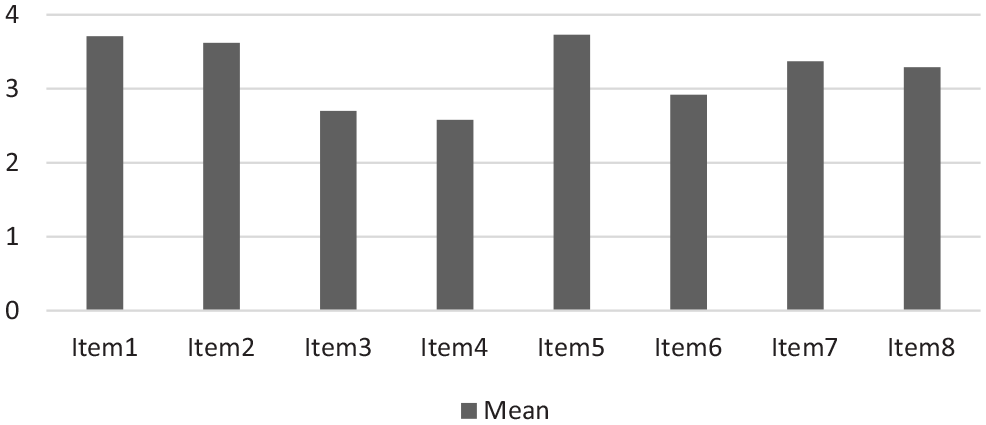
The bar graph of the means of eight grammar items.
According to Figure 1, when comparing the means of these eight items which refer to grammar as one of the causes of writing difficulty, it was found that Item 5 (i.e., I learn grammar along with other language skills) had the highest mean (3.73). The second highest mean (3.70) belonged to Item 1 (i.e., I learn grammar items through a context). Based on what was reported, it can be said that the Iranian EFL learners believe that to overcome grammatical difficulties in writing performance, one should learn grammar along with other skills and through a context.
The means of the next six items dealing with punctuation as a source of writing difficulty are presented in Figure 2.

The bar graph of the means of six punctuation item.
As can be seen in Figure 2, Item 13 (i.e., my teacher uses the punctuation marks in his or her writing and teaching) has the highest mean (4.04), while Item 12 (i.e., I think that Persian punctuation system and the English punctuation system are same) has the lowest mean (2.7). Therefore, the participants believed that teachers should model correct punctuation use in their own writing and teach them explicitly in the classroom.
Figure 3 demonstrates the means of the last eight items relating to spelling.

The bar graph of the means of spelling items.
Based on Figure 3, Items 18 (i.e., I will be a better speller if I become a better reader) and 22 (i.e., knowing the roots and affixes of the words and their meaning can help learners with their spelling) have the first and second highest means of 3.91 and 3.90, respectively. Therefore, the participants believed that they can overcome spelling difficulties in writing by reading a lot in English and working on roots and affixes of words.
Figure 4 represents the means of all 22 items of the scale.

The bar graph of the means of all 22 questionnaire items.
According to Figure 4, the highest means belong to Item 13 with the mean of 4.04, Item 18 with the mean of 3.91, Item 22 with the mean of 3.90, and Item 11 with the mean of 3.75, respectively. In other words, beside other considerations, the participants believe that teachers are required to use punctuation correctly in their own writing and explicitly instruct them to students; reading more in English can improve students’ spelling; by learning roots and affixes, they can better learn the spelling of words; and, this year, they are better in using punctuations.
Interview Results
A semi-structured interview in a face-to-face interaction was conducted to investigate what Iranian EFL learners think about the most frequent writing problems and how to solve them. Lynch (1996) argued that semi-structured interviews enhance the understanding of the data, consolidate the findings, and make the data collection more systematic, compared with the informal conversational approach.
Consistent with the results of the questionnaire, all the interviewees mentioned that making grammatical sentences is the most challenging concern for them. They stated that it sounds easy to write a single sentence correctly, but putting the sentences in a coherent and cohesive paragraph is a big challenge. In line with the data collected from the questionnaire, the interviewees also reported that spelling and punctuation make difficulty for them when they want to write sentences and specifically paragraphs. Furthermore, choice of words, organization, and familiarity with genres and rhetorical structures, as well as idiomatic expressions and collocations are the other factors which make the writing task difficult. Due to word limit, some of the interviewees’ statements are reported as follows:
Student 1: I think it is difficult for me to arrange the components of a sentence and relate sentences together. I think by writing about different topics, learning about linking words or coordinate conjunctions and conjunctive adverbs, mastering the organization of writing, I can learn better.
Student 2: My main problem is sentence structure, especially some of the sentences that are exceptional or have specific structures. I guess by seeing more examples and practicing, I can solve this problem.
Student 3: I have problems with punctuations and basically the rules and regulations of a proper text. I guess I can solve it by practicing and studying more about them, and teachers have not put emphasis on them.
Student 4: I assume I have three major problems in writing. First and the most important one is that I can’t keep the formal form of the essay; in other words, I don’t know how to use professional words in my writings. My second problem is with endings, as you may notice last semester from my speaking, I don’t know how to end my essays. The third one is punctuation. I don’t know where and how to use them in my essays.
Student 5: For some words there are three or four or more synonyms, they all mean the same thing and I get confused. I think by reading different English articles, books, reports, etc., we can get familiar with different kinds of writings and also the usage of different words.
Student 6: I guess I cannot translate verbs and pronouns from Persian to English correctly. To solve this problem, I need to be fluent in grammar and vocabulary.
Student 7: I think the most challenging issue for me is that I don’t know how to make ideas coherently linked and conclude my writing. Organizing ideas and including supporting sentences are difficult for me. I guess by reading more passages, increasing my vocabulary, learning structures, and brainstorming, I can write better.
Student 8: In writing, the most difficult part for me is the words I’m gonna use. For example, I’m gonna write an important letter, and I want to show my understanding of English and the topic I’m gonna write about. In my head, when I try the topic in Persian, it’s a good piece of writing, but when it comes to English writing, my hands are tied up. In my opinion, for a problem like this, there should be a way to use those words which are used less in English and use them.
Student 9: My problem with writing English sentences is that 1. I can’t make wording; 2. I don’t know how to finish my writing; 3. I’m also weak at grammar. I think to boost my writing skill, I can increase my vocabulary, read more books and stories, and strengthen my knowledge of grammar.
Student 10: Well, for me using the right verbs is somehow puzzling. I mean the correct tense of verbs you know, using different timing, etc. the other one is how to arrange the paragraphs in the best way, and I think teaching us the right format in class could help us. The last one for me is using nice words and expressions. For solving this, I think my own practice only works.
Student 11: The most important part of practicing as an English learner is speaking and then learning grammar. When I write, I sometimes get confused about the spelling of words such as quit, quiet, and quite. We don’t spend enough time for writing and its methods, maybe someone should force us to write an essay. Then, we can solve our alphabetical, grammatical, and orthographic problems.
Student 12: In my opinion, some factors make writing challenging. 1. Not knowing the meaning of words or poor vocabulary, 2. not knowing the correct sequence of words; in other words, poor grammar which makes us write incomplete and awkward sentences, and 3. not knowing how to pronounce words correctly or poor spelling are the most common writing difficulties for me and I think with the constant discussion in the class, watching movies, reading various books and articles we can solve them.
Student 13: There are usually petty struggles I have to overcome such as forgetting the spelling of certain words and not knowing grammar rules properly. And, I sometimes can’t find the right words for my ideas and sentences. I think that studying more books would help to solve my problems and instructors need to make us aware of our mistakes and need to give us feedback.
Student 14: I think there are various difficulties regarding to writing, but mostly poor vocabulary, especially for verbs (using stronger verbs rather than weak ones to convey meaning more practically), applying nice and neat grammar structures and keeping an eye for word order come up to my mind. On the other hand, some less-noticed flaws like incomplete paragraph design, redundancy and even wrong punctuation can lead to a result which won’t seem quite desirable. As far as I can see, the more we explore through multiple words and texts in order to face different occasions, structures and samples and follow them in to our own writings so that we can learn how to use them, the better and smoother we will turn into. It seems to me a matter of time and practice.
Student 15: For me, the first problem is grammar because sometimes I don’t know how to write a sentence with a correct structure. The other problem is converting Persian sentences into English sentences, which is because of lack of vocabulary and grammar. I guess I need to read and write more.
Discussion
As academic writing can be considered as an integral part of English learning process, recognizing the learners’ academic writing difficulties and their perceptions toward such problematic areas are of crucial importance in the educational context. Furthermore, as Al Murshidi (2014) stated, writing is found to be one of the most challenging skills to be learned and taught. To deal more tangibly with such issues in the development of the writing skill, various studies in the past have attended to identify major sources of writing difficulties and suggesting practical solutions to overcome such barriers experienced in the way toward successful writing performance (e.g., Akbari, 2015; Al-Khasawneh & Huwari, 2013; Bahloul, 2007; Chen & Wu, 2001; Jafari & Ansari, 2012).
Very few studies have investigated the EFL learners’ perceptions toward their writing difficulty. Two exceptions in this regard are studies conducted by Jabali (2018) and Bani Younes and Salamh Albalawi (2015) which attest to the fledgling nature of this line of research which needs to be supported via more future pertinent empirical studies. However, these two studies were conducted in the contexts of Palestine and Turkey, respectively. To elaborate more on the results of the two mentioned studies in this area, the aims of the Jabali’s (2018) study were twofold: first, to identify Palestinian EFL learners’ attitudes toward writing, and second, to scrutinize whether students perceive any significant difference between how they express their ideas in English and Arabic writing productions. In sum, his findings indicated that students showed positive attitudes toward the writing process in general and to textbooks, instructional approaches, and strategies used in the writing classes. Moreover, in a study done on 40 English major participants in Turley, Bani Younes and Salamh Albalawi (2015) asked the participants about the writing problems they encounter when writing in English. According to the results, the participants believed that the three most common sources of writing difficulty for them were (a) grammatical problems such as tenses, prepositions, subject–verb agreement, and article use; (b) punctuation problems; and (c) spelling problems such as difficulty in appropriate use of substitution, omission, addition, disordering, segmentation, and unrecognizable words. In line with the two previous studies on learners’ perceptions toward writing difficulties, the results of the present study indicated that among the 22 items of the scale measuring learners’ perceptions toward the most common writing difficulties which are grammar, spelling, and punctuation, learners had the highest perceptions toward Items 13, 18, and 11 which pertain to punctuation, spelling, and again punctuation, respectively. In other words, among the three sources of writing difficulty underlying the items of the questionnaire used in this study, learners diagnosed some aspects of spelling and punctuation, rather than grammar, to contribute to writing difficulties.
The results of follow-up interview also confirmed that grammatical structures, spelling, and punctuation are difficult to master. The students also agreed that organization, choice of lexicons, collocations, idiomatic expressions, and rhetorical structures can add to the daunting challenge of writing. For instance, Student 1 stated that I think it is difficult for me to arrange the components of a sentence and relate sentences together. I think by writing about different topics, learning about linking words or coordinate conjunctions and conjunctive adverbs, mastering the organization of writing, I can learn better.
This quotation emphasizes that grammatical rules are prioritized over other elements, which is in congruity with the students’ perceptions stated in the questionnaires. Moreover, Student 13 mentioned that “There are usually petty struggles I have to overcome such as forgetting the spelling of certain words and not knowing grammar rules properly.” This quote confirms that students linger behind spelling and grammar. Other students cited that vocabulary, organization, idiomatic expressions, and negative transfer from Persian to English are some of the writing challenges. For example, Student 6 reported that “I guess I cannot translate verbs and pronouns from Persian to English correctly,” confirming that teachers need to make students aware of intralingual errors and provide them with enough corrective feedback.
The results of the present study lend credence to Al Mubarak’s (2017) study in that punctuation, spelling, and grammatical structures play indispensable role in the process of writing, and students had difficulty mastering them. Al Mubarak found that punctuation, the use of prepositions, weak expressions, unparalleled structure, consistency, and the use of irregular verbs play crucial roles and make writing difficult. Moreover, our results are consistent with Mahmoud’s (2005) study in that syntactic mistakes and students’ blunders such as verbs and prepositions are major obstacles for EFL learners. In addition, in line with our findings, Farouq (2012) argued that grammar is the most difficult area for L2 learners. This idea was also supported with the postulations put forth by Nyasimi (2014) who contends that besides facing challenges in the use of correct sentence structure and paragraph development, students need to struggle in creating coherent text. The interviewees in our study also reported that linking ideas coherently and cohesively is one of the challenges they usually encounter. Student 7 mentioned that “I think the most challenging issue for me is that I don’t know how to make ideas coherently linked and conclude my writing. Organizing ideas and including supporting sentences are difficult for me.”
Furthermore, our findings are consistent with those of Li and Zeng (2019) as they found that the difficulties in academic writing mainly lay in vocabulary, grammar, and writing resources. Our results contradict those of Lee and Tajino’s (2008) in that they observed that the students perceived language-related components of academic writing to be more difficult than structure/content-related components. Our findings also resonate those of Mwangi’s (2017) as Mwangi found that students had difficulty with spelling, use of correct vocabulary, formation of tenses and plural forms of words, and proper punctuation.
Conclusion and Pedagogical Implications
Writing is hypothesized to be a cognitively demanding task (Tillema, 2012). The challenge is even more intense in the EFL context in which learners are exposed limitedly to the target language (Marashi & Dadari, 2012). Chau (2006) explained that because, compared with the other three language skills, writing seems to be more difficult and time-consuming to teach, less prominence and time is allocated to teaching and practicing writing in the classroom. Therefore, research on identifying sources of writing difficulties, understanding learners’ perceptions toward such problematic areas in writing, and providing practical ways to overcome these challenges may have a potential role in directing present instructional tendencies toward the writing skill.
To this aim, the present empirical research attempted to identify 120 Iranian EFL students’ perceptions toward the most common sources of writing difficulties through questionnaires and semi-structured interviews. The frequency results of each item shed light on this issue by revealing that most of the participants considered grammar, punctuation, and spelling as sources of writing difficulties. Furthermore, the respondents’ answers to items of the scale represent their perceptions toward how to overcome writing difficulties and reduce writing errors. Specifically, the participants believed that teachers should teach grammar, punctuation, and spelling through embedding them in an appropriate context and integrating them with other language skills, and teachers should first model good punctuation use for students in their own production and then teach them with the aim of consolidating what students have been exposed to indirectly earlier. The results of the interviews indicated that grammar, spelling, punctuation, paragraph coherence, organization, words, and rhetorical structures make the writing task difficult. Students also mentioned that teachers need to give them more extracurricular activities, and they need to put more emphasis on writing in and outside the class to make the writing task easier and more enjoyable. Teachers also need to feel responsible to provide their students with enough corrective feedback.
The results of the present study will yield fundamental insights regarding the major sources of writing difficulties and their significance from the students’ point of view that could contribute to beneficial guidance for teachers, material designers, and students. The findings also have the potential to suggest some practical solutions to the challenges faced by EFL learners in academic writing production. Besides such pedagogical applications, these outcomes have some implications in the realm of research. As pointed out previously, related research in the past has been obsessed with identifying major sources of writing difficulty while totally neglecting students’ perceptions toward problematic areas in writing. Therefore, this study and that of Bani Younes and Salamh Albalawi (2015) will be pioneers in this regard which can prompt more research in the future about such learners’ perceptions to consolidate past findings or provide new discoveries in this area.
In the light of the results gained, some suggestions could be of help for EFL teachers. If teachers are able to recognize the sources of difficulties that their students experience and contemplate on their underlying cause of the problem, they can resolve the problem during their teaching and provide students with remedial solution. Furthermore, identifying the current problems of academic English writing classroom which are necessary to be improved from the students’ vantage point can usher teachers to encourage innovation in education ideas, teaching methods, and teaching materials. The results of the present study should be generalized with some caution to other educational contexts as they were based on a sample of 120 participants chosen from one university in Iran. Moreover, this study identified students’ perceptions toward writing difficulties in isolation. Future studies can consider such learners’ perceptions in company of other related variables such as learner academic performance and examine their potential associations. Even other studies can examine learners’ perceptions through more qualitative means journal writing to gain more in-depth understanding of these processes.
Supplemental Material
Appendix – Supplemental material for An Investigation of the Iranian EFL Learners’ Perceptions Towards the Most Common Writing Problems
Supplemental material, Appendix for An Investigation of the Iranian EFL Learners’ Perceptions Towards the Most Common Writing Problems by Roghayeh Karimian Shirejini and Ali Derakhshan in SAGE Open
Footnotes
Declaration of Conflicting Interests
The author(s) declared no potential conflicts of interest with respect to the research, authorship, and/or publication of this article.
Funding
The author(s) received no financial support for the research, authorship, and/or publication of this article.

Supplementary Material
Supplementary material for this article is available online.
References
Supplementary Material
Please find the following supplemental material available below.
For Open Access articles published under a Creative Commons License, all supplemental material carries the same license as the article it is associated with.
For non-Open Access articles published, all supplemental material carries a non-exclusive license, and permission requests for re-use of supplemental material or any part of supplemental material shall be sent directly to the copyright owner as specified in the copyright notice associated with the article.
