




Abstract
This research examines how knowledge management practices (KMP) influence eco-innovation through employee creativity (EC), while considering market turbulence (MT) as a moderating factor. The study surveyed 320 employees from ICT firms using simple random sampling. All KMP types positively increase employee creativity, and Creativity mediates the relationships between four KMP aspects and eco-innovation: Knowledge storing (KS) → Product eco-innovation (PDI), Knowledge diffusion (KD) → Process eco-innovation (POI), Knowledge generation (KG) → Organizational eco-innovation (OGI), Knowledge application (KA) → All eco innovation types. The results suggest that fostering knowledge exchange and creative thinking helps companies develop eco innovations, especially in dynamic markets. Current research also proposes the three main mediating hypotheses and 12 sub-hypotheses about the mediating effect of EC for the relation of KD, KS, KG, and KA with PDI, POI and OGI. Results indicate that EC plays its role as a partial mediator. It is also seen that EC has a positive impact on PDI, POI and OGI. This research also proposes three sub-moderating hypotheses. Results indicate that market turbulence (MT) positively moderates the relationship of EC with three kinds of eco-innovation (EI) that is, PDI, POI and OGI. Future directions, limitations and implications are provided at the end.
Plain language summary
Current research investigates the relations between knowledge management practices (KMP) and eco-innovation by using employee creativity as an intervening variable and also checks the moderating role of market turbulence. Data was collected from 320 employees of ICT companies with the help of a simple random sampling method. Results indicate that KMP has a positive impact on employee creativity. Also, employee creativity plays a mediating role in the relationship between the two KMP practices, i.e., knowledge.
While the current body of research on eco-innovation concentrates on factors that may encourage the adoption of eco-innovation in manufacturing SMEs, the goal of this study is to propose a framework for each kind of eco-innovation in SMEs of the ICT sector. In this regard current study proposes two hypotheses for direct relationships and three hypotheses about the mediating effect of employee creativity for the relationship of kinds of KMP with kinds of eco innovation. The current study also proposes the hypothesis about the moderating effect of market turbulence for the relationship of employee creativity with kinds of eco innovations. Results confirm that kinds of KMP have a positive impact on employee creativity, and employee creativity has a positive impact on kinds of eco innovation. Results also confirm that employee creativity plays a mediating role for the relationship of kinds of KMP with kinds of eco innovation. Market turbulence is an important variable in the current era. That is why current research considers as a moderating variable. Results describes that market turbulence plays its moderating role for the relationship of employee creativity with process, organizational eco innovation and product eco innovation.
Keywords
Introduction
Environmental concerns are considered key indicators for businesses because public demand for protection of the environment and stronger environmental legislation (Szabo & Webster, 2021). Successful organizations have mainly adjusted themselves according to emerging issues and explored better opportunities for environment-friendly practices. However, globally, there is limited research about eco innovation (Yan et al., 2022). Eco-innovation (EI) is an evolving concept which considered a new paradigm shift and problems of the environment are also characterized as opportunities for organizations (Kanda et al., 2019). EI is a dynamic and evolving concept that has attained noteworthy attention in the current era (Yan et al., 2022). It represents a fundamental shift in the methods of businesses, governments, and individuals' approach about environmental issues (Loučanová et al., 2022).
Despite considering environmental challenges as constraints, eco-innovation (EI) views these challenges as opportunities for creating value, enhancing economic growth, and fostering a more sustainable future (Loučanová et al., 2022). It includes a variety of practices, from the development of clean technologies and renewable energy solutions to and design of ecologically friendly services and products (He et al., 2018). As compared to other pre-existing creativities, EI results in better solutions for controlling risks relating to environment, harmful impacts of industry, and risks related to pollution (Vieira de Souza et al., 2018). EI creates a win-win situation by benefiting both the environment and the economy (Hojnik et al., 2018; Martínez-Martínez, Cegarra-Navarro, Cobo, & de Valon, 2023). Under growing environmental pressure, eco-innovation has become an inevitable option for businesses looking to attain a competitive edge and for sustainability (W. Cai & Li, 2018). Globally, researchers and practitioners are more interested in eco innovation but in Pakistan, this concept is still at initial stage (S. Ullah et al., 2022). SMEs in Pakistan are lack behind regarding Eco Innovation (Chien et al., 2022). EI has been extensively researched for understanding, antecedents and outcomes by many scholars because of it is very beneficial for sustainability (W. Cai & Li, 2018). Products-eco innovation (PDI) results in heavy expenditures as compared to traditional products (Mady et al., 2022). However, organizations can bear this cost to get a competitive advantage and for more profit (W.-G. Cai & Zhou, 2014). Due to its importance for the economy, only limited studies in the Pakistani cultural context have been carried out to explore this phenomenon. The current study considers EC as a key variable and used employee creativity and knowledge management practices for explaining this variable.
According to Putra et al. (2020), organizations must incorporate distinct measures to maintain their competitive standing in the market. In the current era, particularly in the digital age, firms want to accept the attitudes that provide a guarantee of their survival in the long run such as knowledge management practices (KMP; Al Shraah et al., 2022). A better culture encourages employees to focus their intentions on knowledge storage, creation, application, and transfer (Chang & Lin, 2015; Marchiori & Mendes, 2020). Organizations do better performance as compared to their rival organizations on the basis of good knowledge (Hu et al., 2022). In the current era, knowledge emerges as a vital resource (Casero-Ripolles, 2020). However, era of competition, it is vital that organizations must use knowledge a weapon of competition, in addressing any uncertainty in their business. An organization desires knowledge which helps them to address market uncertainties and accept market variations timely. For the advancement of the ecological health of the world, KMP with an emphasis on managing environmental focus is essential (Chopra et al., 2021). According to research by Martínez-Martínez, Cegarra-Navarro, Garcia-Perez, and De Valon (2023), KMP is helping businesses to become more environmentally aware.
Employee creativity (EC) is considered a key skill of employees regarding introducing and using new technology and generating innovative ideas (Allam, 2019). Many global companies, like W.L. Gore, 3 M, and Google, inspire their workers to concentrate on innovative creativity (Ivcevic et al., 2021). Google recommend their workers to use 20% of working time on innovating thinking (Ivcevic et al., 2021; Liu et al., 2020). Therefore, innovative staff members who generate creative ideas are crucial to contemporary businesses. Investigators have focused on recognizing the abilities of employee creativity, but they have been far less interested in its causes and consequences. However, previous research has shown less interest in its predictors and outcomes (Yu et al., 2019). To fill this gap study focuses on examining antecedent (KM) and on the outcome (EI) along with this variable and also finds the moderating effect of market turbulence for the relationship of employee creativity with kinds of eco-innovation.
Economy of Pakistan is was badly effected in 2021 to 2022 (Siddiqui et al., 2022). Besides this recession, ICT sector of Pakistan is rising rapidly, present improved services at reasonable prices to their customers. The current research is carried out on ICT (SMEs) firms. The ICT sector of Pakistan is better contributor in GDP and established as major contributor in economy by offering products/services along with agriculture sector of Pakistan. According to a report, Pakistani ICT companies is gaining competitive edge as most of advance countries companies outsource their work to Pakistani ICT companies due to cost-effective (Mushtaq et al., 2022). The ICT sector of Pakistan is considered as one of the national foremost five exporter sectors, with the peak revenue in shape of export (Bansal et al., 2021). Due to this reason, researchers ponder the respondents of ICT sector as the target population.
There are three research objectives which are addressed in entire research. Firstly, to check the direct effect of kinds of KMP on EC and to check the direct impact of CE on kinds of EI. Secondly, to check the mediating effect of EC for the relationships of kinds of KMP and kinds of EI. To check the moderating effect of Market turbulence (MT) for the relationships of CE with kinds of EI. The current research contributes to the body of literature in several ways. The current study is conducted on the ICT sector of Pakistan. The current study contributes to the body of literature by proposing a framework based on the theory of RBV. The current study is using the four dimensions of KMP and checking their impact on EC. Current research is also initial effort by checking the impact of KD, KS on EC. Current research is also the initial effort to check the effect of EC on wo kinds of EI empirically. This research is also the initial effort to check the mediating effect of EC for the relationship of KD, KS, KG, and KA with three kinds of EI. This research is also unique in checking moderating variables of MT for the relationship of EC with kinds of EI.
Literature Review
The aim of the resource-based view (RBV) theory is to clarify why certain organizations surpass other organizations and gain a sustained competitive advantage, it claims that the ownership of inimitable firm resources helps to clarify why these organizations compete with others and thus gain a sustained competitive edge. Innovation is considered an emerging construct which encourages continuing growth and a source of competitive edge (Chen et al., 2018). The main features of competitive, dynamic, and advanced organizations is to use EI effectively (Dickel & Moura, 2016; Kuo et al., 2022). Moreover, Larbi-Siaw et al. (2022) explain the term eco-innovation based on the RBV. Similarly, KBV suggests that “knowledge is a key determinant of competitive advantage, and importantly, knowledge is generally refined and or created in the process of organizational learning” (Chalikias et al., 2014; Mueller et al., 2012; Valentim et al., 2016). Organizations are getting competitive by facilitating knowledge management (KM), which is a crucial component of the resource-based perspective. RBV describes that firms require resources and RBV better explain the resources KMP and EC and these links with innovation (Ullah et al., 2022). Naseer et al. (2021) propose the market turbulence based on RBV. Tsai and Yang (2013) explain the moderating role of market turbulence in the relationship of firm innovativeness and business performance. Zhou et al. (2019) also describe the role of MT in the relationship between marketing agility and financial performance.
Relationship of KMP With EC
KMP is an important dimension of intellectual capital (Paoloni et al., 2020). KMP is tactically crucial for the survival of any organization (Santoro et al., 2021). Few scholars describe dissemination and storage are the critical factors of KMP (Alegre et al., 2013), Whereas, remaining scholars have identified transformation, assimilation, exploitation, and acquisition are more important for defining KMP (Alegre et al., 2013; Xie et al., 2018). Lai and Lin (2012) defined three kinds which explained KMP: (a) knowledge storage, (b) knowledge creation and acquisition, and (c) knowledge diffusion and integration. Knowledge application, creation, and transfer were considered as the main KM procedures by (Al-Emran et al., 2018). Moreover, KMP comprises of acquisition, storage, sharing, application, codification, and creation (Costa & Monteiro, 2016). However, In the view of (Ode & Ayavoo, 2020), KD, KS, KG, and KA are considered as main component of KMP. The current study considers these four dimensions.
Inside organizational initiatives that can advance new knowledge by R&D activities are known as KG activities. This may entail generating new material or replacing existing information in the explicit or tacit knowledge pools of the organization (Donate & Guadamillas, 2011). KG has been recognized as a prerequisite for innovation (Costa & Monteiro, 2016). KS refers to “a set of systems and methods for managing and storing information” (Alegre et al., 2013). These are often IT-based systems that help with the retrieval or storage of operational knowledge. Human knowledge that has been written documentation, codified, expert systems, and procedures of tacit knowledge and documented processes collected by individuals and human networks are all illustrations of such knowledge (Donate & Guadamillas, 2011). KA, according to a prior study, is a noteworthy achievement aspect for building a new product and is considered a critical driver of innovation (Hamdoun et al., 2018; Mardani et al., 2018). The basic goal of KA is to combine knowledge from both external and internal sources to achieve organizational goals. Organizations can find the source of competitive edge by offering knowledge as an integration strategy to overcome firms’ problems with the help of knowledge application (Shin et al., 2001).
Knowledge Diffusion (KD) refers to the transfer of expertise, either directly through human capital or indirectly via technology and goods (Rivera-Batiz & Romer, 1991). Effective alignment of such intangible assets fuels innovation (Martelo-Landroguez & Cegarra-Navarro, 2014), with inter-organizational knowledge flows gaining research prominence (Luo et al., 2015). Empirical studies consistently link KMP to enhanced Employee Creativity (EC; Lee & Seol, 2021; Sigala & Chalkiti, 2015; Zhang et al., 2023), including qualitative evidence tying novel knowledge creation to EC (Maimone & Sinclair, 2014). While Imran et al. (2018) explored varied KMP effects on EC, their operationalization differs from this study’s framework. Two of the kinds are the same as proposed in this research that is, KG and KA these kinds have positive significant impact on employee creativity. To the best of the researcher knowledge, no previous research has examined the impact of two kinds of all KMP that is, KD, KS, with EC. Based on these facts current study argues the following hypothesis.
Relationship of Employee Creativity With Eco-Innovation
A large number of research have been conducted about the relationship of creativity with organizational effectiveness and individual competency (Chenji & Sode, 2019). Creativity “empowers employees to make decisions without relying on the hierarchal structure and depicts self-efficacy in making decisions” (Karakoc & Kucuk Yilmaz, 2009). EC is critical for organizational growth, success, and competition (Sacramento et al., 2013).
EC emerged as the integration, creation, or appropriation of new processes, products, organizational strategies, and services, for the organization (adopter or developer), ensuing in a minimizing of pollution, environmental risks, and hostile impact on lifecycle (Kemp & Pearson, 2008). The notion of eco-innovation introduced by (Fussler & James, 1996), is defined “as better use of resources to reduce negative ecological impacts while creating newer products and processes that benefit households and firms” (Hojnik & Ruzzier, 2016). If backed by several public-private partnership programs, EC can enhance the natural environment without restricting economic growth (Sumrin et al., 2021).
Many academic works have examined the factors that influence an organization’s embrace of eco-innovation. According to (Hojnik & Ruzzier, 2016) and (Sanni, 2018), some research has focused on examining the dimensions of just one or two categories of eco-innovation, such as eco-product innovation and eco-process innovation. As noted by (Triguero et al., 2013), very few research have thoroughly examined the factors that increase EI activities, such as PDI, POI, and OGI. As a result, certain studies have suggested that additional research and complete documentation be done to determine the key factors influencing the various forms of eco-innovation (W. Cai & Li, 2018; Hojnik & Ruzzier, 2016). Maldonado-Guzmán et al. (2020) determined that there hasn’t been much research done in the literature on the adoption of various EI approaches, particularly in emerging economies.
PDI designs to improve environmental features of the present products or produce new environment-friendly products (Cheng & Shiu, 2012; Pujari et al., 2004). PDI introduces steps that may reduce expenditures on production and enable an organization to get a competitive edge (Long & Liao, 2021). Moreover, organizations become market leaders by getting the benefit of innovative PDI (Mady et al., 2022). To the best of the researcher’s knowledge, there is only one research which examines that employee creativity has a positive impact on EI (Tuan, 2023). Qualitative research propose that employee creativity may increase the level of product and process innovation (Dul & Ceylan, 2011). Only a single research has examined the positive impact of employee creativity on product eco-innovation (e.g., Luu, 2022).
As noted by Triguero et al. (2013), very few research have thoroughly examined the factors that motivate EI activities. Certain studies have suggested that additional research and complete documentation be done to determine the key factors influencing the various forms of EI (W. Cai & Li, 2018; Hojnik & Ruzzier, 2016). Maldonado-Guzmán et al. (2020) determined that there hasn’t been much research done in the literature on the adoption of various eco-innovation approaches, particularly in emerging economies.
POI highlights process and technological amendments that upsurge distribution and production efficiency resulting in less expenditures (Triguero et al., 2013). POI results in developing and introducing production processes to decrease negative effects on the environment (Cheng & Shiu, 2012; Rennings, 2000). Qualitative research propose that EC may increase the level of product and process innovation (Dul & Ceylan, 2011). Based on this fact, current research argues in this regard.
Organizational eco-innovation is defined as “business model and practices, processes, re-design, roles, and responsibilities within the organization that aim to minimize adverse environmental impacts” (Fernando & Wah, 2017). OGI indicates the advancement of a corporate culture which enables the firm to get a competitive edge and new administrative approaches that enhance to advancement of management procedures and deal with the environmental effect of the firm like eco auditing, eco-training plans, and eco-learning methods (Ch’ng et al., 2021). Liao and Tsai (2019) examined that EC has a positive impact on EI. To the best of researcher knowledge, there is no previous research which examines the impact of employee creativity on organizational eco-innovation. EC has a positive impact on both the PDI and POI. In this regard, the current study argues as:
Mediating Role of Employee Creativity for the Relationship of KMP and Eco-Innovation
Employee creativity (EC) indorses the level innovation and this is important factor for survival and development of a firm in turbulent business environment (Zhou et al., 2019). Creativity improves innovation (Somech & Drach-Zahavy, 2013). EC is used as a mediating variable by some researchers (e.g., Imran et al., 2018; Jnaneswar & Ranjit, 2022; Nasifoglu Elidemir et al., 2020).
Waribugo et al. (2016) explained those three kinds of KMP (i.e., knowledge conversion, knowledge acquisition, and knowledge application) are positively related with product innovation. Another study examined that dimensions of knowledge enhances the level of organizational ability about innovation (M.-C. Wang et al., 2021). KA has a strong positive impact on innovation (Xie et al., 2018); moreover, Shujahat et al. (2019) examined that KC had an indirect effect on innovation. The results describe that knowledge creation, integration, and application are all positively influenced the innovation (Mardani et al., 2018). Additionally, Ode and Ayavoo (2020) proposed that KD, KS, KG, and KA can enhance the level of innovation. KM supports organizations in formulating abilities essential for (EI; do Rosário Cabrita et al., 2016). According to Epicoco et al. (2014) knowledge sources have a positive impact on EI. EI increased from KM has sustained the advance the eco-friendly products or services (W. Cai & Li, 2018). On the basis of these evidences current study argues intervening hypothesis.
H4:
H5:
H6:
Market Turbulence as Moderator
Market turbulence (MT) has become a common phenomenon in the contemporary business environment (Senbeto & Hon, 2020). Organizations must develop their resources and reinforce their ability to overcome turbulent market situations (Larbi-Siaw et al., 2022). One crucial environmental aspect that raises risk and uncertainty in business operations and further affects the relationship between strategy and performance is market turbulence (G. Wang et al., 2015). Research has revealed that market turbulence is a significant environmental aspect (G. Wang et al., 2015; M.-C. Wang et al., 2018). The “technology industry and the MT equilibrium industry dynamics of firms are steered by the synergy between new and current technologies, distinct diversity-related market demands and innovation pressure” (G. Wang et al., 2015). Hence, MT is an important moderating environmental factor which increases uncertainty and danger in processes of business (Ch’ng et al., 2021).
In intense MT conditions, innovations warrants the company in meeting and satisfying the customers’ needs and delivering more benefits (Ebrahimi & Mirbargkar, 2017; Santoro et al., 2021). Under such circumstances, when there is intense MT, the innovations of a company MT may have interactive effects on firm innovation (Tsai & Yang, 2013). Moreover, turbulence has a significant impact on EC (Tang, 2016). In many types of research MT is used as moderating variable (e.g., Ch’ng et al., 2021; Ebrahimi & Mirbargkar, 2017; Larbi-Siaw et al., 2022; Senbeto & Hon, 2020; Tsai & Yang, 2013; G. Wang et al., 2015). The current study uses this variable as a moderator for the relationship between EC and three kinds of EI. In this regards, current study argues the following:
Figure 1 shows the diagram about hypothesized research model. This diagram explains the direct, intervening and moderating relationships of proposed variable.

Hypothesized research model.
Research Methodology
Population, Sample, and Data Collection
Current research used questionnaire for data collecting. In Pakistan, there were 1,123 ICT companies. Researches made the list of these companies the website of P@SHA. These firms are based on innovation and provides novel solutions in local and international markets. According to a report, Pakistan stood at fifth position and considered as more attractive country for offshore work (Global Services Location Index, 2019). Pakistani ICT companies has noticed tremendous growth (Mustafa et al., 2018). Simple random technique was used carried out by selecting 54 firms that were situated in the city of Lahore after that data was gathered from employees of these organizations. Current study used the sampling procedure that was used by previous researcher (Blunch, 2013). It is recommended that sample of 200 respondents is acknowledged as fair, and sample of 300 respondents acknowledged as good for performing SEM test (Anderson & Gerbing, 1988; Mackinnon & Cox, 2012).
However, before actual data collection, a pre-test with a panel of four experts. Two experts were selected from ICT firms of higher managerial posts, and two were chosen from the academia having the ICT background. All experts were having more than 10 years of experience. They were requested to check the relevance of items, biasness, content clarity, and appropriateness of language used, considering the target respondents. Interestingly, no major alterations were recommended except grammatical mistakes and formatting. Thus, the highlighted deficiencies were removed and a pilot study with 41 actual respondents were also conducted. The internal consistency reliability of all constructs was above the threshold value of 0.70.
Overall, 484 questionnaires were provided to respondents. 333 questionnaires were received back and 13 incomplete questionnaires were separated and not included in the final datasheet. So, 320 complete questionnaires were used in the final analysis.
Scale and Measurements
This study measured Knowledge Management Practices (KMP) using assessment statements adapted from earlier research. All items were evaluated on a 7-point Likert scale. Four key aspects of KM were assessed: KD, KG, KA, and KS. To measure KG, a 12-item scale from Gold et al. (2001) was used. An example statement was: “Our company has processes for sharing knowledge with business partners.” The scale showed high reliability, with a Cronbach’s alpha of .91 (Ode & Ayavoo, 2020). Similarly, KA was evaluated using another 12-item scale from Gold et al. (2001). A sample item read: “Our company uses knowledge to develop new products or services.” This scale also demonstrated strong reliability, with an alpha of .90 (Ode & Ayavoo, 2020).
Results and Discussions
Demographic Table
Table 1 describes about the information about demographics. Current study considers gender, age group, salary/income and marital status as the main characteristics of demographics.
Demographics Findings (Control Variables).
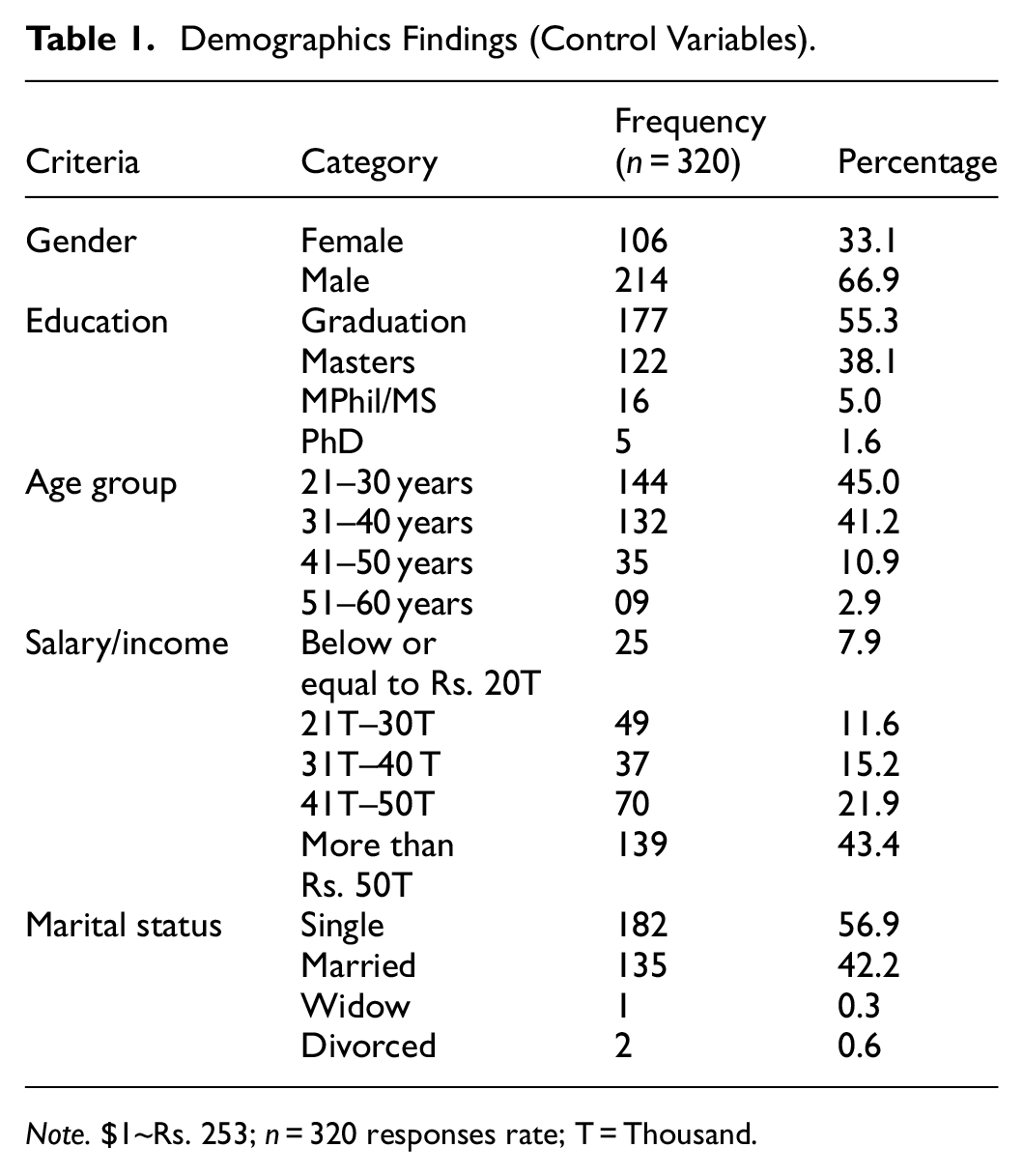
Note. $1~Rs. 253; n = 320 responses rate; T = Thousand.
Common Method Variance
Data was collected over from Dec 2020 to Mar 2021. Podsakoff et al. (2003) suggest that collecting data in one sitting can cause common method variance (CMV). To prevent this, both a priori and post-hoc steps were taken. A priori measures like cover letter, different rating scales, Pre-testing the questionnaire were used. These steps helped reducing the response bias. Whereas for Post-hoc checks; Harman’s single-factor test and full collinearity test (Podsakoff et al., 2003) were used.
Harman’s test showed the first factor explained only 20.685% of variance (below the 50% threshold). However, since it was close to the limit, a collinearity test was also done. All VIF values were between 1.000 and 1.909 (under 3.3), confirming no CMV issue.
PLS-SEM Findings
Measurement Model Assessment
PLS-SEM Analysis
This study analyzed the data using PLS-SEM through SmartPLS 4.1.0 software. Following standard analytical practice (Hair et al., 2021), we first verified the measurement model’s quality before examining the structural relationships. Our reliability and validity checks confirmed all measures performed well - with strong internal consistency (α > .7), robust factor loadings (>.7), and adequate convergent validity (AVE > 0.5) as presented in Table 2. These results gave us confidence in our measurement model before proceeding to test our hypotheses.
Measurement Model: VIF, Reliability and Convergent Validity.

Note. VIF = variance inflation factor; CR = composite reliability; AVE = average variance extracted.
There was total 57 items that covers 11 study constructs. Two items were deleted due to low loadings while 55 were retained. One item KD2 of KD and one item of KG8 of KG are deleted.
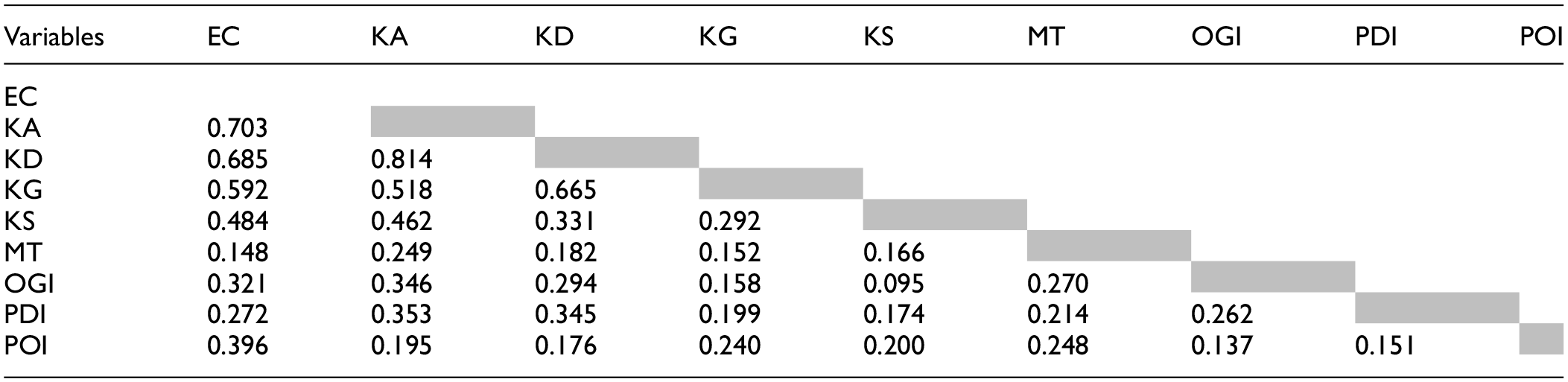
We checked discriminant validity to ensure each concept was distinct. Using the more reliable HTMT method (Hair et al., 2021), all values in Table 3 were below 0.85, confirming our constructs are truly separate. We also tested for collinearity—with all VIF scores under 3, we found no redundancy issues in our measures (Hair et al., 2021).
Discriminant Validity (HTMT < 0.85).
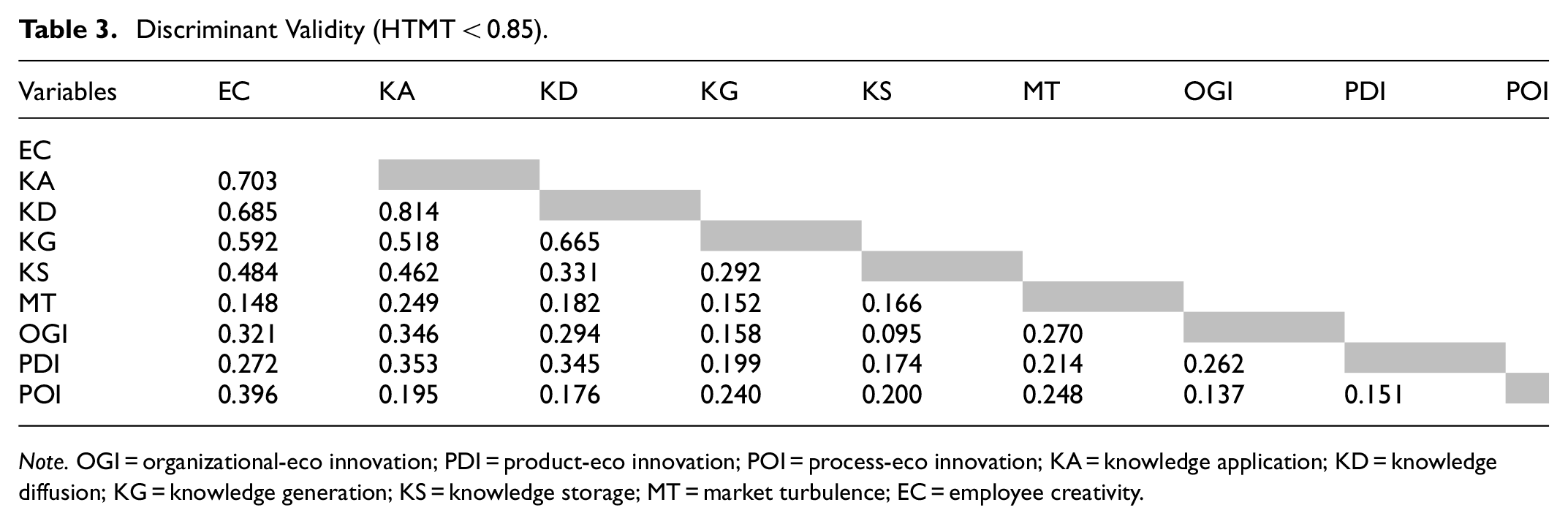
Note. OGI = organizational-eco innovation; PDI = product-eco innovation; POI = process-eco innovation; KA = knowledge application; KD = knowledge diffusion; KG = knowledge generation; KS = knowledge storage; MT = market turbulence; EC = employee creativity.
Structural Model Assessment
Hypotheses Testing and Effect Size (f2)
We tested all direct and indirect relationships using 5000 bootstrap samples(Hair et al., 2021). As shown in Table 4, our results support all hypotheses (H1a–d) confirming that knowledge diffusion, storage, generation, and application each positively influence employee creativity. As previous researches indicate KMP has a positive impact on EC (e.g., Lee & Seol, 2021; Rhee & Choi, 2017; Sigala & Chalkiti, 2015; Zhang et al., 2023). A certain studies have suggested that additional research and complete documentation be done to determine the key factors influencing the various forms of EI (W. Cai & Li, 2018; Hojnik & Ruzzier, 2016). Maldonado-Guzmán et al. (2020) determined that there hasn’t been much research done in the literature on the adoption of various EI approaches, particularly in emerging economies.
Structural Model: Hypotheses Relationships and Value of Effect Size (f2).

Note. OGI = organizational-eco innovation; PDI = product-eco innovation; POI = process-eco innovation; KA = knowledge application; KD = knowledge diffusion; KG = knowledge generation; KS = knowledge storage; MT = market turbulence; EC = employee creativity.
Figure 2 shows the results of SEM analysis. This diagram provides the results of direct, and moderating relationships.

SEM analysis.
A qualitative research proposed that there is a positive relationship between new knowledge creation and employee creativity (Maimone & Sinclair, 2014). Imran et al. (2018) examine the effect of different kinds of KMP on employee creativity but these kinds are different as proposed in the current research. This research was conducted on employees of four kinds of service sectors working in southern Punjab of Pakistan. This research examined that two of the kinds are same as proposed in this research that is, Knowledge generation (creation) and Knowledge application these kinds have positive significant impact on employee creativity. Hence, H1(c) and H1(d) are accepted. These two results are in line with the results of previous research (Imran et al., 2018). Moreover, H1 (a) H1(b), H1(c) and H1(d) about positive impact of KD, KS, KG and KA on EC is also accepted. These are the findings of current study. This implies that ICT companies in Pakistan are maintaining better policies to increase the level of EC.
Current study also proposed three sub hypotheses about the relationships of EC with kinds of EI that is, EC has positive impact on H2(a) PDI, H2(b) POI, and H2(c) OGI respectively.
Qualitative research propose that EC may increase the level of product and process innovation (Dul & Ceylan, 2011). Only a single research has examined the positive impact of EC on PDI (e.g., Luu, 2022). This research was conducted on employees and managers who did their jobs in manufacturing organizations in an Asia-Pacific market. This is also the time lag study and data were collected from three 473 employees and 61 managers at three waves.
Moreover, is about the impact of Employee Creativity on Process Eco-Innovation. Qualitative research propose that employee creativity may increase the level of product and process innovation (Dul & Ceylan, 2011). The result of current study also confirmed that employee creativity has positive impact on process innovation. Hence, H2(b) which is about the positive impact of EC on POI is accepted.
Liao and Tsai (2019) examined that EC has a positive impact on EI. To the best of researcher knowledge, there is no previous research which examines the impact of EC on OGI. EC has a positive impact on both the PDI and POI. Thus, it is also expected that EC has positive impact on OGI. Hence, in line with H2(a) and H2(b), the result of H2(c) is also same which confirmed that EC has a positive impact on OGI. Hence, H2(c) which is about the positive impact of EC on OGI is accepted. This is the finding of this research.
Current research also proposes the three main mediating hypotheses and 12 sub-hypotheses about the mediating effect of EC for the relation of KD, KS, KG, and KA with PDI, POI and OGI.
Previous studies consistently show how knowledge management drives innovation. Waribugo et al. (2016) found three KMP types improve product innovation, while M.-C. Wang et al. (2021) showed all knowledge components enhance innovation capability. Research highlights knowledge application’s strong positive effect (Xie et al., 2018) and creation’s indirect impact (Shujahat et al., 2019). Multiple studies confirm knowledge integration, creation, and application all benefit innovation (Mardani et al., 2018; Ode & Ayavoo, 2020). KM also enables eco-innovation (do Rosário Cabrita et al., 2016), with knowledge sources positively influencing EI (Epicoco et al., 2014) and ultimately supporting sustainable products/services (W. Cai & Li, 2018).
EC is used as a mediating variable by some researchers (e.g., Imran et al., 2018; Jnaneswar & Ranjit, 2022; Nasifoglu Elidemir et al., 2020)). Current study proposed the following mediating hypotheses.
H4: EC mediated the relation of (a) KD, (b) KS, (c) KG and (d) KA with PDI.
Results indicate EC plays better intervening role for the relationship of KA and PDI, then for the relationship of KG and PDI. It plays almost similar kind of intervening role for the relationship of KS and KD with PDI respectively. Hence hypotheses H4 (a), (b), (c), (d) are accepted. These are the findings of current study. Additionally, current study proposed the next mediating hypothesis as:
H5: EC mediated the relation of (a) KD, (b) KS, (c) KG, and (d) KA with POI.
In this regard, results indicate EC plays better intervening role for the relationship of KA and PDI, then for the relationship of KG with POI. It plays almost similar kind of intervening role for the relationship of KS and KD with POI respectively. Hence hypotheses H5 (a), (b), (c), (d) are accepted. These are the findings of current study. These are the findings of current study. Moreover, current study proposed another mediating hypothesis as:
H6: EC mediated the relation of (a) KD, (b) KS, (c) KG and (d) KA with OGI.
In this regard, results indicate EC plays better intervening role for the relationship of KA and OGI, then for the relationship of KG with OGI. It plays almost similar kind of intervening role for the relationship of KS and KD with OGI respectively. Hence hypotheses H6 (a), (b), (c), (d) are accepted. These are the findings of current study. These are the findings of current study.
Similarly, the current study also proposes three sub-hypotheses of moderating effect of MT. In this regards, current research proposed the following hypothesis.
H7: MT positively moderates the relationship of EC with (a) PDI (b) POI and (c) OGI
Results indicate that MT positively moderates the relationship of EC with process-eco innovation and organizational-eco innovation. And the hypothesis about product-eco innovation is rejected. The main reason of this rejection is that the value of path coefficient (0.204) of this relationship is already less other than two relationships of EC with process eco-innovation and organizational eco-innovation (0.219, 0.285). When we used MT as moderator then it reduces all the values. But if we consider assumption of (Hair et al., 2021) about BCI [LL, UL] = [0.005, 0.171], when, p value greater than .05 and their upper and lower limits are positive values then we can accept the hypothesis (Hair et al., 2021). We see that limits values are 0.005, 0.171. and value of path coefficient is .083. Current study accepts this hypothesis as MT positively moderates the relationship of EC and PDI. All are findings of this research.
Coefficient of Determination (R2), and Predictive Relevance (Q2)
Table 5 presents the R2 and Q2 values for key constructs. Entrepreneurial Climate (EC) shows stronger explanatory power (higher R2) and better predictive accuracy (higher Q2) than PDI, POI, and OGI (Hair et al., 2021). Similarly, the R2 value of POI and EC show that these variables are explained by 16.5% and 47.3% of their respective exogenous variables. In this way, the study model has overall weak to substantial explanatory power (Hair et al., 2021). Likewise, the Q2 values reinforce the trend, with EC showing a large predictive relevance (0.456), while PDI, POI, and OGI exhibit weak predictive relevance (0.073, 0.077, and 0.116), respectively.
Coefficient of Determination (R2), and Predictive Relevance (Q2).

Note. OGI = organizational-eco innovation; PDI = product-eco innovation; POI = process-eco innovation; EC = employee creativity.
IPMA Matrix Approach
IPMA is an approach in which an analysis that can predicts antecedents having comparatively high importance for the target variable (i.e., the variable which have a strong impact but can describe the relatively low performance (Ringle & Sarstedt, 2016). In current research, eco innovation is dependent variable with three dimensions that is, product eco innovation, process eco innovation and organizational innovation.
In first step we apply this this test when we consider product eco innovation as dependent variable. Also, current study takes four kinds of KMP that is, knowledge diffusion, storage, generation and application and employee creativity as mediating variable Figure 3a describes that the KG and EC exhibits an entire value of 51 and 50. However, KA, KD and KS value with a performance score of 45, and 38 were slightly below the average score of 32. Hence, this shows that these values were underperforming.

(a) When product eco innovation consider as dependent variable. (b) When process eco innovation consider as dependent variable. (c) When organizational eco innovation consider as dependent variable.
Actually, there are four quadrants of IPMA matrix. KG is fall in first quadrant. This means that this quadrant represents the low performance and high importance. This condition needs highly attention of management for improvement as organization suffering in main weaknesses. Attributes of services are considered as very significant but level of performance is very low. Knowledge application, knowledge donation and knowledge storage are fall in third quadrant. This means that this quadrant represents the low importance and low priority. This condition needs low attention of management for improvement as organization suffering in not many weaknesses. Organizations must divert their resources from this area to another important area. Knowledge generation is fall in fourth quadrant. This means that this quadrant represents the low importance and Possible overkill. In this condition organizations must shift their resources from this area to another important area like quadrant no 1.
In second step we apply this this test when we consider PDI as dependent variable. Figure 3b describes that the KG and EC exhibits an entire value of 51 and 50. However, KA, KD and KS value with a performance score of 45, and 38 were slightly below the average score of 32. Hence, this shows that these values were underperforming.
KG is fall in first quadrant. This means that this quadrant represents the low performance and high importance. This condition needs highly attention of management for improvement as organization suffering in main weaknesses. Whereas, KA, KD and KS are fall in third quadrant. This means that this quadrant represents the low importance and low priority. This condition needs low attention of management for improvement as organization suffering in not many weaknesses. Organizations must divert their resources from this area to another important area.
In third step we apply this this test when we consider process eco innovation as dependent variable. Also, current study takes four kinds of KMP that is, knowledge diffusion, storage, generation and application and employee creativity as mediating variable Figure 3a describes that the KG and EC exhibits an entire value of 51 and 50. However, KA, KD and KS value with a performance score of 45, and 38 were slightly below the average score of 32. Hence, this shows that these values were underperforming.
KG is fall in first quadrant. This means that this quadrant represents the low performance and high importance. This condition needs highly attention of management for improvement as organization suffering in main weaknesses. Attributes of services are considered as very significant but level of performance is very low. KA, KD and KS are fall in third quadrant. This means that this quadrant represents the low importance and low priority. This condition needs low attention of management for improvement as organization suffering in not many weaknesses. Organizations must divert their resources from this area to another important area. Employee creativity is fall in fourth quadrant. This means that this quadrant represents the low importance and Possible overkill. In this condition organizations must shift their resources from this area to another important area like quadrant no 1.
Conclusion
Knowledge plays a vital role as a strategic resource in today’s fast-changing business world, often giving companies their competitive edge. Since organizational success heavily depends on it, knowledge management focuses on how companies generate, store, share, use, and safeguard their knowledge assets. While the current body of research on eco-innovation concentrates on factors that may encourage the adoption of eco-innovation in manufacturing SMEs, the goal of this study is to propose the framework for each kind of eco-innovation in SMEs of ICT sector. Current scenario about eco innovation of employees in the services industry stimulus SMEs to sustain knowledge-based arrangements that warrant unceasing learning which eventually increases employees’ capability to fulfill the intellectual gap aroused due to incorporation better level of eco innovation. For this purpose, SMEs of ICT sector is envisioned to present a knowledge-based environment that encourages employees to attain new and effective knowledge, translate it into practical form, share this with other coworkers, apply this knowledge effectively and diffuse it effectively among employees. Conclusively, the most important consequence of this empirical research is providing the indirect effect of kinds of KMP on kinds of EI via EC. Furthermore, the existence of a MT warrants the consolidate impact of EC on PDI, POI, OGI. Hence, present empirical findings provide three kinds of relationships (i.e., direct, intervening and moderating) among kinds of KMP, MT, EC and kinds of EI. Current research concluded that EC is the result of the KMP present in the SMEs, and EC offer them approaches to attain PDI, POI, OGI. Further, MT moderates the relationship of EC with PDI, POI, OGI.
Implications
This study expands the domain of RBV by explaining all the proposed variables with the help of RBV. Furthermore, current study has used the RBV, which explains that an organization can successfully enhance its level EI with committed resources. Using better resources, EI of SMEs can maintain and establish a supportive green image and distinctive advantages (Tariq et al., 2019). It is necessary for SMEs (ICT) sector to adopt KMP and EC to attain the kinds of eco innovation. Results describes that despite the emerging kind of every kind of KMP in SMEs of Pakistani cultural context, it has a different effect on employee creativity. In this regard, KA is better predictor of EC then KG is at second position. In this regard, organizations and managers must continue the steady flow of their current policies to maintain the current flow of KA and KG. Moreover, KD and KS have similar kind of effect and low level of effect as compare to KA and KG. Hence organizations must increase the level of these to enhance the level of EC.
Moreover, results also describe that despite the emerging kind of every kind of Eco Innovation in SMEs of Pakistani cultural context, it is seen that employee creativity has a changed impact on kinds of eco-innovation. EC is better predictor of process eco-innovation as compare to product eco-innovation and organizational eco-innovation. Hence organizations and managers must maintain the same kinds of policies to maintain the pace of EC for enhancing the level of process eco-innovation. Additionally, it is essential for SMEs of ICT sector to increase the level of EC for enhancing the level of product eco-innovation and organizational eco-innovation. For prompting EI, ICT sector must adopt eco-friendly policies in production, processes and at organizational level.
Current uses the EC as mediating variable and results also confirm that this is partial mediator for the relationship of kinds of KM practices with kinds of eco innovation. Hence, SMEs of ICT sectors must focus on this concept and establish good policies for elevating the concept of EC. For enhancing the skills about creative thinking organizations must make special arrangement internally and also make the external networks like with other organizations, universities and with Government organizations to increase their skills about creativity.
Employee creativity partially mediates how knowledge application, generation, storage, and diffusion affect different types of eco-innovation. It plays a particularly strong mediating role between knowledge application and all three eco-innovation types (product, process, and organizational). For ICT SMEs, maintaining current knowledge application practices is crucial to sustain this beneficial mediating effect on eco-innovation across all areas. For rest of interdependent variables SMEs must enhance their level so that EC will play better role as intervening variable.
According to IPMA matrix approach, Knowledge generation is fall in first quadrant. This means that this quadrant represents the low performance and high importance. So, ICT companies must focus on this variable for this is very important for the companies. This will improve their performance. Moreover, IPMA matrix describes that organizations are lacked behind incorporating the KA, KS and KD in their organizations. Thus, these organizations must focus on these so that they will fall in second or in first quadrant.
Despite the focus of the organization on eco-friendly consumers and environmental issues, the expense on adaptation of these procedures is costly one (Mady et al., 2022). Pakistan in this regard is still at initial stage (S. Ullah et al., 2022). On the other hand, for getting competitive advantage and for more profit organizations must focus on eco innovation (W. Cai & Li, 2018). Thus, SMEs of ICT sector of Pakistan must adopt the strategies of eco innovation for getting the competitive edge.
For intervening hypotheses, Overall, results indicate EC plays better intervening role for the relationship of KA with PDI, POI OGI. Hence, SMEs of ICT sector shall maintain the steady policies reading EC for making the relationship of KA with PDI, POI OGI respectively.
The present literature states that employee creativity foster the level of Eco- Innovation. But the evaluation of intensity level of the impact is at still at initial level. Liao & Tsai (2019) examined that EC has a positive impact on eco-innovation. Moreover, Luu (2022) examined that EC has positive impact on product eco-innovation. Due to scarcity of about these relationships, current study tries to check the impact of CE on kinds of Eco-Innovation. Also, tries to find the direct effect of EC and also introduce the emerging variable market turbulence as moderating variable and check its effect for the relationship of EC with Product eco-Innovation, Process eco-Innovation and Organizational eco-Innovation. All three sub hypotheses are accepted. Results of this research will act as policy guideline for SMEs of ICT sector of Pakistan.
Limitation and Future Directions
This study’s findings are specific to the ICT sector and may not apply to other industries. Future research should include diverse sectors like textiles and education to validate the results. Survey was conducted on dissimilar kinds of ICT organizations. In future, it is beneficial to conduct the research on each kind of industry like software houses, telecom sector separately. We treated demographic factors (age, marital status, education) as control variables, though future studies could examine them as moderators. As this study relied on survey data, responses may not fully reflect employees’ true perspectives, potentially affecting result accuracy. In future mix method approach may be used for generalization of the results.
This Study incorporates only a few predictors of Eco-innovation. In future more independent variables like supplier involvement, external knowledge, competition pressure, and stakeholder pressure, companies’ technological capabilities and green capabilities may also include in future studies. Current study does not incorporate the important consequences of Eco-innovation. In future, business sustainability, firm performance and competitive advantage may also include. Current study used only one mediator for the relationship of kinds of KMP and kinds of Eco- Innovation. In future, along with these variable technological capabilities, open innovation may be used as mediator, similarly along with these kinds of KMP two more kinds like knowledge acquisition, knowledge conversion will consider in future researches.
Footnotes

Funding
The author(s) received no financial support for the research, authorship, and/or publication of this article.
Declaration of Conflicting Interests
The author(s) declared no potential conflicts of interest with respect to the research, authorship, and/or publication of this article.
Data Availability Statement
The original contributions presented in the study are included in the article/supplementary material, further inquiries can be directed to the corresponding author.