




Abstract
School principals play a key role in integrating schools into the digital age. Hence, this research aimed to evaluate education administrators’ technological leadership competencies and their perceptions of the use of the metaverse in education. The study adopted a simultaneous parallel mixed method design. Survey modeling was used in the quantitative research phase, and phenomenology was used in the qualitative phase. Three hundred and sixty four principals participated in the quantitative research and 17 participated in the qualitative part. The research findings indicate that school principals possess a high level of technology leadership competencies and perceptions regarding the use of the metaverse in education and that there is a low-level positive and statistically significant relationship between the participants’ technology leadership competencies and their perceptions of the metaverse in education. While there is consistency between the quantitative and qualitative data, an inconsistency was found concerning the dimensions of digital citizenship and knowledge levels related to the metaverse. Further, although consistency between the quantitative and qualitative data was generally observed, there was inconsistency regarding the principals’ digital citizenship and level of knowledge and awareness regarding the metaverse, the implication of which can researched in depth in future. Based on this study’s findings, education administrators should be supported with pre- and in-service training to develop their skills in using and managing technology.
Introduction
Information and communication technology (ICT) started with the invention of the computer and gained momentum with the launch of personal mobile devices such as phones. The ICT field is now becoming a multidimensional virtual universe dominated by artificial intelligence (AI), and it continues to move towards the future at an unprecedented pace. Many technological products that were unimaginable just 100 years ago are now central to human life, and it is difficult for the digital natives known as Generation Z, who were born into digital technology, and the Alpha generation, who have been dubbed the children of the AI age, to even imagine a world without electricity, computers, the internet, phones, and social media (Hampton & Keys, 2017; Ziatdinov & Cilliers, 2022). Technology emerged as a result of the human mind’s workings in response to human needs, but in present times, it surrounds its inventors and has rapidly changed our lifestyles by making our lives easier. Such rapid technological change has inevitably affected education as well (Borel et al., 2019; Mafratoğlu et al., 2023). Schools have had their share of technological developments, and many technological tools and applications have taken a place in schools’ learning environments.
In the present era, called the digital age, traditional learning environments and models are inadequate to prepare digital natives for the future (Susilawati et al., 2021). For effective learning to occur, teachers’ qualifications must be suited to the digital age, and teachers need to remain open to continuous professional development (Lesinskis et al., 2023). School principals play a key role in integrating schools into the digital age through equipment and hardware infrastructure as well as human capital(Dağlı et al., 2023; Ghavifekr & Wong, 2022). Efforts to technologically integrate schools have increased the importance of school administrators’ technological leadership and assigned them much more challenging roles in education (Adada et al., 2017).
Since schools are open systems that cannot be isolated from environmental factors, they are directly and indirectly affected by every new development. Schools both influence and are influenced by the environment. Their purpose is to educate individuals who then contribute to production using what their predecessors have produced. Moreover, because schools can shape society, these educational institutions have the responsibility of raising individuals who are well suited for the conditions of the time as well as for possible future scenarios (Mafratoğlu at al., 2023). The realization of schools’ mission of guiding society is closely related to education stakeholders’ perspectives, that is, policymakers in particular, but also administrators, teachers, parents, employees, and students. The technology-related ideas and competencies of all school community members are determining factors in schools’ effectiveness (Anderson & Dexter, 2005; Thannimalai & Raman, 2018).
There exists much research on the metaverse, which is today’s remarkable technological breakthrough and may encompass all sectors in the near future (Hwang & Chien, 2022; Kye et al., 2021; Zhang et al., 2022). More specifically, the metaverse literature contains many studies that have revealed education administrators’ technological leadership competencies (Akada, 2023). Studies on the use of metaverse in education have recently gained momentum (Tlili et al., 2022), but since the metaverse’s application to education is still in its infancy, more theoretical and empirical research is needed. An examination of the extant studies on the use of the metaverse in education conducted in the period 2021 to 2023, which is when the metaverse concept became popular, shows that mainly diagnostic information has been presented in scholarly articles and compiled in literature reviews (Mafratoğlu & Mafratoğlu, 2023). However, to the best of our knowledge, no studies have addressed education administrators’ technological leadership competencies and their perceptions of the use of the metaverse in education in a single research effort despite the fact that educators are responsible for managing today’s schools, which entails efficiently leading schools’ technological transformation and integrating technological developments into all the school’s components, while also showing proficiency in using the technologies. To fill the gap in the literature, this study aimed to evaluate school principals’ technology leadership competencies and their perceptions of the use of the metaverse in education guided by the following research questions:
What technological leadership competency levels do school principals possess?
How do school principals perceive the metaverse?
How are school principals’ perceptions of technological leadership competencies and the metaverse related?
Literature Review
School Principals’ Technological Leadership
The rapid development in ICT has precipitated many changes. Many countries have updated their education policies and outfitted their educational environments with cutting-edge technological equipment to keep pace. Such rapid technological development has been the driving force of innovation in educational practices over the last decade on both the global and local scales. Research on primary and secondary education practices has identified a moderate innovation level in Organisation for Economic Co-operation and Development countries (Vincent-Lancrin et al., 2019). In Turkey, the Movement to Increase Opportunities and Improve Technology (FATİH) project accelerated the use of technology in schools through the provision of interactive smart boards and tablets in 2010, and as efforts to integrate technology into schools continue through similar school-based innovations, school administrators have been assigned new roles and responsibilities, among which is technological leadership (Akada, 2023; Gulpan & Baja, 2020)
Technological leadership is the integration of leadership skills with technological skills (Flanagan & Jacobsen, 2003). It is defined as pioneering the effective and efficient use of technology to achieve educational goals at the highest level of management in education and related training processes (Durnalı, 2019). Technological leadership is a skill that involves using technology effectively in management and teaching processes (Anderson & Dexter, 2005). It is a type of leadership that emerges during the process of integrating technology into schools, and it requires the use of various leadership strategies and techniques including principals’ skills in using and managing technology (Yieng & Daud, 2017). Technological leadership includes activities such as technological planning and policy making and implementation (A’mar & Eleyan, 2021).
The International Society for Technology in Education (ISTE), which develops standards to guide students, educators, and education leaders in using technology to create an effective and sustainable learning environment, has presented standards specifically for education leaders. Education administrators are encouraged to develop awareness of digital citizenship, create a vision for transforming learning through technology, create a culture in which teachers and students are empowered to use technology in innovative ways, create teams and systems to implement, maintain, and continuously improve the use of technology, and advance their own and others’ professional development (ISTE, 2023).
To render schools compatible with the digital world, administrators must follow new technologies and integrate them with curricula, establish computer laboratories, and lead the technological integration of all the school’s components. Additionally, administrators are responsible for ensuring that teachers adapt to various technologies and develop the skills to utilize them effectively in teaching processes (Hero, 2020). A principal’s vision directly affects school-wide attitudes towards technological integration and the effective use of technology (Machado & Chung, 2015). Therefore, principals’ technological leadership is important to schools’ effective technological integration (Anderson & Dexter, 2005).
Educational Use of the Metaverse
In today’s digitalizing world, intensive studies are attempting to ensure the transition towards a virtual universe that is integrated with the real world (Kye et al., 2021; Mystakidis, 2022). This universe, which is thought to be the future of the internet, is called the metaverse.
The term was initially used in Neal Stephenson’s 1992 science fiction novel Snow Crash. The metaverse subsequently became the subject of numerous science fiction movies such as The Matrix (1999), Avatar (2009), and Ready Player One (2018). Although the concept’s history spans over 30 years, it became much more popular in 2021 after Mark Zuckerberg’s announcement that Facebook would change its name to Meta. Zuckerberg defines the metaverse as “a virtual environment in which people can physically get involved and meet other people instead of looking at a screen.” It has also been defined as “a continuous and permanent multi-user environment that combines physical reality with digital virtuality, [in] a post-real universe” (Mystakidis, 2022). The metaverse is depicted as a virtual environment that people share for purposes such as playing games, working, and socializing, and it is seen as a developing internet paradigm (Wang et al., 2022). In such a virtual environment, users are expected to be able to interact with avatars they create in real time within a three-dimensional virtual universe (Dubey et al., 2022). The metaverse is expected to create a digital Big Bang effect and is projected to become widespread in the next 15 to 20 years, affecting every aspect of our lives (Lee et al., 2024).
The metaverse has become a trend in recent years and has attracted the attention of education researchers who have discussed the opportunities and threats it will present to education (Zhang et al., 2022). Research is exploring the metaverse’s applicability in education considering the definition of the concept, its historical background, and its design (Tlili et al., 2022). In educational applications in particular, four types of metaverse appear, namely augmented reality, mirror worlds, life recording, and virtual worlds, with the latter having the most widespread applications (Tlili et al., 2022).
Alongside technological developments, using the metaverse in education will provide students with an unusually different learning environment and excellent learning experiences. Moreover, all students will have equal opportunities due to the removal of temporal and spatial barriers from the world of education. This will facilitate disadvantaged individuals’ inclusion in educational environments, enrich educational content, and provide life-changing educational opportunities. Students will be able to learn by doing (Zhang et al., 2022).
Nick Clegg, the head of Meta Global Affairs, believes that the metaverse could create new opportunities for schools, students, teachers, and administrators. Clegg (2023) stated that these technologies can transform education and emphasized the importance of educators’ awareness of this, as well as the influence of education stakeholders in the adoption and spreading of such technologies. Hence, education stakeholders’ levels of interest in and knowledge of the metaverse need to be addressed, particularly administrators’ approach to the metaverse given their role as the leaders of educational activities who are charged with following technological developments and leading new technologies’ integration into schools (Çalık et al., 2019).
Methodology
Research Design
This study, which aimed to evaluate the technological leadership competencies of educational administrators working in public schools and their perceptions of the use of the metaverse in education, adopted a mixed methods design that combined quantitative and qualitative research. Mixed method research, in which quantitative and qualitative data collection methods are used simultaneously in a single study, is defined as combining the data obtained by both methods and analyzing them separately to gain the advantages of both quantitative and qualitative data collection methods (Creswell, 2017). By using quantitative and qualitative methods in the same study, the mixed model compensates for the weaknesses of quantitative and qualitative methods used individually and strengthens their advantageous aspects, thus providing a deeper understanding of the research problem (Baki & Gökçek, 2012; Johnson & Onwuegbuzie, 2004). This study preferred a combination (variation) design. According to the literature, the combination pattern is called the concurrent/parallel mixed method pattern. In this design, qualitative and quantitative data are simultaneously collected but analyzed separately, and the results are combined (Creswell, 2017).
The fundamental basis of the mixed methods research is the integration(merging) of the results obtained from quantitative and qualitative data (Creswell & Plano-Clark, 2018). In the conducted studies, several justifications for the preference of the mixed methods approach have been presented, such as data triangulation, complementarity, development, initiation, and expansion (Toraman 2021). The reason for the preferrence of the mixed methods model in this study is data triangulation. With this method, the aim is to obtain more comprehensive and holistic results regarding the problem of the research.
The epistemological foundation of this study has been established as pragmatism. With a pragmatic perspective, it is possible to focus on the resolution and outcome of the problem presented in the research (Johnson & Onwuegbuzie, 2004). Pragmatism provides researchers with epistemological and methodological flexibility (Greene, 2008). Pragmatism is a perspective associated by mixed-method research. With this perspective, it is essential to address the research problem through diverse data collection methods (Creswell & Plano-Clark, 2011). Various methods designed with a pragmatist approach were employed together to seek detailed answers to the research questions in this research.
Survey modeling was used in the quantitative research phase. According to Karasar (2009), the survey model focuses on detecting a situation that is intended to be analyzed as is. In the qualitative research phase, phenomenology was preferred, and data were collected via interviews. Phenomenology attempts to determine individuals’ perceptions and reactions to an event in depth, based on their experiences (Neubauer et al., 2019; Williams, 2007). Interviewing is a powerful tool to reveal people’s unique perspectives, feelings, thoughts, attitudes, perceptions, and experiences (Taylor, 2005).
In the study, the data were collected cross-sectionally, independently, and simultaneously. The findings obtained were analyzed, and the results were consolidated and interpreted (Creswel & Plano Clark, 2018). A procedural diagram (Figure 1) has been developed that includes the methods used in the study, the analysis of the data, and the synthesis of the results.

Procedural scheme of the research.
Sample-Working Group
The research population comprised 1,502 principals of public schools in the Turkish province of Ankara. The researcher believed that their data would be more comprehensive due to Ankara’s socioeconomic and cultural diversity given its cosmopolitan composition. Information about the research population, as summarized in Table 1, was obtained from the 2022 to 2023 Education Statistics Formal Education report available on the Ministry of National Education’s (MoNE) official website.
Information on Study Population and Sample Size.
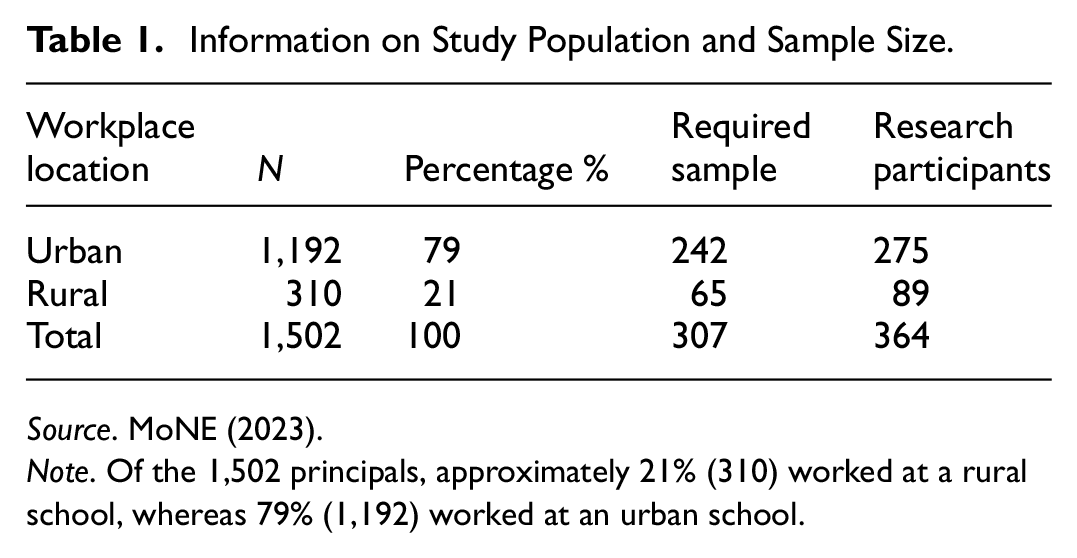
Source. MoNE (2023).
Note. Of the 1,502 principals, approximately 21% (310) worked at a rural school, whereas 79% (1,192) worked at an urban school.
The first stage used a stratified sampling method to determine the sample for the quantitative research phase. This method allowed subgroups to be represented. Stratified sampling is a frequently used method in social sciences, especially in non-homogeneous universes. Urban-rural criteria were used as the basis for stratification. The urban-rural distinction has been addressed and discussed in the literature from various perspectives. While urban areas can be defined as socio-economically developed living spaces with a constantly growing population, rural areas are seen as the exact opposite. Today, approximately 50% of the world’s population lives in urban areas, while 93% of the population in Turkey resides in cities (TSI News Bulletin, 2023). In today’s rapidly digitalizing world, this situation brings with it many problems. In the field of education, in particular, inequalities in access to technology have been documented in various reports (Dalgıç, 2024). This distinction was used in the research to obtain comparable data on the current situation of educational administrators responsible for integrating schools into the modern age.To determine the sample size using the formula n = N t2p q/d2 (N − 1) + t2p q calculations were made according to the 95% confidence interval and the result showed that the sample should have at least 307 bases (Büyüköztürk, 2020). Recalling that approximately 21% and 79% of the study population worked in rural and urban areas, respectively, proportion-based calculation deemed 65 rural principals and 242 urban principals sufficient for the sample. Surveys were delivered to all the principals, and 364 participated in the research, 89 (24.5%) of whom were in a rural area and 275 (75.5%) of whom were in an urban area.
In the qualitative phase, participants were selected from among the principals sampled in the quantitative phase using the maximum diversity sampling method. The qualitative phase of this study was conducted with seventeen principals (12 urban, 5 rural) who agreed to participate in the qualitative dimension of the research among those who answered the scales used in the quantitative dimension.
Data Collection
The personal information form includes questions related to the demographic characteristics of school principals, such as gender, educational background, type of school they serve, total years of experience in administration, and the location of the school (rural or urban).
The “Technology Leadership Competencies Scale for Educational Administrators” is a 32-item, 5-dimensional scale that encompasses technology leadership standards (ISTE). A five-point rating scale (Likert-type) has been used for the items included in the scale. In the Technology Leadership Competencies Scale for Educational Administrators, the ratings are categorized as follows: 1.00 to 1.79 is considered “not at all,” 1.80 to 2.59 is “partially,” 2.60 to 3.39 is “moderate,” 3.40 to 4.19 is “largely,” and 4.20 to 5.00 is “always”.
The “Teachers’ Attitude Scale Towards Metaverse Use” consists of 17 items and 3 dimensions. A five-point rating scale (Likert-type) has been employed for the items included in the scale. In the attitude scale regarding the use of the metaverse, the ratings are categorized as: 1.00 to 1.79 is “strongly disagree,” 1.80 to 2.59 is “disagree,” 2.60 to 3.39 is “neutral,” 3.40 to 4.19 is “agree,” and 4.20 to 5.00 is “strongly agree.”
A semi-structured interview survey comprising open-ended questions with explanations of and support for the scales used in the quantitative phase was used to collect in-depth qualitative data revealing the administrators’ views on the surveyed dimensions. Draft questions were prepared with reference to the relevant literature and in parallel with the scales used in the quantitative phase (Banoğlu, 2012; Çengel & Yıldız, 2022; Gulpan and Baja, 2020; ISTE, 2023; Mystakidis, 2022; Tlili et al., 2022). The survey was finalized after considering the opinions of three education management experts and two language experts who reviewed the content and wording of the questions, respectively.
Three basic criteria were used in the study to address ethical concerns. First of all, ethical approval was obtained from the Near East University Scientific Research Ethics Committee with the date 04.07.2023 and project number NEU/ES/2023/1022. Permission for the application of the data collection tools was obtained from the Strategy Development Directorate of the Ministry of National Education. Ethical approval and consent ensured that the research complied with guidelines and minimized risks that could harm participants. Finally, during the implementation phase, an “Informed Voluntary Consent Form” was obtained from the participants. In the research conducted entirely voluntarily, approvals were obtained through the “I approve participation in the research” tab for online participation and through a wet-signed “participation acceptance form” for face-to-face involvement. This approval process provided the participant with the necessary information about the scope, purpose, possible risks, and benefits of the study, and the security of personal data before the research.
Online tools were used for quantitative data collection, and qualitative interviews were conducted face to face and online. The scales used to collect quantitative data were transferred to the electronic environment via Google Forms. Each item was limited to a single answer. In the qualitative research phase, the concepts of technological leadership and the metaverse were positioned as phenomena, and the principals’ perceptions and experiences of these two phenomena were examined through interviews. Quantitative and qualitative data were collected simultaneously between 1 November 2023 and 26 December 2023.
Permission was obtained from the researchers who developed the scales used as measurement tools.
Data Analysis
SPSS 24 was used to analyze the quantitative data, and analyses were aligned with the research objectives. When interpreting the results, the meaningfulness value p < .05 was considered. Cronbach’s alpha was used to evaluate the quantitative data collection instruments; values were .975 for the Technology Leadership Competencies Scale for Educational Administrators and 0.889 for the Teachers’ Attitude Scale Towards Metaverse Use. These values indicate a high degree of internal consistency among the survey items. Regarding the test results’ reliability, a reliability coefficient of .70 or higher is considered sufficient in the social sciences (Yurtkoru, 2018).
To ascertain the principals’ perceptions of technological leadership competencies and the use of the metaverse in education, descriptive statistics were used, and the scores’ arithmetic averages were examined. Correlation analysis was conducted to investigate whether a significant relationship between the principals’ technological leadership competencies and their perceptions of the use of the metaverse in education would be found. Content analysis, a qualitative data analysis technique, was used to analyze the participants’ opinions, with the primary aim of identifying concepts and relationships that explain the obtained data(Yıldırım & Şimşek, 2016, p. 242).
The interview data were first organized, and responses were then coded under themes and categories determined within the framework of the research problem. This process was consistent with Miles and Huberman’s (1994) coding process. Coding was conducted simultaneously by three experts, and rereading and comparison were performed at different times. Alignment of the coding with the answers led to a consensus among the experts, and consistency was observed among the themes, categories, and created codes. The interviewees were coded as P1, P2, P3, … P17. The interview data were organized as charts including categories, codes, and participants. Attempts were made to increase the research’s reliability by directly including participant opinions during the analysis phase. When simultaneous data collection had been completed, the datasets were analyzed separately and discussed and combined in the final phase of the study.
Results
Quantitative Research Results
Table 2 shows descriptive information about the quantitative research participants.
Description of Quantitative Research Participants.
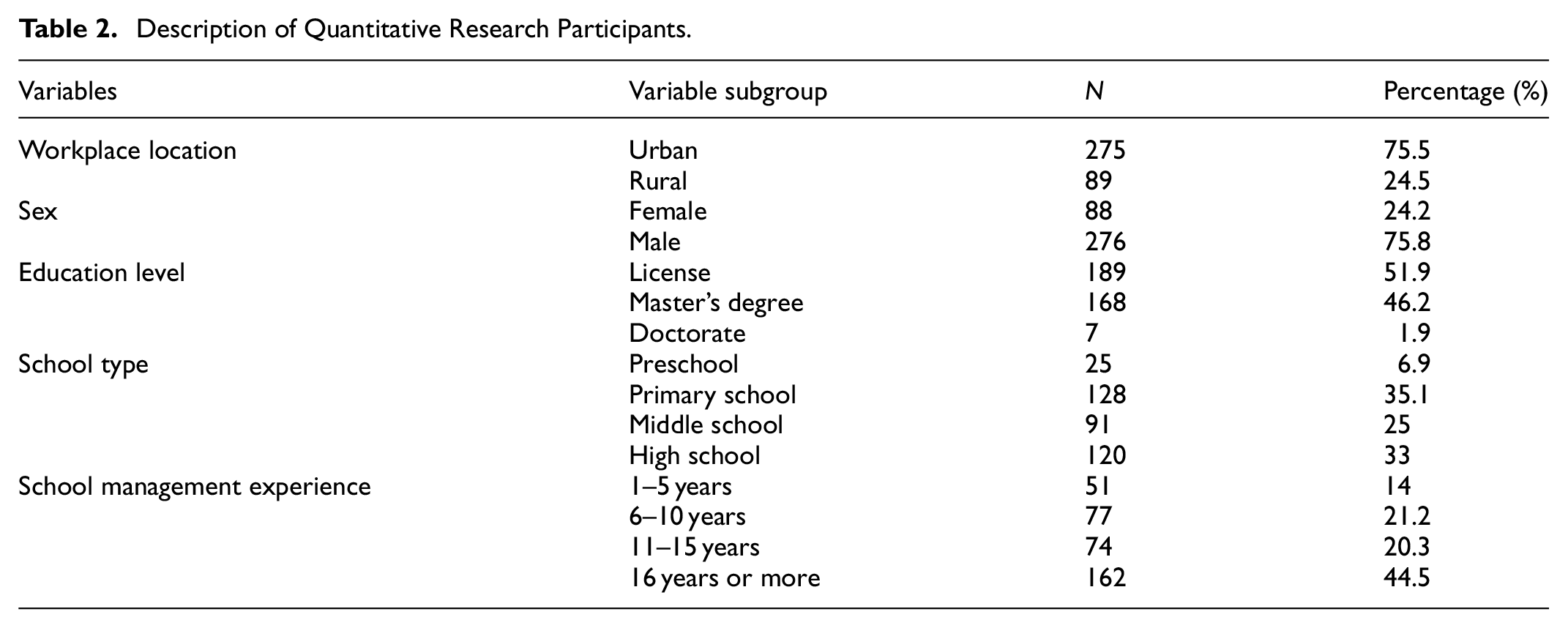
The quantitative research participants were 364 principals, 89 of whom worked in rural areas and 275 of whom worked in urban areas. Of these, 88 were females, and 276 were males. Regarding educational background, 7 held a doctoral degree, 168 had a master’s degree, and 189 had a bachelor’s degree. Regarding their employment type, 120 worked in high schools, 91 worked in middle schools, 128 worked in primary schools, and 25 worked in preschools. Regarding years of administrative experience, 162 had 16 years, 74 had 11 to 15 years, 77 had 6 to 10 years, and 51 had 1 to 5 years.
Table 3 shows the descriptive statistics representing the principals’ perceptions of technological leadership competencies and the use of metaverse in education.
School Principals’ Perceptions of Technological Leadership Competencies and the Use of the Metaverse in Education.
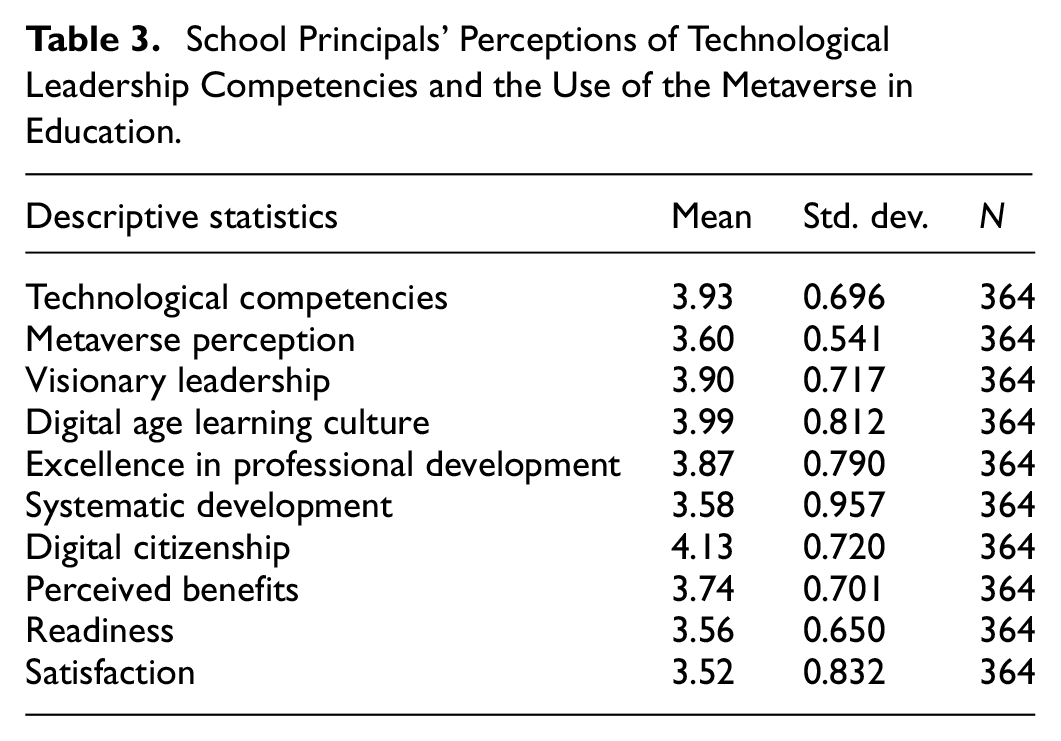
The mean scores for technological leadership competencies and perceptions of metaverse use in education were
The principals’ average scores for technological leadership were high across all dimensions, with digital citizenship showing the highest average score (
The principals’ technological leadership competencies were shown to a great extent” (3.40–4.19) in all dimensions, and their perceptions of the use of metaverse in education were in range of agreement (3.40–4.19 points). Digital citizenship showed the highest scores, averaging
Table 4 describes the correlation between technological leadership competencies and perceptions of the educational use of the metaverse.
Correlation Between Technological Leadership Competencies and Perceptions of the Use of the Metaverse in Education.

**Correlation is significant at the 0.01 level (2-tailed).
A low-level significant correlation was found between the principals’ perceptions of technological leadership competencies and their metaverse perceptions (r = .362 p = .000 <.05). If the correlation coefficient is below .50 in absolute value, the correlation it denotes is considered to be low level, but if the coefficient is between .50 and .70, the correlation is medium level, and if it is above .70, the correlation is high level (Büyüköztürk, 2020).
Table 5 shows the sub-dimensional correlations between technological leadership competencies and perceptions of the educational use of the metaverse.
Correlations Between Technological Leadership Competencies and Metaverse Perceptions in Education Sub-Dimensions.

**Correlation is significant at the 0.01 level (2-tailed).
Visionary leadership showed positive, significant, high-level relationships with other factors within the same scale and positive, significant, low-level correlations with the perceived usefulness and readiness factors in the other scale. No significant correlation with satisfaction was found.
Digital age learning culture showed positive, significant, high-level correlations with systematic development and excellence in professional development and a positive, significant, moderate correlation with digital citizenship. Positive, significant, low-level relationships with the perceived usefulness and readiness factors in the other scale were also found, but no significant correlation was found with the satisfaction factor.
Excellence in professional development showed positive, significant, high-level correlations with other factors within the same scale and positive, significant, low-level correlations with the perceived usefulness and readiness factor in the other scale. No significant correlation was found with the satisfaction factor.
Systematic development showed highly positive and significant correlations with visionary leadership, digital age learning culture, and excellence in professional development and a moderate positive significant correlation with digital citizenship. Low significant correlations were also found with perceived usefulness and readiness, but was no significant correlation was found with satisfaction.
Digital citizenship showed positive, significant, high-level correlations with visionary leadership and excellence in professional development and positive, significant, moderate correlations with digital age learning culture and systematic development. Positive, significant, low-level correlations were also found with the perceived usefulness and readiness factors in the other scale, but no significant correlation was found with the satisfaction factor.
Perceived usefulness factor showed a positive, significant, moderate correlation with readiness factor and positive, significant, low-level correlations with satisfaction factor and all the other factors comprising the scale.
Readiness showed a positive, significant, moderate correlation with perceived benefits and positive, significant, low-level correlations with satisfaction and all the other factors comprising the scale.
Satisfaction showed positive, significant, low-level correlations with perceived usefulness and readiness but no significant correlation with the other scale’s factors.
Qualitative Research Results
Table 6 shows the personal and professional information of 17 principals who voluntarily participated in the qualitative research, and Table 7 shows the themes and other categories applied to their opinions about technological leadership competencies and the educational use of the metaverse.
Qualitative Research Participants’ Personal and Professional Information.

Themes and Categories.

Interview data were collected under two themes: technological leadership and metaverse. Technological leadership was divided into five categories, namely vision, learning environment, professional development, systematic development, and digital citizenship, and the metaverse theme was divided into two categories, namely knowledge/awareness and benefits/risks.
School Principals’ Views on the Technological Leadership Theme
Table 8 describes the participants’ technological visions based on their responses.
Participants’ Technological Visions.

Participants focused on facilitating and enriching education. One said, “The metaverse can provide an enriched educational environment and improve the quality of education.” Participants expressed no negative thoughts about the use of technology in education. Some responses were “Technology helps make education more tangible and helps obtain more data and information. I use technology to facilitate and enrich education” (P2) and “I want our school to be up-to-date with its hardware and software, and for our teachers and students to use these opportunities to work with the requirements of the age” (P11), as well as: Education is a major actor in the development of the world. It is an indispensable necessity to equip this actor with technology appropriate to the spirit of the time. I have made my school active in many areas, and personally, I am constantly researching to keep up with this age. (P4)
Table 9 shows the participants’ opinions regarding the learning environment.
Participants’ Learning Environment-Related Opinions.

All participants reported having smart boards that teachers actively use in their learning environments. One principal installed a virtual reality (VR) system in their school, and four provided coding training in their schools. Three principals attempted to establish an information technology (IT) workshop, two reported using web tools, and one organized a digital book reading event. Some participant opinions are given below.
There is an IT class in our school, but the materials are rudimentary. Our school has an IT group and a teacher from another school who works with them voluntarily. But, of course, these activities are not enough. There are smart boards in our school, and they are actively used by our teachers in lessons. (P5) I work with a young cadre, and the teachers working at my school are very enthusiastic about the use of technology. We are especially working on robotic coding. We use digital games in our classes. Since we introduced these technologies into our classrooms, teachers’ fatigue decreased, and teachers became more adapted to the work environment. I think the introduction of technology into classrooms has boosted success. (P16) As of now, in our standard learning environments, we have smart boards, printers, computers, projection devices, and sound systems in every classroom. We also have internet access in our classrooms, and we are currently not experiencing any new problems. We also have a VR classroom in our school. (P17)
Table 10 shows the participants’ opinions about technological competencies as part of teachers’ professional development.
Participants’ Professional Development-Related Opinions.

A participant pointed out the neglect of technological competencies in professional development, two stated that teachers showed resistance to developing in that area, and one stated that technological competence was not at the desired level. Moreover, two principals observed that teachers were distant from technology, and two stated the need for increased technological competencies. All participants indicated caring about this issue and that technological competence should be a part of teacher professional development. All the principals stressed that they are working toward achieving technological competence. Some participant responses are given below.
Technology competency is part of a teacher’s professional development. We provide information according to the area of application. We aim to reach a certain level of proficiency. (P3) Not only teachers but also education administrators should develop their competence in this direction. It is important that the criteria that determine education standards are updated and internalized [in line] with the developing technology. (P6) In 2016, we were in Prague [discussing] the use of technology in education and the evaluation of new technologies within the framework of the Erasmus project, and [we] received training on this subject. Our teachers made a serious difference in their classrooms based on the education they received there. We recommend that our teachers use educational technologies as a resource. (P17)
Table 11 describes the participants’ responses regarding technology awareness.
Participants’ Opinions on Technology Awareness.

Participants focused on encouraging training participation. None expressed a negative attitude in this category. Some opinions were “I follow technological developments closely and try to apply what I have learned in my school as much as I can” (P7); “We created an IT group, and we are trying to raise awareness by sharing through this group” (P5); and “I share information and announcements related to the school on social media, and I am trying to actively use our school’s website” (P4).
Table 12 describes the participants’ opinions on digital citizenship.
Participants’ Opinions on Digital Citizenship.

One participant expressed a negative view on digital citizenship, another had no knowledge of digital citizenship, and two principals admitted to not having done any work in this area. Statements included “I don’t know what digital citizenship is” (P2); “We arrange periodic seminars on topics such as digital literacy, digital security, [and] digital communication” (P4); “I don’t believe in digital citizenship, so I don’t do anything about it” (P8); and “We participate in training about conscious technology use and put it into practice in our school” (P10).
School Principals’ Views on the Metaverse
Table 13 shows the participants’ responses regarding their awareness and knowledge of the metaverse.
Participants’ Metaverse Knowledge/Awareness.

The majority of participants viewed the metaverse as a “virtual universe.” Some principals expressed negative opinions. Responses included “I don’t have much information about it at the moment” (P1); “I do not have a positive impression or opinion about the metaverse” (P13); “Although it scares me personally, it also arouses my curiosity” (P15); “[The] metaverse is the technology of the future. Creating a virtual and augmented reality is an investment in the future” (P3); “The metaverse scares me. Since it is a very new technology, I cannot foresee what it will bring upon us” (P16); and “I think the metaverse is a virtual environment, a universe that is intended to be created as an alternative to the existing world” (P17).
Table 14 details the participants’ perceived benefits and risks of applying the metaverse to education.
Participants’ Perceived Benefits and Risks.

Regarding benefits, most participants anticipated the provision of “an enriched educational environment” and the realization of “learning by doing and experiencing.” Regarding risks, most principals were concerned about the metaverse’s potential to “damage reality perception.” Some responses were “I think [the] metaverse should not be used in education because it will cause people to move away from reality” (P13); “I don’t know about the metaverse. I don’t have any information about the benefits and risks it will provide in education” (P1); “It can provide many educational opportunities, from professional learning to scientific learning” (P2); “I think it will be useful to use [the] metaverse in education. However, it may damage students’ reality perception. It can damage social abilities [and] cause technology addiction” (P7); and “[The] metaverse can provide training opportunities anywhere. However, if digital security is not fully ensured, some risks may arise” (P12).
Discussion
The quantitative research results showed that, on average, school principals possessed technology leadership competencies “to a large extent” across all dimensions. The principals had the highest average score in digital citizenship and the lowest in systematic development. The qualitative research results showed that all participants were aware of technological competence. Further, they expressed no negative opinions about the use of technology in education and had a technological vision. The principals also attempted to use technology in their learning environments and directed teachers towards training to enhance their technological development, but in this, they encountered resistance and reluctance. Principals have responded by launching initiatives to create technological awareness in their schools. Regarding digital citizenship, some participants’ negative statements which suggests incompatibility between the quantitative and qualitative data in the digital citizenship dimension. The results showed high technological leadership competencies among the participants. Although digital citizenship had the highest average score in the quantitative phase, the inconsistency of participant responses regarding digital citizenship in the qualitative phase suggests that principals need more support to develop digital citizenship awareness.
The participants’ overall averages regarding their technology leadership competencies are similar to Hamzah et al.’s (2016) and Thannimalai and Raman’s (2018) findings. However, in this study, participants scored the highest on average in the digital citizenship dimension, whereas Thannimalai and Raman (2018) observed the highest average score in the systematic development dimension. Akada (2023) also found high technology leadership competencies among the study participants, with digital citizenship showing the highest score. Additionally, Eren and Kurt (2011) found that principals were aware of the importance of using technology in education and that they strove to increase the use of technology in administrative processes and school learning environments. Machado and Chung (2015) concluded that the sampled school principals valued the use of technology in education, and Gulpan and Baja (2020) and Minaz et al. (2022) reported that school principals exhibited moderate technological leadership competencies.
The present study’s findings are doubly useful because they also demonstrate the extent to which the ISTE (2023) standards for education leaders have been achieved in Turkey. In recent years, many factors such as government-driven digital transformation initiatives, the provision of technological devices to schools, increased technology training, the widespread use of mobile devices, and the advent of easy and cheap access to information via the internet have contributed to individuals’ technological development (Taşdemir, 2018). In Turkey, within the framework of the MoNE’s strategic management approach, numerous policies have been implemented aimed at strengthening schools’ physical and technological infrastructure, disseminating technological education-related opportunities nationally, creating a new professional development model to support teachers’ and administrators’ professional development (MoNE, 2019), and creating a digital culture and spreading it throughout schools (MoNE, 2018). Additionally, technological improvements have been made to learning environments within the scope of the FATİH project, and the teacher information network ÖBA has provided support for teachers’ and administrators’ professional development. The present study’s finding that most school principals had high technological leadership competencies confirms these policies’ and practices’ effectiveness.
The quantitative results showed that the principals’ average scores regarding the educational use of the metaverse were in the range of agreement in all three of the scale’s dimensions. This demonstrates school administrators’ high degree of interest in metaverse technologies, which have the potential to transform education. The quantitative research findings are similar to those of Mundy et al. (2019), who found that participants perceived themselves as intermediate or advanced at using VR.
However, this study’s qualitative results showed that the principals’ awareness and knowledge of the metaverse need improvement. Although the quantitative results regarding the educational use of the metaverse revealed positive perceptions, the qualitative results showed—albeit only slightly—insufficient knowledge and awareness of about the metaverse. Han and Noh (2021) examined faculty members’ perceptions of the metaverse and found that although the participants expressed positive opinions recognizing the learning benefits of using the metaverse for educational purposes, higher education professors had a relatively low level of knowledge about the metaverse. Additionally, Gürkan and Bayer (2023) collected teachers’ opinions about the metaverse and its use in education and concluded that most were knowledgeable about the metaverse but considered themselves to be beginners.
This study’s qualitative results showed that most principals expressed positive opinions about the use of the metaverse in education although they also perceived some risks.
Whereas opinions such as “It can provide an enriched educational environment [and] increase students’ interest and attention” point out the benefits of using the metaverse in education, other opinions such as “It can harm reality perception, cause ethical problems, [and] pose a security risk” point to the associated risks. The administrators’ perceived benefits and risks of the use of the metaverse in education are noteworthy given their similarity to those stated in literature. Tlili et al. (2022) stated that metaverse is still in its infancy and that, despite its educational benefits, it poses threats to user security and ethics. Onu et al. (2024) underlined that using the metaverse in teaching can create a new learning ecosystem, but security and privacy issues should be considered. Hwang and Chien (2022) recognized that the metaverse can provide students with new educational opportunities by eliminating restrictions but noted that it also carries ethical risks such as privacy violations, bullying, cheating, and technological deficiencies. Kye et al. (2021) acknowledged that the metaverse will offer a new, borderless, unrestricted learning experience, allowing students to experience events that would be impossible or limited in the real world and possibly increasing students’ interest through active learning; however, the scholars also warned of problems such as “identity confusion, privacy problems, exposure to crime, [and] depersonalization.”
Regarding the relationships between the two scales used in this study as well as between the factors of each, satisfaction had no significant correlations with any of the factors comprising the Technology Leadership Competencies Scale for Educational Administrators, and it showed low significant correlations with perceived usefulness and readiness, which, in turn, showed positive significant low-level correlations with satisfaction and all the factors comprising the Technology Leadership Competencies Scale for Educational Administrators. A significant moderate correlation was found between perceived usefulness and readiness factors. Visionary leadership, digital learning culture, excellence in professional development, and systematic development showed positive, significant and high-level correlations among themselves. Digital citizenship showed positive, significant and high-level correlations with visionary leadership and excellence in professional development and a significant moderate correlation with digital age learning culture and systematic development. Low-level positive significant correlations with perceived usefulness and readiness were also found.
The results showed a low-level positive significant correlation between the principals’ technology leadership competencies and their perceptions of the use of the metaverse in education. This result may have been influenced by the fact that metaverse technologies are relatively new and have not yet become widespread in practice. This could be connected to the satisfaction factor’s lack of a significant correlation with any dimension of the Technology Leadership Competencies Scale for Educational Administrators. The qualitative research findings showing school principals’ insufficient awareness and knowledge of metaverse technology and their hesitancy and negativity towards the use of the metaverse in education offer an explanation for this situation.
Although the correlation was low level, principals’ technology leadership competencies apparently affect their perception of the use of the metaverse in education. Notably, the research findings reinforce the school principal profile documented in the literature. Previous research has shown that school principals’ technological leadership competencies play an important role in the acceptance and integration of new technologies (Dağlı et al., 2023; Ghavifekr & Wong, 2022; Isa et al., 2020). In the metaverse era, school administrators need to mobilize all physical and virtual resources to achieve schools’ goals (Khairiah et al., 2023). Principals’ leadership competence is crucial to schools’ ability to follow technological developments and integrate new technologies (Anderson & Dexter, 2005; Machado & Chung, 2015). Principals must also ensure that teachers develop their technological skills and embrace technology in their teaching (Hero, 2020). In addition to mastering existing technologies, educational leaders need to stay up to date with new technologies and adopt the continuous development model (Cortellazzo, 2019).
Conclusion
It is believed that the perceptions and competencies regarding technology of all parties comprising the school community, particularly policymakers, are determining factors in integrating schools into the modern era for the preparing of digital natives for the future. Especially the approaches of administrators who lead educational activities towards the issue, their ability to keep pace with technological advancements, and their competencies in leading the integration of new technologies into schools are of paramount importance.In this context, it is essential for educational administrators to maintain a commitment to continuous development and for them to be equipped with the competencies requisite for meeting the demands of the era.One of the most effective ways to ascertain this is through the analysis of the current situation at hand using the data collected from the field, coupled with the formulation of appropriate solution proposals based on emerging circumstances.
This study, which investigates the technology leadership competencies of educational administrators and their perceptions of the metaverse in education, was conducted using a mixed-methods approach. In the quantitative phase of the research, data were collected using the “Technology Leadership Competencies Scale for Educational Administrators” developed by “Banoğlu (2012)“ and the “Teachers’ Attitude Scale Towards Metaverse Use” developed by “Çengel and Yıldız (2022).” In the qualitative phase, the data were organized under two main themes: “technology leadership” and “metaverse.” The technology leadership theme was divided into five categories: “vision, learning environment, professional development, systematic development, and digital citizenship.” The “metaverse” theme was categorized into two: “knowledge/awareness” and “benefit/risk.” The answers provided by the school principals were coded and examined within these categories.
The quantitative findings indicate that the technology leadership competencies of the participating school principals are high, while the qualitative findings reveal that all participants are aware of their technological competencies. Additionally, the findings demonstrate that school principals working in both rural and urban areas share similar perspectives regarding technology leadership. However, when the data are combined, a discrepancy exists between the quantitative and qualitative data in the dimension of “digital citizenship.”
Although digital citizenship had the highest average score in the quantitative phase, the inconsistency of participant responses regarding digital citizenship in the qualitative phase suggests that principals need more support to develop digital citizenship awareness. The quantitative data reflecting the views of school principals on the use of the metaverse in education indicate that the participants have a high level of perception, while the qualitative data reveal that the majority of participants hold positive opinions regarding the use of the metaverse in education. It can be inferred from the research that school principals operating in both rural and urban areas share similar viewpoints. Although the quantitative results regarding the educational use of the metaverse revealed positive perceptions, the qualitative results showed—albeit only slightly—insufficient knowledge and awareness of about the metaverse.
The results showed a low-level positive significant correlation between the principals’ technology leadership competencies and their perceptions of the use of the metaverse in education. The low-level relationship between the technology leadership competencies of the participating school principals and their perceptions of the metaverse may be influenced by the relatively recent emergence of metaverse technologies and their insufficient prevalence in practical applications. Although the correlation was low level, principals’ technology leadership competencies apparently affect their perception of the use of the metaverse in education.
Limitations, and Future Research
This study, which aims to investigate the technology leadership competencies of educational administrators and their perceptions on the use of the metaverse in education, has limitations regarding the data collection method and the sample. The data in the study were collected cross-sectionally. This approach has prevented us from forming reason-related connections between the variables. Another limitation of this study is the samples and the tools used for data collection. Results could be compared with similar studies conducted with other members of the school community using different tools and samples.Since this study focuses on identifying the current situation and developing recommondations, conducting other studies that take into account different educational stages, can help achieve a more comprehensive reflection of the actual situation. Future studies can also investigate the inferred incompatibility between the quantitative and qualitative data on digital citizenship and metaverse knowledge and awareness. Education administrators should engage in continuous development to improve their skills for using and managing technology while keeping pace with new innovations into schools. References technologies. Moreover, pre- and in-service training can support the knowledge and awareness levels of school principals, who play a key role in integrating technological innovations into schools.
Footnotes
ORCID iDs

Ethical Considerations
Ethical approval was obtained from the Near East University Scientific Research Ethics Committee with the date 04.07.2023 and project number NEU/ES/2023/1022. “Informed Voluntary Consent Form” was obtained from the participants. In the research conducted entirely voluntarily, approvals were obtained through the “I approve participation in the research” tab for online participation and through a wet-signed “participation acceptance form” for face-to-face involvement.
Funding
The author(s) received no financial support for the research, authorship, and/or publication of this article.
Declaration of Conflicting Interests
The author(s) declared no potential conflicts of interest with respect to the research, authorship, and/or publication of this article.
Data Availability Statement
Data sharing not applicable to this article as no datasets were generated or analyzed during the current study.