




Abstract
Three Minute Thesis (3MT) competition, as a flourishing academic genre, contributes to assisting scholars to popularize scientific knowledge to a heterogenous audience. Regarding metadiscourse of 3MT genre, much attention has been paid to the interactional features, while its interactive features have been underexplored. This study examined 3MT presentations from two planes of metadiscourse, adopting Hyland’s interactive metadiscourse framework and Qiu and Jiang’s modified model of interactional metadiscourse. To investigate the disciplinary similarities and differences between hard sciences and soft sciences, and explore the underlying reasons, this study built a 3MT corpus of 120 presentations with quantitative and qualitative approaches. Results indicate that metadiscourse devices are more abundant in hard sciences than in soft sciences (LL = 24.21, p < .0001). Specifically, presenters of hard sciences tend to use more code glosses (LL = 30.97, p < .0001), endophoric markers (LL = 7.4, p < .01) and engagement markers (LL = 21.83, p < .0001), but less evidentials (LL = 16.25, p < .0001) than those of soft sciences. As for the other subcategories, no significant difference has been found. Our interdisciplinary findings have significant implications for providing rhetorical strategies to presenters of 3MT competition and for EAP teachers preparing students to orally present their research in other academic spoken genres.
Plain language summary
Why was the study done? Three Minute Thesis (3MT) competition has been a popular academic genre, which contributes to assist scholars to popularize scientific knowledge to audiences under various disciplinary backgrounds. Scholars have investigated 3MT from the various perspectives. Regarding to metadiscourse of 3MT genre, much attention has been paid to the interactional features, while its interactive features have been underexplored. Therefore, presenters cannot receive a systematic rhetoric guidance in adjusting their professional research to non-specialists. What did the researchers do? This study would examine rhetoric features of 3MT presentations, adopting Hyland’s (2005) interactive metadiscourse framework and Qiu and Jiang’s (2021) modified model of interactional metadiscourse. To investigate the disciplinary similarities and differences between hard sciences and soft sciences, and explore the underlying reasons, this study builds a 3MT corpus of 120 presentations with quantitative and qualitative approaches. What did the researchers find? Results indicate that metadiscourse devices are more abundant in hard sciences than in soft sciences. Specifically, presenters of hard sciences tend to use more code glosses, endophoric markers and engagement markers, but less evidentials than those of soft sciences. As for the other subcategories, no significant difference has been found. What do the findings mean? Our interdisciplinary findings have significant implications for providing rhetorical strategies to presenters of 3MT competition and for EAP teachers preparing students to orally present their research in other academic spoken genres.
Keywords
Introduction
The lockdown caused by the COVID-19 pandemic has accelerated the popularization of digital media and video conference apps, where numerous academic conferences have shifted from offline to online in the field of academic exchange (Schwarz et al., 2020). Hence, academic knowledge is not a privilege to scholars in academia but available to the masses, which has expanded the audience from professional researchers in academic circles to non-specialists and potential audience over the Internet (Gross & Harmon, 2016; Luzón & Pérez-Llantada, 2019). The trend toward democratization and sharing leads to a blurring of the boundaries between the scientific community and the general public (Marwick & Boyd, 2011). Confronted with the merging of various audiences into one, scholars are urged to adjust their rhetoric and wording accordingly. In particular, PhD students are facing the challenges “to engage in a diversity of ways with a diversity of people as they develop their academic literacies” in an increasingly fast-changing, complex and market-driven landscape (Starfield & Paltridge, 2019). As a result, they are expected to step out of the ivory tower and be able to master and navigate their way through a set of genre repertoires, such as writing and publishing research articles and/or proceedings papers, delivering conference presentations, mastering digital genres (e.g., academic home pages and blogs), and adeptly handling more overtly promotional genres such as personal statements and three minute thesis (3MT) presentations. To cope with all these genres, PhD students are obliged to adapt their specialized knowledge to the heterogenous audience.
It is in this context that 3MT competition has developed and flourished as a burgeoning academic spoken genre (Carter-Thomas & Rowley-Jolivet, 2020). Launched in 2008 by the University of Queensland, 3MT has been widely circulated to more than 900 universities and research institutes across 85 countries. Doctoral students condense their PhD research into a 3-min presentation and communicate with a panel of judges and a disciplinarily mixed audience, resorting to one static slide. While, videos, music, animations and props are not allowed in the competition. 3MT presentations are evaluated from four aspects: content, comprehension, engagement, and communication. In order to deliver a persuasive and intriguing presentation, participants are required to tailor the contents and construe social rapport with the audience. 3MT provides an impetus and opportunity for doctoral students to acquire the adaptability and rhetorical dexterity necessary for dealing with the range of genres and audience they may encounter in their university careers and in other professional contexts (Carter-Thomas & Rowley-Jolivet, 2020).
Metadiscourse resources have been playing a pivotal role in establishing epistemic stance and authority, and social relationships with the audience in competitive 3MT presentations (Hyland & Zou, 2021a; Qiu & Jiang, 2021). The term Metadiscourse was first coined by Zellig Harris in 1959 to offer a way of understanding language in use, and then is defined by Hyland as the cover term for self-reflective expressions used to negotiate interactional meanings in a text, assisting the writer (or speaker) to express their viewpoints and engage with readers as members of a particular community (2005). Hyland’s (2005) metadiscourse framework has been widely taken as a theoretical basis in multiple studies of written (Yavari & Kashani, 2013) and spoken discourses (Farahani & Kazemian, 2021; Zhang & Sheng, 2021) with robust power to investigate the information exchange orchestration between speakers and listeners, which can also provide a solid theoretical foundation for our present study. However, to tailor for the spoken genre nature, our study draws on Hyland’s (2005) interactive metadiscourse framework and Qiu and Jiang’s (2021) modified model of interactional metadiscourse, in which interactive resources are used to support speakers to clarify their viewpoints and organize propositions in a coherent and convincing way, while interactional resources are used to engage the audience in the presentations and construct a credible stance and identity to win approval from the audience.
As Table 1 shows, 10 subcategories of metadiscourse are included in our study: transitions, frame markers, endophoric markers, evidentials and code glosses in interactive metadiscourse, and hedges, boosters, attitude markers, self mentions, and engagement markers in interactional metadiscourse (Hyland, 2005).
Hyland’s Model of Metadiscourse (Hyland, 2005).

In this study, we aim to answer two questions with quantitative and qualitative approaches:
(1) What similarities and differences are there in metadiscourse usage between hard sciences and soft sciences in 3MT presentations?
(2) How can we account for these similarities and divergences?
This study would update the concordance lines of metadiscourse items by addition, deletion and modification, which are more suited to 3MT as an academic spoken genre. To some extent, the updated metadiscourse retrieval list might provide lexicon references for future studies of 3MT genre and make an empirical contribution to Hyland’s metadiscourse model. Furthermore, to provide a practical framework that informs how to use rather than how is it used of metadiscourse (Abdi et al., 2010) in 3MT presentations, this study would put forward feasible metadiscoursal suggestions for participants of various fields in preparing academic English speeches, especially for second language learners, which can guarantee a proper metadiscourse employment, promote 3MT competitions or other academic English activities like 5MRP (Five-Minute Research Presentation) and give pedagogical implications for EAP teachers to conduct innovative discursive practices.
Literature Review
The previous studies on 3MT genre could grossly be categorized into the following perspectives: genre introduction, strategy analysis, move analysis and metadiscourse analysis.
As a newly emerging academic spoken genre, 3MT competition was launched in 2008 and is still in a stage of popularization, with which some people are not familiar. Bandler and Kiley (2017a, 2017b, 2018a, 2018b) and Bandler et al. (2019, 2021) have introduced the International Microwave Symposium (IMS) Three Minute Thesis Competition held by IEEE Microwave Theory and Techniques Society (MTT-S) every year from 2017 to 2021 to attract more students and young professionals to participate in this competition. Moreover, Rossette-Crake (2019) has defined 3MT presentations and put forward two strategies for preparing a successful 3MT in his book Public Speaking and the New Oratory: A Guide for Non-native Speakers. Subsequently, Rossette-Crake (2020) has outlined two New Oratory formats in the 21st century: the investor pitch and 3MT presentation. These introductory literatures arouse our attention to 3MT genre and motivate us to a deeper exploration.
In regard to strategy analysis, on account of the competitive nature of 3MT genre, the ultimate goal for participants is to win a championship. Therefore, some researchers have investigated how to prepare presentations successfully and efficiently. For example, Carter-Thomas and Rowley-Jolivet (2020) have put forward the recontextualization strategies for 3MT participants: rhetorical structure and explanatory strategies in information, and strategies to engage audience’s interest.
As for move analysis, previous 3MT studies have been conducted in cross-disciplinary comparison. For example, based on the Swalesian analytic approach (Swales, 1990, 2004), Hu and Liu (2018) analyzed a corpus of 142 presentations by PhD students to explore two disciplinary distinctions on rhetorical moves: hard versus soft & pure versus applied disciplines. The findings have revealed six obligatory moves, two optional moves, and disciplinary move divergences, which provided an unprecedented move framework for 3MT presentations. Given this, Carter-Thomas and Rowley-Jolivet (2020) have drawn on the move analysis of Hu and Liu (2018) on the part of content selection to explore how professional knowledge is adjusted to fit a non-specialist audience. Significantly, they acquired similar results of disciplinary distinction to Hu and Liu (2018), which made a breakthrough and provided a systematic framework of 3MT moves.
Among previous studies on 3MT metadiscourse analysis, researchers primarily focus on stance and engagement, which constitute the interactional metadiscourse markers (Hyland & Zou, 2021a, 2021b; Qiu & Jiang, 2021; Yang, 2020), while the interactive metadiscourse distribution of 3MT is overlooked. For example, Yang (2020) has made a keyword analysis to compare the use of personal pronouns in 3MT presentations between PhD candidates and trained undergraduate ESP learners. Furthermore, Hyland and Zou (2021a) have drawn on Hyland’s (2005) model of stance, revealing significant disciplinary distinctions in stance between physical and social sciences in 3MT presentations. Meanwhile, in another article, they have investigated how disciplines influence the choices of attention-getting devices, based on Hyland’s (2005) engagement framework, and figured out disciplinary distinctions in engagement (Hyland & Zou, 2021b). In addition, Qiu and Jiang (2021) have embarked on a more comprehensive study on stance and engagement based on Hyland’s (2005) framework, investigating how register, genre and disciplinary knowledge affect the expression of stance and engagement in 3MT presentations.
To stitch the above-mentioned research gaps, this study would make a comprehensive comparison of the metadiscourse distribution features in 3MT presentations, involving interactive and interactional metadiscourse markers, between hard sciences and soft sciences. With a full range of subcategories and more detailed guidance on how to present a discipline-oriented and audience-oriented academic presentation, this study aims to figure out rhetorical preferences, similarities and divergences among disciplines in 3MT competition, and propose feasible suggestions for participants, thus boosting their academic communicative capacities to non-specialists.
Corpus and Analytical Procedures
Corpus
To compare how 3MT presenters manage their presentation of metadiscourse, we compiled a corpus comprised of two sub-corpora: sixty 3MT presentations from hard sciences (Medicine, Engineering, Biology, Physics, Chemistry and Architecture, etc.) and sixty 3MT presentations from soft sciences (Linguistics, Education, Law, Psychology, Sociology and Art, etc.), comparable in size and large enough to provide sufficient examples of the target features. All presentations come from 3MT competitions with its official trademark, downloaded from YouTube, threeminutethesis.org, and Vimeo. These competitions were held in Australia, South-East and North Asia regions, New Zealand, and China. Altogether more than 400 videos are accessible.
We ensure that the chosen presentations meet the key features of 3MT genre, such as PhD candidates, live audience, one static slide, the 3-min limit and so on, with a relatively high quality and representativeness of 3MT genre. Specifically, our selection criteria involve that (a) 3MT presentations are delivered by doctoral students; (b) They are presented between 2010 and 2022 to ensure currency; (c) The presentations are delivered in English; (d) The presenters are selected randomly and equally from finalists of 3MT competition to guarantee consistency of quality, without constraints of institution, gender and age.
Biber (1993) has defined representativeness as “the extent to which a sample includes the full range of [situational and linguistic] variability in a population”. However, it is an ideal, toward which corpus compilers should orient their designs, but not always expect to reach in practice. Thus, a compromise should be made between what would maximize representativeness and what was possible in practice (Love, 2020). Due to efficiency and cost effectiveness, we cannot access and gather every text in the population. To guarantee higher degrees of representativeness, we use probability sampling to gather a random sample from the population, which is regarded as the most effective way of producing a corpus from which generalizations can be made about the wider population (Love, 2020). According to the specific criteria mentioned in the study, 120 3MT presentations were finally chosen as our 3MT corpus. Detailed information on the chosen 3MT presentations is shown in Table 2. Specifically, UQ, Vitae UK and AP are short for University of Queensland 3MT, Vitae UK 3MT and Asia-Pacific 3MT. In addition, other 3MT organizers are Universitas 21 3MT, The University of Hong Kong 3MT, Queensland University of Technology 3MT, University of New South Wales 3MT, Deakin University, Monash University, Syracuse University, Griffith University, Cornell University, and University of Oregon.
3MT Presentations and Composition.

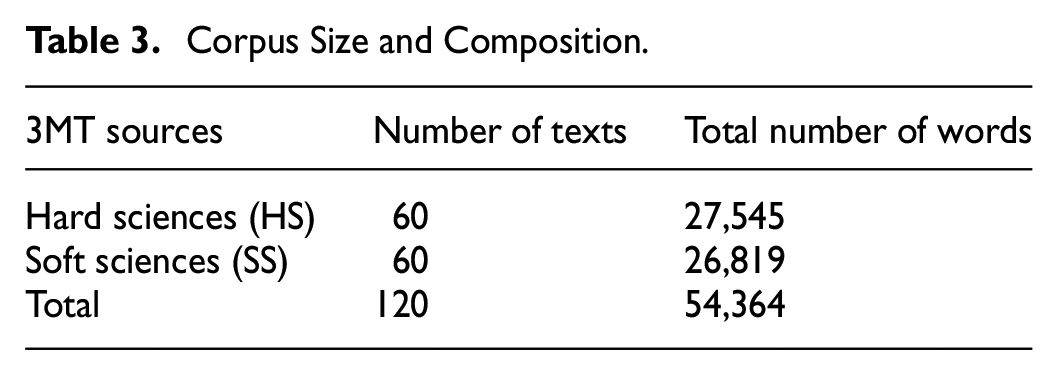
Having collected the qualified 3MT presentations, we recorded these videos into audio files by electronic recorders. Then, a specialized speech-to-text application program (iflynote) was utilized to transcribe these audio files into texts with repeated manual checks and proofs to ensure the consistency and authenticity of the corpus. Detailed information of the corpus is shown in Table 3.
Corpus Size and Composition.
Analytical Procedures
According to the item lists proposed in Hyland’s (2005) interactive metadiscourse framework and Qiu and Jiang’s (2021) modified model of interactional metadiscourse, we first employed AntConc 3.5.8 to retrieve the frequency of items in two corpora (531 metadiscourse items in total). Then, we added 104 eligible items each performing the corresponding function it was assigned (as listed above) after a thorough reading of the data (635 metadiscourse items in total). Next, we manually double checked the concordance result of all retrieved metadiscourse items according to the context and screened out the qualified items and unqualified items. To ensure its accuracy and interrater reliability, a 25% sample was independently coded by each author, with an inter-rater agreement of 95% achieved through discussion. Intra-reliability tests were also conducted by each author re-categorizing 20% of the cases 2 weeks after the initial coding with full agreement achieved between the first and second categorizations, which has also been utilized by Zou and Hyland (2022). In the process, inconsistencies were minimized and retrieval discrepancies were thoroughly discussed and resolved by agreement. Subsequently, the frequencies were normalized into 1,000 words for cross-corpora comparison. And, log-likelihood (LL) test was carried out to examine whether there were significant distinctions between hard sciences and soft sciences in each subcategory. If p < .05, it shows that there are significant differences between them. Finally, based on the statistic analysis, we analyzed the reasons for similarities and differences.
Results and Discussion
Overall Results
Having retrieved the metadiscourse item list by AntConc 3.5.8 and checked manually concordance results according to the context, we have found 8,603 metadiscourse items in the overall 3MT corpus, from which we could infer that presenters are conscious of applying metadiscourse resources in 3MT presentations. With the help of these resources, they could prepare a well-organized, succinct and comprehensible speech draft and present it in an intriguing way, which is required by the competitive and promotional nature of 3MT genre.
In the corpus of 3MT presentations, the raw and normalized distributions of interactive and interactional metadiscourse are illustrated in Figures 1 and 2 respectively. As seen in Figures 1 and 2, interactional resources were found significantly more frequent than interactive resources in 3MT presentations, which is consistent with the results of previous metadiscourse studies on EAP lessons and university lectures and Ted talks in politics. While, the interactional dominance in 3MT presentations runs counter to that in written academic genres, such as L2 postgraduate dissertations, in which interactional devices are more than interactive devices. That is because discourses, like research articles, dissertations and conference papers are delivered in a written mode, which emphasize formal academic language, normative formats, accurate grammar, and logical framework. While, discourses, like TED talks, lectures and 3MT presentations are instantaneously delivered in an oral mode to the audience, highlighting fluency, lucidity and interpersonal interaction. Our finding further verifies the interactive nature of written texts where academic writers may pay more attention to optimizing the ways they negotiate with readers and convey propositional meanings and arguments accurately in texts, and the interactional nature of oral discourses where academic presenters focus on expressing judgments, making evaluations, projecting stance, and constructing a closer relationship with the audience.

The raw distribution of interactive and interactional metadiscourse in 3MT corpus.

The normalized distribution of interactive and interactional metadiscourse in 3MT corpus.
Figures 3 and 4 exhibit the raw and normalized distributions of 10 metadiscourse subcategories. More specifically, the subcategories are ranked according to the raw frequency: engagement markers, transitions, self mentions, boosters, attitude markers, hedges, frame markers, code glosses, endophoric markers and evidentials. Among them, as for engagement markers, the predominance is attributed to the nature of online information elaboration of 3MT presentations, such as asking questions and giving directions, to get the audience involved in speeches. Transitions are high-frequency items in written and spoken discourses, for they are crucial to delivering a coherent speech with logical connections and natural cohesion between sense groups to facilitate non-specialists’ understanding of epistemic description. In contrast, it is conspicuous to find the divergence in hedges, which are the most frequently used items in interactional metadiscourse of written texts, such as book review articles, academic English texts and L2 postgraduate writing, while they rank the lowest in the interactional metadiscourse of 3MT presentations, for participants need to stamp strong authority on their viewpoints as fast as possible within 3 min to gain support and trust from the audience. Therefore, it is necessary to decrease the usage of hedges, which conveys an indeterminate attitude toward arguments.

The raw distribution of 10 subcategories of metadiscourse in 3MT corpus.

The normalized distribution of 10 subcategories of metadiscourse in 3MT corpus.
Comparison Between Hard Sciences and Soft Sciences
Statistically, there are 4,587 cases in hard sciences with 166.5 per 1,000 words and 4,016 cases in soft sciences with 149.7 per 1,000 words, according to Figures 5 and 6. The log-likelihood test shows that speakers in hard sciences employed more metadiscourse items than those in soft sciences with significant differences (LL = 24.21, p < .0001).

The raw disciplinary distribution of interactive and interactional metadiscourse.

The normalized disciplinary distribution of interactive and interactional metadiscourse.
In terms of the interactive markers, as shown in Figures 5 and 6, 1,674 cases were counted in hard sciences and 1,418 cases in soft sciences, which were normalized to 60.8 and 52.9 per 1,000 words respectively with the disciplinary difference being statistically significant (LL = 14.93, p < .001). In terms of the interactional markers, there are 2,913 cases in hard sciences and 2,598 cases in soft sciences, amounting to 105.8 and 96.9 per 1,000 words respectively, with the difference being significant (LL = 10.58, p < .01). This result signifies that participants of hard sciences are more likely to rely on interactional resources to engage audience than those of soft sciences, which largely corroborates Qiu and Jiang’s findings in disciplinary variations of stance and engagement in 3MT presentations.
Interactive Metadiscourse
Code glosses. Code glosses are used to elaborate prepositional meaning to listeners by providing definitions, exemplifications, illustrations, and paraphrases to promote audience’s understanding of the presentations. Since the audience of 3MT competition is disciplinarily heterogeneous, presenters call for code glosses to explain and paraphrase technical terms, with which non-specialists are not familiar, such as called, for example, in other words, that is to say and so on.
Code glosses in 3MT presentations were more frequently used in hard sciences than in soft sciences, which contain 9.9 versus 5.7 cases per 1,000 words with the difference being statistically significant (LL = 30.97, p < .0001), as shown in Figure 8. Since hard sciences are imbued with perceptions of objectivity, it is more likely to find that complex formulas, jargon, algorithm, and computer codes are prevalent, which are quite obscure for the outsider audience to figure them out. Thus, additional explanation is required to interpret them. Whereas soft sciences are imbued with perceptions of subjectivity, to which audience can easily catch on with the help of self-experience. The reason why participants of hard sciences need to employ more code glosses than those of soft sciences is to facilitate audience’s understanding.
Example (1): When you have a bacterial infection, your doctor will likely prescribe you a kind of drug called antibody, which essentially poisons the bacteria in your body, but doesn’t poison you.
Example (2): The psychological term for this is hedge masculinity or in other words, men don’t show pain, talk about their feelings or their mental health.
As seen in example (1) from molecular bioscience and (2) from psychology, the presenter in (1) used called to define a kind of drug and gave an additional interpretation of what an antibody was. What’s more, the presenter in example (2) employed in other words to further elucidate the psychological term hedge masculinity. However, if we try to contrast the obscurity degree of these two terms without code glosses, we can feel that the example (1) is much more difficult for the audience to comprehend.
Endophoric Markers
Endophoric markers are rhetorical devices referring to other parts of the text, which function to associate the current arguments with what has been said before so as to promote audience’s understanding of speeches, such as in chapter X, Example X, X earlier, Fig. X, and so on.
The proportions of endophoric markers in hard sciences and soft sciences are lower than those of academic English texts. Different from written genres, the presenters cannot freely cite or refer to what has been said earlier due to the instant and spontaneous nature of speeches. In terms of disciplinary divergences, as shown in Figures 7 and 8, endophoric markers in hard sciences are almost twice as many as those in soft sciences in raw and normalized frequencies with the difference being statistically significant (LL = 7.4, p < .01). Having scrutinized PowerPoints in the corpora, we find that the static slides of hard fields tend to employ pie charts, flow charts, arrows, histograms, and structural maps of a machine to elaborate their research, while those of soft fields employ one or two pictures with keywords, such as portraits and landscape images, for primarily creating specific atmosphere. Therefore, presenters of hard fields would employ more endophoric markers to explain the charts and paradigms, which cannot be perceived directly through senses and are not easy to understand, like visual pictures in soft fields. Example (3) from physics and (4) from law are as follows.
Example (3): This is where the pie chart comes in that little bit of light orange stuff represents the regular matter that makes you and me and the planet and all that dark stuff is the dark matter about which we know almost nothing.
Example (4): And people like the abused and traumatized woman I described earlier can get the justice that they deserve.
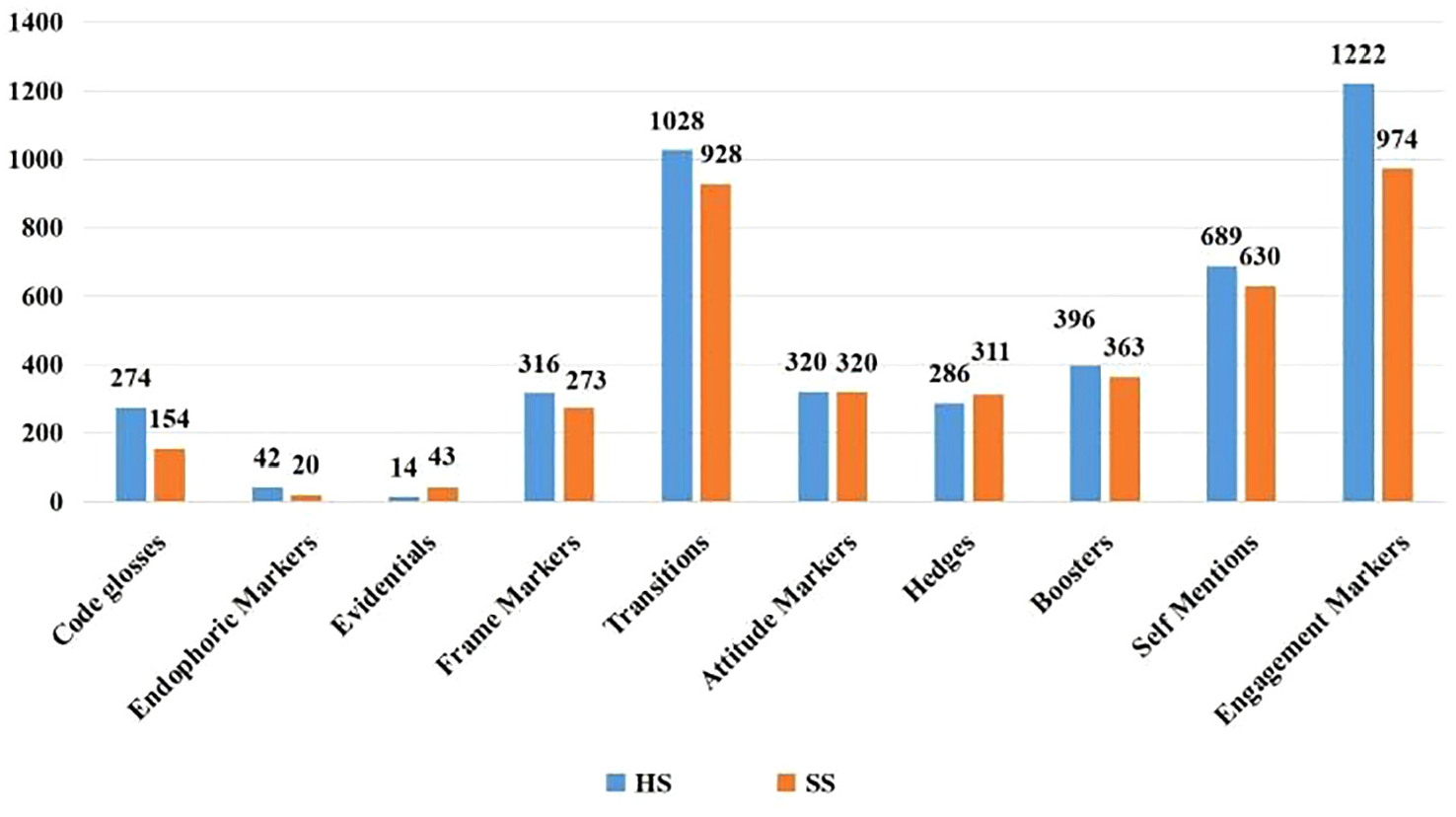
The raw disciplinary distribution of 10 subcategories of metadiscourse.

The normalized disciplinary distribution of 10 subcategories of metadiscourse.
From example (3), we observed the speaker of hard sciences attached greater emphasis to illustrate every part of the pie chart to avoid being misunderstood, while the speaker of soft sciences in example (4) simply referred to what had been mentioned by earlier to help the audience locate the relevant information as quickly as possible.
Evidentials
Evidentials indicate the external source of information in the current discourse, increasing the reliability by leading audience to focus on the credibility of its source, such as (date)/(name), cited, quoted, and so on. Due to the intertextuality of evidentials, they often appear in written academic genres to support the arguments, while, they are employed less in spoken academic discourses. Therefore, it is not surprising to find that evidentials are being used scarcely among 10 subcategories of metadiscourse resources in two corpora.
Disciplinary differences across two corpora have been found significantly in the frequency of evidentials (LL = 16.25, p < .0001), among which more items are detected in soft sciences compared with hard ones (1.6 vs. 0.5 per 1,000 words respectively) as shown in Figure 8. The divergence can be ascribed to that hard sciences give priority to reasonableness and rationality, persuading the audience with rigorous experiments, objective facts, laws with axiomatic approach and deductive inference, which can be independent of additional quotations or citations, while soft sciences focus on concept, spirit, emotion, value of human beings and multitudinous cultures, which involve deep historical accumulations and subjective consciousness. Hence, soft scientists tend to use more evidentials to stress empirical support for their propositions, otherwise they may leave an unsubstantial impression of their presentations to the audience.
Example (5): All like Cathy Hawthorne describes it and is demonstrating here, it feels like breathing through a drinking straw.
Example (6): By the end he (Tom) said, if I try really hard, I can do something.
As we can see in example (5) from medical science and (6) from education, they quoted other person’s remarks to provide evidential support for their statements. Otherwise, it would be hard to convince the audience to accept their viewpoints.
Frame Markers
Frame markers function to establish the local and global organization in the speech, typically sequencing parts of speech (first, second), labeling stages (in short, in summary), declaring speech goals (aim to, desire to) and shifting topics (well, back to).
There is no significant divergence in the normalized frequency of frame markers between hard and soft fields (LL = 2.1, p > .05), suggesting that frame makers are essential elements for well-organized and self-consistent academic discourse no matter in hard or soft fields, helping listeners outline the discourses. As Figure 7 indicates, frame markers are in the second place of interactive categories in two 3MT corpora. However, previous studies have reported that frame makers normally rank fourth or last among interactive devices in written academic texts. As oral presentations rely much on sound transmission, unlike written texts assisted by format and punctuation, 3MT presenters would employ more frame markers than authors of written texts. Resorting to the frame markers, presenters could specify the overall purpose of research, serve to organize the lists of points, and structure the presentations for the audience, which is beneficial for them to keep track of the speeches.
Example (7): Solution number one is we slow down our speed and reduce the energy transfer. Solution number two is we put a lid on our cup, which is kind of the favorite solution for a coffee to-go.
Example (8): The aim of my research is to better understand the scope of the laws we already have, which already prohibited from causing psychological harm to one another.
As we can see in example (7) from engineering science, number one and number two, even three later in order functioned as sequencing devices, which can help the presenter propose his/her solutions in a clear and logical manner. Meanwhile, the presenter in example (8) from law used aim to arouse the audience’s attention and announce his/her research aim solemnly.
Transitions
Transitions refer to the rhetorical devices, which interpret internal connections between clauses, mainly including three relations: addition (, and, furthermore), comparison (but, however) and consequence (so, therefore).
Transitions typically emerge as the highest employed interactive resources in academic genres. As shown in Figure 7, transitions rank first among interactive devices in hard sciences and soft sciences (LL = 2.79, p > .05) without significant disciplinary difference between 3MT corpora, which verifies the findings of previous studies. The predominant distribution reflects that clauses or propositions cannot be placed in isolation but be organized by connectives according to their logical relationships between the clauses. That is to say, transitions are conducive to the cohesion and coherence of speeches. In this way, the audience can comprehend the material much more easily.
Example (9): The remainder is what we call dark matter. We call it dark because it doesn’t interact with light, and we call it matter because it has mass.
Example (10): Now the purpose of my research is to increase transparency throughout that supply chain and bring down the fence. But, how do we increase transparency offshore when our laws don’t even apply there?
As seen in example (9) from physics, a causal relationship was illustrated by because where the result was the former and the latter explained why we call it dark matter. In example (10) from law, the speaker employed but to demonstrate the adversative relation between the sentences, which triggered the audience’s curiosity toward the solution to the question.
Interactional Metadiscourse
Attitude markers. Attitude markers manifest speakers’ attitude toward and evaluation of information in speeches, instead of on epistemology, realized typically through emotional verbs (agree), adjectives (cool, complex), and adverbs (importantly, surprisingly).
As shown in Figure 7, attitude markers rank fourth among interactional devices in two corpora, with no significant divergence between hard sciences and soft sciences through the log-likelihood test (LL = 0.11, p > .05). The reason for its scarcity may be attributed to the following two factors. Firstly, attitude devices mainly appear in the concluding part, especially in the implication and application of the study. Secondly, the PhD research delivered in 3MT presentations is still ongoing, which impedes their conviction of contribution to academia. Although attitude markers are less than other interactional devices, they are indispensable for a persuasive presentation, which are served to provoke the audience to identify with presenters’ feelings and convictions of propositions and agree with contribution and significance of the research in hard sciences and soft sciences.
Example (11): When I applied my new algorithm to some real-life data sets, I found that for these types of complex problems it is really important to pick the starting point carefully.
Example (12): Do they have any distinguishing features or marks? Yeah, surprisingly, over 1/3 of all suspects do.
In example (11) from information technology and electronic engineering, the value adjective important conveys the presenter’s positive attitude toward pick the starting point carefully and prompts the audience’s adherence to this viewpoint. In example (12) from psychology, the emotional adverb surprisingly emphasizes the unexpectedness to attract the audience’s attention, which could pull the audience together to gain their approval.
Hedges
Hedges are utilized to withhold complete commitment to a proposition, allowing to leave certain space for its determinacy degree so as to avoid undertaking unnecessary responsibilities for arguments, such as about, generally, in most cases and so on.
According to Figure 7, we can find that hedges rank last among interactional metadiscourse resources in hard and soft fields with no significant difference between them (LL = 1.82, p > .05). However, it is worth mentioning that hedges always account for the largest proportion of interactional devices in written academic discourses. The drastic decrease of hedges in oral speeches results from the competitive nature of 3MT competitions, which demands participants to acquire listeners’ support and trust of their presentations, and gain recognition of their research achievements within a limited time. Therefore, the overuse of hedges would weaken the presenters’ authority and affirmation of arguments, which leads to the audience’s uncertainty about research procedures and results. What’s more, the instantaneity of speeches results in few opportunities for the audience to question the presenters’ affirmation and assertion, which also reduces the use of hedges in 3MT presentations.
Example (13): And about 14 billion years ago, all the matter that would later become you and me and the galaxy was all swished together in a ball.
Example (14): And in most cases, investors and consumers have no knowledge of these events, because they occur offshore, and companies do not have to report them.
As seen in example (13) from physics, the speaker used about to express his/her rigorous attitude toward the time range. In example (14) from law, the speaker employed an adverbial modifier in most cases to exclude some cases, which leaves room for his/her subsequent statements.
Boosters
Boosters refer to the rhetorical devices of enhancing the certainty and confirmation of arguments as assertions functioning oppositely to hedges, such as no doubt, definitely, surely, and so on.
As shown in Figures 7 and 8, the number of boosters was in the third place in hard sciences and soft sciences with no significant difference between them (LL = 0.69, p > .05), amounting to 396 and 363 words (14.4 vs. 13.5 cases per 1,000 words respectively). Additionally, it is interesting to note that boosters are employed more frequently than hedges in two corpora, for 3MT genre prefers determinacy to conservativeness of propositions. Meanwhile, it is necessary for presenters to make a reasonable balance between hedges and boosters, which produces an impartial presentation, neither equivocal nor exaggerated to the audience.
Example (15): Well, programing a robot to understand all the different types of kitchens all around the world is really, really hard.
Example (16): But while they certainly weren’t trivial, they paled in comparison to the lasting psychological trauma that you’d suffered.
In terms of example (15) from information technology and electronic engineering, really has been mentioned twice to describe a high degree of difficulty in programing a robot, which could resonate with the audience. What’s more, in example (16), the speaker also employed an adverb certainly to solicit solidarity with listeners.
Self Mentions
Self mentions belong to stance devices, indicating the speakers’ overt visibility and ownership to his or her contributions, giving priority to first-person pronouns, such as I, we, my, me, and so on.
As shown in Figure 7, self mentions run second among interactional metadiscourse in 3MT corpora, which has the same position as in written academic genres. Moreover, self mentions are the most frequently used among stance markers in 3MT corpora, which is consistent with the result of previous studies on 3MT presentations. However, there is no significant difference between hard sciences and soft sciences (LL = 1.3, p > .05). The authorial presence exists abundantly in both disciplines, indicating that 3MT presentations are not restricted to the stylistic features of avoiding self mentions and emphasizing impersonality and objectivity of the research. Instead, personal pronouns are welcomed by speakers of 3MT to construct their visible identity and stance in academic community.
Example (17): Now, the people that I work with, they have made fun of me a lot, because I believe that these machines are just like you and me.
Example (18): Now the purpose of my research is to increase transparency throughout that supply chain and bring down the fence.
The presenter in example (17) from engineering science explicitly expressed his/her opinions to listeners, projecting a firm stance by first-person pronouns. Then in example (18) from law, the word my conveyed an exclusive contribution to the research and constructed the speaker’s unique identity.
Engagement Markers
Engagement markers refer to resources that attract listeners’ attention and interest, and involve listeners in the speech by interaction, including listener mentions (reader mentions), questions, knowledge appeals, directives, and personal asides, such as you, commonly, look, listen, imagine and so on.
As demonstrated in Figure 7, engagement markers account for the largest proportion of interactional resources in hard and soft sciences, which is in line with the findings of Qiu and Jiang. The distribution of engagement markers in 3MT presentations is widely divergent from written academic texts where engagement markers tend to account for a small proportion, even the least. Regarding this, the written mode lacks on-site interaction with readers, while speeches are delivered face to face. Therefore, presenters have more opportunities to interact with the audience in 3MT presentations.
By the log-likelihood test, there are significant differences in engagement markers between hard and soft fields (LL = 21.83, p < .0001), which also verifies Hyland and Zou’s (2021b) findings. According to Figure 9, among the subcategories of engagement markers, significant differences exist in listener mentions (LL = 16.97, p < .0001) and directives (LL = 8.87, p < .01). More directives are employed in hard sciences than soft sciences (6.6 vs. 4.7 cases per 1,000 words) as shown in Figure 10, which is consistent with the results of Qiu and Jiang. Besides, this study also reveals that compared with soft sciences, hard sciences employ more listener mentions, which facilitate presenters to involve the audience and track the presentations. Otherwise, the audience may lose interest in speech contents, for the knowledge in hard sciences is more abstract and obscure to understand.
Example (19): But that being said, imagine that you are a race car.
Example (20): What comes to mind when you think of a typical young offender?

The raw disciplinary distribution of engagement markers.

The normalized disciplinary distribution of engagement markers.
The presenter in example (19) from medical science resorted to a directive word imagine, which triggered the audience to participate in the interaction. And the presenter in example (20) from education cast a question to the audience by listener mention you to engage the audience in the presentation.
Conclusion
The purpose of this study has been to present a comprehensive comparison of metadiscourse usage between hard sciences and soft sciences of 3MT genre. As a discursive hybrid with promotional, competitive and academic features, 3MT genre confronts the presenters with a heterogenous audience, which calls for metadiscourse resources to produce a well-organized, coherent, logical, and comprehensible presentation, engage and interact with the audience, project a credible stance and construct the authorial identity. This study reveals disciplinary divergences of 3MT genre. In general, metadiscourse devices are more abundant in hard sciences than soft sciences. Specifically, frame markers (LL = 2.1, p > .05) and transitions (LL = 2.79, p > .05), attitude markers (LL = 0.11, p > .05), hedges (LL = 1.82, p > .05), boosters (LL = 0.69, p > .05) and self mentions (LL = 1.3, p > .05) of two 3MT corpora are distributed in a relatively balanced way with no significant disciplinary difference, while code glosses (LL = 30.97, p < .0001), endophoric markers (LL = 7.4, p < .01) and engagement markers (LL = 21.83, p < .0001) are employed more by presenters from hard sciences with disciplinary differences. As for evidentials (LL = 16.25, p < .0001), more have been employed by presenters in soft sciences than those of hard sciences.
This study has enriched and modified the retrieval list through deleting and adjusting some metadiscourse items, which can optimize Hyland’s (2005) interactive metadiscourse framework and Qiu and Jiang’s (2021) modified model of interactional metadiscourse. To some extent, the updated version might provide lexicon references for future metadiscourse studies of 3MT genre. Moreover, these interdisciplinary findings have practical implications for providing rhetorical strategies to presenters of 3MT competition and other spoken academic genres.
In regard to interactive metadiscourse, firstly, presenters of hard sciences could rely more on code glosses to illustrate abundant perceptions of objectivity timely, such as complex formulas, jargon, algorithm and computer codes, which are quite difficult for the target audience to understand. Secondly, presenters of hard sciences could have a higher level of endophoric consciousness to explain the charts and paradigms, which cannot be perceived directly through senses and cannot be understood by 3MT audience without extra explanations. These two strategies could help 3MT presenters illustrate professional knowledge in a more intelligible manner for non-specialists in 3MT presentations. Thirdly, in view of the subjectivity of soft sciences, presenters of soft sciences are expected to employ more evidentials to increase the reliability of speeches, transferring the adherence from presenters to the audience in 3MT presentations. Despite the distribution proportion of interactive metadiscourse in 3MT presentations is rather low on the whole, transitions cannot be underestimated, for they can lead the audience to follow the presenters’ logical deployment and enhance the cohesion and coherence of speeches.
As for interactional metadiscourse, presenters of hard sciences could rely more on engagement markers, especially listener mentions and directives, to engage the audience in 3MT presentations and to establish a harmonious relationship between presenters and the audience. There is no significant difference in other interactional categories between hard sciences and soft sciences. However, the amount of interactional metadiscourse is significantly higher than that of interactive metadiscourse in 3MT presentations, which suggests a high frequency of interactional metadiscourse markers. To develop a highly audience-engaged 3MT presentations, presenters of hard sciences and soft sciences could be encouraged to utilize interactional metadiscourse, especially engagement markers.
However, this study has some limitations. The self-built corpora are not large enough, for an enormous amount of online 3MT videos of high-quality are not accessible in its initial stage of popularization. Besides, the paralanguage, such as intonation, pitch and gesture, has been neglected in this study. In fact, presenters can resort to paralanguage for clarifying their research and expressing hidden implicatures. In subsequent studies, we could investigate 3MT genre from a multimodal perspective to produce a deeper and more comprehensive understanding of metadiscourse characteristics of this increasingly popular genre.
Footnotes
Acknowledgements
We thank the editors for their excellent editorial guidance and helpful comments from anonymous reviewers.

Ethical Considerations
This article does not contain any studies with human participants performed by any of the authors.
Funding
The author(s) disclosed receipt of the following financial support for the research, authorship, and/or publication of this article: This study was funded by the Humanities and Social Science Fund of Ministry of Education of China (23YJC740096).
Declaration of Conflicting Interests
The author(s) declared no potential conflicts of interest with respect to the research, authorship, and/or publication of this article.
Data Availability Statement
The datasets generated during and/or analyzed during the current study are available from the corresponding author on reasonable request.