



Abstract
Previous studies have explored the genre characteristics and persuasive nature of press releases. However, systematic analyses of the metadiscursive devices for persuasive purposes are lacking for corporate press releases. Following a corpus-assisted approach, this study investigates the distribution patterns of different types of metadiscourse resources used to achieve persuasiveness in the corporate press release genre. A quantitative analysis of the corpus under study reveals the different frequencies of metadiscourse devices in corporate press releases, and comparisons are made across different genres with similar persuasive attempts. The factors underlying the similarities and differences in metadiscourse use across genres are also examined. A qualitative analysis supported with examples illustrates how different types of metadiscourse devices contribute to the rhetorical appeals of ethos, pathos, and logos and help to enhance persuasiveness. Major findings and their implications for business discourse learners and researchers as well as business practitioners are presented. The article ends with its limitations and recommends avenues for further research in this line of inquiry.
Introduction
Press releases are short texts or statements officially delivered to the media to provide newsworthy information on a particular matter (Catenaccio, 2008). They are often issued by companies to communicate news about their products, services, and themselves to the media, the public, and the business world in particular. Their primary readership, however, is gradually shifting to the public (Catenaccio, 2008). Corporate press releases vary in their communicative purposes, ranging from making announcements, building positive corporate images, expanding scientific knowledge, to attracting potential customers. Therefore, some scholars regard the corporate press release as a hybrid genre (Catenaccio, 2008; Lassen, 2006; Maat, 2007; McLaren-Hankin, 2008; McLaren & Gurǎu, 2005). Self-reference, self-quotation, and semi-performatives are often used as meta-pragmatic strategies in this hybrid genre (Jacobs, 1998, 1999a, 1999b, 2014). Traditionally, corporate press releases are supposed to be recapitulated by journalists (Jacobs, 1999a). Currently, press releases are often posted on a company’s official website (often referred to as e-releases) and “expand access to press releases beyond the circles of professional journalists” (Strobbe & Jacobs, 2005, p. 289). Therefore, the meta-pragmatic characteristics of such e-releases not only reflect traditional meta-pragmatic strategies (e.g., self-reference) but also show an increasingly promotional trend, displaying such features as direct reader address, imperatives, and emphatic all-capital typography (Strobbe & Jacobs, 2005). Following this promotional turn, some studies have investigated the promotional aspects of corporate press releases (for instance, Maat, 2007; McLaren-Hankin, 2008). In this regard, it is plausible to assume that the various linguistic strategies for persuasive purposes can be employed in corporate press releases to help achieve their promotional functions.
Metadiscourse is the “cover term for the self-reflective expressions used to negotiate interactional meanings in a text, assisting the writer (or speaker) to express a viewpoint and engage with readers as members of a particular community” (Hyland, 2005, p. 37). Previous studies have indicated that metadiscourse devices could serve as an important linguistic resource to achieve persuasiveness (Del Saz Rubio, 2011; Ho, 2018; Hyland, 1998a; Kawase, 2015; P. Martín & Pérez, 2014; Ozdemir & Longo, 2014). Studies on corporate press releases from the metadiscourse perspective are rare (McLaren-Hankin, 2008; Skorczynska, 2020). McLaren-Hankin (2008) analyzed hedges in corporate press release and discussed their pragmatic functions. Skorczynska (2020) examined how first-person references were used in corporate press releases to achieve the persuasive effect. Although these studies have added our understanding of metadiscourse resources for persuasiveness, a systematic analysis of metadiscourse devices used to achieve persuasiveness has not been conducted. Adding to the promotional aspect of this line of research, this study attempts to explore the “pragmatics of metadiscourse” (Hyland, 1998b) in corporate press releases, focusing primarily on the ways in which persuasiveness is enhanced via metadiscursive means. Specifically, the study seeks to address two research questions:
This research extends the application of metadiscourse analysis from prior studies of the academic genre (Del Saz Rubio, 2011; Kawase, 2015; P. Martín & Pérez, 2014; Ozdemir & Longo, 2014) and the business genre (Fu, 2012; Hyland, 1998a) to e-press release as a discourse genre. It may also add to the understanding of the meta-pragmatic characteristics and communicative functions of the e-press release genre in the promotional trend.
The rest of this article is organized as follows. In the next section, we start with the theoretical foundation of the study by discussing the concept of rhetoric and how rhetorical appeals can be achieved by using metadiscourse devices. Subsequently, we present the corpus and the research method for our study, followed by an illustration of the pattern of metadiscourse use in corporate press releases for persuasive attempts. Possible reasons for the distribution of different metadiscourse resources are explored, and comparisons are made between corporate press releases and other persuasive genres in terms of their metadiscourse use. The last section concludes the major findings, discusses the limitations, and recommends avenues for further research.
Theoretical Foundation
The theoretical foundation of this study is derived from Hyland’s (2005) interpersonal model of metadiscourse. This section starts with an overview of the concept of metadiscourse, followed by an investigation of metadiscourse features based on Hyland’s model. A review of prior studies targeting persuasion via metadiscourse devices is also presented to provide insights into this line of investigation.
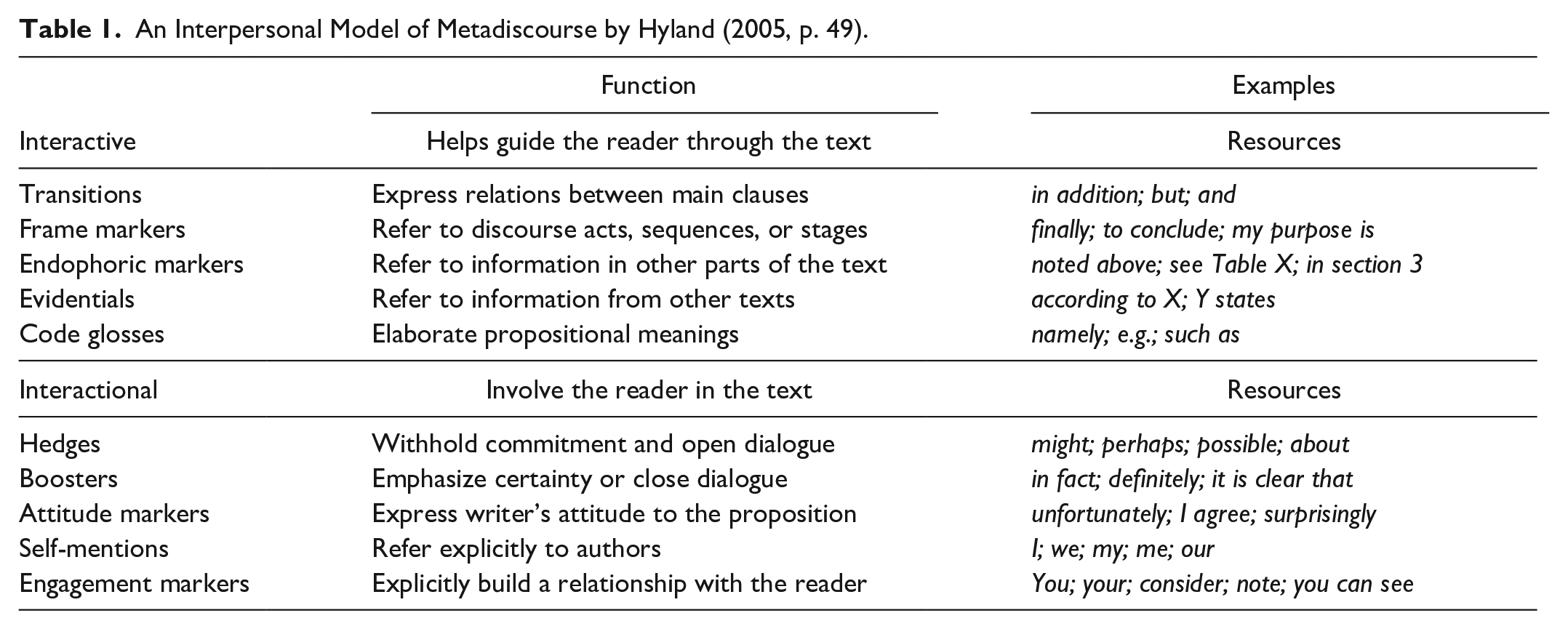
The notion of metadiscourse is widely used in discourse analysis, and its meaning may vary across different communicative contexts. Essentially, two main approaches can be found in extant literature. The first approach, often referred to as a “reflective” approach (Ädel, 2017), views metadiscourse as a form of linguistic reflexivity (e.g., Bunton, 1999; Dahl, 2004; Mauranen, 1993) and focuses on the devices used to organize and produce a discourse. The other approach, often termed an interactive approach, views metadiscourse as a form of interaction between the writer and the reader (e.g., Crismore et al., 1993; Hyland, 1998b). It emphasizes the integration of the propositional content and subject matter and views metadiscourse as an aid to interact with the reader. Hyland argues that people have multiple language choices in interacting with others (Hyland, 2005) and interactivity is a fundamental feature of metadiscourse. Hyland’s (2005) model of interpersonal metadiscourse is shown in Table 1.
An Interpersonal Model of Metadiscourse by Hyland (2005, p. 49).
To persuade readers, writers often use metadiscourse by resorting to rational, credible, and emotional appeals. Metadiscourse helps writers attract and engage readers; thus, its deployment could serve to achieve a persuasive aim. Since ancient times, the main categories of persuasion have been characterized by pathos (affective appeals to the readers), logos (rational appeals linking the arguments), and ethos (related to the writer’s authority and competence) (Furley & Nehamas, 1994). Previous studies have demonstrated that ethos can be achieved by using hedges, boosters, attitude markers, and so on. Logos can be achieved through the use of frame markers and transitions, and pathos can be achieved by using attitude markers, engagement markers, and so on (Ho, 2016, 2018; Hyland, 1998b, 2005).
There has been extensive research on how persuasion is achieved with metadiscourse as an analytical framework in various genres. Extant studies are mostly concerned with the academic genres, focusing on either academic research articles as a whole or different sections of research articles (e.g., abstract, Ozdemir & Longo, 2014; introduction, Del Saz Rubio, 2011; Kawase, 2015) or PhD theses (P. Martín & Pérez, 2014). Attitude markers (e.g., successful and insufficient) often serve as evaluative devices, helping to emphasize the importance and uniqueness of a research paper (Afros & Schryer, 2009).
In addition to academic genres, some studies examined news reports, business discourse, policy documents, and computer-mediated materials (Dafouz-Milne, 2008; Ho, 2016, 2018; Hyland, 1998a). Dafouz-Milne (2008) compared the opinion columns in a Spanish newspaper and an English one and found that textual and interpersonal metadiscourse were prevalent in both languages and were important in achieving persuasiveness in newspaper discourse. Ho (2016) explored how the HKSAR government attempted to convince people of policy documents using metadiscourse resources. In the corporate business genre, Hyland (1998b) demonstrated how CEOs employed metadiscourse devices to achieve persuasion through ethos, pathos, and logos in the CEO’s letters and the director’s reports. Recently, Ho (2018) investigated people’s use of metadiscourse to achieve persuasion in workplace emails.
These studies indicate that metadiscourse is an effective aid in achieving persuasion. Although there is a body of work on the analysis of metadiscourse in achieving persuasiveness, few studies have specifically targeted the use of metadiscourse in the corporate press release genre (McLaren-Hankin, 2008).
Considering the prevalence and importance of this genre in the economic and social aspects of our lives, it is certainly worthwhile to further explore this field. This study seeks to address the gap by analyzing a corpus of 99 corporate press releases selected from three business giants and investigates how persuasiveness is enhanced in this discourse genre by appealing to pathos, ethos, and logos, all of which can be realized with metadiscourse devices (Hyland, 2005, p. 63).
Method
Corpus
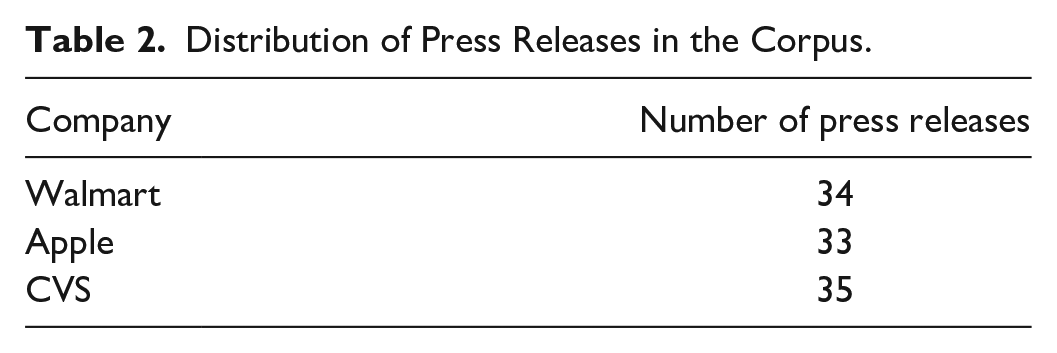
The corpus used for this study comprises 99 press releases (totaling 69,683 words) issued by Walmart, CVS, and Apple between January and June 2019, accessed electronically from the selected companies’ official websites. We chose these three companies for our study for two main reasons. First, they are all representative businesses ranked top in the Fortune Global 500 list, with Walmart leading the comprehensive sector, CVS leading the health care sector, and Apple leading the field of computer and electronics manufacturing and services. Second, they all have been listed on the stock market and obliged to inform their stakeholders of their latest developments. Press releases are often used as an important channel for these companies to disseminate information to their stakeholders and other interested parties.
The topics in our corpus cover the companies’ collaboration with other businesses and their newly launched products or services. The components of the corpus are listed in Table 2.
Distribution of Press Releases in the Corpus.
Analytical Method
Our analysis of the corpus followed the following procedures. First, we imported the 99 press release texts into AntConc (Anthony, 2014), a software used primarily to conduct qualitative analyses such as keyword calculation, word extraction, and concordance. Subsequently, the text of each press release, including the title, was coded and analyzed. We then searched the metadiscourse markers categorized by Hyland (2005) by using the Text Search function of AntConc (pp. 218–224). To confirm its metadiscursive function related to Hyland’s (2005) definition of metadiscourse (see Table 1), each metadiscourse marker was checked manually in its context (p. 37). Considering this top-down approach might miss some expressions that actually performed a metadiscursive function, yet did not fit in any of the categories listed in Hyland’s (2005) model, each press release was double-checked manually to identify the metadiscursive expressions of this sort. An attempt was subsequently made to categorize these metadiscursive expressions by mapping them onto Hyland’s (2005) interpersonal model of metadiscourse.
After the metadiscourse markers were identified and categorized, a quantitative and qualitative analysis of them was carried out. In terms of the quantitative analysis, chi-square test with the SPSS 22.0 software was conducted. This test aims to compare the normalized data within the corpus and across different corpora in prior studies. The raw frequency counts were normalized following Biber et al.’s (1998) methods [(Raw frequency count/number of words in the text) 1,000 = normalized frequency count]. The qualitative analyses examine how different metadiscourse markers are used for achieving persuasive purposes by adopting a discourse analysis method (Fairclough, 2001). We described, explained, and discussed the pragmatic function of certain metadiscourse markers in their specific contexts.
Findings and Discussion
Results of Quantitative Analysis
The quantitative analysis of the metadiscursive devices reveals the overall patterns of metadiscourse use for the purpose of achieving rhetorical appeals including pathos, ethos, and logos in our corpus. Table 3 shows the frequency of metadiscourse use (per 1,000 words) in the corporate press releases under study. All the metadiscursive expressions in the corpus fall neatly into the 10 categories proposed by Hyland (2005). However, two points need to be clarified. First, Hyland (2005) has classified the first-person plural form “we” into the categories of inclusive and exclusive usages, as “we” can be regarded as reader-inclusive or reader-exclusive (Hyland, 2005). In our study, the word “we” is listed only in the self-mention category, as the function of “we” refers to the corporate and its institutionalized voice (Jacobs, 1999a). Second, the attitude markers in Hyland’s (2005) study are mostly realized by adjectives and sentential adverbs. The attitude markers in our study vary in form, with some nouns such as success and convenience included.
Frequency of Metadiscourse Occurrence in Corporate Press Releases (per 1,000 Words).

As shown in Table 3, writers of corporate press releases used more than twice as many interactional metadiscourse resources than interactive metadiscourse resources (57.26 vs. 26.18 per 1,000 words, respectively). This could indicate that press release writers seek to create a closer relationship with their readers through the use of metadiscourse devices. In terms of interactional metadiscourse, we find that attitude markers are most frequently used (18.6 per 1,000 words). This can be accounted for in two ways. One explanation for this result may be the lack of legitimacy. Legitimacy, or the lack of it, is a crucial issue in the context of corporate change (Erkama & Vaara, 2010), and changes such as the launch of new products and the collaboration between a company and its partners are the main topics in corporate press releases. Such changes inevitably imply a legitimacy crisis (Kostova & Zaheer, 1999). Attitude markers (e.g., leading, affordable) in the forms of adjectives and nouns are linked to certain moral values and belong to the four major categories of legitimation (authorization, moral evaluation, rationalization, and mythopoesis). Adjectives such as “affordable” and “latest” are categorized under “moral evaluation,” and they function as a shield from debate and argument (Van Leeuwen, 2008).
Another explanation for the high frequency of attitude markers may be attributed to the genre characteristics of corporate press releases (Catenaccio, 2008). An important communicative purpose of press releases is to promote a good image of the company. In other words, promotion is one of the desired goals. The use of such attitude markers or value-laden evaluative devices affects the attainment of the goal (Hunston, 1985). Attitude markers could help manipulate the readers to see things the way in which the writers wish them to (Hunston & Thompson, 2000).
A comparison of this pattern of metadiscourse use in corporate press releases with other genres with similar persuasive purposes yields interesting results. Table 4 displays the patterns of metadiscourse use across different genres, including CEO letters, director reports (Hyland, 1998a), and workplace request emails (Ho, 2018). These genres are essentially similar in terms of their persuasive goals. That is, persuasion is one of their primary communicative goals. For instance, CEO letters and director reports seek to persuade stockholders and potential investors to have confidence in the company’s prospects for economic returns and sustainable development, and professionals use metadiscourse markers to achieve persuasion via workplace emails.
Overall Distribution of Metadiscourse Use Across Genres (per 1,000 Words).

Note. NA = not applicable.
Table 4 shows the comparison of metadiscourse markers in terms of raw count, normalized frequency (per 1,000 words) across different corpora, and the related results of chi-square tests. This indicates that there were more metadiscourse markers in corporate press releases than in CEO letters and director reports (χ2 = 5.501, p = .019; χ2 = 0.887, p = .346, respectively). The use of metadiscourse markers in corporate press releases was remarkably lower in comparison with workplace request emails (χ2 = 0.368, p = .544).
Regarding raw count, interactive markers are used more frequently in corporate press releases than in business request emails and director reports. However, they are used less in corporate press releases than in CEO letters. Interactional markers are used more in corporate press releases than in CEO letters and director reports. However, they are used less in corporate press releases than in business request emails. Corporate press releases used fewer such markers than workplace request emails—57.24 versus 89.58 per 1,000 words, respectively. This might result from the communication characteristic of computer-mediated genres, which are more casual and require prompt attention and action (Evans, 2012). Therefore, these genres naturally employ more spoken elements such as first-person pronouns “I” and “we,” which are categorized as self-mentions in metadiscourse resources, and “you” and imperatives that are categorized as engagement marker resources (Gains, 1999). Overall, metadiscourse markers are employed most heavily in business request emails, followed by corporate press releases. They are not used as heavily in CEO letters and director reports.
In terms of normalized frequency (per 1,000 words), the normalized frequencies of interactive markers in corporate press releases are higher than those in business request emails, CEO letters, and director reports. The relative frequencies of interactional markers in corporate press releases are higher than the relative frequencies of interactional markers in CEO letters and director reports. However, they are lower than the relative frequencies of interactional markers in business request emails.
Finally, the results of the chi-square test are presented. First, regarding interactive markers, the chi-square analysis indicated a statistically significant difference between those in corporate press releases and in CEO letters (χ2 = 7.412, p = .006). This could be attributed to the fact that half of the companies in Hyland’s (1998a) study were Hong Kong-based, and they provided CEO letters in both Chinese and English. This indicates that these companies are accustomed to the reader-responsible culture, in which readers have to exercise inductive logic to find the transitions and logical links between the sentences and paragraphs (Hinds, 1987). There was no statistically significant difference between the interactive markers in corporate press releases and director reports (χ2 = 2.379, p = .123), and the interactive markers in corporate press releases and business request emails (χ2 = 0.406, p = .524). Second, regarding interactional markers, there was no statistically significant difference between those in corporate press releases and CEO letters (χ2 = 1.361, p = .243), and those in corporate press releases and business request emails (χ2 = 1.613, p = .204). This could result from the difference of these two genres in their primary aims: the aim of corporate press release is mainly to persuade potential customers to buy their products (Lassen, 2006), while the aim of business email is to request the receiver to provide information or perform an action for the sender (Ho, 2018). As the use of interactional markers in director reports is remarkably rare (1.3 per 1,000 words), the chi-square analysis of the interactional markers between those in corporate press releases and director reports is not applicable. Finally, in light of the metadiscourse markers in general, there was a statistically significant difference between those in corporate press releases and those in CEO letters (χ2 = 5.501, p = .019). A possible explanation for this difference could be ascribed to the informalization trend in the public discourse in the West, which is characterized by the frequent use of metadiscourse markers such as boosters, hedges, and self-mention (Pearce, 2005). The CEO letters in Hyland’s research were issued in the 1990s, whereas the corporate press releases in our corpus were published in 2019. Compared to two decades ago, public discourse such as corporate press release and CEO letters has become more informalized. There was no statistically significant difference between those in corporate press releases, director reports (χ2 = 0.887, p = .346), and business request emails (χ2 = 0.368, p = .544). This may also be explained by the similarity in communicative purposes that these three business genres elucidate. One interesting phenomenon that deserves attention is the difference between corporate press releases and director reports in terms of the relative frequency and chi-square result. Table 4 shows that there is a remarkable difference between the usage of metadiscourse markers in these two genres; however, the chi-square analysis reveals no statistically significant difference between them. The reason could be the similar content of these two genres; director reports contain information “on company training and employment policies, and a summary of acquisitions and disposals” (Hyland, 1998a, p. 12), while corporate press release in a broad sense also contains similar information such as staff announcements, company fact sheets, and news items (Walters et al., 1994).
Qualitative Analysis
As stated by Hyland (2005), metadiscourse helps the rational, credible, and affective appeals in the discourse. This section examines the use of metadiscourse resources in our corpus that perform the persuasive function by appealing to pathos (creating affection), ethos (creating credibility), and logos (creating rationality).
Examples are provided to help illustrate how pathos and ethos were achieved with interactional metadiscourse devices, and how logos was achieved with interactive metadiscourse expressions. This section will elaborate on the high occurrence of interactional metadiscourse and explain the use of attitude markers and self-mentions that enhance the effectiveness of affective engagement.
As shown in Table 3, attitude markers accounted for 18.6% of all the interactional metadiscourse markers, making it the largest interactional metadiscourse category. Frequent use of evaluative expressions clearly transmits the writers’ attitude toward the content of corporate press releases and their affection about the subject matter. Such attitude markers enhance the persuasiveness of the announcements by claiming solidarity with the audience and by seeking the same or a similar response from their audience toward the content of the press releases. These markers can be roughly categorized into two semantic types: the positive outcome of the performance of the company and its associated businesses, and the positive or pleasant feelings toward their products or services. Writers use words like best, great, or even better to describe the current status of the company or the quality of the products and services to be released. The following examples illustrate how attitude markers were used to enhance persuasiveness.
Extract 1 is taken from a press release about the collaboration between CVS and Smile Direct Club, who provide affordable dental care and doctor-directed, remote clear aligner therapy. It mainly reports that more Smile Direct Club Smile Shops will be launched in hundreds of CVS pharmacies: (1) The collaboration is a
In this extract, the press release writer uses attitude markers such as leading, innovative, and comparatives (e.g., more accessible, more affordable). Here “leading” is used to describe the collaboration between CVS Health and Smile Direct Club. It serves as a positive attribute that modifies their collaboration, thus making the evaluation explicit and seeking to avoid debate (Van Leeuwen, 2008) to legitimize their endeavor. In this case, the writer appeals to the reader’s emotional response to the news, because a more accessible and affordable health solution represents the common aspiration when people enter a pharmacy. Skillfully managed in such a context, it could successfully arouse the empathetic emotions in the readers. Emotional engagement is further enhanced by using comparative forms (e.g., easier, more accessible, more affordable); thus, a powerful emotional interaction is established between the press release writer and the intended readers. The use of such attitude markers clearly indicates that CVS Health considers the customers’ concerns and understands them, empathizing with their readers’ values and judgments (Hyland, 2005, p. 81). Thus, the persuasiveness of affective appeal can be effectively achieved.
Besides using attitude markers in adjectival form to describe the collaboration between the company and its partners, attitude markers can also be used to describe products or services, as shown in Extract 2: (2) Apple today introduced the all-new iPad Air in an ultra-thin 10.5-inch design, offering the latest innovations including Apple Pencil1 support and high-end performance at a breakthrough price. With the A12 Bionic chip with Apple’s Neural Engine, the new iPad Air delivers Apple today also introduced the new 7.9-inch iPad mini, a major upgrade for iPad mini fans who love a compact, ultra-portable design packed with the
Extract 2 is about iPad Air, a new product released by the Apple company, characterizing its quality, appearance, and properties. Many positive evaluative expressions can be found, italicized in this example. Along with the commendatory adjectives and their comparative and superlative forms, in this extract are some expressions of comparison (e.g., a 70 percent boost, nearly 20 percent larger, half a million more pixels). The concrete numerical information facilitates a sharp comparison with Apple’s former products, and such contrastive expressions arouse a contrasting emotion in the readers. These devices are employed to persuade readers of the excellence and superior quality of Apple’s new products. With such a positive description of the products, this press release seems more like an advertisement than an objective announcement of the new products. Such positive judgments will affect the readers, since “evaluation could be used to manipulate the readers, and thus the readers will see things in a particular way” (Hunston & Thompson, 2000, p. 27). This is because a world-famous brand portraying something as latest and perfect makes it difficult for the readers not to accept it as such. The goal of this press release was to promote its product and make customers crave for something featuring “a compact, ultra-portable design packed with the latest technology.” Such value-laden evaluative devices clearly enhance the impact of the emotional engagement (Hunston & Thompson, 2000), contributing to the persuasive effect of the text.
In addition to using attitude markers to achieve engagement affection, the use of engagement markers also helps achieve the realization of pathos: (3) What’s even better is
As stated by Baker (1992), English has a rich variety of modes of address which can be used to express familiarity. The use of second person plural, rather than third person plural, implies a higher degree of intimacy in the context (Baker, 1992, p. 96). In Extract 3, directly addressing the readers using second-person pronouns (you and your) contributes to the interactive effect and narrows the distance between the writer and readers. You and your provide an interlocutory effect, which implies a close and harmonious relationship (Fu, 2012): (4) That’s why I’m really excited about a couple of
In Extract 4, persuasiveness is achieved using attitude markers (new and amazing) along with engagement markers (pronoun reference). In this example, the engagement markers “we” and “our” were followed by attitude markers “new” and “amazing” to describe the newly launched services. The verb phrase be inspired implies that customers will experience a pleasant and beneficial feeling with their new home assortment. The combination of engagement devices with attitude markers carries an implicit assumption that readers will interpret the press release in the same manner and with the same feelings, creating a set of shared or taken-for-granted understanding and purpose (Hyland, 2005, p. 82).
As is illustrated in Table 4, the number of self-mention expressions in the corpus is 12.3 items per 1,000 words, considerably higher than that in CEO letters and director reports, as shown in previous studies (Hyland, 1998b). Interestingly, our study also finds that such self-mention expressions are often collocated with words that indicate responsibility and commitment (e.g., aim and strive, as shown in Extracts 5 and 6). The use of these phrase frames conveys the endeavors of the company for future commitments, constructing a determined, confident, and positive company ethos (Hyland, 1998a): (5) (6)
In Extracts 5 and 6, the deployment of the self-mention expression we followed by aim and are striving helps to establish the company’s strong ethos of commitment and responsibility. This use of metadiscourse to achieve ethos can be explained in two ways. First, the choice of we as the agent of the clause indicates that the company could construct an identity of an accountable and reliable actor by making them the sole agent of a clause. This finding is consistent with Ho (2010), who demonstrated that leaders of the company often use I as the sole agent. The ethos of dependence and reliability was further enhanced by combining the self-mention token we with such verbs like aim and strive, which imply the objectives of their endeavors. Purposes are constructed as “in people,” as conscious or unconscious motives, aims, intentions, goals, and so on. The formula is “I do x in order to do (or be, or have) y” (Van Leeuwen, 2008, p. 114). In these two examples, the goals of Walmart’s endeavors are to learn more about how to use self-driving vehicles for fresh grocery deliveries and to deliver the customers “Our Promise,” which legitimatizes their endeavors.
Second, the lexical choice also helps convey the company’s ethos. By using verbs that suggest future actions, the press release presents itself to the reader in a committed and assured way (Cockcroft & Cockcroft, 2013). In addition, strongly positive lexis such as unbeatable and valuable is used here to indicate that the customers’ concerns are highly valued by the company, thus creating an expected ethos and the desired persuasive effect. The high degree of assurance presented in the press release creates an image of sincerity and responsibility on the part of the company.
As shown in Table 4, transition markers in corporate press releases represent the highest frequency of interactive resources (20.1 items per 1,000 words), which is much higher than in director’s reports (5.0) and CEO letters (9.1): (7) Our collaboration with Smile Direct Club is exciting (8) Every purchase is secure
Transition markers, as explicit cohesive devices to hang the text together, are an important source for the realization of cohesion and coherence of a text, without which the purpose of any persuasion can be crippled. The logical precedence of cause over effect is reflected in this typical sequence, thus making explicit such arguments (Halliday & Hasan, 1976) in Extracts 7 and 8. The word because, which belongs to the cause-and-effect category, functions as an explanatory device that links the phrase with the preceding one. Here, it signals to the readers that a cause leads to the preceding conclusion. The reason for the statement followed it, supporting its claim through these explanatory elements. In this way, rational (logos) appeals could be achieved, and they helped achieve persuasion. These results echo those of Kim and Lim (2013), who also found a similar use of cause-effect transition in the introduction of the research article: (9) (10) These new technologies are helpful,
Transition markers such as “but” are used to indicate statements of inconsistency or counter-claiming in the press release. Such statements situate the current statement in the context of previous background information and place emphasis by stating how the current statement fills the past gap, or by illustrating how the current statement differs from previous work (Kim & Lim, 2013). These contrastive forms are “antithetic discourse markers” that “exhibit connectivity and were sentence-initial concessive conjuncts appearing in the form of adversatives” (Lim, 2012, p. 234). The use of a contrastive at the beginning of the statements allows writers to position themselves in line with what they expect readers may think to head off objections or counterclaims (Hyland, 2004). According to Hyland (2004), this is to gain sympathy or acceptance from the readers regarding the writers’ views. In this way, the presence of metadiscourse engages readers with the writers and results in successful persuasion.
Endophoric markers are the least frequently used interactive metadiscourse, with a frequency of merely 0.05 items per 1,000 words. This concurs with the findings of the study on CEO letters and workplace emails (Ho, 2018; Hyland, 2005). Despite their difference in genre characteristics, they share one common ground: their short length. A workplace email is, on average, 135 words in length, while a CEO letter is 1,278 words, and a press release is 700 words. This indicates that short length may be an important factor accounting for the infrequent occurrence of endophoric markers. It provides little opportunity for the development of press releases that might demand the deployment of endophoric expressions. The short length makes it relatively easy for readers to access information in different parts of each press release without depending on endophoric expressions.
Conclusion
Although previous studies have approached the press release genre from the perspective of its genre features and promotional purpose (Catenaccio, 2008; Lassen, 2006; McLaren-Hankin, 2008; McLaren & Gurǎu, 2005), this article presented a corpus-based analysis, both quantitative and qualitative, of the corporate press release genre from a metadiscursive perspective. The analysis of the corpus reveals that the writers of press releases made persuasive attempts by appealing to pathos, ethos, and logos with the aid of different metadiscourse resources. A quantitative analysis illustrated the distribution of both interactive and interactional metadiscourse resources in corporate press releases. The distribution of metadiscourse devices in the press release genre was compared with their distribution in other genres in previous studies, specifically, CEO letters, director reports, and workplace request emails (Ho, 2018; Hyland, 1998a). The comparison across different genres revealed the range of language choices made by different companies when they sought to achieve persuasiveness in a press release. Specifically, interactional metadiscourse devices were employed far more than interactive ones (57.24 vs. 26.18 items per 1,000 words). In addition, attitude markers for achieving pathos and engagement markers for achieving ethos were used frequently, while endophoric markers and evidentials were used infrequently. This study on metadiscourse use in the press release genre could further expand its scope of application and the rhetoric analysis of business communication (S. E. Martin & Rawlins, 2018).
The findings of our study could provide insight for the academic and business fields. In academic settings, the overall distribution pattern of metadiscourse devices in the corporate press release genre and its similarities and differences with other business genres in this regard could be a useful reference and guidance for the learning and teaching of business communication. It may also be helpful for linguists and business communication researchers investigating the linguistic features and pragmatic functions of corporate press releases as a discourse genre. Business practitioners could also benefit from the findings in that they can learn from famous companies’ practices and strategies through their corporate press releases and optimize the corporate communications strategies for their own businesses and organizations.
Admittedly, this study also has some limitations that need to be addressed in further investigations. First, a top-down approach was followed based on the pre-defined metadiscourse categories listed by Hyland. Although it simplified and increased the efficiency of the process of identifying the metadiscourse resources, this classification of metadiscourse resources was by no means exhaustive, because some expressions that perform metadiscourse functions were not fully included in the list. Using AntConc 3.5.8 and manually checking the data in this study partially solved the problem. The other limitation is the size and topic of the corpus used for the study, with only 99 press releases from three representative business giants investigated and the focus confined to the retail industry. Authentic data from more businesses and more sectors will be included in future studies to verify our findings and advance the understanding of the metadiscourse usage in the corporate press release genre. Regarding the metadiscursive use in corporate press releases, there may well be some variations across different sectors of the economy. Hopefully, this study will add to our current understanding of the corporate press releases genre and lead to more intriguing and informative research along this line of inquiry.
Footnotes
Declaration of Conflicting Interests
The author(s) declared no potential conflicts of interest with respect to the research, authorship, and/or publication of this article.
Funding
The author(s) received no financial support for the research, authorship, and/or publication of this article.
