




Abstract
This study aims to examine the protective and positive effects of corporate image in healthcare services from the perspective of Porter’s General Competitive Strategies. The COVID-19 pandemic has been a crisis period in which healthcare organizations struggle to eliminate infectious diseases and face economic difficulties. During this crisis period, the sustainability of private healthcare organizations in a competitive environment has become uncertain. Considering this difficulty, the investigation of competitive strategies that healthcare organizations can implement is an important issue that has been neglected. In this context, the study examined the positive effects of corporate image on patient satisfaction and loyalty. The data of this cross-sectional and descriptive study were collected from 446 participants in Istanbul. Three scales—corporate image scale, patient satisfaction scale, and patient loyalty scale—were used to model the concept, and the AMOS structural equation model was applied. The findings show the positive effects of corporate image on patient satisfaction and loyalty. In addition, the effect of corporate image on patient loyalty increases through patient satisfaction. Therefore, corporate image serves as a differentiation strategy that healthcare institutions can implement in normal competitive conditions and in times of crisis. Hospital managers are advised to give importance to corporate image studies and develop them positively. The positive corporate image of healthcare institutions can play a proactive and protective role both in times of crisis and in normal competitive conditions.
Introduction
The COVID-19 pandemic has gone down in history as a process that requires extraordinary transformation and crisis management in the healthcare sector. Hospitals in many countries, including Turkey, have made great efforts to prevent the spread of the epidemic, and to keep the disease under control by being declared pandemic hospitals (Karačić Zanetti et al., 2023; Republic of Turkey Ministry of Health, 2020a, 2020b; WHO, 2024). While public hospitals continued their operations on a budget basis, private healthcare institutions struggled with limited resources and the economic difficulties brought by the pandemic. In the post-pandemic period, private healthcare institutions could not access their former patient portfolio quickly and faced restrictions such as advertising bans (Fener, 2023). In this challenging process, it is vital to investigate strategic methods for private healthcare institutions to maintain their existence and gain a competitive advantage. What competitive paths can private hospitals follow in this uncertain and risky situation? The question forms the basis of this research.
Public policies have supported the privatization of the health sector in Turkey, and the number of private hospitals has increased significantly since the 1990s. The opening of private hospitals has been encouraged by public policies to protect public resources, reduce costs, and increase efficiency in the health system. In this way, it aims to create a competitive structure in the health sector to increase quality and efficiency (Fedai, 2019). The increase in privatization and the support of the utilization of private hospitals with complementary insurance have also increased the choice of alternatives that can be preferred by reducing the value of price functions among hospitals (Başoğlu, 2021). The spread of communication technologies, access to information from anywhere, the increase in education, and the increase in conscious choice opportunities other than emergency diseases are among the other factors that increase competition in the private health sector.
This study aims to investigate the competitive paths that the private health sector, which must continue its economic existence in addition to dealing with a risky pandemic outbreak in the conditions of increasing competition, can implement. In this context, Porter’s Generic Competition Strategies, the most widely used in literature, were examined and the research methodology was determined from this perspective. In this direction, the differentiation strategy was focused on because it is both a value-oriented strategy and a strategy that can be applied to the health sector by the advertising ban restriction. The main determinants of the demand for health services are patient experiences and impressions. The evaluations made because of these experiences affect both patient demand and the demand of the environment they communicate with Chumbler et al. (2016). In this context, can the corporate image, which is perceived and valued due to patient evaluations, be used as a differentiation strategy for healthcare institutions? This is another question that is the subject of research interest.
The competitiveness of healthcare institutions depends on the degree to which they retain their existing customer portfolio and acquire new customers (Chauhan et al., 2021). In this period when the number of hospitals and choice alternatives increases, there is a need to better understand the factors affecting consumer preferences for healthcare institutions (Bezerra de Oliveira et al., 2022; Ho & Huang, 2020). Corporate image, which enables institutions or individuals to be recognized and remembered, positively, or negatively, based on what they have done or have not done in the past, affects consumer decisions. Corporate image has great importance in creating customer loyalty in the service sector (Harris & Goode, 2004).
Although the studies show the positive effects of corporate image on attracting customers to institutions, the scarcity of studies on this subject in the healthcare sector draws attention (Ayutthaya, 2013; Kim et al., 2008; Kösel, 2022; Liat et al., 2014; Prabowo et al., 2020). At the same time, there are a limited number of studies examining the effects of corporate image during crisis periods. The issue of how private health institutions can compete in times of crisis under restrictions such as advertising bans stands out as an area that is missing in the literature.
The theoretical model of this research, which examines whether corporate image can be used as a differentiation strategy in the health sector in the light of Porter’s generic competition strategies, is shown in Figure 1.
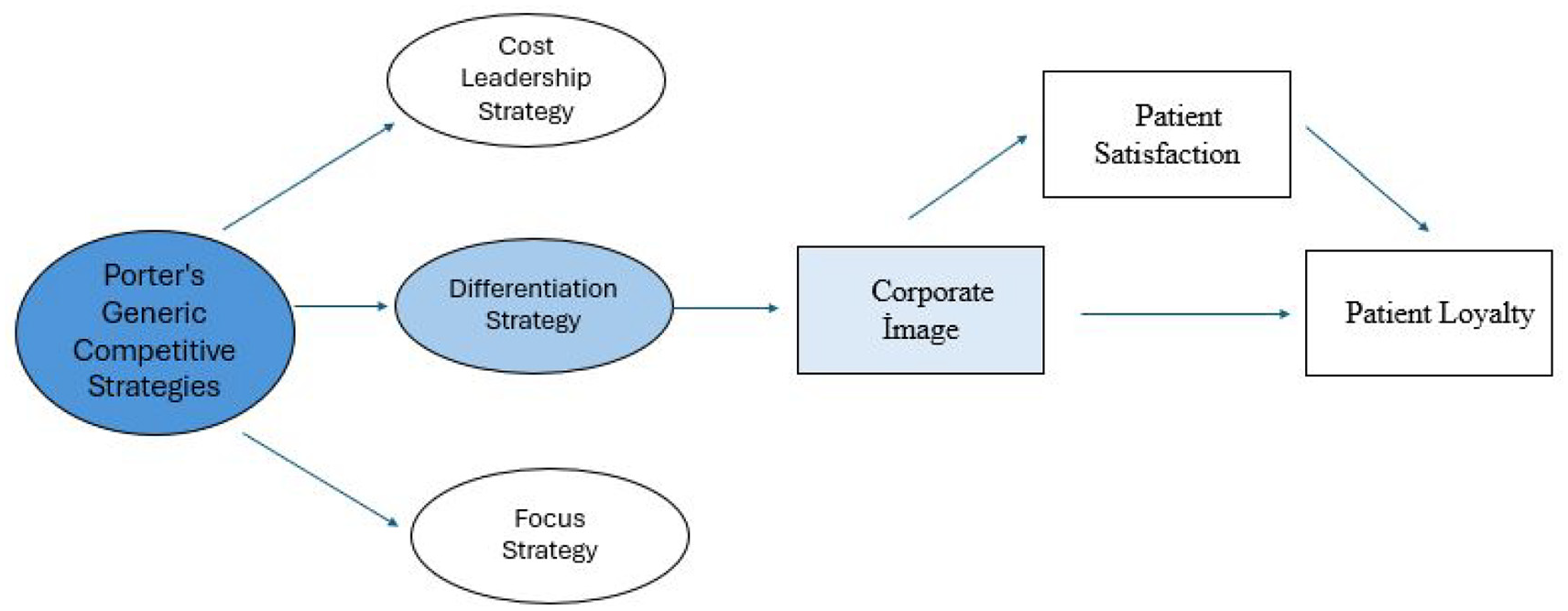
Theoretical model.
The research objectives determined within the framework of this theoretical model can be presented as follows:
Determining the perceived corporate image level, patient satisfaction level, and patient loyalty intention of private health institutions
Examining the positive effects of corporate image on patient satisfaction and patient loyalty
Determining the mediating role of patient satisfaction in the effect of corporate image on patient loyalty.
In this researched article, the current market and competition situation in health services in Turkey is explained in the introduction, and the difficulties the sector faces are included. The second section gives conceptual background, and the hypotheses created with the relationships between the concepts are determined. The theoretical model that explains the research methodology is tested by creating AMOS structural equation modeling. The results obtained from the research findings are discussed in the fifth section. In the last section, the inferences obtained from the research, the effects, and the limitations of the research are included.
Theoretical Background and Research Hypotheses
Corporate Image
Corporate image can be defined as the image that the business creates in its target audience and the set of judgments attributed to the corporate identity (Gray & Balmer, 1998). According to another definition, corporate image is the company’s efforts to provide a vision and hope to its stakeholders and the public; it is defined as the set of meanings attributed to the institution (Dowling, 1986). Corporate image is formed because of a process built through corporate communication activities (Heinberg et al., 2018; Tran et al., 2015; Triatmanto et al., 2021). Corporate image is defined as the image that remains in the minds of how an institution is perceived and seen in its surroundings. Corporate image, which is a subjective value, consists of many sub-dimensions. This study examines corporate image in a structure consisting of four dimensions: physical features, communication, quality, and social responsibility.
Physical features: The physical structure of hospitals is one of the criteria used in the evaluation of hospitals. In this context, it includes all visually perceivable features such as the hospital’s architectural structure, environment, location of the establishment, institutional colors, logo, personnel uniforms, hospital direction signs, waiting areas, and comfort (Zeithaml et al., 2002).
Communication factor: Another issue that should be valued in the provision of health services and that health consumers care about is the communication established by health personnel with patients. Providing information about the stages of the disease and treatment process by observing patient rights, allocating sufficient time for each patient for their treatment, answering patient questions, and approaching empathy are among the basic expectations. Studies show that trust in health services is based on doctor-patient communication and that doctor-nurse communication is the most evaluated (Gordon & Gerber, 2011; Meredith, 1993).
Quality factor: One of the basic criteria used in the evaluation of health services is the quality factor. In particular, the multidimensional structure of service quality is among the difficulties in the evaluation and maintenance of quality. In the evaluation of health services, two quality dimensions are mentioned, namely technical quality, and perceived quality. Technical quality is evaluated based on the application of the right treatment, at the right time, and the ethical and medical justifications of the health service. Perceived quality is defined as the quality dimension that can be evaluated by features such as communication, cleanliness, comfort, food quality, and service presentation that can be perceived by patients (Babakus & Mangold, 1992; Donabedian, 1988; Grönroos, 1984).
Social responsibility factor: Hospitals are businesses that provide services in a socio-technical structure. Social responsibility covers the ethical and moral responsibilities of the business toward its environment, based on the protection and observation of stakeholder interests (Brandão et al., 2013). However, the social responsibility activities expected from hospitals are higher than those expected by other sectors. Indeed, in terms of the public aspect of health services, health institutions are expected to carry out activities that improve public health, protect disadvantaged groups, and raise public awareness about health (Lubis et al., 2017).
Corporate Image as a Differentiation Strategy
Porter mentions three basic competitive strategies in generic competitive strategies. These strategies: It is defined as cost leadership strategy, focus strategy, and differentiation strategy. In the differentiation strategy, the focus is on gaining additional income, being preferred, and providing superior values for this value increase by adding unique values to the product/service (Porter, 1998). When the value created for customers differs, this value increase can provide a significant competitive advantage (Dowling, 1986). When health itself is considered as a value, it brings with it the need for health services to focus on differentiation strategies, aiming to increase additional value during service delivery. Within the scope of this study, corporate image and its effects were examined as a differentiation strategy that private health institutions can implement.
Corporate Image and Satisfaction
The way services are delivered and the level of satisfaction perceived play a crucial role in shaping the corporate image (Dowling, 1986). In today’s competitive landscape, institutions must establish a favorable corporate image to distinguish their services, foster trust, and garner empathy from their consumer base. A positive corporate image enables healthcare institutions to enhance patient satisfaction, set themselves apart from competitors, and gain greater recognition among the target consumer group (Fener, 2023). Although there are few studies in the literature examining the relationship between corporate image and patient satisfaction in healthcare institutions, the results reveal a relationship between corporate image and patient satisfaction (Kim et al., 2008; Kösel, 2022; Liat et al., 2014; Wai Lai, 2019).
The hypothesis developed because of these relationships examined in the literature is as follows:
H1: Corporate image positively affects patient satisfaction
Corporate Image and Loyalty
Institutions operating in the service sector can gain a competitive advantage in the sector by creating a positive corporate image (Richard & Zhang, 2012). It is stated that corporate image increases sales and market share and is a way to gain loyal customers (Liat et al., 2014). Patients who visit healthcare facilities form opinions based on their experiences. By providing recognition, clear information, and earning patients’ trust, healthcare institutions can create a positive image. This can influence a patient’s decision to choose that hospital again in the future (Kim et al., 2008). Corporate image in the healthcare sector is critical for hospitals to maintain their presence in the sector and to create patient loyalty (Ayutthaya, 2013; Liat et al., 2014; Prabowo et al., 2020). Research explains that corporate image affects customer loyalty. The hypothesis developed due to these explained relationships is as follows:
H2: Corporate image positively affects patient loyalty
Satisfaction and Loyalty
The main purpose of organizations is to provide customer satisfaction. Customer satisfaction is also an important indicator of service quality (Korunka et al., 2007; Sadiq Sohail, 2003). There is a strong relationship between customer satisfaction, profitability, and quality. Most studies explain that customer satisfaction affects customer loyalty (Abekah-Nkrumah et al., 2020; Hossain et al., 2020; Kandampully & Suhartanto, 2003; Liu et al., 2021; Martínez & Rodríguez del Bosque, 2013; Phonthanukitithaworn et al., 2020; Wilkins et al., 2010).
When the studies examining the relationship between corporate image and satisfaction and loyalty are examined, it is seen that a limited number of studies were conducted outside health institutions (Phonthanukitithaworn et al., 2020; Wu, 2011). The hypotheses developed due to the relationships described in the literature are as follows:
H3: Patient satisfaction positively affects patient loyalty.
H4: Patient satisfaction has a mediating role in the effect of corporate image on patient loyalty.
Method
Sample and Data Collection Methods
This study, which examines the effect of corporate image and patient satisfaction on patient loyalty, was conducted using a quantitative data-based screening model and a relational screening model. The research universe consists of individuals over the age of 18 in Istanbul. According to the data of the Turkish Statistical Institute (2020), the population over the age of 18 in Istanbul is 11,520,854 (Turkish Statistical Institute, 2020). Kline (2023) recommends a sample size of 200 in determining the sample size for the confirmatory factor analysis that should be conducted before SEM. However, Hair et al. (2010) states that the sample size should be at least 300 in testing a structural model. Considering the relevant literature, the sample size that will represent the universe was determined to be over 300.
In the study, a structured questionnaire form was applied to individuals over the age of 18 who had previously received service from a private hospital using the purposeful sampling method. Before collecting the research data, informed consent was obtained from the individuals with a voluntary consent form and the research data was kept confidential. Personal identifying information such as name and surname were not requested in the study. Within the scope of the research, 446 valid survey data were obtained.
Statistical Analysis
Data were analyzed with SPSS (25) and AMOS (24) programs. Descriptive statistics, confirmatory factor analysis, correlation analysis, and structural equation modeling (SEM) analyses were performed to analyze the data. The reason why SEM is used in AMOS is that it is a data analysis software that can run factor analysis and regression analysis simultaneously. It also provides better evidence for evaluating large samples. AMOS can deal with relationships in complex structures such as moderation and mediation.
Research Model
Within the scope of the research, it aimed to test the positive effect between the variables of corporate image, satisfaction, and loyalty. The model of the research created in this context can be shown in Figure 2.
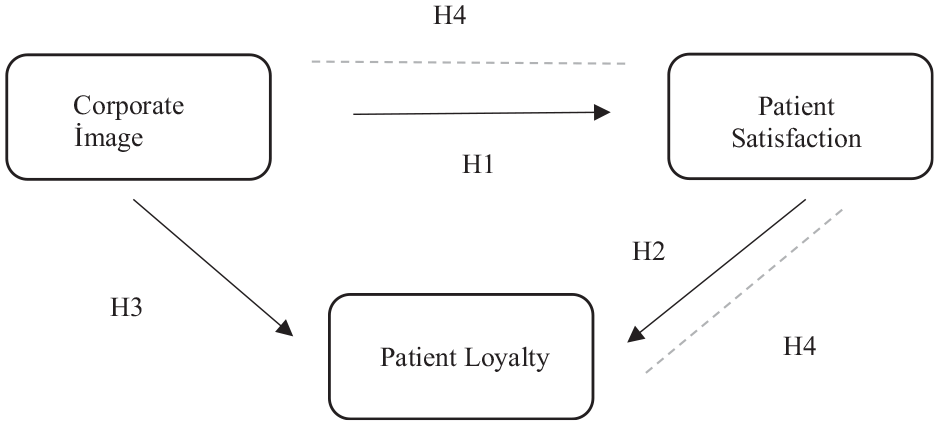
Research model.
The data obtained in the research were collected using a survey form consisting of four parts. In the first part of the survey form, five statements measuring demographic characteristics and two statements containing exclusion criteria were included. In the continuation of the survey, three different scales were used to measure corporate image, patient satisfaction, and patient loyalty. All statements in the scales were evaluated with a 5-point Likert scale, and the participants answered the statements as (1-Strongly Disagree, 2-Disagree, 3-Undecided, 4-Agree, 5- Strongly Agree) it was requested to answer.
Corporate Image Scale
The corporate image scale developed by Karaosmanoğlu (2006) was adapted and developed for health institutions by Bayın (2013). The corporate image scale consists of 26 expressions and four dimensions: physical factors, communication factors, quality factors, and social responsibility factors.
Patient Satisfaction Scale
Validity and reliability analysis was conducted by the researchers for the patient satisfaction scale developed by Chang et al. (2013) and adapted by Durmuş and Akbolat (2020). The scale, which consists of four statements, is collected under one dimension.
Patient Loyalty Scale
Validity and reliability analyzes of the patient loyalty scale developed by Tosyalı (2016) were conducted by the researcher. According to the factor analysis conducted by the researcher, the scale expressions consisting of seven statements are collected under a single factor.
Normality Analysis
In the research, skewness, and kurtosis values, which are most used in the social sciences, were examined to test the suitability of the data for normal distribution. When the skewness and kurtosis coefficients are examined according to the averages of the three dependent variables in the research. It is seen that the values in Table 1 are between (−1.5 and +1.5) and comply with normal distribution (Tabachnick et al., 2018). In this context, it was decided to apply parametric tests.
Skewness and Kurtosis Findings of the Scales.

Confirmatory Factor Analysis (CFA)
The scales used in the study were previously validated and reliable scales. Therefore, confirmatory factor analysis was performed to determine how well the structure fits the data. Confirmatory factor analysis determines whether the data fits a previously designed factor structure and tests construct validity. In evaluating the theoretical model created, it is necessary to examine the reliability, internal consistency, construct validity, and convergent validity of the relevant items and variables (Hair et al., 2010). Cronbach Alpha values were examined in the evaluation of the reliability level of the scales. In evaluating the validity of the model, internal consistency (CR), convergent validity, standardized loadings, and average variance extracted (AVE) were used (Fornell & Larcker, 1981). At the same time, multiple connectivity was examined by checking the VIF values (Tabachnick et al., 2018).
First, confirmatory factor analysis was performed in the AMOS program for all scales in the study. When the CFA analysis was performed on the patient satisfaction scale, it was seen that the variables in the measurement model were in the range of 0.89 to 0.94 and all variables were of ideal size, with factor loadings above 0.70. The scale’s goodness of fit values (χ2/df = 1.757; RMSEA = 0.041; GFI = 0.998; NFI = 0.999; IFI = 1.00; CFI = 1.00; Hair et al., 2010; Kline, 2023; Schermelleh-Engel et al., 2003).
When the CFA analysis was performed on the patient loyalty scale, it was seen that the factor loading values were in the range of 0.73 to 0.91 and all variables were of ideal size. Corrections were made in line with the modification suggestions and acceptable goodness of fit values were achieved (χ2/df = 4.190; RMSEA = 0.85; NFI = 0.985; IFI = 0.988; CFI = 0.988).
When the CFA analysis was performed for the Corporate Image Scale, the seventh statement regarding the quality factor was removed from the analysis because it had a cross-correlation with the first statement regarding the communication factor. After the adjustment, acceptable goodness of fit values was achieved (χ2/df = 3.572; RMSEA = 0.76; CFI = 0.909; NFI = 0.879; IFI = 0.910).
After the acceptable goodness of fit values was achieved in the CFA analysis, the convergent validity and reliability analyses of the measurement model were performed (Table 2). It is seen that the CR and AVE values in the model are at the acceptable values conveyed by Fornell and Larcker (1981). It is seen that the Cronbach alpha values of the scales are above .70 and at a high-reliability level.
CFA Report and Composite Reliability and Validity.
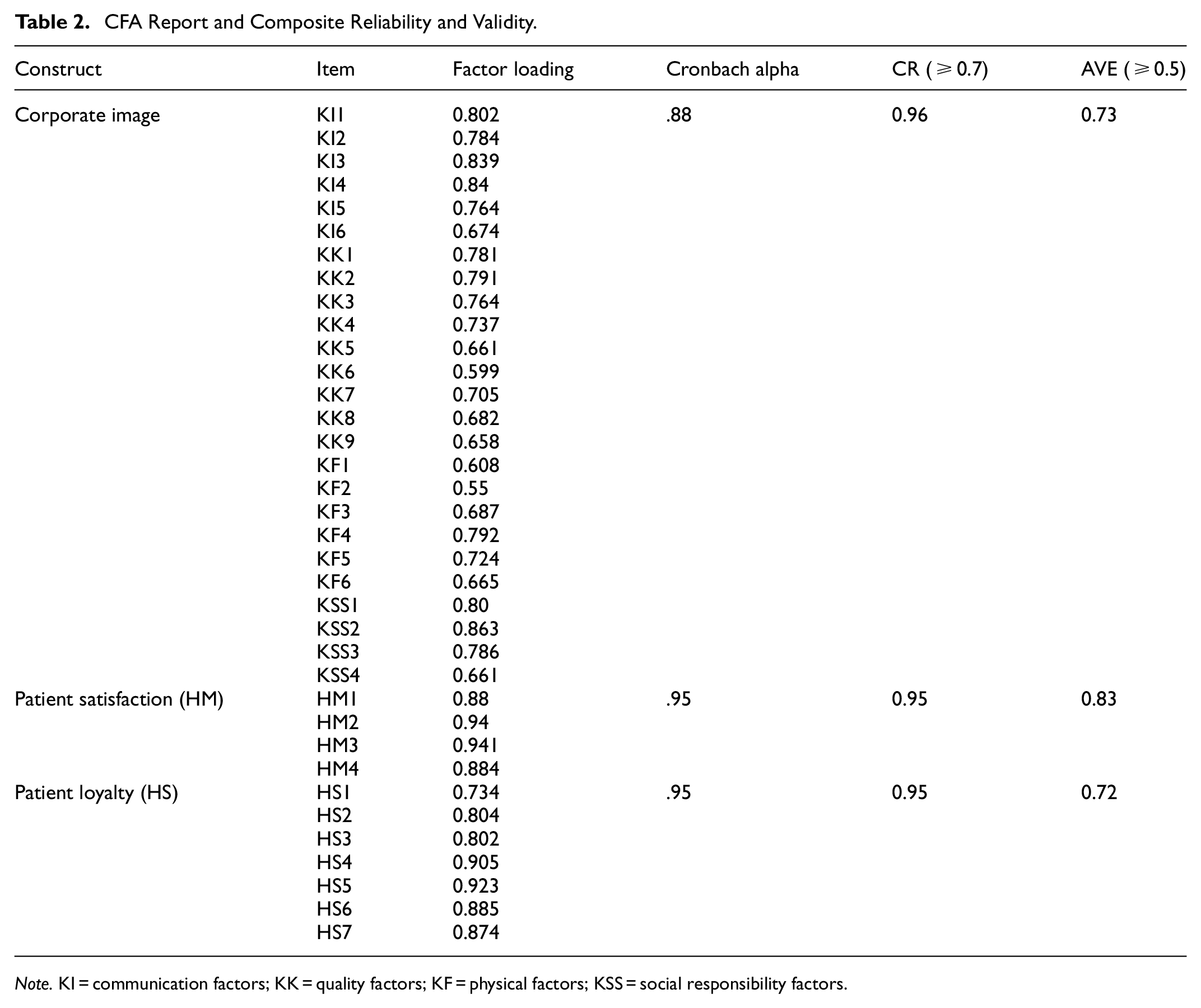
Note. KI = communication factors; KK = quality factors; KF = physical factors; KSS = social responsibility factors.
Ethical Approval
Before the research, written ethical approval (decision no. 228 dated 13.10.2021) was obtained from Mugla Sitki Kocman University Health Sciences Institute Ethics Committee. Participants approved the voluntary participation formula before filling out the survey form.
Findings
Demographic characteristics of 446 people who participated in the research survey are given in Table 3. When the demographic characteristics of the participants were examined; 65% of the participants were female. Approximately 60% are between the ages of 19 to 35. According to education level, 57% have associate degrees and bachelor's degrees. Approximately 56% are private sector employees.
Statistics on Demographic Characteristics.

Correlation Analysis Findings
Pearson Correlation Analysis was performed to measure the relationship between the variables of the study. When the correlation matrix in Table 4 is examined, corporate image, there appears to be a strong positive (p < .005) relationship between patient satisfaction and patient loyalty. When the VIF values for multicollinearity are examined, it is seen that the values obtained are below 5 and there is no multicollinearity problem between the variables (Tabachnick et al., 2018). The created model explains 76% of the change in patient loyalty.
Relationship Between Variables.

Indicates Significant (two-tailed): p < .005.
SEM Analysis Findings
In the research, the Structural Equation Model (SEM) was created to test the effects of corporate image on patient satisfaction and patient loyalty. When the model goodness of fit index values for the research was examined, the goodness of fit index values obtained showed that the measurement model was confirmed (CMIN/DF = 2.998; RMSEA = 0.67; CFI = 0.917; NFI = 0.881. IFI = 0.917).
The findings obtained because of the research are shown in Figure 3. Corporate image, according to the created model, it positively affects patient satisfaction and patient loyalty. Hypotheses H1 and H2 were supported. Patient satisfaction also positively affects patient loyalty. Hypothesis H3 was supported.

SEM direct and indirect effects.
Path analysis based on the bootstrap method was conducted to examine whether patient satisfaction has a mediating role in the relationship between corporate image and patient loyalty. 5,000 resampling methods were chosen for the analysis. According to Bootstrap test results. It has been determined that the indirect effect of corporate image on patient loyalty through patient satisfaction is significant. Bootstrap lower and upper confidence interval values do not include zero. The results obtained show that patient satisfaction has a mediating role in the effect of corporate image on patient loyalty. Hypothesis H4 was supported. Patient satisfaction has a mediating role in the effect of corporate image on patient loyalty.
Discussion
In this study, SEM was created to test the effect of corporate image on patient satisfaction and patient loyalty during the COVID-19 crisis period. According to the findings obtained from the study, it was found that corporate image positively affects both patient satisfaction and patient loyalty. The positive effect of corporate image on patient loyalty increases through patient satisfaction. The study expands Porter’s general competitive strategies and shows the effect and importance of corporate image as a differentiation strategy in the healthcare sector, which is a service sector. In healthcare institutions where advertising is prohibited, corporate image plays an important promotional role and affects consumer preferences. Loyal customers can play a protective role in crisis periods and enable institutions to overcome crisis periods more easily. At the same time, it is known that loyal customers contribute to acquiring new customers through positive recommendations. Studies in the literature support the positive effect of corporate image on patient loyalty (Ayutthaya, 2013; Bayın, 2013; Prabowo et al., 2020).
Studies examining the effects of corporate image on satisfaction explain that corporate image positively affects patient satisfaction and customer satisfaction (Kösel, 2022; Liat et al., 2014). Wu (2011) states that a positive hospital brand image increases patient satisfaction by increasing service quality, and at the same time, quality, and satisfaction increases a positive corporate image. Wai Lai (2019) study reveals that corporate image positively affects perceived value and reputation. The study also states that satisfaction plays a partial mediating role in the relationship between corporate image and loyalty. The literature shows that corporate image has positive effects on patient satisfaction and supports the findings obtained from the study. At the same time, studies show that corporate image alone does not affect satisfaction, but satisfaction also affects corporate image. There is a two-way positive effect between corporate image and satisfaction.
Satisfaction and loyalty relationships are among the most emphasized topics in literature. Most studies support the positive effect of patient satisfaction on patient loyalty (Abekah-Nkrumah et al., 2020; Hossain et al., 2020; Martínez & Rodríguez del Bosque, 2013). Liu et al. (2021) reported in their study that patient satisfaction had no significant effect on patient loyalty, but together with patient trust, it significantly, and positively affected patient loyalty. In the relevant study, a full mediation role was found in the effect of patient trust on patient loyalty. In the study conducted by Ho and Huang (2020), it was shown that brand image and patient loyalty had a positive effect on patient satisfaction and positive recommendations. Phonthanukitithaworn et al. (2020) stated that patient satisfaction is the factor that affects patient loyalty the most. When the studies in the literature are evaluated together, it can be said that there are mutual positive effects between the three variables used in the study (corporate image, patient satisfaction, and patient loyalty). While a positive corporate image positively affects patient satisfaction and loyalty, positive patient satisfaction and patient loyalty also positively affect the corporate image. By ensuring patient satisfaction, a positive corporate image perception is strengthened. At the same time, ensuring patient loyalty supports a positive corporate image by increasing positive recommendations, and the institution’s loyal patient base forms the institution’s protective base in times of crisis.
Conclusion
According to the findings obtained from the research results, in countries where there is a ban on advertising in healthcare, corporate image, and patient satisfaction constitute important antecedents affecting patient demand and continuity. Corporate image is an important competitive strategy that can be used both under normal competitive conditions and during crisis periods. Corporate image has a significant and positive effect on satisfaction (Kim et al., 2008; Kösel, 2022; Liat et al., 2014). The effect of corporate image on patient loyalty increases through patient satisfaction. According to the results of the research, to ensure patient loyalty, both corporate image, and patient satisfaction levels must be increased positively.
Implications of Research
This research shows the positive effects of corporate image in countries where there is a ban on advertising and promotion in health and in times of crisis. Findings from the research, it shows that corporate image can be used as a differentiation strategy, suggested by Porter in the healthcare sector, too. Corporate image and patient satisfaction are important prerequisites for ensuring patient loyalty. Corporate image is an important antecedent that affects patient satisfaction. Loyal customers play an important role in overcoming crisis periods. To create patient loyalty, it is necessary to give importance to corporate image studies instead of focusing only on patient satisfaction. Corporate image is an indirect promotional tool that can be used in healthcare institutions. Due to the ban on advertising in health, the promotional role of corporate image is more important in the health sector than in other sectors. Findings from the research. It shows that corporate image can be used as a proactive strategic tool in the healthcare sector and its positive and protective effects on the sustainability of healthcare institutions during crisis periods. According to the research findings, it can be said that healthcare managers should give importance to corporate image and patient satisfaction studies and focus on increasing efforts both under normal competitive conditions and during crisis periods.
Practical Implications of Research
Hospitals in today’s competitive conditions must maintain their existence, stand out among their competitors, and respond to changing consumer needs. In case of a ban on advertising and promotion of health services, health institutions have a limited competitive advantage. When the findings obtained according to the results of this research are evaluated, corporate image positively influences patient satisfaction and patient loyalty. To maintain its presence in the sector, health institutions that want to be preferred among their competitors create patient satisfaction and subsequently obtain loyal customers need to attach importance to multi-dimensional corporate image studies and continue their efforts to increase the positive corporate image. Corporate image is an important competitive strategy that healthcare institutions can use in competitive conditions with limited options and in times of crisis. Corporate image and patient satisfaction affect patient loyalty in hospitals, improving market share. It will contribute to increasing profitability and reducing the costs of acquiring new customers.
Limitations
This study is limited by being a cross-sectional study, using convenience and purposive sampling. Therefore, the results do not reflect causality between the variables. The relationships between corporate image, patient satisfaction, and patient loyalty can be investigated in a longitudinal study that can provide more robust data. The selection of the convenience sampling method in the data collection process reduces the generalizability of the research results. At the same time, this study is limited by being conducted in a country with an advertising ban in the health sector and on participants receiving services from private hospitals. The fact that this study was conducted in the health sector with an advertising ban also constitutes the study’s originality in revealing the promotional role and importance of corporate image for health institutions and distinguishing it from other sectors. The research was conducted during a crisis period when the COVID-19 pandemic was ongoing. Future studies can be repeated in a period when the crisis is not effective. It is recommended to conduct comparative studies between public and private hospitals in a wider universe and to conduct studies in different countries and sectors. In this study, the positive contributions of corporate image on two factors were examined, and it can also be suggested to measure other possible positive contributions of corporate image in terms of sectors.
Footnotes

Ethical Considerations
Before the research, written ethical approval (decision no. 228 dated 13.10.2021) was obtained from Muğla Sıtkı Koçman University Health Sciences Institute Ethics Committee. Participants approved the voluntary participation formula before filling out the survey form.
Consent to Participate
Not applicable. The research does not contain any personal or identifying information.
Author Contributions
This article is derived from the doctoral thesis written by Esra Fener under the supervision of Tuncay Köse.
Funding
The author(s) received no financial support for the research, authorship, and/or publication of this article.
Declaration of Conflicting Interests
The author(s) declared no potential conflicts of interest with respect to the research, authorship, and/or publication of this article.
Data Availability Statement
The datasets generated during and/or analyzed during the current study are available from the corresponding author on reasonable request.
Open Practices
*Esra Fener, Tuncay Kose. Corporate Image as a Differentiation Strategy in Countries with Advertising Ban in Healthcare: A Study in the Covid-19 Crisis Period. Authorea. August 04, 2023. DOI: 10.22541/au.169114506.60323681/v1*This study has been published as a preprint by Authoera.