



Abstract
Today’s empowered and hyper(dis)connected generation expects from higher education institutions (HEIs) communication strategies that align with their interests, making communication strategies crucial for their ongoing experience at the University. Once students are recruited, the factors they consider important when choosing a university may continue to shape their attitudes toward their institution. Universities continue to innovate in their communication strategies to face intense competition not only in attracting but also in retaining and engaging students. This study investigates the salience of university communication-related attributes and their relationship with student attitudes. Three communication-related attributes (opinion leader recommendations and online and offline messages and four students’ attitudes (institutional commitment, degree commitment, social integration, and academic integration) were measured through an online survey. The study offers critical insights to align the attributes promoted during students recruitment with the current experiences at the University.
Keywords
Introduction
To enhance their competitiveness, HEIs find it crucial to continuously assess their communications and marketing tactics, creating engaging materials to effectively connect with stakeholders, including current and prospective students, faculty, staff, alumni, and the wider community. HEIs also need to attract philanthropic support and retain students, faculty and qualified staff (Muammar et al., 2023). Attracting, engaging, and retaining students have become increasingly challenging mission for HEIs in today’s ever-changing environment. Digital transformation has led to more diverse perspectives and experiences making assumptions about common sense of belonging (Fernández et al., 2023), single channel that capture everyone’s attention, and shared interests and expectations among students no longer viable (Alcaide-Pulido et al., 2024; Crozier et al., 2008; Erkan et al., 2023).This diversity in viewpoints and preferences calls for communication strategies that are more aware of the complex identities that defines today’s generation.
Public relations practitioners, also known as frame strategists (Hallahan, 1999), can benefit from gaining insights into what resonates with students and how it relates to their attitudes to craft relevant and impactful messages that build trust and connect with students on a deeper level. In service-oriented organizations like universities, institutional and academic activities are often invisible to students. Therefore, communication professionals play a crucial role in connecting facts and events or objective reality with the mental image that student develop about their institution. This pseudo-environment Lippmann (1922) is a version of reality based on the information students encounter. The way facts and events are framed determine which aspects of reality become prominent in student’s mind.
Understanding the “salience” of university attributes in student’s minds is vital for revising the communication strategies and effectively connecting with the younger generation (Mogaji et al., 2021). This study argues for an expansion of the definitions of university’s reputation by incorporating the concept of salience. Such an understanding can inform marketing strategies, product design, and service delivery, and improve individuals’ decision-making efficiency. The study aims to test the proposed association between university attributes and students’ attitudes attempting to contribute to the existing literature for a better understanding the influence that university attributes have on students’ attitudes.
Literature Review
Hyperconnectivity and Changing the Characteristics and Preferences of Younger Audience
Hyperconnectivity has been examined in various domains, including communication studies (Brubaker, 2020), psychology (Soldatova & Voiskounsky, 2021), and marketing (Amer et al., 2014). However, its specific impact on how universities should tailor their messaging strategies, still require further exploration. Hyperconnectivity refers to the ability to be connected online 24/7 through multifunctional channels, overcoming limitations of time and space (Brubaker, 2020; Gilman et al., 2020; Guo et al., 2020; Koohang et al., 2002). The literature consistently shows the profound influence of hyperconnectivity on both personal and organizational behavior (Fredette et al., 2012; Swaminathan et al., 2020). On organizational level, and in the specific context of universities, Social networks, Mobile devices, Data analytics, Cloud computing, and the Internet of Things (SMACIT) are integrated which is referred to as digital transformation (Rivera-Gutiérrez et al., 2024). Studies showed that students are more engaged with environments where the transformation toward digitalization has been implemented (Niţă & Guţu, 2023).
According to Kymäläinen et al. (2021), the habits and sociotechnical characteristics of younger individuals, specifically Gen Z, suggest that they are early adopters who readily embrace innovative tech-based devices and solutions or what’s called “hyperconnectivity.” They exhibit remarkable abilities to connect with diverse information sources, facilitated by their constant connectivity through ubiquitous smart devices (Onofrei et al., 2022). This continuous access to information transforms their personal networks, consumption patterns, intentions, and interests. They engage in multitasking, easily switching between tasks such as communication, information retrieval, fact-checking, and reviewing customer feedback. However, the heavy reliance of younger audience on the Internet and social media platforms can limit their access to alternative sources of information (Paggi & Clowes, 2021) and can also result in overwhelming usage leading to passive behavior such as information avoidance (Guo et al., 2020).
Within the framework of hyperconnectivity, younger audiences engage in networked “sociability” (Castells, 2013), actively creating their own paths across various networks. This phenomenon is characterized by the intertwining of social logics both inside and outside digital spaces. By continually establishing new connections both online and offline, they shape a unique social environment where they participate in and belong to multiple networks of relationships, ultimately influencing various aspects of their lives, including their choices of universities.
In the university selection process, students are no longer solely influenced by their parents. Instead, they rely on word-of-mouth (Siripipattanakul et al., 2022) and seek information and recommendations from influencers, peers, and other connections within their networks to evaluate the reputation of universities (Johnston, 2010; Vernon & Drane, 2020). Those people with social influence, often seen as credible source among younger generation, are referred to as “opinion leaders.” They relay information to students and influence their decision making (Kong & Osman, 2024).
Considering them as a secondary audience, universities increasingly craft messages that resonate with both the target audience and their influential networks. They need to connect and collaborate with these opinion leaders to reach students. Following this “two-step flow” model, universities should understand that these opinions leaders serve as intermediaries between their messages and the students.
Additionally, social media platforms offer this new generation an avenue to showcase their achievements, share their interests and shape their digital identities (Mogaji et al., 2021; Rahman & Mithun, 2021). The content they post, interactions they engage in, and their involvement in online communities all contribute to shaping how they present themselves in the digital environment, what scholars refer to as the digital self (Brubaker, 2020). By sharing their academic and University’s experiences, they act as organic marketing for their universities. As they present their digital identities for others to consume (Marwick & Boyd, 2011, p. 140), these empowered and hyperconnected students actively contribute to the reputation of their universities.
However, it is also crucial to recognize that despite the increasing connectivity and engagement facilitated by technology. This raises concerns about the decreasing proportion of individuals categorized as “bounded,” highlighting the need for universities to bridge this gap. Building on the idea of the paradox of heightened connectivity along with a disconnection, this study investigates how communication strategies can effectively engage with their students while avoiding a disconnection between the institution and its intended audience. More specifically, it seeks to explore: How can universities tailor their communication strategies to build stronger connections with students in a context of hyperconnectivity?
University Choice Decision: University Attributes and Communication-related Attributes
Understanding the factors that motivate and influence university choice has become increasingly important in academic research. Scholars have recognized the significance of educational aspects, including academic programs, in shaping student preferences (Alcaide-Pulido et al., 2024; El Alfy & Abukari, 2020). However, research has indicated that relying solely on educational factors is insufficient for achieving successful differentiation and competitiveness among institutions (Duarte et al., 2010). Therefore, it is imperative to explore additional dimensions, such as communication-related attributes, to provide a comprehensive understanding of students’ decision-making processes in choosing a university. Studies emphasize the significance of external communication, particularly through online platforms like university websites and social networks, in shaping the image of universities. Gamoga and Ambang (2020) indicated that the majority of their study participants visited the University website and that this source of information played an important role in student decision and selection choice. Siripipattanakul et al. (2022) found that website quality has a substantial impact on the university’s image. Messages about the university conveyed by the electronic word of mouth (e-WOM) media and other observers plays a crucial role in shaping the institution’s image and the promises it makes to stakeholders. University image refers to the specific mental image or impression that individuals hold about a university. It is influenced by personal experience and interactions or other external factors such as media coverage.
Salience, derived primarily from social psychology, refers to the capacity of an item’s ability to attract the attention and is associated with the prominence of a brand in the memory of buyers (Bordalo et al., 2012). It is also relevant to the second-level agenda-setting of attributes theory, which views attributes as an additional important component of issue salience within the media. This underscores the importance of salience in capturing attention and shaping perceptions. This understanding aligns with the notion that individuals typically prioritize options that they perceive as relevant or significant in a given context, thereby influencing their decision-making process. This paper challenges the traditional understanding of motivation in university choice decision-making, arguing that it conflates underlying reasons with the perceived importance of attributes. To address this, the research adopts the term “salience of attributes” within the Agenda of Attributes Framework (AAF). The AAF proposes that individuals have a prioritized set of attributes used to evaluate options, with salience representing the relative importance of an attribute in the decision-making process. The student’s agenda refers to the attributes significant in their mind, while attributes are specific traits describing the university. A messaging strategy emphasizing these attributes is essential for the university’s success. Building upon this framework, this study aims to address the following main research question:
RQ1: How do students rate the salience of communication-related attributes, such opinions of family and friends, and offline and online messages, in their decision-making process?
By understanding the importance attributed to these attributes, including the influence of social networks and communication channels, this research seeks to deepen our understanding of how these factors may shape University selection and the decision-making process involved.
Student Attitudes
Student’s attitudes refer to their evaluation, feelings, beliefs, and predispositions toward their institution, which is critical for students’ retention. Understanding students’ attitudes is important as attitudes play a significant role in shaping satisfaction, behavior and likelihood of continuing their studies (Pinar et al., 2014). Students’ attitude has been operationalized in various ways. Studies have measured students’ overall satisfaction with overall experience as an indicator of attitude (Romero-Frías et al., 2023). Others focus on specific attitudes toward specific aspects of university life. These studies have conducted surveys that ask students to rate their overall satisfaction with various aspects of their university experience, including digital transformation (Niţă & Guţu, 2023).
Perceived value, which reflects student’s assessment of the benefits they receive in relation to the costs of their education, has also been examined as an element of attitude (Martin et al., 2020; Yousaf et al., 2020). Students’ perceptions of the quality and relevance of their learning experiences, including their interactions with faculty, the rigor of their coursework, and the opportunities for hands-on and experiential learning, has been used as a measure of their attitudes. Furthermore, behavioral intentions and actions, such as loyalty or WOM promotion, have been used as indicators of students’ attitudes.
By using different approaches and measures, research has captured the multi-faced nature of student attitude and emphasized its strong association with key outcomes, including retention, academic success, and overall students’ experiences. Studies have demonstrated that students’ attitudes and intentions serve as strong predictors of their actual behavior (e.g., Kaushal & Ali, 2020). Scholars indicated a strong relationship between university attributes and student attitudes (Kaushal & Ali, 2020; Sung & Yang, 2008). Findings demonstrated strong relationships between university students’ satisfaction with education, the emotional value they perceive, and positive WOM behavior.
Kaushal and Ali (2020) revealed a direct relationship between university reputation and student loyalty behavior. Furthermore, Schlesinger et al. (2023) highlighted the influence of university attributes on word-of-mouth intention, further underlining the importance of these attributes in shaping student behavior and perceptions. Dass et al. (2021) conducted a comprehensive analysis of the factors influencing students’ intention to promote their university and found that both cognitive factors, such as reputation, and affective elements, such as pride, significantly impact this intention. Their research demonstrated that a positive reputation and a sense of pride in their university motivate students to actively promote it. Moreover, Yousaf et al. (2020) investigated the impact of attributes such as benevolence and reliability on student loyalty, and revealed that reliability emerged as the most influential determinant of loyalty, closely followed by integrity. They suggested that students prioritize reliability and integrity in their evaluations of universities when forming loyalty toward their institution.
In the context of higher education, commitment refers to a mindset characterized by a dedication, engagement, and investment. It involves a strong sense of responsibility and obligation to fulfill academic goals and maintain involvement, even in the face of challenges. Interestingly, studies show that intention to continue studying, which reflects a commitment to educational goals, is less related to academic performance that one might expect. Instead, other variables such as the quality of academic support play a vital role in encouraging student commitment (Astin, 1984; Cao et al., 2019; Harrison, 2021). Students’ attitudes toward their degree programs have been found to be positively related to their academic engagement and academic performance (Martin et al., 2020). Indeed, when students possess positive attitudes toward their studies, they tend to approach their educational experiences with enthusiasm and dedication, as demonstrated by previous research suggesting that students who hold positive attitudes toward their studies and display strong intentions to persist are more likely to persevere in their educational endeavors (Maxwell-Stuart et al., 2018; Upcraft & Schuh, 1996).
Studies also reveal that students who have a high degree of social integration, or a strong connection to their peers and the university community (Bano et al., 2019), are more likely to experience a sense of belonging and overall satisfaction with their university experience (Bano et al., 2019; House et al., 2019; Tinto, 1975). Tinto (1993) found that students who experienced a sense of belonging and connectedness to their institution were more likely to persist in their programs and to achieve their academic goals. This suggests that students who feel that they belong to the university community are more likely to be engaged in university life and to have positive attitudes toward their university. In fact, they may even become advocates for their university, promoting it to others. Balaji et al. (2016) reported that students who strongly identify with the university brand are more inclined to engage in positive word-of-mouth communication about their universities.
Social integration has been found to be a key factor in students’ attitudes toward their university (Bano et al., 2019; House et al., 2019; Tinto, 1975). Tinto (1993) found that students who were more socially integrated into their university community were more likely to persist in their programs and to achieve their academic goals. Similarly, a study by Kuh et al. (2010) found that students who had higher levels of social integration into their university community were more likely to be satisfied with their university experience and to persist in their programs. For example, students who feel that their university is supportive of their academic and personal goals are more likely to exhibit a strong sense of degree commitment, or a belief in the value of their university experience (Chickering & Reisser, 1993).
Tinto (1993) studied the relationship between students’ attitudes, such as institutional commitment, degree commitment, social integration, and academic integration, and their persistence in higher education. He argues that institutional commitment, and social and academic integration have a positive relationship with student persistence, as students who were more committed to the university were more likely to persist to graduation, as well as students who had strong relationships with other students and faculty and felt connected to the academic environment were more likely to persist to graduation.
In this study, we expect that the salience of communication-related attributes such as opinions leaders, messages transmitted offline, and messages transmitted online will have a relationship with institutions commitment, degree commitment, social integration, and academic integration. Based on the above discussions, the study is underpinned by the following research hypotheses (Figure 1):
The salience of opinion leaders’ recommendations is positively associated with (H1a) institutions commitment, (H1b) degree commitment, (H1c) social integration, (H1d) academic integration.
The salience of offline messages t is positively associated with (H2a) institutions commitment, (H2b) degree commitment, (H2c) social integration, (H2d) academic integration.
The salience of online messages is positively associated with (H3a) institutions commitment, (H3b) degree commitment, (H3c) social integration, (H3d) academic integration.

The proposed diagram for the hypotheses based on the conceptual framework.
By proposing a model with university communication-related attributes as the independent variable and students’ attitudes as the outcome variable, this study aims to examine the relationships between these constructs. The model provides insights into the role of communication-related attributes in shaping students’ attitudes within the higher education context. It highlights the importance of these attributes and their potential impact on students’ attitudes. By testing the hypothesized relationships, the model offers a comprehensive framework for exploring the complex dynamics between communication-related attributes and students’ attitudes in the UAE higher education.
Methods
Respondents
This study involved participants who were enrolled in (Ajman University) from the first year to the final year. To reach all the enrolled students, an email was sent to all students, allowing the questionnaire to reach individuals across different Colleges and years of study. After that, the questionnaires were distributed through various channels, including emails, and direct distribution of survey links. This convenience sampling approach utilized to distribute the questionnaires among the participants, make the results able to serve as a foundation for future studies that may employ more rigorous sampling techniques. A total of 170 directly distributed surveys, 120 responses were collected, resulting in a response rate of 70.59%. The study is approved by the University Research Ethical Committee prior to distribution (Princess Nourah bint Abdulrahman University, PNURSP2025R789). The survey was created and distributed using Qualtrics software, and the data obtained were analyzed using PLS-SEM.
The Survey
To examine the salience of university attributes and their potential association with student attitudes in the UAE, a 32-item questionnaire was developed, consisting of three sections.
*Demographic information: Respondents were asked to provide their demographic details, including age, gender, and year of study.
* University attributes: As mentioned in Table 2, respondents evaluated how important certain attributes were in their decision to choose specific university. Three main constructs were used to assess this element, using 5-point Likert scale was used “1” Not important, “5” Very important. 1. Opinion leaders’ recommendations: Example item “I chose this university because of the recommendations from opinion leaders (e.g., family members, friends, or influencers).” 2. Online messages: Example item “The university’s online messages played an important role in my decision to enroll.” 3. Offline messages: Example item “Printed materials and in-person communications influenced my decision to choose this university.”
*Student attitude factors: This section inquired about four key attribute factors, which were measured on a 5-point Likert scale, ranging from “strongly agree” to “strongly disagree”: 1. Institutional commitment: Example item “I feel a strong sense of loyalty to this university.” 2. Degree commitment: Example item “I believe that completing my degree at this university will help me achieve my career goals.” 3. Social integration: Example item “I feel that I am part of the social community at this university.” 4. Academic integration: Example item “I am satisfied with my academic experience at this university.”
Prior to distribution, a pilot study involving 15 students was conducted to test and refine the questionnaire, addressing any ambiguities and ensuring the clarity of survey items.
Data Analysis
Factor analysis was employed to determine the salience of communication-related attributes, with mean values used to identify the most significant factors in students’ decision-making process. The factors with the highest mean values were considered the most salient. Both R2 analysis and path analysis were used to assess the predictive power and relationships between the University attributes and the different aspects of student attitudes.
Results
Demographic Profile
The respondents’ socio-demographic profile presented in Table 1. The majority of the respondents were female 78 (65%), whereas male composed of 42 (35%). Their age ranged from 17 to 20 (44%), 21 to 24 (39%) and 31+ (5%). In terms of colleges, 54% of the respondents came from Business Administration college (55.8%), followed by Engineering and IT (24.2%), Dentistry (9.2%), Architecture Art and Design (5.8%), Mass Communication (3.3%) and Pharmacy and Health Sciences (1.7%). Undergraduates computed about (95%) of the respondents compared with postgraduates (5%). Their academic year ranged from those in their first year (33%), second year (14%), third year (32%), fourth year (19%), and fifth year (2%). Their identify, the majority were “Born abroad but moved and had my schooling in the UAE” (31.7%), followed by those “Born in the UAE and parents were born abroad” (28.3%), “Born in the UAE from parents born in UAE” (25.8%), and “Born abroad and moved to the UAE for university studies” (7.5%). A few respondents (6.7%) mentioned “others identify.” When asking about disability, 94% of the respondents did not face any disabilities. Finally, their geographical locations ranged from those came from Ajman and Sharjah (38.3%, 31.7% respectively), followed by Dubai (13.3%), while less respondents came from Ras Al-Khaimah, Umm Al-Quwain and Abu Dhabi.
The Sample Socio-demographic Profile.

Reliability and Descriptive Analysis
To check the internal consistency of Likert scale questions Cronbach alpha (α) was applied. Cronbach (1951) is a test used to measure how a set of variables are together as a group (Table 2). Note that all the variables were above the thresholding of 0.7, with the highest mean score was for the opinion leaders’ recommendations (M = 3.65), indicating that Ajman University (AU) was the preferred choice when it comes for higher education institution with respect to leaders’ recommendations, followed by the messages transmitted offline (M = 3.62). With respect to standard deviation (SD), the highest standard deviation was for social integration followed by academic integration. It means that 95% of all data points should be within <2SD. In our data, a small SD (between 0.64 and 1.06) represents data where the results are very close in value to the mean.
Factor Loading for Students’ Consideration While Selecting a College/University.
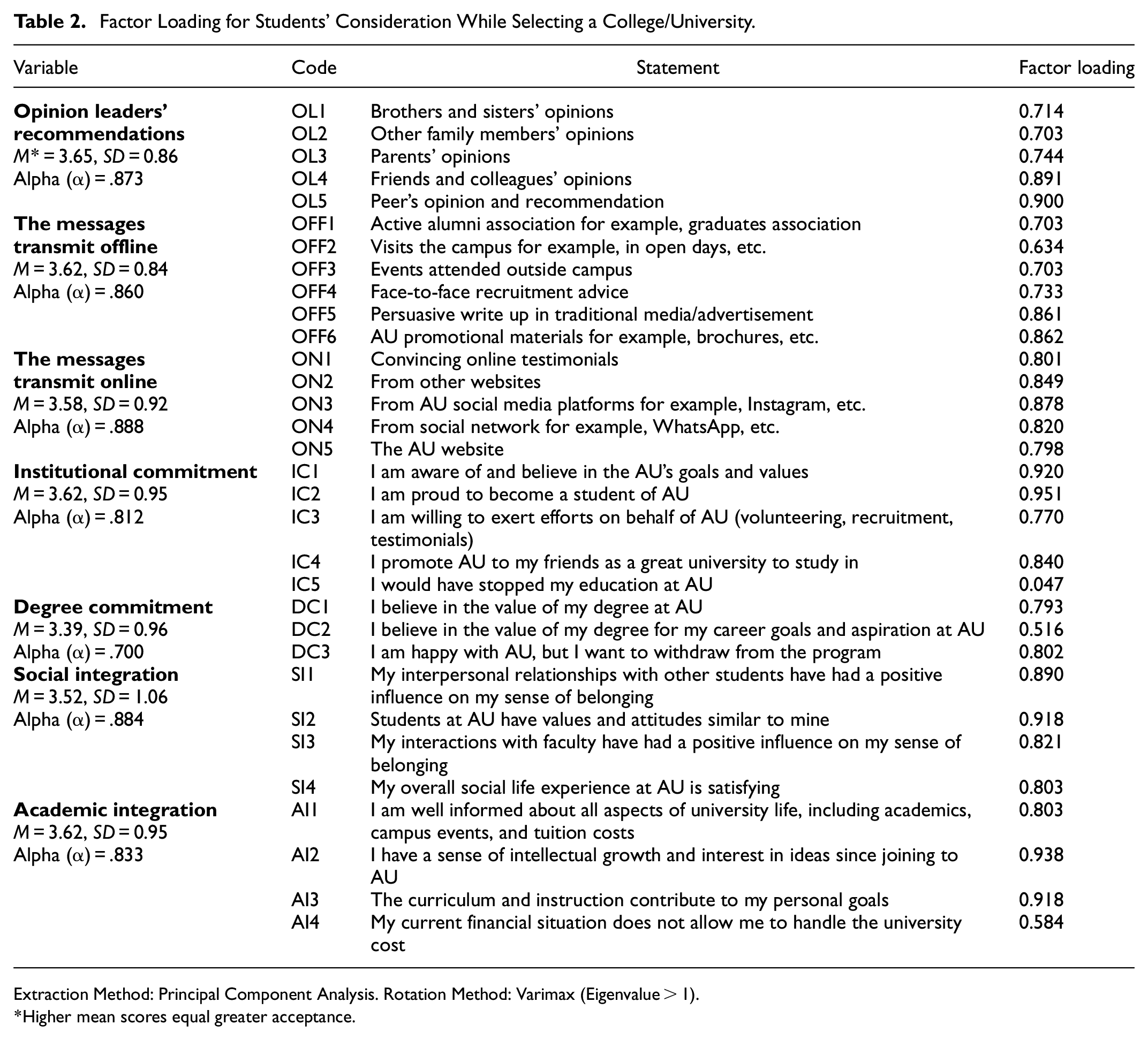
Extraction Method: Principal Component Analysis. Rotation Method: Varimax (Eigenvalue > 1).
Higher mean scores equal greater acceptance.
Salience of Communication-related Attributes
A factor analysis was run to determine the interrelationships between the salience of university attributes (three dimensions) and their impact on student attitudes (four factors), and to find out whether items-related behavior clustered according to the nature of specific factors (RQ1). The factoring criteria were: (a) minimum primary loading ≤0.40 on a factor; (b) a factor Eigenvalue ≤1; and (c) each item has a loading ≤0.40. The principal component analysis, the varimax rotation, yielded the most conceptually meaningful and factorially pure solution. In this analysis, seven factors with Eigenvalue greater than one emerged, explaining the 73.54% of the total variance (Table 2).
The reliability of these measurements was tested by using Cronbach’s alpha (.70), Bartlett’s test of sphericity was ([3,112.340; p < .001]), and the KMO value was 0.82, p < .001. Analyzing the mean of each attribute, it was found that opinion leader’s recommendations had a mean score of 3.65 of close family and friends which ultimately influences once decision of choosing higher education institution. This suggests that these opinions significantly influence individuals’ decisions when choosing a higher education institution. Notably, the two most important variables were peer’s opinion and other family members (FL = 0.851; FL = 0.848 respectively). The results were consistent with (Dao & Thorpe, 2015) who ranked opinion’s leaders as the fifth most important factor.
Regarding the messages transmitted offline, the attribute received the highest mean score (M = 3.62). This attribute measured six statements with the highest being events organized by the University (FL = 0.764), followed by write-ups in newspapers and magazines (FL = 0.757), face-to-face recruitment advice (FL = 0.736) and last factor was visit on campus (FL = 0.662). The third attributes measured the impact of the messages transmitted online (M = 3.58). This factor consists of five items with the highest factor loading associated with online testimonials (FL = 0.804), followed by AU social media platforms and other websites (both FL = 0.796). AU website (FL = 0.788) and other social networks (FL = 0.748) were also mentioned.
Correlation Analysis
Furthermore, the correlations analysis between the above constructs were examined using Pearson test (Table 3). The correlation analysis was performed to obtain the relationship between factors that influences students’ choice of higher education and the student’s attitude measured by four factors such as institutional and degree commitments along with social and academic integration. Degree commitment has only a positive and significant relationship with messages transmit offline (r = .152, p < .05), whereas social integration has three positive correlations. These findings were consistent with Chickering and Reisser’s (1993) results confirming that degree commitment to be a significant predictor of academic persistence. In order words, the more students’ belief in their degree value the more likely to persist to graduation (Martin et al., 2020). Social integration was associated with opinion leaders’ recommendations (r = .159, p < .05), and messages transmit offline (r = .191, p < .05) and transmit online (r = .199, p < .05). Lastly, the results also indicated that there was a significant correlation between academic integration and messages transmit offline (r = .171, p < .05) and transmit online (r = .160, p < .05).
The Correlation Matrix.

Note. OL = Opinion leaders’ recommendations; OFF = The messages transmit offline; ON = The messages transmit online; IC = Institutional commitment; DC = Degree commitment; SI = Social integration; AI = Academic integration.
p < .05. **p < .001 (2-tailed).
The Goodness of Fit
Goodness of fit helps to examine the extent to which obtained data fits well to the expected data. Thus, goodness of fit was also examined in the current research indicating the chi-square value x 2 = 1,422.686, Tucker and Lewis value 0.938 (>90), and Not Fit Indices value 0.587. Besides, the Standardized Root Mean Square (SRMR) value was 0.132, that is lower than the minimum threshold value 0.85, indicating a good fit for the model (Table 4).
Goodness of Fit.

R2 Analysis of Endogenous Variables
The R 2 analysis was performed to examine the effect of attributes on attitudes. The results showed an overall predictive potential of attributes on institutional commitment with 72.1% variance, 69.5% variance in the degree commitment, 80.6% in social integration, and 51.2% variance in the academic integration. Overall, the moderate level predictive power of the exogenous constructs was confirmed.
Path Analysis- Path Coefficients, Regression Weights
The last analysis was based on examining the path coefficients and regression weights of the relationships between salience of communication-related attributed and student attitude factors (Table 5 and Figure 2). The relationship between the salience predictors and student attitude factors was examined and showed that firstly the “opinion leaders’ recommendations” was positively associated with institutional commitment (β = .086, p < .003), degree commitment (β = −.837, p < .000), social interaction (β = −.069, p < .000), and academic interaction (β = −.083, p < .000), supporting our H1a, H1b, H1c, and H1d. Further, the second predictor “the message transmit offline” was tested and found a relationship with institutional commitment (β = −.223, p < .000), degree commitment (β = 1.473, p < .000), social interaction (β = .122, p < .000), and academic interaction (β = .187, p < .000), indicating that H2a, H2b, H2c and H2d were also supported. Thirdly the predictor “message transmit online” was also having positive relationship with institutional commitment (β = .296, p < .000), degree commitment (β = −.422, p < .000), social interaction (β = .100, p < .000), and academic interaction (β = .104, p < .000), indicating that H3a, H3b, H3c, and H3d were confirmed.
The Relationship Between the Salience Predictors and Student Attitude Factors.

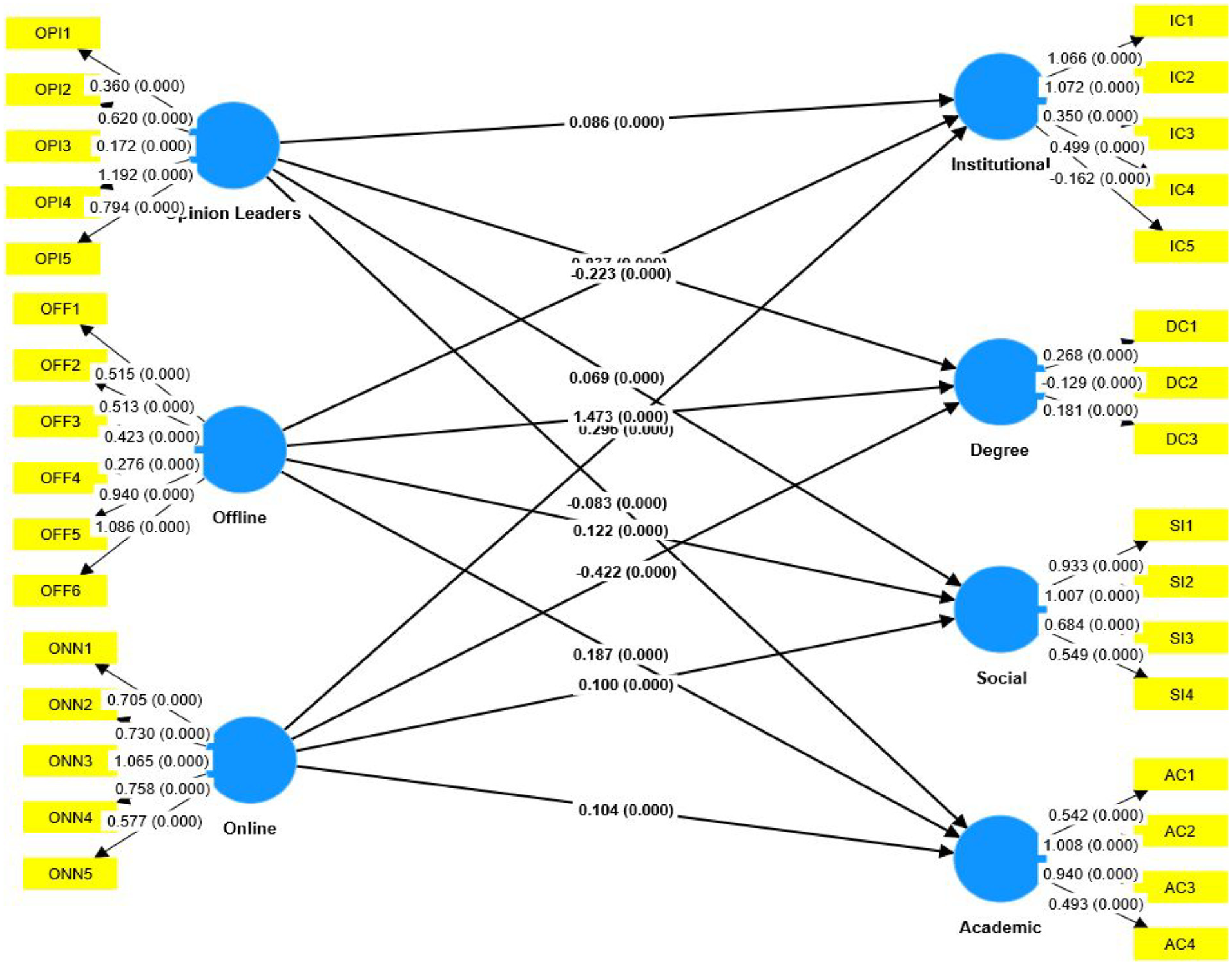
Results of path analysis of salience predictors and student attitude factors.
The results remained supportive as all the proposed hypotheses remained significant, indicating a positive significant relationship between salience of communication-related attributed and student attitude. Effective communication to society, ethical behavior, and social and environmental responsibility to students through their messages (online/offline) and actions are crucial (Alcaide-Pulido et al., 2024).
Figure 2 presents the path analysis results, illustrating the relationships between three key salience predictors – opinion leaders’ recommendations, message transmission offline and message transmission online – and four student attitude factors: Institutional commitment, degree commitment, social integration, and academic integration. Overall, the study findings remained supportive toward the relationship between attributed and attitudes as the competition among higher education institutions (HEIs) grows, there is an increasing interest in studying the steps taken to influence the attitudes and behaviors of their target audience. Griffin and Coelhoso (2019) indicate that higher education institutions in the UAE, as main well-established institutions, actively seek ways to improve their communication strategies to positively impact on how their target audience perceives and engages with them. Different components of messages play a vital role in achieving this objective. By exploring these design features, HEIs can acquire valuable insights into effective communication approaches tailored to their target audience (Muammar et al., 2023).
Discussion
Results indicates that among messages transmitted offline, University-organized events, are the highest salient attributes that students considered while making the decision to select the University, demonstrating that immersive experiences during events allow students to experience the campus environment, allowing a deeper connection than digital channels alone can achieve. This is aligning with recent literature demonstrating the continuous importance of offline communication, specifically in higher education communication. While digital messages offer flexibility and ubiquity, face to face interactions help to offer authentic engagement, particularly in student recruitment and retention. Regarding the messages transmitted online, the attribute with highest importance is online testimonials, suggesting that new generation place greater emphasis on experiences shared by others online. These results align with the changing dynamics of university selection processes, indicating that students are no longer solely reliant on their parents’. Instead, they actively seek information and recommendations from various sources, including influencers, peers, and other connections within their networked environment. This align with the literature indicating the changing nature of university selection processes, with students relying on a network of connections (Johnston, 2010; Siripipattanakul et al., 2022; Vernon & Drane, 2020) and influencers for information and recommendations. This shift highlights the growing significance of the secondary audience, which includes peers and influential individuals, in the decision-making process of selecting a university.
Given that the analysis shows a positive relationship between “opinion leaders’ recommendations” and institutional commitment (β = .086), universities may invest in collaborating with influential figures from student’s network rather relying solely on direct institutional messages. Opinion leaders, such as influential faculty members, or peer mentors, can be used to endorse policies or initiatives and communicate important messages. This strategy could be effective in boosting institutional commitment and sense of belonging. These findings align with the “two-step flow” model, which suggests that information flows from media to opinion leaders and then to the broader audience, showing that opinions leader’s continue to shape students institutional commitment.
Additionally, both online (β = .100 for social, β = .104 for academic interaction) and offline (β = .122 for social, β = .187 for academic interaction) communication positively influence social and academic interactions. This implies that Universities should leverage a comprehensive and multi-channel communication approach, using a hybrid communication strategy, that associates online tools (emails, social media platforms, and other tools) with offline interactions (events, peer collaborations) to promote positive student’s attitude. This also suggests that in a context of hyperconnectivity, the two-step flow model needs to be updated to reflect the integration of digital communication platforms, where opinion leaders can also influence others through online channels (Brubaker, 2020; Marwick & Boyd, 2011; Mogaji et al., 2021; Rahman & Mithun, 2021). The intertwining of social logics in both digital and offline spaces emphasizes the importance of understanding and tapping into these networks when designing effective communication strategies. Universities need to recognize the power of these interconnected relationships and ensure that their messages resonate not only with the individual student, but also with the broader network to which they belong.
Implications and Conclusion
Results showed a relationship between the salience of attributes promoted during recruitment, the attributes based on them students made the choice to enroll in this specific university, and students’ current attitudes. Aligning the attributes promoted during recruitment and students’ experiences is crucial for higher retention rates, increased student satisfaction, and loyalty which in turn, make it more appealing to prospective students. To ensure experience matches the expectations set, Universities need to continuously collect and consider student feedback. This could be not only through surveys but also through focus groups.
Additionally, to achieve this alignment, communication messages need to help creating positive experience and to focus not only on attracting students but also on delivering the values that matter most to them. University messages should prioritize the students’ preferences and ensure that current qualities communicated matches the expectations set during recruitment. As such, universities must not only focus on the delivery of educational information, but also on the creation of a compelling and authentic narrative that speaks to the values and aspirations of their audience. Considering the communication related attributes are not only salient in students but also play an important role in influencing student attitudes. Institutions should invest in communication workshops and trainings that focus on crafting and delivering messages that strengthen commitment and enhance interaction in academic context.
Footnotes

Funding
The author(s) disclosed receipt of the following financial support for the research, authorship, and/or publication of this article: Princess Nourah bint Abdulrahman University Researchers Supporting Project number (PNURSP2025R789), Princess Nourah bint Abdulrahman University, Riyadh, Saudi Arabia.
Declaration of Conflicting Interests
The author(s) declared no potential conflicts of interest with respect to the research, authorship, and/or publication of this article.
Data Availability Statement
Data generated or analyzed during this study are available from the authors on request.