




Abstract
Many activities, from disaster response to project management, require cooperation among people from multiple organizations who initially lack interpersonal relationships and trust. On entering interorganizational settings, preexisting identities and expectations, along with emergent social roles and structures, may all influence trust between colleagues. To sort out these effects, we collected time-lagged data from three cohorts of military MBA students, representing 2,224 directed dyads, shortly after they entered graduate school. Dyads who shared organizational identity, boundary-spanning roles, and similar network positions (structural equivalence) were likely to have stronger professional ties and greater trust.
Keywords
Introduction
When people congregate to work across organizational boundaries, how do relationships and trust develop among them? Interorganizational groups are becoming more common in many work environments, from project management to disaster response. In these cases, people having disparate histories and identities need to work together, but they do not necessarily share interpersonal relationships and the trust that could foster cooperation. If the people entering an interorganizational environment do not trust their new colleagues to provide timely and useful support, cooperation is unlikely to occur. Therefore, we believe that it is important to understand how preexisting social identities and emerging professional networks influence this particular aspect of trust within interorganizational settings.
Trust in a colleague has been defined as the truster’s willingness to rely on the colleague, even when unable to monitor or control the trustee (Mayer, Davis, & Schoorman, 1995; Rousseau, Sitkin, Burt, & Camerer, 1998). Recognizing that many facets of trust can be relevant in organizations, we focus this study particularly on willingness to rely on another person when a rapid response is needed. This aspect of trust is especially important when interorganizational workforces convene to address complex, dynamic situations, but it may also affect day-to-day work flows in less-dynamic settings. For example, Gilbert and Behnam (2013) argued that trust of participants and other stakeholders is a key precondition to collaboration in the United Nations Global Compact, a Global Public Policy Network working in the areas of human rights, labor standards, environmental protection, and anticorruption.
Trust can impact cooperation (Kollock, 1994) and performance (Dirks, 1999; Neves & Caetano, 2009), particularly in knowledge-intensive settings (Lane, 1998). It also affects teamwork (Peters & Karren, 2009) and information sharing (Butler, 1999). As collaborative interorganizational networks continue to grow in prevalence and significance (Currall & Judge, 1995), the development of trust becomes increasingly important (Song, 2009). Prior research suggests that trust can be influenced by social identities and by social networks. In this study, we attempt to determine the direct and interactive effects of these crucial factors in the development of trust between individuals. Our model bridges a somewhat surprising gap between social identity and networks theories and trust research. These areas of inquiry offer considerable insight regarding social forces that underlie development of trust, and our study combines these insights into a cogent model.
Drawing on social theories and trust research, we propose that a stream of interconnected social influences concurrently shapes dyadic trust, and we attempt to discern unique roles of social identities and social structures in creation of trust. By social identities, we mean people’s self-concepts as determined by their membership in salient social groups (Turner, Oakes, Haslam, & McGarty, 1994). By social structures, we mean connections among people and the patterns that those connections form within a social environment. Specifically, we propose a theoretical model to explain how organizational identities, identity-based expectations, emergent boundary-spanning roles, informal professional ties, and structural equivalence in the professional network shape trust among colleagues in a multiorganizational setting. Our proposed model is depicted in Figure 1.

Proposed model of trust development.
To test our theoretical model, we collected time-lagged data from three cohorts of military officers who were beginning a full-time MBA program at a military university. In this defense-oriented environment, people’s social identities are strongly linked to their membership in the Army, Navy, Air Force, or Marines. All of the participants had prior leadership experience within their own organizations, but in this venue, members of these distinct organizations were suddenly required to work together on time-sensitive organizational analysis projects. This study used military identity, willingness to rely on generic members of each organization (Army, Navy, etc.), professional relations, and network structures to predict dyadic trust a few weeks after the participants’ initial meeting. The research makes three contributions to the theory of trust development in interorganizational performance settings. First, we distinguish between the roles of organizational identities and perceptions in development of professional ties and trust. Second, we discern the roles of direct professional ties, boundary-spanning activity, and structural equivalence in creating trust. Finally, we sort out the direct and mediated effects of the organizational and social factors as they impact trust.
Formation of Interpersonal Trust
Interpersonal trust can be based on affect (positive feelings toward another person), assessments of likely trustworthiness (cognition-based trust; Frazier, Johnson, Gavin, Gooty, & Snow, 2010; Lewis & Weigert, 1985; McAllister, 1995), the context (McEvily, Perrone, & Zaheer, 2003; Rousseau et al., 1998), the history of the relationship (Ferrin, Bligh, & Kohles, 2007; Mayer et al., 1995; Nugent & Abolafia, 2006; Zolin & Hinds, 2004), and even subliminal cues (Huang & Murnighan, 2010). Social identities and networks provide key foundations for trust (or distrust) as they shape perceptions and professional interactions.
Characteristic-based trust can result from perceived social similarity or from beliefs about particular social groups. Norms of obligation and cooperation based on social similarity, such as shared organizational membership, may produce trust (Zucker, 1986). Homophily—liking others whom we see as similar to ourselves (McPherson, Smith-Lovin, & Cook, 2001)—may indirectly build trust by fostering interpersonal relationships that produce trust (Krackhardt, 1992). Whether directly, through social identification, or indirectly through relation-building, people tend to trust others who share the same social categories as themselves (Kramer, 1999). In addition, people tend to develop generalized feelings and expectations toward well-defined social groups, such that these attitudes may affect trust toward individual members of those groups. In the current study, we distinguish shared organizational identities from identity-based expectations as sources of trust, with attention to the potential mediating role of interpersonal relationships.
Process-based trust arises through personal experiences of repeated exchanges between people (Zucker, 1986). These exchanges can create dyadic ties, emergent roles, and network structures. For example, interactions that are required by an organization’s formal structure can lead to development of informal professional networks (Brass, 1981). Within the network, people have professional ties to some colleagues, but they may develop more complex structural similarities with others. For example, two unconnected people may play similar social roles or occupy similar positions within the network. These structural similarities could then lead them to interact with each other. Through these social processes, the outcomes of early trusting behavior affect subsequent perceptions of coworkers (Mayer et al., 1995), and trusting relations can develop. In the current study, we approach process-based trust by examining the informal professional network and its effects on the formation of dyadic trust.
Interorganizational environments often bring together a variety of people who lack knowledge of each others’ histories and trustworthiness, but they usually do know which organization each person belongs to. In this situation, organizational identities and expectations are likely to influence the development of professional relationships, and thereby affect trust. At the same time, we suspect that boundary-spanners who are given to relation-building outside their own identity group (in this case, their organization) are more likely to meet, appreciate each other, and to form dyadic ties that lead to trust. As the professional network grows, people who interact with many of the same others are also more likely to develop interpersonal ties and trust. In the following pages, we further explain our reasoning and formally hypothesize relations between these social forces and trust.
Professional Ties, Structural Equivalence, and Trust
Social networks grow as people enter a new environment, begin to interact, and build relationships. Over time, professional relationships between coworkers accumulate and form patterns of interconnected ties. People who interact with the same coworkers become structurally equivalent—occupying the same position within the social network. These two types of relations, direct ties and structural equivalence, are often related, but they have been shown to exercise distinct influences on many outcomes (Gibbons & Olk, 2003). Their potentially discrepant roles in the development of trust, likewise, can and should be distinguished as fundamental contributions to existing research.
As a professional relationship grows stronger, it is likely to involve increasing trust in the partner. This process may be iterative, such that a new professional relationship begins to build trust, and growing trust increases the strength of the professional relationship. Trust relationships are directed (Ferrin et al., 2007), such that the perceptions held by Alice about her relationship with Bob and her trust for him may differ from Bob’s perceptions of and trust toward Alice. Through this directed relationship-forging and trust-building process, we expect to find that the perceived strength of a professional relationship with a colleague predicts the extent of trust toward that colleague.
As people begin to interact and develop connections, the pattern of their relationships affects attitudes and behaviors. For example, informal network position can contribute to a dyad’s ability to establish a positive trust climate (Williams, 2005), and the presence of many shared professional contacts is likely to create a feeling of mutual belonging. When two people are similarly related to many of the same colleagues, they are subject to many of the same social influences and information flows. This structural equivalence can lead to the development of a direct tie as mutual contacts serve to bring the two people together (Heider, 1958). Structural equivalence may also provide an opportunity, distinct from a direct tie, to develop trust. Shared ties to third parties have a positive effect on behavior within dyads, so people who are connected to many of the same others might expect reliable performance from each other (Ferrin, Dirks, & Shah, 2006). This could be reinforced through third-party policing and reputational effects. Several studies have shown that connections among one’s ties increase trust (e.g., Burt, 2005; Burt & Knez; 1995; Chua, Ingram, & Morris, 2008), such that a dyad’s embeddedness in a social network increases the likelihood that the members will be willing to rely on each other. Ferrin et al. (2006) attributed this to the mediating effects of shared network ties on organizational citizenship behaviors. The similarity of two people’s positions in the professional network, then, may distinctly affect trust toward each other, and we propose that structural equivalence fosters direct professional ties while bolstering trust between individuals.
Social Identities, Perceptions, and Roles That Build Professional Ties
People are attracted to each other based on common attitudes and values, goals, and objectives (Newcomb, 1961). The more activities people share, the more they will share information and opinions, and develop stronger sentiments toward each other (Homans, 1950). During this process, ideas about one’s contacts develop. Although formal organizational structures can facilitate or even force the maintenance of professional relationships (Zucker, Darby, Brewer, & Peng, 1996), homophily (McPherson et al., 2001; Reagans, 2005), and instrumentality (Burt, 1992; Markovsky & Lawler, 1994) are likely to contribute to relation-building in interorganizational settings. In addition, we propose that organizational boundary-spanners will tend to find each other, develop professional ties, and build trust.
Shared organizational identity and the development of professional ties and trust
Membership in a particular organization may create an identity that draws people together, and impressions about other organizations may influence their attitudes and behaviors toward others. Similarity between persons often fosters supportive relations (Feld, 1982; Marsden, 1988), and people who see themselves as members of a particular social group often prefer others who are members of the same social group (Brewer & Kramer, 1986). Organizational identity, including characteristics that members believe are central, distinctive, and enduring (Dutton, Dukerich, & Harquail, 1994), serves to mediate how people think, feel, and behave (Gecas, 1982). When viewed as a process of self-definition and self-categorization, organizational identity can strengthen how individuals categorize themselves within their organization (Ashforth & Mael, 1989). When organization membership is very salient, as occurs in venues that bring together known competitors, we can expect shared membership to support the development of informal professional ties between people. The reverse may also be true—we can expect fewer and weaker ties to form between members of disparate organizations, even when the context supports or demands equal interaction among individuals regardless of organizational membership.
Shared organizational identities are also likely to increase trust. We are more inclined to trust people who share the same social categories as ourselves (Kramer, 1999). Thus, attributions of trustworthiness can be based on shared organizational identities. Belonging to the same organization also gives coworkers a shared organizational future, which can create the shadow of the future (Axelrod, 1984). This means that dyads who are likely to meet again in the future are likely to trust each other more, because betrayal or benevolence might be reciprocated at a later date. Hence, both shared identity and future expectations support greater trust between people from the same organization than between people who identify with different organizations. Coming from different organizations reduces the expectation of future interactions and consequently reduces trust. For all of these reasons, we anticipate that shared organizational identity will increase the strength of direct professional ties and levels of trust between people in a multiorganizational setting.
Preexisting opinions about organizations and the development of professional ties and trust
Opinions regarding social collectives are often applied to members of those collectives (Ashforth & Mael, 1989). For example, if two people differ in their membership in a demographic group, each person’s beliefs about people from the other’s group may shape their expectations regarding each other. Stereotypes create both positive and negative expectations about the behavior of others (Kramer, 1999). As a result, in interorganizational settings, relation-building and trust may be influenced by organizational stereotypes. The belief that an organization is competent is likely to increase the development of a professional tie with a member of that organization, and low evaluations of an organization’s competence are likely to reduce relation-building and trust toward members of that organization. In our study, we apply this to beliefs about various military organizations (e.g., Navy, Army, etc.) and civilians, and we propose that an individual’s preexisting willingness to rely on a particular organization will influence his or her relation-building and trust toward specific members of that organization.
Boundary-spanners and the development of professional ties and trust
In multiorganizational settings, boundary-spanners—people who build relationships with members of different organizations—may play crucial integrating roles that bring them together. Organizational boundary-spanning in practice is a visible, and therefore salient, aspect of role performance (Levina & Vaast, 2005). The role of a boundary-spanner has long been recognized as a valuable activity in organizations and teams (Keller, Holland, & Winford, 1975; Leifer & Delbecq, 1978), and successful boundary-spanning can lead to better team performance (Druskat & Wheeler, 2003). While boundary-spanning roles are sometimes assigned, for example, Purchasing Officer or Sales Representative, boundary-spanning roles also emerge and develop in practice (Levina & Vaast, 2005), because boundary-spanning activities are more attractive to some than to others (Keller et al., 1975).
Because they naturally develop external relationships, boundary-spanners from different organizations may be more likely to connect with each other. In addition, homophily may increase the attraction between boundary-spanners if they recognize their propensity for interorganizational ties as an important similarity. Thus, we propose that two boundary-spanning colleagues are more likely to initiate a direct professional tie than if one of them was not a boundary-spanner. For similar reasons, boundary-spanners may also be more likely to trust each other as they recognize similarities in the way they behave and interact. For example, their intrinsic openness to social interaction with people from different organizations may lead them to trust each other more than they would trust someone who maintains most of his or her ties within one organization.
Mediation of Social Influences on Trust
As we have discussed, professional relationships may be founded partially on social identities, expectations, and roles. These social influences, while potentially affecting trust directly, may be mediated or replaced over time by the interpersonal relationships that they help to form. This notion aligns with research showing that perceived risk is related to trust early in a working relationship but not later, when experience provides specific information about the other person’s behavior (Mayer et al., 1995; Zolin, Hinds, Fruchter, & Levitt, 2004). Similarly, interorganizational social identities, expectations, and roles may create general impressions of trustworthiness, but their effects may be channeled and adjusted through formation of professional relationships. As Ben-Shalom, Lehrer, and Ben-Ari (2005) found in their qualitative field study, early impressions based on categorical information can foster interaction that creates social structures that later develop trust. In an interorganizational environment, we expect to find that organizational identities, organizational expectations, and concurrent boundary-spanning all create opportunities for interaction. These opportunities create professional ties that, in turn, support trust.
Method
The hypothesized relationships were tested at the dyadic level in three cohorts of incoming master’s students in a program that is designed for experienced military officers. Participants included 81 active duty military officers from the Army, Navy, Air Force, and Marines, plus two civilians from government organizations. The military work context and maturity of students make this population a better data source for work-related studies than is available in many university settings (Zolin, Fruchter, & Levitt, 2003). Nearly all of the students had several years of work experience between the time that they received their bachelor’s degrees and the time that they entered this program. Most of them held highly responsible leadership positions, regularly overseeing others’ work in routine and crisis environments, and all had experienced the strong indoctrination that accompanies membership in a military organization. Performance in the MBA program would affect their ability to gain future promotions, so development of effective working relationships to support the successful completion of courses was important.
This population is particularly appropriate for testing our theoretical model because of participants’ very clear, salient, and comparable organizational identities. All of the students had chosen long-term careers within their particular military organizations, and military membership was immediately recognized by everyone in the cohort because students attended class in uniform every Tuesday. Alongside the strong military identification, this population demonstrated a generally high need for achievement that may not represent the general population. All three of the cohorts in this study included Air Force and Navy officers. Cohort 3 had no Army members and Cohort 1 had no Marine officers. Professional composition of the three cohorts appears in Table 1.
Professional Composition of the Three Cohorts.

Data Collection Procedures
Individual and relational data were collected in three Organizational Behavior classes with the primary purpose of teaching students to analyze social networks. Each person’s willingness to rely on members from each military organization (e.g., Army, Navy, Air Force, Marines) was measured near the beginning of the course. Professional relationships and dyadic trust were measured using a standard online network survey in the sixth to seventh weeks. We also obtained permission from the university’s institutional review board to use archival data from the courses for this study.
We controlled for nominal membership in the same project team. Students formed project teams between the time of the initial survey (about willingness to rely on members of each military organization) and the time of the network survey. The project required students to analyze an organization’s environment, culture, structure, motivation system, leadership, power and influence issues, and anticipated threats and opportunities, then make theoretically sound recommendations for organization leaders. The warm-up assignment was to select two similar organizations and compare their cultures. Students accomplished this culture comparison during the 6 weeks of our study, and they knew that they would later be required to work together on the in-depth organizational analysis. It seems reasonable to expect that participation in the culture comparison and anticipation of the upcoming project created opportunities for interaction that could foster professional ties and trust.
Measures of Shared Organizational Membership and Reliance on Organization Members
Shared organizational membership
To measure shared organizational membership in a military service, we matched individuals within each cohort according to their service membership, creating binary matrices in which a 0 at the junction of Alice’s row and Bob’s column indicates that they have different membership and a 1 indicates that they have the same membership.
Reliance on organization members
Willingness to rely on members of a particular organization was measured by asking participants to “Imagine that you need to compose a rapid response team” (a situation that is familiar to most military officers), and then to rank each branch of military service along with civilians in the order in which they would choose to contact them. “Rely on organization” was converted to dyadic matrices in which each cell contains the ranking ascribed by the row person to the military service of the column person.
Relationship Measures
All participants were asked to complete an online survey about their relationships with others in their cohort in the sixth or seventh week. This exercise was not graded, and there was no penalty for noncompliance. Participants were asked to select (from a list) the names of everyone from their cohort whom they knew. For each person whom they knew, they were asked to indicate the extent to which they had a professional relationship with that person and the extent to which they were willing to rely on that person. After completion of the survey, names were replaced with numbers.
Network studies differ from individual-level studies in several regards. One difference is that we focus on the intensity and pattern of ties within each type of relation. To do this, we describe the relation types that we want to measure, and we ask respondents to indicate the extent to which they have each type of relation with each other person in the social setting. It is customary when presenting lists of names to ask respondents to skip names of people whom they do not know. Our survey was conducted online, and respondents used Likert-type scales to report the intensity of their professional relations and willingness to rely on each person. Table 2 shows the instructions and format for the relationship questions.
Network Questions Presented in the Online Survey.

Professional ties
Working with the list of names that they had chosen, participants used a 1 to 5 scale to indicate the extent to which they had “a professional relationship with each of the people” they had selected, as follows: 1 = minimal relationship, 3 = moderate relationship, 5 = extensive relationship. All skipped names were coded as 0. When aggregated for each cohort, these individual responses formed a matrix of directed professional relationships, with values ranging from 0 (no relationship) to 5. In keeping with standard network measurement practices, this is a single-item measure.
Trust
Respondents also indicated beside each name how willing they would be “to rely upon this person if a rapid response was required” using a 1 to 7 rating scale in which 1 = not at all willing, and 7 = completely willing. These data were recoded by subtracting 4 from each value, such that a neutral response of 4 in the original scale became 0 in the recoded scale, and below-neutral responses became negative. This allowed us to accurately code people whom the respondent did not know with zeros to represent a neutral attitude. When aggregated for each cohort, these individual responses formed a matrix of directed reliance relationships, with values ranging from −3 (unwilling to rely on this person) through 0 (neutral) to 3 (completely willing to rely on this person). In keeping with standard network measurement practices, this is a single-item measure.
Both boundary-spanners
We measured boundary-spanning across military services using UCINET 6 (Borgatti, Everett, & Freeman, 2002). The routine that we selected (per Gould & Fernandez, 1989) indicates the extent to which a person’s boundary-spanning activity falls below or above what would be expected if group membership had no effect on interaction patterns. Those whose boundary-spanning activity exceeded the random expectation were coded with a 1, and all others were coded with a 0. This level of boundary-spanning activity is meaningful because, as we will see below, organizational membership had a strong positive effect on the network, such that people were significantly more likely to have in-group ties than cross-group ties. We created a boundary-spanning matrix that includes a 1 at the intersection of two boundary-spanners, and otherwise a 0.
Results
We used chi-square tests to compare observed with random distributions of ties among membership groups to determine whether service membership influenced the pattern of ties within each of the three cohorts. All of the hypothesized relationships were then tested using the quadratic assignment procedure (QAP) in UCINET 6 (Borgatti et al., 2002). QAP is a nonparametric method for testing significance of correlation between two matrices. The procedure constructs a reference distribution of random parameters that could have been derived from a data set with the same structure as the data set under evaluation. Then the significance of correlation between matrices is determined by comparison with the random distribution. The nonparametric testing is important because network data include autocorrelation among observations that biases ordinary least squares (OLS) tests to the point that significance tests are nearly useless (Krackhardt, 1988). QAP does not depend on the assumption of nondependence that underlies standard correlation and linear regression procedures.
Several QAP procedures have been developed for multiple regression (MRQAP), including an approach that deals particularly well with autocorrelation that occurs across the rows (outgoing relations of each originating person) and columns (incoming relations received by each person) of a network matrix (Dekker, Krackhardt, & Snijders, 2007). We used this procedure from the UCINET 6 analysis package to test predicted effects on professional relations and trust.
Because the correlation between network variables and nonnetwork variables is limited by the structure of the matrices (Krackhardt, 1988), the key statistic in QAP correlations and regressions is the p value, not the correlation value. Some correlations that seem small may be highly significant, and pairwise correlations of equal size may not be equally significant.
Structural equivalence was calculated as the correlation of the ties of each pair of people. Resulting values range from −1 if two people’s ties are exactly opposite to 1 if their ties are identical.
To obtain a global test of our hypotheses, we converted the matrices from all three cohorts into directed dyads. Each cohort yielded N × (N − 1) dyads, which sum to 2,224 directed dyads. For each relation, we excerpted Alice’s observations of Bob and all other members of their cohort, Bob’s observations of Alice and all other members of their cohort, and so on. To address the autocorrelation that naturally occurs in network data, we used a fixed-effects regression with a component to control for individual idiosyncrasies (Wooldridge, 2010) of the respondents across the observations of cohort members. The fixed-effects regressions were intended as a second look at the data, to determine if we would get similar results using an alternate analysis method. While we did control for the within-respondent autocorrelation that occurs because some people are more gregarious than others, this method is not as robust against autocorrelation as the MRQAP, so it should be viewed as a secondary analysis.
Predicting Professional Ties and Trust in Particular Colleagues
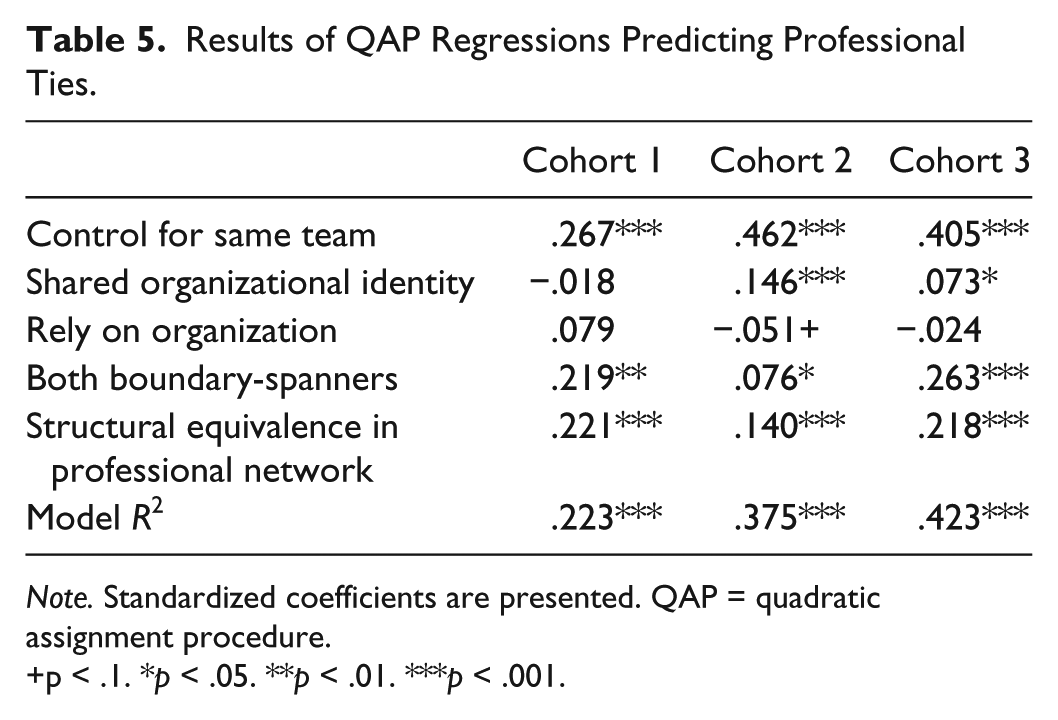
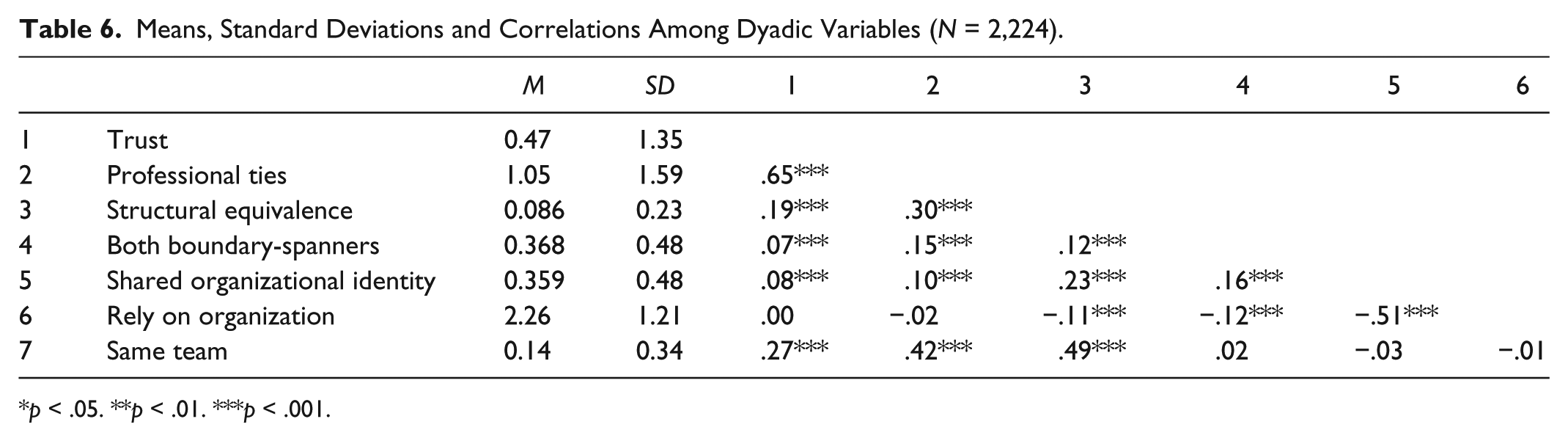
QAP correlations among dyadic variables for all three cohorts appear in Table 3. Results of QAP regressions predicting willingness to rely on one’s colleagues appear in Table 4, and results of QAP regressions predicting professional ties appear in Table 5. Table 6 shows the means, standard deviations, and correlations among the directional-dyad (full-sample) variables. The results of the fixed-effects regressions using the directional-dyad (full-sample) variables are shown in Table 7.
QAP Correlations Among Dyadic Variables.

Note. QAP = quadratic assignment procedure.
p < .05. **p < .01. ***p < .001.
Results of QAP Regressions Predicting Trust.

Note. Standardized coefficients are presented. QAP = quadratic assignment procedure.
p < .1. *p < .05. **p < .01. ***p < .001.
Results of QAP Regressions Predicting Professional Ties.
Note. Standardized coefficients are presented. QAP = quadratic assignment procedure.
p < .1. *p < .05. **p < .01. ***p < .001.
Means, Standard Deviations and Correlations Among Dyadic Variables (N = 2,224).
p < .05. **p < .01. ***p < .001.
Results of Fixed-Effects Regressions Among Dyadic Variables (N = 2,224).

Note. Standardized coefficients are presented.
p < .1. *p < .05. **p < .01. ***p < .001.
Hypothesis 1a, that professional ties would have a positive relationship to trust, was supported in all three cohorts, where we found that the stronger the professional relationship, the greater was the willingness to rely on a colleague (Table 4, Cohort 1: β = .649, p < .001; Cohort 2: β = .521, p < .001; Cohort 3: β = .727, p < .001). This was confirmed in the fixed-effects regressions (Table 7, Model 2, β = .55, p < .001), thus supporting Hypothesis 1a.
Hypothesis 1b, that structural equivalence in the professional network is positively related to professional ties to a colleague, was significant in all samples (Table 5, Cohort 1: β = .221, p < .001; Cohort 2: β = .140, p < .001; Cohort 3: β = .218, p < .001). This relationship was also significant in the full-sample correlations and the fixed-effects regression model (Table 6, r = .30, p < .001, Table 7, Model 4, β = 1.63, p < .001), supporting Hypothesis 1b.
Hypothesis 1c, that structural equivalence in the professional network would positively relate to trust, was not supported. Structural equivalence was negatively related to trust in one cohort (Table 4, Cohort 1: β = .006, ns; Cohort 2: β = −.086, p < .05; Cohort 3: β = −.037, ns). This relationship was not significant in the fixed-effects regression analysis (Table 7, Model 2, β = −.16, ns).
Hypothesis 2a proposed a positive relationship between shared organizational identity and professional ties. First, we conducted a general test of the effects of organizational membership on direct ties. In Cohort 1, chi-square tests indicate that organization membership did not significantly affect the pattern of professional ties (χ2 = 10.846, p = .493) or trust (χ2 = 15.631, p = .293). This cohort was less balanced than the others, having one large subgroup and three small subgroups (see Table 1). In Cohorts 2 and 3, organization membership did influence the patterns of professional ties (Cohort 2: χ2 = 47.319, p = .0001; Cohort 3: χ2 = 32.627, p = .005) and trust (Cohort 2: χ2 = 60.924, p = .0001; Cohort 3: χ2 = 21.496, p = .056). Professional ties were denser than random within three of the four organizations represented in Cohort 2. The Army people had low density of professional ties with all groups except the Air Force members. Trust ties in Cohort 2 were denser than random within two organizations, and there was a general trend to trust fewer than random out-group members, except if they were from the Air Force. Professional ties were denser than random among members of two of the three organizations represented in Cohort 3 (the lone civilian had no in-group). Trust ties in Cohort 3 were also denser than random within all three groups, but the pattern of ties to out-group members varied.
Hypothesis 2a was also supported by QAP regressions in two out of three cohorts (see Table 5, Cohort 1: β = −.018, ns; Cohort 2: β = .146, p < .001; Cohort 3: β = .073, p < .05). This positive relationship between shared organizational identity and professional ties was also significant in the fixed-effects regression analysis (Table 7, Model 3, β = .32, p < .001), and thus Hypothesis 2a was supported.
Hypothesis 2b, which proposed that shared organizational identity will be positively related to trust, was only supported in 1 of 3 cohorts (see Table 4, Cohort 1: β = .032, ns; Cohort 2: β = .153, p < .001; Cohort 3: β = .037, ns). The direction of effects, however, was positive in all three cohorts, and the fixed-effects regression model found overall support for this relationship (Table 7, β = .26, p < .001).
Hypothesis 3a, that individuals’ willingness to rely on particular organizations would predict professional ties with members of the groups, was not supported. We found a marginally significant relationship in one cohort (see Table 5, Cohort 1: β = .079, ns; Cohort 2: β = −.051, p < .10; Cohort 3: β = −.024, ns), and the hypothesized relationship was not significant in the fixed-effects regression model (Table 7, Model 3, β = −.00, ns).
Hypothesis 3b, that willingness to rely on the organization would predict trust toward members, was not supported in any of the cohorts (see Table 4, Cohort 1: β = .092, ns; Cohort 2: β = −.002, ns; Cohort 3: β = −.006, ns). This relationship was marginally significant in the fixed-effects model (Table 7, Model 1, β = .05, p < .10).
Hypothesis 4a proposed that concurrent boundary-spanning roles would be positively related to the strength of the direct professional tie between colleagues. This relationship was significant in all three cohorts (see Table 5, Cohort 1: β = .219, p < .01; Cohort 2: β = .076, p < .05; Cohort 3: β = .263, p < .001). It was also significant in the fixed-effects model (Table 7, Model 3, β = .81, p < .001), thus supporting Hypothesis 4a.
Hypothesis 4b proposed that when both are boundary-spanners, there will be greater trust. This relationship was significant in two of the three cohorts (see Table 4, Cohort 1: β = .154, p < .05; Cohort 2: β = .068, ns; Cohort 3: β = .161, p < .01). This was also significant in the fixed-effects model (Table 7, Model 1, β = .36, p < .001), so Hypothesis 4b was supported.
Hypothesis 5 proposed that the effects of shared organizational identities, organizational expectations, and concurrent boundary-spanning on trust would be mediated by professional ties. Because organizational expectations were not significantly related to trust (Hypothesis 3b), no mediation analysis was conducted for that variable. Tests were conducted, following Baron and Kenny (1996), to determine whether professional ties mediated effects of shared organizational identity and boundary-spanning on trust.
Shared organizational identity (see Table 6: r = .08, p < .001) and professional ties (see Table 6: r = .65, p < .001) were significantly related to trust. Shared organizational identity and professional ties were significantly related to each other (Table 6: r = .10, p < .001). Finally, when shared organizational identity and professional ties were both included in a model predicting trust, professional ties were significant in predicting trust (Table 7, Model 2: β = .55, p < .001), while shared organizational identity became nonsignificant (Table 7, Model 2: β = .09, ns). This reduction in effect of organizational identity on trust when professional ties were included in the regression indicates that professional ties mediate the relationship between shared organizational identity and trust (Baron & Kenny, 1996).
Similarly, trust was significantly related to concurrent boundary-spanning (see Table 6: r = .07, p < .001) and professional ties (see Table 6: r = .65, p < .001), and concurrent boundary-spanning and professional ties were significantly related to each other (Table 6: r = .15, p < .001). When concurrent boundary-spanning and professional ties were both combined in a model predicting trust, professional ties (Table 7, Model 2: β = .55, p < .001) were significant in predicting trust, while concurrent boundary-spanning became nonsignificant (Table 7, Model 2: β = −.07, ns). This reduction of significance indicates that professional ties mediate the relationship between concurrent boundary-spanning and trust (Baron & Kenny, 1996), such that people who are both boundary-spanners are more likely to develop professional ties to each other, and those professional ties lead them to greater trust.
Summary of Results
Although there was a significant relationship between structural equivalence and professional ties, these relationships demonstrated distinct effects on trust. Professional ties had a consistent, positive effect on trust in all cohorts and the overall analysis, but structural equivalence did not (see Table 8). Rather, we found a negative relationship between structural equivalence and trust, which was significant in one of the three cohorts. Membership in the same organization was significantly related to professional ties in two samples and in the full-sample analysis. Shared organizational identity was significantly related to trust in one cohort and supported in the full-sample analysis, but the relationship was mediated by professional ties. Willingness to rely on particular organizations was not significantly related to professional ties or trust. Concurrent boundary-spanning roles were significantly related to professional ties in all three samples and the full-sample analysis. Concurrent boundary-spanning was also related to trust in two samples and in the full-sample analysis, but this relationship was mediated by professional ties. In summary, we found that shared organizational identity and concurrent boundary-spanning roles affect professional ties, which influence trust (see Figure 2).
Summary of Results by Cohort and Overall Analysis.


Summary of results.
Discussion
When people from multiple organizations are brought together for a common purpose, individuals generally need to build new professional relationships and identify others on whom they can rely for timely and useful support. We have asked how these professional and trusting relations develop among unknown actors in such interorganizational settings. Theory suggests that social identities, social expectations, and emerging network structures will affect development of trust. We found positive effects of shared organizational identities and emergent boundary-spanning roles on trust, mediated by the development of professional ties. The initial social identities and emergent structural factors seem to bring people together to form professional relationships, which develop into trust. This result aligns with Zucker’s (1986) theory of process-based trust, as identity-based perceptions, emergent roles, and shared professional networks together built trust.
As expected, organizational identities, which are strong among military people, resulted in greater relation-building and trust among members of the same service. It was surprising, then, that willingness to rely on particular organizations did not affect professional ties or trust. We know from working with military officers that opinions about the various military services are often strong and stable over time. Why would military service identities create in-group preferences, while relative willingness to rely on the various services did not transfer to people who were members of those services? It is possible that working in an academic environment, the respondents may have “given the benefit of the doubt” to members of less-respected organizations, perhaps viewing them as exceptions to the stereotypes. Alternatively, professional ties and trust may have arisen from positive affect toward one’s own group, without regard for more analytical processes. This finding hints at the possibility that feelings, not cognition, played the major role.
An interesting contribution of this study is that, despite the clear relationship between direct professional ties and structural equivalence, only the direct ties affected trust. The apparent positive correlation between structural equivalence and trust in all three cohorts disappeared completely when the other variables were included in regressions predicting trust. In fact, when controlling for direct ties, the relationship between structural equivalence and trust was negative and significant in one cohort, possibly indicating some suspicion introduced to professional relationships by the structural equivalence between participants. This aligns with Burt’s (1987, 1992) work on structural equivalence and competition, but it does not align with theories of social monitoring as a guarantor of trustworthy behavior.
We began this study with three research goals. First, we examined the roles of organizational identities and perceptions in the early development of professional ties and trust. Second, we differentiated the roles of direct ties and structural equivalence in creating trust. Finally, we sorted out the direct and mediating factors in trust-building in a multiorganizational context. This research contributes to theories of trust development by showing how the development of professional ties mediates the effects of antecedent social identities and boundary-spanning roles on trust. The study contributes to social network theory by showing that, although structural equivalence is related to direct ties, it is not necessarily related to trust. This implies that social monitoring and shared information flows that are available to structurally equivalent colleagues are not as relevant for trust development as are the short-term experience or budding affect that may be present in the direct tie.
One managerial implication of these findings is that when setting up a new interorganizational group, attention to the development of professional ties will likely support the development of trust. Organizational diversity could be even more important than other forms of diversity in some interorganizational contexts, so creation of new, shared identities may be crucial for building a truly interorganizational professional network. A less intuitive implication is that greater recognition and encouragement should also be given to emergent boundary-spanning activity. It is ironic that boundary-spanners may trust each other more than other members of their own organizations. It is also interesting that the boundary-spanning roles in our study emerged spontaneously, leaving the possibility that individual attributes underlay both the boundary-spanning and the increased trust between boundary-spanners.
Limitations of the Study and Future Research
This research was limited to the study of three cohorts of military officers in an educational context. Although this interorganizational environment was suitable as a data source for the present study, additional research in other contexts with civilian participants is needed to determine generalizability of the findings. Military organizations endeavor to create strong social identities for their members, such that the organization becomes a crucial part of members’ self-image. Because of this, participants in this study may have been more likely than members of many other organizations to evaluate people in terms of in-group and out-group statuses with regard to organizational membership. We expect that the findings generalize to settings in which people identify strongly with their organizations, but the results could differ among people who are not socially integrated into their organizations.
Although we found a positive relationship between shared organizational identity and trust, it was not significant in all cohorts. Furthermore, we did not attempt to discern whether shared identities built trust via homophily, the “Shadow of the Future,” or another mechanism. A greater focus on this process in future research could expand our understanding of identity-based trust. In addition, the discovery of greater tie-building between boundary-spanners raises several interesting questions. Do boundary-spanners develop ties with each other because of homophily or propinquity, as we hypothesized, or could there be some individual differences at play? For example, a psychologist might argue that two people with outgoing personalities are more likely to become boundary-spanners and to meet each other than two people who are more introverted. Our study did not distinguish between these possibilities, and we defer the question to future research. Finally, we believe that future studies could fruitfully investigate how the factors that we have identified in early trust formation continue to influence trust over the long term.
Conclusion
With a faster tempo in the formation of joint ventures and multiorganization responses to disasters, leaders in organizations need a greater understanding of factors that develop professional ties and trust. Our study indicates that dyads who share organizational identity, boundary-spanning roles, and mutual professional contacts are more likely to have a direct professional tie and greater trust. Despite the positive relationship between direct professional ties and structural equivalence, however, only the direct ties increased trust. It appears, therefore, that the familiarity and the experience of a direct relationship, rather than the social control intrinsic to structural equivalence, serve as a major catalyst for trust. Greater attention should be paid to the development of professional ties and the support for emergent boundary-spanners in hastily formed teams, as these appear to be preconditions for the development of trust between colleagues.
Footnotes
Declaration of Conflicting Interests
The author(s) declared no potential conflicts of interest with respect to the research, authorship, and/or publication of this article.
Funding
The author(s) disclosed receipt of the following financial support for the research and/or authorship of this article: This research was supported by the Cebrowski Institute at the Naval Postgraduate School, Grant Number N00244-05-P-2694.