




Abstract
The worldwide increase in the number of older people has led to great interest in improving their quality of life. to describe the scope and characteristics of the existing research on occupational therapy interventions to enhance the quality of life of healthy older people living in nursing homes. The review was carried out following the PRISMA-ScR guidelines. The databases used were PubMed, Web of Science, Dialnet, Scopus, Cochrane, CINAHL, and SciELO. Twenty-one articles were included in our review. The results were classified as (a) volume and scope of the research; (b) type of research; (c) characteristics of research; and (d) characteristics and outcomes of interventions. Occupational therapy interventions have been shown to improve the quality of life of healthy older people living in nursing homes. Programs that focus on independence in activities of daily living, social participation, and health management are the most effective. The results of this study support a multidimensional view of quality of life, in which occupation plays a crucial role.
Plain language summary
As the global population ages, there is a growing interest in improving the quality of life for older individuals residing in nursing homes. This exploratory review examines existing research on occupational therapy interventions designed to enhance the well-being of healthy older adults in such environments. The review, following PRISMA-ScR guidelines, includes 21 articles extracted from databases like PubMed and Web of Science. The findings highlight the predominance of quantitative research, with intervention programs primarily focusing on specific areas of occupation, such as activities of daily living, health management, and social participation. Occupational therapy interventions can effectively improve the quality of life for healthy older adults in nursing homes. The most successful programs are those that help older adults maintain independence in daily activities, encourage social participation, and promote health management. This study supports the idea that quality of life is multidimensional, with meaningful activities playing an essential role.
Introduction
According to the United Nations Department of Economic and Social Affairs, Population Division (2022), there were 771 million people in the world aged 65 years and over in the world in 2022 (representing 9.7% of the total population). The most recent demographic projections suggest that this population will have doubled by 2050 to over 1.6 billion people (representing 16.4% of the total population).
This increase has led to great interest in research and literature related to this segment of the population and the improvement of their well-being and quality of life (World Health Organization [WHO], 2015).
Quality of life is a multidimensional concept that has evolved throughout history, and its conception has been approached from several perspectives (Boggatz, 2016). As a result, it has been challenging to find a single definition.
Fernández-Ballesteros (2011) propose two classifications: the first distinguishes between socio-environmental factors (social support, financial conditions, health and social services, environmental quality and cultural factors) and personal factors (social relationships, life satisfaction, leisure activities, health, and functional abilities); and the second distinguishes between objective elements (physical environment, availability of social health services, objective health, social networks, and cultural factors) and subjective elements (health, social satisfaction, cultural needs, context evaluation, and functional abilities). Considering all these factors, the concept of quality of life assesses different dimensions of a person’s life, using a comprehensive and complex approach.
Likewise, all these factors can have both negative and positive effects on the quality of life of older people, depending on whether or not they are present or to what extent they are present in the older adult; for example, the factor of social support, if the older adult has sufficient social support, this factor will have a positive effect on their quality of life, whereas if they do not have sufficient social support it will hurt their quality of life (Figure 1).

Hypothetical model of the research.
In the case of healthy older people living in nursing homes, the factors that affect their quality of life can be improved through interventions based on an occupational therapy perspective, which is defined as “the therapeutic use of everyday life occupations with persons, groups, or populations to enhance or enable participation.” (American Occupational Therapy Association [AOTA], 2020). These interventions are based on different variables associated with quality of life such as physical function, mental state, health prevention, gender, social and environmental variables, information and communication technologies, and areas of occupation, understood as the everyday personal activities that people do as individuals, in families, and with communities to occupy time and give meaning and purpose to life. The broad range of areas of occupation is categorized as activities of daily living [ADLs] (e.g., personal hygiene and grooming, dressing), instrumental activities of daily living [IADLs] (e.g., driving and community mobility, meal preparation and cleanup), health management (e.g., medication management, physical activity), rest and sleep (e.g., rest, sleep preparation), education (e.g., formal educational participation, informal educational participation), work (e.g., work performance and maintenance, retirement preparation and adjustment), play (e.g. play exploration, play participation), leisure (e.g., leisure exploration, leisure participation), and social participation (e.g., community participation, family participation) (American Occupational Therapy Association [AOTA], 2020). All these factors can contribute to the prevention of dependency and disability and to the promotion and maintenance of older people’s quality of life and health through the development of meaningful activities in which they are actively engaged (Arbesman & Lieberman, 2012; Zingmark et al., 2016) (Figure 1).
However, our literature review was not able to identify a significant number of studies that rigorously and clearly describe the scope, characteristics and, research finding on interventions based on an occupational therapy perspective in the context of healthy older people living in nursing homes. These are understood as institutions intended for temporary or permanent accommodation, with services and intervention programs adapted to the needs of the older people being cared for, to achieve a better quality of life and promote their autonomy (Imserso, 2011). There is also a lack of systematic reviews among in the scientific literature that synthesize research evidence on the effectiveness of occupation-based interventions, defined as “methods and tasks that prepare the client for occupational performance, used as part of a treatment session in preparation for or concurrently with occupations and activities, or provided to a client as a home-based engagement to support daily occupational performance” (American Occupational Therapy Association [AOTA], 2020), in this setting. Accordingly, a scoping review was considered to be fully justified, as it would allow us to delineate and describe the evidence for occupational therapy interventions to improve the quality of life of healthy older people living in nursing homes.
Therefore, this review aims to describe the characteristics and extent of research on occupational therapy interventions to improve the quality of life of healthy people over 65 years of age living in nursing homes.
The methods used to achieve this aim are described in detail in the following section.
Methods
Narrative reviews are used to make a conceptual contribution, an essay or a reflection. Systematic reviews, on the other hand, are used to test the effectiveness of interventions. Finally, scoping reviews are used to determine the characteristics of a field of knowledge (Codina, 2024).
Therefore, and in line with the aim of the review, a scoping review was conducted (Khalil et al., 2016; Levac et al., 2010) as it allowed examination of the extent, scope, and nature of research activities, as well as to summarize and disseminate the findings or identify gaps in the existing literature (Khalil et al., 2016).
The review was carried out in five stages (Levac et al., 2010) following the PRISMA-SCR guidelines (Tricco et al., 2018).
Identification of the Research Question
Based on the relevant literature, the following research questions guided the review: (a) What is the scope, nature, and characteristics of existing research on occupational therapy interventions to improve the quality of life of healthy people over 65 living in nursing homes? (b) What are the characteristics and outcomes of occupational therapy interventions to improve the quality of life of healthy people over 65 living in nursing homes?
Identification of Relevant Studies
To obtain answers to the previous research questions, a formal literature search (15/03/23 and 16/03/23) was carried out in the selected databases: PubMed, Web of Science (WOS), Dialnet, Scopus, Cochrane, CINAHL, and SciELO, using the MeSH terms: Occupational Therapy, quality of life, aged, and homes for the aged. The purpose of selecting a large number of databases was to identify a greater number of significant studies, maximize relevant data, obtain a more complete understanding of the topic, reduce the risk of bias, and produce more accurate results. A time limit (2010–2023) was also used to filter the search, as well as articles in any language and from any country of origin. The content of these studies was scrutinized using the DeepL Translate translation tool. This was done in an attempt to be as comprehensive as possible. The objective was to avoid any bias that might diminish the information obtained.
The search string used for PubMed, which retrieved 75 documents was ((occupational therapy[MeSH Terms]) AND (quality of life[MeSH Terms])) AND (aged[MeSH Terms]) AND (Homes for the Aged[MeSH Terms]). This search string was then compared with the other databases consulted. The results were updated on May 01, 2023.
Selection of Relevant Studies
At this stage, relevant studies were identified and selected. The eligibility criteria were as follows. The inclusion criteria were: (a) articles on studies involving occupational therapy interventions in nursing homes; (b) articles whose population was healthy people over 65 years of age (adults over 65 years of age with no objectifiable illness, no physical, cognitive, or social impairment due to their state of health and with functional independence); (c) articles from studies using a quantitative, qualitative, or mixed methodological approach. Exclusion criteria were: (a) articles with interventions that did not involve occupational therapy or nursing homes; (b) articles in which the primary objective was related to disabling health conditions (chronic disease, physical or cognitive impairment, or social problem leading to dependency); (c) clinical cases, protocols, letters to the editor, position papers, or editorials.
Data Processing
The fourth stage was carried out simultaneously with the third stage. After eliminating duplicates and applying eligibility criteria, 38 articles were obtained from the abstract/title reading. Finally, after a full-text review of the articles, 21 selected articles were included in a data extraction table developed by the researchers. This data extraction table was developed using the Microsoft Excel program for Office 365.
Data Classification and Analysis
After a full-text review of the selected papers, data on each study were extracted in an iterative process using the following categories: author, title, publication details (year of publication, journal or publisher, type of publication, and language), objectives of the study, methodological aspects (methodological approach, type of method, methodological design of the study and scope of the study) and aspects of the intervention (population, country, results, conclusions, assessment tools, statistics used, type of occupational therapy intervention, effectiveness, duration, professionals involved in the development of the intervention and intervention format).
A descriptive statistical analysis, using measures of central tendency (mean, mode, and median) and percentages, of the collected data corresponding to the above variables was carried out using Microsoft Excel software from Office 365.
Finally, the selected articles were classified into five lines of research according to the main objective of each study: (a) programs based on occupational areas, which refers to studies that focus on the effects that occupational areas have on quality of life (ADLs, health management, and social participation) (American Occupational Therapy Association [AOTA], 2020); (b) specific intervention programs, which includes those studies that focus on the effectiveness of specific occupational therapy programs on quality of life (e.g., meaningful activities, functional independence); (c) occupational therapy intervention that is non-specific on quality of life, which includes studies that focus on the effectiveness of non-specific occupational therapy programs on quality of life (e.g., self-directed activities, challenge-skill activities); (d) basic research programs on occupation, which refers to studies that analyze the relationship between occupational performance—understood as the “accomplishment of the selected occupation resulting from the dynamic transaction among the client, their context, and the occupation” (American Occupational Therapy Association [AOTA], 2020)—and the perception of quality of life of older people; and e) active aging promotion, which includes those studies that promote opportunities for health, safety and participation to improve the quality of life of older people (World Health Organization [WHO], 2002).
The research results obtained from this scoping review will be reviewed below.
The scoping review are not eligible for inclusion in PROSPERO (https://crd.york.ac.uk/propero/#aboutregpage), por this motive the protocol was registered in the Open Science Framework (Date Registered: 2022-04-25 11:23AM) Internet Archive link https://archive.org/details/osf-registrations-sq7p3-v1 Registration DOI: 10.17605/OSF.IO/SQ7P3.
Results
A total of 1,177 articles were identified, which were reduced to 430 after the removal of duplicates. After applying the eligibility criteria, 21 articles were selected for analysis (Figure 2).
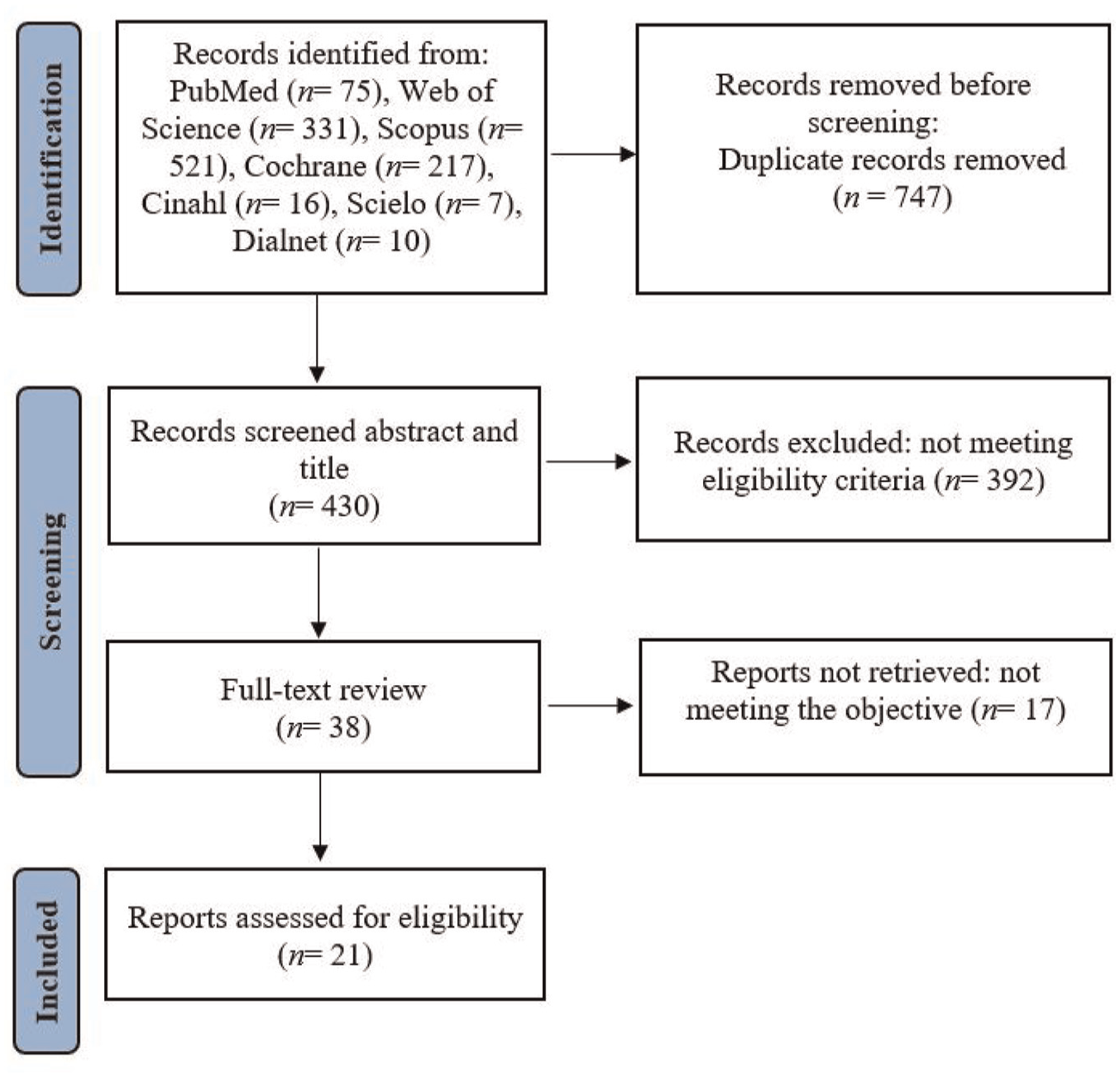
PRISMA flow diagram (Page et al., 2021).
The results are presented under the following four headings: (a) volume and scope of research on occupational therapy interventions to improve the quality of life of healthy older people living in nursing homes, based on the number of publications, year of publication, and evolution over time; (b) nature of research, according to journal or publisher, type of publication, language, line of research, country, and population involved; (c) characteristics of the research, including the methodological approach, method, design, and scope of the research; (d) characteristics and outcomes of the occupational therapy interventions, according to the type, effectiveness, duration, professionals involved in the development of the intervention, and format of the intervention.
Volume and Scope of the Research
The number of studies fluctuated, although their publication was relatively regular, with an average of two articles published per year. The periods of growth corresponded to articles published in 2012, coinciding with the peak, 2014, and 2019; and the decrease periods corresponded to those articles published in 2011 and 2021, coinciding with the minimum point, 2013, and 2016 (Table 1).
Characteristics of the Included Studies (N = 21).

Nature of Research
The analysis showed that the articles were published in 18 different journals. Most of the research was published in the American Journal of Occupational Therapy, Physiotherapy, and the Scandinavian Journal of Occupational Therapy (Table 1).
In terms of type of publication, the highest percentage was original research (Table 1). The languages used by the authors was predominantly English (Table 1).
As a result of the review, the articles were classified into five research lines, according to each study’s main objective (Table 1).
Based on the country where the research was conducted, the highest percentage corresponded to the United Kingdom, Japan, and Spain (Table 1).
The population was divided into five age groups. The highest percentage corresponded to the group of people aged of 81 to 90, and under-recorded, i.e. those articles where the age group was not specified (indicating only “>65 years”) (Table 1).
Characteristics of the Research
The highest percentage of published articles followed a quantitative methodology, n = 16 (76.2%), as opposed to the percentage of qualitative articles, n = 2 (9.5%) and mixed articles, n = 3 (14.3%).
It should be noted that among the studies that used a quantitative methodology, we identified a greater number of non-experimental articles [cross-sectional and longitudinal], followed by experimental articles, corresponding to randomized controlled trials (hereafter, RCTs) and reviews [systematic and narrative], and finally quasi-experimental articles.
In terms of qualitative methodology, only articles of an ethnographic nature were found. Mix methods included both concurrent and sequential designs (Table 1).
Characteristics and Results of Occupational Therapy Interventions
Concerning the types and characteristics of occupational therapy interventions aimed at improving the quality of life of healthy people over 65 years of age in nursing homes, there is a prevalence of group interventions. There was a higher number of interventions carried out by occupational therapists compared to those carried out by interdisciplinary teams (occupational therapy, social work, physiotherapy, nursing, medicine, and nursing assistant professionals). The average duration of the interventions was 20.7 weeks. Intervals of 11 to 20 weeks and 21 to 30 weeks predominated (Table 1).
It should be noted that seven of the studies evaluated the effectiveness of intervention programs based on specific areas of occupation in improving quality of life (Tables 2 and 3).
Research Results.

Note. ADLs = Activities of daily living; APA = Assessment of Physical Activity; BRS = Brief Resilience Scale; BS = Back Scratch Test; CICAc = Classification of the elderly according to their capacity for self-care; CG = Control group; COPM = Canadian Occupational Performance Measure; CSAR = Chair Sit and Reach Test; DCM = Dementia Care Mapping; EQ-5D = EuroQol-5D; EQ-5D-5L = EuroQol-5D-5L; FIM = Functional Independence Measure; GSE = Subjective Exertion Scale; HRQOL = Health-related quality of life; IADLs = Instrumental activities of daily living; LSI-Z = Life Satisfaction Index-Z; MMSE = Mini-Mental State Examination; N/A = Not applicable; NR = Not reported; OBQ11-N = Norwegian Occupational Balance Questionnaire; PAL = Pool Activity Level Checklist; PHQ-9 = Patient Health Questionnaire-9; SF-36 = Short Form Health Survey-36; SF12v2 = Short Form Health Survey-12; SWLS = Satisfaction with Life Scale; TUAG = Timed Up and Go Test.
Research Results From Review Articles.

Note. ADLs = Activities of daily living; CG = Control group; IADLs = Instrumental activities of daily living; N/A = Not applicable; NR = Not reported.
In particular, they focused on the occupational areas of ADLs by implementing activities related to with functional independence: bathing/showering, bowel and bladder control, dressing, eating, personal hygiene, grooming, and functional mobility. Health management activities to improve physical functioning, mental status, social aspects, fall prevention, and health promotion, as well as social participation activities.
In addition, two observational studies analyzed the relationship between occupational performance in the areas of occupation and older people’s perceptions of quality of life. The characteristics of these studies and the results obtained are shown in Tables 2 and 3 (Programs based on occupational areas and Basic research programs on occupation).
Furthermore, specific intervention programs were identified that were structured around simultaneous interventions in several areas of occupation. In these programs, the intervention was articulated around different activities related to the resident’s quality of life: the identification and engagement in meaningful activities, communication activities, and tasks related to functional independence, as well as other psychological and psychosocial aspects, such as pain, among others. It should be noted that the effectiveness of the Active Residents in Care Homes (ARCH) program was evaluated in two articles. The characteristics and results of these articles are shown in Table 2 (Specific intervention programs).
In addition, occupational therapy interventions non-specific to quality of life were also developed by analyzing how specific features of activities affected perceptions of quality of life, in particular, self-directed activities, challenge-skill activities, and occupational balance in the performance of activities. Finally, it is also worth noting two articles that developed programs to promote active aging.
The characteristics of these programs are shown in Tables 2 and 3 (Occupational therapy intervention non-specific on quality of life and Active aging promotion program).
Discussion
The findings of this scoping review provided answers to the research questions posed at the beginning of this work.
About the first question, it was possible to describe the scope, nature, and characteristics of research carried out on occupational therapy interventions to improve the quality of life of healthy people over 65 years of age in nursing homes.
Concerning the scope of research, although the research on this topic is not particularly extensive, it shows a consistent output with approximately two articles published each year. This steady rate of publications, without significant fluctuations, may indicate a sustained interest by researchers in this area of study. This fact might be an indicator of a constant interest in the object of study (Portillo et al., 2022). This circumstance could be related to the increase in the healthy population over 65 years of age in nursing homes (Fernández & Sánchez, 2014), which has led to a greater interest in understanding aspects related to the quality of life of this segment of the population in nursing homes (Garrido et al., 2012; Schlemmer et al., 2018).
In terms of the nature of the research, it is noteworthy that the majority of articles come from English-speaking journals, with American, Scandinavian, and Anglo-Saxon publications being particularly prevalent. Similarly, 42% of the authors are of Anglo-Saxon origin, which could be a potential indication of editorial bias (Boutron et al., 2021). However, there is considerable diversity in the countries in which the research was conducted, with the highest percentages in the United Kingdom, Japan, and Spain, followed by the United States, Northern Europe, and Portuguese-speaking countries. The results of our research, therefore, suggest that there does not appear to be any bias related to sample selection. It is also important to note that occupational therapy interventions in low- and middle-income countries remain under-researched, which may hinder the advancement of occupational therapy practice in these regions (Boutron et al., 2021). Thus, efforts should be made to promote research in these countries to diversify the sample and research findings.
Regarding the characteristics of the research, it is important to highlight the predominance of quantitative methodology, mainly descriptive (76.2%), with a focus on observational studies. These studies aim to describe the characteristics of occupational therapy interventions and explore their relationships with health-related quality of life, mental status, and functionality.
It also highlights the lack of qualitative research (9.5%) that explores the subjective perception of those receiving occupational therapy interventions. This lack could introduce potential bias in the measurement of the object of study, as the quality of life is a concept with a significant subjective component (Boutron et al., 2021).
It is also important to note that, based on the data analyzed in this scoping review, some studies showed lower methodological quality (Husebo et al., 2015; Koskela et al., 2017; Sprange et al., 2013). Several studies did not indicate the intervention duration, the professionals involved, or the format employed. This circumstance could indicate poor methodological quality and a lack of rigor in the research designs (Peters et al., 2020). Therefore, it is essential to improve the methodological rigor of the research conducted, to improve the research methodological quality.
Regarding to the second research question, two main types of programs were identified: firstly, intervention programs focusing on the improvement of specific areas of occupation (ADLs, health management, and social participation); and, secondly, specific programs based on the therapeutic use of occupation, based on a systematic and multi-component intervention (activity, health, physical and mental well-being, safety and occupation), with an average total duration of 20.7 weeks, developed by occupational therapists and delivered in a group format.
The first type of programs is characterized by a focus on activities related to physical function (such as psychomotricity, physical exercise, and low-intensity physical activity) (Clemson & Laver, 2014). This group also includes activities targeting mental health (such as cognitive stimulation, functional integration, and cognitive exercises) (Fernández & Sánchez, 2014), and fall prevention (Leland & Elliott, 2012).
These programs are in line with research developed in the field of care for older people in nursing homes (Mondaca et al., 2019; Schlemmer et al., 2018) that focus their attention on improving and maintaining physical functionality, mental status, and personal autonomy, as well as fall prevention.
This finding corroborates occupational therapy’s fundamental role in promoting and maintaining the quality of life and health of healthy older people in nursing homes (Arbesman & Lieberman, 2012; Portillo et al., 2022).
Nevertheless, there are fewer social and psychosocial interventions targeting areas such as leisure, education, and social participation (Johansson & Björklund, 2016), as well as health promotion activities, both individual and collective (Cichocki et al., 2015).
This may indicate a predominance of the biomedical and psychological conception of quality of life (Clemson & Laver, 2014; Fernández & Sánchez, 2014), as opposed to a social and preventive one (Johansson & Björklund, 2016). It may also be indicative of a process of medicalization of older residents. This process is characterized by, among other things, an emphasis on activities related to physical function and mental health in nursing home programs, often at the expense of leisure, educational, and social participation activities (Clarke et al., 2019).
For these reasons, occupational therapy interventions aimed at improving quality of life should emphasize the achievement of goals related to social, educational, and leisure aspects, as well as the improvement of personal autonomy, since they are more closely related to the essence of the object of study of this discipline: performance and occupational participation, understood as participation in ADLs, leisure, education or work that are part of one’s sociocultural context and are necessary or desired for one’s well-being (Kielhofner, 2004), particularly in older people. Thus, occupational therapy programs complement interventions from other disciplines that focus mainly on biological or psychological aspects (Pizzi & Richards, 2016). This perspective supports a concept of quality of life based on a holistic approach and biopsychosocial interventions (World Health Organization [WHO], 2015).
Attention should also be paid to the lack of educational and training programs (e.g., intergenerational education, self-directed learning, university programs for older adults), as well as health prevention initiatives (e.g., promoting healthy lifestyles, eliminating toxic behaviors, addressing risk factors, health education, abuse, neglect, and maltreatment). Additionally, activities related to leisure and environmental factors (e.g., therapeutic gardens, animal therapy) are rare. Information and communication technologies are also often overlooked, despite being key elements of active aging (Zingmark et al., 2016).
Therefore, it is relevant to develop broader lines of research linked to prevention and health promotion (Johansson & Björklund, 2016), areas of occupation (Mondaca et al., 2019), analysis and modification of the characteristics of the nursing home environment (Arbesman and Lieberman, 2012), and social and psychosocial variables that may influence the perception of quality of life (World Health Organization [WHO], 2015).
In contrast, the second type of program focuses on volitional aspects of activity choice, occupational performance and participation, lifestyle changes (Sprange et al., 2013), communication skills, medication management, and activity safety, as well as systematic assessment and pain management (Husebo et al., 2015). These programs that emphasize health promotion through meaningful activities (Kawamata et al., 2012; Koskela et al., 2017; Hurley et al., 2020), appear to achieve better outcomes in improving the quality of life of older adults living in nursing homes.
In addition, it should be noted that 63% of the study population is aged between 71 and 90 years, with an average age of 79.9 years. The lack of more detailed data on younger residents (65–70 years), could introduce a potential bias in the selection of the study population (Boutron et al., 2021).
Finally, the results obtained show that occupational therapy interventions based on the improvement of specific areas of occupation (ADLs, health management, and social participation) (Tables 2 and 3), specific programs based on the therapeutic use of occupation (Table 2) and occupational therapy interventions non-specific to quality of life (self-directed activities, challenge-skill activities, and occupational balance) (Table 2), may improve the quality of life of older people living in nursing homes compared with to an impairment-based approach, as such occupational therapy interventions appear to be effective in fall prevention (Clemson and Laver, 2014; Leland & Elliott, 2012), functional independence (Schlemmer et al., 2018), a significant reduction in pain/ reported discomfort (Cichocki et al., 2015), physical functioning, mental health, general health, vitality (Johansson & Björklund, 2015; Kawamata et al., 2012; Koskela et al., 2017) and participant engagement in activity (Hurley et al., 2020).
Ultimately, this study contributes to supporting the theoretical perspective that conceives quality of life as the result of a complex interaction between objective and subjective factors (Boggatz, 2016). The former are shaped by external conditions, namely economic, socio-political, cultural, personal and environmental factors that facilitate or hinder the full development of individuals and their personalities, while the latter are determined by the subjects’ evaluation of their own lives. The results of this study reinforce a multidimensional perspective of quality of life (World Health Organization [WHO], 2015), considering occupation as a determinant of it (Portillo et al., 2022).
Next, the main limitations of the research are outlined, and future lines of research are suggested based on the results of the study.
Limitations
Firstly, this scoping review was limited by the heterogeneity of the included studies, in terms of the type, frequency, and duration of occupational therapy interventions, quality of life measures and outcomes, as well as the variability of the data, all of which precluded the possibility of a quantitative synthesis. The results should therefore be treated with caution. Secondly, articles indexed in other literature databases were excluded, which may have omitted a significant number of related studies. Finally, although an exhaustive analysis of the methodological quality and research outcomes was not an objective of this scoping review, it can be considered a research limitation.
Future Lines of Research
Occupational therapy interventions in low- and middle-income countries have not been studied sufficiently, which is likely to limit the practical progress of occupational therapists in these countries. Therefore, efforts should be made to promote research in these countries to diversify the research sample and findings. Future work should also include a systematic review of the literature to analyze the scientific evidence of the effectiveness of occupational therapy interventions in improving the quality of life of healthy older people in nursing homes. Finally, another point that should be highlighted is the volume of experimental quantitative research (23.8%) for RCTs that seeks to explain and determine the effectiveness of specific occupational therapy programs compared to other common interventions to promote quality of life and active aging. The scarcity of these designs suggests the need to develop further lines of research to consolidate scientific evidence.
The following section presents the most relevant conclusions regarding the main findings of the research. These findings correspond to the objective of the study.
Conclusions
Research on this topic can be seen as a stable line of work, which indicates a constant interest among occupational therapists to improve their understanding of the quality of life of this population in nursing homes.
Furthermore, the research that has been carried out is predominantly empirical, quantitative, and non-experimental. However, there is a lack of qualitative and experimental quantitative research for RCTs and a lack of more detailed data on younger residents.
Similarly, the main occupational therapy interventions focus on programs based on improving of specific areas of occupation (ADLs, health management, and social participation), and specific programs based on the therapeutic use of occupation. However, there are few studies related to the prevention and promotion of health, to the areas of occupation (IADLs, leisure, and social participation), to the analysis and modification of the characteristics of nursing homes and the social and psychosocial variables. In short, the results of this study reinforce a multidimensional perspective of quality of life in which occupation plays a determining role.
Finally, the last section presents the main clinical and theoretical implications of the study.
Clinical and Theoretical Implications
Occupational therapy interventions have been shown to improve the quality of life of healthy older people living in nursing homes. These programs could focus on ADLs, social participation, and health management activities. Therefore, the need for occupational therapists to acquire the appropriate theoretical knowledge and skills to deliver occupation-based interventions is also highlighted. This involves understanding the specific occupational needs and preferences of older people and being able to tailor interventions to increase their participation in meaningful activities.
Footnotes
Acknowledgements
Not applicable

Ethical Considerations
The authors did not apply for IRB (institutional review board) review as this is a literature review.
Consent to Participate
Not applicable.
Institutional Review Board Statement
Not applicable.
Author Contributions
PMM and CUP is the lead, MATV and AISG is the corresponding author. All other authors are listed according to contributions as defined using the CRediT taxonomy. Writing –Original Draft: CUP, AISG, MATV, PMM. Writing –Review & Editing: CUP, AISG, MATV, PMM; Conceptualization: CUP, PMM; Methodology: CUP, AISG, MATV, PMM; Formal Analysis: CUP, AISG, MATV, PMM.
Funding
The author(s) disclosed receipt of the following financial support for the research, authorship, and/or publication of this article: This work was supported by the European Social Fund and the ONCE Foundation.
Declaration of Conflicting Interests
The author(s) declared no potential conflicts of interest with respect to the research, authorship, and/or publication of this article.