




Abstract
Literature entails six viewpoints regarding the categorial status of post-nominal monosyllabic localizers in Mandarin Chinese, including locative particles, nouns or a subclass of nominals, clitics, spatial enclitics or particles, postpositions and postpositions in circumpositions. In order to resolve the disputes, this article argues for the postposition viewpoint from a systemic functional perspective given limited studies regarding this in the literature. Systemic Functional Linguistics can provide proper descriptions for various linguistic phenomena, including localizers, observing the function-oriented language study principle. Hence, to specify the categorial status of post-nominal monosyllabic localizers, this study takes a systemic functional approach to investigate their semantic and syntactic functions. The findings indicate that post-nominal monosyllabic localizers are postpositions, for like prepositions, they express positional relationships between things, and along with their preceding nominals, can function as Subjects, Complements and Adjuncts within Chinese clauses, and as completives in Chinese prepositional phrases.
Keywords
Introduction
This study addresses the categorial status of post-nominal monosyllabic ‘localizers’ (fāngwèicí,
Post-nominal monosyllabic localizers refer to those localizers taking on monosyllabic forms and occurring immediately after nominals. Generally speaking, localizers are a closed class of words, appearing in monosyllabic or disyllabic forms. In the course of the Chinese language development, monosyllabic localizers preceded disyllabic ones, and they originate from nouns (Biq, 2009; Chappell & Peyraube, 2008; Z. X. Chu, 2006; Feng, 2015; Y. F. Li, 2009; C. Li, 2019; D. Q. Liu, 2003, 2008; Nie & Liu, 2021; D. D. Wu et al., 2018). The monosyllabic set includes 16 items: shàng (
Monosyllabic localizers typically follow ordinary nouns,
2
transforming them into ‘place words’ (chùsuǒcí,
Studies on localizers primarily focused on determining their categorial status. At present, all literature should agree that monosyllabic and disyllabic localizers used alone are nouns, that is, place words, and even though a few, like Y. H. Liu et al. (2001), D. Q. Liu (2003) and Djamouri et al. (2013), consider a very few exceptions as postpositions, the vast majority of literature believes that post-nominal disyllabic localizers are nouns. Notably, there is a lack of consensus in the literature regarding the categorial status of post-nominal monosyllabic localizers. Due to space limitations and the fact that the examination of post-nominal monosyllabic localizers is a prerequisite and foundation for the exploration of post-nominal disyllabic localizers, this study focuses on the former while the latter will be addressed in another article.
In the literature, there are mainly six divergent viewpoints on post-nominal monosyllabic localizers: locative particles (Hsiung, 2023; C. N. Li & Thompson, 1981); nouns (Cheung, 2016; Huang, 2010; Huang et al., 2009; Kuo, 2022; Y. H. A. Li, 1985, 1990; McCawley, 1992; H. H. I. Wu, 2015; B. Zhang, 2010), or a subclass of nominals (Chappell & Peyraube, 2008, 2013; Z. X. Chu, 2006; Y. F. Li, 2009); clitics, that is, phrasal affixes (F. S. Liu, 1998; Sun, 2008; D. D. Wu et al., 2018); spatial enclitics or particles (Sun, 2008); postpositions (Djamouri et al., 2013; Ernst, 1988; Tai, 1973; Takahashi, 2020); postpositions in circumpositions (D. Q. Liu, 2003, 2008). These perspectives, while reasonable in their own right, have failed to reach consensus among scholars. They are primarily based on observation of natural usages, introspective structural substitution and transformation, or analogical reasoning in language typology. Limited studies have thoroughly analyzed and described the semantic and syntactic functions of post-nominal monosyllabic localizers. Hence, this study investigates the categorial status of post-nominal monosyllabic localizers from a different perspective, that is, SFL, which observes a function-oriented language study principle (Fawcett, 2000, 2008; Halliday, 1985, 1994, 2004, 2014), and can provide sufficient descriptions for various linguistic phenomena (W. He et al., 2023; Caffarel et al., 2004). Specifically, this study is intended to answer two questions: a) What are the semantic and syntactic functions of post-nominal monosyllabic localizers in Mandarin Chinese? b) What kind(s) of categorial status do post-nominal monosyllabic localizers in Mandarin Chinese have? Overall, by examining their semantic and syntactic functions, it aims to provide powerful arguments for the postposition view regarding post-nominal monosyllabic localizers.
Section 2 reviews relevant literature. Subsequently, considering comments on the existing viewpoints, section 3 revisits the two versions of SFL and specifies the semantic and syntactic functions of related grammatical units. Referring to the analogy standards outlined in section 3, section 4 examines the categorial status of post-nominal monosyllabic localizers based on the analysis and description of their semantic and syntactic functions. Section 5 reexamines concerns raised by scholars regarding the postpositional approach to post-nominal monosyllabic localizers, and discusses the influencing factors behind the characteristics of such phenomena. Finally, we summarize the investigation of post-nominal monosyllabic localizers in this study, and provide conclusive remarks.
Literature Review
To understand the grammatical category that post-nominal monosyllabic localizers belong to in Mandarin Chinese, six viewpoints in the literature are reviewed below. To start with, it should be noted that the general term ‘localizer’ instead of the specific term ‘post-nominal monosyllabic localizer’ would be referred to, for it is not necessary to distinguish between the two in this section, given that when it comes to localizers, scholars usually focus on post-nominal monosyllabic ones, and that specific contexts could reveal which type the localizers in question are of.
The first viewpoint suggests that ‘locative particles’ (localizers in this study) are an independent category, forming ‘locative phrases’ or ‘locative constructions’ with their preceding ‘nominal phrase’ and preposition as exemplified by zài jiā lǐ (在家里 ‘at home’) (Hsiung, 2023; C. N. Li & Thompson, 1981). However, this viewpoint fails to clarify the relationship between such phrases and ‘nominal phrases’, ‘adverbial phrases’ and prepositional phrases for any of them may occur in the argument or adverbial position in the clause; except for ‘adverbial phrases’, others can function as modifiers in ‘nominal phrases’. Localizers and prepositions both express location, leaving the differentiation between them unexplained. Notably, Hsiung (2023) differentiates localizers from prepositions in expressing spatial relation, and stresses that localizers denote the region or dimension of Figure relative to Ground while prepositions encode the path of Figure. That is, Hsiung (2023) suggests two types of locative constructions in Chinese: [P + NP] and [P + [NP + L]]. However, this perspective does not explain the locative construction [NP + L].
The second viewpoint says that localizers are nouns or deviated nouns. According to Y. H. A. Li (1985, 1990), McCawley (1992), Y. H. Liu et al. (2001), Huang et al. (2009), Huang (2010), B. Zhang (2010), H. H. I. Wu (2015), Cheung (2016) and Kuo (2022), localizers create compound nouns or locative phrases with their preceding nouns, and the outputs are place nouns or locative phrases indicative of location. However, this viewpoint has significant issues. The present study agrees with Ernst (1988), F. S. Liu (1998) and H. H. I. Wu (2015) that localizers cannot act as nouns in the following aspects: a) they usually cannot stand alone; b) they cannot occur in the structure of ‘noun + de (
Considering these concerns, some scholars take localizers as a subclass of nominals. For example, Z. X. Chu (2006) considers localizers as a distinct category parallel and autonomous to nouns. Chappell and Peyraube (2008) assume that originally, localizers expressed places, but later, a precise and concrete position, and now, a generic position. Y. F. Li (2009) claims that localizers are the head in the structure of ‘noun + localizer’, similar to the second noun in the structure of ‘noun + de (
The third viewpoint indicates that localizers are clitics, that is, phrasal affixes, or specifically, suffixes, adding to preceding nominal phrases the feature [+loc] (F. S. Liu, 1998; Sun, 2008; D. D. Wu et al., 2018). Regarding the reasons for the clitic status of localizers, D. D. Wu et al. (2018) do not provide explanations, but just focus on the pragmatic usages of the localizer shàng (上 ‘up, on, in, above, top’). F. S. Liu (1998) holds that localizers are phonologically dependent for they can be reduced to the neutral tone. This reason does not hold true because, as mentioned by D. Q. Liu (2003), except for a very few localizers like shàng (
(1) 一 个 人 站 在 yī gè rén zhàn zài qiáng shàng, yī gè rén zhàn zài qiáng xià. a CLF person stand at wall on, a CLF person stand at wall under ‘A person stood on the wall while the other stood under the wall’.
The fourth viewpoint assumes that localizers are enclitics. As a proponent, Sun (2008) states that localizers are not yet clitics but enclitics, which result from the grammaticalization of spatial nominals in Chinese history. At first a noun and a spatial nominal formed a binominal complex structure, and the spatial nominal functioned as the head of the derived spatial nominal. Subsequently, the combination loses the binominal structure, and the spatial nominal becomes an enclitic. This point can be exemplified by the schema provided by Sun (2008, p. 212): (2) 於 山 上 (Old Chinese) 在 山 上 (Modern Chinese) [yú [[shān]N [shàng]N ]NP ]PP → [zài [[shān]N [shàng]enclitic]NP]PP at hill top at hill top ‘on the hill’ ‘on the hill’
Notably, Sun’s (2008) analysis of localizers is very similar to F. S. Liu’s (1998) and D. D. Wu et al.’s (2018) approach, all taking the preceding nominal as the stem. The only difference is that Sun (2008) considers the initially comprehensive spatial nominal as an enclitic whereas F. S. Liu (1998) and D. D. Wu et al. (2018) consider it as a clitic. Enclitics are still words following stems while clitics are affixes attached to stems. However, it is self-evident that the enclitic status of localizers results from a less grammaticalized stage in the course of development whereas the clitic status results from a more grammaticalized stage. Then, together with the noun approach, these three positions form a continuum as localizers as nouns → localizers as enclitics → localizers as clitics. Overall, whether considered as nouns, enclitics or clitics, they form a ‘nominal phrase’ with their preceding nominal. This implies that the combination of a localizer and its preceding nominal is an endocentric construction representing a place (i.e., a space). Nevertheless, the structure of ‘noun + localizer’ is an exocentric construction, representing a kind of positional relationship instead of a place, which will be verified in section 4 of this study.
The fifth viewpoint suggests that localizers are postpositions, which is advocated by Tai (1973) and Ernst (1988), supported by F. X. Wu (2008), Djamouri et al. (2013) and Takahashi (2020). It says that localizers form postpositional phrases with their preceding nominals. Regarding this perspective, Ernst (1988) notes that the postposition status of localizers is inconsistent with the general assumption of Chinese as a Subject-Verb-Object (SVO) language, but no explanations are found in relevant studies. For an SVO language, the case marker typically precedes the nominal phrase. However, Chinese is not a typical SVO language. It has experienced the evolution of the word order from SOV to SVO in the course of development, and has retained some characteristics of SOV languages (LaPolla, 1994; Tai,1988). Therefore, Chinese has prepositions as well as postpositions. How the changing of word order affects the existence of both types of adposition in Mandarin Chinese will be further explored in section 5 of this study.
Besides, there are other concerns regarding this viewpoint seeing localizers as postpositions. F. S. Liu (1998) and C. Li (2019) hold that this postposition approach has coordination concerns. According to them, jiā lǐ (
The sixth viewpoint takes localizers as postpositions in circumpositions (D. Q. Liu, 2003, 2008; Peyraube, 1980). According to Peyraube (1980), the postposition and the preposition form a discontinuous unit, that is an adposition that ‘subcategorizes for an NP and assigns Case to it’ (F. S. Liu, 1998, p. 202); resultingly, the adposition and the ‘nominal phrase’ comprise an adpositional phrase. However, it is argued in this study that the preposition and the postposition do not form a discontinuous unit. Prepositions in Mandarin Chinese have evolved from verbs whereas postpositions have evolved from nouns. Prepositions mainly provide information regarding the location, destination, source, path, manner, etc. of an event whereas postpositions mainly provide information regarding the location of an entity, specific or abstract. Since their origins and ranges of meanings are different, then their appearances are not conditioned on each other. Hence, prepositions and postpositions in Mandarin Chinese do not form circumpositions. This position is supported by Ameka (1995), assuming that Ewe, a West African language, has two sets of adpositions – prepositions and postpositions, and they do not form a discontinuous unit.
Unlike Peyraube (1980), D. Q. Liu (2003, 2008) argues that the preposition and the postposition in a circumposition are not located at the same layer. Exactly, the postposition and its preceding nominal form a postpositional phrase, and subsequently, this phrase and the preposition form a prepositional phrase. This aligns D. Q. Liu’s (2003, 2008) study with the postposition approach.
Unlike the above six uniform treatments of localizers as particles, nouns, clitics and others, C. Li (2019) holds that localizers in Mandarin Chinese have varied functions in different contexts. Specifically, localizers act as nouns in a few contexts, roots in polymorphemic words, and clitics when attached to comprehensive nominal phrases. Evidently, there is no fundamental difference between this viewpoint and those relevant ones outlined above, particularly, localizers as nouns and clitics.
To summarize, except for the first viewpoint advocated by C. N. Li & Thompson (1981) and Hsiung (2023), the above viewpoints concerning the categorial status of localizers can be classified into two groups: one is the noun or noun-like group, including the noun, clitic, enclitic and multi-functional approaches, and the other is the adposition group, including the postposition and circumposition approaches. The primary difference between them is that the noun group holds that the localizer and its preceding nominal signal a place (a kind of space) whereas the adposition group assumes that the combination indicates a positional relationship between the referent or thing expressed in the combination and another referent or thing suggested in the local context.
As the above viewpoints cannot reach consensus, this study provides powerful arguments to verify one of them from a new perspective, which is meant to resolve the disputes. Overall, from the perspective of SFL, this study argues that post-nominal monosyllabic localizers are postpositions, and that localizers and their preceding nominals form postpositional phrases, which represent positional relationships between things, rather than relative positions of things.
Theoretical Framework
SFL was initiated by Halliday in the late 1950s, and subsequently developed by Halliday and other systemic functionalists. Since 1980s, SFL has remained a primary trend in the field of language studies. Currently, it has two major versions – the Sydney Grammar (SG) and the Cardiff Grammar (CG). The SG has been developed mainly in Halliday’s (1985, 1994, 2004, 2014), Matthiessen’s and Hasan’s works, especially in the seminal monograph An Introduction to Functional Grammar. The CG has transitioned out of Halliday’s works in the 1960s and 1970s, and has been prominently presented in works by Fawcett (1980, 2000, 2008), Tucker (1998), He (2014, 2017a, 2017b) and W. He et al. (2015a, 2015b, 2023), among others. While they differ in some aspects, including whether there is a demarcation line between meaning and form, whether the intermediate unit between clause and word is classified into six items (nominal group, verbal group, adverbial group, prepositional group, prepositional phrase and conjunction group) or four items (nominal group, quality group, quantity group and prepositional group), whether a grammatical unit involves diverse structures or only one syntactic structure, which kind of chart format – parallel lines of boxes or tree diagrams– is adopted when analyzing the structures of clauses, and others, both adhere to key language study principles such as systemic and multifunctional nature of language, stratificational perspective and primacy of meaning over form.
This study integrates SG and CG in its analysis and description of localizers and their preceding nominals and prepositions. It classifies groups into the nominal, quality, quantity, preposition and conjunction groups, and the prepositional phrase. As the analysis and description primarily concern monosyllabic localizers and their preceding elements, involving only nominal groups and prepositional phrases, a brief review of these two classes of unit follows.
The nominal group is a grammatical unit that conveys several meanings related to things. The concept of thing at the level of meaning of the language system mirrors the category of object in the belief system (i.e., the cognitive world). The concept of object is a broad one, encompassing physical and abstract objects such as people, animals, places, ideas and others. Thus, the concept of thing can also be a broad one, encompassing specific and abstract things such as entities, space, time, quality-things, quantity-things and situation-things. The nominal group primarily comprises the determiner, modifier, head and qualifier elements in its potential structure. The pivotal element ‘head’ expresses a cultural classification of things, and answers the question ‘What class of thing does the nominal group refer to?’. The modifier expresses qualities of things, and answers the question ‘What sort of thing does the nominal group refer to?’. The determiner specifies the thing, and answers the question ‘Which (or whose) thing does the nominal group refer to?’. Finally, the qualifier is similar to the modifier in function for either classifying or depicting things, but preceding the head. For example, in wǒmen de hǎo péngyǒu, rú Zhāng Sān (
The prepositional phrase is a grammatical unit expressing minor relationships between things, and typically comprises a preposition and a completive. The preposition relates the referent indicated by a grammatical unit filling the completive to the referent indicated by another grammatical unit in the local context. For example, in (Zhāng Sān) zài xiào túshūguǎn (gōngzuò) ([
Closely observing the essential tenets of SFL, and taking the descriptions of the nominal group and the prepositional phrase into account, the ensuing section analyzes and describes the conjunctions of monosyllabic localizers with their preceding nominals, as well as with their preceding nominals and prepositions. The aim is to elucidate the categorial status of post-nominal monosyllabic localizers and their combinations.
Analysis, Description and Results
To establish the categorial status of post-nominal monosyllabic localizers as postpositions, we address two crucial aspects. Firstly, at the semantic level, they function to connect the referent of a grammatical unit with that of another unit in the local context. That is, they indicate positional relationships between referents rather than functioning referentially. Secondly, at the syntactic level, they act as predicators, forming postpositional phrases with their completive, which in turn may fill the Adjunct, Complement and Subject slots in the syntactic structure of the clause, or fill the modifier of the nominal group and the finisher of the quality or quantity group. Such syntactic functions are shared by prepositional phrases.
To clarify these points, this study closely examines the semantic and syntactic functions of post-nominal monosyllabic localizers. As mentioned earlier, there are in total 16 items. For clarity, this study focuses on a few of them, but not all, depending on two factors: a) they should be the most basic human positional orientations; b) they should occur more frequently than the others in use. Considering these, six of the localizers – shàng (
(3) a. 她 tā zài xiǎocèzi shàng yě huà le qǐlái. she at pamphlet on also draw ASP ASP ‘She also drew it on the pamphlet’. b. tāmen yào zài nàxiē dà hútáoshù xià xīu yī tiáo xiǎo lù. they will at those big walnut under build a CLF small road ‘They are going to build a path under those big walnut trees’. c. 现在 用户 已 习惯 xiànzài yònghù yǐ xíguàn zài diànnǎo qián kàn jiémù. now user already habituate at computer before watch program ‘Now users are used to watching programs in front of the computer’. d. 他 tā zài shùcóng hòu kàndào yěrén qún jìu zài yǎn qián. he at bush behind see savage crowd just exist eye before ‘Behind a bush, he saw a crowd of savages in front of him’. e. 老 林 哥 lǎo Lín gē zài rén qún lǐ dūnong. old Lin brother at human crowd in murmur ‘Old Brother Lin murmured in the crowd’. f. 风暴 狞厉 fēngbào nínglì de xiàoshēng zài xiánchuāng wài xiǎng zhe. storm fierce REL howling in porthole outside ring ASP ‘The fierce howling of the storm was ringing outside the windows’.
In these examples, shàng (
Regarding the positional relationship between things, it may be questioned whether it is expressed by the localizer or by the preposition ahead of the nominal group. However, while the preposition relates one thing to the other, the thing denoted by its completive is not the referent denoted by the nominal group, like xiǎocèzi (
Regarding the semantic function, the preposition is crucial to the syntactic structure of the clause. According to Greenberg (1966) and Hawkins (1983), languages featured by the SVO order observe prepositional phrases after verbs in most clauses, contrary to those featured by the SOV order. This can be explained by the relator principle (Dik, 1997). Here, as a kind of relator, the preposition in a prepositional phrase functioning as an adverbial in the clause comes between the ‘object’ after the verb and the completive after the preposition. That is, the preposition is typically nearest to the verb of the clause. Therefore, in SVO languages, the preposition precedes its completive, while in SOV languages, the similar relator, viz. postposition, follows its completive. Chinese is not a typical SVO language, and has some characteristics of SOV languages (D. Q. Liu, 2003), implying that it has both prepositions and postpositions. In such a situation, if there is another nominal group located before the completive, it may cause ambiguity in the reading of the clause. For example, if the preposition zài (
(4) a. chājī shàng yǒu yī duì zhūtái. tea table on have a pair candlestick ‘There is a pair of candlesticks on the tea table’. b. qiángjiǎo xià shì yī gè kuāndà de chítáng. corner under be a CLF large REL pond ‘Under the corner is a large pond’. c. yǎn qián chūxiàn le yī gè dǒu pō. eye before appear ASP a CLF steep slope ‘There appeared a steep slope in front of us’. d. jìniànbēi hòu yǒu yī tiáo dìxià tōngdào. monument behind have a CLF underground passage ‘There is an underground passage behind the monument’. e. zhēng gè xuéyuàn lǐ zhǐ yǒu jǐ wèi nǚ jiàoshòu. whole CLF college inside only have several CLF female professor. ‘There are only several female professors in the whole college’. f. chuāng wài chuánlái qīlì de jǐngbàoshēng. window outside come shrill REL alarm ‘There came a shrill alarm outside the window’. (5) a. 她 脱掉 tā tuōdiào shēn shàng de tīxù. she take off body on REL t-shirt ‘She took off her T-shirt’. b. tái xià de lǎo Lǐ hěn shēngqì. stage under REL Lao Li very angry ‘Lao Li was very angry off stage’. c. wū qián de chítáng biān zhǎng zhe dícǎo. house before REL pond side grow ASP silver grass ‘The pond in front of the house is covered with silver grass’. d. bàngōngzhuō hòu de nánrén lìkè qǐshēn zǒuxiàng tā. desk behind REL man immediately get up walk towards he ‘The man behind the desk immediately got up and walked towards him’. e. 他 在 tā zài jiǎng zhèn lǐ de xīnwén. he now talk about town in REL news ‘He is talking about town news’. f. chē chuāng wài de jǐngwù yuè lái yuè móhu. car window outside REL scenery more come more blur ‘The scenery outside the window is getting more and more blurred’. (6) a. zhè shì shìjie shàng zuì bìkěxiǎngxiàng de shì. this be world in most unimaginable REL thing ‘This is the most unimaginable thing in the world’. b. 它 是 tā shì tàiyáng xià zuì gǔlǎo de shēngwù. it be sun under most old REL creature ‘It is the oldest creature under the sun’. c. bàotān qián zuì zǒuqiào de shì zhè fèn bàozhǐ. newsstand before most popular REL be this CLF newspaper ‘The most popular newspaper in front of newsstands is this newspaper’. d. yuàn qián wū hùu zuì xǐngmù de yào shǔ mùchái. courtyard before house behind most striking REL should count firewood ‘The most striking thing in front of and behind the courtyard is firewood’. e. 他 是 tā shì liánduì lǐ zuì liǎobùqǐ de jiāhuo. he be company in most great REL guy ‘He is the greatest guy in the company’. f. 改革 是 gǎigé shì běn sàichǎng wài zuì yínrénzhùmù de liàngdiǎn. reform be this stadium outside most eye-catching REL highlight. ‘Reform is the most eye-catching highlight outside the stadium’. (7) a. 他 tā liánjù dào shìjie shàng zuì duō de sīrén cáifù. he amass to world in most much REL private wealth ‘He amassed the most private wealth in the world’. b. 他 会 tā huì géi nǐ quán tiān xià zuì duō de cǒngài. he will give you whole sky under most much REL love ‘He will give you the most love in the world’. c. 你 nǐ de mǒuzi shì wǒ yǎn qián zuì dà de yī kē xīngxing. you GEN eye be I eye before most big REL a CLF star ‘Your eyes are the biggest star in front of me’. d. zhè céng shì wǒmen zài dí hòu zuì dì de jīdì. this once be we at enemy behind most large REL base ‘This was once our largest military base behind the enemy’. e. 每 个 学生 měi gè xuéshēng zài yī gè xuíqī lǐ xiě liǜ piān xiǎo lùnwén. each CLF student at a CLF semester in write six CLF small paper ‘Each student writes six small papers in a semester’. f. 中国 成为 乌克兰 Zhōngguó chéngwéi Wūkēlán zài Dúliántǐ wài zuì dà de màoyì huǒbàn. China become Ukraine at CIS outside most large REL trade partner ‘China has become Ukraine’s largest trading partner outside the CIS’.
Another potential query arises regarding the use of a localizer in expressing spatial relationships. Literature consensus dictates that localizers must occur in the encoding of spatial relationship when the preceding nominal group comprises a common noun instead of a locative noun, and if it is a locative noun, localizers may be absent for their redundance in the semantics under discussion (D. Q. Liu, 2003). For example, zài xuéxiào (lǐ) (
As discussed above, from the semantic perspective, localizers represent minor relationships, and are termed as postpositions due to their positions after nominals (actually nominal groups within SFL). Now, let’s look at the other research question concerning the categorial status of the combination of post-nominal monosyllabic localizers and their preceding nominals, viz. postpositional phrases. Do they share the same syntactic functions as prepositional phrases? According to Fawcett (2000, 2008) and W. He et al. (2015a, 2015b, 2023), prepositional phrases can fill the Adjunct, Complement and Subject slots in the clause. They can also fill the modifier in the nominal group, the finisher in the quality group, the finisher in the quantity group and the completive in the prepositional phrase. As shown by those clauses in (3), prepositional phrases composed of a preposition and a postpositional phrase fills the Adjunct slot in the clause. Notably, the prepositions can be excluded for semantics because the spatial relationship is comprehensively expressed by the subsequent localizers, that is, the postpositions. However, as a normal Adjunct of the Chinese clause, a prepositional phrase is typically located between the Subject and the Predicator, and therefore to reduce ambiguity in the reading of the relationship between the nominal group functioning as the Subject and the nominal group functioning as the completive of the postposition (here, the postpositional phrase functions as the Adjunct of the clause), the preposition is typically kept explicit. The syntactic function of such postpositional phrases as those in (3) is shown in the analysis of (3a), as illustrated by Figure 1.
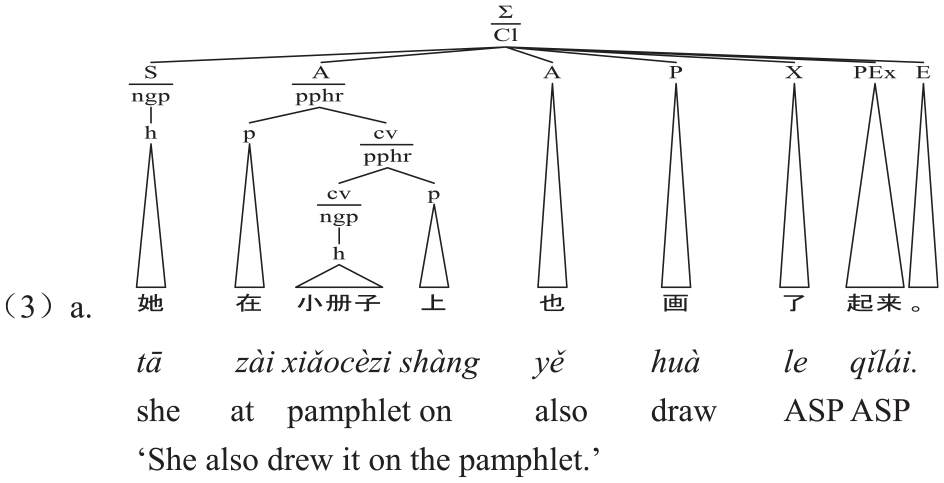
Functional syntactic analysis of example (3a).
As shown by those clauses in (8), postpositional phrases fill the Complement slots in the clauses. Regarding the function of the preposition following the verb in such a clause, most scholars in the Chinese linguistic field, such as D. Q. Liu (2003) and B. Zhang (2010), agree that it is part of the verb of the clause. In other words, the verb of the clause as a whole comprises a verb and a preposition. In our functional sense, the verb and the following preposition are described as the Predicator and its Extension. The syntactic function of such postpositional phrases as those in (8) is explained in the analysis of (8a), as illustrated by Figure 2.
(8) a. 他 来 到 tā lái dào yī gè shānpō shàng. he come to a CLF hillside on ‘He came to a hillside’. b. 那 个 人 站 在 nà gè rén zhàn zài lóutī jiǎo xià. that CLF human stand at stair foot below ‘That person stood at the foot of the stairs’. c. 他 叉 着 腰 站 在 tā chā zhe yāo zhàn zài rén qún qián. he cross ASP waist stand at human crowd before ‘He stood in front of the crowd with his waist crossed’. d. tā de tóufā wǎn zài nǎo hòu. she GEN hair tuck at head behind ‘Her hair was tucked behind her head’. e. 他 来 到 tā lái dào jiàoshì lǐ. he come to classroom inside ‘He came to the classroom’. f. 卫青 率 兵 追 到 Wèi Qīng shuài bīng zhuī dào chángchéng wài. Wei Qing lead troop chase to the Great Wall outside ‘Wei Qing led his troops to chase to the outside the Great Wall’.

Functional syntactic analysis of example (8a).
As shown by those clauses in (4), postpositional phrases fill the Subject slots in the clauses. Such clauses are existential ones in Chinese, comprising a Subject filled by a locative phrase, which is a prepositional or postpositional phrase, a Predicator filled by a verb indicating a static or dynamic existential meaning or an appearing or disappearing existential meaning, and a Complement filled by a nominal group or a clause (He, 2017b). The syntactic function of such postpositional phrases as shown by Figure 3.

Functional syntactic analysis of example (4a).
As shown by those clauses in (5), postpositional phrases fill the modifier slots in the nominal groups functioning as the Complements or Subjects in the clauses. Below we analyze the nominal group in (5a) to illustrate the syntactic function of such postpositional phrases, as shown by Figure 4.

Functional analysis of example (5a).
As shown by those clauses in (6), postpositional phrases fill the finishers of the quality groups functioning as the modifiers of the nominal groups, which in turn fill the Complement slots in the clauses. Below we analyze the quality group in (6a) to illustrate the syntactic function of such postpositional phrases, as shown by Figure 5.

Functional syntactic analysis of example (6a).
As shown by those clauses in (7), postpositional phrases or together with their preposition fill the finishers of the quantity groups functioning as the modifiers of the nominal groups in (7a) through (7d) and (7f) and as the Adjunct of the clause in (7e). The prepositions in (7d) through (7f) can be implicit from the angle of semantics, but due to the syntactic contexts, their presence clarify the relationship between the nominal groups before and after the prepositions. Typically, explicit prepositions in such cases are syntactically rather than semantically evoked. Below we analyze the quantity group in (7a) to illustrate the syntactic function of such postpositional phrases, as shown by Figure 6.
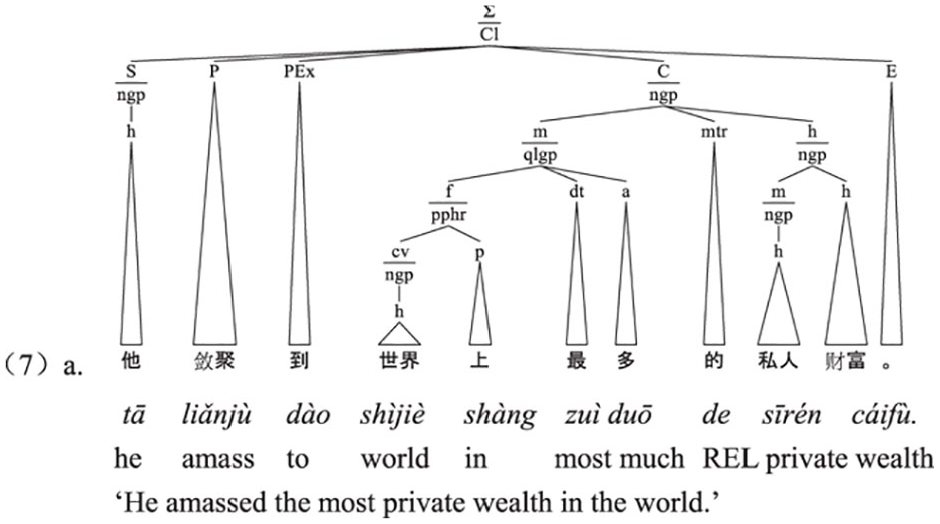
Functional syntactic analysis of example (7a).
As shown by examples (3a) through (3f) and examples (8d) through (8f), postpositional phrases fill the completives of prepositional phrases. This analysis indicates that the domain of the preposition is larger than that of the concerned postposition. This study aligns with Liu’s description of such cases. Following Ernst (1988), D. Q. Liu (2003) argues that Chinese has both prepositions and postpositions, and that prepositions can have postpositional phrases in their domain. To confirm this, D. Q. Liu (2003, p. 171) conducts two tests. First, he examines which of these can form a complete unit with a nominal group; in this case, between the preposition zài (
The analysis and description above reveal that post-nominal monosyllabic localizers have similar semantic and syntactic functions to prepositions. Conclusively, they are postpositions.
Discussion
The Categorial Status of Post-Nominal Monosyllabic Localizers
As outlined in section 2, there are four concerns regarding the postpositional approach to post-nominal monosyllabic localizers. Firstly, F. S. Liu (1998) and C. Li (2019) question that if post-nominal monosyllabic localizers are postpositions, why such postpositional phrases cannot be coordinated with prepositional phrases, as illustrated by example (9).
(9) *小明 家 里 和 在 学校 都 不 听 Xiǎomíng jiā lǐ hé zài xuéxiào dōu bù tīnghuà. Xiaoming home in and at school all NEG behave ‘Xiaoming does not behave either at home or at school’.
This concern is addressed as follows. As described earlier, postpositional phrases realize a simple positional relationship between things while prepositional phrases formed by a preposition and a postpositional phrase realize a complicated positional relationship between things. Their use depends on the context. If there is another nominal occurring before – in such a context, a complicated positional relationship between things is considered, and subsequently, a prepositional phrase is used. Otherwise, a postpositional phrase is used. Regarding example (9), given that the postpositional phrase jiā lǐ (
The second concern raised by Sun (2008) and C. Li (2019) questions that if post-nominal monosyllabic localizers are postpositions, a pause can occur between the preceding nominal and the post-nominal monosyllabic localizer, similar to that between a preposition and its following nominal as shown by example (10). However, there is no pause between the two parts, especially when the preceding nominal is a monosyllabic nominal as shown by example (11).
(10) 他 在__ 国 内 工作。 __indicates a pause (Sun, 2008, p. 203) tā zài __ guó nèi gōngzuò. he at state in work ‘He works in (his) home country’. (11) 他 在 国 *__内 工作。(Sun, 2009, p. 203) tā zài guó *__neì gōngzuò. he at state in work ‘He works in (his) home country’.
This is not a concern in the present study. Chinese, especially modern Chinese, favors disyllabic words. When a monosyllabic localizer occur after a monosyllabic nominal, they form a unit similar to a disyllabic word, although the combination is actually a postpositional phrase. Therefore, there is typically no pause between the preceding nominal and the post-nominal monosyllabic localizer. Regarding this, by examining the use of locative words in archaic, medieval and modern Chinese, Feng (2015) argues that the change and the development of localizers’ use from locative nouns to a functional category are motivated and constrained by prosody. This prosodic effect causes the grammaticalization of locative words, giving rise to disyllabic units formed by preceding nominals and post-nominal monosyllabic localizers.
The third concern raised by Y. F. Li (2009) questions that if post-nominal monosyllabic localizers are postpositions, then the prepositions before their preceding nominals are redundant. For example, (12) tāmen fàng le yī tào píngfēng * (zài) fángjiān lǐ. they put ASP a CLF screen * (at) room inside ‘They put a screen in the room’.
According to Y. F. Li (2009), if fángjiān lǐ (
The fourth concern raised by C. Li (2019) is that since adpositional phrases cannot be used as the Subject element, and the combination of preceding nominals and related post-nominal monosyllabic localizers can function as the Subject, then they cannot be postpositional phrases, and they must be nominals. As shown by examples (4a-f), postpositional phrases can be used as the Subject, specifically, in Chinese existential clauses. Regarding why the postpositional phrase preceding the verb in Chinese existential clauses is considered as the Subject element, He (2017b) from the perspective of SFL argues that as existential clauses concern two Participant Roles, Participant Roles are the Subject or the Complement element in the clause, the postpositional phrase preceding the verb realizes one Participant Role, and Chinese is featured by the SVO as well as the SOV word order, then the postpositional phrase preceding the verb should be the Subject element.
The fifth concern raised by Kuo (2022) is that it is challenging to differentiate the structure of [N + L] from that of [PREP + N + L] if post-nominal monosyllabic localizers are viewed as postpositions. As described earlier, the structure of [N + L] realizes a simple minor positional relationship between things while the structure of [PREP + N + L] realizes a complex one, hence it should be presented as [PREP + [N + L]]. That is, [N + L] underlines postpositional phrases while [PREP + [N + L]] underlines prepositional phrases.
Reasons for Chinese Involving Both Prepositions and Postpositions
In addition to those above concerns against the postposition approach to post-nominal localizers, literature raises a highly relevant and crucial issue regarding why modern Chinese has postpositions as it primarily follows the SVO word order, which favors prepositions rather than postpositions.
The argument that modern Chinese has postpositions as well as prepositions aligns with the observations of constituents’ ordering patterns of worldwide languages by Dik (1997). From a cross-linguistic perspective, Dik (1997) formulates his observation about relators (including coordinators and non-coordinators like adpositions, case markers and subordinating elements) as follows: (SP3) Relators have their preferred position (i) in between their two relata; (ii) at the periphery of the relatum with which they form one constituent (if they do so). (Dik, 1997, p. 406)
For adpositions, this specific principle defines the following preferred orderings: [V] [adposition] [NP] and [NP] [adposition] [V]. These preferred orders indicate that a great number of worldwide languages are characterized in these two orders between verb and ‘nominal phrase’. Irrespective of verb or ‘nominal phrase’ being placed first, the adposition would be placed between and separate them. If the verb comes first, then the adposition is a preposition as it comes before its dependent, which is the ‘nominal phrase’. Otherwise, the adposition is a postposition. This intermediate position of adposition is fundamentally motivated by the function of adposition.
According to He (1992, 2000), in ancient Chinese, especially before the Han Dynasty, Chinese was featured by the frequent occurrences of prepositions. However, since the Qin Dynasty, with prepositional phrases’ position changing from after to before verb, localizers started being grammaticalized. Until the Tang and the Five Dynasties, localizers had been largely grammaticalized. Their substantial meanings were blurred; they were more commonly used after nominals; together with subsequent nominals, they often occurred before verbs; and such phrases were notably used alone without preceding prepositions. Since then, post-nominal monosyllabic localizers became entirely grammaticalized, and post-nominal disyllabic localizers have been undergoing grammaticalization. Typically, the grammaticalization of localizers has been caused by prepositional phrases’ position changing. The gradually occurring vacancy of a relator between dependent and head has conveniently led to localizers becoming postpositions (D. Q. Liu, 2002, 2003).
Another correlative observation regarding constituent ordering by Greenberg (1963) and Dik (1997) is formulated as the Principle of Cross-domain Harmony, which is as follows: (GP8) Each language has a certain degree of consistency in either using Prefield or Postfield ordering across the different ordering domains. (Dik, 1997, p. 403)
Notably, this principle has been addressed by different scholars using diverse terms, including ‘Natural Serialization Principle’ by Vennemann (1972) and ‘Principle of Head Proximity’ by Rijkhoff (1986, 1987). This principle suggests that if a language uses the SVO word order, it will have prepositions. In such languages, adpositional phrases that depend on verbs are typically placed after the verbs, which aligns with the order of the verb and the ‘object’. Conversely, if a language follows the SOV word order, it is more likely to include postpositions. In these languages, adpositional phrases that depend on verbs are usually placed before the verbs, consistent with the order of the ‘object’ and the verb.
According to Tai (1988) and LaPolla (1994), Chinese has evolved from the word order of SOV to SVO over time; however, this change is not radical, suggesting that modern Chinese is an SVO language but not a typical one, and continues to have some characteristics of SOV languages. In such a case, localizers may have been grammaticalized as postpositions as a retained characteristic.
Regarding why modern Chinese has characteristics of SOV languages, Dryer (2002) assumes that it may not be attributed to the evolution of the word order of Chinese given that characteristics such as involving postpositions are scarce in languages worldwide that underwent the change of the word order from SOV to SVO. Dryer (2002) provides an alternative perspective, that is, it is the areal influence of languages to the north that led to modern Chinese’s association with the SOV order. However, this has not been confirmed in his study.
The presence of certain SOV characteristics in modern Chinese, despite the language’s transition to the SVO word order, can be examined from another perspective. This phenomenon may be rooted in the foundational principles of Chinese philosophical thought. Historically, Chinese philosophy has been significantly shaped by the idea of the unity of man and nature (P. Y. Meng, 1993; S. Y. Zhang, 1991, 1992). In particular, the mainstream Chinese philosophy highlights both the integration of the subject and object and the significance of intuitive thinking, subjective awareness and personal subjectivity.
In contrast to Western philosophy, which emphasizes the dichotomy between subject and object, Chinese philosophy is characterized by the integration of these two concepts (J. Y. Chen, 2017; H. J. Liu, 1993; S. Y. Zhang, 1991, 1992). In Chinese thought, the subject and object are homologous, isomorphic and compatible. This integrated perspective focuses on the overall relationship between elements rather than on logical reasoning, and does not delve into the ontology of things (J. Shang, 2010). This perspective helps explain the incidental characteristic of the SOV word order of Chinese. In some Chinese clauses, the Subject is not separated from the ‘object’ (referred to as the Complement in SFL) by the verb (the Predicator in SFL) in the Chinese clause. This suggests that there is a lack of clear distinction between subject and object in the worldview of Chinese speakers. In other words, this juxtaposition of S and O reflects the Chinese perception of subject-object integration.
Word order in a language is not directly tied to the philosophical thinking of its speakers; this relationship is complex. While it may be a contributing factor, it is not necessarily crucial. For example, in Arabic, clauses with a verb are characterized by the VSO word order. In contrast, clauses without a verb typically follow the SP word order, where the Predicate can be a nominal group, a quality group, a quantity group or a prepositional phrase. This means that in any clause containing a verb (the Predicator), the Subject and the Object (Complement) are arranged next to each other. In clauses without a verb, the Subject and the Predicate are placed adjacent to one another. The Predicator in Arabic is a combination of both the Predicator and the ‘object’ (Complement); consequently, the Subject and the ‘object’ (Complement) are presented together. An examination of the word order features reveals that there is no barrier between the Subject and the ‘object’ (Complement) in an Arabic clause. The Arabic language clearly illustrates the distinction between subject and object (Moussa, 1997; L. C. Zhu, 2004), which corresponds to the syntactic and semantic characteristics of the Predicator, as well as the agreement between the Subject and the Predicator, among other factors (W. He & Z. B. Xiang, 2023, 2024). Being an inflectional language, Arabic has undergone various morphological changes. These changes, along with other syntactic features, may help clarify the distinction between the Subject and the ‘object’ (Complement) in a clause.
Few languages worldwide that have shifted their word order from SOV to SVO are found to be with postpositions (Dryer, 2002); otherwise, such a language does not conform to the principle of head proximity (Rijkhoff, 1986, 1987). This raises concerns about how Chinese clauses with postpositions can be encoded and decoded unambiguously if the incidental feature of the SOV word order in Chinese is rooted in the perception of subject-object integration.
In addition to the Subject and the ‘object’ (Complement) of the clause, another two pairs of subjects and objects that are relevant in philosophy must be considered, that is the speaker and their experience of the world, and the listener and that experience to be interpreted. For these two pairs of subjects and objects, Chinese philosophy emphasizes intuitive thinking, subjective awareness and subjectivity on the side of the subject. In language encoding activities, the speaker as the subject aims to convey as much information as possible using the fewest codes in construing the experience of the world, taking advantage of subjective awareness. Meanwhile, the listener, also a subject, interprets the codes provided by the speaker, benefiting from a similar level of subjective awareness. That is, if the speaker is aware, whether consciously or unconsciously, that the listener possesses the same extensive knowledge and contextual understanding, they are likely to use fewer codes to convey their experience of the world. In this case, the unspoken information becomes obvious within the context. This may explain why Chinese is considered a high-context language (W. He & C. L. Yu, et al., 2022; Hall, 1976, 2000). As a high-context language, Chinese exhibits the following characteristics: a) at the semantic level, some information is implied rather than explicitly stated; b) at the syntactic level, Chinese sentences are characterized by their humanity and flexibility; c) regarding syntactic elements, Chinese emphasizes the connection and integrity of components (W. He & C. L. Yu, et al., 2022, p. 186). This context helps clarify the apparent contradiction between the SOV word order typical of Chinese and the use of postpositions.
Conclusion
The following concluding remarks can be made from the above analysis, description and discussion.
Chinese localizers originate from place nouns. During evolution, monosyllabic localizers have experienced a few stages – used as nouns originally, later, expressing a precise and concrete position, then, indicating a generic position, and now expressing positional relationships between things when occurring after nominals. The postpositional interpretation is confirmed by the fact that along with their preceding nominals, they can function as Subjects, Complements or Adjuncts in Chinese clauses, and as completives in Chinese prepositional phrases.
The debate over Chinese post-nominal monosyllabic localizers as postpositions is complex. A common view argues that this phenomenon contradicts the primary word order in Chinese. While most languages that shift from SOV to SVO use prepositions, Chinese stands out as an exception, with scholars attributing this to language contact. This study offers an alternative perspective, suggesting that the interpretation of these localizers as postpositions reflects the fundamental Chinese philosophical belief in the unity of man and nature, which may explain the retention of certain SOV characteristics even after the shift to SVO.
Footnotes

Ethical Considerations
This study did not involve human or animal subjects, and thus no ethical approval or committee approval number is applicable.
Funding
The author disclosed receipt of the following financial support for the research, authorship and/or publication of this article: This study was supported by the Major Program of National Social Science Fund of China: Database Construction of Language Resources of Those Countries along the Belt and Road and Contrastive Studies between Chinese and Foreign Languages (19ZDA319), and by the Major Project of Key Research Institures of Humanities and Scoial Sciences under the Ministry of Education (MOE): Functional Contrastive Studies of Lexicogrammar between Chinese and Multiple Foreign Languages (22JJD740010).
Declaration of Conflicting Interests
The author declared no potential conflicts of interest with respect to the research, authorship and/or publication of this article.
Data Availability Statement
Data sharing not applicable to this article as no datasets were generated or analyzed during the current study.