




Abstract
In this study, we aimed to develop and test the psychometric properties of an online 24-hr movement behavior questionnaire (24 hr-MBQ). We recruited a sample of 195 undergraduate students. We developed a questionnaire based on 19 items extracted from previously validated questionnaires. We conducted reliability and construct validity assessment by classical test theory and structural validity assessment using unsupervised machine learning. In the classic test, we identified seven factors where the explained variance was 66.80% in the exploratory factor analysis, with no item excluded. We identified three clusters using unsupervised machine learning and this structure was able to distinguish differences in physical activity (physically active vs. long sleeper), sedentary behavior (all cluster comparison), and sleep time duration (all cluster comparison). Our findings suggest that the online 24 hr-MBQ is a reliable and structured construct for assessing 24-hr movement behaviors in college students.
Plain language summary
In our study, we developed a new online questionnaire about how people move and behave in a day. We asked 195 college students to help us test it. We made the questions in our new questionnaire by using 19 questions from other questionnaires that were already proven to be good. We checked if our new questionnaire was valid by using different procedures. Firstly, we tested if the questions were consistent and made sense together. Then, we applied machine learning to examine if the questions grouped people in similar ways. We found that our new questionnaire had seven important parts and that it worked well for telling the difference between active people and those who sleep a lot. It also helped us see differences in how much people sit around and how long they sleep. Overall, our new online questionnaire seems to be a valid tool to understand how college students move and behave in a day.
Introduction
Historically, public health recommendations in adults deal separately with physical activity, sedentary behavior, and sleep time (Rosenberger et al., 2019). This reflects the main scientific evidence published until now, which deals with the relationship of specific health outcomes to time spent in only one activity during a 24-hr sleep and wake cycle (Rosenberger et al., 2019). However, new research suggests that the composition (mix) of movement behaviors within a 24-hr period may have important implications for health across the lifespan (Rollo et al., 2020). The time-use composition of physical activity, sedentary behavior, and sleep time during a 24-hr period is associated with indicators of adiposity at all ages (Rollo et al., 2020) and cognitive health, (Falck et al., 2021) among other outcomes (Chastin et al., 2015; Kastelic et al., 2021; Rosenberger et al., 2019; e.g., cardiovascular disease and stress). Reallocating time to physical activity from other movement behaviors was associated with favorable changes in most health outcomes (Janssen et al., 2020; Kastelic et al., 2021). These findings support the notion that the composition of movement across the entire 24-hr day matters and that recommendations for physical activity, sedentary behavior, and sleep time should be combined into a single public health guideline (Janssen et al., 2020).
To date, several countries across the world have developed and released 24-hr movement guidelines (Draper et al., 2020; Okely et al., 2022; Rollo et al., 2020; Ross et al., 2020). The compositional approach constitutes a radical shift in the way we conceptualize (and measure) 24-hr movement behaviors. The 24-hr instrument depends on the ability to accurately evaluate daily human activity behaviors (Rosenberger et al., 2019). There are a few common (objective) methods for measuring physical activity, sedentary behavior, and sleep time in a compositional outcome (Falck et al., 2021). Currently, these methods include accelerometry, multimodal sensors, and systematic direct observation (Falck et al., 2021). Objective methods can be very good at detecting total time over a given timeframe but may be less good at distinguishing domains or types of behaviors, (Kelly et al., 2016) leading to measurement bias for sedentary behavior and light physical activity, (Janssen et al., 2020) and they are frequently not feasible (due to logistic and economic costs) in epidemiological studies or populational assessments.
The primary method of information on how people in free-living environments spent their time has predominantly relied on self-reported data, including activity logs and questionnaires (Rosenberger et al., 2019). Nowadays, structured self-report questionnaires are considered a convenient and cost-effective means to evaluate physical activity, sedentary behavior, sleep time, and contextual details (Falck et al., 2021; Kelly et al., 2016). However, there is a gap of reliable and valid questionnaires assessing 24 hr behaviors in an integrated way, (Rodrigues et al., 2022) and none of them were tested in low-income regions. In this regard, a comprehensive systematic review argues that valid approaches for measuring 24-hr movement behaviors should be provided in order to preclude measurement bias (Janssen et al., 2020). The literature indicated that existing questionnaires have insufficient measurement properties and none was developed considering the 24 hr movement behavior paradigm (Rodrigues et al., 2022). This gap, compounded by the absence of standardized tools, complicates the evaluation of 24-hr movement behaviors in Latin American adults. Although accelerometers have been employed in this region, device-based measurement tools remain insufficient for this construct (Ferrari et al., 2022).
The college years signify a critical developmental phase for emerging adults, globally drawing attention to the promotion of students’ lifestyles and health (Barbosa et al., 2016; Cena et al., 2021; Müller et al., 2022). Consequently, investigating the 24-hr movement behaviors of college students and their correlations with health indicators holds significance (Zheng et al., 2023). To the best of our knowledge, there is no validated questionnaire for assessing domain-specific physical activity, different types of sedentary behaviors, and essential and incidental sleep time jointly in college students from low-income regions. Therefore, a specific questionnaire for college students from low-income regions is necessary to promote tailored health-related behaviors. Hence, we aimed to develop and test the psychometric properties of a 24-hr movement behavior questionnaire (24 hr-MBQ) in college students from low-income regions.
Methods
Study Design
In this study, we developed (based on the International Classification of Activities for Time-use Statistics [ICATUS] (Liangruenrom et al., 2019)) and tested the psychometric properties (reliability and construct validity [using classical test theory] and structural validity [using unsupervised machine learning]) of the 24 hr-MBQ following international guidelines for questionnaire development (Boateng et al., 2018; Boynton, 2004; Boynton & Greenhalgh, 2004). This study is part of the 24 h movement behavior and metabolic syndrome (24h-MESYN) study, a prospective, multicenter study divided into two phases: a feasibility study (conducted in the academic year of 2021) and a longitudinal cohort study (will be conducted in the academic years of 2022–2025) (M. Nascimento-Ferreira et al., 2022). We carried out the feasibility protocol in only one research center due to sanitary restrictions related to the COVID-19 pandemic. A detailed information about 24h-MESYN study is available elsewhere (M. Nascimento-Ferreira et al., 2022).
Ethical Aspects
The 24h-MESYN study followed international and national ethical principles for research with humans (1) Declaration of Helsinki, revised in 2008, Seoul, Korea; national ethical recommendations (2) resolution of national health council 466/12; (3) guidelines for conducting research activity during the pandemic caused by COVID-19 (available at: www.fo.usp.br/wp-content/uploads/2020/07/Orientações-condução-de-pesquisa-e-atividades-CEP.pdf); and (4) orientations for research in a virtual environment (OFÍCIO CIRCULAR Nº 2/2021/CONEP/SECNS/MS). This study was approved by the Research Ethics Committee under research protocols (No. 4,055,604 and 5,161,340), and all participants gave informed consent.
Participants
The feasibility phase of the 24h-MESYN study was conducted in a private university of Imperatriz, Maranhão, Brazil (M. Nascimento-Ferreira et al., 2022). At the start of the academic year of 2020, the private university informed us that 2,225 students were registered, and enrolled in nine undergraduate courses (study programs: Business Administration, Law, Physical Education, Nursing, Esthetics and Cosmetics, Physiotherapy, Nutrition, Psychology, and Social Work).
The sample size estimation was based on the assumptions of Nascimento-Ferreira et al. (M. V. Nascimento-Ferreira et al., 2018). The parameters used to calculate the sample size were α = .05, β =.20 (power of 80%), and a pooled correlation coefficient of .28 (for physical activity total duration) (M. V. Nascimento-Ferreira et al., 2018). Based on these parameters, we estimated a sample of 98 students. Anticipating losses of 100.0%, rejections of 100.0%, and missing data of 50.0% in each test-retest assessment, we planned to invite 342 students to participate. At the design level, students were randomly selected following the proportional distribution of 60/40 by sex (female and male) and program of study (health and other sciences) based on previous cohorts (Barbosa et al., 2016; Cena et al., 2021).
In this sense, after inviting 342 students, we assessed data from 195. Our sample decreased by 43.0% (up to study acceptance) with no significant differences (p > .05) according to biological sex (female 74.6%) and undergraduate course (health sciences program 66.0%) and course time (>3rd semester 75.1%). Our sample was aged between 18 and 52 years (Supplemental Table 1).
Eligibility Criteria
All participants included in the study were enrolled in the university, were 17 years of age or older, and had signed the informed consent form. We lost 147 students due to refusal to participate or missing value, or failure to respond to the questionnaire. In this sense, in order to test the questionnaire’s psychometric properties, (Boateng et al., 2018; Boynton, 2004) we analyzed data from participants with no missing values on responses.
Procedures
Firstly, the students were invited to participate (in person) in the university facility. After this phase, the study contacts were restricted to messaging via WhatsApp. Secondly, we delivered a link with the questionnaire to students who agreed to participate, and up to three reminders were sent in the subsequent initial invitation. Thirdly, we resent the link with 2-week of the interval, and the participants answered the same questionnaire again. The questionnaire was resent to only those who replied to it in the first sending. Students were evaluated anonymously by completing and submitting the questionnaire in Google Forms (available at: https://forms.gle/L92wXsVaxxfPNgpE8). All data were self-reported electronically. We conducted our analyses in Stata 14 software (StataCorp, College Station, TX, USA).
Questionnaire Development and Psychometric Assessment
Thus, the 24 hr-MBQ was built in to three scientific steps (Boateng et al., 2018; Boynton, 2004; Boynton & Greenhalgh, 2004): item development (domain identification and item generation, and content assessment [based on evaluation by experts], questionnaire development (extraction of factors and item reduction) and questionnaire evaluation (dimensionality assessment).
Item Development
The 24 hr-MBQ was developed by a panel of four experienced scientists. One scientist (Nascimento-Ferreira) is an expert epidemiologist with a specialization in 24-hr movement behavior measurements. Two scientists are human physiologists (Marin & Torres-Leal), and the last one is a distinguished professor with experience in multicenter study coordination and epidemiological tools developing (Carvalho). All scientists were selected due to their expertise regarding the concepts of the questionnaire development needs in 24-hr movement behavior and psychometric testing (Vlachopoulos & Michailidou, 2006).
Thus, we developed the 24 hr-MBQ following these phases: selection, design, and pilot testing of the questionnaire, (Boateng et al., 2018; Boynton, 2004; Boynton & Greenhalgh, 2004). In the selection phase, we selected theoretical definitions of the constructs of interest (physical activity, sedentary behavior, and sleep time) (Boateng et al., 2018). Owing to a lack of existing questionnaires to assess 24-hr movement behavior, the Canadian 24-Hour Movement Guidelines for Adults (Ross et al., 2020) and 24-Hour Activity Cycle (Rosenberger et al., 2019) were consulted. In the design phase, we applied the ICATUS assumptions to select operational variables for physical activity (light, moderate, and vigorous), sedentary behavior (TV watching, playing games, computer use, studying or reading, and passive commuting), and sleep time (essential and incidental) (Liangruenrom et al., 2019). Thus, we reviewed previous validated questionnaires in order to compose the instrument, where the 24 hr-MBQ was composed by of six items to reflect physical activity duration, frequency and intensity; 10 items to reflect sedentary behavior duration and type; and three items to reflect sleep (time) duration and type (Table 1). In this sense, the 24 hr-MBQ was composed of items (in Portuguese version) from the International Physical Activity Questionnaire (IPAQ, validated against accelerometer), (Matsudo et al., 2001) South American Youth Cardiovascular and Environmental Sedentary Behaviour Questionnaire (SAYCARE-SBQ, validated against accelerometer), (De Moraes et al., 2020) Pittsburgh Sleep Quality Index (PSQI, validated against polysomnography), and Longitudinal Aging Study Amsterdam Sedentary Behavior Questionnaire (LASA-SBQ, validated against accelerometer) (Bertolazi et al., 2011; Helio Junior, 2016). In this sense, the time spent at physical activity, sedentary behavior, and sleep time were assessed in hour and minutes per day. For sedentary behavior and incidental sleep time, the information was retrieved by week and weekend days, separately.
24-hr Movement Behavior Questionnaire Composition.
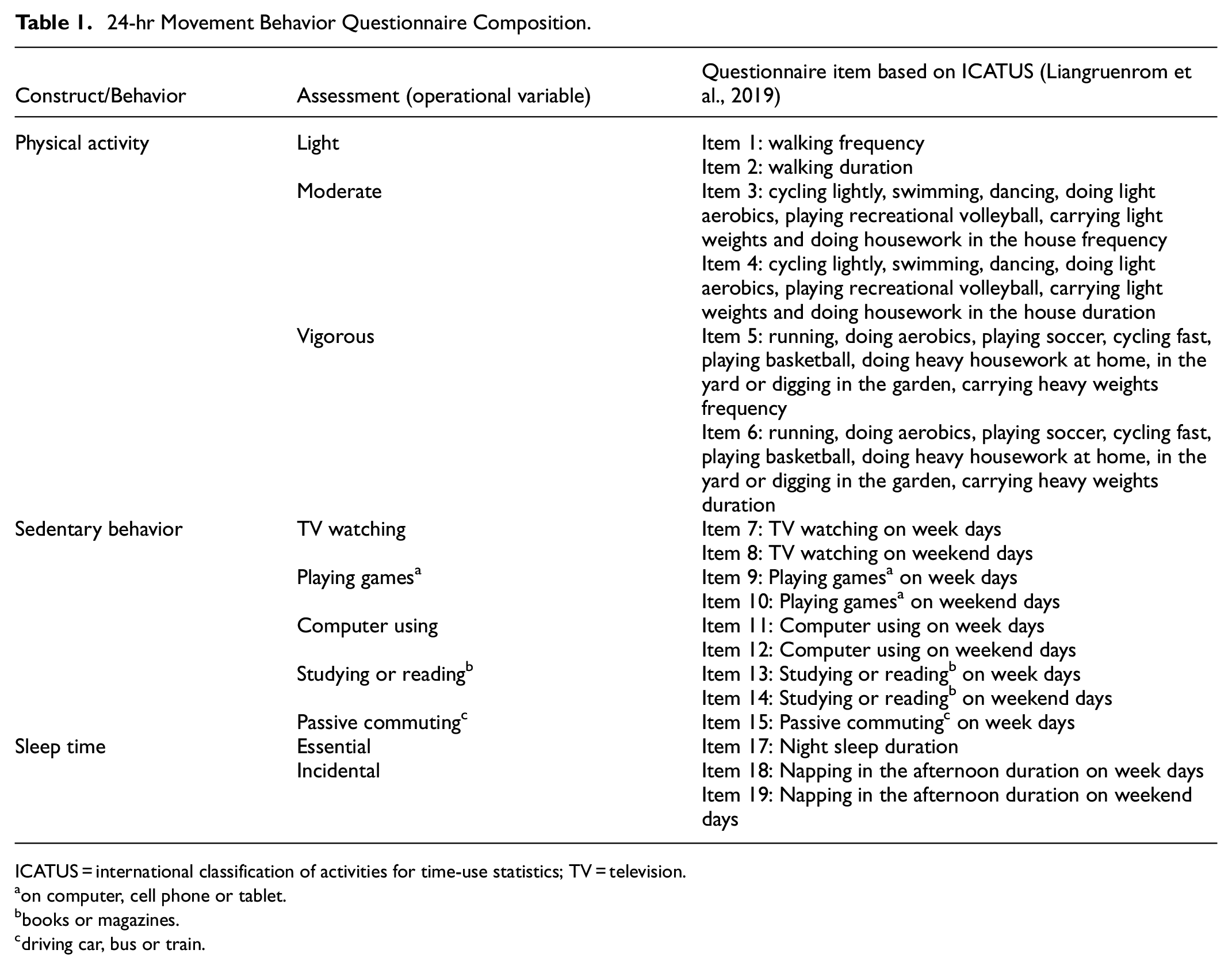
ICATUS = international classification of activities for time-use statistics; TV = television.
on computer, cell phone or tablet.
books or magazines.
driving car, bus or train.
Questionnaire Development: Pre-testing Questions
At this step, 10 undergraduate students in the scientific initiation program answered the questionnaire, examining the extent to which the questions reflect the domain being studied (Boateng et al., 2018). They also provided comments regarding clarity and problems with item comprehension. After that, we reviewed and corrected questionnaire problems.
Questionnaire Development: Reliability and Construct Validity
We conducted questionnaire initial psychometric assessments via classical test theory in two levels (Boateng et al., 2018; Jin et al., 2018; Mooi et al., 2018): exploratory factor analysis (level 1, construct validity) and internal consistency tests (level 2, reliability) (Boateng et al., 2018). Firstly, we conducted a preliminary analysis to determine if the data were factorable with the Kaiser–Meyer–Olkin test (KMO, acceptable threshold was set as >0.50) for sample adequacy and the Bartlett test (p < .05 was considered statistically significant) for sample sphericity (Jin et al., 2018; Martınez-Gonzalez et al., 2014). Secondly, we conducted an exploratory factor analysis with oblique rotation (because the 24 hr-MBQ items were not completely unrelated to each other) (Jin et al., 2018; Martınez-Gonzalez et al., 2014). Thirdly, we extracted the factors (also interpreted as latent constructs) based on the eigenvalue-greater-than-one rule (Kaiser’s rule) (Martınez-Gonzalez et al., 2014). Finally, we assessed the item-score reliability and internal consistency using the corrected item-total correlation and Cronbach’s alpha, respectively (Jin et al., 2018; Martınez-Gonzalez et al., 2014; Mooi et al., 2018).
Two levels were used to reduce the number of items. Level one, we adopted as construct validity criteria a factor loading greater than 0.3, (Jin et al., 2018) and items with uniqueness lesser than 0.6 (Mooi et al., 2018). Level two, we adopted as reliability criteria items with a corrected item-total correlation greater than 0.30 and those whose removal do not show increasing Cronbach’s alpha (Jin et al., 2018). The item with lower than expected both criteria in each level has been removed.
Questionnaire Evaluation: Structural Validity
Previously, all behaviors were harmonized into minutes per day (minutes/day). After that, the total time spent in each behavior was calculated for a complete week, for example: ([light PA frequency * light PA duration]/7) + ([moderate PA frequency * moderate PA duration]/7) + ([vigorous PA frequency * vigorous PA duration]/7). Standardizing the measures was necessary to keep a variable with high variability from dominating the machine learning (Engl et al., 2019). And, grounded on 24 hr-MBQ final version, we built a 24-hr movement period via compositional data analysis (CoDA) statistical technique (Janssen et al., 2020). This approach assumes physical activity, sedentary behavior, and sleep time as codependent variables by conceptualizing movement behavior data as compositions that exist in a constrained space (Rollo et al., 2020). Thus, the proportion of daily time reported in physical activity, sedentary behavior, and sleep time were normalized for each participant so that their sum equaled one (or 100.0%) (Chastin et al., 2015). We also built a triplot to describe the compositional data (in a proportion of daily duration).
We evaluated the questionnaire’s structural validity with unsupervised machine learning, (Engl et al., 2019) this procedure assesses the extent to which an instrument reveals the internal structure of its components as expected or theoretically hypothesized (Kien et al., 2018). Unsupervised machine learning does not involve a predefined outcome (Sidey-Gibbons & Sidey-Gibbons, 2019). Thus, we adopted this technique to find the 24-hr movement behavior hyphotetical structure or dimensionality urdelying the 24-MBQ (Boateng et al., 2018; Engl et al., 2019). Initially, we explored potential clusters graphically with a (dendrogram) hierarchical method using complete linkage (maximum distance from the furthest neighbor) cluster analysis (Engl et al., 2019). Dendrograms graphically present the information regarding which observations are grouped together at various levels of (dis)similarity. Long vertical lines indicate more distinct separation between the groups (StataCorp, 2015a). Long vertical lines at the top of the dendrogram indicate that the groups represented by those lines are well separated from one another. Shorter lines indicate groups that are not as distinct (StataCorp, 2015a). We arbitrary restricted the dendrogram to 15 groups (as potential clusters). Sequentially, we adopted the Duda–Hart stopping-rule to find one of the largest Je(2)/Je(1) index values that corresponded to a low pseudo-T 2 value, which should have larger pseudo-T 2 value values next to it, to determine the number of clusters (StataCorp, 2015b). We retrieved these values based on the number of factors observed in the exploratory factors analysis previously. After identifying the clusters, we applied the k-median method to create latent constructs (StataCorp, 2015b). We used box-plots to compare the time reported in the behaviors stratified by latent constructs. These behaviors (as compositional data) were also described using median and interquartile range (IQR). Finally, we conducted a Kruskal–Wallis test with Dunn’s post hoc test to assess differences among the latent constructs for compositional data for physical activity, sedentary behavior, and sleep time. A p-value of <.05 was considered statistically significant.
Results
The 24 hr-MBQ was composed of 19 items (Table 1). In the preliminary exploratory factor analysis, we identified a Kaiser–Meyer–Olkin test of 0.60 and a significant Bartlett test (p < .001). Thus, grounded in a factorable data matrix, we also identified seven factors using Kaiser’s rule. The explained variance was 66.80% for these seven factors (Table 2). Table 2 shows the questionnaire reliability and construct validity results based on classical test theory. We observed no reliability for duration of light physical activity (item 2, Table 2) in internal consistency (level 2) criteria only. In this case, the question about walking duration increased Cronbach’s alpha (α; from .17 to .29 in factor 6, and from .01 to .49 in factor 7).
24-hr Movement Behavior Questionnaire Reliability and Construct Validity Based on the CTT.
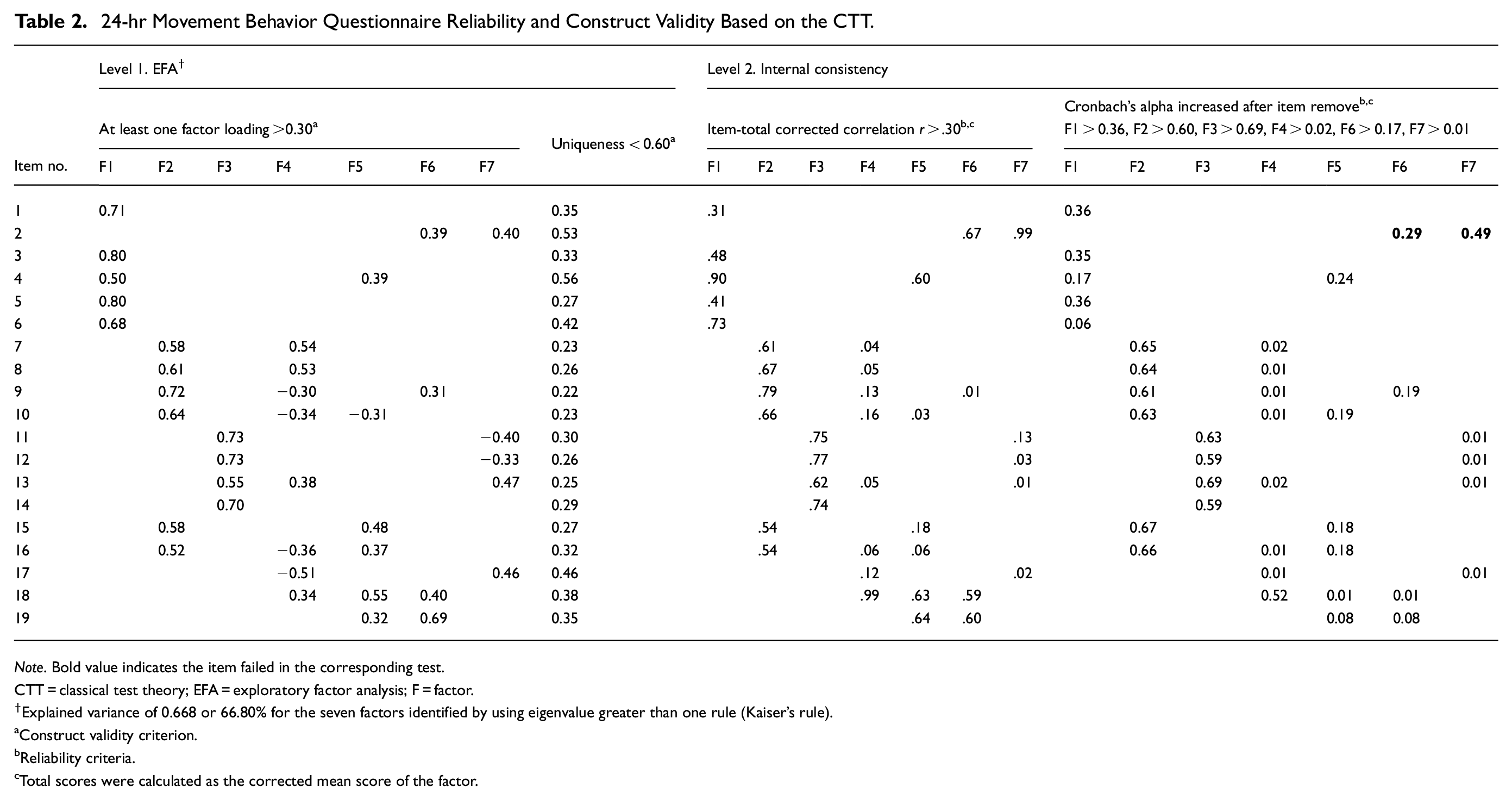
Note. Bold value indicates the item failed in the corresponding test.
CTT = classical test theory; EFA = exploratory factor analysis; F = factor.
Explained variance of 0.668 or 66.80% for the seven factors identified by using eigenvalue greater than one rule (Kaiser’s rule).
Construct validity criterion.
Reliability criteria.
Total scores were calculated as the corrected mean score of the factor.
In this sense, based on the 24 hr-MBQ (with 19 items), the students showed a median of 1038.31 (interquartile range from 844.29 to 1212.86) min/day of 24-hr movement behavior, where only 5.6% performed greater or equal to 1440.0 min/day (or 24 hr/day). Figure 1 demonstrates questionnaire structure and physical activity, sedentary behavior, and sleep time jointly in a triplot. Although graphically the triplot indicates that the majority of 24-hr movement behavior was composed of sedentary behavior, in the unsupervised machine learning assessment, we identified three clusters [Je(2)/Je(1): 0.69; pseudo-T 2 : 53.3] (Supplemental Table 2). We labeled the clusters as latent constructs “physically active” (physical activity median of 55.1 min/day [IQR: 8.9–133.2]; sedentary behavior median of 650.6 min/day [IQR: 595.6–685.7]; sleep time median of 718.7 min/day [IQR: 649.9–779.0]), “sedentary” (physical activity median of 41.7 min/day [IQR: 0.0–80.6]; sedentary behavior median of 853.7 min/day [IQR: 802.9–930.8]; sleep time median of 533.1 min/day [IQR: 440.7–581.6]), and “long sleeper” (physical activity median of 25.4 min/day [IQR: 0–81.5]; sedentary behavior median of 412.2 min/day [IQR: 338.8–470.6]; sleep time median of 964.0 min/day [IQR: 916.4–1060.9]). These constructs were able to identify differences in physical activity (physically active vs. long sleeper, p = .02), sedentary behavior (all cluster comparison, p < .001) and sleep time (all cluster comparison, p < .001) based on Kruskal–Wallis median comparison and Dunn’s post hoc test (Figure 2). The 24 hr-MBQ is available in Portuguese in the Supplemental Figure 1.

24-hr movement behavior questionnaire compositional structure (A) and triplot (B). All variables are harmonized in minutes per day (A) and converted in proportion of daily duration (B).
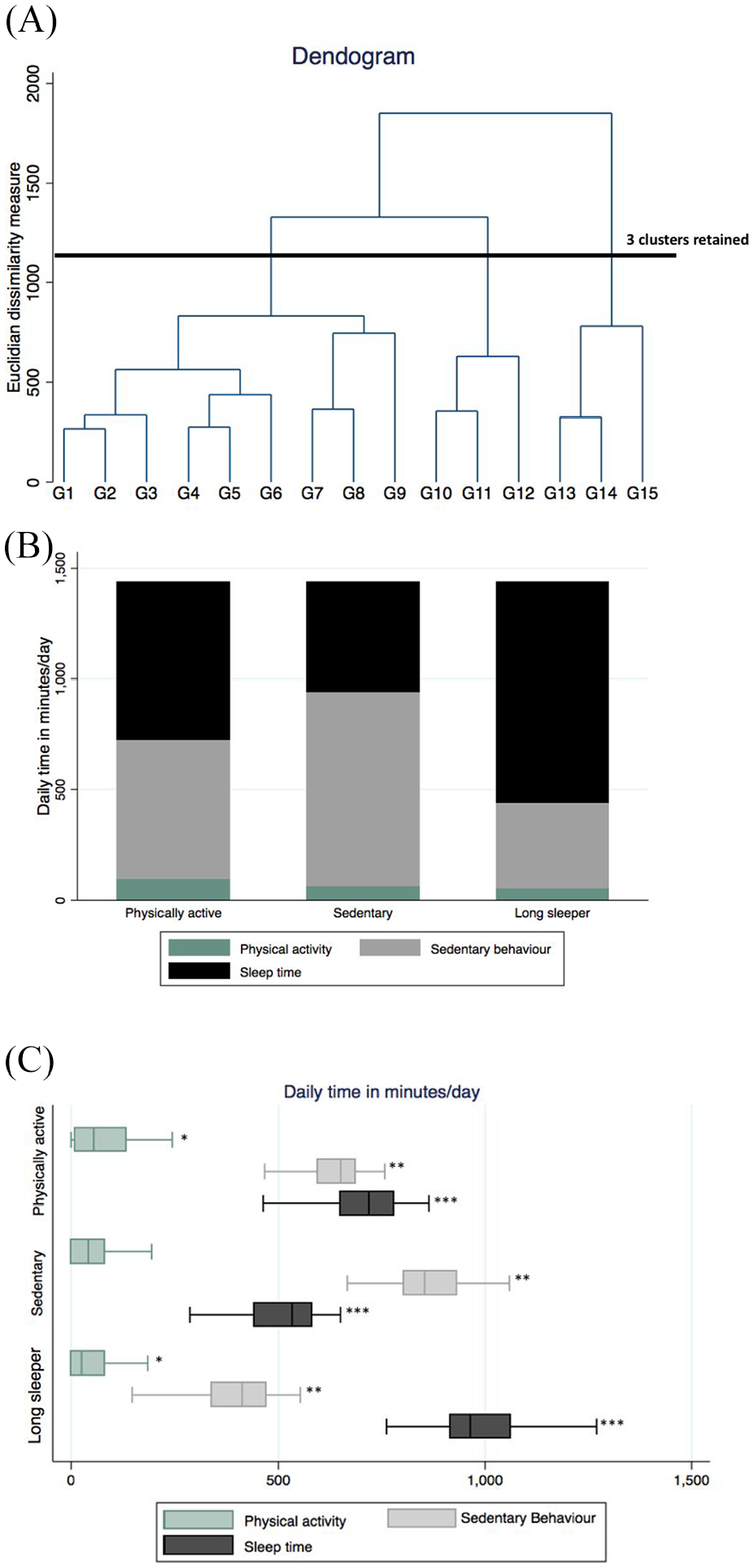
24-hr movement behavior questionnaire hierarchical cluster analysis (A), k-median cluster group distribution (B) and median differences (C). K-W, Kruskal-Wallis.
Discussion
The study novelty is the innovative 19-item questionnaire identifying diverse 24-hr behaviors in college students, crucial for broad-scale epidemiological studies and low-income region surveillance. We described in this study how we developed (or composed) a 24-hr movement behavior questionnaire and how we tested its psychometric properties (test reliability, and construct and structural validity) following international standards (Boateng et al., 2018). The 24 hr-MBQ was composed of six items for physical activity, 10 items for sedentary behavior, and three items for sleep time with acceptable reliability. The classical test theory showed acceptable reliability and construct validity of the 24 hr-MBQ based on 19 items (with no item excluded). Next, unsupervised machine learning was conducted showing questionnaire structure for assessing time-use composition of physical activity, sedentary behavior, and sleep time during a 24-hr period. In this line, the 24 hr-MBQ applied virtually, requires a low response burden on college students in practice with several psychometric qualities, including factorial composition, internal consistency, and structural validity. The questionnaire’s psychometric performance can be attributed to the ability of the chosen items to work together to measure 24-hr behavior.
A recent study in Latin America showed that less than 2% of adults met all three movement guidelines, even though there are no specific public health recommendations concerning 24-hr movement behavior in the continent (the authors adopted Canadian movement guidelines) (Ferrari et al., 2022). Effective strategies are, therefore, needed to promote healthy lifestyles in Latin American adults (Ferrari et al., 2022) and youth (Tapia-Serrano et al., 2022). However, the starting point for identifying public health issues and problems, and for designing and implementing interventions, is the valid behavior measure (Zheng et al., 2023). The lack of standardized and validated measurements (e.g., questionnaires) could partially explain the difficult to evaluate 24-hr movement and elaborate recommendations (as well as public health strategies) (Rodrigues et al., 2022; Song et al., 2021; Zheng et al., 2023). So, the 24 hr-MBQ, in online format, is a low-cost tool for monitoring 24-hr movement behavior in college students during a pandemic period, with social isolation, or even in remote-format research and population surveillance.
A compositional paradigm opens the door to finding the optimum distribution of time spent in different behaviors throughout the day (Chastin et al., 2015). Scientists discuss how to record 24-hr movement behaviors correctly (Rosenberger et al., 2019). Thus, the 24 hr-MBQ is an adapted questionnaire for jointly assessing physical activity (six items from the IPAQ short version), (Matsudo et al., 2001) sedentary behavior (10 items from the SAYCARE SBQ), (De Moraes et al., 2020) and sleep time (one item from the PSQI and two items from the LASA-SBQ) (Bertolazi et al., 2011; Helio Junior, 2016; Visser & Koster, 2013). The 24 hr-MBQ showed acceptable reliability, and its final version overestimated the daily (1,440 min) duration by around 5.6%. There are few published studies we can compare our results with. A comprehensive systematic review retrieved 20 studies addressing the composition of 24-hr movement behaviors, (Rollo et al., 2020) but few studies adopted subjective tools (e.g., questionnaires, diary). In this review, the retrieved studies assessing 24-hr behavior with subjective tools conducted rescaling of the data to sum up to 1440 min/day (Chastin et al., 2015; Foley et al., 2018; Lewthwaite et al., 2019). A detailed rescaling protocol can be found in Chastin et al. (Chastin et al., 2015). Another recent study, in order to control daily overestimation, conducted item exclusion in the questionnaire, (Tapia-Serrano et al., 2021) without testing the instrument’s psychometric properties (or item reduction feasibility). In this sense, we can attribute the low overestimation of the daily behavior durations in our study to the questionnaire development in accordance with the ICATUS standardized criteria for classifying the activity groups, (Liangruenrom et al., 2019) a classification system based on time-use data developed by experts in measurement, epidemiology, and movement behavior. The ICATUS classification system guided us in standardizing the questionnaire considering mutually exclusive and exhaustive behaviors of the time-finite 24-hr day (Liangruenrom et al., 2019). In addition, the time spent in a changing movement behavior is not accompanied by the opposite change in some combination of the remaining movement behaviors when measured separately by questionnaires (Chastin et al., 2015). We can speculate that our short questionnaire with 19 items may have improved the participants’ 24-hr day behavior self-perception.
Our findings indicate 24-hr movement behavior composed mainly of time spent in sedentary behavior in college students, although the questionnaire was able to identify three different latent constructs (“physically active,”“sedentary,” and “long sleeper”). Our findings corroborate those of previous literature, which demonstrate predominance of the sedentary behavior pattern during a 24-hr period in adults (Foley et al., 2018; Kohler et al., 2017) and college students (Barbosa et al., 2016; Cena et al., 2021). There is a lack of evidence about the psychometric properties of the 24-hr movement behavior subjective tool. A similar study showed acceptable criterion validity of a computer-based 24-hr physical activity recall divided into 13 categories (and 262 activities), (Kohler et al., 2017) but with an important participant response burden. In contrast to us, the authors tested the computer-based recall validity for total time spent in sedentary (including sleep time), light, and moderate to vigorous activities (Kohler et al., 2017). However, both studies identified worse performance for validity (and reliability) assessments for light physical activity. This result may be partly explained by the fact that time spent in light activities is underestimated, (Kohler et al., 2017) and respondents have difficulty remembering less vigorous activities (Kelly et al., 2016).
Although machine learning algorithms is being increasingly used in health sciences to predict outcomes based on clinical and epidemiological data, (Engl et al., 2019; Sarker, 2021; Sidey-Gibbons & Sidey-Gibbons, 2019) this study is the first to use unsupervised machine learning to examine questionnaire structure. Here, we explored the machine learning algorithm (for structural validity) in dialog with exploratory factor analysis (for construct validity). Briefly, we adopted exploratory analysis for extracting the maximum common variance from the variables to arrange them under common factors to understand how much each variable contributes to each factor; (Boateng et al., 2018; Jin et al., 2018) whereas, we adopted unsupervised learning in order to simplify complex data by identifying a small number of components (or clusters) which capture the maximum variance (Sarker, 2021). In this sense, the observed differences regarding the number of latent constructs assessed in the construct (seven factors, Table 2) and structural (three clusters, Figure 2) validity is mainly explained by the competing aims instantiated as formal statistical models, a trade-off is often sought between model parsimony (in the extraction of factors and item reduction during questionnaire development) and goodness-of-fit (in the dimensionality assessment during questionnaire evaluation) (Bader & Moshagen, 2022). Aside the benefits of the dialog between these procedures, there are additional advantages for using unsupervised algorithms in questionnaire structure interpretability: (i) the hierarchical clustering created is more informative than an unstructured set of flat clusters (Engl et al., 2019) and (ii) the artificial intelligence methods were less affected by the changes caused by the individuals between the test sets (Costa et al., 2021).
The present study has some limitations. The questionnaire should be externally (criterion) validated in future studies, preferably against an objective measure, (Falck et al., 2021) in order to confirm its ability to measure 24-hr movement behaviors; as well as, examining the psychometric properties in different cultural and economic contexts can improve the understanding of the external generalizability of the findings (e.g., factor solution). The 24 hr-MBQ was developed for assessing jointly physical activity, sedentary behavior, and sleep time and we cannot extend the psychometric performance for assessing each behavior separately (these performances were provided previously) (Bertolazi et al., 2011; De Moraes et al., 2020; Helio Junior, 2016; Matsudo et al., 2001). In addition, given that the 24 hr movement guidelines (or behavioral isotemporal substitution or reallocation) for adults do not include specific recommendations for different domains in which physical activity and sedentary behavior can take place (e.g., work, transport, domestic, leisure time), we did not consider possible differential outcomes of domain or type-specific activities (Kastelic et al., 2021). On the other hand, our study presents strengths. Firstly, we presented for the first time a 24-hr movement behavior questionnaire applied virtually with acceptable psychometric properties, which overcomes the limitations of the 24-hr movement behaviors overlapping. Secondly, we designed a questionnaire based on international standardized criteria for classifying the behavior groups and composed by previous validated ones. Thirdly, our sample is not representative of Brazilian undergraduate students, which is not a limiting factor in this type of studies (Mbuagbaw et al., 2020). However, the sample was calculated in line with best practices in movement behavior validity analysis (M. V. Nascimento-Ferreira et al., 2018). In a post-hoc analysis, with communalities among items above 0.50 (1 – uniqueness, Table 2), our sample size was sufficient to apply factor analysis (Mooi et al., 2018). Based on asymptotic (large-sample) standard test, we also observed that 195 subjects were adequate to detect a change in proportion from 7.7% (proportion of students who meet 24-hr movement guidelines, data not shown) (M. Nascimento-Ferreira et al., 2022) with the power of 100% using a 5%-level two-sided test. Finally, this study was designed exclusively to develop and assess the psychometric properties of epidemiological tools (M. Nascimento-Ferreira et al., 2022).
Conclusions
The 19-item online 24-hr movement behavior questionnaire offers a reliable and valid assessment with reduced burden and costs, identifying active, sedentary, and long-sleeping college students. This questionnaire is a promising tool to investigate 24-hr movement behaviors for large-scale epidemiological studies and a feasible surveillance tool in low-income regions as well.
Supplemental Material
sj-docx-1-sgo-10.1177_21582440251338337 – Supplemental material for Development of a 24-Hour Movement Behavior Questionnaire: Reliability and Validity Testing in College Students From Low-Income Regions
Supplemental material, sj-docx-1-sgo-10.1177_21582440251338337 for Development of a 24-Hour Movement Behavior Questionnaire: Reliability and Validity Testing in College Students From Low-Income Regions by Marcus Vinicius Nascimento-Ferreira, Kliver Antonio Marin, Lorrane Cristine Conceição da Silva, Alaiana Marinho Franco, Francisco Leonardo Torres-Leal, Heráclito Barbosa Carvalho and Augusto César Ferreira De Moraes in SAGE Open
Supplemental Material
sj-docx-2-sgo-10.1177_21582440251338337 – Supplemental material for Development of a 24-Hour Movement Behavior Questionnaire: Reliability and Validity Testing in College Students From Low-Income Regions
Supplemental material, sj-docx-2-sgo-10.1177_21582440251338337 for Development of a 24-Hour Movement Behavior Questionnaire: Reliability and Validity Testing in College Students From Low-Income Regions by Marcus Vinicius Nascimento-Ferreira, Kliver Antonio Marin, Lorrane Cristine Conceição da Silva, Alaiana Marinho Franco, Francisco Leonardo Torres-Leal, Heráclito Barbosa Carvalho and Augusto César Ferreira De Moraes in SAGE Open
Supplemental Material
sj-ppt-3-sgo-10.1177_21582440251338337 – Supplemental material for Development of a 24-Hour Movement Behavior Questionnaire: Reliability and Validity Testing in College Students From Low-Income Regions
Supplemental material, sj-ppt-3-sgo-10.1177_21582440251338337 for Development of a 24-Hour Movement Behavior Questionnaire: Reliability and Validity Testing in College Students From Low-Income Regions by Marcus Vinicius Nascimento-Ferreira, Kliver Antonio Marin, Lorrane Cristine Conceição da Silva, Alaiana Marinho Franco, Francisco Leonardo Torres-Leal, Heráclito Barbosa Carvalho and Augusto César Ferreira De Moraes in SAGE Open
Footnotes
Acknowledgements
All authors acknowledge the university dean/chair of both universities that agreed to participate in this observational study as well as the students for their voluntary participation in the 24h-MESYN (feasibility) study. We thank also Mrs. Vanderlene Brasil Lucena and Shirley Cunha Feuerstein for helping in the study logistic.
ORCID iDs

Ethical Considerations
The study was conducted in accordance with the Declaration of Helsinki, and approved by the Research Ethics Committee of Centro Universitário do Maranhão (No 4,055,604) and Universidade Federal do Tocantins (No 5,161,340), respectively
Consent to Participate
Informed consent was obtained from all subjects involved in the study.
Funding
The author(s) disclosed receipt of the following financial support for the research, authorship, and/or publication of this article: This study was funded by the National Council for Scientific and Technological Development (CNPq, grant numbers 402391/2021–7 and 444580/2024-7), and the Federal University of Tocantins (PROPESQ Universal No. 088/2022). Lorrane Cristine Conceição da Silva received a technical scholarship from CNPq (grant number 370246/2025-0).
Declaration of Conflicting Interests
The author(s) declared no potential conflicts of interest with respect to the research, authorship, and/or publication of this article.
Data Availability Statement
The raw data supporting the conclusions of this article will be made available by the authors, without undue reservation.
Supplemental Material
Supplemental material for this article is available online.
References
Supplementary Material
Please find the following supplemental material available below.
For Open Access articles published under a Creative Commons License, all supplemental material carries the same license as the article it is associated with.
For non-Open Access articles published, all supplemental material carries a non-exclusive license, and permission requests for re-use of supplemental material or any part of supplemental material shall be sent directly to the copyright owner as specified in the copyright notice associated with the article.
