




Abstract
Understanding the built environment’s impact on older adults’ wellbeing necessitates the identification of high-quality measures that capture environmental properties, wellbeing, and needs.
Literature searches were conducted to identify instruments that measure (a) objective environmental properties, (b) wellbeing, (c) needs, and (d) environmental perception, which were evaluated using the COSMIN checklist. Another literature search was conducted to explore which instruments are used in studies examining objective and perceived qualities of the environment in relation to wellbeing.
Of the 54 instruments evaluated, most showed strong content or construct validity, but weak or unreported test-retest reliability. Structural validity and internal consistency tended to be satisfactory in instruments assessing wellbeing and the intersection of environment and wellbeing. Instruments evaluating needs and the perceived environment generally had poor results in our evaluation. Our review of studies assessing both perceived and objective built environments alongside wellbeing indicates a lack of consistent use of validated instruments for older adult populations.
We have identified instruments in each category with mostly sufficient psychometric properties, while the rest require improvement, particularly in terms of structural validity and reliability. Environment evaluation instruments mainly focus on outdoor spaces, leaving indoor spaces underrepresented in literature.
Plain Language Summary
We were interested in studying the connection between the environment older adults live in, their wellbeing, and needs. This led us to the decision of which measurement instruments we should use in an upcoming study. We searched the literature for studies investigating the wellbeing of older adults, and for studies that assess subjective and objective environments to narrow our selection. We narrowed the literature selection to those articles that included assessments of the validity and reliability of the instruments used. For environment assessment tools, we included studies that used either subjective or objective evaluations of living environments. We followed the COSMIN checklist to provide an objective evaluation of the 54 instruments found in the 110 articles included in our literature review. The strength of most wellbeing and needs assessment instruments was the validity of their psychometric properties. However, many instruments were lacking in structural validity as well as reliability. Instruments used to evaluate environments were generally evaluated poorly. We only identified five studies that considered both objective and subjective environmental assessments along with assessments of wellbeing. This demonstrates that the relationship between wellbeing and environmental quality is studied infrequently compared to other studies that consider the wellbeing of older adults. In each category of instruments we assessed, we were able to identify at least one with acceptable psychometric properties. Instruments to assess environments objectively considered both indoor and outdoor spaces, while subjective assessment tools focused more on outdoor spaces leaving a gap related to perceptions of indoor environments.
Introduction
The European population is ageing rapidly, and many older individuals struggle to live independently. Environmental quality can affect wellbeing as it provides ample opportunities to meet needs, but it may threaten health, too (Altomonte et al., 2020; Andargie & Azar, 2019; Chan & Liu, 2018; Huisman et al., 2012; Mendes et al., 2017; Menec et al., 2011; Oswald et al., 2003, 2007; Reddy et al., 2021; ten Bruggencate et al., 2019). Like most people, older adults spend the majority of their time indoors and mostly in cities, making these environments critical to the overall wellbeing of older adults (Klepeis et al., 2001; Sattari et al., 2023).
Researchers have previously examined the links between older adults’ wellbeing, needs, and the built environment (Altomonte et al., 2020; Bayar & Türkoğlu, 2021; Burton et al., 2011; Firdaus, 2017; Guo et al., 2021; Vásquez Sánchez et al., 2020). However, many tools designed to measure these relationships focus solely on outdoor environments, often overlooking indoor spaces, as well as lacking a clear definition of wellbeing or the needs they aim to measure (e.g., Burton et al., 2011; Nordin et al., 2015). To better understand these connections, robust measurements that include both objective environmental properties and individuals’ perceptions of their surroundings are needed. As with these instruments, selecting an appropriate means to assess psychological constructs poses challenges, too. There are many instruments that address the constructs of interest, but in some cases properties like validity and reliability are underreported or not reported at all.
Psychometric Properties of Instruments
Psychological constructs are typically assessed through self-report instruments. These should be valid – capturing the intended construct – and reliable – consistently providing the same or very similar results when used repeatedly under the same conditions. High validity and reliability are fundamental to all activities that rely on instruments, such as comparing different interventions, testing theories, and making clinical decisions (Gremigni, 2020).
Validity is assessed across three main elements: content, construct, and structural validity. Content validity assesses if items cover the full spectrum of what they are meant to measure. Construct validity examines whether a scale measures what it is designed to measure. Structural validity focuses on the internal structure of the instrument – identifying whether the items within the instrument align with the proposed theoretical model or factor structure (Bannigan & Watson, 2009; Fishman & Galguera, 2003).
Facets of reliability include internal consistency and test-retest reliability. Internal consistency examines whether the instrument items that measure the same construct are related to each other in the expected manner. Test-retest reliability considers whether the results of an instrument are consistent when the test is administered in a similar context at two points in time (Bannigan & Watson, 2009; Fishman & Galguera, 2003).
Validity is the central property of an instrument. Generally, if the instrument is deemed valid, it must also be reliable, because high reliability is a necessary condition for high validity. However, a reliable instrument may not be valid (Fishman & Galguera, 2003).
Validity and reliability are also dependent on other factors, like the population being assessed. For example, valid and reliable instruments for younger populations may not be psychometrically sound for older people (Mokkink et al., 2017; Prinsen et al., 2018; Terwee et al., 2018).
Assessment of Psychosocial Wellbeing
Conceptualizations of wellbeing in the field of psychology are diverse (Cooke et al., 2016). We considered wellbeing from a psychosocial perspective that encompasses psychological or emotional wellbeing, social wellbeing, and collective wellbeing, as these are all highly relevant to older adults (Eiroa-orosa, 2020). Although many conceptualizations of wellbeing overlap, creating an all-inclusive instrument is difficult (Linton et al., 2016). Unsurprisingly, the quality of the psychometric properties of wellbeing measures varies greatly (Cooke et al., 2016).
Assessment of Needs
Measuring needs is complex, as people have many needs encompassing physical, psychosocial, spiritual, and environmental domains. Different disciplines use different frameworks and measures to evaluate needs (Lester, 2013). For example, in gerontological social work, the focus is primarily on measuring medical and physical needs, while the psychological and existential aspects are often overlooked (Olaison, 2010). Some researchers have attempted to learn more about needs by relying on personality scales (Taormina & Gao, 2013). These approaches can lead to results that can be misunderstood or, at the very least, incomplete. To address this gap, the World Health Organization introduced the International Classification of Functioning, Disability and Health (ICF), which encompasses body, activities, social, structural, and community environments, highlighting a holistic assessment of needs, including housing needs (Gitlin, 2019; Murphy et al., 2022; Oswald et al., 2007). The ICF has since served as inspiration for various instruments (e.g., Needs of Care; Åhsberg et al., 2017).
Previous research has reported that instruments measuring needs can lack reliability – particularly internal consistency and test-retest reliability – although content validity appears to be sound in many instruments (Kipfer & Pihet, 2020; Tian et al., 2019).
Perception of the Built Environment
With age, older adults may need to move into long-term residential and care facilities, making those spaces an important aspect of wellbeing (Chaudhury et al., 2013; Stolt et al., 2021). The built environment influences older adults’ wellbeing directly through its physical features and indirectly through their perception of it (Evans et al., 2002; Guo et al., 2021). For example, perceptions of neighborhood safety, accessibility, social cohesion, housing quality, surrounding areas, overcrowding, and household size have all been linked to older adults’ psychosocial wellbeing (Fernandez-Portero et al., 2017; Firdaus, 2017; Gale et al., 2011; Giraldez-Garcia et al., 2012; He et al., 2020; Stephens et al., 2019). While these factors primarily address outdoor environments, the SALIENT checklist – which includes sound, air, light, image, ergonomics, and tint – itemizes elements of indoor environments and how they may affect occupant wellbeing (Dolan et al., 2016).
Assessments of environmental quality may be used to identify shortcomings and opportunities for improvements, making the instruments used for assessment important for occupant wellbeing (Andargie & Azar, 2019; Bicket et al., 2010; Koohsari et al., 2019; Liao et al., 2015; Lin & Moudon, 2010; Nyunt et al., 2015; Oswald et al., 2007). Environmental quality is usually measured with self-reports of the perceived environment, for example, residential satisfaction or post-occupancy evaluation (P. Li et al., 2018). These reports may be connected to objective measurements of the built environment (e.g., residential density, number of rooms in the building, air quality, light levels) to provide more contextual information (Smrke, 2022).
Inadequate theoretical foundations, limited research application, and insufficient psychometric data have been identified as weaknesses in environmental quality studies (Elf et al., 2017).
Objective Assessment of the Built Environment
To recommend useful interventions in the built environment, practitioners need to be able to identify elements or attributes of the environment that have a meaningful impact. Given that self-reported evaluations of environmental quality are susceptible to issues like recall errors, reporting bias, and same-source bias (where individuals in a positive state tend to rate their environment more favourably), combining these with objective assessments can help mitigate these limitations (Burton et al., 2011; Pontin et al., 2022). Objective measures can reduce subjectivity while still allowing consideration of unique circumstances, characteristics, and needs of older adults (Garin et al., 2014; Nyunt et al., 2015).
Frequently assessed environmental features include parks, facilities, land use mix, pollution, housing, street and residential density, walkability, natural spaces, location of buildings, and leisure activities. In contrast, safety, aesthetics, accessibility, and transportation are examined less frequently, despite being known to influence older adults’ wellbeing (Burton et al., 2011; Cottagiri et al., 2022; Firdaus, 2017; Giraldez-Garcia et al., 2012; Guo et al., 2021; Pontin et al., 2022; Stephens et al., 2019; C. J. P. Zhang et al., 2019). Geographic information systems (GIS), which provide objective measurements over extensive geographic areas, are widely used to collect a subset of outdoor environmental data (Nordbø et al., 2018; Pontin et al., 2022).
Capturing both objective properties and subjective perceptions of the environment is crucial. Using only one of the approaches may lead to biased or incomplete results and missed associations between the environmental properties and wellbeing (Ball et al., 2008).
Purpose of the Review
The aim of this review was to identify existing instruments that capture older adults’ wellbeing, needs, perception of the built environment, and objective evaluations of the environment, then to assess their psychometric properties following the COnsensus-based Standards for selection of health Measurement INstruments (COSMIN) checklist (Mokkink et al., 2017; Prinsen et al., 2018; Terwee et al., 2018). The review further examines how these instruments are applied in studies exploring the relationships between environmental qualities – both measured and perceived – and wellbeing outcomes in ageing populations.
Methodology
Overview
We conducted five different literature searches to collect data for our systematic literature review. The first four searches were conducted to identify measurement instruments for the (a) older adults’ wellbeing, (b) needs, (c) perception of the built environment, and (c) objective assessment of the built environment. The fifth literature search examined studies on older adults’ wellbeing in relation to the built environment. The goal was to understand which questionnaires are used in these studies, and whether the selection of those questionnaires meets recommended validity and reliability criteria. We followed the PRISMA statement for reporting systematic reviews (Liberati et al., 2009; see Table S8 in Supplemental Material).
Search Strategy
First, we conducted exploratory literature searches to determine the most appropriate keywords for each of the five searches. The final search strings are available in Table S1 in Supplemental Material. Each of the five searches was complemented by the first author with a selection of previously known articles or articles identified through the reference lists of articles found in the initial searches. The first and second authors reviewed the selected articles, as well as those for which the first author encountered uncertainty regarding their inclusion or exclusion. When the authors were uncertain about inclusion, the third author was consulted.
Inclusion and Exclusion Criteria
For all five searches, articles were included if they (a) involved older adults (60 years old or older or with the mean age of 65 years or higher), including papers addressing different age groups if older adults were discussed separately, (b) included cognitively healthy older adults, (c) were written in English, and (d) were peer-reviewed original articles published in scholarly journals.
Each of the first four searches was conducted on PubMed in October 2024. Articles addressing the wellbeing, needs, or perceptions of the environment were included if they reported related psychometric properties. Searches for instruments used to objectively assess the built environment were conducted on PubMed, Scopus, and Web of Science. Since classic psychometric properties are not applicable to these instruments studies were only included if they provided access to the instrument and they examined at least one domain of psychosocial wellbeing together with both perceived and objectively measured aspects of the built environment. Additionally, we expanded our search by reviewing the reference lists of eligible papers and conducting a Google Scholar search using the names of identified instrument from the initial search. This approach aimed to gather a broader array of instruments and more comprehensive data, enabling us to make more informed conclusions regarding the psychometric properties of the questionnaires.
Studies were excluded if they involved (a) older adults with physical or mental illnesses not related to the ageing process (e.g., depression), (b) pharmaceutical, technological, or other interventions and services that are not related to the built environment, (c) wellbeing not related to psychosocial wellbeing (e.g., international, national wellbeing), (d) only differences between individuals (as opposed to focusing on older adults as a group), (e) only caregivers or other stakeholders, and (f) instruments with proxy reports (e.g., caregivers’ reports on older adults’ wellbeing), observational methods, or anecdotal case reports.
During the search and review process, we identified instruments that measure more than one relevant topic simultaneously (e.g., the same instrument capturing psychological wellbeing and environment). These instruments were added to a new category that we examined separately (Figure 1).

Flowchart of the article selection process.
Quality Appraisal
Psychometric properties of the instruments and methodological quality for assessing those properties were evaluated using COSMIN checklist (Mokkink et al., 2017; Prinsen et al., 2018; Terwee et al., 2018). The checklist is an established tool that can be used to select the most robust instrument for research or clinical practice.
The identified instruments were evaluated in terms of construct, content, and structural validity, internal consistency, and test-retest reliability.
We first evaluated the methodological quality of studies assessing psychometric properties of instruments. Methodological quality was rated with “very good”, “adequate”, “doubtful”, or “inadequate” (in our reporting, A, B, C, D, respectively). For example, in the evaluation of construct validity, instruments rated as “very good” were those that were compared with reference instruments based on well-defined constructs and good psychometric properties.
The psychometric properties were rated as “sufficient (+)”, “insufficient (−)”, or “indeterminate (?)”. For example, test-retest reliability was assessed as sufficient if the Intraclass Correlation Coefficient or weighted Kappa was equal to or greater than 0.70 (Mokkink et al., 2017; Prinsen et al., 2018; Terwee et al., 2018).
We refrained from assessing criterion validity, which examines the extent to which instrument scores correlate with a gold standard reference, as we believe that no relevant measures can be unequivocally deemed as gold standards (see Coast et al., 2008 and Bowling et al., 2013 for a related discussion).
In certain instances, original articles claimed to evaluate a particular form of validity or reliability (e.g., criterion validity), but their research methodology indicated that a different form of validity or reliability was assessed (e.g., construct validity). We determined the form of validity or reliability assessed based on the research methodology and COSMIN criteria rather than the authors’ assertion.
In line with the COSMIN criteria, when structural validity was not reported, the methodological quality of its testing was marked as doubtful and measurement properties as indeterminate. Since structural validity is a prerequisite for internal consistency, the methodological quality of testing the latter was marked as inadequate, and its measurement properties as indeterminate (Mokkink et al., 2017; Prinsen et al., 2018; Terwee et al., 2018).
Results
General Characteristics of Evaluated Instruments
Across all searches we identified 110 articles that met our inclusion criteria. Amongst these 110 articles 54 instruments were used, of which 22 were original and 19 were translations or adaptations (Table 1). The instruments were developed, translated, or validated in either one or more countries (e.g., in Norway and Sweden; Bergland et al., 2015) and across different continents (mostly in Europe, followed by Asia and North America). Some articles presented multiple instruments or translations of a single instrument into multiple languages.
General Characteristics of Included Articles.

Note. NR = not relevant.
Instruments Examining Psychosocial Wellbeing
Psychological wellbeing was addressed by 7 out of 13 wellbeing instruments, where the most frequently used instrument was Ryff’s Psychological Wellbeing Scale (Table 2). The remaining instruments assessed social, emotional, subjective, and mental wellbeing constructs. Some wellbeing constructs, such as collective wellbeing, were not assessed by any of the identified instruments. However, community-related wellbeing is included in the Psychological Sense of Community instrument, the Community Commitment Scale, and the Older Adults’ Perceptions of Community-based Connectedness with People instrument (Buckley et al., 2022; Kikuchi et al., 2024; J. I. Kim et al., 2018; Kono et al., 2012).
Names, Abbreviations, and General Information of Included Wellbeing Instruments.
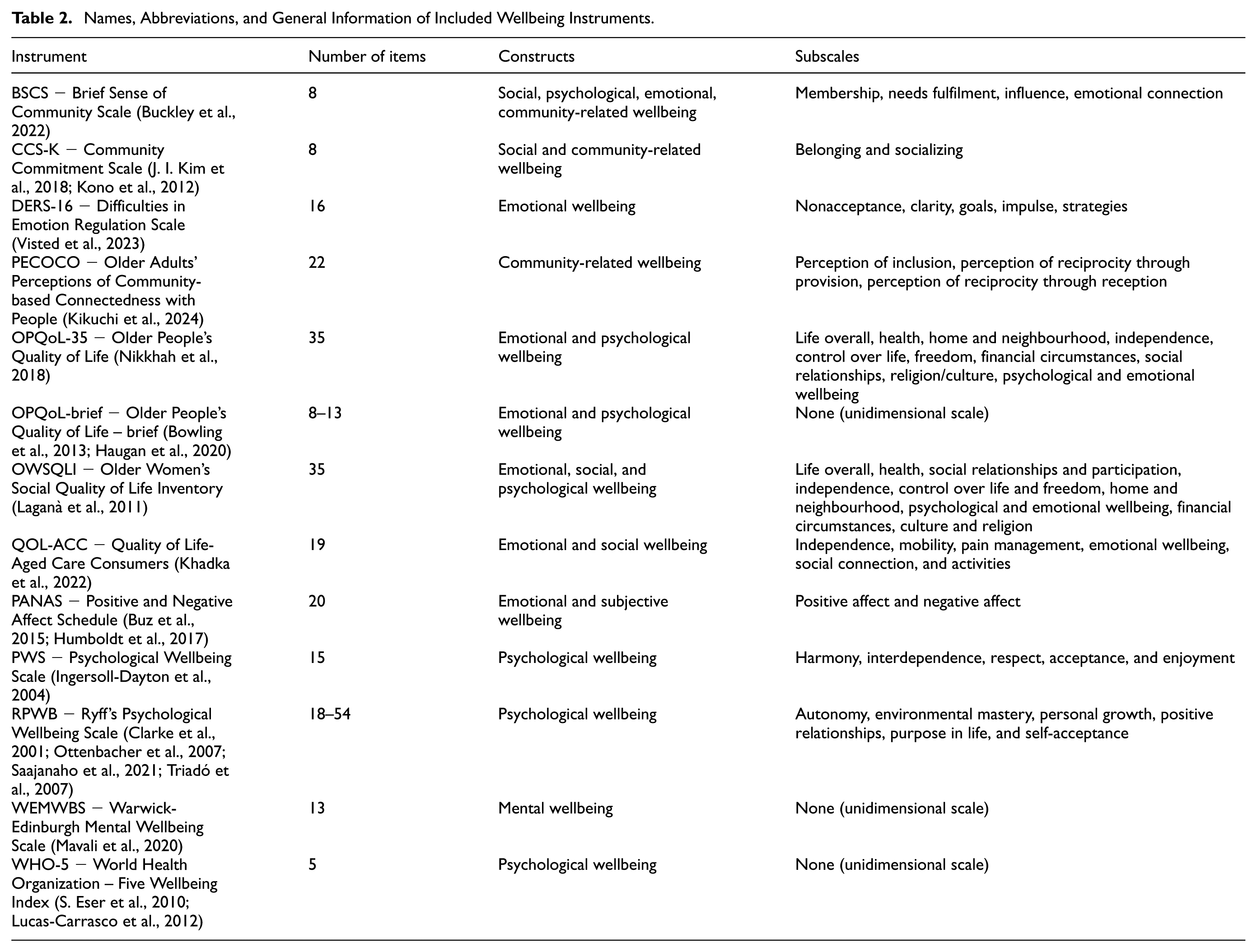
Researchers reported developing their instruments based on:
- literature reviews (Kikuchi et al., 2024; Laganà et al., 2011; Mavali et al., 2020),
- previous scales (Bowling et al., 2013; Buckley et al., 2022; S. Eser et al., 2010; Haugan et al., 2020; Khadka et al., 2022; J. I. Kim et al., 2018; Kono et al., 2012; Lucas-Carrasco et al., 2012; Visted et al., 2023),
- models (Buz et al., 2015),
- theories (Clarke et al., 2001; Ottenbacher et al., 2007; Saajanaho et al., 2021; Triadó et al., 2007),
- a bottom-up approach, which builds on the input from the individuals for whom the measure is designed (Ingersoll-Dayton et al., 2004).
All studies examining the psychometric properties of wellbeing instruments tested internal consistency, and a large majority of employed methods were evaluated as very good (Table 3, see Table S2 for details). Examinations of test-retest and inter-rater reliability were most often not reported or were inadequate.
Quality of Methodological Analysis of Psychometric Properties and Psychometric Properties of Questionnaires Measuring Psychosocial Wellbeing.

Note. A = very good; B = adequate; C = doubtful; D = inadequate; blank = not reported; NA = not applicable; “+” = sufficient; “?” = indeterminate; “−” = insufficient; blank = not reported.
Methodological quality of the psychometric analysis.
Psychometric properties of the instrument.
Content validity was not tested for many instruments. Construct validity was tested more frequently, and the testing approach was almost always adequate or very good. The results showed sufficient construct validity in almost every case. All studies examined structural validity and generally employed a very good methodological approach. However, there were exceptions as some instruments showed only sufficient or insufficient structural validity.
The PANAS, Norwegian OPQoL-brief, Turkish WHO-5, PECOCO, DERS-16, and BSCS instruments were consistently rated well. The methodological quality of the psychometric analysis was good, and internal consistency, construct validity, and structural validity were sufficient. CCS-K, OWSQLI, and the Finnish version of RPW also showed promising validity results, while other instruments demonstrated less favourable psychometric properties.
Instruments Examining Needs
Thirteen different instruments for measuring older adults’ needs were found among 23 articles identified in our search. The most frequently used and translated instrument was the Camberwell Assessment of Need for the Elderly (Abihabib et al., 2011; Reynolds et al., 2000; Stein et al., 2014, 2015; Van Der Roest et al., 2008) (Table 4).
Names, Abbreviations, and General Information of Included Instruments.

These instruments were developed based on:
- previously existing instruments (Abihabib et al., 2011; Åhsberg et al., 2017; Lee et al., 2015; Malley et al., 2012; Reynolds et al., 2000; Stein et al., 2014, 2015; Van Der Roest et al., 2008; Van Leeuwen et al., 2015),
- theories (Gerritsen et al., 2010; Leidy, 1994; Marty et al., 2012; Nieboer & Cramm, 2018; Parkhurst et al., 2016; Vanhove-Meriaux et al., 2020; Zawisza et al., 2020),
- models (Vanhove-Meriaux et al., 2020),
- research design that employed qualitative and quantitative research (Shih et al., 2005, 2008).
The methodological quality for assessing internal consistency of these instruments was mostly poor, while the psychometric properties were indeterminate for many studies, with only three studies rated as sufficient (Table 4). Test-retest and inter-rater reliability were examined in about half of the cases, mostly with adequate methodological approaches and sufficient psychometric properties.
Structural validity was examined in all but two studies, with a mix of poor and good methodological approaches resulting in mostly indeterminate ratings, with only five studies showing sufficient properties. Around half of the studies tested content validity, all with adequate or very good methodology. Construct validity was evaluated in most cases, usually with adequate or very good methodological approaches. The results typically showed sufficient construct validity properties (Table 5, Table S3).
Quality of Methodological Analysis of Psychometric Properties and Psychometric Properties of Questionnaires Measuring Older Adults’ Needs.

Note. A = very good, B = adequate, C = doubtful, D = inadequate, blank = not reported; “+” = sufficient; “?” = indeterminate; “−” = insufficient; blank = not reported.
Methodological quality of the psychometric analysis.
Psychometric properties of the instrument.
SRNS displayed satisfactory properties for the most part. The English and Lebanese versions of CANE, (the English version of) ASCOT, INQ, HNSI, PNFS-OA, and SPF-ILs showed potential with some satisfactory properties. Other instruments were problematic because their psychometric properties were not tested, the psychometric testing was conducted with inadequate methodological rigor, or the psychometric properties did not meet the desired standards.
Instruments for Subjective Evaluation of the Built Environment
Eight instruments that measure perceptions of the built environment were found amongst 11 papers (Table 7). The most frequently used questionnaire was Neighbourhood Environment Walkability Scale. The instruments typically capture transportation, social participation, and safety (Table 6).
Instruments were developed based on:
- previously developed instruments (Bailey-Catalán et al., 2019; Cerin et al., 2010, 2021; Starnes et al., 2014; Stolt et al., 2021; Yoon et al., 2015),
- previous research and expert panel (Cerin et al., 2021),
- literature reviews (Lak et al., 2019),
- checklists (Dikken et al., 2020; Garner & Holland, 2020; K. Kim et al., 2022; Özer et al., 2023).
All studies tested internal consistency, two thirds of which applied very good methodology (Table 6). One third of all studies showed sufficient internal consistency properties. Less than half of the studies examined test-retest and inter-rater reliability, mostly with adequate methodological approaches. In all cases, the results showed either insufficient or indeterminate properties.
Names, Abbreviations, and General Information of Included Instruments.
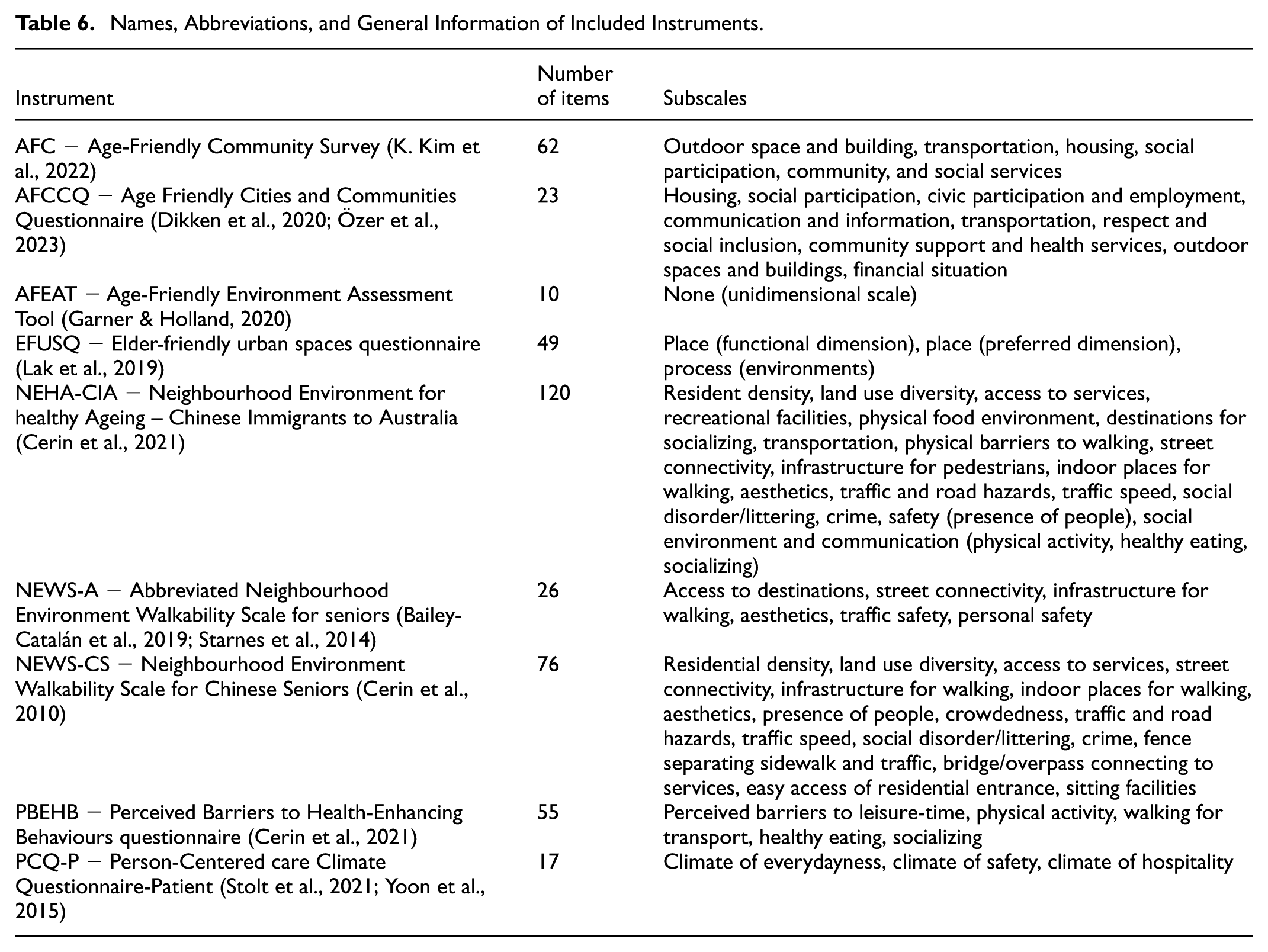
Content and construct validity were tested in more than half of the studies, with either adequate or very good methodology. Structural validity was examined in all studies; in one third of the studies with doubtful methodology and in the remaining studies with adequate or very good methodology. In more than half of the cases, construct validity was indeterminate; in other cases, it was sufficient (Table 7, Table S4).
Quality of Methodological Analysis of Psychometric Properties and Psychometric Properties of Questionnaires Measuring Older Adults’ Perception of the Built Environment.

Note. A = very good, B = adequate, C = doubtful, D = inadequate, blank = not reported, NA = not applicable; “+” = sufficient; “?” = indeterminate; “−” = insufficient; blank = not reported.
Methodological quality of the psychometric analysis.
Psychometric properties of the instrument.
The AFCCQ, the North American version of PCQ-P, and AFEAT stand out in terms of psychometric properties, demonstrating sufficient reliability as well as construct and structural validity, all tested with sound methodology. NEWS-CS, NEHA-CIA, and the Finnish version of PCQ-P exhibited promising psychometric properties, although with some important shortcomings.
Instruments Measuring Needs or Wellbeing, and Perceived Built Environment
From 14 articles we extracted seven instruments that simultaneously measure perceived built environment and psychosocial wellbeing or needs of older adults. The most frequently used instrument was WHOQoL (Table 8).
Names, Abbreviations, and General Information of Included Instruments.

Instruments were developed based on:
- theory (Arani et al., 2022; Bergland et al., 2015; Molony et al., 2007; Varer Akpinar et al., 2023),
- a bottom-up approach (Weil, 2020),
- existing checklists and instruments (Cheng et al., 2023; E. Eser & Özcan, 2020; S. Eser et al., 2010; Gebrye et al., 2023; Gil-Lacruz et al., 2022; C. P. Li et al., 2021; Liang et al., 2009).
All 14 papers tested internal consistency, and the methodology was very good in nearly all cases. In more than half of the studies, the internal consistency was sufficient. Test-retest and inter-rater reliability were assessed in one third of the cases, with varying degrees of methodological quality, ranging from robust to poor. Sufficient properties were observed in half of these studies.
Content or construct validity was tested in almost all cases. Content validity was generally tested with poor methodological approaches, whereas construct validity assessments generally employed robust methodologies. Construct validity showed sufficient properties in all but one study where it was examined. Structural validity was tested in almost all the cases, for the most part with adequate or very good methodological approaches. The properties were sufficient in half of the cases and the rest were mostly indeterminate (Table 9, Table S5).
Quality of Methodological Analysis of Psychometric Properties and Psychometric Properties of Questionnaires Measuring Perception of the Built Environment and Needs or Psychosocial Wellbeing.

Note. A = Very good; B = Adequate; C = Doubtful; D = Inadequate; white = not reported; “+” = sufficient; “?” = indeterminate; “−” = insufficient; “blank” = not reported.
Methodological quality of the psychometric analysis.
Psychometric properties of the instrument.
PPFM-OA, NHAS, and WHOQoL, in all its versions, displayed the best psychometric properties among the tested instruments. EoH and HCQ exhibited promising psychometric properties, although with some important inadequacies. Other instruments showed deficiencies in at least one important aspect.
Instruments for Objective Assessments of the Built Environment
Thirteen different instruments for objectively assessing the built environment were found in the 42 articles included in our study (Table 10). Although Geographic Information Systems (GIS) are not conventional questionnaire-based instruments, we have included them here because they are so frequently used.
Names, Abbreviations, and References of Included Instruments.

Many methods are employed to objectively describe the environment. For example, GIS uses spatial data, such as maps, satellite imagery, and geographic coordinates to formulate a detailed representation of the environment. Investigator observations of the environment involve direct observation through sensory perceptions and include qualitative descriptions and/or quantitative measurements. Environmental audits and checklists involve systematic examination of the environment based on predetermined criteria.
Different instruments address different aspects of the built environment, which can be divided into four domains: (a) density, connectivity, proximity, and walkability, (b) availability and accessibility, (c) safety, (d) and quality of the environment:
Density, connectivity, proximity, and walkability encompass various factors such as public transport, seating places, street connectivity, intersections, recreational facilities, and amenities. This domain is assessed predominantly using GIS (e.g., ArcGIS, Seasonal Persistent Green Cover), national databases, and similar tools;
Availability and accessibility focus on relevant factors related to different areas, such as housing (e.g., hallway width) and walkability (e.g., sidewalks). GIS and national databases, as well as HEST, are used frequently in this domain, while EVOLVE, and CBE-OUT may evaluate subsets of this domain;
Safety comprises aspects such as safety from crime, bathroom safety, and pollution. HEST is a prevalent tool for assessing this domain. However, EAST-HK, EVOLVE and CBE-OUT appear to evaluate a greater number of subdomains when compared to HEST;
Quality of the environment focuses on factors such as the quality of the infrastructure, size of dwellings, and the type and shape of streets. HEST remains a widely embraced instrument within this domain. Notably, EVOLVE, CBE-OUT, CCSS, and AS 4299 comprehensively address most subdomains.
These domains are presented in Table 11, where coloured squares indicate the frequency of instrument usage in research studies for each domain, offering a visual representation of the prevalence and emphasis on specific instruments within each domain. Within the table, the symbol “x” signifies the possibility of the instrument measuring a subdomain. Absence of colour indicates that the authors did not employ this particular aspect of the instrument in their study.
Overview of Instruments for Measuring Built Environment Objectively.


Note. An instrument mentioned by 1–3 papers = light blue, 4–6 papers = yellow, 7–9 papers = orange, 10 or more = red; “x” indicates the measurable categories of the instrument. AS 4299 = Australian Design Access and Mobility Standard AS 4299 (Adaptable Housing); CAT-AV = Community Audit Tool-Analytic Version; CBE-OUT = COURAGE Built Environment Self-Reported Questionnaire; CCSS = Corridor Coding System Scales; EAST-HK = Environment in Asia Scan Tool – Hong Kong version; EVOLVE = Evaluation of Older People’s Living Environments; GIS + National databases refer to several tools used, see Supplementary file S6 for details; HEST = Housing Enabler Screening Tool; HOME FAST = Home Falls Accidents Screening Tool; NeDeCC = Neighbourhood Design Characteristics Checklist; SSWS = Street Smart Walk Score®.
The selection of the appropriate tool for objective assessments of the built environment largely depends on the domains one wishes to examine. For example, to measure proximities (of grocery stores), GIS and national databases hold significant potential, while for evaluating safety and quality of the environment, especially indoors, checklists and environmental audits (systematic evaluations of an environment, which follows environmental requirement standards) are a more suitable choice (Table 11; more details in Supplementary file S6).
The categories and subscales identified here are those reflected in the instruments included in this review. Of included instruments, EVOLVE addresses the most categories (20), followed by GIS and national databases, and CBE-OUT (17 each). Additionally, GIS, EVOLVE, CCSS, CBE-OUT, CAT-AV, and AS 4299 can be used to measure at least one subscale from all categories.
Measuring Psychosocial Wellbeing and Objective and Perceived Built Environment
Objective environments have primarily been assessed using national databases, GIS, and checklists. We identified five articles that measured psychosocial wellbeing together with objective and perceived built environment. The instruments employed by the studies varied widely (Table 12).
Instruments Used to Measure Older Adults’ Psychosocial Wellbeing, Together With Perceived and Objective Built Environment.

Note. PANAS = Positive and Negative Affect Scale; ICECAP-O = Investigating Choice Experiments for the Preferences of Older People; NEWS-A = Abbreviated Neighbourhood Environment Walkability Scale for seniors; SSWS = Street Smart Walk Score; WHOQoL-BREF = The World Health Organization Quality of Life Brief Version; BSCS = Brief Sense of Community Scale; AFC = Age-Friendly Community Survey.
Researchers have combined different instruments to evaluate psychosocial wellbeing alongside perceived and objective built environments. Even when the same tool was used in two studies, it was used differently. Phillips et al. (2005) and Yue et al. (2022) both employed WHOQoL-BREF but used a different number of questionnaire items, and different domains were assessed with GIS.
In terms of wellbeing assessment from the selected studies, PANAS, WHOQoL-BREF, ICECAP-O, and BSCS underwent psychometrics testing within a sample of older adults. Among these, all instruments demonstrated good psychometric properties except for ICECAP-O, which exhibited insufficient reliability and structural validity (Tables 3 and 5). Data regarding residential satisfaction, life satisfaction, and happiness were gathered through single-item measures, introducing potential measurement errors and social desirability bias (Bowling et al., 2013; Sarstedt & Wilczynski, 2009).
In the included studies, perceptions of the built environment were assessed with NEWS-A, AFC, or modified questionnaires that were based on existing instruments (Engel et al., 2016; Evans et al., 2002; Guo et al., 2021; Phillips et al., 2005) or theories (Yue et al., 2022). To the best of our knowledge, the psychometric properties of these instruments were not tested on older adults, except for the NEWS-A (Starnes et al., 2014) and AFC (K. Kim et al., 2022). In both instruments, only structural validity and internal consistency were examined. Both showed good structural validity, but only AFC demonstrated good internal consistency (Table 7).
Discussion
We found that reliability and validity are often insufficiently reported, and when they are reported, are inadequate. Nonetheless, there are instruments with promising psychometric properties that provide useful insights into wellbeing and needs, and those that allow researchers to assess perceptions of the built environment or its objective properties.
Wellbeing, Needs, and Perception of the Built Environment
Conceptual Frameworks and Theories
Definitions and theoretical frameworks behind the instruments for assessing needs and wellbeing are lacking or vary broadly, making the creation of reliable and valid instruments difficult (Zhang & Chen, 2019). We found many cases where structural validity was low, raising questions about the instruments alignment with the theories they are based on.
Many tools seem to capture only a part of the larger construct that might be of interest to researchers exploring the relationship between wellbeing and environment. For example, wellbeing instruments tend to focus only on specific domains, such as emotional wellbeing, and do not examine wellbeing holistically (possibly because of the difficulty defining holistic wellbeing mentioned previously). On top of this, some potential constructs of interest, like collective wellbeing, are not frequently investigated. This may be due to ambiguous definitions, lack of instruments, or substantial overlap with a related wellbeing domain that is being measured.
Additional challenges arise when trying to understand and assess the relationship(s) between older adults’ wellbeing, needs, and the built environment. To explore how the built environment influences older adults’ wellbeing, we might wish to examine how it addresses or hinders their needs along with how their needs satisfaction affects their wellbeing. This is not an easy task, as there are many ways to define and measure these concepts, and there is no agreement on which features of the built environment are most relevant to specific needs, and which needs are most important for different domains of wellbeing.
Psychometric Properties
In the analysis of all identified instruments, we found that examinations of psychometric properties are often lacking. In several cases, aspects of validity or reliability were either not tested at all, were tested poorly, or the resulting psychometric properties failed to meet acceptable standards. Even content validity, which is considered to be a crucial measure (Mokkink et al., 2017; Prinsen et al., 2018; Terwee et al., 2018), was omitted from discussions in more than half of the identified studies (Table 13 and Table S7 in Supplemental Material). Similar findings were reported by other studies examining instruments for analysing wellbeing (Cooke et al., 2016), needs (Kipfer & Pihet, 2020; Tian et al., 2019), and residential satisfaction (Smrke et al., 2018). For example, instruments included in Elf et al.’s (2017) review were mostly tested for either content or construct validity, yet frequently lacked data on reliability.
Summary of Instruments Across Domains With Satisfactory Psychometric Properties.

Only about one fourth of the studies reported both reliability and validity measures, with most of these being more recent – showing a positive trend in assessment methodology. Both types of validity are essential, as they measure different but important properties of an instrument. Even widely used scales like PANAS, RPW, WHOQoL, and WEMWBS lack comprehensive evaluations of content and construct validity, as well as reports on reliability for older populations.
In some cases, instruments that were translated or modified did not receive a thorough psychometric analysis, even though validity is subject to change in such situations, and should always be analysed (Cerin et al., 2010; Linton et al., 2016).
Studies examining instruments to assess older adults’ wellbeing often did not report test-retest reliability, and internal consistency results were generally insufficient. While construct validity was typically sufficient in most cases, there was a notable lack of content validity.
In contrast, studies describing instruments to assess older adults’ needs tended to report results of content and construct validity, supporting previous findings by Kipfer and Pihet (2020) and Tian et al. (2019). In most cases psychometric properties were adequate to very good, while structural validity tended to be weak. Reliability was either omitted or, when reported, usually rated as low (Tables 13). Studies examining instruments for perception of the built environment typically reported content or construct validity, which was generally sufficient, while half of the results on structural validity were indeterminate.
Psychometric properties for instruments measuring multiple constructs (i.e., wellbeing or needs and the built environment) were critically lacking, as construct, content and structural validity, and test-retest reliability, tended to be unreported or insufficient. Although, structural validity and internal consistency were frequently well reported, their psychometric properties were questionable in half of the included studies. This inconsistency likely stems from the lack of a theoretical foundation or conceptual framework linking wellbeing and the built environment. This shortcoming should be carefully considered before designing new instruments for this purpose.
Given these results, it is challenging to pinpoint which questionnaires are more suitable for specific applications. However, some instruments demonstrated more robust psychometric properties than others, these were: PANAS, PECOCO, OPQoL-brief, DERS-16, and BSCS for wellbeing; SRNS for needs; AFCCQ, AFEAT, and PCQ-P for perception of the built environment; and PPFM-OA and WHOQoL for measuring wellbeing and the built environment (Tables 13 and S1).
Another limitation of existing instruments is that questionnaires rarely integrate measurements of both wellbeing and environmental factors. Of those that do, the focus is often limited to outdoor environments, leaving indoor spaces largely unexamined (e.g., E. Eser & Özcan, 2020; Liang et al., 2009; Weil, 2020). Moreover, to our knowledge, no comprehensive tool exists that connects the built environment with the holistic needs of older adults. This gap is due to a lack of theoretical foundations that link the built environment to the needs of older adults, though some efforts have been made (Vásquez Sánchez et al., 2020). Additionally, no instrument currently measures wellbeing or needs and both perceived and objective aspects of the built environment.
Objective Built Environment
Objective measurements of the built environment could be categorised into three groups: (a) GIS, (b) observations (e.g., Google Street views) and audits, and (c) instruments based on building standards. When considering sustainability evaluation, various instruments such as BREEAM, LEED, and Sustainable Sites Initiative are available. Some instruments, including BREEAM for Communities, LEED for Neighbourhood Development, and Green Start for Communities, have also been adapted to assess the age-friendliness of the built environment effectively (Siew, 2016). However, their psychometric properties have not been tested (Elf et al., 2017).
Most often, objective measurement of the environment covers (a) density, connectivity, proximity, and walkability, (b) availability and accessibility, (c) safety, and (d) quality of the environment. Density, connectivity, proximity, and walkability are most often evaluated by GIS and national databases. Availability and accessibility of places showed more diversity in measurement, with GIS and national databases, and checklists such as HEST, CBE-OUT, and EVOLVE being commonly used. Safety and environmental quality are frequently measured using checklists and environmental audits. The tools used most frequently were EVOLVE and CBE-OUT, which may be due to the broad coverage of criteria they include.
Most of the identified instruments orientate towards outdoor environments. Less focus is given to interior spaces, which are important due to the amount of time older adults spend indoors. This oversight leads to a critical gap in assessments of the relationship between the built environment and the wellbeing of older adults. While some studies have addressed some physical aspects of the environment that affect older adult’s health, such as indoor pollutants and lighting, many other environmental factors remain underexplored (Andargie & Azar, 2019; Chan & Liu, 2018; Huisman et al., 2012; Klepeis et al., 2001; Mendes et al., 2017; Reddy et al., 2021). These quantitative factors should be assessed along with subjective preferences of older adults concerning their living space layout, building materials, lighting, and other properties that have an important effect on their wellbeing and fulfilment of needs (Bigonnesse et al., 2014; Burton et al., 2011; Campbell, 2015; Gibney et al., 2020; Lipovac & Burnard, 2021; Nygaard et al., 2021; Serrano-Jiménez et al., 2019).
To our knowledge, no tool currently exists for assessing instruments examining the built environment (i.e., similar to the COSMIN checklist). Therefore, we did not evaluate the quality of the instruments included in this review. At this point, it remains unclear to what degree and with what accuracy the identified instruments capture relevant aspects of the environment.
Research on Older Adults’ Wellbeing, Perceived and Objective Built Environment
Few studies have simultaneously examined older adults’ wellbeing, their satisfaction with the built environment, and objective environmental properties, despite a substantial body of literature on each component and recent research emphasizing the positive effects of age-friendly built environments on wellbeing (Firdaus, 2017; Gale et al., 2011; Nikkhah et al., 2018; Nordin et al., 2017). While some studies evaluated the built environment both objectively and subjectively from older adults’ perspectives (Hoehner et al., 2005; Hou et al., 2020; Koohsari et al., 2015; Y. Li et al., 2020; Lin & Moudon, 2010; Nyunt et al., 2015), they often did not measure psychosocial wellbeing. The studies that did measure wellbeing tended to capture only older adults’ perception of the built environment without measuring the environment objectively (Burton et al., 2011).
Still, we did identify studies that simultaneously measured all aspects – wellbeing, perception of the built environment, and objective environmental properties. From the instruments used in these studies, WHOQoL-BREF, PANAS, BSCS, and ICECAP-O’s psychometric properties were previously tested in a population of older adults and show the most promising results, while they also exhibit some issues. PANAS (measuring wellbeing) lacks reports on test-retest reliability and content validity results, ICECAP-O (measuring needs) lacks reports on structural validity and internal consistency, while BSCS (measuring wellbeing) lacks reports on test-retest reliability and content validity. The WHOQoL-BREF (measuring wellbeing and the environmental domain) mostly lacks results on validity. From the instruments identified for measuring the perception of the built environment, only NEWS was previously tested on older adults. The instrument lacks reports on its psychometric properties, except for structural validity which was found to be sufficient. Other studies (Evans et al., 2002; Guo et al., 2021; Phillips et al., 2005; Yue et al., 2022) utilized instruments that were not psychometrically tested on older adults, potentially undermining the validity of the study outcomes.
Life satisfaction and happiness are often evaluated with single-item measures, which pose challenges for the evaluation of reliability and validity (Bowling, 2005; Sarstedt & Wilczynski, 2009).
We observed a lack of clarity and consensus on definition of psychosocial wellbeing and on a conceptual framework linking wellbeing to the built environment, which may contribute to the challenges we have observed. Additionally, collective wellbeing is notably absent from existing psychosocial wellbeing measures. As a result, we lack appropriate tools to assess collective wellbeing. While instruments such as the Collective Efficacy Scale have been utilized in previous studies we were unable to confirm they had been tested with older adults.
Limitations
Studies on age-friendly environments use diverse keywords and publication strategies (i.e., publishing in a wide range of journals related to construction, materials, psychology, gerontology), making them difficult to discover. To address this issue, we used an exploratory approach before conducting our review to determine the most appropriate keywords, but some relevant studies may not have been included.
Using only PubMed to search for studies that examined both the objective and subjective environment in relation to wellbeing limited the pool of identified instruments. We attempted to mitigate this by looking for additional studies in reference lists of the studies discovered through the initial search.
Cross-cultural validity was not addressed in our assessment of these instruments. This is a relevant factor that should be considered in a future study (Ingersoll-Dayton, 2011).
Conclusion
We have reviewed several instruments that measure older adults’ psychosocial wellbeing and needs, as well as objective and perceived qualities of the built environment. We also examined instrument use in studies that simultaneously investigate all these constructs.
Although many of the reviewed instruments have been widely used, several either (a) do not test reliability or validity with a suitable methodology, (b) do not adequately report on results of reliability and validity testing, or (c) exhibit low reliability or validity.
Despite these limitations, some of the evaluated instruments show stronger psychometric properties and can be cautiously recommended for use. PANAS, WHO-5, PECOCO, DERS-16, BSCS, and OPQoL-brief performed well in measuring psychosocial wellbeing; SRNS showed promise for assessing needs; and AFFCCQ, PCQ-P, and AFEAT exhibited the greatest potential for evaluating perception of the built environment. WHOQoL, NHAS, and PPFM-OA are promising for measuring wellbeing or needs as well as the built environment in the same instrument. Existing instruments and tools for assessing built environments objectively are mostly orientated towards outdoor environments. GIS and checklists are commonly used for assessing many attributes of the physical environment. EVOLVE and CBE-OUT are widely used instruments for objectively evaluating the built environment, covering all domains – including interiors, which are neglected by other frequently used tools, like GIS. Indoor environments are crucial for older adults’ wellbeing and should be investigated more closely. Additionally, we lack psychometrically sound instruments that could evaluate wellbeing or needs together with the built environment.
There is an advantage to using existing, well-established instruments rather than developing new ones. When using an existing instrument with good psychometric properties, there is no need for the long and exhaustive process of new instrument construction that ensures its reliability and validity. The use of existing instruments also eases comparison between studies that have used the same instrument. We call for thorough testing and reporting of psychometric properties, so researchers can compare existing instruments and use the one best suited for their topic of interest. Psychometric properties should be re-evaluated when instruments are modified or translated.
Given the scarcity of studies capturing all three aspects − psychosocial wellbeing, perceived environment, and objective environmental measures − alongside the issues with psychometric rigor and scope, we urge researchers to continue to explore this pertinent topic and to select research instruments with care.
Supplemental Material
sj-docx-1-sgo-10.1177_21582440251380110 – Supplemental material for A Systematic Review and Evaluation of Measurement Instruments Assessing the Needs, Wellbeing, and Living Environments of Older Adults
Supplemental material, sj-docx-1-sgo-10.1177_21582440251380110 for A Systematic Review and Evaluation of Measurement Instruments Assessing the Needs, Wellbeing, and Living Environments of Older Adults by Mateja Erce Paoli, Dean Lipovac and Michael D. Burnard in SAGE Open
Footnotes

Ethical Considerations
There are no human participants in this article and informed consent is not required.
Funding
The authors disclosed receipt of the following financial support for the research, authorship, and/or publication of this article: The authors gratefully acknowledge the European Commission for funding the Horizon 2020 projects Pilots for Healthy and Active Ageing (GA# 857188) and InnoRenew CoE (GA# 739574) and the Republic of Slovenia (Investment funding of the Republic of Slovenia and the European Union of the European Regional Development Fund). The authors additionally acknowledge the Slovenian Research and Innovation Agency for supporting the BUILDWELL project (N2-0386).
Declaration of Conflicting Interests
The authors declared no potential conflicts of interest with respect to the research, authorship, and/or publication of this article.
Data Availability Statement
Data sharing not applicable to this article as no datasets were generated or analyzed during the current study.
Supplemental Material
Supplemental material for this article is available online.
References
Supplementary Material
Please find the following supplemental material available below.
For Open Access articles published under a Creative Commons License, all supplemental material carries the same license as the article it is associated with.
For non-Open Access articles published, all supplemental material carries a non-exclusive license, and permission requests for re-use of supplemental material or any part of supplemental material shall be sent directly to the copyright owner as specified in the copyright notice associated with the article.
