



Abstract
The study analyzes the impact of financial incentives, production inputs, technology adoption, policy infrastructure, and labor dynamics on the likelihood of Income Disruption (ID) events in agribusinesses. The research identifies key financial metrics contributing to ID risks using the Cox Proportional Hazards (PH) Model and time-to-failure data from 1- to 2-year prior models. Agribusinesses are classified into Super, A, B, C, and D categories based on their agricultural wholesale produce market registration. This study focuses on the IIIA Agro Climatic Zone of Rajasthan, a semi-arid region consisting of districts such as Jaipur, Ajmer, Tonk, and Dausa. Characterized by erratic rainfall, poor water retention, and extreme temperatures, agribusinesses in this zone encounters heightened ID risks due to environmental and infrastructural challenges. The findings show that excessive spending relative to income, low profit margins, and poor asset returns significantly increase ID risk in the 1-year model. In the 2-year model, factors such as gross loan charge-offs relative to income also elevate ID risk. However, when appropriately leveraged, financial incentives and subsidies reduce the likelihood of income disruptions. The study emphasizes the importance of financial strategies, including subsidies and technology adoption, to mitigate risks in agribusinesses. From a policy perspective, the results underscore the need for long-term investments in climate-smart agriculture. Policymakers should focus on improving access to credit, supporting digital transformation, and fostering resilience through sustainable agricultural practices. These strategies will enable agribusinesses to endure the challenges of climate variability and market volatility, contributing to their overall financial sustainability.
Plain language summary
The study uses a statistical method called the Cox proportional hazard model to look at how long it takes for income disruptions to happen in agribusinesses. They look at various factors that might affect these disruptions in areas with semi-arid climates. Agribusinesses are divided into different categories based on their size in the agricultural market. The results show that certain factors, like expenses compared to income, can increase the risk of income disruption. However, some strategies, like receiving incentives, might reduce this risk. Overall, the study suggests that certain actions could either increase or decrease the chances of income disruptions in agribusinesses facing agricultural risks. This information can help policymakers make better decisions about dealing with these challenges.
Introduction
As Indian agriculture transitions from the Green Revolution to the Amrit Kaal, the sector retains its crucial role in socio-economic development (Chand & Singh, 2023). “Amrit Kaal” refers to a strategic set of long-term policies that outline India’s developmental journey to the 100th anniversary of independence. The holistic strategy aims to improve the quality of life, alleviate rural-urban disparities, and integrate cutting-edge technologies across various sectors (Jena, 2024). The data-driven policies aim to create a clear framework for guiding the economy toward increased economic growth, sustainability, higher productivity, greater private investment, and a transition to green energy to address climate change. (Chand & Singh, 2023; Ravi, 2023). A comprehensive long-term vision for the agricultural sector is proposed, incorporating provisions of evidence-driven policies to enhance the sustainability of agriculture while boosting farmers’ incomes. The goal is to enhance the resilience of Indian agriculture to climate change (Alok, 2023; Jena, 2024; Ravi, 2023).
Despite the relatively higher growth observed in the non-agricultural sector, agriculture remains the primary source of employment, engaging 45% of the workforce in agricultural and allied activities. During 2021 to 2022, the sector contributed 18.6% to the national income at current prices. Over the past three decades, disaster events have resulted in an estimated loss of USD 3.8 trillion in agricultural output, averaging USD 123 billion annually, accounting for 5% of the global agricultural GDP yearly. Lower- and lower-middle-income countries experienced the most significant relative losses, ranging from 10% to 15% of their agricultural GDP. Similarly, Small Island Developing States (SIDS) witnessed notable losses, approximately 7% of their agricultural GDP (FAO, 2024). Agriculture operational risks are associated with various setbacks, including mechanical, hydrometeorological, geophysical, biological, environmental, and social disruptions (Auffhammer, 2018; FAO, 2024; Komarek et al., 2020). The prevalence rates of these risks exhibit significant variation linked to multiple determinants, including specific agricultural activities (such as crop production and yield management, livestock farming, and horticulture), geographic regions (encompassing climatic zones and areas prone to droughts/floods), farming methodologies (including no-till farming, permaculture, and aquaponics), financial considerations (such as market prices, input costs, and access to capital), production inputs (e.g., seeds, fertilizers, insecticides, water quality), technological adoption (such as precision agriculture, satellite, drones, IoT, biotechnology, blockchain, and traceability), regional policies (linked to market access, trade policies, subsidies, and infrastructure), and labor dynamics (including labor rights and regulations, availability of casual and informal labor, bonded and migrant labor, and mechanization; Azadi et al., 2021; Balasundram et al., 2023; Mizik, 2021; Mohammed et al., 2023). Obtaining precise incidence rates for agricultural risks on a global or national scale presents a substantial challenge due to inherent complexities (Azadi et al., 2021; Mohammed et al., 2023). Certain risks, particularly hydrometeorological events like droughts, floods, or storms occur unpredictably. As mentioned earlier, farm management practices, technology adoption, and risk mitigation strategies significantly influence the occurrence rates of risks (Alamgir et al., 2021). Agribusinesses that embrace advanced technologies or utilize sophisticated risk management tools may experience differing rates and risk rates compared to conventional farming methods (Naqvi et al., 2023; Yang & Liu, 2020; Zscheischler et al., 2020). The Centre for Research on the Epidemiology of Disasters’ International Disaster Database (EM-DAT) records a notable global increase in disaster events, rising from an estimated 100 occurrences yearly in the 1970s to approximately 400 annually within the last two decades (shown in Figure 1).
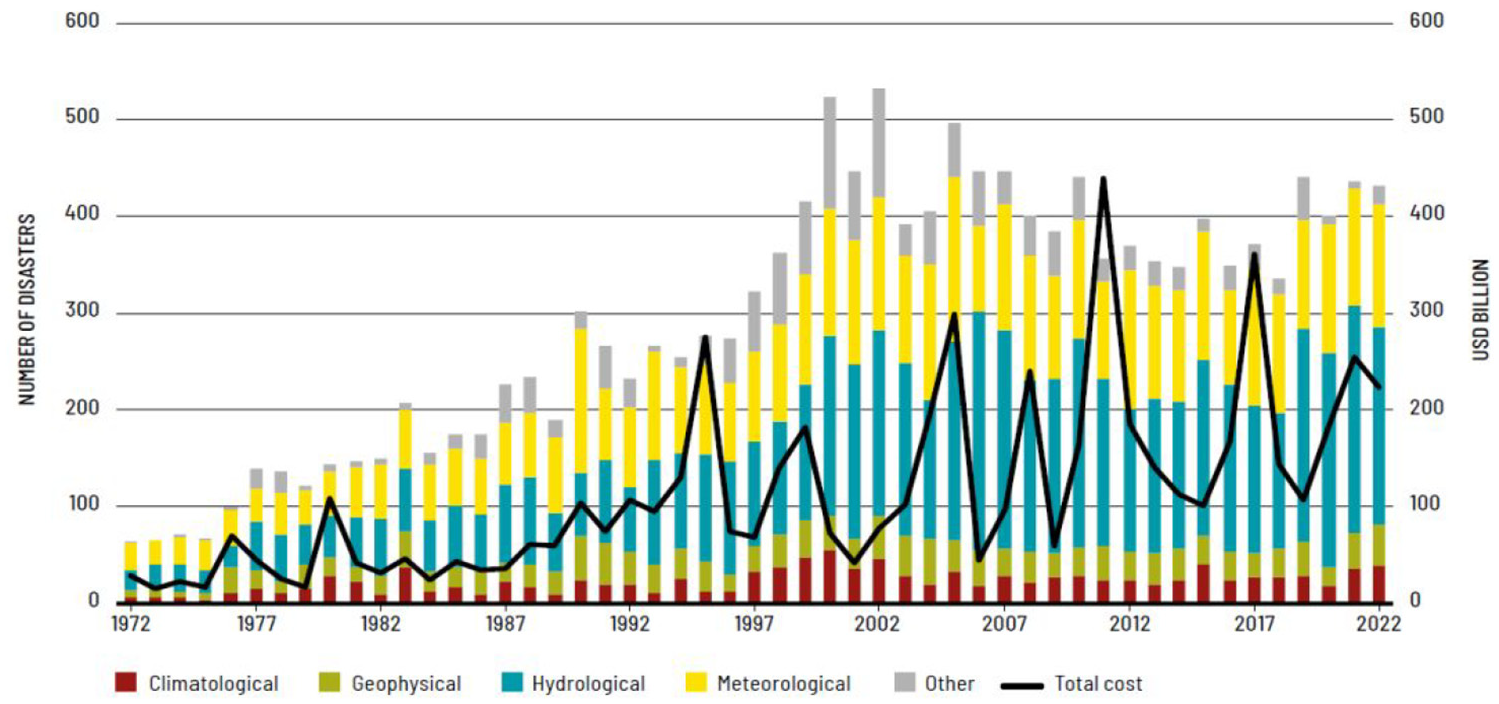
Number of disasters by EM-DAT hazard grouping and total economic losses (1972–2022).
Studying the goals of Climate-Smart Agriculture (CSA) and Agriculture 5.0 is essential for understanding their role in enhancing disaster risk reduction, as outlined in the Sendai Framework for Disaster Risk Reduction (2015–2030; Hu et al., 2023; Nowak et al., 2019). Indicator C2 of the Sendai Framework measures direct agricultural losses caused by disasters, covering sectors like crops, livestock, and fisheries. It aims to track progress in reducing economic losses in agriculture and related infrastructure, contributing to the broader goal of reducing disaster-related economic impacts by 2030. Both practices significantly contribute to building resilience and reducing vulnerabilities within agribusinesses, which is critical in the face of climate-induced disasters (Bhattacharyya et al., 2020). CSA focuses on adapting agricultural methods to evolving conditions, helping farmers manage risks such as droughts and floods while promoting sustainable practices (De Pinto & Ulimwengu, 2017). In parallel, Agriculture 5.0 leverages advanced technologies like precision farming and data analytics to optimize resource use and boost crop resilience, ensuring that farmers can effectively respond to environmental stresses (Holzinger et al., 2024; Mesías-Ruiz et al., 2023). The integration of these practices not only supports sustainable resource management but also empowers agribusinesses to make data-driven decisions. Moreover, CSA and Agriculture 5.0 emphasize community engagement and knowledge sharing, fostering collaborative efforts among farmers, researchers, and policymakers. This collective action strengthens resilience at the community level, aligning with the Sendai Framework’s emphasis on local knowledge and participation (Kamau et al., 2023; Sanka et al., 2024). Ultimately, studying these frameworks provides valuable insights into how agribusinesses can adopt practices that enhance resilience and sustainability, thereby contributing to a more secure agricultural future in the face of ongoing climatic challenges.
The study’s findings contribute significantly to the existing scholarly literature by examining how these practices impact agribusinesses. Firstly, the research deepens the understanding of how much time is taken to solve income disruptions in agribusinesses adopting Agriculture 5.0 compared to those relying on conventional practices, specifically in managing these disruptions. Secondly, the application of the Cox Proportional-Hazards Model reveals connections between various dimensions of operational risk—such as financial incentives and subsidies, production inputs, technology adoption, policy infrastructure, and labor force dynamics—and the rates of income disruptions, as indicated by time-to-failure data. The insights facilitate the classification of risks by grouping agribusinesses based on their experiences and management of operational risks. The understanding is essential for developing recommendations to refine and implement CSA strategies within the agriculture 5.0 framework. Ultimately, the article provides empirical evidence on income disruptions within agribusinesses, explicitly focusing on integrating Agriculture 5.0 technologies while outlining the impact of operational risks on income disruption rates. Thus, leading to informed policy adaptations for effective implementation & execution of the CSA paradigm.
In the context of Agriculture 5.0, risks redefine how advanced technologies are managed. These risks include interruptions, disruptions, and system or policy failures that adversely affect agribusiness operations, hindering production, profitability, and sustainability. To explore the link between agricultural risks and the likelihood of income disruptions, the research question of the study is formulated as follows:
This study rigorously examines the hypothesis of the Cox Proportional-Hazards Model. It aims to predict the cumulative effect of different risk dimensions (such as financial incentives and subsidies, production inputs, technology adoption, policy infrastructure, and labor dynamics) on income disruptions, utilizing higher-order moments of agricultural income in time-to-failure data. The subsequent sections of this article follow a structured outline. The succeeding section elaborates on the literature review, establishing the study’s hypotheses. Following this, Section 3 outlines the data sampling strategy, including a meta-analysis that identifies variables and provides operational definitions. Section 4 elucidates and deliberates upon the findings derived from the investigation. Ultimately, the concluding segment encapsulates the deduced conclusions and provides recommendations for policy considerations.
Nurturing Sustainability and Resilience
Phases of Agriculture 5.0: From Concept to Implementation
Agriculture 5.0 represents the latest evolution in agricultural practices, integrating advanced technologies and data-driven solutions to optimize farming processes. Growing concerns about environmental sustainability and resource conservation have driven the adoption of Agriculture 5.0 (Ahmad & Nabi, 2021; Paul et al., 2022; Saiz-Rubio & Rovira-Más, 2020). Agriculture 5.0 evolves through a cycle of inception, where technologies are identified, followed by technological integration into farming practices. The execution phase sees the widespread adoption of precision and smart farming practices, ushering in a new era of efficiency and sustainability in agriculture (De la Parte et al., 2023; Javaid et al., 2022; Paul et al., 2022). Automated farming is gaining business and economic appeal in the technically advanced era. Automated farming uses modern sensor technology to track growth, plant health, animal health, and the environment. Automation is vital in such an industry, and AI and IoT can play a critical role in automation (Paul et al., 2022). Precision farming for the general population began after GPS signals were made available to businesses and the public through various agencies and internet applications. Precision farming increases operational accuracy and allows for site-specific monitoring and vehicle guidance. Agriculture production, weather forecasts, and agriculture-related information are all available in digital farming (Balaska et al., 2023; Mohan et al., 2023). It leverages the power of emerging technologies like the Internet of Things (IoT), artificial intelligence, precision agriculture, and robotics to enhance efficiency, sustainability, and productivity in the agricultural sector.
The Symbiosis of Agriculture 5.0 and Climate-Smart Agriculture
The symbiotic relationship between Agriculture 5.0 and climate-smart agriculture practices is central to the evolution of agriculture, with the World Bank emerging as a pivotal force in composing the transformative alliance. Technological innovations have redefined conventional farming methods, ushering in an era of agriculture characterized by data-driven decision-making and automation (Bhattacharyya et al., 2020; Commission on Sustainable Agriculture and Climate Change, 2012; Palombi & Sessa, 2013; Roy et al., 2024). The climate-smart agriculture includes a strategy that strives to boost agricultural productivity, enhance resilience to climate shifts, and diminish greenhouse gas emissions (Rasul & Sharma, 2016; Roy et al., 2024). Climate-smart agriculture goes beyond mere adaptation, emphasizing mitigation and improved livelihoods for farmers (Rasul & Sharma, 2016; World Bank, 2021; Bhattacharyya et al., 2020) to develop a holistic and integrated approach that combines technological innovation with sound agricultural practices. The World Bank’s initiatives encompass a range of activities, including financial support, capacity building, and policy advocacy (Beddington et al., 2011; Commission on Sustainable Agriculture and Climate Change, 2012; Rasul & Sharma, 2016). Financial instruments like loans and grants are directed toward projects integrating climate-smart technologies and practices. The World Bank also plays a crucial role in facilitating knowledge exchange and building the capacity of agricultural stakeholders to embrace sustainable practices (Palombi & Sessa, 2013; World Bank, 2021; Thornton et al., 2018). While the alliance between Agriculture 5.0 and climate-smart agriculture holds immense promise, challenges persist on the path to widespread adoption. (De Pinto & Ulimwengu, 2017; Thornton et al., 2018). Socio-economic and institutional barriers, including access to technology, training, and financial resources, pose hurdles that must be addressed. Additionally, the scalability of successful pilot projects remains a critical consideration for the global implementation of these practices. Future research should focus on refining technological solutions and addressing barriers to adoption. The World Bank’s role in facilitating knowledge dissemination, fostering public-private partnerships, and advocating for supportive policies becomes increasingly crucial in overcoming these challenges (Siddharth et al., 2021).
Survival Characteristics of the Agri-Businesses
As the global landscape grapples with climate change, resource depletion, and an expanding population, the imperative for sustainable agriculture has become more pronounced. At the forefront of this paradigm shift are agribusinesses, playing a critical role in the evolution toward sustainable agricultural practices. Agribusinesses that thrive in sustainable agriculture can adapt to changing environmental conditions and market dynamics (De Pinto & Ulimwengu, 2017; Barasa et al., 2021). These entities demonstrate resilience by embracing innovative technologies, diversifying crops, and implementing adaptive strategies in the face of erratic weather patterns, fluctuating commodity prices, or evolving consumer preferences. This adaptability ensures survival and positions them as drivers of change within the agricultural sector (Boehlje et al., 2011; Carlisle et al., 2019; Lin et al., 2020). Surviving in sustainable agriculture demands a proactive approach to technological integration and innovation.
Agribusinesses that endure invest in and adopt cutting-edge technologies, such as precision farming, data analytics, and smart irrigation systems. These technological advancements optimize resource utilization and enhance productivity and environmental sustainability. The ability to leverage technology underscores the survival characteristics of agribusinesses in the pursuit of sustainable agriculture. Sustainable agriculture places a premium on environmental stewardship, and agribusinesses that endure recognize the intrinsic value of eco-friendly practices. From implementing organic farming methods to reducing chemical inputs and promoting biodiversity, these entities prioritize the health of ecosystems. The survival characteristics of such agribusinesses are intertwined with their commitment to safeguarding the environment, recognizing its symbiotic relationship with long-term agricultural viability. Surviving in the context of sustainable agriculture necessitates robust supply chain management and active engagement with local communities. Agribusinesses endure establishing resilient supply chains that prioritize fair trade, minimize waste, and promote local economic development. The ability to engage with local communities ensures a social license to operate, fostering positive relationships and contributing to the sustainable development of the regions in which they operate (Boehlje et al., 2011; German et al., 2020; Long et al., 2019).
Agribusinesses committed to sustainable agriculture exhibit a propensity for diversification and responsiveness to market demands. By diversifying crop portfolios, exploring alternative revenue streams, and staying attuned to consumer preferences for ethically produced goods, these entities mitigate risks associated with mono-cropping and market volatility. The survival characteristics of such agribusinesses are rooted in their capacity to evolve with market trends while maintaining a focus on sustainability. Agribusinesses that demonstrate a dedication to ongoing learning and collaboration through their engagement with research institutions, participation in knowledge-sharing platforms, and investment in workforce training foster a culture of continuous enhancement. The ability to adapt to new knowledge and collaborate with stakeholders is integral to the survival and success of agribusinesses in the pursuit of sustainability. The survival characteristics of agribusinesses are paramount in shaping the trajectory of sustainable agriculture. Adaptability, technological integration, commitment to ecological responsibility, supply chain resilience, local engagement, diversification, market responsiveness, and a culture of continuous learning and collaboration collectively contribute to the endurance of agribusinesses in the face of complex challenges. The technological transition of agriculture systems ensures a more sustainable, resilient, and equitable agricultural future. (Bastos Lima, 2021; German et al., 2020; Kahn & LeZaks, 2009).
Recent research has revealed new dimensions in understanding agricultural income hazards, expanding the focus beyond factors like climate-smart practices and digital technologies. Market volatility has emerged as a critical factor, especially in developing nations, where price fluctuations in crops like grains and vegetables are deeply tied to global supply and demand (Alamgir et al., 2021; Naqvi et al., 2023; Priscilla et al., 2017). Farmers are left vulnerable to these sudden price changes without access to futures markets or adequate insurance, which can directly impact their revenue (Majeed, 2020). This risk is exacerbated for those dependent on single crops, as price drops offer little room for adjustment. Another significant issue is the limited diversification in cropping systems, which increases farmers’ susceptibility to pests, diseases, or extreme weather affecting specific crops. While crop diversification is promoted as a key risk management tool, barriers such as restricted market access and resource constraints often prevent farmers from adopting this strategy effectively (Barry, 2019; Benzie et al., 2018; Komarek et al., 2020). Policy inconsistencies also play a major role in income instability. Sudden subsidies, tariffs, or trade policy changes can severely impact agribusinesses, particularly in regions heavily reliant on government support. Such unpredictability complicates long-term planning, making agribusinesses more vulnerable to financial risks (Ghosh et al., 2023; Nan et al., 2023; Smith, 2018). Additionally, inadequate infrastructure—such as poor road networks, irrigation systems, and storage facilities—exacerbates income hazards by increasing post-harvest losses and limiting market access. This challenge is compounded by insufficient access to high-quality seeds and fertilizers, reducing productivity and stability (Touch et al., 2024). Finally, low levels of financial literacy among smallholder farmers have been identified as a key contributor to income disruptions (Maity et al., 2023; Mulesa et al., 2024). Many agribusiness owners fail to adopt essential risk management practices without understanding concepts like credit, savings, or insurance. Research emphasizes the importance of financial training in helping farmers better manage these risks. These findings illustrate the complexity of agricultural income hazards, pointing to the need for comprehensive strategies that address market, infrastructural, policy, and educational gaps (Anser et al., 2023; Khatri et al., 2024).
Theoretical Framework and Evolution of Hypothesis
The Resource-Based Theory (RBT) provides a foundational perspective on how firms’ internal resources and capabilities—both tangible and intangible—drive their growth and long-term performance. The core tenet of RBT emphasizes that a firm’s unique, rare, valuable, and non-substitutable resources are key to achieving sustainable competitive advantage (De Tommaso & Borini, 2024; Zimuto, 2018). However, as the theory gained acceptance, scholars critiqued its relatively static nature. Specifically, RBT was found to focus primarily on the possession and internal optimization of resources, often overlooking the dynamic and volatile environments in which firms operate. This limitation was especially pronounced in fast-changing industries, such as technology and agribusiness, where relying solely on existing resources may be insufficient to sustain competitive advantage (Amjad, 2013; Charles & Benson Ochieng, 2023).
As a result, the question arose: How do firms facing rapid changes and external risks manage their resources to maintain competitiveness over time? This question laid the groundwork for transitioning from RBT to Dynamic Capabilities Theory (DCT).
Dynamic Capabilities Theory (DCT) emerged as an extension of RBT emphasizing a firm’s ability to adapt, integrate, and reconfigure internal and external resources in response to ever-changing environments. The theory argues that in volatile markets, firms must not only possess valuable resources but also dynamically deploy these resources to respond to new market conditions, technologies, and risks (Hoang, 2020; Schwarz et al., 2010). This continuous process of resource reconfiguration is critical for mitigating external shocks—such as income disruptions—in sectors like agribusiness, where uncertainty and volatility are standard (Bari et al., 2024). In sectors like agribusiness, where environmental risks (e.g., climate change, policy shifts, and market volatility) can lead to income disruptions, DCT provides a robust framework to understand how firms can mitigate these risks. By sensing changes (e.g., weather patterns or market trends), seizing new technologies (e.g., digital farming tools), and continuously transforming their resource base (e.g., optimizing labor, technology, and financial incentives), agribusinesses can build resilience and adapt to external shocks (Thomas & Douglas, 2024). Digital transformation plays a crucial role in the current context, as it equips firms with tools to make data-driven decisions and respond more effectively to market disruptions, thus reducing income volatility. The integration of digital technologies, such as AI, big data, IoT, blockchain, and cloud computing, into a firm’s core processes allow for better sensing of opportunities and threats, more effective seizing of market opportunities, and efficient reconfiguration of resources to maintain competitiveness (Henke & Jacques Bughin, 2016; Hokmabadi et al., 2024). Recent studies have emphasized that digital capabilities form a vital part of a firm’s dynamic capabilities portfolio, enabling companies to navigate digitally disrupted environments. The firm’s ability to adopt and leverage new digital technologies is defined as digital capabilities and utilizing digital tools to enhance a firm’s ability to identify market volatilities and opportunities (Atheeq et al., 2023; Maheshkar et al., 2024). Some studies have explored how firms develop digital transformation capabilities to reconfigure existing resources and compete in technology-driven markets (Kundu, 2020; Maring, 2023).
In the context of agribusiness, digitalization enhances dynamic capabilities by enabling firms to manage risks and external shocks more effectively. Specifically, digital technologies improve a firm’s ability to sense risks, seize opportunities, and reconfigure resources, thereby addressing the following hypotheses:
If the null hypothesis holds, integrating digital technologies and their capabilities—such as sensing, seizing, and transforming resources—would not significantly reduce income disruptions. This understanding would imply that even with digital tools in place, managing resources like financial incentives, technology adoption, labor dynamics, and policy infrastructure might not be sufficient to mitigate risks in agribusiness effectively. In contrast, under the alternative hypothesis, firms that strategically integrate digital technologies into their operations would experience a substantial decrease in the likelihood of income disruptions. These digital capabilities would enable firms to anticipate risks better, capitalize on opportunities, and reconfigure their resources, making resource management much more effective for reducing risks.
Data and Methodology
Within the framework of Agriculture 5.0, risks transform the management of cutting-edge technologies. In this context, risks encompass interruptions, disruptions, and failures in policies and systems, negatively impacting production, profitability, and sustainability in agribusiness operations. In order to thoroughly investigate the association between agricultural risks and the hazard function of income disruption within agribusinesses, the research inquiry of the study is formulated as follows:
This study critically evaluates the hypothesis of the Cox Proportional-Hazards Model. The study predicts the cumulative impact of risk dimensions (Financial incentives and subsidies, Production Inputs, Technology adopted, Policy infrastructure, and Labor force dynamics) on income disruptions using higher-order moments of agriculture income in time-to-failure data. Therefore, the study hypothesizes:
The study considered the IIIA Agro Climatic Zone of Rajasthan (India), where agriculture represents approximately 25% of the state’s economic output and involves about two-thirds of the labor force. However, the state faces substantial challenges in the agriculture sector due to its distinctive geographical attributes, encompassing a harsh, arid climate, barren land, and water scarcity. Rajasthan’s terrain comprises extensive dunes extending into the Thar desert. Moreover, the region experiences an arid climate transitioning to humid conditions, marked by limited rainfall across most parts of the state- these climatic conditions impact soil quality and curtail the shelf life of agricultural produce, further complicating agricultural activities and the financial well-being of farmers living in the area. The IIIA Agro Climatic Zone of Rajasthan, also known as the Semi-Arid Eastern Plain Zone, includes districts such as Jaipur, Ajmer, Tonk, and Dausa. Characterized by semi-arid conditions, the region experiences annual rainfall of 500 to 700 mm, mainly during the monsoon, and faces extreme temperature fluctuations. Loamy sand soil, with poor water retention, exacerbates agricultural challenges. Agribusinesses in this zone confront significant risks due to erratic rainfall, dependence on monsoon rains, and inadequate soil quality, leading to frequent droughts and inconsistent yields. Limited irrigation and over-reliance on groundwater worsen water scarcity and increase operational costs, while extreme temperatures heighten susceptibility to pests and diseases. These issues align with the study’s hypothesis that effective resource management reduces income disruptions. The zone’s economic importance and need for advanced technologies, make it ideal for testing resource-based risk mitigation strategies.
Research Site and Data
The sampling strategy outlined herein is meticulously designed for the systematic selection of the respondents and to minimize the researcher’s bias. The research question is approached through the adoption of a quantitative research method. The methodology is designed to approach data collection for the agriculture operational risks encompassing financial incentives and subsidies, production inputs, technology adopted, policy infrastructure, and labor force dynamics. The questionnaire was designed to capture the variable information so that the impact of these factors on the hazard function of the income disruptions of agri-businesses can be established. The data collection site was selected based on the average productivity in the area and the agro-climatic conditions. The IIIA agroclimatic zone, comprising Ajmer, Jaipur, Dausa, and Tonk districts, is of profound significance, covering 9% of the state’s total cropped area. A database from Agriculture Produce Markets (Krishi Upaj Mandi) served as the sampling frame, identifying a cohort of agribusinesses facing income disruptions due to agriculture operational risks. Operational risk in agriculture is defined as the potential loss or adverse impact on agricultural activities and productivity due to disruptions in agriculture production. For data collection, questionnaires were administered in four districts in Rajasthan—Dausa (highest average productivity), Jaipur (moderate average productivity I), Ajmer (moderate average productivity II), and Tonk (lowest average productivity)—within Agro-Climatic Zone IIIA (Semi-arid Eastern Plain). The average productivity is calculated and ranked for the period 2011 to 2021. The productivity rankings were derived from Krishi Vikas Kendra’s (KVKs) databases and published reports from the Directorate of Agriculture, Rajasthan. The selection of the agribusinesses for the survey was ascertained based on inclusion criteria. The agribusinesses are categorized as Super, A, B, C, and D based on their sale of produce in the agricultural wholesale produce market. The agribusinesses that sell agriculture produce of 0.75 and above metric tons annually were characterized as Super, while others were characterized in descending order—A for 0.5 to 0.75 metric ton, B for 0.25 to 0.5 metric ton, C for 0.10 to 0.25 metric ton, and D for below 0.10 metric ton. The survey included eight failed agribusinesses and 16 surviving agribusinesses for analysis. The systematic random sampling strategy was used to select the businesses from the sampling frame. The sampling interval, the population ratio to the sample size, represents the number of units between successive sampling elements. The Attrition rate and non-response rate are set at 28%. Thus, starting from first every 30th, agribusiness is included in the survey. The final sample comprised 40 failed agribusinesses, each matched with 80 surviving counterparts for comparative analysis.
The Cox PH Model
The Cox proportional hazards model (Cox PH Model) represents a semiparametric approach. The model assumes the impact of predictors on the hazard function denoted as λ(t). The aim of this investigation is twofold: firstly, to introduce and apply the Cox PH Model in forecasting income Disruptions due to various risks in Agri-Business, and secondly, to explore its usage, which is relatively underrepresented in finance literature centered on agriculture (Choi et al., 2023). In the model, t represents the duration until income disruption within an Agribusiness. Further,

where S(t) denotes the survivor function, signifying the probability that the Agribusiness will persist beyond time t when encountering operational risks.
The distribution function and the density function are illustrated in (2) and (3) for the time until income disruption is denoted as


While the distribution of the time until income disruption could be delineated using either F(t) or f(t), it is more conventionally defined through the hazard function:

The hazard, h(t), is the probability of income disruption in the next instant, given that the agribusiness was profitable at time t. In actuarial statistics, h(t) is called the force of mortality, and in economics, its reciprocal is called Mill’s ratio. Once an estimate of h(t) has been obtained, estimates of f(t) and F(t) are readily available from

In this study, the Cox PH model (PHM) is the suitable framework for the hazard function analysis concerning income disruptions in agri-businesses when risks strike. Let h(t|z) denote the hazard function at time t for an agri-business with an explanatory variable vector z. Within the Cox PH Model framework,

where
(1) It readily accommodates incomplete (censored) failure data, where the time to failure is unknown for certain Agri-business.
(2) Statistical Estimation and inference challenges for the model possess relatively straightforward solutions even when
Thus, the hazard function can be formulated as:

The model delineated by the hazard function (7) will henceforth be denoted as the Cox PH Model within the subsequent sections of this manuscript. Although the Cox PH Model is not strictly nonparametric due to its dependence on the regression parameter vector β, it should be noted that the baseline hazard function


is the survivor function corresponding to the baseline hazard function
Fitting the Cox PH Model requires identifying a sample of (in this case) agribusinesses that failed due to agricultural risks and a control sample of agribusinesses that survived the operation risks. Observations over a vector of financial variables are made for both samples’k periods prior to failure, and the Cox PH Model is fit for these observations. The resulting survivor function estimates the probability that a particular agribusiness possessing specific financial characteristics will survive for t periods into the future, where t ≤ k. The modified Kolmogorov-Smirnov test was conducted as an initial step toward validating the assumption of multivariate normality concerning the ratios. This assessment was performed on the data related to the firms that survived 1 year prior and 2 years before their eventual failure. This dataset constitutes the “1-year prior” data. Similarly, the “2 years prior” dataset encompasses the ratios for 2 years before the failure event for both the failed and the surviving firms.
Metadata Analysis
The study focused on examining research hypotheses by employing survival analysis, with the dependent variable (DV) being the survival durations and time-to-failure of agribusinesses. The DV represent how long agribusinesses can remain operational and sustainable against external pressures. The study examined independent factors, including financial incentives and subsidies, production inputs, technology adoption, policy infrastructure, and labor dynamics. Each factor was assessed using specific variables to quantify their impact on the financial sustainability of the business. A crucial element in this analysis is income disruption, which acts as a significant threat to the survival of agribusinesses. Income disruption refers to any event or external shock—such as market volatility, adverse weather, or sudden policy changes—that severely reduces or halts a business’s revenue streams. These disruptions pose substantial risks, preventing firms from covering essential operational costs, repaying financial obligations, or investing in technology that could enhance efficiency. As a result, businesses experiencing income disruption often face a shortened survival period, making it a key factor in predicting the time-to-failure of agribusinesses. The study highlights the intricate connection between managing these independent factors and mitigating the risks of income disruption to ensure business sustainability in the volatile agricultural sector. Table 1 provides a concise metadata overview of variables analyzing the effects of financial incentives and subsidies on agribusiness performance. It includes key dimensions, abbreviations, transformations, and references, highlighting how these variables reflect financial sustainability, loan recovery, and risk management.
Metadata Description.

In the raw form, the covariates capturing the effects on the hazard ratios of income disruption in the Cox Proportional Hazards (PH) model—such as gross, net, and arithmetic values—exhibited significant violations of the model’s core assumptions. These variables showed nonlinear patterns, while analyzing continuous variables like net income or total loans. For instance, variables such as NLRL or LGCP in their untransformed form produced skewed distributions, making it difficult to model their actual impact on the hazard function. This nonlinearity introduced bias, and may result in an improper model fit and eventually might compromise the accuracy of the hazard ratio estimates. Similarly, the proportional hazard assumption, that require the effect of covariates on the hazard function to remain constant over time, was also violated by several raw variables. For example, raw metrics like NITA or TOIA showed time-varying effects that changed the magnitude of their impact over different periods, leading to unstable hazard ratio estimates. The instability further suggested that these variables in their raw forms did not meet the requirements for the Cox PH model.
Various transformations were applied to the covariates to make them more suitable for the Cox PH model, addressing these issues effectively. Logarithmic transformations were particularly useful in stabilizing skewed data and reducing extreme values. Variables such as LTIA and LGCP became linear about the log-hazard function, thus improving the model fit. The transformation allowed the data to conform to the assumptions of the Cox PH model by stabilizing variance and restoring linearity in the relationships between the covariates and the hazard ratio. Furthermore, ratios and net/gross forms, such as in NLRL, assisted to standardize the covariates with respect to other variables. The transformation allowed for consistent scaling and reduced the time-varying effects, aligning the covariates with the proportional hazard assumption. Ratios like NITC and TOIA ensured that covariates consistently affected the hazard function over time. Additionally, transformations such as LMSA and arithmetic cumulation in TOIA ensured that significant numerical differences in raw data were managed effectively. Thus, transformations mitigated violations of the proportional hazards assumption by maintaining a consistent, proportional relationship between the covariates and the hazard function. Table 2: Operationalization of Variables outlines the key contextual variables used in the study and provides their operational definitions.
Operationalizing the Variables.

After implementing the transformations, diagnostic tests, such as the Schoenfeld residuals test, confirmed that the transformed covariates adhered to the assumptions of the Cox PH model. The transformed variables showed a more linear relationship with the log-hazard of income disruption and maintained proportional effects over time, allowing for a statistically precise and reliable model fit of the model. As a result, the transformed covariates provided more robust predictions of the financial, operational, and technological factors influencing income disruption in agribusinesses, leading to a deeper understanding of the risks affecting agribusiness sustainability.
Results and Findings
Data Reliability and Validity
Ensuring the accuracy and robustness of the study’s findings involved conducting reliability and validity tests. Reliability, measured through Cronbach’s Alpha, confirmed the internal consistency of the data collection across key dimensions such as financial incentives, production inputs, and labor force dynamics. Table 3 presents the results of Cronbach’s Alpha analysis to assess the internal consistency of different dimensions related to agribusiness risk factors.
Internal Consistency of Dimensions in Agribusiness Risk Factors: Cronbach’s Alpha Analysis.

Table 3 outlines the reliability test results, focusing on Cronbach’s Alpha, which assesses the internal consistency of the items within each dimension. The Financial Incentives and Subsidies dimension, with a Cronbach’s Alpha of .83, indicates an acceptable level of internal consistency, suggesting that the items reliably capture the underlying construct. Similarly, Production Inputs (Cronbach’s Alpha = .78) and Technology Adoption (Cronbach’s Alpha = .76) also demonstrate acceptable internal consistency, confirming that the items within these dimensions consistently reflect their respective constructs. The dimensions of Policy Infrastructure (Cronbach’s Alpha = .81) and Labor Force Characteristics (Cronbach’s Alpha = .80) show good internal consistency, highlighting strong reliability in measuring the associated factors. Overall, the high levels of internal consistency across all dimensions confirm the reliability of the measurement instrument in effectively capturing the factors related to agricultural risks and income disruptions. Table 4 presents the results of sampling adequacy, Bartlett’s test of sphericity, and the percentage of variance explained for various agribusiness risk dimensions. These dimensions include financial incentives and subsidies, production inputs, technology adoption, policy infrastructure, and labor force characteristics, highlighting their importance in assessing risk within the agribusiness sector.
Sampling Adequacy, Bartlett’s Test, and Variance Explained for Agribusiness Risk Dimensions.
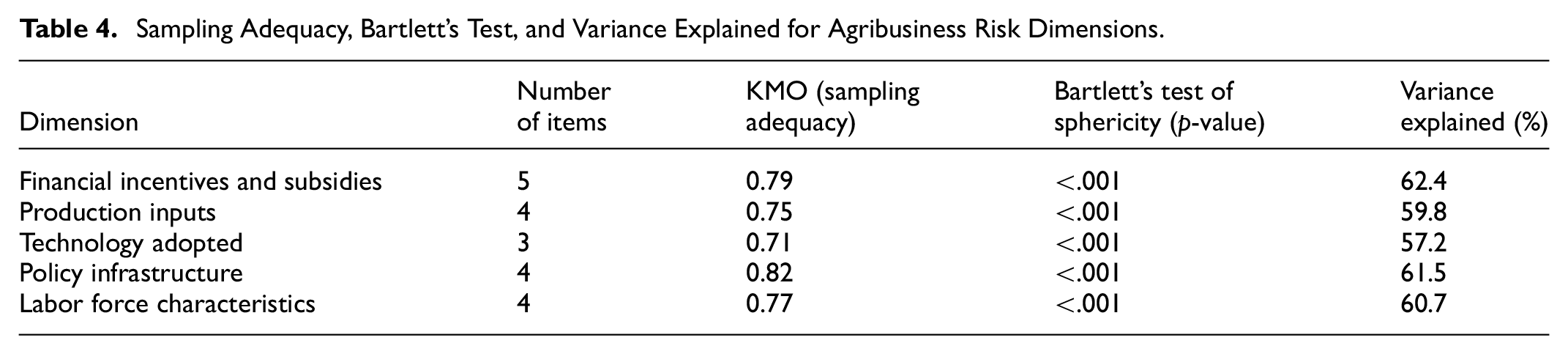
The table presents the results of the construct validity test, highlighting the key statistics for each dimension. The Kaiser-Meyer-Olkin (KMO) test values above 0.7 indicate good sampling adequacy, meaning the data was suitable for factor analysis. Additionally, Bartlett’s test of sphericity is highly significant (p < .001) across all dimensions, confirming that the variables are sufficiently correlated for factor analysis to proceed. The variance explained by each dimension exceeds 57%, demonstrating that the factors capture a substantial portion of the underlying variance in the data. Specifically, financial incentives and subsidies explain 62.4% of the variance, while production inputs, technology adoption, policy infrastructure, and labor force characteristics explain between 57.2% and 61.5% of the variance. These results affirm that the constructs were well-defined and that the items measured the intended dimensions effectively.
In evaluating this study’s Cox Proportional Hazards (PH) model assumptions, a series of checks and diagnostics were conducted to ensure the model’s validity in examining the relationship between agricultural risks and income disruptions within agribusinesses. The primary assumption of proportional hazards, which posits that the hazard ratios of covariates remain constant over time, was assessed using Schoenfeld residuals. Additionally, the linearity assumption for continuous covariates was verified through martingale residuals. Multicollinearity was evaluated using the Variance Inflation Factor (VIF), revealing that most covariates exhibited low multicollinearity, with a few displaying moderate levels deemed acceptable. Influential data points and outliers were also examined through deviance residuals, showing no highly influential observations. Lastly, the model’s goodness-of-fit was confirmed using the Akaike Information Criterion (AIC), affirming that the selected covariates balanced model complexity and fit. These diagnostic checks support the robustness of the Cox PH model in analyzing the impact of various risk dimensions on the hazard of income disruptions among agribusinesses.
Schoenfeld Residuals Test Results for Proportional Hazards Assumption
The Cox Proportional Hazards (PH) model operates under the crucial assumption that the hazard ratios between different groups remain constant over time. This assumption implies that the effect of each covariate on the hazard function is multiplicative and consistent throughout the study period. As a result, the relative risk, or hazard ratio, between individuals remains stable, even though the baseline hazard may fluctuate. If this assumption is violated, the covariates’ effects will no longer be stable, making the Cox PH model unsuitable for analysis. The Schoenfeld residuals test is commonly used to evaluate whether this assumption holds by checking for proportionality. Interpretation of the test results relies on three key metrics: the rho value, chi-square statistic, and p-value. The rho value measures the correlation between Schoenfeld residuals and time for each covariate, with values close to zero indicating no time dependence and supporting the proportional hazards assumption. The chi-square statistic assesses whether residuals are time-dependent, with larger values indicating a greater departure from proportionality. However, in this case, all chi-square values remain within acceptable limits. The p-value, a critical metric, indicates whether there is significant evidence against the proportional hazard assumption. In this analysis, all p-values were greater than .05, suggesting that the proportional hazards assumption holds for each covariate. The results of the Schoenfeld residuals test showed that all p-values exceeded .05, indicating no violations of the proportional hazards assumption for any covariate. Overall, the Schoenfeld residuals test results confirmed that the Cox PH model’s proportional hazards assumption was satisfied for all covariates. None of the covariates exhibited significant time-dependent effects, as indicated by p-values greater than .05. Table 5 presents the results of the Schoenfeld Residuals Test, analyzing the correlation between time and agribusiness risk dimensions. It includes the Chi-Square values and corresponding p-values, providing insights into the proportional hazard assumption for each risk dimension.
Schoenfeld Residuals Test Results: Correlation with Time, Chi-Square, and p-Value for Agribusiness Risk Dimensions.

As depicted in Figure 2, the Schoenfeld Residuals Test Results for Proportional Hazards Assumption confirm that the proportional hazards assumption holds for all covariates. For each dimension—Financial Incentives and Subsidies, Production Inputs, Technology Adopted, Policy Infrastructure, and Labor Force Dynamics—the residuals remain close to zero across the event times, with no clear time-dependent patterns.

Schoenfeld residuals plot for testing proportional hazards assumption across various covariates in agribusiness income disruption analysis.
Thus, indicating no significant deviations from the proportional hazard assumption. The corresponding rho values from the table are near zero, and all p-values are greater than .05, further supporting the conclusion that the assumption holds for each covariate. The chart’s lack of systematic trends aligns with the test results, confirming that the Cox PH model is appropriate for the data and that no time-dependent adjustments are necessary.
Martingale Residual Tests for Linearity of Continuous Covariates
In the Cox Proportional Hazards (PH) model, the assumption of linearity of continuous covariates requires that the relationship between continuous variables and the log hazard function be linear. This implies that as the value of a continuous covariate changes, its effect on the hazard should increase or decrease in a consistent, log-linear manner. When this assumption is violated, and a covariate exhibits a non-linear relationship with the log hazard, it can lead to biased estimates, distorting the true effect on the hazard ratio. Martingale residuals can detect and address non-linearity by evaluating the functional form of continuous covariates. If non-linearity is identified, transforming the covariates—such as through a log transformation or splines—can more accurately reflect the relationship and enhance the model’s performance. Thus, assessing linearity in continuous covariates using Martingale residuals is essential in ensuring the validity and accuracy of the Cox PH model. Figure 3 illustrates the Martingale residuals used to test the linearity assumption in the Cox Proportional Hazards Model, specifically applied to various covariates in the analysis of agribusiness income disruption. This figure helps assess whether the covariates maintain a linear relationship with the log hazard, as required by the model assumptions.
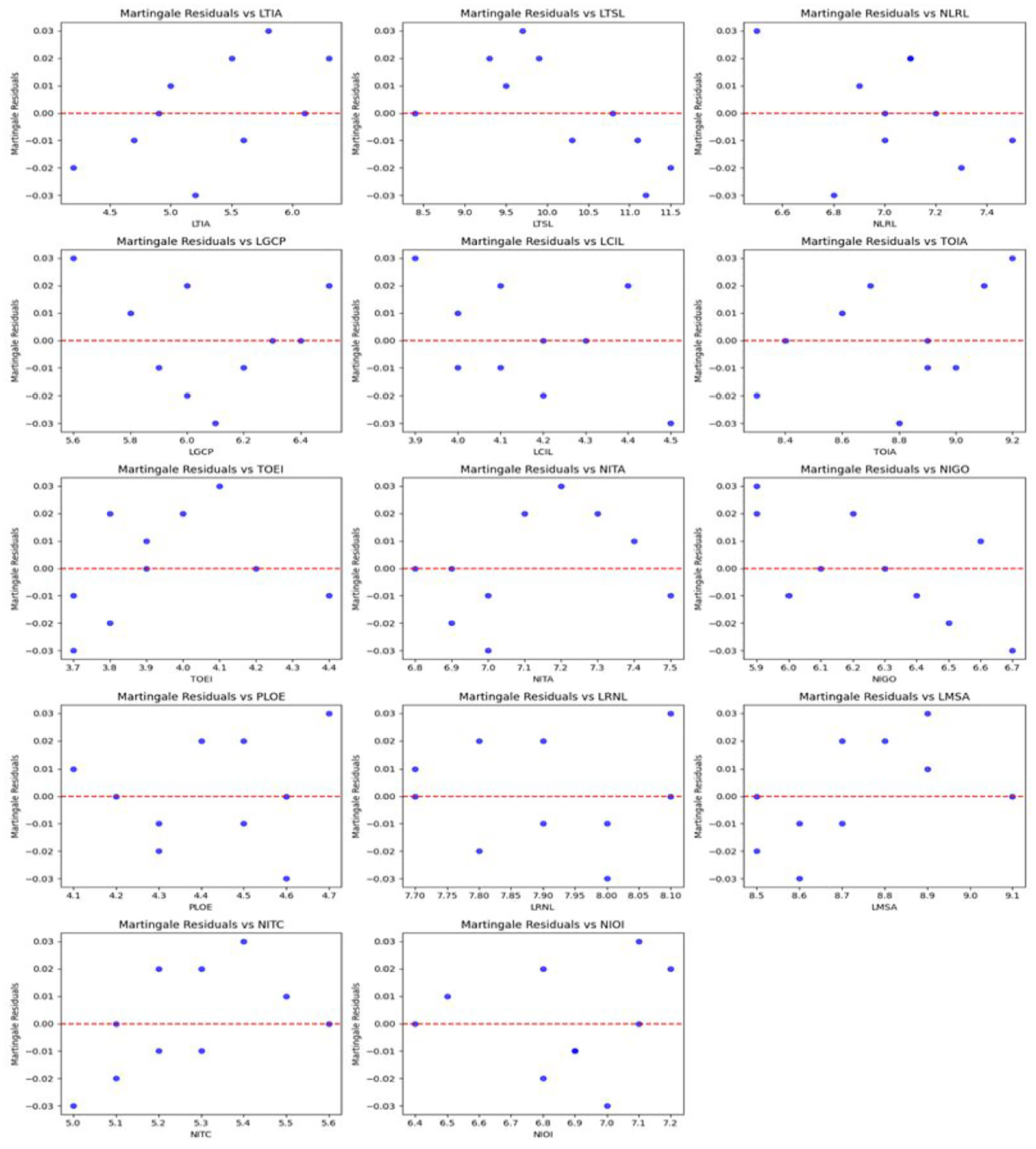
Martingale residuals for testing linearity assumption in cox proportional hazards model for various covariates in agribusiness income disruption analysis.
The Martingale residual plots illustrate the residuals for continuous covariates from the dimensions of Financial Incentives and Subsidies, Production Inputs, Technology Adopted, Policy Infrastructure, and Labor Force Characteristics in the Cox Proportional Hazards model. These plots assess whether a linear relationship exists between the covariates and the log hazard. For the linearity assumption to hold, residuals should scatter randomly around zero without forming patterns. In the Financial Incentives and Subsidies dimension, covariates LTIA, LTSL, and NLRL show random residuals around zero, indicating the assumption holds. Similarly, in the Production Inputs dimension, the LGCP, LCIL, and TOIA residuals display no systematic patterns. Technology adoption covariates (TOEI, NITA, and NIGO) and Policy Infrastructure covariates (PLOE, LRNL, and LMSA) also show no trends, further supporting the linearity assumption. Lastly, in Labor Force Characteristics, residuals for NITC and NIOI confirm the assumption holds. Overall, the residuals scatter randomly across all covariates, suggesting that the assumption of linearity between covariates and the log hazard is valid. No transformations are necessary, as there is no evidence of non-linearity in the plots.
Model Fitting
The focal variable in this investigation delineates the duration between the inception of agricultural risk and the initiation of income disruption stemming from said risk, considering cases where income disruptions remain absent as right-censored data. The Cox PH assumption’s validity assessment involves the Schoenfeld residual test, which scrutinizes residuals and contextualizes variables based on the test outcomes. In the Cox Proportional Hazards (PH) analysis, 15 variables serve as covariates, with three variables, each delineating the five dimensions influencing the observed endogenous variable. The log-likelihood ratio test and the concordance index evaluate the model’s appropriateness. The log-likelihood ratio test produces a value of 862.6 for 15 degrees of freedom, indicating a significance probability of .05 or lower, signifying the model’s superiority over the covariate-free model. The concordance index, typically between 0.6 and 0.75, yields a value of 0.637, affirming the model’s adequacy. The model generates coefficients for each variable, with positive coefficients indicating escalated hazard or risk of the event, while negative coefficients imply reduced hazard. In the context of income disruption amidst risks affecting Agri-businesses in Agriculture 5.0, positive coefficients for certain variables suggest heightened survival hazard upon adopting respective dimensions, leading to increased income disruption likelihood during severe operational risk events.
Conversely, negative coefficients suggest potential income disruption for agribusinesses embracing Agriculture 5.0 with specific treatments, indicating significant consequences on income stability. Table 6 provides a comprehensive overview of estimation outcomes, highlighting individual variables’ high significance and predictive capability. Moreover, the chi-square likelihood ratio test underscores the overall model’s significance (p = .0001), with favorable R-values of .649 and .750 for the 1-year and 2-year prior datasets, respectively, indicating reasonably favorable model fits.
Cox PH Model Results for the survival of Agribusiness—1-Year prior Failure Model.

Significant at 1%. **Significant at 5%. ***Significant at 10%.
Using 1-year prior data, the Cox Proportional Hazards (PH) model evaluates the effects of various factors on the income disruption hazard function within agribusinesses. The hazard ratio Exp(β), also known as the risk ratio, represents the effect of a covariate on the likelihood of income disruption. A hazard ratio less than 1 indicates a reduced risk of disruption as the covariate increases, while a ratio greater than 1 suggests an increased risk.
The model examines LTIA, LTSL, and NLRL for financial incentives and subsidies. The hazard ratio for LTIA is 0.789 (Z = −2.330, p = .020), meaning higher values of LTIA reduce the likelihood of income disruption by approximately 21%. LTSL has a hazard ratio of 1.001 (Z = 0.381), indicating a negligible effect on the risk of disruption, while NLRL’s hazard ratio of 1.000 (Z = −5.456) suggests it has no significant impact on income disruption. LGCP, LCIL, and TOIA are assessed in the dimension of production inputs. LGCP shows a hazard ratio of 0.999 (Z = −4.785, p < .01), indicating that an increase in gross loan charge-offs slightly reduces the risk of income disruption. LCIL and TOIA exhibit hazard ratios of 1.000 (Z = 5.166 and 4.175, respectively), suggesting they have minimal impact on income disruption. When analyzing the effects of technology adoption, NITA and NIGO are key covariates. NITA has a hazard ratio of 1.000 (Z = −9.425, p < .01), suggesting that higher net income from technology reduces the risk of disruption, while NIGO’s hazard ratio of 0.830 (Z = −2.285, p < .01) indicates that increased levels of this covariate also lower the likelihood of income disruption. For policy infrastructure, PLOE, LRNL, and LMSA are evaluated. PLOE’s hazard ratio of 1.266 (Z = 2.208, p = .027) suggests that increased provisions for loan losses raise the risk of income disruption by 26.6%. On the other hand, LRNL’s hazard ratio of 0.763 (Z = −8.894) and LMSA’s hazard ratio of 0.972 (Z = −3.946) indicate that these covariates are associated with reduced disruption risk. Finally, NITA, NITC, and NIOI analyze the characteristics of the labor force. NITA’s hazard ratio of 0.985 (Z = −2.853, p < .01) shows that higher net income for labor employed is linked to a lower risk of income disruption. Meanwhile, NITC and NIOI have hazard ratios of 1.004 (Z = 1.246) and 1.335 (Z = 1.097), indicating slight increases in income disruption risk with these covariates, though the effects are not strongly significant. Table 7 presents the Cox Proportional Hazards (PH) Model results for predicting the survival of agribusinesses based on a 2-year prior failure model. The table outlines the variables, hazard ratios (Exp(β)), Z-scores, p-values, and variance inflation factors (VIF) to assess the significance and multicollinearity of each predictor.
Cox PH Model Results for the survival of Agribusiness—2-Year prior Failure Model.

Significant at 1%. **Significant at 5%.
In the Cox PH Model utilizing 2-year prior data, LTIA, LTSL, and NLRL are scrutinized to discern the impact of financial incentives and subsidies on agribusinesses’ Income Disruption Hazard function. The LTIA exhibits a risk ratio of 0.830 (Z = −2.862), with a significance of 0.661, suggesting that higher LTIA values coincide with diminished income disruption probability. Specifically, increased total incentives agribusinesses receive are associated with decreased income disruption risk. LTSL and NLRL reveal risk ratios 1.266 (Z = 2.208) and 0.763 (Z = −8.894), respectively. LGCP, LCIL, and TOIA are evaluated to understand the effects of production inputs on income disruption hazards. LGCP’s risk ratio stands at 0.972 (Z = −3.489), with a significance of 0.131. Increased gross loan charge-offs correspond to reduced income disruption probability. LCIL and TOIA present risk ratios of 0.985 (Z = −2.456) and 1.004 (Z = 1.246), respectively. NITA and NIGO are examined to ascertain the impact of technology adoption on income disruption hazards, with NITA’s risk ratio at 0.568 (Z = −2.082) and a significance of 0.213. Higher net income from agribusinesses is associated with decreased income disruption risk. NITA and NIGO reveal risk ratios 0.568 (Z = 1.834) and 1.001 (Z = 1.509), respectively. PLOE, LRNL, and LMSA are scrutinized to discern policy infrastructure effects, with PLOE’s risk ratio at 1.000 (Z = 1.509) and a significance below 0.01. Increased provisions for loan losses correlate with decreased income disruption risk. LRNL and LMSA present risk ratios of 0.822 (Z = −0.371) and 0.870 (Z = −3.186), respectively. NITA, NITC, and NIOI are analyzed for labor force characteristics’ influence on Income Disruption Hazard, with NITA’s risk ratio at 0.999 (Z = −3.162) and a significance at 0.027. Increased net income of employed labor in agribusinesses corresponds to decreased income disruption risk. NITC and NIOI exhibit risk ratios 1.000 (Z = 0.439) and 0.862 (Z = 4.178), respectively.
Thus, the study presents that at a certain level of significance, dimensions of risks, including financial incentives and subsidies, production inputs, technology adoption, policy infrastructure, and labor force dynamics, significantly affect the hazard rate of income disruptions among agribusinesses. Thus, the study rejects the null hypothesis of no difference in Cox PH Models based on the 1-year prior failure and 2-year prior failure data. It can be inferred here that the possibility of Income disruption (calculated as the hazard rate through the Cox PH Model) in 1 year is significantly affected by the Technology Adoption, Financial incentives and subsidies, and Policy infrastructure. Thus, it can be seen that these dimensions, if diffused efficiently, can delay the income disruption in agri-business, thus safeguarding them from the toll of climate change and associated risks. However, in the 2-year prior failure data, production inputs’ labor characteristics and quality also play a significant role.
Discussions
Theoretical Implications
The study deployed 1- and 2-year prior models to predict income disruptions in agribusinesses through the Cox Proportional Hazards (PH) model, and draws mixed theoretical support and critique. The models examined the effects of financial incentives, technological adoption, and production inputs across time frames, contributing to the evolving understanding of how risks affect agribusinesses.
Dynamic Capabilities Theory emphasizes the importance of a firm’s ability to adapt to external changes by sensing, seizing, and transforming resources. This study’s 1-year model, which highlights the role of financial incentives and technology adoption in reducing income disruption risks, aligns with this theory. Agribusinesses that leverage financial support and digital tools such as IoT sensors and precision agriculture technologies are better equipped to mitigate income disruptions in the short term. Empirical research supports the idea that enhanced digital capabilities increase agribusiness resilience to market and environmental fluctuations (Sharma et al., 2022; Ye et al., 2024). The concept of sustainability and resilience in agribusiness supports the study’s findings. The 2-year model shows that sustained financial incentives and access to credit continue to stabilize income over time, although their significance diminishes. This reflects the need for evolving support to maintain resilience. Evidence shows that sustained investments in climate-smart agricultural technologies and resource management reduce financial risks, particularly in arid zones (Leitão et al., 2024). This is consistent with the study’s findings, where long-term investments in technology and infrastructure enhance resilience against income disruptions. Technological Adoption in agriculture is also a critical factor in mitigating risks, especially in the 2-year model. Studies highlight how precision agriculture and blockchain technologies improve resource efficiency and supply chain transparency (Annosi et al., 2024; Priya et al., 2018). This study’s results, showing the positive impact of NITA and NIGO on reducing income disruptions, align with the broader literature on the benefits of technology adoption in the agricultural sector.
In the literature criticisms arise from the suggestion that the 1-year model may emphasize short-term gains, particularly regarding financial incentives like LTIA. This focus on immediate impact could create a dependency on subsidies, potentially subverting long-term sustainability. Critics of subsidy-based models argue that financial support may create dependency rather than foster long-term sustainability. Studies show that while subsidies boost financial resilience in the short term, they can encourage inefficiencies if not tied to performance-based criteria (Brax et al., 2021). This suggests that the strong results in the 1-year model could be misleading unless paired with structural improvements in technology and infrastructure. The critique based on path dependency theory is also relevant. This theory argues that firms can become locked into suboptimal practices, particularly those heavily reliant on financial incentives. The 2-year model’s reduced impact of financial incentives over time may indicate a risk of stagnation. A study emphasizes that firms that fail to update their operational frameworks may see diminishing returns from earlier investments, a criticism that resonates with this study’s findings (Foguesatto et al., 2024). While credit access and incentives help in the short term, they are less effective without a dynamic shift toward sustainable business practices. Finally, the issue of technological barriers and resource limitations raises further concerns. While this study finds that technology adoption reduces income disruptions, studies highlight that such technologies may not be accessible to smaller agribusinesses, particularly in developing nations and arid regions (Rao & Anitha, 2021; Tarihoran et al., 2023). The significant costs of implementing precision agriculture, IoT devices, and blockchain systems can be prohibitive, limiting the ability of resource-constrained businesses to benefit from the findings of this study.
Implications for Agribusiness
From a practical standpoint, the findings offer valuable insights for agribusiness owners in arid regions and developing countries. Agribusinesses should prioritize maximizing financial incentives by actively pursuing subsidies and support from government programs or international aid to mitigate short-term income disruptions, particularly in drought-prone areas. Additionally, improving credit accessibility is crucial, as strengthened access to credit and maintaining financial reserves can help manage operational fluctuations, evidenced by the positive impact of LGCP on income stability. Technology adoption, while beneficial in the long term, should be approached gradually. Agribusinesses are encouraged to adopt new technologies like NITA and NIGO in phases, ensuring they have the necessary training and infrastructure in place. Finally, a strong focus on long-term resilience is essential. Beyond immediate financial relief, agribusinesses must invest in water-saving technologies, drought-resistant crops, and climate-smart agricultural practices to achieve sustainable growth and resilience.
Implications for Policymakers and Governance
For policymakers, this study provides critical insights into improving the financial sustainability of agribusinesses, particularly in arid regions of India and other developing nations. The findings emphasize the necessity of long-term financial planning and technology-driven policies to build resilient agricultural systems capable of withstanding environmental and economic shocks. Facilitating access to credit for digital transformation is essential, as policymakers must collaborate with financial institutions to provide affordable loans for investments in digital platforms and precision agriculture systems. This enables businesses to allocate resources more efficiently, reduce operational risks, and enhance resilience. Additionally, promoting climate-smart agriculture and digital resource management is crucial. Investments in precision farming and technologies like blockchain for supply chain transparency can optimize resource use, manage environmental risks, and increase productivity. Moreover, investing in technological infrastructure and compliance tools is key to long-term sustainability. Governments should support training programs, digital tools, and infrastructure improvements to help agribusinesses adapt to regulatory changes and reduce risks. Finally, tailored incentives and climate-resilient technologies, such as drip irrigation and rainwater harvesting, are necessary for arid regions. These technologies enhance productivity and mitigate climate risks, and a policy review board should ensure that agricultural policies remain aligned with sustainability goals.
Conclusions and Recommendations
The agricultural sector is experiencing a profound transformation propelled by emerging technologies, promising substantial farm productivity and profitability improvements. Precision Agriculture, the third wave in modern agricultural progress, integrates farm knowledge systems by leveraging abundant data resources. However, adopting these technologies poses uncertainties and trade-offs. Addressing these challenges demands attention to factors such as enhanced education, shared information, financial accessibility, and escalating demand for organic products to foster sustainable farming technology adoption. The research underscores the following policy implications that should be considered for developing sustainable farming practices for agriculture income disaster assistance.
Precision farming holds significant economic implications, particularly its potential to revolutionize agricultural practices. Firstly, its localized and wider-scale adoption fosters a dual strategy for implementing disaster risk reduction in agriculture. Precision farming encourages gradual scaling while ensuring widespread implementation by promoting farmer-to-farmer replication alongside larger-scale initiatives supported by governments and the private sector. Secondly, incentivization and capacity building are crucial components for successful adoption. Investing in programs incentivizing and enhancing farmers’ capabilities simultaneously facilitates localized and broader-scale adoption efforts. Prioritizing infrastructural development and creating conducive operational environments further strengthens the economic viability of precision farming, promising long-term sustainability and resilience in agricultural sectors worldwide. Encouraging technological adoption by highlighting cost efficiencies, increasing production, reducing operational costs, and producing eco-friendly produce can spread acceptance among farmers and consumers. Moreover, the emergence of smart farming and Agriculture 5.0 underscores the importance of technological integration in enhancing financial performance and meeting global food demands. Prioritizing training, especially targeting young farmers, is essential to ensure effective technological implementation and foster future agricultural innovation. By embracing precision farming and integrating advanced technologies, societies can address social challenges such as food security, sustainability, and economic development, ultimately leading to more resilient and inclusive agricultural systems. The governance and policy implications of precision farming are profound, especially regarding disaster risk reduction (DRR) strategies. Integrating documented DRR strategies into agricultural policies, extension services, and national/local disaster risk reduction frameworks is imperative. By doing so, governments can effectively address vulnerabilities within the agricultural sector and mitigate the impact of natural disasters on food security and livelihoods.
This study moves beyond conventional assumptions by enhancing the Cox Proportional Hazards (PH) model by including variables that challenge the traditional PH assumption. By doing so, the study improves the model’s explanatory power, particularly in understanding the dynamic nature of income disruptions in agribusiness. A time-averaged hazard ratio allows a more nuanced interpretation of how risks evolve. Incorporating variables that deviate from the proportional hazard assumption enables a more robust transition to a multi-layered and time-series framework, increasing the model’s capacity to capture the complexity of financial risks in agriculture. Despite offering valuable insights into the financial sustainability of agribusinesses in arid zones, the study is not without its limitations. Relying on 1- and 2-year prior data may not sufficiently account for the long-term impacts of variables such as financial incentives and technology adoption on income disruptions. Future research should explore multi-layered and time-series survival models to provide more precise insights into the timing and impact of risk variables. Additionally, while this research focuses on the agribusiness sector in Rajasthan, its findings should be validated across other arid regions and developing nations to ensure broader applicability. Expanding the dataset to include external shocks—such as climate change and global market fluctuations—would yield a more comprehensive understanding of income disruption risks. This refined approach would provide more actionable strategies for mitigating agribusiness financial risks, helping farmers better manage disruptions in increasingly volatile environments.
Footnotes
Acknowledgements
The first author, Srishti Saxena, received a doctoral fellowship for the project from the Indian Council of Social Science Research, India. The authors extend heartfelt gratitude to Ajman University for Article Publishing Charges.

Funding
The author(s) received no financial support for the research, authorship, and/or publication of this article.
Declaration of Conflicting Interests
The author(s) declared no potential conflicts of interest with respect to the research, authorship, and/or publication of this article.
Data Availability Statement
The data supporting the findings of this study are available upon request.