




Abstract
The aim of the present study is to examine the effect of COVID-19 victimization experience (CVE) on university students’ academic behaviors, which has not received sufficient attention in current research. Based on the job demands-resources model, which claims that insufficient resources and high demands can result in burnout, the present study proposes a mediation model to investigate the association between CVE and academic burnout (AB), and the mediating role of emotional intelligence (EI). A cross-sectional survey including the COVID-19 Victimization Experience Scale, the Academic Burnout Scale, and the Emotional Intelligence Scale among Chinese university students, were administered online. A final sample of 1,223 valid questionnaires were collected. The SPSS macro PROCESS program was used to test the mediating impact of EI on CVE and AB. Bootstrap resampling techniques with 5,000 data resamples further tested the rigor of the mediating effect. The results indicated that (1) CVE significantly predicted university students’ AB (β = .500, p < .001); (2) EI partially mediated the association between CVE and AB (indirect effect value was 0.023 with 95% CI [0.010, 0.039]), and higher EI could decrease the impact of CVE on AB. These findings highlighted the significance of nurturing university students’ EI as a protective factor against the risk of burnout caused by COVID-19 and other similar public health events, advocating for transdiagnostic evidence-based educational interventions in order to improve individual’s ability to emotionally cope with the stressful and traumatic experiences.
Keywords
Introduction
As a public health issue, the symptoms of academic burnout (AB) can occur among students in different school stages. AB is defined in terms of three main components: emotional exhaustion, cynicism, and decreased sense of professional efficacy (Schaufeli et al., 2002). It has been reported that higher levels of AB are significantly related to lower levels of academic engagement, impaired identity development, academic performance, and lower levels of meaning of life (Paloş et al., 2019; Shih, 2015; Vansoeterstede et al., 2023). With the outbreak of COVID-19, as one of the most vulnerable groups, the levels of university students’ AB significantly increased (C. Jin et al., 2024; Svavarsdottir et al., 2023). For instance, according to a study among university students in Jordan, 6.6% of the participants were reported to have symptoms of burnout due to the COVID-19 pandemic (Toubasi et al., 2022). A body of past findings have suggested that COVID-19 related variables, such as the COVID-19 perceived risk, anxiety, stress, and posttraumatic stress disorder, are all considered significant positive predictors of burnout risk (Kilic et al., 2021; Qu et al., 2022; Ying et al., 2023; Žuljević et al., 2021). As such, in stressful and traumatic circumstances, individuals have a high risk of developing burnout.
As most governments relaxed or even abolished measures on epidemic prevention and control (such as lockdown, stay-at-home, and social distancing), particularly with the abandonment of the “Zero-COVID policy” in China, almost everyone in the worldwide is at risk of contracting the virus and becoming the victims of COVID-19 (Daigle et al., 2021; Teixeira et al., 2022). Indeed, it is the post-COVID-19 era. Consequently, individuals have had or will have the COVID-19 victimization experience (CVE). In this vein, it is necessary to examine the effect of CVE on university students’ behaviors. In terms of the effects of CVE on individuals’ lives, some recent empirical studies have noted its negative prediction on individuals’ mental health and behavioral addiction (Chen et al., 2022; Fisher et al., 2023; Yang et al., 2020). Due to the particularity of their social interactions and living environments, university students are more likely to become the primary infected groups and develop high levels of AB. To date, however, no studies have explored the predicted effect of CVE on AB among university students. In this sense, to deal with this gap, the main purpose of this study is to examine whether and how CVE is related to AB.
Additionally, as a positive psychological construct, the positive role of emotional intelligence (EI) in decreasing burnout symptoms has been reported by prior studies in different fields of occupations (Holliday et al., 2017; Romano et al., 2020; Vinter et al., 2021). For instance, using a sample of 95 academic medical chairs, Holliday et al. (2017) reported that individuals with higher scores of EI showed low rates of burnout. In their study among 493 Italian high school students, Romano et al. (2020) found that both perceived teacher emotional support and students’ trait EI could negatively predict school burnout. However, the potential positive effects of EI on university students’ AB in the context of post COVID-19 era remain largely unknown. In particular, no studies have investigated the mediating EI in the association between CVE and AB among university students. Therefore, informed by previous studies on EI in positive psychology, the present study attempted to fill the gap by examining the potential mediating role of EI in the association between CVE and AB. The empirical findings of the present study could enrich our knowledge of the different factors influencing university students’ AB, and provide new sights for educators on how to reduce the risk of AB among university students when confronting the ongoing and possible future pandemics.
COVID-19 Victimization Experience (CVE) and Academic Burnout (AB)
COVID-19 victimization experience (CVE) is defined as catastrophic cognition and psychological trauma symptoms associated with the coronavirus event (Yang et al., 2020). Individuals with high levels of CVE mean that when confronting disaster events, such as COVID-19, they merely focus on the negative aspects of coronavirus and experience high levels of psychological trauma symptoms. Within the context of the COVID-19 pandemic, previous studies have consistently reported that individuals with high levels of pandemic trauma may develop boredom tendencies and mental health, such as anxiety, depression, emotional distress, and worsening psychological symptoms (Bambrah et al., 2023; Fisher et al., 2023; L. Jin et al., 2020). For instance, according to a recent longitudinal study among 345 community participants conducted by Bambrah et al. (2023), individuals’ COVID-19 pandemic trauma positively predicted their boredom tendency.
As for the relationship between the university students’ CVE and their AB, there are fewer direct studies. However, some previous studies, in the context of COVID-19 and other stressful and traumatic life events, have identified some potential factors causing AB (Mather et al., 2014; Xu et al., 2017; Ying et al., 2016). For example, using a sample of 247 Chinese adolescents who experienced a severe tornado, Xu et al. (2017) found that students with high levels of negative posttraumatic beliefs indicated high levels of AB. Similarly, in their study among 19,861 university students from America, Artime et al. (2019) found that combat-related trauma could significantly impact university students’ academic functioning and mental health. More recently, using a sample of 631 adolescents during the COVID-19 pandemic, Shen et al. (2021) indicated that adolescents with high levels of post-traumatic stress disorder symptoms tended to report high levels of academic boredom. University students who have CVE, particularly anhedonia, dysphoric and anxious arousal symptoms which share core characteristics with PTSD, cannot focus their efforts and energies on their academic activities. In a similar vein, Martínez-Martínez (2024) summarized that individuals, particularly physicians, were more prone to develop burnout syndrome and posttraumatic stress disorder after COVID-19. Thus, based on the aforementioned findings, the present study proposed the first primary hypothesis as follows:
Emotional Intelligence (EI) as a Potential Mediator
As a research construct in positive psychology, emotional intelligence (EI), as envisioned by Mayer et al. (2008), refers to the ability to recognize, appraise, use, and regulate different emotions in oneself and others, functioning as a pivotal predictor in influencing mental health, psychological well-being, and performance in the different settings of occupation (Koçak, 2021; Skokou et al., 2019). In academic settings, it was theorized that EI could negatively correlate with students’ burnout and anxiety levels, and positively predict satisfaction with life, improve students’ mental health and their academic performance (Cazan & Năstasă, 2015; Liu & Cao, 2022; Ranasinghe et al., 2017; Supervía et al., 2020). For example, using a sample of 1,235 Italian high school students, Fiorilli et al. (2020) found a strong significant effect of EI on school burnout. Similarly, in their study among 216 university students, Loi and Pryce (2022) reported that EI was negatively associated with each dimension of AB. Overall, these facts suggest that university students with high levels of EI may possess a lower risk of developing AB.
Additionally, within the trauma-related context, prior empirical studies have underscored the role of multiple adverse life experiences on people’s inability to label, describe, and differentiate their emotional experiences (W. Tang et al., 2020; Zorzella et al., 2020). For instance, in their study among home-quarantined adults, W. Tang et al. (2020) found that a higher number of exposures to coronavirus was positively associated with more severe alexithymia symptoms, including difficulties in identifying or describing one’s emotions and feelings. Another recent study conducted by Bambrah et al. (2023) concluded that individuals with exposure to pandemic trauma reported more emotion dysregulation. Similarly, the present study posits that students with higher levels of CVE may also have low levels of EI ability.
Moreover, the mediating role of EI in the field of burnout has also been documented by prior findings. For instance, in their study among 241 medical students in Malaysia, Yusoff et al. (2021) concluded that psychological distress significantly increased burnout levels and that EI had a significant mediating effect on reducing burnout. Similarly, in their study among 1287 high school students in Spain, Molero Jurado et al. (2021) found EI mediated the effect of academic performance on burnout. More recently, in their study among 562 Italian healthcare workers, Epifanio et al. (2023) reported that EI had a moderately mediating effect between hopelessness and every burnout dimension. Li and Zhang (2024) delved into teacher-student dynamics, learning enjoyment, and burnout in among 806 English as a Foreign Language students, suggesting that EI could act as a mediator in the teacher-student dynamics—burnout link and learning enjoyment—burnout link.
Thus, based on the above findings, the present study proposed the second hypothesis as follows:
Rationale for the Present Study
A rationale for the joint effect of CVE and EI on AB could be based on the job demands–resources (JD-R) model. According to Schaufeli and Bakker (2004), the JD-R model claims that an individual’s work condition depends on two main factors: job demands and job resources. The former is the continuous physical and mental efforts invested, and the latter provides support and assistance to individuals. It has been theorized that insufficient resources and high demands can lead to burnout in job contexts (Çankır & Şahin, 2018; Karataş & Çankır, 2023; Rastegar & Rahimi, 2023; Shen et al., 2021). In the field of education, some previous studies have proven the apt of JD-R in investigating students’ academic behaviors, such as school engagement, burnout, and academic performance (Salmela-Aro & Upadyaya, 2014; Teuber et al., 2021; Wu et al., 2024). For instance, based on the JD-R model, Teuber et al. (2021) concluded that academic demands (e.g., academic overload) positively predicted school burnout, whereas personal resources (e.g., grit) were negatively related to lower levels of burnout. Informed by these studies of the JD-R model in school settings, the present study further used the JD-R model amongst Chinese university students. Drawing on the JD-R model, CVE may be considered as high demand, triggering a sense of AB among university students; whereas EI could be considered as a sufficient resource, which in turn decreases their levels of AB. More specifically, university students with CVE might suffer from more mental and behavioral problems in their daily lives, such as emotional distress, sleep disorders, and problem social media use. These decreased physical and mental efforts could lead to severe boredom and tiredness, especially in freshmen who just entered school without enough social communication with their classmates. In addition, students with high levels of EI have sufficient psychological resources. Engaging in academic activities, such as attending lectures and group discussions, requires adequate physical and mental resources; emotionally intelligent students could meet such academic demands, thus resulting in lower levels of AB.
Taken together and based on the above-related studies, the present study proposed a mediation model in Figure 1, in which EI mediated the positive effect of CVE on AB.

The hypothesis model.
Methods
Participants and Procedure
The Ethics Committee of the author’s university approved the present study (code number: 22ZK0091). Since many university students had contracted or were contracting COVID-19 during the survey, to collect the data we used a convenience sampling questionnaire survey conducted at two Chinese universities, that is, Zhoukou Normal University in Henan Province and Shenyang University of Technology in Jilin Province between September 14 and November 22, 2022. Questionnaires were distributed online, no formative credits were given, and participants were enrolled by four assistants. General information about the purposes of the study, anonymity, and the use of data was provided to them. The criteria for inclusion run as follows: (1) university students who contracted COVID-19 and were contracting the virus; (2) informed written consent and voluntary. The criteria for exclusion run as follows: (1) answering time was too low (lower than 120 s); (2) doing other intervention studies. The entire questionnaire took about 15 min, and 1,341 questionnaires were gathered. After excluding 118 invalid questionnaires, the final survey consisted of 1,223 valid samples, with an effective rate of 91.20%.
Measures
COVID-19 Victimization Experience
To measure university students’ CVE, the 2019-nCoV Victimization Experience Scale developed by Yang et al. (2020) was used. Participants reported their traumatic experiences with COVID-19 and the levels of negative psychological symptoms with eight-item statements. Participants rated items on a 5-point Likert scale (1 = strongly disagree; 5 = strongly agree), with higher scores revealing higher levels of CVE.
Academic Burnout
The Maslach burnout inventory-student survey developed by Schaufeli et al. (2002) was used to measure university students’ AB. This scale is a 16-item self-report measure, including three dimensions: exhaustion, cynicism, and professional efficacy. Participants rated items on a 5-point Likert scale (1 = not at all; 5 = always), with higher scores indicating higher levels of AB.
Emotional Intelligence
The Wong and Law (2002) Emotional Intelligence Scale (WLEIS) was used to measure university students’ EI. This scale is a 16-item self-report scale to measure the participants’ abilities in recognizing, appraising, using, and regulating different emotions in oneself and others. Participants rated items on a 5-point Likert scale (1 = strongly disagree; 5 = strongly agree), with higher scores suggesting higher levels of EI.
Data Analysis
The statistical procedure runs as follows. Firstly, Harman’s single factor was selected to test the common method variance (CMV; Podsakoff et al., 2003). Secondly, the SPSS (version 21.0) was performed to explore descriptive statistics and Pearson’s correlations among CVE, AB, and EI. Thirdly, Hayes’ SPSS macro PROCESS program (Model 4) was used to evaluate the mediating role of EI on CVE and AB (A. F. Hayes, 2013). Finally, to test the vigor of the mediating effect, a bootstrapping method with 5,000 resamples was further used to obtain bias-corrected 95% confidence intervals (CI; Preacher & Hayes, 2008). If the 95% CI excluded zero, the effect was considered as significant.
Common Method Variance (CMV) Test
Since all variables were measured with a self-reported scale among the same participants, there may be the problem of CMV. Harman’s single-factor test extracted 8 factors with eigenvalues greater than 1. The first factor explained was 26.435% of the variation, which didn’t overpass the 40% threshold (Podsakoff et al., 2003). Thus, the CMV had little effect on the following results.
Results
Participants’ Profile
A total of 1,223 participants were enrolled, Table 1 shows the results of the participants’ profiles. Among these, 581 (47.5%) participants were male, and 642 (52.5%) participants were female. As to age, 43 (3.5%) were 17-year-old, 375 (30.7%) were 18-year-old, 341 (27.9%) were 19-year-old, and 464 (39.9%) were 20-year-old. Regarding grade, the sample included 570 (46.6%) freshmen, 299 (24.4%) sophomores, 322 (26.3%) juniors, and 32 (2.6%) seniors. Regarding major, 433 (35.4%) were arts and humanities, 337 (27.6%) were science and 453 (37%) were engineering. On the whole, the proportions of gender, age, grade, and major are consistent with the expected proportions of the population being studied.
Demographic Profile of Participants.

Measurement Model
To ensure the quality of the model, composite reliability (CR), average variance extracted (AVE), discriminatory validity, and external loading were used. The results indicated that the CR and Cronbach’s alpha of the variables were all more than .7, suggesting the internal consistency of the data. As shown in Table 2, the AVEs and loadings of variables, apart from the professional efficacy dimension of AB, were all greater than 0.5 and 0.7, suggesting that the convergent validity of the data satisfied the requirements (Preacher & Hayes, 2008). According to Fornell and Larcker (1981), even if the AVE of professional efficacy is less than 0.5, if the CR value meets the criteria (greater than 0.6), the convergent validity is still acceptable. On the whole, the measurement model was acceptable.
Reliability and Validity of Constructs.
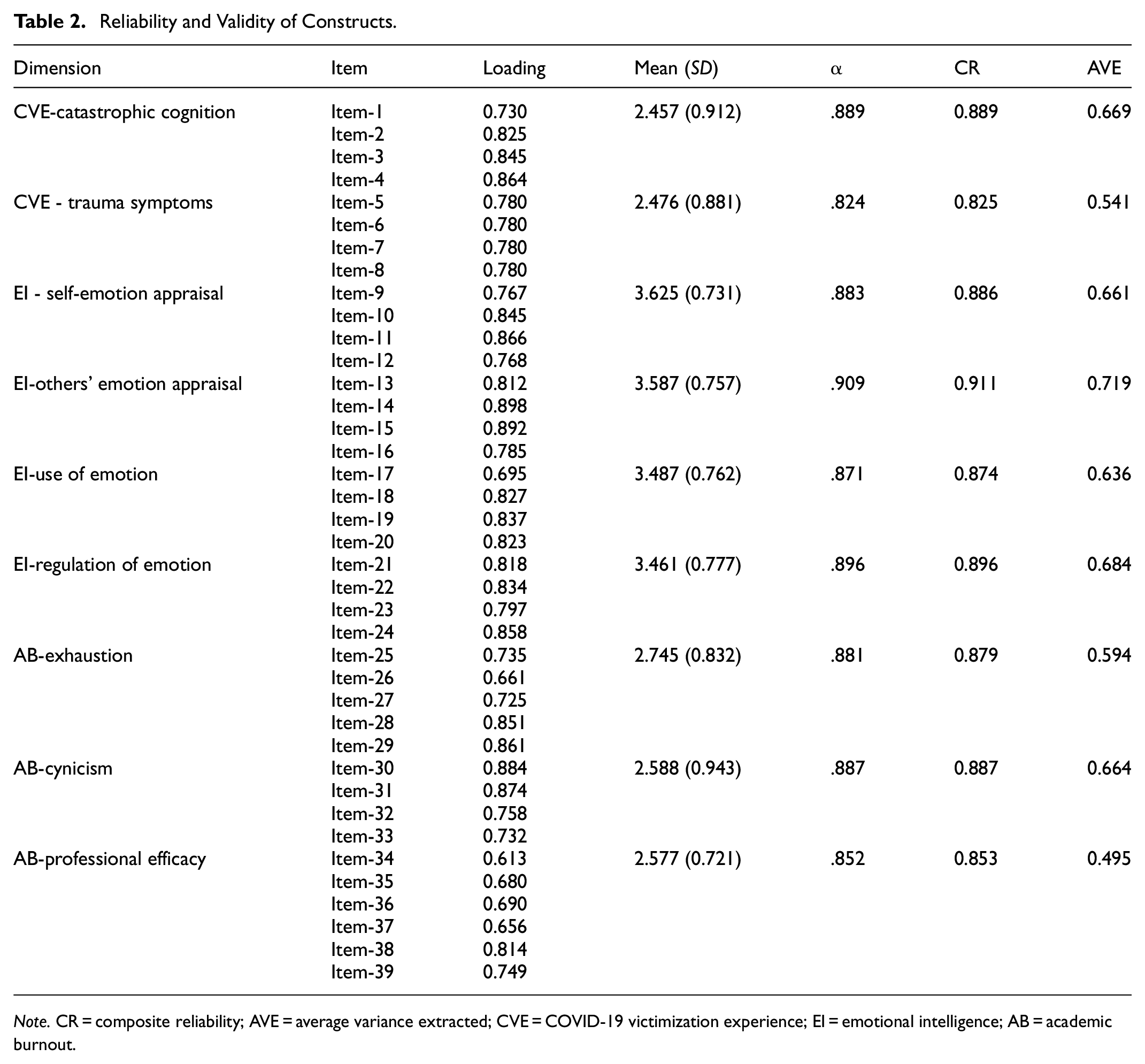
Note. CR = composite reliability; AVE = average variance extracted; CVE = COVID-19 victimization experience; EI = emotional intelligence; AB = academic burnout.
To test discriminant validity, the Fornell and Larcker (1981) tests were tested. As shown in Table 3, the square root of each variable’s AVE was greater than its correlation with other variables, indicating that the data discriminant validity was met.
Discriminant Validity.

Note. Bolded fonts are AVE square root values.
CVE = COVID-19 victimization experience; EI = emotional intelligence; AB = academic burnout.
p < .05. **p < .01. ***p < .001.
Descriptive Analysis
Table 4 shows the descriptive statistics and correlation analysis. The statistical results showed that university students had a mean level of CVE (catastrophic cognition = 2.467; trauma symptoms = 2.476), higher levels of EI (self-emotion appraisal = 3.625; others’ emotion appraisal = 3.587; use of emotion = 3.487; regulation of emotion = 3.461), and a mean level of AB (mean = 2.636). The mean levels of CVE and AB among university students suggested that the risk of infecting COVID-19 was still an important variable influencing their mental health and academic lives in the post-COVID-19 era. In addition, the results indicated apart from catastrophic cognition and others’ emotion appraisal, intercorrelations of the variables used in the present study had significant correlations. More specifically, the dimension of CVE had significantly positive correlations with AB (catastrophic cognition r = .499, p < .001; trauma symptoms r = .468, p < .001) and had negative correlations with the subscales of EI. The subscales of EI all had significantly negative correlations with AB. Compared to the other EI subscales, EI3 (the use of emotion) has a significantly stronger negative association with AB (r = .334, p < .001).
Descriptive Statistics and Correlation Analysis.

Note. n = 1,223.
M = mean; SD = standard deviation; CVE = COVID-19 victimization experience; EI = emotional intelligence.
p < .05. **p < .01. ***p < .001
Mediating Role of EI
To examine the effect of CVE on AB and the role of EI, the SPSS macro PROCESS program (Model 4) was used. In the present study, some variables, such as respondents’ gender, grade, and age were controlled for, since previous studies have reported that these factors could affect EI and AB (Holliday et al., 2017; Kilic et al., 2021). The regression analysis results were listed in Table 5.
Testing the Mediation Model of Emotional Intelligence.

Note. n = 1,223.
β = standardized coefficients; SE = standard error; CI = confidence interval; CVE = COVID-19 victimization experience.
p < .05. ***p < .001.
In model 1, in which CVE was taken as the independent variable and AB as the dependent variable, the regression analysis indicated that university students’ CVE significantly predicted AB (β = .500, p < .001). Thus, the hypothesis H1 was supported. In model 2, in which CVE was regarded as the independent variable and EI as the dependent variable, the regression analysis showed that CVE had significantly negative effects on EI. The regression coefficient of CVE on EI was β = .149 (p < .001). In model 3 with CVE taken as the independent variable and AB as the dependent variable, adding EI as the mediating variable, CVE still has a significant positive effect on AB (β = .468, p < .001), and EI had a significantly negative effect on AB (β = .216. p < .001). Furthermore, the β value of the impact of university students’ CVE on their AB decreased significantly from 0.500 significantly in model 1 to 0.468 in model 3, suggesting that EI partially mediated the effect of CVE on AB, and hypothesis H2 was supported. The mediation model is finally illustrated in Figure 2.

Mediating effect of EI on the link between CVE and EI.
In order to test the vigor of mediating effect, the bootstrap method was further used in a procedure of 5,000 data resamples via the SPSS macro PROCESS. As shown in Table 6, the indirect effect value (i.e., CVE → EI → AB) was 0.023 with 95% CI [0.010, 0.039], indicating the mediating effect of EI. The direct effect value (i.e., CVE → AB) was 0.337 with 95% CI [0.303, 0.372], indicating the partial mediating effect of EI. The total effect was 0.360 with 95% CI [0.325, 0.396]. The mediating effect accounted for 6.39% of the total effect.
Direct, Indirect, and Total Effects.

Note. SE = standard error; CI = confidence interval.
Discussion
Main Findings
COVID-19 might be one of the most global devastating events in recent decades, but emerging research indicates a high probability of experiencing future pandemics similar to COVID-19 (Bambrah et al., 2023). As such, scholars need to continue to deeply investigate the long-term effects of COVID-19 in a post-disaster context. The academic burdens caused by COVID-19 could lead to a mismatch between university students’ needs and available resources, which in turn would render university students particularly vulnerable to high levels of burnout. Thus, it is still meaningful to examine the risk and the potential protective factors of university students’ AB in the post-COVID-19 era. In this vein, the present study aims to examine the role of CVE and EI in predicting university students’ AB. A cross-sectional online survey including the COVID-19 Victimization Experience Scale, the Academic Burnout Scale, and the Emotional Intelligence Scale among 1,223 Chinese university students, was administered. According to the results, the proposed hypotheses were tested as follows.
First, the current findings confirmed Hypothesis 1, supporting that university students’ CVEs are negative stimuli that have a significant predictive effect on AB (β = .500, p < .001). In the context of the COVID-19 pandemic, previous studies have reported that COVID-19 related variables, such as perceived stress (Kilic et al., 2021), posttraumatic growth (Xu et al., 2017), posttraumatic stress disorder symptom (Tomaszek & Muchacka-Cymerman, 2022; Zhou et al., 2017), and COVID-19 pandemic trauma (Bambrah et al., 2023), were significantly associated with the risk of burnout among different groups. Aligning with those results, the present study further found a significant relationship between CVE and AB among university students.
A possible explanation for this finding is that the high demands caused by COVID-19, such as the maladjustment of online learning, low sense of control, and sleep disorders (Brailovskaia & Margraf, 2021; Qu et al., 2022), deplete students’ academic resources. University students who have become the victims of COVID-19 already have high levels of psychological stress, accompanied by related behavioral and physiological problems, such as negative cognition and insomnia, which require more individual resources to alleviate those negative outcomes (Bakker & Demerouti, 2017). Individuals didn’t have sufficient resources to deal with challenging learning tasks, and the mismatch between individual resources and needs can easily lead to AB. In this vein, university students with high levels of CVE are more prone to have the risk of AB.
Second, the results indicated that EI had a partial mediating effect in the link between CVE and AB, and the indirect effect value of EI was 0.023 with 95% CI [0.010, 0.039]. That is, CVE could indirectly affect the university students’ AB through their EI abilities. High levels of EI were a key protective factor against AB among university students, which can compromise the effects of perceived CVE on AB. This finding is consistent with those of prior studies indicating that EI mediated the association between psychological distress and increased burnout level (Yusoff et al., 2021), and between academic performance and burnout (Molero Jurado et al., 2021). The present study further broadens the mediating role of EI in the link between CVE and AB, showing that the effects of university students’ CVE on their AB could be compromised by their high levels of EI abilities.
Many factors, including contextual variables, personal variables, and psychological variables, could influence on university students’ AB. According to Demerouti et al. (2021), compared to contextual factors, the role of cognitional factors was indispensable in the studies of burnout. In this sense, as an important psychological resource, the directly predicted role of EI in preventing burnout symptoms has received considerable attention. Supporting this suggestion, the present studies further reported the mediating role in the link between CVE and AB. The indirect role of EI in the contest of COVID-19 means that although individuals with CVE tend to AB, the levels of AB could be decreased by enhancing their EI abilities. Indeed, when confronting stressful life and disaster events, emotionally intelligent students, who are more capable of knowing how to appraise emotions and feelings consistently and handle emotional problems effectively, are less vulnerable to developing AB.
Third, the results of the present study empirically proved the explanation of the JD-R model in the research of university students’ AB in the context of post-COVID-19. Previous studies on burnout based on the JD-R model mainly focused on adolescents and high school students (Salmela-Aro & Upadyaya, 2014; Shen et al., 2021; Teuber et al., 2021). Aligning with previous studies, the present studies further applied the JD-R model among university students’ AB in the context of post-COVID-19. According to the JD-R model, the levels of burnout depends on two main factors: job demands and job resources, that is, both insufficient resources and high demands can result in the risk of burnout. In the framework of the JD-R model, according to the results of the present study, it is theorized that (1) CVE functions as high demand, triggering a sense of AB among university students; whereas (2) EI functions as a sufficient resource, which in turn decreases their levels of AB. Although high demand caused by CVE could develop the risk of university students’ AB, however, this negative effect could be mitigated by their EI abilities. Overall, these findings highlights the significance of nurturing university students’ EI as a protective factor against the risk of burnout caused by COVID-19 and other similar public health events.
Theoretical and Practical Implications
The current study could advance our understanding of AB by underlining under-researched, but highly relevant, predictors of AB during the post-COVID-19 era: the risk role of CVE and the protective role of EI. Extending beyond previous research about the effect of COVID-19-related measures on AB, the present study directly focused on the predictive role of CVE on university students’ AB. Overall, the results indicated that CVE could provide a more comprehensive interpretation of AB among university students in the post-COVID-19 era. Also, the present results illustrated the effects of victimization experience on their abilities of EI. These findings underscore the wide-ranging impact of pandemic trauma on people’s ability to regulate negative feelings, highlighting the need for transdiagnostic evidence-based supports that improve individual’s emotional ability to cope with stressful and traumatic experiences and events (Waterschoot et al., 2022).
The present study could also provide some practical reference for education instructors both within and beyond the context of pandemics. First, it should be noted that viruses per se never and ever go away, the same applies to COVID-19, which is still evolving and changing its form. University students and other individuals will get infected again, becoming the victims of COVID-19 and its variants, such as Omicron (Maruf et al., 2024).To help students avoid negative thinking toward COVID-19 and other similar stressful and traumatic events, instructors should hold lectures on public health knowledge to guide students to properly confront disaster victimization experiences. Second, considering the effects of university students’ CVE on AB could be compromised by their EI abilities, it is suggested that instructors should integrate EI training programs into public health courses, for instance, Acceptance and Commitment Therapy teaching clients skills to notice, describe, and manage painful feelings and thoughts (S. C. Hayes et al., 2006). Students with improved EI ability will minimize the risks of developing AB.
Limitations and Future Research
Some limitations should be pointed out so that some further research could be carried out to address them in future.
First, the method of the present study was cross-sectional and the sample was merely collected among Chinese university students using the convenience sampling, limiting causal relationships among variables. To generalize the results of the present study, therefore, a longitudinal study should be conducted, and the range of participants should be expanded, particularly populations with cultural differences must be considered.
Second, all the variables measured in the present study were by self-report scales from students themselves, which could have resulted in socially desirable answers. Thus, the method of multi-sources data from the perspectives of peers, parents, and teachers, should be adopted in future research to minimize the potential social desirable effect.
Third, this study only examined the mediating effect of EI in the link between CVE and AB. Previous studies have reported that other positive psychological constructs, such as psychological capital (Y. Tang et al., 2023), grit (Teuber et al., 2021), and work engagement (Çankır & Arıkan, 2019), may also have a significant role in mitigating the risk of burnout. Thus, future studies should pay more attention to these potential mediating constructs in decreasing the long-term effects of CVE on AB.
Conclusion
Based on the JD-R model and previous research, the present study proposed a mediation model to investigate the main influencing factors of academic burnout among Chinese university students. Significant correlations were observed among COVID-19 victimization experience, emotional intelligence, and academic burnout. The results indicated that CVE and EI could provide a more comprehensive knowledge of AB among university students during the post-COVID-19 era. In detail, the findings of the present research showed that CVE had significantly positive predictive effects on AB and EI of university students. Moreover, EI played a mediating role between CVE and AB. Considering the effects of COVID-19 will be long and lasting, more studies about CVE and its effects should be carried out.
Footnotes
Acknowledgements
The authors would like to thank all instructors and students that have participated in the study

Author Contributions
Conceptualization, Hongxin Zhang; methodology, Hongxin Zhang and Hongxia Chen; software, Hongxia Chen; investigation, Hongxin Zhang and Hongxia Chen; data curation, Hongxin Zhang and Hongxia Chen; writing-original draft preparation, Hongxin Zhang; writing-review and editing, Hongxin Zhang. All authors have read and agreed to the published version of the manuscript.
Funding
The author(s) received no financial support for the research, authorship, and/or publication of this article.
Declaration of Conflicting Interests
The author(s) declared no potential conflicts of interest with respect to the research, authorship, and/or publication of this article.
Data Availability Statement
The datasets used during the current study are available from the corresponding author on reasonable request.