




Abstract
This article aims to reveal the factors that affecting the impact of international collaboration papers in the field of social sciences and humanities. Based on resource-based theory and transaction cost theory, we analyzed the articles from a sample of 13,331 listed research papers come from the 42 world class universities in China using descriptive statistics, ordinary least square (OLS) regression, and came to the following conclusions: First, it is the quality rather than the quantity of international collaborator that affect the academic influence of the research outputs. Second, researchers from different backgrounds are conducive to improve the impact of research papers and the collaboration leading by Chinese university perform better. Yet, too much collaborators coming from different institutions would have an adverse impact, which may due to the increase cost of cooperation. Finally, collaborating researchers from developed countries or top universities will significantly improve the research performance because of the abundant resources behind them. Findings from this research suggest that setting up international collaboration should pay more attention to the level of the collaborator and consider the cost behind the whole process.
Introduction
As disciplines progress to a more specialized direction, scientific research is increasingly reliant on the communication and cooperation of different organizations and institutions. The ever-deepening globalization also contributes to the popularization of international collaboration in scientific research. To bolster overall national strength, countries around the world, especially developing countries, are scaling up their investment in scientific research and meanwhile seeking international collaboration to push their technological edge to a higher level, which can be manifested by the steady promulgation of international science and technology cooperation policies since the beginning of the 21st century. For instance, the developed countries such as the United States, the United Kingdom, Germany, Finland, etc., are publishing a lot of international research cooperation programs in order to maintain their advantage in the field of science and technology. Some developing countries such as China and India are also devoted to achieving scientific and technological development through international cooperation (Qiang, 2015). In the course of implementing policy, higher education has played a vital role. Through jointly running schools, conducting scientific research, and solving international conflicts, higher education in various countries share and exchange technologies, in ways to elevate scientific research strength.
Among all the ways that countries carry out international collaboration, scientific research cooperation between universities is an essential carrier for researchers to communicate with and learn from each other. For such cooperation, research papers are the typical embodiment of the results. In Big Science, Little Science authored by Price, it was mentioned that with the arrival of the era of big science, striving for scientific priority needs to be proved by publishing papers. At the same time, cooperation has become a widely-recognized trend in the development of modern science (Price, 1963). On the one hand, scientific research cooperation is conducive to pooling experts from various fields to solve interdisciplinary problems; on the other hand, scientific research cooperation also significantly lifts the quality of scientific research papers. According to the data from Incites, in the first decade of the 21st century, the total number of international cooperative papers was about 6.51 million, and in the second decade, the number was nearly 16 million. The increase of collaborative papers shows that in the context of accelerated globalization and increased international competition, countries try to vie for technological superiority, in order to secure economic advancement, as well as discourse power and leadership in international affairs. In a world with tremendous progress in science, international collaboration was more lasting and solid, and hence seeking high-quality and sustainable partners has become the common goal of all countries in international collaboration.
Based on the importance of international scientific research cooperation, this study aims to explore the factors that influence the quality of international scientific research collaboration papers. At present, many researches prove that international collaboration papers have more academic impacts from different perspectives. For example, scholars compare internationally co-authored papers from different countries and they all point out international collaboration research have significant higher impact than domestic research (Abramo et al., 2011; Adams et al., 2007; Lancho-Barrantes et al., 2013). Research based on different discipline such as chemistry, life sciences, biomedicine indicates international collaboration in scientific research is conducive to improving the quality of scientific research output, but difference policies and research environment, as well as other factors, could lead to differences in the extent to which international collaboration impacts on the quality and performance of scientific research (Glänzel & de Lange, 2002; Glanzel & Schubert, 2001; Narin et al., 1991; Puuska et al., 2014). Conclusions coming from analyzing different institutions also reflect that international collaboration has a positive impact on research performance of the institution (Adams et al., 2007; Arunachalam et al., 1994; Barjak & Robinson, 2008; Carayol & Matt, 2004).
From the existing literature, we can find that the current research mainly focused on comparing the quality between internationally co-authored papers and non-internationally co-authored papers, some of which also explored the impact of international collaboration on scientific research performance. However, regarding what factors affect the performance of internationally co-authored papers, and what kind of institutions or objects should be selected as cooperative partners, few studies have investigated. To optimize the decision in selecting high-quality research cooperator, reveal the characteristics of high-level collaborators in scientific research, and secure the quality and sustainability of international collaboration in scientific research, this study try to explore the factors affecting the quality of international collaborative scientific research papers on the basis of established research.
This study sets out to explore the factors that influence the quality of international collaboration in the humanities and social sciences. There are two reasons for selecting it as the research object. On the one hand, currently, there is a lack of studies that focus on the impact of current international collaboration on the humanities and social sciences and explore which factors affect its research quality; on the other hand, with the growing complexity of international relations, international public affairs require multiple countries to take part in the collaboration. Whereas social sciences play an increasingly significant role in communication and cooperation, and the cooperation in humanities and social sciences often takes a long time, only by identifying high-quality collaborators, can the sustainability and scalability of research be ensured. Such being the case, this paper chooses to investigate factors affecting the quality of international collaboration in humanities and social sciences, so as to foster sustainable development in international exchanges and cooperation.
The reason why we choose China is that the country plays a more vital role in international public affairs with China’s elevated international status. Since the turn of the millenium, China is committed to building world-class universities and strives for advancing higher education so that it can play the part of serving politics and economics. In 2014, the Chinese government put forward an ambitious plan to set up world-class universities. Chinese universities have been committed to the construction of high-level universities and actively participated in international collaboration. In 2016, the “13th Five-Year” Science and Technology Development Plan for Higher Education issued by the Ministry of Education of China clearly asserted that it was imperative to vigorously strengthen high-level and innovative international collaboration in science and technology. These efforts in encouraging collaboration have generated tremendous benefits. According to the Report on the Status of China’s International Collaboration in Scientific Research in 2017, it can be inferred that China has risen to the third-largest paper producer of international scientific research collaboration. With 188 countries and regions collaborating with China in scientific research, it can be said that China basically reached global coverage. And the data from incites show that the international collaboration papers from China in the past 10 years increased from 39,595 in 2010 to 159,122 in 2020. During the period, China’s gross enrollment rate of higher education has exceeded 50% and entered the era of popularization. The rise of China has attracted many researchers’ attention and they point out that the development of their science technology is breaking the monopoly of the European and American scientific system, which makes international science development goes into a more complex, polycentric global order (Marginson, 2021).
As such, this study selects China’s world-class construction universities and analyzes internationally co-authored papers in humanities and social sciences published in these universities in 2014 to 2019, since the starting of the construction plan, so as to explore the factors that impact on the impact of international collaboration. This paper aims to provide a reference for developing world-class universities, raise the quality of international collaboration in scientific research, and gain higher international discourse power.
This article is organized as follows, Section 2 introduces the theoretical framework and propose research hypothesis according to the theory and related research. Section 3 explains the data and method in detail. Section 4 presents the results and finally, Section 5 provides a discussion and concludes our findings.
Theoretical Framework and Research Hypotheses
Many studies have implied that international collaboration in scientific research can effectively improve the quality of scientific research. In some research, scholars concluded that the impact of international research collaboration papers is higher than that of local papers, such as Bordons et al. (1996) in the field of biology medicine and Van Raan (1998) in the field of astronomy. However, some researches have come to the opposite conclusion, they found international collaboration did not have a positive impact on research quality in the field of finance (Avkiran, 1997) and there was no significant difference in the impact of international co-authored articles and those published domestically in the field of biology (Roosa & Julia, 2005). Different conclusions drive us to think why international collaboration bring different results even in similar discipline. Insights from resource-based theory and transaction cost theory may provide us with an explanation.
According to the resource-based theory, the competitive advantage of an enterprise is not determined by the market and industrial competitive structure, but by the competitive resources that an enterprise has mastered (Wernerfelt, 1984). In the process of international collaboration, different scholars share resources and undertake tasks with each other. Some scholars focus on theoretical construction, research design, and funding, while others focus on data collection and analysis, writing research conclusions, and finally the whole research team interprets and discusses the results together. The existing research have also regarded the resource-based view as a powerful explanatory mechanism to study academic collaboration (Lavie & Drori, 2012; van Rijnsoever et al., 2008).
However, resource-based theory fails to explain why some international cooperation does not lead to effective competitive advantage. This is due to the obstacles from international cooperation. Researches showed that scholars working in different locations, similar to distributed work teams, find it difficult to find “each other at the same time, in different times” (Armstrong & Cole, 2002), and they lack mutual knowledge (Hinds & Bailey, 2003). Scholars find that geographical dispersion causes more relational conflicts (Hinds & Mortensen, 2005), inhibits communication (Van Den Bulte & Moenaert, 1998), and reduces team innovation (Gibson & Gibbs, 2006). That kind of factors can be attributed to the increase cost of cooperation. According to the transaction cost theory, the transaction cost refers to the various resources spent to achieve the transaction, including the cost of information searching, bargaining, signing, and the cost of guaranteeing the performance of the contract (Coase, 1937). In a broader sense, transaction costs can also be understood as the operating costs of economic systems (Arrow, 1969). Oliver Williamson believes that transaction costs are affected by human factors, trading factors, and trading environment factors (Williamson, 1995). In international scientific research cooperation, transaction costs are also involved. For example, the larger the scale of cooperation, the more communication and time costs are needed, which may affect the effect of international scientific research cooperation.
Combined with the resource-based theory and transaction cost theory, this study is going to proposed the research hypotheses based on the existing research conclusions.
The Quality of Scientific Research
Many studies have implied that international collaboration in scientific research can effectively improve the quality of scientific research. In those studies, researchers often leverage FWCI (Field-Weighted Citation Impact) or the citations to measure the quality of internationally co-authored papers. However, the conclusion differs using these two indicators. In studies adopting FWCI as the indicator, Leydesdorff et al. (2019) found that FWCI was related to whether international collaboration initiated, while it had nothing to do with the volume of the funding, it was found that international collaboration has a greater effect on improving the quality of scientific research publications of young universities. However, the results changed when using the citations to measure the quality of scientific research. Taking the citations to measure the quality of ecological papers, Roosa and Julia (2005) found that in the field of ecology, scientific research cooperation has little impact on the quality of papers. Therefore, this study incorporates both FWCI and the citations as dependent variables to measure the quality of internationally co-authored papers in scientific research, with an attempt to better characterize the quality of scientific research results.
On such basis, this research is devoted to exploring the factors that affect the quality of international collaboration in scientific research, including the characteristics of collaborator, research institutions, and countries. Although there are few studies that directly examined the linear relationship between them, existing research has identified lots of factors that can lead to a successful international collaboration.
Collaborators
Generally speaking, the influence of scientific research papers is tightly bound to the influence of scholars themselves. It is proven that researchers engaged in international collaboration usually have high academic achievements and status (Kwiek, 2020). Moreover, researchers’ academic influence is a crucial variable affecting international collaboration (Payumo et al., 2017). Their personal research performance has a positive impact on the extent to which scientists collaborate internationally (Abramo et al., 2011). In turn, international collaboration can effectively lift individuals’ academic influence (Yao et al., 2013). As such, international collaboration can often push the popularity of researches to a higher level. When conducting international activities, the academic achievements of participants are also a paramount factor in securing international collaboration (Jeong et al., 2014). Therefore, in research design, many studies consider research performance, researcher’s personal academic achievement, and influence as cardinal factors affecting international collaboration (Abramo et al., 2011).
In addition, with the deepening of internationalization, factors affecting the quality of international collaboration are not only the academic influence of researchers but also the number of collaborators. Scholars with different knowledge backgrounds can surface wisdom, draw on each other’s merits, reduce research errors, and thus elevate research quality. Studies from various countries have shown that the number of collaborators is positively correlated with scientific research influence. Chinese researchers found that the size of the research team was positively correlated with research influence. It was pointed out that in China, the smaller the team size, the lower the impact (Quan et al., 2019). International collaboration analysis carried out by Norwegian scholars also demonstrated that the size of research teams had a positive effect on the quality and quantity of research (Kyvik & Reymert, 2017). However, results vary in different research fields. Existing studies have found that in the field of education technology, the number of authors in international collaboration is significantly positively correlated with the number of articles cited (Guo et al., 2016). While the conclusion was not proven in the field of humanities (Puuska et al., 2014). Based on exploration on team size and quality as well as the impact of papers, the following research hypotheses are put forward:
H1: The higher the h-index of scientific researchers, the higher impact of papers.
H2: The more collaborators, the higher impact of papers.
Institutions
It is noteworthy that in addition to factors at the micro-level, we shall also take Meso-level factors into account when investigating the impact of scientific research on the quality of scientific research. A combination of knowledge and skills from different backgrounds and cultures is often considered to be conducive to scientific research and innovation. Existing research on papers published by Harvard University found that publications with more institutions participated tend to be cited more frequently (Gazni & Didegah, 2011). Team diversity can effectively contribute to a higher impact of scientific researches, but such diversity needs to be limited to a moderate level, which means maximized diversity will not necessarily result in the best performance (Barjak & Robinson, 2008).
Besides the number of collaborators, the quality of collaborators is also an important factor that affects the impact of papers. Previous studies have found that the research resources owned by collaborators can effectively influence the establishment of international collaboration (Chang et al., 2016). Meanwhile, the academic excellence, technology development level, and external fund inspiration of the partner institutions play significant roles in the determination of specific collaboration modes (Jeong et al., 2011). World-class universities often possess abundant research resources and boast a higher academic level. In order to more accurately mirror the level of collaborators in scientific research, this study holds that the higher the international ranking of a university, the stronger its comprehensive strength. In this sense, we treat the number of top 100 universities as an independent variable. Based on existing research results, the following research hypotheses are put forward:
H3: The more institutions involved in scientific research, the higher impact of papers.
H4: The more top 100 universities participating in the collaboration, the higher impact of papers.
Countries
Although team diversity can reflect different research backgrounds and cultures, different indicators can embody different degrees of cultural diversity. Compared with indicators such as institutions, the number of countries involved in international collaboration can better denote differences in background and knowledge between partners. Some studies have stated that the number of countries participating in international collaboration is a critical factor affecting international collaboration (Prakasan et al., 2014), in which the more countries participating, the greater the influence (Guerrero Bote et al., 2013), although the high citation brought by this multinational cooperation is due to the audience effect (Wagner et al., 2019).
Similar to the level of the institutions, the strength of a nation also matters when starting international collaborations. How much universities invest in scientific research is related to the strength of the country where the university locates. Studies have found that scientific collaboration between developing or small countries with developed countries can bolster the influence of developing or small countries’ scientific research cooperation (Chinchilla-Rodríguez et al., 2012). Such scientific and technological cooperation between countries with huge economic and technological gaps can gain more citations (Hsiehchen et al., 2018). Cooperation with developed countries such as the United States can effectively increase the impact of scientific research (Sud & Thelwall, 2016). At the same time, researches also indicate that R&D investment is a kernel variable that affects the impact and output of scientific research. In the social science field, cooperation with countries with high R&D investment yields the greatest benefit (Bordons et al., 2015). Developed countries often invest copiously on R&D. Based on the above research, the following hypotheses are put forward:
H5: The more countries involved in scientific research, the higher impact of papers.
H6: The more developed countries participating in the collaboration, the higher impact of papers.
It should be noted that although it is evidential that international collaboration increases the impact of scientific research, the impacts differ when collaborators assume different positions in scientific research. Studies have pointed out that non-native scholars serving as corresponding authors is more helpful to citations (Nguyen et al., 2017), when collaborators who come from countries with fewer resources are not in a leading role, their papers will generate greater scientific impact (Chinchilla-Rodríguez et al., 2019). This research delves into the influence factors of international scientific collaboration in the field of humanities and social sciences. Given that the first author and affiliation in these fields are usually in the leading role with the highest contribution among all the participating institutions in international collaboration in scientific research. Hence, the study takes whether a world-class university aims to build itself as the first affiliation as a control variable that affects the impact of international collaboration in humanities and social sciences research in China.
Methods and Data
This study selects China’s world-class construction universities and analyzes internationally co-authored papers in humanities and social sciences published in these universities in 2014 to 2019, so as to explore the factors that impact on the quality of international collaboration. This paper aims to provide a reference for developing world-class universities, raise the quality of international collaboration in scientific research, and gain higher international discourse power.
All data in this article source from Scopus database, where the authors’ h-index data is obtained using Selenium, a web automation tools. Other related data is downloaded from SciVal, a scientific research management tool developed by Elsevier. Stata 14.0 is introduced to analyzed the data in the research.
The main unit of analysis in this study is the paper. Our research collects the data internationally co-authored papers published by scholars in 42 China’s world-class construction universities in 2014 to 2019 in the field of humanities and social sciences, including citations, FWCI, the sum of h index of co-authors, number of authors whose institutions rank among the top 100 universities in the world (Ranking come from the Shanghai Ranking’s Academic Ranking of World Universities), team size, number of countries involved in the paper, number of developed countries involved in the paper, number of institutions involved in the paper, and whether the author is the first author in a China’s world-class construction university. After removing duplicate papers, a total of 13,331 papers are selected in the field of humanities and social sciences. Data acquisition methods and partial results are shown in the following two tables (Table 1).
Data Acquisition and Calculation Method.

The number and FWCI of international collaboration papers published by 42 China’s world-class construction universities are shown in Figure 1. From 2015 to 2019, Peking University, Tsinghua University, and Beijing Normal University are the top three universities in publishing international collaboration papers. The article number of the top 1/3 universities account for 65% of the total international collaboration papers. As for the FWCI, it is consistent with the number of collaboration papers.

The academic performance of research output.
The descriptive statistics of variables are shown in Table 2. The average number of international collaboration papers is 368.4, and the standard deviation is 292.1. Peking University has the highest number of papers, and Xinjiang University has the lowest number of papers. The standard deviation of other indicators is also very large, which means that there are significant differences between each university in publishing international collaboration articles.
Descriptive Statistics of Variables.
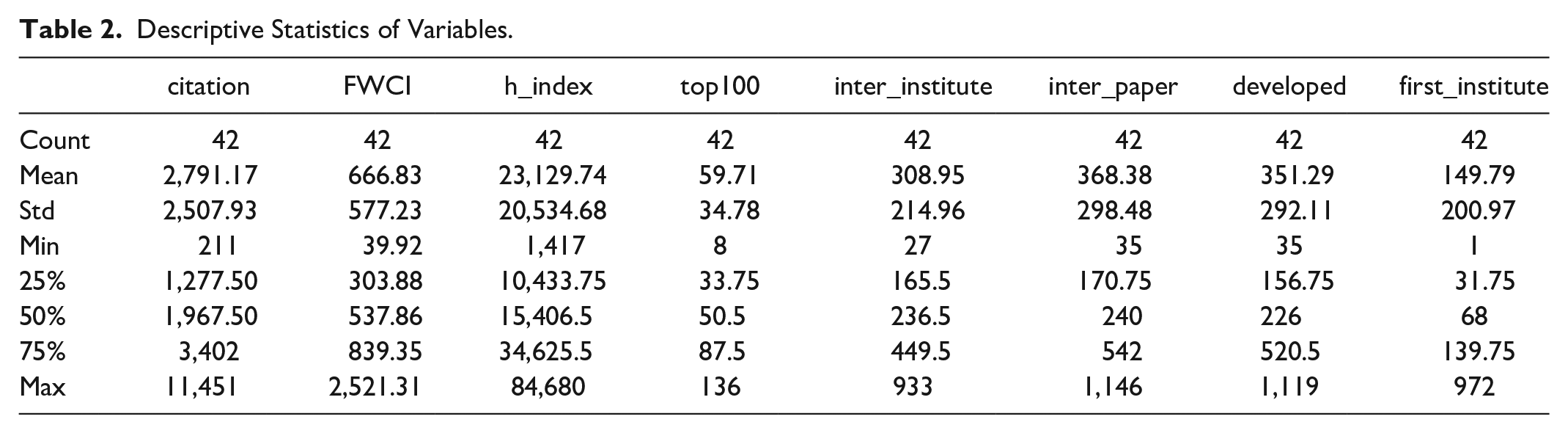
Analyzing the correlation coefficient between the variables, we can infer that there are significant correlations between the variables. Through the preliminary analysis, it can be found that increasing the level of each variable can significantly increase the level of the dependent variable (Table 3).
Correlations Between Variables.

Note. ***means a significance level of 1%, **indicates a significance level of 5%, and *refers to a significance level of 10%.
Results and Findings
An Analysis of How Characteristics of International Collaboration Impact on International Collaboration Influence in Scientific Research
This research employs the FWCI of papers to measure the influence of international scientific research papers, OLS least squares regression to analyze the impact factors of international scientific research papers. Among them, Model 1, Model 3, and Model 5 reflect the number and scale of collaborations at the individual level, the number of collaborations at the institutional level, and the quality of collaborations at the institution level, respectively. Model 2, Model 4, and Model 6 mirror the regression results of each variable after including the control variables. Model 7 demonstrates the regression coefficient of each variable when all variables are included.
Of concern is that from the pre-analysis of the data, it can be found that there is a significant correlation between the various factors that affect the dependent variable, which might lead to multicollinearity to a certain extent. Thus, the study conducted a multicollinearity test. The results show that the VIF (variance inflation factor) of respective variables are all less than 10, indicating that there is no multicollinearity among the variables in the regression model, and hence the regression equation is reliable.
From the analysis of individual factors, it can be found that whether the control variables are included or not, the higher the academic influence of the authors in international scientific research, the higher FWCI; the more collaborators involved in scientific research, the higher FWCI. When the control variables are included, the conclusion still holds. This indicates that regardless of whether the international collaboration is led by a domestic world-class university, increasing the number and quality of collaborators can significantly promote the influence of scientific research papers.
From the analysis of the number of institutions and countries involved, it can be discovered that whether or not control variables are included, the number of institutions and countries involved will significantly affect the scientific research influence of international collaboration. The more institutions involved in international collaboration, the higher impact of the paper; the more countries involved in international collaboration, the higher impact of the paper. It is worth noting that when the control variables are included, the influence of the number of institutions increases, but the influence of the number of countries slightly decreases. This shows that when international collaboration is led by world-class construction universities in China, the influential effect of the number of institutions increases, while that of the number of countries decreases.
From the analysis of the level of institutions and countries involved, it is found that whether or not the control variables are included, the higher the ranking of international universities, the higher FWCI; the more developed countries, the higher FWCI. Whether it is the first affiliation or not, in this regression, will not affect the FWCI of internationally co-authored papers.
Model 7 reflects how all independent variables affect FWCI. The results represent that, in addition to the number of countries involved, variables including individual factors, the number and quality of institutions all significantly affect FWCI. Notably, though, the impact is different from that of a single model. As far as individual factors are concerned, the expansion in team size does not increase FWCI; in terms of the number of institutions, more countries involved do not significantly increase FWCI; however, the quality factors at the institutional-level still significantly promote the quality of international collaboration in scientific research. Whether the university is led by a world-class university in China has no effect on the influence of international collaboration in scientific research.
In order to further test the role of the number of collaborators and institutions involved in the academic influence of scientific research papers, the study includes the quadratic term of these variables for regression analysis. That’s how Model 8 is generated. It is found that the quadratic terms also significantly affect FWCI. The results of the influence factors of the quadratic regression show that the symmetrical abscissa of the quadratic term of the number of collaborators is −9.5, which implies that all else being equal, the more collaborators, the lower the impact of scientific research papers; the quadratic coefficient of the number of countries involved is 17.875, that is when there are less than 17 countries involved, the more countries, the higher impact of scientific research, but there are than 17 countries involved, the overall impact of the scientific research paper will decrease. In this study, there are merely 38 samples with more than 17 countries involved, so it can be considered that in most cases, the more countries involved in scientific research, the higher impact of scientific research (Table 4).
Results of Regression Analysis.

Note. ***means a significance level of 1%, **indicates a significance level of 5%, and *refers to a significance level of 10%.
Robustness Test of Results
In order to prove the robustness of the research results, this study uses citations to replace FWCI to perform the regression, in ways to explore the robustness of the respective variables on the influence of internationally co-authored papers. The specific analysis results are shown in the table below.
From the perspective of individual factors, the h_index significantly affects citations, while the team size has no significant impact on citations. Regardless of whether the first author is controlled, the conclusion still stands.
From the perspective of the number of institutions, institute_num significantly affects citations, but the country_num has no effect on citations; it is worth paying attention to whether it is the first affiliation, which has a significant impact on the institute_num. The influence of domestic institutions as the first author is 0.876 higher than that of the non-first author.
From the perspective of the institutional quality, the number of high-level universities and developed_num can significantly promote citations. Regardless of whether the first author is controlled, the conclusion still stands.
From the results of the overall regression analysis, the regression results show that all variables can significantly affect the citations of scientific papers. Analyzing the results, it can be found that compared with treating FWCI as the dependent variable, the differences and directions of the influence factors are completely consistent. In order to further explain the influence of the team_size and country_num, their quadratic coefficients are introduced to perform the regression, and the results of Model 8 are obtained. It shows that the inflection points of the quadratic regression between the team_size and country_num is −7.23 and 21.17 respectively, meaning that when other conditions remain unchanged, the more collaborators, the lower citations. When the number of countries involved is or less than 21, the more countries, the higher impact of papers. When there are more than 21 countries, the overall impact of papers will decrease (Table 5).
Results of Regression Analysis.

Note. ***means a significance level of 1%, **indicates a significance level of 5%, and *refers to a significance level of 10%.
The results of these two regressions all indicate that h_index, institute_num, developed_num, and top100 universities can significantly promote the influence of scientific research papers, but blindly increasing team_size will not be conducive to elevating of scientific research influence. The impact of country_num on the influence of scientific research papers show an inverted U-shaped curve, which means too many countries involved would mitigate the influence of scientific research.
In order to further prove the reliability of the results, this study performed regression on humanities and social sciences respectively. The results are essentially in agreement with the overall situation. From the regression results of social sciences, the regression coefficients and influence factors are completely identical with the overall situation; from the regression results of humanities, when the dependent variable is FWCI, the inflection point of the quadratic term for the team_size is 22.92, and the overall impact is in a positive U shape. In this study, as there are only 10 papers whose collaborators exceed 23, team_size in humanities is still negatively correlated with the overall scientific research influence. However, part of the regression results in humanities shows that some variables are not significantly correlated with the impact of papers. On the one hand, this may be due to the limited number of samples. On the other hand, given that the humanities activities are not directly related to the overall strength of the country, they are instead related to the historical or cultural background of collaborators (Table 6).
Results of Regression Analysis.

Note. ***means a significance level of 1%, **indicates a significance level of 5%, and *refers to a significance level of 10%.
Discussion and Implication
This study probes into the international collaboration research papers of the humanities and social sciences in the world-class construction universities in China, analyzing the influence factors of internationally co-authored papers. From the results after analyzing 13,331 papers from 42 universities, we can reach the following conclusions.
First of all, what contributes most to high-quality international collaboration in scientific research is not about conducting cross-international collaboration, but about choosing the right partner. Existing studies have shown that the higher the overall h-index of collaborators, the higher the impact of the scientific research paper. The conclusion is an explanation of Matthew effect, which claims that those who have been blessed will be blessed again, thus assuming that the recognized top performer will continue to perform better than others, thereby receiving more recognition and increase their productivity again (Merton, 1988). This indicates that in international collaboration, it is crucial to select authors who are active in scientific research with high-level output. Seeking international collaboration partners indiscriminately cannot increase the impact of papers. The results even show that the large team in international collaboration in scientific research papers will significantly reduce citations and FWCI. This conclusion is consistent with Puuska et al. (2014) who found that in humanities, more collaborators participating in research do not have an obvious advantage in the quality of internationally co-authored publications, which implies that in international collaboration, the key is to pool more high-level international researchers, rather than form a large team. Resource-based theory and transaction cost theory can also explain this conclusion. Selecting higher-level collaborators can contribute to carry out scientific research, gain competitive advantages, and produce higher-level scientific research cooperation papers. However, if the level of participants is not outstanding and the cooperation is large, the cost of cooperation will increase, which will influence the cooperation experience and effect of participants. Existing studies have shown that when there are too many collaborators, they would spend too much time on communication and negotiation because of giving interpretation and managing relationships (Macfarlane, 2017).
Secondly, research collaboration is always influenced by the dynamic interplay of economic, scientific, cultural, and geographical factors (Hoekman et al., 2010). To ensure the success of the international collaboration, it is wise to engage more institutions with different backgrounds, especially those from high-level universities. Results illustrate that the more institutions, especially those from the top 100 universities, the higher impact of scientific research. This may be due to that in international collaboration in scientific research, team diversity can draw on a wide variety of perspectives and in-depth analysis of problems from different angles.
Moreover, the more high-level universities involved in scientific research, the more support will be given, which is more conducive to carrying out high-level international exchanges and investigations, thereby underlining the impact and quality of research. Research show that collaboration may have solved the transaction costs of cultural diversity and turned them into resources for publishing success (Ou et al., 2012). Collaborating with high-level university makes it easier for them to solve the problem. Besides, participating in international cooperation enables collaborators to join in frontier research and enhancing capacity (Parker & Kingori, 2016).
For Chinese university, they should try to be the leading role in the collaboration, which will bring more contributions to the impact of the research. Recent research also proves that Chinese researchers’ innovation and collaborative abilities may help China to establish itself as a leader in the field of international research (Zhang & Guo, 2017).
Finally, in-depth exchanges and research in humanities and social sciences with developed countries should be encouraged. The results have crystallized that the number of countries and the overall scientific research influence show an inverted U-shape. Excessive countries involved even have a negative impact on scientific research influence. Nonetheless, cooperation with developed countries can effectively enhance the international influence of scientific research. This may be due to two reasons: first, the developed countries themselves have relatively strong comprehensive national strength, and invest more to support humanities and social sciences research, which can ensure the sustainability and quality of research; second, in international humanities and social sciences research, especially in social sciences, developed countries have always had a greater say and decision-making authority. These countries play a pivotal role in international affairs. International collaboration in scientific research with them can effectively influence the process of international affairs and generate huge influence. Existing research also shows that collaborating with countries with stronger research capabilities can also bring positive effects. For example, North Korean researchers benefit from maintaining a close relationship with China (Kim & Kim, 2020). Vietnam actively participates in international cooperation, which contributes to the construction of its own open database (Vuong et al., 2018). However, it should also be noted the disadvantages of developing or weak countries in international cooperation. Some researchers point out they feel isolated and disadvantaged when cooperating with people from developed countries, and they need to take time to deal with cross-cultural difference (Macfarlane, 2017).
Successful international research cooperation should take multiple factors into account. On the one hand, the ability of the partners and the diverse teams can bring a lot of advantages (Groves & Feyerherm, 2011). On the other hand, the administrative burden coming from a large team would also increase the cost of cooperation and have a negative effect on collaboration (Macfarlane, 2017). Therefore, to carry out international collaboration in scientific research, it is necessary to judge the scientific research environment of the institutions where the collaborators are located from the macro level, instead of blindly expanding the scale of international collaboration.
This study explores the factors influencing the quality of international collaboration and makes an important supplement to the research in the field. However, this research also has the following limitations: first, the research targets the situation of the world-class construction universities in China, which might not be representative of the general situation; second, in the variable selection process, subject to the data processing technology, we failed to identify the individual characteristics of domestic and international collaborators, such as their gender and age. In future research, it is necessary to further explore the factors affecting the quality of international collaboration in scientific research in a wider range.
Footnotes
Declaration of Conflicting Interests
The author(s) declared no potential conflicts of interest with respect to the research, authorship, and/or publication of this article.
Funding
The author(s) disclosed receipt of the following financial support for the research, authorship, and/or publication of this article: Cheng Zhe is supported by the China Scholarship Council for 1 year study at the Nanyang Technological University.
