




Abstract
Across 8 European and Central Asian countries, the paper explores the hypothesis that female entrepreneurs are more likely to exhibit green behaviour by adopting new and more environmentally friendly and/or energy efficient technologies (ecopreneurship). Methodological rigor (such as broad sampling and measurement of institutions using latent constructs derived from factor analysis) is made possible in this study thanks to the richness of data provided by the World Banks’ Enterprise Surveys. The traditional simple linear approach to the adoption of gender variables in quantitative studies is applied. Results demonstrate that women exhibit a higher propensity to act in ecopreneurial ways. However, the most important finding of the study is that retroductively, a paradox emerges due to the meta-institutional dimension of the data (across former socialist vs. capitalist systems). The results show that as gender participation is mainstreamed, for example by subjecting female values to male institutions of professional management, behaviour is also mainstreamed. The paper concludes that for quantitative gender studies to attain more legitimacy vis-à-vis institutional theory and institutional feminism, the role of gender requires a better grounding in theories of how institutions work to produce economic outcomes.
Plain language summary
The paper investigates if there is a difference about decision-making across males and females when adopting new and more energy efficient or environmentally friendly technologies with firms. The World Bank’s Enterprise Surveys give unique opportunity to observe this decision-making across a variety of countries in Europe and Central Asia. Using factor analysis and econometrics, the study shows that females are around 11% more likely to make climate or environmentally friendly choices when adopting new technologies. But it is a paradox that for samples from former socialist countries, where female participation is much higher, this difference disappears.
Keywords
Introduction
The paper investigates the role of gender for ecopreneurship decisions in firms in a cross-country perspective, using the World Bank’s Enterprise Surveys (ES). The background theory to the research is institutional theory (DiMaggio & Powell, 1983; Gregory & Stuart, 1999; Hall & Soskice, 2001) and institutional feminism (Grahn, 2024). Both formal (such as written down rules and regulations) and informal institutions (such as culture and societal norms), are expected to influence ecopreneruship or green behaviour in firms in relation to the adoption of new technologies. Additionally, pure economic factors, such as energy consumption and the economies of scale of firms (or firm size), can influence the propensity of firms to adopt new and more sustainable technologies. However, excluding these factors that are treated as controls in the research, can we find a systematic relationship between gender and technology adoption across different countries?
Prior studies have reported mixed findings on gender variables by using similar research designs (linear econometric studies) and focusing on similar or related research questions. However, the specific contexts studied may have a large influence on the results. Most previous studies on gender and ecopreneurship are of a one-country nature and data has been collected for a specific purpose, which can make it difficult to explore the gender-related variables across different contexts within the same study or research design. Relative to existing studies, the main contribution of the present study is the possibility both to widen and embed the role of institutional theory into the research design and widen the sample to include diverse contexts in the same study.
This paper develops a robust investigative framework (a.o. applying sampling weights that come with the ES and conducting factor analysis both as a device of construct determination and as a data reduction technique), to overcome several of the theoretical and applied barriers towards validating the gender hypothesis in previous literature. Few prior research designs in the economic-institutional tradition have been able, in the application of the theory, to develop as intact and coherent a framework as the present to uncover latent constructs (defined as variables that are hidden in the mind of survey respondents) representing different institutions that can impact green behaviour. This made possible thanks to the presence of rich data from the Green Module in the ES datasets.
Across the eight country cases investigated in this paper (Azerbaijan, Italy, Kyrgyz Republic, Lithuania, Portugal, Slovenia, Tajikistan and Turkiye), the findings demonstrate that gender is a significant explanatory factor of ecopreneurship. The strategy used to model gender in the paper, is to capture gender as a deviation or dummy variable from the average, after controlling for the influence of other factors. This approach follows previous quantitative research designs (see also literature review). The main finding is that females exhibit a higher propensity to adopt more energy efficient and/or environmentally concerned technologies in firms across Europe and Central Asia. The secondary nature of the ES data is postulated to be a strength rather than a weakness in terms of validating the results and research findings. The most important result can be traced back to differences that emerged in the research process (retroductively), across the sampled countries, with some being historically capitalist and others previously socialist. Isolating the former socialist countries in the sample, no significant linear impact of gender on the outcome variable (adoption of energy preserving technologies) is found. But this could be due to both a positive and/or negative impact of the mainstreaming of gender under socialism on ecopreneurship. Inserting a dummy for meta-institutions shows that gender mainstreaming under socialism led to a vindication of traditional values in the professional management of firms. The study, therefore, also provides evidence of the ecofeminist hypothesis, which predicts that mainstreaming (such as through quotas) alone as a response to the ecological crisis will only serve to force women to reproduce and enact existing male institutions of industrial society. Thus, in a retroductive perspective, it is found that ignoring more complex interactions between gender and institutions can produce flaws or lead to reductionist conclusions of how to overcome barriers to change in society being drawn. This can be confronted in future research by using applications that allow for a deeper analysis of the relationships that exists between the variables representing institutions and gender.
Section 2 introduces institutional theory and provides a simple conceptual framework. Section 3 offers a review of previous studies investigating the role of gender in situations of technology adoption decision-making, both in households and/or organisations, in relation to the natural environment and/or energy efficiency. Section 4 accounts for the research design and methodology, starting with the selection of country cases to be studied with the ES before discussing the data and the variables selected from the Surveys in this research. Section 5 explains the derivation of factor variables (latent constructs) used in the subsequent econometric models. Section 6 briefly introduces the model-driven parts of the methodology. Section 7 summarises the results country-by-country. Section 8 reports the main result of the paper, where all the country-level datasets are merged into one overall model and robustness checks are conducted. Finally, section 9 discusses the results and offers some theoretical and practical perspectives that emerge from the research.
Theory
The methodology is based on the extraction of three factors in a confirmatory (theory driven) factor analysis. The factors are hypothesised to represent the latent constructs that we, in institutional theory, associate with the informal and formal institutions (rules of the game) in a firm’s operating environment. Theory on decision-making in organisations claim that each of these forces of institutions, which are also termed coercive, mimetic and normative (DiMaggio & Powell, 1983), will place a pressure on firms to conform with their operating environment. The importance of gender roles is then added as an additional aspect of the informal institutions – see also the conceptual framework in Figure 1a.

(a) Conceptual framework and (b) applied conceptual framework.
DiMaggio and Powell (1983, 2000) , in their work, termed the effect that the operating environment exerts on firms to conform as ‘isomorphism’. In combination with the reinforcement through the mimetic pressure (or pressure for sameness through imitation across firms), it means that the tendency for firms to become more similar over time is greatly intensified, leading to less and less organisational diversity. This could result in a race to the bottom, where economic factors or the pure drive for competition and efficiency, without concerns for external and indirect effects, take over and drive industries towards unsustainable positions (both geographically and in their innovatory trajectories), driving them, eventually, to a developmental standstill.
Institutional theory has many different traditions and strands in economics, that both overlap and compete with the institutional theory proposed by DiMaggio and Powell. For example, neoclassical economic theory operates with other classifications of institutions, as pointed out by North (1989), who has also emphasised the difference between formal and informal institutions. Arrow’s work on institutions, derived from the law and economics perspective of Coase (Arrow et al., 1996), has focused on property rights and rent-seeking behaviour. Acemoglu and Robinson (2012), in Why Nations Fail, emphasise inclusive (political) and extractive (rent-seeking) institutions. Hall and Soskice’s work (limited also to the Western context of institutional setting), has focused on varieties of capitalism across the European Continent, the UK and the US, with concepts such as co-ordinated and liberal market economic systems. The comparative economic system tradition is also distinct in this respect and offers a universal, helicopter or meta perspective on institutions. However, this approach has traditionally been confined to being developed for the dichotomy of socialism versus capitalism (Gregory & Stuart, 1999). The tradition has been to label institutions on four dimensions (co-ordination, ownership, information and incentive structure), but it has failed, for example, to integrate the influence of political institutions until very recently. Comparative economics also has not paid much attention to the role of gender across the two systems.
Regarding pro-environmental behaviour and decision-making surrounding these concerns, the research provides evidence for the isomorphic hypothesis advanced by DiMaggio and Powell (1983), alluding to its relevance for the modelling framework in this research (see Figure 1a below for a conceptual framework). The theoretical perspective adopted here is that gender is to be treated separately from the model set-up, that is, the existing economic institutions and the influence of ecofeminism (whether grounded in evolutionary theories of selection, biology, sociology, culture or behavioural psychology) are external to the way we normally think of the influence of formal and informal economic institutions on behaviour in economic theory. Perhaps that is also because the theory has been entirely developed by men. All the above-mentioned theories are silent on such aspects of diversity (Ely & Meyerson, 2000; Johnson et al., 2020).
See also the conceptual framework re-represented under methodology in Section 4 referring to this discussion about separating the influences of the different variables in relation to institutional theory.
Literature Review
This review focuses on recent studies concerning technology adoption of energy saving and/or environmentally concerned technologies (green behaviour broadly conceived), where gender was a primary or secondary (control) variable. Given the limited research available in organisational studies, it was decided to include research of a similar nature at the level of individuals and households. The review is organised in chronological order by the following three groupings. First is presented evidence for households followed by organisational studies, then reserving for the last paragraph a mentioning of a broader category of studies that have sought to think more deeply together theory and the quantitative approach or econometric strategy.
Lee et al. (2013) studied the role of gender in suburban household consumption of energy-efficient lighting in the United States. In their research, women demonstrated higher willingness to pay and engage in energy-saving practices. However, no gendered difference emerged in actual consumption decisions according to Lee et al. (2013). The research suggested, rather, that underlying beliefs and attitudes among women rather than psychological traits (such as egoistic values) were the reason for their pro-environmental concerns and green behaviour. In a large and gender balanced sample of 1,089 university students in the Basque country, Vicente-Molina et al. (2018) found that women are more inclined to exhibit pro-environmental behaviour. However, their model (all based on intent rather than de facto behaviour) also suggest that men are more likely to be impacted by policies and interventions designed to change or impact individual values, beliefs, and behaviour. For heat-pumps, a similar question of technology adoption was investigated across Chinese households by Jingchao et al. (2018). The authors’ general finding is that in hilly and mountainous areas in China, closer to nature (than in the plains), the propensity of households to adopt green technologies, such as heat-pump technology, is higher. Female-led households were also more likely to instal heat-pumps, Among studies of households a correlation exists between living close to nature and being in a female-led household, also illustrated by the research conducted by Jingchao et al. (2018). A study by Guta (2018) on adoption of solar energy among private households in Ethiopia, showed that male-led households were less likely to adopt renewable- based technologies, such as solar, in comparison to the female headed households (of which there were only 12% in Guta’s random sample). Nabaweesi et al. (2024) found the opposite (male headed households more likely to adopt) in a study of household adoption of solar energy technology in Uganda, using a Heckman model that considers both the willingness and urgency to adopt renewable technologies.
The organisational literature has mainly approached research questions related to green innovation and technology adoption, in the top-down perspective of gender diversity on boards (Khan et al., 2021). For example, a recent but highly cited study by Konadu et al. (2022) found that gender diversity on boards of directors can be an important factor towards improving the carbon footprint of organisations and that innovation plays an intervening role. Other similar studies according to Khan et al. (2021) reflect quite similar findings or impacts of board of directors’ diversity on green management practices. One problem in the organisational studies can be that both factors (i.e., diversity on boards of directors and more green management practices such as adoption of energy preserving technologies) may be co-determined by third factors, such as the propensity of firms to adopt voluntary environmental standards (i.e., Environmental, Social and Governance [ESG] standards or other similar corporate social responsibility practices). Therefore, it must be put into question whether most of the findings in the management literature regarding gender issues are robust in understanding agency or decision-making regarding technology adoption. Here, the more economic grounded literature has prevailed, and has been focused on cost perspectives in the investigative framework. There is, for example, literature in economics on the energy-efficiency paradox (referring to the empirical fact that the diffusion of energy conserving technologies is much slower than what pure economic rationality concerns or relative costs would seem to dictate; see i.e., Jaffe & Stavins, 1994a, 1994b; Popp et al., 2010) related to this type of decision-making in households and, to some extent, also firms. Alas, the technology adoption problem has not been studied widely in this tradition either, and especially not in a broader lens of institutional theory or considering theories of gender biases in decision-making from within organisations.
Across a variety of studies on technology adoption and gender, the review therefore resonates with the review by Gunawan et al. (2020). Their literature and meta-study of ecopreneurship and gender confirms that many studies treat gender as a casual control variable rather than a main variable. This can be a hindering factor in drawing stronger conclusions from available empirical literature about biases in green technology adoption rates. According to Gunawan et al. (2020) male and female ecopreneurs are driven by different motivations. They conclude that women are more likely to exhibit pro-environmental or ecopreneurial behaviour that reflects their personal, ecological, social and family values. Men, on the other hand, are more likely to be driven by rational economic factors in their choices. Similar observations are made in a study on female managers in banks and risk-taking (Elnahass et al., 2024), where methodological challenges of incorporating the role of gender into an investigative framework grounded in institutional theory are also present.
In summary, many studies have found that gender plays a role in decision-making and the adoption of new, more climate friendly and/or environmentally concerned technologies. However, most of the available studies that have singled out agency or decision-making affected by gender tend to focus on individual contexts and specific situations, such as household or non-professional situations. These situations and contexts often take place where results may be impacted by skewed samples or the problem of underrepresentation of women in actual decision-making processes. Few studies – at the level of organisations – have singled out decision-making or agency affected by gender factors. Overall, the existing literature is therefore only of weak or of partial relevance to the present research results.
Methodology
Operationalisation
Institutions translate into observed variables with the ES, such as regulations, taxation and standards (formal institutions). The normative and mimetic – or informal – on the other hand, is more difficult to observe directly with the ES data. For these aspects of institutions, it is necessary to rely on variables measuring these aspects indirectly through management, strategy, and pressure from customers (such as the variable Customers, see also Appendix 2). In contrast, the energy consumption of the firm, is a ‘pure’ economic factor, but also co-determined by the general economic environment or economic system, including the energy system that the firm operates within. Other firm-specific variables, such as firm size and industry (simple control variables), are not used to create the latent constructs. See also the final (applied) version of the conceptual framework informed by institutional theory in Figure 1b.
Selection of Country Cases
The country cases are selected from the ES pools of data. The Green Module was implemented during the period 2018 to 2020, but was then dropped, possibly overshadowed by issues related to the recent ‘pandemic’. The Green Module is available for approximately 40 countries in the Middle East, Central Asia, Europe and North African regions during this period (see also Kalantzis et al., 2022). This research focuses on European and Central Asian countries. A follow up study could later be conducted to broaden the perspective towards other world regions (such as Latin America, Africa and South-East Asia). All the surveys selected for this research were carried out in 2019.
Figure 2 demonstrates the criteria for the selection of country cases. Where the share in renewables is plotted against GDP per capita (in 2019), for some of the European and Central Asian countries (subject to the availability of information about the share of renewables in total energy consumption from the World Development Indicators dataset). The idea with a comparative case study (Blatter & Haverland, 2012), is to choose cases that exhibit maximum variance on these underlying macro-institutional differences. In the context of the present research, such differences are identified to be income level (GDP per capita), and energy system (captured in Figure 2 with renewables, even though other aspects of the energy system such as self-sufficiency and export capacity in fossil fuels, are important as well). Other relevant aspects of institutions that can be ‘controlled’, through conducting a study of comparative cases, include religion and economic system.

Selection of country cases.
The selection of cases seeks to maximise the size of the red circle on these two dimensions as much as possible (the two axis in Figure 2). As mentioned above, other important underlying sources of macro-institutional variation include religion. Here Italy, Lithuania and Portugal predominantly adhere to the Catholic faith, whereas the Kyrgyz, Tajik and Turkish populations are predominantly of Muslim faith. Finally, in the Azari and Slovene populations, the modern or institutionalised religions play a limited role in society. In terms of economic system, Portugal, Turkiye and Italy are more similar (with predominantly market-economic systems), whereas Azerbaijan, Lithuania, the Kyrgyz Republic and Tajikistan were part of the Former Soviet Union (Kornai, 1992). Slovenia was part of Yugoslavia, which also belonged to the Eastern Bloc, but was never contained by the Soviet Union. Upon transition, Slovenia quickly fell back to its institutional roots in the Julian Alps between Austria, Hungary and Northern Italy.
There is a stark contrast between the rest of the countries and Azerbaijan and Tajikistan in several aspects of their energy systems. According to data published in the World Development Indicators datasets, Azerbaijan and Tajikistan’s fuel pump prices are less than half when compared to European prices. But, while Azerbaijan relies on oil rents and is self-sufficient, including relying on oil-based electricity, Tajikistan has a very clean system and uses mostly hydropower to produce electricity. Ultimately, this means that due to the ‘behind the scenes’ green transition in Tajikistan (thanks to a conversion of the energy system as a whole), it places less urgency on individual decision-makers. The opposite is true in the case of Azerbaijan. In many ways these two cases must be considered as outliers in the sample.
Ideally, at least two protestant countries from Northern Europe should have been included in the research as well. But no additional cases were found in the pool of ES, from the relevant period (2018–2020), and with inclusion of the Green Module.
Factor analysis as a data reduction tool
Several strategies for strengthening the validity of using the survey data are available. The research uses factor analysis to combine survey items into latent variable constructs, but there are multiple reasons why factor analysis can be ideal to use with the survey data (see the section on the generation of factor variables). In addition, limits of sampling sizes and the challenges it poses for validity can be alleviated by pooling the country cases into a larger research design. The research is built around such comparisons. Without factor analysis, it would be difficult to implement the theory or conceptual model when pooling the data across countries with very different institutions and energy systems. In the reporting, and due to the bottom-up nature of the research design, it is important to report the results, both on a country-by-country basis and for the pooled data or combined results of the eight cases. The next sections now illustrate how the relevant variables are selected out of the surveys.
Data
All the data used in the research comes from the World Bank’s ES (see also section on selection of country cases). A full explanation of each variable (including the survey wordings) is given in the Appendix 2. Though many relevant survey items are not selected due to limited availability (missing observations) and/or relevance, most of the potential explanatory variables that capture formal and informal institutions overlap. Therefore, factor analysis is used as a data reduction technique.
Depending on the country, missing observations lead to a reduction in the datasets – between 25% and 50% in most of the cases – but more severe in the case of Tajikistan (reducing the number of observations by 75%) and Azerbaijan (reducing the number of observations by 63%; See also Table A3.1). The statistical results reported in this research are after the deletion of rows with missing observations for any of the included variables.
Descriptive Statistics by Country Case
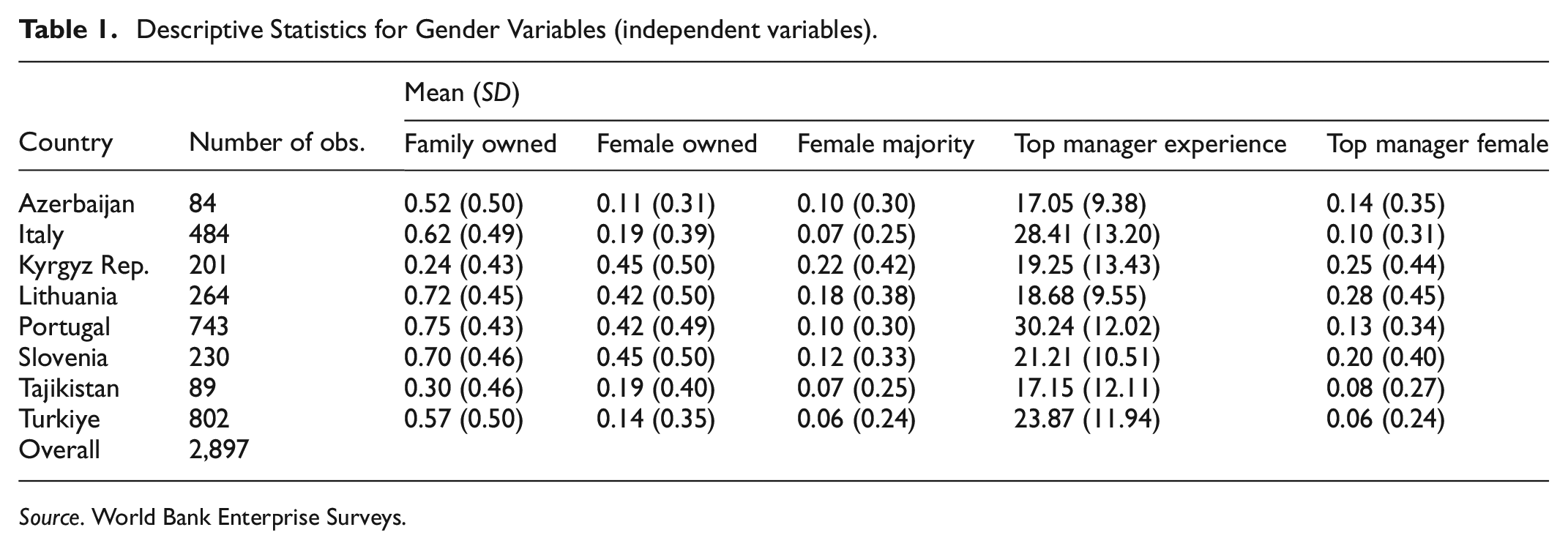
This section briefly introduces several variables by country case. Descriptive statistics are provided for the most important explanatory or independent variables in Table 1 and for the dependent variables in Table 2. A correlogram along with several reliability measures are available from Appendix 3 (Figure A3.1 and Table A3.1).
Descriptive Statistics for Gender Variables (independent variables).
Source. World Bank Enterprise Surveys.
Descriptive Statistics for Technology Adoption (dependent variables).

Source. World Bank Enterprise Surveys.
According to Table 1, the share of female owners, Female, is lowest in the Tajik and Turkish samples and highest in the samples from most other former socialist countries (Kyrgyz Republic, Lithuania and Slovenia). However, inheritance laws may also play a role; for example, both Portugal and Lithuania have high shares of family held firms in combination with high female ownership shares. The preferred variable in the research that captures gender in organisations is the simple Female dummy, but robustness checks are made by using the other variables. However, introducing several of these variables in the same equation is avoided, due to the high degree of correlation among them (see also Figure A3.1).
Table 2 shows descriptive statistics for the dependent variables. Note that the variable Adopt_all_EC is generated using factor scores (more details below), explaining why it is rendered as a standardised variable with mean 0 and variance 1. It follows a slightly different distribution than the other dependent variables but captures the same yes/no (y/n) dimension of whether the firm has decided to adopt a certain type of technology. All the dependent variables are moderately to highly correlated (with a coefficient around 0.4–0.6) – see the Correlogram in Appendix 3, Figure A3.1. One of these dependent variables Adopt_tech_mach serves as a ‘control’ or background dependent variable. Its purpose is to investigate whether there is any difference in behaviour when it comes to the adoption of new technologies generally, and the adoption of green technologies (see also detailed information about these survey items in Appendix 2).
Considering the presence of many and internally consistent dependent variables that are available, factor analysis is used as a data reduction technique to generate a single dependent variable from all these items (see also Figure A1.1 in Appendix 1). The only exception is the last item on technology adoption in the questionnaire Adopt_any_EE, which is a rephrasing of the previous questions using the wording (see Figure A1.1): ‘Over the last three years, did this establishment adopt any measures to enhance energy efficiency?’. The variable Adopt_all_EC has been generated by applying factor analysis with a single factor for all the survey items listed in Figure A1.1. The shown statistic (Table 2) is for the factor score (which is a composite variable obtained through the factor analysis and the factor loadings) generated using Bartlett’s method.
Caveats and Other Limitations
The study seeks to control for as many relevant variables as possible, given the availability of data. For example, the estimations control for both family ownership and the experience of top managers. It must be ensured that these factors could not be wrongly ascribed to the effect-size of the gender variable (Blau & Kahn, 2007). Omitted variable biases is a common problem in cross-sectional research on gender pay differences in economics (Alkadry & Tower, 2011). However, it is also important to note that there is a difference between the dependent variable in this study, which refers to the agency of the person or manager of the firm him- or herself, whereas in studies of, for example, gender pay differences, the agency effect is that of ‘others’.
Due to the cross-sectional nature of the dataset (with a time frame between 2016 and 2019), the time order is relatively weak in arguing for strong causality in the research. All the dependent variables in the research were collected using questions that refer to the last 3 years prior to the survey year, whereas many of the explanatory variables refer to the latest financial year (which in the time perspective of the present research could be 2017, 2018 or 2019, depending on the individual firm respondent and, even though all the ES used here were conducted during 2019). However, considering the main variable (gender), it is safe to say that gender could cause decisions about technology adoption, but the reverse could never be true.
Generating Factor Variables
The first step in generating the factor variables (also called factor scores) is to run Bartlett’s test. It investigates the hypothesis that the variances across the potential explanatory variables exhibit a high degree of homogeneity or covariation. Across the country cases, the test value is highly significant, confirming the assumption that factor analysis is useful given the available data.
The second step is to generate the factors, based on different rotation techniques and assumptions about the number of factors inherent in the data. Considering the prior or theoretical conceptions about the studied constructs (informal institutions, formal institutions and economic factors), confirmatory factor analysis is the more relevant method (Kim & Mueller, 1978). Hence, it is assumed that there will be 3 inherent factors (formal and informal institutions and economic factors) in the data.
The results for Lithuania and Turkiye come closest towards confirming the assumption behind the factor analysis and are more in accordance with the theoretical assumptions for the market economies: Factor 1 reflects informal institutions, Factor 2 the formal ones and finally Factor 3 captures important economic aspects that are not illustrated by the other variables, such as prior or current energy consumption with firms. In a total of 6 cases, the informal institutions load more strongly onto Factor 1, with Portugal and Slovenia being the exception. Instead, economic factors take precedence and load more onto Factor 1. Only in the case of Tajikistan do we see that higher energy cost give a negative factor loading. This may be due to the differences in energy systems across the country cases discussed earlier. Hence, across the country cases, we are led to the weak assumption that Factor 1 represents informal institutions such as organisational culture, Factor 2 represents the coercive or formal institutions, such as public standards and energy taxes, while Factor 3 represents pure economic factors, such as energy consumption cost (which in practice will also be determined by the underlying energy system in each country). Therefore, when adopting the three factor scores (Factor 1, Factor 2 and Factor 3) as explanatory variables in the regression analysis, they incorporate the flexibility that institutional factors are allowed to depend on firms perceiving them as relevant, in terms of affecting their behaviour (subjectively) and within their own context of economic operating environment.
Econometric Models
The following two versions of the model are estimated in the paper. Equation 1 shows the standard specification when using the underlying explanatory variables coded directly from the responses to the survey.
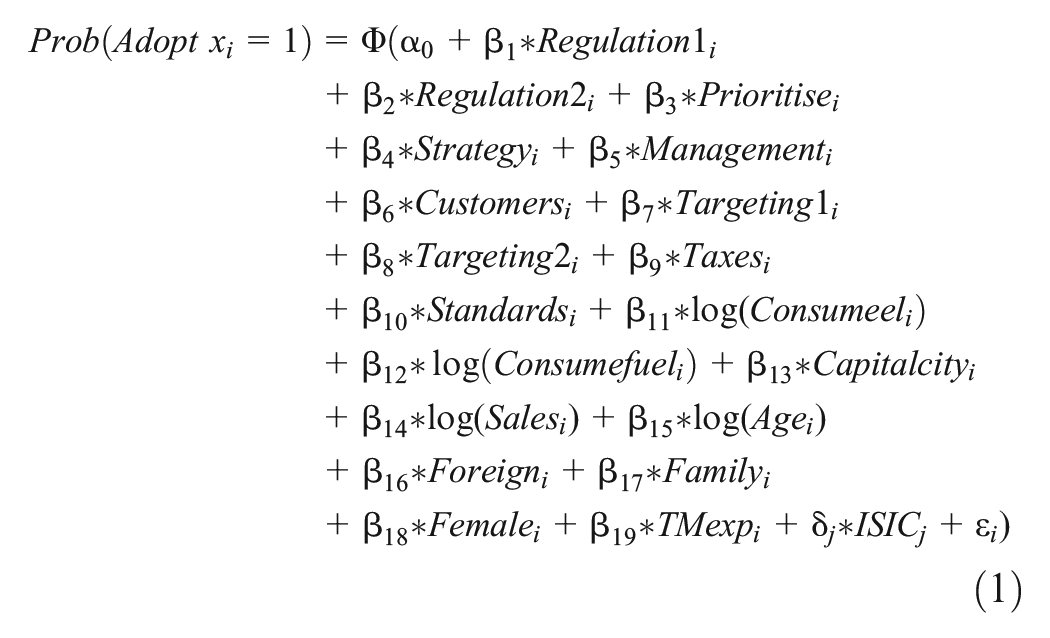
Equation 2 is the collapsed version where, instead of using individual survey items, the factor scores are adopted as explanatory variables as a data reduction technique.

One major advantage of adopting the factor scores instead of the original survey items as variables in the econometric specification, is that the influence of the original underlying variables may differ by country. However, this also makes them more difficult to interpret in a cross-country comparison. The intention is to estimate the models with a binomial logit model as shown. However, this is not feasible in combination with using the stratified sampling weights2, published with the Enterprise Survey data. It is therefore necessary to calculate the ordinary Gaussian estimators. Hence, the interpretation of the coefficients shown in the subsequent tables is straightforward, however, with the usual caveat that they are based in a linear model and cannot be extrapolated beyond the dichotomy of the dependent variable (i.e., 0–1). Additionally, when a factor score is involved, there is no direct interpretation possible because the factors do not have a scale of their own.
Country-Level Results (Comparing Country Cases)
Initial estimations without factor scores as regressors (see e.g., Appendix Table A3.2) confirmed the problem that was inherent in the analysis upon using all the potential explanatory variables in the same equation. It is likely, due to multicollinearity and the inherent overlap between many of these explanatory factors of firms’ propensities to adopt new technologies, that they are crowded out and, thus, rendered insignificant.
Only in the cases of the samples for Italy, Portugal and Turkiye (which are also larger), do we get coefficient estimates where several of the expected explanatory factors are significant and of expected sign/size. Simultaneously, the R2 suggests that the model is relevant and explains at least 40% or more of the variation in technology adoption across the four countries. Finally, the adjusted R2 is penalised heavily by too many overlapping independent variables. However, the large differences between the R2 and adjusted R2 across all tables are also due to the inclusion of 4-digit industry dummies. (As the Enterprise Survey samples are stratified by industry, it implies, often, the inclusion of more than 60–70 additional dummies in the equations (not shown in the tables).
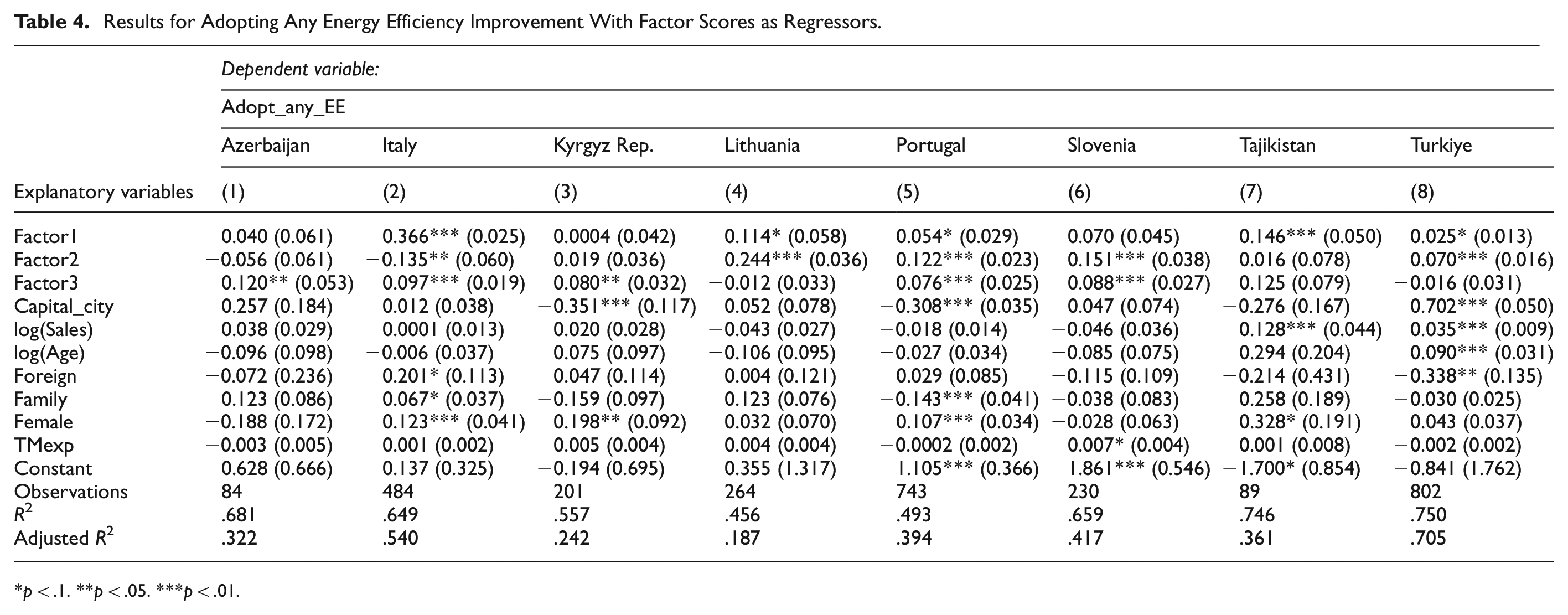
Therefore, the reporting of results solely relies on models where factor scores are used as regressors, the main results at the country level are reported in Tables 3 to 5. These tables adopt the scores from the factor analysis instead (re. Equation 2). While Factor 1 captures informal institutions, Factor 2 captures formal institutions, and finally Factor 3 captures economic factors, such as energy cost (measured in local currency units) - considering that the exact interpretation of the 3 factors is allowed to vary across the country cases studied.
Results for Background Dependent Variable With Factor Scores as Regressors.

*p < .1. **p < .05. ***p < .01.
Results for Adopting Any Energy Efficiency Improvement With Factor Scores as Regressors.
p < .1. **p < .05. ***p < .01.
Results for Adopting All EC Measures With Factor Scores as Regressors and Regressand.

p < .1. **p < .05. ***p < .01.
The theory suggests that all the underlying variables should add to exerting pressure on firms to adopt new technologies in a ‘positive’ way. When a firm responds to the survey positively, having felt the presence of such a pressure on its actions and behaviour, we expect it to respond by innovating through technology adoption.
Across the three tables the influence of the three factors is investigated, then the variable of main interest, which is the dummy for the female gender (i.e., the dummy takes the value of 1 when the ownership group involves female participation). Table 3 reports the results for the background dependent variable. Table 4, accounts for the dependent variable which measures whether the firm has adopted any measure to improve energy efficiency (over the last 3 years). Finally, Table 5 illustrates the results of the dependent variable, measuring whether the firm has adopted all the measures combined to address concerns related to negative externalities (the last one not only pertaining to energy efficiency, but all broad categories of environmental concerns including pollution of air, water and soil.) The advantage of the latter measure is that it is derived as a composite or latent (hidden) construct, whereby specific measures may differ across firms. When measured in this way it can capture the concerted effort across all firms to combat negative externalities (pollution, emissions, waste etc.) with one single variable.
Adopting factor analysis, a considerable improvement results for the model explanatory power. Results vindicate the importance of institutional factors in exerting pressure on firms to adopt new, energy efficient or less polluting technologies. Several of the control factors are also relevant (such as family ownership and the experience of the Top Manager) and now, gender plays an important role in several of the country cases when investigated individually using the factor scores.
Main Results (Combining Country Cases)
Next it is investigated whether there is a general effect of the gender variable across samples when pooling all the country cases into one dataset. This is the main conclusion/finding of interest in the study, that is, can we generalise across the sampled countries about the role of gender for green behaviour? Results (Table 6) show that, across the three dependent variables, female gender, of owners and/or managers, is positively associated with technology adoption. The higher propensity among women to adopt new and greener technologies is larger and equally significant for the composite dependent indicator that captures all environmental measures. Across tables, and when interpretation is feasible, the gender effect for adoption rates is 7.7%, 7.8% and 10.7% higher in firms owned, majority owned (see Table A3.3a in Appendix 3) or managed by females (see Table A3.3b in Appendix 3), but the coefficient estimates are not directly comparable for column 3 in these tables. Only in column 1 and 2 can we interpret the coefficient estimate as the deviation in the decision of the female gender to adopt new, green technologies or more energy efficient technologies. This exact interpretation is more difficult in column 3 (for all environmentally concerned technologies), because the dependent variable is a factor score. For example, the factor score for Adopt_all_EC takes values between −1 and 1, whereas the other dependent variables take values between 0 and 1.
Combined Results Across Eight Country Cases.

*p < .1. **p < .05. ***p < .01.
For the combined sample, the effects are larger and more significant than in any of the underlying samples (results are reported in Section 7). These results, therefore, document that the propensity of women to adopt more green or environmentally friendly technologies could be universal for samples across Europe and Central Asia. For several reasons (such as the necessity to use a linear model and that the results across dependent variables are not directly comparable), the research design hinders a more precise interpretation of the effect sizes for some of the results. But for results where we can make inference, it can be concluded that the propensity of adopting green technologies is around 8% to 11% higher in firms owned and/or led by females, across samples of firms in Central Asia and Europe.
Robustness Checks Related to the Influence of Socialism on Gendered and Green Behaviour
Robustness checks on the above results were conducted in relation to the inheritance of the socialist system, because past economic systems and ingrained institutions may matter for gendered green behaviour and green behaviour, more generally, in these countries. First, the analysis was rerun only for the former socialist countries as a group (without Italy, Portugal and Turkiye) in the total sample. The results confirm that gendered behaviour is more mainstreamed in the socialist part of the sample (as reported in Table 7 for the part of the sample only pertaining to the five former socialist countries – Azerbaijan, Kyrgyz Republic, Lithuania, Slovenia and Tajikistan). In this part of the sample, there is still a positive, although weaker and now only insignificant, association between the gender of owners and/or managers and the likelihood that respondents say they have taken action to adopt greener technologies in the firms over the last 3-year period.
Results for the Five Country Cases of Former Socialist Countries.

*p < .1. **p < .05. ***p < .01.
Given this result, it is natural to ask then, did the mainstreaming of green behaviour under socialism have a positive, neutral or negative influence on the mainstream? For example, did mainstreaming imply a positive spillover from females to males or vice versa?
Table 8 shows that, if there was a mainstreaming under the socialist systems of the past in Europe and Central Asia, the implication is that there is no general positive effect of such mainstreaming on overall green behaviour (because there is no positive deviation when inserting a dummy for the former socialist countries instead of a per country basis into Equation 2). This result is perhaps not surprising, in view of the many environmental problems, which also, in part, led to the demise of the socialist experiments in Europe and Central Asia. The results, however, could also be affected by the type of industries and activities that have been promoted in the former socialist countries after they entered the global economy in the early 1990s. This is discussed further in the last part of the paper.
Comparative Green Behaviour Across Past Economic Systems.

p < .1. **p < .05. ***p < .01.
Discussion, Concluding Remarks and Research and Policy Perspectives
The overall study hypothesis - that female managers are more likely to exhibit ecopreneurial behaviour – as introduced with the theoretical and conceptual framework presented in Section 2, finds confirmation in the present research findings. For the results and context represented here (samples of firms in Central Asia and Europe) and when exact statistical inference is possible, it is concluded that among firm managers adopting green technologies such propensity is higher with around 8% to 11% in firms owned and/or led by females. Yet in the same research context, when investigated separately, socialist countries stand out with a weak or absent such gender effect. At the same time, female ownership and/or top management is often more prevalent across the five former socialist countries included in the research and could, therefore, still count towards the general association that exists between gender and ecopreneurship across the country cases investigated in the research. However, when adopting a dummy for the former socialist countries in the general econometric specification, the results also demonstrate that mainstreaming has not implied positive spillovers from female-led firms onto other groups, but perhaps rather that for environment (fe) has been taken out of female owners and managers. This result could have multiple explanations. For example, that mainstreaming in socialism has implied more male-dominated institutions rather than less. It could also reflect that owners and managers in Central and Eastern Europe are driven more by economic necessity (and opportunity in combination with globalisation and different environmental legislative regimes inside and outside the EU), than idealistic concerns over the environment as expressed in the eco-feminist ideology (Bauhardt, 2014; Shiva & Mies, 2014).
Due to the differences in results across traditional market-economic systems (Italy, Portugal and Turkiye) and the former socialist countries (Azerbaijan, Lithuania, the Kyrgyz Republic, Slovenia and Tajikistan), this research also demonstrates that economic systems may have an influence on gendered behaviour through: (1) the share of women’s ownership and stakes in firms and (2) by mainstreaming gendered behaviour, as it is a direct objective in socialism to erase these types of biases. Despite the mainstreaming of gendered behaviour under socialism, it did not lead to any type of institution-building that has emerged with a positive spillover from the long-term ecological thinking of households to the short-termism which often plagues the efficiency concerned professional manager of the firm. The socialist experiment had few positive connotations on the natural environment. That is in the form that we know socialism from the European, Central Asian and East Asian experience. In fact, the vast environmental problems that led to internal resistance against socialism were soon forgotten when the transition started (Jancar-Webster, 2016).
However, globalisation, and especially its ‘hyper’ form since the 1990s (Rodrik, 2011, 2019) has fundamentally altered the relationship between the human species and commitment to the local place and, thus, the responsibility for the pollution of the natural environment where production takes place. Both elements of change, introduced during the 20th Century in Europe and globally, could explain the results obtained in the study about the differences in gendered behaviour and ecopreneurship. Another contesting explanation is drawn from the affordability of idealistic values. According to the green version of the Kuznets Curve (Ekins, 1997), there is a trickle-down effect on environmental or green preference as society progresses. Another version of the same hypothesis, based in psychology, also suggests that the observed difference has more to do with trade-offs between survival concerns and idealism or green preference (van der Werff et al., 2013). However, there is no direct link between the green version of the Kuznets Curve and gendered behaviour, except perhaps that feminine values can start to take precedence as income increases, or we can afford trading off short-term survival concerns for longer-term sustainability of the economic and social system (Wood & Eagly, 2002, Hechavarria et al., 2012). Nevertheless, and despite our afforded idealism, in societies that have progressed towards feminist values, we must face the real issue of concern, which is that a large share of the pollution that goes into producing the goods we consume often takes place far away from us in other corners of the world.
Therefore, nothing is irreversible or genetically inherent in such gendered or gender-based value driven patterns. The patterns can be reversed and, despite the domestic division of labour through new technologies, arrangements can be made for work-life balance and constellations for family life, which separates biology from task and identity. However, real change for mainstreaming of gender in a positive way requires confrontation with the underlying institutions that create and reproduce these patterns across societies and over time. For example, it has never been understood or confronted in depth why there is a negative relationship between socialism and the natural environment, even though one obvious explanation is the absence of innovation for long-term economic change and progress (such as towards renewable technologies). Another unknown factor is what fundamentally happens to society when, and if, the state intervenes too much in family life. Absurdly enough, globalisation has now proven to provide capitalism with a similar mechanism to escape caring about the natural environment by placing the emphasis and consequences of ‘growth’ or societal progress on households elsewhere in the world.
The result of this research demonstrates the importance of a more gendered and diverse inclusion in decision-making, at all levels of society and across all countries. It may be necessary, if we are to breach the transition towards sustainable and greener technologies in 1 to 2 decades. Alas, the contrasting results across historical divides of past economic systems in the analysed region also suggests that it is not gender that needs to be the target of future policy, but, rather, that future institution building and economic theory making needs to be subjected to gender mainstreamed thinking. Then, only by putting environmental responsibility into all individuals, independent of background, gender, age, etc., will real change be possible.
Footnotes
Appendix 1
Appendix 2
List of independent variables (survey items) taken from the ES instruments and how they were recoded:
Appendix 3
Combined Results Across Eight Country Cases With Alternative Gender Indicator.

| Dependent variable: | |||
|---|---|---|---|
| Adopt_tech_Mach | Adopt_any_EE | Adopt_all_EC | |
| Explanatory variables | (1) | (2) | (3) |
| Factor1 | 0.170*** (0.009) | 0.268*** (0.009) | 0.635*** (0.014) |
| Factor2 | 0.033*** (0.011) | 0.156*** (0.012) | 0.498*** (0.019) |
| Factor3 | 0.095*** (0.008) | 0.063*** (0.008) | 0.208*** (0.013) |
| Capital_city | −0.186*** (0.016) | 0.017 (0.016) | −0.218*** (0.026) |
| log(Sales) | 0.023*** (0.005) | −0.022*** (0.005) | −0.057*** (0.008) |
| log(Age) | −0.0001 (0.015) | 0.049*** (0.015) | 0.041 (0.025) |
| Foreign | 0.112** (0.044) | 0.155*** (0.045) | −0.019 (0.073) |
| Family | 0.053*** (0.015) | 0.065*** (0.016) | 0.064** (0.026) |
| FemMaj | 0.016 (0.022) | 0.107*** (0.023) | 0.153*** (0.037) |
| TMexp | 0.001 (0.001) | −0.0003 (0.001) | 0.002 (0.001) |
| factor(Country)Italy | −0.236** (0.109) | 0.295*** (0.111) | −0.193 (0.182) |
| factor(Country)Kyrgyz Republic | −0.112 (0.200) | 0.313 (0.204) | 0.074 (0.335) |
| factor(Country)Lithuania | −0.106 (0.115) | 0.311*** (0.118) | −0.201 (0.193) |
| factor(Country)Portugal | −0.134 (0.112) | 0.283** (0.114) | −0.338* (0.187) |
| factor(Country)Slovenia | 0.050 (0.116) | 0.305*** (0.118) | −0.150 (0.194) |
| factor(Country)Tajikistan | −0.150 (0.208) | 0.427** (0.213) | −0.312 (0.349) |
| factor(Country)Turkiye | −0.269** (0.110) | 0.269** (0.112) | 0.113 (0.185) |
| Constant | 0.013 (0.175) | 0.272 (0.179) | 0.892*** (0.294) |
| Observations | 2,897 | 2,897 | 2,897 |
| R 2 | .467 | .499 | .663 |
| Adjusted R2 | .430 | .464 | .640 |
p < .1. **p < .05. ***p < .01.
Acknowledgements
Thank you to the Enterprise Analysis Unit of the Development Economics Global Indicators Department of the World Bank for collecting the data.

Funding
The author received no financial support for the research, authorship, and/or publication of this article.
Declaration of Conflicting Interests
The author declared no potential conflicts of interest with respect to the research, authorship, and/or publication of this article.
Data Availability Statement
The data is available from the World Bank Enterprise Surveys, www.enterprisesurveys.org. The R code for replicating the results presented in the paper are available from the author on request: camje@ruc.dk.