




Abstract
Brands can deploy analogical reasoning as a means to articulate an incongruent sponsorship and improve fit perception between a property and its sponsor. Nevertheless, challenges remain for sport marketers regarding how best to leverage analogical articulation in sponsorship-linked advertising (SLA) to achieve the best outcomes. The current research expands on previous work by testing the effects of different types of analogical articulation (presence vs. absence of functional attributes) on consumers’ recognition of, attitudes concerning, and purchase intention toward a sponsor that does not naturally align with the property at hand. The results indicate that SLA that uses functional attributes in analogical articulation leads to greater degrees of favorable consumer attitudes toward the sponsor. Accordingly, sponsors lacking native fit should focus on their product or service’s functional attributes and actively explore creative ways to connect them to the sponsorship through analogical articulation in SLA.
Introduction
When Angelina Jolie and Brad Pitt were married, the media described them as perfect match: they were both very attractive, high-profile celebrity actors with presumably many commonalities. In contrast, the pop culture and folklore figures of “the Beauty and the Beast,” a couple with no obvious common ground, also form a classic example of a happy couple that has captivated many viewers over the years and in many different media. This analogical comparison could be applied to the context of a sport sponsorship in which two entities are put together. For example, both Wilson and Kumho Tire are sponsors of the National Basketball Association (NBA). However, whereas the former may be thought to be a perfect match (a congruent sponsorship) because Wilson manufactures basketballs, it is not immediately clear what relevance Kumho, a tire manufacturer, has to a basketball league. This issue, wherein the functional attributes of a product like a tire (Kumho) cannot be demonstrated in a game like a basketball (Wilson), can be addressed by explaining the meaning of this incongruent sponsorship through a process known as sponsorship articulation (Cornwell et al., 2006). Specifically, when two previously-unrelated parties (a property and a sponsor) become aligned through a sponsorship agreement, the process of sponsorship articulation attempts to convince the audience why this association makes sense.
One commonly used tactic for sponsorship articulation is analogy. An analogy “compares two incongruent entities on the basis of a common relational structure, thus creating a new concept in the consumer’s mind” (King & Madrigal, 2018, p. 464). In the context of sponsorship articulation, using an analogy allows marketers to subtly explain and communicate what and how a sponsor could be meaningfully associated with a property (Madrigal & King, 2017). Analogical articulation has been found to improve congruence perceptions for incongruent sponsorships (King & Madrigal, 2018; Madrigal & King, 2017, 2021). Since many sponsors are typically lacking in strong congruence with a property, it is important to use analogical articulation to improve the effectiveness of such sponsorship, especially after the drastic and devastating impact of the pandemic on sponsorship (Koronios et al., 2023, 2024; Su & Kennedy, 2022). However, a key challenge for creating such an analogical articulation is how to identify and communicate a common relationship structure that will satisfy the audience.
Logically, sponsors engaging in analogical articulation should consider the functional attributes of their brands. Functional attributes are those descriptive features that characterize a product and can be defined as “the qualities of the product needed for use” (Earle et al., 2001, p. 230). Sponsoring brands often explain how the functional benefits of their products align with those of the sponsored events in their sponsorship articulation (Madrigal & King, 2021). For example, in their sponsorship-linked advertising (SLA), Kumho Tire articulates the relational commonalities between its product and the NBA by focusing the functional characteristics of tire products. Three main functions of tires, such as providing traction to the road surface (grip), maintaining and changing the moving direction of the vehicle (handle), and transmitting accelerating or braking force to the road (control), are demonstrated alongside highlight footage of several NBA star players in the TV commercial. Grip, handle, and control were presented as analogous features related to a player’s performance on the basketball court (e.g., their powerful grip on the ball, their complete handling of movement, and their full control of the speed and acceleration of the basketball and their own bodies). These functional attributes that connect the sponsor with the property thus form the analogic relationship.
Recent conceptualizations of analogical articulation in the literature have not examined the relevance of functional attributes in SLA, and many of these studies have used perceived fit as a dependent variable or a mediator. Specifically, previous studies examining the effect of analogical articulation have mainly focused on non-SLA communications, such as press releases, and assumed that the resulting improved fit can lead to better consumer-focused sponsorship outcomes (King & Madrigal, 2018; Madrigal & King, 2017, 2021). Very few studies have tested the effect of analogical articulation in SLA on the effectiveness of sponsorship directly. Furthermore, perceived fit could be a subjective perception that precedes audience exposure to any sponsorship articulation. Becker-Olsen and Simmons (2002) divided perceived fit into two categories, native fit and created fit, in their study. Native fit refers to the natural alignment between a sponsor and the property, where the connection is immediately clear to consumers. In contrast, created fit refers to a connection that is not immediately obvious and must be communicated to consumers, often through marketing strategies like analogical articulation. While created fit may result from sponsorship articulation, native fit is defined as the extent to which the sponsor and the property are perceived as fitting together independent of and prior to any marketing communications related to the sponsorship (Becker-Olsen & Simmons, 2002). In other words, different levels of such perceived native fit might influence how an audience interprets information they have received from SLA when they evaluate the analogical articulation. This current study addresses this gap by examining how consumers perceive sponsorship as a function of analogical articulation types in SLA, according to their pre-existing perception of native sponsorship-event fit.
Specifically, the purpose of this study is to determine how the presence and absence of functional attributes in analogical articulation are perceived by a target audience while watching the sponsor’s SLA. We also examine whether the presence of functional attributes in analogical articulation influences these viewers’ recognition of, attitudes toward, and product purchase intention for the sponsor’s brand differently according to their perceived native fit. Despite the growing use of sponsorships, there remains a key question: how can incongruent sponsors effectively communicate their relevance to an audience through SLA? Specifically, the problem this study addresses is how functional attributes in analogical articulation can be leveraged to improve consumer perceptions of incongruent sponsorships. This study seeks to answer the research question: how does the inclusion of functional attributes in sponsorship-linked advertising influence consumer attitudes, recognition, and purchase intentions based on their perceived native fit? The study draws on congruence theory and schema theory to propose that the effects of analogical articulation type (i.e., with or without functional attributes) on consumers’ cognitive, affective, and behavioral responses would be determined based on their level of perceived native fit before they were exposed to the SLA. Congruence theory suggests that perceived native fit will influence how sport consumers store and retrieve data, making it easier for them to recall, for example, the official tire sponsor when viewing a motor sports event, due to this sponsor’s appropriateness (Cornwell et al., 2005). Schema-based expectancy theory suggests, however, that consumers will better remember a sponsorship with a moderate sponsor-event fit because they tend to pay more attention to new information that is lightly incongruent with their existing schema (Jagre et al., 2001). In addition, previous research has used the similarities between a sponsor and a property to supplement new information to articulate incongruent sponsorships to participants (Cornwell et al., 2006). Thus, we expect that the recognition of similar functional attributes between a sponsor and a property through analogy in SLA might be more effective for an audience with a moderate perceived degree of native fit before exposure to such analogical articulation. This study should have important implications for both academia and practice in the field of sport communication by broadening the conceptualization of analogical articulation and its functional attributes. The results of this study could guide advertisers and sponsors to create their own analogies for articulating sponsorship relationships through SLA.
Review of Literature
Sponsorship-Linked Advertising (SLA) and Sponsorship Articulation
SLA is defined as “a way to leverage sponsorship relationships and to communicate creatively with consumer[s]” (S. Kelly et al., 2017, p. 59), which could be conceptualized as either explicit or implicit communication of sponsorship links and connections. Brands engage in SLA to communicate a sponsorship link to tie the sponsor to the sponsored event. Thus, the sponsor/advertiser’s intent to link to the property is a necessary element of SLA. Advertisements that lack this intent are considered non-SLA (S. Kelly et al., 2017). Most SLA leverages narrative to create that link and “[make] the link understandable” (Cornwell, 2020, p. 48). The association between sponsors and properties should be created through the process of sponsorship articulation, so that consumers can understand the relationship (Cobbs et al., 2020; Fleck & Quester, 2007; Madrigal & King, 2021; Silva & Veríssimo, 2020; Skard & Thorbjornsen, 2017). Instead of sponsorship articulation, previous studies exploring SLA have mainly focused on its beneficial tendency to attenuate the negative effects of ambush marketing (S. J. Kelly et al., 2012; S. Kelly et al., 2017; S. J. Kelly et al., 2019). Ambush marketing refers to the practice of an organization attempting to create a false impression that its brand is an official sponsor of a sporting event (S. J. Kelly et al., 2019). The use of explicit SLA from the legitimate sponsors can distinguish them from such “ambushers” (S. Kelly et al., 2017). Although SLA’s role of sponsorship articulation has not been empirically examined in the literature, S. Kelly et al. (2017) noted that the sponsorship link in explicit SLA is “consistent with articulation objectives inherent in sponsorship leveraging” (S. Kelly et al., 2017, p. 60).
Sponsorship articulation is defined as “the act of explaining the relationship between entities to support the development of meaning in the mind of the individual” (Cornwell et al., 2006, p. 312). There are many ways in which a brand can engage in sponsorship articulation, including through SLA. SLA enables sponsors to explain their sponsorship relationship with the property to their SLA viewers. Hence, SLA gives consumers more information to help them understand and interpret the association between sponsorships and products. Research supports this view, showing that articulation can enhance perceived congruence, which in turn results in more positive consumer-focused sponsorship outcomes, such as sponsor recognition, attitude toward a sponsor, and purchase intentions for a sponsor’s product. (Alexandris et al., 2007; Boronczyk & Breuer, 2020; K. K. Chen & Zhang, 2011; Prendergast et al., 2010). Therefore, SLA as a form of sponsorship articulation should be able to elicit these favorable consumer-focused responses to sponsorship through explicit communication of a sponsorship link (S. J. Kelly et al., 2012, 2019).
Analogical Articulation with Functional Attributes
Several types of sponsorship articulation and their effectiveness have been identified and examined, such as explanations of commercial versus noncommercial motives (Na & Kim, 2013; Weeks et al., 2008), indications of the short versus long-term duration of a sponsorship (Olson & Thjømøe, 2011), the addition of open- versus close-ended arguments (Skard & Thorbjornsen, 2017), and the use of analogical versus non-analogical articulation (Madrigal & King, 2017). Unlike those forms of sponsorship articulation, analogical articulation involves the creation of an analogy between the sponsor and the property as a means of articulating incongruent sponsorships (King & Madrigal, 2018; Madrigal & King, 2017, 2021). Analogy is a technique that is used to design advertising messages, and it is defined as “drawing a comparison between two unrelated things in order to show a similarity” (Madrigal & King, 2017, p. 531). By extension, the same notion of analogy can be applied to sponsorship articulation. For example, since 2003 FedEx has sponsored the National Football League (NFL) by awarding the “Air Players of the Week” to an outstanding quarterback weekly during the regular season. The analogy in this case is the similarity between completing a football pass and the air delivery of packages, and their sponsorship relationship was articulated by highlighting the structural parallels between football and delivery service (Madrigal & King, 2017). Compared with non-analogical articulation, analogical articulation is much more effective in enhancing the perceived congruence between a sponsor and a product and the recall of that relationship (Madrigal & King, 2017). Moreover, Madrigal and King (2021) also suggested that analogical articulation might lead to better attitudes toward a sponsor because it provides consumers with the pleasure of recognizing an analogy in a sponsorship articulation, similar to solving a puzzle.
Previous studies have not been extensive enough to compare the effects of different types of analogical articulation (King & Madrigal, 2018; Madrigal & King, 2017, 2021). However, scholars have noted that certain kinds of analogies might make it difficult for consumers to recognize the intended relational similarities in the presented associations (Madrigal & King, 2021). Attribute-specific information about how a brand is related to a property is commonly used in analogical articulation (Madrigal & King, 2017). Thus, creating an analogy by using different kinds of attribute-specific information should be a reasonable method of differentiating types of analogical articulation. In this study, we focus on the sponsor’s functional attributes, which are the actual things that a sponsor’s product does for consumers. Those functional attributes are directly related to a product’s practical features and can differ from product to product. For example, while quality is listed as one of apparel’s functional attributes—among others like durability, color, and comfort (J. Lee & Nguyen, 2017)—such functional attributes can be more specific: a tire, for example, has the functional attribute of wet brake performance, which is related to the braking distance of the tire on a wet road (Sarigol et al., 2022). As sponsorship has been used as a tool of building brand associations for sponsors (Koronios et al., 2021, 2022; Quester & Farrelly, 1998), A. C.-H. Chen (2001) suggested that such brand associations can be categorized into product associations and organizational associations. Product associations, in turn, can be further divided into functional attribute (e.g., functional benefits or perceived quality) and non-functional attribute associations (e.g., symbolic or emotional associations). Drawing on these categorizations, we divided analogical articulation into two types (i.e., with vs. without functional attributes). Similarities between a brand’s functional attributes and those of the property have long been used to articulate a sponsorship (Cornwell et al., 2006): for example, Kumho Tire adopted analogical articulation in one of their SLA campaigns, exclaiming that consumers who expect “all season performance” from the best NBA players should expect these same qualities from their tires as well. In this case, the analogy compared and connected the double meanings of the word “season,” as it applies to basketball and periods of the year. Such a functional attribute is presumably more easily understood by the audience of this SLA strategy due to its lower level of abstraction.
Poon and Prendergast (2006) suggested a traditional hierarchy of sponsorship effect model (i.e., cognition, affect, and conation), in which consumers first become aware of the sponsorship in the cognitive stage, then appreciate the sponsor’s brand in the affective stage, and finally reach the stage of conation by increasing their intentions of purchasing the sponsor’s product. Therefore, applying the traditional sponsorship effect model in the context of articulation and sponsorship seems reasonable. The results of previous articulation research have also indicated the same trend. For example, Na and Kim (2013) found that fans’ attitudes toward a sponsor improved when they were motivated to make a cognitive effort to process articulation messages. Generally, research has found that SLA and articulation improve the effectiveness of incongruent sponsorship as tools of sponsorship-linked marketing because they explain the relationship between sponsor and property (Coppetti et al., 2009). That is, SLA provides viewers with extra information about the sponsorship that helps them associate a sponsor with the property. When viewers commit greater cognitive efforts to practical sponsorship-related information (i.e., analogical articulation with functional attributes), viewers are then more likely to re-evaluate an incongruent sponsorship, which can lead them to advance from the first stage to the third stage of the traditional hierarchy of sponsorship effect model. Based on this discussion, analogical articulation should be seen as more effective in terms of cognitive, affective, and conative consumer-focused sponsorship outcomes when it features functional attributes. Thus, our first pair of hypotheses focusing on the main effect of analogical articulation type is proposed as below:
Perceived Native Sponsor-Event Fit
Fit has been examined in the sponsorship literature under many different names (Fleck & Quester, 2007), which has produced much confusion and misuse. The two main types of fit most commonly examined the literature are (1) fit between the audience of a property and the sponsor’s target consumer, or audience overlap and (2) fit between “the sponsoring company’s brand, product or service, and its perceived closeness with an event, based on consumer’ perceptions and expectations,” or sponsor-event fit (Jagre et al., 2001, p. 441). Research has suggested that good perceived sponsor-event fit can lead to increased sponsorship effects in terms of image transfer, sponsor attitude, and purchase intentions toward a sponsor’s product or service (Cornwell, 2020). However, previous empirical research has mainly focused on understanding the effect of fit magnitude (i.e., high and low fit) on the evaluation of the sponsor. While higher perceived congruence has been shown to produce favorable responses to both the sponsor and the sponsorship, including sponsor recall (Johar & Pham, 1999), attitudes toward sponsors (Rodgers, 2003), and purchase intention (Koo et al., 2006), the real complexity of sponsors-event fit in SLA has not been fully addressed in these studies. Specifically, the lack of differentiation of the type of sponsor-event fit and its relative influence might limit the applicability of previous sport sponsorship effectiveness studies.
Types of sponsor-event fit should be defined clearly and explored thoroughly in analogical articulation and SLA research in order to determine the effectiveness of a sponsorship. Becker-Olsen and Simmons (2002) divided sponsor-event fit into two different types: native fit and created fit. Fleck and Quester (2007) further defined the link between sponsor and property as one that “can be obvious and apparent from the mere juxtaposition of the two names (native fit) or [one that] may require some explanation via dedicated communication activities (created fit)” (p. 980). In other words, native fit occurs when the sponsor-property connection is intuitively clear, while created fit requires deliberate messaging to establish relevance in consumers’ minds. Native or created sponsor-event fit can be consistent, extremely inconsistent, and moderately inconsistent, and their effects depend on their magnitude (Becker-Olsen & Simmons, 2002). Some sponsorships share a high native fit before sponsors communicate with the target audience via SLA, because of their functional or image-related similarity with the sponsored events or products, while other sponsorships do not (Gwinner & Eaton, 1999). Therefore, whether a perceived native sponsor-event fit is congruent (high fit), moderately incongruent (moderate fit), or extremely incongruent (low fit) is affected by an individual’s pre-existing perception. According to the results of Becker-Olsen and Simmons (2002) study, higher perceived native sponsor-event fit can yield better results in consumer-based sponsorship outcomes. Thus, we propose the second pair of hypotheses focusing on the main effects of perceived native sponsor-event fit level as below:
Previous research has indicated that the negative effects of low-congruence sponsorships could be mitigated through articulation of the sponsorship (Coppetti et al., 2009). Some scholars have observed a ceiling effect for highly congruent sponsorships, where the presence of articulation makes no difference for those consumers who perceive a high degree of congruence in terms of sponsorship effectiveness (M. C. Lee et al., 2009). That is, the effects of articulation on improving the effectiveness of a sponsorship are expected to be most pronounced when consumers perceive moderate incongruence in the sponsorship. If consumers do not perceive the incongruence of a sponsorship, then they do not need extra information (i.e., articulation) from SLA to explain the sponsorship. Alternatively, if consumers perceive extremely low congruence in a sponsorship, then this would leave less room for articulation to improve the perception of congruence. Hence, we argue that moderate fit is the ideal situation for articulation.
In a moderate fit relationship, there remains something about the sponsorship that could be explained through analogical articulation, but the incongruence is not too extreme to be reconciled. While the majority of previous empirical research suggests that perfect native fit can greatly benefit a sponsor, some scholars have conversely suggested that sponsors may also benefit greatly from a moderate sponsor-event fit. This research, drawing on schema-based expectancy theory, suggests that consumers will better recall a sponsorship when they pay more attention to new information that is lightly incongruent with their existing schema (Jagre et al., 2001). Research in advertising has revealed similar results when comparing how viewers process congruent and incongruent information in ads they read (Prendergast et al., 2010). When viewers receive congruent information, they will likely not engage in as elaborate cognitive processing as when presented with moderately incongruent information. As such, it is reasonable to assert that a sponsorship with a moderate native sponsor-event fit will likely produce more engagement and elaboration, especially when viewers process this incongruent, new information from an SLA-articulating sponsorship. When SLA provides a creative analogy that articulates the sponsorship with a moderate fit by using functional attributes as a cue, viewers are supposed to have better responses to the sponsor, especially when the incongruity they perceive drives them to think favorably about the sponsorship. After they understand the meaning of SLA that creatively highlights the semantic relationship between the sponsor and the property, they should have better consequent responses to the sponsorship. Thus, the third pair of hypotheses, focusing on the interaction between analogical articulation type and perceived native sponsor-event fit level, is proposed as below:
Previous studies have demonstrated that analogical articulation can enhance perceived sponsorship fit, particularly for incongruent sponsorships (King & Madrigal, 2018; Madrigal & King, 2017, 2021). Research has also established that sponsorship articulation improves consumer attitudes and recognition, but most studies have focused on press releases or general articulation strategies rather than SLA (Na & Kim, 2013; Skard & Thorbjornsen, 2017). Additionally, sponsorship fit has traditionally been studied in binary terms—high versus low fit—without sufficiently exploring the nuanced effects of moderate fit (Jagre et al., 2001). This study addresses these gaps by focusing on the role of functional attributes in SLA, examining how different levels of perceived fit influence sponsorship effectiveness, and exploring whether moderate-fit sponsorships exhibit distinct consumer response patterns. By doing so, it advances our understanding of how brands can strategically leverage analogical articulation in SLA to optimize sponsorship effectiveness. Figure 1 depicts a research model of our summarized hypotheses.

MANCOVA research model and summary of hypotheses.
Method
This research utilized a 2 (analogical articulation type: with or without an analogy of functional attributes in the SLA) × 3 (perceived native sponsor-event fit: high, low, or moderate perceived fit before viewing the SLA) between-subjects design, with perceived native sponsor-event fit serving as a measured independent variable. Multivariate Analysis of Covariance (MANCOVA) was chosen for this study because it allows for the simultaneous analysis of multiple dependent variables while controlling for covariates. Given that this research examines three interrelated consumer responses—sponsor recognition, attitude toward the sponsor, and purchase intention—MANCOVA helps determine whether analogical articulation type and perceived native fit influence these variables collectively rather than analyzing them in isolation. Additionally, MANCOVA controls for the influence of covariates (e.g., team identification, familiarity with the sponsor and property), reducing potential confounding effects and providing a more precise assessment of the effects of analogical articulation in SLA. A total of 226 subjects were recruited from the Amazon MTurk by providing compensation of $1 upon completion of the survey. The sample size for this study was justified based on the typical range of sample sizes used in previous research on analogical articulation in sponsorship. Studies in this field often utilize sample sizes between 200 and 300 participants to ensure sufficient statistical power to detect effects (King & Madrigal, 2018). The descriptive statistics of their demographics indicated that 59.6% of respondents were males of ages ranging from 21 to 71 years old. To specifically break down respondent demographics, 33.8% of the participants were under 30 years old, 33% were between 31 and 40 years old, and 31.2% were between 41 and 71 years old (M = 37.7; SD = 11.61). The racial makeup of the participants comprised 70% Caucasians, 10.4% African Americans, 15.7% Asians, 6.7% Hispanics, 4.6% Native Americans, and 1.3% Other. As for education levels, 78.3% of had earned at least a college degree, and 4.2% had a high school diploma only. Total annual household income mostly ranged from $30,000 to 59,999 (47.9%), with only 5.4% earning less than $10,000.
As a between-subject design, all participants were randomly divided into two groups. After signing an informed consent form, participants were asked to respond to items measuring perceived native sponsor-event fit regarding Kumho Tire’s NBA sponsorship and the three covariates. Each group responded to the items measuring manipulation, sponsor recognition, attitude toward sponsor, and purchase intention for the sponsor’s product after watching one of two TV commercials (one SLA featuring analogical articulation with functional attributes, and another SLA without functional attributes). In order to manipulate successfully, viewers were asked to watch the TV commercial three times, a request justified by suggestions in the existing advertising literature (Krugman, 1972).
Selection of Stimuli
Kumho Tire was selected as the sponsoring brand for this research because of the availability of their SLA content that is consistent with the purpose of this study. Kumho Tire, a South Korean company, was formerly known as Samyang before its renaming and rebranding. Its relative unfamiliarity to U.S. consumers compared to other major brands like Goodyear, Michelin, and Bridgestone makes it an ideal case of a sponsor without good native fit. Considering previous investments in sport sponsorship from other major tire brands, such as Bridgestone becoming the official tire of the National Hockey League (NHL) and Goodyear’s Blimpworthy campaign for college football, a tire company sponsoring a sporting property other than a car racing event is not excessively incongruent, because the time duration of a sponsorship relationship is one source of native fit (Walliser, 2003). Instead of using a fictional brand and advertisement, the real-world sponsor and property served to elicit serious responses from participants because they can engage in higher identification and involvement. Research has suggested that using real brand stimuli will result in a greater effect size (Kim et al., 2015).
The analogical articulation type was manipulated by adding functional attributes as a creative analogy between Kumho Tire and the NBA. Two video clips of SLA were used as the stimuli, which were adopted and revised from Kumho Tire’s actual TV commercials to ensure ecological validity and realism. The stimuli were selected by first reviewing three available Kumho TV commercials that fit the definition of SLA. From these, we selected the clip that allowed us to incorporate different analogies without altering the overall structure or style of the video. For the image-related analogies, a pre-test survey was conducted using a convenience sample of undergraduate and graduate students who were familiar with the NBA. The participants were primarily male (70%), with an age range of 20 to 30 years (M = 30.4), aligning with the NBA’s core target demographic. They were asked to choose words that best represented the image of the NBA. The chosen words were then matched with Kumho’s brand image, and the final set of image analogies was selected for the experiment. In the version with functional attributes, the SLA analogizes the grip, handle, and control of a tire to those same attributes in basketball. In contrast, the version without functional attributes makes no reference to Kumho Tire’s product characteristics. Instead, three analogies of image-related attributes—spirit, passion, and globalization—were selected during a series of pretests before the main test. In summary, the only difference between the two TV commercials is these three analogies on the screen. The image style, background music, and structure are identical. Both video clips end by announcing that Kumho Tire is the official tire of the NBA (see Appendix).
Measurement
Perceived Native Sponsor-Event Fit as an Independent Variable
Perceived native sponsor-event fit level was assessed before watching the stimuli and participants rated fit on a five-point, two-dimensional congruence scale based on the expectancy and relevancy of the sponsorship (Fleck & Quester, 2007). Three items for expectancy (I am not surprised that Kumho Tire sponsors the NBA; I would expect Kumho Tire to sponsor the NBA; It was predictable that Kumho Tire would sponsor the NBA), and two items for relevancy (That Kumho Tire sponsors the NBA tells me something about it; With the sponsorship, I discover a new aspect of Kumho Tire). For one of the independent variables (i.e., perceived native fit between sponsor and property), the continuous variable was recoded into a categorical variable. Specifically, the perceived native fit between sponsor and property was assessed by a seven-point scale and the responses were then divided manually into three levels as suggested by Close and Lacey (2013. The three levels of perceived native fit are: (1) high-fit (mean = 6.22, range = 5.8–7.0, n = 85), (2) moderate-fit (mean = 4.97, range = 4.2–5.6, n = 94), 3) low-fit (mean = 3.05, range = 1.0–4.0, n = 61). The rationale for recoding the continuous variable into three categorical levels stems from the requirements of MANCOVA analysis, which is suited for categorical variables. Furthermore, in the context of event-sponsor fit, previous research by Close and Lacey (2013) divided participants’ perceived fit responses into three categories based on average scores, demonstrating that this approach is appropriate. Following their procedure, we categorized participants into three groups to facilitate a more meaningful comparison and ensure consistency with previous studies.
Dependent Variables
The three dependent variables in this study are measured using existing scales adapted from recent research (Kao et al., 2020; Wakefield et al., 2020). Sponsor recognition was measured using a four-item scale adapted from Yoo and Donthu (2001) and revised to fit the context of this study (Pitts et al., 2020). Attitudes toward the sponsor were measured using a three-item, seven-point semantic-differential scale (unfavorable/favorable, bad/good, negative/positive) adapted from previous studies (Kinney & McDaniel, 1996; Wakefield et al., 2020). Purchase intention for the sponsor’s product was measured using a three-item scale adapted from previous research (Alexandris et al., 2007; Cheong et al., 2019).
Covariates
The literature has largely focused on several predictors of consumer-focused sponsorship outcomes, namely familiarity and identification (Cobbs et al., 2020; Schlesinger & Gungerich, 2011; Su & Kunkel, 2020). The familiarity of sponsor and property reflects the positive effect of prior experience and related knowledge on consumer responses (Cobbs et al., 2020). Identification, especially team identification, also generates a highly favorite attitude prior to sponsorship (Lin & Bruning, 2020; Prayag et al., 2020). Consumers who are highly familiar and identified with a sponsor or property are more likely to better recognize, possess more positive attitudes toward, or exhibit greater purchase intention to said sponsor or product compared with those who are not. In order to control for the distortive effects of prior experiences and attitudes on consumer responses, familiarity and identification were included as covariates and measured using scales adapted from previous research. Team identification was measured using Wann and Branscombe’s (1993) Sport Spectator Identification Sale, which has seven items in 8-point scale (Wann & James, 2018). Familiarity with the sponsorand the property was measured by a three-item, 7-point semantic-differential scale (very unfamiliar/very familiar, very inexperienced/very experienced, not knowledgeable/very knowledgeable) from a previous sponsorship study (Carrillat et al., 2005). Finally, in order to reduce and eliminate potential acquiescence and boredom among participants, some reverse coded scale items were randomly used in the measurements above.
Results
Manipulation Check of Analogical Articulation Type
The manipulation check on analogical articulation type is conducted by assessing the perceived functional similarity and image similarity of the sponsor and the property after watching the stimuli, respectively. These were measured using a six-item, seven-point semantic-differential scale (incongruent/congruent, incompatible/compatible, meaningless/meaningful, not complementary/complementary, goes together/doesn’t go together, illogical/logical) adapted from previous research (Bigné et al., 2012). The results of the independent sample t-test showed that the score for the functional-based similarity for the group of analogical articulation with functional attributes (M = 5.49) was higher than that for the group of analogical articulation without functional attributes (M = 5.11). The difference was significant (t = 1.99, df = 238, p < .05). This suggests that participants in the functional attributes condition more clearly perceived the connection between the sponsor’s product features (e.g., grip, control) and the performance attributes in basketball. On the other hand, no significant difference was observed in the scores between two groups of participants in terms of perceived image-based similarity. indicating that participants did not perceive a strong connection between the sponsor and the property in terms of brand image. These results suggest that the functional attributes manipulation was successful, as participants responded more to the product’s functional characteristics rather than image-based associations. This aligns with the study’s aim to test the role of functional attributes in enhancing perceived fit between incongruent sponsors and properties.
Hypothesis Testing
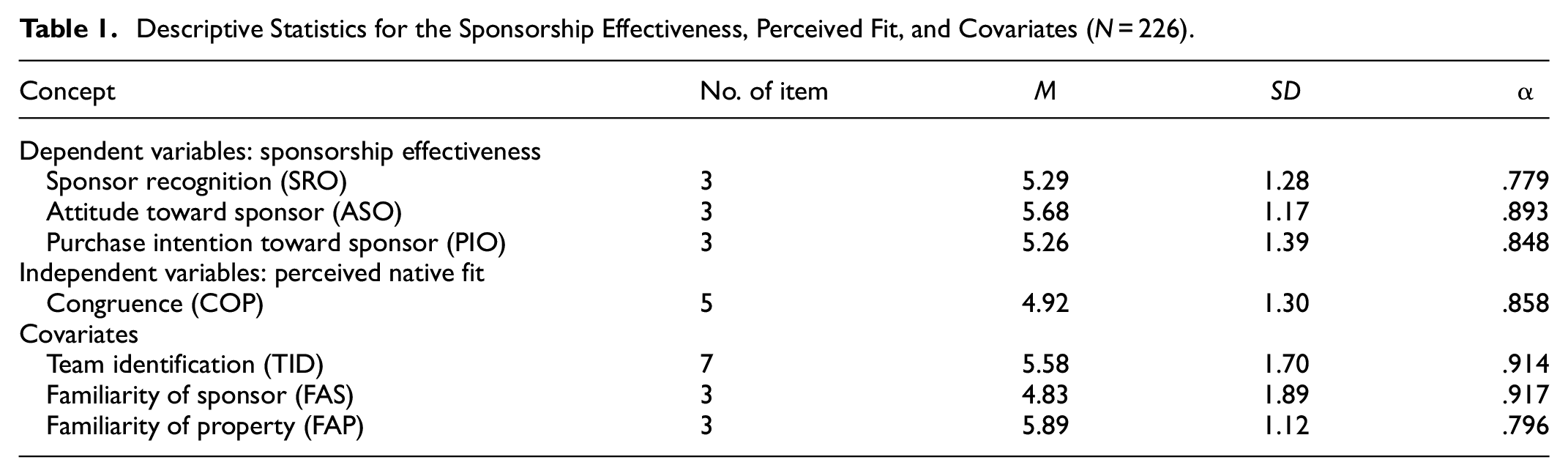
Descriptive statistics for the major variables are presented in Table 1. Before the covariates were partialed out, participants who perceived high native sponsor-event fit tended to exhibit the greatest recognition, attitude, and purchase intentions after being exposed to SLA featuring analogical articulation with functional attributes (see Table 2). However, further analyses are needed to verify the statistical significances of these trends.
Descriptive Statistics for the Sponsorship Effectiveness, Perceived Fit, and Covariates (N = 226).
Descriptive Statistics for the Dependent Variables with Respect to Perceived Native Fit and Type of Articulation (N = 226).

The MANCOVA revealed that the population means of the three consumer-focused sponsorship effectiveness measures differed significantly (p < .05) with respect to the type of analogical articulation and perceived native fit after controlling for the effect of the three covariates (see Table 3). It’s noteworthy that all three covariates were statistically significant (p < .05), which explained the 40.3% variance among the groups. Hence, this indicates that significant differences exist among these groups.
Factorial MANCOVA Comparing Mean Sponsor Recognition, Attitude Toward Sponsor, and Purchase Intention with Respect to Articulation Type and Congruence After Adjusting for the Effects of Covariates.
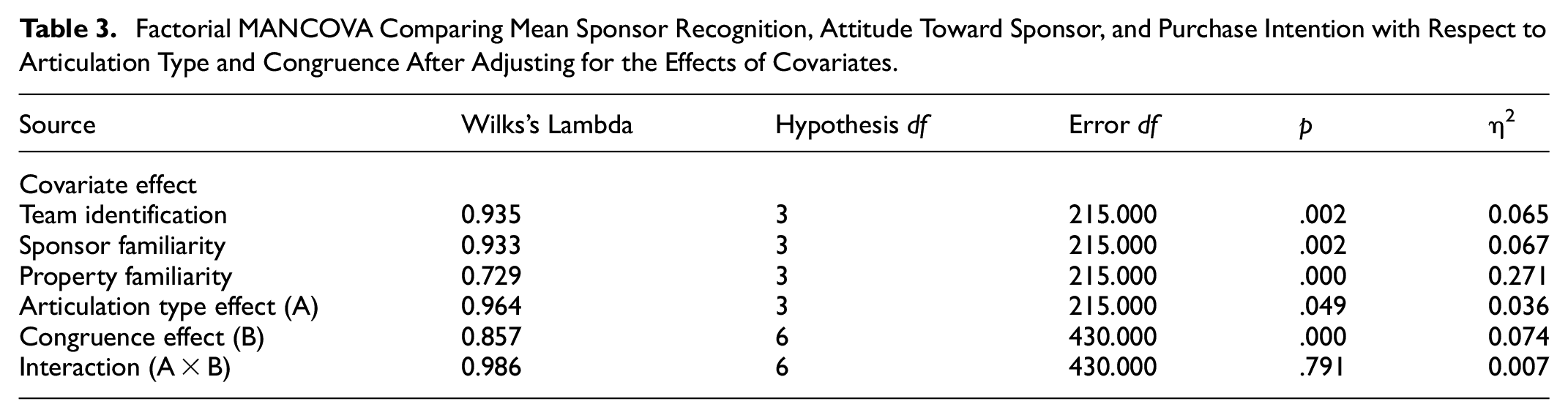
As indicated in Table 3, Wilks’ Lambda was significant (p < .05) for the main effect of analogical articulation type (with vs. without functional attributes) on the three dependent variables (Wilks’λ = 0.964, F(3, 215) = 2.66, p < .05, η2 = 0.036), explaining the 3.6% variances among the groups. While this represents a small effect, it suggests that even minor adjustments in sponsorship messaging—such as incorporating functional attributes in SLA—can lead to meaningful improvements in consumer attitudes and engagement, particularly for low-fit sponsors. Initially, this finding indicated that the adoption of functional attributes in the analogical articulation improved sponsorship effectiveness after partialing out the effects of the covariates, offering primary support for our first pair of hypotheses. Wilks’ Lambda was also significant (p < .05) for the main effect of perceived native sponsor-event fit level (high, moderate, and low) on the three dependent variables (Wilks’λ = 0.857, F(6, 430) = 5.77, p < .05, η2 = 0.074), explaining the 7.4% variance among the groups and supporting our second pair of hypotheses. However, the MANCOVA results indicated that there was no significant interaction effect between the articulation type and the perceived congruence level (Wilks’λ = 0.986, F(6, 430) = 0.52, p = .791, η2 = 0.007). As shown in Figure 2, all three dependent variables showed similar trends and a lack of interaction on the levels of the two factors. The third pair of hypotheses about interaction, therefore, was not supported.
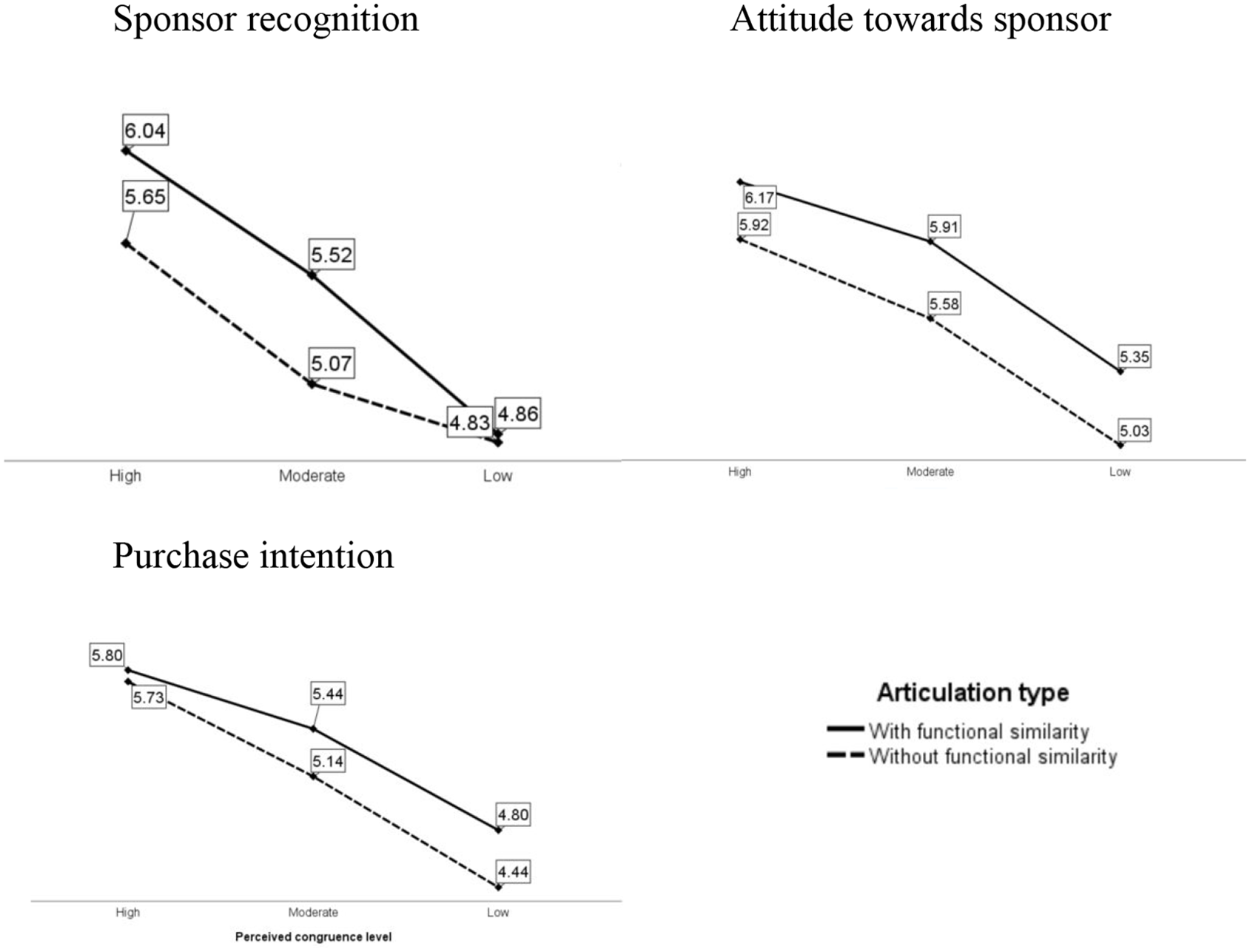
Interaction effects of the degree of congruence and the type of articulation. Sponsor recognition. Attitude toward sponsor. Purchase intention.
Additional analyses were performed to examine these findings further. Using the Bonferroni method, each ANOVA was tested at the 0.025 level (Green & Salkind, 2014). Regarding the main effect of our first factor, analogical articulation type, only the ANOVA for attitude toward sponsor was significant (F(1, 217) = 6.41, p < .025, η2 = 0.029), whereas the ANOVAs on other two dependent variables were nonsignificant (i.e., sponsor recognition, F(1, 217) = 4.46, p = .036, η2 = 0.02, purchase intentions, F(1, 217) = 3.15, p = .077, η2 = 0.014). Therefore, H1a and H1c were not supported, but H1b was supported. In the main effect of our second factor, perceived congruence level, the ANOVAs on the three variables were significant (i.e., sponsor recognition, F(2, 217) = 10.31, p < .01, η2 = 0.087, attitude toward sponsor, F(2, 217) = 9.77, p < .01, η2 = 0.083, and purchase intentions, (F(2, 217) = 13.03, p < .01, η2 = 0.107). Thus, we elected to use pairwise comparisons to retest the second pair of hypotheses. To better understand the nature of these relationships, pairwise comparisons were conducted to test the second pair of hypotheses. We examined which perceived native fit level influences the three consumer-focused sponsorship outcomes most strongly. Each pairwise comparison was tested at the 0.025 divided by 3 or 0.008 level (Green & Salkind, 2014). The high perceived congruence group produced significantly (p < .001) superior performance on sponsor recognition, attitude toward sponsor, and purchase intention in comparison with either of the other two groups with moderate or low congruence (see Table 4). Therefore, H2a, H2b, and H2c were all supported.
Estimated Marginal Means and Standard Errors on the dependent Variables for the Three Levels of Perceived Congruence (N = 226).

Discussion
This study examined the effects of analogical articulation with functional attributes in SLA on consumer-focused sponsorship outcomes and developed three pairs of hypotheses to test this relationship. The results have several important implications for both practitioners and researchers in the field of sport communication by providing further insights into the usage of analogical articulation in SLA.
Main Effect of Analogical Articulations Type
This study conceptualized analogical articulation as two levels of a factor and hypothesized that analogical articulation with functional attributes should produce better sponsorship outcomes through cognitive, affective, and conative levels than analogical articulation without functional attributes. After controlling for familiarity and identification, we found that analogical articulation with functional attributes is more likely to improve attitudes toward the sponsor. Previous studies of SLA have suggested that a sponsor whose consumers normally focus on its functionality (e.g., a package-delivery company) can gain a more favorable attitude toward a sponsorship when the sponsor articulates that its service is functionally aligned with the performance of the event (Prendergast et al., 2010), which is consistent with this finding. King and Madrigal (2018) also indicated that analogical articulation messages should be created by avoiding vague terminology because such associations shared by two incongruent entities might be difficult to recognize by consumers. Associations that exist at a lower level of abstraction, such as functional attributes, should lead to more favorable attitudes toward the sponsor brand. In practice, for those sponsors without significant functional based similarity, using analogical articulation with functional attributes can be an effective way to improve sponsorship effects. That is, when a sponsor’s product is not actually used by the participants during the sponsored event (Gwinner & Eaton, 1999), like the NBA’s official tire sponsor Kumho Tire in this study, the sponsor should analogically highlight the functional attributes the sponsor shares with the sponsored event through SLA.
However, the impact of this type of articulation on other cognitive and conative responses was not observed in this study. As we developed our hypotheses by following a traditional hierarchy of sponsorship effect model (i.e., cognition, affect, and then conation), we found that the explanation for why our findings differed from the literature could be based on alternative variations of the same hierarchy of effect model. Barry and Howard (1990) suggested that the sequence of the three stages might progress differently from the traditional model: they proposed that consumer preferences could be formed without a cognitive basis and they might seek cognitive justification later. This alternative hierarchy of effects model (affect-cognitive-conation) has been tested and proven to be applicable in the context of sponsorship (Alexandris et al., 2012). Accordingly, the impact of analogical articulation with functional attributes on sponsorship effectiveness is limited only in the affective stage of such a model. As for managerial implications in the field of sport communication, the results indicate that for a sponsor articulating its sponsorship analogically by using its functional attributes in SLA, its marketers should also help its consumers justify their preference by providing extra information through other sponsorship-linked marketing communications, in order to generate even better sponsorship effectiveness.
Moreover, unlike other studies of articulation, we proposed that SLA could function as a form of sponsorship articulation in this study. In the current study, we controlled for the potential influence of team identification, which should have excluded the role sport fans’ feelings that might play into in their consumer behavior (Lin & Bruning, 2020). However, previous research in marketing communications has suggested that one’s attitude toward advertisement (AAD) can influence their attitude toward sponsors (McDaniel, 1999), while research on the integration of sponsorship messages in advertisements also has shown that sponsorship can alter attitudes toward a sponsor via attitudes toward the advertisement (Dudzik & Gröppel-Klein, 2005). Thus, these participants might nevertheless possess a favorable attitude toward the creativity of the analogical articulation that they saw in the SLA and transfer this positive attitude to the sponsor’s brand. In addition, analogical articulation represents a creative way of resolving perceptions of incongruity (Madrigal & King, 2017), which could contribute to the perceived creativity of the SLA. Previous advertising literature has shown that creative advertising results in more favorable brand attitude when an unexpected-relevant-positive-feeling ad was used as the baseline (Ang & Low, 2000). When Kumho Tire adopted creative puns, such as grip, handling, and control, thereby relating their product’s functional attributes to jargon commonly used in basketball, these analogies could potentially invoke positive feelings toward the SLA. Creative analogical articulation with functional attributes may possibly increase the perceived creativity of SLA and, therefore, result in a more favorable attitude toward a sponsor’s brand. However, the role of ad creativity was not within the scope of the current study. Academic researchers in the field of sport communication should conduct studies in the future that explore how consumer perception of ad creativity relates to articulation in SLA.
Main Effect of Perceived Native Sponsor-Event Fit
We predicted that the higher the congruence between sponsor and property that consumers perceived, the more positively they would respond to the sponsor through the levels of cognition, affection, and conation. Unlike the most of previous studies regarding articulation and congruence, we also included and tested the main effect of moderate fit in addition to the binary level of congruence (i.e., high vs. low). As expected, all three hypotheses were supported: high congruence resulted in better sponsor recognition, more favorable attitudes toward the sponsor, and greater intentions to purchase the sponsor’s product. These findings are consistent with previous studies (e.g., Koo et al., 2006; Na & Kim, 2013; Rodgers, 2003). However, our findings extend the previous literature to also incorporate the effect of moderate fit. After adding the additional level of this factor, we still observed a significant difference between moderate fit and high fit, or between moderate fit and low fit. After controlling for team identification, familiarity with a sponsor and familiarity with a property, we found that consumers that perceive high congruence generate superior performance in terms of cognitive, affective, and conative responses to the sponsor. The “match-up” effect we observed between the level of perceived congruence and the valence of sponsorship effectiveness in this study, which can be explained by schema theory, indicated that people tend to remember information that is more congruent or relevant to the existing schema in their mind (Cornwell et al., 2006). As such, more favorable attitudes and behavioral intentions were expected.
Previously, some scholars had suggested that sponsoring brands with moderate fit were capable of producing a significantly higher attitude rating from consumers and could consequently lead to more favorable sponsor evaluations than sponsoring brands with high or low levels of congruence (Jagre et al., 2001). It would follow that moderate fit could be regarded as interesting and positively valued compared to situations in which consumers perceived high fit or low fit, thus leading to a more positive response to the brand. As the notion of “high fit” implies that a consumer highly expects the sponsorship, they are likely to generate favorable, but relatively mild, thoughts about the sponsorship. In contrast, moderate fit might encourage consumers to elaborate more internally about the meaning and motivations of why a sponsor is aligning itself to a property. Our findings contradicted this potential impact that moderate fit might have on a consumer’s attitude toward a sponsor. This discrepancy could be explained by the perception of moderate fit as a form of moderate congruence or incongruence. Additionally, it is possible that consumers tend to evaluate how a sponsorship is congruent instead of how it is “incongruent.” In this study, we divided perceived congruence according to the responses from the participants by high fit, moderate fit, and low fit, instead of low incongruence, moderate incongruence, and high incongruence. Although the magnitude of fit remains the same, the rhetorical difference in the way we tested these levels may have altered the direction of valence. Specifically, participants were led to think positively, not negatively, about the sponsorship. To address this, future studies should consider reframing moderate fit by testing whether consumers perceive it as moderate congruence (a weak but still acceptable connection) or moderate incongruence (a disconnect that does not fully require justification). This approach could provide a more nuanced understanding of sponsorship effectiveness and refine the application of congruence theory in sport sponsorship research.
Interaction of Analogical Articulation Type and Perceived Native Sponsor-Event Fit
For our third pair of hypotheses, we predicted there should be an interaction of analogical articulation type and perceived native sponsor-event fit on sponsorship effectiveness. Specifically, we expected that analogical articulation with functional attributes would improve sponsorship effectiveness more when consumers perceived moderate fit. Surprisingly, we did not find evidence to support this hypothesis.
There are several possible explanations for the discrepancy between prior literature and our findings. First, the use of a single real sponsor (Kumho Tire) in this study may have introduced confounding variables that we did not account for. One potential confound is persuasion knowledge—the consumer’s awareness of the sponsor’s persuasion goals, motives, and tactics (Friestad & Wright, 1994). Consumers may have entered the study with different levels of persuasion knowledge, which could have affected their pre-existing attitudes toward tire manufacturers sponsoring basketball. For instance, participants with higher persuasion knowledge might have been more skeptical of the sponsorship’s relevance and less influenced by the analogical articulation presented in the SLA.
Another possible explanation involves pre-existing attitudes toward the product category. Tires are not typically associated with basketball, and consumers may have already held entrenched views about whether such a sponsorship is congruent. Those with strong pre-existing attitudes might have been less open to changing their views through the analogical articulation presented in the SLA. This could explain why we observed no significant interaction effects, despite significant main effects.
Additionally, the lack of significant interaction effects could be attributed to schema theory. It is possible that consumers had well-established schemas for what constitutes a “good fit” in sports sponsorship, and these schemas were difficult to disrupt with functional attributes. As prior research suggests, when consumers’ schemas strongly align with their perceptions of fit, additional information (such as functional attributes) may not enhance their attitudes further (Jagre et al., 2001). Similarly, when fit is perceived as very low, there may be little that articulation can do to change consumer perceptions. Future research could address these potential confounding variables by incorporating multiple sponsors from different product categories, as well as assessing participants’ persuasion knowledge and pre-existing attitudes toward both the sponsor and the sport. Including these variables could provide a more comprehensive understanding of the relationships between analogical articulation, sponsorship effectiveness, and perceived fit.
Still, the findings from this study offer valuable managerial implications for sponsors with low native fit in sponsorship. Despite the challenges of low fit, brands can still strategically leverage analogical articulation with functional attributes to enhance sponsorship effectiveness across multiple advertising platforms. For example, Bridgestone has been sponsoring the National Hockey League, and one of its SLA campaigns uses the slogan “Conquer the Cold” as an analogy for the functional attributes of its winter tire, “Blizzak,” in the game on the ice. This campaign strategically links the product to the NHL’s Winter Classic game, reinforcing the brand’s association with superior performance in extreme winter conditions. Brands can use functional attributes to highlight parallels between their products and the sport, helping audiences see the connection more clearly. This type of campaign allows the audience to perceive a tangible, functional connection between the sponsor and the event. In the context of digital advertising, brands can adopt programmatic ads, YouTube pre-rolls, or even interactive video formats that offer short, engaging content designed to immediately capture attention. For these strategies to be effective, marketers must ensure that their analogical articulation is creatively designed to adapt across various platforms while maintaining the focus on functional attributes. Successful analogies require thoughtful execution that extends beyond the mere visual or verbal comparison. They should engage consumers by clearly demonstrating how the sponsor’s product benefits align with the performance features of the sponsored event. This creative approach must be consistent, yet flexible enough to be expressed through different media formats—from short-form videos on social media to more in-depth interactive experiences on mobile apps or websites. By tailoring analogical articulation with functional attributes to fit the unique characteristics of each platform, brands with low native fit can enhance their sponsorship effectiveness and drive meaningful engagement across diverse digital spaces. As the sponsorship landscape continues to evolve, brands must recognize the growing importance of digital, programmatic, and AI-driven advertising in enhancing sponsorship effectiveness. Unlike traditional SLA formats such as TV commercials or in-arena signage, digital platforms provide real-time targeting, personalization, and interactive engagement opportunities. By integrating analogical articulation with functional attributes into personalized programmatic ads, AI-powered sponsorship activations, and influencer-driven content, brands can optimize message relevance and improve consumer engagement. The increasing adoption of immersive technologies such as augmented reality (AR), virtual reality (VR), and in-game sponsorships also presents new opportunities for brands with low native fit to creatively align themselves with sports properties in ways that resonate with digitally-savvy audiences.
Limitations and Future Research
The current study has several limitations. First, the stimuli we adopted in the current experimental study were TV commercials. Unlike previous articulation studies that mainly used press releases (King & Madrigal, 2018; Na & Kim, 2013; Pontes et al., 2020; Skard & Thorbjornsen, 2017), our pioneering use of SLA could render comparison of our findings with related studies questionable. Although we requested participants focus on the verbal messages in the stimulus they processed, other peripheral cues from the SLA, such as its choice of music, might have interfered with the process. Additionally, we used a real sponsor’s genuine TV commercial and revised it to fit the manipulation we desired; thus, the conditions of manipulation that we could design were limited. This operation also makes it difficult to develop similar studies to compare the effect of different analogical articulation type in SLA for different sponsors. Future research could improve on this limitation by using multiple real-world brands and creating custom-made SLA content where manipulation of analogical articulation can be more controlled, allowing for direct comparisons across different sponsor types.
Second, the generalizability of this study’s findings might be limited because of our recruitment method: specifically, we recruited participants from the Amazon’s MTurk. Although the results should be generalizable to more broad population compared to using a convenience sample of students, we could not compare the results with different type of target consumer. Due to limitations in our research funding, we could only set up requirements for those MTurk’s “workers” based on their location and records of previous performance on completing Human Intelligence Tasks (HIT) on the platform. Therefore, future studies should recruit a more diverse sample that includes specific target consumer groups, such as fans of different sports or consumers who have prior experience with the sponsor’s product or service. This would improve the generalizability and provide a more nuanced understanding of how analogical articulation with functional attributes works in different consumer contexts.
Last but not least, as discussed previously, there might be more confounding variables that were neglected in this study. These include the extent of elaboration, perceived creativity of SLA, congruence changes, consumer’s involvement with the sport, consumer persuasion knowledge (i.e., consumers’ awareness of sponsors’ intentions to influence their attitudes and behaviors; e.g., recognizing that a tire brand sponsoring a basketball event is a marketing strategy rather than a natural fit), negative perception of congruence, and potential interference from competitors and ambushing marketers (i.e., those tire brands who sponsor sporting events other than the NBA). Taking these factors into account in future research might reveal new findings related to the research questions we investigated. For example, a greater extent of elaboration might increase the effectiveness of articulation in SLA through consumers’ analogizing of functional attributes, because they are more motived and capable of processing the information received from the SLA. Similarly, the creativity that viewers perceive from the SLA might moderate the impact of the perceived congruence of the sponsorship on its effectiveness. A repeated measure of perceived congruence should have been performed and treated as a dependent variable to clarify what if any differences emerge before and after participants were exposed to different type of analogical articulation in SLA. Moreover, future research should reframe the scale of congruence in a negative way, that is, by asking participants how “incongruent” they perceive a sponsorship to be and how negatively they might evaluate one without a good native fit. Since articulation was effective in mitigating the negative effects of incongruent sponsorship (Coppetti et al., 2009), it might be reasonable to focus on alleviating negative outcomes instead of enforcing positive outcomes when investigating more possible aspects of analogical articulation effects. Furthermore, cultural differences may influence how consumers perceive sponsorship fit and analogical articulation, requiring future studies to compare sponsorship effectiveness across different markets through cross-cultural experimental designs or multinational consumer surveys. Likewise, the rise of digital sponsorship platforms may introduce unique engagement patterns, differing from those observed in traditional SLA formats like TV commercials. Longitudinal studies could examine how analogical articulation effects evolve over time, assessing whether repeated exposure strengthens perceived fit and brand recall. Additionally, future research should explore how SLA effectiveness varies across media types, such as social media activations, interactive ads, and influencer-driven content, to determine whether analogical articulation is more impactful in digital, immersive formats than in traditional advertising. Additionally, future studies could benefit from examining multiple sponsors and a variety of sports contexts to enhance the generalizability of the findings. A sponsor is always competing for a consumer’s attention with other brands. One SLA will never stand alone in the marketplace, and the influence of other SLAs is inevitable. The context of competition and the sponsorship portfolio should be incorporated into a future research design in order to depict and gage the impact of competition in a way that better reflects the real world. Given the aforementioned discussions, a series of follow-up studies should be conducted to examine each of these feasible variables in order to understand the role analogical articulation with functional attributes in SLA plays in the target consumer’s mind.
Conclusion
This study explored the impact of analogical articulation with and without functional attributes in SLA on sponsorship effectiveness, considering different levels of perceived native fit between the sponsor and property. Significant main effects were found for both articulation type and perceived fit, although no significant interaction effects were observed. These findings suggest that functional attributes can enhance sponsorship effectiveness independently of perceived fit. By using real-world sponsors in an experimental design, this research addresses gaps in the literature related to the application of analogical articulation in SLAs. . It contributes to the broader understanding of sport sponsorship by demonstrating how functional analogies influence consumer attitudes, recognition, and purchase intentions in low-fit sponsorships, offering empirical support for the role of analogical articulation in improving sponsorship effectiveness. Additionally, it provides practical guidance for marketers on integrating functional attributes into SLA, emphasizing the importance of strategic messaging, creative execution, and multi-platform delivery to enhance consumer engagement and brand relevance in low-fit sponsorships.
Footnotes
Appendix
Author Note
The manuscript represents the results of our original work. This manuscript is not currently under review by any other journal and will not be submitted elsewhere while it is under review by Sage Open. We have approved the manuscript and agree with its submission to Sage Open. If you have any questions about this manuscript, please feel free to contact me directly. We look forward to hearing from you soon.

Ethical Considerations
The study was conducted in accordance with the Declaration of Helsinki, and approved by the Institutional Review Board of UNIVERSITY OF GEORGIA (protocol code MOD00009913, 7/21/2017). This study was approved by the institutional review board (#PROJECT00002884) for the use of human subjects. Informed consent was obtained from all subjects involved in the study.
Funding
The author(s) received no financial support for the research, authorship, and/or publication of this article.
Declaration of Conflicting Interests
The author(s) declared no potential conflicts of interest with respect to the research, authorship, and/or publication of this article.
Data Availability Statement
Research data are available upon request.