




Abstract
Using survey data from Chinese gig workers, this study employs OLS regression, mechanism analysis, and instrumental variable methods, supplemented by semi-structured interviews, to explore female gig workers’ precarity in the labor market, labor process, and labor reproduction. Findings reveal heightened precarity in the labor market and reproduction, but not in the labor process, where women achieve work-life balance. Consent-giving is identified as a key mechanism. Heterogeneity analysis shows occupation selection impacts precarity: online doctors experience less labor market precarity, while avoiding online streaming reduces reproduction precarity.
Introduction
The second decade of the 21st century has witnessed a transformation in the nature of work, brought about by the gig economy, which offers individuals increased access to flexible and autonomous work opportunities outside the constraints of traditional employment structures (Wood et al., 2019). Gig economy refers to short-term, just-in-time, flexible, and often project-based employment where individuals (often referred to as “gig workers,” such as food delivery services, ride-hailing services, digital nomads, etc.) are hired to complete specific tasks or provide services, typically through digital platforms (De Stefano, 2015). However, this shift comes with inherent challenges, commonly referred to as “precarity” in the gig economy, which includes issues such as job instability, lack of social protections, income insecurity, and compromised work-life balance and welfare. A more formal definition characterizes precarity as economic insecurity arising from non-conventional employment arrangements such as part-time work, temporary positions, self-employment, zero-hour contracts, and contingent work (International Labour Office, 2016).
This article delves into a particularly impacted demographic: female gig workers, who face the added challenge of sexism. With the increasing number of women opting for digital labor platforms as a source of employment, it is imperative to involve female gig workers in ongoing discussions actively. While acquiring precise large-scale data on the gig workforce poses challenges, several surveys have underscored the significant presence of women in the platform economy (Hunt & Samman, 2019a). Notably, there exists a slight gender gap in the propensity to engage in the gig economy, with 24% of women and 47% of men partaking as weekly gig workers (Huws et al., 2016).
The analytical framework of precarity in this article comes from Marx’s (1976) theoretical analysis, which has been utilized to analyze the trajectory of labor power across its stages of creation, exchange, utilization, and replenishment, includs three central concepts: the labor market, where labor power is commodified and exchanged; labor reproduction, which pertains to the processes through which labor power is sustained and renewed; and the labor process, wherein labor power is mobilized for production, functioning as working capital to generate surplus value. There has been a certain research foundation for analyzing the precarity of the gig work as a whole using Marx’s framework (Doorn, 2020; Qi & Li, 2020). This article employs this framework to analyze the position of female gig workers in China, thereby assessing the applicability of the framework to the specific context of female gig labor. Concurrently, a heterogeneity analysis is conducted by differentiating the primary occupational categories within the gig economy. Precarity among female gig workers is notably more pronounced in the labor market and labor reproduction aspects, while being less evident in the labor process. Meanwhile, the precarity of female gig workers, not as online doctors in the labor market but as online streamers in labor reproduction, can be mitigated.
The context under investigation holds significant importance for several reasons. Firstly, female gig workers in China have not yet received substantial scholarly scrutiny. Current research on the gig worker demographic in China often categorizes gig workers as a homogeneous group, providing limited insights into the working conditions and experiences specific to women within this population. Insights into platform work environments and digital instability are largely derived from studies that emphasize male engagement in gig work or research that overlooks gender distinctions (James, 2022). Furthermore, existing examinations of female gig workers often narrow their focus to select aspects such as earnings, work hours, and social safeguards, leading to disparate conclusions when assessing the overall precarity encountered by these workers.
Secondly, this article introduces a thorough and structured analytical framework. Through the delineation of the labor market, labor process, and labor reproduction dimensions, we delve into the diverse work environments encountered by Chinese female gig workers, encapsulating the shifts from traditional markets to online platforms and individual work experiences. These three dimensions are systematic and objective in nature. Furthermore, we integrate the notion of individuals’ consent-giving as an influential mechanism, reflecting the subjective intentions and impacts of female gig workers, thereby enriching the comprehensiveness of our analysis.
Brief Review of Precarity Among Female Gig Workers
The gig economy has attracted a multitude of individuals to engage as gig workers due to its substantial promise of a flexible work environment, low entry barriers, and the allure of spare time (Anwar & Graham, 2020). However, concerns about work intensity, extended hours, oversight methods, and the increasing disorder in delivery services have sparked public discussions about the sector’s challenges.
The Perspectives Understanding Precarity
The concept of precarity is generally linked to the nature of the work itself—characterized by low wages, instability, exposure to risk and uncertainty, as well as the absence of regulation, protection, and employment benefits (Standing, 2013). The body of literature on precarity encompasses a spectrum of dimensions spanning the labor market, labor process, and labor reproduction, with a primary emphasis on tenuous employment status and sustenance (Qi & Li, 2020). Although the labor market and labor reproduction aspects garner more attention, the labor process component is frequently overlooked. Standing (2013) identifies seven forms of insecurity, with only one directly linked to the labor process. Rodgers (1989) defines precarious work across four dimensions, while Vosko (2009) extends this to encompass self-employed workers. Various studies approach precarity through the prism of job quality, while others analyze its repercussions on social domains beyond the workplace (Arnold & Bongiovi, 2013).
The rationale behind the emphasis on the labor market and reproduction is sound; however, there exists a necessity to unify precarity across these domains rather than treating them in isolation. A comprehensive grasp of the interconnectedness of precarity in the labor process, market, and reproduction demands an examination of micro-level determinants alongside macroeconomic and institutional influences. Numerous studies offer empirical and theoretical insights into precarity within the labor process. Mezzadri (2016) scrutinizes how contractors in India’s embroidery sector exploit labor flexibility, affecting workers’ livelihoods. Williams (2017) delves into the mechanisms amplifying women’s susceptibility to job displacement in geosciences. Moore and Robinson (2016) deliberate on the repercussions of digital technologies on labor processes in Amazon and Tesco warehouses, spotlighting heightened surveillance and its consequences for workers under precarious agreements. These studies underscore the imperative of comprehending precarity holistically, bridging the gaps between the labor process, market dynamics, and reproduction.
The Precarity in the Labor Market
Scholars have utilized three primary frameworks—precarity, efficiency, and algorithmic control—to examine the gig economy and gig workers (Rosenblat & Stark, 2016; Sundararajan, 2016). Within this framework, precarity scholars conceptualize the gig economy as a progression in the continual process of precarization, marking a shift from the postwar era’s model of secure, full-time employment to one characterized by instability (Ravenelle, 2019; Scholz, 2016; S. P. Vallas & Kalleberg, 2018). In this process, the precarity in the labor market mainly refers to three parts. First is lack of formal employment contracts. gig workers, such as Didi Kuaiche drivers, are not recognized as formal employees by the platform and are not covered by labor laws. They operate in a highly unstable market without guaranteed job security or benefits (Friedman, 2014). Second, high turnover and instability. significant portion of drivers experiences a high turnover rate, which is indicative of job insecurity. This is exacerbated by the absence of long-term contracts and the constant risk of being removed from the platform without notice (Rani & Gobel, 2022). Third, limited legal protection. Many drivers, especially part-time or those using self-owned cars, operate without licenses, further deepening their precarious situation. If caught driving without a license, they risk punishment and being excluded from the platform (Lobel, 2017).
The precarity confronted by female gig workers within the labor market predominantly materializes in the form of gender-based discrimination, encompassing disparities in income based on gender and biases in procedural practices. Gender discrepancies in earnings are blatantly evident on online platforms due to gender bias. An illustrative case of subcontracted micro-tasking is observed on Amazon Mechanical Turk, where a study conducted by the International Labor Organization (ILO) revealed that, despite comparable educational qualifications and weekly working hours, women earn an average hourly wage equivalent to 82% of that of their male counterparts (Adams-Prassl & Berg, 2017). Similar research insights further indicate that female gig workers across 30 U.S. urban centers (constituting 42% of the surveyed population) consistently receive 10% fewer evaluations on platforms in comparison to men possessing similar platform work backgrounds, thereby detrimentally influencing the algorithmic ratings of women and their prospects for platform-based employment opportunities (Hannák et al., 2017). Furthermore, a distinct motherhood penalty is observable, where interruptions in work arising from pregnancy contribute to diminished assessment scores for female gig workers on platforms, subsequently impacting their earnings (Van Doorn & Badger, 2020). Hence, the length of tenure on a specific platform exhibits a positive correlation with the accrual of pertinent work skill and experience (Adekoya et al., 2025; Webster, 2016). Consequently, individuals with longer durations of engagement on these platforms tend to garner greater favor and acceptance within the platform infrastructure. Consequently, they gain a notable competitive edge in the gig economy landscape, representing reduced levels of labor market precarity.
The Precarity in the Labor Process
The labor process serves as the arena where the labor force, functioning as working capital, is harnessed for production to generate surplus value (Marx, 1976). Building on Marx’s labor theory, Burawoy introduced the concept of “production politics,” arguing that labor is not only an economic process but also a site of power and ideological struggle. Through ethnographic research in factories, he discovered that the relationship between workers and capital is not solely governed by exploitation but also forms a dynamic balance through the mechanism of “Manufacturing Consent” (Burawoy, 1979). At the same time, from a broader analytical framework perspective, the feminist critique of flexibility in gig work shows that consent is often a trade-off. Women’s consent to precarious work in exchange for flexible hours reflects the broader theme in feminist theory that structural inequalities limit women’s choices, forcing them to accept work conditions that ultimately reproduce their subordination (James, 2022; Shade, 2018; Wood et al., 2019).
Furthermore, certain studies suggest that firms wield authority over workers in ways that surpass the explanatory scope of competitive market theories. Differing from proponents of algorithmic control, it appears that the market conditions of workers play a moderating role in this control dynamic, with varying levels of control observable across different platforms (Schor et al. 2020; S. Vallas & Schor, 2020). Nonetheless, the influence of platforms on the work processes of gig workers remains a significant factor to consider. For instance, within the most concentrated labor processes, the elongation of working hours represents a critical contemporary challenge. Statistics indicate that 51% of Uber drivers operate for 1 to 15 hr weekly, 30% work between 16 and 34 hr, 12% work for 35 to 49 hr, and 7% engage for more than 50 hr (Hall & Krueger, 2018).
The precarity in the labor process inclouds three aspects. On the one hand, surveillance and control. The platform exercises significant control over the labor process by collecting data on gig workers’ performance (e.g., driving hours, routes, and customer feedback). This data is used to determine work incentives, rewards, and penalties, essentially monitoring the labor process through digital means (Qi & Li, 2020). On the other hand, the unilateral transparency. Gig workers have limited access to the rules and algorithms that govern their work. This lack of transparency gives platforms the ability to impose incentives and restrictions without the gig workers’ input or understanding, leading to an environment of control and uncertainty (Y. Li et al., 2025). Finally, the incentive systems. Gig workers depend heavily on bonuses for their income, making their earnings precarious and subject to changing rules. The bonuses are tied to performance metrics, and fluctuations in these incentives can leave them with little compensation for their labor (Donovan et al., 2016).
What about the precarity female gig workers face in the labor process? In terms of disparities in gig workforce engagement, women tend to be more prevalent in gig tasks associated with digital services and domestic care responsibilities. Additionally, female gig workers typically have fewer working hours compared to their male counterparts (Dokuka et al., 2022), resulting in a unique form of precarity within the labor process for women. This situation manifests in lower income levels due to reduced labor participation rates (Vyas, 2020), adverse impacts of irregular work schedules on physical well-being (Davis & Hoyt, 2020), exposure to unsafe working conditions (Cox et al., 2024), and an increased vulnerability to instances of sexual harassment (Tarife, 2019), among a multitude of other adversities.
The Precarity in Labor Reproduction
The concept of labor reproduction encapsulates the process through which the labor force is regenerated (Marx, 1976). The valuation of the labor commodity comprises diverse elements, including the means of subsistence vital for maintaining life, the resources essential for child-rearing, and the expenditures associated with ongoing education—all aimed at facilitating the reproduction of the labor force. This sustains a continuous labor supply, fulfilling the necessary labor standards crucial for the advancement of capitalist production (Van Onzen, 2021).
Precarity in the reproduction of the labor force has two perspectives: social security and benefits, economic dependence on the job. The perspectives of social security and benefits means that many gig workers lack access to social security and other benefits typically provided in formal employment. This places them in a vulnerable position, especially since their income often only covers basic living costs, leaving little room for savings or investment in health, education, or other aspects of life (Qi & Li, 2020). Meanwhile, economic dependence on the job provides the gig work a primary source of income, but it often does not provide a living wage or security. The reliance on such jobs for labor reproduction further entrenches the cycle of precarity, especially when the cost of living exceeds the income earned from driving (Celestin & Vanitha, 2021).
In the contemporary digital age platform economy, labor force reproduction has been integrated into a new cycle of capital accumulation processes (Hammer & Karmakar, 2021). Nevertheless, there remains a lack of consensus regarding its implications on reproduction, particularly concerning female gig workers’ reproductive roles.
One viewpoint posits that professional women can utilize the on-demand economy to advance in their careers or sustain their professional engagements while fulfilling their desired parenting responsibilities. Nonetheless, certain scholars contend that the reproductive obligations of female gig workers are exploited through platforms’ extraction of surplus value. This exploitation places women at a heightened risk of increased exploitation within the labor market and in their familial caregiving roles, potentially exacerbating gender disparities and subjecting them to exploitation by the platforms (W. Li & Niu, 2022). For instance, findings from the survey of food delivery riders on delivery platforms in Beijing from March 2017 to October 2018 reveal a significant gender disparity, with approximately 87% of riders being male and only 13% female. The uniform application of reward and punishment systems, time penalties, and performance evaluations on the platform leads to hidden inequalities faced by women in this sector (Sun, 2022). These circumstances create unfavorable working and living conditions for female gig workers, hampering their ability to engage in reproductive activities. As a result, women who are more economically dependent on the platform may face more precarity.
Simultaneously, the platform emphasizes improving efficiency within the existing labor time structure rather than emphasizing the well-being of gig workers. Via gamification strategies, platforms exercise influence over specific behaviors of gig workers to enhance work engagement and productivity (Lehdonvirta, 2018; Rosenblat & Stark, 2016). This practice aligns with the perspective that female workers in platform labor, who utilize surplus production to support themselves and their families, face challenges in balancing childcare responsibilities with family care duties (Kwan 2022).
Data
Data Source
According to the National Bureau of Statistics of China, nearly 200 million individuals were engaged in the gig economy by the end of 2021 (National Bureau of Statistics of China, 2022). China has the largest absolute number of gig workers (China Academy of Information and Communications Technology, 2019), and this emerging and rapidly expanding gig economy has significantly transformed the traditional labor market by offering numerous employment opportunities with flexible working arrangements. Consequently, China presents itself as an ideal context for studying gig workers.
In this context, our data are drawn from a study conducted in China between September 2021 and April 2022, which investigated the lives, work, and interests of gig workers. Questionnaire surveys and semi-structured interviews were conducted with gig workers in first-tier cities (e.g., Beijing, Shanghai, and Guangzhou), emerging first-tier cities (e.g., Chengdu, Chongqing, and Wuhan), and second-tier cities (e.g., Kunming and Ningbo). The cities were ranked according to the 2021 China City Business Charm Ranking (one of the most prominent rankings in China) by the Emerging First-tier Cities Research Institute, which considers five essential factors: commercial resource concentration, transportation infrastructure, residents’ activities, residents’ lifestyle diversity, and future city development. These factors are crucial to workers’ precarity and are closely related to our topic. The data-collection process was divided into two stages, as follows.
The data collection is primarily divided into two stages. The first stage involves semi-structured interviews. Due to the pandemic, the research team conducted in-depth semi-structured interviews via Tencent video, utilizing stratified sampling based on occupational categories. Specifically, a total of 39 gig workers from first-tier and second-tier cities were selected for interviews. The second stage consists of a questionnaire survey. Based on the results of the semi-structured interviews, the research team distributed the questionnaires online. After removing extreme and missing values, 3,100 valid samples remained, comprising 578 women and 2,522 men. Despite the considerable gender disparity, the sample includes a significant number of female online streamers, which is notably higher compared to gig-worker-related studies focusing solely on ride-share drivers or food delivery riders. The total sample consists of 1,500 ride-share drivers, 1,000 food delivery riders, 200 online streamers, 200 homemaking service attendants, and 200 online doctors. The distribution of men and women in each occupation is as follows:
Table 1 suggests that women are more likely to be concentrated in occupations such as online streamers and homemaking service attendants. In contrast, men show a tendency to work as ride-share drivers and food delivery riders, roles which demand comparatively high physical strength due to the nature of prolonged driving and food delivery activities. However, there is only a slight discrepancy between the numbers of male and female online doctors, a profession that requires relatively high skill levels but not necessarily physical strength.
Amount of Men and Women: by Occupations.

Variables
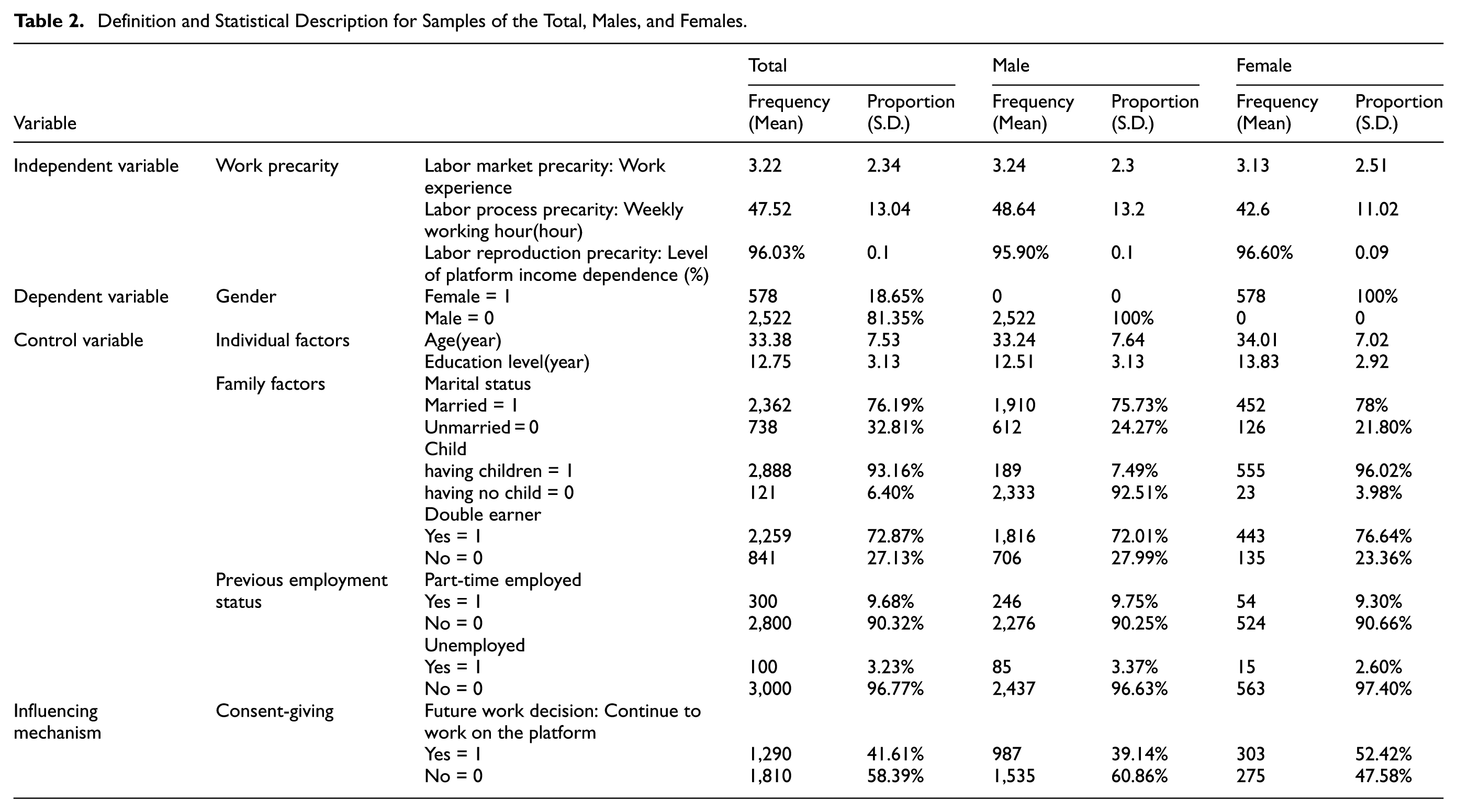
The dependent variable in the analysis is three-dimensional work precarity, encompassing labor market precarity, labor process precarity, and labor reproduction precarity. This study measures the dependent variables according to the research by Qi and Li (2020). Labor market precarity is assessed by an individual’s years of experience with a particular platform, with the total sample reporting an average of 3.22 years of work experience, 3.24 years for men, and slightly less, at 3.13 years, for women. Labor process precarity is measured by gig workers’ weekly working hours, with statistics indicating that men regularly work more hours per week (48.64 hr) compared to women (42.60 hr), suggesting a higher likelihood of men encountering labor process precarity. Furthermore, labor reproduction precarity is assessed by gig workers’ level of platform income dependence, derived from the question, “What is the percentage of your income from the platform?” Women are generally more dependent on platform incomes, with 96.6% of their earnings derived from platforms, compared to 95.9% for men. However, the gap between men and women is not substantial. Previous studies have presented similar findings (Schor et al., 2020).
The independent variable in this analysis is the gender of gig workers, coded as 1 for women and 0 for men. The study includes 578 female respondents and 2,522 male respondents. Although the number of female participants is relatively low, it is considerable within the context of gig economy research, where the number of women is significantly lower than that of men.
The mediating variable (influencing mechanism) is workers’ consent-giving, defined as their agreement and participation in the rules and work formulated by the platforms (Burawoy, 1979). While “voting with their feet” represents the absence of consent, continued work and adherence to platform rules indicate consent. Consequently, we measure gig workers’ consent-giving by their future plans to “leave or stay” on the platform. The question “Would you like to continue to work on the platform in the future?” is transformed into a dummy variable, with “yes” indicating a value of 1 (consent) and “no” indicating a value of 0 (non-consent). Recently, scholars have increasingly incorporated the concept of gig workers’“consent” toward various control mechanisms of platforms (such as algorithms, institutions, market behaviors, etc.) into their analyses (Pulignano & Franke, 2022; Schor et al., 2023). This trend offers a valuable reference point for the following analysis.
Control variables include individual factors (age and education level), family factors (marital status, number of children, and dual earners), working factors (previous employment), and location (city). The conceptual framework is illustrated in Figure 1:

Conceptual framework.
Table 2 provides the definitions and statistical descriptions of the variables involved in this study. It reports the statistics separately for the total sample, men, and women, including the mean and standard deviation for continuous variables and the percentages for categorical variables.
Definition and Statistical Description for Samples of the Total, Males, and Females.
Methods
Ordinary Least Squares Model
The outcome of interest in this study is work precarity, measured by gig workers’ years of work experience, weekly working hours, and level of platform income dependence (%). Since all these are continuous variables, we employ the ordinary least squares (OLS) model to examine the effect of gender on workers’ work precarity. The model for determining precarity is specified as follows:
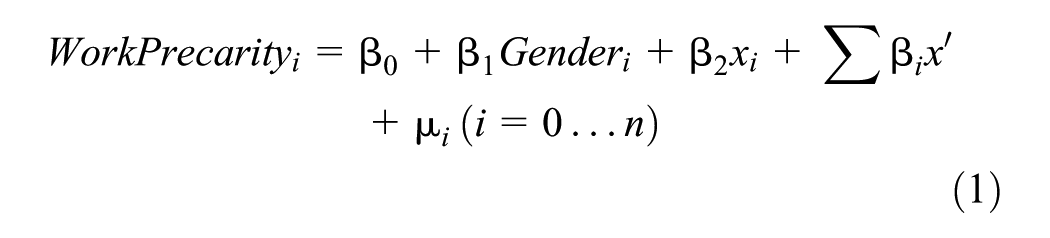
The dependent variable
Influencing Mechanism Analysis
As the voices and aspirations of female gig workers become more visible (James, 2022), it is hypothesized that the effect of gender may be mediated by consent-giving, ultimately influencing individuals’ work precarity. Therefore, gig workers’ consent-giving can be considered the mediating mechanism through which gender affects workers’ platform work precarity (Figure 2). To further explore this mechanism, this research introduces gig workers’ consent-giving as the mediating variable between the independent and dependent variables, as illustrated:

Influencing mechanism.
Based on the traditional approach to testing mediating variables proposed by Baron and Kenny (1986), the regression equations are established as follows:


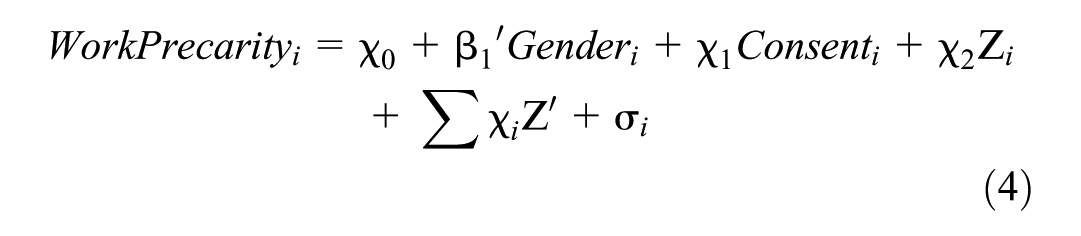
In the equations above, denotes the mediating variable, and
Instrumental Variable Method
There are endogeneity problems between gig workers’ gender and their platform precarity, leading to estimation bias and a failure to reflect actual causal effects. To address this endogeneity, the instrumental variable (IV) approach is employed. Endogeneity mainly arises from omitted variables (factors such as personality traits and risk prevention ability that affect the probability of experiencing work precarity but are not directly measurable). The IV selection strategy follows a methodology similar to that of Demurger et al. (2011).
In this study, gig workers’ perception of work-life balance is selected as the IV, measured by the question, “Do you agree with ‘being responsible for my family keeps me from focusing on my work’?” This choice is based on the premise that gender roles can influence workers’ perceptions of work-life balance. Work-life balance in gig work refers to the ability of gig workers to manage the competing demands of their work responsibilities and personal life. Unlike traditional employment, gig work often offers flexibility in terms of working hours and location, which can help gig workers better integrate their professional and personal lives (Warren, 2021). At the same time, there is no necessary relationship between an individual’s perception of work-life balance and their work precarity. Therefore, both conditions of correlation and exogeneity are satisfied. Consequently, gig workers’ perception of work-life balance will be used as an IV in this study to address the issue of endogeneity.
Analysis of the Empirical Results
The Impact of Gender on Precarity
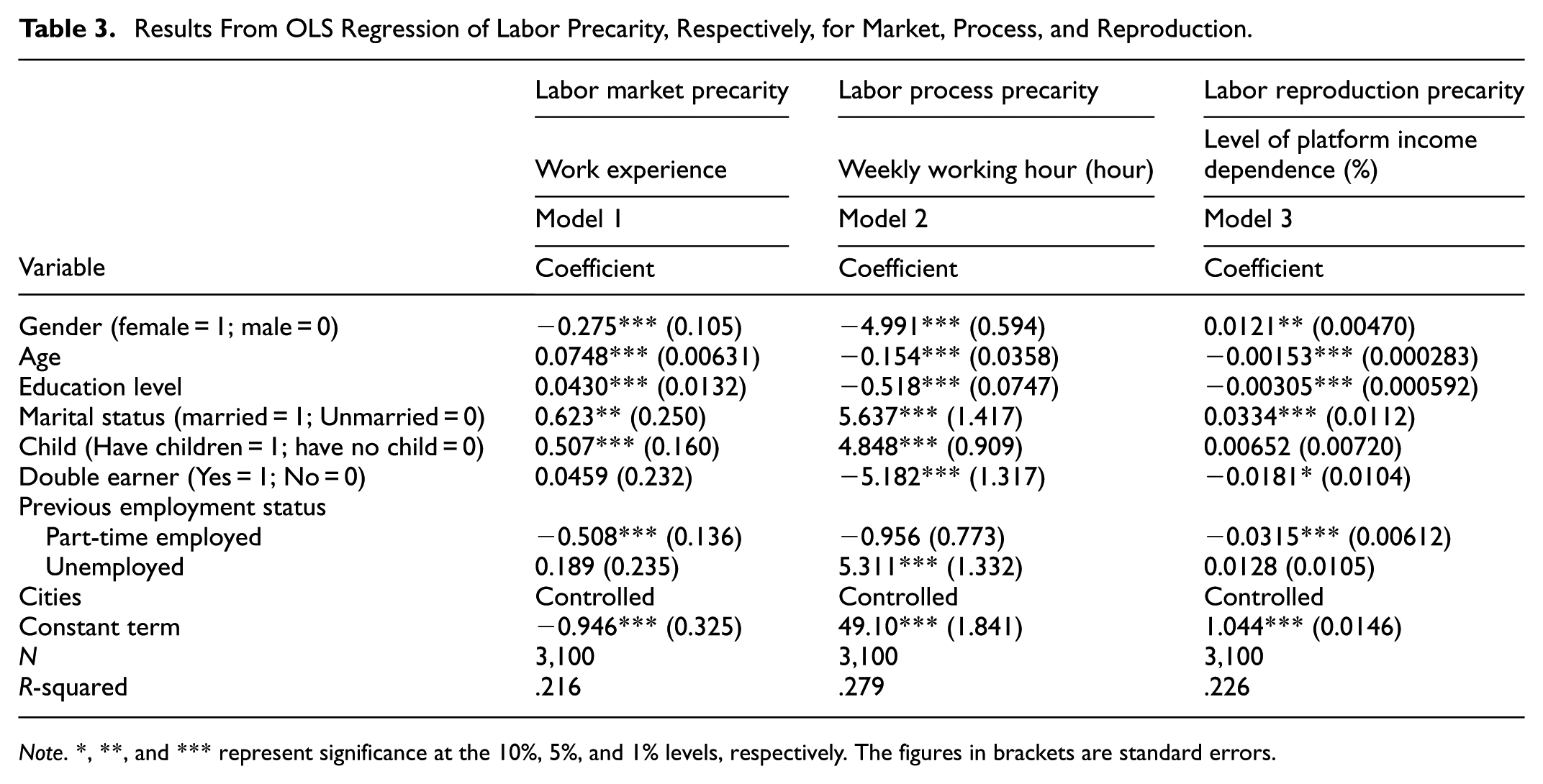
The study initially employs ordinary least squares (OLS) regression to estimate the impact of gig workers’ gender on their work precarity. Table 3 presents the results from OLS regression, focusing on three dimensions: gig workers’ work experience for labor market precarity, weekly working hours for labor process precarity, and levels of platform income dependence for labor reproduction precarity. Specifically, Model 1 examines labor market precarity, Model 2 assesses labor process precarity, and Model 3 evaluates labor reproduction precarity.
Results From OLS Regression of Labor Precarity, Respectively, for Market, Process, and Reproduction.
Note. *, **, and *** represent significance at the 10%, 5%, and 1% levels, respectively. The figures in brackets are standard errors.
The regression results from Model 1 reveal that the influence of gender (female) is significantly negative at the 1% level, with a coefficient of 0.275. This indicates that, compared to men, women generally work 0.275 years less on the platform, suggesting greater stability for men in the gig labor market relative to women. Consequently, women may experience higher levels of precarity in the gig economy labor market. This finding is substantiated by the labor participation rates of female gig workers. Prior studies have found that women’s participation rate in the gig economy is lower, and even though women dominate certain professions within the gig worker population, their overall numbers remain lower than those of men (Kasliwal, 2020; Vyas, 2020).
Generally, female drivers cannot do this (ride-sharing services) for long. It’s too tiring to be in the car all day. None of the women I know can be a ride-share driver for over two years. (Ride-share driver, No. RSD20221117-1, male) There are female riders, but not many, and they don’t do it for a long period. We’re in a hurry to deliver food, and there’s a higher risk of occupational injury. It’s more challenging for women. (Food delivery rider, No. FDR20221118-1, male)
The results from Model 2 indicate that the coefficient for females is −4.991, with significance at the 1% level, suggesting that women may work nearly 5 hr less per week than men. On the one hand, this implies that women are less likely to experience over-fatigue due to their fewer working hours. On the other hand, female gig workers might exhibit lower work continuity than their male counterparts in the gig economy. The consistency of work for female gig workers, however, presents both challenges and advantages. For example, while irregular working hours may reduce output, they also offer more flexibility for achieving a work-life balance and managing childcare responsibilities (Milkman et al., 2021).
Having children makes no difference. I only took two weeks off after giving birth. I can work when my daughter is sleeping. Although the number of working hours per day is not as long as before having children, the impact is insignificant, so I can achieve a work-life balance. (Livestreamer No. OS20221115-2, female) No breaks in a week. I deliver almost every day, unless I am sick or have something else to take care of. The more food delivered, the more money received. Admittedly, it is really hard work. Most of the time I am full of energy, but sometimes I feel too tired to work for long periods. (Food delivery rider No. FDR20221118-2, male)
Furthermore, the analysis in Table 3 shows that the role of women as mothers in the household also affects the sustainability of their labor supply, but has no significant impact on the reproduction of labor power.
I have a 8 year-old daughter, and I need to spend weekends with her, so I only stream from Monday to Thursday. My fans know this, so they never push me to update or go live. I also chat with them about my kid’s meals, homework, and my own thoughts- it helps keep the stream lively. But I never let my daughter appear on camera—she’s still too you ng. (Livestreamer No.OS20221116-4, female) I have a son, 4-year-old, and usually, my parents take him to kindergarten. But when they’re not feeling well, I have to step in. His dad’s a programmer, so he doesn’t have much time. Luckily, I’m a matchmaker streamer, so the need for immediate updates isn’t that high, and my schedule is more flexible. (Livestreamer No.OS20221116-5, female)
Drawing from the results of Model 3, the coefficient for women is 0.0121, which is significant at the 5% level. This implies that women are 1.21% more dependent on platform incomes than men, suggesting that men may experience less precarity in the labor reproduction aspect of the gig economy. Gender wage differentials within the gig economy have long been a subject of considerable attention. The higher earnings of men are not only related to their gender advantage but also to the nature and skill requirements of gig work itself (Churchill & Craig, 2019; Cook et al., 2021). While gender discrimination is indeed a factor in this context, this study does not explore that specific aspect.
I only have the energy to work for one platform. My husband is different. He is physically fit, working both as a ride-share driver and at a construction site. (Homemaking service attendant, No. HSA20221116-1, female) I used to sell cosmetics to others and do ride-sharing after work, but I soon gave it up as I couldn’t physically handle it. Later, the cosmetics business declined, so I am now a full-time driver. (Ride-share driver, No. RSD20221117-2, female)
Preliminary analysis suggests that female gig workers in the labor market face greater precarity than their male counterparts, as they generally have less work experience, consistent with the lower labor participation rate of female gig workers (Vyas, 2020). Furthermore, although the work continuity of female gig workers is weaker than that of males, they are less likely to experience overwork, indicating that their precarity is similar but differs in specifics. In fact, the precarity faced by female gig workers in the labor process is a double-edged sword. While it undermines the continuity of women’s work, it also provides them with more opportunities to maintain a work-life balance (Hunt & Samman, 2019b). Additionally, female gig workers exhibit a higher level of economic dependence on platforms, demonstrating a stronger precarity in labor reproduction, as reflected in existing studies (Schor et al., 2020).
Influencing Mechanism Analysis: Consent-giving
Gender might impact gig workers’ precarity via their consent-giving (Adekoya et al., 2025), which is regarded as an influencing mechanism in the relationship between gender and precarity in the gig economy. Table 4 presents the test results on the effects of workers’ gender on their precarity, mediated by workers’ consent-giving, followed by the mediation effect tests using the bootstrapping method.
Influencing Mechanism Test: Consent-Giving.

Note. ** and *** represent significance at the 5% and 1% levels, respectively. The figures in brackets are standard errors.
Based on the basic regression in the previous section, the first step of the influencing mechanism test involves conducting the regression of workers’ gender on consent-giving using the binary probit model. Subsequently, the mediator (i.e., consent-giving) is included in the precarity regression using OLS regression to observe how the coefficients of the three dimensions of precarity change. The results of Model 5 pertain to labor market precarity, those of Model 6 to labor process precarity, and those of Model 7 to labor reproduction precarity.
Model 4 demonstrates that gender significantly negatively affects consent-giving at the 1% significance level. Compared to men, female gig workers give 31% more consent to their platform work, suggesting that women appear much more satisfied with their platform-based work than men. This difference may be attributed to occupational segregation, where men are more likely to work as delivery riders or drivers, while women tend to work as online streamers. The former can be considered labor-intensive and basic-skilled work, whereas the latter may be relatively knowledge-based and general-skilled, which could influence their subjective well-being and, consequently, their consent-giving to platform work. This transmission is shown to be present but varies by individual nature (Wu et al., 2022).
Results from Model 5 indicate that the consent-giving coefficient is −0.0386, without significant impacts on labor market precarity. However, the consent-giving coefficients in Models 6 and 7 are 0.0171 and 2.560, respectively, significantly positively affecting labor process precarity and labor reproduction precarity at the 1% level. This confirms that consent-giving mediates the influence of gender on labor process precarity and labor reproduction precarity among gig workers. Testing via the bootstrapping method shows that the mediation effect is significant at the 1% level. However, consent-giving does not appear to be the influencing mechanism in the relationship between workers’ gender and their labor market precarity.
Heterogeneity Analysis by Occupations
We argue that the impact of gender on gig workers’ precarity differs across various occupations, reflecting the nature of tasks, skill requirements, and individual attitudes toward specific tasks (Adekoya et al., 2025; Webster, 2016). This section primarily examines whether the effect of gig workers’ gender on their precarity varies across the five specified occupations: ride-share drivers, food delivery riders, online streamers, homemaking service attendants, and online doctors. To investigate these questions, we constructed interaction terms for gender and each of the five types of occupations, focusing on whether these interactions significantly affect the three dimensions of precarity. Tables 8 to 10 present the regression results for labor market precarity, labor process precarity, and labor reproduction precarity, respectively.
The longer gig workers are employed by a platform, the less precarity they encounter, as they can accumulate more work experience and thereby obtain greater competitive advantages in the labor market, reducing their precarity (Choonara, 2020; James, 2022; Shade, 2018). Results from Table 5 indicate that, for labor market precarity, being an online doctor can significantly reduce workers’ precarity under the same gender conditions (Female). This is evidenced by the interaction term of Female × Online doctor, which positively influences work experience at the 1% significance level, with a coefficient of 0.9173. However, there appear to be no significant differences in the effect of gender on labor market precarity across other occupations.
Results for Heterogeneity Analysis by Occupations: Labor Market Precarity.

Note.*** represents significance at the 1% level, respectively. The figures in brackets are standard errors.
Long weekly working hours can be considered a double-edged sword for gig workers. On the one hand, extended work hours can lead to physical and mental health issues, fatigue, and occupational injuries (Bajwa et al., 2018; Cefaliello & Inversi, 2022). On the other hand, maintaining longer working hours over a period represents greater work continuity for individuals. Therefore, an increase in weekly working hours cannot be universally viewed as a sign of gig workers’ precarity. The regression results in Table 6 show significant differences in the effect of gender on labor process precarity for workers in certain occupations compared to those in other occupations (interaction term coefficients are 7.3858, 7.2713, and 4.0493, respectively). Specifically, for workers of the female gender, those engaged in ride-share driving, online streaming, and online healthcare providing may experience more issues like fatigue, health damage, or work-related injuries, but they may face fewer challenges related to work discontinuity. Concurrently, prior studies suggest that the voluntary nature of female gig workers’ employment (i.e., consent) may influence their psychological stress and mental well-being. Research on a significant number of women in temporary roles reveals that individuals involuntarily engaged in temporary employment experience greater psychological distress and somatic complaints compared to those who choose temporary work (Connelly & Gallagher, 2004).
Results for Heterogeneity Analysis by Occupations: Labor Process Precarity.

Note.*, **, *** represent significance at the 10%, 5%, and 1% levels, respectively. The figures in brackets are standard errors.
Economic dependence on the platform increases a worker’s precarity in the labor reproduction of the gig economy (Schor et al., 2020). As reported in Table 7, only the interaction term Female × Online streamer positively impacts labor reproduction precarity at a 5% significance level, with a coefficient of 0.0424. This indicates that, for the female, being an online streamer can increase their labor reproduction precarity by 4.24%, demonstrating how precarity varies across occupations (and platforms; S. Vallas & Schor, 2020).
Results for Heterogeneity Analysis by Occupations: Labor Reproduction Precarity.
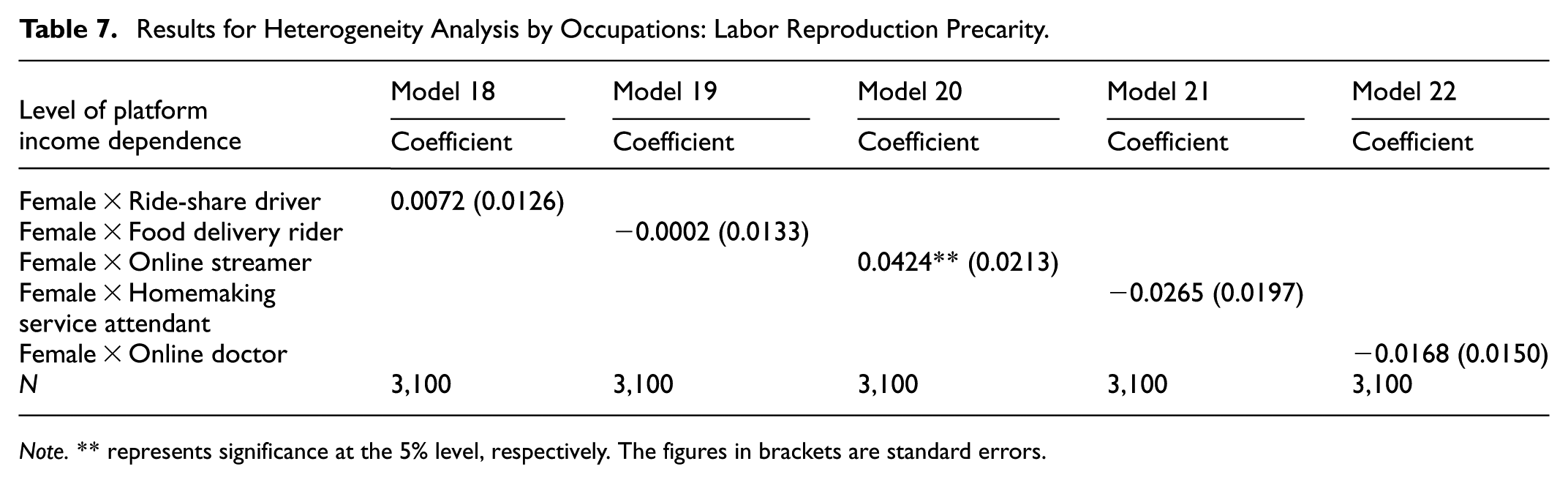
Note.** represents significance at the 5% level, respectively. The figures in brackets are standard errors.
To sum up, heterogeneity analysis reveals that engaging in specific occupations can significantly reduce certain forms of precarity. For instance, online doctors experience reduced precarity in the labor market. However, occupations like online streamers may encounter more precarity in the labor reproduction. Thus, while female gig workers may experience more precarity in the labor market and labor reproduction than men, choosing to work as online doctors or avoiding roles as online streamers in the gig economy can significantly reduce their precarity.
Instrumental Variable Model Analysis
This study first adopts the IV method to solve the endogenous problems of missing variables. Table 8 is the regression results for IV Probit, reporting coefficients of corresponding variables. The IV (gig workers’ perception of work-life balance) comes from “Do you agree with ‘being responsible for my family keeps me from focusing on my work’?” The regression results show that the gig workers’ gender still significantly affects the labor market, labor process, and labor reproduction precarity, at the level of 10%, with the coefficients of −9.044, −35.616, and 0.0592. This is basically consistent with the analysis of others (Adams-Prassl & Berg, 2017; Cox et al., 2024; Kwan, 2022). This shows that even after considering the endogeneity problem, the workers’ gender still significantly affects three dimensions of precarity. Moreover, Table 8 also reports the results of endogenous test, where both test and Wu-Hausman F test identify gender as exogenous, indicating that the results of IV regression are more robust than the basic.
Gender and Work Precarity: IV Regression.

Note.*, **, and *** represent significance at the 10%, 5%, and 1% levels, respectively. The figures in brackets are standard errors.
Robustness Test
To assess the robustness of the preceding results, we conduct the propensity score matching (PSM) method and utilize the probit model as an alternative to OLS for regression analysis, where we also vary the measurements of dependent variables to validate our findings.
Under the PSM approach, we initially perform a balancing test, which highlights a substantial difference between women and men, with inconsistencies in each variable. After the propensity scores are matched, the inconsistencies in these variables are reduced, and the sample averages are significantly closer than before, suggesting that the balancing test was passed. Table 9 shows the average treatment effect (ATT) of gender on three types of precarity. Given the bias in the standard error of single matching, the self-sampling bootstrap method is used to modify the standard error in this case. After controlling for control and treatment group sample bias, the results demonstrate that the ATT achieved by various matching approaches is consistent with our basic regression.
Average Treatment Effect (ATT) Results.

Note.*, **, and *** represent significance at the 10%, 5%, and 1% levels, respectively. The figures in brackets are standard errors.
Table 10 reports the results from two robustness tests. The first test uses probit regression for labor precarity, specifically for the labor market, labor process, and labor reproduction. Gender is negatively correlated with labor market precarity and labor process precarity, significantly at the 1% level, while positively correlated with labor reproduction precarity at the 5% significance level. According to existing literature, female gig workers are more economically dependent on platforms due to several interconnected factors. Limited access to alternative employment, especially for those with caregiving responsibilities, drives women toward platform work, which offers flexibility but often at the cost of long-term stability (James, 2022). Additionally, biased platform algorithms, income volatility, and financial insecurity further entrench this dependence (Hannák et al., 2017; Shade, 2018). Gendered labor market segmentation places women in lower-paid roles, reducing upward mobility, while weak institutional protections and societal norms make platforms the most viable option (Davis & Hoyt, 2020; James, 2022; Van Doorn & Badger, 2020). These dynamics combine to create a cycle of economic reliance on platforms, despite the inherent precarity of gig work.
Results From Robust Tests.

Note. ** and *** represent significance at the 5% and 1% levels, respectively. The figures in brackets are standard errors.
Furthermore, we have also modified the measurement of each independent variable. Specifically, we construct two dummy variables to replace the years working on the platform and the levels of platform income dependence. For the former, “working on the platform over one year” takes the value of 1, while “below and equal to one year” takes the value of 0; for the latter, “income dependent level of 75% or over” takes the value of 1, while “income dependent level below 75%” takes the value of 0. In addition, weekly working hours are replaced by daily working hours. The results remain similar to the original regression. These robustness tests confirm the validity of our conclusions.
Conclusion
This study utilizes data from a survey on gig workers in China to analyze the precarity issues faced by female gig workers from three perspectives: labor market, labor process, and labor reproduction. Additionally, it examines the corresponding influencing mechanisms by introducing the “consent-giving” indicator and conducting heterogeneity tests by occupation. Preliminary analysis results indicate that even in the gig economy, which claims to be equal and fair, women may be more precarious than men. Specifically, female gig workers face more labor market precarity than their male counterparts, with overall less work experience, consistent with the analysis of lower female labor participation rates. Meanwhile, at the household level, the impact on women’s precarity in gig work is also pronounced: having children tends to exacerbate precarity in both labor market participation and labor processes, just like “I have a 8 year-old daughter, and I need to spend weekends with her, so I only stream from Monday to Thursday” (No. WJ20221116-4); yet, more optimistically, a double-earner household contributes to mitigating precarity in the domains of labor processes and the reproduction. For example, the husband of female (No. HSA20221116-1) also has income, and she can support her family’s needs by working for just one platform, without any other working plan.
Furthermore, although female gig workers exhibit weaker work continuity than male workers, they are not as prone to overwork situations. Therefore, the labor process precarity of both genders is similar but differs in specific aspects. Moreover, female gig workers demonstrate higher economic dependence on platforms, reflecting greater precarity in terms of labor reproduction. It is noteworthy that the precarity related to the labor process has a dual nature, particularly concerning working hours, where the double-edged sword effect is evident.
However, heterogeneity analysis results underscore that engaging in or avoiding certain gig occupations can significantly reduce precarity, indicating that occupation selection may enhance individual resilience to precarity. Female online doctors show less precarity in the labor market, with more working experience. Female rideshare drivers and online doctors exhibit labor process precarity similar to female online streamers (double-edged sword), but online streamers face more precarity in labor reproduction. Hence, working as online doctors can help women lessen precarity in the labor market, while avoiding roles as online streamers can help women reduce precarity in the labor reproduction.
The primary contribution of this article is to provide comprehensive and systematic evidence on the precarity issues faced by female gig workers, thereby supplementing the gender perspective on the differential impact of precarity in the gig economy. Furthermore, the chosen analysis framework, encompassing labor market, labor process, and labor reproduction, offers new insights for the systematic analysis of precarity among female gig workers in the future. Additionally, the study clearly defines the role of the consent-giving mechanism, enriching research on the influence of gig workers’ individual preferences on their work status.
However, this study has the following limitations. First, as these conclusions are confined to the Chinese context, they may not be applicable to gig workers outside China, particularly in areas such as childcare, occupational gender segregation, and the discourse power of platform companies, due to economic, social, and cultural differences. Future studies should consider the situations in other countries and regions. Second, the analysis of the five types of occupations may not provide a comprehensive representation of the overall picture of the gig economy. These categories represent some of the most prominent groups within the current gig economy, with the latter three categories comprising a significant number of female participants. This focus not only addresses our objective of exploring the experiences of female gig workers but also significantly enhances the diversity of our sample. However, while these categories can represent a substantial portion of gig workers in China, they do not encompass all gig worker groups. In future research, we should include additional categories to diversify the sample further and enhance the representativeness of the study’s findings. Third, the concept of precarity is multifaceted, and the explanatory content provided by the three-level analysis framework in this study may not provide a complete picture of precarity. At the same time, this framework does not reflect the platform’s perspective, particularly the impact of platform algorithms on female gig workers’ work processes and the considerations of platform rules, necessitating further supplementation in subsequent research. Fourth, issues of omitted variables may still exist, despite our efforts to address endogeneity issues using various methods such as IV and PSM. Finally, the sample distribution across different occupations among gig workers is somewhat unbalanced. Currently, most gig workers are engaged in food delivery and ride-sharing services, resulting in larger sample sizes for these two occupations, while the samples for the other three occupations are relatively smaller. However, we have made every effort to gather as many samples as possible from various occupations. We believe that, with the development of the gig economy, the number of gig workers in other occupations will also increase in the future.
Footnotes
Acknowledgements
We would like to express our heartfelt gratitude to the editors, particularly Maitree Rawat, for their valuable guidance and support throughout the review process. We also extend our sincere thanks to the three anonymous reviewers for their insightful comments and constructive suggestions, which significantly enhanced the quality of our manuscript. Their contributions were invaluable to our research.

Consent to Participate
We have obtained oral consent from the study participants.
Author Contributions
Funding
The authors disclosed receipt of the following financial support for the research, authorship, and/or publication of this article: A Major Planning Project, supported by the Funding from Science Research of Renmin University of China, titled “Research on Digital Economy and Work Market” ID: 23XNLG04. Humanities and Social Sciences Foundation Youth Project, by Ministry of Education of China, titled “Research on the Resolution of Motherhood Dilemmas, Influencing Mechanisms, and Optimization Paths from the Perspective of New Employment.” Approval Number: 25YJC840030.
Declaration of Conflicting Interests
The authors declared no potential conflicts of interest with respect to the research, authorship, and/or publication of this article.
Data Availability Statement
The data underlying this study are confidential and cannot be made publicly available.