




Abstract
How is economic inequality associated with gender inequality at the individual level? Even though previous literature has broadened our understanding of the impacts of economic inequality at the national level, the influence of attitudes toward income inequality on the attitudes toward gender equality has not been fully examined at the individual level. To contribute to the previous literature, relying on the World Value Survey dataset in Wave 5, 6, and 7, this article unveils the relationship between economic inequality and gender inequality at the individual level with the cases of 17 Asia-Pacific countries. Estimating ordered logistic regression models, this article demonstrates that there is a statistically and substantially significant relationship between the justification of income inequality on the confidence in the women’s movements. More interestingly, we find that male respondents compared to their female counterparts are more susceptible to the changes in the justification of income inequality. Our research advances the literature on the impacts of economic inequality concerning individual perspectives. At the same time, this article extends previous research on the influence of economic inequality by showing that the role of economic inequality in determining people’s attitudes toward gender equality is conditioned by the gender of individuals.
Keywords
Introduction
How is economic inequality associated with gender equality at the individual level? Along with the emergence of economic inequality across the globe (Engler & Weisstanner, 2021; Hailemariam et al., 2020), eminent scholars have mentioned that economic or income inequality is the major issue of our period (Milanovic, 2016; Stiglitz, 2015). Many studies have examined various negative impacts of economic inequality in both political and social spheres such as regime stability (Jung & Sunde, 2014), democratic backsliding or transitions (Haggard & Kaufman, 2012), policy responsiveness (Barber, 2011), political trust (Zmerli & Castillo, 2015), generosity of the public on minorities or post-material values (Andersen & Fetner, 2008; Côté et al., 2015), etc. In addition, economic inequality also negatively affects the economic situation of countries concerning economic growth (Anyanwu et al., 2021; Cingano, 2014).
While the potential infamous influence of economic or income inequality on various areas, the relationship between economic inequality on gender inequality has also received wide attention from scholars (Beer, 2009; Moreno-Bella et al., 2023; Ukhova, 2015). The association between the two inequalities has been spotlighted under the situation of rising economic and gender inequalities over the decades (Razavi, 2016). Previous literature on the intersection between the two inequalities has focused on the impacts of one inequality on the other inequality. At the national level, it has been revealed that the decrease in the degree of income inequality led by quality social services is associated with the women’s movements and gender equality (Kostov & Moraliyska, 2022). Also, some academic reports have continuously expressed the detrimental impacts of economic inequality on gender inequality (Rhodes, 2016).
Despite the contributions from the previous literature on the association between economic inequality and gender inequality, the link has not been thoroughly and empirically examined at the individual level. Given that the influence of economic inequality on public attitudes toward political or social issues including the women’s movements is largely based on the changes in the degree of tolerance at the individual level (Andersen & Fetner, 2008; Dutta et al., 2019; Gonzales et al., 2015), this academic lacuna is surprising. Without an individual-level approach, it is nearly impossible to capture the essence of the role of economic inequality in determining the attitudes toward “outgroups” such as women, racial minorities, or homosexuals (Svallfors, 2006).
To contribute to the previous literature on economic and gender inequality and to demonstrate the relationship between the perceptions of economic inequality and support for gender equality at the individual level, this article relying on the World Value Survey (WVS) dataset in waves 5, 6, and 7 which have been conducted from 2005 to 2022 attempts to evaluate the influence of the justification of economic inequality on the confidence in the women’s movements. Moreover, this article takes one step further by examining whether the relationship between the justification of income inequality and the confidence in the women’s movements is conditioned by the gender of individuals or not. In other words, we will examine the heterogeneous impacts of the justification of income inequality according to the gender of individuals.
The rest of this article is composed of the following sections. In the next Theories and Hypotheses section, we will introduce our hypotheses about the link between the justification of income inequality and the confidence in the women’s movements. Also, we will theorize the intervening impact of the respondents’ gender. In the Empirical Analysis and Results section, data, variables, and methodology to evaluate the influence of the justification of income inequality on the confidence in the women’s movements will be presented. In addition, the empirical results from ordered logistic regression models will be provided. Finally, we conclude with a discussion on the potential contribution of this article and future research directions.
Literature Review
In recent decades, a growing volume of studies has examined the various impacts of economic inequality as mentioned earlier (Anyanwu et al., 2021; Engler & Weisstanner, 2021; Stiglitz, 2015; Zmerli & Castillo, 2015). At the national level, economic inequality tends to negatively affect national-level indicators including economic growth. Also, it increases the degree of instability of political regimes which even results in regime changes such as democratic backsliding and breakdown (Haggard & Kaufman, 2012).
Gender equality is one of the subjects which can be negatively affected by economic inequality. Along with the increasing attention to gender equality after the 2000 Millenium Declaration (Stuart & Woodroffe, 2016), there have been many attempts to link the two types of equalities and inequalities: economic equality and gender equality. Previous literature examines the determinants of gender equality and economic inequality has received spotlights as a potential factor. For sure, while some scholars maintain that achieving gender equality is a prerequisite to enhance economic inequality (Mitra et al., 2015; Morrison & Morrison, 2007; Nelson & Goel, 2023), other scholars argue that economic inequality tends to hinder the improvement of gender equality (Moreno-Bella et al., 2023; Razavi, 2016; Ukhova, 2015).
For instance, Nelson and Goel (2023) related to the influence of gender equality on economic equality demonstrate that greater representation of women in government and overall gender equality are likely to lower economic inequality, by conducting empirical analysis with time-series cross-national data on 162 nations from 1985 to 2019. Moreover, Mitra et al. (2015) based on the unbalanced panel data on 101 countries show that equality in economic opportunity tends to be followed by gender equality, even though the relationship is contingent on the state of development. Concerning the influence of economic inequality on gender equality, more recently, Moreno-Bella et al. (2023) through experiments found that the increase in economic inequality tends to lead to the growth of communal contents including gender equality.
Although the direction of the impacts of the two types of inequalities and equalities is different, there is growing academic consensus that economic and gender equality are closely associated (Falk & Hermle, 2018; Nunn, 2020). The scholars focused on the role of economic inequality in determining the degree of gender equality have emphasized the psychological drive from economic inequality. For instance, Nishi et al. (2015) through experiments find that economic inequality by hindering cooperation among the public is likely to result in more unequal situations and degrade the welfare of others. Also, Sánchez-Rodríguez et al. (2019) using experimental design demonstrate that broad gaps in economic status make individuals think of themselves as more separate from others and not regard normative values such as the welfare of others.
The above-mentioned studies have broadened our understanding of the relationship between economic inequality and gender equality. However, the link between the two has not been thoroughly and empirically examined over the last decades at the individual level (Sánchez-Rodríguez et al., 2022). Especially, even though individual attitudes toward economic inequality such as the justification of income inequality are crucial to understanding the influence of economic inequality on gender equality, the attitudes about economic inequality have not received much academic attention compared to the aggregate statistics of economic inequality. To contribute to the previous literature, this article aims to test the association between economic inequality and gender equality at the individual level.
Theories and Hypotheses
This article focuses on the role of the justification of income inequality in determining the confidence in the women’s movements. Throughout this article, the women’s movements are defined as a set of movements, “composed primarily but not necessarily exclusively of female participants, that make claims on cultural and political systems on the basis of women’s historically ascribed gender roles” (Alvarez, 1990, p. 23). Even though the specific goals and activities of the women’s movements differ for each women’s movement and each country, the common goal of the women’s movements is to promote women’s rights (Roces, 2010; Roces & Edwards, 2010). For instance, the women’s movement in Kyrgyzstan has largely attempted to overcome the underrepresentation of women in the decision-making process (Commercio, 2022), while that in South Korea has aimed to prevent and to stop violence against women (Heo, 2010).
To investigate the link between the justification of income inequality and the confidence in the women’s movements, we borrow the theory of values originated from Schwartz (1992). According to Schwartz (1992), basic human values can be divided into self-transcendence value and self-enhancement value. Self-transcendence value is related to reciprocity and sharing behaviors, also characterized by a concern for the welfare of others, social justice, universalism, and equality. On the contrary, self-enhancement value is about personal achievement and power, depicted as the pursuit of one’s success and interests or dominance over others (Schwartz, 2012).
The main thrust of the theory of value is that individual behaviors are mostly guided by which values individuals weigh more, and individuals have their relative importance between the two values (self-transcendence and self-enhancement values). To put it in a nutshell, if individuals seek self-transcendence value rather than self-enhancement value, they tend to spotlight the welfare of others and benevolence (Botterill & Lewis, 2023). Previous literature has applied the theory of value to explain public attitudes toward equality or other normative values such as environmentalism (Goren et al., 2016; Oreg & Katz-Gerro, 2006).
The link between the justification of income inequality and the confidence in the women’s movements can also be theorized with the theory of values. The perception of economic inequality has been revealed as a potential factor in promoting self-enhancement value. For instance, Wilkinson and Pickett (2017) emphasize the social costs of economic inequality. They argue that economic inequality tends to lead the public to change their behaviors in strategic ways. Moreover, some studies have shown that economic inequality among individuals makes a society with a competitive, individualist, and masculine atmosphere (Moreno-Bella et al., 2019; Sánchez-Rodríguez et al., 2019). More recently, Sanchez-Rodriguez, Sánchez-Rodríguez et al. (2022) demonstrate that higher levels of perceived economic inequality are related to normative self-enhancement value.
Apart from the theory of value, not negligible number of studies maintain that economic inequality negatively affects perceived normative values including gender equality and democratic political engagement (Houle, 2018; Solt, 2008). As an example, Houle (2018) finds that economic inequality is negatively associated with political participation and depresses support for democratic activities. Therefore, based on the theory of value and previous findings on the influence of economic inequality and political participation, we expect that people with a higher level of justification of income inequality tend to have lower confidence in the women’s movements.
Hypothesis 1: People with a higher level of justification of income inequality tend to have lower confidence in the women’s movement, while all other things being equal (Ceteris Paribus).
Rather than only testing the direct influence of the justification of income inequality on the confidence in the women’s movements, this article also questions the heterogenous impacts of the justification according to the gender of individuals. To theorize the varying impacts of the justification of income inequality, we borrow the theory of shared identity from Mansbridge (1999). According to Mansbridge (1999), women tend to support women’s rights and empowerment which is s substantive representation of women due to their shared experience. Female citizens are likely to have similar experiences with other females such as specific forms of violence or negative stereotyping (Xydias, 2023). The similar experience shared among females tends to result in shared interests and the interests are likely to be translated into the cooperation among them.
Previous literature has unveiled observational evidence for the theory of shared identity (Berkman & O’Connor, 1993; Lemi, 2021; Montoya et al., 2022; Schwindt-Bayer, 2006). For instance, Dolan (2018) based on the Gender Social Survey (GSS) dataset indicates that female voters are more likely to support female candidates and hold up the women’s movements. In regards to women’s rights and movements, it is found that female citizens tend to support the introduction of female empowering policies such as gender quotas (Barnes & Córdova, 2016; Beauregard, 2018). More relevantly, some studies have demonstrated that women tend to support the women’s movements and further change social norms and beliefs about women’s roles (Banaszak & Ondercin, 2016).
At the decision-maker level, the theory of shared identity has been also empirically supported. Woo (2022) analyzing African countries showed that the percentage of female legislators is closely related to the adoption of anti-human trafficking laws, while Lawless (2015) uncovered that female legislators’ priorities and preferences differ compared to those of male legislators. Even though the distinctive behaviors of female decision-makers are contingent on various institutional factors (Höhmann, 2020), female politicians and the public are believed to have support for women-specific interests (Kweon & Ryan, 2022; Wängnerud, 2009).
Therefore, based on the theory of shared identity chiefly advanced by Mansbridge (1999) and other empirical evidence supporting the theory, we expect that the negative impact of the justification of income inequality on the confidence in the women’s movements is much more conspicuous among male individuals rather than their female counterparts. To be specific, the negative impact of the justification is mitigated among female individuals because women tend to express their support for women’s rights or women’s movements based on their shared identity as women. Below is the hypothesis concerning the varying influence of the justification of income inequality.
Hypothesis 2: The influence of a higher level of justification of income inequality on the confidence in the women’s movement is conditioned by the gender of individuals, while all other things being equal (Ceteris Paribus).
Empirical Analysis and Results
In this section, we will introduce data, variables, and empirical analysis conducted to evaluate the two hypotheses presented in the previous section. To test the influence of justification of income inequality on the confidence in women’s movement and the heterogenous impacts of the justification according to respondents’ gender, we take advantage of the time-series survey data from the World Value Survey (WVS). We employ three waves of the WVS: wave 5 (2005–2009), wave 6 (2010–2014), and wave 7 (2017–2022). The WVS conducts surveys on 20 Asia-Pacific countries throughout the three waves. Asia-Pacific countries covered in the WVS are Australia, Bangladesh, China, India, Indonesia, Japan, Kazakhstan, Kyrgyzstan, Malaysia, Myanmar, New Zealand, Pakistan, Philippines, Singapore, South Korea, Taiwan, Tajikistan, Thailand, Uzbekistan, and Vietnam. The wide coverage of the WVS enables us to test the generalizability of our findings across Asia-Pacific countries.
As an independent variable, we employ respondents’ answers for the questionnaire about the justification of income inequality (WVS code: e035). This questionnaire asks respondents for their opinion about income inequality, and respondents can select answers on a bipolar scale ranging from 1 (income should be made more equal) to 10 (we need larger income differences as incentives). This variable has been widely employed as a variable to predict respondents’ attitudes toward income inequality and their beliefs about the necessity of income inequality (Halman et al., 2007; Sheetal et al., 2022).
To capture the influence of the justification of income inequality, we use the questionnaire about the confidence in women’s movement in the WVS as our dependent variable (WVS code: e069_15). The questionnaire requires respondents to answer the question: “The Women’s Movement: I am going to name a number of organizations, for each one could you tell me how much confidence you have in them: is it a great deal of confidence, quite a lot of confidence, not very much confidence, or none at all?” We reordered the categories of answers and the order in this article ranges from 1 (none at all) to 4 (a great deal of confidence). As the questionnaire used for building our independent variable, the questionnaire about the confidence in women’s movement has been applied to measure or proximate women’s political empowerment (Pospieszna, 2015), cultural values concerning women’s rights (Messner, 2023), and gender inequality (Klasing, 2013).
To prevent omitted variable bias (OVB) from being introduced in our analysis, we control a series of variables that can influence individual confidence in the women’s movements. First, we include the basic individual characteristics including respondents’ age, gender, marital status, employment status, level of education, and religiosity, following the academic tradition of conducting empirical analysis based on survey results (Denny & Doyle, 2009; Kurer, 2020; Morgan & Buice, 2013).
Those basic characteristics have also been studied as potential factors affecting individual attitudes toward the women’s movements and rights. For instance, Gerber et al. (2010) argue that age is negatively associated with the support for women’s political empowerment while being more conservative. On the contrary, Huddy et al. (2000) demonstrate that female and married individuals are more likely to support the women’s movements. Although the studies are not about the Asia-Pacific countries, we attempt to control the potential influence of the basic characteristics of individuals on their attitudes toward the women’s movements. In addition, even though some studies demonstrated that the level of education and employment status are not closely related to the support for the women’s movement (Habibov et al., 2017), we include those basic information variables to handle the OVB. Moreover, we add the religiosity variable based on the questionnaire about the weekly number of participations in religious services (WVS code: f028). This decision is led by previous studies demonstrating that religiosity might help to explain public attitudes toward women-related issues (Barkan, 2014).
Along with the above-mentioned basic characteristics, we control the influence of household income based on the modernization theory. According to the modernization theory, greater economic success or resources tend to make a person and a society pursue post-materialist values including political freedom, participation, and tolerance through the cultural change mechanisms (Inglehart & Welzel, 2005; Lipset, 1959; Verba & Almond, 1963). Given that the women’s movements are closely related to post-martialist values (Lancaster, 2022), we include household income as one of the control variables.
Unlike the expected impacts of household income, economic anxiety might deter support for women’s rights and movements because economic hardship tends to stereotypically lead to masculine qualities in both private and public spheres (Lei & Bodenhausen, 2018). To build the economic anxiety variable we rely on the questionnaire about family saving and spending (WVS code: x044). In this questionnaire, Respondents are allowed to answer the question related to last year’s savings by selecting one of the four answer categories ranging from 1 (saved money) to 4 (spend savings and borrowed money).
At the same time, we also decided to control the influences of political interest (WVS code: e023) along with political ideology (WVS code: e033), and the attitude toward the importance of democracy (WVS code: e235). The inclusion of political interest is based on the fact that the women’s movements are largely associated with the political sphere (Jaquette, 2018). It has been also revealed that a left-wing political ideology and democratic values are closely related to the support for gender equality and the women’s movements (Kantola & Lombardo, 2021; Rawłuszko, 2021). Therefore, to isolate the influence of the independent variables, we control the impacts of the potential explanatory variables.
Moreover, we also include the original country weight provided by the WVS. The original country weight is to compensate for deviations in the resulting samples. The inclusion of the weight variable enables us to consider the sample unbalanced sample distribution concerning respondents’ sex-age, rural-urban, and education across countries (Adamczyk & Pitt, 2009). Given the nature of the statistical approach, the isolated influence of the justification of income inequality on the confidence in the women’s movements cannot be genuinely examined. However, the inclusion of a series of control variables enables us to minimize the omitted variable bias.
Table 1 shows the descriptive statistics for variables employed in this article. To demonstrate whether there is a problematic correlation among explanatory variables including independent and control variables, we conduct the variance inflation factor (VIF) test which has been widely used to detect multicollinearity among variables (Mohammadi, 2022). The mean and individual VIF scores of the independent and control variables do not exceed 4, indicating there are no multicollinearity issues.
Descriptive Statistics for Variables Employed.

Considering that our dependent variable is an ordinal variable, we estimate four ordered logistic regression models. We only include our key explanatory variable in the bivariate model, while we include a series of control variables in the other three models. In the baseline model, we do not implement fixed or random effects for countries and waves of the WVSs. In fixed and random effects models, the fixed and random effects of the country and the wave of WVSs are included respectively. According to the AIC and BIC, it is revealed that the fixed effects model has the best model-fit among the four models estimated.
Our key independent variable, the justification of income inequality, is consistently statistically significant at the level of p < .05 across all four models. It means that respondents who highly justify income inequality in their societies are less likely to express their confidence in the women’s movements. This finding is consistent with our expectation that people who are supportive of income inequality or who are reluctant to redistribute wealth tend to refuse normative values such as gender equality. It also echoes previous findings that income inequality will decrease self-transcendence values and unequal social atmosphere leads to less cooperative environments (Dawtry et al., 2019; García-Castro et al., 2020; Sánchez-Rodríguez et al., 2022). At the same time, this result provides empirical evidence for the psychological and social costs of income inequality related to improving gender equality (Wilkinson & Pickett, 2017).
Turning to control variables, respondents’ age, gender, economic anxiety, political interest, and importance of democracy are statistically significant at the level of at least p < .01 across the four models. These results are consistent with the previous literature demonstrating that age is negatively related to the support for women’s movement (Gerber et al., 2010), while women tend to support women’s active participation in both social and political spheres (Krook & Restrepo Sanín, 2020). In addition, economic anxiety, political interest, and the importance of democracy are statistically significant with the expected directions. Economic anxiety decreases the confidence in the women’s movements (Lei & Bodenhausen, 2018), whereas political interest and the importance of democracy lead individuals to pay more attention to the women’s movements (Jaquette, 2018).
Other control variables such as marital and employment status, religiosity, and political ideology are only statistically significant at the level of p < .001 in the baseline model without fixed and random effects of countries and the waves of WVSs. It emphasizes the relatively explanatory strength of the justification of income inequality in explaining individuals’ variances in the confidence in the women’s movements. We also found that the level of income is not associated with the confidence in the women’s movement when the impacts of other variables are controlled. Even though this does not match the expectation from modernization theory (Inglehart & Welzel, 2010; Stockemer & Sundström, 2016), it is in line with critical and feminist scholars arguing that increase in per capita income in countries does not affect gender equality (Chen, 2004; Eastin & Prakash, 2013; Forsythe et al., 2000).
Given that the fixed effects model has the best model-fit, we based on the predicted probabilities also evaluate the substantive influence of personal justification of income inequality on the confidence of the women’s movement. Figure 1 illustrates the predicted probabilities of selecting each four categories for the questionnaire concerning our dependent variables. As presented in Figure 2, the association between the justification of income inequality and the confidence in women’s movement is not merely statistically significant, but the relationship is also substantively consequential.

Predicted probabilities of selecting each category of dependent variable according to the justification of income inequality.
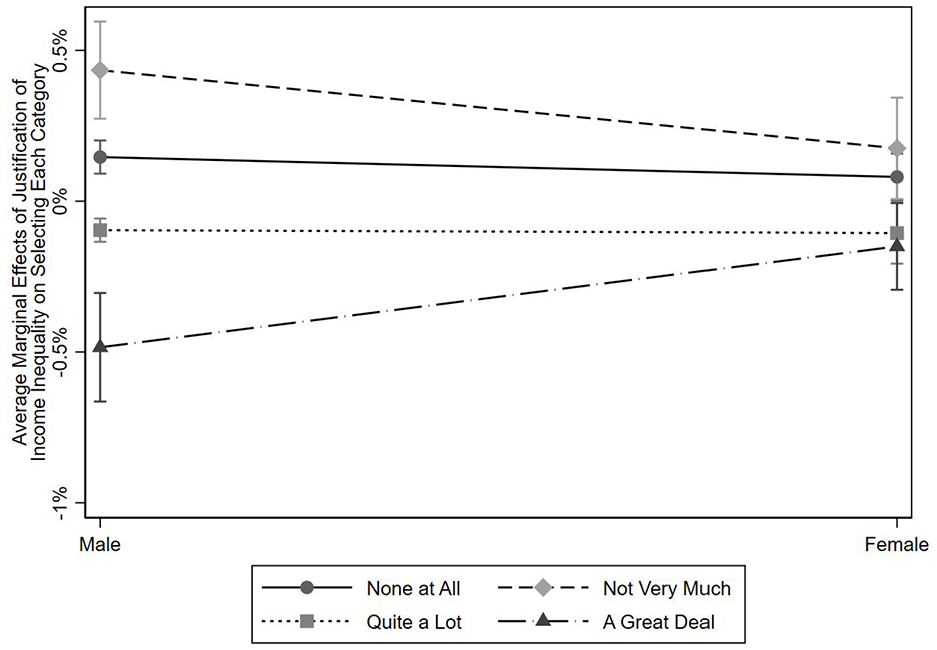
Average marginal effects of justification of income inequality by gender.
When respondents answer “1 (incomes should be made more equal)” to the questionnaire about the justification of income inequality, the probability of selecting the “None at All” category related to the questionnaire about the confidence of women’s movement is 4.947%. However, it increases to 6.485% when respondents believe that larger income differences are needed for incentives. The impacts of the justification of income inequality appear similarly concerning the “Not Very Much” category. In this case, the absolute changes in the percentage of selecting the “Not Very Much” category are bigger than those of selecting the “None at All” category.
Related to the “Quite a Lot” and “A Great Deal” categories, the independent variable reveals a negative relationship. For instance, when the independent variable increases from 1 to 10, the predicted probabilities of selecting the “Quite a Lot” category decrease from 51.343% to 49.564%. Moreover, the predicted probabilities of selecting the “A Great Deal” category considerably drop from 20.806% to 16.469% with the changes in the independent variable. Therefore, from the analysis on the predicted probabilities, it can be inferred that the influence of the independent variable on the dependent variable is not negligible but sizeable.
To test hypothesis 2 about the heterogenous impacts of the justification of income inequality on the confidence in the women’s movements according to the gender of respondents, we replicate the fixed effects ordered logistic regression analysis with the interaction term between the independent variable and the gender of respondents. Table 2 shows the empirical result with the AIC and BIC for model comparison. As presented, the model estimated with the interaction term has better model fits compared to other models estimated in Table 3.
Results from Ordered Logistic Regression Models with the Interaction Term.

Note. The AIC and BIC are 83409.813 and 83621.577 respectively. The number of observations is 61,141.
Results from Ordered Logistic Regression Models.

Note.*p < .05, **p < .01, ***p < .001. The Akaike Information Criterion (AIC) and the Bayesian Information Criterion (BIC) are presented for the comparison of the models’ explanatory powers.
Even after we include the interaction term, the justification of income inequality is still statistically significant at the level of p < .001. Also, a series of control variables that are statistically significant in the fixed effects model in Table 3 consistently have associations with the confidence in women’s movement. Meanwhile, marital and employment status, religiosity, and political ideology are not related to the dependent variable. These results support the robustness of the findings in Table 3.
Concerning the interaction term between the justification of income inequality and the gender of individual respondents, the term is statistically significant at the level of p < .05. This empirical result provides evidence for our expectation that the influence of justification of income inequality on the confidence in the women’s movements is conditioned by the gender of individual respondents. Rather than relying on the estimated coefficients of the interaction term for the interpretation, we further estimate the average marginal effects (AMEs) which allow us to understand the substantive meaning of the interaction term (Hanmer & Ozan Kalkan, 2013).
Figure 2 shows the AMEs of the justification of income inequality according to the gender of respondents. As presented, the impacts of the justification of income inequality are more influential among male respondents compared to their female counterparts. For instance, a unit increase in the justification of income inequality tends to decrease the predicted probability of selecting the “A Great Deal” category by 0.484% concerning male respondents. On the contrary, the AME of the justification of income inequality on selecting the “A Great Deal” category among female respondents diminishes to 0.001%. Furthermore, among male respondents, the AMEs of the justification of income inequality on selecting “Not Very Much” and “None at All” are 0.004% and 0.001% respectively, while the AMEs among female respondents are 0.002% and 0.000%.
The empirical results from Table 2 and Figure 2 demonstrate that male respondents are more likely to be affected by their justification of income inequality, while the association between the justification of income inequality and the confidence in the women’s movements is quite less strong among female respondents as expected. Even though not presented, the empirical results we demonstrated throughout this article are consistently robust in the corresponding multinomial logistic regression models which have been usually used as models for robustness check on the results from ordered logistic regression models (Fullerton, 2009). To be specific, the estimated coefficients from the multinomial logistic regression are slightly different but without changes in terms of the level of p-value and direction of impacts. Moreover, the results from the multinomial logistic regression are substantively meaningful.
Conclusion and Implications
With the cases of 17 Asia-Pacific countries, this article examines the relationship between economic inequality and gender inequality at the individual-level based on the measurements of the justification of income inequality and the confidence in the women’s movements. To sum up the empirical results from this article, this article based on the data from the three waves of WVSs demonstrates that there is a statistically and substantially significant relationship between the justification of income inequality on the confidence in the women’s movements. More interestingly, we also find that male respondents compared to their female counterparts are more susceptible to the changes in the justification of income inequality. Those findings are steady in the compatible multinomial regression models.
With the findings, this article contributes to previous studies in at least two different forms. First, our research advances the literature on the impacts of economic inequality concerning individual perspectives. Given that previous studies on economic inequality have been largely focused on the influence of economic inequality at national level such as regime changes and stability (S. Haggard & Kaufman, 2016; Mitnik et al., 2016), political equality (Guntermann, 2021), and environmental deterioration (Berthe & Elie, 2015), the finding on the relationship between the justification of income inequality and the confidence in the women’s movement broadens our understanding at the individual level. This contribution urges scholars to pay more attention to the linkages among different types of inequalities at the individual level.
Second, this article extends previous literature on the influence of economic inequality by showing that the role of economic inequality in determining people’s attitudes toward gender equality is conditioned by the gender of individuals. Even though it is foreseeable and intuitive that gender might act as an intervening factor concerning the relationship between economic inequality and opinions about gender equality (Falk & Hermle, 2018; Kanter, 1977; Mansbridge, 1999), there has been a lack of thorough empirical study on this topic. This article provides empirical evidence based on the WVS survey data.
However, although this article has the above-mentioned contributions to previous studies and provides empirical evidence of the relationship between the perception of economic inequality and gender inequality, this article is not flawless as all studies do. We would like to note our study’s limitation along with future research direction to encourage further examination of the link between the two types of inequality.
This article only examines 17 Asia-Pacific countries, meaning that the generalizability of the empirical findings from this article is limited to Asia-Pacific countries. Therefore, replicating our study with other country groups such as European countries or African countries will be promising. By conducting such studies, it might be also possible to unveil cultural intervening factors on the association between the two inequalities. In addition, this article relies on the use of an empirical approach. However, given the fact that the relationship between the justification of income inequality and the confidence in the women’s movement is theoretically largely based on psychological perspectives concerning individuals, more qualitative approaches such as interview or case study methods are required to evaluate the mechanisms behind the relationship empirically supported in this article. Therefore, conducting qualitative studies on this topic will be a natural addition to this article.
Footnotes

Ethical Considerations
An ethics statement (including the committee approval number) for animal and human studies. If this is not applicable, please state this instead.
Funding
The author(s) received no financial support for the research, authorship, and/or publication of this article.
Declaration of Conflicting Interests
The author(s) declared no potential conflicts of interest with respect to the research, authorship, and/or publication of this article.
Data Availability Statement
Replication data are available upon request.