




Abstract
The aim of this study is to examine the intercultural sensitivity levels of teacher candidates using CART analysis and to develop a predictive model using machine learning algorithms. Additionally, this study provides a framework for understanding the relationship between internet usage and intercultural sensitivity. The participants comprised 416 teacher candidates enrolled in the education faculty of a state university in Southeast Anatolia, Turkey, during the fall semester of the 2022–2023 academic year. The study was conducted on a voluntary basis. A relational screening model was employed to assess the intercultural sensitivity levels. Subsequently, a two-step cluster analysis integrated with CART classification was performed, identifying 9 nodes that explain the intercultural sensitivity levels of participants. Among the teacher candidates, 43.56% displayed a “high” level of intercultural sensitivity, 40.26% showed a “medium” level, and 16.17% exhibited a “low” level. The variable “class” emerged as the primary determinant for the cluster of students reporting daily internet usage times of “0–1 hr” or “1–3 hr.” “Gender” was identified as the most influential variable in explaining the cluster of students whose class was “2,” and daily internet usage time fell within the range of “0–1 hr” or “1–3 hr.” To predict intercultural sensitivity, five machine learning algorithms were utilized, with the Naive Bayes algorithm achieving the highest accuracy at 69.0%. Based on these findings, the study recommends implementing effective teacher training programs aligned with the observed data patterns.
Introduction
The continuous development of digital technologies and their widespread reach in society have enabled individuals from different cultures to communicate more easily and have rapidly increased interactions among people living in various parts of the world. This growing intercultural interaction has led individuals to encounter cultural differences more frequently in both professional and social life, making societies increasingly multicultural. In such an environment, it has become an unavoidable necessity for individuals to understand and accept cultural differences and to develop intercultural communication skills. Especially with the process of globalization, intercultural communication competence in workplaces, educational settings, and social environments where different identities co-exist is considered important for creating a harmonious interaction environment.
Intercultural communication refers to the communication that takes place among members of different cultures or within different subcultures within a culture. Interaction, message sending and receiving, and efforts to create meaning and share common meanings between individuals from different cultures are considered within the scope of intercultural communication, occurring as a result of the interaction of people from different cultures (Kartari, 2001). Intercultural sensitivity (IS) is the key to the development of a competent intercultural communication. A greater intercultural communication competence is only possible with a greater IS (Hammer et al., 2003).
Intercultural sensitivity, which represents the affective dimension of intercultural communication competence, explains the individual’s affective characteristics such as knowing, recognizing, and liking cultural differences (Fritz et al., 2002). It involves awareness of cultural differences, the ability to understand them, and the capacity to interact effectively with people from different cultures (Tomul et al., 2024). Another common definition describes intercultural competence as “the ability and attitudes of a person to interact successfully and appropriately with individuals and groups from different cultures, based on their own intercultural knowledge” (Deardorff, 2006). IS refers to the emotional capacity of an individual to recognize, learn, and respect cultural differences in intercultural communication (G. M. Chen & Starosta, 2000). It also indicates the degree of psychological power that an individual has to cope with cultural differences (Medina–López–Portillo, 2004). Hammer et al. (2003) define the concept of IS as the ability to distinguish and experience cultural differences, while Bhawuk and Brislin (1992) emphasize the importance of being sensitive to these differences and the perspectives of people from different cultures. Hart and Burks (1972) consider this concept as a schema that includes cognitive, emotional, and reactive skills such as tolerating uncertainty, tolerance, flexibility, and interactional awareness in an individual’s daily life.
The transformation of societies into multicultural structures today highlights the importance of individuals with IS in all areas of life. Turkey stands out as a crossroads between different cultures because of its historical background and geographical location. The country encompasses a multitude of different cultural identities, including Turks, Kurds, Arabs, Laz, Circassians, Armenians, Greeks, and other ethnic and religious groups. Particularly in recent years, the influx of millions of refugees into Turkey due to the Syrian civil war has further increased cultural diversity within the country. According to data from the Directorate General of Migration Management (2024), Turkey has approximately 4.4 million foreigners with legal residency rights, including over 3.1 million Syrians under temporary protection, 220,000 foreigners under international protection, and 1.1 million foreigners with residence permits. As a natural consequence of the rise in the number of migrants and asylum seekers in Turkey, there has also been a significant increase in the number of foreign students. These students, who come from various cultural, linguistic, religious, and educational backgrounds, require an educational approach that emphasizes the importance of cultural diversity (Göktuna Yaylacı, 2019). Turkey’s multilingual, multi-religious, and multicultural structure necessitates that teachers and teacher candidates possess the skills to recognize and effectively manage this diversity. In this context, it is crucial for educational institutions to be organized in a way that accommodates multiculturalism and for teacher candidates to be trained to embrace this diversity. IS in educational services enhances effective communication and service quality, leading to increased satisfaction. Therefore, it is expected that teacher candidates will have a high level of IS. Individuals with low levels of IS generally have limited knowledge about other cultures, struggle to adjust their behavior according to those around them, find it challenging to build relationships with individuals from different cultural backgrounds, and lack the maturity to handle differences, which can often lead to conflicts. (Croucher, 2020; Yanto et al., 2022). Furthermore, individuals with strong IS are observed to be better equipped to handle intercultural situations (Peng, 2006).
Various studies have explored IS among teachers and prospective teachers, highlighting its significance in diverse educational settings, relationship with other psychological factors, and ethnocentric tendencies among educators. These studies also examine the impact of culturally focused courses and emphasize the importance of culturally responsive education in enhancing IS. Fretheim (2007) analyzed IS of educators within an international school setting and found that despite mission statements promoting global citizenship, many educators held ethnocentric worldviews. Spinthourakis et al. (2009) assessed the intercultural sensitivity levels (ISLs) of Greek university students, noting that while ISLs were generally high, students were insufficiently prepared on intercultural education issues through their education. Aydemir and Kalin (2021) discovered a significant positive relationship between IS and emotional intelligence among social studies teacher candidates, emphasizing the importance of emotional and interpersonal skills in developing intercultural competence. Yuen and Grossman (2009) demonstrated that even in multicultural regions such as Hong Kong, Shanghai, and Singapore, teacher candidates exhibited ethnocentric tendencies, highlighting the need for effective intercultural education programs. Aksin (2023) examined the positive relationship between traits like agreeableness, extraversion, emotional stability, and openness to new experiences with levels of IS. Akcaoğlu and Kayiş (2021) reported that IS fully mediated the relationship between multicultural attitudes of teachers and their sense of efficacy. Akcin (2023) conducted a qualitative study and identified that while Turkish language teachers displayed appropriate attitudes toward IS, they exhibited deficiencies in certain dimensions. Lash et al. (2022) emphasized that culturally-oriented courses and field experiences in teacher education programs significantly enhanced IS of teacher candidates. Estepp et al. (2023) demonstrated that IS significantly explained teachers’ culturally responsive classroom management self-efficacy.
In studies on IS, several research gaps are evident. The number of studies exploring IS remains quite limited, as recent research clearly indicates, and no studies in the literature have been identified that examine the variables predicting IS of prospective teachers and their order of importance. Therefore, there is a need to investigate the ISLs among prospective teachers who will serve as future educators and to determine the variables that predict these levels. In addition, understanding the importance of demographic variables on IS can help educators and policymakers in shaping their initiatives. Another significant issue is that, despite the widespread use of the internet in the digital age, internet usage has not been considered as a variable in these studies, and no existing research has included internet usage as a variable. In a multicultural context, Turkey’s mosaic structure, which encompasses various languages, religions, and cultures, along with the presence of refugee students, highlights the necessity of this study. For these reasons, examining the ISLs of prospective teachers and identifying the factors that predict these levels have emerged as fundamental needs in our research. Another significant aspect of this study is the use of machine learning algorithms to predict the ISLs of prospective teachers. The findings obtained through this approach will contribute to effective and efficient teacher education planning. This study can serve as a model for future research, laying the groundwork for similar studies, and highlighting the role of machine learning techniques in education.
Literature Review
Intercultural Sensitivity
G. M. Chen and Starosta (1996) define IS in four aspects: self-concept, open-mindedness, nonjudgmental attitudes, and social relaxation. Self-concept has been defined as an individual’s way of perceiving himself. Self-confidence is related to self-concept, and individuals with high self-confidence develop a more positive view of those outside their group or culture than those with low self-confidence. Open-mindedness refers to an individual’s willingness to express himself openly and to accept the views of other individuals. Nonjudgmental attitudes imply that prejudices do not prevent individuals from listening sincerely during intercultural communication. Social relaxation means to have minimum level of social anxiety during intercultural communication.
Cross-cultural sensitivity does not occur automatically after exposure to a culture. To develop IS, individuals must have a cognitive orientation toward counterculture (M. J. Bennett, 2009). In order to increase the ISL of an individual, he/she must discover and accept their own intercultural values and prejudices and to be aware of other cultures. Therefore, to develop IS, individuals need to be open-minded and respectful of intercultural differences, as well as to understand the dynamics of another culture (Ruddock & Turner, 2007). According to Intercultural Sensitivity Development Model proposed by J. M. Bennett and Bennett (2004), IS is addressed in two stages as ethnocentric and ethnorelative. In general, the ethnocentric stages can be viewed as ways of avoiding cultural difference, either by denying its existence, by raising defenses against it, or by minimizing its importance. The ethnorelative stages are ways of seeking cultural difference, either by accepting its importance, by adapting a perspective to consider it, or by integrating the whole concept into a definition of identity. The ethnocentric phases can generally be seen as attempts to avoid cultural differences by downplaying, denying, or raising defenses against them. The ethnorelative stages are ways to look for cultural difference, whether by acknowledging its significance, changing one’s viewpoint to account for it, or incorporating the concept at large into one’s definition of identity (J. M. Bennett & Bennett, 2004). The intercultural sensitivity development model is depicted in Figure 1.

The intercultural sensitivity development model (J. M. Bennett & Bennett, 2004).
In the intercultural sensitivity development model, rejection, defense, and reduction constitute the steps of ethnocentrism. Ethnocentrism can be expressed as placing one’s own culture at the center of reality (Hammer et al., 2003). An ethnocentric individual sees the culture in which he/she lives as superior to other cultures. In addition, at the stage of evaluating other cultures, he/she puts its own culture at the center and compares it with other cultures. Therefore, he/she thinks that the cultures closest to his own culture or the cultures that are most similar to his own culture are important, while the other cultures are less important. Ethnocentrism creates obstacles for people and societies in terms of both intercultural communication and IS. Because ethnocentric people think they have the right to judge and interpret other cultures (Neuliep & McCroskey, 1997). Ethnorelativism, which consists of the steps of acceptance, adaptation, and integration, is the experience of the individual’s own culture in the context of other cultures (Hammer et al., 2003). Ethnocentrism judges other cultures in the context of an individual’s own worldview. In contrast, ethnorelativism is the ability to evaluate other cultures in their own context. Individuals begin to comprehend and practice that other cultures also exist and that not only their own ideas but also the ideas of people who have adopted a different culture are valuable. This process constitutes the initiation phase of the IS process. With this model, Bennett provides a framework for the change of an individual’s ethnocentric worldview toward intercultural awareness (Galante, 2015).
Individuals’ progression through the stages of developing IS, transitioning from an ethnocentric perspective to an ethnorelative one, is influenced by various factors. Specifically, age, gender, educational level, and cultural experiences of individuals have noticeable effects on their ISLs (Choi, 2023).
Internet Usage and Intercultural Sensitivity
Advancements in media and communication technologies have not only increased communication possibilities among individuals and provided new opportunities for socialization but have also significantly enhanced communication opportunities between societies, civilizations, and cultures, making intercultural communication an inevitable necessity (Karaca, 2015). Today, the internet has become a platform that brings individuals from different cultures together by eliminating geographical boundaries. Through online communication tools, social media platforms, and other digital means, individuals can instantly interact with diverse cultures worldwide. This situation allows for the diversification and expansion of intercultural relationships, while also having significant effects on sensitivity toward different cultures.
The impact of internet usage on IS needs to be approached from various perspectives (Coffey et al., 2013; Gholami Pasand & Hassaskhah, 2023). First, access to digital resources provides individuals with the opportunity to explore and understand different cultures, enhancing the continuity of cultural interaction (Ölçekçi, 2020). The diversification of digital media, coupled with the advantage of instant access to global news, allows individuals to transcend their cultural boundaries and understand different lifestyles, beliefs, and values worldwide. This has the potential to increase IS (Coffey et al., 2013). McEwan and Sobre-Denton (2011) also emphasize that online communities and social networks offer unique opportunities for intercultural communication.
Digital communication, including social media, messaging, and online games foster a sense of togetherness, maintains relationships, and contributes to social connectedness (Ellison et al., 2014; Grieve et al., 2013; Pettegrew & Day, 2015; Ryan et al., 2017; Tseng et al., 2015). Conversations occurring through instant messaging, forums, and social media platforms can contribute to individuals understanding different perspectives and engage in intercultural interactions (Xi & Habil, 2023). However, the anonymity of the virtual environment can also provide a breeding ground for biased or discriminatory behaviors (Morales-Martinez et al., 2020). This situation can weaken intercultural dialogs and deepen prejudices. In particular, information shared on social media platforms and various online channels can influence biases (Relia et al., 2019). The risks associated with selectively consuming information and focusing on a specific perspective can strengthen cultural biases. When exposed to various digital contents, individuals may become more attached to their cultural values and norms, making it challenging to understand other cultures.
The temporal and spatial elimination of boundaries through digital communication technologies has intensified certain cultural boundaries (Bauman, 2013). Discrimination and hate speech, which are prominent on social media, are significant challenges in intercultural communication (Andrade & Pischetola, 2016; Chetty & Alathur, 2018). Individuals, groups, and organizations on the internet can encounter or be direct sources of numerous biases, stereotyping, discrimination, and hate speech (Aksoy, 2020). Moreover, those who spend excessive time in digital environments may increasingly distance themselves from face-to-face communication and face loneliness and isolation from society. Social withdrawal can result in individuals being unable to integrate with society, leading to a gradual weakening of social relationships (Hark Söylemez & Oral, 2018)
In conclusion, the impact of internet usage on IS can vary depending on how individuals are exposed to information, how they evaluate such information, and how they interact with others in the digital environment.
The Purpose of the Study and Research Questions
The aim of the study is to examine the ISLs of teacher candidates through CART analysis and to develop a predictive model using machine learning algorithms. Accordingly, this research seeks answers to the following subproblems:
(1) How are the results of two-stage clustering analysis regarding the average scores on the intercultural sensitivity scale for teacher candidates evaluated?
(2) What is the structure of the decision tree algorithm obtained through CART analysis for students’ intercultural sensitivity levels?
(3) What are the rule sets obtained from CART analysis regarding students’ intercultural sensitivity levels, and how can they be interpreted?
(4) How is the correlation between the variables used in the study?
(5) What are the results of predicting the intercultural sensitivity levels of teacher candidates using machine learning methods?
Method
Pattern of the Research
A relational screening model was used in this study. Relational studies are used to detect relationships between two or more variables and to determine the effects of these relationships on cause and effect (Fraenkel et al., 2012). The relational screening model is a powerful approach in terms of getting answers to the variables and examining the variables and indicators of the variables with various questions at the same time (Neuman, 2011).
Participants
The participants of this study are 416 prospective teachers who are studying at the education faculty of a state university in Southeast Anatolia, Turkey in the fall semester of the 2022–2023 academic year. Participants voluntarily participated in the study. General information about the participants is presented in Table 1.
General Information About the Participants of the Study.
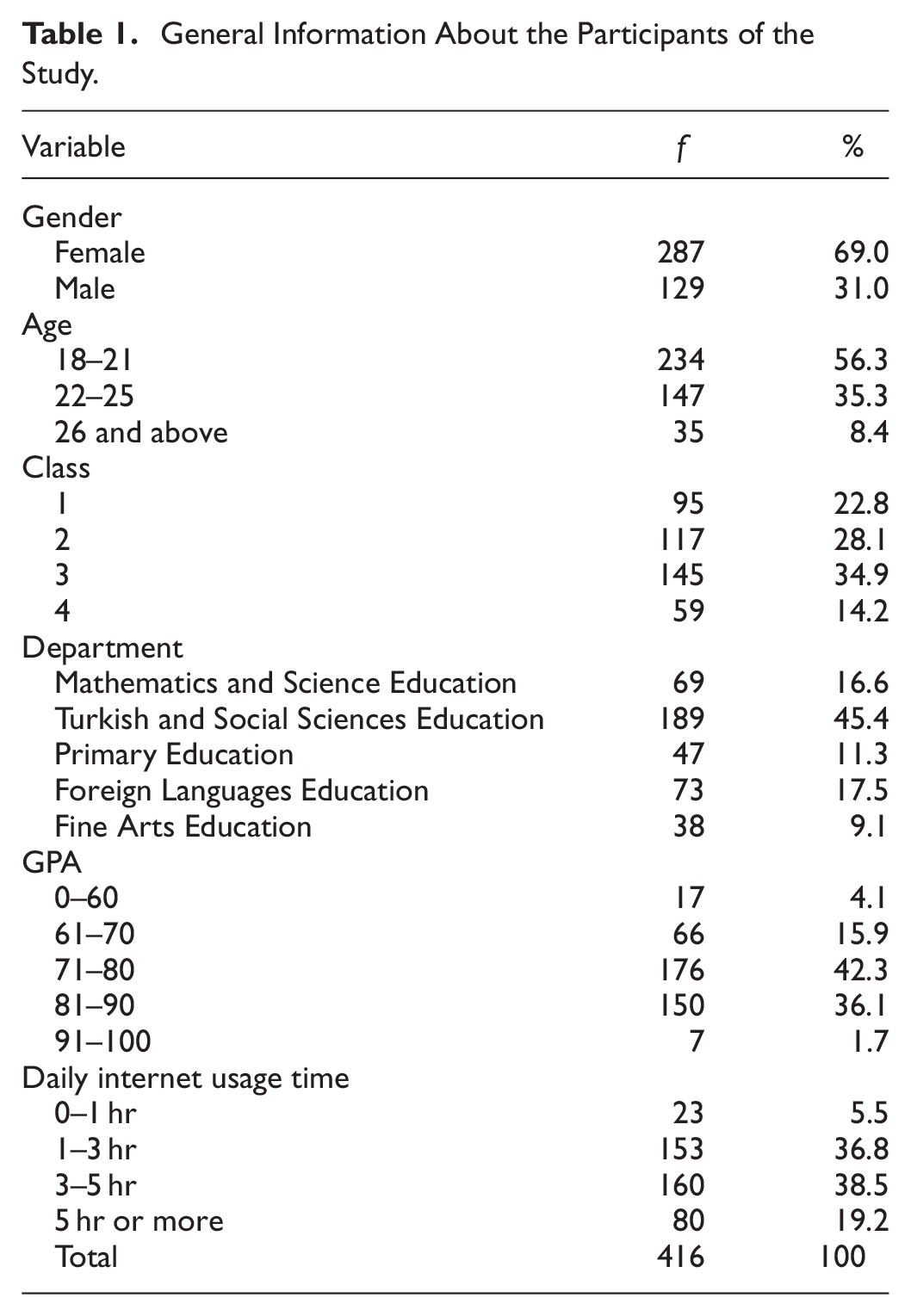
Table 1 shows that a total of 416 prospective teachers participated in the study, with 287 (69%) being female and 129 (31%) being male. Of the prospective teachers, 234 (56.3%) are between the ages of 18 and 21, 147 (35.3%) are between the ages of 22 and 25, and 35 (8.4%) are aged 26 and over. Of the prospective teachers, 95 (22.8%) are first-grade students, 117 (28.1%) are second-grade students, 145 (34.9%) are third-grade students, and 59 (14.2%) are fourth-grade students. Of the prospective teachers, 69 (16.6%) were in the Mathematics and Science Education department, 189 (45.4%) were in the Turkish and Social Sciences Education department, 47 (11.3%) were in the Primary Education department, 73 (17.5%) were in the Foreign Languages Education department, and 38 (9.1%) were in the Fine Arts Education department. Of the prospective teachers, 17 (4.1%) had a GPA of 0 to 60, 66 (15.9%) had a GPA of 61 to 70, 176 (42.3%) had a GPA of 71 to 80, 150 (36.1%) had a GPA of 81 to 90, and 7 (1.7%) had a GPA of 91 to 100. Of the prospective teachers, 23 (5.5%) had 0 to 1 hr of daily internet usage, 153 (36.8%) had 1 to 3 hr, 160 (38.5%) had 3 to 5 hr, and 80 (19.2%) had 5 hr or more of daily internet usage.
Data Collection Tool
A 24-item, 5-point Likert-type Intercultural Sensitivity Scale, developed by G. M. Chen and Starosta (2000) and adapted into Turkish by Üstün (2011), is used to measure ISLs of prospective teachers. The statements of the scale were scored as follows: 1: Strongly Disagree, 2: Disagree, 3: Undecided, 4: Agree and 5: Strongly Agree. Theoretically, each item scores between 1 and 5.
The measurement tool was applied to 240 prospective teachers to determine the validity of the Intercultural Sensitivity Scale. Consisting of 5 dimensions in its original form, the scale was analyzed as one-dimensional in its Turkish version. The 19th item was removed from the scale because its factor load value was low. The factor loading values of the remaining 23 items were accepted during item language equivalence, validity, and reliability. The alpha coefficient as a result of the adaptation study of the scale was found as .90. This coefficient indicates that the internal consistency of the scale is high. The scale was applied to the prospective teachers who participated in the research via Google Forms.
Analysis of Data
Initially, a two-stage clustering analysis was carried out on the data obtained from the prospective teachers. Afterward, a CART (Classification and Regression Tree) analysis was performed onto the resultant data. These practices were followed to divide the dependent variable into homogeneous subgroups and to identify the variables that predict the dependent variable within each subgroup, as well as the order of importance of these variables.
The two-stage clustering method is a nonhierarchical clustering technique. The goal of two-stage clustering analysis is to separate data collection into uniform subgroups (Kayri, 2007). The important features of this analysis are that it can process categorical and continuous variables, determine the most appropriate number of clusters automatically or optionally, and remove observations that do not comply with the created clusters from the dataset when desired (Ceylan et al., 2017). The Bayesian Information Criterion (BIC) is used to determine the ideal number of subsets for the universe. Thus, the dependent variable was defined as a three-category variable consisting of low, moderate, and high ISLs.
Decision trees are tree-based algorithms used in classification and regression tasks. In classification, the values of the features in the decision trees are used. Decision trees consist of three parts: nodes, branches, and leaves. The decision tree contains branches that are developed according to the yes-no answers applied to the continuous experiment units starting from the root node. The questions asked at each node are called separators, and this process is referred to as separation (Breiman et al., 2017; Han et al., 2012).
CART is a binary decision tree created by dividing a variable into two consecutive nodes, repeating the process until the homogeneity criterion is reached, and starting from the root node, which contains two learning steps. This algorithm can use continuous and categorical data (Breiman et al., 2017). The CART structure specifically consists of a root node containing the data, non-homogeneous branch nodes, and homogeneous leaf nodes. In the CART structure, each node represents a feature of the classified sample, facilitating interpretation (Pandya & Pandya, 2015). CART analysis offers several advantages. First, because it is not parametric, it does not require the assumptions required for parametric tests. Additionally, it saves researchers time by eliminating the need to determine whether the variables are normally distributed and, if not, to transform them (Lewis, 2000).
Machine Learning Algorithms Used in Classification
Machine learning involves the systematic exploration of algorithms and statistical models employed by computer systems to accomplish specific tasks without the need for explicit programing (Batta, 2020). Machine learning algorithms form the core of machine learning, a subset of artificial intelligence (El Bouchefry & de Souza, 2020). These algorithms can be classified into various types according to their learning paradigms, such as supervised, unsupervised, and reinforcement learning. In supervised learning, models are trained on labeled datasets to learn the mapping between inputs and outputs (Sen et al., 2020). Unsupervised learning explores unlabeled data to discover inherent patterns or structures (Y. Chen et al., 2022). Reinforcement learning relies on interaction with an environment, where the model learns by receiving feedback in the form of rewards or penalties (Ladosz et al., 2022). Each paradigm serves different purposes, with supervised learning addressing classification and regression, unsupervised learning exploring data relationships, and reinforcement learning focusing on sequential decision-making.
This study employs various machine learning algorithms to classify IS data with the objective of discerning distinct patterns within the dataset. Classification, in this context, seeks to predict and assign predefined labels to instances, allowing for the identification of factors influencing IS. Algorithms used include Naive Bayes, Decision Trees, Logistic Regression, Random Forest, and Artificial Neural Networks. After preprocessing, the dataset is divided into 80% training data and 20% testing data, with the algorithms being trained and tested accordingly. The results obtained from the supervised learning process contribute to the findings and conclusions of this study.
Naive Bayes, Decision Trees, Logistic Regression, Random Forest, and Artificial Neural Networks machine learning algorithms were specifically selected for their unique characteristics and capabilities. Naive Bayes is a probabilistic classification algorithm based on Bayes’ theorem, assuming independence between features. It calculates the probability of each class given a set of features and predicts the class with the highest probability (Wickramasinghe & Kalutarage, 2021). A Decision Tree is a supervised machine learning algorithm which operates by recursively partitioning the data into subsets based on the most significant attributes or features (D. Kumar & Priyanka, 2020). The structure of a Decision Tree resembles an inverted tree, where each internal node represents a decision based on a specific feature, each branch represents the outcome of that decision, and each leaf node represents the final decision or predicted outcome. It visually represents decisions in an understandable manner. Logistic Regression is a machine learning algorithm for binary classification that models the probability of an input belonging to one of two classes (Schober & Vetter, 2021). Despite its name, it is mainly used for classification, not regression. Random Forest is an ensemble learning algorithm for classification and regression that creates multiple decision trees with bootstrapped sampling and feature randomization (Hatwell et al., 2020). Combining predictions from individual trees mitigates overfitting, enhances robustness, and excels at capturing complex patterns in data. An Artificial Neural Network is composed of perceptrons connected in a multilayer fashion, including an input layer, one or more hidden layers, and an output layer (M. Kumar & Yadav, 2011). Neurons in each layer are connected with weighted connections, and nonlinear activation functions are applied to introduce complexity and allow the network to learn difficult patterns.
Metrics Used in the Study
The primary performance metric used in this study is accuracy. For a more comprehensive interpretation, precision, recall, and F1-score were also incorporated. These metrics are calculated based on TP (True Positive), which represents the number of correctly predicted positive classes; TN (True Negative), represents the number of correctly predicted negative classes; FP (False Positive), indicates the number of incorrectly predicted positive classes; and FN (False Negative), indicates the number of incorrectly predicted negative classes.
Software Used in the Study
The SPSS Modeler software was used in the decision tree modeling phase of this study. Python language (v3.10) was employed to implement machine learning algorithms. The machine learning concepts were realized using the Scikit-learn library (v 1.2.2) in Python. Correlation matrices were plotted using the Seaborn library (v 0.12.2).
Findings
What Are the Results of the Two-Stage Clustering Analysis of the Prospective Teachers’ Average Scores on the Intercultural Sensitivity Scale?
The results of the clustering quality analysis of the two-stage clustering of the mean scores obtained from the IS scale is presented in Figure 2 and Table 2.

Cluster quality.
Two-Step Clustering Analysis Results of Teacher Candidates’ Average Scores on the IS Scale.

Cluster quality results are shown in Figure 2. The silhouette measure was used to evaluate cluster quality. The silhouette value is a criterion that uses the similarity (fitness) of an object to its own cluster relative to other clusters (separation). The criteria for poor, fair and, good cluster interpretations are based on the work of Kaufman and Rousseeuw (1990). These interpretations translate as good-strong evidence, moderate-weak evidence, and weak-no significant evidence regarding cluster structure. The clustering results of this study show that the cluster structures have strong evidence and fall into the “good” category. A cluster that is evaluated as “good” indicates that data with similar characteristics are grouped together, and the data within this group are closer to each other than to the data in other groups. In this study, achieving “good” cluster quality means that the groups can be meaningfully differentiated and that the ISLs of prospective teachers can be reliably classified based on the identified variables.
Table 2 shows that the mean score of 68 prospective teachers in the first cluster (low level) is 2.96, the mean score of 171 prospective teachers in the second cluster (medium level) is 3.71, and the mean score of 177 prospective teachers in the third cluster (high level) is 4.26, representing 16.3%, 41.1%, and 42.5% of the total, respectively. Thus, a three-category dependent variable was established, and the results indicate that 83.6% of the prospective teachers possess medium to high levels of ISLs.
How is the Decision Tree Obtained by the CART Analysis Regarding the Intercultural Sensitivity Levels of the Prospective Teachers?
The decision tree for the ISLs of the prospective teachers is presented in Figure 3.

Decision tree obtained by cart analysis of students’ ISLs.
Figure 3 shows that 9 nodes explain the ISLs of students. The ISLs of the students were classified as 43.56% “high,” 40.26% “medium,” and 16.17% “low.” “Daily internet usage” was identified as the variable that best explains the ISLs of prospective teachers. Among those who reported their daily internet usage time as “0–1 hr” or “1–2 hr,” 52.24% had a “high” ISL, 29.10% had a “medium” ISL, and 18.66% had a “low” ISL. In contrast, for prospective teachers who indicated their daily internet usage time as “3–5 hr” or “5 hr and above,” 49.11% had a “medium” ISL, 36.69% had a “high” ISL, and 14.20% had a “low” ISL.
“Class” was identified as the variable that best explains the cluster formed by students who reported their daily internet usage time as “0–1 hr” or “1–3 hr.” Among these students, 56.30% of those in classes “1,” “2,” or “3” had a “high” ISL. In contrast, the ISLs of 53.33% of the students in class “4” who reported their daily internet usage time as “0–1 hr” or “1–3 hr” were found to be “medium.”
“Class” was identified as the variable that best explains the cluster formed by students whose daily internet usage time is “0–1 hr” or “1–3 hr” and who are in classes “1,” “2,” or “3.” Within this cluster, 48.39% of the students in class “2” have “high” ISLs, while 59.09% of the students in classes “1” or “3” were found to have “high” ISLs.
“Gender” was identified as the variable that best explains the cluster formed by students in class “2” who have a daily internet usage time of “0–1 hr” or “1–3 hr.” Among the female students in this cluster, 62.50% reported “high” ISLs, while 25.00% were classified as “low” and 12.50% as “medium.” In contrast, among the male students in this cluster, 71.43% were found to have “low” ISLs, and 28.57% were found to have “medium” ISLs.
What Are the Rule Sets Obtained as a Result of the CART Analysis Regarding the Intercultural Sensitivity Levels of the Students?
The rule sets obtained as a result of the CART analysis of the ISLs of the students are presented in Figure 4.

Rule sets obtained from the CART analysis.
When Figure 4 is examined, it is seen that the important rule sets obtained as a result of the CART analysis applied to the ISLs of the students are as follows.
• ISLs of students whose daily internet usage time is “0–1 hr” or “1–3 hr”→ high
• ISLs of students whose daily internet usage time is “0–1 hr” or “1–3 hr” and classes are “1,” “2” or “3”→ high
• ISLs of students whose daily internet usage time is “0–1 hr” or “1–3 hr, ” class is “2” and gender is “female”→ high
• ISLs of students whose daily internet usage time is “0–1 hr” or “1–3 hr” and class is “4”→ medium
• ISLs of students whose daily internet usage time is “3–5 hr” or “5 hr and more”→ medium
• ISLs of students whose daily internet usage time is “0–1 hr” or “1–3 hr,” class is “2” and gender is “male”→ low
How is the Correlation Between the Variables Used in the Study?
A correlation matrix, which includes correlation coefficients measuring relationships between different variables, was created to examine intervariable relationships. The correlation matrix is represented as a heatmap in Figure 5. Spearman correlation method was preferred for calculating the matrix. The correlation coefficient found to be .42 (p < .05) between age and class indicates a weak positive relationship between these two variables. Similarly, a correlation coefficient of .29 (p < .05) between class and GPA, asserts a weak positive relationship between these two variables. The correlation coefficient of .10 (p < .05) between gender and age suggests a very weak positive relationship between these two variables. Conversely, the correlation coefficient of −.11 (p < .05) between gender and IS indicates a very weak negative relationship. The correlation coefficient between age and daily internet usage time is −.11 (p < .05), indicating a very weak negative relationship between age and daily internet usage time.

The heatmap representation of the correlation matrix.
Results of Predicting Intercultural Sensitivity Levels of Teacher Candidates Using Machine Learning Methods
Within the scope of the study, various machine learning methods were employed to predict ISLs of students. In this context, algorithms such as Naive Bayes, Decision Tree, Logistic Regression, Random Forest, and Artificial Neural Network were utilized. The input factors included gender, age, class, department, GPA, and daily internet usage time, with the target being the total score that reflects ISLs of students.
The findings regarding the prediction of ISLs using machine learning methods are presented in Table 3 and Figure 6.
Algorithms and Performance Metrics.


Confusion matrices for different classifiers.
In this study, five classification algorithms were employed, and accuracy was selected as the primary metric for performance evaluation. The algorithms used and their classification performances in terms of precision, recall, F1 score, and accuracy are presented in Table 3. In this context, Naive Bayes exhibited the highest accuracy among the algorithms, achieving a score of 69.0%. Following this, Decision Tree and Logistic Regression achieved similar accuracy scores of 66.7%, while Random Forest and Artificial Neural Network displayed comparable accuracy scores of 64.3%. A similar ranking is observed when examining the F1 scores, with Naive Bayes leading at 68.5%, followed by Decision Tree and Logistic Regression, which recorded similar performances of 66.4% and 64.2%, respectively. Random Forest and Artificial Neural Network also demonstrated comparable F1 scores, with values of 62.2% and 63.2%, respectively.
A confusion matrix was used to assess the performance of the proposed classification model, illustrating how accurately the model predicted the true class labels. In evaluating the performance of various classification models—Naive Bayes, Decision Tree, Logistic Regression, Random Forest, and Artificial Neural Network—distinct patterns emerge from their confusion matrices. Both Naive Bayes and Decision Tree algorithms display similar outcomes, with a slight advantage in True Positives and lower True Negatives. Logistic Regression, while exhibiting the highest True Positives, also recorded the highest False Positives, indicating an optimistic bias in its predictions. Random Forest and Artificial Neural Network demonstrate a balanced distribution between True Positives and True Negatives, maintaining a relatively even distribution of False Positives and False Negatives. These straightforward comparisons highlight the importance of selecting a model that aligns with the specific requirements of the classification task, considering the inherent trade-offs between precision and recall.
Discussion, Conclusions, and Recommendations
Today, IS is accepted as a necessary factor for effective and harmonious human relations (M. J. Bennett, 2004). To successfully communicate with different cultures, people should not be prejudiced against people from these cultures, be sensitive enough to their cultures, and be willing to pay attention to their own behavior as a sign of respect for people from other cultures (Bhawuk & Brislin, 1992). There is a need for high levels of IS for prospective teachers who will create effective educational environments in the future and bring IS to their students. For this reason, this research was carried out to determine the variables that predict the ISLs of prospective teachers who are the teachers of the future, and the order of importance of these variables.
The ISL of 43.56% of the prospective teachers was high, 40.26% was medium, and 16.17% was low. The results show that 83.82% of the prospective teachers have IS at medium and higher levels. This finding indicates that prospective teachers have developed sensitivity to intercultural interactions and have the potential to communicate effectively with individuals from different cultures. The high IS of prospective teachers can be interpreted as an indication that they will tolerate cultural differences in their professional lives. The high IS of individuals enables their understanding, approval and acceptance of differences between individuals. People who have developed IS have developed the ability to understand and respect cultural values in different structures. In addition, these individuals have high motivation, self -respect, self-control, open-mindedness, and empathy (G. M. Chen & Starosta, 2000; Üstün, 2011). A high level of IS in education can enhance capacities of teachers to manage diversity within the classroom and develop teaching approaches that encompass different cultures. Therefore, it is desirable that the ISLs of prospective teachers who will be in the lead role of the teaching process are high. According to Gay (2010), teachers’ sensitivity to cultural values of students also contributes to students becoming more active in learning environments. Therefore, it is important for teachers to be sensitive to cultural values. Educational programs should be structured to further develop these sensitivity levels, aiming to enable candidates to communicate more effectively with students from diverse cultural backgrounds. In this way, teachers can establish deeper empathy with their students and create a more inclusive learning environment in intercultural interactions.
Similar to our study, Ruiz-Bernardo et al. (2014) concluded that young people have moderate to high levels of IS. In the study conducted by Akın (2016), it was revealed that the ISLs of prospective teachers are at a moderate level. Bilgiç and Şahin (2019) stated in their study that the ISLs of nursing students are above average, while Kasa Ayten and Köse (2020) stated that the level of IS of classroom teachers is high. A study conducted with Greek prospective teachers found that prospective teachers had a high level of IS (Spinthourakis et al., 2009). In the study conducted by Tabatadze and Gorgadze (2018), the IS of students in teacher education programs in higher education institutes in Georgia was evaluated, and it was found that most of the students were in the ethnocentric phase.
“Daily internet usage” was identified as the variable that best explains ISLs of prospective teachers. It was found that 81.34% of the prospective teachers who reported their daily internet usage time as “0–1 hr” or “1–2 hr” had “medium” or “high” ISLs, while 85.79% of those who stated their daily internet usage time as “3–5 hr” or “5 hr and above” also exhibited “medium” or “high” ISLs. These results indicate that the daily internet usage duration of teacher candidates has an impact on their ISLs. Internet usage has the potential to facilitate greater interaction with different cultures and enhance cultural awareness. The fact that candidates who use the internet for a short time demonstrate high levels of IS suggests that they may tend to use the internet in a more focused and targeted manner. The results may be related to the increasing social mobility and intercultural diversity of individuals using the internet. In modern society, individuals are surrounded by different communication opportunities. Developments in technology and communication remove cultural boundaries and bring people of different cultures together. This situation, on the one hand, provides individuals with the opportunity to get to know different cultures; on the other hand, it provides an increase in cultural exchanges between individuals.
Postman (2005) noted that technology has a structure that changes societies and cultures. It is also emphasized that technology affects cultures in different ways. It is obvious that technology deeply affects people’s thoughts, behaviors, and ideas in an ideological and biased way. Coffey et al. (2013) revealed that participants mostly paid attention to the intercultural interactions they established in virtual environments and tended to understand the people in front of them. Park (2013) stated that the sensitivity levels of the participants who had contact with other cultures because of the mass media were more developed than the others. In the study conducted by Wang (2012) on Facebook, a social media platform, it was concluded that Facebook allows cooperation among students and provides intercultural interaction. Sawyer and Chen (2012), who examined the impact of social media on intercultural adaptation, argued that individuals overcome intercultural adjustment issues through relationships established via social media.
In Mas’udah’s (2017) study, international students expressed that social media assisted them in establishing closeness with other foreign students, and they hoped to maintain friendships formed through social media in the future. In the study by Tuncel (2019) on students, individual and focus group interviews were conducted with people from different cultures. It has been stated that making use of the internet and social media allows students of both cultures to come together and exchange information. Similarly, studies by Bekiroğlu and Balcı (2014) and Baksi et al. (2019) have indicated that communicating with people from different countries through social media enhances ISLs.
“Class” was identified as the variable that best explains the cluster formed by the prospective teachers who reported their daily internet usage time as “0–1 hr” or “1–3 hr.” “High” IS was observed in 81.30% of the prospective teachers in this group, while the ISLs of 53.33% of the students who stated their daily internet usage time as “0–1 hr” or “1–3 hr” and whose class was “4” were found to be “medium.” This finding indicates that grade level is an important factor influencing the relationship between daily internet usage of teacher candidates and their ISLs. In particular, the higher levels of IS exhibited by first, second, and third-year students may suggest that these students are more motivated to develop cultural awareness and engage in cultural interactions during their educational processes. However, the fact that the IS of fourth-year students remains at a “medium” level may be attributed to their academic intensity or proximity to graduation, which could limit their opportunities for diverse social interactions and cultural experiences. This finding suggests that educational programs should incorporate more practices aimed at enhancing students’ cultural awareness.
Similar to the results obtained, Yılmaz and Göçen (2013) found that the ISLs of prospective teachers differ according to grade level. In this study, the mean score of the third graders was higher than that of the first and second graders. However, contrary to our expectations, the mean score of the fourth grade students was found to be lower than that of the third grade students. In a study by Akın (2016), it was found that the ISLs of prospective teachers differ significantly in favor of the higher classes. In the study conducted by Banos (2006) on secondary school students in Barcelona, it was found that age and class levels did not have an effect on the ISLs. This difference may be related to the sample group of the study. This difference in the results obtained can be interpreted as implying that education given at the undergraduate level has more positive effects on the IS of the individuals than the education given at the secondary school level.
“Gender” was identified as the variable that best explains the cluster formed by the prospective teachers who reported daily internet usage times of “0–1 hr” or “1–3 hr” and whose class is “2.” The ISLs of 62.50% of the female students in this cluster were classified as “high,” while 25% were “low” and 12.50% were “medium.” In contrast, 71.43% of the male students in this cluster were found to have “low” ISLs, and 28.57% were classified as “medium.” These results indicate that the ISLs of female prospective teachers is higher than that of their male counterparts. Notably, a significant portion of female second-grade students, with internet usage times of “0–1 hr” or “1–3 hr,” exhibit high levels of IS. This situation may suggest that female students tend to be more open and sensitive to cultural interactions. Micó-Cebrián and Cava (2014) suggested that these differences may stem from patterns of socialization between men and women. On the other hand, most of male students in the same grade with similar internet usage times demonstrate low ISLs, indicating gender differences in developing cultural awareness.
In parallel with our results, Bezirgan and Alamur (2016) found that women are more respectful of cultural differences than men. Holm et al. (2009) stated that the IS of female students is higher than that of males. Banos (2006), in a study on secondary school students in Barcelona, obtained results in favor of female students regarding the ISLs. Coffey et al. (2013) concluded in their study that women are more attentive in intercultural interaction than men. In a study conducted by Nayir (2019), it was concluded that there is a significant difference in favor of female teachers in terms of their sensitivity to cultural values. Aslan and Kozikoğlu (2017), on the other hand, found a significant difference in favor of males in the attitudes of teachers toward different cultures in their studies. Most of the research on gender variables showed that women have higher IS than males (Bosuwon, 2017; Holm et al., 2009; Mellizo, 2017; Micó-Cebrián & Cava, 2014; Yetiş & Kurt, 2016). Some studies have demonstrated that there is no difference in the ISLs of prospective teachers according to their gender (Bayles, 2009). It can be interpreted that the varying results observed in existing studies regarding different genders may stem from the fact that the research was conducted on teachers from different disciplines and that the selected sample groups were gathered from various times and regions.
In the current study, a negative correlation of −.11 between age and daily internet usage time was identified. This result indicates a tendency for daily internet usage time to decrease as age increases, suggesting that younger individuals tend to use the internet more, while this usage declines with age. Additionally, the negative correlation of −.11 between gender and IS implies that females exhibit higher IS than males. This finding suggests that, in general, females may better understand and adapt to different cultures. However, since this is merely a correlation, further investigation is necessary to understand how gender affects IS by considering other influencing factors and controls.
This study introduces a novel perspective by examining the factors that influence ISLs of teacher candidates. The ISLs of these candidates were predicted using machine learning algorithms, with inputs including gender, age, class, department, GPA, and daily internet usage time, while the total score reflecting ISLs of students as the output. Among the models tested, Naive Bayes model demonstrated the best performance in predicting the ISLs of prospective teachers, achieving a high accuracy rate of 69%. The results indicate that all classification methods exhibited acceptable performance, thereby supporting the applicability of machine learning techniques in the social sciences. This finding is particularly significant for practical applications in the field of education, as it can facilitate future planning aimed at enhancing the IS of prospective teachers. The insights gained can be used to design strategies for improving these sensitivity levels. For instance, educational institutions could develop cultural interaction programs and training sessions tailored for prospective teachers based on the findings from the machine learning models. Such approaches could contribute to more effective educational processes by enhancing the IS of future educators. This study may serve as a model for future research in this area.
The confusion matrices used to evaluate the performance of the proposed classification models serve as an important tool to analyze the prediction accuracy of the models. The information derived by the confusion matrices illustrates the degree to which the models accurately predicted the actual class labels. In this context, True Positive (TP) values reflect the model’s ability to correctly identify teacher candidates with high IS, while True Negative (TN) values represent instances where the model accurately recognizes candidates with low IS. Conversely, False Positive (FP) and False Negative (FN) values indicate errors in the classification processes: FP represents the misclassification of candidates with low sensitivity as having high sensitivity, and FN denotes the misclassification of candidates with high sensitivity as having low sensitivity. The results obtained from the confusion matrix confirm the effectiveness of the proposed methodology and demonstrate successful model performance. This finding offers significant implications for how the model can be utilized in designing and implementing educational programs in the future. Such insights are particularly valuable for gaining a deeper understanding of the ISLs of teacher candidates and developing targeted educational strategies accordingly.
In light of the data obtained from the research; the following suggestions are proposed:
• It is recommended that arrangements be made in education faculties to enhance the levels of IS. This will support teacher candidates in becoming respectful and sensitive toward different cultures.
• Given the differences among individuals in society, it is essential to organize the education system with these differences in mind. Thus, it is suggested that prospective teachers receive support to cultivate respect and sensitivity toward various cultures.
• While the CART algorithm was utilized in this study, future research could explore alternative decision tree algorithms and compare their effectiveness.
• By examining the purposes for which students utilize the internet, further studies can be conducted to enhance IS. In this context, it is recommended that training be provided to teacher candidates on effectively using digital tools and the internet to foster cultural awareness.
• The results indicates that the daily internet usage times of teacher candidates significantly impact their ISLs. Therefore, teacher training should focus on how to effectively leverage digital tools and the internet to develop intercultural awareness.
• Educators should support the preservation and enhancement of ISLs by offering cultural interaction-focused activities and opportunities to use digital tools, particularly for upper-grade students.
• Considering the impact of gender on cultural awareness, teachers should develop differentiated strategies for classroom activities and the digital tool usage. Awareness-raising initiatives aimed at increasing IS among male students, along with diverse cultural interaction events, may help mitigate these disparities
• It is feasible to obtain different rule sets using various variables. Therefore, future research is encouraged to compare the performance of different algorithms.
• While quantitative studies predominately explore IS, qualitative research can also provide deeper insights. The ISLs of prospective teachers may be further examined using various data collection tools, such as observations and interviews.
Lesson Learned
Based on the research and findings, the following insights can be derived from this study:
• The transformation of educational environments into multicultural structures has increased the need for teachers with a high level of IS.
• Proper planning of teacher training programs is crucial to enhance efficiency in education and teaching processes and to meet the diverse needs of students.
• Machine learning algorithms can be used to predict the ISLs of teacher candidates.
• High IS among teacher candidates can be seen as an indicator of their tolerance toward cultural differences in their professional lives.
• In this study, the algorithms predicted the ISLs of teacher candidates with accuracy rates of 69.0% for Naive Bayes, 66.7% for Decision Tree and Logistic Regression, and 64.3% for Random Forest and Artificial Neural Network.
• Future research can contribute to the literature using different parameters and analytical methods.
• Additional research is needed to examine the effects of social media usage on intercultural interactions at the individual level.
Footnotes

Ethical Considerations
Approval for the current study project was obtained from the Dicle University Social Sciences Ethics Committee with date of the ethical assessment decision 25/11/2022 and ethical assessment document number 25.11.2022-286.
Funding
The author(s) received no financial support for the research, authorship, and/or publication of this article.
Conflicting Interests
The author(s) declared no potential conflicts of interest with respect to the research, authorship, and/or publication of this article.
Data Availability
The datasets generated and/or analyzed during the current study are available from the corresponding author upon reasonable request.