



Abstract
The study delves into the innovative strategy of Supported Teaching in School (STS) as a transformative approach to achieving sustainable teacher education in Ghana. This reflection explores the experiences of a student-teacher in the STS program, providing insights into the benefits and challenges faced by the student-teacher, as well as the advantages of the program for learners. A qualitative approach with a case study design was adopted for the study. The sample consisted of final-year undergraduate students from four Colleges of Education, faculty members, and link tutors from assigned STS schools. An interview guide was developed, and data was collected through Focus Group Discussions (FGD) and in-depth interviews. Data was analyzed using a thematic analytical approach. Three main themes (benefit of STS to the student-teacher, challenges of STS, and benefits of STS to the learners) with their subthemes emerged from the analysis. The article highlights how STS equips student-teachers with practical skills, improve their confidence and communication skills, fosters innovation through diversified instructional methods, and promote healthy student-teacher-community relationships. The STS also benefited learners by inculcating a sense of self-discipline, creating collaborative learning, assisting mentors, and promoting gender inclusivity. However, challenges such as accommodation difficulties, misuse of instructional time, language barrier, inadequate resources and communication gaps between educational institutions and practice schools must be addressed for sustainable implementation. STS has the potential to transform teacher education in Ghana and support the country’s sustainable educational growth and development, as well as the attainment of all the sustainable development goals.
Plain language summary
• Supported teaching in school (STS) equips student-teachers with practical skills, improve their confidence and communication skills, fosters innovation through diversified instructional methods, and foster a healthy student-teachers-community relationships. • STS inculcates a sense of self-discipline, creating collaborative learning, assisting mentors, and promoting gender inclusivity among trainee teachers. • Challenges such as accommodation difficulties, misuse of instructional time, language barrier, inadequate resources, and communication gaps between educational institutions and practice schools are major barriers to STS implementation.
Introduction
Supported Teaching in School (STS) is an omnibus term referring to series of experiential learning activities that undergraduate students in Colleges of Education in Ghana are required to undertake before they qualify for graduation with a Bachelor of Education degree (National Teacher Education Curriculum Framework [NTECF], 2018 (2018) is not provided in the reference list. Please check and provide the reference in appropriate place.]). It includes observations, micro-teaching (On- and Off-campus), macro teaching (practicum) and reflection on the macro teaching. In Years 1 and 2, teacher trainees engage in a 12-week school observation program, visiting schools 1 day per week for two semesters (6 weeks each semester). During the break between semesters, they spend 4 weeks teaching small groups, with assistance from their institution in selecting schools. In Year 3, Semester 1, trainees complete 6 days of observation, working with entire classes and groups. In Semester 2, they spend 6 weeks either working from home or residing at schools, taking on 50% to 60% of classroom responsibilities and conducting small-scale classroom research. In Year 4, students undertake extended off-campus teaching during the first semester and return to campus in the second semester for reflection. STS is an expanded version of teaching practice which is a crucial aspect of teacher preparation/development program in Colleges of Education (CoE) in general and in the Faculties of Education in particular (Ogonor & Badmus, 2006). Education shapes how citizens think and act in their lives and, as an outcome, determines a country’s trajectory (Draghici, 2019) of development. Education is thus the foundation of a competent citizenry and workforce.
The modern world is said to be fraught with numerous challenges ranging from poverty, climate change, unemployment, poor housing and health services, to hunger and food insecurity (Draghici, 2019). It was against this background that the United Nations formulated the 17 Sustainable Development Goals (SDGs) as a blueprint to address such challenges and to achieve a better and more sustainable future for all by 2030. Sustainable development is a development that meets the needs of current generations, without compromising the ability of future generations to meet their own needs (Abdulkadir et al., 2024). SDG 4 seeks to ensure inclusive and equitable quality education and promote lifelong learning opportunities for all and according to Draghici (2019), it is a goal in itself but it also has the capacity to facilitate the attainment of the other 16 goals. This type of education (equitable quality education) should have knowledge, skills, values, and attitudes embedded in it so as to empower learners to make informed decisions and take responsible actions for environmental integrity, economic viability and a just society. That is Education for Sustainable Development (ESD). This demand structural and orientational changes in teacher education. This kind of education must start from Colleges of Education as a matter of priority to produce teachers who will be sent out as formators to champion the course of sustainable development in the coming years.
Indeed, ESD is the required type of education since Draghici (2019 describes it as being holistic, transformational, more transdisciplinary and multidisciplinary. It pays critical attention to learning content and outcomes, uses innovative pedagogy and “learning by doing” method, and as well uses a whole-educational entity approach to engage communities in achieving sustainable change. United Nations Educational, Scientific and Cultural Organization (UNESCO, 2014) recommended for ratification and adoption of education that allows every human being to acquire knowledge, skills, attitudes, and values necessary for shaping a future that is sustainable especially in developing countries. Any attempt toward achieving sustainable development, must first and foremost rethink our teacher education mix; the kingpin of every education system worldwide.
Teacher Education for Sustainable Development (TESD) means including key sustainable development indicators or parameters into the training and development of teachers (NTECF, 2018). TESD is a process of equipping student teachers with competencies, attitudes and skills to implement the key sustainable development issues of social inclusion, environmental sustainability, and economic prosperity (NTECF, 2018). It also requires participatory teaching and learning methods that motivate and empower learners to change their behavior and take action for sustainable development. Such education consequently promotes competencies like critical thinking, future imagination and finally making collaborative decisions in the best interest of generations yet to be born (Rieckmann, 2019).
It also requires participatory teaching and learning methods that motivate and empower learners to change their behavior and take action for sustainable development. Such education consequently promotes competencies like critical thinking, future imagination and finally making collaborative decisions in the best interest of generations yet to be born (Rieckmann, 2019). The incidence of Covid-19 pandemic which hit the world was a reminder that we have to get our institutions of higher learning right to deliver in terms of healthcare, social protection, food security, building resilient local businesses and industry, environmental protection etc. In the latter part of 2021, climate scientists put the world, and particularly developing countries, on high alert to the realities and consequences of climate change (Draghici, 2019). It is a hard fact that we are now living in a changing world with changing problems that requires some changes in our educational system in order to prepare our youth for these changing times and the emerging new world. According to Tilbury and Wortman (2004) there is no “correct” pedagogy for sustainability education, but there is a broad consensus that requires a shift toward active, participative, and experiential learning methods that engage the learner and make a real difference to their understanding, thinking and ability to act.
In order to incorporate ESD functions and/or parameters into teacher education in Ghana, Transforming Teacher Education and Learning (T-TEL) came into the scene to assist in the transition process. That is assisting Colleges of Education (CoE) to make transition from Diploma awarding to Bachelor of Education (B.Ed) awarding institutions. As part of the reform, the National Teachers’ Standard (NTS) was established and documented. The standard sets out the minimum values, skills, knowledge, and attributes required of a good teacher. These Bachelor of Education holders are expected to develop a passion for teaching and learning, reflect on their practices, act as potential agents of change if for nothing all, toward sustainable development. National Teacher Education Curriculum Framework (NTECF) is also one of the documents developed to regulate and direct the course of operations of the new B.Ed. program. The document describes teacher education process and procedure as shown in Figure 1.
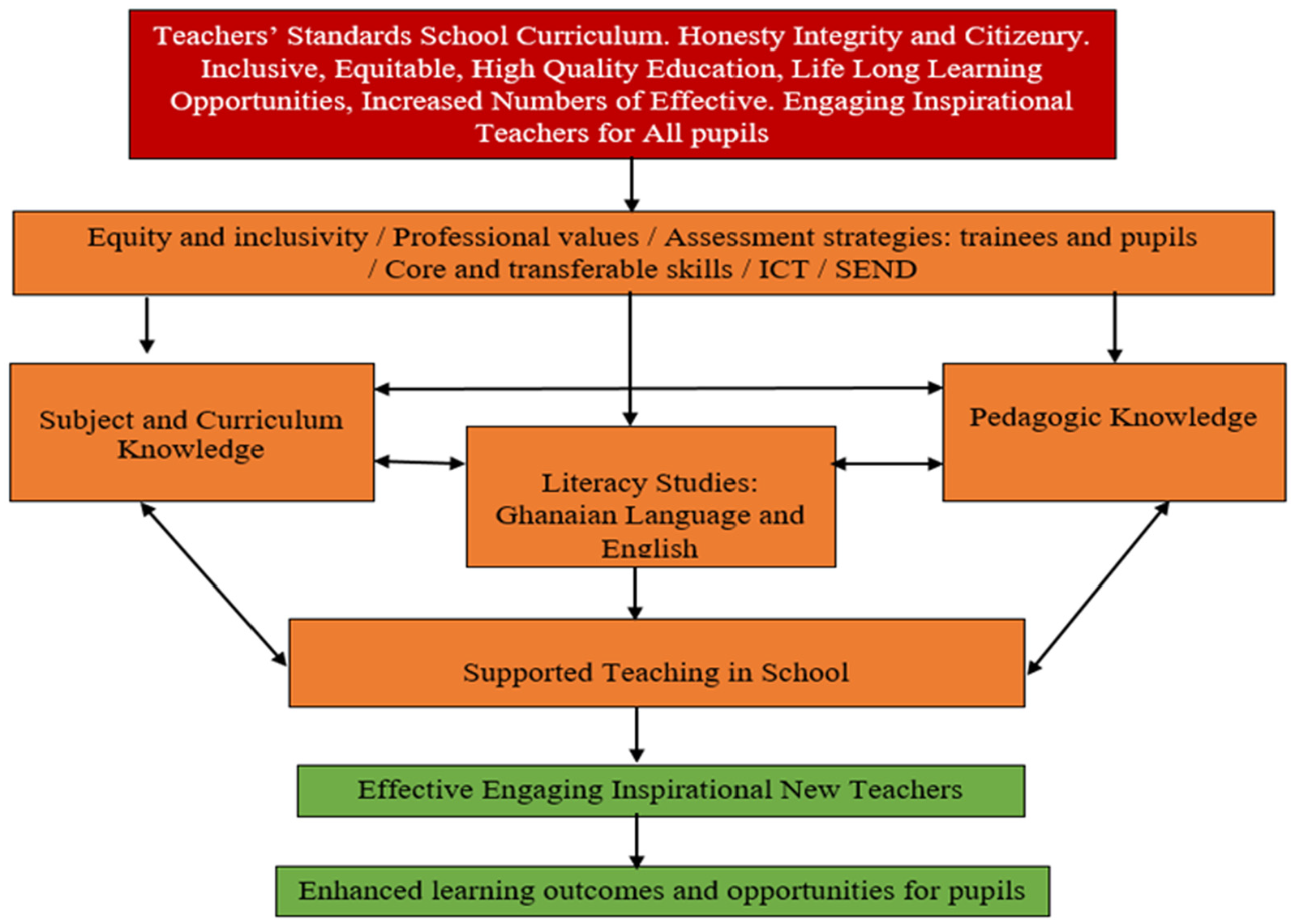
Teacher Education Process and Procedure. Source: NTECF (2018).
To all intense and purpose, this paper is limited to the STS aspect of the new B.Ed. curriculum. The emphasis is laid on the STS because it constitutes the experiential aspect of the curriculum or the practical aspect of teacher education, the foundation of ESD (ESD uses innovative pedagogy and “learning by doing” method). For Ogonor and Badmus (2006) teaching practicum provides the teacher trainees, those they called “neophytes” some kind of pre-service training which serves as opportunity for them to be exposed to the realities of teaching and performance of professional activities. It is the only opportunity for students to test theories learnt and ideas developed in the classroom, as they come in contact with real life situations. This practice provides opportunity for the teacher trainees to answer questions such as what kind of information, skills, attitude, and values to impart into the next generation in order to prepare them toward achieving the needed sustainable development. Therefore, this study seeks to explore the benefits of STS student-teacher, challenges experienced by student-teacher during STS, the benefit of STS to the learners.
Methods
Research Design
The study was qualitative in nature and the design was case study. A case study is an empirical inquiry that investigates a contemporary phenomenon (the “case”) in depth and within its real-world context (Yin, 2018). Yin indicated that case study research constitutes an all-encompassing method that covers the logic of design, data collection techniques, and specific approaches to data analysis. Rigorous activities must be carried out to ensure validity and reliability of results.
Population
The study population consisted of final-year undergraduates from the new Bachelor of Education program who had completed their Supported Teaching in Schools (STS) activities. These students were from selected institutions: Seventh-day Adventist College of Education, Mt. Mary’s College of Education (Somanya), Mampong Technical College of Education, and St. Monica’s College of Education (Mampong). Additionally, faculty members from these institutions and link tutors were included in the study.
Participant’s Recruitment
A combination of convenient and purposive sampling strategies was used to recruit participants from selected schools. Convenient sampling, which selects participants based on their availability and accessibility (Suen et al., 2014), was employed to sample students willing and able to participate. Purposive sampling was used to select faculty and link tutors actively involved in teaching practice supervision and mentorship. A total of 150 participants were selected, including 104 students, 36 faculty members, and 10 link tutors. From each of the four schools, 26 students and 9 faculty members were selected, with 10 link tutors purposively chosen during STS supervision.
Data Collection Instrument
An in-depth interview guide was developed to gather information from students, faculty members and link tutors regarding the experiences of student-teachers during the STS activities. Additionally, information was also gathered from student-teachers reflective journals and excerpts of these presentations obtained from STS coordinators and quality assurance officers. The guide was structured into three distinct sections to ensure all relevant areas were explored in detail.
Data Collection Procedure
Focus Group Discussions (FGD) and interview guides were used to gather data. Two FGDs were conducted with 13 students in each group at every selected school, providing a platform for students to share their perspectives on STS activities in each semester of their entire eight semesters (2018–2022). Additionally, one FGD was conducted for faculty members in each school, with 9 participants in each group. Tutors who had directly supervised or served as mentors were approached, and only those who consented were interviewed. In total, 10 link tutors were also interviewed to gather their insights on the subject matter. The FGDs for students and faculty members were led by the researchers within the school premises, after a mutually agreed upon time and date had been set. Similarly, interviews with link tutors were conducted during routine visits to STS schools for supervision. Prior to each interview, participants were informed of the study’s purpose and their expected role in it. They were assured of confidentiality, their right to withdraw at any time, and their consent was obtained before the interviews commenced.
Data Cleaning, Categorization and Analysis
Before the analysis, the research team upheld every beliefs about the phenomenon being investigated before approaching the analysis (Osborn & Smith, 2008; Starks & Brown Trinidad, 2007). Thematic analytical approach was used to analyze the data. Braun and Clarke (2006) define thematic analysis (TA) as a method for systematically identifying, organizing, and offering insight into, patterns of meaning (themes) across a dataset. By focusing on meaning across a dataset, thematic analysis allows the researcher to see and make sense of collective or shared meanings and experiences instead of identifying unique and idiosyncratic meanings and experiences found only within a single data item. This method is a way of identifying what is common to the way a topic is talked about, and making sense of those commonalities.
Prior to the analysis, all the data collected from the various colleges were edited by scrutinizing each dataset to make sure that it did not have errors so as to influence the validity of the results. Babbie (1998) believes that editing involves going through data in order to find out inconsistencies and errors. After editing, the complete set of data was then coded. Coding process involved categorizing data from the various colleges and assigning characters to them so that they could be put into one exclusive category. Coding was followed by the data cleaning which involved a critical search for coding errors identified as being impossible and improbably based on the way the variables were defined. Hereafter, a carefully scrutinized coding scheme was developed. Consequently, the data for the study were organized under themes such as benefits of STS to the student-teacher, challenges of STS, and benefits of STS to the learners. Tables were used to summarize the data for thematic analysis and to draw relationships between and among variables of interest. All authors participated in the coding process. In instances of disagreement, a meeting was convened among the authors to reach a consensus on the coding. The final codes were discussed to ensure that the resultant themes accurately reflected the data.
Trustworthiness
To ensure the credibility of the data, we employed three of Creswell’s (1998) procedures for maintaining data quality and establishing the trustworthiness of the research. These procedures included member checking, providing rich and thick descriptions, and peer review and debriefing.
Through member checking, participants reviewed transcripts to ensure accuracy and ensure that all interview contents were captured (Korstjens & Moser, 2018). This allowed for clarifications and verifications of unclear areas during the interviews, which added depth to the data collected (Patton, 2002). The themes conveyed by the participants were deemed trustworthy since no changes were suggested.
Again, we employed rich and thick description to present the findings, offering multiple perspectives on the identified themes. This approach enhanced the depth and realism of the results, making them more vivid and relatable (Patton, 2002). Additionally, it provided a clearer context and direction for discussing the participants’ shared experiences, contributing to a more comprehensive understanding of the data.
Finally, a peer debriefer was identified to review and pose questions regarding the study, ensuring that the findings resonate with individuals beyond the immediate research team. This strategy entails an interpretation that extends beyond the researcher, involving an external party, which enhances the validity of the account.
Results
The first major theme that was generated was the benefit of STS to the student-teacher and this has been shown in Table 1 with its subordinate themes.
Benefit of STS to the Student-Teacher.
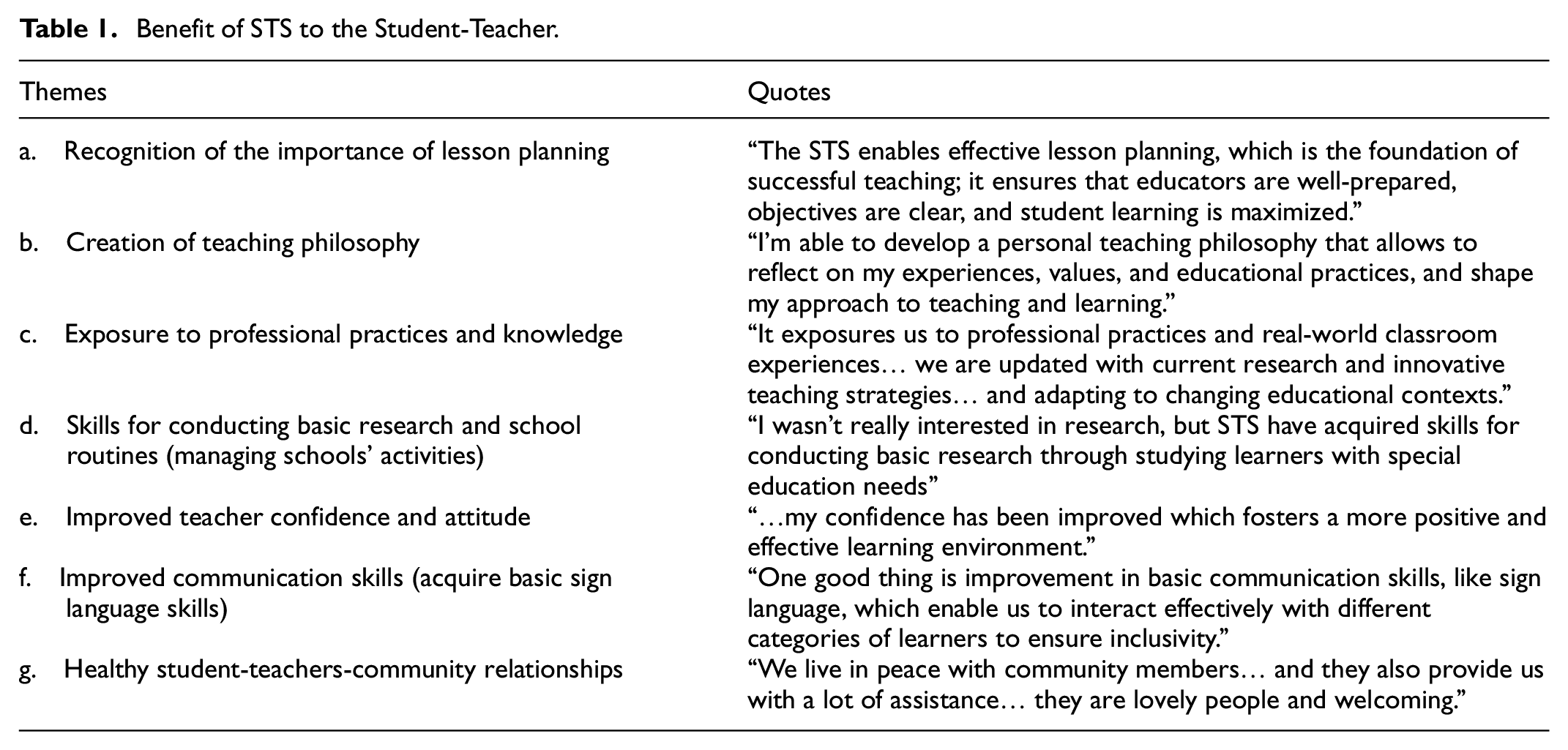
It was discovered that student-teachers now recognized the importance of lesson planning during the STS session. Lesson planning is a crucial aspect of effective teaching. Student-teachers were able to organize their thoughts, structure their instruction, and set clear objectives for student learning. With this, they were able to ensure that they cover the required content, incorporate appropriate teaching strategies, develop assessment and evaluation methods, and accommodate diverse student needs. Student-teachers developed teaching philosophies that were essential for educators as it serves as a guiding framework for their instructional practices. Again, student-teachers opined that they were exposed to professional practices and knowledge which are crucial for teachers’ ongoing professional development. They stayed updated with current research, pedagogical trends, and innovative teaching strategies, and this expanded their knowledge base, refine their instructional techniques, and adapt to changing educational contexts.
Another benefit that was unraveled was the acquisition of skills to conduct basic research through the study of learners with special education needs. They acquire skills in data collection, analysis, and interpretation, enabling them to make evidence-based decisions to support inclusive education practices. Aside the skills of conducting back research, they developed the skills of conducting school routines activities such as morning assembly, marking, and closing of register. It is essential for teachers to establish a structured and efficient learning environment to master such skills as this demonstrates a teacher’s organizational abilities, attention to detail, and professionalism. By efficiently managing these routines, they created a sense of order and discipline, which positively impacts student behavior and engagement.
Student-teachers confidence and attitude were improved because of the professional development experiences, exposure to best practices, and the acquisition of new skills. As teachers develop their knowledge and refine their instructional practices, they gain a sense of competence and self-assurance in their ability to meet the needs of their students. Teachers develop effective communication skills which were essential for them to engage students, foster positive relationships, and create an optimal learning environment. Teachers’ non-verbal and verbal communication skills were enhanced through the constant interaction with students in the classroom. Some could learn basic sign language which is a valuable skill for them to promote inclusive education and support students with difficulties. The continuous professional development and STS experience helped student-teachers to establish a healthy relationship with the community. Building positive relationship is fundamental to the success of effective teaching and learning. Teachers who foster healthy student-teacher community relationships create a supportive and inclusive learning environment which eventually promote a sense of belonging, trust, and emotional well-being, which are crucial for students’ overall development.
Despite the benefits student-teachers gained from the STS session, they equally encountered some challenges, and this have been shown in Table 2:
Challenges of STS.

Finding affordable accommodation near the school was difficult, particularly in urban areas with high living costs. This challenge was exacerbated in schools located in remote or underserved areas where housing options are limited. The cost of accommodation, settling utility bills (electricity, water, or internet) placed a financial burden on student-teachers, especially because of their limited financial resources. Student-teachers were faced with absenteeism and lateness from both their mentees (students) and their mentors (experienced teachers). Mentees and mentors frequently absented or arrived late to class and this disrupted the flow of instruction and hinders the overall learning experience, and also affected the guidance and support provided to the student-teachers. In some instances, they were assigned to teach classes without the presence or support of their assigned mentors. Mentors played a crucial role in guiding and supervising student-teachers; providing feedback, and helping them develop their teaching skills. However, due to various reasons such as scheduling conflicts or limited mentor availability, student teachers may find themselves teaching a class without the presence of their assigned mentors.
The availability and adequacy of teaching and learning resources significantly impacted the teaching experience of student-teachers. Inadequate resources, such as textbooks, educational materials, technology, or classroom supplies limited the effectiveness and variety of instructional strategies that student-teachers can employ. Insufficient resources hindered student engagement, limit hands-on learning experiences, and impact the overall quality of education provided. Some student-teachers highlighted the poor relationships between mentees (student-teachers) and their lead mentors, mentors, and link tutors. The poor relationships usually stem from communication breakdowns, differences in expectations or teaching philosophies, lack of trust or support, or limited opportunities for meaningful interaction. Student-teachers felt been excluded from professional teachers’ meetings, where important discussions and decisions about curriculum, instructional strategies, and school policies took place. This exclusion made them feel marginalized and undervalued, as they are not recognized as professional teachers in the same way as their experienced counterparts. This denied them the opportunity to contribute their perspectives, share their experiences, and benefit from the collective wisdom of experienced educators.
The learners in the school also benefited from the STS and the key highlights have been presented in Table 3.
Benefits of STS to the Learners.
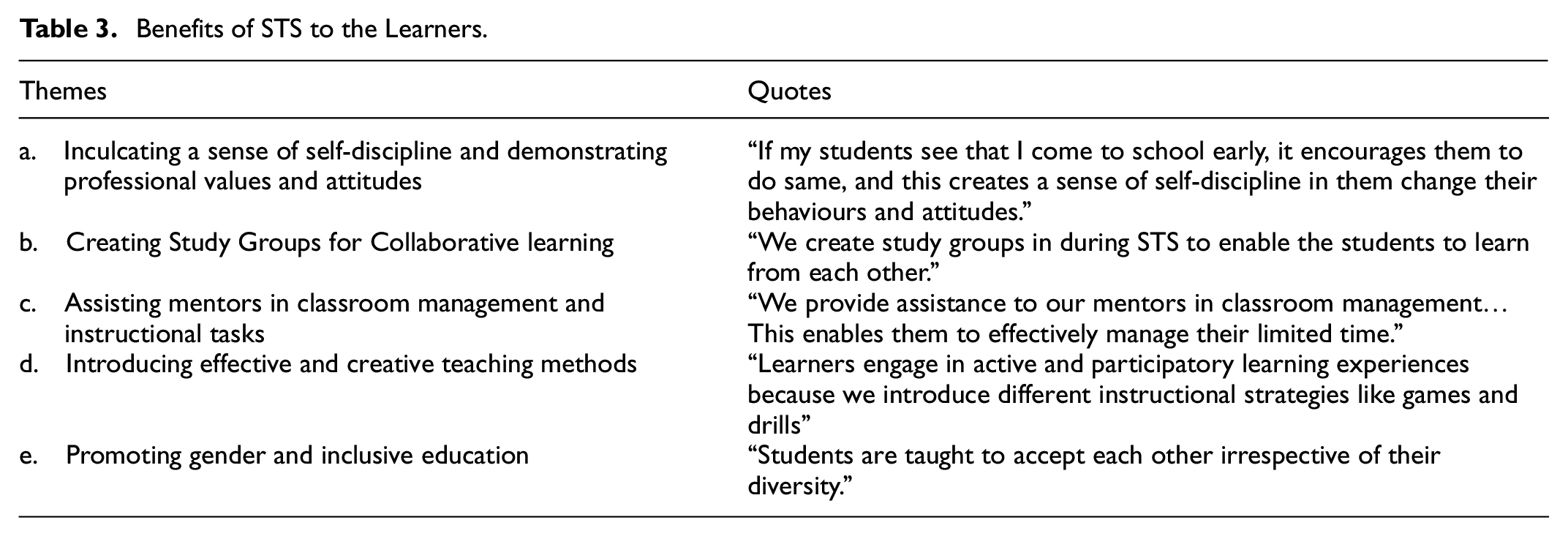
The presence of student-teachers participating in STS contribute to the inculcation of a sense of self-discipline among learners. Student-teachers, by going to school early and modeling punctuality, shape learners’ behaviors, and attitudes toward arriving at school on time. This practice helps learners develop a sense of responsibility and discipline, which are essential for their overall academic success and personal growth. Student-teachers involved in STS facilitated the creation of study groups among learners. These groups provided opportunities for learners to engage in group discussions and collaborative learning. Learners benefited from sharing ideas, asking questions, and collective problem-solving, which enhances their understanding of the subject matter and improves their academic performance. Student-teachers supported their mentors in managing the classroom, marking attendance registers, preparing and delivering lessons, designing learning materials, and assessing student work. This assistance reduced the workload of mentors, allowing them to focus more on individualized instruction and addressing the diverse needs of learners. The presence of student-teachers also increased the student-teacher ratio, facilitating more personalized attention and support for learners.
Student-teachers involved in STS had the opportunity to introduce effective and creative teaching methods that mentors were not familiar with. By implementing innovative approaches, such as problem-based learning or role-play, student-teachers were able to diversify instructional strategies and engage learners in active and participatory learning experiences. Through reading drills, Student-teachers contributed to the development of learners’ literacy skills. Additionally, they promoted gender and inclusive education practices. This manifested through seating arrangements that ensured equal participation and opportunities for all learners, promoting gender equality and inclusivity. Student-teachers also encouraged learners to challenge stereotypes, respect diversity, and develop inclusive attitudes, fostering a positive and inclusive learning environment.
Discussion
The study explored the challenges and benefits of supported teaching in schools as a strategy for attaining sustainable teacher education in Ghana. STS is a collaborative approach in which student-learners receive guidance, mentorship, and supervision from experienced teachers during their training period. For Ghana to be able to achieve SDG 4, it is important to develop the teachers’ capacity and pedagogical skills to enable them deliver lessons and manage classrooms effectively. Therefore it is ideal to look at the training process and address any challenges that may arise.
Benefits of STS to Student-Teachers
After thorough examination of the transcript, seven (7) key benefits of STS to the student-teachers were highlighted; recognition of the importance of lesson planning, creation of teaching philosophy, exposure to professional practices and knowledge, skills for conducting basic research and school routines, improved teacher confidence and attitude, improved communication skills, and healthy student-teachers-community relationships. These benefits adds to the existing findings of Darling-Hammond (2017), Gudmundsdottir and Shulman (2019), van Velzen et al. (2019), Jenkins and Poulton (2018), and Lucas and Villegas (2019). Lucas and Villegas supported the idea that the presence of student-teachers from diverse background creates a healthy student-teacher-community relationship. Thus, diverse background and experiences enhances learners’ cultural competence and promotes inclusivity. According to Epstein (2019), this strengthens the bond between schools and communities, helping to create a more supportive and responsive educational environment.
Additionally, the finding corroborates that of Jenkins and Poulton (2018) who highlighted that STS introduces the student-teachers to a variety of instructional strategies and approaches in the classroom. Thus, they are able to recognize the need of a lesson plan, create their personal teaching philosophies and are exposed to professional practices and knowledge. This enables the student-teacher brings to the fore fresh perspectives and innovative teaching methods. A strong teaching philosophy ensures consistency and purpose in their work, which can help Ghana produce more motivated and self-aware teachers for the future (Buabeng et al., 2020). This improves the confidence and attitudes of teachers, and heighten students’ motivation which eventually contribute to improved attendance, attentiveness, and overall academic performance (van Velzen et al., 2019). Again, an increase in teacher confidence is linked to higher student achievement, contributing to the overall quality of education in Ghana (Osei-Owusu, 2022). The teaching practice helped teachers connect college-based training to practical skills and knowledge of the teaching profession (Dankwah et al., 2021). This practice ensures that teachers are not only delivering quality education but are also able to manage diverse classrooms, contributing to the long-term sustainability of teacher education in Ghana (Buabeng et al., 2020). Gaining this experience early helps them become more competent and adaptable, leading to a more skilled teaching workforce, which is crucial for improving the quality of education in Ghana (Osei-Owusu, 2022).
Similarly, Dankwah et al. (2021) pointed out that STS is beneficial to teacher trainees since it equips them with requisite teaching knowledge, skills, experience, efficacy, professional development and supports their learning. In Aduhene-Chinbuah (2009), teacher trainees saw themselves as competent after going through the new program. It promoted the development of teaching experience and prepared them for the real world of work (Msangya et al., 2016). The basic research skills acquired can also enable the student-teachers contribute to continuous improvement in educational practices, which promotes innovation and problem-solving in the educational system (Owusu-Ansah et al., 2023).
Challenges of STS
Student-Teacher Support (STS) programs in Ghana face several challenges that hinder their effectiveness and sustainability. One major issue is the high cost of accommodation, which places a financial strain on student-teachers, often discouraging them from fully participating in the program (Annan-Brew & Arhin, 2022). Accessibility to affordable housing near assigned schools is essential to ensure student-teachers can focus on their professional development. Absenteeism and lateness, whether by student-teachers or mentors, also waste instructional time, reducing the quality of education delivered. This compromises the professional development of mentees and requires stricter oversight and accountability (Opoku et al., 2020). According to Asuo-Baffour et al. (2019), a lack of mentorship further exacerbates this issue, as unsupervised student-teachers miss valuable feedback and guidance necessary for their growth. To build a sustainable education system, relationships within the mentorship structure must be strengthened, and both mentors and mentees should be trained on effective communication and collaboration (Osei-Owusu, 2022). In many schools in Ghana, language barriers also create significant communication challenges in many schools, especially when student-teachers do not speak the local language. Von Esch et al. (2020) noted that this can hamper both teaching and student engagement, making it essential to provide language training and support for student-teachers to adapt to diverse linguistic environments. Additionally, some student-teachers are excluded from professional meetings, limiting their understanding of broader school policies and affecting their sense of belonging. A sustainable teacher education system should integrate them fully into all aspects of school life to foster their professional growth (Bascopé et al., 2019). Other barriers include inadequate teaching and learning resources, poor communication between colleges and partner schools, and a lack of financial support. In the findings of Abudulai (2021) and Sousa et al. (2020), insufficient instructional materials prevent the acquisition of necessary skills, while weak links between colleges and schools lead to unfriendly receptions and poor mentorship. Addressing these challenges by improving resource availability, fostering stronger relationships between educational institutions and schools, and providing better financial and logistical support will be essential for ensuring a sustainable teacher education system in Ghana (The National Teacher Education Curriculum Framework [NTECF], 2018).
Benefits of STS to the Learners
The presence of student-teachers in the classroom enhances academic achievement, social-emotional development, engagement, and motivation. Learners benefit from diversified instructional strategies, positive role modeling, mentorship, and increased cultural sensitivity. Studies have shown that student-teachers introduce diversified instructional strategies, which enhance academic achievement by catering to different learning styles and needs (Ashraf et al., 2021; Kazmi et al., 2023). It was again found that student-teachers inculcate a sense of self-discipline in learners. This corroborate the report by Aldrup et al. (2022) that what learners benefit from observing the professional values and attitudes demonstrated by student-teachers, such as respect, responsibility, and empathy, which contribute to a positive classroom environment. Through STS Student-teachers often organize study groups that encourage collaborative learning among learners. This collaborative learning enhances peer-to-peer interaction, allowing students to learn from each other while strengthening their understanding of concepts. Ashraf et al. (2021) reports that over time, this fosters a culture of cooperation in the classroom, which is beneficial for both learners and teachers. These findings highlight the importance of STS in creating an enriched learning and sustainable environment that supports learners’ holistic development and prepares them for future success.
Recommendations
In view of the challenges encountered by student-teachers, it is recommended that efforts should be made to ensure an adequate supply of essential curriculum materials, such as syllabuses, teacher’s handbooks, and textbooks, to support the teaching and learning process. The Ghana Education Service (GES), Parent-Teacher Associations (PTAs), School Management Committees (SMCs), and benevolent organizations could collaborate to address the shortage of these materials. Additionally, schools should strive to have an adequate number of teaching staff to meet the demands of the student population. Efforts should be made to recruit and employ additional qualified teachers. This will ensure that each class has the appropriate number of teachers, allowing for more personalized attention and effective instruction.
Colleges of Education and the Ghana Education Service should collaborate to provide training and capacity-building opportunities for mentors to enhance their knowledge and skills in effective mentoring practices. These training sessions can focus on mentoring strategies, providing constructive feedback, and supporting the professional growth of student-teachers. By investing in mentor training, the quality of support and guidance provided to student teachers will improve, leading to better learning outcomes for both student-teachers and learners. Mentoring should be recognized and valued within the promotion criteria for teachers. By including mentoring responsibilities in the promotion matrix, it will incentivize experienced teachers to actively participate in mentoring programs and dedicate time and effort to support student teachers.
Finally, it is recommended that the duration of macro teaching, where student-teachers take on the role of the lead teacher for an extended period, should be extended to allow for a more comprehensive learning experience. This extension will provide student-teachers with more time to practice and refine their teaching skills, gain confidence in their abilities, and develop a deeper understanding of the teaching profession before entering the workforce as qualified teachers.
Limitation
Though this paper offers insightful information about the advantages and difficulties of supported teaching in schools (STS) as an approach for achieving sustainable teacher education in Ghana, it is important to acknowledge some limitations. The emphasis on the single exposure of student-teachers experience is a significant drawback. A wider range of participant viewpoints, such as those of mentor teachers, school administrators, and educational policymakers, could be taken into account to produce a more thorough understanding. Furthermore, the study mostly depended on individual views and experiences, which would restrict the generalizability of the findings to a larger sample of student teachers undergoing STS.
Conclusion
The study offers a comprehensive analysis of the benefits and challenges associated with STS. STS offers significant benefits for both student-teachers and learners by enhancing lesson planning skills and helping student-teachers develop a personal teaching philosophy. Exposure to professional practices boosts student-teachers’ confidence and equips them with essential skills for conducting research and managing classroom activities. Additionally, student-teachers inculcate self-discipline in learners and support collaborative learning through the formation of study groups. However, challenges identified include accommodation costs, misuse of instructional time by mentees and mentors, exclusions, language barriers, and strained relationships between mentees and mentors, leading to insufficient guidance from link tutors. Addressing these challenges while promoting the benefits of STS will contribute to a more sustainable teacher education system. Ultimately, the positive impact of STS aligns with the achievement of inclusive, equitable quality education and lifelong learning opportunities (SDG 4), as well as supporting the attainment of other sustainable development goals.
Footnotes

Funding
The author(s) received no financial support for the research, authorship, and/or publication of this article.
Conflicting Interests
The author(s) declared no potential conflicts of interest with respect to the research, authorship, and/or publication of this article.
Data Availability
The data is available and accessible from the corresponding author upon reasonable request.