



Abstract
This systematic review synthesizes recent trends in English for Specific Purposes (ESP) research, examining 149 empirical studies published in Social Sciences Citation Index (SSCI) journals between 2014 and 2023. Employing a six-dimensional coding framework, we investigated participants, pedagogical methods, research methods, research foci, materials and technologies, and application issues. Findings reveal a predominant focus on undergraduate education and Chinese-speaking participants, with a notable increase in teacher-focused studies. Research methods show a polarization between large-scale quantitative and small-scale qualitative approaches, while non-experimental designs remain dominant. Collaborative and experiential learning approaches emerge as preferred teaching methods, reflecting a shift toward contextualized, learner-centered pedagogies. Technology integration in ESP instruction has grown significantly, particularly through online learning platforms and multimedia resources, though emerging technologies remain underexplored. Research foci have gravitated toward academic and professional communication, teaching methodologies, and learner characteristics, whereas assessment and evaluation have received less attention. While most studies report positive outcomes, the prevalence of mixed results highlights the complexity of ESP interventions. Our review underscores the need for more diverse participant pools, robust experimental designs, and innovative approaches to technology integration and assessment in future ESP research.
Introduction
English for Specific Purposes (ESP) has evolved significantly since its conception as an approach that bases language teaching decisions on learners’ needs (Hutchinson & Waters, 1987). As English increasingly dominates international commerce, academia, and technology, the demand for tailored, specialized language instruction has grown substantially. This growth has sparked extensive research in the inherently interdisciplinary field that straddles linguistics, pedagogy, cognitive science, and domain-specific knowledge (Hyland, 2019; Paltridge & Starfield, 2013; Swales, 2019).
Over the past decade, ESP research has yielded valuable insights in a wide array of topics from needs analysis, materials development, technological integration, to disciplinary discourses (Anthony, 2018; Kenny et al., 2020; Stojković et al., 2017). However, the rapid diversification of theories and methodologies within the field has led to fragmentation, isolating studies within specific disciplinary silos (Belcher, 2009; Hyland, 2022). As a result, practitioners and researchers face challenges synthesizing research findings into coherent pedagogical strategies, thus necessitating a comprehensive systematic review of ESP research to navigate existing literature and identify gaps, trends, and future directions (Snyder, 2019).
Several recent studies have made valuable contributions in mapping the terrain of ESP research through systematic reviews and bibliometric analyses. Y. Liu and Hu (2021)’s co-citation analysis of articles published in two flagship ESP journals (1980–2018) identified major research clusters and evolutionary stages. The study revealed landmark publications and current research trends in ESP, providing a systematic overview to complement narrative reviews. Bolton and Jenks (2022) contributed a geographical and sociolinguistic perspective, reviewing ESP research in Asia and Europe in the English for Specific Purposes journal (ESPJ), and arguing for more detailed sociolinguistic descriptions of local contexts. Further regional insights emerged from Basturkmen’s (2022) review of recent ESP research trends in the Asia Pacific region, examining 23 empirical studies published in ESPJ from 2018 to 2020. The analysis identified main topical themes that highlight the vibrancy and diversity of ESP research in the region. Dou et al. (2023) provided offered a semi-systematic, qualitative review of the historical development in ESP, tracing the evolution of ESP from the 1960s and highlighting key phases and influential theories. The review reveals the central role of needs analysis in ESP course design and delivery, and discusses emerging trends in ESP, particularly the increasing influence of technology and intercultural communication. R. Yang et al. (2023) performed automated topic extraction on articles, also published in ESPJ, from 1980 to 2019 to trace the journal’s development. They identified prominent research topics and traced their changes over four decades, examining highly cited articles and references, and revealing landmark works in ESP.
While these reviews have offered important insights into the state of ESP research, they are limited by their relatively narrow scope (often focusing on one or two journals), specific geographical regions, narrow timeframes and/or small sample sizes. Moreover, many of these reviews lack robust quantitative analysis and systematic coding procedures, potentially overlooking nuanced trends and emerging themes. Finally, the time lag inherent in existing analyses, coupled with the rapid pace of change in ESP research, particularly regarding technological advancements and shifting global communication needs, calls for a more up-to-date review that captures recent developments.
To address these limitations, the present study conducts a systematic review of ESP research published in Social Sciences Citation Index (SSCI) journals in the last decade (between 2014 and 2023). Compared with existing studies, our review encompasses a wider range of journals from diverse sources, allowing us to identify trends and patterns that may have been overlooked in more narrowly focused reviews.
To guide our analysis, we adopt a revised coding framework based on the review model of educational research first proposed by Y. C. Hsu et al. (2012) and further refined in subsequent studies (Chung et al., 2021; R. Li, 2022; Turan & Akdag-Cimen, 2020). This framework was selected for its comprehensive structure for analyzing key aspects of empirical educational research and its flexibility to accommodate diverse variables relevant to ESP. It was adapted in this study to provide a multifaceted lens for analyzing trends in ESP studies, accommodating both research-based dimensions (e.g., participants, methods, and foci) and pedagogical dimensions (e.g., teaching methods, materials, and application issues). This approach enables us to capture not only the theoretical and methodological trends in how ESP is studied as a field but also the practical insights into how ESP is implemented in real-world educational settings.
The original framework consists of the following dimensions: Participants, Learning Strategies, Research Methods, Research Foci, Adopted Technologies, and Application Issues. While this framework has been successfully applied and adapted in varied educational contexts, including medical, science and language education (e.g., C.-K. Chen et al., 2022; Liang et al., 2023; H.-C. Lin & Hwang, 2019), its focus on technology use required adjustments to accommodate the characteristics of ESP studies, which often include diverse teaching methodologies, disciplinary contexts, and specialized instructional materials. Informed by prior adaptations of the framework in interdisciplinary educational research (M.-R. A. Chen et al., 2023; Chung et al., 2021; R. Li, 2022; Liang et al., 2023; H.-C. Lin & Hwang, 2019), we made the following revisions: the Learning Strategies dimension was renamed Pedagogical Methods to encompass diverse instructional approaches, such as experiential learning and explicit instruction, that are central to ESP pedagogy. Similarly, the Adopted Technologies dimension was expanded to Materials and Technologies to reflect the importance of traditional instructional materials (e.g., textbooks, corpora) and emerging technologies (e.g., virtual platforms) in ESP contexts. Each dimension in the revised framework (Figure 1) is further delineated into specific coding items, offering a nuanced and multifaceted lens through which to examine ESP research.
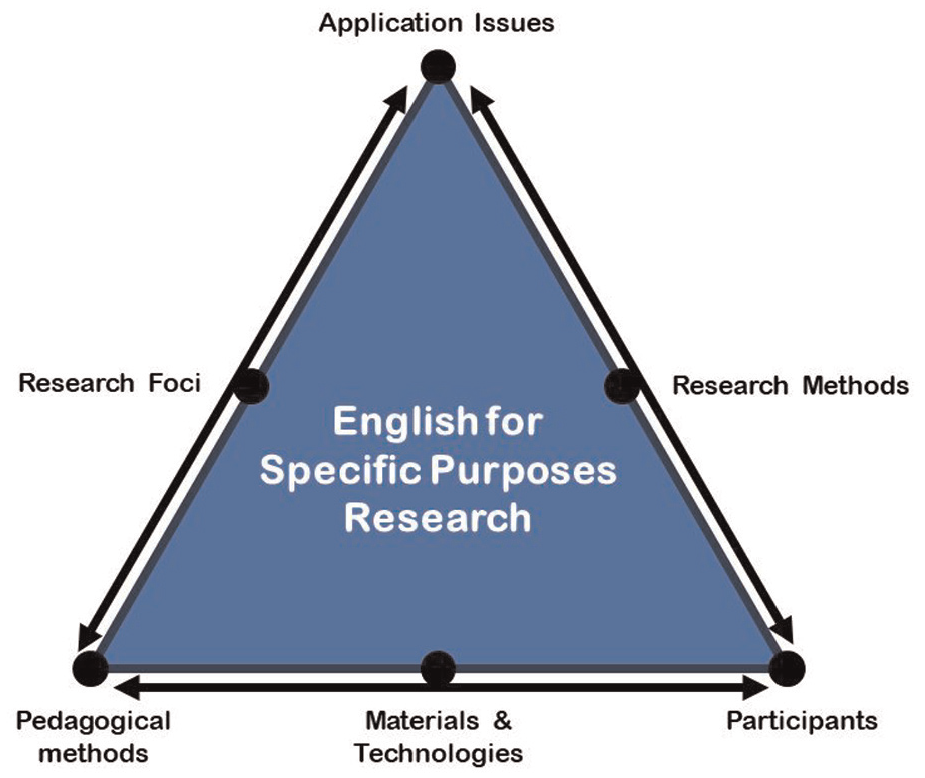
Revised review framework for ESP research.
Guided by this framework, the present study aims to investigate the following research questions:
(1) What are the publication trends in empirical ESP research published in SSCI-indexed journals between 2014 and 2023?
(2) Who are the participants involved in the reviewed studies?
(3) What pedagogical methods are reported in the reviewed studies?
(4) What research methods are employed in the reviewed studies?
(5) What are the research foci highlighted in the reviewed studies?
(6) What materials and technologies are adopted in the reviewed studies?
(7) What are the application issues (effectiveness, advantages, and challenges) reported in the reviewed studies?
Methodology
Data Collection
Search Criteria
Figure 2 illustrates the data search and screening process for our study. We searched relevant literature using the Web of Science database (WoS) core collection. Compared with other databases such as ERIC, CNKI, and Scopus, WoS provides comprehensive indexing of high-impact journals across multiple disciplines. This broader scope, combined with stringent inclusion criteria and consistent quality standards (K. Li et al., 2018), makes WoS particularly suited for systematic reviews in language education research (See: M.-R. A. Chen et al., 2023; Hajar & Karakus, 2024; G.-J. Hwang & Fu, 2019; J.-F. Wu & Tsai, 2022 for some recent examples). We employed “English for Specific Purposes” as the search term using WoS’s Topic Search functionality. This search method examines not only explicit keywords through its indexing of titles, abstracts, author keywords, but also related terms through the Keywords Plus feature, which identifies frequently occurring phrases in article references. This approach allowed us to retrieve relevant articles across various ESP subfields (e.g., English for Academic/Medical/Business Purposes) under the ESP umbrella concept without requiring separate, potentially inexhaustible search terms for each domain. Our approach aligns with recent systematic reviews (e.g., W. Liu, 2019; A. Wu & Wei, 2022; J. Yu & Muñoz-Justicia, 2020) that have employed similar broad-term search strategies. Following established conventions in systematic reviews (G. Hwang & Tsai, 2011; Shadiev et al., 2017), we focused on publications from 2014 to 2023, a timeframe that enables a balanced comparison between two distinct 5-year intervals (2014–2018 and 2019–2023). The selected period complements existing reviews of earlier work and captures recent developments in ESP research, particularly the pedagogical and technological innovations that have transformed ESP practices in the past decade. Additional search parameters included limiting the document type to “Article” and the language to “English.” This initial search yielded 1956 articles. We further refined these results to include only those indexed in the Social Sciences Citation Index (SSCI), known for its stringent selection criteria and inclusion of high-impact journals (Duman et al., 2015), resulting in 817 articles.

Data search and screening process.
To manage the scope of our analysis and ensure a balanced representation across sources, we employed a stratified random sampling approach using Python’s Pandas library. After exporting eligible articles from WoS to an Excel file, we stratified them by publication year and journal source. For journals with multiple eligible articles per year (such as the English for Specific Purposes Journal and the Journal of English for Academic Purposes), we used Pandas’sample function to randomly select one article within each journal-year stratum. Our use of stratified random sampling was guided by three primary considerations. First, this approach prevented overrepresentation from flagship journals like the English for Specific Purposes Journal, which publish a disproportionately large number of ESP studies. Including all articles from these sources could have skewed trends, overshadowed smaller journals, and reduced insight diversity (Booth, 2016). Second, our strategy complements existing reviews that focus exclusively on one or two flagship journals (e.g., Basturkmen, 2022; Bolton & Jenks, 2022; Y. Liu & Hu, 2021; R. Yang et al., 2023) by offering a broader perspective that spans 68 journals. Third, time and resource constraints necessitated a manageable sample size to enable in-depth analysis across multiple dimensions. This stratified random sampling approach aligns with established systematic review practices across disciplines that aim to reduce sampling bias, maintain feasible sample sizes, and account for journal-specific factors (e.g., Cook et al., 2007; Devers, 2011; Gabler et al., 2016; Montori et al., 2003). This approach resulted in 578 articles across various publications.
Manual Screening
Following the initial database search, two trained reviewers conducted a manual screening process to ensure the relevance and empirical nature of the included papers. The full texts of the articles were manually downloaded from the official hosting websites via institutional subscriptions or open-access platforms. Articles for which full texts were unavailable through these channels (n = 16) were excluded, reducing the pool to 562 papers. These were then assessed for eligibility using the following inclusion criteria: (1) ESP pedagogy must be the main focus or theme of the article (e.g., language teaching/learning in specific contexts, development of specialized language skills, or analysis of specialized discourse for pedagogical purposes), (2) the article must be empirical in nature, involving the analysis of data from human participants, and (3) the main participants must be second or foreign language speakers of English. The reviewers read each article’s title and abstract and, when necessary, full text to ensure adherence to these criteria. Discrepancies were resolved through discussion. This resulted in a final sample of 149 papers.
Coding Scheme
To enable quantitative analysis of the literature, we developed a coding scheme based on the aforementioned review model of educational research by Y. C. Hsu et al. (2012). Two trained reviewers independently coded 15 articles (about 10% of the sample) to test and refine the coding scheme. Inter-coder reliability was assessed by calculating percentage agreement, following standard practice in systematic reviews and meta-analyses in applied linguistics (e.g., Boulton & Cobb, 2017; Plonsky, 2011). The initial inter-coder agreement rate across all dimensions was 83.1%, above the conventional 80% threshold for reliability (Bayerl & Paul, 2011). Discrepancies were resolved through discussion and consensus, and iterative adjustments enhanced clarity and consistency. The final coding scheme included the following coding items:
Participants
The participants dimension captures key characteristics of the study subjects with three coding items: educational stage, first language, and sample size. Educational stages include preschool, elementary, middle school, high school, undergraduate, postgraduate, adult learners, and teachers (Sung et al., 2015). First languages cover major world languages such as Chinese, English, Spanish, Hindi, Arabic, with provisions for less common languages. Sample sizes are categorized as small (1–29), medium (30–50), medium to large (51–100), and large (101+), aligning with common practices in educational research (G.-J. Hwang & Fu, 2019).
Pedagogical Methods
Pedagogical methods focus on the rules and methodologies that regulate ESP pedagogy, comprising two coding items: teaching method and intervention duration. Teaching methods encompass explicit instruction, expert guidance, collaboration, discussion, feedback & reflection, demonstration by learner, experiential learning, and independent learning. Intervention duration categorizes ESP interventions based on their length, ranging from less than 1 day to over 6 months.
Research Methods
This dimension delineates the methodological approaches employed in the studies, comprising two coding items: experimental design and data collection methods. Experimental designs range from full experimental design to no experimental design. Data collection methods encompass surveys, observations, interviews, case studies, tests, content/corpus analysis, and system development/evaluation.
Research Foci
Research foci encompasses the primary areas of investigation with two coding items: field of study and main research topic. Fields of study cover natural sciences, health sciences, applied sciences and technology, social sciences, humanities, and interdisciplinary Studies. Main research topics in ESP span language skills, academic communication, teaching methodologies, educational technology, learner characteristics, assessment, sociolinguistic aspects, teacher education, and linguistic analysis.
Materials and Technologies
This dimension focuses on the content & tooling aspects of ESP interventions. It includes two items: teaching materials and adopted technologies. Teaching materials encompass textbooks and course materials, multimedia and digital resources, tailor-made task-specific materials, corpora and linguistic data, and assessment materials. Adopted technologies range from online learning platforms, social and collaborative tools, gamified learning, immersive technologies, artificial intelligence, text and language analysis tools, productivity and communication tools, to specialized language tools.
Application Issues
Application issues examine the practical challenges and outcomes associated with ESP interventions, focusing on three main items: effectiveness, advantages, and challenges. Following Turan and Akdag-Cimen (2020), the results, discussion, and other relevant sections were assessed. Effectiveness is categorized as positive, negative, no significant difference, mixed results, or not applicable. Advantages and challenges were summarized, encompassing aspects such as language skill enhancement, learner engagement, technological affordances, pedagogical considerations, and resource constraints. Suggestions for improvement were noted when explicitly mentioned.
Coding Procedure
Two reviewers systematically coded the entire corpus of 149 articles using the finalized coding scheme. They extracted data from each article and entered the results into a structured spreadsheet, resolving any discrepancies through discussion and consensus. The coding process incorporated flexibility in two ways. First, two supplementary categories—“other” and “not available”—were included where appropriate, allowing for the capture of data that did not fit neatly into existing categories. Second, following precedents in linguistics and educational research (Hiver et al., 2024; Walker et al., 2020), multiple response codings were permitted where appropriate. This approach allowed certain coding items to be applied across multiple categories simultaneously, enhancing the analysis’s granularity and depth. For example, in Mazgutova and Kormos (2015), participants included both undergraduate and postgraduate students, necessitating coding under both categories. This flexibility prevented oversimplification from forced single-category assignments, thereby providing a more accurate and nuanced understanding of the data.
Data Analysis
For quantitative data analysis, we developed custom Python scripts utilizing the Pandas library for data manipulation and aggregation. This computational approach allowed us to generate descriptive statistics, including frequencies and percentages for each coding dimension, and to analyze trends across the 10-year period.
Results and Discussion
Data Distribution
Our collection of articles reveals some notable trends in terms of research output. The annual publication output showed an overall upward trend, despite some fluctuations (Figure 3). A modest increase was observed from 2014 (7 articles) to 2016 (14 articles), followed by a slight decline in 2017 and 2019 (9 and 7 articles, respectively). However, a significant surge occurred from 2020 onward, with peak output in 2022 (28 articles) and 2023 (26 articles). The increased output in recent years might indicate a continued maturation of the field, with an expanding community of researchers building on established frameworks and methodologies to address emerging challenges in ESP.

The number of articles by year.
The articles span 68 different journals, revealing both concentration and diversity in publication venues. In our sampled dataset, four journals featured prominently, with each contributing 10 articles: English for Specific Purposes, Journal of English for Academic Purposes, Computer Assisted Language Learning, and Iberica. These four journals collectively account for 27% of the total publications reviewed. The prominence of technology-focused journals like Computer Assisted Language Learning, Education and Information Technologies (4 articles) and Interactive Learning Environments (4 articles) reflects ESP’s adaptation to digital pedagogies (Hafner & Pun, 2020). The data also reveals a long tail of journals with fewer publications, with 39 out of 68 journals (57%) publishing only one article each within our review scope. This wide dispersion across journals confirms ESP’s position as a diverse, interdisciplinary field with broad relevance and appeal across various academic disciplines and publication venues (Paltridge & Starfield, 2013).
Participants
Educational Stage
The data in Table 1 reveal a pronounced emphasis on undergraduate education, which accounts for 56% of studies overall, followed by teachers (17%) and postgraduate students (14%). The focus on undergraduate research remained stable across the examined periods (56% in 2014–2018, 55% in 2019–2023). Notably, teacher-focused research increased from 11% to 21%. In contrast, postgraduate studies showed a slight decline (16% to 13%), and research on K-12 education (preschool, elementary, middle school, and high school) contexts decreased more substantially (13% to 3%). Adult learners and other specialized groups, for example, administrative staff (Reynolds et al., 2023), remained on the periphery, representing only 2% to 4% of the total articles, with a further decline across the periods.
Participants’ Educational Stages, First Languages, and Sample Sizes During the First (2014–2018) and Second (2019–2013) Periods.

Note. The sum of individual categories may exceed the total number of articles (N) as some studies were coded in multiple categories.
The focus on undergraduate studies aligns with the growing recognition of discipline-specific language needs in tertiary education, where specialized language proficiency is most immediately relevant and applicable (Dikilitaş & Kırkgöz, 2018). The complexity and specificity of language needs at this stage necessitate more focused research, which is crucial in developing methodologies and materials that prepare students for the linguistic demands in professional careers (Knoch & Macqueen, 2020). The increasing attention to teacher-focused studies suggests a growing recognition of the important role ESP educators play in shaping learning outcomes and of the need for ESP teacher training and professional development, and for more research to give voice to ESP practitioners (Bocanegra-Valle & Basturkmen, 2019; Fitzpatrick et al., 2022). This emphasis on teacher training is particularly important in profession-specific contexts (e.g., English for Medical Purposes), where instructors must first acquire extensive disciplinary knowledge and skills to effectively design and deliver courses (Cao et al., 2022). While ESP teachers recognize the need to engage in “continuous professional development” to stay abreast of the evolving nature of ESP and to gain credibility within their professional communities, access to such opportunities remains limited, suggesting an area requiring further research (Bocanegra-Valle & Basturkmen, 2019).
However, the relative scarcity of K-12 focused studies is concerning. Most studies in this category were conducted at vocational high schools, as exemplified by F. C. Lu and Chang (2016), who explored the effectiveness of a role-play game-enhanced ESP vocabulary acquisition framework. While this scarcity might be attributed to the fact that K-12 education tends to focus on general English language instruction, Lu and Chang pointedly highlight the general negligence of ESP pedagogy at this stage. This research gap might represent a missed opportunity to investigate how early exposure to specialized language can scaffold later academic and professional success (Yamada & Maswana, 2020). The limited attention to adult learners and specialized groups outside traditional academic settings is another significant gap. With increasing internationalization and interdisciplinary collaboration in the global workforce, this dearth of research might not adequately address the growing need for continuous, lifelong professional development in specialized fields, where language demands are constantly evolving (Basturkmen, 2010).
First Language
Regarding participants’ first languages, Chinese emerged as the dominant language, featuring in 38% of the articles overall, with a marked increase from 25% in the first period to 46% in the second. Meanwhile, studies focusing on Spanish-speaking participants decreased from 27% to 12%, while those involving Korean-speaking participants dropped from 9% to 2%. Arabic-speaking participants maintained a consistent presence at 7%. The presence of multilingual studies, incorporating diverse language backgrounds, was also observed. For instance, Macqueen et al. (2016) encompassed speakers of Arabic, Bangla, Chinese, Farsi, Korean, among others, a reflection of the globalized ESP research landscape with varied linguistic backgrounds. However, some languages, including Hindi, Russian, and German, were underrepresented, appearing in only one or two studies each.
The substantial increase in Chinese-focused studies may reflect China’s growing emphasis on ESP education and international academic engagement (Cheng, 2020; X. Yu & Liu, 2018). However, this trend raises questions about the generalizability of findings to other linguistic and cultural settings. For example, the motivations and learning styles of Chinese-speaking learners might differ considerably from those of learners from other linguistic backgrounds and it remains unclear how results derived from Chinese participants apply to speakers of other major languages, such as Spanish, whose share of ESP research is on the decline. Anthony (2018) highlights the importance of considering cultural factors in ESP teaching and learning, noting that learners’ previous educational experiences and cultural norms can significantly influence their expectations and approaches to language acquisition. On the other hand, several widely spoken languages, such as Hindi, Russian, and German, are noticeably underrepresented, and may indicate a gap in the current ESP literature. Given the economic and academic importance of countries where these languages are spoken, more research may be needed to target these language communities. Finally, the presence of multilingual studies highlights the complex linguistic landscape in which ESP operates and underscores the need for research that addresses diverse language backgrounds (Bolton & Jenks, 2022).
Sample Size
Sample sizes in the reviewed studies show a trend toward polarization. Large-scale studies (101 + participants) consistently dominated the field, accounting for approximately 35% to 36% of articles across both periods. At the same time, there was a substantial increase in small-scale studies (1–29 participants), nearly doubling from 15% to 29% between the periods. This shift is illustrated by studies like Q. Sun and Yang (2022), which employed just 15 participants to explore feedback on English for academic purposes speaking skills in online teaching. By contrast, there was a decline in medium (30–50 participants) and medium-to-large (51–100 participants) sample sizes, with their combined proportion decreasing from 42% to 29%.
Overall, a methodological diversification in ESP research is apparent. The consistent dominance of large-scale studies suggests a continued emphasis on generalizability and statistical robustness in ESP research. These studies often focus on broad patterns in ESP learning and teaching (e.g., validating a rating scale), leveraging technological advancements for data collection and analysis. For instance, Arifani et al. (2023) proposed a new psychometric ESP online teaching scale based on 566 samples. The significant increase in small-scale studies, on the other hand, might indicate a “qualitative turn” driven by an increased interest in understanding the nuances of language use in specific professional or academic contexts, which often require more small-scale, in-depth, and context-specific investigations. C. Lu et al. (2021) and Q. Sun and Yang (2022) exemplify this shift, focusing on innovative methodologies and in-depth analysis of individual experiences. However, the decline in medium-sized studies, which often strike a balance between depth and breadth, points to a potential research gap. Future research might benefit from explicitly justifying sample size choices, exploring mixed-methods approaches, and improving standardization in reporting methodological details (Piovesana & Senior, 2018).
Pedagogical Methods
Teaching Method
As shown in Table 2, collaboration emerged as the most prevalent teaching method, featuring in approximately 30% of articles across the two periods studied. Experiential learning showed the most substantial growth (9%–20%). Explicit instruction, such as direct teaching of technical vocabulary (Alharbi, 2023), showed a modest increase (7%–13%). Conversely, discussion-based methods decreased from 27% to 19%, though they remained a significant component of ESP teaching approaches. Meanwhile, there was a diversification of teaching approaches, with the “other” category increasing from 2% to 11% of articles, as exemplified by studies exploring innovative approaches like serious game-based learning for vocabulary acquisition in healthcare contexts (Soyoof et al., 2022) and intuitive text simplification as a teaching strategy (Rets et al., 2022). Independent learning, an indicator of learner autonomy, maintained a stable presence (16%–18% across both periods). The proportion of articles with unspecified teaching methods (“not available”) decreased from 53% to 41%, potentially indicating improved reporting practices in recent research.
The Teaching Methods and Intervention Durations of the Reviewed Studies During the First (2014–2018) and Second (2019–2013) Periods.

Note. The sum of individual categories may exceed the total number of articles (N) as some studies were coded in multiple categories.
The consistent prominence of collaborative learning methods aligns with sociocultural theories of language learning (Lantolf & Beckett, 2009) and mirrors team-based environments common in professional contexts (Hall et al., 2017). Hands-on, practical, experiential teaching approaches, in resonance with Kolb’s experiential learning theory (Kolb et al., 2014), have been on the rise, and reflect a growing awareness of the need to contextualize language learning within practical and professional domains (Knoch & Macqueen, 2020) and to create an engaging learning environment with opportunities for interaction to foster student motivation in ESP (X. Yang & Wyatt, 2021). Our reviewed research also suggests that effective collaboration should encompass not only student-to-student interactions but also partnerships with subject-area teachers to create more authentic learning experiences (Antic & Milosavljevic, 2016). The rise in explicit instruction, alongside the continued focus on independent learning, indicates a balanced approach that recognizes the need for both structured guidance and learner autonomy. This balance is particularly important for ESP learners, who may require targeted guidance in navigating discipline-specific terminology and discourse conventions (Evans et al., 2015) while also developing skills for continued independent learning in their field.
Intervention Duration
Short-term studies (less than a day to 4 weeks) showed a notable increase from 13% to 22%. An example of such short, focused interventions is Bocanegra-Valle and Basturkmen (2019), who conducted a single 1-day session to investigate teacher education needs of experienced ESP teachers. Medium-term studies (1–6 months) remained relatively stable, comprising about 30% of the articles across both periods. Long-term studies (over 6 months) saw a modest increase from 5% to 9%, reflecting an emerging interest in examining sustained language development and long-term intervention impacts. Similar to teaching method, there was a substantial decrease in studies classified as “not applicable” (where duration was not reported or relevant) from 55% to 39%, a potential indication of improved reporting practices.
The increase in short-term studies suggests a shift toward more targeted, intensive interventions. This trend could be influenced by factors such as the rise of microlearning and the use of technology-enhanced learning approaches that allow for more concentrated learning experiences and the examination of immediate perceptions or effects of specific teaching strategies (e.g., V. Lin et al., 2023; X. Yang & Wyatt, 2021). Recent research supports the effectiveness of these interventions. Wright et al. (2022) found that even brief EAP courses can enhance students’ academic interactional competence, challenging the idea that ESP instruction always requires long-term interventions. The consistent presence of medium-term studies and the slight increase in long-term research are encouraging signs. These longer durations allow for longitudinal studies where a more comprehensive examination of language development is possible. For example, Simonova et al. (2021) conducted 12 sessions over 3 months to study students’ motivation types in ESP instruction. However, the relatively low proportion of long-term studies points to a need for more research in this area, given the long-term nature of second language acquisition (Foley & Thompson, 2017).
Research Methods
Experimental Design
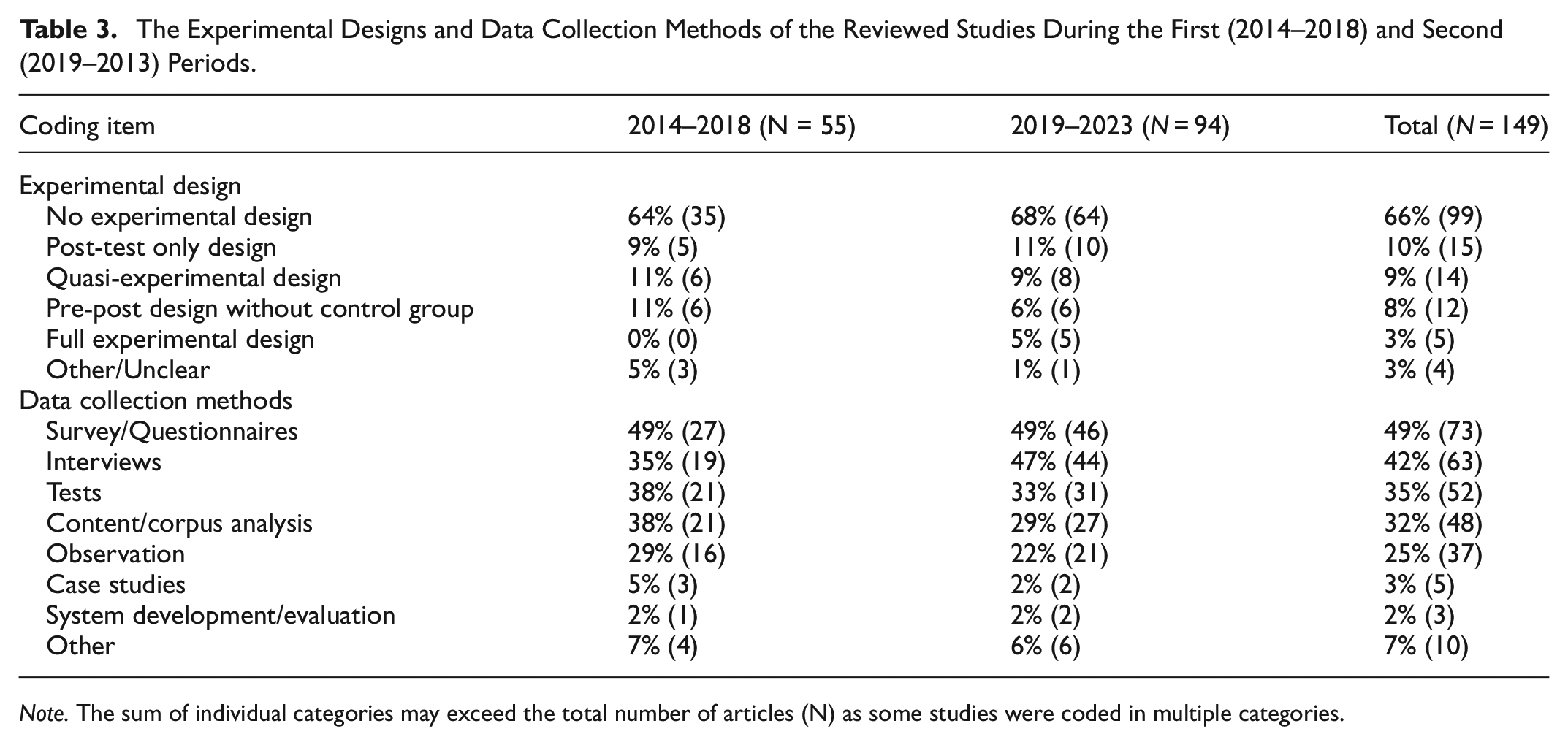
Analysis of the data in Table 3 reveals a dominant trend toward non-experimental designs, with 66% of all articles eschewing experimental controls. This prevalence has increased slightly, from 64% to 68%. For instance, articles like Kampouri (2022) and Engin and Donanci (2015) focus on descriptive case studies and qualitative investigations without experimental controls. At the other end of the spectrum is a notable emergence of full experimental designs, rising from complete absence in the first period to 5% of studies in the second. These studies incorporate rigorous methodologies, including control groups, pre-tests, post-tests, and randomization, thus allowing for stronger causal inferences. Noteworthy examples include Xodabande et al. (2022) and T. Zhang and Zhang (2021), which investigated the effectiveness of specific pedagogical interventions using robust experimental frameworks.
The Experimental Designs and Data Collection Methods of the Reviewed Studies During the First (2014–2018) and Second (2019–2013) Periods.
Note. The sum of individual categories may exceed the total number of articles (N) as some studies were coded in multiple categories.
In contrast, quasi-experimental designs and pre-post designs without control groups have seen a slight decline. Quasi-experimental designs, accounting for 9% of studies overall, decreased from 11% to 9%. Similarly, pre-post designs without control groups fell from 11% to 6%. H. Liu et al.’s (2022) examination of flipped classroom approaches in ESP contexts and Mazgutova and Kormos’s (2015) investigation of L2 learners’ academic writing development illustrate these approaches.
The dominance of non-experimental designs in ESP research reflects both practical and theoretical considerations inherent to the field. The exploratory nature of many ESP studies, which emphasize ecological validity and sensitivity to context, often lends itself to descriptive or observational methods (Atai & Fatahi-Majd, 2014). These methods enable researchers to capture rich, contextualized data that is essential for understanding the complex interplay between language, disciplinary knowledge, and professional practice (Gunnarsson et al., 2014). Additionally, the highly contextualized nature of ESP instruction often prioritizes naturalistic inquiry approaches, which offer in-depth qualitative insights (Dressen-Hammouda, 2012). This methodological preference aligns with broader trends in applied linguistics and second language research (Plonsky, 2013).
The dominance of non-experimental designs, while allowing for rich, contextual insights, might limit the field’s ability to draw causal conclusions about the effectiveness of ESP interventions (Teimouri et al., 2021). Although full experimental designs represent a step toward more rigorous empirical evidence and potentially improved generalizability, the overall scarcity of such rigorous designs suggests that ESP researchers may be grappling with the practical constraints of implementing controlled studies in diverse educational settings. On the other hand, the slight decrease in quasi-experimental designs, coupled with the increase in post-test only approaches, may indicate a polarization of methodological choices—researchers opting either for more rigorous experimental designs or for simpler, snapshot evaluations.
Data Collection Methods
Survey/questionnaires was found to be the most prevalent data collection method, used in 49% of the articles and maintaining consistent usage across both periods. Interviews, the second most common method (used in 42% if all articles), showed a notable increase from 35% in 2014 to 2018 to 47% in 2019 to 2023. Tests and content/corpus analysis were also frequently employed, appearing in 35% and 32% articles, respectively. However, both methods saw a decrease in usage, with tests dropping from 38% to 33% and content/corpus analysis from 38% to 29%. Observation methods followed a similar declining trend, decreasing from 29% to 22%. Another noteworthy trend was the increasing adoption of mixed-method approaches, exemplified by studies like T. Zhang and Zhang (2021), which combined surveys, observations, tests, and content analysis to evaluate an ESP blended course. Less common methods included case studies (3.4%), system development/evaluation (2%), and other methods (6.7%), which showed minimal variation over time.
The consistent use of survey/questionnaires suggests that ESP researchers continue to value quantitative data for capturing broad trends and participant attitudes, aided by the reliability and ease of administration of such methods in diverse research contexts. The significant increase in interviews signals a growing preference for nuanced, qualitative insights into learner and teacher experiences, aligned with a broader move in applied linguistics toward understanding the complex, subjective aspects of ESP contexts, as evidenced by studies like X. Yang and Wyatt (2021), which explored ESP teachers’ motivational practices in a Chinese university.
On the other hand, the slight decline in tests and content/corpus analysis suggests a potential move away from purely linguistic analyses toward more holistic, participant-centered evaluations of ESP efficacy. Nevertheless, studies like Crosthwaite and Jiang (2017), which investigated the impact of EAP instruction on academic writing, demonstrate the continued relevance of linguistic analysis in assessing the impact of ESP interventions on language proficiency (Gledhill & Kübler, 2016). In terms of qualitative methods, the decline in observation methods may reflect practical constraints in implementation or a preference for less resource-intensive data collection strategies, although this method remains valuable for real-world insights into practices. The marginal presence of case studies and system development/evaluation may suggest a gap in the methodological repertoire, as these methods offer potential for deep, contextualized insights and technological innovation (Peterson & Jabbari, 2023).
Research Foci
Field of Study
Table 4 shows that social sciences emerged as the dominant field of study, accounting for 54% of all articles, with a notable increase from 45% in 2014 to 2018 to 59% in 2019 to 2023. This trend is exemplified by studies such as Kampouri (2022), which investigated approaches adopted by English for academic legal purposes teachers to handle law subject content. Meanwhile, there was a substantial growth in natural sciences-related ESP research, which leapt from 2% to 14%, as illustrated by Petraki and Khat (2022), which discussed the challenges and recommendations in designing an ESP course for STEM. While health sciences maintained a consistent presence, its relative share decreased from 22% to 14%, despite a stable number of articles. This is evidenced by studies like Y.-L. Lu (2018), which investigates English language needs for Taiwanese nurses. Applied sciences and technology showed steady growth, increasing from 13% to 17% of articles. For instance, Bobkina and Domínguez Romero (2022) compares Spanish ESP engineering students’ perceptions of video production and in-class presentations in developing digital oracy skills. The humanities category also maintained a relatively stable presence, with a slight increase in absolute numbers but a decrease in percentage, from 16% to 13%. An example of ongoing research in this area is Lee (2015), which examines evaluative stances in undergraduate persuasive essays.
The Fields of Study and Main Research Topics of the Reviewed Studies During the First (2014–2018) and Second (2019–2013) Periods.

Note. The sum of individual categories may exceed the total number of articles (N) as some studies were coded in multiple categories.
The data point to the adaptability of ESP pedagogies and methodologies to diverse areas of application. The predominance of social sciences highlights ESP’s strong foundation in fields like education, law, and business communication, areas where ESP has traditionally been impactful (e.g., Bhatia & Bremner, 2012; Northcott, 2012). The significant growth in natural sciences and applied sciences and technology articles indicates a broadening scope of ESP applications and a revival of the roots of ESP in English for science and technology since its inception (Johns, 2012). It may also be a response to the evolving needs of language learners and professionals in an increasingly technology-driven world (Ra et al., 2019). The consistent presence of health sciences and humanities research, albeit with a slight percentage decrease, underscores the ongoing relevance of ESP in these disciplines.
Main Research Topic
Regarding the main research topic, the most prevalent category, academic and professional communication, which accounted for 42% of all studies, saw a notable increase from 36% of articles in the first period to 45% in the second. This trend is exemplified by studies such as Pill and McNamara (2016), which aimed at establishing the minimum required level of professionally relevant oral communication ability in English for health practitioners. Meanwhile, research on teaching methodologies and learning strategies more than doubled (16%–34%). Learner characteristics and perceptions accounted for about 30% of articles. This sustained interest is reflected in studies like Simonova et al. (2021), which investigated students’ motivation types in ESP instruction, and Sheppard et al. (2018), which examined the effects of ability grouping on Japanese ESP students’ English language proficiency development and academic self-concept. The integration of technology in ESP instruction also gained traction, with educational technology in language learning increasing from 18% to 22% of articles, as exemplified by H. Zhang et al. (2022), which explored the use of computer-assisted language teaching technologies for medical vocabulary acquisition. Other notable trends include a significant decrease in research focusing on assessment and evaluation, dropping from 16% to 4% of articles, and an increase of teacher education and development from 7% to 13%.
The data reveal a research focus on academic and professional communication, which is unsurprising given the field’s traditional emphasis on disciplinary literacy and communicative competence in academic and professional settings (Hafner & Miller, 2018). Genre-based instruction, which involves studying the “communicative events” that occur within specific discourse communities, has proven particularly valuable within academic and professional communication research (H. Wu et al., 2022; T. Zhang & Zhang, 2021). The sustained interest in learner characteristics and perceptions and the significant increase in research on teaching methodologies and learning strategies indicate a shift toward more learner-centered and evidence-based pedagogical approaches in ESP. They point to an interest in understanding how ESP pedagogy is affected by individual differences, and how to adapt instruction methods to individualized learner needs (Brown, 2016), for example, fostering students’ confidence in oral communication through a dialogic, inclusive, and hospitable teaching model (Ai et al., 2020). However, the decline in assessment and evaluation research may indicate a gap, as developing appropriate assessment tools and evaluation methods is crucial for demonstrating program effectiveness and ensuring alignment with specific language needs. Both L. Wang and Fan (2020) and Knoch et al. (2020) emphasize the critical role of involving both teaching and domain experts in developing ESP assessment criteria, suggesting that effective ESP assessment requires interdisciplinary collaboration, which is often challenging as it requires translating domain experts’“indigenous criteria” into usable rating scales. Future research should consider broadening the construct of communicative competence in ESP contexts, moving beyond a narrow focus on linguistic accuracy to encompass the broader communicative skills valued by professionals in specific domains (Elder et al., 2017). Likewise, the relatively low representation of research on sociolinguistic and intercultural aspects as well as teacher education and development likely suggest areas for future growth.
Materials and Technologies
Teaching Materials
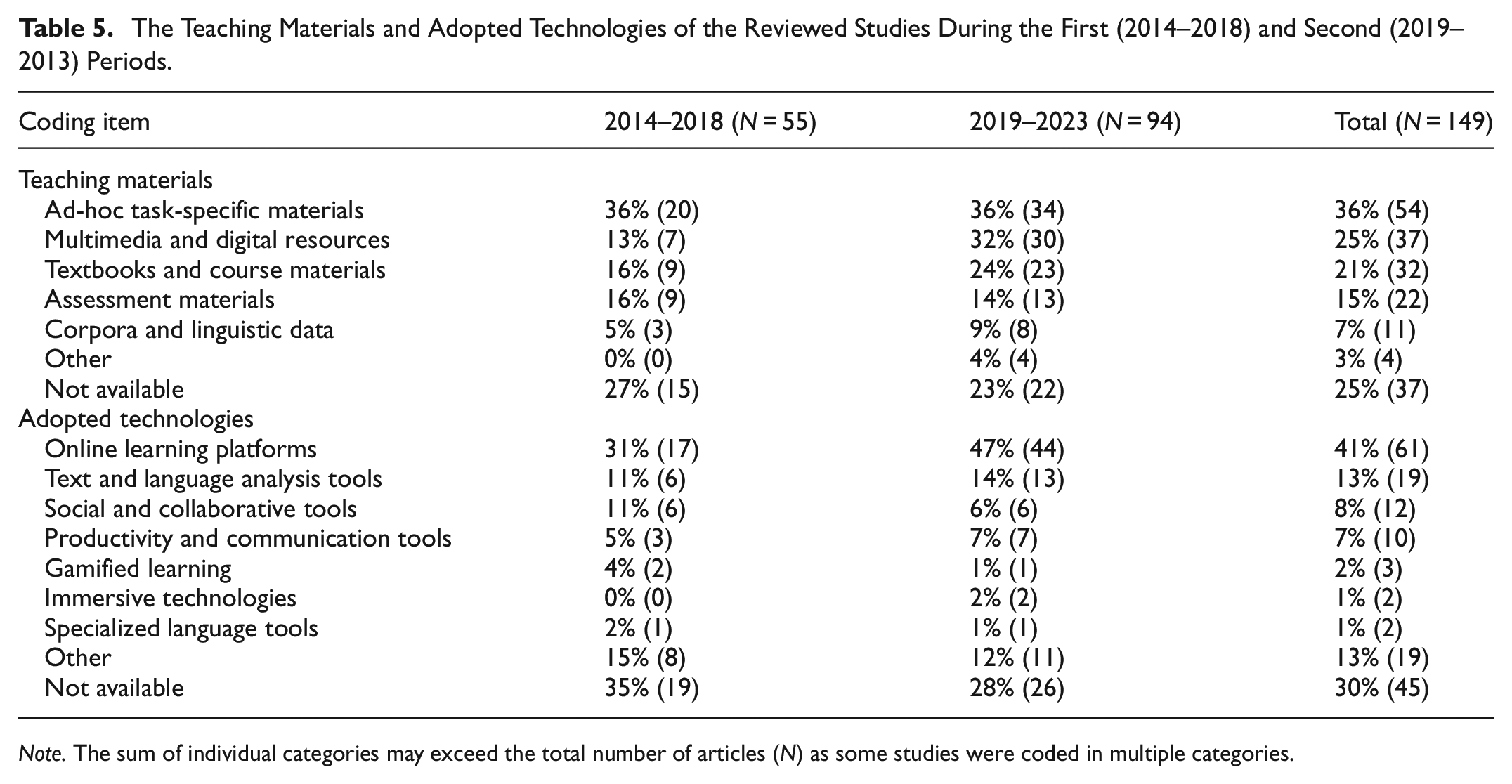
As shown in Table 5, the most prevalent category of teaching materials was tailor-made task-specific materials, featured in 36.2% of the reviewed articles. These materials ranged from argumentative essay prompts (Mazgutova & Kormos, 2015) to business meeting case studies (J. G. Wu & Miller, 2020). A notable trend was the substantial increase in the use of multimedia and digital resources, which more than doubled from 13% to 32% across the periods. This surge appears driven by the growing integration of technology in ESP instruction, with articles employing innovative resources such as virtual reality applications (V. Lin et al., 2023), digital flashcards (Xodabande et al., 2022), and video lectures (R. Zhang, 2021). Textbooks and course materials also saw an uptick in usage from 16% to 24%. Examples of this category include specialized ESP textbooks (Y.-L. Lu, 2018) and EAP coursebooks (Crosthwaite, 2017). Meanwhile, corpora and linguistic data remained underutilized, despite a slight increase from 5% to 9%, as seen in studies employing discipline-specific corpora (Therova & McKay, 2023).
The Teaching Materials and Adopted Technologies of the Reviewed Studies During the First (2014–2018) and Second (2019–2013) Periods.
Note. The sum of individual categories may exceed the total number of articles (N) as some studies were coded in multiple categories.
Tailor-made task-specific materials, which typically contain highly esoteric content unavailable in ready-made ESP textbooks and have “clear advantages in terms of authenticity and specificity” (Belcher, 2009), could enhance learner engagement and the transfer of skills to professional contexts. The dominant usage of such materials underscores the field’s commitment to authenticity and contextual relevance, a cornerstone of ESP pedagogy, although these may prove too advanced and difficult to some students (Guest & Le, 2024). Additionally, while tailor-made materials are highly valued, their development can be time-consuming and require specialized knowledge that language instructors may not possess (Antic & Milosavljevic, 2016). The surge in multimedia and digital resources echoes broader educational trends toward digital learning environments. The use of technologies such as virtual reality and online games not only caters to the digital literacy of modern learners but also provides innovative avenues for more interactive, immersive and context-rich ESP learning experiences. Despite the increased use of traditional textbooks and course materials, the relatively low adoption of corpora and linguistic data may represent a missed opportunity in ESP research. Corpus-based, data-driven methods can offer contextually rich and authentic insights into specialized language use and inform material development (Flowerdew & Petrić, 2024). Their limited adoption may reflect practical constraints, such as the time-intensive nature of corpus compilation, a lack of awareness among practitioners, or ingrained resistance to materials that deviate from the “standard” English found in traditional course books (X. Yang & Wyatt, 2021). Future research could explore integrating corpus-based approaches with other material types to enhance the efficacy and specificity of ESP instruction.
Adopted Technologies
The data on technology usage revealed a clear dominance of online learning platforms, which featured in 41% of all articles and showed a marked increase from 31% in 2014 to 2018 to 47% in 2019 to 2023. This trend is exemplified by studies like H. Zhang et al. (2022), which integrated web-based platforms with mobile apps for medical vocabulary development, and H. Liu et al. (2022), which explored flipped classroom approaches in ESP contexts. Text and language analysis tools maintained a consistent presence, appearing in 13% of articles with a slight increase from 11% to 14% over the two periods. This trend is illustrated by studies such as Alyousef (2023), which employed multiple corpus analysis software tools for examining research article abstracts. Social and collaborative Tools, while decreasing slightly from 11% to 6%, continued to play a role in ESP research, as seen in Gómez-Ortiz et al. (2023), which investigated Instagram’s potential for technical vocabulary acquisition in sports science. Notably, some categories remained underrepresented. Gamified learning (2% of articles) and immersive technologies (1% of articles) showed limited but potentially growing interest, as evidenced by studies like Soyoof et al. (2022) on serious games for vocabulary acquisition and C.-C. Hsu et al. (2022) on virtual reality in language learning. Specialized language tools (those specifically designed for ESP pedagogy), despite their relevance to ESP, appeared in only 1% of articles.
The growing prevalence of online learning platforms reflect the growing ubiquity of digital learning environments in ESP contexts and an increasing recognition of their flexibility and accessibility for ESP instruction. However, while studies like H. Zhang et al. (2022) have highlighted the benefits of such technologies, other research has revealed a more nuanced perspective. For example, Engin and Donanci (2015) noted that while the use of iPads facilitated opportunities for dialogic teaching in ESP classrooms, it also introduced challenges, especially in changing the nature of classroom talk and interaction. Moreover, the trend may also raise questions about the efficacy of fully online ESP instruction compared to traditional or blended approaches. As Gaffas (2023) points out, simply offering technical features in online platforms is not enough as a lack of meaningful social interaction can lead to isolation and a weakened sense of community. Future research should investigate the long-term impacts of this increased reliance on online platforms and explore best practices for integrating them into ESP pedagogy. The steady rise in the use of text and language analysis tools reflects the growing importance of data-driven approaches in ESP, as advocated by Boulton and Cobb (2017). Tools like WordSmith, AntConc, and MAXQDAplus demonstrate the potential of these technologies to inform curriculum design and tailor instructional materials. However, the relatively low adoption rate suggests a hesitancy to fully embrace these sophisticated tools and a potential need for continued professional development to equip ESP educators with the required technical skills.
The underrepresentation of gamified learning, immersive technologies, and specialized language tools points to potential areas for innovation in ESP research and practice. As technologies like virtual reality (VR) and artificial intelligence mature, they could offer new ways to create immersive, context-rich learning experiences in ESP contexts. The scarcity of specialized language tools, in particular, suggests a need for more research and development of tools tailored to ESP contexts (Tang, 2023). Future studies should explore how these emerging technologies can be effectively integrated into ESP curricula to enhance affordances for authentic language exposure and learner engagement.
Application Issues
Effectiveness of the Learning Intervention
As shown in Table 6, among studies that reported clear outcomes, a substantial majority (65%) demonstrated positive effects of ESP interventions. However, a considerable portion of studies (28%) reported mixed results. For example, H. Zhang et al. (2022) found varying effects of computer-assisted language teaching technologies on medical vocabulary knowledge development for second language medical students. This inconsistency reflects findings from Vlaeva and Dörnyei (2021), who emphasize that even within uniform pedagogical frameworks, students may engage with specific course components differently. Consequently, continuous monitoring is essential to ensure that all students are benefiting from the instruction. Notably, there was a scarcity of studies reporting negative effects (6%) or no significant difference (1%). A notable increase in studies reporting positive effects was observed, rising from 25% in the first period to 35% in the second. Concurrently, there was a slight decrease in studies reporting negative effects (from 4% to 2%) and an increase in those reporting mixed results (from 11% to 15%). Notably, the proportion of studies classified as “not applicable or insufficient information” decreased from 58% to 48%.
The Effectiveness, Advantages, and Challenges of the Interventions Implemented in the Reviewed Studies During the First (2014–2018) and Second (2019–2013) Periods.

Note. The sum of individual categories may exceed the total number of articles (N) as some studies were coded in multiple categories.
The predominance of positive outcomes in ESP interventions is encouraging, and aligns with previous findings on the overall positive impact of ESP instruction on learners’ linguistic and professional communication competence (Paltridge & Starfield, 2013). The increase in studies reporting positive effects might also indicate a potential refinement of ESP methodologies over time (e.g., growing sophistication of needs analysis; see Brown (2016)). However, the significant number of studies reporting mixed results highlights the nuanced nature of ESP interventions, echoing the observations of Belcher (2009), who emphasized the need for carefully designed interventions that consider various factors such as learner needs, disciplinary contexts, and technological integration. While the scarcity of studies reporting negative effects or no significant difference could be interpreted as a testament to the overall efficacy of ESP interventions, it also raises questions about potential publication bias. This phenomenon, observed in other fields of applied linguistics (Isbell et al., 2022), may suggest a need for more balanced reporting of research outcomes, where null results and unsuccessful interventions could provide valuable insights for refining ESP teaching practices and intervention design.
Advantages of the Learning Intervention
Language skill enhancement emerged as the most prevalent category, reported in 57 articles (38% of the total) and increasing from 33% of articles in 2014 to 2018 to 41% in 2019 to 2023. For instance, Mazgutova and Kormos (2015) observed improvements in lexical diversity and syntactic complexity in an intensive EAP program. Authentic and Contextualized Learning, reported in 43 articles (29% of the total), maintained a strong presence across both periods, slightly increasing from 27% to 30%. Macqueen et al. (2016) highlighted the benefits of authentic practice in patient interactions for healthcare professionals, while Smith (2020) demonstrated the effectiveness of using DIY corpora for learning accounting and finance vocabulary. Notably, there was a substantial increase in focus on learner engagement and motivation, rising from 22% to 29%. Simonova et al. (2021) found that smart approaches to ESP instruction were suitable for all motivation types and helpful for struggling students. Technological affordances also saw a significant increase, from 13% of articles in the first period to 20% in the second. Teacher development likewise gained prominence, increasing from 5% to 13%.
The findings highlight a clear trend toward prioritizing language skill development within authentic, contextualized learning environments in ESP research, aligning with the growing demand for graduates who can effectively communicate in highly specialized professional settings (Moore & Morton, 2017). The consistent emphasis on personalized and autonomous learning, learner engagement and motivation, coupled with the increase in technological affordances, points to a potential area for innovation in ESP instruction. ESP practitioners and CALL developers should consider designing adaptive learning systems that can cater to individual learner needs while providing authentic, context-specific language learning experiences. For example, Xu et al. (2020) reported improved ESP teaching skills and enhanced self-regulated learning competency through a personal learning environment approach. Such learner-centered systems could potentially address the challenge of diverse learner backgrounds and proficiency levels often encountered in ESP classrooms.
Challenges of the Learning Intervention
Pedagogical and instructional limitations emerged as the most prevalent issue, consistently representing 24% of articles across both periods. For instance, a study reported challenges in designing subtitling tasks for online platforms (Fuentes-Luque & Patrick Campbell, 2021), while another (H. Zhang et al., 2022) identified a lack of support for compensation and affective aspects of vocabulary learning in medical contexts. Learner-specific challenges showed an increase from 13% to 18%. These challenges encompass issues such as lack of motivation, engagement problems, and difficulties in adapting to new learning approaches, for example, R. L.-W. Hsu (2021). Engin and Donanci (2015) also reported technical problems and reduced class dialog in iPad-based EAP classrooms. Institutional and contextual barriers remained a significant concern, including issues such as lack of institutional support, insufficient training, inadequate teaching resources, and challenges in integrating ESP/EAP programs into broader curricula, for example, K. Wang et al. (2023). Pedagogical and instructional limitations reported are exemplified in Kampouri (2022) and R. Zhang (2021), which suggest that ESP instructors require more robust training and resources to effectively integrate domain-specific knowledge with language instruction.
The rise in learner-specific challenges, coupled with the increase in assessment and evaluation difficulties, suggests a growing recognition of the need to deal with implementation challenges in nuanced, personalized learning environments. R. L.-W. Hsu (2021), for example, observed decreasing motivation over time and difficulty creating adequate socialization in virtual environments for some students in ESP MOOCs, highlighting the importance of addressing individual learner engagement. Similarly, B. Sun and Fan (2022) noted the limitations of automated writing evaluation systems in providing feedback on content and communication in business English writing. These findings underscore the need for flexible, adaptive ESP programs that can accommodate diverse learner needs and accurately assess specialized language proficiency in specific professional or academic contexts. As pointed out by Basturkmen (2021), contextual variations often shape ESP practices: What proves effective in one setting may not be directly transferable to another, thus necessitating a localized approach to needs analysis. While technology offers potential solutions to resource limitations, it also introduces new challenges in implementation. V. Lin et al. (2023), for example, reported physical discomfort and technical issues for some users in a virtual reality-based ESP learning environment. Future research should explore how to optimize technology use in ESP contexts, addressing issues such as digital literacy and the development of ESP-specific educational technologies.
Conclusions
This systematic review of 149 empirical ESP studies published between 2014 and 2023 reveals several significant trends and gaps in the field. The analysis highlights a predominant focus on undergraduate education and Chinese-speaking participants, with a notable increase in teacher-focused studies. The research landscape is characterized by a polarization between large-scale quantitative studies and small-scale qualitative investigations. While non-experimental designs continue to dominate, the emergence of long-term and experimental studies suggests a push toward more rigorous empirical evidence. Collaborative and experiential learning approaches have emerged as preferred teaching methods, reflecting a shift toward more contextualized and learner-centered pedagogies. The review also underscores the growing influence of technology in ESP instruction, particularly through online learning platforms and multimedia resources. However, the potential of emerging technologies such as virtual reality and artificial intelligence remains largely unexplored. Research foci have gravitated toward academic and professional communication, teaching methodologies, and learner characteristics, while assessment and evaluation have received diminishing attention. The majority of studies reported positive outcomes, yet the prevalence of mixed results suggests a nuanced landscape requiring careful consideration of contextual factors.
While this review offers some insights into current trends in ESP research, it is not without limitations. The focus on SSCI-indexed journals and the reliance on specific database search terms may have excluded relevant research published in other venues or indexed using different keywords, potentially limiting the generalizability of our findings. Additionally, time and resource constraints precluded a more granular analysis of the nuances in ESP research based on the extensive coding scheme, and the interpretation of results is inevitably influenced by the researchers’ perspectives. While this review provides a macrolevel synthesis of trends in ESP research, combining quantitative analysis with qualitative examination of representative studies and offering preliminary interpretations of observed patterns, it does not delve into the motivations and decision-making processes of individual researchers. This gap could be addressed through qualitative case studies that explore how researchers design, carry out, analyze, and report their studies. Such investigations could shed light on the factors that shape ESP research and contribute to a more nuanced understanding of the field.
Our findings highlight several avenues for future research in ESP. First, there is a need to diversify participant demographics and enhance the generalizability and applicability of findings by expanding research to include participants from underrepresented linguistic and cultural contexts such as K-12 and adult vocational training, non-academic professional settings, and multilingual populations. Second, researchers should investigate the long-term impacts of technology-enhanced ESP instruction and explore innovative approaches to assessment that align with specialized ESP contexts. Finally, greater adoption of experimental and mixed-method designs could provide more robust evidence of the effectiveness of ESP interventions. Addressing these gaps will ensure that ESP research remains responsive to the evolving needs of learners and educators in an increasingly globalized and digitalized landscape.
Footnotes
Acknowledgements
The author would like to thank the postgraduate research assistants who contributed as reviewers for the articles included in this study.
Declaration of Conflicting Interests
The author(s) declared no potential conflicts of interest with respect to the research, authorship, and/or publication of this article.
Funding
The author(s) disclosed receipt of the following financial support for the research, authorship, and/or publication of this article: This study is supported by the Teaching Quality and Teaching Reform Project of Undergraduate Universities in Guangdong Province, China; the Bilingual Cognition and Development Lab, Guangdong University of Foreign Studies (grant numbers: BCD202002; BCD202203); and the MOE Project at Center for Linguistics and Applied Linguistics, Guangdong University of Foreign Studies (grant number: 22JJD740021).
Ethics Statement
Not applicable.

Data Availability Statement
Data sharing not applicable to this article as no datasets were generated or analyzed during the current study.