



Abstract
The integration of the Internet into business operations has led to the rise of cyberloafing, which involves engaging in non-work-related online activities during work hours. This study adopts a novel approach using Job Demands-Resources (JD-R) theory to explore the positive aspects of cyberloafing and its impact on employee well-being. Conducted with a sample of 255 employees from diverse sectors in the Turkish Republic of Northern Cyprus (TRNC), this study investigated how cyberloafing can reduce perceived stress, provide mental breaks, and foster creativity and innovation. Challenging traditional views that consider cyberloafing as purely counterproductive, this study posits that it can be a potential resource for enhancing well-being. Utilizing partial least squares structural equation modeling (PLS-SEM) via SmartPLS 4, the analysis revealed significant relationships between cyberloafing, stress reduction, mental relaxation, and creativity, which collectively contributed to improved employee performance and well-being. The findings suggest that under the right conditions, cyberloafing serves as an effective coping mechanism that promotes both innovation and stress relief. This study offers valuable insights for organizations by highlighting strategies to leverage the positive aspects of cyberloafing while managing its risks.
Plain language summary
This study explored how taking online breaks during work, known as cyberloafing, can have positive effects on employees. We used a model to understand how cyberloafing influences employee well-being by examining factors such as stress reduction and creativity. We surveyed 255 people from different industries and found that cyberloafing is linked to these positive outcomes. This challenges the idea that cyberloafing is always ineffective. Our findings showed that this could be beneficial for employees. By highlighting these positive effects, our study helps us to better understand cyberloafing and its impact on workers. This model provides new insights and ideas for future research and workplace policy.
Keywords
Introduction
The Internet plays a pivotal role in both individuals’ daily lives and professional endeavors, revolutionizing how work is conducted across industries. Integration of technology into the workplace has been linked to numerous benefits, including enhanced efficiency and job performance. However, it also introduces challenges, such as cyberloafing, in which employees engage in non-work-related online activities during work hours (Choi et al., 2024).
Cyberloafing, the practice of employees using company Internet access for personal, non-work-related activities during working hours, has become increasingly common in modern workplaces (Lim & Teo, 2024). Perspectives on cyberloafing are also divided. On one hand, it has been viewed as detrimental, contributing to reduced productivity and a lack of focus on organizational goals. However, emerging research suggests that cyberloafing may have positive effects on employee well-being, including reducing stress and enhancing creativity (Kalischko & Riedl, 2024). The modern work environment has evolved significantly over the past century, driven by rapid technological advancements (Kokshagina & Schneider, 2023). Employees now face complex job tasks, increased global competition, and blurred boundaries between work and personal life due to innovations such as mobile devices and high-speed Internet (Yao et al., 2023). These changes have transformed how employees engage with work, leading to new forms of behavior such as cyberloafing, which has become prevalent in technology-driven workplaces. While many organizations implement policies to restrict non-work-related Internet use, there remains a pressing need to understand cyberloafing from a more nuanced perspective, particularly its potential as a coping mechanism to alleviate stress and enhance employee creativity (Qian & Jiang, 2023).
Despite a growing body of research on cyberloafing, key gaps remain. First, much of the existing literature primarily focuses on the negative aspects of cyberloafing, emphasizing its role in reducing productivity (S. Andel et al., 2022). However, less is known about how this behavior might serve as a resource for employees, enabling them to recover from job demands and enhance their well-being. Furthermore, while the link between stress and cyberloafing has been touched upon (Shan et al., 2022), the mechanisms by which cyberloafing may reduce perceived stress and contribute to mental recovery have not been sufficiently explored. Additionally, little research has focused on how cyberloafing can foster creative thinking and problem-solving skills, which are essential for organizational innovation (Koay et al., 2022).
Understanding these dynamics is crucial for organizations that aim to foster a positive work environment while maintaining productivity. In an era in which employee well-being has become a central concern for organizational success (Onkila & Sarna, 2022), exploring how cyberloafing can potentially contribute to stress reduction and creativity is timely. This study addresses this gap by investigating the potential of cyberloafing to function as a mental break that improves employee well-being and fosters innovation. Given the substantial investment organizations make in employee welfare programs, recognizing the positive aspects of cyberloafing can provide insights into balancing productivity with mental health (She & Li, 2023).
This study makes three key contributions to the literature: First, it expands the job demands–resources (JD-R) model by positioning cyberloafing as a resource that can aid employee recovery from job demands. Traditionally seen as counterproductive behavior, this reframing offers a novel understanding of how cyberloafing can support mental breaks, relaxation, and stress reduction (Peng et al., 2023). Second, the study explores how cyberloafing can enhance creativity and problem solving, offering insights into how non-work-related online activities might promote novel and innovative thinking (Sarfraz et al., 2023; Tsai, 2023). Finally, while prior studies have focused on cyberloafing’s antecedents and its impact on performance, this study shifts the conversation to its potential benefits for employee well-being, highlighting its role in fostering a positive work environment (Kaur & Kang, 2022).
This paper addresses knowledge gaps by examining cyberloafing’s role in enhancing employee well-being through the Job Demands-Resources (JD-R) model. The JD-R model elucidates how job demands and resources impact employee outcomes such as burnout, engagement, and performance. Cyberloafing is a resource for managing work demands, potentially reducing stress, facilitating mental relaxation, and fostering creativity and innovation. A cross-sectional survey of 255 employees from six industries was conducted, and data were analyzed using partial least squares structural equation modeling (PLS-SEM) to validate the theoretical model. This analysis provides a nuanced understanding of the effects of cyberloafing on stress reduction, mental breaks, creativity, and overall well-being. The remainder of this paper is organized as follows. Section 2 reviews the literature on the JD-R model, cyberloafing, and its dual nature, highlighting the positive effects of the previous studies. Section 3 details the methodology including the survey instrument, sample characteristics, and statistical techniques. Section 4 presents empirical findings on cyberloafing’s relationship to stress reduction, mental relaxation, creativity/innovation, and well-being. Section 5 summarizes the key contributions, theoretical implications, and practical recommendations for organizations, addresses study limitations, and suggests future research directions.
Theoretical Background and Hypotheses Development
The job demands–resources (JD-R) model proposes two key mechanisms that contribute to workplace burnout: (1) high job demands, which lead to exhaustion; and (2) insufficient job resources, which result in disengagement and reduced motivation (Bakker & Demerouti, 2017). According to Demerouti and Bakker (2023) job demands include physical, psychological, social, and organizational aspects that require sustained effort, potentially leading to psychological strain.
Conversely, job resources encompass autonomy, social support, and opportunities for personal growth, which help mitigate stress, enhance motivation, and promote well-being. In applying the JD-R framework to the current study, we focused on how the concepts of cyberloafing, creativity, innovation, and employee well-being can be integrated into this model. Specifically, cyberloafing is considered a coping strategy that employees use to manage the demands of their work environments. This study conceptualizes cyberloafing as a job resource that, when appropriately managed, can serve as a tool for mental recovery and relaxation. This aligns with the JD-R model’s view that certain job resources can buffer the negative effects of high job demands (Bakker et al., 2023; Demerouti et al., 2001).
In terms of the hypotheses, this study explored the following: How cyberloafing reduces perceived stress (Hypothesis H1) and provides mental breaks (H2) are job resources in the JD-R framework that promote well-being. Creativity and innovation are positive outcomes resulting from the interaction between cyberloafing (job resources) and work-related demands (H3, H4, H6). Finally, we extend the JD-R model by examining the mediating role of perceived stress reduction and mental breaks/relaxation on the relationship between cyberloafing and employee well-being (H7a, H7b, and H7c). By situating these hypotheses within the broader JD-R framework, our study contributes to understanding how job resources, such as cyberloafing, can mitigate job demands, stimulate creative thinking, and ultimately enhance employee well-being (Parvar et al., 2022).
Cyberloafing and Perceived Stress Reduction
Perceived stress reduction refers to an individual’s subjective assessment in which their stress levels have decreased (Romagnoli et al., 2023). Rather than relying on objective measurements, it is contingent on how a person perceives and describes their stress (Arrivillaga et al., 2022). Perceived stress is highly individualized and contextual as it reflects how individuals evaluate stressful situations in their work environments. Research has demonstrated that elevated levels of workplace stress negatively affect employee well-being, job performance, and health outcomes (Lu & Zhuang, 2023).
Cyberloafing, frequently considered counterproductive, may function as a temporary escape mechanism for employees when confronted with stressful workplace situations (Jamaluddin et al., 2023). When employees engage in non-work-related online activities such as browsing social media or perusing articles, they afford a mental response that facilitates the replenishment of their cognitive resources, mitigates mental fatigue, and reduces their perceived stress (Chavan et al., 2022; Yang et al., 2022). According to the job demands–resources (JD-R) theory, job demands such as high workloads, time constraints, and conflicting tasks generate mental and physical stress for employees. However, JD-R theory postulates that job resources, including opportunities for mental breaks or recovery, can assist employees in managing these demands and mitigating stress (Demerouti & Bakker, 2023).
In this context, cyberloafing functions as a job resource that provides employees with a cognitive response to stress-inducing tasks. This resource enables them to recover mentally, thereby reducing their perceived stress levels (AlShuaibi et al., 2021). Empirical studies such as Schott and Fischer (2023) further demonstrated the role of cyberloafing in mitigating stress by providing employees with an accessible resource for managing demanding work conditions. While traditionally perceived as counterproductive, cyberloafing is increasingly recognized as a coping mechanism that can help employees disengage from stress-inducing tasks temporarily, leading to positive outcomes, such as stress reduction and well-being improvements. Grounded in the JD-R framework, we propose that employees who engage in cyberloafing experience reduced perceived stress, as this behavior provides a mental break from job demands. Therefore:
Cyberloafing and Mental Breaks and Relaxation
Regular mental breaks are essential for maintaining employees’ well-being and cognitive performance, enabling them to replenish mental resources, mitigate fatigue, and sustain productivity (Brazaitis & Satas, 2023). One method by which employees engage in these breaks is cyberloafing, which entails participating in non-work-related online activities, such as browsing the Internet or utilizing social media platforms. Cyberloafing facilitates mental detachment from work tasks, promotes relaxation, and provides respite for monotonous or cognitively demanding activities (Lim & Teo, 2024).
A significant aspect of cyberloafing is exposure to novelty and cognitive diversity. Through engagement with a broad spectrum of online content, including news, social media, and entertainment, employees encounter novel information and stimuli that refresh their cognitive processes and facilitate a sense of rejuvenation. This cognitive stimulation, distinct from routine work tasks, enables employees to resume work with enhanced focus and energy (Chen et al., 2022; Schott & Fischer, 2023). Empirical studies support this perspective, emphasizing how the variety of online activities during cyberloafing can stimulate intellectual curiosity, enhance cognitive recovery, and provide the necessary mental respite (Lim & Teo, 2024; Mercado et al., 2017).
Based on the Job Demands-Resources (JD-R) model, cyberloafing can be conceptualized as a resource that supports employees’ mental health by offering accessible cognitive relief from work demands. Within the JD-R framework, job demands (such as workload and time pressure) can lead to stress and exhaustion, whereas resources (such as mental breaks) help mitigate these negative effects. Cyberloafing functions as a resource that provides employees with the opportunity to mentally disengage and recover, thereby facilitating the management of job-related stress and maintaining well-being (Bakker et al., 2023). Therefore:
Cyberloafing and Creativity and Innovation
Employee creativity refers to the manner in which individuals approach their work, resulting in the creation of ideas, products, processes, systems, or services that are both novel and hold potential value (Opoku et al., 2022). The creative outcomes achieved by employees can expose them to various online stimuli, facilitate flexible thinking, and encourage the exploration of diverse perspectives, as well as groundbreaking and transformative ideas (Lüy et al., 2024). According to Tsai (2023), employees engaged in cyberloafing activities are exposed to a wide range of online content, including articles, videos, and discussions, which offer fresh information, perspectives, and ideas. Cognitive stimulation has the potential to spark creative thinking and encourage innovative thoughts. By engaging with diverse online content during cyberloafing, employees can broaden their knowledge, strengthen problem-solving skills, and stimulate creativity.
Cyberloafing can serve as a source of inspiration to generate novel ideas (Heidari et al., 2023). By exploring various online platforms, employees can encounter inventive concepts, trends, or solutions that can ignite their own creativity. Platforms, such as social media, online forums, and industry-specific websites facilitate the sharing of ideas and foster collaboration, allowing employees to exchange thoughts and contribute to the creation of imaginative and innovative solutions (Fu, 2024). Cyberloafing can promote divergent thinking, which is an essential aspect of generating multiple ideas and exploring unconventional solutions. Participation in online activities unrelated to work during cyberloafing can establish a psychological safety net that encourages risk-taking and experimentation, which are crucial elements in nurturing innovation (Zada et al., 2023).
Within the framework of cyberloafing, creativity, and innovation, JD-R theory provides insights into the underlying mechanisms and conditions that influence the connection between these variables (Zahmat Doost & Zhang, 2024). It is anticipated that higher levels of engagement in cyberloafing activities are linked to heightened levels of creativity and innovation within the workplace. Drawing from JD-R theory, it is possible to propose that the interplay between job demands, resources, and cyberloafing behavior influences employees’ creativity and innovation. Therefore:
Perceived Stress Reduction and Employee Well-Being
According to McDowell (2023), stress is initially defined as a nonspecific response to challenging situations. However, as research has progressed, scholars have refined the definition of stress, emphasizing that it is not solely triggered by a demand itself, but rather by an individual’s evaluation or appraisal of that demand. Stress can hinder cognitive functioning and affect memory, attention, and decision-making capabilities (Yilmaz & Kafadar, 2022). However, when employees experience a decrease in perceived stress levels, they can enhance their ability to concentrate, improve cognitive performance, and refine problem-solving skills (Nixon et al., 2022). With reduced stress levels, employees are better equipped to think with clarity, make sound decisions, and carry out tasks more effectively, thus fostering a sense of cognitive well-being (Kwala & Agoyi, 2024).
Whenever employees sense a reduction in tension, it has a positive effect on their psychological health (Flood et al., 2022). Reducing stress can ameliorate feelings of anxiety, tension, and being overwhelmed, leading to an improvement in mood, a boost in self-esteem, and an overall sense of psychological wellbeing. When employees perceive less tension, they are more likely to experience positive emotions, such as happiness and contentment (Tran et al., 2022).
According to JD-R theory, employees face job demands and resources that impact their well-being and performance (Bakker & Demerouti, 2017). A reduction in perceived stress indicates that job demands have been effectively managed. This perception reflects a positive assessment of the work environment and ability to cope with job demands. Job resources are crucial for lowering perceived stress levels. Access to job resources enables employees to handle demands better and reduce stress (Bakker et al., 2023). For example, social support from colleagues or supervisors provides emotional aid and guidance, helping employees to manage job stressors more effectively (Ersoy et al., 2023). It is postulated that reduced perceived stress enhances overall well-being, with greater stress reduction correlating with improved employee well-being. Therefore:
Mental Breaks/Relaxation and Employee Well-Being
Detaching from work is of utmost importance and has been highlighted in various theoretical frameworks (Bryson et al., 2015; Cropley et al., 2023; Daraba et al., 2021). As an illustration, (Hoover et al., 2022) propose in their Effort-Recovery model that the exertion of energy during demanding work depletes crucial psychological and physical resources, which can only be replenished through adequate rest. (Petsnik & Vorauer, 2023) contends that individuals possess an inherent drive that compels them to generate, nurture, and safeguard personal resources necessary for survival, as well as to enhance self-esteem and overall well-being.
According to Gellmers and Yan (2023), while excessive indulgence in cyberloafing can have negative consequences on productivity, adopting a controlled and purposeful approach to cyberloafing can actually function as a self-regulatory strategy. Engaging in planned mental breaks and participating in relaxation activities through cyberloafing can aid employees in managing their cognitive resources, preventing decision fatigue, and ultimately enhancing overall productivity (Jiang et al., 2023). By striking a healthy balance between work responsibilities and short bouts of cyberloafing, employees can cultivate a greater sense of well-being and improve their job performance. Cyberloafing can facilitate the psychological detachment from work, which is vital for employee well-being. By mentally disengaging from stressors associated with work and immersing themselves in enjoyable online activities, employees can momentarily escape job demands and experience a state of relaxation (Khan et al., 2023). In order to reduce stress and facilitate recovery, incorporating mental breaks and relaxation into one’s routine is essential. Based on a study by He and Liu (2022), deliberately setting aside time for mental breaks, employees can detach themselves from the pressures of work, allowing their cognitive resources to recharge. Engaging in relaxation activities additionally promotes the renewal of both psychological and physical well-being, enabling individuals to effectively manage stress and enhance their overall sense of wellness (Hoover et al., 2022).
It is hypothesized that actively integrating mental breaks and relaxation into employees’ routines will result in a perceived decrease in stress levels. This, in turn, is anticipated to have a positive impact on multiple dimensions of well-being, such as work-life balance (He & Liu, 2022), overall life satisfaction, psychological well-being, and decreased burnout (Bryson et al., 2015). Consequently, it is expected that employees who deliberately prioritize and engage in intentional mental breaks and relaxation techniques will experience higher levels of well-being in comparison to those who do not prioritize such activities. Therefore:
Creativity and Innovation and Employee Well-Being
Creativity plays a crucial role in gaining a competitive edge and achieving long-term success in today’s fast-paced and fiercely competitive business landscape. Frequently, when employees demonstrate creativity in their work, they generate ideas that bring value to the organization (Wang et al., 2022). Given that employee creativity is a vital driver of enterprise innovation, it effectively fosters organizational development. Moreover, as creativity fuels innovation, growth, and competitiveness, most companies heavily invest in identifying effective strategies to encourage and nurture employee creativity (Ersoy et al., 2023). Furthermore, involving in creative and innovative endeavors within the workplace can evoke positive emotions and a profound sense of fulfillment, amplify employees’ feelings of purpose and autonomy, both of which are critical for their overall well-being. When employees have the opportunity to unleash their creativity, they generate fresh ideas, and contribute to innovative projects, which in turn, can significantly enhance their psychological well-being and also cultivate their creative abilities, participate in innovative projects, fostering a sense of competence and personal growth (Flood et al., 2022; Khassawneh et al., 2022). The pursuit of creativity and innovation often necessitates a certain degree of autonomy and the freedom to explore new possibilities (Mäntymäki et al., 2019). Consequently, this can have a positive influence on their well-being by instilling a sense of accomplishment and ongoing development. The association between creativity, innovation, and positive outcomes extends to enhanced job satisfaction, increased engagement, and improved psychological well-being (Flocco et al., 2022).
The creative orientation of employees holds significant value for organizations, enabling them to swiftly adapt to unpredictable environmental conditions, maintain progress in dynamic contexts, and proactively cultivate new skills and approaches (Kilic & Gök, 2022). When employees perceive their creative contributions as valuable, have access to essential resources and support, and receive recognition for their innovative endeavors, it cultivates a positive work environment that enhances overall well-being (Koroglu & Ozmen, 2021). It is postulated that employees who actively participate in creative and innovative activities in their work will experience elevated levels of well-being in comparison to those who face limited opportunities for creativity and innovation. Therefore:
Recovery Experiences Serve as Mediators
Drawing from existing research and integrating the Job Demands-Resources (JD-R) theory, we propose a hypothesis that explores the mediating effects of cyberloafing activities outside of employees’ designated work hours on their well-being (Demerouti & Bakker, 2023). This relationship is influenced by factors including the reduction of perceived stress, opportunities for mental breaks and relaxation, and stimulation of creativity and innovation, which has not been implemented in any past study. This means that moderate engagement in cyberloafing activities can have advantages, while excessive or insufficient involvement can lead to detrimental outcomes (She & Li, 2023; Wu, Mei, Ugrin, et al., 2020).
Previous study by Amponsah-Tawiah et al. (2023) have indicated that engaging in cyberloafing outside of work hours can generate positive emotions. These positive emotions, as a result of cyberloafing, have the potential to reduce perceived stress levels and promote a sense of relaxation and mental rejuvenation among employees (Chan et al., 2022; Peng et al., 2023). Additionally, participating in cyberloafing activities can facilitate creativity and innovation by offering employees the chance to explore, encounter new ideas, and engage in cognitive stimulation (She & Li, 2023). The mediating factors, including perceived stress reduction, mental breaks and relaxation, and creativity/innovation, play a crucial role in promoting employee recovery and improving their overall well-being and productivity (Junça-Silva & Mendes, 2023) Perceived stress reduction serves to alleviate the adverse effects of work-related stressors, leading to enhanced well-being among employees. Taking mental breaks and participating in relaxation activities during cyberloafing offer employees valuable downtime, contributing to their recovery process and positively influencing their well-being. Furthermore, the cultivation of creative and innovative thinking during cyberloafing can contribute positively to employee well-being by fostering a sense of fulfillment and achievement (Mishra & Tageja, 2022; Tsai, 2023; Wu, Mei, Ugrin, et al., 2020). As a result, we hypothesize that when employees experience a reduction in stress levels, engage in mental breaks and relaxation, and exhibit creativity and innovation, the negative impact of demanding job conditions on employee well-being will be alleviated. Higher levels of perceived stress reduction, mental breaks, and creativity will be associated with elevated levels of employee well-being (Kapoor et al., 2021).
Engaging in cyberloafing activities can contribute to the reduction of perceived stress levels, which subsequently has a positive effect on well-being. Taking brief breaks through cyberloafing enables employees to unwind and rejuvenate, ultimately fostering their well-being. Additionally, participating in cyberloafing activities that involve exploring various online content or engaging in online communities can stimulate employees’ creativity and inspire innovative ideas, thereby enhancing their overall well-being. Therefore:
Methodology
Participants and Procedures
The participants were recruited from diverse employment backgrounds, including full-time and part-time employees, contract workers, and freelancers (Table 1). These participants were employed across six established organizations in North Cyprus. The organizations comprised both private comprehensive service businesses and public-sector entities. Survey respondents represented a broad spectrum of job levels, ranging from entry-level positions, such as clerks, front desk receptionists, and call-center employees, to managerial and executive roles, thus ensuring a comprehensive and representative workforce sample. To address the issue of potential bias, we implemented a random sampling method, a widely accepted approach in cyberloafing literature (S. A. Andel et al., 2019; Lim & Teo, 2024). This method ensured that the participants were selected impartially and represented various sectors and job roles. Upon identifying the primary participants, we procured a list of employee names from the human resource departments of the selected organizations. These employees were contacted individually and informed of the research objectives, followed by verification of their job-related information, such as their access to the internet at work. Consent was subsequently obtained from those willing to participate, thereby establishing them as primary participants of the study. Subsequently, we employed a random selection process to identify a coworker for each main participant, to serve as an additional data source. This process is crucial for maintaining the integrity of data and minimizing selection bias. The coworkers were randomly selected from the same organizational department as the main participants. The selection process stipulated that the chosen coworkers met the following criteria: (1) they worked in close proximity to the primary participant (either physically or virtually), and (2) they were in a position to observe the main participant’s work behaviors. This ensured that the coworkers’ observations were relevant and reliable, thus providing an additional layer of validation for the data.
Demography of Participants.

To enhance the reliability of the data, surveys were administered using Microsoft Forms over a 5-month period. Both the primary participants and their randomly selected colleagues were assigned unique identification numbers to ensure consistent data alignment, while maintaining confidentiality. All participants were assured that their responses would be treated with strict confidentiality and utilized solely for academic research purposes, thus encouraging veracious and unbiased responses. Through the implementation of random sampling techniques and the selection of coworker observations from individuals in close proximity to primary participants, we mitigated the potential for selection bias and ensured that the observations were objective and predicated on firsthand knowledge of primary participants’ behaviors. Heterogeneity in job roles, industries, and the randomized coworker selection process collectively contributed to the robustness and reliability of the data. In the employee sample, 43.1% were male and 54.9% were female. Regarding educational qualifications, 21.2% had a high school diploma/GED, 14.1% had an associate’s degree, 27.8% had a bachelor’s degree, 31.8% had a master’s degree, and 5.1% had a doctoral degree.
Time Frame and Data Collection
Data collection for this study spanned from February 2022 to March 2023 and lasted over a year. Despite the potential variability arising from changes in work environments, organizational policies, or external events during this period, several justifications supported the extended timeline, and measures were taken to minimize biases. Our diverse sample, including employees from various industries and roles in North Cyprus, requires an extended timeframe for an adequate representation. The participants came from the public and private sectors, encompassing full-time, part-time, freelancers, and contract workers. Owing to varied employment arrangements and seasonal industry demands, prolonged data collection was necessary to achieve the desired sample size and ensure a comprehensive representation of all employment categories. Second, the post-pandemic work environment required a longer timeline. The rise of hybrid and remote work has necessitated capturing a wide range of work behaviors, including cyberloafing, in various organizational contexts. Extending the data collection period allowed these evolving practices to be included, enhancing the generalizability of the study (Hessari et al., 2024).
Furthermore, extending the timeframe mitigated non-response bias, as some participants needed more time due to work, leave, or personal commitments. Lengthening the data collection period increased the response rate, reduced nonresponse bias, and ensured a more representative sample. To address potential temporal biases, we maintained a consistent measurement approach throughout the data collection. The survey instrument, procedures, and recruitment strategies remained unchanged, ensuring identical conditions for all the participants. A time-lag analysis examined the differences between early and late responses. This analysis found no significant temporal effects on key variables, such as cyberloafing behavior or employee well-being, indicating data stability throughout the collection period.
Ethical Considerations
Limiting Risk of Harm to Participants
The study design prioritized participant safety by employing non-invasive data collection methods and excluding physically or emotionally distressing procedures. All data were anonymized and personal identifiers were removed to ensure confidentiality. Given the sensitive nature of the topic (employee well-being), trained researchers monitored the participants for signs of distress, provided debriefing materials, and offered referrals to support services when necessary. The study protocol was rigorously reviewed and approved by the Cyprus International University Review Board (Ethics Approval Number: EKK22-23/016/003), which confirmed that risks were minimal and justifiables.
Benefit-Risk Balance
The potential benefits of this research, both societal and participant, outweigh the identified risks. This study explores the role of cyberloafing in enhancing employee well-being through the job demands–resources (JD-R) model, which examines how job demands and resources influence outcomes, such as burnout, engagement, and performance. The findings aim to inform policy and practice, with results made openly accessible to maximize their impact. The participants were informed of their contributions to advancing multidisciplinary knowledge in this field. Risks were mitigated through design safeguards, including voluntary participation and opt-out options and were deemed no greater than those encountered in daily life or routine medical/psychological procedures.
Informed Consent Process
Informed consent was obtained from all participants. They received detailed written and oral explanations of the study purpose, procedures, potential risks, benefits, and confidentiality measures. Participants were assured of their right to withdraw from the study at any time without penalties.
Measures
Figure 1 illustrates the research model utilized in this study, which comprises five variables: cyberloafing, perceived stress reduction, mental breaks and relaxation, creativity and innovation, and employee well-being. To assess these variables, we adopted established questionnaires previously used by other researchers. These questionnaires have demonstrated good reliability and validity, ensuring their effectiveness in measuring the intended variables.

Proposed research model.
Cyberloafing
To evaluate cyberloafing, we utilized a scale consisting of six items that was developed by Wu, Mei, Liu, et al. (2020). This scale was previously employed in a recent empirical study focusing on employees engaging in cyberloafing, where it demonstrated a high level of reliability, as evidenced by Lim (2002). Moreover, to the best of our knowledge, this scale is the most up-to-date and concise instrument available to measure cyberloafing. Some example statements from the scale include “When I need to take a break from work, I use social media (e.g.,) during working hours.” and “I browse investment-related websites that are unrelated to my work during working hours.” In our study, Cronbach’s α coefficient for this scale was .904, indicating a high level of internal consistency.
Perceived Stress Reduction
To evaluate perceived stress reduction, we employed a scale consisting of five items developed by Cohen et al. (1983) and previously used by Arrivillaga et al. (2022). Kapoor et al. (2021) establish the scale’s good dependability in empirical research of employee stress. The scale includes statements like “Browsing social media helps reduce the stress I feel from my job responsibilities.” and “When I engage in online browsing, I feel less overwhelmed by work-related tasks.” In our study, Cronbach’s α coefficient for this scale was .892, indicating a strong level of internal consistency.
Mental Breaks and Relaxation
Mental breaks and relaxation were assessed using a five-item scale adapted from the work of Sonnentag and Fritz (2007). Sample items from this scale included statements such as “Engaging with social media allows me to mentally detach from work-related stress.”
“When I use social media, I feel like I can switch off from my job and relax.” In our study, the Cronbach’s α coefficient for this scale was .842, indicating good internal consistency.
Creativity and Innovation
To evaluate employee creativity and innovation, we used a scale comprising six items developed by Kaufman (2012). This scale has been validated in several studies examining the association between daily cyberloafing and creativity, as exemplified by Tsai (2023). Example statements from the scale included items such as “Browsing social media makes me feel accomplished to engage in creative works” and “It makes me feel satisfied to engage in creative works.” In our study, Cronbach’s α coefficient for this scale was .942, indicating a high level of internal consistency.
Employee Well-Being
To evaluate employee well-being, we employed a five-item scale adapted from Tennant et al. (2007) and previously used by Stewart-Brown et al. (2021). Sample statements from this scale included items such as “I feel a sense of job satisfaction when I can take short breaks to engage in personal internet use at work.” and “Having the flexibility to use the internet for personal reasons during work hours contributes to my work-life balance.” In our study, Cronbach’s α coefficient for this scale was .829, indicating a satisfactory level of internal consistency.
Results
In this study, we employed structural equation modeling (SEM) using the Partial Least Squares (PLS) approach implemented via SmartPLS version 4 (Ringle et al., 2012). PLS-SEM was chosen because it is particularly well suited for predictive modeling and theory development, as noted by Reinartz et al. (2009). Their simulations demonstrated that PLS-SEM is more efficient in terms of statistical power, requiring only approximately half as many observations as Covariance-Based SEM (CBSEM) to achieve comparable results. This makes it ideal for studies with limited sample sizes or where prediction is the key focus. In alignment with the recommendations of Gefen et al. (2011), we ensured that the statistical power of our model met the minimum acceptable threshold of 80%, which is widely recognized as the standard in social science research.
To test the measurement and structural models, we used SmartPLS 4.0, applying 5,000 bootstrap resamples to rigorously assess the robustness of the path coefficients. This technique allowed us to calculate bias-corrected 95% confidence intervals (CIs) for indirect effects, enhancing the precision of our results and ensuring that the findings were not overly influenced by sampling fluctuations. Additionally, we performed a thorough evaluation of the model’s validity, adhering to the key criteria suggested by J. Hair et al. (2017). Specifically, we tested for convergent validity, which assesses the degree to which multiple indicators measure the same construct, and discriminant validity, which ensures that the constructs in the model are sufficiently distinct from one another.
Furthermore, we examined measurement invariance, a crucial step in confirming that the constructs are consistently measured across different groups or conditions, thereby enhancing the generalizability of the results (Dong & Dumas, 2020). Through this rigorous methodological approach, we ensured that both the reliability and validity of our findings were sound, offering a robust foundation for interpreting the relationships between cyberloafing, employee well-being, and their mediating variables. This methodological rigor is crucial for enhancing the credibility of the results and the theoretical contributions they offer to the field of organizational behavior.
Measurement Model
Assessing reflective measurement models comprises the examination of internal consistency reliability as well as the determination of convergent validity and discriminant validity, as outlined by J. Hair et al. (2017).
Convergent Validity
The loadings of items, composite reliability of individual scales, and average variance extracted for each construct were evaluated to determine convergent validity, as shown in Table 2. According to J. F. Hair et al. (2020), loadings with standardized values greater than 0.707% and AVE values greater than 0.5 according to Fornell and Larcker (1981), are the recommended benchmarks. Consequently, particular items (e.g., CY7, PSR6, EWB6) were omitted because their loadings were less than 0.707%. Both datasets meet or exceed the prescribed 0.70 threshold for reliabilities, items, and composites, as shown by the results. Additionally, the AVE values exceeded the recommended threshold of 0.5. This indicates that the scales used to predict cyberloafing behavior possess an adequate level of convergent validity (Table 4).
Internal Consistency and Convergent Validity.
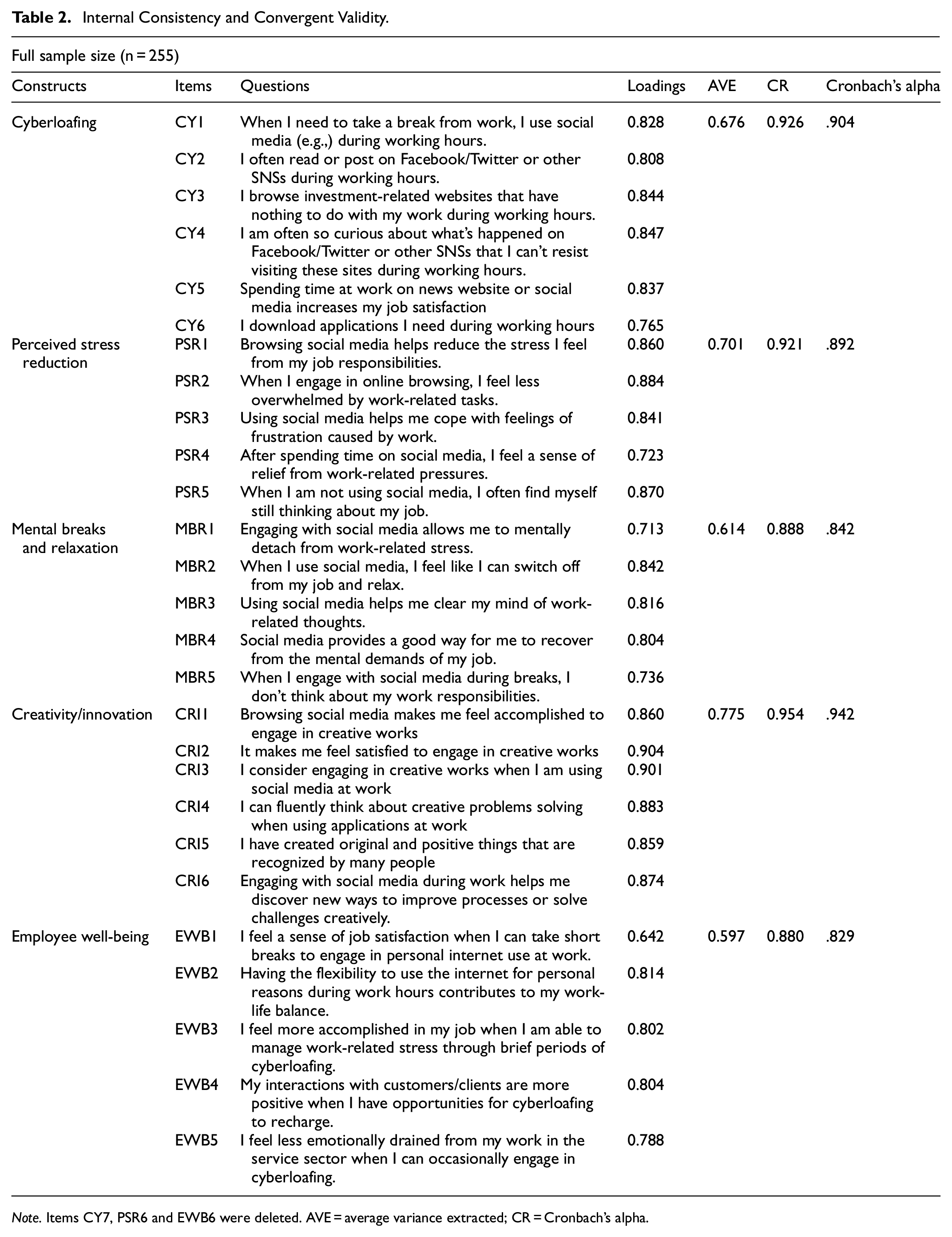
Note. Items CY7, PSR6 and EWB6 were deleted. AVE = average variance extracted; CR = Cronbach’s alpha.
Discriminant Validity
The evaluation of discriminant validity involves comparing the pairwise correlation among factors with the variance extracted, following the method introduced by Fornell and Larcker (1981). Discriminant validity is confirmed when the diagonal values in the corresponding rows and columns are significantly greater than the off-diagonal elements. In addition to Fornell and Larcker’s criterion, we also employed the Heterotrait-Monotrait Ratio (HTMT) criterion (Henseler et al., 2015). The diagonal values in Table 3 represent the square root of the AVE values for each factor. The results demonstrate that all the constructs display discriminant validity.
Fornell-Larcker Criterion.

Note. The values on the diagonal (italicized) indicate the square root of the AVE (Average Variance Extracted), while the correlations are represented by the off-diagonal values.
Structural Model
To evaluate the statistical significance of the path analysis, a nonparametric bootstrapping procedure with 5,000 re-samples was conducted using the Smart PLS. As recommended by Chin (1998), this approach ensures stable parameter estimates and provides reliable confidence intervals. The structural model illustrated in Figure 2 explains approximately 11.7% of the variance in the endogenous variable, specifically, cyberloafing. Additionally, the goodness-of-fit of the model was assessed using the standardized root mean square residual (SRMR) criterion. A value below 0.08 is generally considered indicative of an acceptable approximate fit for PLS path models, as suggested by Henseler et al. (2015). In this study, the SRMR value obtained was 0.058, indicating a satisfactory model fit.

Test results of structural models.
Based on previous research and hypotheses, all factors in this study are believed to have a positive effect on behavior. The significance of all paths was confirmed at a 0.01 level. The bootstrapping results presented in Tables 4 and 5 provide empirical support for all hypothesized relationships. Specifically, a significant positive relationship was found between cyberloafing and perceived stress reduction, with a path coefficient (β) of .695 and t-value of 18.058 at ρ < 0.01, confirming H1. Therefore, it can be concluded that cyberloafing is likely to intensify the perceived stress reduction among employees.
Heterotrait–Monotrait Ratio (HTMT) Criterion.

Summary of the Structural Model.

Note. CRI = creativity/innovation; EWB = employee well-being; CY = cyberloafing; MBR = mental break/relaxation; PSR = perceived stress reduction.
p < .01. *p < .05.
Furthermore, the results support H2, indicating that cyberloafing contributes to higher levels of employee mental health and relaxation. The path coefficient (β) was .447 with a t-value of 7.568 at ρ < 0.01. H3 was also supported, revealing that increased levels of cyberloafing are associated with higher levels of creativity and innovation in employees, with a path coefficient (β) of .686 and t-value of 19.937 at ρ < 0.01. Similarly, H4 indicating that perceived stress relief leads to a higher level of employee well-being, as indicated by a path coefficient (β) of .223 and t-value of 2.445 at ρ < 0.05. Additionally, H5 demonstrated that mental breaks and relaxation are linked to higher levels of employee well-being, with a path coefficient (β) of .271 and t-value of 3.714 at ρ < 0.01. Hypothesis 6 was supported, as evidenced by a path coefficient (β) of .317 and t-value of 3.198 at a significance level of ρ < 0.01.
In addition, the findings of this study support Hypotheses H7a, H7b, and H7c. Specifically, the results indicate that cyberloafing plays a partial mediating role in the associations between perceived stress reduction and employee well-being; mental breaks and employee well-being; and creativity, innovation, and employee well-being, respectively. The indirect effects of H7a (0.155 and t-values of 2.329 at p < .05), H7b (0.121 and t-values of 2.891 at ρ < 0.05), and H7c (0.218 and t-values of 3.125 at ρ < 0.05) provide evidence of the stated claims. Nitzl et al. (2016) underscored the significance of the impact of private demand on cyberloafing.
Mediation Effect Testing
To assess the significance of the mediation effects in the structural model, both the Sobel test and Variance Accounted For (VAF) method were employed (Birant et al., 2024). The Sobel test was used to determine whether the mediating variables Perceived Stress Reduction (PSR), Mental Break and Relaxation (MBR), and Creativity and Innovation (CRI) significantly mediated the relationship between cyberloafing (CY) and Employee Well-being (EWB).
Sobel Test
The Sobel test results indicated that all three mediation paths exhibited statistically significant mediation effects: CY → PSR → EWB: z = 2.43, significant at p < .05, CY → MBR → EWB: z = 3.33, significant at p < .01 and CY → CRI → EWB: z = 3.16, significant at p < .01
These findings suggest that PSR, MBR, and CRI significantly mediate the effect of cyberloafing on employee well-being.
Variance Accounted for (VAF)
In addition to the Sobel test, the Variance Accounted For (VAF) was calculated to determine the proportion of the total effect of each mediating variable (Deb et al., 2023). The indirect effects of each mediation pathway were computed as follows: CY → PSR → EWB: Indirect Effect = 0.155, CY → MBR → EWB: Indirect Effect = 0.121, CY → CRI → EWB: Indirect Effect = 0.217.
As no significant direct effect was identified for the relationship between CY and EWB, VAF was calculated with the assumption that the total effect is entirely mediated by indirect effects. This yielded a VAF of 1.0 for each mediation pathway, indicating that the mediating variables fully explained the relationship between cyberloafing and employee well-being. The results of both the Sobel test and VAF analysis provide substantial evidence for the mediating role of PSR, MBR, and CRI in the relationship between cyberloafing and employee well-being.
Discussion
This study provides robust evidence of the intricate relationships between cyberloafing (CY), employee well-being (EWB), and intermediary factors of perceived stress reduction (PSR), mental breaks and relaxation (MBR), and creativity and innovation (CRI). In accordance with previous research (Bakker et al., 2023; Liu & Zhang, 2022; Zada et al., 2023; Zhang et al., 2022), our findings indicate that engaging in cyberloafing behaviors can provide employees with essential mental breaks and relaxation periods, reduce stress, and enhance creativity, all of which can significantly contribute to their overall well-being. The path analysis results provided robust statistical evidence for these relationships. The impact of cyberloafing on perceived stress reduction (H1: CY → PSR) was significant (β = .695, p < .01, T = 18.058), indicating that cyberloafing played a crucial role in mitigating workplace stress. This finding aligns with those of (Wu, Mei, Liu, et al., 2020), who observed that cyberloafing enables employees to manage job demands by offering temporary psychological respite. Similarly, cyberloafing had a positive effect on mental breaks and relaxation (H2: CY → MBR, β = .447, p < .01, T = 7.568), creativity, and innovation (H3: CY → CRI, β = .686, p < .01, T = 19.937). These results corroborate the findings of (Kapoor et al., 2021; Tsai, 2023) who posited that brief interruptions at work facilitate cognitive refreshment and creative thinking. From a theoretical perspective, the findings align with Job Demands-Resources (JD-R) theory, as cyberloafing is identified as a behavior that can mitigate job demands by providing essential resources such as stress reduction and mental breaks. However, Zhang et al. (2022) have conceptualized cyberloafing as a counterproductive behavior. Our findings challenge this notion by demonstrating that cyberloafing can function as a critical job resource to enhance employee well-being through stress relief (H4: PSR → EWB; β = .223, p < .05, T = 2.445) and mental relaxation (H5: MBR → EWB; β = .271, p < .01, T = 3.714). These results emphasize the importance of viewing cyberloafing not just as a behavior to be managed or eliminated but also as a potential tool for fostering employee well-being. For instance, Mishra and Tageja (2022) found that providing employees with mental breaks is vital for managing workplace stress. Our study further confirms this by demonstrating that mental breaks (facilitated through cyberloafing) significantly contribute to employee well-being. Moreover, creativity and innovation were identified as crucial mediators in the relationship between cyberloafing and employee well-being. The direct impact of creativity on well-being (H6: CRI → EWB, β = .317, p < .01, T = 3.198) underscores the significance of providing employees with the cognitive space to engage in creative tasks, corroborating the findings of Tsai (2023) and Wu, Mei, Liu, et al. (2020), who emphasized the role of innovation in enhancing job satisfaction and overall well-being. The findings of the structural model analysis for these organizations are illustrated in Figure 2, revealing that all paths exhibited statistical significance at the .01 level. The factors of perceived stress reduction, mental breaks and relaxation, and creativity and innovation collectively explained 48.3%, 47%, and 20% of the variability in cyberloafing behavior. Furthermore, the overall well-being of employees demonstrates a 50% variation that can be attributed to factors such as the perception of reduced stress, opportunities for mental breaks and relaxation, fostering creativity, and promoting innovation within an organizational setting. The results of the present analysis are supported by those of prior research conducted by Kapoor et al. (2021), Koroglu and Ozmen (2021), and He and Liu (2022) to enhance the reliability and validity of these findings
Practical Implication of Research
Studies on the relationships among cyberloafing, employee well-being, and the mediating variables of perceived stress reduction, mental breaks and relaxation, and creativity and innovation have received limited attention in organizational behavior research (Sarfraz et al., 2023). The practical implications of this study demonstrate that engaging in cyberloafing activities can provide a temporary escape from work-related stressors, resulting in reduced stress levels (Mishra & Tageja, 2022). Perceived stress reduction positively influences employee well-being. Cyberloafing serves as a mental break, offering opportunities for employees to recharge and experience relaxation, which contributes to enhanced well-being (Wu et al., 2020). Furthermore, these activities stimulate creativity and innovation by exposing employees to new ideas and perspectives (Tsai, 2023). The combination of relaxation and mental breaks facilitated by cyberloafing enhances creative thinking and problem-solving abilities, further benefiting employee well-being. Cropley et al. (2023) emphasized the importance of incorporating brief mental breaks, particularly through cyberloafing, to improve employees’ psychological welfare, reduce work-related stress, and enhance job satisfaction. These positive outcomes contribute to overall well-being. Therefore, this study offers significant insights for organizations to understand the key factors that influence cyberloafing behavior. By applying the JD-R model, this study integrates divergent findings and positions cyberloafing as a coping strategy for managing job demands and mitigating perceived stress.
Study Contributions
This study makes several contributions to the extant literature on workplace dynamics, specifically regarding the role of cyberloafing and its effects on employee well-being and creativity. While previous research has predominantly emphasized the negative consequences of cyberloafing, such as reduced productivity and misuse of resources, this study offers a more nuanced perspective by exploring its potential benefits through the lens of the Job Demands-Resources (JD-R) model. A significant contribution of this research lies in its reconceptualization of cyberloafing as a job resource rather than solely as a detrimental behavior. Through an examination of its positive aspects, particularly in terms of perceived stress reduction (PSR) and mental breaks and relaxation (MBR), this study demonstrates how these behaviors can function as recuperative mechanisms to assist employees in managing workplace demands. Consequently, this study presents a novel perspective on how minor distractions such as cyberloafing can enhance employee resilience and overall well-being (EWB). Furthermore, this study makes a novel contribution by investigating creativity as a mediating factor in the relationship between cyberloafing and employee well-being. While creativity has been examined in various organizational contexts, its role as a mediator in this specific context has been largely overlooked. By incorporating creativity and innovation into the JD-R model, this study elucidates how mental breaks through cyberloafing can stimulate creative thinking, which in turn positively influences employee well-being. This insight adds a significant dimension to the understanding of how employees can utilize brief interruptions to enhance creativity and innovation, ultimately benefiting both themselves and their organizations.
Limitations and Future Research Recommendations
Similar to any academic study, this study had inherent limitations. First, the generalizability of our findings is limited. While this study draws on data from a sample of employees across multiple service sectors, it may not fully capture the nuances of cyberloafing behaviors in other organizational contexts, particularly those outside the service industry or from different cultural settings. This limits the extent to which the results can be applied to professional employees in underrepresented geographic regions. Future research could expand this by including more diverse samples from various industries and countries to increase the external validity of the findings.
Second, the cross-sectional design of this study presents another limitation. The data collected at a single point in time offer only a snapshot of the relationships between cyberloafing, employee well-being, creativity, and other variables. As a result, this study cannot establish causal relationships or observe how these dynamics might evolve over time. Future studies may benefit from adopting longitudinal designs to explore the temporal progression of cyberloafing behaviors and their effects on employee outcomes. By tracking changes in variables over time, future research could provide a more robust understanding of how cyberloafing influences well-being and creativity across different stages of work life fees.
Additionally, while this study focused on the positive aspects of cyberloafing, such as mental breaks and creativity, individual differences or situational factors may moderate these outcomes. For instance, personal traits, such as self-control, job satisfaction, and stress tolerance, might influence how employees engage in and benefit from cyberloafing. Future research could delve deeper into individual differences to identify which employees are more likely to experience the positive versus negative effects of cyberloafing. Exploring the roles of personality traits, emotional intelligence, and motivation could provide further insights into the impact of cyberloafing on well-being.
Finally, given the growing prevalence of remote and hybrid work models, future research should investigate how cyberloafing manifests in different work environments. The flexibility and autonomy afforded by remote work may lead to higher rates of cyberloafing, but it is unclear how this affects employee well-being, productivity, and creativity compared to traditional office settings. Examining the impact of organizational policies, Internet monitoring practices, and employee autonomy on cyberloafing in remote work contexts could offer valuable insights for organizations navigating digital workspaces.
Conclusion
A comprehensive conceptual framework incorporating the Job Demands-Resources (JD-R) model was constructed to provide deeper insights into the phenomenon of cyberloafing, employee well-being, and mediating processes, thereby fulfilling the primary research objectives and addressing key research questions. This study demonstrated that extended behavioral models, such as the JD-R theory, offer greater explanatory power for understanding cyberloafing behavior within organizations. These findings align with those of previous research and contribute to the growing body of literature on this subject. By leveraging the JD-R theory and advanced techniques such as SmartPLS, commonly used by academics worldwide, this study evaluated the key factors driving cyberloafing behavior. The results underscore the predictive power of the JD-R model, with its five key behavioral factors—perceived stress reduction, mental breaks, relaxation, creativity, and innovation—emerging as significant contributors to employee well-being. These factors exhibited high path coefficients, highlighting their critical role in fostering employee well-being within the organizational context. The study also emphasizes the complexity of prioritizing individual and situational factors in predicting employee well-being, especially when considering personal traits and their relationship with non-work-related digital activities. The novel findings of this study provide a deeper understanding of the intricate relationship between cyberloafing, well-being, and mediating factors, such as stress relief, mental relaxation, and creative engagement. Moreover, the study identifies the conditions under which cyberloafing positively influences creative thinking and problem solving, both of which are vital to organizational success.
Footnotes

Ethical Considerations (Institution Name and Study Reference Number)
All procedures performed in studies involving human participants were in accordance with the ethical standards of the institutional and/or national research committee and with 1964 the Helsinki declaration and its later amendments or comparable ethical standards.
Consent Details (Please Only Include Information on Consent;Do Not Include Consent Forms)
Informed consent was obtained from all individual participants included in the study.
Funding
The author(s) received no financial support for the research, authorship, and/or publication of this article.
Declaration of Conflicting Interests
The author(s) declared no potential conflicts of interest with respect to the research, authorship, and/or publication of this article.
Data Availability Statement and Fig Share References
Data will be provided upon reasonable request to the corresponding author.