




Abstract
To address the urgent need for effective adolescent mental health support, this systematic review and meta-analysis evaluated the impact of mental health literacy interventions on adolescents, a group highly susceptible to mental health issues. In accordance with the Preferred Reporting Items for Systematic Reviews and Meta-Analyses (PRISMA) guidelines and registered under the International Platform of Registered Systematic Review and Meta-analysis Protocols (INPLASY202330098), our research thoroughly searched prominent databases, including PubMed, Web of Science, EBSCO, CNKI, Wanfang, and Chongqing VIP. We focused on studies employing a pre-test-post-test design to compare mental health literacy interventions against control groups. Our analysis included 18 studies revealing statistically significant improvements in adolescents’ mental health literacy, knowledge, and help-seeking and a reduction in stigma associated with mental health issues. The effectiveness of these interventions varied significantly across regions, with notable improvements in Asia, particularly in terms of help-seeking and stigma reduction. Interventions featuring frequent interactions proved particularly effective, showing significant increases in mental health knowledge and help-seeking. Multifaceted interventions that combined various methods were most beneficial for enhancing mental health knowledge. Importantly, although the positive effects on mental health literacy and stigma reduction were sustained at the 2-month follow-up, the improvements in help-seeking did not maintain significant levels post-intervention. These findings emphasize the critical need for tailored mental health literacy programs for adolescents and provide novel insights into the efficacy of interactive and diverse intervention strategies.
Plain language summary
Adolescents are particularly vulnerable to mental health issues, so there are various programs to improve their mental health literacy. However, there is much debate about how effective these programs are. We searched several major databases and included 18 studies that tested these programs by comparing groups of adolescents who received the teaching with those who did not. Our findings show that these programs significantly improve adolescents’ understanding of mental health, increase their willingness to seek help, and reduce the stigma around mental health issues. The effectiveness of these programs varies by region, with particularly strong results in Asia for help-seeking and stigma reduction. Programs that involve frequent interactions with adolescents are especially effective, greatly improving their mental health knowledge and help-seeking behavior. Programs that use multiple methods are best for increasing mental health knowledge. While the positive effects on mental health knowledge and stigma reduction lasted for two months after the programs ended, the improvements in help-seeking behavior did not last as long. These results highlight the need for tailored mental health education programs for teenagers and provide new insights into the most effective strategies for these programs.
Introduction
Childhood and adolescence are significant periods when mental health disorders often emerge and have long-term implications for well-being (Kessler et al., 2007). However, many young individuals are hesitant to seek assistance when faced with mental health challenges (Rickwood et al., 2005). Research indicates that only approximately one-third of adolescents with psychological disorders receive treatment (Pinto-Foltz et al., 2011), often compounded by inadequate knowledge about mental health (Gulliver et al., 2010). In a study of adolescent students in the eastern United States, Olsson and Kennedy (2010) revealed a prevalence rate of 27.5% for anxiety and 42.4% for depression, highlighting a significant gap in mental health support due to limited awareness.
The term “mental health literacy” was coined by Jorm (2000) and refers to the knowledge and beliefs about mental disorders that contribute to mental health literacy recognition, management, or prevention. This includes the ability to identify specific disorders, understand risk factors and causes, be aware of self-help interventions, know how to access professional help, foster attitudes that promote problem recognition, and possess knowledge about where and how to find mental health information. Building upon this, Kutcher et al. (2016) later expanded the definition to include aspects of positive psychology, such as combating stigma and strengthening help-seeking effectiveness.
According to previous research, mental health literacy includes three key components: knowledge of mental health, help-seeking, and stigma reduction (Bourget & Chenier, 2007). Numerous studies have demonstrated that improving public awareness and attitudes toward mental health can facilitate earlier identification of mental illnesses, reduce stigma, and enhance the public’s ability to help themselves, ultimately fostering a greater willingness to seek professional help (Casañas et al., 2018). However, the effectiveness of these interventions exhibits considerable variability (Maunder & White, 2019). The study revealed that the impact of such interventions was notable, with effects ranging from small to medium at various time points assessed. Importantly, the impact of intergroup contact was found to be stronger in non-Western countries, suggesting that the context and population may play pivotal roles in the strategy’s effectiveness. The study conducted by Wong and Xuesong (2011) further supports the importance of context, revealing that participants from Shanghai showed less preference for “lifestyle changes” as a treatment strategy compared to those in Hong Kong and Australia. Instead, a larger proportion of these participants leaned toward psychiatric treatments and traditional Chinese practices, such as dietary adjustments and the use of supplements. These preferences underscore the necessity for culturally sensitive educational initiatives that respect and integrate local beliefs and practices. Adding another layer to our understanding, Reavley et al. (2014) identified demographic factors—including gender, age, and professional identity—as correlated with specific stigmatizing attitudes. Morgan, Ross et al. (2018) and Morgan, Reavley et al. (2018) reported that the Mental Health First Aid (MHFA) course generally leads to modest improvements in mental health literacy, which can last up to a year. Importantly, these interventions significantly boost confidence in assisting others with mental health issues, although the impact diminishes after 6 months. Furthermore, a meta-analysis reviewing primary and secondary school interventions concluded that mental health literacy initiatives significantly enhance knowledge but may not consistently improve attitudes toward stigma or the inclination to seek help (Amado-Rodríguez et al., 2022). These studies emphasize the need for further research into intervention content, the individuals delivering these interventions, and the methods employed, such as the use of videos, first-person experiences, or discussions.
Given the variability in intervention effectiveness influenced by factors such as geographic location, frequency of interaction, type of intervention personnel, and level of exposure (Maunder & White, 2019; Reavley et al., 2014; Wong & Xuesong, 2011), this study aimed to (1) evaluate the immediate effectiveness of mental health literacy interventions in enhancing mental health literacy, knowledge, help-seeking, and reducing stigma among adolescents across various global regions; (2) assess the sustainability of the intervention effects through a follow-up evaluation conducted 2 months post-intervention; (3) systematically analyze the factors influencing the effectiveness of these interventions, with a focus on variables such as geographic location, frequency of interaction, and intervention strategy.
This meta-analysis aimed to systematically collate and evaluate international research on mental health literacy interventions for adolescents, with the goal of informing future interventions and policy development by highlighting effective strategies for enhancing mental health literacy among this vulnerable demographic group.
Method
Study Protocol and Registration
This systematic review and meta-analysis adhered strictly to the Preferred Reporting Items for Systematic Reviews and Meta-Analyses (PRISMA) guidelines (Moher et al., 2009). The review protocol was registered with the International Platform of Registered Systematic Review and Meta-analysis Protocols (INPLASY) under registration number INPLASY202330098.
Search Strategy
In January 2023, a thorough search was conducted across multiple databases, including PubMed, Web of Science, EBSCO, CNKI, Wanfang, and Chongqing VIP. The search strategy included terms related to mental health (e.g., “mental health,”“mental disorder,”“depression”), outcomes (e.g., “knowledge,”“help seeking,”“stigma”), interventions (e.g., “health education,”“training,”“curriculum”), and specific terms for the target population (e.g., “children,”“students,”“adolescents”).
Inclusion and Exclusion Criteria
Studies were included based on the following criteria: (1) participants aged 11 to 18 years; (2) randomized controlled trials or nonrandomized controlled trials assessing changes in mental health literacy pre- and post-intervention; (3) reported outcomes including knowledge, help-seeking, attitudes, and stigma, with data presented as the means and standard deviations; (4) interventions comprising educational and contact approaches to enhance mental health literacy; (5) publications including peer-reviewed journal articles and academic theses (master’s and doctoral); (6) empirical data from primary research; (7) only the most recent data from studies with multiple publications; and (8) Chinese and English literature. English serves as the predominant language of international scientific discourse, housing a majority of high-quality mental health literacy research. Chinese studies aimed to capture unique insights into mental health literacy challenges and strategies in China, where cultural and social differences influence mental health and interventions.
The exclusion criteria were as follows: (1) studies involving participants outside the 11 to 18 years age range and (2) studies involving interventions targeting patients diagnosed with mental illness due to the complexity of such cases (Xu et al., 2017).
Screening and Data Extraction
The initial screening and data extraction were conducted separately by the first and second authors. Any disagreements were resolved through discussion with the corresponding author. Data were extracted using a standardized form covering variables such as author and year, region, sample size, age group, study design, follow-up duration, intervention method, measurement tools, outcome variables, and quality assessment results. The extracted data were compiled in Excel for analysis (Borenstein et al., 2009).
Quality Assessment
Study quality was assessed using the quantitative research evaluation tool developed by Kmet et al. (2004), which evaluates sample characteristics, study design, methodology, and reporting. Each study could score between 0 (criteria not met) and 2 (criteria fully met) per item, with a maximum potential score of 28 points.
Statistical Analysis
Data analysis was performed with Comprehensive Meta-Analysis software version 3.0. Effect sizes were calculated using Hedges’ g adjusted for small sample bias. Effect size interpretations were categorized as small (ES < 0.2), medium (0.2 < ES < 0.8), or large (ES > 0.8; Huedo-Medina et al., 2006). A random-effects model was employed due to expected variability among studies, with heterogeneity assessed using the Q test and I2 statistic. I2 values of 25%, 50%, and 75% indicated low, medium, and high heterogeneity, respectively.
Publication Bias and Sensitivity Analysis
Publication bias was assessed using Rosenthal’s fail-safe N test, Begg’s funnel plot, and Egger’s regression test (Egger et al., 1997). Sensitivity analyses were conducted to examine the robustness of the results, considering factors such as the impact of missing data and variations in study inclusion criteria.
Moderating Effect Test
Moderating effects were analyzed to understand the impact of various factors on intervention efficacy based on the population, intervention, comparison, outcome (PICO) principle. Factors examined included participant characteristics, intervention details, publication year, and outcome measures. Each level of analysis required a minimum of three studies to ensure the robustness of the results (Zhang et al., 2021).
Results
Characteristics of the Included Studies
The inclusion and exclusion processes are summarized in the PRISMA flowchart (Figure 1). A total of 18 studies were analyzed, comprising 6 studies from China and 12 studies from other countries including Australia, the USA, the United Kingdom, Greece, Spain, Portugal, and Japan. The combined participant pool consisted of 6,146 individuals, with 3,264 allocated to intervention groups and 2,882 to control groups. The studies covered multiple geographical regions, including 3 from North America, 4 from Oceania, 4 from Europe, and 8 from Asia. The detailed characteristics of these studies can be found in Table 1. The quality of the included studies was independently assessed by two authors, resulting in scores ranging from 19 (67.9% of the total score) to 25 (89.3% of the total score), with an average score of 22 (78.6%). The interrater reliability was high, as indicated by a kappa coefficient of 0.86 (Cooper et al., 2019).

PRISMA 2020 flow diagram for new systematic reviews.
Description of the Studies Included in the Systematic Review.

Effectiveness of Interventions
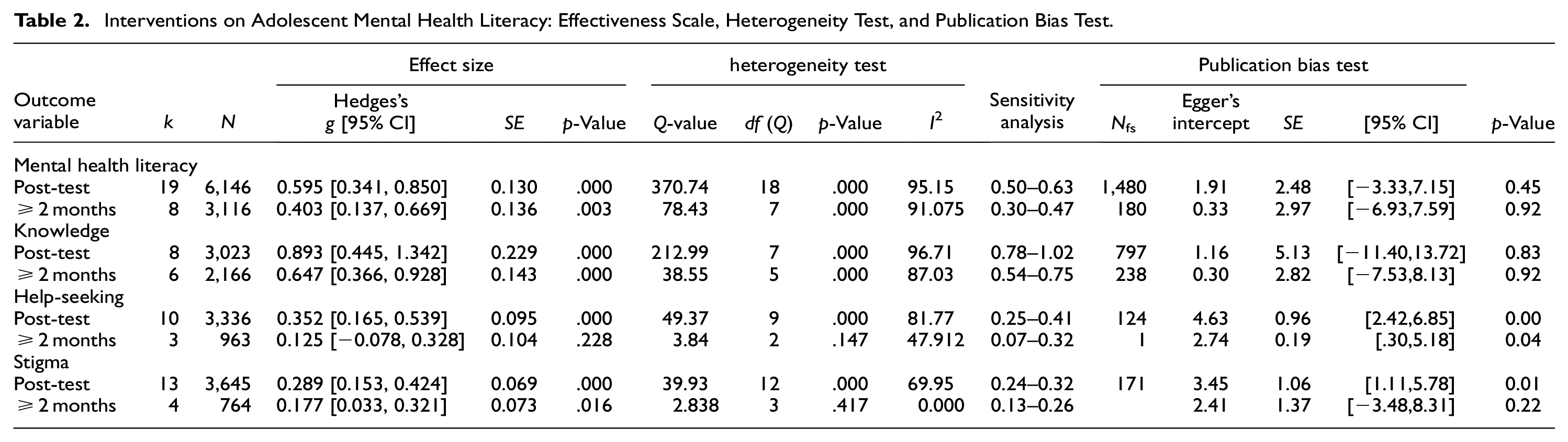
The overall effect size immediately following the intervention was g = 0.595 (95% CI [0.341, 0.805], SE = 0.130), indicating a moderate to large and statistically significant improvement in mental health literacy. This value suggests that the intervention group experienced a substantial improvement in mental health literacy compared to the control group.
Regarding the other three subdimensions assessed, the results were as follows: The combined effect size for the knowledge intervention was g = 0.893 (95% CI [0.445, 1.342], SE = 0.229), indicating a large and significant increase in mental health knowledge. The help-seeking intervention demonstrated a combined effect size of g = 0.352 (95% CI [0.165, 0.539], SE = 0.095), suggesting a moderate and statistically significant improvement in help-seeking . Finally, the stigma intervention had a combined effect size of g = 0.289 (95% CI [0.153, 0.424], SE = 0.069), indicating a small to moderate and statistically significant reduction in stigma.
Sustainability of Intervention Effects
The intervention’s persistent impact on mental health literacy, assessed 2 months post-intervention, demonstrates a notable effect size of (g = 0.403; 95% CI [0.137, 0.669], SE = 0.136). This underscores a sustained and statistically significant enhancement in adolescents’ understanding of mental health issues. Likewise, a substantial effect size of (g = 0.647; 95% CI [0.366, 0.928], SE = 0.143) indicates the enduring improvement in mental health knowledge.
In contrast, the impact on help-seeking is rather minimal, with an effect size of g = 0.125 and a 95% confidence interval ranging from −0.078 to 0.328, accompanied by a standard error of 0.104, indicating that the result lacks statistical significance at the 2-month milestone. Additionally, the effect on stigma reduction remains perceptible, though relatively modest, with an effect size of (g = 0.177; 95% CI [0.033, 0.321], SE = 0.073) at the 2-month follow-up.
Publication Bias and Sensitivity Analysis
Sensitivity analysis indicated minimal changes in outcome estimates when any single study was excluded, confirming the robustness of our findings (Table 2). However, potential publication biases were detected, particularly for help-seeking and stigma outcomes. Egger’s regression tests suggested a potential overrepresentation of studies with significant findings for immediate post-intervention outcomes and those evaluated 2 months later. The Fail-safe N number for the longer-term outcomes was below the threshold of 25, suggesting the possibility of selective publication (Rosenthal, 1979).
Interventions on Adolescent Mental Health Literacy: Effectiveness Scale, Heterogeneity Test, and Publication Bias Test.
Moderating Effect Test
We conducted an analysis of moderating effects related to region, publication year, professional involvement, interaction type, and intervention form.
Moderating Effect Test on Mental Health Knowledge
Due to the limited availability of literature and data, our analysis focused on the moderating effects of publication year, interaction type, and intervention content on the knowledge dimension. We found that the moderating effect of publication year on intervention outcomes was not statistically significant (b = −0.01; 95% CI [−0.08, 0.06]). This indicates that the effectiveness of the interventions did not vary consistently over time.
We observed that interventions with higher levels of participant interaction were significantly more effective than those with lower levels of interaction. Specifically, interventions with high interaction had an effect size of g = 1.24, while interventions with low interaction had an effect size of g = 0.50, with the difference being statistically significant (p < 0.05). These findings suggest that increased participant interaction greatly enhances the impact of interventions on mental health knowledge.
Furthermore, when comparing different intervention approaches, we found that the combined use of video and direct contact was significantly more effective than using direct contact alone. The effect size for the combined approach was g = 1.11, which was significantly greater than the effect size of g = 0.36 for the contact-only approach (p < 0.05). These results highlight the added value of integrating multiple modalities, such as video and direct contact, in intervention strategies aimed at improving outcomes. The consistent nature of these effects over time, despite the lack of significance in the publication year, reaffirms the robust benefits derived from increased interaction and the incorporation of multimedia in interventions.
Moderating Effect Test on Help Seeking
The moderating effects of various factors on the help-seeking dimension of the interventions were evaluated. Interventions in Asia demonstrated a significantly stronger effect on help-seeking than did those in Oceania, with an effect size of (g = 0.92) versus (g = 0.17), respectively (p < 0.05). This indicates notably better outcomes in enhancing help-seeking in Asian settings than in Oceanian settings. The year of publication did not significantly moderate the intervention outcomes (b = −0.02 ; 95% CI [−0.06, 0.02]), suggesting that the effectiveness of help-seeking interventions did not vary significantly over time or with shifts in publication trends. Interventions involving professionals showed a slightly greater effect size (g = 0.42) than did those without professional involvement (g = 0.34), although this difference was not statistically significant (p > 0.05). The interventions with high levels of participant interaction were considerably more effective (g = 0.70) than those with low interaction (g = 0.23), with statistical significance (p < 0.05). These findings underscore the importance of interactive elements in interventions, suggesting that greater engagement among participants can lead to better help-seeking outcomes.
Moderating Effect Test on Stigma
The moderating effects on the stigma dimension were analyzed by region, year of publication, professional involvement, type of participant interaction, and the primary form of intervention content. Interventions conducted in Asia were significantly more effective in reducing stigma than those conducted in Oceania (effect size, g = 0.64 vs. g = 0.15, p < 0.05) and Europe (effect size, g = 0.64 vs. g = 0.21, p < 0.05). There was no significant moderating effect of publication year on the effectiveness of interventions (coefficient b = 0.01 ; 95% CI [−0.04, 0.05]), suggesting that the impact of these interventions did not change appreciably over the years covered by the study.
Interventions featuring greater levels of interaction among participants showed a greater reduction in stigma than those with lower interaction (effect size, g = 0.44 vs. g = 0.22), although this difference was not statistically significant (p > 0.05). The combination of video and direct contact was more effective than direct contact alone in reducing stigma (effect size, g = 0.35 vs. g = 0.29), but this difference did not reach statistical significance (p > 0.05), suggesting that while the combined approach may offer some advantages, these advantages were not strong enough to be definitively concluded in this analysis.
Discussion
Post-Test Effects of Mental Health Literacy Interventions
The study findings revealed that interventions targeting mental health literacy, knowledge, help-seeking, and stigma had significant post-test effects, which are consistent with existing research, underscoring the efficacy of educational and contact-based interventions. As highlighted by Arboleda-Flórez and Sartorius (2008), education and contact are the predominant methods employed to enhance mental health literacy. Educational interventions aim to dismantle myths associated with mental illness through the dissemination of information about psychological issues. These are typically delivered through lectures, courses, distribution of reading materials, group counseling, and discussions. Contact interventions, on the other hand, involve exposing individuals to people with mental illnesses, who share their personal stories. This direct exposure is designed to reduce anxiety and increase empathy, thereby decreasing stigmatizing attitudes toward those suffering from mental health conditions (P. Corrigan et al., 2015). Furthermore, studies such as that by Griffiths et al. (2014) have also shown that interventions can effectively reduce stigmatizing attitudes.
These findings are crucial for developing future interventions that not only aim to enhance mental health literacy but also foster a more supportive and understanding environment. The combination of educational and contact-based approaches appears to be particularly potent, possibly due to the dual focus on cognitive understanding and emotional empathy. By addressing both the informational needs and the emotional biases of individuals, these interventions create a more comprehensive strategy for combating the stigma and enhancing the mental health literacy of adolescents.
Sustainability of Intervention Effects
The interventions targeting mental health literacy, knowledge, and stigma demonstrated sustained impact up to 2 months and beyond, though there was a noted decline in the magnitude of these effects over time. Maunder and White (2019) reported that the intervention effects were significant but diminished from moderate to small over time, with effect sizes (d) of −0.334 and −0.526 at 3 and 12 months, respectively. This indicates that while interventions are initially effective, their impact tends to lessen without ongoing reinforcement. Similarly, a meta-analysis by Morgan, Ross et al. (2018) highlighted that interventions significantly enhanced mental health knowledge with a medium to large effect size (d = 0.54) at 6 months, which decreased to a smaller effect size (d = 0.31) by 12 months. This trend suggests a gradual erosion of intervention gains over time, necessitating continuous efforts to sustain initial improvements. Furthermore, Xu et al. (2018) examined the interventions’ impact on help-seeking for mental health issues. Their findings indicated a significant increase in seeking professional help, with effects persisting for over 6 months.
However, in contrast to these findings, the effectiveness of interventions on help-seeking was not significant in later follow-up periods in our analysis. This disparity may be attributed to the decay of help seeking over time if not periodically reinforced, a phenomenon similarly reported by Richards and Frankland (2017). The decay suggests that without regular refreshers or continued educational efforts, the initial benefits of interventions may diminish, highlighting the need for sustained and repeated measures to maintain efficacy in improving mental health literacy and reducing stigma. These findings underscore the necessity for ongoing intervention strategies to bolster the longevity of the effects, particularly in educational settings where continuous engagement and reinforcement could potentially counteract the natural decline in intervention impact. Developing a framework for regular updates and refreshers within the educational curriculum may prove vital in maintaining the efficacy of mental health interventions over longer periods.
Moderating Factors Affecting the Efficacy of Interventions
Among the different facets of mental health literacy, the most noteworthy improvement was observed in the knowledge dimension, indicating that interventions can genuinely enhance awareness of mental health issues. This finding is in line with Morgan, Ross et al.’s (2018) and Morgan, Reavley et al.’s (2018) similar observations. Adolescents who primarily receive formal education tend to benefit more in areas involving cognitive engagement, such as knowledge acquisition, rather than in domains requiring experiential, voluntary, or behavioral changes such as attitudes, stigma, and help-seeking (Ren et al., 2020). Knowledge interventions help individuals process relevant information and develop personal understanding, thereby enhancing their overall mental health literacy.
Geographic factors also play a significant role in help-seeking and stigma. The analysis suggested that interventions in Asia had a considerably greater effect on help-seeking than did those in Oceania, potentially due to differing levels of economic development. Regions in Asia with lower economic development might have limited access to mental health services, creating more room for improvement through interventions. Conversely, Oceania and Europe, with their relatively higher levels of development and more comprehensive psychological services, may exhibit less pronounced effects of interventions. Cultural factors also influence these results; for example, Asian cultural backgrounds might foster more negative attitudes toward psychological help, leading to increased stigma and avoidance behaviors (Sheu & Sedlacek, 2004). Research has demonstrated that individuals within Asian cultures tend to attribute mental illness to a range of factors, including perceived weaknesses in personality traits and superstitions. Consequently, this cultural attribution may lead to an intensified level of stigma surrounding mental illness (Abdullah & Brown, 2011). Notably, the amplifying effect of this stigma is particularly prominent within these cultural contexts.
The level of interaction among participants significantly influenced the outcomes of knowledge acquisition and help-seeking. Interactive engagement promotes deeper learning and understanding, thus facilitating the internalization of acquired knowledge (Philip, 2010). Increased interpersonal contact can reduce prejudice, creating a supportive intervention environment that enhances the recognition and effectiveness of the intervention (Rhodes et al., 2001). The study conducted by Brijnath et al. (2016) explored the potential of web-based interventions in enhancing mental health literacy and found that the improvements in mental health literacy were found to be associated with concurrent advancements in personal health seeking behaviors, health outcomes, and a decrease in stigma against those with mental illness. Regarding the modality of interventions, the combination of video and face-to-face communication proved to be significantly more effective than using only face-to-face approaches. This finding can be attributed to the limited attention spans of adolescents and their preference for dynamic content such as videos (Amsalem & Martin, 2022).
Practice Implications and Limitations
Our findings have important implications for the design and implementation of mental health literacy interventions targeted at adolescents. The effectiveness of these interventions varied across different regions, highlighting the importance of adapting strategies to specific cultural and developmental contexts. Multimodal interventions that incorporate both video and direct interaction appear to offer greater benefits, supporting the idea that using diverse instructional approaches can enhance engagement and improve learning outcomes. Additionally, expanding the conceptual framework of mental health literacy to include newer dimensions such as confidence and proactive behaviors in helping others could further enhance intervention strategies and outcomes. Future research should focus on identifying and understanding moderating variables that influence the efficacy of interventions. This will enable the development of targeted strategies that are finely tuned to the needs and contexts of adolescent populations. Future research should focus on identifying and understanding moderating variables that affect intervention efficacy, enabling the development of targeted, developmentally appropriate strategies that are finely tuned to the needs and contexts of adolescent populations. Furthermore, emerging intervention methods merit consideration, particularly those that involve positioning the intervenor as a key player in enhancing mental health literacy (Fung et al., 2016). When considering the three primary outcome variables: knowledge, help-seeking, and stigma, it becomes apparent that each possesses distinct types and dimensions. Specifically, knowledge can be segmented into theoretical knowledge and practical recognition of psychological issues (Wei et al., 2016). Help-seeking comprises formal, informal, and self-help avenues (Rickwood & Thomas, 2012). Lastly, stigma is categorized into self-stigma and public stigma (P. W. Corrigan & Watson, 2002).
This study has several limitations. Despite conducting an extensive search across six databases in Chinese and English, there is a possibility that relevant studies, including unpublished ones, were missed. Future research should expand the scope of investigations to include studies from other European and Asian cultures, as well as studies published in other languages. This will help compile a comprehensive meta-analysis database, thereby improving data availability and reliability. Additionally, the outcome variables analyzed in this review were not categorized in detail. Due to the limited number of studies, mental health literacy was broadly assessed without distinguishing between its various components. This generalization could lead to inaccuracies in interpreting the effects of interventions. Furthermore, while some meta-analyses have examined the long-term effects of interventions, our study focused primarily on immediate post-test results due to limited data availability. Hence, there is a need for future studies to explore long-term outcomes more thoroughly. Given these limitations and the evolving landscape of mental health interventions, it is crucial to validate findings through high-quality primary studies and to consider expanding research to include diverse cultural contexts and detailed categorization of outcome variables.
Conclusions
This systematic review and meta-analysis underscored the efficacy of mental health literacy interventions in enhancing adolescent mental health literacy. In accordance with the PRISMA guidelines and registered under INPLASY202330098, our study synthesized data from prominent databases, including PubMed, Web of Science, EBSCO, CNKI, Wanfang, and Chongqing VIP. Employing a pre-test-post-test design, we evaluated these interventions against control conditions. Our analysis revealed that while interventions generally improved mental health literacy among adolescents—a demographic variable particularly susceptible to mental health issues—the effects on help-seeking and stigma were nuanced.
Specifically, although the overall impact on mental health literacy was positive and substantial, interventions displayed limited effectiveness in significantly altering help-seeking and reducing stigma in the long term. This finding resonates with the literature, suggesting that while initial educational impacts can be robust, sustaining changes in behavior and attitudes often necessitates more intensive or continuous intervention strategies.
Notably, the enhancement in knowledge about mental health was significant and enduring, emphasizing the potential of these interventions to bolster understanding among adolescents. This is particularly promising because enhanced knowledge plays a pivotal role in empowering adolescents to manage their mental health effectively.
The variability in intervention effectiveness across different regions underscores the importance of tailored approaches. Our findings indicate that interventions in Asia were notably effective, particularly in improving help-seeking and reducing stigma, emphasizing the significance of regional adaptations in intervention strategies. Moreover, interventions characterized by frequent interactions and those integrating multiple methods, such as direct contact and multimedia elements, demonstrated the most efficacy. This underscores the necessity of engaging, multifaceted approaches to optimize outcomes in adolescent mental health literacy.
In summary, while the interventions examined exhibited clear benefits in enhancing mental health knowledge and literacy, the limited effects on help-seeking and stigma underscore the necessity for ongoing refinement and targeting of interventions. Future research should continue to explore and address factors that enhance the sustainability of these results, ensuring that enhancements in mental health literacy translate into enduring changes in behavior and attitudes among adolescents.
