



Abstract
Policies designed to cultivate talent within universities are central to China’s strategy for reforming and improving the quality of its higher education. This study develops a goal-instrument analysis framework for a content analysis of 113 such policies. Within the context of China’s Double First-Class construction, the analysis examines the selection and use of policy instruments for university talent cultivation in Henan Province. Using a value orientation analysis, the study also explores the rationality between policy goals and the selection of policy instruments. There are three main findings: (1) policy instruments for cultivating university talent are comprehensive, but their structural allocation is imbalanced; (2) the utilization of secondary policy instruments has some level of diversification, but there the path dependence is clear; (3) the selection of policy instruments is reasonably aligned with the achievement of policy goals, but there are still noticeable biases. To optimize the policies and improve the quality of cultivated talent, three measures should be taken: scientifically allocate the structure and further strengthen the mutual promotion of various types of policy instruments; break the path dependence and further optimize the collaborative combination of secondary policy instruments; and correct existing biases and further enhance the effectiveness of policies.
Plain language summary
This study focuses on understanding and optimizing university talent cultivation policies within the context of China’s Double First-Class construction. We conducted a content analysis of 113 university talent cultivation policies in Henan Province to gain insights. Two dimensions were considered: policy goals and policy instruments. There are three main findings: First, the policy instruments for cultivating university talent cover a wide range, but their structural arrangement isn’t balanced. Second, the use of secondary policy instruments has some variety, yet there’s obvious path dependence. Third, the selection of policy instruments is reasonably aligned with the achievement of policy goals, yet discernible biases remain. To make the policies better and improve the quality of the cultivated talent, three measures are proposed: First, allocate the structure in a scientific way and strengthen the mutual promotion among different policy instruments. Second, break the path dependence and optimize the collaborative integration of secondary policy instruments. Third, correct the existing biases and improve the effectiveness of the policies.
Keywords
Introduction
As academic organizations responsible for delivering higher education, universities must undertake the essential task of cultivating talent. To elevate a group of high-level universities and disciplines to global status, the State Council of China (2015) issued the Notice on the Overall Program for Coordinately Promoting the Construction of World-Class Universities and First-Class Disciplines in October 2015. This initiative includes key projects such as the 211 Project, 985 Project, and Advantage Science Innovation Platform. On January 24, 2017, the Ministry of Education and Finance and the National Development and Reform Commission of China jointly issued Implementation Measures to Coordinately Promote the Construction of World-Class Universities and First-Class Disciplines (Provisional; hereinafter referred to as Implementation Measures). In September 2017, the first list of world-class universities, and first-class discipline construction universities and the construction disciplines was officially confirmed and announced (Ministry of Education of China, Ministry of Finance of China, & National Development and Reform Commission of China, 2017). In February 2022, the Ministry of Education collectively referred to the world-class construction universities and first-class discipline construction universities as “Double First-Class construction universities.” Subsequently, the second list of Double First-Class construction universities was announced, and a new round of construction began. The Double First-Class construction marks a pivotal stage in China’s efforts to accelerate the modernization of its higher education system and establish itself as a global leader in higher education. This initiative has played an important role in cultivating talent, improving scientific research, promoting economic and social development, and promoting cultural inheritance. Due to the progress of the Double First-Class construction, the cultivation of first-class talent has received extensive attention. Consequently, relevant governmental departments issued a series of policies for cultivating talent. To ensure the realization of the set goals requires an analysis and optimization of these policies.
In 2022, Henan Province had 156 higher education institutions. Among these, 38 were public undergraduate schools (including two Double First-Class construction universities) and 19 were private undergraduate schools (Ministry of Education of China, 2022). Henan Province also had 1.25 million students taking the college entrance examination, ranking first among all provinces in China. Henan Province had the greatest disparity between the supply and demand of high-quality higher education. Located at the junction of open coastal areas and central and western regions, Henan Province is in the middle zone of China’s economic development from east to west. It is an important transportation hub that connects east to west and south to north (Yuan, 2023). Henan Province also represents the origin of Chinese civilization and a simplified version of Chinese culture. The Double First-Class construction provides a new opportunity for Henan Province, which has formulated enough relevant policies to support the cultivation of university talent. These policies, which Henan Province formulated under unfavorable conditions, can serve as a representative model for other provinces. Therefore, this study conducts a content analysis of policies in Henan Province regarding the cultivation of university talent within the context of the Double First-Class construction. We also propose policy optimization strategies to improve the quality of talent cultivation.
Literature Review
Due to China’s Double First-Class construction, an increasing number of scholars are focused on cultivating first-class talent. Scholars believe that this goal (Han & Xie, 2021) can be achieved through various models, such as the integration of talent cultivation and discipline construction (Ni & Wang, 2017), the creation of a diversified talent cultivation system driven by discipline + specialization (Y. Liu et al., 2021), and an emphasis on cultivating interdisciplinary talent (W. Sun & Ma, 2019).
Relevant governmental departments have also introduced many policies to cultivate university talent and promote the goal of the Double First-Class construction. To optimize these policies, scholars have conducted a series research. These include exploring the characteristics (Luo et al., 2023) and the evolution mechanisms and development patterns of university talent cultivation policies (X. L. Dai et al., 2022), and analyzing the effectiveness and shortcomings of policy implementation (X. X. Wang & Niu, 2018). Scholars have also analyzed the root causes of issues arising from university talent cultivation policies from the perspective of policy formulation and implementation. For example, scholars have documented how policy formulation lacks robust planning (Y. Liu & Fang, 2022), policy targets have a low level of awareness (Gu et al., 2019), and universities experience deviations in policy implementation (K. Yan, 2018). Scholars have advanced suggestions for improvements based on policy reformulations (Cao, 2022; Xue, 2012). Although existing research involves longitudinal reviews (Y. Dai & Yang, 2024; F. Yu, 2019), horizontal comparisons (N. Li et al., 2019; J. Liu & Zhong, 2021), and statistical analyses of policies (Chang, 2024), most are conducted from the perspective of governance processes or functionalism.
A policy instrument is an effective means of realizing the transformation of a policy from textual symbols to actual outcomes. This is an important perspective for policy analysis and optimization. Since the 1980s, policy instruments have become the focus of research in the field of policy science. Based on concept definitions and characteristic analyses (Q. Y. Chen, 2011; Hood, 1983; Zhu, 2011), scholars have classified policy instruments in various ways. Regarding the impact of policies, policy instruments are divided into environmental, demand, and supply instruments (Rothwell & Zegveld, 1985). Policy instruments are also divided into five categories based on the government’s guidance approach: authority, incentive, capacity, symbolic and hortatory, and learning instruments (Schneider & Ingram, 1990). Similarly, they can be divided into three categories according to the degree of the government’s direct participation in providing goods or services: compulsory, mixed, and voluntary instruments (Howlett & Ramesh, 1995). From a transaction-cost perspective, policy instruments are divided into discrete, public, and mixed transactional policy instruments (Zhan, 2015). Furthermore, to better select and apply policy instruments, Z. M. Chen (2015) researched policy instruments and proposed three dimensions for their evaluation: effectiveness, efficiency, and fairness.
Policy instrument studies have been conducted in many areas such as politics (Cohen & Eimicke, 1998), the economy (Lane, 2000; J. Wu et al., 2019), culture (Choi, 2008; Y. Y. Zhang & Xu, 2017), ecology (X. F. Wang et al., 2018), social security (Zheng & Sun, 2004) and education (J. L. Gao & Liu, 2023; J. Yao, 2017). Some scholars have also researched talent cultivation policies from the perspective of policy instruments. For example, Z. F. Zhang et al. (2022) conducted a review and provided an outlook on talent cultivation policies for the integration of industry and education based on a policy instrument analysis. L. Y. Wang et al. (2022) analyzed the policy of cultivating talent in traditional Chinese medicine (TCM) from the perspective of policy instruments. Similarly, Y. Liu and Fang (2022) optimized policy instruments to cultivate innovative talent in China. These studies provided the foundation for this research. However, research on university talent cultivation policies from the perspective of policy instruments must be strengthened in terms of quantity, depth, and breadth.
Policy instruments are the fundamental means of achieving policy goals. Any policy is an organic unity of goals and instruments (Z. K. Lv, 2006), and a key factor in selecting policy instruments is achieving policy goals. However, not all policy instruments achieve their goals (Geng & Yu, 2018; H. W. Wu, 2011). Therefore, constructing a two-dimensional analysis framework for the goal-instrument has become an important perspective for both selecting policy instruments and optimizing policy (Guan, 2019; L. P. Yu et al., 2023; Y. L. Zhao et al., 2024). In addition, university talent cultivation goals reflect the organic unity of professional and political requirements (Y. Q. Zhang & Zhang, 2023). Y. S. Wang (2016) interpreted the talent cultivation goals of first-class universities in China, revealing nine talent traits and six types of talent, emphasizing the three major characteristics of designing talent cultivation goals for China’s first-class universities. Based on Wang’s research, R. Zhao and Shi (2018) statistically analyzed 11 specific characteristics and seven types of talent cultivation, highlighting the shortcomings and optimization suggestions for talent cultivation goals in China’s first-class universities. The policy goals of university talent cultivation represent the specific manifestations of university talent cultivation objectives at the policy level. Constructing a two-dimensional analysis framework for the goal-instrument is of great significance for optimizing these policies. Based on the literature review given above, we found that most existing research analyzes a single dimension of policy instruments or two-dimensional perspectives such as subject-instrument, process-instrument, and instrument-talent cultivation systems. However, research on the analysis of university talent cultivation policies based on the goal-instrument analysis framework is lacking.
Therefore, this study uses Henan Province as a case study to conduct a content analysis of university talent cultivation policies within the context of the Double First-Class construction. We first focus on the establishment of a goal-instrument analysis framework for university talent cultivation policies. We then explore issues in the selection of university talent cultivation policy goals and instruments. Finally, we propose improvement strategies to achieve policy optimization, improve talent cultivation quality, and promote the Double First-Class construction.
Analysis Framework
Policy instruments are the techniques, means, methods, and approaches used by the public authority of society, represented by the government, to achieve policy goals. As such, they are intermediary bridges between policy goals and effects (Q. Y. Chen, 2011). Therefore, this study constructs a two-dimensional interactive analysis framework of university talent cultivation policies based on the logic of a goal-instrument.
X Dimension: The Policy Instrument Dimension
To date, scholars have conducted studies on policy instruments from various perspectives and according to different standards. Based on the expected goals of the policies, McDonnell and Elmore divided policy instruments into mandates, inducements, capacity-building, and system-changing (McDonnell & Elmore, 1987). They then applied suasion (W. Lv, 2016). The classification results were clear and systematic and demonstrated good discrimination. This type of classification is useful for applying to policy analyses in the field of education. This study draws on this approach and divides the policy instruments of university talent cultivation into five categories: mandates, inducements, capacity-building, suasion, and system-changing. The classification and definition of university talent cultivation policy instruments are listed in Table 1.
Classification and Definition of University Talent Cultivation Policy Instruments.

Note. Sorted and summarized according to relevant literature.
Y Dimension: The Policy Goal Dimension
In the context of China’s Double First-Class construction, university talent cultivation policies have distinct goals. Through a textual analysis of relevant materials from the 108 985 Project and 211 Project universities, Y. S. Wang (2016) summarized nine key aspects of the talent cultivation goals of first-class universities: national sentiments, ideals and beliefs, physical and mental health, a strong foundation, outstanding skills, practical versatility, active innovation, a broad perspective, and quality development. Through a textual analysis of the relevant materials from 42 first-class universities, R. Zhao and Shi (2018) summarized 11 key aspects of the talent cultivation goals of these universities: patriotism and social responsibility; global citizenship; ideals and beliefs; all-round development of moral, intellectual, and physical qualities; a strong foundation; outstanding skills; spirit of innovation; international vision; humanistic feelings; scientific spirit; and lifelong learning ability. Drawing on and combining these results with the content of relevant policy texts, this study defines nine key aspects of the policy goals of university talent cultivation: strong national sentiment, physical and mental health, strong foundational skills, strong professional expertise, a rich knowledge base, high caliber, outstanding ability to innovate, international vision, and established ideals and beliefs. Their specific meanings are listed in Table 2. This classification was used as the Y-dimension to conduct the policy content analysis.
Classification and Definition of University Talent Cultivation Policy Goals.
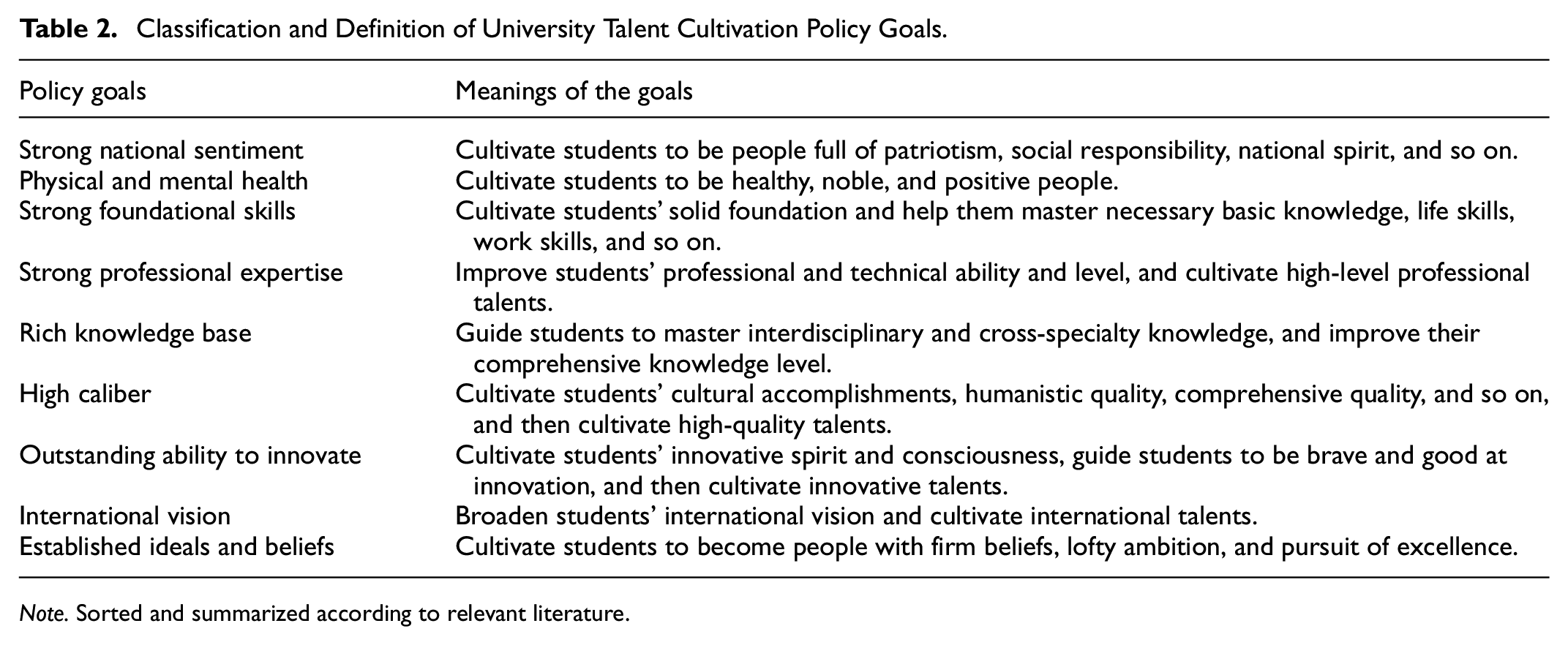
Note. Sorted and summarized according to relevant literature.
X-Y Two-Dimensional Interactive Analysis Framework Based on the Goal-Instrument
Policy instruments should be guided by policy goals. The realization of these goals depends upon the appropriate selection and application of policy instruments (Z. K. Lv, 2006). However, in practice, not all policy instruments effectively achieve their intended goals, and conflicts sometimes arise. Starting from the inherent fuzziness of the relationship between the two (Geng & Yu, 2018) and the actual needs, this study constructs a two-dimensional interactive analysis framework based on the goal-instrument (Figure 1). The framework aims to explore the correspondence between university talent cultivation policy instruments and goals in the context of Double First-Class construction, optimize the use of policy instruments and policy systems, and promote the achievement of policy goals.

Two-dimensional interaction analysis framework based on the goal-instrument of university talent cultivation policies.
Methods
Data Collection and Policy Sample Selection
Since the issuance of the Implementation Measures on January 24, 2017, China’s Double First-Class construction has gradually entered the stage of comprehensive practice and exploration. For Henan Province, this study searched for and collected public policies closely related to university talent cultivation since January 24, 2017, on the portal website of the People’s Government of Henan Province and websites of relevant governmental departments.
Following the four principles of timeliness, authority, relevance, and diversity, 113 policies were selected for analysis (Table 3). They encompassed various types such as notices, opinions, programs, plans, measures, and key working points.
Sample of University Talent Cultivation Policies in Henan Province.

Note. Due to limited space, only some examples are shown here.
Content-Coding
This study used NVivo software to code and analyze relevant policy texts. Excel was used to summarize and organize the results. As stated in the Analysis Framework section, the two-dimensional interaction analysis framework used in this study is scientific and has good applicability. Using the analytic categories in the two-dimensional interaction analysis framework mentioned above, five policy instruments were designated as nodes, and 20 secondary policy instruments were designated as the corresponding sub-nodes. Similarly, we designated nine policy goals as nodes, too. Because policy clauses are fully expressed and can minimize problems such as unclear meanings or biased understanding, they were used as the unit of analysis. Through in-depth reading, we coded the policies according to policy number - chapter number - clause number. Based on the richness of policy types and formats, some policies only had specific clauses without chapters, whereas others had sub-clauses within the clauses. Therefore, this study flexibly coded them according to policy number - clause number or policy number - chapter number - clause number - sub-clause number. We incorporated content related to policy instruments, secondary policy instruments, and policy goals into the corresponding nodes and sub-nodes. During the coding process, this study followed the principles of one-to-one correspondence and non-subdivision. Therefore, when an analysis unit could be subdivided into multiple layers of different meanings, it was further subdivided into multiple codes in sequence, followed by “1, 2, 3…” to distinguish them. A total of 2,098 analysis codes were created. Coding examples are presented in Table 4.
Coding Examples.

Note. Due to the limited space, only the coding examples are shown here.
Reliability and Validity Analysis
Based on the results of existing research and following the principle of exhaustive mutual exclusion, we constructed a two-dimensional interactive analysis framework that had good reliability for the categories. Each policy was coded separately by two coders. Inter-coder reliability was confirmed by a high level of category agreements (CA) between the two coders. The index of concordance was computed to estimate category agreements using the formula CA = 2 × number of agreements between coders / [Number of Coder A’s codes + Number of Coder B’s codes] (J. Li et al., 2020). Specifically, two coders were trained to understand the two-dimensional interaction analysis framework, category meanings, policy content, coding rules, and master software usage. Next, 15 policies randomly selected from the sample policies were independently coded by each coder. Based on a comparison of the coding results, different coding results were discussed, and the analysis framework and its categories were optimized. After four rounds of coding, discussion, and optimization, the two-dimensional interaction analysis framework and its categories were determined, and a coding consensus was reached with a CA of 0.94. Subsequently, formal coding was initiated. Based on consensus, the two coders independently coded all the sample policies. The CA was 0.85, indicating high coding consistency and reliability. For inconsistent coding results, we invited an expert to confer with us, and after a discussion between the expert and the two coders, a consensus was reached. In addition, the reliability and completeness of the policy sample selection as well as the accuracy of category construction and coding analysis ensured that this study had good validity. The flowchart of this study is shown in Figure 2.

Flowchart of analysis for university talent cultivation policies in Henan Province.
Two-Dimensional Interaction Analysis of Policy Texts
X Dimension: Policy Instrument Dimension Analysis
As shown in Figure 3, five types of policy instruments were used for university talent cultivation of Henan Province. This finding provides an important guarantee that the policies can comprehensively promote talent cultivation and achieve the policy goals. However, the utilization frequency for each policy instrument varied significantly. Capacity-building was the most frequently used (920 instances, 43.85% of the total). The second most frequently used were mandates, with 360 instances, accounting for 17.16% of the total. However, suasion (301 instances, 14.35% of the total), system-changing (292 instances, 13.92% of the total), and inducements (225 instances, 10.72% of the total) were used less frequently.

Usage of policy instruments for university talent cultivation policies in Henan Province.
At the level of secondary policy instruments, the differences in utilization frequencies were also significant. In the mandates, requirements were used the most (202 instances), accounting for 56.11% of the mandates. However, prohibition (26 instances, 7.22% of the mandates) and supervision (37 instances, 10.28% of the mandates), were used less frequently (Figure 4). In inducements, the use of policy preferences accounted for 78.67% of the inducements (177 instances; Figure 5). In capacity-building, policy support (339 instances, 36.85% of the capacity-building), and education and practice (200 instances, 21.74% of the capacity-building) were used the most frequently. However, cooperation and exchange was used less frequently (80 instances, 8.70% of the capacity-building; Figure 6). In suasion, encouragement and guidance accounted for 70.76% of the suasion (213 instances). However, model establishment was relatively rare, accounting for only 8.31% of the suasion (25 instances; Figure 7). In system-changing, adjustment of the system and mechanism (159 instances, 54.45% of the system-changing), and structural optimization (118 instances, 40.41% of the system-changing), were used the most frequently. However, power reorganization was used less frequently, accounting for only 5.14% of the system-changing (15 instances; Figure 8).

Usage of secondary policy instruments in the mandates.

Usage of secondary policy instruments in the inducements.

Usage of secondary policy instruments in the capacity-building.

Usage of secondary policy instruments in the suasion.
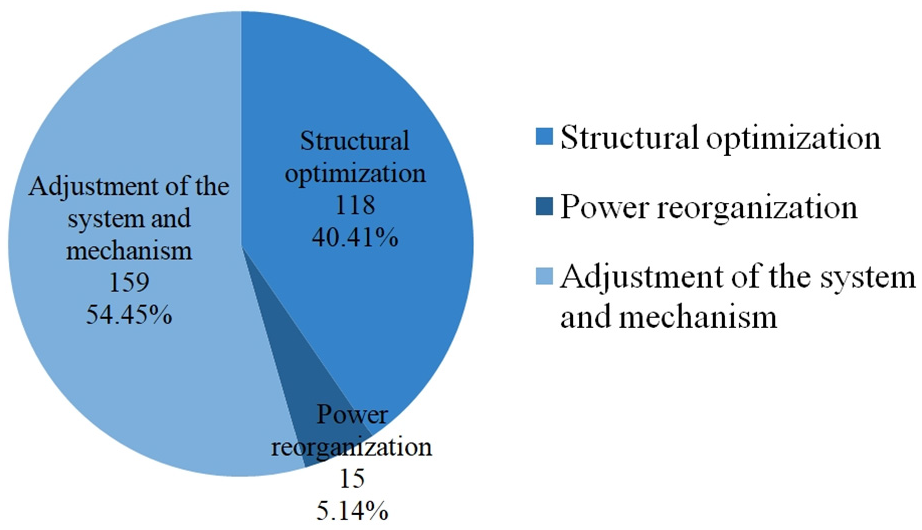
Usage of secondary policy instruments in the system-changing.
Y Dimension: Policy Goal Dimension Analysis
The policy goals of the university talent cultivation policies contained all nine key aspects mentioned above. However, as shown in Figure 9, the frequencies for the key aspects differed. For example, many explanations prioritized the achievement of two policy goals: an outstanding ability to innovate (386 instances, 18.40% of the total) and strong professional expertise (373 instances, 17.78% of the total). However, the policy goals of an international vision (96 instances, 4.58% of the total) and physical and mental health (159 instances, 7.58% of the total) were prioritized less frequently.

Key aspects of policy goals for university talent cultivation policies in Henan Province.
X-Y Two-Dimension: Interaction Analysis Based on the Goal-Instrument
Based on the two-dimensional interaction analysis framework and coding analysis, a two-dimensional distribution table was calculated, as shown in Table 5.
Two-Dimensional Interaction Analysis Table.

From a horizontal perspective, the five policy instruments were used to achieve all policy goals, but with different focuses. Mandates prioritized achieving the policy goal of established ideals and beliefs. Inducements and capacity-building prioritized achieving the policy goal of strong professional expertise. Suasion and system-changing prioritized achieving the policy goal of an outstanding ability to innovate. These findings are related to the nature of the policy instruments and goals. For example, mandates are mandatory. Established ideals and beliefs need this mandatoriness to defend ideological positions, ensure talent’s recognition of national positions and policies, and thus contribute to the country and society. For some policy goals, such as strong professional expertise and an outstanding ability to innovate, it is even more necessary to use non-mandatory policy instruments to stimulate enthusiasm. However, differences existed in the use of secondary policy instruments to achieve policy goals. Specifically, the utilization frequency of eight secondary policy instruments—supervision, prohibition, commendations, rewards, cooperation and exchange, publicity and promotion, model establishment, and power reorganization—in achieving one or more policy goals was 0. Instead, the remaining 12 secondary policy instruments were used to achieve the nine policy goals. The frequencies suggest that policy support prioritized achieving the policy goals of strong professional expertise, an outstanding ability to innovate, and strong foundational skills; policy preferences focused on achieving the policy goals of strong professional expertise and an outstanding ability to innovate; and requirements prioritized achieving the policy goal of established ideals and beliefs.
From a vertical perspective, the frequency and prioritization of policy instruments used to achieve different policy goals also differed. The policy goals can be divided into four levels based on the utilization frequency of policy instruments: outstanding ability to innovate and strong professional expertise are at the first level; strong foundational skills and high caliber are at the second level; strong national sentiment, established ideals and beliefs, and a rich knowledge base are at the third level; and physical and mental health, and international vision are at the fourth level. From the prioritization perspective, the realization of talent cultivation policy goals tended to favor the use of capacity-building, which often provides support for universities and helps them conduct talent cultivation work. In addition, to encourage universities to complete their educational tasks and ensure the effectiveness of moral education, the realization of the policy goals of established ideals and beliefs, and physical and mental health also prioritized mandates, while the realization of the policy goal of strong national sentiment prioritized suasion.
Research Findings
The Application of Policy Instruments Was Comprehensive, But Their Structural Allocation Was Imbalanced
Our findings revealed that Henan Province attaches great importance to university talent cultivation in the context of Double First-Class construction. As shown in this study, Henan Province has formulated a series of relevant policies that promote the achievement of talent cultivation policy goals through the application of five major policy instruments with good comprehensiveness: capacity-building, mandates, suasion, system-changing, and inducements. However, there is still an overall structural imbalance in the use of policy instruments (Figure 3).
Specifically, the utilization frequency of the five policy instruments to achieve talent cultivation goals varied significantly. The use of capacity-building accounted for 43.85% of the total, while the utilization frequency of the other four policy instruments ranged from 10.72% to 17.16%. Capacity-building can provide policy targets with some capacity elements that are closely related to policy behaviors, so as to enhance their capacities and promote their adoption of policy behaviors (Du, 2024). This can promote the development of related talent cultivation. However, the utilization frequency is merely an expression of government attitudes and preferences and is not equivalent to implementation effects (Song et al., 2023). Moreover, an overreliance on capacity-building may lead to structural imbalances in policy instruments. Consequently, inducements and system-changing may receive insufficient attention and be ineffective, which is inconducive to the sustainable cultivation of talent. In addition, capacity-building has certain limitations such as uncertainty, intangibility, difficulty measuring, and distant return time (Elmore, 1987). This may lead to insufficient attention being paid to short-term planning and a focus on speed rather than quality (Zhou & Hu, 2019). In addition, the overuse of capacity-building in resource-constrained situations can lead to symbolic and unnecessary policy implementation, which can hinder the effective achievement of talent cultivation policy goals.
The Utilization of Secondary Policy Instruments Had Some Level of Diversification, But There the Path Dependence Was Clear
We found that 3 to 5 secondary policy instruments supported each type of university talent cultivation policy instrument in Henan Province, which had a level of diversification that could promote the realization of different policy goals to some extent. However, for the same policy goals, the secondary policy instruments had not been updated and exhibited a clear path-dependence. In addition, the frequency and scope of secondary policy instruments varied greatly (Figures 4–8).
Specifically, path dependence was evidenced in the overreliance on requirements in mandates. Requirements have become secondary policy instruments that are widely used for achieving the policy goals of university talent cultivation. These requirements have been used by the social public authority, which is represented by the government of Henan Province, owing to their leadership, clarity, and efficiency. However, the excessive use of requirements may limit the usage space of other secondary policy instruments within mandates, thereby affecting the exertion of their functions. It can not only lead to conflicts between the subject and the object due to an overemphasis on consistency, but also legitimacy crises driven by harsh measures (S. W. Li, 2023; J. Zhao & Chen, 2022). This can lead to policy distortion and affect the realization of university talent cultivation policy goals.
In addition, path dependence was evidenced in the tendency of inducements to foster the centralized use of positive secondary policy instruments. In inducements, positive secondary policy instruments represented by policy preferences were more commonly used, while punishments, as the counterpart of positive secondary policy instruments, were less commonly used. Positive secondary policy instruments in inducements encourage policy targets to act in accordance with policy expectations by providing support and rewards (Lin & Hou, 2010). This is beneficial for promoting innovation in university talent cultivation methods and realizing talent cultivation policy goals. However, in inducements, overreliance on positive secondary policy instruments can easily lead to resource wastage and the Matthew effect (J. Gao & Qu, 2023; K. J. Sun, 2019). Conversely, clear punishment measures can provide policy targets with a clear understanding of the consequences of behaviors regarding talent cultivation, playing a warning and regulatory role (Song et al., 2023). Neglecting the reverse secondary policy instruments in inducements, such as punishments (11.56% of the inducements), can lead to lax control over the achievement of basic standards, restricting the achievement of university talent cultivation policy goals.
In capacity-building, we also found an insufficient use of cooperation and exchange. The secondary policy instruments of capacity-building mainly focused on the use of policy support, education and practice, infrastructural construction, and system guarantees, while cooperation and exchange was used less frequently. This greatly limits the work on talent cultivation conducted by universities and social organizations, both domestically and internationally, thereby constraining the international vision of university students (H. Y. Chen, 2017) and restricting the achievement of university talent cultivation policy goals.
In addition, there was an overreliance on encouragement and guidance in suasion, while model establishment, and publicity and promotion were used less frequently. Through the guidance of values, universities can generate policy value recognition and consciously implement relevant policy behaviors (Qi & Song, 2022) to promote the realization of university talent cultivation policy goals. However, to some extent, this restricts the establishment of action goals rooted in the internal values of the university community and hampers the effective spontaneous implementation of innovative talent cultivation action plans. Consequently, it affects the realization of university talent cultivation policy goals.
Finally, there was insufficient emphasis on the secondary policy instrument of power reorganization in system-changing (5.14% of the system-changing), with prioritization given to the secondary policy instruments of adjustment of the system and mechanism (54.45% of the system-changing), and structural optimization (40.41% of the system-changing). On one hand, adjusting the system and mechanism, and optimizing the structure can enhance the action strategy and efficiency of talent cultivation. This is especially true when universities struggle to effectively complete talent cultivation tasks under existing incentives. On the other hand, the use of system-changing, especially the secondary policy instruments of power reorganization, may face resistance or even be undermined due to the potential damage to vested interests, which may restrict the effectiveness of policy implementation (L. Hu, 2010). However, the essence of system-changing lies in the transformation of power, which involves the redistribution of responsibilities and authority (Huang, 2008). Insufficient emphasis on the secondary policy instrument of power reorganization can result in superficial system reform and failure to solve the root causes of problems.
The Selection of Policy Instruments Was Reasonably Aligned With the Achievement of Policy Goals, But There Were Still Noticeable Biases
Overall, the university talent cultivation policies of Henan Province indicated a commitment to achieving nine policy goals by selecting five policy instruments and 20 secondary policy instruments. These goals involved the complete development of morality, intelligence, physical fitness, beauty, and other aspects, reflecting the well-rounded development of human beings (Z. P. Hu, 2005). Henan Province has also gained experience in selecting policy instruments. Its approach was reasonably aligned with the achievement of policy goals, but there were some noticeable biases (as shown in Table 5).
The bias was manifested by significant differences in the utilization frequencies of policy instruments across the nine policy goals, with insufficient emphasis on some policy goals. Specifically, emphasis was placed on achieving an outstanding ability to innovate and strong professional expertise. However, insufficient emphasis was placed on an international vision (4.58% of the total) and physical and mental health (7.58% of the total). In today’s globalized world, a talent for innovation with an international vision is an important guarantee for achieving success in international competition. The construction of the Double First-Class also emphasizes the need to promote international exchange and cooperation, strengthen substantive cooperation with world-class universities and academic institutions, and enhance international collaborative innovation (Ren, 2016). Therefore, insufficient emphasis on the policy goal of an international vision is not conducive to effectively cultivating innovative talent. In addition, physical and mental health is the cornerstone of high-quality talent and an important part of university talent cultivation. Xi Jinping, General Secretary of the Communist Party of China Central Committee and President of the People’s Republic of China, emphasized that we should establish the educational concept of putting health first and help students enjoy physical exercise, strengthen their bodies, improve their personalities, and temper their will (Xi, 2018). Insufficient emphasis on the policy goal of physical and mental health is inconducive to effectively cultivating healthy and comprehensive talents, promoting the modernization of higher education, and building a healthy China and a country with strong human resources.
The bias was also manifested in the selection of certain university talent cultivation policy instruments for achieving the nine policy goals. Consequently, some policy instruments have received insufficient attention for achieving certain policy goals. As an example, the achievement of physical and mental health prioritized mandates and capacity-building, whereas the achievement of the other eight talent cultivation policy goals all prioritized capacity-building. In addition, the achievement of an international vision neglected mandates (4 instances) and system-changing (5 instances); and established ideals and beliefs neglected inducements (11 instances). At the level of secondary policy instruments, the achievement of physical and mental health neglected commendations (0) and rewards (0); strong foundational skills neglected rewards (0); strong professional expertise neglected commendations (0) and model establishment (0); a rich knowledge base neglected commendations (0), rewards (0), model establishment (0), and power reorganization (0); an international vision neglected supervision (0), prohibition (0), commendations (0), publicity and promotion (0), model establishment (0), and power reorganization (0); and established ideals and beliefs neglected cooperation and exchange (0). Although these are related to the nature of policy instruments and policy goals, these biases limit the realization of university talent cultivation policy goals to a certain extent, which is inconducive with the cultivation of overall talent development (H. M. Liu et al., 2024).
Optimization Measures
Scientifically Allocate the Structure and Further Strengthen the Mutual Promotion of Various Types of Policy Instruments
With the release of the second list of Double First-Class construction universities, the construction of the Double First-Class entered a new cycle. Therefore, based on information obtained from feedback collection and on-site research and analysis, the People’s Government of Henan Province, the Education Department of Henan Province, and other relevant governmental departments can conduct certain activities, per the theory of progressive decision-making. Specifically, they can make certain adjustments and revisions to the current university talent cultivation policies, scientifically allocate policy instrument structures, coordinate the utilization frequency and scope of various types of policy instruments, and strengthen their mutual promotion.
First, these departments must use capacity-building appropriately. As mentioned above, capacity-building is not a panacea for all problems, and its overuse may even lead to various drawbacks. Therefore, the relevant departments should make appropriate and reasonable use of capacity-building based on the scientific setting of university talent cultivation goals, achievement deadlines, and resource allocation.
Second, these departments should focus on inducements and system-changing. Inducements can provide substantial rewards or punishments to encourage policy targets to support and comply with relevant university talent cultivation policies, greatly reducing the potential obstacles to policy implementation (H. W. Wu, 2011) and playing an important role in promoting the achievement of university talent cultivation policy goals. Based on the scientific use of capacity-building, the relevant departments should strengthen their selection of inducements. For example, we could conduct activities such as selecting outstanding educators and civilized campuses for formal recognition. Teachers and units that have made outstanding achievements in talent cultivation should be commended and rewarded (X. H. Wu, 2024). System-changing could also utilize authority to adjust relevant action methods. This is consistent with the demand for talent cultivation and quality-improvement measures and is of great significance for the realization of university talent cultivation and policy goals. The relevant departments should strengthen their selection of system-changing. For example, we could improve talent cultivation organizations through collaborative governance, build a mechanism for exploring and sharing of multi-channel educational resources, and innovate teacher appointments and professional title evaluation systems through organizational reconstruction, resource integration, and institutional reform (X. H. Zhao et al., 2022).
Additionally, we must strengthen the mutual promotion of various policy instruments. As Rothwell and Zegveld (1981) noted, although each policy instrument plays a unique role, they do not function alone; instead, they operate as policy systems. We should make full use of the policy toolbox, integrating both soft and hard measures to develop an effective and balanced policy mix (Y. F. Yao et al., 2024). Therefore, we should optimize the structure of university talent cultivation policy instruments in the context of Double First-Class construction. To do so, we should start from the inherent attributes of policy instruments, relying on diversified rationality and using policy systems as the foundation, to enhance the systematicity of various types of policy instruments, and strengthen their mutual promotion.
Break the Path Dependence and Further Optimize the Collaborative Combination of Secondary Policy Instruments
The policy environment determines and restricts public policies (Xie, 2020), and affects the selection of policy instruments, their applicability, and effectiveness (Qian, 2010). To maximize the effectiveness of policy instruments and support the achievement of policy goals for cultivating university talent, we must foster a conducive environment for selecting and implementing policy instruments. Simultaneously, efforts should be made to break path dependence and avoid overreliance on the same secondary policy instruments or the avoidance of a certain one for a long time. Based on the policy environment and problem context, scientific and applicable secondary policy instruments should be selected to achieve the university talent cultivation policy goals.
First, we must change our mindset to fully respect the autonomy and diversity of universities and cultivate talent based on specific contexts. Rigid, one-size-fits-all measures should be avoided, with the moderate use of requirements. Prohibition, supervision, management, and assessment should be used to ensure a balanced and efficient application of various secondary policy instruments in mandates. Second, while the moderate and reasonable use of positive secondary policy instruments of inducements, we must strengthen bottom-line thinking, strictly control basic standards, and appropriately utilize reverse secondary policy instruments of inducements, such as punishments. For example, academic misconduct and actions violating teacher ethics should be seriously addressed (Fan, 2021). Universities and individuals who violate regulations in the process of talent cultivation should be held accountable. More broadly, those who violate the laws and regulations should be held legally responsible by laws and regulations. Third, for capacity-building, we must focus more on cooperation and exchange, and actively strengthen joint cultivation work with domestic and foreign universities and social organizations to improve talent quality. In addition, for suasion, we must make moderate use of encouragement and guidance, while strengthening model establishment, and publicity and promotion, to further promote independent innovation and efficiency in achieving university talent cultivation policy goals. For example, we must identify and highlight exemplary actions, strengthening demonstration and guidance. We should also widely publicize role models among educators and exemplary universities in comprehensive education, promoting and replicating the successful experiences of outstanding teachers and teams (L. F. Yan, 2023). Furthermore, while ensuring the effectiveness of the power reorganization as a secondary policy instrument of system-changing, we should focus on strengthening it in a balanced and strategic manner to fundamentally promote long-term problem-solving.
Secondary policy instruments function interdependently. Therefore, it is crucial to focus on their coordination, optimize their integration, and apply them flexibly, fully leveraging their combined effectiveness to efficiently realize university talent cultivation policy goals.
Correct the Existing Biases and Further Enhance the Effectiveness of Policies
Policy effectiveness is reflected in both the content and implementation of the policy. It reflects not only the scientific rigor of the policy itself but also the tangible outcomes of the policy during its formulation and implementation (Xiong et al., 2023). Addressing the imbalance between policy goals and instrument selection is essential for enhancing policy effectiveness, thereby promoting the efficient achievement of talent cultivation goals.
First, it is necessary to ensure that policy instruments address the nine policy goals in an effective and balanced manner and minimize the variability in the emphasis of policy goals (J. Tang & Shi, 2020). Specifically, we should abandon fixed ideological tendencies and policy goal preferences based on maintaining the emphasis on the realization of university talent cultivation policy goals, such as an outstanding ability to innovate and strong professional expertise. We should also strengthen the focus on an international vision and physical and mental health, by selecting appropriate policy instruments to promote the holistic development of talent.
Second, we must reduce the ambiguity surrounding the attributes of policy instruments, as well as minimize the impact of habitual thinking and preferences on their selection and the realization of university talent cultivation policy goals. The characteristics, scope of application, and functional effectiveness of various university talent cultivation policy instruments must be clarified. A goal-instrument selection spectrum chart should be constructed based on the essential attributes of university talent cultivation policy goals (Xiang et al., 2021). Based on the insights from this chart, we should aim to scientifically select policy instruments across all levels and types to effectively achieve the nine policy goals. For example, to achieve physical and mental health, increase the selection of inducements, suasion, and system-changing. To achieve the other eight talent cultivation policy goals, increase the application of the four types of policy instruments beyond capacity-building. For the selection of secondary policy instruments to achieve policy goals, the following adjustments can be made: to achieve physical and mental health, increase the selection of commendations and rewards; to achieve strong foundational skills, increase the selection of rewards; to achieve strong professional expertise, increase the selection of commendations and model establishment; to achieve a rich knowledge base, increase the selection of commendations, rewards, model establishment, and power reorganization; to achieve an international vision, increase the selection of supervision, prohibition, commendations, publicity and promotion, model establishment, and power reorganization; and to achieve established ideals and beliefs, increase the selection of cooperation and exchange.
The goal-instrument selection spectrum chart is not fixed. It should be adjusted and updated according to practical changes (Q. P. Tang & Qian, 2013).
Conclusion, Limitations, and Future Work
Based on the goal-instrument analysis framework, this study researched university talent cultivation policies within the context of China’s Double First-Class construction through a content analysis of 113 relevant policies in Henan Province. We found that the application of policy instruments was comprehensive, but their structural allocation was imbalanced. The utilization of secondary policy instruments had some level of diversification, but there the path dependence was clear. The selection of policy instruments was reasonably aligned with the achievement of policy goals, but there were still noticeable biases. Therefore, the following optimization measures can be taken: scientifically allocate the structure and further strengthen the mutual promotion of various types of policy instruments; break the path dependence and further optimize the collaborative combination of secondary policy instruments; and correct the existing biases and further enhance the effectiveness of policies. This study is beneficial for gaining a deeper understanding of the policy logic of talent cultivation, promoting the optimization of university talent cultivation policies, and facilitating the achievement of first-class talent cultivation goals.
Despite the contributions of this study, we acknowledge certain limitations, which highlight avenues for future research. First, the current analysis focuses only on the policies of Henan Province. Furthermore, the scope and quantity of the policies were limited. Future studies may benefit from an expansion in the policy scope and quantity to enhance the applicability of the findings (X. D. Zhang & Bian, 2024). Second, the current results highlight the importance of optimizing policy goals and instruments to enhance policy effectiveness. However, this study did not conduct empirical research on the effectiveness of these policies. In the future, a multidimensional evaluation index system should be established to assess the effectiveness of these policies. Based on the three-dimensional analysis framework of goal-instrument-effectiveness, we can explore opportunities for enhancing policy effectiveness to further optimize university talent cultivation policies within the context of China’s Double First-Class construction. Despite these limitations, we believe that our study paves the way for additional research involving the optimization of talent cultivation policies.
Footnotes
Acknowledgements
The authors thank everyone who assisted in this study.

Ethics Statement
This study did not involve animals or human subjects.
Author Contributions
Liang Bian and Qianqian Yang: conceptualization, methodology, data analysis, visualization, and writing-original draft preparation. Liang Bian: funding acquisition, writing-review and editing. Qianqian Yang: data collection and curation. Both authors have read and agreed to the published version of the manuscript.
Funding
The author(s) disclosed receipt of the following financial support for the research, authorship, and/or publication of this article: This work was supported by the National Social Science Fund of China (Grant Number: 22FGLB053), Postgraduate Education Reform and Quality Improvement Project of Henan Province (Grant Number: YJS2023AL068) and Postgraduate Cultivating Innovation and Quality Improvement Action Plan of Henan University (Grant Number: SYLAL2022001).
Declaration of Conflicting Interests
The author(s) declared no potential conflicts of interest with respect to the research, authorship, and/or publication of this article.
Data Availability Statement
The data used and analyzed in this study are available from the authors upon reasonable request.