




Abstract
A goal of developing economies is to promote manufacturing output servitization, thereby increasing jobs and optimizing employment structure. This study analyzes the impact of manufacturing enterprises’ output servitization on employment and its mechanism in the downstream value chain, based on Chinese Industrial Enterprises Database, and uses mediation and moderation effect models for empirical testing. The results show: (1) Embedded servitization in manufacturing promotes employment growth, including highly-skilled labor growth, while mixed servitization has little effect on the employment of highly-skilled labor. Overall, manufacturing output servitization promotes both the employment of highly-skilled employees and total employment growth. (2) Enterprise and environmental characteristics affect manufacturing output servitization on employment. There are significant differences in the promotional effect of manufacturing output servitization on employment when enterprise ownership, industries, regions, and scales differ. (3) Increased profits, decreased transaction costs, and increased wages are possible channels for manufacturing enterprises to promote employment growth by manufacturing output servitization. (4) The marketization and internationalization degrees play an important role in regulating the impact of manufacturing output servitization on employment. The improvement of enterprises’ marketization and internationalization degrees will allow manufacturing output servitization to play a more significant role in promoting labor employment.
Introduction
Chinese manufacturing enterprises are squeezed at both ends in the global value chain system: On one hand, they are stuck using technology created by enterprises from developed countries; on the other hand, they face price competition from developing countries in processing and assembly operations. Sustainability is a rapidly growing topic among firms (Hazaea et al., 2021), service-oriented manufacturing helps enterprises to climb up the value chain (Breinlich et al., 2018) and is an important driving force behindthe transformation into a manufacturing power. At present, manufacturing servitization is a typical feature of China’s economic structure. While changing the content of enterprise input and output will achieve a value chain upgrade (Lexutt, 2020), it will also have a profound impact on the division of labor and will cause changes in both labor employment and its structure. Manufacturing servitization includes input and output servitization. Input servitization is a process in which enterprises gradually change from producing physical factor inputs to service factor inputs anddepicts changes in the upstream operations of the value chain (Reim et al., 2019). Output servitization concernsthe transformation from providing physical products to service products anddepicts changes in the downstream operations of the value chain (Jovanovic et al., 2019; Baik et al., 2019). The impact of manufacturing input servitization on employment has attracted the attention of some scholars (Liu & Zhao, 2020), yet few studies have focused on the impact of manufacturing output servitization on employment. Transforming from input to output servitization leads to increased product services that (Martinez et al., 2017), in turn, raise the enterprise’s specialization level (Bustinza et al., 2019), deepen the division of labor, achieve industrial upgrades (Kohtamäki et al., 2020), promote service sector employment, affectingoverall labor employment and structural change (Felbermayr et al., 2018; Baumgarten et al., 2020; Barth et al., 2020).
Since the downstream value chain concerns brands, after-sales services, and other high value-added operations, and output servitization affects the division of labor in the downstream value chain, will manufacturing enterprises’ output servitization promote labor employment and optimize employment structure? If so, what are the possible impact mechanisms? Is there any difference in the impact of output servitization on the heterogeneity of firm employment? Will the effect of output servitization on employment change with an enterprise’s level of marketization and internationalization? Answers to these questions will help provide a comprehensive understanding of the manufacturing output servitization effect on employment andwill provide both a theoretical basis and empirical evidence for China to achieve its dual goals of promoting manufacturing output servitization and solving structural employment contradictions.
At present, the research on the effect of manufacturing servitization has mainly focused on enterprises’ value-added, value chain upgrade, technological innovation, total factor productivity (TFP), export complexity, and performance (S. A. Brax et al., 2021; Khanra et al., 2021; Y. Wang et al., 2022). H. Xu et al. (2017) reveal the U-shaped impact of service-oriented input on enterprises’ domestic value-added export; additionally, the size and direction of the impact have obvious firm heterogeneity. The cost reduction and technological innovation brought about by service-oriented input are channels that promote the increase of domestic value-added exports. Liu et al. (2016) analyze the impact of manufacturing servitization on the status of Chinese enterprises in the value chain from a micro-enterprise perspective and believe that manufacturing servitization not only increases the degree of enterprises’ participation in the value chain but also upgrades the division of labor status. Du and Peng (2018) show that manufacturing servitization can enhance an enterprise’s resource control and improve its position in the global value-added trade network. Lv et al. (2017) believe that manufacturing servitization promotes the improvement of enterprises’ TFP, and such a promotional effect increases with the degree of value chain embedding. Grossman and Rossi-Hansberg (2010) believe that service-oriented manufacturing can improve enterprises’ quality of input service factors, reduce production costs, and improve labor productivity. Arnold et al. (2008) and Wolfmayr (2008) use data from Africa and Austria, respectively, and find that the service input significantly increases the TFP of manufacturing enterprises.
Meanwhile, some studies have extended the impact of manufacturing servitization to export competitiveness. Lodefalk’s (2014) investigation shows that service factor input intensity has an important impact on the international competitiveness of manufacturing enterprises’ export products. Ma and Sheng (2018) believe that manufacturing servitization increases the technical complexity of export productsand is an important way to promote the transformation and upgrade of foreign trade. S. Wang and Zheng (2019) find that manufacturing servitization promotes both the quality and technical complexity of export products, and the input of domestic service factors is the main driving force. S. Brax (2005) reveals that manufacturing enterprises have sustainable and stable income sources after conducting service businesses, and their financial performances are significantly improved. Based on the data analysis of listed companies, L. Chen and Shen (2017) reveal that the manufacturing output servitization plays a significant role in improving enterprise performance, but there are differences between enterprises under different ownership.
Few studies have explored the impact of manufacturing servitization on employment. Likewise, onlya few researchers, such as Xiao (2015) and Boddin and Kroeger (2021) have discussed how manufacturing servitization impacts employment from the perspective of input services. Furthermore, from the perspective of the changes in the division of labor in the downstream value chain, almost no research has explored the impact of manufacturing servitization on the employment market. As such, the current study’s contribution is reflected in the following aspects. First, from the perspective of servitization at the downstream output of the value chain, this study divides manufacturing output servitization into two types: embedded servitization and mixed servitization, and systematically discusses the impact of manufacturing output servitization on both employment and its structure. This compensates for the limitations of the research that hasfocused on the input services perspective to explore the impact of manufacturing servitization on employment and widens the research on both employment and its structural change. Second, based on the type of enterprise ownership, size, industry, and region, this study provides a detailed analysis of the heterogeneous effect of manufacturing output servitization on employment. Third, through a mediating effect model, this study explores the mechanism of the manufacturing output servitization effect on employment through three paths: profits, transaction costs, and wages. Accordingly, this study further reveals the relationship between output servitization and employment changes and deepens the understanding of the manufacturing output servitization effect on employment. Fourth, taking the degrees of marketization and internationalization as adjustment variables, this study examines the moderating effects of manufacturing output servitization on employment. This can enable relevant departments to formulate policies that can play the role of manufacturing enterprises’ servitization to drive employment growth. Therefore, this paper extends the study of servitization effect of manufacturing output to employment effect, providing a new perspective and thinking for scholars to study labor employment.
Theoretical Mechanism
Manufacturing Output Servitization: Product Embedded Servitization and Product Mixed Servitization
In the manufacturing output servitization process, enterprises can provide relevant supporting services for existing products; however, they may also have no relationship with existing products (Fang et al., 2008; Huang & Huo, 2015). According to whether the service business carried out by the manufacturing enterprise relates to the existing products, the manufacturing output servitization is divided into product embedded and product mixed servitization (M. Chen & Zhuang, 2016). Product embedded servitization refers to manufacturing enterprises engaging in both producing goods and providing services in the downstream value chain to both complement the products and add value through embedded services. Embedded services and products are part of the same value chain and include market planning, market research, after-sales service, and so on. They promote manufacturing to climb downstream of the value chain in the form of “product + service.” Product mixed servitization refers to manufacturing enterprises that expand their business scope and become involved in a service industry that is not related to their existing products to realize an economy of scope (increasing the types of products and services). The services mixed into manufacturing enterprises do not belong to the original value chain; they are new service formats for manufacturing enterprises, such as financial and insurance, wholesale and retail, logistics and transportation, catering and tourism, and other service industries. Product mixed servitization can achieve resource reorganization, business scope expansion, and market risk reduction (Vargo & Lusch, 2004).
Product embedded servitization refers to an enterprise’ expanding down stream to participate in a value chain; product mixed servitization refers to an enterprise expanding into other value chains. There are some differences in the impact of these two types of output servitization on employment in each division of labor. When discussing the impact of manufacturing output servitization on employment, it is necessary to distinguish between product embedded and product mixedservitization. Employment change results from the interaction between supply and demand in the labor market. From the enterprise perspective, manufacturing output servitization affects the structure of the labor demand through the channels of enterprise profits and transaction costs. Regarding labor, manufacturing output servitization affects the labor supply by affecting wages. Next, we expound on the influence of the product embedded and product mixed servitization on both employment and its structure from three aspects: profits, transaction costs, and wages.
The Influence Mechanism of Product Embedded Servitization on Both Employment and Its Structure
Product embedded servitization influences both employment and its structure through profits, transaction costs, and wages. First, regarding the profit channel, manufacturing enterprises integrate their existing products with matching services to promote the transformation from product-oriented manufacturing to service-oriented manufacturing. Through the form of “product + service,” an enterprise can meet the personalized and diversified needs of consumers and improve consumer satisfaction regarding products and services. Service quality is an important factor for consumers when choosing products, and the profit created by the service quality is even higher than the product itself. Attracting consumers through high-quality services and achieving greater consumer loyalty constitute new profit growth points for manufacturing enterprises. On one hand, the improvement of corporate profit will expand production scale and drive employment growth; on the other hand, it will provide more funds for product upgrades and increase the demand for knowledge-intensive talents, such as R&D, design, and consulting; thus promoting the employment of a highly-skilled labor force.
Second, product embedded servitization can affect both employment and its structure by reducing transaction costs. By integrating market research, consulting, information technology and other product services downstream of the value chain, the connection between the market demand and production process is more direct. That is, the information distortion caused by the transmission of market information layer by layer is reduced, so enterprises can fully grasp the potential market demand for products to reduce their market transaction costs. Therefore, an enterprise’s division of labor in the value chain jumps, which provides more highly-skilled jobs in the job market.
Third, product embedded servitization will affect both the labor force employment and its structure by affecting wages. Matching products with relevant product services adds value to products and promotes higher product prices. Higher product prices will be passed on to factor markets, thereby increasing labor remuneration. By realizing the rising trend of wages, the labor force can create long-term investment in personal human capital and actively participate in various vocational skill training and academic improvement plans to meet the changing knowledge requirements of jobs. Regarding the labor supply-side, the continuous improvement of the labor force’s knowledge and skills will improve the quality of the labor force in the market and optimize the structure of employment skills.
The Influence Mechanism of Product Mixed Servitization on Both Employment and Its Structure
From the profit channel perspective, the influence of product mixed servitization on corporate profit, and whether it can promote the development of employment structure to a higher level, is uncertain. On one hand, product mixed servitization can increase corporate profit. By expanding to service industries that have no direct matching relationships with products, a multi-format business model will not only reduce enterprises’ business risks, but will also enable enterprises to obtain economies of scope. Low-risk operations enable enterprises to obtain a stable source of profit and provide more highly-skilled jobs to the labor market. On the other hand, when enterprises become involved in other service industries, operations across multiple industries also increase their organizational and management difficultiesthat canresult in great differences between consumer relations, brand maintenance, price strategies, and existing products (Baines et al., 2009). This will undoubtedly increase enterprises’ coordination, organization, and management costs, resulting in the reduction of enterprises’ profits and investments in R&D and innovation. Accordingly, this will be inconducive to enterprises’ division of labor upgrade status, and will reduce the supply of highly-skilled jobs.
Regarding the transaction cost channel, enterprises need to restructure and allocate resources to conduct services that do not match the original products. Multi-line operations will increase transaction links and costs, yet the increase of transaction costs will be inconducive to enterprises’ division of labor upgrade status in the value chain, and they will be unable to provide more highly-skilled jobs to the labor market. Regarding the wage channel’s impact on employment, since a service industry that is newly entered by an enterprise will not be directly related to the enterprise’s original products, multi-line operations will disperse the enterprise’s limited resources and increase their organizational and management difficulties. Hence, the original products’ prices and market share may be reduced. When the products are passed to the labor market, employees’ wages will be reduced, and the attractiveness of a highly-skilled labor force will be reduced. This will be conducive to the structural optimization of employment skills.
The Moderating Effect of the Degrees of Marketization and Internationalization
Since the Reform and Opening-up, and especially after joining the World Trade Organization (WTO), China has steadily advanced its reform of the market economy system and expanded the level of openness, and enterprises’ degrees of marketization and internationalization have continuously improved. The promotion of the degrees of marketization and internationalization exert a moderating effect on the influence of manufacturing output servitization on labor employment through three channels: corporate profits, transaction costs, and wages.
First, regarding the marketization degree’s moderating effect onproduct embedded servitization, as an enterprise’s degree of marketization continues to increase, there are fewer institutional barriers that hinder the flow of knowledge- and technology-intensive product services (e.g., scientific research, information technology, and finance) that expand the marketization of product service elements. The expansion of the market-based allocation of product service factors not only reduces the transaction cost of service factors, but also improves enterprise profits and promotes the increase in employees’ wages. Therefore, with the continuous improvement of the marketization degree, the promotional effect of product embedded servitization on employment growth can be strengthened, especially in the growth of a highly-skilled labor force.
Second, regarding the internationalization degree’s moderating effect on product embedded servitization, after China’s accession to the WTO, the internationalization degree of Chinese enterprises has continued to improve. On one hand, China continues to conduct trade liberalization reform, including service trade. With the reduction of trade barriers, enterprise transaction costs are reduced. Manufacturing enterprises may import advanced product service elements (e.g., R&D, design, and consulting) from abroad at lower cost, thus increasing product service content; this increase not only helps obtain diversified intermediate input services (Klenow Peter & Rodríguez-Clare, 1997), but also promotes the upgrade of product technical complexity by improving the intermediate input quality of product services (Ye & Zhao, 2008). In turn, this not only increases the added value of products and enterprise profits, but also increases employees’ wages. On the other hand, with the increase of the overseas share of market sales, enterprises need to hire more labor to engage in production and operation activities, which promotes employment growth. Therefore, the continuous promotion of the opening-up and improvement of an enterprise’s degree of internationalization can strengthen the promotional effect of product embedded servitization on employment growth.
Regarding the marketization degree’s moderating effect on product mixed servitization, with the increase in the marketization degree, various service industry entry barriers are broken down, and enterprises can enter new service areas at lower cost, reduce corporate strategic risks through economies of scope, and reduce the adverse impact of product mixed servitization on profit growth. Regarding the internatinalization degree’s moderation effect on product mixed servitization, with the promotion of China’s service trade liberalization reform, the openness of the service industry is continuously improving, and the institutional obstacles for enterprises to enter the service industry (that are unrelated to existing products) have been reduced, which, in turn, can decrease transaction costs, increase profits, and increase employees’ wages. This is conducive to alleviating the adverse impact of mixed services on employment growth and structural upgrades, to a certain extent. Therefore, as the degrees of marketization and internationalization increase, alleviating the adverse impact of product mixed servitization on the growth of a highly-skilled labor force. The results of influence mechanism and moderating effect analysis are shown in Figure 1.

Mechanism diagram illustrating the influence of manufacturing output servitization on both employment and its structure.
Research Design
Model Specification
Basic Econometric Model
To explore the impact of manufacturing output servitization on employment, this study used the number of employees as the dependent variable and manufacturing output servitization as the core explanatory variable to construct a basic econometric model:

where i is the enterprise, j is the industry, P is the province, and t is the year. The impact of manufacturing output servitization on employment includes total employees and highly-skilled employees. Therefore, the dependent variable employment includes two indicators: the number of employees, Temployment, and highly-skilled employees, Semployment. SEROUTit is the core explanatory variable of the manufacturing enterprise’s output servitization, which represents the service value contained in the output of enterprise i in year t and includes two indicators: SEROUTeit of product embedded servitization and SEROUTmit of product mixed servitization. γj and δp are the industry fixed effects and the province fixed effects, respectively, and εit is the random bed variable. Xit is a set of control variables at the enterprise level; it includes enterprise size (size), capital intensity (capital), enterprise sales (sale), enterprise technological innovation ability (inno), proportion of enterprise exports (export), enterprise debt ratio (debt), and enterprise age (age).
Mediating Effect Model
To test the mechanism of the impact of manufacturing output servitization on employment, the next step is to construct a mediating effect model. According to the above theoretical analysis, the output servitization of manufacturing enterprises can affect labor employment through three paths: profits, transaction costs, and wages. These are taken as mediating variables to construct the mediation effect model and investigate the mechanism of the effect of manufacturing output servitization on employment. The model is as follows:


where Mit is a mediating variable, including profit, transaction costs (cost), and wage; and νit, σit, and μit are random error terms. The mediation effect test procedure is as follows. Equation 2 examines the total effect of manufacturing output servitization on employment. If coefficient a1 passes the significance test, it will indicate that output servitization has an effect on employment. If it is not significant, the mediation effect test is unnecessary. Equation 3 tests the influence of output servitization on profits, transaction costs, and wages. Equation 4 estimates the impact of output servitization and the mediating variables on employment.
If b1, c1, and c2 are significant, and

Mechanism diagram illustrating the mediating effect of manufacturing output servitization on employment.
Moderating Effect Model
The theoretical analysis shows that the effect of manufacturing output servitization on employment will be affected by the degrees of marketization and internationalization. When enterprises’ degrees of marketization and internationalization differ, the magnitude and direction of the impact that the output servitization has on the effect on employment may be different. We used the two variables of marketization and internationalization as adjustment variables, and built the following measurement model with interaction terms based on a basic regression model to examine the degrees of marketization and internationalization in the moderating effect of manufacturing output servitization on employment:

where R denotes the moderating variables, including the degrees of marketization (market) and internationalization (inter). Model (5) focuses on coefficient d3 of the interaction

The moderating effect of the degrees of marketization and internationalization on employment.
Variable Selection and Data
Explanatory Variables
The explanatory variables are the number of employed people (
Core Explanatory Variables
The core explanatory variables include three indicators: manufacturing output servitization
Control Variables
The control variables are as follows:
Enterprise Size
The more assets an enterprise has, the larger its production scale. We use an enterprise’s total assets to measure its size, so as to control the impact of enterprise size on employment changes.
Capital Intensity
This is measured by dividing an enterprise’s total fixed assets by the annual average number of employees in the enterprise. The higher an enterprise’s capital intensity, the higher the content of capital and technological factors in its products, which will increase the demand for skilled labor.
Enterprise Sales
This is expressed as the industrial sales value, which is used to control the effect of sales on employment changes.
Enterprise Technological Ability (inno)
This is measured by the output value of new products. The higher the output value of new products, the stronger the technological innovation ability. Technological innovation ability is added to control the influence of technological factors on employment changes.
Proportion of Enterprise Exports
This isrepresented by the ratio of corporate debt to total assets, and is used to control the influence of enterprise debt factors on employment changes.
Enterprise Age
This is expressed by the current year minus the enterprises’ year of establishment to control the impact of the enterprises’ operating times on employment changes.
Mediating and Moderating Variables
The mediation and moderating variables are as follows:
Profit
This is expressed by the total corporate profits.
Transaction Costs
This is expressed by the enterprises’ operating costs.
Wage
Thisis expressed by the employees’ average wage, whichis calculated by the total payable wages divided by the annual average number of employees.
Degree of Marketization
Non-public enterprises such as private and foreign-funded enterprises have a relatively high degree of employment marketization, and their employment flexibility and mobility are higher than those of State-owned enterprises (SOEs). Therefore, the proportion of the number of employees in non-public enterprises is used to measure the enterprises’ degree of marketization. The number of employees in non-public enterprises includes the number of employees in private and foreign-funded enterprises.
Degree of Internationalization (inter)
This is expressed by the ratio of theenterprise’s export delivery value to the total output value.
The data were sourced from the Chinese Industrial Enterprises Database, and the time span was between 2004 and 2009. At present, the time span of the Chinese Industrial Enterprises Database includes 1998 to 2013. The data required to measure related indicators include other business income, non-business income, annual average number of employees, enterprise fixed assets, industrial sales output value, new product output value, enterprise liabilities, total profits, operating costs, payable wages, number of employees in non-public enterprises, export delivery value, and so on. After removing the years that contained missing data, we referred to the method of Nie et al. (2012) to screen the data of the enterprises that did not meet the requirements. The data required for the empirical research were thus obtained. The descriptive statistics of the variables in this article are shown in Table 1.
Variable Descriptive Statistics.

Analysis of Measurement Results
Fundamental Regression Analysis
Table 2 shows the basic estimation results of the impact of the manufacturing output servitization on labor employment. The estimation results of Columns (1) to (3) show the changes in enterprise employment. The coefficient of manufacturing output servitization in Column (1) is significantly positive, indicating that the transformation of output servitization increases the number of employees in an enterprise. This is because the manufacturing enterprises’ transformation to “product + service” enables them to improve their value chain status and provide consumers with high-quality services in the product life cycle, which, in turn, drives the development of downstream producer services, creates many service jobs, and increases the total number of employees. Column (2) shows that the embedded servitization coefficient is significantly positive, indicating that enterprises climb downstream of the value chain by embedding relevant services that support the existing products, expand the production scale, improve the employment absorption capacity, and increase the number of employees. Column (3) shows that the mixed servitization coefficient is also significantly positive, indicating that manufacturing enterprises expand their business scope.
Basic Estimation Results.

Note.***, **, and * indicate significance at the 1%, 5%, and 10% levels, respectively. The t statistics estimated by the parameters are shown in parentheses.
Although there is no matching relationship between the newly entered service field and the original products, enterprises gain an economyofscope effect through resource reorganization, which improves their employment supply capacity. Manufacturing output servitization can promote labor employment; however, there are contradictions in China’s employment structure, such as difficulties in employing college students. Therefore an important question we must ask is: can the servitization output drive more highly-skilled labor, such as college students, to find employment, while promoting an increase in overall labor employment? This question relates to whether the contradiction in China’s employment structure can be effectively resolved. Columns (4) and (5) show the estimation results of the impact of the manufacturing servitization output on the employment of highly-skilled labor. The manufacturing output servitization clearly stimulates the employment of highly-skilled labor, which shows that manufacturing enterprises promote the upgrade of value chains and the development of advanced product services through the output servitization, which, in turn, creates knowledge- and technology-intensive jobs to absorb highly-skilled labor.
Embedded servitization promotes the employment of highly-skilled labor, but mixed servitization does not, indicating that embedded servitization is the key factor for manufacturing output servitization to promote the employment of highly-skilled labor. The integration of embedded servitization in manufacturing enterprises enables advanced product services to improve both product quality and the consumer experience, which promotes the manufacturing enterprises’ value chain upgrade status into a higher division of labor; simultaneously, output servitization drives the development of advanced product services. Accordingly, they both provide more skilled jobs to society. However, mixed servitization makes it easy for enterprises to fall into organizational and management difficulties, which is inconducive to improving their international division of labor status and reduces the demand for highly-skilled labor.
Endogeneity Tests
The fundamental regression results show that the manufacturing enterprises’ output servitization promotes employment growth, including the employment of highly-skilled labor; however, the above empirical research may have the following endogeneity problems. First, there may be a two-way causality between the independent and dependent variables. Second, the fundamental model may omit other variables that affect employment. To deal with the possible endogeneity problem, we used the system generalized method of moments (SYS-GMM) and two-stage least squares (2SLS) methods to estimate the robustness of the fundamental model. Table 3 shows the estimated endogeneity test results for the number of employees. Regarding the test results for the SYS-GMM method, the p-values for the Sargan test are .5942, .5845, and .6843 when the lag period of the number of employees is used as the tool variable, which is considered effective. The p-values for AR(1) and AR(2) indicate that the assumption that the random error terms have no second-order autocorrelation is accepted. The estimation coefficients and significance of manufacturing enterprises’ output servitization, embedded servitization, and mixed servitization are basically consistent with the fundamental test results, which indicates that the above empirical research has good control over theendogeneity problems and that the fundamental estimation results are relatively robust. Regarding the estimation results for the 2SLS method, the estimation coefficient of the manufacturing output servitization lag for one period is significantly positive; that is, manufacturing output servitization promotes employment growth; embedded and mixed servitization promote the growth of labor employment. These results are consistent with the basic model’s estimation results and verify that the basic model is relatively robust in estimating the impact of manufacturing output servitization on employment.
Estimated Endogeneity Test Results for the Total Number of Employees.

Note. The t-or z-statistics estimated by the parameters are shown in parentheses.***, **, and * indicate significance at the 1%, 5%, and 10% levels, respectively. The Sargan test, residual autocorrelation test, and Wald test provide the p-values.
Table 4 shows the estimated endogeneity test results for the highly-skilled labor force. The SYS-GMM and Sargan test results show that it is valid to use the employment lag periodof highly-skilled labor as an instrumental variable. The p-values for AR(1) and AR(2) indicate that the assumption that the random error terms have no second-order autocorrelation is accepted. The embedded servitization of the manufacturing enterprises significantly promotes the employment of highly-skilled labor, while the mixed servitization has no obvious effect. The overall output servitization has a certain role in promoting the employment of a highly-skilled labor force, which is basically consistent with the benchmark regression model, and indicates that the basic model’s estimation results are relatively stable. This is consistent with the basic regression model, indicating that the basic estimation results are relatively robust. Regarding the estimation results for the 2SLS method, the estimation coefficient of the manufacturing embedded servitization lag for one period is significantly positive; the estimation coefficient of the manufacturing mixed servitization lag for one period is positive but not significant; the estimation coefficient of the overall manufacturing output servitization lag for one period is significantly positive. These results are consistent with the basic model’s estimation results and verify that the basic model is relatively robust in estimating the impact of manufacturing output servitization on the employment of highly-skilled labor.
Estimated Endogeneity Test Results for Employment of Highly-Skilled Labor.

Note. The t-or z-statistics estimated by the parameters are shown in parentheses.***, **, and * indicate significance at the 1%, 5%, and 10% levels, respectively. The Sargan test, residual autocorrelation test, and Wald test provide the p-values.
Further Analysis
Heterogeneity Tests
An enterprise’s characteristics and environment may affect the employment effect of manufacturing output servitization, so it is necessary to test the heterogeneity of the effect of manufacturing output servitization on employment to draw a more detailed research conclusion. We examine enterprise heterogeneity in terms of ownership, industry, regional, and size.
Enterprise Ownership Heterogeneity Test
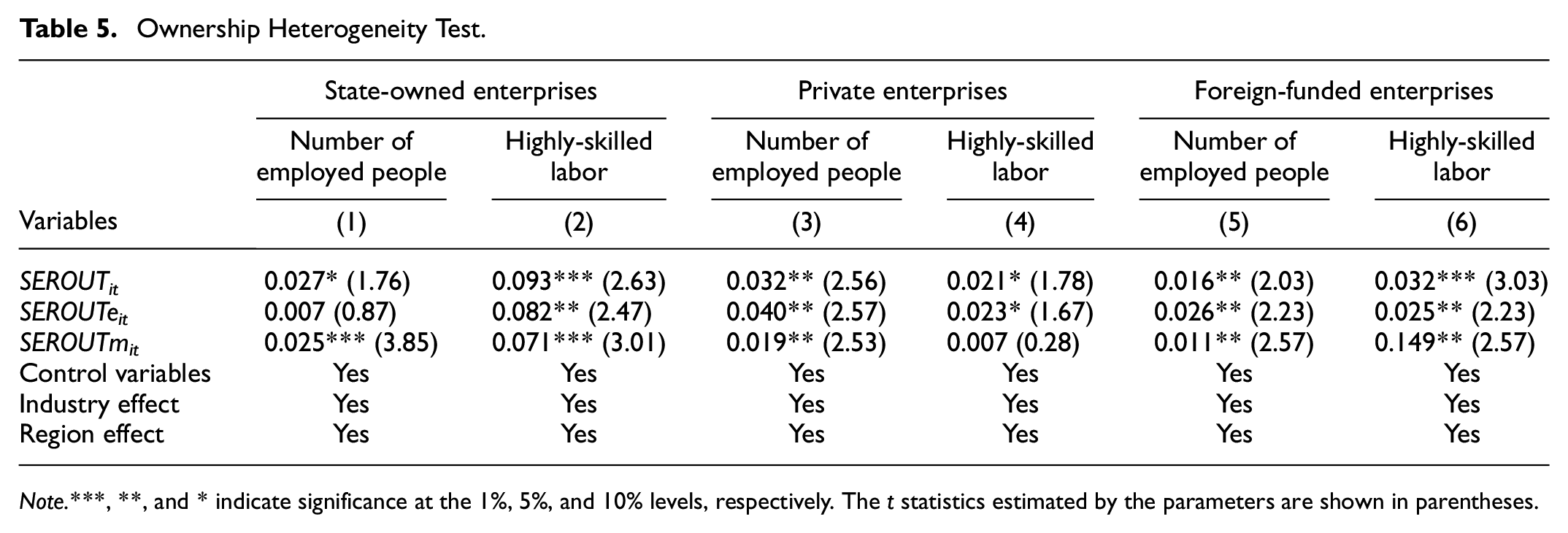
The estimation results in Table 5 show how an enterprise’s ownership heterogeneity affects thetransformation of manufacturing output servitization’s impact on employment. Regarding the estimation results for the number of jobs in SOEs, the estimated coefficient of manufacturing output servitization is positive, but it only passes the significance test at the 10% level, indicating that the pulling effect of the output servitization of SOEs on the number of employees is limited. The estimation coefficient of embedded servitization is not significant, while that of mixed servitization is significantly positive, indicating that mixed servitization is the main reason for output servitization to improve the number of employed people. The estimated coefficients of output servitization, embedded servitization, and mixed servitization of private and foreign-funded enterprises are significantly positive, indicating that these two enterprise types drive employment growth through both embedded servitization and mixed servitization. The reason for this relates to the position of private enterprises in the value chain and the production businesses in which they engage.
Ownership Heterogeneity Test.
Note.***, **, and * indicate significance at the 1%, 5%, and 10% levels, respectively. The t statistics estimated by the parameters are shown in parentheses.
There are many labor-intensive private enterprises, and the service-oriented transformation drives the creation of many jobs in the manufacturing and service industries. Moreover, most overseas companies keep their high value-added activities (e.g., R&D, design, and brand marketing) at home andmove theirlow-end production and assembly operations to developing countries. By relying on cheap labor and factor prices, China has many manufacturing links with multinational companies, which shows that the service-oriented transformation of foreign-funded enterprises can stimulate employment growth.
Regarding the estimation of the impact of having a highly-skilled labor force, as far as SOEs and foreign-funded enterprises are concerned, the servitization of manufacturing enterprises obviously promotes the employment of a high-skilled labor force, and both embedded and mixed servitization play a key role. Regarding the private enterprises, although embedded servitization has a positive effect on the employment of a highly-skilled labor force, the effect is limited, and mixed servitization does not improve the private enterprises’ ability to absorb a highly-skilled labor force. Overall, the output servitization of the private enterprises has a limited effect on the employment of a highly-skilled labor force. A possible reason is thatforeign-funded enterprises pay more attention to consumer experiences and product brand-building, and they create more highly-skilled jobs by increasing the service content of manufacturing products. Meanwhile, SOEs are generally larger in scale and are an important sector for the national economy and people’s livelihoods, so the transformation of output servitization has a greater role in driving the employment of a highly-skilled labor force. Therefore, the enterprise ownership heterogeneity test shows that the servitization of private and foreign-funded enterprises can improve employment growth in China, while the servitization of SOEs and foreign-funded enterprises canimprove the quality of employment.
Industry Heterogeneity Test
The estimation results in Table 6 show how an enterprise’s industry heterogeneity affects the transformation of manufacturing outputservitization on employment. Regarding the results for the number of employed people, embedded servitization and mixed servitization both increase a labor-intensive enterprise’s ability to absorb employment. Therefore, the transformation of an enterprise’s output servitization is conducive to increasing the number of employees. The servitization of a capital-intensive enterprise promotes employment growth, but it is mainly achieved by embedded servitization, and the effect of mixed servitization on employment growth is not obvious. Since embedded servitization does not stimulate the increase in employment, the servitization of a technology-intensive enterprise’s output has little effect on employment growth. Regarding the results for the effect of the manufacturing servitization on the employment of a highly-skilled labor force, since neither the embedded servitization nor the mixed servitization of a labor-intensive manufacturing enterprise can significantly promote the growth of a highly-skilled labor force, the promotional effect of the output servitization on the employmentof skilled labor is not significant. The output servitization of a capital- and technology-intensive manufacturing enterprise creates more jobs that require higher education and skills, which promotes the employment of highly-skilled labor. From the perspective of the servitization types, both embedded and mixed servitization contribute to the promotion and growth of high-skilled laborbecause the increased service content of a labor-intensive enterprise’s product will promote consumer recognition of the brand. Additionally, the increase in product output and market share will lead to the continuous expansion of the enterprise’s production scale, which, in turn, will stimulate employment growth. However, most jobs in labor-intensive enterprises require unskilled labor, so the promotion of a highly-skilled labor force is not obvious. The industry heterogeneity results show that the servitization of labor-intensive manufacturing output can increase employment growth in China, while the servitization of capital- and technology-intensive manufacturing enterprises can improve the quality of employment.
Industry Heterogeneity Test.

Note.***, **, and * indicate significance at the 1%, 5%, and 10% levels, respectively. The t statistics estimated by the parameters are shown in parentheses.
Regional Heterogeneity Test
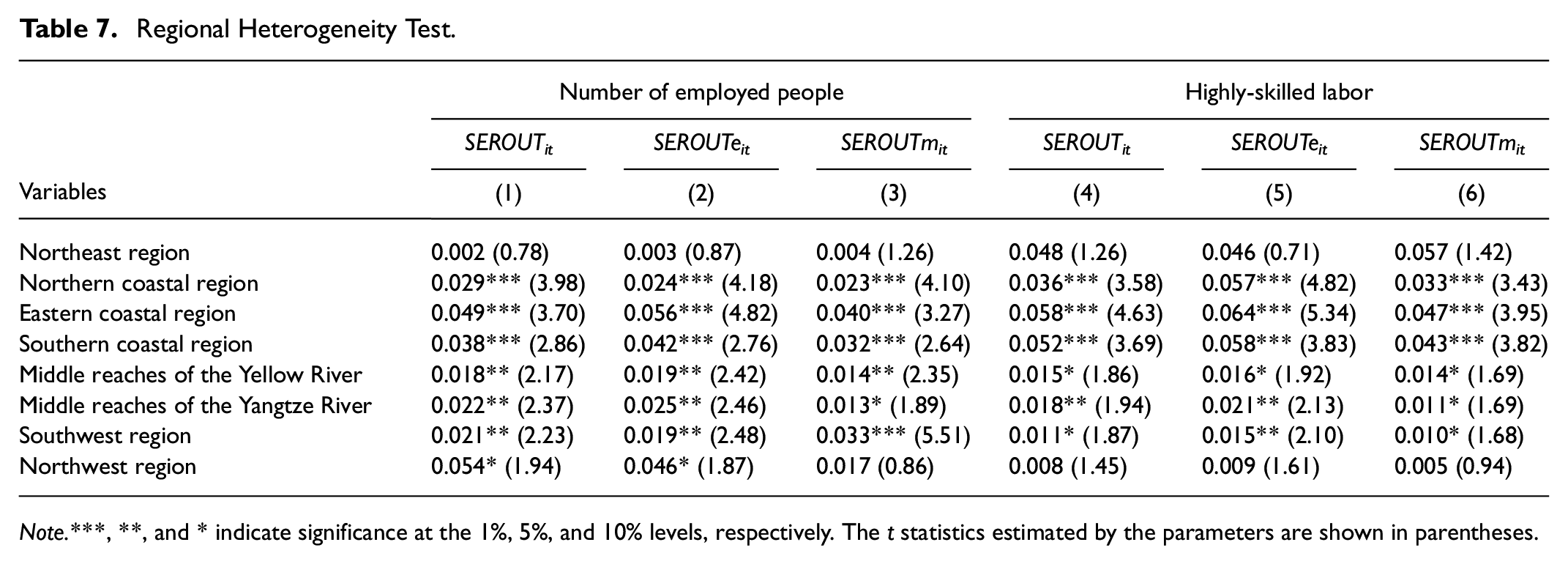
In the past, the division of China into Eastern, Central, and Western regions was relatively rough. Based on the practice of the Development Research Center of the State Council (DRCSC), this study divides China into eight economic zones. The estimation results in Table 7 show how an enterprise’s regional heterogeneity affects the transformation of manufacturing output servitization on employment. The estimation results for Northeast China show that because the estimation coefficients of embedded and mixed servitization are not significant, manufacturing output servitization does not promote employment growth, including the employment of a highly-skilled labor force. This is because the development of the service industry in Northeast China is relatively lagging, and the service content of manufacturing products is relatively small, so employment growth cannot be promoted. Moreover, manufacturing output servitization in Northeast China does not create knowledge- and technology-intensive jobs to absorb highly-skilled labor. Manufacturing output servitization in the Northern coastal region not only promotes employment growth but also improves the employment structure, which means the employment of a highly-skilled labor force. This indicates that the product services in Beijing and Tianjin accelerate the transformation of manufacturing output servitization in the region, which drives employment growth, including the employment of a highly-skilled labor force.
Regional Heterogeneity Test.
Note.***, **, and * indicate significance at the 1%, 5%, and 10% levels, respectively. The t statistics estimated by the parameters are shown in parentheses.
The estimated coefficients of manufacturing output servitization, product embedded servitization, and product mixed servitization in the Eastern and Southern coastal areas are significantly positive. In these two regions, the transformation of manufacturing output servitization plays the largest role in promoting the growth of both the total employment andthe highly-skilled labor force. This shows that the Yangtze River Delta urban agglomeration (represented by Shanghai, Nanjing, Hangzhou, and Suzhou) and the Guangdong-Hong Kong-Macao Greater Bay Area urban agglomeration (represented by Guangzhou, Shenzhen, Foshan, and Dongguan) have solid manufacturing foundations and developed product service networks, which accelerate the “product + service” development of manufacturing enterprises, create many highly-skilled jobs, and improve both the quality and quantity of employment. In the middle reaches of the Yellow River, manufacturing output servitization, product embedded servitization, and product mixed servitization play a certain role in promoting employment growth but do not play a significant role in promoting the employment of a highly-skilled labor force.
In the middle reaches of the Yangtze River, manufacturing output servitization promotes the growth of the total number of employees and a highly-skilled labor force, but the effect is less significant than thatfor the Eastern, Southern, and Northern coastal areas. In Southwest China, manufacturing output servitization has a significant effect on employment growth at the 5% level, but the effect on the highly-skilled labor force is only significant at the 10% level, so the ability to create highly-skilled jobs needs to be improved. In Northwest China, manufacturing output servitization does not significantly promote the growth of total employment or a highly-skilled labor force, indicating that the transformation of the output servitizationin this region needs to be further accelerated, and the role of promoting employment and structural optimization should be further improved.
Size Heterogeneity Test
The estimation results in Table 8 show how an enterprise’s size heterogeneity affects the transformation of manufacturing output servitization on employment. Both medium- and large-sized enterprises promote overall employment growth, and the larger the size of the enterprise, the stronger the driving force for employment growth. The promotional effect of large manufacturing enterprises’ output servitization on employment growth is from product embedded, and product mixed servitization, while the promotional effect of medium manufacturing enterprises is mainly from product mixed servitization. Although the estimated coefficient of the small manufacturing enterprises’ output servitization is positive, it is only significant at the 10% level, which shows a limited effect on employment creation. In terms of the highly-skilled labor force employment estimates, the output servitization of large manufacturing enterprises has a positive effect on the employment of highly-skilled labor, and both product embedded and product mixed servitization show similar effects. This shows that the service output can bring economies of scale, while economies of scope play an important role in improving employment quality. Accordingly, the economies of scale and scope brought about by the servitization of enterprises’ output play an important role in improving the quality of labor employment.
Size Heterogeneity Test.

Note.***, **, and * indicate significance at the 1%, 5%, and 10% levels, respectively. The t statistics estimated by the parameters are shown in parentheses.
Although the output servitization of medium-sized manufacturing enterprises has a smaller role in promoting the employment of high-skilled labor than large enterprises, the positive role is obvious. Since small manufacturing enterprises have less service content in their output, their status in the value chain is not high, and their role in leading the development of advanced product services is relatively small. Their ability to create highly-skilled jobs is insufficient, and their ability to absorb highly-educated and skilled workers is weak. The enterprise size heterogeneity results show that with the expansion of enterprise size, the promotional effect of output servitization on the total number of employees continues to improve, and the driving effect of output servitization on a highly-skilled labor force continues to strengthen. This is because the larger the scale of the enterprise, the more obvious the economies of scale and scope make the output servitization stimulate employment through the profit, cost, and wage channels. Economies of scale will reduce corporate costs, increase corporate profits, and promote wage growth, which, in turn, will stimulate the employment of a highly-skilled labor force and overall employment growth.
The Mechanism Test Results for the Impact of Manufacturing Output Servitization on Employment
The previous results have shown that, overall, the servitization of manufacturing output can promote labor employment growth. What is the mechanism thatstimulates employment growth? Examining this mechanism can help refine the research conclusions and suggest more targeted policy recommendations. The following discussionuses amediation effect model to investigate the mechanism of the effect of manufacturing output servitization on employment from three paths: profits, transaction costs, and wages. Table 9 shows the mediation affect test results.
Test Results for the Mediating Effect of the Influence of Manufacturing Output Servitization on Employment.

Note.***, **, and * indicate significance at the 1%, 5%, and 10% levels, respectively. The t statistics estimated by the parameters are shown in parentheses.
Regarding the intermediary effect of the profit channel, the estimation results of Model (1) show that the estimated coefficient of the impact of manufacturing output servitization on profit is significant at 0.076, indicating that manufacturing output servitization has a positive impact on enterprise profit. This may be because manufacturing companies improve their corporate performance, including their proportion of net profits, through service business transformation (L. Chen & Shen, 2017). The estimation results of Model (2) show that both the estimated coefficients of the impact of manufacturing output servitization and the intermediary variable of profit on employment are significantly positive, output servitization’s impact on employment through the intermediary effect of profit is 0.009, and the mediating effect of the output servitization coefficient is less than the estimated coefficient (0.028) shown in the basic regression model. This indicates that profit plays a role in the mediation effect; the mediation effect accounts for 32.03%, and the output servitization of manufacturing enterprises promotes employment growth through the mediating effect of profit. This is because increased profits will enable an enterprise to continuously expand its production scale to occupy the market share, which, in turn, will increase the demand for labor. Accordingly, the profit-increasing effect of manufacturing output servitization has become an important factor in promoting employment growth.
Regarding the mediation effect of the transaction cost channel, the estimated coefficient of the impact of the output servitization on transaction cost in Model (3) is significantly negative, indicating that manufacturing enterprises reduce transaction coststhrough the transformation of output servitization. The estimation results of Model (4) show that the estimated coefficient of the intermediary variable of transaction cost is significantly negative, indicating that reducing transaction costs can promote employment growth. The impact of output servitization employment through the intermediary effect of transaction cost is 0.006, while the direct effect is 0.022. Therefore, the mediation effect accounts for 21.38%. The above analysis shows that manufacturing enterprises can reduce transaction costs through the transformation of output servitization, which plays a positive role in driving employment growth.
Regarding the mediation effect of the wage channel, the estimated coefficient of the impact of the output servitization on wages in Model (5) is significantly positive, indicating that manufacturing enterprises increase wages through the transformation of output servitization. This is because the transformation of the manufacturing servitization improves enterprises’ statuses in both the global value chain and value-added exports, and the status upgrade in the international division of labor promotes the output servitization and increases the share of the labor income (L. Chen & Shen, 2019). In Model (6), the estimated coefficient of the mediation variable wage on employment is significantly positive, indicating that wage increase promotes employment growth, while the direct effect of the transformation of manufacturing servitization on employment is 0.020. Therefore, the intermediary effect is 0.008, accounting for 28.57%. The above analysis shows that manufacturing output servitization promotes labor employment growth, especially in the employment of high-skilled labor, by increasing wages. Therefore, the wage-increasing effect of manufacturing output servitization is a vital forcefor increasing labor employment.
Test Results for the Moderating Effect of the Degrees of Marketization and Internationalization
From the above theoretical analysis, the manufacturing enterprises’ degrees of marketization and internationalization may have a certain impact on the effect of manufacturing output servitization on employment. The following discussion tests the moderating effect from two aspects: the degrees of marketization and internationalization. Table 10 shows the moderating effect test results.
Test Results for the Moderating Effect of Enterprises’ Marketization and Internationalization Degrees.

Note.***, **, and * indicate significance at the1%, 5%, and 10% levels, respectively. The t statistics estimated by the parameters are shown in parentheses.
Test Results for the Moderating Effect of the Degree of Marketization
Regarding the results for the marketization degree’s moderating effect on the influence of output servitization on employment, the output servitization coefficient is significantly positive, and the estimated coefficient of the interaction term between the output servitization and marketization degree is also significantly positive. Therefore, the total impact of the manufacturing output servitization on employment is 0.019 + 0.011 market. This means that as the degree of marketization increases, the role of output servitization in promoting employment growth increases, and the degree of marketization plays a positive moderating role in the effect of output servitization on employment growth. Next, we separately tested the marketization degree’s moderating effect on the influence of manufacturing enterprises’ embedded and mixed servitization on employment. The overall effect of embedded servitization is 0.023 + 0.015 market, indicating that with the improvement of marketization, embedded servitization can drive employment growth. The influence of mixed servitization on the number of employees also shows that the marketization degree hasa moderating effect. The promotional effect of mixed servitization on employment growth increases with the increase in the marketization degree, which means the marketization degree has an obvious positive moderating effect.
Test Results for the Moderating Effect of the Degree of Internationalization
The test results show the internationalization degree has a positive moderating effect on the impact of manufacturing output servitization on employment. Specifically, after adding the degree of internationalization as a moderating variable, the total effect of the manufacturing output servitization on the number of employees is 0.023 + 0.028 inter. This shows that with the increase in the degree of internationalization, more jobs will be created throughthe manufacturing output servitization. The degree of internationalization plays an important moderating role in the impact of output servitization on employment, and can strengthen the effect of manufacturing output servitization on employment growth. Regarding the test results for the degree of internationalization’s moderating effect on the manufacturing enterprises, embedded servitization affects employment. The degree of internationalization also plays an important positive moderating role. That is, as the degree of internationalization increases, an increase in product embedded servitizationwill have a larger effect on the promotion of labor employment. Similarly, the impact of mixed servitization on labor employment is influenced by the moderating effect of enterprise internationalization. The higher the degree of enterprise internationalization, the more obvious the pulling effect of mixed servitization on employment growth. Therefore, an enterprise’s degree of marketization and internationalization plays an important moderating effect in the impact of output servitization, embedded servitization, and mixed servitization on labor employment.
Conclusions and Policy Implications
This study analyzes the impact of manufacturing enterprises’ output servitization on employment and its mechanism from the downstream value chain. We also examine the mechanism of the effect ofoutput servitizationon employment through profits, transaction costs, and wagesvia a mediating effect modeland considers the moderating effects of marketization and internationalization. The study findings are as follows. First, manufacturing output servitization not only promotes the employment of a highly-skilled labor force, but also drives the total employment growth. From the perspective of the output servitization types, embedded servitization promotes employment growth, including high-skilled labor, while mixed servitization has little effect on the employment growth of high-skilled labor.
Second, the heterogeneity tests show that an enterprise’s characteristics and environment will affect the employment effect of manufacturing output servitization. From the perspective of the different enterprise ownership types, the servitization of private and foreign-funded enterprises can increase the number of employees in China, while the servitization of SOEs and foreign-funded enterprises can improve the quality of employment. In terms of the different industries, the output servitization of labor-intensive manufacturing can promote employment growth in China, while the servitization of capital- and technology-intensive manufacturing enterprises can improve the quality of employment. The enterprises’ regional heterogeneity test shows that the manufacturing output servitization in the Northern, Eastern, and Southern coastal regions increases both the quality of employment and the number of jobs. The promotional effect of the enterprises in other regions needs to be further improved. The impact of the manufacturing output servitization on employment is also different depending on enterprise size. The larger the enterprise size, the greater the promotional effect of the output servitization on the employment of a highly-skilled labor force and the total number of employees. Specifically, the servitization of medium- and large-sized enterprises stimulates the employment of high-skilled labor and promotes the growth of the total number of employees, while the servitization of small enterprises has a limited stimulating effect on employment growth.
Third, the mechanism test results of the mediating effect model show that profits, transaction costs, and wages are the possible channels through which manufacturing output servitization promotes employment growth. The profit-increasing effect of manufacturing output servitization has become an important factor for promoting employment growth. The transaction costs’ reduction effect of output servitization plays a positive role in stimulating employment growth. The wage-increasing effect of output servitization is an important force for the improvement in the number of highly-skilled employees.
Fourth, the marketization and internationalization degrees play an important moderating role in the impact of manufacturing output servitization on employment. With the continuous improvement of enterprises’ marketization and internationalization degrees, manufacturing enterprises’ output servitization, embedded servitization, and mixed servitization can play a greater role in promoting employment growth.
This study’s conclusions have the following policy implications for both the realization of the transformation of manufacturing enterprises’ output servitization and the goal of high-quality employment in China. First, to encourage employment growth and improve the employment structure, the manufacturing output servitization process should be actively promoted, so as to upgrade enterprises’division of labor status in the value chain. To compensate for the short comings of output servitization in the promotion of high-quality employment growth, the role of manufacturing enterprises’ embedded servitization in promoting employment growth and optimizing the employment structure should continue to be explored, and thereasonfor the insufficient role of mixed servitization in promoting the employment of high-skilled labor should be further examined.
Second, differentiated policies should be formulated according to different enterprise characteristics to enhance the employment-driving role of the transformation of manufacturing output servitization. In particular, China should expand and strengthen SOEs to improve their employment absorption ability; encourage private enterprises to conduct technological innovations, transformations, and upgrades to guarantee the employment of highly-skilled workers in private enterprises; and appropriately liberalize foreign investment access to encourage foreign-funded enterprises to create more jobs. Meanwhile, China should also encourage labor-intensive enterprises to create more jobs through service-oriented output, and make full use of the service-oriented output of capital- and technology-intensive enterprises to optimize the employment structure. Besides, the capacity of the manufacturing enterprises’ output servitization in the Northern, Eastern, and Southern coastal regions to absorb highly-skilled labor should continue to be improved, and policies should be developed to encourage other regions to increase the employment promotion role of output servitization on employment. Finally, tax reductions, exemptions, and other measures should be implemented to continue the improvement ofsmall enterprises’ employment absorption capacity.
Third, corporate profits, transaction costs, and wages are three possible paths through which the transformation of manufacturing enterprises’ output servitization affects employment. Therefore, continuously increasing corporate profits, reducing transaction costs, and increasing corporate wages can be effective measures for enhancing the role of manufacturing output servitization in promoting employment. Accordingly, China should continue to implement supply-side reform, which means reducing enterprise transaction costs and improving enterprise profits. Meanwhile, to accelerate the realization of high-quality employment, China should establish and improve a scientific wage increase mechanism and salary system for highly-skilled personnel and give full play to the incentive role of income distribution policies.
Fourth, the market environment should be optimized for the transformation of output servitization to enhance the employment promotion effect ofmanufacturing output servitization. It is necessary to improve both the marketization and internationalization degrees of manufacturing enterprises based on the requirements of the servitization transformation of the enterprises’ output. Specifically, China should accelerate the implementation of market-oriented reforms regarding the allocation of factors and products andshould continue to increase its level of opening-up. Through the marketization and internationalization degrees of enterprises, manufacturing output servitization can be used to achieve the goals of increasing the number of jobs and improving the quality of employment.
Footnotes
Declaration of Conflicting Interests
The author declared no potential conflicts of interest with respect to the research, authorship, and/or publication of this article.
Funding
The author disclosed receipt of the following financial support for the research, authorship, and/or publication of this article: This study was funded by the philosophy and Social Science Foundation of Zhejiang (Grant No. 2022JDKTZD48).

Data Availability Statement
Data sharing not applicable to this article as no datasets were generated or analyzed during the current study.