




Abstract
Studies have shown that traumatic experiences are positively associated with risk of suicidal behaviors, whereas religiosity has been found to be negatively associated with that risk. How exactly religiosity interacts with traumatic experiences in its relationship to suicidal behaviors remains unclear. The current study examined the moderating effects of religiosity on the relationship between traumatic experiences and suicidal behaviors in 5,301 college students in northwestern China. Results indicated a strong positive association between traumatic experiences and suicidal behaviors (β = .46, p < .01), and a weak inverse association between religiosity and suicidal behaviors (β = –.06, p < .01). However, a significant interaction emerged between religiosity and traumatic experiences in their effect on suicidal behaviors (β = –.23, p < .01). These findings suggest that religiosity may play a role in reducing the risk of traumatic experiences-induced suicidal behaviors among college students in a largely secular society.
Introduction
Suicide is a serious problem on a worldwide basis. In most countries, suicide is one of the top 10 causes of death in the overall population and is one of the top three causes of death among young adults (Centers for Disease Control and Prevention, 2017). China accounts for an estimated 22% of global suicides, or roughly 2,00,000 deaths in the year 2011 (Hvistendahl, 2012). Among those aged 15 to 34 years, suicide is the most common cause of death and accounts for 19% of deaths from all causes (Hawton, Saunders, & O’Connor, 2012). Suicidal behaviors have been associated with the social environment, politics, cultural issues, and spiritual factors (Chen, Wu, Yousuf, & Yip, 2012; Wincy et al., 2009).
Various correlates of suicidal behaviors in college students have been reported including gender, religiosity, social support, purpose in life, hope, self-esteem, and traumatic experiences (Nadler, 2018). Lower self-esteem has been associated with the risk of suicidal ideation in college students (Eskin, 2012). At least one study found that hopelessness was associated with a higher risk for suicidal behaviors (Weishaar & Beck, 2009). In addition, social support plays an important role in relieving psychological stress and in protecting individuals from suicide (Kleiman, Riskind, & Schaefer, 2014). Furthermore, studies have found that traumatic experiences are closely related with suicidal behaviors (Maltsberger, Goldblatt, Ronningstam, Weinberg, & Schechter, 2011). For example, victims of bullying often express higher levels of suicidal ideation and are at greater risk to attempt suicide (Shireen, Janapana, Rehmatullah, Temuri, & Azim, 2014). Adverse childhood experiences have also been closely related to risk of suicide attempt (Jimenez et al., 2016).
In contrast, participating in religious activities may be protective against suicidal behaviors. Studies in religious countries have found that more religious involvements are associated with a lower risk of suicide attempt (Rasic, Robinson, Bolton, Bienvenu, & Sareen, 2011). Individuals with a religious affiliation have a significantly lower risk of suicidal ideation compared with those without religious affiliation (Rasic, Kisely, & Langille, 2011).
How does religion affect risk of suicidal behaviors? There are at least three different mechanisms likely responsible: (a) religious involvement provides a social support system by increasing social networks (Koenig et al., 1997), (b) religious doctrines discourage suicide (Dervic et al., 2011), and (c) religious beliefs may serve as a coping behavior when dealing with traumatic stressors, or may reduce the likelihood of experiencing stressors by doctrines that discourage high risk behaviors (Evans, 2014; Koenig et al., 1992).
However, compared to the many studies conducted in Western society, religion and suicide have not been studied as well in less religious countries such as China. What research has been done suggests different relationship than reported in more religious countries. Although one study reported that college students with higher intrinsic religiosity and lower personally oriented extrinsic religiosity had less suicidal ideation (Lew et al., 2018), another study found no association between intrinsic religiosity and suicidal behaviors (Z. Z. Wang, Koenig, Ma, & Liu, 2015).
The role that religion plays in decreasing risk of suicidal behaviors among those suffering traumatic experiences remains unclear, particularly, in Mainland China. The current study sought to examine the moderating effects of religiosity on the relationship between traumatic experiences and suicidal behaviors using a four-step hierarchical regression model. We hypothesized that religiosity may play an important role in reducing trauma-related suicidal behaviors by its buffering effects on the psychological distress produced by those experiences.
Participants
The data for this paper came from a cross-sectional survey conducted in northwest China. Three universities/colleges located in the Ningxia Hui autonomous, Qinghai province, and Xingjiang Uygur autonomous regions were selected. A cluster sampling method was used to identify students from each university. Students registered in the same class (usually 35-45 students) were defined as a cluster. Then 148 classes (n = 6,000) were selected and approached to complete the survey. A total of 5,301 college students completed questionnaires and were included in the final analysis. The remaining students (n = 699) either refused or did not complete the entire survey (i.e., answered less than 70% of questions).
Procedure
A research team composed of four postgraduate students in epidemiology administered the survey during a 2-week period for each university: 11/14/17 to 11/24/17 for Ningxia Medical University, 11/24/17 to 12/8/17 for Qinghai Nationalities College, and 1/13/18 to 1/21/18 for Xingjiang Medical University. Questionnaires were distributed to students in university classrooms and were collected at that time. Gift packages (cost about US$1) were given as compensation for completing the surveys. Participants completed the questionnaires anonymously, and no identifying information was collected. Informed consent was obtained from all participants. The study was approved by the Institutional Review Board of the Ningxia Medical University (No.2017-171).
Measures
The questionnaire asked about sociodemographical characteristics (grade, age, gender, rural/urban, and ethnicity) and included a battery of social psychological measures (social support, purpose in life, self-esteem, hope, traumatic experiences, and religiosity). Suicidal behaviors were the dependent variable.
Social Support
The 12-items multidimensional scale of perceived social support (Zimet, Dahlem, & Farley, 1988) was used to measure social support, each question with a 7-point Likert-type response resulting a total score range from 12 to 84, where the higher scores indicate greater social support. The scale has acceptable reliability and validity in Chinese (Y. Wang, Wan, Huang, Huang, & Kong, 2017).
Purpose in Life
The four-item purpose in life test–short form (PLT-SF; Schulenberg, Schnetzer, & Buchanan, 2011) was used to measure the extent to which participants felt their lives had meaning and purpose. The PLT-SF has a 7-point Likert-type scale response format. Different anchors are used for each item, depending on item content. Responses to items are summed to produce a total score ranging from 4 to 28. Higher scores indicate greater perceived meaning/purpose in life. A Chinese version of the PLT-SF has been shown to have acceptable reliability (α = .89) and construction validity (Law, 2012).
Self-Esteem
The self-esteem scale (SES), developed by Rosenberg (1965), was originally used to assess adolescents’ overall feelings of self-worth and self-acceptance, and is currently the most widely used self-esteem measure with solid reliability (α = .84; Chad, Jameson, Lyndsay, & Sheri, 2013). The SES consists of 10 items with a total score ranging from 10 to 40, where higher scores indicate greater self-esteem.
Hope
The hope scale was adapted from Snyder’s dispositional hope scale (Snyder et al., 1991), which has good internal consistency and acceptable validity. In Snyder’s cognitive model of hope, it is defined as “a positive motivational state that is based on an interactively derived sense of successful (a) agency (goal-directed energy) and (b) pathways (planning to meet goals).”
Traumatic Experiences
Trauma suicide potential index (TSPI-5) is a brief five-item measure developed by Osman and colleagues. It is designed to screen for the tendency to experience traumatic events that may precipitate suicide-related behavior (Osman, Gutierrez, Bagge & Freedenthal, 2014). The psychometric properties of the TSPI-5 have been reported to be solid (α = .91).
Religiosity
Revised intrinsic extrinsic religiosity scale (IE-R) was used to measure religiosity (Gorsuch & Mcpherson, 1989). The scale has 14 items, and responses to each item are measured on a Likert-type scale from 1 (strongly disagree) to 5 (strongly agree). The total score ranges from 14 to 70 and higher scores indicate higher religiosity. Studies have reported acceptable reliability and validity for the scale (Lew et al., 2018).
Suicidal Behaviors
The suicidal behavior questionnaire–revised (SBQ-R; Osman et al., 2011) was used to assess the primary dependent variable, that is, the frequency and severity of suicidal behaviors and past history of suicide attempts. The SBQ-R is a four-item instrument with a total score that ranges from 3 to 18, where higher scores indicate greater risk of suicidal behaviors. The SBQ-R has been shown with acceptable psychometric characteristics in Chinese adolescents (Chad et al., 2013).
Statistical Analyses
SPSS 21.0 software package was used for all statistical analyses. For bivariate analyses, the Student’s t test was used, along with Pearson correlations. For multivariate analyses, hierarchical linear regression was used. The alpha level for statistical significance was set at 0.05.
Hierarchical regression was used to examine the moderating effect of religiosity on the relationship between traumatic experiences and suicidal behaviors (Xiang, Muhd, Siti, Normala, & Zubaidah, 2014). Variables were included in regression models only if correlations were <.80 to avoid multicollinearity (Toothaker, 1994). In the first step, social psychological factors were entered into the model; in the second step, traumatic experiences were entered; in the third step, religiosity was included; and in the fourth step, the interaction term between religiosity and traumatic experiences was included to examine whether religiosity moderated the relationship between traumatic experiences and suicidal behaviors.
Results
Demographic Characteristics
The demographic characteristics are presented in Table 1. The final sample had an average age of 20.1 (SD = 1.6) years, ranging from 18 to 26 years, and the majority were female (66.0%). More than half of the participants described their ethnicity as Han (52.6%). Approximately one third (31.0%) of participants indicated a religious affiliation: Buddhism or Taoism (10.8%), Christianity (0.9%), Islam (18.5%), and other (1.2%). Students with a religious affiliation had significant higher scores on the religiosity scale, but lower scores on social support, purpose in life, self-esteem, and hope than students without an affiliation.
Characteristics of Participants.

Note. *p < .05. **p < .01.
Bivariate Analyses
In correlational analyses (Table 2), hope, social support, and purpose in life were all negatively correlated with suicidal behaviors (r = –.18; r = –.18; r = –.28; all p < .01), whereas traumatic experiences were positively correlated with suicidal behaviors (r = .45, p < .01).
Bivariate Correlation Between Suicidal Behaviors and Psychosocial Variables.

Note. *p < .05. **p < .01.
Multivariate Analyses
Table 3 shows the results of the hierarchical regression analysis. In the first step (Model 1), psychosocial factors were included in the model (overall F = 122.98, p < .01, R2 = .08); social support (β = .09, p < .01), self-esteem (β = .05, p < .01), and purpose in life (β = –.24, p < .01) were all significantly related to suicidal behaviors. In the second step (Model 2), traumatic experiences variable was added in the model (overall F = 394.72, p < .01, R2 = .27, ΔR2 = .19), indicating a strong positive correlation between traumatic experiences and suicidal behaviors. In the third step (Model 3), religiosity was added in the model (overall F = 333.55, p < .01, R2 = .27, ΔR2 = .002), indicating a slight negative correlation between religiosity and suicidal behaviors. Finally (Model 4), the interaction between religiosity and traumatic experiences was added in the model (overall F = 334.88, p < .01, R2 = .31, ΔR2 = .03), and religiosity was significantly moderated by the relationship between traumatic experiences and suicidal behaviors (β = –.227, p < .01).
Hierarchical Regression Analysis Examining Psychosocial Factors Associated With Suicidal Behavior.
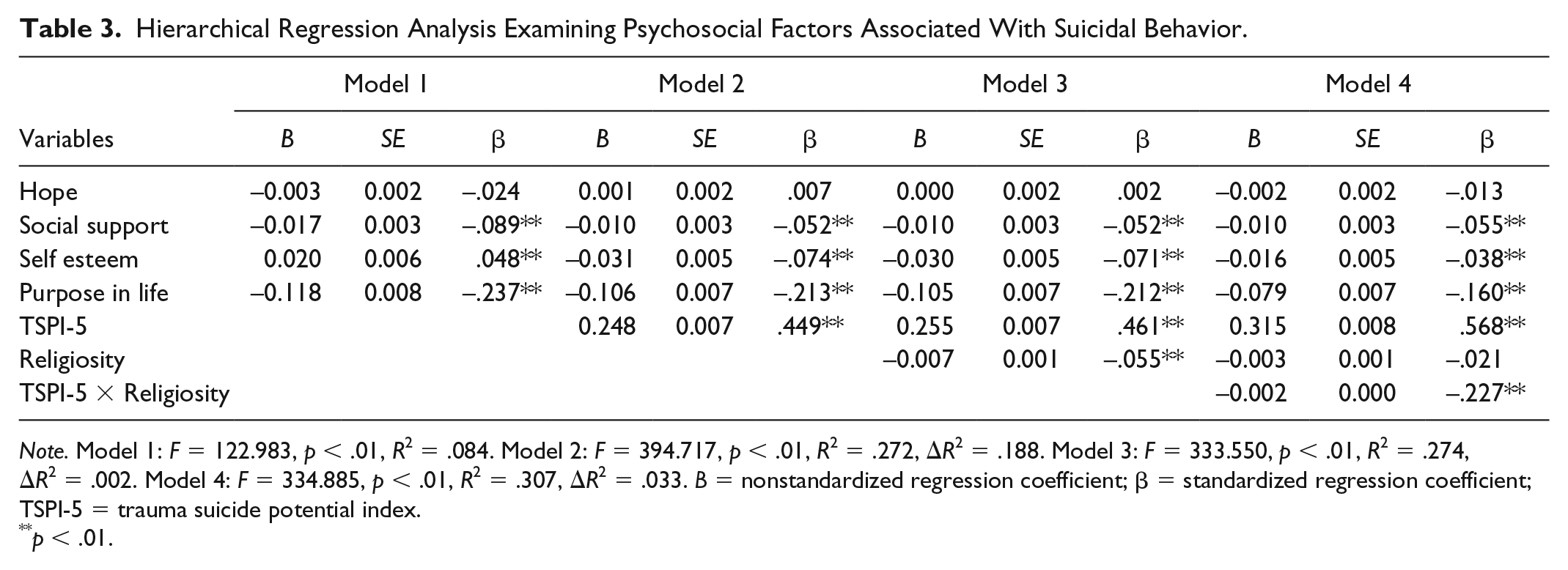
Note. Model 1: F = 122.983, p < .01, R2 = .084. Model 2: F = 394.717, p < .01, R2 = .272, ΔR2 = .188. Model 3: F = 333.550, p < .01, R2 = .274, ΔR2 = .002. Model 4: F = 334.885, p < .01, R2 = .307, ΔR2 = .033. B = nonstandardized regression coefficient; β = standardized regression coefficient; TSPI-5 = trauma suicide potential index.
p < .01.
Discussion
Although religiosity has often been associated with less suicidal behaviors in Western countries, the specific mechanisms by which religion may affect suicidal behavior remain unclear. Furthermore, fewer studies have examined whether religiosity may prevent suicide in non-Western societies or among adherents of other religions besides Christianity (Zhang, 2014). The present study contributes to the literature on religiosity and suicide by examining whether religiosity moderates the relationship between traumatic experiences and suicidal behaviors. Although, religiosity had only weak direct effects on the suicidal behaviors (β = .021), a moderately strong interaction emerged between religiosity and traumatic experiences in their effect on suicidal behaviors (β = .227). These results suggest that religiosity may play an important role in protecting against suicidal behaviors among students with traumatic experiences in a highly secular society like that in China.
A study examined the influence of religious factors on attitudes toward suicide in a small qualitative study of 27 participants from both rural and urban areas of Ghana (Osafo, Knizek, Akotia, & Hjelmeland, 2013). In that study, subjects reported that religion was particularly protective against suicide when going through a crisis. Teismann et al. (2017) also found that religious belief buffered against suicidal ideation. Xiang et al. (2014) provided a detailed description of the interactions between religious commitment, attitudes toward suicide, and suicidal behaviors among college students of different ethnic and religious groups, finding that religiosity may help to protect against suicidal behaviors in adolescents. Likewise, there was reported a negative relationship between the religious involvement and suicide among women exposed to violence in Turkey (a largely Muslim country; Zeynep, Derya, & Tuğba, 2015).
The present study also found that social support and purpose in life were negatively correlated with suicidal behaviors, whereas traumatic experiences were strongly and positive correlated with them. A study has found that having a reason for living played a key role in protecting against suicidal ideation and behaviors in a sample of Chinese college students (M. C. Wang, Lightsey, Pietruszka, Uruk, & Wells, 2007). Similarly, studies have found that social support plays a role in buffering against depression and suicidal thoughts, particularly emotional support by family members, which is strongly associated with lower risk of suicidal behaviors (Kleiman et al., 2014). Although positive social support may also buffer against suicide risk in college students, promotion of positive supportive relationships through encouragement of faith community participation may be an important suicide prevention strategy (Hirsch & Barton, 2011).
However, psychosocial factors such as social support known to be protective against suicidal behaviors were surprisingly negatively related to religiosity in the present study. A meta-analysis of religiosity and mental health concluded that religiosity may have both a negative and a positive influence on psychological adjustment depending on how individuals define religiosity and employ it to cope with psychosocial stressors (Hackney & Sanders, 2003). The absence of a relationship between religiosity and suicidal behaviors was also reported by Kazi and Naidoo (2016) in Muslim students in South Africa. Not surprising, extrinsic religiosity (the use of religion to obtain other personal and social benefits such as status and security, other than religion itself) is often associated with greater anxiety and more depression (Z. Z. Wang, Koenig, Zhang, Ma, & Huang, 2015).
Limitations
Several aspects of this study limit the generalizability of the findings reported here, especially, outside of China. First, due to the cultural differences between China and the West (most participants had no religious beliefs in China), the results of this study cannot be applied to college students living in Western countries. Second, the study was conducted in a sample of college students, which may not generalize to adults in China, particularly those who are older, less educated, and not currently in a university setting. However, there are also numerous study strengths including the large sample size, the rigorous assessment of suicidal behaviors and religiosity, and the control for various psychosocial variables known to affect suicidal behaviors using hierarchical regression, particularly when examining the moderating effect of religiosity.
Conclusion
We examined the role that religiosity plays in the relationship between traumatic experiences and suicidal behaviors among Chinese college students. We found that religiosity has a significant moderating effect on the relationship between traumatic experiences and suicidal behaviors, such that the relationship between traumatic life experiences and suicidal behaviors was much weaker in those who were more religious. The finding may help in developing intervention programs to reduce suicidal behaviors in Chinese university students.
Footnotes
Acknowledgements
The authors would like to thank the staffs from NingXia Medical University, Qinghai Nationalities College, and Xingjiang Medical University for providing support in the data collection. They also thank Dr. Osman for providing the instruments used in current study, and the valuable comments in study design.
Declaration of Conflicting Interests
The author(s) declared no potential conflicts of interest with respect to the research, authorship, and/or publication of this article.
Funding
The author(s) disclosed receipt of the following financial support for the research, authorship, and/or publication of this article: This work was part supported by the CMB foundation project (16-254), and the funder played no role in the study design and publication.
