




Abstract
70% of youth in Djibouti experience unemployment. However, the country is critically responsible for assisting in regional security and global trade. Given the interest of the Djibouti government and international aid donors in promoting youth employment, this study provides a direction toward evidence-based decision-making. Data were collected from graduates of the principal organization providing non-formal education in Djibouti. From the results, respondents strongly prioritize work that matches their interests, with subgroup analyses showing varying levels of prioritization for attributes such as on-the-job training and higher salaries.
Plain language summary
We investigate how Djiboutian youth make trade-off decisions on aspect of the employment options including distance-from-home, salary, contract duration, training opportunities, etc. By using a fully randomized survey technique, i.e., conjoint-analysis, we can quantify how each aspect of the employment influences their preference toward or away from certain job types. Our results identify two sub-groups of youth, one which prefers training opportunities and the other, which prefers higher salaries. As Djibouti gains attention from global investors and international aid donors as a stable and peaceful nation in a highly volatile region, understanding what youth are looking for in employment can further benefit stability and prosperity in Djibouti. By supporting stability in Djibouti, regional stability benefits, contributing to stability in trade, especially between Europe and Asia.
Keywords
Introduction
With a small and arid territory, the Republic of Djibouti, after gaining its independence from France in 1977, invested heavily in state-of-the-art maritime port facilities while also renting military bases for global powers such as the US, France, Japan, and China. This contributes to stability in international trade passing before its waters at the mouth of the Red Sea. This outsized role in global commerce and security often overshadows domestic concerns such as those of the underserved Djiboutian youth, comprising roughly half the population, lacking political and economic opportunities.
However, the government of Djibouti and international aid agencies, such as the US Agency for International Development (USAID) and the French Development Agency (AFD), have committed to funding projects supporting youth education and employment. The most successful project to provide schooling to out-of-school children is the not-for-profit Centre LEC, whose graduates exceed national rates of acceptance into higher education. Given that the government and international aid agencies plan to expand programs like Centre LEC and create more significant opportunities for youth employment, a pilot study of recent graduates’ employment preferences could provide valuable insights to match aspirants with employment schemes better. As such, this study surveys recent graduates of Centre LEC using conjoint analysis to estimate employment preferences and better inform policy formation.
In this research paper, we aim to conduct a pilot study to explore employment preferences among youth in Djibouti by employing a choice-based conjoint analysis (CBCA) methodology based on the influential work of Hainmueller et al. (2014) and Hainmueller and Hopkins (2015). In addition, we apply a partitional clustering algorithm, as found in Christodoulou and Sarafidis (2017) and Sarafidis and Weber (2015), to bifurcate the data into heterogeneous groups with distinct characteristics. By doing so, we isolate key motivating factors that distinguish each group of students.
With the key issues affecting youth in Djibouti outlined in the introduction, the literature review will expand on the features and challenges of education in Djibouti, focusing on remedial and basic primary education and the employment landscape. In the methodology and data section, a detailed discussion will be given on the conjoint analysis (how it differs from previous approaches by the same name, the attributes and levels chosen, the required assumptions), partitional clustering analysis, and the data collection. The results section provides a general overview of the conjoint survey experiment, the disaggregation of male and female preferences, and the partitional clustering results for respondents revealing shared preference characteristics. Lastly, the discussions and conclusions sections will express the limitations of the study in addition to implications for future research.
This research aims to pilot a study to enhance our understanding of the critical factors influencing employment-seeking decisions in Djibouti. Doing so will provide a path forward to evidence-based recommendations for policymakers, educators, and other stakeholders to improve employment outcomes, especially among youth. Through an in-depth analysis of employability preferences using choice-based conjoint analysis, we can gain valuable insights into the intricate dynamics of labor markets in developing countries. By uncovering the factors contributing to employability and the trade-offs individuals make, we can inform the design of targeted interventions, educational programs, and policy initiatives more effectively to enhance employment opportunities and empower individuals to secure meaningful and sustainable employment.
Literature Review
Education plays a pivotal role in the socio-economic development of nations, particularly in developing countries where providing quality education to all citizens remains a persistent challenge (Colclough, 1980; Lewis, 1962; Ozturk, 2008;). The challenges that developing countries are facing in their education systems are diverse: Inadequate infrastructure, insufficient funding, limited teaching and learning materials, teacher shortages, a lack of qualified teachers, high student-teacher ratios, and disparities in educational opportunities based on gender, socioeconomic status, or geographical location, limited access to quality learning are among the common challenges (Al-Samarrai & Peasgood, 1998; Lewin, 2007; Psacharopoulos & Patrinos, 2018). These factors contribute to low literacy rates, high dropout rates, and a significant student-learning achievement gap.
As a location for research, Djibouti poses many challenges. While it does feature in studies relating to political science and geostrategic studies (e.g., Bezabeh, 2011; Styan, 2016), much of these can be completed without requiring a physical presence in the country and without the need to navigate the sensitive political environment. Of the researchers that have examined the educational landscape, little has been published beyond curricular reform in Djibouti in the early 2000s (Dudzik et al., 2007). This paucity of research into Djibouti’s education system is likely a result of the closed nature of its government and lack of a free press or secure human rights. Having resided in Djibouti since 2020, the authors of this study have attained uncommon access to members of government and supporting documents and have collected data that would otherwise have been inaccessible through remote means.
Basic Education in Djibouti
The Republic of Djibouti is a small country with a multi-ethnic population of over 950,000, with 23% living in extreme poverty. There are significant disparities between the city of Djibouti and other regions, as well as between urban and rural areas. Regionally, Djibouti is surrounded by socio-political instability, causing migratory flows and refugees and creating a risk of social tensions spilling over. Because of its open-door policy to refugees and foreign migrants, the country’s limited resources and infrastructure have been overwhelmed, resulting in limited income-earning opportunities and a competitive job market. 1
The Djiboutian education system has been strengthened over the last several decades. Since adopting and implementing the Education Orientation Law (2000), the Djiboutian educational system has experienced significant progress with the development of the first-ever 2010 to 2019 Djibouti Education Sector Plan (MENESUP, 2010). Despite this progress, the Djiboutian education system faces numerous challenges, as highlighted in the World Bank Out-of-School Children study (World Bank, 2019). The study noted that approximately 30% of Djiboutian children are still out of school, with girls, those in rural areas, and refugees being the most disadvantaged.
Remedial Education
Remedial education, also known as non-formal education or accelerated basic education, is an intervention strategy designed to provide targeted assistance to students who have never attended school or have dropped out of school at an early stage of basic education (Latchem, 2018). It aims to address learning gaps, improve basic skills, and enhance educational outcomes for students who want to re-enter the formal education system (Schwartz, 2012).
Existing research suggests that remedial education interventions have the potential to impact educational outcomes in developing countries positively. Several studies have highlighted the effectiveness of targeted interventions in improving students’ basic literacy and numeracy skills (Ball et al., 2014; Banerjee et al., 2007; Dietrichson et al., 2020; Sempere, 2009). However, success is contingent on various factors such as skilled and trained teachers, appropriate curriculum and instructional materials, adequate resources and infrastructure, parental and community involvement, and policy support from government and educational institutions (Dietrichson et al., 2020).
Over the past decades, the primary provider of remedial education has been the Catholic Diocese of Djibouti, in conjunction with Caritas, a faith-based international non-governmental organization (INGO). The program provided by the Diocese is called the Centre “LEC,” for the French “Lire, Écrire, Computer” or, in English: “Read, Write, Count” (International Office of Catholic Education, 2022 December). As this name indicates, the mission of Centre LEC is to educate children who have either dropped out of school at an early stage of primary education or who have never attended school due to a lack of legal documents or other household vulnerabilities. The Centre LEC then fast-tracks the child’s primary education with a strong emphasis on foundational literacy and numeracy to re-integrate into the formal government-run education system after completing the three-year LEC program. Centre LEC started operating in 2002 by targeting children between 9 and 20 in five population centers of Djibouti (the national and regional capitals: Djibouti-City, Arta, Ali Sabieh, Tadjorah, and Obock).
The number of students in the different centers, according to the interview with the Head of LEC Centers, 2 has increased in ten years from 520 students in 2008-09 to more than 750 in the 2020 to 2021 school year (with almost as many girls as boys over the entire period). Over the last ten years, numbers stagnated in the most significant center in Boulaos (Djibouti-City); on the other hand, they doubled in Ali-Sabieh and increased by more than two in Tadjourah. Graduates from Centre LEC can either (a) join the 5th grade in the public primary schools, (b) take the end of primary exam directly and then enter the lower secondary school, or (c) enter the technical and vocational education courses provided by the Djiboutian Ministry of Education (MENFOP). For the 2019 to 2020 school year, the interview with the LEC administration reported that 111 children (64 boys, 47 girls) from the LEC program were integrated into the national education system (public formal schools) and continued their studies. LEC centers operate by donations from the Caritas and the Diocese global network and financial and material support from donor communities, including the United Nations and foreign military volunteer groups based in Djibouti, such as the Americans, French, and Italians (UNICEF, 2018). Most LEC program graduates continue their education by integrating into the public education system, primarily toward technical colleges and training institutions instead of general secondary education institutions.
There are three types of Technical, Vocational Education, and Training (TVET) programs at Djibouti’s lower secondary education level. The first one is a 2-year professional training course (two years) to obtain the Certificate of Professional Aptitude (CAP), and the second one is a 3-year course attested by the professional baccalaureate (called ‘BAC PRO’). A gateway is provided for a small proportion of CAP graduates toward the professional baccalaureate (BAC PRO) in the corresponding sectors. The third type of professional training is a 1-year short course with the Certificate of Professional Training (CFP) delivery targeting out-of-school children aged 11 to 14 or older. In many cases, students whose mainstream education ended at 9th grade (primary + lower secondary level) without obtaining the Certificate of Fundamental Education (Brevet d’Enseignement Fondamental/BEF) or the possibility of access to a place in upper secondary school. Access to and demand for professional training in Djibouti is generally linked by default in the event of failure in the academic mainstream pathways for upper secondary school and eventual university education. Failure to pass the BEF leads to CFP training if students do not wish to repeat or drop out. For the students who have obtained the BEF, only the best ones will be directed toward mainstream upper secondary education, and for those who remain, the best will be directed toward the BAC PRO, and the others will be sent toward the CAP. For BAC PRO and the CAP, it is once again the academic ranking that will guide the choice of job sectors rather than students’ motivation and individual interests.
Employment Landscape in Djibouti
Employability refers to the skills, knowledge, and attributes that enable individuals to gain and maintain employment. It is pivotal in driving economic growth and reducing poverty in developing countries. Youth make up a large part of the population in developing countries, where successful skills development of youth and transitioning from learning to earning are essential for a nation’s stable human capital development. As economies evolve and labor markets become increasingly competitive, understanding the factors influencing employability and the trade-offs individuals make when seeking employment becomes crucial.
According to the 2018 Djiboutian Household Survey for Social Indicators (Djibouti Department of Statistics and Demographic Studies, 2018), Djibouti’s gross domestic product was 2.72 USD per capita in 2017 prices (1.42 USD in 2013). The economy is strongly dominated by the tertiary sector (77%), with the primary and secondary sectors contributing only 4% and 19% to the gross domestic product, respectively. The harsh climate and limited natural resources severely limit the diversity of economic activities as primary sectors such as agriculture and fishing face multiple barriers, including heat waves, water scarcity, salinity, and lack of skilled labor and infrastructure for competing in the global agribusiness and seafood markets. The secondary sector performs better than the primary sector, yet its scale is limited for manufacturing and construction, while gas and electricity are nationally owned without competition. Thus, the tertiary sector contributes the most to economic activities. The Djibouti Port plays a crucial role in government revenue as most goods to and from Ethiopia pass through, providing various job positions to Djiboutian workers. Djibouti society also heavily relies on the Djibouti port as essential goods and commodities are traded through it. Besides logistics and transportation sectors linked to port activities, government jobs are the dominant employment options in the country, along with jobs related to foreign military bases stationed in the country. As for the unemployment rate, Djiboutian women are more likely to be unemployed (63%) than men (38%). The rural areas (59%) are hit the most by the unemployment rate, as opposed to the urban areas (37%). Youth also suffer a high unemployment rate of 63% (Djibouti Department of Statistics and Demographic Studies, 2018).
In March 2014, the Government of Djibouti adopted a new reference framework for planning long-term public development policies called “The Djibouti Vision 2035” (MEFI, 2014). This long-term vision aims to make Djibouti, by 2035, “the lighthouse of the Red Sea, a commercial and logistics hub of Africa.” One of the critical operational strategies of the Vision paper is the Accelerated Growth and Employment Promotion Strategy (SCAPE), in which the education and vocational training sector is considered vital to the growth and development of the human capital that the country needs to achieve its vision. The youth unemployment rate is regarded as one of the most urgent priorities.
After the publication of the Djibouti Vision 2035 document by the Djibouti Ministry of Economy and Finance (MEFI, 2014) with an urgent call to action on youth employment issues, various schemes for accelerating youth employment have been implemented with the technical and financial support of international communities. Most projects and programs aim to link young graduates with internships, apprenticeships, paid volunteer schemes, and others to bridge the gap in skills and professional networks that can aid graduates in finding employment. While data on the success rate of these youth employment schemes is limited, existing data on previous initiatives suggest low success rates.
According to the evaluation report of the former Education Sector Master Plan (2010–2019), a quantitative study on the integration of students leaving training in June 2017 and 2018 was carried out within the framework of the Education Sector Analysis (MENFOP, 2020) at the end of 2019. This study showed that only 800 students could find jobs among more than 6,000 students in CFP or the final year of baccalaureate technical or professional in 2017 or 2018; they were questioned about their professional situation 18 or 30 months after leaving training.
18 months after the end of their studies (2018 cohort):
1. Only 14% of graduates had a paid employment.
2. 9% of graduates had been briefly employed or returned to education.
3. 77% of graduates were looking for a job.
30 months after the end of their studies (2017 cohort):
1. Only 26% of graduates had a paid employment.
2. 17% of graduates had been briefly employed or returned to education.
3. 64% of graduates were looking for a job.
The report concluded that professional integration measured in this study is, therefore, on average, very low, even if it is higher for holders of a BAC PRO than for those of a CFP, perhaps due to the more extended period of training courses (the CFP offers a year-long course against the three-year course offered by the BAC PRO).
Bilateral aid to Djibouti
Bilateral donors such as USAID support the Djiboutian government by investing millions of dollars to improve employment prospects for secondary school graduates. One such project tackling youth unemployment was “USAID/Djibouti Workforce Development Activity,” implemented from 2016 to 2021 worth more than 24 million USD, executed by the Education Development Center, a U.S.–based, global non-profit institution. The project had three intermediate results and targeted Djiboutian youth aged 16 to 34:
1. Expand quality workforce readiness programs (particularly TVETs).
2. Develop sustainable, productive linkages between the TVET Institutions (workforce supply) and the private sector (workforce demand).
3. Strengthen job placement, retention, and advancement services.
The final project evaluation was commissioned in 2022 by USAID. The project was implemented in collaboration with the Djiboutian ANEFIP (L’Agence Nationale de l’Emploi de la Formation et de l’Insertion Professionnelle or the National Agency for Employment, Training, and Professional Integration) and successfully organized an internship program for 500 participants over the project implementation period, of which 26.6% were later hired. In its report, cross-sectoral recommendations were provided. These mentioned the importance of soft skills training components that cover personal development, employability, and entrepreneurial competencies. Most participants appreciated the internship experiences and viewed them as a chance to gain practical experience (USAID, 2019). The report concluded on the importance of co-design and co-creation of future projects with all stakeholders, including the youth and civil society, to ensure a shared vision of the priorities and the nature of the activities to ensure that participants not only express their needs and visions but the importance of co-design for sustainable and innovative solutions.
Methodology and Data
This study used two key methodological approaches: improved conjoint analysis (ICA) and partitional clustering. Before detailing the strengths and limitations of ICA, traditional conjoint analysis (TCA) predates ICA by several decades and is therefore highly represented in the academic literature. Originating as a tool for understanding preferences for marketing research (e.g., Green et al., 2001; Green & Srinivasan, 1990; Gustafsson et al., 2000), use of TCA broadened to encompass political science, health care, and others (Engidaw et al., 2023; Gyarteng-Mensah et al., 2022; Shamir & Shamir, 1995; Ryan & Farrar, 2000). For education research, TCA has measured teacher and student preferences under various contexts over several decades, primarily in high-income countries (Soutar & Turner, 2002; Tashchian & Freiden, 1983). Given the wide adoption of TCA, several limitations of TCA have been identified (Hauser & Rao, 2004), which include some of the following:
1. Assumption of Independence: TCA assumes that respondents consider attributes independently. Respondents may consider interactions between attributes, and this assumption may not always hold.
2. Difficulty Handling Complex Interactions: TCA may struggle to model complex interactions between attributes. For example, it may not capture non-linear relationships or higher-order interactions.
3. Assumption of Homogeneous Preferences: This assumption assumes that all respondents have similar preferences and similar weight attributes. In reality, preferences can vary widely among individuals or segments of the population.
Improved Conjoint Analysis (ICA)
ICA can include two advanced conjoint analysis methods: Choice-Based Conjoint (CBC) or Hierarchical Bayes (HB) models. Each is more adept at capturing complex interactions between attributes, allowing for a more realistic representation of consumer decision-making processes. In this study, we use the CBC model first presented by Hainmueller et al. (2014), which has advantages over TCA by offering a realistic simulation of choice scenarios (e.g., Graham & Svolik, 2020; Leeper et al., 2020; Motta, 2021). CBC presents respondents with choice sets, asking them to choose alternative product profiles. This closely mirrors real-world decision-making, providing more accurate insights into consumer preferences. CBC also handles interactions and nonlinearities, allowing the modeling of complex interactions between attributes and capturing nonlinear preferences. This makes it more effective in scenarios where TCA may struggle.
The methodology set forth by Hainmueller et al. (2014) also allows us to systematically analyze individuals’ preferences and trade-offs when considering various employment options by obtaining the Average Marginal Component Effect (AMCE) respondent preferences. This means we can investigate the relative importance of various preference attributes and shed light on individuals’ trade-offs when faced with different employment decisions. The value of obtaining the AMCE is in the ability to measure the impact of different attributes or components on overall preference or choice. We can quantify the average change in preference or choice probability resulting from a one-unit change in a specific attribute level while holding other attributes constant. However, to obtain the high internal validity of ICA, the following assumptions must be met (ibid.):
1. Stability and no carry-over effect. Stability in choices implies that when presented with options A versus B or C versus D, the declared preference will be stable and unaffected by the choices in previous decisions.
2. No profile order effects. This assumes that the choice set of A vs B would have the same outcome compared to B versus A.
3. Randomization of the profiles: Each of the choice sets was generated through complete randomization, so the profiles in the choice sets are statistically independent from the outcomes. This means that the AMCE can be derived by basic linear regression.
To explore the relationship between remedial education and employability in Djibouti, we adopted a choice-based conjoint (CBC) analysis methodology.
Partitional Clustering
Partitional clustering is a method used in unsupervised machine learning to group data points into distinct clusters based on their similarity (Christodoulou & Sarafidis, 2017; Sarafidis & Weber, 2015). This study employs K-means clustering as found in Stata’s xtregcluster command, in which the algorithm iteratively assigns data points to clusters and updates the cluster centroids to minimize the within-cluster variance. The clusters, therefore, capture the heterogeneous unobserved fixed effects. While more than two clusters may be generated given an adequate sample size, doing so will generally diminish statistical reliability (Liu et al., 2008). The command automatically adjusts the standard errors to correct for within-cluster dependence, providing more accurate inference for hypothesis testing and confidence intervals. This feature is handy where observations within the same cluster may be correlated due to shared characteristics or unobserved factors.
Attributes and Levels
Based on a review of existing literature, informal consultations with members of the Ministry of Education, INGOs, NGOs, and pilot studies, we identified a set of job preference attributes relevant to the context of Djibouti. These attributes were selected to represent critical dimensions of realistic job profiles. Each attribute was chosen for its lack of ambiguity, and each level was set to capture a wide range of plausible scenarios and preferences. The attributes, as reflected in the literature, include the following: salary (Clotfelter et al., 2008; Hanushek et al., 1999); contract duration (Lain et al., 2014; Stasiowski & Kłobuszewska, 2018); commuting time (Carlsson et al., 2018; Van Ommeren & Rietveld, 2005); matching interests (Hoff et al., 2022; Nye et al., 2012); on-the-job training opportunities (Mincer, 1962; Na, 2021); flexible working hours (Kelliher & Anderson, 2008; Wheatley, 2017); and if the job includes medical insurance (Barsoum, 2015; Gruber & Madrian, 2002).
We employed an experimental design where two choice scenarios (presented as A or B) and their seven attributes were fully randomized, giving 186,624 total possible choice set combinations. 3 The number of attributes and levels in the survey design was intentionally limited in number and scope to minimize respondent burden while maximizing the utility of the information gained from each respondent (Table 1). The attributes and levels in each choice set were randomized using Microsoft Excel; then, each unique choice set was copied to paper handouts so that each respondent would decide on five choice sets. As each handout was unique, a generic cover letter was added to provide informed consent for participation and to collect participant age, sex, and level of education. Names and other identifying information were not collected to preserve the anonymity of the participants.
Conjoint Attributes and Levels.

Salaries equivalent to USD 141, USD 282, and USD 565, respectively.
Sampling Technique and Data Collection
The Ali Sabieh LEC provided a master list of students from the 2017 to 2018 school year to the 2012 to 2022 school year. From this list of the graduating cohorts, we observed a total graduate population of 270 with an average class size of 54. Given the dispersed nature of the graduated student population throughout the regions of Djibouti, the constraints on travel costs for the graduates to attend the data collection. The constraints on the volunteer staff of LEC who could attend the data collection: 65 students of the 270 graduates were invited, through a randomized selection, to participate in this study, 49 of whom could attend. Therefore, the 49 graduates participating in this study represent 75% of the invitees and 18% of the total LEC graduate population of Ali Sabieh in the study period. Of the 270 graduates, 36% are female, whereas in the sample population, 29% are female (Table 2). Regarding the participants’ present activities, 26 were enrolled in lower-secondary education, 18 in upper-secondary education, 4 in technical education, and 1 was employed in the private sector.
Sex and Age of Participants.

Data collection was held at the Ali Sabieh LEC. We employed the paper-based survey noted above. Participants were provided with instructions on the choice-set design and given the opportunity to ask questions for clarification.
Analysis
The collected data from the handouts were entered into an Excel spreadsheet and analyzed first by ordinary least squares regression (OLS) with robust clustered standard errors based on the handout identification numbers. Following the OLS, the conjoint analysis was conducted on the whole sample, followed by a sex-disaggregated analysis. Lastly, we ran the partitional clustering algorithm to identify two groups with heterogeneous characteristics.
Interpretation of Results
The results of the choice-based conjoint analysis were interpreted based on the estimated utility functions and relative importance of employability attributes. We examined the magnitude and direction of the attribute coefficients to understand the factors that significantly influenced employability. Furthermore, we conducted subgroup analyses to explore preference variations across different demographic groups or socio-economic backgrounds. The findings were presented comprehensively, integrating statistical results and qualitative insights from participant responses. The results are summarized in Figures 1 to 3 in the results section.

This plot shows the effect of randomly assigned attributes on stated preference for contract types. Error bars show 90% confidence intervals.

The plot shows the randomly assigned employment attributes on stated preference with homogenous slope parameters differentiated by sex. Error bars show 90% confidence intervals.
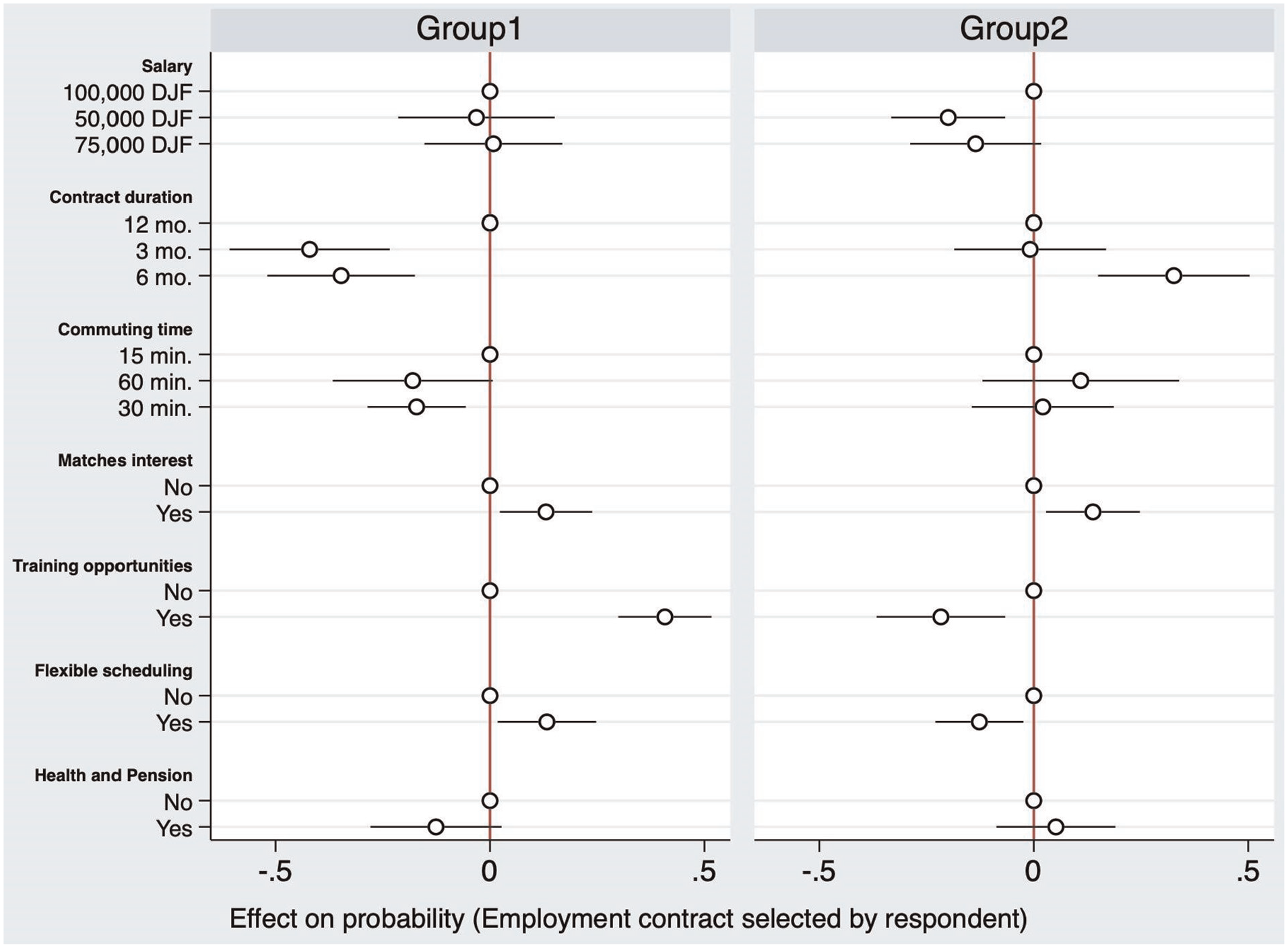
The plot shows the partitional clustering effect of randomly assigned employment attributes on stated preference with homogenous slope parameters. Error bars show 90% confidence intervals.
Limitations
It is important to acknowledge certain limitations of our methodology. While choice-based conjoint analysis provides valuable insights into preferences and trade-offs, it relies on respondents' self-reported choices and may be biased. The generalizability of our findings is limited to the sample population and the specific attributes and levels considered in our analysis. Additionally, the cross-sectional nature of our data may restrict our ability to establish causal relationships between remedial education and employability.
Results
For each analysis, we include attribute-level dummy variables with sample weights and robust standard errors clustered on the respondents’ identification code, with error bars set to 90%. Here, we present three sets of findings: The full-sample conjoint analysis to establish any broad trends in the stated preferences of the respondents (Figure 1); the Sex-differentiated conjoint analysis to observe any correlation between preferences and the sex of the respondent (Figure 2); Conjoint analysis after partitional clustering (Figure 3). Each Figure’s reference categories for each attribute are indicated as the uppermost dots (without error bars). Horizontal markers (ranging from 1 to −1 at .1 or .5 intervals) represent the likelihood for the preference selection, with “1” representing 100% likely and “−1” representing 100% unlikely.
In Figure 1, we observe the preference outcomes for the entire respondent sample, with sampled graduates having clear preferences, which are statistically significant at the 90% and 95% confidence intervals. Compared with the default options, students are less likely to prefer reduced salaries, with the 75,000 DJF (282 USD) and 50,000 DJF (141 USD) options garnering an 11% (SE = 0.063) and 10% (SE = 0.058) lower likelihood of preference respectively. The shortest contract duration (3 months) predicts a 16% lower likelihood preference (SE = 0.084). Results suggest that commuting times of more than 15 min were unpopular, with the 30-min commute having a 9% lower likelihood preference (SE = 0.048) significant at the 90% level. In contrast, respondents are 11% more likely (SE = 0.039) to prefer jobs that match their interests, which is significant at the 99% level.
When differentiating the sample based on the sex of the respondents, the conjoint analysis suggests various employment characteristics that have distinct levels of preference. The point estimates, and standard errors associated with the attributes are suggestive of the preferences held despite low statistical significance. Most notably, while females state no clear prioritization of salary over other attributes, males place the highest salary, 100,000 DJF (565 USD), as strongly preferred, with the 75,000 DJF (282 USD) and 50,000 DJF (141 USD) options garnering a 17% (SE = 0.073) and 16% (SE = 0.067) lower likelihood of preference respectively. While males place little emphasis on contract duration, the point estimates suggest that females prefer longer (12-month) contract durations, with point estimates for the 6-month and 3-month contracts at 28% and 31% lower likelihood. These last results only suggest the accurate preferences given the standard errors (SE = 0.190 and 0.201, respectively). Males emphasize employment that matches their interests with a 15% higher likelihood preference (SE = 0.042), significant at the 99% level. Preference for on-the-job training opportunities is highest among females, with a 25% higher likelihood (SE = 0.133).
Partitional Clustering With Unobserved Fixed Effects
The partitional clustering algorithm identified two groups with common characteristics. Group 1 comprises 43% of the total participants, 19% of whom are female. In Group 2, females represent 36% of the group.
Group 1 is characterized by the following traits: the longest-term contract (12 months) was preferred compared to the 6-month and 3-month contracts. Each of the latter predicted lower preferences by 35% (SE = 0.083) and 42% (SE = 0.090); finding work that offers on-the-job training opportunities shows a 40% higher preference probability (SE = 0.053); employment that matches their interests received a 13 higher preference probability (SE = 0.052); job locations requiring a short commuting time (15 min) were preferred over the 30 and 60 min, which respectively had lower preference probabilities of 17% (SE = 0.055) and 18% (SE = 0.090). Flexible schedules predicted a 13% higher preference (SE = 0.055). Most distinctively, salary for group 1 was not a significant determinant of employment preference.
Group 2 is characterized by a disinterest in all but the highest salary, with the 75,000 DJF (282 USD) and 50,000 DJF (141 USD) predicting 14% (SE = 0.074) and 20% (SE = 0.064) lower probabilities. The stated preferences in mid-duration contracts (6 months) were highly preferred with a 34% probability (SE = 0.085). In addition, group 2 has a 14% higher preference for employment that matches their preferences (SE = 0.053). They are also 22% less likely to request on-the-job training opportunities (SE = 0.072) and 13% less likely to choose positions with flexible scheduling (SE = 0.049).
This study best serves as a starting point to align government policy decisions on youth unemployment with foreign donor initiatives that aim to support youths seeking employment and with the youth whom these programs seek to benefit. Comparing the results of this study to the existing literature can provide valuable inference to the divergent interests of young employment seekers. Maguire (2010) outlined various motivations for youth employment, namely those that place basic monetary needs above others, as evidenced by other studies such as Anderson et al. (2006) and Spielhofer et al. (2007), and her study, which details non-monetary motivations such formal and informal on-the-job training opportunities or simply the desire to acquire more personal independence. Two reports, one from Malawi and one from Ethiopia, support the latter approach in that jobs that offer the potential to learn and acquire new skills can serve as vehicles for both promotion and self-employment based on the skills acquired (Aggarwal et al., 2010; Walther & Filipiak, 2007). These studies provide a “common sense” framework to interpret the patterns seen in the Group 1 and Group 2 responses. Group 1 responses coalesce in a manner coherent with the theses of Aggarwal et al. (2010), Maguire (2010), and Walther and Filipiak (2007). These respondents prioritize training opportunities, followed by matching interests and scheduling flexibility above all other employment attributes. In contrast, Group 2 responses were consistent with a pragmatic interest in meeting monetary needs, the lower time commitment of a six-month contract, and matching the work to their interests, as detailed in Anderson et al. (2006) and Spielhofer et al. (2007).
Discussion
This study revealed the non-parametric preferences of young non-formal education graduates on employment preferences using an improved conjoint analysis (Hainmueller et al., 2014). The data generated underwent three analyses, including the complete sample using OLS, a sex-disaggregated analysis, and one defined by an established partitional clustering algorithm (Sarafidis & Weber, 2015).
By providing respondents with a method of expressing their preferences for hypothetical employment through a discrete choice experiment, we could assess how each attribute affected the overall preference outcome. This was achieved by providing respondents with a pair of employment profiles, each with seven attributes, repeated over five rounds. The attribute levels and order of the attributes were independently and completely randomized, creating a statistically robust internal validity dataset. Through this randomization, we obtain the average marginal component effect (AMCE), directly quantifying respondent preferences for attribute X to attribute Y.
This study provides a template for further research into addressing the employment needs of Djiboutian youth. This study provided a first-of-its-kind glimpse into the job preferences of Djibouti youth. This was urgently needed given the low standards of the formal education system, high rates of out-of-school children, and increased government and international donor interest in funding and improving the employment prospects of youth in Djibouti. As such, future international donor proposals and government policy plans should consider expanding the findings of this study to generate additional nuance into the conditions and opportunities of job creation programs to ensure success for the enrolled youth.
Due to the limited sample size, it is impossible to generalize the job preference trends among Djiboutian youth nationally. A large-scale study is needed to design youth employability projects that are more relevant to the needs and preferences of participating youth, attract their motivation to complete the training schemes, and thus increase the market insertion rate among participants. In order to make a successful skills training project for youth, project activities need to be co-designed with youth that reflect their perspectives on employment. In addition to co-creating project activities with youth, further research is needed to gain a deeper understanding of the most effective approaches and strategies for implementing remedial education programs as a promising pathway to empowering youth with skills for job hunting in developing countries.
Conclusions
Our results suggest that the average respondent prefers the “high” salary option, 100,000 DJF (565 USD), with an apparent aversion to contract durations shorter than 6 months and commuting times longer than 15 min. Lastly, jobs that match personal interests were highly preferred. When comparing average differences between males and females, clear distinctions emerged. Males prioritize salary and matching of interests above all other attribute categories. In contrast, females are most strongly in favor of the most extended contract duration option (12 months) and that the positions provide on-the-job training opportunities. Under the partitional clustering algorithm, two distinct groups with common preference patterns were identified. The first pattern, comprising Group 1, demonstrated characteristics consistent with a “stepping stone” approach to employment opportunities. As such, they portrayed no strong preference for monetary gains. Instead, the group placed a strong emphasis on on-the-job training opportunities, flexible scheduling, and a matching of interests. The second pattern, labeled Group 2, was characterized by a “do it for the money” approach where the primary interest is meeting financial aims while doing work that coincided with their interests while not overly committing themselves to a long contract duration. Understanding these underlying motivational differences will benefit policy decisions and help implement foreign aid projects that seek to empower youth to enter the job market.
Footnotes
Author contributions
The first author devised the study’s objectives, collected the data, liaised with the Djiboutian authorities, and co-wrote the study. The second author selected the methodology, conducted the data analysis, and co-wrote the study.
Declaration of Conflicting Interests
The author(s) declared no potential conflicts of interest with respect to the research, authorship, and/or publication of this article.
Funding
The author(s) received no financial support for the research, authorship, and/or publication of this article.

Data Availability Statement
Data for this study is available from the authors upon request.