




Abstract
The concept of meaning in life has received growing empirical interest over the last decade; however, it remains less explored in the context of midlife transition. This mixed-method study assesses factors associated with the search for and presence of meaning in life in a sample of middle-aged adults residing in the United Arab Emirates. Multiple regression analysis of data from 152 participants revealed that personal growth and self-compassion, but not materialism, significantly predicted the search for and presence of meaning in life. Qualitative data from five participants were analyzed using Interpretative Phenomenological Analysis (IPA). Three central themes were identified- “lessons learnt from the midlife transition,”“spirituality redefined at midlife,” and “growing through giving.” The findings contribute to the domains of humanistic psychology and counselling practice. Researchers recommend shifting from the crisis approach to a more positive, growth-oriented view of midlife.
Plain language summary
Middle adulthood is a period which has long been associated with the concept of crisis, despite conflicting research findings in this regard. It can be a time for both retrospection and thinking about the future, with questions about meaning in one’s life coming to the fore. This study, encompassing qualitative and quantitative components, examines how middle-aged expatriates in the United Arab Emirates view meaning in life - how they search for it and whether they view their lives as meaningful. Data were collected across three psychosocial constructs- self-compassion, personal growth, and materialism (predictor variables) and meaning in life (both search for meaning and the presence of meaning were outcome variables). Findings from analysis of quantitative data from 152 participants showed that two of the three quantitative predictors had significant negative associations with the search for meaning in life. The more people displayed self-compassion and personal growth, the less they searched for meaning in their lives. Personal growth and self-compassion positively predicted the presence of meaning in life, but materialism did not. We found that people who felt like they were growing as individuals and who were kind to themselves, were more likely to have found meaning in their lives. Analysis of qualitative data from this study found three main themes, focusing on lessons learned in midlife, how people redefined their spirituality, and how ‘giving back’ was important in this life stage. This study contributes to the academic literature by providing a holistic account of midlife as a time for potential growth and redefinition of what is important. Counsellors and therapists working with midlife clients and researchers exploring this critical stage may benefit from a more nuanced approach of midlife, rather than one typified by loss and crisis.
The developmental phase of midlife has doggedly retained negative connotations, mainly due to the popular concept of the “midlife crisis” a term coined by Jaques (1965) regarding middle-aged contemplation of mortality. Whether the midlife crisis is an overestimated fallacy or a developmental transition fueled by Western popular culture has been well-discussed (Charlton, 2004; Lachman et al., 2015; Wethington, 2000). Giuntella et al. (2023) argue that it is not a myth and that the pernicious impacts of this crisis should be taken more seriously. Portrayals of midlife (including from media) show it as a period of frustration with unachieved goals, declining health, loss of reproductive function, empty nest, and lack of purpose—thus evaluating it from a loss perspective (Gatling et al., 2014; Lunnay et al., 2023). Lachman et al. (2015) argue that while there are several areas where middle-aged adults may experience stress, “there are also opportunities to feel accomplished, with a sense of mastery and satisfaction in their roles” (p. 27). Midlife literature on meaning-making and midlife has focused on the existential crisis as a function of entering middle age—grappling with mortality, generativity leading to existential relief, and searching for reassurance that one’s life has been productive (Sekowski, 2022; Ward et al., 2023).
Wethington (2000) objected to the widespread use of the term crisis in association with midlife, advocating for the broader umbrella term of transition. The search for meaning to counter these losses has long been assumed to typify the midlife crisis (Chuang, 2019; Glaw et al., 2020). Despite the prevalent negative connotations of middle age, it is increasingly associated with maturity, strengthening relationship dynamics, and transitioning from searching for meaning in life to discovering it (Galambos et al., 2020; Toothman & Barrett, 2011). Because of its broad reach, meaning in life is of interest within various psychological fields, with research associating it with physical and mental health, personal growth, and life satisfaction (Czekierda et al., 2017; Jebb et al., 2020; Steger et al., 2009). Meaning in life is mostly a philosophical construct—an endeavor to make sense of life experiences (Steger et al., 2006). Meaning-making is subjective because people differ in how they conceptualize and search for meaning, making this construct challenging to quantify. Therefore, exploring what this type of meaning means to people is essential.
The meaning in life construct includes dual concepts of the search for and the presence of meaning (Steger et al., 2006). The relationship between the “search for” and the “presence of” meaning is inversely proportional, and it can be dependent upon external sources of meaning, such as social connectedness (Sørensen et al., 2019; Steger et al., 2006). The search for meaning can be fueled by a desire to understand the purpose of lived experiences, along with previous and current challenges; it can be an attempt to fill a void or inspiration to seek new opportunities (Morse et al., 2021). Along with greater self-awareness, exploration of meaning can result in personal growth during midlife and orient a person to their life’s journey as its central character (Ivtzan et al., 2013; Rogers et al., 2023).
As much as the search for meaning is an intrinsic exploration, it can also become diluted by pursuing otherworldly pleasures, that is, it can become an extrinsic search instead of internal self-exploration (King & Hicks, 2021, Li & Lui, 2023). The existence of meaning relates to multiple sources, including self-preoccupation (satisfying hedonistic needs), individualism (relating to the self), collectivism (being a meaningful contributor to society), or self-transcendence (seeking the meaning of life) (To & Sung, 2016). More recently, meaning in life has also been conceptualized as a tripartite model, which consists of purpose, significance, and coherence (Martela & Steger, 2023). This study focuses on psychosocial factors that include intrinsic and extrinsic meaning sources.
Psychosocial Influences on Meaning-making During Midlife
To a large extent, research on the quest for, and the existence of, meaning-making uses the theoretical lens of Erikson’s (1980) lifespan theory that specifies “stagnation versus generativity” as midlife’s developmental task. A sense of purpose and new responsibilities in life, often related to developing new interests, nourishing the younger generations, or enhancing one’s career prospects, ultimately results in personal growth. Conversely, stagnation could lead to feelings of worthlessness. This theory’s advantage lies in its clear framework for understanding the developmental tasks and emotional challenges that middle-aged adults encounter. It provides a robust lens through which to examine how individuals in this stage navigate between these two poles and find meaning in their lives. In this regard, Neugarten’s (1968) theory of midlife is based on interiority—a noticeable downward shift in engagement from outward-focused to introspective during the second half of life. Despite many midlife theories, with some exceptions, it is still comparatively underrepresented in the empirical literature (Kuther & Burnell, 2019; Lachman, 2015, Lin et al., 2021).
Findings suggest a wide range of psychosocial constructs such as personal growth, identity, interpersonal relationships, altruism, creativity, religion, spirituality, career, happiness, mindfulness, materialism and social and political categories as essential to meaning-making (Cameron-Smith, 2011; Hargrave, 2009; Hill et al., 2013; O’Connor & Chamberlain, 1996; Sørensen et al., 2019; Wink & Dillon, 2002). Nonetheless, the relevance of these constructs during the transition period of midlife has not yet been fully explored. Research on realms other than the long-established factors of existentialism and spirituality signals acceptance of a broader range of issues involved in the midlife transition (Lamba et al., 2021). Many contemporary studies on midlife focus on career identity and work-life balance, suggesting that equilibrium is essential to meaning in life (Duffy et al., 2013; Emslie & Hunt, 2009; Willis & Cashwell, 2017).
Personal growth and meaning in life share some common features, for example, their subjective and transitory nature. Indeed, both can be derived from the same sources (such as spirituality or mindfulness), making them particularly relevant during midlife (Maurer et al., 2023). However, this focus has mainly been outside the crucial midlife period. One notable exception is Taubman-Ben-Ari et al. (2012), who suggested that the transition between life stages leads to personal growth and an increased presence of meaning.
Meaning in life is also associated with increased self-awareness; one facet of this is being mindful of how one relates to oneself (Allan et al., 2015). Self-compassion entails being kind to oneself, even when faced with adversity, and being mindful of one’s difficulties as part of the shared human experience (Neff, 2003a). Self-compassion is associated with positive attitudes toward ageing and well-being during midlife, particularly when faced with difficulties (Brown et al., 2015; Foster & Levitov, 2012). Increased self-awareness through reflecting on life transitions may facilitate acceptance of one’s circumstances, increasing self-compassion and bringing an individual closer to understanding the meaning in their lives (Neff, 2016; Yarnell et al., 2015). Thus, being kinder to oneself can signal achieving inner peace and attaining meaning.
A socio-cultural factor potentially contributing to meaning-making is materialism. Materialistic thinking may indicate the use of superficial coping mechanisms to deal with potential difficulties encountered in midlife; it can harm meaningfulness. Interestingly, wealth accumulation is linked to an increased search for meaning but not its ultimate achievement (Grouden & Jose, 2015). High levels of materialism have been associated with lower life satisfaction, self-actualization, and happiness, and with higher anxiety (Grouden & Jose, 2015; Sirgy et al., 2021). Several studies have shown a higher prevalence of materialistic values within the United Arab Emirates (UAE) compared to other countries due to more accessible luxury goods and services as well as the striking rate at which urbanization has taken place and the economy has flourished in the past 30 years (Roy et al., 2020; Shrivastava et al., 2017; Vel et al., 2011). Therefore, there is a need to assess materialism’s contribution to the search for and presence of meaning in life within this cultural context, particularly with middle-aged individuals with the most access to wealth in the UAE. On a population level, it can be argued that evaluating variables such as growth and meaning can be helpful indicators of public welfare instead of focusing on wealth accumulation or socio-economic status for policy-making decisions.
Hopkyns (2014) refers to the UAE as “superdiverse,” with a population comprising 85% to 87% of expatriate workers predominantly from South-East Asian countries such as India, Pakistan, Bangladesh, Philippines, along with other parts of the world (Aruta, 2023; De Bel-Air, 2015; Shrivastava et al., 2017). Steger et al. (2006) suggest vast cultural differences in meaning-processing; while Eastern cultures emphasize the search for meaning, Western notions are more linked to the presence of meaning due to the influence of self-concepts and differing identities. Exposure to influences from various cultures in the UAE can result in an amalgamated sense of self or even over-identification with a particular culture as an attempt to deal with the chaos of conflicted identities (Shrivastava et al., 2017). To the authors' knowledge, there are no published studies of meaning in midlife in the UAE. The current research uses qualitative and quantitative analyses to investigate psychosocial factors associated with the search for and presence of meaning during midlife.
Quantitative
For the quantitative aspect of the study, the authors hypothesize that the search for and the presence of meaning in life will be predicted by personal growth, self-compassion, and materialistic thinking. Researching the predictors of meaning in life contributes to a broader understanding of human well-being and fulfilment. It explores what drives people to find purpose and meaning, which is crucial for mental health, life satisfaction, counselling practice, and consumer culture, amongst many other reasons.
Qualitative
The qualitative research question is “how do middle-aged adults describe their experiences of the meaning in life transition?” This exploration provides valuable insights into human development and adaptation, with significant implications for the midlife population’s quality of life and psychological fulfilment. This study also enhances current theory and research by examining findings from a culturally underrepresented population, which is increasingly critical in our interconnected and globalized world where diverse perspectives enrich understanding (Seidel et al., 2023).
Method
Research Design
This study featured a mixed-method design—the quantitative aspect attempted to ascertain the extent to which the psychosocial factors of self-compassion, materialism, and personal growth predict meaning in life during midlife. Researchers also qualitatively explored the psychosocial aspects of meaning in life during midlife through a phenomenological approach (IPA; Smith & Nizza, 2022).
Participants and Procedure
Researchers used a combination of opportunistic and purposive sampling for the study’s quantitative and qualitative components, respectively. The study was conducted within multicultural, professional learning and educational free trade zones in the United Arab Emirates. All 152 participants in this study were middle-aged individuals between 40 and 60 years old (Mean age = 48 years; SD = 5.6 years). Lachman (2002) and Whitbourne (2001) recommended this middle age bracket based on a method of calculation using life expectancy data from the United States. World Health Organization (WHO) (2016) data depicted similar population characteristics in the UAE (US = 79.3 years; UAE = 77.1 years), subsequently determining the age criterion. Within the current sample, 61% of participants (N = 93) identified as male and 39% (N = 59) identified as female. The sample consisted of primarily well-educated individuals (77% were degree holders). This is, in part, explainable by the large proportion of professionals migrating to the UAE, as highlighted by Hvidt (2019), and the specific location of data collection (i.e., free trade zones). Most participants were long-term residents of Dubai, belonging to South Asian (63%), Arab (12%), and East Asian (6%) cultures, representing the broader UAE population demographics which consists of about 88% expatriate workers from Asia and North Africa (Dervic et al., 2012; Dubai Statistics Center, 2020). A small, homogeneous sample of participants opted to take part in qualitative interviews. Five middle-aged participants (three females and two males) between the ages of 42 and 55 were interviewed from the wider participant pool. All interviewees self-selected pseudonyms. Data were collected following institutional ethical approval and obtaining written informed consent from all participants.
Materials
Meaning in Life
The Meaning in Life Questionnaire (MLQ; Steger et al., 2006): The MLQ comprising two constructs is a 10-item instrument measuring Presence of Meaning (MLQ-P) and Search for Meaning. A sample item from the former construct is “My life has a clear sense of purpose” and the latter “I am seeking a purpose or mission for my life.” These two dimensions of the instrument are each measured by five items rated on a 7-point Likert scale. The scores range from 5 to 35, and higher scores represent greater presence of meaning and search for meaning. One item in the purpose of meaning subscale (item 9) is reverse coded. The calculated Cronbach’s alpha values for our study for “search for meaning” was .90 and ‘presence of meaning’ was .87.
Personal Growth
The Personal Growth Initiative Scale (PGIS; Robitschek, 1998) is a self-report instrument that yields a single scale score for personal growth initiative. PGIS measures one’s active and intentional involvement in changing and developing as a person. The scale consists of nine items and these are rated on a 6-point Likert scale ranging from 1 = Strongly Disagree to 6 = Strongly Agree. An example item from the scale is “I know what I need to do to get started toward reaching my goals.” The individual scores are summed to obtain a total PGI score. The Cronbach’s alpha value for our study for PGIS was .88.
Self-compassion
The Self-Compassion Scale-Short Form (SCS–SF; Raes et al., 2011) is a modified version of Self-Compassion Scale (SCS; Neff, 2003a). The original SCS has 26 items measuring six components of self-compassion: Self-Kindness, Self-Judgment, Common Humanity, Isolation, Mindfulness, and Over-Identification. The short form of Self-Compassion Scale comprises 12 items rated on a 5-point response scale ranging from 1 = almost never to 5 = almost always. An example item from the scale is “I try to see my failings as part of the human condition.” The SCS–SF demonstrated good internal consistency .76.
Materialism
Richins and Dawson’s (1992) Material Values Scale (MVS) was used to assess materialism. The MVS consists of 18 items with six items for success, seven for centrality, and five items for happiness subscales. An example item from the scale is “I usually buy only the things I need.” These items are rated on a 5-point Likert scale ranging from 5 = strongly agree, to 1 = strongly disagree. To obtain the total score all items were summed. The calculated Cronbach’s alpha was .89.
Analyses
Multiple regression analyses assessed the contributions made by the three psychosocial predictors (self-compassion, personal growth, and materialism) toward the search for and the presence of meaning in life.
The qualitative method of inquiry used was Interpretative Phenomenological Analysis (IPA), proposed by Smith and Nizza (2022). Interpretation of data involved manual, exhaustive coding of each transcript, in line with Smith and Osborn (2015, p. 41), who noted the need to examine “… the detailed experience of each case in turn.” The researcher tried to grasp the overall phenomenology of participants’ meaning in life experience, using exploratory coding and theme formation—both data-derived. Knox and Burnard (2009) suggested recognizing researcher/interviewer characteristics in the research process, that is, part of the reflexive process. Consequently, the authors acknowledge the interviewer’s training in counselling as influencing the interview process. The evidence-based COREQ checklist (Tong et al., 2007) was used to ensure the qualitative research process’s rigor and trustworthiness. The data that support the findings of this study are available from the corresponding author upon reasonable request.
Results
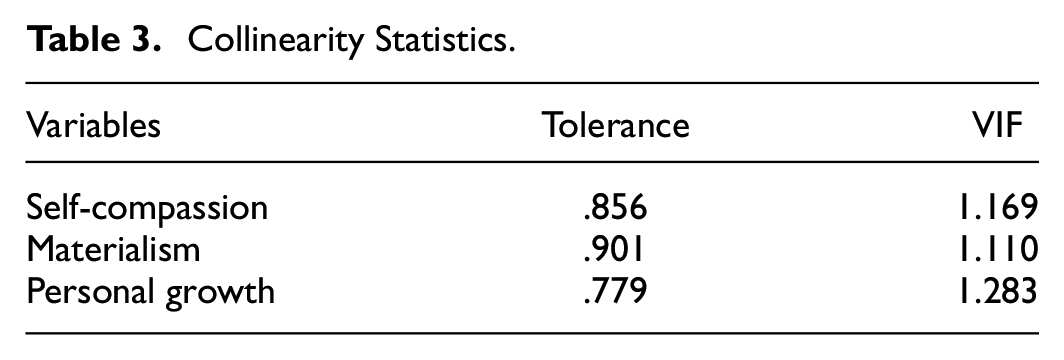
Researchers used IBM SPSS (Version 25) to examine variables’ skewness and kurtosis, linearity, and multicollinearity before conducting analyses and to calculate descriptive statistics (See Table 1). Table 2 reports the correlation coefficients between the key variables, demonstrating the strength and direction of their associations. Assessment of calculated variance inflation factors (VIF) indicated no significant multicollinearity among the variables. All VIFs are below 5, ranging from 1.11 to 1.28 (see Table 3).
Descriptive Statistics for Predictor and Outcome Variables.

n = 152.
Correlation Matrix of Predictor and Outcome Variables.

p < .01. **p < .001.
Collinearity Statistics.
Search for Meaning in Life
For the “search” component of the meaning in life, it was hypothesized that personal growth and self-compassion would be positive predictors and that materialism would be a negative predictor for the model.
Multiple regression analysis, as displayed in Table 4, showed that overall, all three independent variables were significant predictors, accounting for about 14% of the variance, indicating that the model as a whole was significant (R2 = .156, F [3, 146] = 8.974, p < .001). Personal growth (β = −.244, p < .01), self-compassion (β = −.215, p < .01), and materialism (β = −.239, p < .01) were all significant negative predictors of the search for meaning in life. However, it must be noted that the correlation between materialism and search for meaning, despite showing a similar, negative trend—was non-significant. This may indicate that the relationship between these variables is not necessarily linear and of a complex nature.
Multiple Regression Values for “Search for Meaning” (S-MIL).

Note. R2 = .156**.
All B = unstandardized regression coefficient; SE B = standard error; β = standardized regression coefficient.
p < .01. **p < .001.
Presence of Meaning in Life
Researchers hypothesized that personal growth and self-compassion would be positive predictors of the presence of meaning in life and that materialism would be a negative predictor.
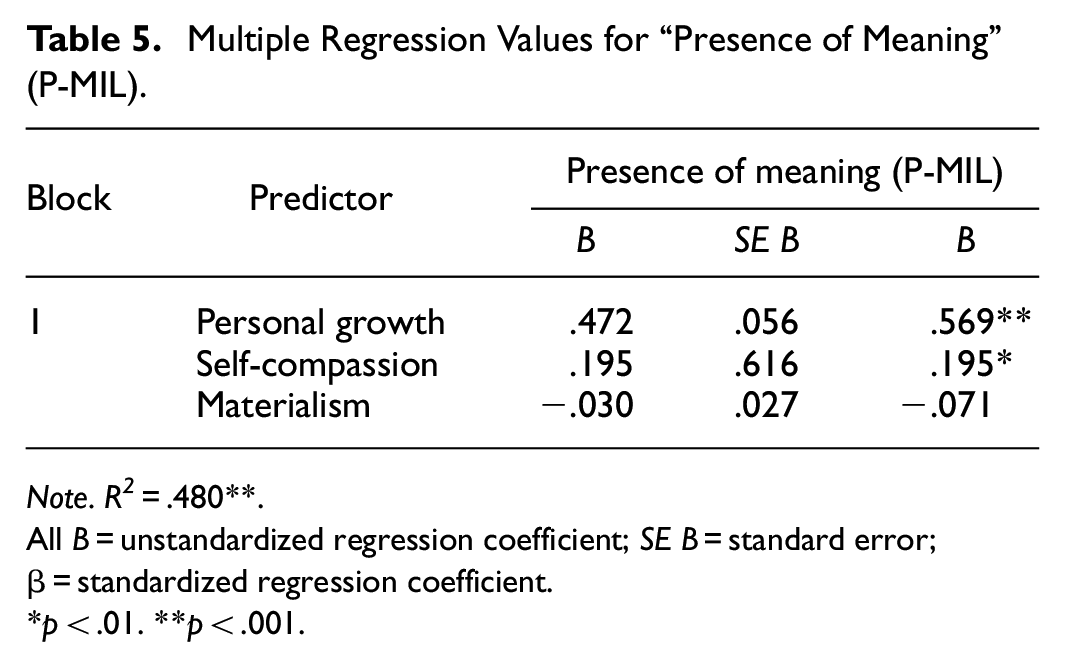
Multiple regression analysis, as detailed in Table 5, revealed that the three variables significantly explained 47% of the variance (R2 = .480, F [3, 146] = 44.891, p < .001). Personal growth (β = .569, p < .001) and self-compassion (β = .195, p < .01) were significant positive predictors. Contrary to the hypothesis, and despite showing a negative trend, materialism was not a significant predictor of the presence of meaning in life (β = −.071, p = .264).
Multiple Regression Values for “Presence of Meaning” (P-MIL).
Note. R2 = .480**.
All B = unstandardized regression coefficient; SE B = standard error; β = standardized regression coefficient.
p < .01. **p < .001.
Qualitative Findings
The phenomenological analysis identified three group experiential themes (see Table 6): “lessons learnt from the midlife transition,”“spirituality redefined at midlife,” and “growing through giving.” These themes had recurring but unique representations within participants’ accounts, emphasizing the idiographic nature of this analysis method.
Themes From Qualitative Data Analysis.

I can still live feeling the very same ‘happy’ like others do after striving so hard …That has become clear to me now. So my wants are so much more simple. [Anand] Yeah. So meaning in life. (sigh) Tomorrow is Peter Pan with the boys, and I never thought that would give me meaning in life but … [Paul]
It seems as if a change in perspective had occurred. It may be that lower expectations increase goal (and therefore, meaning) attainability. However, it may also relate to shifting values. For Manisha, a 42-year-old Indian homemaker, relationship expectations she had as a younger woman had changed: I used to feel that ‘how come the other person is not reciprocating’ but then I feel I’ve accepted that it is me that always gives 100%. [Manisha]
The expectation shift pointed toward greater acceptance and satisfaction with self and others. This may stem from attaining relationship security during midlife and is characteristic of self-exploration and awareness, also mentioned by Arnold (2005). As a result of this emergent self-realization, the shift to midlife was relatively smooth for many participants; they accepted it as a natural developmental phase in their life cycle. Participants (Maya, a 43-year-old Pakistani-Canadian homemaker, and Manisha) reported a peaceful transition into this stage of life: I think that we just flow, we evolve, and we grow older. It’s only now recently that I’m hearing, ‘Okay, now you’ve entered midlife’, but I’ve never actually consciously thought about it. So I really would call the transition also very natural and gradual and not even knowing until you are asking. [Maya] It's like the normal- I feel uh, this is part of life, isn’t it? Growing up. [Manisha]
For some interviewees, midlife led to significant growth in work and family domains. For instance, Paul’s children brought him life satisfaction; this and the pleasure he derived from his work made his midlife a period of wellness.
A couple of weeks after being with the kids, babies. That, I guess, solved the midlife thing completely. Trade, business, and shaking hands with people. I’m very busy, but I love it. Because it gives you meaning. Let’s face it, we spend a lot of our time working. I could never work in a job that didn’t give me meaning.
Participants seemed to have discovered possibilities for personal growth in their careers, which is significant to their meaning-making. The same was also described by O’Connor and Chamberlain (1996) and can be linked to Erikson’s (1980) stagnation versus generativity stage of midlife. This importance of the probability of personal development is also consistent with Neugarten’s (1968) theory of increased interiority during midlife. Evaluations of what is important to them at this stage of life characterize participants’ midlife experiences.
There’s a difference in how you view spirituality. For me, spirituality is not being religious. [Maya] So you know I really lack religious thought, but I believe in the spirit. [Paul]
Maya considered her way of living to be “pure,” only recently accepting the label of “spirituality.” Spirituality was at the foundation of Manisha’s existence; it reflected in all areas of her life. For Karen (a 44-year-old Japanese homemaker), her spirituality was a recent development, only prompted by an existential crisis: I went through a really bad time in my early thirties but since I started to know spirituality, why we’re born here, why are we going through tough times, what makes me realise from this tough experience… I came to understand why I am here, the meaning of life. So, to me, spirituality is very, very important. Well, you know, spirituality really helped me accept myself. Because without spirituality, to me, one cannot really understand the meaning of life.
Karen later stated: I think it’s important in order for me to grow. I had to go through it because otherwise, I wouldn’t learn anything. It was really tough, but I needed to go through it. Because of that I learnt a lot. Accepting, actually accepting myself, that’s the most fundamental thing. Accepting myself is starting from self-realisation.
Cameron-Smith (2011) characterized midlife transition as a meaning-making process involving soul-searching at higher levels. This was evident in participant experiences revolving around self-acceptance and letting go of self-centeredness (a trait Paul believed typified his youth) in his midlife. Doing so allowed them to become more receptive to new, valuable thoughts and experiences: I tend to believe that once you lose that ‘self’ in you, you’re opening the doors for other thoughts to sink in and think about it. My view is at that age, a younger age, you’re so focused on yourself that you’re building a wall around you. That as you just move out (age), when you open up, it could be spirituality, it could be sex. It could be anything, for that matter. [Paul]
In most interviews, the growth or expression of spiritual thought was present in participants’ midlife in different ways. This phenomenon could be attributed to increased self-realization, as mentioned in the first theme, and the search and presence of self-compassion, as explained by the quantitative findings.
[Being} selfless is no good, I think … Because, to me, the most important self is the self. Myself. Then I can look after others, and I can love others. So everything starts from here, from me, from myself. So, neglecting myself and doing things for others is nonsense.
Depending on their different interpretations, participants exhibited a variety of rationales for engaging in selflessness, from specific to general: I don’t practice much. If somebody’s doing a charity event, I’ll sponsor them. I helped a guy at work actually whose wife and him were having problems with having a child. And I put him in touch with people in the adoption support group here. We were very active in the adoption support group. Obviously during our adoption and after the adoption. Helping others. [Paul]
In contrast, Maya immediately recognized her contribution to the lives of others and noted the satisfaction she received from this. The meaning she found in these actions was so profound that she was actively seeking new ways in which to give back to society: Normally, I feel I don’t know so much about meaning, but I feel more um content and satisfied when I know that I have been able to help somebody in some way. [Maya] [I began] to sit, and think, and evaluate. So I started thinking about the meaning of my life, what is the meaning of this life, of being here. And that's when I started questioning, and then it started. I wanted to do something and live in a way where I could contribute to the world, to society, to my family in a much, much more… just contribute in any way and in a better way. [Maya]
This motivation for altruism was similar to that identified by Hill et al. (2013), wherein people cited altruism as a significant source of meaning, albeit with different impacts. Despite such diversity within the current study, one commonality in participants’ reflections was the tendency to help others in ways that channeled their abilities and interests. Another shared aspect observed within the participants’ stories was selflessness within their relationships, a transition from expectations to contribution. For some, such tendencies also materialized as desires to impart ethical values to the younger generation, providing them with a sense of continuity and generativity: What you feel as parents, somewhere down the line it goes to your children also, so I guess she- my daughter has gotten into it. And somewhere we live the dreams [through] what our children are doing. Since I didn’t, I couldn’t do that during my time, I’m living my dreams through her. She is into all these things and even volunteering. I encourage them, and I also believe in doing that. [Manisha] You make sure that your boys are aware, and they don't just drop their clothes around and expect the maid to pick them up. [Paul]
These accounts are similar to the parenthood experiences observed by Igarashi et al. (2013) and O’Connor and Chamberlain (1996), in which midlife was seen as the intersection of parents’ unrealized hopes and dreams with the reality of their children’s future potential.
Within this study, other factors provided meaning in life to the participants, yet these did not appear as themes. Instead, they influenced the formation of more complex themes. Some of these include receptivity and openness to adapt to technology and a marked shift in priorities during midlife. Once again, such findings were consistent with Hill et al. (2013) and O’Connor and Chamberlain (1996). Implications of these themes in terms of perceptual changes for the midlife construct will be further explored in the discussion.
Discussion
The current study provides a mixed-method analysis of psychosocial factors influencing meaning during midlife, including personal growth, self-compassion, and materialism. Data analysis from a culturally diverse sample revealed that all quantitative psychosocial predictors had significant negative associations with the search for meaning in life. Personal growth and self-compassion positively predicted the presence of meaning in life, whereas, despite having a negative trend, materialism did not. Overall, the analyses also suggest that the presence of meaning was better predicted by psychosocial factors compared to the search for meaning, which is generally in line with past research about meaningfulness (King & Hicks, 2021; Steger et al., 2006; Vötter & Schnell, 2024). The search for meaning and the presence of meaning are thus diametrically opposing yet related constructs that provide an overall understanding of the value of meaning in an individual’s life.
Complementing the quantitative findings, the phenomenological analysis also indicated that individuals who experience the presence of meaning in their lives may have a clearer understanding of themselves, their position in life (for example, spouse, parent, employee), or their midlife journey. This was evident through the first and second group experiential themes, with participants’ reflections on finding meaning in spirituality, career, and parental responsibilities. Participant narratives are indicative of an earlier drive for growth in a time of crisis. Although it was hypothesized that the desire for personal growth would go hand in hand with the search for meaning in life, our results indicate that individuals who feel lacking in personal growth may be actively searching for meaning—a finding which is supported by some previous research as well (e.g., Maurer et al., 2023; Steger et al., 2009; Taubman-Ben-Ari et al., 2012). Personal growth can thus be visualized as predictive of attaining meaning, as indicated through the first qualitative theme of lessons learnt from the midlife transition, which illustrated both elements of the meaning in life construct as narrated by all participants.
The pursuit of material objects or desires may hamper the search for meaning. Young adults may aspire to accumulate wealth and material objects (Wink & Dillon, 2002), but these tendencies tend to decline with age. Qualitative findings further suggested that by midlife, life goals transition from materialistic to the pursuit of contentment, that is, the shift from consuming (materialism) to giving back (altruism). As illustrated by the interviews, sources of meaning include family relationships, career, spirituality, and the smaller things in life. Interestingly, no participants remarked upon financial matters (or object attainment) in the interviews, corroborating the non-significant correlation between materialism and the search for meaning in the larger dataset. It is worth noting that the relationship between materialism and the search for meaning may be complex (Aruta, 2023). In this UAE-based sample, a high level of materialism was expected (Roy et al., 2020; Vel et al., 2011), possibly explaining why, despite being a correlate, materialism did not significantly predict the presence of meaning. Further research may be required to gain a broader understanding of the relevance of materialism to meaning-making, with a particular interest in comparing cultural group behaviors.
The current investigation has provided new insight into the relationship between self-compassion and meaning (Neff, 2003a; Neff et al., 2007, Yela et al., 2020). Contrary to our initial expectation that self-compassion would be associated with a greater search for meaning and self-reflection, our findings instead suggested that a lack of self-compassion can trigger a frantic search for meaning, potentially to make up for an absence of self-awareness or self-knowledge. On the other hand, being compassionate toward oneself aids in the midlife transition, thus helping one to understand the presence of meaning in life (Neff & McGehee, 2010). This was exemplified by a qualitative research participant who expressed the value of nurturing the inner self. Her version of self-compassion acted as a stepping-stone toward loving and doing good for others. Greater self-compassion may thus be an imperative component of meaning-making and help individuals make sense of their life experiences in a psychologically healthy manner.
Spirituality, indicated by interviewees as a valuable psychosocial construct during midlife, ties in with the Buddhist-originated concept of self-compassion, both woven together by mindfulness (Campos et al., 2016; Neff, 2016). The growing understanding of the link between spirituality and self-compassion could also contribute to developing more positive psychology-based interventions that include mindfulness within their scope (Neff, 2023b). This study supports self-compassion as a valuable component of existing psychological therapies such as mindfulness-based cognitive behavioral therapy, acceptance & commitment therapy, existential therapy, or compassion-focused therapy, particularly when dealing with middle-aged individuals (Kim & Ko, 2018; Neff & Tirch, 2013). Future research into meaning-making processes may be relevant to psychotherapists, especially those working with grief and loss during midlife (Johnston, 2017).
Participant narratives focused on exploring the psychosocial determinants of meaning-making from a phenomenological perspective. Qualitative themes reflect altruistic and spiritual inclinations as providing meaning and adaptation to the midlife transition, either in overcoming a midlife “crisis” or experiencing changes in life orientation because of the transition. All but one participant defined meaning in life as the purpose of their existence, indicating the “presence” of meaning in their lives. Not placing importance on any single psychosocial determinant, most participants’ narratives presented a view of individualistic achievement as a function of midlife and increased the attribution of meaning to others, including close relationships. This demonstrates an internal-to-external orientation. Such a finding is contrary to Neugarten’s theory of interiority (1968). However, the fact that most participants ascribed increased tendencies to personal growth during midlife supports interiority as a feature of this lifespan stage. This can be compared to the intrinsic orientation of self-compassion and contrasted with the more extrinsic construct of materialism, both researched in this study concerning meaning.
The current findings further validate the psychosocial constructs of spirituality and altruism as considerably impacting individuals’ meaning-making during midlife (Hargrave, 2009; Hill et al., 2013; Wethington, 2000). In the present research, altruism was an important finding, potentially suggesting “generativity” of participants instead of midlife “stagnation” (Erikson, 1980). Such evidence of altruism may be explained by the participants’ self-reported affluence, perhaps attributable to their residence in the UAE. Their level of privilege (i.e., education status and financial stability) allowed them to help others generously. Contrary to popular belief that midlife is a period of inertia and resistance to new experiences and knowledge (Johnston, 2017; Salthouse, 2010), interviewees had a refreshing receptivity to life and openness to new experiences, thus achieving personal growth during midlife.
In contrast to previous research that has emphasized the existential crisis as an integral facet of midlife, qualitative findings show that mortality as a determinant of meaning-making was given lesser importance. Indeed, participants’ narratives indicate that an existential crisis was not a necessary precursor of emerging spirituality during midlife, as Igarashi et al. (2013) proposed. Successful adjustment to the midlife experience, to some extent, can thus be attributed to establishing beliefs and roles that ultimately bring about the presence of a more meaningful existence.
Limitations
The authors acknowledge that the study’s theoretical foundation is based on Western ideas but argue that exploring midlife among a non-Western sample can offer a more nuanced understanding of this concept. Our sample was admittedly privileged with many degree holders and a high level of self-reported affluence. Nonetheless, it further provides impetus to examine the transferability of well-established concepts relating to midlife within other cultural groups and socioeconomic gradients (Martela et al., 2023). While the mixed-method nature of the study provided a holistic account of well-being in midlife, the stories of those who did not volunteer to take part in the interviews remain untold. We acknowledge the presence of potential volunteer bias among the participants who agreed to the qualitative interviews; they were likely more motivated to share their experiences of meaning in life. Additionally, the three female qualitative respondents were homemakers, and the two males were employed. Certainly, findings from the qualitative portion of the study do not purport to be generalizable, but they should be considered in the light of participants’ gendered roles.
Conclusion
Search for meaning is a more self-focused approach. Our qualitative participants who had meaning could move beyond searching and adopt a more selfless outlook toward life while concentrating on their personal growth and being kinder to themselves and others. It is also interesting to note that all of the qualitative participants seemed to experience the presence of meaning, having undergone the journey of searching for it, intentionally or unintentionally. Our mixed-method study presents complementary quantitative and qualitative findings, focusing on different psychosocial influences on meaning in life. On the one hand, our qualitative findings provide a broad perspective derived from the in-depth phenomenological experiences of a few individuals. In contrast, the quantitative aspect of the study focuses on specific constructs that have received relatively less empirical attention in the past and investigated their associations with meaning in life in a larger sample.
This study attempts to contribute to research within humanistic psychology and psychotherapy, emerging practice fields in the UAE. Consequently, this research has implications for the underrepresented midlife population – the findings reflect a need for a continued shift in perspective from a negative midlife crisis approach to a more positive growth perspective.
Given the Middle East’s cultural diversity, this trend could be particularly relevant within psychotherapy and career transitions. Psychotherapists working with middle-aged people can focus more on the experience of meaningfulness (and enhancement of self-compassion) instead of merely focusing on symptom reduction. The study’s practical significance in psychological counselling practice is substantial, particularly for guiding midlife transitions. By emphasizing personal growth and self-compassion, this research encourages counsellors to adopt a more holistic approach. Techniques from humanistic therapies, such as existential therapy and narrative therapy, offer valuable frameworks for helping clients reframe midlife as a period of opportunity and exploration rather than crisis or decline. These approaches support clients in finding new sources of meaning, whether through personal reflection or storytelling, which can lead to improved mental health outcomes and reduced distress (Rogers et al., 2023; Ward et al., 2023). Shifting the counselling focus to building meaning and self-compassion can empower clients to face midlife transitions with confidence and resilience, highlighting the importance of this study in advancing counselling practices that address the complexities of ageing and personal development.
Research on midlife career transitions could examine growth tendencies instead of existing outlooks that characterize a move toward retirement or career stagnation during middle age. These concepts’ cultural relevance also calls for a deeper understanding of ethnic differences in meaning derivation during midlife. Meaning in life as a significant element of the midlife transition requires an overall increase in focus. An essential first step is a willingness to reconceptualize midlife as a time of potential growth rather than a time characterized by loss.
Footnotes
Declaration of Conflicting Interests
The author(s) declared no potential conflicts of interest with respect to the research, authorship, and/or publication of this article.
Funding
The author(s) disclosed receipt of the following financial support for the research, authorship, and/or publication of this article: The author(s) received financial support from Middlesex University Dubai for the publication of this article.

Data Availability Statement
The data that support the findings of this study are available from the corresponding author upon reasonable request.