




Abstract
Moral discourse embodies interpersonal communication, social relations, responsibilities, and obligations and serves as a reasoning and lecturing tool during judicial activities. As moral imperatives are ingrained in the culture that is instilled into individuals, this study develops an analytical model for identity construction in courtroom moral narratives. The study draws eclectically on the Discourse-Historical Approach in Critical Discourse Studies, positioning theory, and proximization theory. It does so by investigating themes, discursive strategies, linguistic realizations, and identity categories in 10 trials, five selected from court sources in China and five from sources in the United States. Through exploring and interpreting historical and cultural backgrounds, participant identity construction was analyzed and differences between the two countries, with their different legal cultures, were illustrated. Contrasting the moral discourse differences in Chinese and American courtrooms, this study illuminates the complementary use of moral discourse in both courtrooms.
Keywords
Introduction
Courtroom discourse analysis is a vital part of legal discourse analysis since many types of spoken and written language are encompassed in a court trial: verbal interaction among all participants (judges, lawyers, witnesses, defendants, etc.), judges’ introductions to juries, sentencing, lawyer talks, depositions, testimony, evidence, and more. While previous studies have examined the features and implications of courtroom legal discourse (Chaemsaithong, 2017; Cotterill, 2004; Johnson, 2004; Richland, 2012), fewer have focused on the moral discourse that is applied in court occasionally by both prosecutors and defendants to explain attitudes, motives, and views. For example, Ren et al. (2020) stated that moral discourse is one of the four discourses that are recurrently used in Chinese lawyers’ communication practices. Merry also researched morality discourse in US court and described it as “discourse about interpersonal communication, social relations, responsibilities and obligation” (Merry, 1990, 2007, p. 34). Besides, there are some articles concerning the analyses of the relationship between moral discourse and legal culture, such as comparisons between the uses of moral discourse in ancient Chinese trials and modern Chinese society (Ch’ü’, 1981; Du, 2017), the moral speech used in American courtrooms and interrupted by judges or the opposing side as being considered “subjective,” or questionable (Johnson, 2004; Lakoff, 2002). In this paper, we adopt the definition of “moral discourse” as mentioned in Ren et al. (2020)’s work. We agree with their definition, which characterizes “moral discourse” as being less concerned with evaluating parties’ rights and obligations and more focused on emphasizing the goodness or badness of individuals in terms of their personalities. It typically involves an explicit claim of authorial responsibility and employs informal language (Ren et al., 2020, p. 623). Three distinctive features were identified in moral discourse compared with legal discourse, therapeutic discourse, and legitimation discourse, with the detailed description listed as follows. “(1) Moral discourse is concerned not with socially confined duties and rights, but with the assessing of personal goodness, humility, and social relationships. It focuses more on the personal interests of victims and defendants, and less on the integrity of social justice and judicial system. (2) Moral discourse appeals not to reasoning, but to a community-based commonsensical conscience. The user of moral discourse aligns his/her hearers as the co-members of one same compassionate community, mobilizes its shared local knowledge, and attempts to evoke a communal sympathetic or abhorrent stance toward criminal defendants’ action. (3) Though moral discourse, as pointed out by Conley and O’barr (1990), is normally affiliated with lay participants and with the general public, whose level of legal literacy is usually limited, both judges and lawyers may appropriate this discourse to fulfill their professional ends” (Ren et al., 2020, pp. 627–628).
Against this background, questions such as “What specific moral discourse differences do court participants in China and the United States demonstrate in courtroom talk?” and “How can those differences be analyzed linguistically?” arise. To answer these questions, this study collected five trial transcripts from China Court Trial Online and five trial transcriptions from the Supreme Court of the United States (n.d.) to compare the applications of moral discourse in Chinese and American trials, as well as the embedded cultural values. More precisely, our aim is not to offer a representative study of moral discourse in trials as such—but to take the first step in this direction by offering a detailed, multifaceted analysis of relevant examples.
The Discourse-Historical Approach (DHA), one of the most prominent critical approaches to the study of discourse (Reisigl, 2017), was adopted eclectically to conduct a contrastive study on the discursive features of moral discourse in Chinese and American courtrooms, including themes, discursive strategies, and linguistic realizations. Bamberg’s positioning theory and Cap’s proximization theory were also employed to investigate different subjects’ constructed identities at the story world, interactive narrative, and grand narrative levels (Forchtner, 2020).
In a word, we attempt to explore moral discourse and identity construction in Chinese and American courtrooms, trying to figure out whether there exist differences in the use of moral discourse in these two courtrooms and make potential explanations for the findings from the DHA perspective.
Moral Discourse and Identity Construction in Courtrooms
Research on Courtroom Discourse
Many researchers have investigated the topic of courtroom discourse: lexically, grammatically, or pragmatically. Through the language of legal discourse, the power of law can be realized, exercised, reproduced, and, occasionally, challenged and subverted (Chaemsaithong, 2017; Conley & O’barr, 1990; Cotterill, 2004; Johnson, 2004). Wodak (2009) asserted that discourse was a major determinant of trial outcomes because it largely controlled the role projections available to the accused (social class, income, respectability, responsibility, and credibility) and that eloquent, fluent, cogent and compelling testimonies were always trusted regardless of the facts of the case.
Meanwhile, the research on courtroom discourse has been focusing on an ever more diversified professional domain. For example, in legal domains, the researchers have focused on the discourse of criminal courtrooms (Hoyle & Ullrich, 2014), as well as Chinese civil trials (Y. S. Li, 2015). In the sociolinguistic domain, there are discourse analyses of different genders in court, the socio-pragmatic study of discourse markers, and the interruptions of courtroom discourse (Bednarek, 2014; Bogoch, 1999; Wagner & Cheng, 2011). Bogoch (2000) has demonstrated how judges enacted different legal, political, and social ideologies in their handling of seemingly straightforward procedures, thus “by inducing suspects to restore moral balance by accepting blame, attempting to make up for their offenses and promising to turn over a new leaf” (p. 234). Besides, researchers show an apparent tendency of combining computational quantitative techniques with qualitative studies, mostly through building a descriptive analysis of all the samples from a related corpus, which will be resorted to in this research.
Discourse Research on Morality
Four types of morality in discourse have been identified in previous studies (Christopher, 1999; Donald, 2009; Elaine, 1999; Fritz, 1991; Lakoff, 2002; Wacks, 2020; Wald et al., 2001). Judicial morality, which entails all rules and regulations that are mandated by the law, is focused on promoting public safety through the preservation of public order and justice, different from political morality which dictates the rules of conduct within the context of executing a democratic system. Economic morality guides economic conduct based on market principles such as laissez-faire, innovation, and competition. And the last—professional morality guides professional conduct and is an articulation of professional norms, rights, and duties that shape and guide professional conduct for professional groups such as the medical profession, journalistic profession, and professions within the law and order community.
Based on the idea of moral differences fueling political division, the Moral Foundations Theory (MFT) was proposed by Haidt and Joseph (2008). They considered morality to be gut reactions or intuitions occurring in five separate foundational domains that stemmed from basic evolutionary social pressures focused on benefiting the needs of the community. These include care, which is rooted in compassion and empathic concern for others in need; fairness, which pertains to equitable allocation of resources; loyalty, which concerns bias toward the ingroup and against outgroups; authority, which deals with respect for benevolent hierarchies, and sanctity, which is rooted in disgust-avoidance mechanisms (Haidt & Joseph, 2008). Although these intuitions are hypothesized to be innate in all humans regardless of culture, the importance placed upon anyone or any one set of intuitions can vary. For instance, Eastern cultures tend to place greater weight on respect for dominance hierarchies than Western cultures (Graham et al., 2011). A similar cultural divide can be seen among political conservatives and liberals. Notably, when engaged in moral decision-making, liberals tend to base their judgments on the domains of care and fairness, whereas conservatives tend to use all five domains equally (Clifford et al., 2015; Graham et al., 2011; Haidt & Graham, 2007; McAdams, 2006).
Recent research has noted the impact of moral discourse in the courtroom concentrating on the ethics of the judges or examining the morality conveyed through the spoken language of judges (Du, 2017; Liu, 2012; Wojciechowski, 2010). In contrast, limited research has recognized the moral discourse adopted by different participants involved in a trial representing different legal cultures. Thus, Haidt and Joseph’s (2008) MFT, concerning the care, fairness, loyalty, authority, and sanctity that are emphasized differently in diverse cultures, was adopted in the current study to identify the moral domains to which the themes belong so that the themes in China and the U.S. are comparable.
Discourse and Identity Research in Courtrooms
Identities are generally constructed and projected strategically through discourse and in connection with specific communicative goals. Each narrative world bears its narrator-constructor’s stamp (Bamberg & Georgakopoulou, 2008; De Fina et al., 2006). The study of discourse and identity within courtrooms offers valuable insights into how language practices contribute to the construction and negotiation of identities in legal settings. The literature review reveals several prominent themes in discourse and identity research within courtrooms. These themes include the role of language practices in identity construction and negotiation (Chaemsaithong, 2019; Matoesian, 2001; Xia, 2017), the impact of courtroom discourse on power dynamics, social roles, and professional identities (Z. J. Ma & Guo, 2021; Yang & Sun, 2023; Yang & Tong, 2022), and the influence of sociocultural factors (such as gender, race, and social class) on identity formation processes (Faria et al., 2020; Habiburrahim et al., 2020; Jain & DasGupta, 2021). Further research is needed to deepen our understanding of the complexities of language and identity in courtrooms and to inform improvements in legal practices and procedures.
Besides, societies “narrativize” themselves, that is, they draw their moral (and symbolic) boundaries through the telling of stories. There are three levels of positioning in the narrative construction of identities and the projection of co-narrator identity (Bamberg, 1997; Bamberg & Andrews, 2004). On the first level is the positioning between the characters of the narrative world; on the second level is the positioning in the interactive narrative between interlocutors during the event; on the third level is the narrators’ own positioning of addressing the question “Who am I?.” This theory regards narrative analysis in three levels: the world, the event, and the self, which can just supplement DHA and enhance its applicability to the study of identity construction in courtrooms at the three levels of themes, discursive strategies, and linguistic realizations. Thus, Forchtner (2020) suggested including narrative as an additional layer to DHA, a complement to discourse analysis, through selectively and causally organizing time.
Theoretical Framework and Research Methods
Approaching Courtroom Identity Construction Through Moral Discourse
Generally, the purpose of Critical Discourse Studies (CDS) is to reveal the relationship among ideology, language, and social practice. The main research targets of CDS are the public discourse and political discourse, such as newspapers, official documents, laws, and regulations (Dai & Chen, 2004). The DHA, proposed by Wodak in 1986 in Austria, is important to the broadly defined field of Critical Discourse Studies (CDS) (Krzyżanowski & Forchtner, 2016; Wodak & Meyer, 2015). It conceives language as “a medium of domination and social force” that “serves to legitimize relations of organized power” (Forchtner, 2011, p. 3; Wodak, 2001, p. 2), acknowledging the existence of the counterfactual double role of language, which involves ideal speech situation and distorted communication (Habermas, 1974).
While we do not adopt the entire conceptual framework of the DHA, we do draw on its three-dimensional approach to analysis, including theme analysis, discursive strategy analysis, and linguistic realization analysis. Discursive strategy analysis is a unique feature of DHA; it examines the strategies of nomination, predication, argumentation, perspectivization, and intensification and mitigation reveals how addressers achieve positive or negative in-group and out-group representation via specific linguistic attributes, certain formulations, and different perspectives in the linguistic context (Reisigl & Wodak, 2016; Wodak, 2009, 2011). Thus, the current study adopted DHA’s three-layer framework to explore the themes of each case, analyze the discursive strategies of litigants’ statements, and figure out their linguistic realizations in order to illuminate the patterns of moral discourse usage in Chinese and American courtroom talk.
“Proximize” was first used as a verb in Chilton’s (2004) political discourse analysis; Cap (2008) first proposed the noun “proximization,” used initially to mark the organized and strategic cognitive-pragmatic interpretation of discourse. In its most general and practical sense, proximization is a discursive strategy of presenting physically and temporally distant events and states of affairs as increasingly and negatively consequential to the speaker and their addressees. Projecting distant entities as gradually encroaching upon the speaker-addressee territory (both physical and ideological), the speaker tries to achieve a variety of goals. The basic goals are legitimizing the actions and policies the speaker proposes and neutralizing the growing impact of negative, “foreign,”“alien,” and “antagonistic” entities (Cap, 2014). Proximization theory and its Spatial-Temporal-Axiological (STA) analytic model assume that all three aspects or strategies of proximization (spatial, temporal, and axiological) contribute to the continual narrowing of the symbolic distance between the entities/values in the discourse space and their negative impact on the speaker and the addressee.
CDS involves handling issues of the conceptual arrangement of the Discourse Space (DS). Any CDS practice may need the apparatus of proximization to account for both the original and the target setup of the DS. The proven capacity of the STA model is crucial to pinpointing specific, quantifiable, lexical-grammatical choices responsible for the strategic enactment of conceptual shifts. This proximization tool adds to our capacity to understand identity construction in courtroom interaction within varied discourse spaces, thus complementing our use of the DHA.
Compared with typical legal discourse, moral discourse in courtrooms is full of narration and comments on past events, implying the complex relationships between litigants and other subjects, groups, societies, and ideologies. Along with DHA, a focus on narrative and narrative identity construction is thus needed to constitute the analytical model.
Therefore, based on DHA’s three-layer framework (themes, discursive strategies, and linguistic realizations), this study adopted both Bamberg’s positioning model (Bamberg, 1997; Bamberg & Georgakopoulou, 2008) and Cap’s proximization theory (Cap, 2008) to enrich the analysis of how moral discourse narrative plays a role in the courtroom. The identity analysis was divided into three levels based on Bamberg’s model: self-identity, relational identity, and group identity.
The study first categorized and compared different case types through theme analysis, employing Python to analyze word segmentation, word tagging, and word frequency to identify and classify topics. This methodology was chosen because it allowed us to effectively process and analyze a large volume of textual data. The use of Python programing language and the implementation of TF-IDF and LDA techniques provided a robust framework for identifying and extracting meaningful themes from the trial cases. By utilizing this research method model, we aimed to gain insights into the patterns and characteristics of the selected trial cases, thereby contributing to a deeper understanding of the legal systems and crime types in both China and America. Next, the identity construction by both prosecutors and defendants was explored, and discursive strategies were analyzed, including nomination, predication, perspectivization, argumentation, and intensification and mitigation strategies (Wodak, 2001). Nomination highlights how social actors, objects, phenomena, and events are linguistically named and referred to; predication examines what characteristics are attached to the actors or objects. Argumentation aims to justify claims of truth frequently by drawing on topoi; perspectivization reveals the writer’s perspective. Intensification and mitigation focus on the strength and status of utterances. This study is focused on the textual data, all of which are analyzed with the transcriptions of Chinese and American court trials. Coding was done manually by both authors, with the participants in the courtroom being coded as prosecutors, defendants, judges, lawyers, and others. The coding unit is the monolog of one-side participant (prosecutor, defendant, etc.). Adopting proximization theory (Cap, 2008), additional goals were to identify the relational identity of both parties constructed in the moral discourse narrative of the trial and determine how moral discourse played a role in the courtroom narrative. Finally, based on the use of habitual narratives and the perspectivization strategy of DHA and MFT, the construction of group identity was investigated. The analytical framework is shown in Figure 1.

Analytical model for the identity construction of moral discourse narrative in courtrooms.
Data Collection
The study extracted 10 analysis samples of Chinese and American criminal court trials, five Chinese samples of transcriptions from direct courtroom videos on the China Court Trial Online Network (n.d.), and five American samples of courtroom oral transcriptions from the Supreme Court of the United States (n.d.). Selected samples were criminal cases, a genre which is perceived as imposing a greater impact on society, provoking moral narratives about “good” and “bad,” and are more representative of the legal solution to social problems (R. C. Ma, 2012; Wang & Cheng, 1998); Additionally, the selected Chinese cases had relatively high online browsing clicks on the official Chinese trial websites between 2020 and 2021. To ensure the validity of the comparison, American cases were selected with similar backgrounds and events within the same period of time between 2020 and 2021.
Data Analysis and Findings
Moral Discourse Themes in Chinese and American Courtrooms
In this study, we conducted an analysis of trial cases from both China and America. The selected cases were categorized into four types based on the specific crime involved, namely intentional injury, fraud, theft, and traffic accident. To ensure consistency, we named and classified the cases according to their respective types and official titles as provided on the official court websites. To facilitate the analysis, we utilized the Python programing language. The textual data from the trial cases was imported and transformed into word vectors. This process involved executing the following statements: “corpus_tfidf = models.TfidfModel(corpus)[corpus]” and “lda = models.LdaModel(corpus_tfidf, num_topics=num_topics, id2word=dictionary, alpha = .01, eta=0.01, minimum_probability = .001, update_every = 1, chunksize = 100, passes = 1).” By executing these statements, we established a computing model that facilitated the analysis of the trial cases, which employed the techniques of term frequency-inverse document frequency (TF-IDF) and Latent Dirichlet Allocation (LDA) to uncover underlying themes within the texts.
Subsequently, following Haidt and Joseph’s morality Moral Foundations Theory (MFT) domains, four major themes were identified within the Chinese courtrooms: professional ethics, family responsibility, social responsibility, and pride and honor. Likewise, in American courtrooms, five major themes were identified: fairness and justice, leniency, family responsibility, equality, and professional morality. By applying Haidt and Joseph’s MFT domains, we gained valuable insights into the moral foundations and values prevalent in these legal systems. This approach offers a comprehensive and systematic analysis, enabling a comparison of the identified themes between the two countries. By exploring the major themes, we contribute to a deeper understanding of the ethical and moral dimensions inherent in the legal proceedings of both China and America.
Table 1 presents the percentage of moral discourse in each case and their moral themes (based on Haidt and Joseph’s MFT domains). The percentage was calculated by dividing the word number of the moral discourse of each case by the total word number of the whole discourse of each case. As Table 1 demonstrates, the percentage of moral discourse within the Chinese cases was much higher than within the American cases. In other words, moral discourse was more prevalent, that is, arguably accepted in Chinese courtroom trials.
Themes and Moral Discourse Percentage in Each Case.

Note. Moral Discourse themes are based on Haidt and Joseph’s MFT domains. The numbers in the brackets are moral discourse words divided by the whole document words of each case.
Family responsibility was the most frequently mentioned theme within the moral discourse of Chinese courtrooms. In the second and fourth cases, defendants appealed to the court for mitigation based on their responsibilities as a husband, son, and father-to-be, to care for their families. The pleas echoed the care foundation of morality proposed in MFT—caring for offspring and other relatives (Haidt & Joseph, 2008). The defendant in the fraud case attributed his criminal actions to his poor and miserable growth environment, the social responsibility theme, echoing the MFT sanctity foundation—the body is a temple of purity that can be desecrated by immoral activities and contaminants (Haidt, 2012). The first case’s theme of professional ethics concerned a leader’s exploitation of employees, corresponding to the MFT authority foundation—propriety of leadership and followership (Haidt, 2012). In the traffic accident case, the defendant spoke about his “hard work and admission to the pilot program that night,” and argued that “I was so excited [as a new airline pilot] that I incidentally ran into trouble.” This claim is related to self and family pride and honor, which is significant in traditional Chinese culture and corresponding to MFT’s matching sanctity, and just because the defendant’s indulge in his outstanding performance/honor such a mistake was unfortunately made.
In American courtrooms, leniency was a frequently discussed theme in the moral discourse. In the second case, the defendant’s lawyer insisted that “even under the death penalty, the petitioner still had the right to choose the way of execution,” and that “imposing avoidable suffering on others is a certain violation of human rights, humanity and morality.” These quotations reflected the MFT care foundation—virtues of kindness, gentleness, and nurturance are essential moralities (Haidt, 2012). Looking at equality, fairness, and justice themes in cases of intentional injury and theft, defendants’ lawyers argued that “racial discrimination exists, in the happening, interpretation, and final sentencing of the case” with a presumption of guilt for specific groups. These examples correlated with the MFT fairness foundation—people are especially sensitive to cooperation and cheating, generating ideas of justice, rights, and autonomy (Haidt, 2012). The theme of family responsibility illustrated within American courtrooms was similar to that within Chinese courts. Finally, the professional morality theme in the traffic accident case involved police abuse of power, corresponding to the MFT authority foundation.
Haidt and Joseph’s statement (Haidt & Joseph, 2008) that the five domains are emphasized differently in different cultures holds in these examples. Chinese culture was shown to emphasize responsibility and virtues while American culture emphasized responsibility and social equality.
Self-Identity Narrative in Moral Discourse
According to Bamberg’s (1997) positioning theory, the narrator positions his identity in the story world through personas. According to DHA, discursive strategy is the primary way to construct identity. Thus, the current study examined in detail the types of discursive strategy and linguistic realizations used by both prosecutors and defendants to construct individual identities across different topic narratives. Most of the five macro-discursive strategies were found to be applied in Chinese courtrooms: nomination, predication, argumentation, and intensification and mitigation; in American courtrooms, nomination, predication, and argumentation strategies were widely applied, as shown in Table 2. The ratio was calculated by dividing words constituting each strategy into the total number of words in the text documents, though the relative weight of these strategies within one country, comparable to the other —rather than the precise numbers — is the main focus.
Discursive-Strategy Use in Chinese and American Courtrooms.
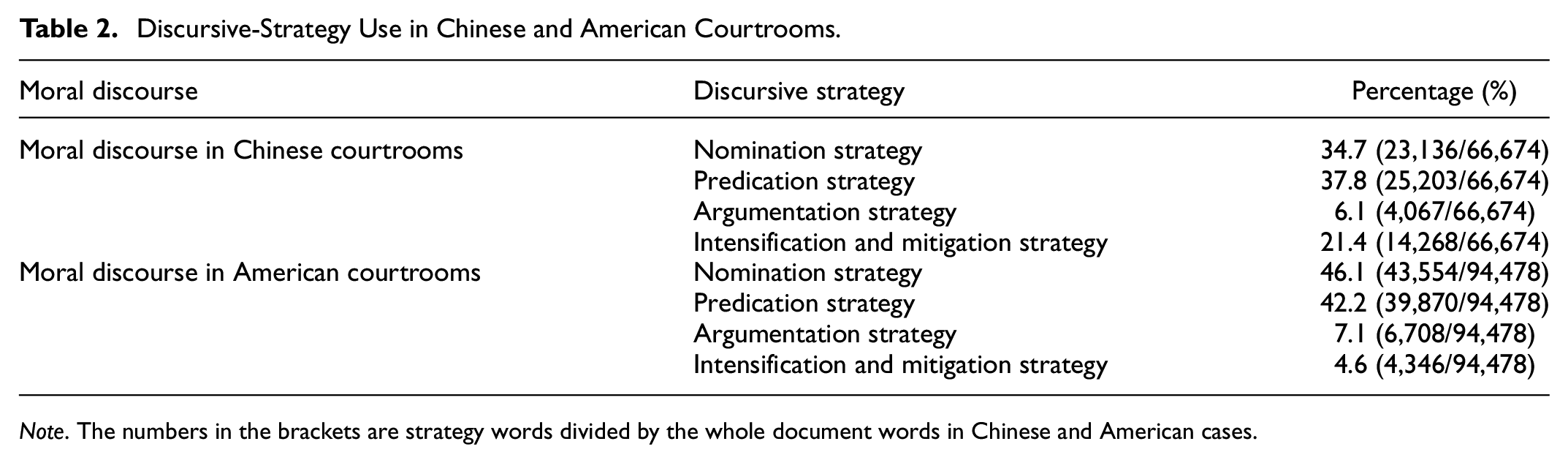
Note. The numbers in the brackets are strategy words divided by the whole document words in Chinese and American cases.
Across the five Chinese courtroom samples, the nomination strategy was employed 34.7% of the time. According to Wodak (2001), the discursive construction of social actors, objects/phenomena/events, and processes and actions are three purposes of applying the nomination strategy. For instance, in the fifth (traffic accident) case, the defendant recognized and labeled himself as “the supporter of the family” and “a dedicated colleague at work,” demonstrating his responsibilities and his favorable reputation at work and conveying to the audience an image of a defendant with good morals. When asked why he insisted on driving fast when the police told him to stop the car, he described himself as being “threatened” by “two men in their uniforms,” instead of referring to them as “two policemen.” In this way, he could explain that his reaction was one of fright rather than a decision to break the law purposely; thus, he could escape moral condemnation. In the third (fraud) case, the defendant blamed his father for being an “alcoholic” and the family’s “poverty (poor living environment),” and the “pressure” of the social environment and the need to “survive” led him to fraud.
Across the five American courtroom samples of moral discourse, the nomination strategy was employed 46.1% of the time. The American samples and approaches demonstrated differences from those in China, focusing more on the case than on the person involved. People in American courtrooms were often addressed as prosecutors, petitioners, or defendants rather than referred to as someone in a role or evidencing a characteristic, such as fathers, civilians, victims, or Black people, appealing more to identity in court than to other identity characteristics. Additionally, processes and actions were often referred to with specific word choices. For example, in the first (intentional injury) case, the defendant used the word “kill” to describe the criminal behavior, while the opposing side used the word “murder” to underscore the purposeful intention and the potential dangerousness of the criminal. In the fourth (theft) case, the defendant argued that he was a “15-year-old civilian having not done anything bad” and was also a “victim” just because of his “black” skin. Because he was treated unequally by the community and he needed money at that time, his behavior was “an act of desperation.” Moral discourse in American courtrooms was shown to be deeply rooted in the narratives of both defendants and prosecutors; it differed from the moral discourse in China, tending to be more concerned with the case description rather than the participants.
In terms of the predication strategy, verbs and adjectives occurred 34.1% and 3.7% of the time, respectively, a total of 37.8%, within the five samples of moral discourse in Chinese courtrooms. Many of the words offered a more detailed picture of the case or the person involved; speakers discursively characterized or qualified social actors, objects, phenomena, events, processes, and actions. In the fifth (traffic accident) case where the defendant was sued for hitting an old man with his car, he expressed his deepest regret while “technically” describing what really happened, using predication strategy heavily to reveal the truth and justify his action, as well as to show his deepest regret:
(1) …As soon as I spotted the fast-moving man, I hit the brake immediately. I was wondering why a man was crossing the traffic fence like that. But I didn’t think too much, just trying my best to stop my car and change the direction if at all possible. But I still hit the man. I was frightened and stopped at once to check on him. He passed out, so I called 120 on my own… [Case No. 0221 (December 1, 2021, at 00:14:06)]
In this example, “as soon as I spotted the fast-moving man” and “I was wondering why a man was crossing the traffic fence like that” implied that the victim was not careful enough and exposed himself carelessly to a dangerous situation. Besides, the defendant argued that “I hit the brake immediately” and “I didn’t think too much, just trying my best to stop my car and change the direction if at all possible” indicating his carefulness and his efforts to avoid the accident. The expression “I was frightened and stopped at once to check on him” and “He passed out, so I called 120 on my own” both indicated that the defendant was eager to make amends and that he did take remedial measures.
Intentional verbs, adjectives, and adverbs occurred 18.8%, 17.2%, and 6.2% of the time, respectively, in the samples from American courtrooms, totaling 42.2%. While verbs were used less frequently than they were in Chinese courtroom discourse, the use of adjectives and adverbs was richer in American courtroom discourse, due to the use of a series of modifiers before a single verb or noun that strengthened the power of the discourse. For example, in the second (intentional injury) case where the defendant was sued for illegal seizure and violent enforcement, the defendant’s lawyer described the behavior of shooting the petitioner’s car while she drove away as “conscience-shocking.” He put it like this:
(2) There are all sorts of abuses by the government of power that would fall short of the conscience-shocking standard, even though they would be unreasonable uses of excessive force… [Case No. 19-292 (October 14, 2020, at 00:11:34)]
In this case, the sentence, “There are all sorts of abuses” indicated that the nature of the tragedy was the abuse of power, generally morally condemned, and the phrase, “by the government of power,” drew everyone’s attention to the unbalanced power relationship between civilians and the authorities. The expression “that would fall short of the conscience-shocking standard” reemphasized the extreme level of inhumanity in this case, and “even though they would be unreasonable uses of excessive force” blamed the police action through moral labeling. By using words such as “abuses,”“conscience-shocking,”“unreasonable,” and “excessive,” the speaker sparked the audience’s moral awareness in the search for the root of the crimes.
In the moral discourse in Chinese courtrooms, for the strategy of intensification and mitigation that was used to modify the illocutionary force of utterance in terms of epistemic or deontic status (Reisigl & Wodak, 2016), speakers would emphasize some information while neglecting others. In the fourth (theft) case, the defendant’s lawyer repeated that the defendant had a family to feed: a sick father who had been in bed for many years, and a newborn child with a mother who could not work. According to the defendant’s lawyer, fining the defendant a huge sum of money would “not be a proper means for a happy family and a harmonious society.” The lawyer intentionally excluded the disaster brought by the defendant to the prosecutor’s family. When asked what other families should do, as they suffered no less than the defendant’s, the defendant’s lawyer managed skilfully by saying “We are concerned, but the tragedy of two families is no better than the tragedy of one.” In this way, the defendant was able to de-emphasize his role as a law-keeping citizen prohibited from causing harm to others but intensified his role as a family supporter with important responsibilities.
Overall, the discursive strategies of moral discourse in Chinese courtroom narratives were different from those in American courtrooms, as the major participants and the identities they tried to construct differed between the two countries. In China, the defendants participated more actively in the self-identity construction narrative within moral discourse, while the prosecutors had less opportunity to make use of it. The strategies of nomination, predication, and intensification and mitigation best served the defendant’s benefits. Using nomination and predication strategies, the defendants labeled themselves as a certain group through analogy, thereby reinforcing social pressure to respect the rights, interests, dilemmas, and challenges of people from this group. Defendants who were guilty and legally unacceptable took the initiative to evoke the others’ empathy and pity, using intensification and mitigation strategy to construct emotional ethical identities that were acceptable and touching. In moral discourse, the defendants became emotional prompters, ethics evokers, and, most importantly, storytellers. In contrast, in American courtrooms, prosecutors participated more actively in their self-identity construction narratives within moral discourse. The strategies of nomination, predication, and argumentation best served the prosecutors. Instead of appealing to people’s emotions or ethics, prosecutors in American courtrooms focused on claims of humanitarianism, truth, and rightness to maximize their benefits and weaken the discursive power of the opposing side; that is, they emphasized legality over morality.
Diverse self-identities were constructed in the story narratives via different discursive strategies in moral discourse within Chinese and American courtrooms. These constructions demonstrated the different legal cultures between the East and the West, between emotional sympathy and legal rationality.
Relational Identity of Moral Discourse in the Interactive Narrative
Analyzing President George W. Bush’s speech on the Iraq War, Cap (2008) proposed six lexical and grammatical categories for studying legalized discourse, including noun phrases (NPs) on inside deictic centers (IDCs); NPs on outside deictic centers (ODCs); verb phrases (VPs) on the movement from ODCs to IDCs; VPs in contact between ODCs and IDCs; abstract NPs on the potential contact between ODCs and IDCs; and abstract NPs on the real contact between ODCs and IDCs. Proximization theory and its Spatial-Temporal-Axiological (STA) analytic model can help explain self-identity in the interactive narrative of courtroom talks.
Spatial proximization was primarily reflected in the use of noun phrases and verb phrases. In trials, prosecutors usually realized spatial proximization through threats and losses caused by ODCs (defendants, judges, audiences, etc.) and experienced by IDCs (prosecutors, prosecutors’ families, etc.) to sway the judges to their side against the defendants. Defendants aimed to spatially proximize IDCs (defendants, defendants’ families, etc.) to ODCs (anyone except defendants, such as the prosecutor, society, etc.) by detailing pressure from external factors and their inner, sincere guilt and regret. In the fourth theft case in a Chinese courtroom, the defendant argued that he grew up in a single-parent family, and his father drove drunk and illegally before the case, resulting in excessive psychological and financial stress to him. The defendant attempted to show his subjective malice to be relatively small, with the primary motivation stemming from economic loss due to family trouble. In the theft case in an American courtroom, it was specified that the defendant’s lawyer argued it didn’t matter what the race of the jury was because this was evidence of an explicit appeal to racial bias. And it was the kind of evidence that courts for over a hundred years have said, once it is introduced, even just once, it’s impossible to unring the bell. But this evidence in this case spoke to the pivotal question of whether or not the defendant would be executed. The legitimization strategy of spatial proximization can encourage ODCs to think of distant and far-fetched events and their influence as closer to IDCs, thus legitimizing ODC’s discourse/argumentation. Although spatial proximization was used in both Chinese and American courtroom narratives, the number of spatial markers in American courtroom discourse was more than that in China, with a ratio of 56:45. Spatial proximization helps ODC and IDC construct their own identities to meet their demands, and places the opposing side in the opposite position.
Different from synchronic spatial proximization, temporal proximization always includes time markers, bringing past and future conflict events closer to the present and creating an urgent atmosphere, which is diachronic. With temporal proximization, past events are compared with the present to construct a “discourse form of infinite extension of past events to future threats” (Cap, 2013, p. 116), reflected primarily in the grammatical form of sentences. For example, the relevant expressions in the sample of Chinese courtrooms included “before the incident/after the incident, three years ago/now/work till now/nine months ago, I grew up knowing that a boy has to carry the burden of a family, and three years ago my family suffered a major change.” In American courtrooms, the expressions included “in the previous case, at the time of the Fourth Amendment, the case from 1604—the Countess of Rutland, previous definition of seizure compared to that in the current case.”
The legitimization strategy within temporal proximization can trigger the emotions of the ODCs effectively, leading them to empathize with IDCs; it can also make the IDC argument more reasonable. Although temporal proximization was used in both the Chinese and American courtroom narratives, the proportion of temporal markers in Chinese courtroom discourse was higher than that in American courtrooms (48:33). This strategy immerses the ODCs more in the IDC speech, also facilitating the use of moral discourse and allowing the audience to empathize with the prosecutors’ claims or tolerate the defendants’ pleas for forgiveness. Meanwhile, this strategy helps construct the relational identity between the prosecutor and the defendant, the prosecutor as a defender and victim, the defendant as someone poor and suffering.
Axiological proximization is the recognition of the increasing value or ideology conflicts between ODC and IDC. The positive values of IDC in the sample were expressed using positive words, while the negative values brought about by ODC were demonstrated in expressions of negative words. In the fifth traffic accident case in a Chinese courtroom, the defendant claimed that he has never had an unsafe incident for any reason and has always been a good comrade and employee. Since the accident, he has been deeply regretful every day, and all his irrational behavior and all that he has done made him ashamed to face his family and leaders who cared about him. In the intentional injury case in the American courtroom, there are statements such as “It says the right of people to be secure against unreasonable seizures and searches shall not be violated…it would also put the very integrity of the courts in jeopardy.”
From these two cases, it is found that both Chinese and American defendants used positive expressions, such as “never had an unsafe incident/good comrade and employee/willing to be punished/be secure,” describing their own behaviors; they used negative expressions, such as “very remorseful/deeply regretful/irrational/ashamed/in jeopardy,” seeking forgiveness and understanding. However, compared with American defendants, Chinese defendants used more moral discourse language, such as “the supporter of the family/a dedicated colleague at work/a good employee.”
Accordingly, in terms of proximization theory, spatial proximization occurred more frequently in the moral discourse of American courtrooms than in Chinese courtrooms; temporal proximization occurred more often in Chinese courtrooms. Regarding axiological proximization, American courtrooms focused more on previous regulations or cases from the past, such as the definition of “arrest” and “seizure” in the Fourth Amendment of the Constitution, and on whether those regulations or cases were adaptive to the current case. In Chinese courtrooms, the moral discourse narrative highlighted the defendant’s self-situation before and after the case, also placing more emphasis on axiological proximization. Comparisons of moral discourse in Chinese and American courtrooms are presented in Table 3.
Comparisons of Moral Discourse in Chinese and American Courtrooms.

In summary, the study’s analysis found that the moral discourse for defendants in courtrooms demonstrated polarization. For instance, the defendants’ behaviors became more understandable and legalized when the proximization strategies were used to expose the IDC’s regret, guilt, and unintentional hurt for their sudden, irrational behaviors, and the ODC’s oppression and misunderstanding of the IDC. Through the use of proximization strategies, the defendant expressed accusation and doubt to the prosecutor in stating that the boss was always dissatisfied and spited them. Similarly, the relational identity positioning of the defendant as the exploited and the oppressed and the prosecutor as the primary cause and root of the killing event was realized.
Group Identity and Moral Judgment in Grand Narratives
Identity positioning in grand narratives adds social meaning to discourse by linking narrative events to dominant values and universal stereotypes (Z. Z. Li, 2002). In courtrooms, prosecutors and defendants often use habitual narratives and perspectivization strategy to construct group identity at the big story level. Habitual narratives can be achieved through the use of high-value modal operatives, including adjectives belonging to semantic categories such as “whole, maximum, high frequency,” a large number (e.g., “all,”“general,”“any”), and collective or impersonal reference to specific groups (e.g., “worldwide,”“human society”). These tools present particular events as universal beyond individual instances or repeated over time (Carranza, 1998), thus characterizing ideas or voices as grand narratives of the related groups.
In the first intentional injury case in Chinese courtrooms, the defendant used a grand narrative to position himself as a victim of resistance, stating that he was just a small staff, the very small potato in today’s society, living in fear all the time, but the boss was always dissatisfied with the subordinates and spited them. The defendant described himself as “staff” and a “small potato” against the grand background of “society” and “time,” highlighting his tininess and insignificance with the contradiction of “the boss” and “the subordinates” showing the sharp antagonism between the two social classes.
Perspectivization strategy can attribute specific types of grand narratives to specific groups and establish congruent or distant relationships with them. This is accomplished through the use of paraphrased speech and intervening resources with the goal of achieving in-group or out-group identities for members of the relevant groups. Using these strategies, defendants characterized all people of the same type as an in-group that holds the same ideas, faces similar situations, and acts together. Through the juxtaposition and contrast of the voices of the in-group and the out-group, the grand narrative of the in-group is legitimized and the voices of the out-group are de-legitimized, highlighting the unreasonable standards of judgment faced by the defendants’ group and their vulnerability to the law and public opinion.
In the second intentional injury case in American courtrooms, through grand narratives from the perspective of “everyone, citizen and law,” the defendant successfully constructed differences between the in-group and the out-group, as well as a legitimate defense of the in-group and the legitimate condemnation of the out-group. The statement reads, “Everyone enjoys that right, Sir, no matter if he is a criminal or not, and it is illegal in our law to withhold any citizen’s right to keep silent about certain issues”.
In this sentence, the in-group identity constructed by the defendant’s perspectivization strategy included the defendant and anyone in the same situation as him; the out-group involved prosecutors, juries, judges, listeners, etc.
Overall, the study found that discourse in American courtrooms employed identity construction strategies at the level of the grand narrative that most often related to previous legal provisions and law, based on their frequent references and citations in court, as seen in the intentional injury and theft cases. However, the narratives in Chinese courtrooms constructed group identity based most often on social status quo, family responsibilities, and moral concepts, such as the specific description of the family situation and the presentation of personal experience in the intentional injury and traffic accident cases. These examples reflected the differences between China and the United States in terms of collective and individual values and socio-cultural understanding.
In summary, the aforementioned results demonstrated that Chinese and American courtrooms each developed moral discourse narratives into different theme types based on their respective legal culture and reality. Identity positioning of prosecutors and defendants in courts was found at three levels: story world, interactive narratives, and grand narratives. Self-identity positioning in the story world was achieved through nomination, predication, intensification and mitigation, and argumentation strategies; spatial, temporal, and axiological proximization strategies were adopted in the relational identity positioning in the interactive narratives. Finally, habitual narratives and perspectivization strategy were employed in the group identity positioning in grand narratives.
Discussion and Conclusion
Based on DHA’s three-layer framework, Bamberg’s positioning model (Bamberg, 1997), and Cap’s proximization theory (Cap, 2008), an analytical model for identity construction in courtroom moral narratives was developed. Accordingly, the themes involved, discursive and proximization strategies used, and identity categories embodied in the moral discourse courtroom narratives of criminal cases were examined. In Chinese courtrooms, the defendants played a more active role in constructing their identities within the moral discourse while the prosecutors had less opportunity to do so. Additionally, the defendants were best served by the nomination, predication, intensification and mitigation discursive strategies. In contrast, prosecutors took a more active role in identity construction within the moral discourse in American courtrooms. These prosecutors best benefited from the nomination, prediction, and argumentation discursive strategies. Besides, the moral discourse in Chinese courtrooms was more commonly temporally proximized than in American courtrooms; while spatial proximization occurred more often in American courtrooms.
Through different uses of various types of strategies in moral discourse, prosecutors and defendants in Chinese and American courtrooms were engaged in differentiated identity construction. These dissimilarities implied the varying purposes of identity construction and roles of law under two different cultural contexts. Chinese courtrooms, emphasizing family responsibilities and honor to families, were more expressive and persuasive on those topics. Influenced by traditional Confucianism’s view of “the conviction of the heart,” judges offered more opportunities for confession and exemption. The defendant side, constructing a morally inferior identity, participated more actively in identity construction. Contrastingly, American courtrooms considered law as the highest authority. Influenced by the ideology of human rights and justice, court participants emphasized the protection of rights and the avoidance of discrimination and prejudice, with the prosecutor side participating more actively in identity construction. The current research agrees with Graham et al. (2011) that Eastern cultures tend to place greater weight on respect for dominance hierarchies than Western cultures. Acknowledging Haidt and Kesebir’s (2010) regarding moral systems as “interlocking sets of values, virtues, norms, practices, identities, institutions, technologies, and evolved psychological mechanisms that work together to suppress or regulate selfishness and make social life possible” (p. 800), this study also found that, at least descriptively, a wide range of societies make up moral systems, but the use of moral discourse is both enabled and restricted by particular sets of institutions and technological advancements that are culturally and historically specific.
Saussure (1959) stated in Course in General Linguistics, “Speech has both an individual and a social side, and we can not conceive of one without the other” (p. 8) and “The culture of a nation exerts an influence on its language, and the language, on the other hand, is largely responsible for the nation” (p. 20), from which we can see that language is a system of symbols that expresses ideas, and that it is closely linked to culture and its ethnicity (or idiosyncrasies), while “the arbitrary nature of the sign” (p. 67 ) forms the web of meaning that people need to understand. According to the symbolic character of culture, culture and language share the same features and, like language, constitute a system of “meaning.” This, in turn, makes it possible to interpret and analyze institutions and behaviors culturally, because every action, every utterance, has a symbolic meaning, and they reflect the culture as a whole (Cui, 2017). What’s more, Shiga (1998) pointed out that in traditional China, “the law of the land may be likened to the floating icebergs that are now and then visible on the sea of sense and reason” (p. 36), and that therefore the law enforcers, adhering to “my heart as a scale,” should deliver fair and appropriate rulings based on sense, reason, and law. Meanwhile, for both the enforcers and the litigants, “the central part of a reasoned judgment is the universal and self-evident truth that no one can dispute” (p. 80), and the use of moral discourse plays a crucial role in the integration of sense, reason, and law.
Building upon the findings of this comparative study, it is also found that moral discourse plays a crucial role in influencing trial outcomes in both Chinese and American courtrooms. The higher frequency of moral discourse observed in Chinese courtrooms suggests a more explicit integration of moral considerations in the decision-making process, which can have a significant impact on the final verdict. Similarly, although less prevalent, moral discourse in American courtrooms can also exert influence on trial outcomes. The use of moral discourse in criminal cases, including intentional injury, theft, fraud, and traffic accident offenses, contributes to shaping the narrative and rhetoric employed during courtroom proceedings. By invoking moral arguments, legal professionals seek to establish a connection between the alleged actions of the defendants and broader ethical principles or societal norms. This strategic use of moral discourse aims to influence judges and juries by appealing to their sense of right and wrong, fairness, and justice.
In Chinese courtrooms, where moral values hold substantial societal importance, the use of moral discourse can evoke emotional responses and reinforce the significance of upholding moral order. The moral dimension introduced through discourse may influence judges’ perspectives and decision-making, leading to outcomes that align with societal expectations and prevailing ethical standards. Meanwhile, in American courtrooms, moral discourse, albeit less frequent, can still impact trial outcomes. The integration of moral arguments can influence the interpretation and application of legal principles, potentially swaying the perceptions of judges and jurors. However, it is important to note that the impact of moral discourse in American courts may be moderated by the legal framework, which prioritizes legal reasoning, precedents, and the adherence to due process. The influence of moral discourse on trial outcomes underscores the dynamic nature of the legal process, where legal principles intersect with ethical considerations. However, it is essential to recognize the potential pitfalls associated with relying solely on moral discourse. The subjective nature of moral values and the potential for biases in their interpretation can introduce challenges to the pursuit of impartial justice. Therefore, it is crucial for legal professionals and the judiciary to exercise critical judgment and ensure a balanced consideration of legal principles, evidence, and moral arguments.
In conclusion, the findings of this comparative study highlight the significant influence of moral discourse on trial outcomes in both Chinese and American courtrooms. The strategic use of moral arguments can shape the narrative, evoke emotional responses, and influence the perspectives of judges and jurors. By recognizing the impact of moral discourse, legal systems can strive for a more nuanced and balanced approach to justice that incorporates both legal principles and ethical considerations. Influenced by traditional Chinese perceptions about legality, authority, and morality, especially deeply rooted thoughts stemming from traditional Confucianism, Chinese courtrooms evidenced more tolerance toward moral discourse and intention to uphold justice by delivering moral lectures. Influenced by American culture that prioritizes law, American courtrooms retained an exclusively legal focus rather than assuming a moral role, thus following a more logical and less humanitarian approach to moral discourse. In fact, the purpose of narration and argument is to better regulate courtroom discourse so as to better make fair judgments and effectively carry out court services. On this basis, the problems that arise in the moral discourse of the courtroom are analyzed and corresponding language regulation or improvement countermeasures are proposed to facilitate better and more effective courtroom judgment work. These three tasks can be carried out either in the above sequential order or simultaneously.
All in all, the purpose of this research is not to offer a totally representative analysis of moral discourse, but to explore differences at the discursive level, to take a step toward understanding the different legal-cultural aspects of China and America. This comparative analysis of moral discourse in Chinese and American courtrooms provides valuable insights into the cultural, legal, and social elements that shape courtroom practices. The findings underscore the significance of understanding the role of cultural values, legal traditions, and socio-political contexts in shaping moral discourse in legal settings. As legal systems continue to interact and evolve in an increasingly globalized world, this research contributes to cross-cultural understanding, facilitating the development of more inclusive and culturally sensitive legal practices. For future research, the integration of legal argumentation and moral discourse could be further explored with larger samples and multiple cases, or with multi-modal data. Additionally, examining the impact of moral discourse on legal decision-making processes and outcomes would provide deeper insights into the relationship between discourse and justice. Ultimately, an interdisciplinary approach that integrates linguistics, cultural studies, and legal studies will be instrumental in advancing our understanding of moral discourse in courtrooms and its implications for legal practice and societal values.
Footnotes
Acknowledgements
We would like to thank Kejing, Lin for her contributions to some of the material collections and partial understanding of moral discourse who is an MA student of School of Information Resource Management at Renmin University of China. We also thank Prof. Bernhard Forchtner for comments on an earlier version of this article.
Author Contributions
YM proposed the research direction, designed the structure of the article. YM and LY wrote and revised the manuscript together. Both authors contributed to the article and approved the submitted version.
Declaration of Conflicting Interests
The author(s) declared no potential conflicts of interest with respect to the research, authorship, and/or publication of this article.
Funding
The author(s) disclosed receipt of the following financial support for the research, authorship, and/or publication of this article: This study was supported by the Major Program of Renmin University of China (Grant number: 20XNL016).
Ethics Statement
This is not applicable to this paper.

Data Availability Statement
Data sharing not applicable to this article as no datasets were generated or analyzed during the current study.