



Abstract
Enterprise Content Management Systems (ECMS) help organizations to improve efficiency and effectiveness. However, the successful adoption of ECMS depends on the accurate factors. The ability to identify the factors contributing to the successful adoption of a system like ECMS requires a systematic and comprehensive approach. Thus, this study adopts the Systematic Literature Review (SLR) to ensure a comprehensive coverage and evidence-based findings, while the expert insights provide practical knowledge and validation of factors, with a specific focus on their application in anti-corruption efforts within public sector organizations. The combination of these methods enhance the credibility and relevance of the identified factors for organizations seeking to adopt ECMS effectively. The rigorous search strategy from 2012 to 2023, comprehensive screening process, and meticulous data extraction and analysis were done to ensure the reliability and validity of the findings, contributing valuable insights to the field of ECMS adoption. The SLR identified 41 factors that could potentially influence the adoption of ECMS. These factors were then ranked by ten experts who were selected based on their extensive experience and expertise in the field. The top 14 factors were security, top management support, training, laws and legislations, service quality, change management, AI tools integration, facilitating conditions, system quality, policy, social influence, information quality, and compatibility. This paper provides valuable insights for organizations that are considering adopting an ECMS. By considering the factors identified in this study, organizations can develop a more effective adoption strategy and increase the likelihood of successful implementation.
Plain language summary
The study provided 14 factors were security, top management support, training, laws and legislations, service quality, change management, AI tools integration, facilitating conditions, system quality, policy, social influence, information quality, and compatibility
Keywords
Introduction
In the majority of organizations, computer-based information system (IS) strategies adoption is viewed as a critical issue, especially for those that fall into the financial services category. Such organizations often take help from information communication technologies (ICTs) to combat corruption, enhance accountability and improve productivity (Adam & Fazekas, 2021; Cette et al., 2022; Khalil et al., 2022; Nofal et al., 2024).
ECMS have become essential tools for organizations seeking to improve efficiency and effectiveness in managing their content and information. Despite their potential benefits, the successful adoption of ECMS is influenced by various factors that need to be identified and understood. While numerous studies have explored the adoption of information systems in general, there is a lack of comprehensive research specifically focusing on the factors influencing ECMS adoption in the context of anti-corruption efforts within public sector organizations. Existing literature often overlooks the unique challenges and requirements of public sector organizations in combating corruption through secure and efficient information management systems (Mukred & Yusof, 2014; Hawash, Asma’Mokhtar, et al., 2020; Mukred et al., 2020; Rosman, 2020b).
ICT applications like e-business, e-government, mobile technology, Internet applications, and social media and technologies are those utilized in minimizing the corruption level, playing a significant part in helping management in combating corruption (Bertot et al., 2010; Brusca et al., 2018).
In different types of organizations, content is created, used, stored, disseminated and destroyed in various formats (structured, semi-structured and unstructured). The steady increase in semi-structured and unstructured content at a considerable rate is estimated to be coming from organizations and the heavy pressure of compliance, collaboration, records management, and requirements for content is ongoing. Organizations need to manage and oversee the unstructured content’s complete lifespan, including email, transaction, paper and digital records, papers, photos and graphics, electronic bills, and web content. In this regard, enterprise content management (ECM) refers to a subset of information systems (IS) created to tackle the issues, while enterprise content management system (ECMS) refers to a system to manage the content coming from organizations and enterprises (Rosman et al., 2018).
Additionally, ECMS considered as an approach that covers different technological tools, strategies, processes, content and people in light of creation, management storage, publishing, retrieval, use, preservation and disposal (Rosman et al., 2018). Thus, it is a system used to manage different digital information assets taking in different forms (structured, semi-structured and unstructured) within organizations. ECMS-dedicated studies largely ignored public sector entities despite its considerable contribution to records management in such entities. This domain is quite new and needs more investigations.
Technology adoption is described as the potential adopters’ level of belief that adopting technology would lessen their efforts towards task achievement (Phillips et al., 1994), which begins with assessing the awareness prior adopting or using the technology (Katuu, 2012a; Rosman, 2020a). According to Proctor et al. (2011), adoption is the innovative use and it is one of the topmost alternative actions to be taken. ECMS adoption has a key role in service delivery and implementation. ECMS technology adoption is linked to combating corruption, which has been acknowledged globally, enabling the minimization of the demand-supply gap in countries (reference). Also, investing in innovation adoption has been shown to generate improved economic system, transparency and accountability of processes, and, ultimately, improved performance and outcomes of public institutions. Research on ECMS adoption has indeed addressed barriers, and it concluded that developing nations face numerous such obstacles (Halai et al., 2021; Hassan, 2022; Khan et al., 2021; Masud et al., 2022; Merhi, 2022; Sarker et al., 2021).
This study fills this gap by employing a Systematic Literature Review (SLR) to identify and validate the critical factors influencing ECMS adoption. Additionally, expert insights were incorporated to ensure practical relevance and validation of the identified factors. The findings of this study provide a comprehensive understanding of the factors that can enhance the successful adoption of ECMS, particularly in public sector organizations aiming to combat corruption.
The implications of this study are significant for both academia and practice. For researchers, this study offers a consolidated set of factors that can serve as a foundation for future studies on ECMS adoption. For practitioners, particularly those in the public sector, the identified factors provide valuable insights for developing effective strategies to implement ECMS successfully, thereby enhancing their anti-corruption efforts.
The remainder of this paper is organized as follows: Section “Enterprise Contents Management System (ECMS)” provides an overview of ECMS. Section “Methodology” describes the methodology, including the SLR process and expert consultation. Section “Findings and Discussion” presents and discusses the findings, including the identified factors and their ranking. Section “Implications of the Study” elaborates on the implications of the study. Finally, Section “Conclusion” concludes the study and suggests areas for future research.
Enterprise Contents Management System (ECMS)
An entries contents management system (ECMS) was initially developed to assist in management of digital content and information assets in organizations. The system has many functionalities, among which are, Web Content Management (WCM), Records Management (RM), Document Management (DM), Business Process Management (BPM), Digital Asset Management (DAM), Workflow Management, repositories, storage, backup and recovery, search and retrieval, and collaboration (Khan et al., 2021; Marutha & Ngulube, 2018).
According to Marutha and Ngulube (2018), digital systems like ECMS can ensure that management units can have timely access to records, share them and use them to satisfy requirements, while (Khan et al., 2021), highlighted its usefulness in combating corruption. In sum, ECMS is a digital approach for retrieving content in a structured format for easy use, easy searching and easy referencing (Tang et al., 2016; Vom Brocke et al., 2011). In related studies, Rickenberg et al. (2012) and Rosman (2020c) described content as a document of any type that needs saving in an electronic format. Additionally, ECMS can minimize search times in organizations and deal with records contents, managing structured, unstructured and semi-structured data effortlessly (Rosman, 2020c). It can also keep track of records and oversee them throughout their life cycle, indicating that they are in complete control of them.
More importantly, risks are related to enabling the availability of digital assets online and organizations need content-security methods to ensure that none of the assets can be accessed, created, modified or removed by unauthorized users—such assets include files, pictures and digital artefacts. It is important for managers to keep abreast of information flows in order to secure such assets and through ECMS, data safety can be effectively achieved (Bock, 2022).
Notably, ECMS is able to generate and present information and service quality in organizations considering it is one of the top applications extensively utilized, owing to its compatibility to many platforms (e.g., Google Suits, Microsoft Apps and other systems). Based on market performance of ECMS, its use increased from 2009 to 2014, with a market size of $5.4 billion, and based on the 2020 Market survey, ECM software is predicted to increase to $67 billion or higher by 2025, with a marked increase of 50% over the next several years. The need for online ECMS has the likelihood of expanding its market further considering COVID-19 has managed to shut-down more businesses driving them to adopt a remote workforce (BasuMallick, 2021; Bock, 2022).
Also, ECMS is s system that combines technologies in a single information system that is capable of integrating with the enterprise system application (e.g., Enterprise Resource Planning, Customer Relationship Management, and Supply Chain System) and it covers different components, including Web Content Management (WCM), Document Management (DM), Records Process Management (BPM), Workflow Management, repositories, storage, backup and recovery, collaboration, and search and retrieval (Alalwan & Weistroffer, 2012; Alalwan et al., 2014; Gilbert et al., 2012). According to past studies (Alalwan et al., 2014; Bock, 2022; Katuu, 2012a, 2012b), the top extensively utilized ECM proprietary software are, IBM ECM, Documentum, Alfresco, Microsoft SharePoint, and OpenText Suite.
It could be concluded that, the implementation of ECMS has the potential to enhance an organization’s ability to address corruption and maintain the integrity of its records and content. ECMS employs rigorous access controls, audit trails, and version control mechanisms to safeguard sensitive data, limiting its accessibility solely to authorized individuals. Additionally, it preserves an unmodified historical account of document modifications. The implementation of robust encryption and digital signatures provides an additional layer of protection against tampering, enhancing the overall security of the system. Additionally, the integration of workflow automation minimizes the likelihood of manual interventions, which are susceptible to corruption. The inclusion of compliance adherence, document retention policies, and reporting capabilities enhances levels of accountability and transparency. Moreover, the cultivation of a culture centered on ethical principles and integrity, achieved through comprehensive employee training and heightened awareness, serves to enhance the technical functionalities of an ECMS. This collective effort reinforces an organization’s ability to withstand corrupt behaviors, while simultaneously reinforcing its dedication to maintaining the integrity and security of its data (Rosman et al., 2018; Rosman, 2020b).
ECMS can combat corruption by enhancing transparency through automated documentation and secure storage of transactions, thereby reducing opportunities for untraceable activities. By managing sensitive documents securely and controlling access, ECMS ensures accuracy and prevents tampering. Detailed logs and audit trails foster accountability and make it easier to identify suspicious activities. ECMS also ensures compliance with regulatory requirements by automating compliance checks and enforcing policies, minimizing legal risks. Additionally, workflow automation reduces human intervention, further decreasing opportunities for corrupt practices. Corruption significantly impacts human rights, economic development, and environmental sustainability, especially in developing countries and multinational companies (MNCs). Despite the implementation of anti-corruption programs, evidence suggests that these are often superficial, serving more to mitigate legal liabilities than to prevent corruption (Morozkov et al., 2022). Moscariello et al. (2024) study identifies that effective programs should integrate genuine compliance measures into corporate culture, manage conflicts of interest, and ensure transparency and accountability (Nofal et al., 2024; Utami & Barokah, 2024).
Methodology
This study adopted the qualitative methodology to collect data from literature and to obtain the feedback from experts in an attempt to develop a comprehensive ECMS adoption model to fight corruption. Accordingly, the methodology entails carrying out a systematic review of literature and expert analysis—data was gathered from several sources to provide insight into the factors influencing the ECMS adoption for anti-corruption efforts in organizations. The methodology steps are adopted from (Mukred et al., 2016) as presented in Figure 1, beginning with the literature review, followed by experts’ ranks.

Methodology of the study.
This study addresses a significant gap in the literature by focusing on the specific factors influencing the adoption of ECMS within the context of anti-corruption efforts in public sector organizations. While many studies have explored general information systems adoption, our research uniquely combines a SLR with expert insights to identify and validate factors specifically relevant to ECMS and anti-corruption initiatives. This dual-method approach enhances the robustness and practical relevance of our findings.
A detailed explanation of the above steps is elaborated in the following sub-sections.
Systematic Literature Review (SLR)
In this study, the SLR approach was conducted using a theory-based review method, which is one of the four common types of literature review methods along with domain-based, method-based and meta-analytical based reviews. Specifically, the theory-based method entails categorizing chosen documents on the basis of the theory they are based on (Thomas & Gupta, 2022). This study’s selected literature is categorized on the basis of the system adoption (e.g., ECMS) determinants and anti-corruption.
The review of literature is essentially conducted to highlight the studies and published works (Safaei et al., 2020) relating to ECMS adoption. The steps involved in the review process are explained as follows;
Defining the Research Question
The formulation of the research question is directed towards guiding the research process and focusing on a particular topic under examination. The main research question is, “What are the factors that influence the adoption of ECMS?”
The study involves obtaining data from surveys, interviews and case studies to determine and analyze the factors influencing ECMS adoption or the adoption of any similar system dealing with e-records, with specific focus on anti-corruption efforts related studies.
Developing the Search Criteria
In a literature review, the search criteria need to be developed to make sure that the publications included are relevant to the study and such criteria includes keywords about the study, in this case, ECMS-related words like “anti-corruption,”“adoption” and adoption “factors.” Through the use of a “behind and forward” search strategy, the studies origins were traced and through Google Scholar, the articles were located. Such search approach enables the extraction of data from particular articles and feasibly locate them. The results were confined to a six-year time period (from 2018 to 2023).
Following the first automated search, the author carried out a manual search based on Watson and Webster (2020) statement that a “forward and backward” search strategy can be used for the location of the references cited in the initial study. In order to establish SLR systemization, comprehensiveness and completeness, the manual stage was conducted after the first search. The publications were then categorized based on a common reference management tool (Endnotes)—where the study outcomes were kept, while the duplications were dropped.
Conducting the Search
As mentioned, the search was conducted through e-databases, primarily Google Scholar, Scopus and Web of Science, following an iterative process and including additional keywords where refinement was required. Other databases include ScienceDirect, SpringerLink, IEEEExplorer, Taylor and FrancisOnline, ACM DigitalLibrary, MDPI.
The reviewed literature concerning ECMS adoption and general IS adoption was carried out through content analysis, and considering researches in this field are still few and far between, other studies in the related fields were also covered.
Different publishers were also used to gather articles using the following keywords—factors for technology adoption, enterprise contents management factors, enterprise contents management system adoption, enterprise contents management system and anti-corruption, factors for system adoption in developing countries, and enterprise contents management system models. The articles reviewed in this stage are presented in Appendix A.
Screening and Selection
The studies were exposed to screening and selection process on the basis of their significance to the research question and the inclusion condition. Through screening the publications titles, abstracts and full texts were reviewed.
An illustration of the SLR steps is presented in Figure 2. Essentially, the SLR involves a robust and methodical process of searching, screening and synthesizing scholarly published works. The review initially identified a considerable number of publications through its search through the databases where (n = 299), and supplementary sources were (n = 38), with a total record of 337. Following the exclusion of the duplicate articles (n = 76), the remaining articles were (n = 261). And after the third phase, which involved dropping articles based on their title (n = 61), assessing the full-text articles for their inclusion (n = 200), and further screening through abstracts (n = 63), the remaining articles were 137, and they were exposed to qualitative synthesis. In the final phase of the review, only quality articles were included which numbered 57 articles, indicating that 80 articles were dropped in the meta-analysis. Hence, it is clear that SLR calls for a methodical and meticulous method to determine and synthesize the most significant publications.

Literature review map (PRISMA).
Data Extraction and Analysis
In this stage, the data from the final number of publications were extracted to identify the factors influencing ECMS adoption for anti-corruption efforts in organizations. This entailed classifying the factors into themes and sub-themes. Details are to be discussed in the findings and discussion section.
Qualitative Data Collection
The findings obtained from the literature review were exposed to expert analysis to rank the factors that have been extracted from the SLR. This phase consists of serval sub phases as follows:
Purpose of the Interviews
The primary objective of conducting interviews with experts is to gather their knowledge, experiences, and opinions regarding the factors that influence the successful adoption of ECMS. These insights can help validate and complement the findings from the SLR. The interviews aim to provide a nuanced understanding of the factors and their relative importance. Since there were many factors extracted by SLR, this stage is aiming to rank the factors and select the most critical once.
Sampling and Participant Selection
The selection of experts for interviews was done based on their expertise, experience, and knowledge (Bilau et al., 2018; Demi et al., 2022) in the field of ECMS and technology adoption. Experts were IT managers, ECMS implementation consultants, researchers, and industry professionals with extensive experience in implementing ECMS.
The experts were selected based on criteria ensuring their relevant knowledge and experience. Each expert had a minimum of 10 years of professional experience (Hammad et al., 2024) in ECMS or related fields, providing a deep understanding of the subject matter. Additionally, the experts had notable contributions to the field, such as published research, leadership in significant ECMS projects, or recognized roles in industry associations. Given the focus on anti-corruption efforts within public sector organizations, the experts were also required to have a strong understanding of how ECMS can be leveraged for such purposes.
A purposive sampling method was employed to select the experts, ensuring that the chosen individuals had the specific expertise required for this study. The selection process involved identifying potential experts through professional networks, industry associations, academic institutions (Hammad et al., 2024), and notable publications in the field of ECMS and anti-corruption. These identified experts were then contacted and assessed for their willingness and ability to contribute valuable insights to the study. Those who met the criteria and agreed to participate were included in the expert panel.
The sample size of 10 experts was deemed appropriate for several reasons. First, a group of this size ensured a diverse range of perspectives, significantly enhancing the depth and breadth of the insights collected (Aldossari et al., 2023; Hammad et al., 2024). Additionally, it struck a balance between manageability and comprehensiveness, allowing for effective synthesis of input without overwhelming logistical challenges. Furthermore, the purposive sampling method ensured that each expert contributed high-quality, relevant, and in-depth data, which was crucial for maintaining the study’s validity and reliability (Campbell et al., 2020).
Table 1 show the profiles of the involved experts.
Experts Profile.

Interview Protocol Development
In this step, an interview protocol that includes a set of open-ended questions designed to elicit detailed responses from the experts was developed. The questions covered the various dimensions and factors identified in the literature review, allowing experts to share their opinions, experiences, and insights on each factor. The interview protocol was found to be flexible enough to allow for probing follow-up questions to delve deeper into specific areas of interest (Demi et al., 2022; Hunter, 2012).
The questionnaire was developed by adopting elements from previous studies (Aldossari et al., 2023; Hammad et al., 2024) and incorporating additional questions formulated by the authors to ensure comprehensive coverage of the factors influencing ECMS adoption.
The open-ended questions were directed towards eliciting specific responses from the experts—whereby they were requested to rate each factor using Likert scale, from 1 (not important) to 5 (extremely important). Such scale allows for accurate factor ranking and quantitative data analysis. Also, the experts may provide their feedback and opinion on each item concerning the topic of ECMS adoption among organizations.
Conducting the Interviews
When conducting the interviews, it is important to create a comfortable and conducive environment for the experts to freely share their thoughts and experiences (Dempsey et al., 2016). Therefore, the interview starts by explaining the purpose of the study and obtaining informed consent. The experts were interviewed through a semi-structured interview format to obtain their feedback, opinions and insights on the factors influencing the ECMS adoption. The interview data was recorded and later transcribed for synthesis and analysis; the experts were requested to evaluate and rank the factors that were synthesized from the literature review of publications and they were interviewed using open-ended questions to determine data on ECMS adoption.
Data Analysis
In this stage, the transcribe of the interview recordings verbatim and organize the data for analysis is done. Qualitative data analysis techniques such as thematic analysis and content analysis is employed to identify common themes, patterns, and perspectives across the interviews. Thereafter, the responses to each factor and identify any emerging themes or unique insights is analyzed. Interview data was analyzed through the use of a thematic analysis method, which entailed the identification of themes and sub-themes that stood out. The analysis was conducted manually because the number of pages did not exceed 500, making it feasible to manage and analyze the data without the need for specialized software (Baker & Lewis, 2013; Bowen, 2009; Lin & Hovy, 2002; Mukred et al., 2023).
Findings and Discussion
This study’s aim is to develop to identify the critical success factors for the adoption of ECMS. This findings and discussion section is dedicated to presenting the qualitative study outcome through the use of literature review and semi-structured interviews with 10 field experts in technology adoption, information systems, anti-corruption and information management. The first step is the presentation of the major factors influencing the ECMS adoption as highlighted through the review of literature. The most cited factors are extracted and sent to the experts for their feedback and ranking. The last step is the final list of factors ranking obtained from the experts.
The next sub-sections present the findings details, beginning with the descriptive outcome of ILR, the expert’s findings and the conceptual ECMS model.
Descriptive Findings of SLR
There was a total of 337 publications obtained from Google Scholar that were filtered using their titles, 76 articles were dropped on account of the dropped duplicates and 63 were dropped on account of their abstracts, leaving a total of 137 articles for the qualitative analysis. Finally, 80 articles were dropped, after which 51 articles remained for synthesis (meta-analysis). Table A1 in Appendix A show the list of papers included in this study.
Based on the findings, the number of papers that were published yearly on a specific topic was highlighted, and they were found to have had increased from 2012 onwards. The highest numbers of papers (17 and 9) were published in 2020 and 2022 respectively, indicating the increasing focus on the topic by the research, and the increasing availability of data and research methods. Notably, there were four published papers in 2018, which was relatively significant in number but this could be attributed to less research funding or lower level of interest from the researchers on the topic. Also, from 2012 to 2016, one paper was published each year, after which from 2017 onwards, two more than two papers were published yearly. On the whole, based on the obtained data, the interest on the topic has had a gradual increase, with more and more studies being carried out as the years passed. Figure 3 shows the distributions of the papers per years.

Distributions of the papers per year.
On the basis the Figure 4, the frequency of studies or research based on country indicate that the topic has been focused on a global level, as most the country was represented. In particular, the highest frequencies of papers were from Yemen and Malaysia, which means that the countries focused on the topic intensively. Generally-focused studies (which did not specify on a single country) had a frequency of 10, the U.S. had a single publication, whereas India, Spain and Nigeria had two publications of studies on the topic each. The remaining countries had a single publication each.
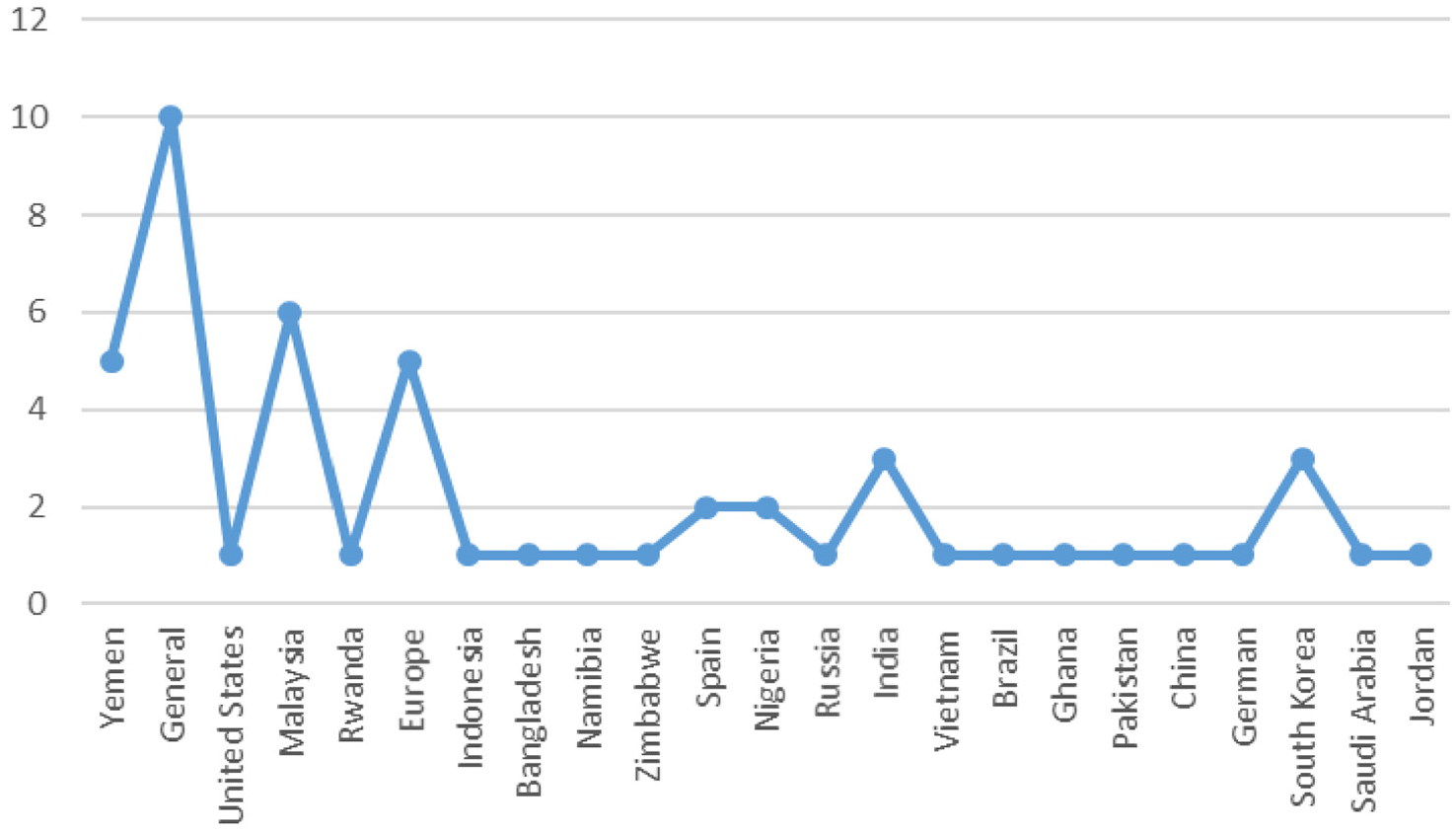
The distributions of articles based on countries.
Studies focused on the context of Namibia, Zimbabwe and Bangladesh showed that studies on the topic are diverse and inclusive, with data providing insights into the global perspective, data stemming from most of the countries in the world.
The major factors highlighted in review of literature were found to be found in theories and models, and they were included in the list in order of importance. The extracted factors are listed in Table 2 along with the theories they are included in.
Most Cited Factors in the Literature Review.

The factors were found to be included in the eight theories, which are Technology Acceptance Model (TAM1 and TAM2), DeLone and McLean’s IS Success Model (D&M), Unified Theory of Acceptance and Use of Technology (UTAUT1 and UTAUT2), Theory of Reasoned Action (TRA) and Theory of Planned Behavior (TPB), Technology, Organization and Environment (TOE) model, Principal-Agent Theory, Collective Action Theory, and Institutional Theory. There were 41 main factors extracted as presented in Table 2.
This list is sent to the experts. All the factors were evaluated and ranked according to their importance as discussed in the coming sections.
Experts’ Analysis Outcomes
The interview with the experts involved the use of open-ended questions to determine ECMS adoption in firms. The list of factors that were forwarded to the experts for their perusal is available in Table 3, where 14 factors are highlighted to be the most significant ones.
Experts’ Ranking of the Extracted Factors.

The mean score for a given set of factors was determined by employing the formula:

Within the context of the rankings provided by a panel of 10 experts utilizing a 5-point Likert scale to assess multiple factors, the mean score for each factor is computed by aggregating the individual scores assigned by all 10 experts for that particular factor, and subsequently dividing the resulting sum by the total number of experts, which in this instance amounts to 10. The aforementioned computation produces a mean evaluation of the experts’ collective rankings for each factor on the Likert scale, thereby facilitating the process of evaluation the factors.
According to the experts, those are the highest ranked list of factors, that should be included based on their influence on ECMS adoption. The final list of factors that the experts recommended are tabulated in Table 4.
Final List of Factors.

The outcome of the experts’ ranking included the following factors—corruption, security, social influence, facilitating conditions, system quality, information quality, service quality, compatibility, top management support, training, change management, policy, laws and legislations and AI Tools Integration. Moreover, the lowest-ranking factors were dropped from the list and this study phase online focused on the extracted factors as exogenous variables, while the endogenous variable (intention to adopt) is not included.
The following is the discussion and interpretations of the factors based on their dimensions;
Technological Dimension
Technological factors are found to be critical in adopting ECMS in literature review as well as by experts’ qualitative findings. In this regard, Laumer et al. (2017) mixed method approach research focused on ECMS users in an attempt to determine the drivers for successful implementation, adoption and use of the system. The authors used DeLone and McLean’s IS Success Model when interviewing 34 individuals and obtaining data from 247 ECM users at the financial service providers. The authors found it suitable to differentiate between contextual and representational information quality as the two dimensions of information quality.
The experts highlighted the need to factors such as system quality, information quality, service quality, compatibility and AI tools to speed up and influence the successful adoption of ECMS. In the study conducted by Dening et al. (2018), a success model of enterprise content management (ECM) was developed on DeLone and McLean’s information system (IS) success model. The authors empirically tested it through SEM’s PLS, using data gathered through an online survey. The reported results indicated a positive and significant influence of ECMS on organizational content management in light of collaboration, compliance and efficiency, evidencing that ECMS is moderated by the its impact on user’s satisfaction of the system.
To be a specific, the quality of information factor is defined as the degree to which it satisfies the needs of those involved in the creation, management, and analysis of that information (Eppler & Wittig, 2000); the efficiency of ECMS is likely to be affected considerably by the quality of the information used in it. Thus, we might define information quality as the extent to which IS achieves its goals (Poels & Cherfi, 2006). The ECMS is built on a foundation of high-quality information (Rosman, 2020c).
Governments around the world are being challenged by the rapid pace of technological change. Using data analytics and artificial intelligence, governments now have a wealth of new tools at their disposal for improving public services, maximizing the value of their investments, and combating corruption (Engin & Treleaven, 2019; Soni et al., 2020). Thus, there are some factors must to be attached with ECMS such as artificial intelligence that will be good attempt to improve the system and influence its adoption. In this regard, Zheng and Khalid (2022) highlighted the importance of including AI tools as a critical factor that lead to influence the adoption of systems in organizations.
It is noteworthy to mention that as per the SLR and experts, the compatibility is the most crucial factor in deciding whether or not a given technology will be adopted (Chong & Pervan, 2001; Hawash, Asma’Mokhtar, et al., 2020). In this regards, the relevance of compatibility in terms of the rate at which organizations adopt technology has been repeatedly emphasized in the literature (Ramayah et al., 2016), and it is one of the most studied concepts across a variety of settings. Thus, this study aims to include it as one critical factor in the technology dimension.
Organizational Dimension
The top challenge reported by many studies is the large and diverse organizations within which information needs to be managed (e.g., government institutions) and this entails combining different information from several sources, which may have to adhere to different regulations and thus need specific organization (Abdurrahaman et al., 2020; Jaakonmäki et al., 2018; Katuu, 2012b). This confirms the need to include organizational factors in each study that aspire to adopt technology as per this study came up with.
Acceptance and adoption of IT are bolstered by the backing of upper management, which can be broken down into two distinct types (direct and indirect) as asserted by Lombardi et al. (2020). The findings are consistent with those of Wiltzius et al. (2014), who established a connection between the successful adoption of ECMS and the backing of senior management. The SLR and experts are with same caliber and found that top management support is vital for the technology adoption as in this study the ECMS.
While in other study on organizational factors, Owusu et al. (2019) confirm the critical significance of training as a factor in boosting technology and system utilization in his study of anti-corruption measures in construction project management. Many studies agree, finding that this is one of the most important criteria in determining whether or not a technology will be adopted (Netshakhuma, 2019).
In order to establish an enterprise content management system for the entire government, Pierre et al. (2016) conducted an interview study with 56 individuals from 10 government agencies. The change management strategy, according to the authors, is essential for a successful implementation. Change management factor importance was also confirmed by Nengomasha and Chikomba (2018) and Hawash, Umi Asma’, et al. (2020) who confirmed the need to include this factor in developing any adoption models. Thus, this study raised the importance of the change management as vital factor in the successful adoption of ECMS.
What’s more, this study highlighted the critical role of facilitating conditions in the successful adoption of technology especially ECMS. In this regard, a person’s perception of the organizational and technological infrastructure’s readiness to enable the use of a system is referred to as their belief in facilitating conditions (Venkatesh et al., 2003). According to Hawash, Umi Asma’, et al. (2020), enabling circumstances have a significant influence in the adoption of new technology, including ERMS (which is a part of ECMS).
Environmental Dimension
Environmental factors can indeed have a significant impact on the adoption of technology, including ECMS. The factors such as security, policy, laws and legislations and social influence are among the extracted drivers by this SLR and highlighted by the experts’ panel involved in this study.
Integrating high-quality and well-tested technologies is essential for the security of electronic records. Mukred et al. (2021) findings confirmed that employees are willing to adopt an electronic records system as long as their privacy and confidentiality are protected are consistent with this. As a result, research is needed to shed light on how concerns about security affect workers’ attitudes about ECMS adoption. This is why it’s crucial to look into how people feel about the ECMS being adopted. Based on the existing literature, it is clear that security is crucial, and this is why the security construct in the current study is a reference to the safety of the e-records system used by public schools.
Policy was one other important factor by this study. Organization’s policies and procedures can’t be expected to work without constant evaluation, and this evaluation can’t be made to look like it was done using manual forms; rather, it must be based on a thorough examination of the business model, operations, degree and type of electronic communication, and recordkeeping practices.
Chang et al. (2015) who examined the adoption and deployment of clinical knowledge management systems (CKMS) in Taiwan’s healthcare facilities and found that policy played a significant role in both.
This study also found that the laws and legislations factor are crucial in the successful adoption. Governance is concerned with stewardship, collaboration, and incentives to act on common interests, while regulation is concerned with laws that are aimed to restrict behavior. Governments, rather than being the heavy hand of the law, should control ECMS and other technology by acting as a collaborative peer to other members of society.
Considerations that may influence technological adoption should be factored into the legal issues faced by regulators (Janssen et al., 2020). Laws should be altered or amended to consider the nature of ECMS technology to allow for its widespread use.
The last environmental factor determined by this study was social influence. The studies conducted in the field of IS have shown that the social influence plays a significant role in the acceptance and utilization of technology. When a person is in the early stages of adopting a new technology, for instance, he or she has limited direct experience with it and is therefore very susceptible to the information and opinions offered by those closest to them (Nuryyev et al., 2020; Singh et al., 2020). As such, this study takes social influence as one determinant of ECMS adoption for its extreme influence in both technology adoption theories and corruption theories
Behavioral Intention and Corruption
In this context, there is a factor of “behavioral intention” which means both the propensity and the planned level of effort to carry out the behavior. Ayaz and Yanartaş (2020) identified the intention to utilize an electronic document management system (EDMS) as a UTAUT construct, ranking it among the best models for predicting such intent. The research team found that the proposed model could account for 61% of the variance in EDMS adoption intentions due to factors including performance expectancy and social impact. This study aims to use the original UTAUT construct of behavioral intention too.
This study found that anticorruption factor is linked with ECMS and the system helps in fighting the corruption properly. The anticorruption factor had been extracted by SLR and recommended by experts. In this regards, corruption is a term that stems from “corrupt behavior” (Carvajal, 1999) and the best definition of the term according to Zhang and Zhang (2009) and Mahama and Dahlan (2021) is the abuse of public power for private benefit. This definition was provided by the World Bank (Huther & Shah, 2000) and corruption acts cover theft, extortion, bribery, influence peddling, fraud, nepotism, speed money/embezzling, abuse of discretion, exploitation of conflicting interests, favoritism, and improper political contributions (Lio et al., 2011; UNDP, 2008). This study defines corruption as the abuse of public financial resources in sides, expenditures and revenues and the act of using such resources to gain personal interests.
Corruption prevention involves complexities and different efforts have been taken throughout the years for its minimization. These efforts are manifested in the form of the establishment of international coalitions against corruption to combat the considerable impact of the issue. Coalitions are generally made mandatory in order to fight jointly against corruption, in the national, local and regional levels. Corruption issues have been addressed in private and public organizations (Wilhelm, 2002) albeit cooperation and collaboration are still elusive. Generally, governments display significant resistance towards transparent systems in an effort to retain and protect their authority and hierarchical statuses (Ndou, 2004; Shelton-Colby, 2003)
There is a need for synergy at various levels (local, regional and national) among the public and private enterprises to mitigate or eradicate the prevalence of corruption. However, collaborating and cooperating towards to achieve such a feat is almost impossible as government are averse to presenting transparent systems, wary of scrutiny on the authority, power and hierarchical status (Denkers, 2018; Ndou, 2004; Shelton-Colby, 2003). Efforts towards preventing corruption should not be limited to the public enterprises but also include the private one in the initiative (Choi, 2018; Stea & Harindranath, 2006).
Nevertheless, studies on ECMS in public sector organization are still limited as will be evident from the review of past relevant studies. The review is appropriate considering that general application of different components of the system in organizations is similar to that of the ECMS.
The connection between the identified factors and anti-corruption efforts is crucial for understanding the impact of ECMS adoption in public sector organizations. By enhancing security and ensuring high information quality, ECMS reduces opportunities for unauthorized access and manipulation of data, thereby preventing corrupt practices. Strong top management support and well-defined policies foster a culture of integrity and accountability, essential for aligning ECMS implementation with anti-corruption goals. Adequate training and effective change management ensure that employees are well-equipped to utilize ECMS correctly, promoting ethical behavior and the identification of corrupt activities. Compliance with laws and legislation ensures transparency and adherence to legal standards, minimizing corruption risks. Integration of AI tools and maintaining high system quality aid in detecting and preventing fraudulent activities through advanced data analysis. Finally, fostering a positive organizational culture and leveraging social influence encourage ethical behavior, further reducing the likelihood of corruption. These factors collectively create an environment that supports anti-corruption initiatives, demonstrating the critical role of ECMS in enhancing transparency, accountability, and efficiency.
Implications of the Study
This study has several contributions to literature concerning ECMS. Such contributions are built on the basis of many factors, with the inclusion of the SLR, expert’s feedback, and critical factors. This makes the study a novel one with enriching contributions.
The first contribution of the study comes from the SLR that conducted an extensive review of the current state of ECMS research and the factors that influence its adoption. Based on the review, the gaps in literature were discerned and the major factors driving ECMS adoption success were obtained. The review represents a robust basis for main determinants of ECMS adoption.
The second contribution is the experts’ involvement in identifying the extracted variables on the basis of their practical experience and perspectives as field professionals. Experts’ involvement validates the factors in the SLR and guarantees the practicality of their actual situations in today’s world.
The third contribution is the identification of critical factors that are crucial for ECMS adoption and implementation success and taxonomic classification of the factors. The critical factors were divided into technological, organizational and environmental dimensions, which encapsulate system quality, information quality, top management support, training, policy, security, laws and legislation, and social influence. They provided the basis for the successful adoption with emphasis on the adoption process complexities.
The study also contributes by stressing on the role of ECMS in combating corruption in organizations, whereby the prevention of detection of corruption is carried out through a secure and efficient platform for information management and sharing. The study presents the importance of viewing the needs and challenges of anti-corruption efforts during the ECMS adoption and implementation. The contribution to literature lies in the comprehensive identification and validation of factors influencing ECMS adoption, with specific applications for anti-corruption efforts in public sector organizations.
The study also contributes by stressing on the role of ECMS in combating corruption in organizations, whereby the prevention of detection of corruption is carried out through a secure and efficient platform for information management and sharing. The study presents the importance of viewing the needs and challenges of anti-corruption efforts during the ECMS adoption and implementation. The contribution to literature lies in the comprehensive identification and validation of factors influencing ECMS adoption, with specific applications for anti-corruption efforts in public sector organizations.
Additionally, this research categorizes the critical factors into technological, organizational, environmental, and behavioral dimensions, providing a comprehensive framework for understanding the complex interplay between these dimensions. This holistic approach challenges existing paradigms that often treat these factors in isolation. The findings demonstrate that successful ECMS adoption requires an integrated approach that considers the interdependencies between these dimensions, offering a more robust theoretical model for future research. These contributions offer valuable insights for both researchers and practitioners, providing a deeper and more comprehensive understanding of the dynamics at play in public sector technology adoption.
Conclusion
This study concludes by presenting the extracted factors for ECMS adoption. The study comprehensively helps in identifying critical factors categorized into technological, organizational and environmental dimensions. The SLR builds a robust basis for discerning the literature gaps. Experts’ involvement also made sure that the factors extraction is practically useful considering it is based on the field experience and perspectives of professionals. Practically, the factors can be used by organizations in their adoption of ECMS and it stresses on the importance of specific needs and challenges of anti-corruption efforts, providing a holistic viewpoint of the process of system adoption. The findings stress on the key role of ECMS in organizations through a secure and efficient platform that enables information management and sharing, and eventually enhance transparency and accountability of the stakeholders involved.
The study’s relative novelty is its presentation of a comprehensive approach to adopting and implementing ECMS in organizations. Such an approach is encapsulated in a combination of a SLR and expert insights, which identified distinct critical factors—an attempt that was missing in literature. On the whole, the significant contribution of the study to literature is the list of critical factors that will influence the ECMS adoption and implementation in organizations—a list that can be used as a practical guide by organizations for the same and for reaching informed decision-making, planning and evaluation.
Policymakers should consider these identified factors when developing strategies and frameworks for ECMS adoption. Specifically, enhancing security measures, ensuring top management support, providing adequate training, and aligning with laws and regulations are crucial steps for successful implementation. Additionally, integrating artificial intelligence tools and ensuring system compatibility can further enhance the efficiency and effectiveness of ECMS
Although this study has several strengths and contributions highlighted in the previous section, it also has its limitations, the first of which lies in the adopted qualitative approach, which could lead to limited generalizability of results. The size of the sample expert panel is also small, which could also confine the proposed model’s transferability to other contexts and environments.
The second limitation is the sole focus on ECMS adoption and implementation, which did not include the evaluation of ECMS effectiveness in the prevention and minimization of corruption. The study stresses on researches of ECMS potential role in improving transparency and accountability, but the effectiveness of ECMS use in achieving the same has been left untouched.
Building on the findings of this study, several areas for future research are suggested. First, expanding the sample size and including experts from diverse geographical regions can provide a more comprehensive understanding of ECMS adoption across different contexts. Second, future studies could employ quantitative methods, such as meta-analysis, to complement the qualitative insights provided by this research. This approach could offer a more objective and precise summary of the factors influencing ECMS adoption. Third, investigating the long-term impacts of ECMS implementation on organizational efficiency and anti-corruption efforts can provide valuable insights into the sustainability and effectiveness of these systems. Lastly, exploring the role of emerging technologies, such as blockchain and advanced AI, in enhancing ECMS functionalities could offer new avenues for research and innovation. These directions will help advance the theoretical and practical understanding of ECMS adoption and its role in combating corruption in public sector organizations.
Footnotes
Appendix A
Articles Included in the SLR.

| S_ID | Author | Journal | Title | Data collection/respondents | Role/domain | Model | Factors | Year | Country |
|---|---|---|---|---|---|---|---|---|---|
| 1 | Mukred and Yusof (2020) | IGI Global | The performance of educational institutions through the electronic records management systems: factors influencing electronic records management system adoption | 350 employees/survey | Education | TAM + D&M | System quality, information quality, service quality, security | 2020 | Yemen |
| 2 | Rickenberg et al. (2012) | AIS Electronic Library | Enterprise content management—A literature review | Literature review: 68 articles were reviewed | General | No model | NO | 2012 | |
| 3 | Alalwan et al. (2014) | Decision Support Systems | Decision support capabilities of enterprise content management systems: An empirical investigation | 618 users, 157 completed responses were received of which 111 were usable | Public Sector | Sequential decision making framework | Decision making analysis, decision making speed, decision quality, the use of ECM, impact on problem definition, problem identification speed, satisfaction | 2014 | United States |
| 4 | Rosman (2020c) | Asia-Pacific Journal of Information Technology and Multimedia [Jurnal Teknologi Maklumat Dan Multimedia Asia-Pasifik] | The role of business processes in influencing the decision support capabilities of enterprise content management system (ECMS): Towards a framework | Conceptual model: Qualitative 24 participants from all organizations | Public Sector | Organizational information processing theory | Use of ECMS, the nature of ECMS-supported business process and the improvement of organizations’ decision-making capabilities | 2020 | Malaysia |
| 5 | Rosman (2020a) | Open Journal of Science and Technology | The 5Ws of enterprise content management (ECM) research | Structured literature search approach was conducted, and comprehensive analysis of ECM was presented | Public Sector | General | Content dimensions, technology dimensions, process dimensions, strategy people dimensions | 2020 | General |
| 6 | Rosman (2020b) | Journal of Digital Information Management | Reviewing the concept of enterprise content management (ECM) | Literature review | Public Sector | General | Information quality, improved decision making, governance and compliance, cost reduction, integration, task efficiency, improve search and retrieval, facilitate information sharing, continuity, customization, collaboration | 2020 | General |
| 7 | Scholl et al. (2016) | Joint Proceedings of Ongoing Research, PhD Papers, Posters and Workshops of IFIP EGOV and EPart | E-government implementation in developing countries: Enterprise content management in Rwanda. In electronic government and electronic participation | An interview study with 56 people in 10 government organizations involved in implementing a government-wide enterprise content management system | Public Sector | General | User factors: user involvement in IT system improvement, user perception of system advantage, training, user perception of system complexity, task related factors: project management plan, change management plan, project cost planning, post-implementation evaluation plan, building a business case, technological factors, technical infrastructure, business process reengineering, system quality, content factors: digital signature, managerial factors, top management support | 2016 | Rwanda |
| 8 | Harr et al. (2019) | Business Process Management Journal | Evaluating the individual and organizational impact of enterprise content management systems | Online survey | Public Sector | DeLone and McLean IS success model | System quality, use, user satisfaction. information quality, service quality, process quality, individual impact, efficiency, collaboration, compliance | 2019 | Europe |
| 9 | Hawash, Asma’Mokhtar, et al. (2020) | Records Management Journal | The adoption of electronic records management system (ERMS) in the Yemeni oil and gas sector: Influencing factors | Systematic literature review and experts | Public Sector | TOE | Compatibility, effort expectancy, security, performance expectancy and system quality, accountability, change management, financial support, social influence, training and top-management support, availability, facilitating conditions, policy and regulations and trust | Yemen | |
| 10 | Mukred et al. (2019) | Journal of Information Science | Taxonomic framework for factors influencing ERMS adoption in organizations of higher professional education | Literature review and experts | Public Sector | UTAUT and TOE | Perceived ease of use, perceived usefulness, IT infrastructure, IT security, top management support, financial support, training and policy, system quality, information quality, service quality | 2019 | Yemen |
| 11 | Mosweu et al. (2017) | Information Development | A probe into the factors for adoption and usage of electronic document and records management systems in the Botswana context | A questionnaire, with both open and closed-ended questions, was administered to all 61 Action Officers (with response rate of 87%) who were the key users of the system | Public Sector | UTAUT | Technophobia, negative attitudes to system use, perceived system complexity and incompatibility with existing information system | 2017 | Africa |
| 12 | Aziz et al. (2018) | International Journal on Advanced Science, Engineering and Information Technology | A conceptual model for electronic document and records management system adoption in Malaysian public sector | A qualitative study involving a critical review of the related literature in the area and interviews were employed | Public Sector | UTAUT | Performance expectancy, effort expectancy, system quality, training, security, top management support, facilitating conditions, information quality, perceived value of records, financial support | 2018 | Malaysia |
| 13 | Mouna et al. (2020) | Transforming Government: People, Process and Policy | International comparative evidence of e-government success and economic growth: technology adoption as an anti-corruption tool | Examines the relationship between ICT and economic growth in a large sample of 149 countries for the period 2012–2016 | Public Sector | No model | Electronic administration, quality of the information, accountability and transparency | 2020 | General |
| 14 | Park and Kim (2020) | International Review of Administrative Sciences | E-government as an anti-corruption tool: Panel data analysis across countries | Longitudinal data from 2003 to 2016 were collected from 214 countries and then panel data analysis based on a fixed effect model was conducted | Public Sector | No model | Law, effective legal systems, corruption, open government, e-government | 2020 | General |
| 15 | Lupu and Lazăr (2015) | Procedia Economics and Finance | Influence of e-government on the level of corruption in some EU and non-EU states | Explores the relationship between corruption and e-government in two moments: 2004 (2007) and 2012 in EU and non-UE countries | e-Government | No model | Corruption, control corruption, government effectiveness | 2015 | Europe |
| 16 | Joseph et al. (2019) | Journal of Cleaner Production | Realising sustainable development goals via online integrity framework disclosure: Evidence from Malaysian and Indonesian local authorities | The data collected in this study were based on a content analysis of inclusion or exclusion of integrity framework information disclosed on 51 Malaysian and 34 Indonesian local authorities’ websites | General | No model | Lack of information technology capitalization to disclose integrity framework information, lack of coercive factors (educated stakeholders), different state policy relating to information technology and lack of personnel to manage the websites, lack of support from the top management, and political competition | 2019 | Indonesia and Malaysia |
| 17 | Muhamad and Gani (2020) | Journal of Financial Crime | A decade of corruption studies in Malaysia | This study employed structured review process as well as critically examined the contents to ensure that the data are filtered from high-quality peer-reviewed journals. Twenty-five quality papers were selected from top journals of various areas to produce the list | General | No model | Culture, participation of women in politics and duration of education, good governance, organizational culture, religious and corruption, individual aspect | 2020 | Malaysia |
| 18 | Masud et al. (2022) | Sustainability | Anti-corruption disclosure, corporate social expenditure and political corporate social responsibility: Empirical evidence from Bangladesh | The study uses all financial sector companies listed on the Dhaka Stock Exchange the total firm-year observations are 245 from 2012–2016. The authors developed a diverse set of 97 keywords as content for ACD | General | No model | Political connection, internationalized reporting, cash payment, media visibility | 2022 | Bangladesh |
| 19 | Hawash et al. (2021) | International Journal of Management and Enterprise Development | Users’ acceptance of an electronic record management system in the context of the oil and gas sector in Yemen: an application of ISSM-TAM | A total 415 survey questionnaires collected. | Oil and Gas | Information systems success model | System quality (SQ), information quality (IQ), service quality (SRQ), perceived ease of use (PEOU), perceived usefulness (PU), and trust (TRU) | 2021 | Yemen |
| 20 | Mackey and Cuomo (2020) | Global Health Action | An interdisciplinary review of digital technologies to facilitate anti-corruption, transparency and accountability in medicines procurement | Extracted 37 articles for in-depth review based on our inclusion criteria focused on the utilization of digital technology to improve medicines procurement. | Pharmaceutical | No model | Block chain, electronic data interchange, e-procurement systems | 2020 | |
| 21 | Nengomasha and Chikomba (2018) | Records Management Journal | Status of EDRMS implementation in the public sector in Namibia and Zimbabwe | This multi-case study was informed by an interpretivist paradigm. Qualitative in nature, the study applied face-to-face interviews as the data collection method, supplemented by documents analysis. The study population was Namibia and Zimbabwe’s public sectors with units of analysis, being the governments’ ministries, offices and agencies which have implemented EDRM | General | No model | Change management, management support, user involvement, composition of project team, getting the file plan right, end users training on the system, resources for ongoing support of the system | 2018 | Namibia and Zimbabwe |
| 22 | Mukred et al. (2021) | KSII Transactions on Internet and Information Systems (TIIS) | Improving the decision-making process in the higher learning institutions via electronic records management system adoption. | The study conducts a cross-sectional survey with a questionnaire as the technique for data collection, distributed to 364 participants in various Yemeni public Higher Learning Institutions (HLI) | Education | UTAUT and TOE | Technology factors (effort expectancy, performance expectancy, IT infrastructure and security), Organizational factors (top management support, financial support, training, and policy), environmental factors (competitiveness pressure, facilitating conditions and trust) and behavioral intention to adopt ERMS and Decision Making | 2021 | Yemen |
| 23 | de Mingo and Cerrillo-i-Martínez (2018) | International Journal of Information Management | Improving records management to promote transparency and prevent corruption | Analyses the mechanisms available to Spain’s public administrations for managing these irregularities in records management though the raft of regulations and protocols that have been approved in the country. It assesses how the lack of specific regulations providing for transparency by design currently represents a limitation on the role of records management as a tool for preventing and fighting corruption | Public Sector | No model | Regulations, transparency, integrity, availability and quality of information, records management | 2018 | Spain |
| 24 | Cuadrado-Ballesteros et al. (2020) | International Review of Administrative Sciences | The role of public-sector accounting in controlling corruption: An assessment of Organisation for Economic Co-operation and Development countries | This study investigates a sample of 33 Organization for Economic Co-operation and Development countries for the period 2010–2014, creating a panel data set that allows the taking of an international comparative approach. | Public Sector | No model | Economic development, education level, ethno-linguistic fragmentation of the population, electronic system, legal origin | 2020 | Europe |
| 25 | Inuwa et al. (2020) | The Electronic Journal of Information Systems in Developing Countries | Dimensions that characterize and mechanisms that cause the misuse of information systems for corrupt practices in the Nigerian public sector | Focus group and semi structured interviews were used as primary sources of data, while archival documents and press media reports were used as secondary data sources | Public Sector | Danermark et al.’s (2002) model | Malleability structures of the IS artefacts, dysfunctional structures of the Nigerian state, embeddedness of corrupt routines into IS artefacts, institutionalization, socialization, rationalization, and negative reintegrative shaming were identified as core causal structural mechanisms generating the misuse of IS for corrupt practices in the study context | 2020 | Nigeria |
| 26 | Khan et al. (2021) | Technological Forecasting and Social Change | Electronic government and corruption: Systematic literature review, framework, and agenda for future research | A systematic literature review (SLR) of 63 articles discussing e-government and corruption and provide a comprehensive synthesis of the current knowledge in this domain | Public Sector | Prevention strategy, enforcement strategy, citizen participation, capability building | 2021 | General | |
| 27 | Agbozo and Asamoah (2019) | R-Economy | The role of e-government systems in ensuring government effectiveness and control of corruption | The data to measure the e-Government Development Index (EGDI) in 15 countries was provided by the e-government 2016 survey conducted by the United Nations | Public Sector | Path model | Rule of law and control of corruption | 2019 | Russia |
| 28 | Arayankalam et al. (2021) | International Journal of Information Management | How to deal with corruption? Examining the roles of e-government maturity, government administrative effectiveness, and virtual social networks diffusion | Study hypotheses were tested using archival data collected from various reputable sources such as the World Economic Forums (WEF) | Public Sector | Technological determinism theory, general deterrence theory, and Habermas’ public sphere perspective | E-government maturity, legislature, executive, and judiciary, administrative effectiveness, government administrative effectiveness | 2021 | India |
| 29 | Le Thanh (2022) | International Journal of Electronic Government Research | Accelerating digital transformation implementation in the fight against corruption?: Evidence from European countries before and during the COVID-19 pandemic | Empirically analyze the effects of digitalization on corruption prevalence by using a sample of 27 European countries over the period 2015–2020. We utilize the digital economy and society index capturing five diverse aspects of digital transformation: connectivity, human capital, use of the internet, integration of digital technology, and digital public services to reflect digital performance | Public Sector | No model | Online transactions, business digitization, e-commerce, and e-government | 2022 | Vietnam |
| 30 | Saldanha et al. (2022) | Government Information Quarterly | Transparency and accountability in digital public services: Learning from the Brazilian cases | Adopting a qualitative approach through comparative case studies, this research contributes to information practices theory (construction of a model for assessing transparency and accountability in digital public services) | Public Sector | No model | Accessibility; awareness; access and repair; accountability; explanation; origin of data, privacy and fairness; auditing; validation, accuracy and testing | 2022 | Brazil |
| 31 | Merhi (2022) | Pacific Asia Journal of the Association for Information Systems | The effect of digital transformation on corruption: A global analysis | Secondary data from 139 countries collected by credible international organizations are used for the empirical analyses. The sample of 139 countries, used in this study, makes the results more robust and generalizable than those published in previous studies | Public Sector | No model | Corruption, e-participation, human capital, importance of ICT to governments, laws relating to ICT, online service, telecom infrastructure, government-efficiency | 2022 | General |
| 32 | Chakraborty et al. (2021) | Technology in Society | Analysis of digital technologies as antecedent to care service transparency and orchestration | The examination is expected to involve the doctors, IT staff and administrative staff of the hospitals. The survey helped in building a database of tertiary care private corporate hospitals with number of beds above 100.The hospitals listed in the government and private databases were identified and checked for the primary information regarding, whether they have implemented the digitized technology | Healthcare | No model | Digitized technology adoption, care service transparency, care service orchestration | 2021 | India |
| 33 | Owusu et al. (2019) | Project Management Journal | Contemporary review of anti-corruption measures in construction project management | Using a two-stage methodological process to identify the relevant publications needed, 39 unique ACMs were identified in 38 selected publications | Public Sector | No model | Ethical codes, transparency mechanism, training, and development initiatives | 2019 | General |
| 34 | Owusu et al. (2020) | Journal of cleaner production | Impacts of anti-corruption barriers on the efficacy of anti-corruption measures in infrastructure projects: Implications for sustainable development | An expert survey was conducted with 62 professionals involved in project procurement and management | Public Sector | No model | Regulatory measures, administrative e-measures, compliance measures, promotional measures, probing measures, reactive measures | 2020 | Ghana |
| 35 | Novak et al. (2021) | International Journal of Computer Science & Network Security | Information and analytical support of anti-corruption policy | The research methodology is based on a qualitative content analysis of the functioning of information and analytical systems of Ukraine used by anti-corruption bodies. A quantitative analysis of the CPI score was conducted, according to Transparency International, to identify the effectiveness of anti-corruption policies in developing countries | Public Sector | No model | Strategy to combat corruption mainly involves increasing the independence and powers of anti-corruption bodies | 2021 | Eastern Europe. |
| 36 | Lombardi et al. (2020) | Journal of Cleaner Production | Exploratory evidence on anticorruption activities in the Spanish context: A sustainable governance approach | Based on a case study using the Gioia methodology, our research seeks to identify the role of the board of directors compared with that of control activities (i.e., corruption prevention activities) within the management system of the company | Companies | No model | Top management team, compliance system, enterprise risk management system, training, ethical corporate behavior | 2020 | Spain |
| 37 | Kohler and Dimancesco (2020) | Global Health Action | The risk of corruption in public pharmaceutical procurement: how anti-corruption, transparency and accountability measures may reduce this risk | This paper was informed by a narrative literature review from 1996 to the present. The search focused on publications that addressed the issue of pharmaceutical procurement and governance and corruption issues. Our search included peer-reviewed literature, books, grey literature such as working papers, reports published by international organizations and donor agencies, and some media articles. Some documents used in this paper were already known to the authors. | Healthcare | No model | Procurement process, transparency and accountability mechanisms | 2020 | General |
| 38 | Sekalala et al. (2020) | Global Health Action | Human rights mechanisms for anti-corruption, transparency and accountability: enabling the right to health | Qualitative content analysis methods to analyze all 135 Universal Periodic Review documents produced during 2018 in order to analyze how human rights mechanisms address the impact of corruption on the realization of the right to health | Healthcare | No model | Strategic litigation and social audits, transparency and accountability, legislation, policies and programs | 2020 | General |
| 39 | Hassan (2022) | Central European Journal of Public Policy | Social implications of corruption in developing countries: Case study of Pakistan and India | Study employs a systematic literature review method (PRISMA-P 2015) that identifies currently available research, selects and assesses contribution, analyses and synthesizes data, and presents pieces of evidence with a justified conclusion. It also encourages researchers to apply PRISMA protocols in future researches | Public Sector | No model | Political accountability, institutional reforms, technological advancement, social audits | 2022 | India and Pakistan |
| 40 | Rosman (2020c) | Asia-Pacific Journal of Information Technology and Multimedia | The role of business processes in influencing the decision support capabilities of enterprise content management system (ECMS): Towards a framework | Having been researched for a period of 25 years, most prior studies on ECMS focus on a bottom-up approach with the intention of achieving immediate benefits such as cost-reduction, meaningful knowledge work and re-use of previous content | Public Sector | Organizational information processing theory | IT infrastructure managerial operational, organizational strategies, decision making | 2020 | Malaysia |
| 41 | Wu et al. (2020) | Australian Journal of Public Administration | Public sector innovation, e-government, and anticorruption in China and India: Insights from civil servants | Comparative in-depth interviews with 44 mid- or senior-level officials in the public sector in these two countries | Public Sector | No model | Political willingness, income inequality, and infrastructure readiness, role of technology | 2020 | China and India |
| 42 | Laumer et al. (2017) | European Journal of Information Systems | Information quality, user satisfaction, and the manifestation of workarounds: a qualitative and quantitative study of enterprise content management system users | 34 interviews, and an empirical study of 247 ECM system users at a financial service provider | Financial enterprises | DeLone & McLean IS success model | System quality, representational information quality, contextual information quality service quality, user satisfaction, workaround, net benefit | 2017 | German |
| 43 | Jaakonmäki et al. (2018) | Journal of Enterprise Information Management | ECM implementations in practice: Objectives, processes, and technologies | This paper assembles more than 1,200 case reports on industrial ECM implementations in order to characterize the ECM concept from a practitioners viewpoint | Public Sector | No model | ECM, factors, technologies, sectors | 2018 | General |
| 44 | Hwang (2021b) | Journal of the Korea Convergence Society | A study on the improvement of the intention of continuous use of enterprise content management system: Focusing on the technology acceptance model | Survey of 300 ECM system users in South Korea | Public Sector | TAM and DeLone and McLean | Perceived usefulness (PU), perceived ease of use (PEOU), system quality (SQ), information quality (IQ), social influence (SI), facilitating conditions (FC) | 2021 | South Korea |
| 45 | Hwang (2021a) | The Journal of the Korea Contents Association | A study on the influence of enterprise content management system success factors and task characteristics on intention to use | The author surveyed 300 ECM system users in South Korea | Public Sector | TAM | System quality, information quality, task complexity, task variety | 2021 | South Korea |
| 46 | Abdurrahaman et al. (2020) | Electronic Journal of Information Systems Evaluation | Evaluating factors affecting user satisfaction in university enterprise content management (ECM) systems | The authors conducted a survey among 144 faculty members and administrative staff from two Nigerian universities who use ECM systems | Education | TAM and DeLon snd McLean | System quality, information quality., service quality, perceived usefulness, perceived ease of use | 2020 | Nigeria |
| 47 | Arshad et al. (2022) | Knowledge Management Research & Practice | A sustainable enterprise content management technologies use framework supporting agile business processes | The methodology of this article involves a cross-sectional multiple-case studies approach with participation of seven large-scaled organizations | Public sector | No model | Adoption of ECM technologies, governance and management of the ECMS, integration of the ECMS, continuous improvement of the ECMS | 2022 | Malaysia |
| 48 | Muthuswamy and Sharma (2022) | International Journal of eBusiness and eGovernment Studie | Enterprise content management and plummeting IT complexity | The researcher used experimental research, and 50 H.R. specialists were considered based on convenience sampling and the focus group | Enterprises | No model | Compliance, cost, collaboration, effectiveness and efficiency | 2022 | Saudi Arabia |
| 49 | Hwang (2022) | Journal of Society for e-Business Studies | The effects of internal communication, Techno-stress, and Task-Technology Fit on Intention of Continuous Use of Enterprise Content Management System | Questionnaire survey on employees of organizations | Education | No model | Reciprocal communication, formal communication, techno overload, techno complexity, intention of continuous use, task technology fit | 2021 | Korea |
| 50 | Salleh et al. (2022) | Journal of Advanced Research in Business and Management Studies | Relationship between ease of use, content, and user satisfaction on enterprise content management system (ECM) | The population of this study consists of 130 respondents. The researcher used simple random sampling technique to determine the estimated of 97 individuals as a sample size of the respondents for this research | Private company | No model | Content, ease of use, satisfaction | 2022 | Malaysia |
| 51 | Lutfi (2022) | International Journal of Digital Accounting Research | Understanding the intention to adopt cloud-based accounting information system in Jordanian SMEs | Structured survey questionnaire collected from 156 owners/managers of SMEs in Jordan through online means | SMEs | TOE | Intention to adopt CB-AIS; perceived usefulness; security concern; top management support; organizational readiness; competitive pressure; supplier computing support | 2022 | Jordan |
Declaration of Conflicting Interests
The author(s) declared no potential conflicts of interest with respect to the research, authorship, and/or publication of this article.
Funding
The author(s) disclosed receipt of the following financial support for the research, authorship, and/or publication of this article: The authors would like to thank Universiti Kebangsaan Malaysia—Faculty of Information Science and Technology for supporting this research under grant GUP-2024-045. Additionally, the authors extend their appreciation to the Deanship of Scientific Research at Northern Border University, Arar, KSA, for funding this research work through the project number NBU-SAFIR-2025.

Data Availability Statement
Data sharing not applicable to this article as no datasets were generated or analyzed during the current study.