



Abstract
English-medium instruction (EMI) has become increasingly popular in higher educational institutions across the world due to the prominence of English and the internationalization of higher education. Nevertheless, limited research to date has investigated its impacts on content learning through objective measures. The present study addresses this gap by examining whether students taught in English at a university in China perform differently in a business course from their counterparts taught in Chinese and how English-taught students’ English proficiency and academic ability (as measured by grade point average) relate to their EMI academic outcomes. The study employed a quasi-experimental design and adopted inter-translated versions of the same syllabus, textbook, class materials, and exam paper for the English- and Chinese-medium classes. It found no significant differences in students’ academic outcomes (i.e., total score, assignment, participation, and final exam) between the English- and the Chinese-taught classes. It also showed that both English proficiency and academic ability were statistically significant predictors of English-taught students’ academic outcomes with academic ability being a much stronger predictor than English proficiency. These findings add to a growing but still limited body of evidence on the impacts of EMI on content learning and point to several important implications for EMI.
Keywords
Introduction
English-medium instruction (EMI) refers to “the use of the English language to teach academic subjects (other than English itself) in countries or jurisdictions where the first language (L1) of the majority of the population is not English” (Macaro, 2018, p. 19). EMI in higher education has grown rapidly over the past two decades or so due to the increasing dominance of English and the intensifying internationalization of higher education (Coleman, 2006; Jiang & Zhang, 2019; Macaro et al., 2018). Dearden (2015), for example, surveyed English-medium instruction in 54 countries around the world and revealed an accelerating expansion of English-medium courses and programs in higher education on a global scale. There are various propelling forces for the increased popularity of EMI, including attracting international students and staff (Jensen & Thøgersen, 2011; Lei & Hu, 2014), boosting institutional internationalization, and competitiveness (Hu, 2009; Joe & Lee, 2013), enhancing students’ mobility (Coyle, 2013; Denman et al., 2013), securing better jobs for students (Bozdoğan & Karlıdağ, 2013; Hu & Lei, 2014), and “developing English proficiency without a detrimental effect on content learning” (Macaro et al., 2018, p. 36; see Airey, 2016; Block & Moncada-Comas, 2019; Graham et al., 2018; Lo & Lo, 2014 for theoretical discussions of EMI benefits).
Although an increasing body of literature has discussed the impacts of EMI on content learning, only a relatively small number of studies have examined the impacts empirically using objective tests (see Graham et al., 2018; Macaro et al., 2018; Tong et al., 2020). As a result, it remains unclear whether and to what extent EMI affects content learning. To address this gap, the present study aims to investigate whether students taught in English at a university in China perform differently in a business course from their counterparts taught in Chinese and how the English-taught students’ English proficiency and academic ability relate to their academic outcomes. The findings of this study contribute to a growing but still limited body of evidence on the impacts of EMI on content learning and the influencing factors thereof.
Literature Review
Effects of EMI on Content Learning
Research on EMI impact has focused primarily on language learning with much less attention paid to content learning (Paran, 2013; Tong et al., 2020). In a global systematic review of research on English-medium instruction in higher education, for example, Macaro et al. (2018) identified only four studies (out of 83) that measured the impacts on content learning.
Results from the limited number of studies on content learning are mixed and inconclusive. While some studies (e.g., Arco-Tirado et al., 2018; Hellekjaer, 2010; Li, 2018) have identified negative effects of EMI on content learning, others have found positive or nonsignificant effects (e.g., Dafouz et al., 2014; Guo et al., 2018; Hernández-Nanclares & Jiménez-Muñoz, 2017; Joe & Lee, 2013). In examining the impact of a bilingual program on students’ academic performance at a Spanish university, for example, Arco-Tirado et al. (2018) compared the bilingual and L1 students’ grade point average at graduation and found “a cost in academic performance for students taking the bilingual program” (p. 85). Similarly, Li’s (2018) study of the effectiveness of a bilingual course offered to social science students at a university in China showed that the bilingual course had an adverse effect on students’ content learning. In contrast, in an investigation of the academic outcomes of a group of English-taught students and a group of Spanish-taught students, Hernández-Nanclares and Jiménez-Muñoz (2017) found that the Spanish-taught and the English-taught students obtained overall similar grades. Similarly, drawing on a sample of 498 undergraduate students enrolled in a core business course at a Chinese university, Lin and He (2019) examined empirically the effects of medium of instruction on content learning between bilingual and L1 classes. Their study also revealed no statistically significant differences in academic performance between the bilingual and the L1 students. In addition, in a study of the academic outcomes for three courses between a cohort of English-taught Business Administration students and their Spanish-taught counterparts, Dafouz et al. (2014) concluded that “the language of instruction does not seem to compromise students’ learning of academic content” (p. 223). Similarly, through a quasi-experiment, Guo et al. (2018) examined the effectiveness of EMI on academic, affective, and linguistic outcomes, and found no detrimental effect on students’ content learning, either.
There is thus no clear evidence of the effects of EMI on content learning in higher education (see Macaro et al., 2018; Tong et al., 2020). Macaro et al. (2018) attributed the lack of clear evidence to “research methodology problems both at the micro and macro level” in the extant research (p. 36). Two of the most notable problems in the existing research are the lack of standardized, valid, and reliable content tests (Paran, 2013; Pérez-Cañado, 2012; Reljić et al., 2015) and the absence of comparable control groups (Bruton, 2011a, 2011b; Guo et al., 2018; Rubio-Alcalá et al., 2019). Hernández-Nanclares and Jiménez-Muñoz’s (2017) study was one of the few studies that employed equivalent assessment procedures and a comparable control group. In particular, the English-taught students and the Spanish-taught students in the study took the same exam in English and Spanish, respectively. The careful design of this study makes its findings more compelling than those from studies that adopted less rigorous designs. Given the limited number of studies on the effects of EMI on content learning, there is obviously a need for more research that employs soundest research designs possible.
Effects of English Proficiency on EMI Content Learning
The literature has posited that students receiving EMI tend to face language difficulties, which may prevent them from benefiting the most from EMI (Macaro et al., 2018; Tong et al., 2020). Dalton-Puffer (2011), for example, points out that students’ less than optimal command of the medium of instruction may hamper their lecture comprehension and lead their instructors to water down content, thereby undermining their mastery of the subject content.
Students’ self-assessments of their English proficiency have pointed to their inadequate English proficiency as a barrier to effective content learning in courses and programs taught in English (or in both English and L1) (Doiz et al., 2011). The English-taught Norwegian students in Hellekjaer’s (2010) study, for example, reported having difficulties in lecture comprehension. The Korean students in Choi’s (2013) study also encountered language challenges and regarded their insufficient English proficiency as the greatest hindrance to their content learning. In a similar vein, limited English proficiency hampered the students in Kim and Shin’s (2014) study from learning the content in an English-medium programs at a Korean university. Moreover, research on student and lecturer beliefs and perceptions about EMI has shown that students tend to find it easier to learn content in L1 than in English (Kirkgöz, 2014; Lei & Hu, 2014). Lei and Hu (2014), for example, noted that the Chinese students in their study found it easier to understand and learn content in Chinese than in English. The Turkish students in Kirkgöz’s (2014) study also found it less taxing to learn content in L1 than in English.
However, as Joe and Lee (2013, p. 202) aptly observe, “[d]espite students’ concerns and anxiety about their lack of English proficiency as a barrier to successful academic performance in English-medium courses, little empirical research has been conducted on the relationship between students’ English proficiency and academic performance in these kinds of courses.” Rose et al.’s (2020) investigation of the relationship between academic performance, English proficiency, motivation, and academic English skills in an EMI business program at a Japanese university is an example of examining the relationship between English-taught students’ English proficiency and academic performance. The study found students’ English proficiency and academic English skills to be significant positive predictors of their academic performance. Similarly, in a mixed-methods study of business management undergraduates’ EMI academic success at a Chinese university, Xie and Curle (2020) found students’ business English proficiency to be a significant predictor of their academic success. In another study of the effectiveness of a bilingual course for social science majors at a university in China, Li (2018) revealed that the students’ general English proficiency was the strongest predictor of their content learning outcomes in the bilingual course.
Therefore, students’ reported language difficulties and the positive associations identified between English proficiency and content learning indicate an important role played by English proficiency in EMI content learning. However, it remains unknown how important it is, especially compared to academic ability.
Effects of Academic Ability on EMI Content Learning
The literature has suggested that because students can transfer language-independent knowledge (Cummins, 2017), their academic ability may mediate the effect of language difficulties on their content learning. Hu and Gao (2018), for example, explored self-regulated strategic writing for academic studies in an EMI context and revealed that high-achievers used resources strategically to overcome challenges in academic writing. Similarly, Airey and Linder (2006) showed that students taught in L2 modified their learning strategies to deal with their language problems, including reading the pre-lecture section and reducing note-taking to listen attentively. A questionnaire survey on Austrian students’ attitudes, experiences, and challenges in EMI conducted by Tatzl (2011) found that students recognized and tackled the challenges in the EMI courses in the face of language difficulties. Despite these accounts of the effect of academic ability on mediating language difficulties in EMI, few studies have quantified the effect.
The preceding review shows that there is still a dearth of clear and rigorous evidence of the impact of EMI on content learning and the influencing factors thereof. To fill this lacuna, the present study employed a quasi-experimental design and drew on equivalent content tests and two comparable groups to examine the effect of EMI on students’ content learning and the relative effects of English proficiency and academic ability on EMI content learning. Specifically, it sought to answer the following two research questions:
RQ1: Does medium of instruction have an influence on the academic outcomes (i.e., total score, assignment, participation, final exam) of students taught in English compared to their counterparts taught in Chinese?
RQ2: How do English-taught students’ English proficiency and academic ability relate to their EMI academic outcomes?
Methods
Context and Participants
The focal course in this study was Fundamental Accounting offered as a compulsory course to undergraduate business students at a university in mainland China. Accounting, like many other academic courses, has its own vocabulary and language style that students need to understand and apply in their profession (Basturkmen & Shackleford, 2015). Kieso et al. (2016) define accounting as identifying, measuring, and communicating financial information about economic entities to interested users. Business organizations consider accounting as a language that provides useful information for present and potential users to make decisions. Under the efforts of the International Accounting Standard Board (IASB), many countries’ accounting standards follow the international financial reporting standards (IFRS). Consequently, China’s basic accounting framework and key conceptual definitions are inter-translated between Chinese and English (Financial reporting framework in China, 2020). In response to the international convergence, Chinese universities have rushed to develop English-medium accounting courses to prepare students in accounting and related fields for the job market. These courses often offer parallel English- and Chinese-medium classes, which allow students to choose either L1- or English-medium courses depending on their language proficiency and career interest.
The focal course provided English- and Chinese-medium face-to-face classes simultaneously. To maintain the consistence of content learning for the course, all the learning materials, including syllabi, textbooks, exercises, class slides, and final exams, were inter-translated between English and Chinese. In particular, a substantial part of the Chinese accounting textbook was translated from the English textbook. This is not unique in accounting. Indeed, many other Chinese business courses, such as management, finance, marketing, human resources, are developed under considerable Western influence (Newell, 1999; Pan et al., 2015).
A total of 205 students took the focal course and the majority (96%) of them were first-year students. Among them, there were 142 female and 63 male students. There were two English-medium classes and three Chinese-medium classes. These classes were taught by two instructors. One instructor (L) taught the English-medium classes and the other instructor (Z) taught the Chinese classes. Instructor L is a Chinese teacher, but he received his Master’s and PhD degree in accounting from an English-speaking country. He has been teaching EMI courses at universities in China for 8 years. Therefore, he understands the difficulties faced by Chinese university students and designed the course specifically for them. Instructor Z is an experienced certified accountant and graduated with a PhD in accounting. She has more than 10 years’ experience of teaching Chinese and bilingual accounting courses to undergraduate students. The two instructors coordinated closely, followed the same curriculum, adopted the same classroom activities, and implemented equivalent assessment procedures. Moreover, as the students were in their freshman year and had not taken any accounting courses before this course, it was unlikely that there were differences between the two groups in terms of their prior knowledge about accounting.
All the students taking the focal course were informed of the purpose of this study and invited to participate in it. They were assured that their participation was confidential and their decision not to participate would not have any impact on them. Eighty-one students from the English-medium classes and 113 students from the Chinese-medium classes participated in the present study voluntarily. Thirty-six students from the English-medium classes and 25 students from the Chinese-medium classes majored in accounting respectively, with the remaining students majoring in other fields.
Data Collection and Analysis
To provide a more comprehensive picture of the impact of EMI on students’ content learning, we operationalized students’ academic outcomes as total score, assignment, participation, and final exam. Students’ scores on all these outcome variables were measured using the centesimal system with a score of 100 being the full mark and any score lower than 60 being a failing mark. The total score was made up of three components with different weightings: assignment (20% of the total score), participation (30%), and final exam (50%). The assignment component assessed how well students did in their written assignments, which were submitted via the Blackboard platform and evaluated by the instructor. The participation component measured students’ preparation (readiness to participate), participation (contribution to the class and quality of contribution), attitude (interest and enthusiasm), and interaction (in working within a group). To ensure the reliability and validity of students’ scores on assignment and participation, scoring rubrics and a calibration protocol were designed and used to grade students’ assignments and participation. The final exam was a 2-hour closed-book exam. The exam paper was based on the textbook’s test bank, with 20% being True/False questions, 30% being multiple-choice questions, and 50% being task based simulations. The exam had an English version and an equivalent Chinese one. The English-taught students took the English version, and the Chinese-taught students sat for the Chinese one.
In addition to students’ academic outcomes, we also collected their medium of instruction (MoI), grade point average (GPA), credit hours, major, and College English Test Band 4 (CET 4) scores. MoI referred to the medium in which the course was taught (English-taught = 1; Chinese-taught = 0). GPA, the average value (0–5) of the final grades that the students had earned at university, served as a proxy for students’ academic ability, which was defined in this study as students’ ability to carry out academic studies. Credit hours measured the total number of hours that students spent on attending the courses each week during the semester and served as a proxy for their workload. Derived from the university’s course selection system, this measure was based on the number of courses selected by students and the contact hours of each course. Major was a dummy variable assigned to students based on their majors (accounting = 1; others = 0). CET 4 assessed students’ general English proficiency and served as both a controlling variable and a predictor in this study. As the basic level of CET, CET 4 is designed to test non-English-major students’ general English proficiency in listening, speaking, reading, and writing. Its purpose is to ensure that students meet the required English levels specified in the National College English Teaching Syllabuses (NCETS). The CET has been in operation in China for about three decades and now has a test population of over 10 million annually (http://www.cet.edu.cn/). To ensure anonymity, the collected data were de-identified before being tabulated for ensuing analyses.
To address the two research questions, two series of regression analysis were conducted because regression analysis is equipped to control for other variables and tease out the unique contribution of each predictor. Specifically, to examine the effect of medium of instruction on students’ academic outcomes, four regression analyses were run on their academic outcomes (total score, assignment, participation, and final exam, respectively) with MoI, GPA, CET 4, credit hours, and major as the predictors in each case. Another four regression analyses were performed on the English-taught students’ academic outcomes (total score, assignment, participation, and final exam, respectively) with GPA, CET 4, credit hours, and major as the predictors in each case to explore the relationships of their English proficiency and academic ability with their academic outcomes.
Findings
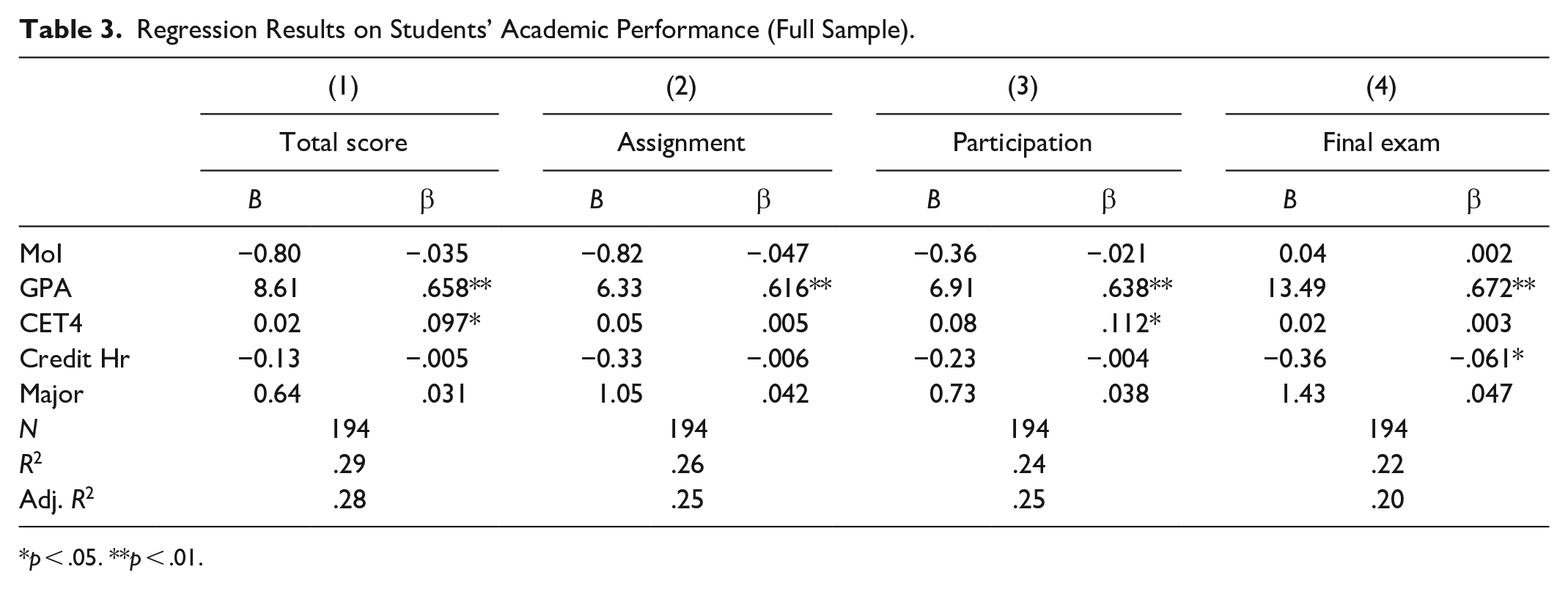
Table 1 presents descriptive statistics for the continuous variables entered in the regression analyses. Table 2 displays the correlation matrix for the variables. The correlations between different test components and those between them and the total score are statistically significant and positive, indicating reasonably high associations between different test components. Table 3 summarizes the results from the regression analyses predicting the students’ academic outcomes, in which medium of instruction was entered as one of the predicator variables.
Descriptive Statistics for Variables.

Correlation Matrix.

p < .01. ***p < .001.
Regression Results on Students’ Academic Performance (Full Sample).
p < .05. **p < .01.
As shown in Table 3, MoI was negatively but non-significantly related to total score (B = −0.80, β = −.035, p > .05), assignment (B = −0.82, β = −.047, p > .05), participation (B = −0.36, β = −.021, p > .05), and MoI was positively but non-significantly associated with final exam (B = 0.04, β = .002, p > .05). These results indicate that although the Chinese-taught students performed slightly better than the English-taught students in total score, assignment, and participation, and the English-taught students did slightly better than the L1 students in final exam, these differences were statistically nonsignificant after controlling for GPA, credit hours, CET 4, and major. In addition, GPA was significantly and positively related to total score (B = 8.61, β = .658, p < .01), assignment (B = 6.33, β = .616, p < .01), participation (B = 6.91, β = .638, p < .01), and final exam (B = 13.49, β = .672, p < .01). This means that students with higher GPA performed significantly better in all the assessment components. Similarly, CET 4 was also positively related to all the outcome measures. However, only the effects on total score (B = 0.02, β = .097, p < .05) and participation (B = 0.08, β = .112, p < .05) were statistically significant, indicating that students with higher CET 4 scores scored significantly higher in total score and participation, but not in assignment or final exam. Moreover, credit hours was negatively associated with all the outcome measures, but only the effect on final exam was statistically significant (B = −0.36, β = −.061, p < .05), suggesting that students with more credit hours or higher workload scored significantly lower in final exam. Furthermore, major was positively but non-significantly related to total score (B = 0.64, β = .031, p > .05), assignment (B = 1.05, β = .042, p > .05), participation (B = 0.73, β = .038, p > .05), and final exam (B = 1.43, β = .047, p > .05), indicating that students majoring in accounting received slightly higher scores in all the outcome measures, but the differences were statistically non-significant. Finally, the models explained significant proportions of variance in total score, R2 = .29, adj. R2 = .28, F (6, 187) = 48.23, p < .01; assignment, R2 = .26, adj. R2 = .25, F (6, 187) = 46.06, p < .01; participation, R2 = .24, adj. R2 = .25, F (6, 187) = 44.99, p < .01; and final exam, R2 = .22, adj. R2 = .20, F (6, 187) = 42.71, p < .01.
Table 4 presents the results from the regression analyses predicting English-taught students’ academic outcomes. As shown in the table, GPA was positively and significantly related to total score (B = 11.00, β = .731, p < .01), assignment (B = 8.52, β = .715, p < .01), participation (B = 7.62, β = .706, p < .01), and final exam (B = 13.76, β = .759, p < .01). This means that students with higher GPA performed significantly better in all the assessment components. Similarly, CET 4 was also positively and significantly associated with total score (B = 0.03, β = .152, p < .01), assignment (B = 0.09, β = .124, p < .05), participation (B = 0.12, β = .179, p < .01), and final exam (B = 0.03, β = .154, p < .01). These results demonstrate that students with higher CET 4 scores did significantly better in all the outcome measures. Moreover, credit hours was negatively related to all the outcome measures, but only the effect on total score was statistically significant (B = −0.44, β = −.108, p < .05), indicating that students with more credit hours or higher workload received significantly lower total scores. Furthermore, major was positively but non-significantly associated with total score, assignment, participation, and final exam. These results mean that students majoring in accounting did slightly better in all the outcome measure, but none of the effects were statistically significant. The betas from the regression models were used to compare the relative weights of GPA and CET 4 for total score (0.731 vs. 0.152), assignment (0.715 vs. 0.124), participation (0.706 vs. 0.179), and final exam (0.759 vs. 0.154). The results showed that the effects of GPA were 4 or 5 times those of CET 4, indicating that GPA had much greater effects on the outcome scores than CET 4. Finally, the models explained significant proportions of variance in total score, R2 = .37, adj. R2 = .35, F (7, 73) = 21.14, p < .01; assignment, R2 = .35, adj. R2 = .33, F (7, 73) = 20.48, p < .01; participation, R2 = .36, adj. R2 = .35, F (7, 73) = 20.69, p < .01; and final exam, R2 = .31, adj. R2 = .31, F (7, 73) = 20.17, p < .01.
Regression Results on English-Taught Students’ Academic Performance (English-Taught Sample).

p < .05. **p < .01.
Discussion
Results of the regression analyses revealed no significant differences in academic outcomes between the English- and the Chinese-taught students, controlling for GPA, CET 4, credit hours, and major. This finding diverges from the findings from Arco-Tirado et al. (2018) and Li (2018), which identified negative effects of medium of instruction on content learning in bilingual courses. However, the finding concurs with the findings from other studies (e.g., Dafouz et al., 2014; Guo et al., 2018; Hernández-Nanclares & Jiménez-Muñoz, 2017); Lin and He (2019), which also found no negative effects of medium of instruction on content learning. There are several explanations for this result. First, the equivalent syllabi, textbooks, and materials adopted by the English- and Chinese-taught classes and the close collaboration between the two instructors may have worked to ensure comparable content delivery for the two groups. Second, the English Language Center (ELC) at the university assesses students’ English proficiency for their eligibility to take English-taught courses, assuring that English-taught students would have relatively high English proficiency at the time of enrollment. Additionally, the center also provides continuous language support for all students at the university, especially those intending to take English-taught courses (Al-Issa, 2016; Peker et al., 2020). These measures may have helped the English-taught students reach the lower level threshold of English proficiency needed for effective EMI (Ardasheva et al., 2012; Cummins, 1979, 2000) and have hence minimized or canceled out potential negative effects of EMI on sutdents’ content learning (see also Chang et al., 2017; Han & Yu, 2007; Yang, 2015).
The finding that EMI had no significantly negative effects on students’ content learning does not mean that students’ English proficiency had no bearing on their content learning. The study found significant and positive associations between the English-taught students’ English proficiency and academic outcomes. This finding is consistent with the results of previous research (e.g., Li, 2018; Rose et al., 2020; Xie & Curle, 2020; Yang, 2015), which identified moderate and positive correlations between students’ language proficiency and content learning. However, as Yang (2015) pointed out, the language effect would be mitigated with the continuous improvement of students’ language proficiency. This observation suggests that students whose English proficiency has not reached the threshold may suffer in content learning, but the adverse effect would gradually subside and finally disappear as their English proficiency improves. Moreover, the present study also revealed significant associations between the EMI students’ academic ability and academic outcomes. Notably, the associations between academic ability and academic outcomes were much stronger than those between English proficiency and academic outcomes. This finding points to the importance of academic skills in EMI content learning. Indeed, regardless of the medium of instruction, students need to draw on academic skills to build conceptual and theoretical frameworks to succeed in academic learning (see, e.g., Basturkmen & Shackleford, 2015; Klaassen, 2001). Thus, the findings of this study show that the English-taught students’ academic outcomes still hinged on their English proficiency (though no longer suffering from it), and even more so, on their academic ability (Joe & Lee, 2013).
Our results also showed that the English-taught students taking more credit hours tended to perform worse in the focal course, but only the effect on total scores was statistically significant. This result diverges from our previous prediction that students with higher workload may allocate less time and effort to the course and thus perform less well in it (Szafran, 2001). A plausible explanation of the non-significant results is that the workload for the great majority of students in Chinese universities is more often than not standardized, even though some flexibility is allowed. This was evidenced by the relatively small standard deviation for the workload data (credit hours) in this study. Nevertheless, the significant and negative association between credit hours and total scores is also noteworthy, suggesting that students taking English-taught courses should consider their credit hours carefully so as not to negatively impact their overall academic outcomes in English-taught courses. Moreover, the study also demonstrated that the English-taught students’ major had no significant effects on their academic outcomes. This might have to do with the nature of the course and the timing of its offering. As the focal course was a foundation course and was offered during year one, students majoring in accounting probably did not differ much from their peers from other majors in terms of their interest and investment in the course.
Conclusion
This study set out to investigate the effect of EMI on students’ academic outcomes as well as the influencing factors thereof. The results show that there were no significant differences in all the assessment components (including the total score) between the English- and Chinese-medium classes. As regards the relationship between language proficiency and academic outcomes, the English-taught students’ English proficiency had small but significant effects on their academic outcomes. Moreover, their GPA was a stronger predictor of their academic outcomes than their CET 4 scores. These findings suggest that the language barrier to academic outcomes can be mitigated and even offset by favorable and effective language support as well as strong academic ability.
The findings of this study, however, need to be treated with caution because of its several limitations. First, this study focused on one course from a single institution, which limited the generalizability of the findings. Future research may involve more courses from more contexts. Second, given the aim and nature of the study, it did not collect observations of classroom practices or perceptions of students and instructors, and thus missed the opportunity to gain a richer picture of what happened on the ground. Future research may elicit observational, interview, and survey data to enrich our understanding of the impacts of EMI. Third, despite our best efforts to ensure the equivalence of the assessment procedures for the two groups, the tests were not standardized and therefore not readily amenable to comparisons with the findings of previous and future studies. Future research may develop and use standardized content tests, which would contribute to our cumulative knowledge about the impact of EMI on content learning. Fourth, although the constructs of credit hours and GPA proved to be useful gauges of students’ workload and academic ability and generated some interesting findings, their measurements could be improved. As for workload, apart from credit hours (number of contact hours), time spent outside of class may play an equally important role in students’ learning outcomes and should therefore be examined in future research. Likewise, research adopting a more fine-grained measure of academic ability than GPA may shed new light on the relationship between academic ability and content learning in EMI. Finally, and relatedly, this study attempted to examine the effects of major and assumed that the accounting majors were more interested and invested in the focal course than other majors. However, the study did not elicit directly students’ interest, motivation, or other affective factors. Future research on the impact of EMI should explore the role of affective factors in content learning.
Despite these limitations, several implications can be derived from the findings of this study. First, our results indicate that it is important to provide continuous and effective language support for students receiving EMI. As shown in this and other studies, EMI students’ academic outcomes are significantly related to their English proficiency at the initial stage. It is therefore crucial to provide EMI students with general language support in the beginning. However, general language barriers to content learning can be overcome by the continuous development of students’ language proficiency. Hence, it is necessary to offer domain-specific language support once students have reached the threshold and general language support no longer helps with content learning in EMI. Second, the study shows that the English-taught students’ credit hours were significantly and negatively associated with their total scores. This suggests that students taking English-taught courses should be aware of this potential adverse effect and plan their course selection accordingly. Finally, the results of our study also demonstrate that GPA was highly associated with English-taught students’ content learning. This suggests that in addition to providing English language support, English-taught programs should also strive to develop students’ academic learning skills and boost their overall academic outcomes. Taken together, these results point to the need for universities offering English-medium programs and courses to develop students’ academic ability, language proficiency as well as their ability to coordinate and integrate content and language learning.
Footnotes
Acknowledgements
We would like to thank our participants for their participation and cooperation.
Declaration of Conflicting Interests
The author(s) declared no potential conflicts of interest with respect to the research, authorship, and/or publication of this article.
Funding
The author(s) disclosed receipt of the following financial support for the research, authorship, and/or publication of this article: This study was funded by Ningbo University (grant no.: JYXMRCZX202008) and the Educational Science Planning Project of Zhejiang Province (grant no.: 2021SCG082).
