




Abstract
The rising global competition, post-pandemic crisis, and dynamic changes in the business environment have created anxiety and fear among employees resulting in less productivity at the workplace. Consequently, logistics firms are striving to design strategic business models that encourage employees to keep working during turbulent environments and achieve firm goals. To address this issue, the current study integrates a high-performance work system and e-HRM and examines employee work engagement behavior. Moreover, the moderating effect of digital talent acquisition is tested between employee work engagement and logistic firm performance. Hypotheses were tested through empirical data. Findings revealed that high-performance work systems and e-HRM practices explained substantial variance in employee work engagement. Similarly, work engagement and digital talent acquisition have explained a large variance in logistic firm performance. Moreover, motivation capability is the most influential factor due to large effect size
Keywords
Introduction
The rising global competition and turbulent environment have created a challenging situation for logistics firms to survive in a competitive market (Dovbischuk, 2022; Hohenstein, 2022). Therefore, organizations could survive in a disruptive environment through e-HRM practices and High-performance work systems. However, the adoption and implementation of the e-HRM system is still an ongoing issue due to its complex nature and continuous advancement in information technology (Agrawal et al., 2022; Gupta et al., 2022; Jayarathna et al., 2023; Noutsa Fobang et al., 2019; Sindhwani et al., 2022). For instance, Nyathi and Kekwaletswe (2023) asserted that e-HRM practices are unclear due to the complex nature of technology and its usage. Similarly, organizations are striving to achieve employee performance through a high-performance work system. Therefore, comprehensive research is required to investigate how e-HRM and HPWS impact logistics firm performance and engage employees in the workplace during the crisis period (Al-Alwan et al., 2022; L’Écuyer & Raymond, 2023; Nyathi & Kekwaletswe, 2023; Priyashantha, 2023; Zhou et al., 2022; Zhou & Zou, 2023). To address this issue current study has the following research objectives:
i. This study examines the impact of a high-performance work system on employee work engagement.
ii. This study investigates the influence of e-HRM practices on employee work engagement.
iii. This study has tested the moderating effect of digital talent acquisition on the relationship between employee work engagement and logistic firm performance.
The current research has integrated high-performance work systems and e-HRM capabilities altogether towards employee work engagement and logistics firm performance. The term HPWS is the degree wherein a firm offers a rich work environment to achieve employee satisfaction resulting in less turnover and more engagement in the workplace (Fabi et al., 2015). Therefore, this research has summarized that HR development capability, motivation capability, and empowerment are core determinants of high-performance work systems that positively impact employee work engagement. Moving further e-HRM capabilities are defined as practices that enrich firm HR function and boost logistics firm performance (L’Écuyer & Raymond, 2023). Thus, factors such as e-HRM infrastructure, cognitive and experiential e-HRM competencies, and HR analytics are the main determinants of e-HRM capabilities and are conceptualized in this research to investigate employee behavior in the workplace.
Similarly, this study has outlined that logistics firms could achieve performance through digital talent acquisition. Hence, the moderating effect of digital talent acquisition is conceptualized between employee work engagement and logistics firm performance. This study is significant as it introduces an integrated research framework that combines e-HRM practices, high-performance work systems, and digital talent acquisition altogether to investigate employee work engagement and firm performance.
Literature Review and Hypotheses Development
High-Performance Work System
The role of human resource practices is deemed to be decisive in improving employee performance. Although plethora of human resource practices is being used in an organization to boost employee performance, little research has been found that discusses the relationship between high-performance work system-enabled HR practices and employee engagement at the workplace (Inegbedion, 2024; Rahi, 2022). Therefore, a researcher like Fabi et al. (2015) has emphasized that HR practices that support high-performance work systems need to be examined. The term HPWS is the degree wherein an organization offers a rich work environment to achieve a high level of employee satisfaction resulting in less turnover and more work engagement (Fabi et al., 2015; Yang et al., 2024). The current study has schematized that HR development capability, motivation capability, and empowerment are core high-performance HR practices that positively impact employee behavior and boost logistics firm performance (Lai et al., 2020; L’Écuyer & Raymond, 2023). Coder et al. (2017) asserted that high-performance work system has improved firm performance and therefore must be implemented in the organization to achieve strategic goals.
Aside from high-performance work systems, the firm capability has proven to be an essential factor in deploying and implementing high-performance work systems. Therefore, capability in the HPWS perspective is defined as a firm ability to offer a rich environment to employees that leads to greater employee satisfaction and reduces turnover in the workplace (Awan et al., 2020; Kehoe & Wright, 2013; Yamin, 2019, 2020). Within high-performance work systems motivation capability is the degree wherein a firm motivates employees through leadership style, compensation, and financial incentives. Therefore, empowerment capability refers to practices that allow employees to participate and communicate in a firm strategic decision-making process. Similarly, development capability denotes a firm HR integration and selection process to achieve firm goals. Literature has substantial support that motivation capability, empowerment, and development capability are core factors of high-performance work systems and influence employee behavior toward work engagement (Fabi et al., 2015; Kehoe & Wright, 2013). Thus, high-performance work system practices are hypothesized as:
H1: Motivation capability is positively related to employee work engagement.
H2: Empowerment capability is positively related to employee work engagement.
H3: Development capability is positively related to employee work engagement.
Electronic Human Resource Management
The rapid increase in technology has led organizations to introduce electronic human resource practices in organizations to achieve strategic goals. The notion of e-HRM is defined as any practice that supports information technology and brings efficiency to the HR department. Nevertheless, e-HRM capabilities are explained as practices that enrich firm HR functions and boost firm performance (L’Écuyer & Raymond, 2023; Teece, 2019). Although e-HRM practices are advantageous however the outcome of these practices is still unclear due to the complex nature of technology (Nyathi & Kekwaletswe, 2023). Therefore, e-HRM practices that directly impact employee and firm performance need to be examined. This study enriches the body of knowledge on this subject and conceptualizes the relationship between e-HRM capability and employee work engagement at the workplace. After a detailed literature review, this study has schematized e-HRM capabilities into four main factors namely cognitive and experiential e-HRM competencies, HR analytics, and e-HRM infrastructure (L’Écuyer & Raymond, 2023; Nyathi & Kekwaletswe, 2023; Yamin & Sweiss, 2020). In terms of characteristics experiential kinds of e-HR practices include education and e-HRM training, conferences, and informal networking to enhance employee experiences. Therefore, cognitive e-HRM practices include characteristics of knowledge regarding e-HRM software, web use for HR purposes, and understanding of labor issues through HR software. Therefore, infrastructure and e-HR analytics indicate to firm ability to ensure connectivity of the HR team with employees and different stakeholders using different e-HRM software. Prior studies have established that cognitive and experiential competencies, HR analytics, and infrastructure are the main determinants of e-HRM capabilities and enrich HR functions which in turn boost employee satisfaction and engagement at work workplace (L’Écuyer & Raymond, 2023; Marler & Boudreau, 2017; Marler & Fisher, 2013; Nyathi & Kekwaletswe, 2023). Thus, the following hypotheses are assumed:
H4: Cognitive e-HRM is positively related to employee work engagement.
H5: Experiential e-HRM is positively related to employee work engagement.
H6: HR analytics is positively related to employee work engagement.
H7: e-HRM infrastructure is positively related to employee work engagement.
Digital Talent Acquisition
The term digitalization is the degree to wherein logistic firms improve logistics operations through digital technology. Therefore, digital talent acquisition (DTA) is the process that leverages digital platforms through data-driven approaches and identifies a wider pool of relevant candidates that a logistics firm needs to achieve its strategic goals (Lai et al., 2020; Singh & Shaurya, 2021). Prior studies have established a positive relationship between digital talent acquisition and effectiveness in business processes (Singh & Shaurya, 2021; Verma et al., 2023). According to Rahi (2023a), the right HR practices assist firms in finding relevant employees resulting in better employee engagement at the workplace and high work performance (Figure 1). Moreover, literature has revealed that with the implementation of DTA, firms can collect large volumes of data including candidate profiles, prior experience, turnover rates, employee behavior, and engagement at the workplace which in turn brings effectiveness to the recruitment process (Shrivastava et al., 2022; Tursunbayeva et al., 2022). Aside from this digital talent acquisition allows firms to find employees that support firm business values and increase firm performance (Tursunbayeva et al., 2022; Yang et al., 2024). Following the above arguments it is assumed that digital talent acquisition will act as a moderating factor between employee work engagement and firm performance. Thus, the following hypotheses are assumed:
H8: Employee work engagement is positively related to firm performance.
H9: Digital talent acquisition moderates the relationship between employee work engagement and logistic firm performance.

Research model.
Methodology
Research Strategy, Design, and Sampling
The research strategy of this study is to empirically investigate factors underpinned research framework. Therefore, the quantitative research approach is taken into consideration. The quantitative research design directs to collection of data through a structured questionnaire. Nevertheless, for data collection, the first step is to identify the research population. Therefore, HR managers of logistic firms were selected as the research population of this study. The objective of this research is two-fold first to investigate the impact of high-performance work systems on employee work engagement and second to examine how electronic human resource practices enrich organization culture and engage employees at work place. Consequently, HR managers were requested to fill survey questionnaire according to their understanding of how they see the impact of high-performance work systems and electronic human resource practices on employee work engagement and logistic firm performance.
The sample size was selected following guidelines provided by Rahi (2017a) has stated that 200 data size is sufficient for factor analysis. Before the final research survey, a pilot study was also conducted with the assistance of 15 HR managers working in different logistics firms. These HR managers were requested to review the survey questionnaire and suggest if any improvement was required in the survey questionnaires. After minor corrections in the questionnaire contents final research survey was conducted. For questionnaire distribution, a purposive sampling approach is adopted. Data were collected from Saudi Arabia and participation in this study was voluntary with the promise that the identity of the respondents would not be disclosed. Overall, 235 research questionnaires were distributed among human resource managers by visiting their offices and through courier service. Therefore, 213 questionnaires were returned with an attractive response rate of 91%. Among 213 responses three questionnaires were discarded due to blank and inappropriate answers. Thus, data from 210 survey questionnaires were calculated through a structural equation modeling approach.
Scale Validity
Scale items were adopted from prior literature and measured on 7 point Likert scale in line with prior studies Rahi (2023a) and Yamin (2021). The research framework of this study is a combination of high-performance work systems and e-HR practices. Therefore, a high-performance work system is measured with three core dimensions consistent with prior studies L’Écuyer and Raymond (2023). These dimensions are known as motivation capability, empowerment capability, and empowerment capability. Scale items for the construct motivation capability were adopted from Geringer et al. (2002), Jiang et al. (2012), L’Écuyer and Raymond (2023), and Subramony (2009). Therefore, scale items for the construct empowerment capability were adopted from Jiang et al. (2012), L’Écuyer and Raymond (2023), Rahi (2022), Raymond and St-Pierre (2013), and Subramony (2009). Scale items for development capability were adopted from L’Écuyer and Raymond (2023) and Raymond and St-Pierre (2013). Moving further e-HRM practices were measured with four dimensions namely cognitive competency, experiential competency, HR analytics, and infrastructure. Scale items for cognitive and experiential competency were adopted from previous studies Khatri et al. (2010) and L’Écuyer and Raymond (2023). Scale for the factor infrastructure was adopted from Fink and Neumann (2007) and L’Écuyer and Raymond (2023). Scale items for work engagement were adopted from a previous study Rahi (2023a). Similarly, digital talent acquisition items were adopted from L’Écuyer and Raymond (2023), Shrivastava et al. (2022), and Walford-Wright and Scott-Jackson (2018). Moving further HR analytics items were adopted from Marler and Boudreau (2017) and Ontrup et al. (2022). Finally, scale items for firm performance were adopted from prior studies Mardani et al. (2018).
Data Analysis
Common Method Bias Issue
Rahi (2018) postulated that common method bias issues could arise in survey-based research and therefore it is mandatory to address common method bias issue (CMB) before inferential analysis. The common method bias issue is tested with procedural and statistical remedies as recommended by Rahi (2018) and Fornell and Larcker (1981). Therefore, following procedural remedy questionnaires items were jumbled up before questionnaire distribution. Nevertheless, from statistical remedies, Harman’s single-factor analysis is taken into consideration. Findings of Harman’s single factor have revealed that the maximum variance explained by the first factor was 13% which is substantially less than the threshold value of 40%. These results have confirmed that the common method bias issue is not likely in this study.
The Structural Equation Modeling
Data were calculated with a structural equation modeling approach. Following a two-stage approach of structural equation modeling first confirmatory factor analysis was conducted and then hypotheses were tested with structural assessment. Results of the confirmatory factors analysis are given in the following sub-section.
Confirmatory Factor Analysis
The confirmatory factor analysis estimates factors convergent validity, instrument reliability, and convergent validity of the measure. Factors convergent validity is established through average variance extracted following threshold value 0.50. Therefore, factors reliability is determined with composite reliability following the criterion that values of the CR must be higher than 0.70. Next to this indicator loading was measured with a loading value of 0.60. Nevertheless results of the confirmatory factor analysis are exhibited in Table 1.
Construct Reliability.
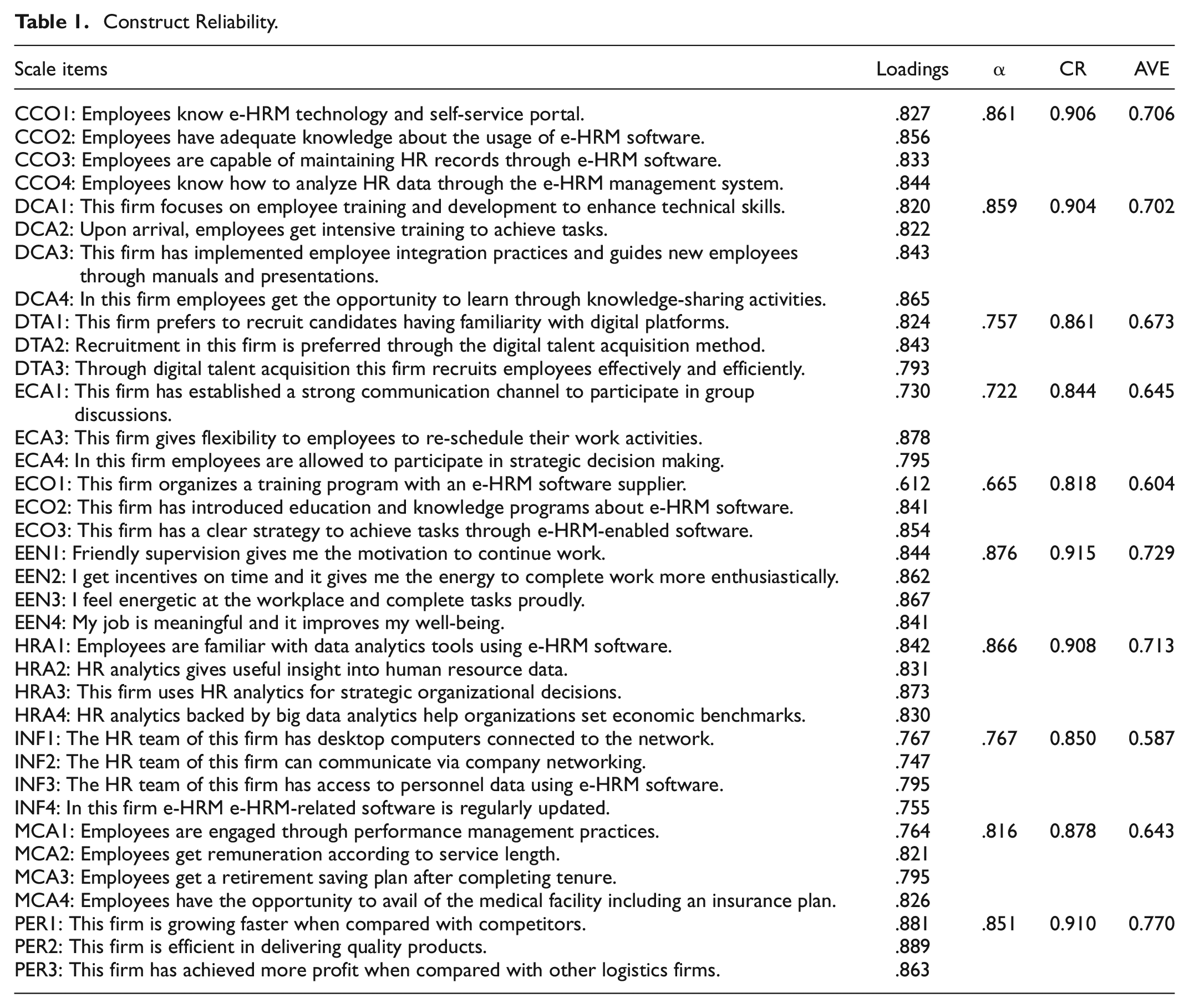
After confirming factor reliability as shown in Table 1, the discriminant validity of the factors was established through cross loading method (Rahi, 2017b). This method directs that loading of the factors indicator should be higher when comparing with corresponding factors loading. Nevertheless, results have indicated satisfactory loadings of all indicators and confirmed the discriminant validity of the factors. Table 2 depicts the results of loadings of all indicators in italic style and confirmed factors are discriminant and measure distinct concepts.
Factors Loadings.

Similarly, the discriminant validity of the factors was tested with the average variance extracted. According to Rahi (2023a) factors, discriminant validity must be confirmed with the Fornell and Larcker method. Fornell and Larcker (1981) method suggests that the AVE square root must be greater than other factor values. Table 3 depicts AVE square root in italics is higher hence confirming the discriminant validity of the factors.
Discriminant Validity Analysis.

Structural Assessment
The process of structural assessment includes testing of hypothesis and determining variance explained exogenous factors towards outcome variable. Table 4 demonstrates the results of all hypotheses with path, significant level, standard error, and t-values.
Hypotheses Testing.
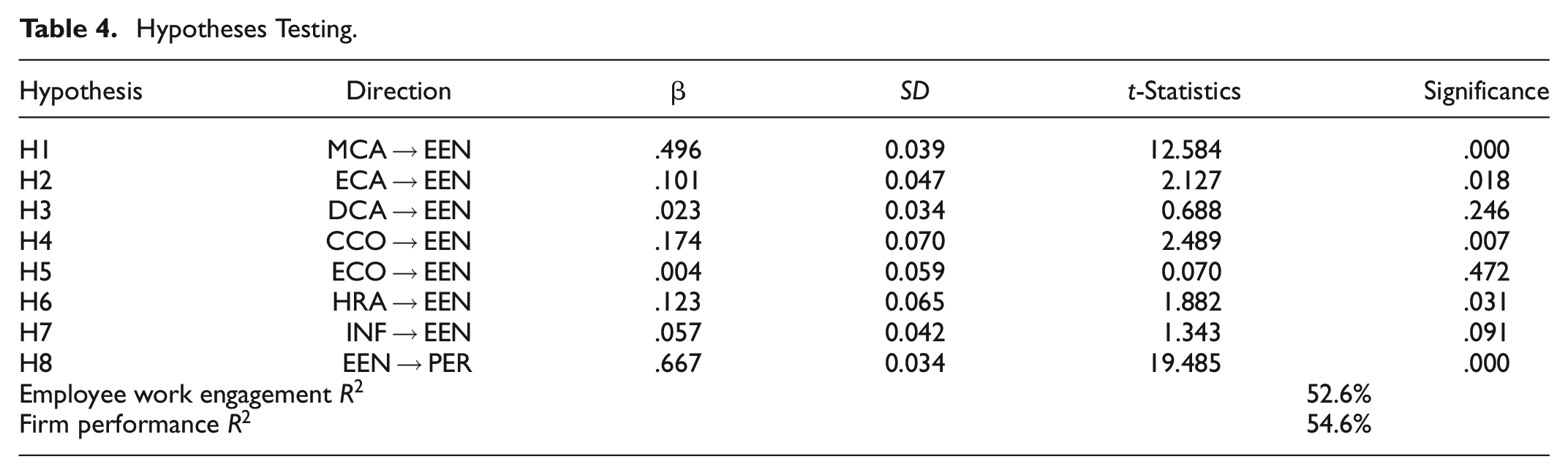
The relationship between hypotheses was established through t-statistics, significance level, path, and standard error. Results revealed that within high-performance work systems factors such as motivation capability and empowerment capability have shown a significant impact on employee engagement and supported by β = .496, t-statistics = 12.584 significant at p = .000; β = .101, t-statistics = 2.127 significant at p = .018 and hence confirming H1 and H2. Therefore, development capability has shown an insignificant impact on employee work engagement, and therefore H3 is rejected backing by β = .023, t-statistics = 0.688 significant at p = .246. Results of the structural assessment have revealed that cognitive competency is positively related to employee work engagement and supported by H4: β = .174, t-statistics = 2.489 significant at p = .007.
Within e-HRM experiential competency is showing an insignificant impact on work engagement and therefore H5 is rejected β = .004, t-statistics = 0.070 significance level p = .472. Therefore, the relationship between HR analytics and work engagement is found significant and established by β = .123, t-statistics = 1.882 significance level p = .031 thus H6 is accepted. Contrary to our expectation the relationship between e-HRM infrastructure and work engagement is found insignificant and hence H7 is rejected backed by statistical results β = .057, t-statistics = 1.343 significance level p = .091. Lastly, employee work engagement has shown a positive impact on logistic firm performance and confirmed H8 by statistical results β = .667, t-statistics = 19.485 significance level p = .000. Overall research framework has shown a considerable impact of exogenous factors on employee work engagement and indicates variance
These factors were further estimated with importance-performance analysis to disclose the importance and performance level of the exogenous factors. As this study investigates the phenomenon two-fold thus at first employee work engagement is taken as a criterion factor. The findings of the analysis have shown that motivation capability is an important factor in engaging employees in the workplace. Therefore, cognitive competency is the second most important factor in determining employee work engagement. Similarly, factors such as empowerment capability and HR analytics are also essential factors in determining employee behavior in the workplace. These findings suggest that factors such as cognitive competency, motivation capability, empowerment capability, and HR analytics need policymaker attention to boost employee work engagement at the workplace. The results of the IPMA analysis are depicted in Table 5.
Importance and Performance Analysis.

In the first stage results of the IPMA analysis have disclosed the importance of the factors in determining employee work engagement. Therefore, in the second stage logistic firm performance is taken as the criterion variable. Results of the importance-performance analysis have shown that employee work engagement is essential to achieving firm performance as it has the highest level of importance. Similarly, motivation capability is found second most important factor in measuring firm performance. Nevertheless, the importance of cognitive competency and digital talent acquisition is also notable. These findings have concluded that logistics firms could achieve performance through digital talent acquisition, cognitive competency, motivation capability, and employee work engagement and hence need policymakers’ attention. Results of the importance-performance analysis with criterion factor firm performance are shown in Table 6.
Importance and Performance Analysis.

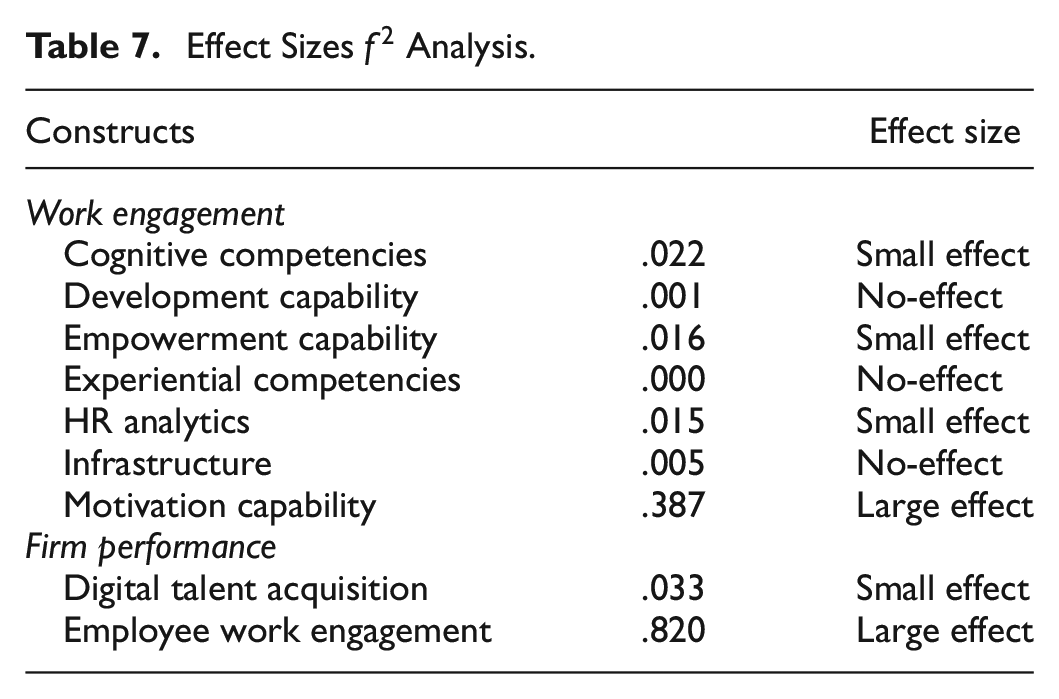
Aside from the importance and performance of the factor researcher has tested the actual impact of factors in measuring endogenous factors. Consistent with the prior study Rahi’s (2023b) effect size was estimated following threshold value of effect size
Effect Sizes
Moderating Analysis
The moderating analysis is conducted wherein digital talent acquisition is taken as the moderating factor in the relationship between employee work engagement and firm performance. Results of the moderating analysis have revealed that digital talent acquisition positively moderates work engagement and firm performance and is statistically confirmed by β = .119, t-statistics = 3.257 significant at p = .001, and hence confirmed H9. Figure 2 reveals values of moderating factors including path coefficient and t-values.

Moderation analysis output.
Although statistical results have confirmed that digital talent acquisition moderates the relationship between employee work engagement and logistic firm performance however strength of the moderating effect is yet to be analyzed. Therefore, the strength of the moderating effect is tested with simple slope analysis. According to Rahi (2018), a simple slope graph shows the trend of the moderating relationship through the gradient. Results of indicate that the uphill trend at DTA + 1SD demonstrating a higher level of digital talent acquisition will strengthen the relationship between employee work engagement and firm performance. A simple slope graph can be seen in Figure 3.

Simple slope analysis output.
Discussion
The rising competition and turbulent environment have distressed employees resulting in demotivation at the workplace. To address this issue current research has investigated the impact of electronic human resource practices and high-performance work systems on work engagement and firm performance. The integrated research model has combined both e-HRM and high-performance factors altogether and conceptualized different hypotheses. These hypotheses were tested and then compared with prior research work. For instance first factor of a high-performance work system namely motivation capability has shown a positive impact on employee work engagement and is consistent with L’Écuyer and Raymond (2023). Therefore, empowerment capability has revealed a significant effect on employee engagement and is in line with prior research work (Fabi et al., 2015; Kehoe & Wright, 2013). Similarly, development capability has shown an insignificant impact on employee work engagement hence negating arguments developed by Kehoe and Wright (2013). Concerning e-HRM factors results have indicated that cognitive competency is positively related to employee work engagement and is in line with L’Écuyer and Raymond (2023). Nevertheless, experiential competency has shown an insignificant impact on work engagement and rejected arguments established by Nyathi and Kekwaletswe (2023). Moving further the relationship between HR analytics and work engagement is found significant and consistent with prior research work (L’Écuyer & Raymond, 2023; Marler & Boudreau, 2017; Marler & Fisher, 2013; Nyathi & Kekwaletswe, 2023). However, the relationship between e-HRM infrastructure and work engagement is found insignificant and thus rejects arguments developed by previous researchers (L’Écuyer & Raymond, 2023; Nyathi & Kekwaletswe, 2023).
Finally, employee work engagement has indicated a positive impact on logistic firm performance and is consistent with prior research findings (L’Écuyer & Raymond, 2023; Marler & Boudreau, 2017; Marler & Fisher, 2013; Nyathi & Kekwaletswe, 2023). Moreover, the moderating effect of digital talent acquisition between work engagement and firm performance was established and endorsed by prior researchers’ findings (Shrivastava et al., 2022; Tursunbayeva et al., 2022). Overall research framework has shown a considerable impact of exogenous factors on employee work engagement and indicates variance
Research Contributions
This study has several practical and theoretical utilizations. In terms of theoretical utilization, the integration of e-HRM and HPWS has substantially contributed to human resource literature. In addition to that this research has summarized that within e-HRM factors cognitive competency and HR analytics are essential factors to engage employees at the workplace. Therefore, factors such as motivation capability and empowerment capability have a positive impact on employee work engagement behavior and hence enrich literature based on high-performance work systems. The research framework of this study has been analyzed with the latest statistical approach namely structural equation modeling and hence contributes to research methods. Similarly, a positivist research paradigm is selected to design this research that assists in meeting with research objectives. Practically findings of this research are vital for logistics firm managers to understand the importance of e-HRM practices in improving HR function. Results of the importance-performance analysis have revealed that logistics firms could achieve performance through cognitive competency, motivation capability, and employee work engagement and hence these factors need policymakers’ attention. Moreover, digital talent acquisition assists managers in understanding that the right recruitment will motivate employees to keep working in turbulent environments. This research has revealed that managers can achieve firm long-term and short-term goals with minimum resources by implementing high-performance work system. Likewise, a combination of e-HRM and high-performance work systems has enabled logistics firms to deal with future crises effectively and boost firm performance.
Conclusion
The findings of this study are twofold. First, employee work engagement behavior is determined through an integrated research framework that combines factors underpinned high-performance work systems and electronic human resource management. Therefore, in the second stage, the moderating effect of digital talent acquisition was tested on the relationship between work engagement and firm performance. HR managers were approached and requested to fill out research questionnaires. The findings of this study have revealed that high-performance work systems and e-HRM practices explained substantial variance in employee work engagement. Similarly, work engagement and digital talent acquisition have shown substantial variance in determining logistic firm performance. Aside from accumulated variance factor impact was examined independently. The result of the f2 analysis has shown that motivation capability is the most influential factor due to the large effect size. In terms of contributions theoretically integration of e-HRM and HPWS has substantially contributed to human resource literature. More precisely this research has summarized that among e-HRM factors cognitive competency and HR analytics are essential factors to engage employees at the workplace. Refereeing to high-performance work system motivation capability and empowerment capabilities have shown a positive impact on employee work engagement behavior and hence enrich literature based on high-performance work systems. Therefore, in a practical context important performance analysis have revealed that logistics firms could achieve performance through cognitive competency, motivation capability, and employee work engagement and thus need policy maker’s attention. Moreover, this study has revealed that digital talent acquisition motivates employees and lets them engage in the workplace even during turbulent environments. To conclude this research is valuable as it discloses an integrative research model that assists policymakers in understanding how to engage employees in the workplace in turbulent environments and achieving firm performance.
Research Limitations and Future Directions
Besides several contributions to theory and practice this study has also acknowledged research limitations. First, this study has summarized four core factors of electronic human resource practices however future studies may extend these e-HRM dimensions with some other dimensions like e-learning, e-selection, and recruitment. Similarly, in this study high-performance work system is studied with three core dimensions namely motivation, empowerment, and development capability. Nevertheless, some other dimensions of HPWS like information sharing and performance appraisal could be examined in the employee work engagement context. Another limitation of this research is that this study is designed and conducted in a developing country context like Saudi Arabia. Nevertheless, a cross-cultural kind of research could reveal interesting findings. The research population of this study is HR managers working in logistics firms resulting narrow research scope. Therefore, future researchers are suggested to test current research models other than logistic firms to enlarge the scope of this research. Finally, this research is cross-sectional and tests phenomena at once however a longitudinal kind of research could provide useful insight into determining employee work engagement through high-performance work systems and electronic human resource practices.
Footnotes
Author Contribution
This article was written solely by the author.
Declaration of Conflicting Interests
The author declared no potential conflicts of interest with respect to the research, authorship, and/or publication of this article.
Funding
The author disclosed receipt of the following financial support for the research, authorship, and/or publication of this article: This work was funded by the University of Jeddah, Jeddah, Saudi Arabia, under grant No. (UJ-23-DR-18). Therefore, the authors thank the University of Jeddah for its technical and financial support.
Ethical Approval
The study was approved by the Human Research Ethics Committee of the University of Jeddah (Ethics approval number: HAP-02-J-094). Participants were informed that their involvement was voluntary, anonymous, and that their data would be used solely for research purposes. They had the right to withdraw at any time without consequences, and all data was securely stored and accessible only to the research team.

Data Availability Statement
The datasets generated and analyzed during the current study are available from the corresponding author on reasonable request.