




Abstract
This study aims to analyze the role of transformational leadership on followers’ creative performance through pro-growth working environment, entrepreneurial values-based developmental interaction capability, and psychological empowerment in start-up businesses in Indonesia and to test a new pro-growth working environment concept in that model. This study uses a Structural Equation Model (SEM) using data analysis tools, namely WarpPLS. The research design used a survey method, and data collection was carried out using questionnaires sent directly to the research respondents. In this study, the population is start-up business employees in Indonesia. The sampling technique is purposive, and this study’s sample is 270 respondents. The results indicate that all the variables significantly influence each other. The existence of transformational leadership, a pro-growth working environment, entrepreneurial values-based development interaction capability, and the right psychological empowerment can affect creative performance to get even better results.
Plain Language Summary
This study investigates how transformational leadership affects followers’ creative performance through a pro-growth working environment, entrepreneurial values-based developmental interaction capability, and psychological empowerment in Indonesian start-up businesses and tests a new model. WarpPLS is used to generate a Structural Equation Model in this work. The study employed a survey method. This study examines Indonesian start-up employees. This study used purposive sampling, and 270 participants involved. The results demonstrate that all factors interact strongly.
Keywords
Introduction
Regarding how big and great the advancement of technology and information development is, it will be easier for organizations to achieve their goals with human resources. Employee performance will increase if human resources are abundant and meet needs (Nugroho et al., 2020). Regarding organizational human resource management, followers are among the most important components to gaining a competitive advantage. So, leaders must figure out how to handle it well so that it becomes a key factor in the organization’s success.
Organizations need more creative followers with the development of a dynamic and competitive environment. It encourages organizations to maximize followers’ creative performance, a series of creative-related actions and behaviors carried out by followers to achieve organizational goals. According to Phung (2020), high work performance is possible if employees understand their abilities, job characteristics, and the proper method of responding to all work despite its challenges. Increasing the number of followers’ creative performances will help achieve organizational goals and improve performance. Followers’ creativity has received much attention in the literature because it is believed to be important for organizational success and will impact success in various jobs and industries (Naidoo, 2016). The concept of followers differs from subordinates because followers and leaders work toward the same goal. Also, they believe in the organization’s goals and are committed to achieving them.
In contrast, subordinates refer to those who report their work to their superiors. Followers’ creative performance is the collective result of all the abilities and efforts of followers to achieve organizational targets. The creative performance will have many benefits, including generating new ideas, products, and procedures that encourage innovation and become a source of organizational competitive advantage. Furthermore, it can assist the innovation process by realizing successful ideas essential for organizational success and sustainable growth.
This research was conducted to fill the research gap on the role of transformational leadership on followers’ creative performance by adopting Freud’s theory of work and organization (Diamond & Czander, 1996) through human capacity and capability at work, work processes, and the work environment. These things are then synthesized into a new concept, a pro-growth working environment, pouring into a conceptual model to increase followers’ creative performance (Dziallas, 2020; Frishammar, 2006). Therefore, this research will develop a new conceptual model from the perspective of Freud’s theory of work and organization (Diamond & Czander, 1996) as a novelty that will be tested empirically. A growth-oriented work environment is a novel concept of a pro-growth working environment (Setiawan, Eliyana, & Suryani, 2020). This concept will be appropriate for start-up businesses known to be very dynamic. Generally, a start-up business is defined as a business established within the last 5 years in Indonesia.
Several studies have concluded that transformational leadership impacts organizations’ development of human resources. Someone with a transformational leadership style is known to have an influence that motivates followers to develop themselves to become better people than they are today. Transformational leadership can change followers and organizations significantly (Hasib et al., 2020). The concept of transformational leadership and a pro-growth working environment will create entrepreneurialism value-based development interaction capability. It refers to leaders’ and organizations’ ability to assist followers in developing knowledge and competencies through a growth-oriented work atmosphere or environment. It is also a novelty concept synthesized from entrepreneurship and value-based development interaction capability (Setiawan, Eliyana, & Suryani, 2020). Therefore, interactions between leaders and followers can produce development initiatives that add value to completing the required responsibilities. This interaction between leaders and followers will help followers complete the work process properly because their knowledge, competence, and individual capacities will increase (Manss, 2017; Sulistiyani & Ferdinand, 2018).
Previous studies on the influence of Transformational Leadership on the performance of organizational members were more related to job satisfaction, organizational commitment, and individual attributes (Phaneuf et al., 2016; Wang et al., 2017). It is essential to foster a creative environment to increase employee performance in a dynamic environment where constant change, variability, and unpredictability persist (Lakoy, 2015). Therefore, there is a gap in our understanding of how leaders who exhibit Transformational Leadership behaviors can cultivate and perpetuate creative environments.
Previous research on Transformational Leadership demonstrates that it can create a growth-oriented work environment, referred to in this study as the Pro-growth Working Environment concept, because leaders strongly influence behavior that motivates, intellectually stimulates, and focuses on followers. A Transformational Leader’s objective is to instill in followers the right aspirations for achieving the organization’s goals, but the leader does not force followers to only work to achieve these goals; rather, the leader helps followers develop first, and then together they achieve a goal, because for Transformational Leaders, if they want to achieve the best performance and achieve the organization’s goals, they must move in tandem with existing followers.
Furthermore, the concept of a pro-growth working environment and entrepreneurial value can be associated with a creative environment in the organization, so followers are expected to have the ability to absorb knowledge and demonstrate good competence, which will make them think positively and experience psychological empowerment (Abdulrab et al., 2018; Bin Saeed et al., 2019). To realize creative performance within the organization, these followers must be confident enough to do their jobs well.
This research refers to a start-up business or a business or trading venture that has just been started or has not been operating for a long time (more precisely, less than 5 years). It is in the development phase, which is undergoing a process to find the right market segment for this business (Salamzadeh & Kesim, 2015). According to the results of the ranking.com start-up survey in 2019, Indonesia is ranked fifth worldwide, as shown in Table 1, with a total number of start-up businesses owned by 2,180 start-up businesses.
Validity Test Results.

The development of start-up businesses in Indonesia is known to be quite fast. However, the readiness of human resources (HR) still needs to be improved for the government to improve the capabilities of its HR in Indonesia. According to the Global Innovation Index 2022, it was noted that Indonesia was ranked 75th out of 132 countries, based on five indicators, namely human capital, institutions, technology, creative output, market and business sophistication. (Mutia, 2022). A start-up business is designed to find new business models to achieve big profits. Only a few start-up businesses have succeeded. According to Forbes, 90% of the start-ups created worldwide have failed (Patel, 2015). There are many reasons why start-ups fail, lack of financing or investors, running out of cash, and impact of Covid-19 pandemic (Huddleston, 2023).
Various leadership patterns can be applied to start-up businesses, and these leadership styles will determine the success and sustainability of the start-up business. In previous studies, it was found that transformational leadership is an effective leadership pattern for start-up businesses, in which the leader uses energy to create a creative environment and empower its members, which will impact the success of the start-up business (Reid et al., 2018; Saleem & Mahmood, 2019; Sheehan et al., 2020). However, some studies stated that transformational leadership did not significantly affect followers’ creative performance (Safitri et al., 2023; Wulansari, 2016). Based on this contradicting result, this study found a research gap in measuring the role of transformational leadership on followers’ creative performance. As a result, the context of transformational leadership will be used in this start-up business research. The conceptual framework of transformational leadership on followers’ creative performance in the presence of a pro-growth working environment, entrepreneurial values-based on development interaction capability, and psychological empowerment as mediation is a new model proposed by this study, specifically in the context of Indonesian start-up companies. Furthermore, Pro-growth Working Environment and Entrepreneurial Value-Based Development Interaction Capability are newly developed concepts (Setiawan, Eliyana, & Suryani, 2020). Followers’ creative performance realized correctly with the influence of the variables used correctly is expected to overcome existing phenomena and make companies that can develop sustainably better.
Literature Review
Conceptual Overview
Transformational Leadership
Leadership is one of a leader’s abilities to lead an organization. Leadership is the ability to encourage a group to achieve organizational goals, and the success or failure of an organization depends on the leaders (Barika et al., 2020). Transformational leadership denotes the process by which a leader can motivate followers to strive for group versus personal goals through charisma, inspirational motivation, intellectual stimulation, and individual judgment (Bass & Avolio, 1990). In addition, the transformational leadership style can also be described as empowering followers with a sense of autonomy and responsibility, which can increase commitment and efficiency by facilitating growth and providing evidence into practice to achieve organizational goals (Al-Thawabiya et al., 2023). Transformational leadership is based on the principle of developing subordinates by evaluating the abilities and potential of each subordinate in carrying out their duties or work and seeing the possibility of expanding the responsibilities and authority of subordinates in the future (Bastari et al., 2020). In addition, in guiding changes to strategy, structure, mission, and organizational culture to promote product and job innovation, transformational leadership brings significant changes to followers and organizations (Hasib et al., 2020). Transformational leadership will be able to show consideration for the leader to followers, inspire them to be the best, and develop their leadership skills (Bakker et al., 2023).
Pro-Growth Working Environment
Studies conducted under the Australian Social Security Act 1991 showed that capability to work indicates the ability to complete work continuously, even when it is done independently (MS Society, Arthritis Care, Parkinson’s UK, Forward-ME Group, National AIDS Trust, & Crohn’s and Colitis UK, 2011). In work oriented toward an interactive model, the personal development of followers, working relations, job opportunities, and quality of service are usually emphasized to create a conducive work environment (Setiawan, Eliyana, & Suryani, 2020). The work environment is very important and needs to be considered by the organization (organizational environment) because it will determine the future steps of the organization. The organizational work environment usually refers to a series of physiological-social-psychological characteristics that the people in that environment directly or indirectly feel and the work environment is considered a key factor in determining the performance of a team or work unit (Manfield & Newey, 2018) and is always required to be adaptive to change (Frishammar, 2006). A new concept called the Pro-growth Working Environment can be synthesized through the concepts described. This work environment encourages personal growth and is characterized by empowering interactions, enthusiasm for progress, and challenging responsibilities.
Entrepreneurial Values-Based Development Interaction Capability
Knowledge in organizations needs to be managed, and the process of managing knowledge is more popularly known as knowledge management, which is very dependent on the role of Knowledge Sharing (Zhu, 2016). Knowledge sharing between leaders, followers, and co-workers is known to educate each individual to increase their skills and competencies, and this is called the concept of developing interaction (Karpen et al., 2015). Significant effort has been devoted to understanding entrepreneurial interaction behavior. Until now, individual and organizational factors have been known to facilitate entrepreneurial interaction behavior. Through this process, developmental interactions will shape individuals to create added entrepreneurial values in their work life, which in this study is called the entrepreneurial concept values-based developmental interaction capability (Sulistiyani & Ferdinand, 2018).
Psychological Empowerment
Researchers have paid considerable attention to empowerment as a psychological and motivational construct due to its significance to organizations and individuals. Furthermore, psychological empowerment is expressed as individuals’ intrinsic motivational experience based on cognition about themselves concerning the work role by having confidence in their abilities in terms of exchanging and utilizing knowledge, which can provide a foundation for motivation and empowerment to carry out the required tasks in an effective manner (Sridadi et al., 2023; Yasir et al., 2023). By increasing psychological empowerment, employees will be more confident and realize their potential, which can help employees appreciate their work. Al Harbi et al. (2019) define psychological empowerment as four cognitions that reflect an individual’s orientation to his work role: meaning, competence, self-determination, and impact. Through psychological empowerment, followers will be encouraged to have confidence in their abilities due to self-confidence, so they are encouraged to prove their abilities through better work results (Kang et al., 2017; Matsuo, 2021).
In conclusion, psychological empowerment is a motivational process deliberately carried out to influence a person’s (followers) empowerment. Good empowerment requires support from other people in the form of motivation that can influence how followers think and work to be more innovative. That is why psychological empowerment is important to apply in the workplace.
Followers’ Creative Performance
Creativity is creative work through new work that is accepted as work that can be maintained or useful and satisfying by a group at one time (Anggarwati & Eliyana, 2015). In other words, existing products put forward something new and must be valid, useful, and satisfying. Referring to Hidayat et al. (2023), employee creativity is useful in developing new methods, strategies and products so as to encourage organizational performance. Creative followers have received extensive attention in the literature because it is believed to be important for organizational success (Naidoo, 2016). Social interaction within the organization will majorly contribute to Followers’ creative performance. Followers’ creativity has integrated aspects in forming personality, motivational, cognitive, leadership behavior, co-worker behaviors, job context, social network, and working environment (Jain & Jain, 2016). Therefore, creative follower performance is defined as a form of follower performance that has useful new ideas and can become a critical asset for competitive organizational performance (Cai et al., 2019).
Hypothesis Development
Transformational Leadership and Pro-Growth Working Environment
Transformational leadership can create significant changes for followers and organizations by creating the ability to direct changes in organizational strategy, mission, structure, and culture, which can promote what the organization needs (Bass & Avolio, 1990), like the right work environment for followers. Transformational leadership is associated with more job development (finding resources and seeking challenges) through adaptability, especially for employees with low organizational identity. Setiawan, Eliyana, and Suryani (2020) aim to develop a new conceptual model, namely the Pro-Growth Working Environment (PWE), through a work and organization theory perspective by Freud, which is unified from the concept of human capacity and work capability, work processes, and the environment work. Thus, the Pro-Growth Working Environment is heavily influenced by leadership in the work environment, especially through transformational leadership. In carrying out work effectively and efficiently, a pro-growth working environment is needed to support the things being implemented so that they function properly through the influence of transformational leadership. Previous studies on transformational leadership, organizational support, and the work environment have stated that transformational leadership can create a conducive work environment for followers to experience cognitive and affective growth to form creative behavior (Setiawan, 2020; Wang et al., 2017). Based on this, this study hypothesizes that:
H1: Transformational leadership has a significant effect on pro-growth working environment
Pro-Growth Working Environment and Entrepreneurial Values-Based Developmental Interaction Capability
In a growth-oriented work environment, there will be an interactive relationship between leaders, followers, and co-workers due to knowledge sharing, collaboration, and empowering patterns (Ribeiro & Cherobim, 2017). The organizational ability to design a growth-oriented work environment can create followers who seek positive values in the work process so that individual and team capabilities will increase (Han et al., 2018; Matošková & Směšná, 2017; Setiawan, 2020; Sulistiyani & Ferdinand, 2018). Setiawan, Eliyana, and Suryani (2020) aim to develop a new conceptual model regarding the capability of developing entrepreneurial values-based interactions or Entrepreneurial Values-Based Development Interaction Capability (EVBDIC), which is unified from the concept of knowledge, work interactions within organizations, and entrepreneurial values. Sulistiyani and Ferdinand (2018) aimed to develop a conceptual model by proposing the concept of a value orientation to develop interactions used with several criteria, such as having to be in a teamwork position for department heads, supervisors, and strategic staff. The results of this study indicate that knowledge sharing has an impact on value-based interactive development capabilities. The value will affect the work team’s performance based on the ability to interact. In addition, the value-based interactive development function can adjust the impact of knowledge sharing on work-team performance. Based on this, this study hypothesizes that:
H2: Pro-growth Working Environment has a significant effect on Entrepreneurial Values-Based Developmental Interaction Capability
Entrepreneurial Values-Based Developmental Interaction Capability and Psychological Empowerment
Knowledge sharing and interactions worth knowing will make followers more confident because they feel confident they have cognitive abilities that will encourage them effectively. Psychological empowerment will become a very important capital for followers to dare to act (Feiz et al., 2019; Setiawan, 2020). Setiawan, Eliyana, and Suryani (2020) aim to develop a new conceptual model capable of developing entrepreneurial values-based interactions that are unified from the concepts of knowledge, work interactions within organizations, and entrepreneurial values. According to Hayter (2016), entrepreneurship assumes knowledge is an important source of innovation, economic dynamism, and growth. Information about organizational goals and skills outcomes through knowledge sharing will be important concerning jobs in psychological empowerment. It can also give them a better sense of control over decision-making. Based on this, this study hypothesizes that:
H3: Entrepreneurial values-based developmental interaction capability has a significant effect on psychological empowerment
Pro-Growth Working Environment and Psychological Empowerment
The Pro-growth Working Environment can significantly influence followers’ cognitive, affective, emotional, and behavioral aspects to be ready to be empowered because these followers have been given the opportunity and are involved in the process (Setiawan, Eliyana, & Suryani, 2020). In addition, Matsuo (2021) has shown a direct influence of positive interaction on the development of work experience and learning goal orientation on psychological empowerment. In this research, the development of work experience will show a good work environment that can increase psychological empowerment. According to Javed et al. (2019), workplace events such as performance evaluation, work environment, and formal assistance can affect psychological empowerment. Setiawan, Eliyana, and Suryani (2020) intend to create a new conceptual model, the Pro-Growth Working Environment (PWE), based on Freud’s work and organization theory, unified from the concepts of human capacity, work capability, work processes and work environment. According to Manfield and Newey (2018), improved work environment improvements can result in greater employee professionalism, increased psychological empowerment, increased job satisfaction, decreased fatigue, and higher retention rates. Based on this, this study hypothesizes that:
H4: Pro-growth Working Environment has a significant effect on Psychological Empowerment
Psychological Empowerment and Followers’ Creative Performance
The key element of creative performance is the followers’ readiness to be empowered. Often, creative performance cannot be achieved when followers do routines or have habits at work and do not have a great will to try new things. It is known that psychological empowerment and followers’ creative performance are two things that cannot be separated in the organizational concept. The psychological empowerment of the followers largely determines the level of the followers’ creative performance, and different responses to work will create changing levels of pressure and ambivalence that affect Followers’ Creative Performance (Abdulrab et al., 2018; Abualoush et al., 2018; Abukhait et al., 2019). When employees believe they are capable and are given the necessary means for productive work, they will have scope for self-determination beyond work arrangements. Therefore, they can easily shape the desired results based on their actions, and they will be more likely to focus on generating solution-oriented ideas more conscientiously and enduringly. As a result, employees with psychological empowerment tend to show more creative performance in the organization. In addition, previous research supports the relationship between psychological empowerment and creative performance (Seibert et al., 2011). Based on this, this study hypothesizes that:
H5: Psychological empowerment has a significant effect on Followers’ Creative Performance
Pro-Growth Working Environment and Followers’ Creative Performance
In studying organizational behavior, the working environment can make organizational members feel safe and comfortable and generate enthusiasm for creating new ideas that will influence individual attitudes in bringing out innovative behavior through creativity. A pro-growth work environment will create a strong work environment to support followers’ creative performance through organizational and supervisory encouragement, work group support, freedom, and sufficient resources, which will greatly arouse followers to have creative performance (Yeh & Huan, 2017). In the Pro-growth Working Environment, followers will be encouraged to have creative self-efficacy and motivation. However, the organization provides supportive resources, leaders, and challenging work to create social networks that mutually build each other to increase Followers’ Creative Performance (Cai et al., 2019; Hidayat et al., 2023; Setiawan, 2020). Setiawan, Eliyana, and Suryani (2020) in their research aim to develop a new conceptual model, namely the Pro-growth Working Environment (PWE), from the perspective of Freud’s work and organization theory, which is synthesized from the concept of human capacity and capability in work, work processes, and the work environment. Seeing the adequacy of individual resources is one form of organizational support for employee creativity. The work environment has been considered in terms of cognitive, emotional, and physical resources for developing innovation processes through creativity (Ma et al., 2020). Based on this, this study hypothesizes that:
H6: Pro-growth working environment has a significant effect on followers’ creative performance
Transformational Leadership and Followers’ Creative Performance
Research on the influence of leadership in stimulating creative and innovative abilities in individuals is known to have been carried out by many scholars, especially focusing on understanding the relationship between transformational leadership and creative followers (Chaubey et al., 2019). Individual consideration, inspirational motivation, and idealized influence can help followers work more creatively because the leaders have given them great expectations. Through innovative ideas, leadership can reflect aspects of follower behavior and motivate them to innovate through creativity (Sandvik et al., 2018). Thus, creative performance is a vision-based motivational process behind transformational leadership (Yeh & Huan, 2017). Transformational leadership will encourage followers to try new things, improve their abilities, and develop innovation. Therefore, there is a significant and positive relationship between transformational leadership and followers’ creative performance (Afsar & Masood, 2018; Chaubey et al., 2019; Khalili, 2016). In addition, according to Yang et al. (2019), the right level of transformational leadership can encourage employees to be motivated and guided by their leaders to exceed performance expectations and to act proactively and creatively. Based on this, this study hypothesizes that:
H7: Transformational leadership has a significant effect on Followers’ Creative Performance
Mediating Role of Pro-Growth Working Environment, Entrepreneurial Values-Based Developmental Interaction Capability, and Psychological Empowerment
Transformational leadership inspires employees to overcome self-interest by changing their ideals, passions, interests, and values to achieve higher performance (Yang et al., 2019). Transformational leaders can identify their employees’ developmental needs and ensure that skill development is carried out properly for each employee. Facilitating individuals as the focus of transformational leaders is a determinant of creating the right pro-growth working environment and producing maximum creative performance within a company. However, the innovation process depends on employees’ knowledge, skills, and related experience to create value for the company because organizational learning and workplace relationships may trigger the impact of transformational leaders on creative performance (Yeh & Huan, 2017). The Pro-Growth Working Environment is known to help generate new ideas for products, services, and business processes. It will demonstrate a positive relationship between the transformational leadership style and creating a pro-growth working environment to produce creative performance (Ragins, 2016; Setiawan, 2020). Based on this, this study hypothesizes that:
H8: Transformational leadership significantly affects followers' creative performance through a pro-growth working environment.
Transformational leadership can help develop a pro-growth working environment and psychological empowerment through leaders forming the team, setting the right expectations, and motivating the team to think of new ideas. It can be done through a discussion process that creates a pro-growth working environment and psychological empowerment, which will embed capabilities and stimulate new ideas that are useful for achieving better organizational goals (Al Harbi et al., 2019; Bin Saeed et al., 2019; Javed et al., 2019). Therefore, a significant and positive relationship exists between transformational leadership and followers’ creative performance through the pro-growth working environment and psychological empowerment (Matsuo, 2021; Setiawan, 2020). Based on this, this study hypothesizes that:
H9: Transformational leadership significantly affects followers’ creative performance through a pro-growth working environment and psychological empowerment.
Previous studies have shown a positive relationship between transformational leadership and followers’ creative performance through a pro-growth working environment, entrepreneurial values-based developmental interaction capability, and psychological empowerment. A leader will play an important role in influencing the psychological condition of employees because transformational leadership will affect the psychological climate of safe employees (Naidoo, 2016). They are related to the four dimensions of transformational leadership, especially individual consideration and inspirational motivation (Bin Saeed et al., 2019; Matsuo, 2021). In general, employees who acquire a pro-growth working environment, entrepreneurial value-based developmental interaction capability, and psychological empowerment will be motivated to work more creatively and effectively. It is due to a shift in employees’ attitudes toward themselves and their jobs. Through a pro-growth working environment, entrepreneurial values-based on developmental interaction capability, and psychological empowerment, employees will experience increased self-confidence and become more aware of their potential.
In addition, a pro-growth working environment, entrepreneurial values-based developmental interaction capability, and psychological empowerment also help employees appreciate their work more. When these values appear in employees, their behavior will automatically change, and they will become more creative to produce something that impacts the organization. It will be related to Followers’ creative performance, bearing in mind that creativity is important. Therefore, a pro-growth working environment, entrepreneurial values-based developmental interaction capability, and Psychological empowerment play a role in increasing the possibility of followers’ creative performance at work (Abdulrab et al., 2018; Al Harbi et al., 2019; Feiz et al., 2019; Han et al., 2018; Setiawan, 2020). Based on this, this study hypothesizes that:
H10: Transformational leadership significantly affects followers’ creative performance through a pro-growth working environment, entrepreneurial values-based developmental interaction capability, and psychological empowerment.
The theoretical studies described above provide an understanding in organizational studies that to increase followers’ creative performance, an effective leadership pattern is needed, namely transformational leadership. This transformational leadership style will create a creative environment within the organization and provide psychological empowerment to followers to support themselves in completing their tasks in a creative way. Meanwhile, concepts such as Pro-growth Working Environment, Entrepreneurial Values-Based Developmental Interaction Capability, and Psychological Empowerment will be referred to as Empowering Environment which acts as a mediation between Transformational Leadership and Followers Creative Performance. Imran et al. (2012) revealed that transformational leadership and the work environment have a positive and significant effect on employee performance. Imran et al.′s research (2012) also revealed that the work environment was also found to play a mediating role in the relationship between transformational leadership and employee performance. The hypotheses are depicted in the following conceptual framework (Figure 1).
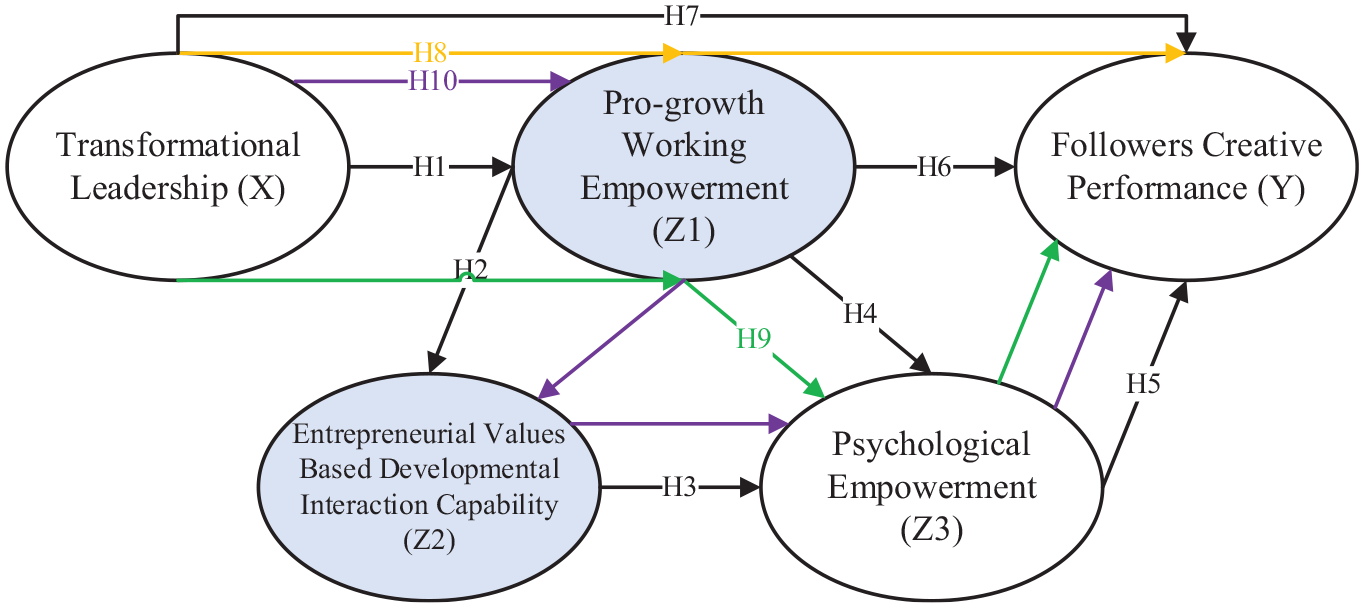
Conceptual framework.
Research Methods
Research Approach
This study uses a quantitative approach through a correlation pattern that uses scientific principles: empirical, objective, measurable, rational, and systematic. This study examined some of the subjects who were representatives of the population through survey methods using questionnaires directly to research respondents. The independent variable of this research is transformational leadership (X), the dependent variable of this research is followers’ creative performance (Y), and the mediator variables of this research are a pro-growth working environment (Z1), entrepreneurial values-based development interaction capability (Z2) and psychological empowerment (Z3). Investigating mediating variables can help eliminate wrong assumptions regarding the relationship between the independent and dependent variables. By analyzing mediating variables, researchers can explore the relationships deeper and better understand the mechanisms.
Data Collection Technique
In this study, the population used was start-up business employees in Indonesia. The sampling technique for this research is purposive sampling. Purposive sampling was carried out to obtain the most relevant subjects according to the research objectives (Sekaran & Bougie, 2016). In addition, subjects selected using purposive sampling are considered to have appropriate experience, thereby increasing the quality of the data obtained. Thus, the sample used in this study is some employees (followers) from start-up businesses in Indonesia who have special characteristics relevant to research objectives to answer research problems. Start-up business employees work in companies that have only started or established within the last 5 years. The business must also be actively managed independently and not as an additional line of business from an established company (Salamzadeh & Kesim, 2015). Researchers referred to J. F. Hair et al. (2014) rule that the number of samples required for SEM-based research is 10 times the number of reflective indicators. The total number of indicators is 27, so the required minimum sample size is 27 times 10, or 270 respondents, which means the size has been reached.
Measurement
This study measures transformational leadership variable using items adapted from the Multifactor Leadership Questionnaire (MLQ) Form 5X-Short by Avolio and Bass (1995), pro-growth working environment variable using items by Blumberg and Pringle (1982), entrepreneurial values-based development interaction capability variable referring to the instrument by Frappaolo (2008), psychological empowerment using items by Spreitzer (1995), and followers’ creative performance using items from Farmer et al. (2003).
Data Analysis Technique
The data analysis technique used in this study is the Structural Equation Model (SEM) or structural equation model using data analysis tools, namely WarpPLS. Several tests must be carried out in this study to fulfill the requirements for conducting data analysis: the validity test, reliability test, Confirmatory Factor Analysis (CFA) test, model test, hypothesis test, and mediation test. The PLS bootstrapping technique in this study is a resampling method used to calculate the standard errors and confidence intervals for the path coefficients in the PLS model. This method is based on a random sample of observations with replacement from the original data, and the PLS model is calculated for each of these samples. Using the PLS bootstrapping technique, many bootstrap samples can be generated from the original data, which can be used to calculate the different path coefficients for each sample. Then, the confidence interval for the path coefficient is calculated from the obtained sample distribution.
Regarding the PLS bootstrapping procedure, in theory it is explained that the recommended boostrapp sample is 5,000 subsamples, but because using a large number of subsamples requires a lot of computing time, the number of subsamples is smaller, namely 500 can be used (J. F. J. Hair et al., 2022).
Results and Discussion
Results
Start-up business employees in Indonesia who were the respondents in this study were mostly male (52.96%), 25 years old (66.66%), working in the food and beverage business (35.9%), and dominated by employees who work in companies that have been operating for 1 to 2 years (33.70%). Furthermore, each item has an average value of 3.50 to 4.50, meaning all variables in the start-up business have been relatively good.
Validity check with Pearson correlation. The research instrument is declared valid if the correlation value is ≥ .30. The significance level used is 5% (0.05). If an item does not meet validity, it is deleted, and a validity test is performed again. Based on the data analysis results (Table 1), all questionnaire items have a correlation value of more than .300. Thus, all items meet validity.
The stage after testing the validity is testing the reliability of the instrument. The reliability test was carried out by looking at the alpha-cronbach coefficient value for each variable. A variable is called reliable (consistent) if it has an alpha-Cronbach coefficient of more than 0.600. Based on data analysis (Table 2), all variables in the questionnaire have Cronbach’s alpha value, which is more than .60. Thus, all research instruments to measure variables have fulfilled reliability.
Reliability Test Results.

According to Table 3, all criteria have reached the expected value limits or have met the recommended critical limits of Goodness of fit indices so that the results of this modeling are acceptable or feasible analysis. In addition, the variables used are Transformational Leadership (X), Pro-Growth Working Environment (Z1), Entrepreneurial Values-Based Development Interaction Capability (Z2), Psychological Empowerment (Z3), and Followers’ Creative Performance (Y), also shown that it meets the requirements of validity and reliability.
Results of Testing the Goodness of fit.
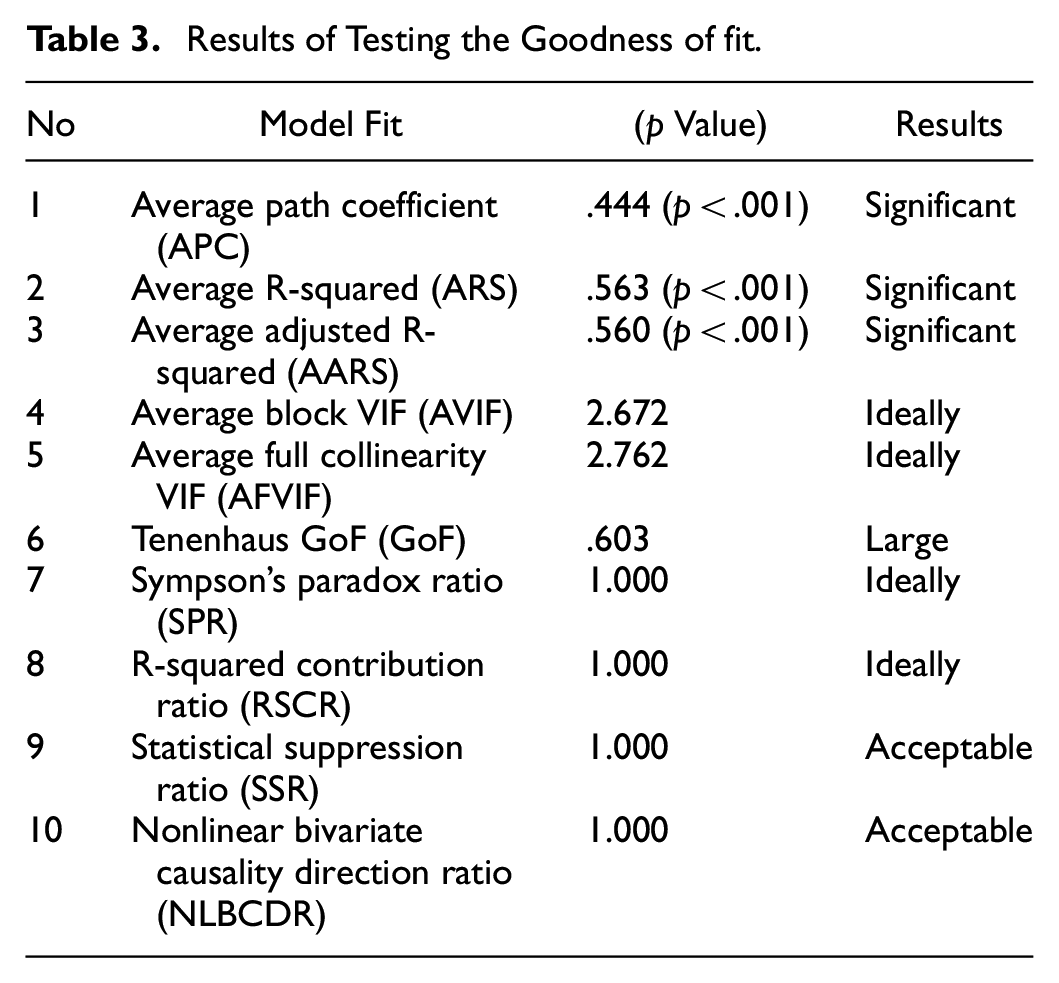
The next stage is testing structural relationships on direct and indirect influence paths. There is a significant influence between variables if the p-value < .05 (Hair et al., 2022).
The results of testing the direct effect structural model, as presented in Table 4 and Figure 2, prove that all hypotheses have a significantly positive effect on one another. According to the above description, follower creative performance (Y) is the main determinant factor. This research is Psychological Empowerment (Z3). It is known from the path coefficient value, which is the largest compared to other direct path coefficients, namely the influence of Transformational Leadership (X) and Pro-Growth Working Environment (Z1). The Psychological Empowerment variable (Z3) itself is influenced by two factors, namely Pro-Growth Working Environment (Z1) and Entrepreneurial Values-based Development Interaction Capability (Z2). The main factor influencing Psychological Empowerment (Z3) is Entrepreneurial Values-based Development Interaction Capability (Z2), indicated by a larger path coefficient.
Results of Testing the Effect of Inter-Variables.

Note. *significant at 0.05 level, **significant at, 0.01 level.
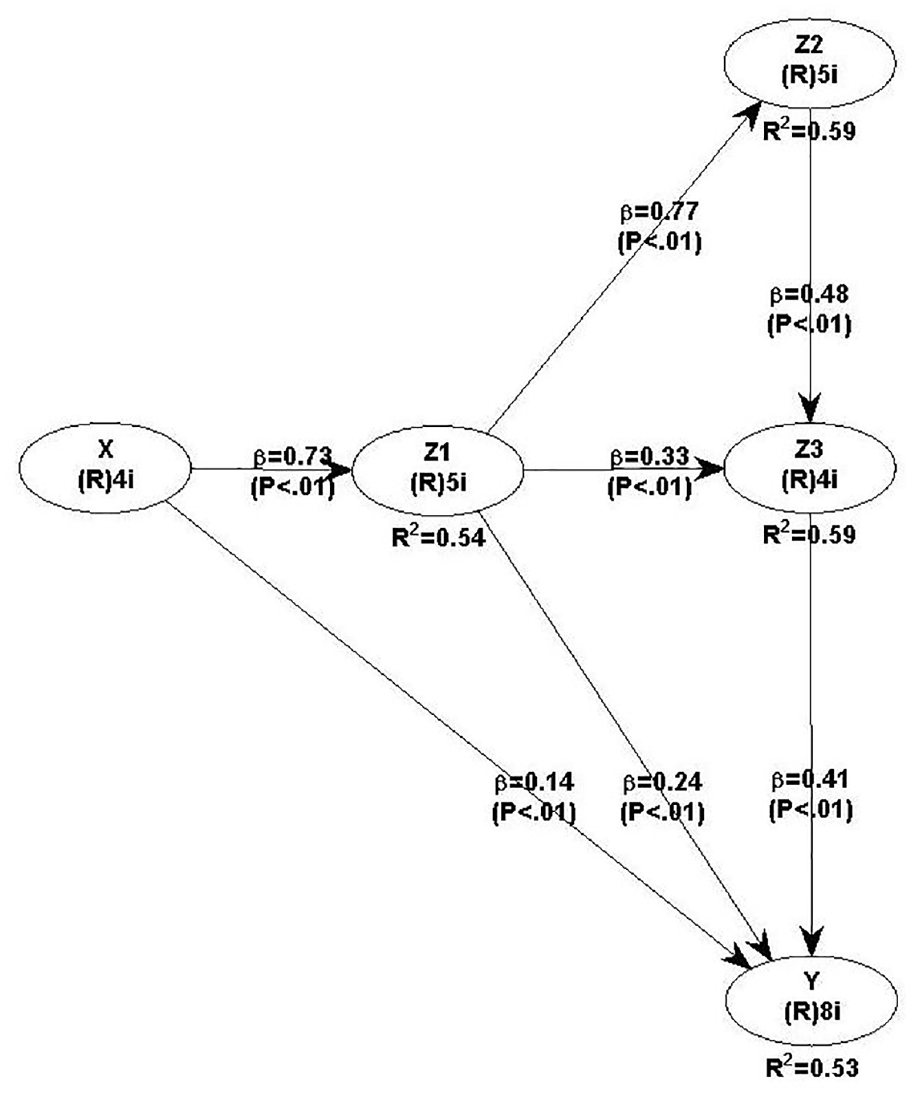
SEM structural models.
Discussion
The research analyzes the effect of Transformational Leadership (X) on Followers’ Creative Performance (Y), with the pro-growth working environment (Z1), entrepreneurial values-based development interaction capability (Z2), and psychological empowerment (Z3) as mediating variables. According to the findings, transformational leadership has a significant positive impact on the pro-growth working environment. It shows a positive and significant relationship, which shows that the better the Transformational leadership in the start-up business, the Pro-growth of the working environment is also improving. It will be related to leadership, an important factor in the company, which makes leadership able to have a major influence on the work environment in the company for the better. The results of this study are known to be in line with the opinions of Frishammar (2006) and Wang et al. (2017), which state that leaders, as holders of organizational constraints (in this case, business start-ups), can move members of the organization to achieve their goals. The goal in question is a conducive work environment as a pro-growth working environment. The findings show that a pro-growth work environment significantly positively influences entrepreneurial values-based developmental interaction capability. In the context of this study, the intended stimulus is a good start-up business work environment, while the intended response is interaction capability. This study’s results align with Ribeiro and Cherobim (2017). A good work environment, in this case, the Pro-Growth Working Environment, will have a good interactive relationship.
The results also show that Entrepreneurial Values-based developmental interaction capability significantly positively affect Psychological Empowerment. It shows a positive and significant relationship, which shows that the better the Entrepreneurial Values-based developmental interaction capability in start-up businesses, the better psychological empowerment will also be. The results of this study support that knowledge sharing and valuable interactions in start-up businesses will make followers more self-confident because they feel confident that they have cognitive abilities cognitively and will encourage them effectively. Thus, psychological empowerment in the start-up business will be valuable for followers to dare to act forward (Feiz et al., 2019; Setiawan, 2020). Furthermore, these findings indicate that a pro-growth work environment significantly positively affects psychological empowerment. It shows a positive and significant relationship, which shows that the better the Pro-growth working environment in the start-up business, the better the Psychological Empowerment will be. A good work environment in a start-up company will improve the psychological empowerment of followers working. This result supports the opinion that a growth-oriented work environment can empower followers, including job characteristics that will continue to experience dynamic development.
The pro-growth working environment also has a significant positive influence on Followers’ creative performance. It demonstrates a positive and significant relationship, indicating that the better the pro-growth working environment in a start-up business, the better the creative performance of followers. This study’s results are known to align with research from Yeh and Huan (2017). The working environment, according to the study of organizational behavior, makes start-up business members feel safe and comfortable, and it generates enthusiasm for creating new ideas, influencing individual attitudes, and bringing out innovative behavior in start-up businesses. The results of this study also support that in the Pro-growth Working Environment, followers are encouraged to have creative self-efficacy and motivation.
On the other hand, the organization provides leaders, supportive resources, and challenging work to create social networks that build each other to increase Followers’ Creative Performance (Jain & Jain, 2016; Karpen et al., 2015; Setiawan, 2020). It shows a positive and significant relationship, which shows that the better the Psychological Empowerment in the start-up business, the better the creative performance of Followers will be. This study’s results align with the statement of Jha (2017), which states that the key element of creative performance is followers’ readiness to be empowered. Psychological empowerment will be a follower’s perspective on the meaning of work and the follower’s willingness to cognitively generate new ideas in the start-up business, which, of course, can be triggered by patterns of leadership, interaction, and the work environment, including the work culture in the start-up business. The results of this study also support the results presented by Abdulrab et al. (2018) and Abukhait et al. (2019). Transformational leadership is also known to have a significant positive influence on Followers’ creative performance. Followers’ creative performance is also improving due to transformational leadership in the start-up business. The results of this study are in line with and support the researchs (Afsar & Masood, 2018; Chaubey et al., 2019; Khalili, 2016), who stated that transformational leadership affects the creativity of followers. The results of this study indicate that transformational leadership will act as a creative force in start-up businesses that can introduce new and useful ideas, which can also increase process effectiveness in start-up businesses as a whole.
Transformational leadership can affect the Pro-growth working environment indirectly. Thus, the better the Transformational leadership in the start-up business, the better the Pro-growth working environment will be, which can indirectly improve Followers’ creative performance in the start-up business. The results of this study are supported by several previous studies, namely Ragins (2016), and Setiawan (2020). Previous studies only partially discussed the relationship between variables. Thus, the results of testing the effect of this mediation are new findings. Apart from that, this research is also an extension of the research by Setiawan, Eliyana, and Suryani (2020). which only focused on developing the concept of measuring pro-growth working environments, while this research has accommodated hypothesis testing regarding one of the driving factors for pro-growth working environments. The findings of this study suggest that transformational leaders in start-up businesses can identify employee development needs and ensure that skill development is carried out properly for each employee in the start-up business. Apart from that, Transformational leadership is also known to indirectly influence Followers’ Creative Performance through the Pro-Growth Working Environment and Psychological Empowerment. The results of this research support the results of previous studies (Jha, 2017; Matsuo, 2021; Setiawan, 2020). This study’s findings contributed in the form of discoveries. Transformational leadership can help develop a pro-growth working environment and psychological empowerment in start-up businesses through how transformational leaders form teams, set the right expectations, motivate, and assist teams in thinking of new ideas. Furthermore, the transformational leader will stimulate the knowledge that is transformed into capabilities that are embedded in every employee. Thus, the stimulation results will present new ideas for improving followers’ creative performance in a start-up business.
Finally, these findings indicate that transformational leadership can indirectly influence followers’ creative performance through a pro-growth work environment, entrepreneurial values-based developmental interaction capability, and psychological empowerment. This research is known to be an extension of Setiawan, Eliyana, and Suryani (2020). This study explains that the effect of a pro-growth working environment on entrepreneurial values-based-developmental interaction capability is one of the mediating components of transformational leadership on followers’ creative performance. Employees in start-up businesses will gain a pro-growth working environment, entrepreneurial value-based developmental interaction capability, and psychological empowerment in general, which will motivate them to work more creatively and effectively. It is due to a change in the employee’s perspective on the start-up business, which is better for himself and his work. Through a pro-growth working environment, entrepreneurial values-based on developmental interaction capability, and psychological empowerment, employees in start-up businesses will experience an increase in self-confidence and become more aware of their potential. Thus, the results of this study support, expand and develop the results that have been put forward by (Abdulrab et al., 2018; Al Harbi et al., 2019; Feiz et al., 2019; Han et al., 2018).
Conclusion
Based on the data processing results regarding this research model, it can comprehensively explain the driving factors of Followers’ creative performance through Transformational Leadership, Pro-growth working environment, Entrepreneurial Values-based developmental interaction capability, and Psychological Empowerment. The results show significant and positive influences on the direct and indirect relationships between the variables. Transformational Leadership (X) has a positive and significant effect on Followers’ creative performance (Y) through Pro-growth working environment (Z1) and Psychological Empowerment (Z3). It is known that Transformational Leadership (X) has a positive and significant effect on Followers’ creative performance (Y) through a Pro-growth working environment (Z1), Entrepreneurial Values-based developmental interaction capability (Z2), and Psychological Empowerment (Z3). According to Naidoo (2016), Creative followers have received much attention in the literature because it is considered important for organizational success and will impact success in various jobs and industries. In conclusion, this study shows that followers’ creative performance in start-up businesses can experience better improvements when they get the right influence through the role of the empowerment environment in supporting the influence of transformational leadership.
Managerial Implications
The results of this study can be used as material for consideration in selecting start-up leaders, recruiting employees, and training to develop leadership skills for leaders within the company. Specifically, startups must develop leadership development plans that accommodate both the short-term and long-term organizational requirements. Next, organizations should identify individuals who have the potential to become leaders in the future in order to conduct targeted leadership training and development. In addition, start-ups must design a performance management system that emphasizes the need for competency development and the creation of future leaders. In addition, the results of this study have provided an overview for start-up business managers regarding the importance of increasing the Pro-growth working environment, especially from the aspect of Progressive spirit: Togetherness, which means that start-up companies can pay more attention to togetherness by bonding between employees or between employees and superiors in certain ways to strengthen the bond between one another in a start-up company.
Increasing psychological empowerment is also very important, especially in competence, by conducting various training or coaching its employees’ soft and hard skills. Based on the discussion and conclusions outlined in this study, this research can also be used as a recommendation for company management to measure the influence of transformational leadership on followers’ creative performance in start-up businesses with the help of Pro-growth Working Environment variables, Entrepreneurial Values-Based Developmental Interaction Capability, and Psychological Empowerment. It is known to have a positive impact not only on organizational development but also on followers’ relationships and individual development, influencing in encouraging personal growth, which is characterized by empowering interactions, enthusiasm to move forward through challenging responsibilities, being able to create entrepreneurial added values in their work life, and participating in a motivational process that aims to increase the success of followers. In the cultural context, Indonesia is characterized by high power distance (Hofstede Insights, 2023). That means that Indonesian culture has a strong tradition of hierarchy within it. In a start-up business, where innovation and flexibility are often valued, company leaders should consider integrating this aspect of hierarchy without inhibiting creativity and innovation. In addition, start-up leaders need to encourage individuals to adapt to change, handle problems, and remain flexible in the face of challenges. For this reason, leaders should always collaborate with start-up employees by involving them in decision-making so that they feel more motivated and less dependent on the leader alone.
Limitations
This research has certainly been conducted to the best knowledge and ability. There are several limitations that researchers must consider for future research because this study itself still has several areas for improvement, such as using a cross-sectional research design. Longitudinal study designs can provide more reliable general results. Therefore, further researchers are advised to conduct research using time-lag and longitudinal analysis. Second, this study did not include a moderator role, which could influence relationships. Future research may do so. Third, the drawback of this study is that the sample used is still a company with limited operating experience. Hence, the sample still needs to describe the start-up business as a whole but is limited to the start-up population with limited operations.
Footnotes
Declaration of Conflicting Interests
The author(s) declared no potential conflicts of interest with respect to the research, authorship, and/or publication of this article.
Funding
The author(s) received no financial support for the research, authorship, and/or publication of this article.

Data Availability Statement
Data is available upon request.