




Abstract
In order to communicate effectively in the workplace, the professional translators, interpreters, communication, and public relations specialists make linguistic choices that help them achieve their goals. One way to teach them how to reach the appropriate linguistic decisions is through the discipline of Pragmatics. The originality of the present paper lies in the fact that it proposes a new approach to teaching Pragmatics that aims at creating a dynamic educational context, namely by means of projects. For 2 years in a row, students from the Faculty of Communication Sciences at Politehnica University of Timişoara (Romania), specializing in Translation and Interpreting or Communication and Public Relations, have carried out a project for this discipline and presented it to the class. Then, they have reflected on the tasks and their experience through a sixteen-question questionnaire, created by the researchers and distributed online, using Google forms. Most of the 164 respondents have pointed out the usefulness of the projects to better acquire the concepts in Pragmatics and to improve their soft skills, even if the curriculum of each of the two specializations dedicates a different number of hours to the discipline.
Introduction
Today’s globalized world creates the ideal professional framework within which people of different linguistic and cultural backgrounds can communicate effectively through a common language. Understanding the subtleties of a language means, among others, knowing about the pragmatic or practical dimension of the meaning conveyed by a communicative act in a well-defined context (Chapman, 2011; Grice, 1975; Jucker, 2012; Leech, 1983; Şimon, 2014; Şimon, 2022). In other words, understanding the contextual and «“invisible” meaning» (Yule, 2010, p. 128) of utterances is of paramount importance in the contemporary, global and multicultural society, turning Pragmatics into a discipline that is essential to all the people who work with language to achieve professional goals.
Since English has been accepted as a global language (Crystal, 2003), it is no wonder that it is taught in schools, from nurseries to higher education institutions, all over the world, thus laying the foundations of successful careers in a large number of domains. As such, at Politehnica University of Timişoara (Romania), at the Faculty of Communication Sciences, the bachelor’s degree in Communication and Public Relations as well as that in Translation and Interpreting go beyond the specialization-specific training and offer students the opportunity to study English thoroughly, by including in their curricula courses in Grammar, Pragmatics, Discourse Analysis, Terminology, Culture and Civilization, Written and Oral Communication, to mention but a few ( Facultatea de Ştiinţe ale Comunicǎrii. Programe de studii de licenţǎ, 2023 ).
This article focuses on one of the courses, namely the course in English Pragmatics, which is essential for the communication and public relations specialists as well as for the translators and interpreters because, in their future professional activities, they will have to identify and create hidden meanings intralingually and interlingually. As the students stated that the course in English Pragmatics was difficult, the professors considered that it was a good idea to go beyond the traditional ways of teaching and assessing students’ perspective on the acquisition of the subject. Consequently, they decided to use a project-based final examination and designed an educational context in which the students were assisted by the professors until the submission and presentation of the project. Thus, the main research goal was to evaluate whether the new teaching strategy was worth considering in the future, taking into account students’ perceptions of the entire project. For this, an online questionnaire was created and distributed, for two consecutive academic years, to all the students that attended the course. This endeavor is even more valuable since the previous research has focussed mainly on teaching the pragmatic communicative competence in foreign language classes (Al-Abdali & Maniam, 2020; Alcón, 2007; Kasper, 2001; Kasper & Roever, 2005; Ohta, 2001; Roever, 2009; Taguchi, 2011), and less on teaching Pragmatics as an independent academic discipline at a higher education level (Hendi & Widya, 2020).
Literature Review
Benefits and Drawbacks of Project-Based Assessment
Assessment plays a key role in the educational process, taking different forms. For example, the staged assessment is formative, occurring while the students are still learning, whereas the final assessment is summative, taking place after the students have finished learning. As such, the goal of the assessment is different. In the first case, it guides both the student and the professor in what needs to be done to reach the educational goals set at the beginning of the course. In the second case, it shows the knowledge that the student has gained at the end of the course or of the course unit(s) (Brookhart & McMillan, 2020; B. A. Clark, 2017; Greenstein, 2012; Starkings, 1997). The educational tools used to assess students’ progress may vary from quizzes, written tests, conversations to self- or peer-assessment, whereas students’ achievement at the end of the course is measured through final tests, final projects, final presentations or standardized tests, to mention but a few (Theall & Franklin, 2010; Trumbull & Lash, 2013).
The use of projects to assess students’ acquisition of a subject at the end of a course is considered a good alternative to the traditional written tests for several reasons (Bender, 2012; B. A. Clark, 2017; Eby et al., 2009; Holzman, 2009; Resnick, 1991; Ryan & Deci, 2000; Starkings, 1997; Warren, 2016). First, the role of the professor is that of a facilitator of learning, being a guide and an advisor rather than a provider of knowledge (Starkings, 1997). Consequently, students ‘manage their own acquisition of learning’ (Warren, 2016, p. 34) under the supervision and guidance of the professor. Second, students learn to build group cohesion (Granado-Alcón et al., 2020), by collaborating in order to solve problems in a social and professional context (B. A. Clark, 2017). Therefore, students interact with each other and share the knowledge they have attained so far to find the best solution to their professional task (Bender, 2012; Resnick, 1991). Third, students learn to make their voices heard and to make valuable choices for the development of the project (B. A. Clark, 2017). In other words, students develop their critical thinking (Eby et al., 2009; Holzman, 2009). Working and learning independently is a precious lesson that students must learn for their professional and personal growth (Hickey, 2014), although it is reluctantly taught by some professors because it means giving up the control they have over the students and the educational environment (Ryan & Deci, 2000). Nevertheless, working independently has been shown to increase motivation as opposed to working constantly assisted, which demotivates (Ryan & Deci, 2000). Fourth, in order to complete the project, today’s students resort to all kinds of resources, technology in particular (B. A. Clark, 2017), and this is a huge benefit since the contemporary society is becoming more and more technologised. To put it differently, projects should be designed to offer students no other chance but to use technology (Bender, 2012). Fifth, projects that are assessed are usually meant to be presented (B. A. Clark, 2017) and, consequently, help students to gain the communication skills much needed in nowadays society (Starkings, 1997; Warren, 2016). Sixth, students learn to transfer the knowledge gained while conceiving the project to other learning contexts (Mitchell et al., 2009), often employing interdisciplinary approaches (Granado-Alcón et al., 2020). Seventh, the skills learned while completing the project are better internalized (A. M. Clark, 2006) and, as such, retained for a longer period of time (Mioduser & Betzer, 2008). Finally, the marks earned by students are better when they are assessed through projects (Bender, 2012).
Although there are many advantages of the use of projects for evaluation purposes, there are also some disadvantages. First, they are extremely time consuming. Second, the evaluation process might be challenging and subjective sometimes. Third, students often feel uncomfortable to present a project in front of the class (A. M. Clark, 2006; Starkings, 1997).
Organizing Project-Based Activities
Projects may be carried out by a student or a group of students. Groups may be formed by the professor or the students themselves. In the first case, the learning experience is more enriching than in the second case because the professor does not usually form a group on student-friendship criteria, as it often happens when students organize their own groups. The most successful groups are the mixed-ability ones because their members can have different perspectives on the same topic and can have different abilities to solve the tasks assigned to them (Starkings, 1997).
The project and its stages must be clearly introduced to the students. Creating clear rubrics for the assessment of tangible artifacts rather than intangible skills is also advisable because these are guiding lines for both the students and the assessor(s) (Clark, 2017). While completing the assignments, all the students should be engaged in project-related activities under the close supervision of the professor. Students’ motivation should also be constantly refueled by the professor as it tends to drop on the way. Good time management ensures the success of the project, so both the students and the professor should pay special attention to meeting deadlines (A. M. Clark, 2006; Starkings, 1997).
Nowadays, to orally present a project is one of the best ways to assess students’ acquisition of the subject because, in their professional life, they have to be able to present and to defend their ideas with reliable arguments as well. In other words, besides the subject itself, students also acquire communication skills, which are essential for any professional in any field of activity (Starkings, 1997; Warren, 2016). Starkings (1997, p. 8) recommends that the professor should take into account the following aspects when evaluating the presentation skills of the students:
a. “Relationship to the audience: Appropriate material used, clear message and recommendations that are meaningful.
b. Use of supporting materials and useful aids to communication: Use of appropriate media for demonstration, handouts, etc.
c. Structure: Introduction, middle, summary, and conclusion.
d. Handling questions: Thoughtful and honest responses, appropriateness of answers and convincing arguments.
e. Time Management: Presentation too long, too short, or appropriate.”
Furthermore, the project should be assessed also from viewpoint of the 4 C’s: critical thinking, collaboration, communication and creativity ( Buck Institute for Education, 2023 ).
Using Projects in Higher Education
At a university level, projects have been used in class for several reasons (Easter & Evans, 2014; Granado-Alcón et al., 2020). First, such a teaching method is student-centered, determining the student to manage his/her own learning. Second, it better prepares students for the labor market as it creates the framework within which they solve real-life professional problems effectively and interdisciplinarily. Third, accrediting bodies might require this as a response to the needs of the economic stakeholders.
In higher education, the use of project work was studied in courses in Psychology (Gómez-Baya et al., 2019), Business (Hansen, 2006; Santoso et al., 2023), Education Sciences (Granado-Alcón et al., 2020), Statistics (Starkings, 1997), Foreign Languages (Anyushenkova et al., 2020; Chi, 2023; Marwan, 2015; Oranpattanachai, 2018; Ting, 2013), Recreation and Sports (Easter & Evans, 2014), to mention but a few. The overall conclusion drawn from these investigations is that the use of projects to create an educational environment is worth employing in class more often, in teaching a larger number of subjects, because it helps students to acquire both the hard skills and the soft ones. In other words, in this way, students learn the skills needed for the dynamic labor market of today and of tomorrow (Guo et al., 2020). Therefore, no study has been done so far on the use of projects in teaching Pragmatics as an academic discipline, at least to the researchers’ knowledge, which justifies this research even more.
Materials and Methods
Research Background
As aforementioned, the two bachelor’s study programs offered by the Faculty of Communication Sciences, at Politehnica University of Timişoara (Romania), give students the chance to master English at an advanced level by including courses in English Pragmatics in their curricula (Facultatea de Ştiinţe ale Comunicǎrii. Programe de studii de licenţǎ). Hence, both the Communication and Public Relations students and the Translation and Interpreting ones attend lectures and participate in seminars in English Pragmatics. There is, however, a slight difference between the two. Whereas the Communication and Public Relations students benefit from 28 hr of lectures and 28 hr of seminars, the Translation and Interpreting students learn English Pragmatics in half of the time, that is, 14 hr of lectures and 14 hr of seminars. This made the professors assume that it is easier for the Communication and Public Relations students to solve subject-related tasks than for the Translation and Interpreting students because the former ones delve into English Pragmatics for the double amount of time, and, as such, they are able to acquire the academic discipline much better. The main research objective was to identify students’ perspectives on project-based acquisition of Pragmatics. Consequently, the educational scenario, described below, was created.
The theoretical and practical activities designed for the whole class were allotted three quarters of the teaching time. In that period of time, all the topics included in the syllabus were covered in class. After that, the instruction continued in small groups or in professor-student one-to-one meetings, that aimed at guiding the students in the solutions found for the end-of-term project entitled “The Pragmatics of Advertising,” that had to be presented in front of the class.
This project consisted in choosing one advertisement, that contained around 50 words and abounded in hidden meanings, on the one hand, and analyzing it from a pragmatic point of view, on the other. In order to complete this final assignment, the following steps were taken:
All the students announced whether they wanted to work alone or in groups.
Each student or group of students had to choose three advertisements that they discussed with the professors, deciding afterward which one to analyze for the final assessment.
A list of tasks to be considered for the pragmatic analysis of the advertisement was provided to the students. The students were free to choose at least one task that was applicable to the advertisement they had selected for the project. In other words, the student(s) had to analyze at least one pragmatic concept.
Each student or group of students made a draft of the analysis they intended to present at the end of the semester for the final assessment. The analysis was talked over with the professors, the latter drawing students’ attention to the weaknesses and strengths of the small-scale analysis.
All the students had to prepare a PowerPoint presentation of the pragmatic analysis of the selected advertisement, which had been examined together with the professors, before they did the final project presentation in front of the class.
In the end, the project was presented in front of the class. For the final mark, what counted was: the soundness of the small-scale analysis, the design of the PowerPoint presentation and the accurateness of the answers to the questions asked by the professors and/or peers. In other words, the presentation skills were disregarded for the final mark, but they were commented on. Thus, the suggestions for improvement could be a benchmark for situations in which good presentation skills might be essential in attaining the communicative goal.
This teaching strategy aimed at creating a dynamic educational context (Taba, 2000) in which students were taught both as a class and individually or in small groups, and, as such, each of their educational needs were addressed separately. In this way, it aimed at giving students confidence in their own reasoning and in their capacity to understand and acquire English Pragmatics thoroughly as well as at preparing them for a successful final assessment, that could encourage them to pay even more attention to the way in which meanings and contexts influence each other.
Research Methodology
To give a comprehensive overview of the teaching strategy designed by the professors for the creation of a dynamic educational context (Taba, 2000), on the one hand, and to determine the added value of such an instructional design, on the other, six research objectives were set by the research team:
RO1 To determine students’ ability to find advertisements that contained about 50 words and hidden meanings at the same time,
RO2 To determine students’ perspective on the course in Pragmatics,
RO3 To get insights into students’ work on the project,
RO4 To identify the difficulties students faced while completing the project,
RO5 To determine students’ perspective on their project-based acquisition of Pragmatics,
RO6 To identify ways to improve the teaching strategy under scrutiny.
In order to achieve the research objectives, an online questionnaire in Google forms was created that comprised sixteen questions (cf. 3.3 Research Findings and Discussion for a detailed presentation). Two of them were factual questions, whereas the rest of the questions were opinion questions. The questions were designed to fit the research objectives and, except for an open-ended question, provided several answers to guide respondents. In other words, the research objectives were met by answering one (RO1), two (RO4), three (RO2 and RO5) or four (RO3) questions with pre-defined answers in the case of the first five research objectives. Finally, one open-ended question was asked to achieve RO6. The researchers have taken steps to ensure the validity and reliability of the study, in other words its logic, meaningfulness and scientific soundness. As such, a group of 12 professors and students was formed to pretest, and pilot test all the items of the survey. Only after their positive assessment of all the items of the questionnaire, the research presented in this article started (Ruel et al., 2016; Taherdoost, 2016). The online survey was conducted for two consecutive academic years, namely 2021 to 2022 and 2022 to 2023, to be more precise between December 2021 and February 2023. All the students that attended the course in Pragmatics agreed to anonymously complete the questionnaire. Their participation in the survey was voluntarily and could be interrupted at any time. The sample consisted of 164 students, that is, 89 pursuing a degree in Communication and Public Relations and 75 in Translation and Interpreting. In terms of age, all the Communication and Public Relations students were between 18 and 24, whereas the Translation and Interpreting ones were less homogenous, namely 1 was older than 41, 1 was between 25 and 30, and 73 were between 18 and 24.
Research Findings and Discussion
The number of questions asked in the questionnaire to meet the six research objectives varied from objective to objective. Below, each objective with the related questions is considered at a time. In order to determine whether there are differences between the two groups of students, which took part in the survey, their answers were compared, pointing to the viewpoints of the Communication and Public Relations (CPR) students and those of the Translation and Interpreting (TI) students, respectively. Due to the uniqueness of the present study, the discussion of the findings of this research are the primary focus of the current section.
RO1 To Determine Students’ Ability to Find Advertisements that Contained About 50 Words and Hidden Meanings at the Same Time
The first task of the students for the completion of the final project was to identify three advertisements that contained about 50 words and hidden meanings at the same time. One of the advertisements was then selected for the pragmatic analysis, after discussing the pragmatic aspects of the three advertisements with the professors. For the first research objective, one question was asked: What is the length of the advertisement you have chosen to analyze? The students had to choose one answer of the following possibilities: more than 50 words, 50 words, or less than 50 words. Thirty-five percent of the CPR students and 49% of the TI students were able to find advertisements that had more than 50 words and hidden meanings, too. Thirty-two percent of both the CPR and TI students found 50-word advertisements, whereas an ad with more than 50 words was the choice of 33% of the CPR students and 19% of the TI students, respectively. In other words, most often the surveyed students were able to find advertisements that posed some difficulties in understanding them from the very beginning because of their hidden meanings, but these advertisements contained more than 50 words.
RO2 To Determine Students’ Perspective on the Course in Pragmatics
To determine students’ perspective on the course in Pragmatics, three questions were asked. The first question aimed at identifying which task(s) they had chosen to complete from the given list of tasks:
Define the context according to Hymes’ SPEAKING grid or to Nord’s New Rhetoric Formula.
Identify the words/phrases (if any) that have a different sense and reference and explain their denotative (sense) and connotative (reference) meaning.
Identify any anaphoric or cataphoric reference.
Identify the person, place and time deixis.
Identify the type of implicature used (if any): conventional/conversational implicature.
Identify the presuppositions (if any) and do the presupposition checking.
Identify the constative and performative utterances.
Identify the direct and indirect speech acts.
Identify the micro-speech acts and the macro-speech act of the discourse.
Use the maxims of the cooperative principle to describe the effectiveness of the piece of discourse.
Identify any minimizers and maximizers and explain their use.
The tasks actually cover all the topics approached by the course and taught in class. Since the students could complete several tasks for the project, multiple answers could be crossed, in this case. Table 1 illustrates the ranking of the choices, that each group of students has made, from the most frequent to the least frequent ones.
Tasks Chosen by the CPR and TI Students to Complete for the Final Project.

It can be noticed that implicature and person, place and time deixis are the first two options of both groups, but in reversed order for the TI students. Other topics often dealt with were context, sense and reference, anaphoric or cataphoric reference, and direct and indirect speech acts (more than 20%). The least approached topics were the maxims of the cooperative principle, the constative and performative utterances, the micro-speech acts and the macro-speech act of the discourse, the presuppositions, and the minimizers and maximizers.
The second question aimed to identify the reasons underlying students’ choice of the aforementioned tasks. The answers that the students could select, and their preferences are given in Table 2.
Students’ Reasons for Choosing to Complete a Particular Task.

As can be noticed most of the CPR students went for the task that they understood best, whereas most of the TI students chose the tasks in relation to the ad features, which was the CPR students’ second choice. The third choice of the CPR students and the second of the TI students were determined by their liking of the task. For the TI students whether the task was the easiest or not did not matter that much, as this option ranks third in their preferences. Finally, the last position is occupied in both cases by the answer pointing to the fact that they had no particular reason to choose one task or another.
The third question directly asked the students whether they liked Pragmatics. The possible answers and the opinions of the two groups of students ranked from the most frequent to the least frequent choice is rendered in Table 3.
Students’ Opinion on Pragmatics.

Although the students could also express their total dislike, none of them opted for that. One student considered it useless. The rest of the answers given by both groups of students overlap. Most of the students emphasized that, although the subject seemed complicated, the projected helped them understand Pragmatics. Some students expressed their liking of the subject, whereas others considered it complicated.
RO3 To Get Insights into Students’ Work on the Project
Four questions were asked in an attempt to get insights into students’ work on the project. The first question aimed at finding out what the surveyed students liked most about working on this project. Six possible answers were pre-defined by the research team, namely 1. working individually, 2. working in a team, 3. researching, 4. fulfilling the task(s), 5. creating the presentation and 6. delivering the presentation. The seventh possibility gave the respondents the chance to express their ideas freely. The respondents could choose multiple answers. Table 4 summarizes the surveyees’ answers.
Students’ Likes as Regards the Work on the Project.
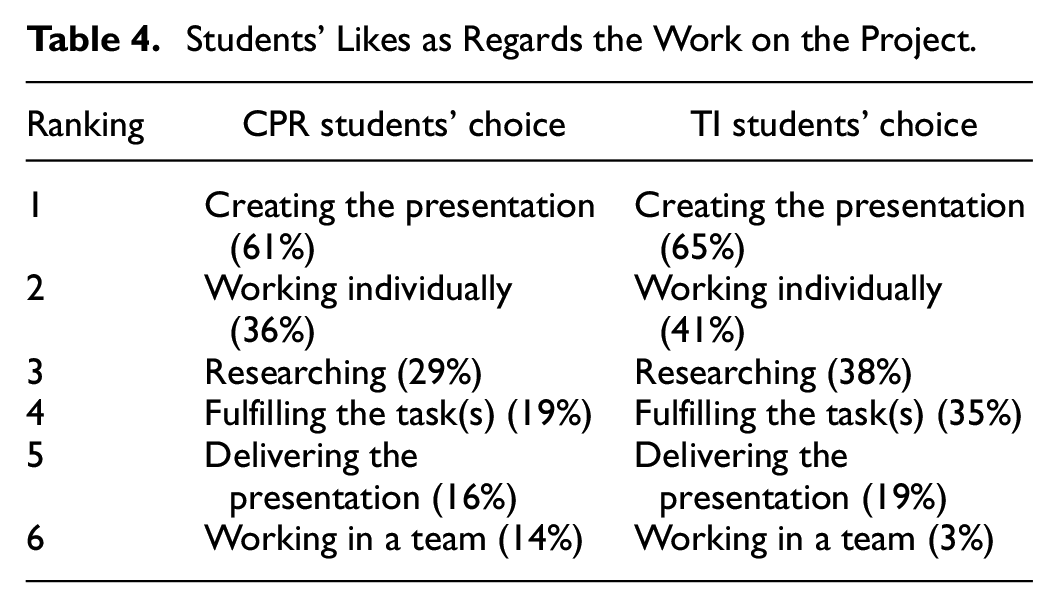
Interestingly, although the percentage differs, the ranking of the CPR and TI students’ preferences is identical: creating the presentation, working individually, researching, fulfilling the task(s), delivering the presentation, and working in a team. Additionally, two CPR students added that using their creativity and creating the artwork for the presentation were positive aspects that they had enjoyed. Only one TI student gave details about his/her experience, pointing that the entire project was ‘really fun’ because s/he had the freedom to choose an ad that s/he liked and was familiar with.
The purpose of the second question was to spot what the students liked least about working on this project. The first six answers were pre-defined and identical with those given to the previous question. The seventh answer was open, giving all the students the opportunity to express their personal dislikes. As above, multiple answers were possible. Table 5 renders students’ answers.
Students’ Dislikes as Regards the Work on the Project.

The CPR students’ answers to the open-ended question (6%) revealed that students found it difficult to identify the right advertisement and the right task as well as to solve the tasks, because they had not understood the pragmatic concepts taught. One student emphasized that s/he did not dislike anything while working on the project. The TI students’ answers to the open-ended question (8%) pointed out that most of the students found working on the project enjoyable. However, five students mentioned that delivering the presentation was difficult because they were really “nervous,” because they knew they did not have the best pronunciation, because they were too analytical, because they were uncertain about the solutions they proposed in the project as well as about the coherence of the presentation. As it can be observed, researching was the most disliked activity for the CPR students, whereas delivering the presentation for the TI students.
The answers to the third question highlighted the overall satisfaction of the respondents regarding their participation in the project. This question was a closed-ended one, thus the respondents had to choose between five possible answers: 1. to a very large extent, 2. to a large extent, 3. to a moderate extent, 4. to a small extent, and 5. not at all. Table 6 illustrates the answers of the surveyed students.
Students’ Overall Satisfaction as Regards Their Participation in the Project.

The survey showed that both groups of students liked participating in the project to a large extent. To a moderate extent is the next common preference of the students, but, in the case of the TI students, it recorded the same number of responses as to a very large extent. None of the TI students opted for to a small extent and not at all. The latter has not been the choice of the CPR students, either, whereas to a very large extent, and to a small extent recorded few responses.
Finally, the last question aimed at finding out whether the professors’ mentoring helped the students in completing the project. Only two possibilities were given, namely, to answer positively or negatively. The recorded responses showed that 92% of the CPR students and 93% of the TI students answered positively.
RO4 To Identify the Difficulties Students Faced While Completing the Project
To outline the fourth research objective, which aimed to identify the difficulties faced by the students while completing the project, two questions were asked. The first question determined the main barriers to completing the project, by giving the students the possibility to choose between four pre-determined answers and/or to speak their mind. This was a multiple-answer question. Table 7 summarizes the respondents’ answers.
Students’ Barriers to Completing the Project.

The first and the fourth positions, difficulty of the academic discipline and English language, are identical both for the CPR group of students and for the TI one. Lack of time and lack of bibliography ranked either the second or the third position in the two groups of students. As for the open-ended question, some students emphasized once more that they experienced no difficulty while completing the project, other students specified that they did not have enough time because they had postponed the project too close to the submission deadline or because they were ill at the time when they had to submit the project. One student in each group mentioned that it was hard to find the right advertisement and to analyze it before really understanding and acquiring the pragmatic concepts.
The answers to the second question determined how challenging the project was. The closed-ended question had five pre-determined answers: 1. very challenging, 2. somewhat challenging, 3. neither challenging nor unchallenging, 4. somewhat unchallenging, and 5. very unchallenging. The CPR and TI students could choose only one answer. The responses given by the surveyed students are found in Table 8.
Students’ Perspective on the Degree of Project Challenge.

The first three choices are identical, namely all the students considered that the project was somewhat challenging, neither challenging nor unchallenging and very challenging, in this very order in the case of the CPR students, whereas in the case of the TI students, the last two recorded the same number of responses. Somewhat unchallenging and very unchallenging is the sequence reflecting the perception only of the CPR students because the TI students did not opt for these responses at all.
RO5 To Determine Students’ Perspective on Their Project-Based Acquisition of Pragmatics
To determine students’ perspective on their project-based acquisition of Pragmatics, three questions were asked. The first question was a closed-ended one, giving students the opportunity to choose only one of the pre-defined possible answers: 1. very satisfied, 2. somewhat satisfied, 3. neither satisfied nor dissatisfied, 4. somewhat dissatisfied, and 5. very dissatisfied. Students’ perception of their project-based acquisition of Pragmatics is illustrated in Table 9.
Students’ Satisfaction with Their Project-Based Acquisition of Pragmatics.
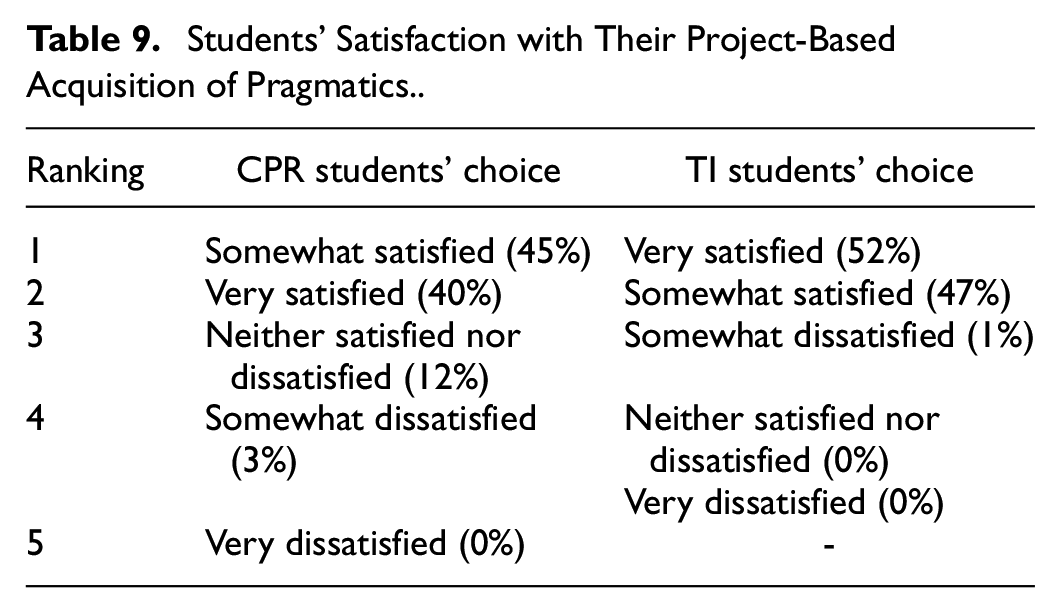
Table 9 highlights that the first two positions in the ranking of the responses given by the surveyed students are occupied by somewhat satisfied and very satisfied. The recorded responses showed that the CPR students opted for these answers in this very order, whereas the TI students in the reversed order. Very dissatisfied was the choice of none of the students. Neither satisfied nor dissatisfied was mentioned by 12% of the CPR students and 0% of the TI ones.
The second question was a closed-ended one, and it gathered information regarding the students’ perspective on the acquisition of Pragmatics through projects. The respondents could choose between two statements, as shown in Table 10.
Students’ Perspective on Their Project-Based Acquisition of Pragmatics.

The two groups of students recorded the same percentage of responses for the two statements. In other words, all the students opined that the completion of the project helped them to acquire the concepts of the academic discipline more thoroughly, although they had been comprehensively covered in class.
Finally, the perspective of the surveyed students on the effectiveness of the project-based acquisition of Pragmatics was captured by another closed-ended question. One possible answer could be chosen from the following the following: 1. very effective, 2. somewhat effective, 3. neither effective nor ineffective, 4. somewhat ineffective, and 5. very ineffective. The recorded responses can be seen in Table 11.
Students’ Perspective on the Effectiveness of the Project-Based Acquisition of Pragmatics.

The first three positions of the ranking show that the CPR and TI students made identical choices, that is, very effective, somewhat effective and neither effective nor ineffective, in this very order. No other options were selected by the TI students, whereas 1% of the CPR students opted for very ineffective and 0% for somewhat ineffective.
RO6 To Identify Ways to Improve the Teaching Strategy Under Scrutiny
The last research objective aimed at identifying ways to improve the teaching strategy presented and, as such, offered the students the chance to open their mind and put forth a number of teaching proposals. Thus, the suggestions made by the two groups of students were: to analyze more advertisements from a pragmatic viewpoint during the classes; to provide the students with more bibliography, an advertisement pool from which they could select one and some PowerPoint presentations that could be used as models of analysis; to have more time for research and project completion; to be compulsory to work in teams to complete the project. Additionally, the TI students suggested that helping them to develop presentation skills in the course of the semester would have helped them to be better prepared for the project presentation.
To summarize the discussion part, the findings have turned out significantly different between the two groups of students. Most of the answers differ in terms of 1% to 10% of the questioned population. However, in some cases, the difference in percentages goes beyond 10%. For example, in the second question related to the reasons underlying students’ choice of the tasks, the theoretical background was considered the easiest to understand by 38% of the CPR students compared to 22% of the TI students, while CPR students liked the task in a percentage of 17% compared to 31% TI students. Differences in percentages were found also in the questions regarding what the students liked and disliked about the project. More CPR students liked working in a team (14%) than TI students did (3%), while less CPR students liked fulfilling the task(s) (19%) than TI students did (35%). Regarding the dislikes during the project, slightly significant differences are recorded in terms of the task(s) fulfilment (CPR 23%, TI 8%), and the presentation delivery (CPR 18%, TI 31%). Small differences could be observed also in the overall satisfaction of the respondents regarding their participation in the project, where to a moderate extent was selected by 40% of CPR students compared to 24% TI and to a very large extent by 12% of CPR compared to 24% of TI. The lack of time to complete the project was considered more important by CPR students than TI ones (33% compared to 21%). Less CPR students were very satisfied with their project-based acquisition of Pragmatics (40%) than TI (52%), while more were neither satisfied nor dissatisfied (12% - CPR) than 0% TI. Finally, regarding students’ perspectives on the effectiveness of the project-based acquisition of Pragmatics, more CPR students considered it somewhat effective (39%) than (26%), in the case of TI students. The most significant difference has been found in this particular question, where the difference in responses was more than 20%, namely CPR students considered the projects very effective in a percentage of 48% compared to 69% of TI students. These slightly significant differences can be accounted for by personal, linguistic or knowledge-based reasons. Further studies could be carried out to investigate them.
Concluding Remarks
The importance of proper use of words and their correspondent meaning for professionals needs no further reiteration. The teaching of the discipline that focuses on the contextual and hidden meaning of utterances may be difficult, whereas its understanding by the students even more. The present study has proposed teaching Pragmatics by assigning projects to students and has proven that students believe that these facilitate the acquisition of concepts and their application to real texts. As the projects were presented to the class, also students’ soft skills have been improved and/or developed.
Students’ perspectives have been observed through a questionnaire that paid attention to several tasks carried out in the realization of the project, such as finding out the right advertisement, deciding what to analyze, doing the analysis and presenting it to the class. Students have also pointed out what they liked, such as creating the presentation and working individually, and disliked in the process, namely researching and delivering the presentation. They have reflected on the difficulties they faced, like the academic discipline per se, the lack of time and bibliography, as well as how challenging the projects were. Finally, they have pointed out their perceptions of this approach based on projects, being somewhat and very satisfied, highlighting how much the completion of the project helped them to acquire the concepts of the academic discipline more thoroughly, although they had been comprehensively covered in class and how effective this has been. The questionnaire has been applied to 164 students of Pragmatics for 2 years in a row. Students’ specialization is different and so is the number of hours they are taught Pragmatics; Communication and Public Relations students have the double of lectures and seminars than Translation and Interpreting students. This difference has not been observed in the results, even if the professors and researchers assumed that Communication and Public Relations students will perform better in the discipline.
To conclude, project-based methods of teaching help students acquire better the disciplines taught as indicated also by previous studies (Anyushenkova et al., 2020; Chi, 2023; Easter & Evans, 2014; Gómez-Baya et al., 2019; Granado-Alcón et al., 2020; Hansen, 2006; Marwan, 2015; Oranpattanachai, 2018; Santoso et al., 2023; Starkings, 1997; Ting, 2013). The discipline of Pragmatics, though, has not been investigated so far, at least to the researchers’ knowledge, in relation to project-based teaching as a facilitator of students’ acquisition of the subject. As such, the results of the present study cannot be compared to other studies carried out in the field. Together with the recommendations of the students, these maybe used to improve the teaching strategies and make Pragmatics more accessible to students. In order to give a broader overview of the topic, a new approach can be developed by comparing the perspectives of the students that are taught Pragmatics using the project-based teaching strategy as opposed to those that are not.
Footnotes
Declaration of Conflicting Interests
The author(s) declared no potential conflicts of interest with respect to the research, authorship, and/or publication of this article.
Funding
The author(s) received no financial support for the research, authorship, and/or publication of this article.
Informed Consent
Participation in the survey was voluntary and the participants had the right to withdraw from the study at any point or not answer any question.

Data Availability
Research data are available from the corresponding author on reasonable request.