




Abstract
Exploring the influence mechanism of user creativity in online learning community is beneficial for improving learning efficiency and increasing stickiness and loyalty of users to online learning community. But the current research on collaborative creation mainly focuses on the effectiveness and innovation of online learning, and lacks the research focusing on the impact of environmental factors like learning group members on online users’ creativity enthusiasm and even creativity. This paper addresses this research gap by exploring the influence of learning team factors like social presence and observational learning on creativity by using self-efficacy and intrinsic motivation as mediators. The theoretical model was validated with data collected from 242 online learning community users. This paper finds that social presence and observational learning have a positive impact on motivational factors, such as self-efficacy and intrinsic motivation, which, in turn, enhance user creativity. Their influences are moderated by challenging research discipline, level of team members and incentive.
Introduction
With the in-depth integration of “Internet + Education,” online learning community, as a learning form with new social characteristics based on the Internet, is gradually attracting the attention of experts in the field of education. The communities in online learning systems such as online courses, cognitive tutors, and massive open online courses are popping up in various domains (Parrish et al., 2023).
Community vitality, as a representation of a higher level of focused and frequent interactions and communications in the community, is measured by enthusiasm for member-generated content and passion for the frequency of member interactions (Gomashie & Terborg, 2021). Previous researchers have shown that learners’ interaction and continuous participation are critical indicators for online learning community development (Miao et al., 2022). T. K. Yu and Chao (2023) proposed a new sense of belonging model of online learning community by reconstructing the structural framework of online learning community, which could improve learners’ participation in online learning community and enhance learners’ sense of belonging, thus improved the community vitality. In fact, compared with the traditional offline learning environment, users are more likely to feel lonely and bored in the online learning environment, and the driving force to support their creation mainly comes from their internal creativity enthusiasm (Gu et al., 2022). Although the existing studies have improved community vitality, few studies have devoted their efforts to exploring community user creativity, especially creativity enthusiasm. Enhancing user creativity, improving learning efficiency and effectiveness are conducive to increasing their stickiness and loyalty to online learning community. So in this paper, the influence mechanism of user creativity in online learning community is studied systematically.
At present, the theories that can be used to study user creativity in online learning community mainly include social cognition theory and constructivism learning theory (Bandura, 1986). According to social cognition theory, human activities are mutually influenced, dependent and determined by three factors: individual situation, individual cognition and other characteristics, and individual behavior (Bandura, 1986). Among them, the situation of the individual will interact with the individual’s values and other characteristics to influence the individual’s cognitive and behavioral strategies (Bandura, 1986). As a representative theory of social cognition theory, the triadic reciprocal determinism theory, which holds that individual behavior is the result of interaction among individual, behavior and environment, has been widely applied (Bandura, 1978). But the related studies only focus on the user cognitive behavior in traditional offline learning models, and the research on user creativity in online learning community is rare indeed. In addition, the existing Triadic Reciprocal Determinism theory only gives a rough structure, and lacks a cognitive behavior model that takes into account the impact of online environmental factors such as the difficulty of learning content and the group members (Liang et al., 2022).
Constructivism learning theory emphasizes the importance of sociocultural environment and believes that learning is a process of constructing knowledge system in collaboration with environmental peers (Chien & Hwang, 2022). The sketchy hierarchy of traditional constructivism learning theory includes individual, knowledge and society as well as their circular development (Chien & Hwang, 2022), which cannot provide the visible shape of internal creativity enthusiasm of online users, namely why it happens and how it works in online learning community.
There have been some studies about the online user creativity. For example, Lobato-Calleros et al. (2022) pointed out that most of the research on cooperative creation had focused on the effectiveness and innovation of online learning. For the sake of fostering a creative, connected community of learners, Gabaree et al. (2020) shared Learning Creative Learning strategies implemented in a large online course and community. McKay and Gutworth (2021) explored the role of individual differences on creativity, which was called temporal individual differences. Their results showed that temporal individual differences influenced creativity in unique ways. On the whole, current relevant studies mainly take individual characteristics as the focus of creativity research, but they ignore the influence of social environmental factors, for example, the impact of learning team factors on individual creativity (Liu et al., 2023). Learning teams play a crucial role in providing users with a conducive online learning environment and can also stimulate learners’ motivation (X. D. Yu et al., 2022). The role of these learning teams is primarily seen from two perspectives: on one hand, they create a sense of social presence, and on the other hand, they facilitate observational learning (X. D. Yu et al., 2022). This collaborative and interactive learning model helps enrich the learning experience, enhance user creativity, and improve their academic achievements (Haines, 2021). Thus, this paper investigates the relationship between user creativity and learning teams factors (social presence and observational learning) within online learning communities among undergraduate and postgraduate-level learners.
To fill the current research gap of this field, based on the framework of Triadic Reciprocal Determinism theory, this paper extracts the mechanism of user creativity from the perspective of the influence of social environmental factors such as the group members, and further explores the impact of learning team factors on the user creativity in online learning community. Emotional factors and knowledge factors in the environment have an important impact on user creativity (Altinay et al., 2021; Wan et al., 2021). Thus, this paper uses social presence (learning atmosphere within the team) and observational learning (knowledge supply and demonstration effect in the team) to describe the learning team factors that affect user creativity. Creativity is a behavioral construct that is aroused by one’s motivation (Li et al., 2022). On the basis of previous studies, this paper deems that the intrinsic motivation and self-efficacy produce distinct motivational forces toward boosting one’s creativity.
Bandura (1978) put forward the concept of self-efficacy for the first time. He believed that self-efficacy was the key to a person’s confidence and was a necessary condition for creativity and new knowledge discovery. Intrinsic motivation is an important driving force of creativity, which reflects the individual’s willingness to make efforts to complete a task out of interest and curiosity (L. Wang, 2022). Therefore, this paper uses self-efficacy and intrinsic motivation to describe the individual factors (i.e., creativity enthusiasm) that affect creativity.
In addition, as the discipline complexity, level of team members and incentive also play an important role in the influence of learning team factors on creativity. This paper considers the moderating effects of challenging research discipline, level of team members and incentive. Finally, this paper establishes the influence mechanism model of user creativity in online learning community, and the proposed model is tested using the questionnaire data from 242 online learning community users.
This paper devotes to clarifying the influential mechanism of user creativity in online learning community, which can support the construction of vibrant and creative online community. This paper finds that online learning team factors such as social presence and observational learning positively influence motivational forces to boost one’s creativity such as self-efficacy and intrinsic motivation. The challenging research discipline moderates the relationship between social presence and intrinsic motivation. The level of team members moderates the relationship between social presence and self-efficacy, social presence and intrinsic motivation, observational learning and self-efficacy. The incentive moderates the relationship between observational learning and self-efficacy.
This paper is structured as follows. Firstly, the “Research Background” section elaborates on the research background and related concepts. Secondly, the “Proposed Research Model and Hypotheses” section provides an overall framework for the research and proposes specific assumptions. Thirdly, the “Methodology” section describes questionnaire design and research, sample selection and sampling procedures, and measurement items for each variable. Subsequently, the “Data Analysis and Results” section provides a detailed data analysis process and results, verifying the proposed assumptions. Finally, this paper summarizes main conclusions, contributions, and implications, as well as research limitations and future directions.
Research Background
Online Learning Community Vitality
With the specific trend of social division of labor in information society, social education mode and individual learning style are undergoing profound changes. The acquisition of learners’ knowledge is no longer systematic. People begin to learn from the online platform with social interaction, a strong sense of scene and open sharing instead of the closed learning space, thus the online learning community is booming. Online learning community, which is an organized forum that allows users to freely exchange ideas, can take many forms, including bulletin board systems, blogs, or chat rooms (Lai et al., 2019). Online learning community has been studied by experts and scholars in various fields. Almatrafi and Johri (2019) showed that understanding the links between community learning and learning outcomes were a necessary research attempt. The research by Paydon and Ensminger (2021) has implications for understanding learning processes and factors that exert influence on learning outcomes.
Actually, compared with the traditional offline learning environment, users are more likely to feel lonely and bored in the online learning environment due to the lack of face-to-face communication between users, and the core issue in the area of online learning community is improving its vitality. The online learning community vitality represents a high degree of concentrated interactions and frequent communications in the community, which is primarily described in terms of enthusiasm for member-generated content and frequency of member interactions (Gomashie & Terborg, 2021). Previous studies have shown that active interaction and continuous participation among learners are the key indicators for the development of online learning community (Miao et al., 2022). According to Krouska and Virvou (2020), online learning environments should be more interactive, collaborative and flexible, and more student-centered. They pointed out that group formation in an online learning environment played a key role in learning effectiveness, and appropriate groups could promote interaction among students and improve learning outcomes. Further, Xu et al. (2021) found that more abundant and targeted content in online learning community could stimulate individuals to engage in high-quality social interaction and improve learning performance. T. K. Yu and Chao (2023) proposed a new sense of belonging model of online learning community by reconstructing the structural framework of online learning community, which could improve learners’ participation in online learning community and enhance learners’ sense of belonging, thus optimizing community vitality.
On the whole, the existing studies have focused on improving community vitality mostly via enhancing the active interaction and continuous participation among learners. However, few researchers have attempted to enhance online learning community vitality from the perspective of the internal creativity enthusiasm of online user, which is the critical motive force source of community vitality. In order to make up for the deficiency of the existing research, this paper focuses on the impact of environmental factors like learning group members on online users’ creativity.
User Creativity in Online Learning Community
According to the standard definition of creativity, both originality and effectiveness are required for creativity (Runco, 2022). In the definition of creativity, “effectiveness” refers to the actual value of the outcomes or ideas generated by creativity (Runco, 2022). Creativity is not only about innovation or originality but also about providing practical solutions to problems, challenges, or goals. This means that creative outcomes must not only be novel but also have practical value in real-world applications, addressing issues, meeting needs, achieving objectives, or generating positive impacts (Runco, 2022). Therefore, effectiveness is a key component of creativity, ensuring that creative results do not remain solely at the theoretical or abstract level but can make a positive impact in the practical world (Runco, 2022). In this paper, the research background is the creativity of users with undergraduate and higher education levels participating in course learning in online learning communities. Creativity is defined as the ability embodied in individual or team work, which contributes to achieving objectives, including proposing novel ideas, exploring innovative methods, and discovering new problems (Zhou & George, 2001). Similarly, Lobato-Calleros et al. (2022) pointed out that most of the research on cooperative creation had mainly focused on the effectiveness and innovation.
In general, the existing studies with regard to individual creativity theory mainly focus on individual performance, personalities, characteristics, abilities, etc. (McKay & Gutworth, 2021; J. Zhang et al., 2020). Du et al. (2021) pointed out that researchers would refer to the creative skills of individuals in a group situation, but ignored the research orientation that creation was generated by people in cooperation, and neglected another important aspect of cooperative innovation ability, namely the process of cooperation. However, only paying attention to the individual performance will miss the valuable things that can be obtained in the process of research. Therefore, some studies begin to focus on the process of cooperation and study the mechanism of cooperation, rather than just the creation and performance of individuals in cooperation. Stoytcheva (2021) found that collaboration helped to reduce loneliness in online learning environments by studying students’ perception of online collaborative courses. Building a theoretical framework for cooperative creation requires an understanding of the similarities and differences between different social entities related to creation, such as partners, groups and teams (Skau, 2022).
To sum up, the current studies have made a series of positive explorations in online learning community from the aspects of learning effect, learning style and learning mode. But there are still some limitations, that is, the lack of consideration on user creativity in online learning community. Studies have proved that personal creativity reflects the ability of creative thinking (Rahimi et al., 2019), and is the source of organizational innovation as well as organizational competitive advantage (Vasconcellos et al., 2019; Y. M. Wang et al., 2022). So this paper focuses on the user creativity of online learning community. It mainly explores the influence of learning team factors on user creativity in online learning community, so as to provide the guidance for the construction of creative online community.
Proposed Research Model and Hypotheses
Figure 1 depicts the proposed influence mechanism model of user creativity in online learning community. This paper investigates the impact of learning team factors on user creativity in online learning community, which are mainly reflected in two aspects. One is social presence (learning atmosphere within the team), and the other is observational learning (knowledge supply and demonstration effect within the team) which refers to individuals acquiring some new reactions or correcting their behavioral reactions by observing others’ behaviors and subsequent outcomes (Abu Sharour et al., 2022). These two major factors will directly affect the learners’ psychological level of self-efficacy and intrinsic motivation, and ultimately affecting learners’ creativity.

Research model.
Social Presence, Self-efficacy, and Intrinsic Motivation
Social presence, also known as social existence, refers to the degree to which community participants are regarded as real people and the perceived degree of contact between community participants and other members of the community when communicating through media (Morgan et al., 2022). It is the psychological basis for the formation and existence of a community, and also an important indicator to measure the development degree of a community.
As Gkinko and Elbanna (2022) suggested, social presence was a prerequisite for nurturing emotions and relationships, which was important in facilitating and sustaining successful and meaningful learning experiences. A good social presence can bring learners high-quality exploratory interactive experience, so that learners can integrate into the community as soon as possible for collaboration and in-depth interaction, and jointly accomplish meaningful learning goals (López-Crespo et al., 2021). Tu (2000) pointed out that social presence was very important for social learning, which helped to maintain and enhance the social interaction between learners. Mr (2021) believed that social existence enhanced the sense of reality of online learning participants, and the accumulation of the sense of reality would promote the improvement of learners’ participation. D. C. Wang et al. (2021) also proved through experiments that in virtual environment, social presence was the most important factor to enhance classroom community cohesion, which could reduce loneliness in learning and enhance mutual social trust and social connection. Therefore, the stronger the social presence is, the closer the online learning community will be to the offline learning community, so that the community members will identify with the real individual existence, and the individuals are likely to have a sense of belonging in the process of participation, in which the confidence and courage to complete the target task will be enhanced (Peacock et al., 2020).
In addition, social presence is not a static structure, but a kind of social interaction and cognitive communication, which will change with the progress of communication, and it is a continuous changing process from absence to low level of psychological participation and then to high level of behavioral expression (Burchardt et al., 2023). Existing studies have showed that social presence is an important emotional factor affecting online perceptual learning, and has a significant positive predictive effect on learning engagement, learning intention and learning satisfaction (Miao & Ma, 2022). Yeung et al. proved that social presence in online learning environment was conducive to promoting students’ learning perception and improving students’ satisfaction with teachers. The basic association needs between students and teachers are met (Yeung et al., 2023), and the existence of meaningful association between both sides is conducive to students to obtain the support of teachers and improve the students’ satisfaction, which can improve students’intrinsic motivation (Pap et al., 2021). Thus, this paper proposes the following hypotheses:
H1a: Social presence positively influences self-efficacy.
H1b: Social presence positively influences intrinsic motivation.
Observational Learning, Self-efficacy, and Intrinsic Motivation
Observational learning, a major component of Social Learning Theory (Abu Sharour et al., 2022), refers to individuals acquiring some new reactions or correcting some of their own behavioral reactions through observing others’ behaviors and those subsequent negative or positive outcomes (Abu Sharour et al., 2022). Observational learning is an efficient learning way to convey information (Bandura, 1986). Learning is not a purely personal behavior, but a cognitive process that can be realized by observing the behaviors of others and their consequences, including information extraction and decision making (Nasar et al., 2021). The neural working mode of observational learning consists of three stages: observation, acquisition and response, which can help people save energy and time and avoid the risk of making mistakes (Kang et al., 2021). Previous research results show that by observing other students’ operations to describe how students cooperate in group learning, it is helpful to deepen the understanding of theories related to peer learning (Tiberius & Sackin, 1988). By observing the abilities and achievements of others in the group and going through steps such as imitation, self-control, and self-regulation, learners can usually internalize the external learning skills of individuals into their own abilities, thereby improving their personal learning skills (Pålsson et al., 2021). When individuals know that they are under observation, they can better focus on learning materials and reduce abnormal learning activities (Yoon et al., 2021). Under the influence of role models, the observers will produce the substitution and reinforcement experiences, which help them adjust their learning psychological state in time and enhance their learning motivation, so as to form correct behaviors or restrain the improper behaviors that have been formed, and finally achieve the effect of active and efficient learning (Posner, 2021). In the process of observational learning, learners can obtain relevant technologies, strategies and experience to overcome corresponding difficulties, so as to enhance the beliefs to discover, identify and solve problems in learning activities (Han et al., 2022). Therefore, observational learning provides the possibility to enhance self-efficacy and stimulate intrinsic motivation. Thus, this paper proposes the following hypotheses:
H2a: Observational learning positively influences self-efficacy.
H2b: Observational learning positively influences intrinsic motivation.
Self-efficacy, Intrinsic Motivation, and Creativity
As an important part of Bandura’s (1986) Social Cognitive Theory, self-efficacy, which focuses on describing an individual’s perception of efficacy, is a set of specific beliefs about an individual’s ability to carry out an action plan in the future situation (Alzahrani & Seth, 2021). Self-efficacy is the key to a person’s confidence and is a necessary condition for creative productivity and new knowledge discovery (Abu Sharour et al., 2022). Motivated by self-efficacy (namely, can-do motivational force), individuals believe that they have the ability to successfully complete the creative process, and will participate in the creative process more actively and maintain a higher degree of involvement (Tierney & Farmer, 2002). Daradoumis et al. (2022) found that self-efficacy involved how people controlled actions with beliefs that affected the environment, so as to produce desired results. Bai et al. (2022) proved that self-efficacy had a positive predictive effect on postgraduate creativity through research.
Intrinsic motivation indicates motivation to participate in an activity because it is satisfying and enjoyable to do so, and the intrinsic motivation stimulates behavior through expectation to realize a certain purpose (Kotera et al., 2021). Intrinsic motivation is one of the important predictors of creativity, which has always been the focus of researchers. Previous studies have shown that intrinsic motivation is conducive to creativity (L. Wang et al., 2021). Intrinsic motivation can improve individual attention and cognitive ability, which can stimulate users to generate related ideas and enhance the fluency of individual thinking. Individuals with high intrinsic motivation have a strong sense of self-efficacy and job achievement (Y. M. Wang et al., 2022). They actively adopt self-driven behaviors to maintain pleasant working mood and high job satisfaction, and are more competent in challenging work and flexible in solving problems (Prestridge et al., 2021), thus showing a high level of creativity more likely. In conclusion, intrinsic motivation is conducive to the generation of novel and unusual creative ideas. Thus, this paper proposes the following hypotheses:
H3: Self-efficacy positively influences creativity.
H4: Intrinsic motivation positively influences creativity.
Moderating Roles of Scene Variables
From the above analysis, it can be seen that social presence and observational learning have positive effects on self-efficacy and intrinsic motivation, but the strength of the influence mechanism will be regulated by other factors, such as challenging research discipline, level of team members and incentive. These moderating variables will affect the internal psychological activities of users in online learning community, thus affecting their creativity.
Challenging Research Discipline
Cognitive engagement, as an important indicator of theoretical motivation of social cognition, is the degree of mental effort expressed by learners in completing tasks (Zahra & Latifa, 2021). When the subjects studied by users in the online learning community are extraordinarily difficult, they are prone to excessive anxiety, so it is difficult for them to obtain spiritual satisfaction (AlJhani et al., 2021; W. Wang & Zhan, 2020). Experimental evidence shows that anxious individuals perform worse when stimulated by distractions than non-anxious individuals (L. D. Cohen & Rubinsten, 2022). On the contrary, if the research discipline of the online learning community users is slightly challenging, they will easily feel a sense of success, thus accumulating the faith to constantly break through challenges, and gaining the motivation and courage to overcome setbacks (Bartelheimer et al., 2022). Thus, this paper proposes the following hypothesis:
H5: Challenging research discipline positively moderates the relationship between social presence and intrinsic motivation.
Level of Team Members
Human behavior is a bidirectional interaction process between people and things that form social and physical environments. The occurrence, development and change of online learning behavior are controlled by users themselves, and the strength of control ability is jointly affected by users’ internal psychological factors and external environmental factors (Intayoad et al., 2020). According to social identity theory proposed by Tajfel et al. (1979), under the effect of group identity, people will regulate their own behaviors to keep consistent with the group, and one of the core factors that can enhance or weaken people’s normative behavior tendency is team atmosphere (Lei et al., 2021). Strauss and Rummel (2020) also believed that learners could make use of the help of others, building knowledge in a meaningful way through collaborative activities in interpersonal communication and learning materials. Therefore, in online learning community, group members are helpers and guiders for individuals to construct knowledge, who can stimulate and improve individuals’ learning confidence and enthusiasm, trigger and maintain individuals’ learning motivation, and help individuals learn the meaning of current knowledge (L. H. J. Lee et al., 2020). When the level of the team members is high, the online learning community users will be in a state of internal awakening or tension, which will help to stimulate the users’ motivation (T. Yang et al., 2020). In conclusion, the influence of learning team on self-efficacy and intrinsic motivation is regulated by the level of team members. Thus, this paper proposes the following hypotheses:
H6a: The level of team members positively moderates the relationship between observational learning and self-efficacy.
H6b: The level of team members positively moderates the relationship between social presence and self-efficacy.
H6c: The level of team members positively moderates the relationship between social presence and intrinsic motivation.
Incentive
In the process of online learning, users always hope that their learning team can pay attention to their efforts and recognize their influence and importance in the team (Goldsmith et al., 2022). On the one hand, providing high rewards for user creativity is equivalent to indirectly transmitting the information of team identification to users, which is helpful to promote users to experience more creative fun in observational learning, thus improving their enthusiasm to explore new problems and enhance learning efficiency (Dodi, 2020). On the other hand, high incentive means that the team not only recognizes the value of what the user is doing, but also expects the user to actually translate meaningful work into creative results. This kind of recognition and expectation helps to strengthen the users’ sense of responsibility and mission, thus improving the sense of self-efficacy (Z. Yang, 2020).
Furthermore, incentive system, as an important element of learning environment, can promote the integration of learning communication, learning exchange and knowledge sharing, and can also stimulate the generation and enhancement of users’self-efficacy through physiological and emotional state (Bandura, 1986). The above analysis indicates that incentive can moderate the positive influence of observational learning on self-efficacy (Wu et al., 2021). Thus, this paper proposes the following hypothesis:
H7: Incentive positively moderates the relationship between observational learning and self-efficacy.
Methodology
Questionnaire-Survey
Questionnaire Design
This research mainly captured data through questionnaire-survey. On the basis of reviewing previous research in related fields and the dimensions of variable measurement, the definitions of variables were clarified and decomposed into several dimensions in combination with the research background of this paper, and corresponding measurement problems were proposed.
Pre-survey and Questionnaire Revision
Before implementing the formal questionnaire, a pre-survey was conducted through a small sample investigation between February 10, 2021 and February 15, 2021 to collect the feedback and modification opinions of the respondents. This paper randomly recruited 30 college students to participate in the pre-survey, controlling their age, gender, characteristics, knowledge level, etc. It should be noted that the knowledge level here is used to assess an individual’s level of understanding in a specific field or subject (Tas & Minaz, 2021). This includes subject-specific expertise gained through participating in courses across various disciplines within an online learning community, as well as understanding of course content (Tas & Minaz, 2021). A higher level of knowledge can provide users with more cognitive resources, helping them more easily generate new ideas, solve complex problems, and engage in creative activities (Tas & Minaz, 2021).
According to the various problems reflected by respondents when filling in the questionnaire and the results of the pre-survey, this paper modified the questionnaire from the following aspects: Firstly, this paper calculated the factor loading (FL) of each item, and deleted the items with factor loading (FL) less than .6. After modifying or deleting the options inconsistent with the survey objectives or having inclusion relations, the expressions of some items, preface, introduction, order, layout and printing of the questionnaire were further optimized according to the respondents’ suggestions, so as to ensure the readability of the questionnaire (Dar & Jan, 2021; Sirin & Sen Dogan, 2021).
After completing the first pre-survey and revising the questionnaire, this paper conducted the second pre-survey between February 25, 2021 and March 1, 2021. During the second pre-survey, by analyzing the data collected, this paper found that the problems in the initial questionnaire had been thoroughly eliminated, and the validity of the questionnaire items was very good. Moreover, only a small part of the questionnaire items underwent secondary modify according to the respondents’ feedback to further enhance the readability of the questionnaire. And finally, the questionnaire on the influence mechanism of user creativity in online learning community was formed.
Face Validity
In order to scrutinize the appearance of the research construct, this paper used the face validity to estimate the clarity and representativeness of measurement items (Kuo et al., 2023). After analyzing a focus group interview with 20 individuals, the measurement items were determined.
First, to determine the qualitative face validity, this paper tested whether the selected measurement items meet the purpose and requirements of the measurement. This paper extracted all the items to be measured in the questionnaire, presenting them to the interviewees, and conducted semi-structured interviews with interviewees respectively. As a result, the difficulty, ambiguity, representativeness and consistency of the measurement items were tested, through which some meaningful feedback was given on how to improve the unsuitable or inadequate items. Thus, some of the measurement items were deleted and some were revised to ensure the face validity of the questionnaire.
Then, this paper confirmed the quantitative face validity. On the one hand, the Likert’s 5-point scoring method ranging from 1 “Not representative” to 5 “Very representative” was used by all the interviewees to evaluate the degree to which each item was representative of the construct (Ramazani et al., 2022). On the other hand, clarity was measured using a Likert-type scale ranging from 1 “Not clear” to 5 “Very clear” (Ramazani et al., 2022). In fact, the average score of all statements in the face validity questionnaire is at least 4 in 5-point scoring method, which leaded to the number of original revised items being further reduced. Face validity test and the above pre-survey process reduced the number of items across the five critical constructs to 5, 5, 5, 3, and 4 items, respectively. Finally, the revised questionnaire which was extremely suitable for this paper was used for the formal questionnaire survey.
Sample and Procedure
Sample Size
G*power is a power analysis program, which can ascertain the sufficiency of sample size before data collection and analysis of the study design (http://www.psycho.uni-duesseldorf.de/aap/projects/gpower/) (Lin et al., 2023). Therefore, G*power was first used for a priori power analysis to confirm the adequate sample size for this paper (Lin et al., 2023). This paper set a conservative estimate with an alpha level of .05, recommended adequate power of .80 and medium effect size of .30 (J. Cohen, 1992), and accordingly, minimum adequate sample size should be no less than 82. However, to ensure sufficient analysis, the high sample size with 274 participants was adopted.
Procedure
The data in this paper were captured in three waves (T1, T2, and T3), with a 4-month time lag (J. Zhang et al., 2020) between March 10, 2021 and July 15, 2021.
Firstly, this paper used different electronic social tools, such as WeChat, WeChat Moments, QQ, Baidu Post Bar, Weibo, Zhihu and so on, to randomly recruit 274 users of the mainstream online learning community. These participants were distributed in various contemporary mainstream online learning community, such as Coursera, Stanford Online, MIT Open Courseware, edX, Udacity, Massive Open Online Courses (MOOC), NetEase Open Course and Tencent classroom, which could guarantee that the samples this paper collected were representative and could be used for further analysis and research.
WeChat is an important social media platform in China, which can realize mobile instant text and voice messaging communication services (Cong et al., 2022). WeChat Moments allows users to post texts, pictures and video clips on their Moments to establish an online community with friends. QQ is one of the most popular instant messaging software in China. Baidu Post Bar is a huge online community with more than 1 billion registered active users. In addition to twitter-like functions, Weibo allows rich media to be uploaded to user feeds and provides continuous comments (Zhao & Wang, 2023). Zhihu is a popular online question-and-answer community and social platform in China.
The entire sampling procedure is quite rigorous. Firstly, the sampled population in this paper consists of users with undergraduate and postgraduate qualifications who actively participate in online learning community courses. The commonly used social tools for such user groups include WeChat, QQ, Baidu Tieba, and Zhaihu (Feng et al., 2022). These social tools provide access to a substantial target user base. Secondly, the survey sample size is large, well exceeding the effective sample size calculated using G*power, thus adequately representing the overall population (Lin et al., 2023). Finally, given the absence of significant internal stratification or organizational structures among users engaging in undergraduate and postgraduate-level course studies within online learning communities, this paper employed a simple random sampling method to ensure equal selection opportunities for all potential participants in the online learning community (Ellis et al., 2022; Mitani et al., 2021).
For the sake of eliminating the influence of the common method bias in the cross-sectional design and data collection, a time-lagged design (Campanini, 2021) was applied by conducting the survey at three times within 4 months. A time-lagged design, through the collection of data at multiple time points, allows for a better inference of causal relationships between variables, aiding in determining whether a specific event leads to subsequent changes rather than merely establishing correlations (Samuelsson et al., 2023). Specifically, participants answered questions about social presence, observational learning, demography, scenario variables, and control variables at Time 1. At Time 2 (two months later), self-efficacy and intrinsic motivation were measured. Finally, at Time 3 (4 months later), creativity was measured (Campanini, 2021). Like other recent studies, the online survey tool Sojump (www.Sojump.com) was utilized to distribute the questionnaire links to all participants in the above investigation procedures (Y. Y. Wang et al., 2020).
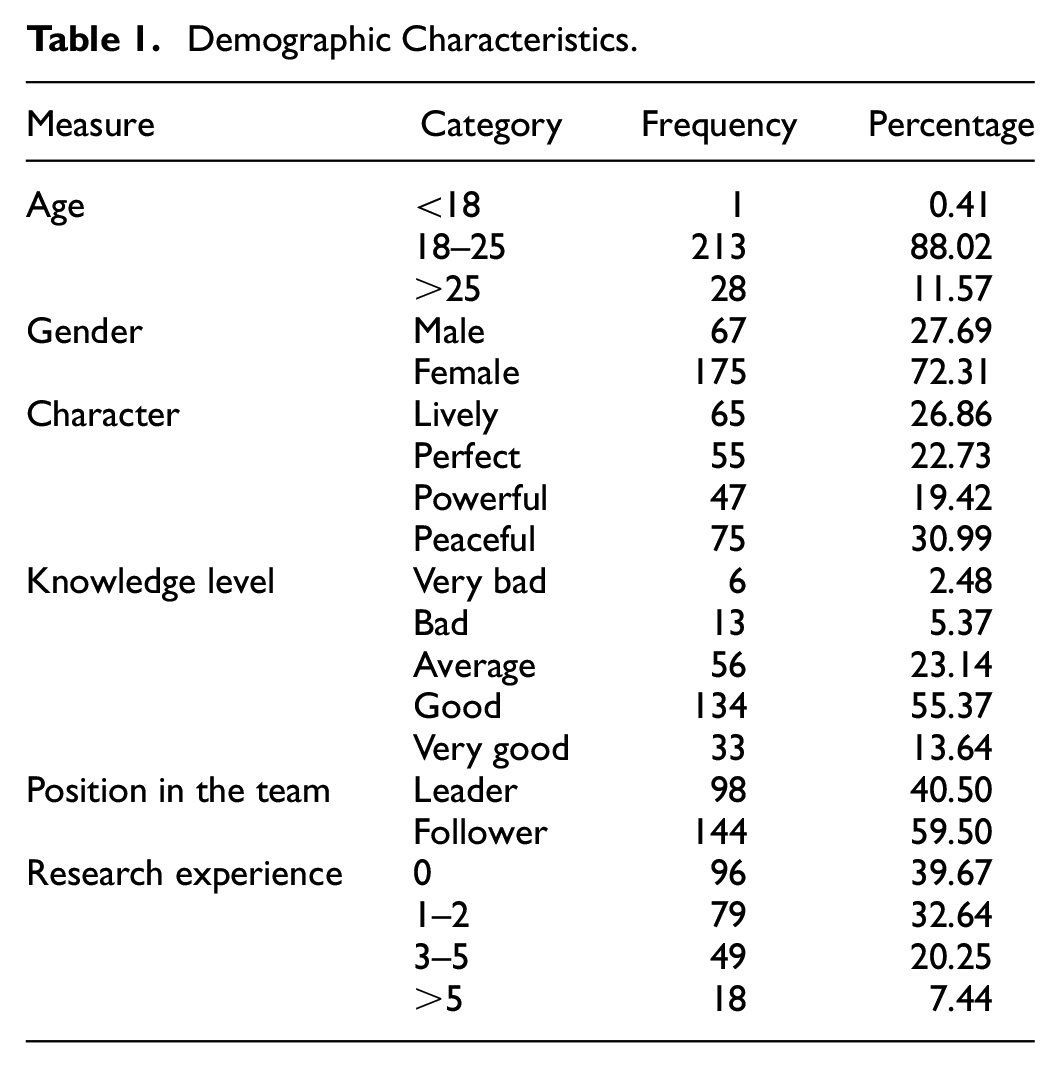
In total, 242 valid paired questionnaires collected in three stages were obtained after excluding the questionnaires with omissions and errors, with an effective rate of 88.32%. Demographic characteristics of 242 subjects in this paper are shown in Table 1. In general, individuals with undergraduate and postgraduate qualifications typically possess higher levels of education, which may be associated with greater cognitive abilities and creativity (Fan et al., 2021). Therefore, selecting this group can make it easier for the study to detect the influence of environmental factors on creativity, as they are more likely to exhibit creative traits (Fan et al., 2021). Consequently, this research focuses on the creativity of users with undergraduate and postgraduate qualifications in online community course learning. As shown in Table 1, respondents under the age of 25 dominate, and their levels of knowledge generally range from average to very high.
Demographic Characteristics.
Measures
The research variables of this paper were meticulously derived from an extensive review of relevant literature and then deconstructed into specific dimensions. A pre-survey facilitated the incorporation of valuable feedback, resulting in the removal of items with factor loadings below .6 and improvements to overall questionnaire clarity and readability (Dar & Jan, 2021; Sirin & Sen Dogan, 2021). Our approach to face validity involved both qualitative and quantitative assessments, ensuring the questionnaire’s refinement (Dar & Jan, 2021; Sirin & Sen Dogan, 2021). This comprehensive process ultimately yielded a final questionnaire tailored to the study’s primary focus on understanding the influence mechanism of user creativity in online learning communities. The resulting measurement tools demonstrate a high level of suitability for the study’s objectives and context, guaranteeing the quality and appropriateness of the measures.
Specifically, the scales employed in this paper were adjusted on the basis of the existing scales, so the validity and reliability could be guaranteed. The 5-point Likert Scale was used to assess items of the scales from strongly disagree to strongly agree (1 = strongly disagree, 5 = strongly agree). According to the method proposed by Brislin (1980), all measures were translated from English to Chinese through translation and back-translation procedures, and this paper corrected 6 words or phrases in the Chinese version that were different from the English version.
The above translation procedures make sure that the clarity and readability of the items are suit for participants to some extent. As for the modification and deletion of items, first of all, in order to make all the initial scales applicable to the research background of online learning community and meet the research purpose of this paper, this paper modified the semantic features of the items and deleted some items. Secondly, according to the questions and feedback reflected by the respondents in the pre-survey and face validity test, this paper further modified and deleted some items of the scales. Finally determined measurement items are presented in Table 2.
Finally Determined Measurement Items.

Social Presence
To measure social presence, this paper adopted the scale developed by Kim (2011). The Cronbach’s α for social presence is .894 (greater than the critical value .80), which means that this measure has a good internal consistency reliability (Perazzo et al., 2022).
Observational Learning
To measure observational learning, this paper adapted the scale developed by Tiberius and Sackin (1988). The Cronbach’s α for this measure is .914, which is greater than the critical value .80, indicating that the internal consistency reliability of this measure is rather good (Perazzo et al., 2022).
Self-efficacy
Self-efficacy was assessed using the scale developed by Chen et al. (2001). The Cronbach’s α for self-efficacy is .922, greater than the critical value .80, which indicates that the internal consistency reliability of this measure is quite good (Perazzo et al., 2022). Self-efficacy in this paper was measured using a general self-efficacy scale primarily for the following reasons. Firstly, generic self-efficacy scales are versatile and comparative, capable of measuring self-efficacy across different contexts, thereby providing universally comparable data that facilitate cross-disciplinary and cross-environment comparative research (Chen et al., 2001). Secondly, these generic self-efficacy scales are typically based on psychologist Albert Bandura’s self-efficacy theory, which posits that an individual’s self-efficacy is a relatively stable belief encompassing their assessment of their abilities in various situations (Poluektova et al., 2023). Therefore, generic self-efficacy scales have theoretical support for evaluating this broad belief (Chen et al., 2001). Additionally, this paper has adapted and adjusted these generic self-efficacy scales to better suit assessment within an online learning environment. These adaptations include adding, removing, and modifying items within the construct to more accurately reflect elements of creativity in online learning. Thus, generic scales become a feasible construct, providing crucial information about self-efficacy in online learning.
Intrinsic Motivation
To measure intrinsic motivation, this paper adopted the scale developed by X. Zhang and Bartol (2010). The Cronbach’s α for intrinsic motivation is .874, which is greater than the critical value .80, showing that the internal consistency reliability of this measure is pretty good (Perazzo et al., 2022)
Creativity
This construct was measured using the scale developed by Zhou and George (2001). The Cronbach’s α for the scale is .878, greater than the critical value .80, meaning that the internal consistency reliability of this measure is quite good (Perazzo et al., 2022). As the organizational context often encompasses scenarios where multiple team members collaborate together (L. Lee et al., 2023), this paper aims to investigate the impact of teams on user creativity, and thus, it has selected the construct developed by Zhou and George (2001) for measuring creativity. Additionally, this paper has adapted and modified the original construct to better suit the assessment within an online learning environment. Furthermore, this paper conducted construct validation during the pre-survey to establish the reliability and effectiveness of the construct within an online learning context (Roemer et al., 2022).
Scene Variables
As shown in Table 3, the three scene variables in this paper include challenging research discipline, level of team members, and incentive. Challenging research discipline refers to the difficulty of user research content in online learning community. The level of team members indicates the intensity of the competitive atmosphere in online learning community. Incentives means the external rewards that enable users in the online learning community to generate learning motivation. All the scene variables were measured by one question item.
Scene and Control Variables.

Control Variables
As shown in Table 3, in order to exclude other factors affecting individual creativity and get more accurate experimental results, this paper set up some pivotal control variables, such as age, gender, character, knowledge level, position in the team and research experience (the number of published papers or patents), which were measured with one item (Tierney & Farmer, 2002).
Data Analysis and Results
In this paper, SPSS 25.0 and AMOS 23.0 were used for data analysis, and research conclusions were drawn according to the analysis results.
The process of research data analysis was shown as follows. First, common method bias was tested, which could affect the reliability and validity of the study results. Secondly, the reliability and validity of the scales in this paper were analyzed to guarantee the internal consistency and credibility of the questionnaire. Finally, structural equation model (SEM) analysis was utilized to test the hypotheses proposed in this paper (Anthonysamy, 2021; Mailizar et al., 2021).
Common Method Bias Test
A factor analysis was performed to check for the common method bias. Since the questionnaire data in this paper came from the self-perception of respondents, there might be common method bias, which affected the reliability and validity of the study. Therefore, this paper tested the sample data for common method bias (Campanini, 2021). In this paper, a two-factor model was used to verify the common method bias, that is, a potential variable of the common method bias was added to the original confirmatory factor analysis model (Tzafilkou et al., 2021), and the changes of the model fitting degree were compared after the addition of the potential variable. The indexes of goodness of fit examined are Chi Square/Degree of Freedom (χ2/df), Comparative Fit Index (CFI), Incremental Fit Index (IFI), Tucker Lewis Index (TLI) and Root Mean Square Error of Approximation (RMSEA). The analysis results show that Δχ2 = 57.571 (df = 22), ΔCFI = 0.009, ΔIFI = 0.009, ΔTLI = 0.009, ΔRMSEA = 0.011, indicating that the data fitting degree of the model has not been significantly improved after controlling the common method factor, so there is not significant common method bias in the measurement.
Validation of Measurement Model
In this paper, internal consistency and composite reliability were used to test the reliability of variables, and the test results are shown in Table 4 which contain Factor Loading (FL), Cronbach Alpha Reliability Coefficient, Composite Reliability (CR) and Average Variance Extracted (AVE). As can be seen from Table 4, Cronbach alpha coefficient values of all scales are between .874 and .922, which confirms that the reliability of the scales are quite high since internal consistency of each variable is higher than the critical value .7 (Tsekoura et al., 2021). Moreover, composite reliability is effectively verified since the composite reliability values of all variables are between .874 and .923, which are greater than the critical value .7.
Reliability and Validity.

Validity test includes convergent validity test and discriminate validity test. Confirmatory factor analysis was used to test the convergent validity of the variables, and the results are displayed in Table 4. The factor loading of all items range from .623 to .922, greater than .600. In Table 4, it can be seen that AVE values of all variables are between 0.631 and 0.705, which are greater than the critical value 0.5 (Kianimoghadam et al., 2021). Furthermore, CR values of all structures are greater than AVE, which confirms convergence validity.
Moreover, the fitting index results of the measurement model in Table 5 also show that the model has a good fitting degree, which proves that the scales of relevant variables in this paper have high convergent validity. The discriminate validity is judged by comparing the square root of AVE with the correlation coefficient, and the results are presented in Table 6. The square root of AVE of each variable is greater than the correlation coefficient between the variable and other variables, indicating that the scale has discriminate validity. In conclusion, the data of this paper has good reliability and validity, which can be analyzed in the next step.
Values of Model Fit Indices.

Note. χ2/df = chi square/degree of freedom; CFI = Comparative Fit Index; NFI = Normed Fit Index; RMSEA = root mean square error of approximation; TLI = Tucker Lewis Index; IFI = Incremental Fit Index; GFI = Goodness of Fit Index.
Correlations Between Constructs.

Note. Diagonal values show the square root of AVE. Off-diagonal values show the correlations among the variables.
Validation of Structural Model
Model Path Test
In order to avoid the problems that the traditional linear regression method cannot deal with the latent variables effectively and the collinearity problem leading to the failure to explain the data analysis results, this paper adopts the SEM to conduct the analysis. SEM is known as a statistical technique for testing models, where causality and correlation relationships between the observed variables and the potential variables coexist (Anthonysamy, 2021; Mailizar et al., 2021). It can be seen from Table 5 that the seven fitting indexes of the structural model all meet the acceptable standard of the commonly used fitting indexes of SEM, indicating that the SEM constructed in this paper has a good fitting degree. Then, this paper tested the model hypotheses, and the test results of path hypotheses are shown in Tables 7, 8, and Figure 2.
Path Coefficients and Significant Results.

p < .05. **p < .01. ***p < .001.
Path Coefficients and Significant Results of Control Variables.


Path coefficients of the research model.
Meanwhile, as shown in Table 7, the corresponding effect size and power are also reported to confirm the practical significance of our research. The most commonly utilized measure of the strength of association between one dependent variable and multiple predictors is Pearson Correlation Coefficient (Pearson’s r), which can be directly used to describe the effect size (Sella et al., 2023).
Firstly, it can be seen from Table 7 and Figure 2 that learning team factors have a significant influence on self-efficacy and intrinsic motivation. Specifically, social presence has a significant positive effect on self-efficacy (β = .801, p < .001, effect size of Pearson’s r = 70.9%, a large effect size) and intrinsic motivation (β = .822, p < .001, effect size of Pearson’s r = 68.5%, a large effect size). Therefore, H1a and H1b are supported. Besides, observational learning positively affects self-efficacy (β = .158, p < .01, effect size of Pearson’s r = 30.6%, a medium effect size) and intrinsic motivation (β = .102, p < .05, effect size of Pearson’s r = 23.9%, a small effect size). Therefore, H2a and H2b are supported. Secondly, self-efficacy (β = .390, p < .001, effect size of Pearson’s r = 79.7%, a large effect size) and intrinsic motivation (β = .629, p < .001, effect size of Pearson’s r = 80.8%, a large effect size) have a significant impact on creativity. Therefore, H3 and H4 are supported. Finally, as shown in Table 8, control variables have no significant influence on creativity.
Next, a post hoc power analysis using G*Power was carried out with the above effect sizes (Pearson’s r), our total sample size of 242 participants, and an alpha level of .05 (J. Cohen, 1992) to compute the achieved power of this paper (Arunteja et al., 2022). As shown in Table 7, the power of H1 to H4 are all greater than the recommended value .8. Thus it can be seen that, the chances of Type II error in the hypothesis test are all quite small, indicating high probabilities of correctly rejecting the null hypotheses (Hesamian & Akbari, 2022).
Examination of Mediating Roles of Self-efficacy and Intrinsic Motivation
In order to test the mediating role of self-efficacy and intrinsic motivation, the PROCESS macro for SPSS provided by Hayes (2013) (with 5,000 bootstrap samples and 95% bias-corrected confidence intervals) was employed. Mediated effect sizes were also calculated (Turunc & Kisbu, 2023). The results presented in Table 9 show that the indirect effects of social presence through self-efficacy (effect = 0.226, boot SE = 0.056, 95% CI = [0.110, 0.330], effect size = 83.82%, a large effect size) and intrinsic motivation (effect = 0.283, boot SE = 0.046, 95% CI = [0.196, 0.372], effect size = 82.97%, a large effect size) on creativity are both significant. Furthermore, the direct effect (effect = 0.259, boot SE = 0.051, 95% CI = [0.194, 0.396], effect size = 74.9%, a large effect size) and the total effect (effect = 0.804, boot SE = 0.046, 95% CI = [0.714, 0.895], effect size = 86.78%, a large effect size) of social presence on creativity are significant. So self-efficacy and intrinsic motivation play a partial medium role between social presence and creativity.
Mediating Effect Results.

Note. LLIC is the 95% lower limit of the estimated value, ULIC is the 95% upper limit of the estimated value, *p < .05. **p < .01. ***p < .001.
The results in Table 9 show that the indirect effects of observational learning through self-efficacy (effect = 0.096, boot SE = 0.028, 95% CI = [0.045, 0.155], effect size = 56.12%, a large effect size) and intrinsic motivation (effect = 0.089, boot SE = 0.025, 95% CI = [0.043, 0.140], effect size = 54.64%, a large effect size) on creativity are both significant. The direct effect (effect = 0.043, boot SE = 0.028, 95% CI = [−0.012, 0.098], effect size = 29.3%, a large effect size) of observational learning on creativity is not significant, and the total effect (effect = 0.227, boot SE = 0.048, 95% CI = [0.133, 0.322], effect size = 84.94%, a large effect size) of observational learning on creativity is significant. Therefore, self-efficacy and intrinsic motivation play a full medium role between observational learning and creativity. The mediation analysis has confirmed that self-efficacy and intrinsic motivation indeed play a mediating role in the relationship between learning team factors and creativity.
Examining Moderating Effect of Scene Variables
To test the moderating effect of challenging research discipline, level of team members and incentive, this paper employed PROCESS again (with 5,000 bootstrap samples and 95% bias-corrected confidence intervals). The results are presented in Table 10 and Figures 3 to 5. Firstly, according to Model 3 (M3) in Table 10, the test result of “social presence × challenging research discipline” is β = .106, p < .05. The result shows that challenging research discipline has a significant positive moderating effect on the relationship between social presence and intrinsic motivation. H5 is supported. Besides, according to Model 3 (M3) in Table 10, the test result of “observational learning × level of team members” is β = .160, p < .05, which demonstrates that the level of team members has a significant positive moderating effect on the relationship between observational learning and self-efficacy. H6a is supported. Then, according to Model 3 (M3) in Table 10, the test result of “social presence × level of team members” is β = .146, p < .01, which indicates that the level of team members has a significant positive moderating effect on the relationship between social presence and self-efficacy. H6b is supported. It can be seen from Model 3 (M3) in Table 10 that the test result of “social presence × level of team members” is β = .098, p < .05. The result demonstrates that the level of team members has a significant positive moderating effect on the relationship between social presence and intrinsic motivation. H6c is supported. Finally, according to Model 3 (M3) in Table 10, the test result of “observational learning × incentive” is β = .144, p < .05. The result displays that incentive has a significant positive moderating effect on the relationship between observational learning and self-efficacy. H7 is supported. The effect sizes and the achieved power of the above moderation analysis are shown in Table 10 (Weiss et al., 2022), which are all greater than the critical value.
Moderating Effect Results.

p < .05. **p < .01. ***p < .001.

The moderating effect of challenging research discipline between social presence and intrinsic motivation.

The moderating effect of the level of team members. (a) The interaction effects of observational learning and level of team members on self-efficacy; (b) The interaction effects of social presence and level of team members on self-efficacy; (c) The interaction effects of social presence and level of team members on intrinsic motivation.
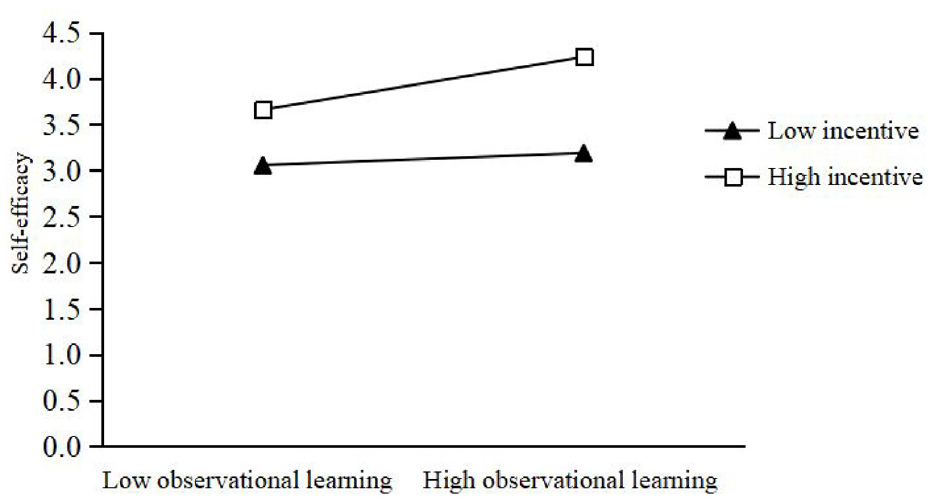
The moderating effect of incentive between observational learning and self-efficacy.
Discussion
By exploring the influence mechanism of user creativity in online learning community, this paper expects to improve the learning efficiency of online learning community users, and build an online learning community with creativity. The research results demonstrate that the research model proposed in this paper is effective, and the hypotheses are supported.
Firstly, this paper proves that learning team factors have a positive significant impact on creativity (shown in Table 7).
Social presence and observational learning have positive effects on self-efficacy and intrinsic motivation. The stronger the user’s sense of social presence is, the more the user can perceive himself as a “real person” in the online learning system, and it is easy to produce a sense of community and belonging. Enhancing the social interaction among learners can make users persevere without flinching when they are confronted with difficulties and challenges. In addition, users can generate a sense of pleasure and success in the process of solving problems. Users of online learning community can avoid mistakes and accumulate successful experience by observing the performance of other users in the learning team. The more learning experience users have, the more confident they will be when they are confronted with setbacks and challenges, and they will actively seek better solutions. (2) Self-efficacy and intrinsic motivation have positive effects on creativity. Individuals’ creativity is driven by internal psychology, which can be proved in previous studies (L. Wang et al., 2021). The stronger self-efficacy users have in online learning community, the more confident they will be, and thus the more creative motivation they will generate. Similarly, the feeling of success that users experience in an online learning community can stimulate their creativity. Therefore, in order to build creative online learning community, community managers should pay attention to the construction of learning teams and strengthen social interaction among community members. For example, community managers regularly post interesting topics in the discussion board to enhance interaction, so that users can have a sense of reality and belonging, which can promote the sustainable and stable development of the online learning community. In addition, managers can also initiate voting of outstanding users in the community, giving full play to the role of example demonstration and guidance, strengthening the self-building of role models, and making their demonstration function sustainable.
Secondly, self-efficacy and intrinsic motivation play a mediating role in the relationship between learning team factors and creativity. Among them, social presence can not only influence creativity through self-efficacy and intrinsic motivation, but also directly influence creativity. Observational learning influences creativity through self-efficacy and intrinsic motivation, which is shown in Table 9. Self-efficacy makes users generate strong expectations for themselves when facing learning tasks, so they believe that they can overcome difficulties and face the next challenges with confidence, which can stimulate individual creativity. Intrinsic motivation can bring excitement, satisfaction, sense of achievement and exciting experience to users in online learning community. Continuous stimulation of intrinsic motivation helps users to maintain a positive psychological state all the time and improve their creativity. Therefore, online learning community managers should not only enhance the construction of learning team, but also promote users to play their autonomy and subjective initiative, so that users can maintain a positive, upward and progressive faith, and give full play to the intellectual effect and maintain the enthusiasm for creation. For example, online learning community should provide timely feedback of learning results, and generate individual exclusive achievement reports, or establish modes of task, points, medal and so on.
Finally, the results also show that user creativity in online learning community is not only affected by learning team factors, but also moderated by environment variables (shown in Table 10 and Figures 3 –5), which can be described from three aspects: (1) Challenging research discipline positively moderates the relationship between social presence and intrinsic motivation. (2) The level of team members positively moderates the relationship between social presence and self-efficacy, the relationship between social presence and intrinsic motivation, and the relationship between observational learning and self-efficacy, respectively. (3) Incentive positively moderates the relationship between observational learning and self-efficacy.
Based on the above findings, this paper may safely draws the conclusion that appropriate learning difficulty can stimulate user creativity. For example, managers set up the mode of learning task level to make users feel challenged in the process of learning and using, and promote users to reach the optimal motivation level. In addition, it is valuable to select excellent members with initiative, then through their exemplary role to gradually drive the whole team to form a creative atmosphere. Therefore, community managers should strengthen the construction of team atmosphere and create a positive community learning environment, such as carrying out community users’ mutual evaluation to supervise and encourage each other. Finally, community managers should also mobilize users’ enthusiasm and creativity by means of external incentives. For example, the community can establish a membership system so that inventive users can enjoy the privilege of downloading high-quality resources to stimulate users’ sustainable creativity.
It should be noted that, the above findings and suggestions are mainly applicable to young users, since the number of participants in age category 18 to 25 constitutes 88.02% of the entire data set. But this does not affect the generalization and practical significance of our results because there exists the strong evidence that young people are major user groups of online learning communities (Goodyear & Quennerstedt, 2020).
Conclusion and Implications
Conclusion
With the rapid development of Internet technology, online learning community has broken the time and space limitations, and develops rapidly with the advantage of knowledge acquisition capacity and convenience, which attracts the keen attention of many researchers. However, most current studies focus on the efficiency and effectiveness of online learning, and there is a lack of research related to the user creativity in online learning community. Therefore, from the perspective of the influence of environmental factors such as the group members, this paper explores the impact of learning team factors on user creativity in online learning community, and proposes and tests the influence mechanism of user creativity in online learning community. According to the research results, learning team factors such as social presence and observational learning have positive effects on self-efficacy and intrinsic motivation under the moderation of challenging research discipline, level of team members, and incentive regulation, which make users full of enthusiasm for creation and stimulate their creativity.
Theoretical Implications
As a representative theory of social cognition theory, the triadic reciprocal determinism theory, which holds that individual behavior is the result of interaction among individual, behavior and environment, has been widely applied (Bandura, 1978). But the related studies only focus on the user cognitive behavior in traditional offline learning models, and the research on user creativity in online learning community is rare indeed. In addition, the existing Triadic Reciprocal Determinism theory only gives a rough structure, and lacks a cognitive behavior model that takes into account the impact of online environmental factors such as the difficulty of learning content and the group members.
Firstly, this paper contributes to facilitating the development of individual creativity theory. Individual creativity research formerly focused on creator’s individual performance, trait, thinking and ability (J. Zhang et al., 2020). Unlike the existing research, this paper focuses on the user creativity in online learning community and mainly discusses the impact of learning team factors on user creativity in online learning community.
Secondly, from the perspective of specific verified hypotheses, H1a emphasizes the role of social factors in shaping self-efficacy, providing a new perspective for understanding how learners gain confidence and overcome learning obstacles. H1b, on the other hand, underscores the potential role of social interactions and social support in fostering learners’ intrinsic motivation. What sets these two hypotheses apart is their incorporation of social presence into the framework of the Triadic Reciprocal Determinism theory, strengthening the role of social factors in individual learning and behavior. This broadens the applicability of the Triadic Reciprocal Determinism theory, making it more practically valuable in the context of online education and remote learning. Traditionally, the Triadic Reciprocal Determinism theory has primarily focused on individuals forming self-efficacy through their own experiences. However, H2a suggests that observing others successfully completing tasks or overcoming challenges can also enhance an individual’s belief in their own ability to succeed. This perspective broadens the pathways to self-efficacy formation, emphasizing the role of observational learning in the development of an individual’s self-efficacy. The innovation of H2b lies in its assertion that by observing others’ learning and behavior, individuals may be inspired, thus igniting their intrinsic motivation.
Finally, H6a implies that teamwork and interaction within a group may have a positive impact on enhancing individual self-efficacy. The innovation in H6b and H6c lies in emphasizing that in a team environment, the influence of social presence on an individual’s self-efficacy beliefs and intrinsic motivation may vary depending on the levels of team members. This further extends the applicability of the Triadic Reciprocal Determinism theory, applying it to team collaboration and learning contexts.
Practical Implications
The results of this paper prove the critical impact of learning team factors on user creativity in online learning community, and provide a constructive guidance for the future construction of vibrant and creative online community, in which creativity enthusiasm as well as user creativity can be fully stimulated. And accordingly, the stickiness and loyalty of users in online community can finally be enhanced, which is of great significance to improve the educational quality of online communities.
Limitations and Future Directions
This study has some limitations. First, the data were collected by using self-reported questionnaire, which might increase the possibility of common method bias. In order to eliminate this problem, the present research adopted a time-lagged design. However, this paper cannot completely avoid common method bias through this method. Thus, there is a need to collect data from multi information resources in the future research to further eliminate the potential influence of the common method bias.
Furthermore, this paper only focused on Chinese users, which represents a limited cultural background. Future research will investigate the mechanisms influencing user creativity within online learning communities across diverse cultural backgrounds. Different cultures may exert varying impacts on self-efficacy and intrinsic motivation, making a comparative analysis of user creativity within distinct cultural contexts an intriguing research avenue.
Lastly, this paper has not taken into consideration the impact of technological tools. Given the extensive use of online learning and collaborative tools such as virtual reality and artificial intelligence, future research will investigate how these tools influence social presence and observational learning, thus further impacting user creativity. This can encompass various platforms and technologies, exploring how their design features affect user creativity.
Footnotes
Authors’ Contributions
All authors contributed to the study conception and design. Material preparation, data collection and analysis were performed by Zhifang Wen. The first draft of the manuscript was written by Shugang Li and Lirong Zhu and all authors commented on previous versions of the manuscript. All authors read and approved the final manuscript.
Declaration of Conflicting Interests
The author(s) declared no potential conflicts of interest with respect to the research, authorship, and/or publication of this article.
Funding
The author(s) disclosed receipt of the following financial support for the research, authorship, and/or publication of this article: This work was supported by the Chinese National Natural Science Foundation (No. 71871135, 72271155).

Data Availability Statement
All data generated or analyzed during this study are included in this published article.