




Abstract
Although numerous studies have examined the direct association between academic stress and problematic smartphone use, the empirical evidences for the association are inconsistent. Also, the factors that can mediate or moderate the association remain underexplored. With the aim to address these knowledge gaps, based on 680 undergraduate students recruited from Universiti Teknologi Malaysia (UTM), this study has examined (1) the direct association between academic stress and problematic smartphone use, (2) the mediating role of escapism motivation on the association between academic stress and problematic smartphone use, (3) the moderating role of present hedonistic time perspective on the association between escapism motivation and problematic smartphone use, and (4) the moderating role of present hedonistic time perspective on the indirect association between academic stress and problematic smartphone use through escapism motivation. The findings have shown that (1) the association between academic stress and problematic smartphone use was not statistically significant, (2) the association between academic stress and problematic smartphone use was mediated by escapism motivation, (3) present hedonistic time perspective has positively moderated the association between escapism motivation and problematic smartphone use, and (4) present hedonistic time perspective has positively moderated the indirect association between academic stress and problematic smartphone use through escapism motivation. The current study identified escapism motivation and present hedonistic time perspective as the factors that can explain “how” and “for whom” academic stress causes problematic smartphone use and provided important practical implications for the intervention of problematic smartphone use among undergraduate students.
Plain Language Summary
This study investigated whether undergraduate students who face academic stress would be motivated to use smartphone for escape and whether they would continue using smartphones despite knowing its negative consequences. Additionally, this study explored whether those who prioritize present enjoyment without thinking about the future are more likely to continue using smartphones despite knowing its negative consequences, compared to those who exhibit less focus on present enjoyment and strong consideration of future consequences. Through questionnaire survey with 680 undergraduate students from Universiti Teknologi Malaysia (UTM), this study collected information on academic stress level, the extent to which they continue using smartphone despite knowing its associated negative consequences, the extent to which their smartphone use is motivated by the desire to escape from life problems, and the extent to which they focus on maximizing present enjoyment without reflecting on its future consequences. Subsequently, these data were statistically analyzed to address the questions highlighted above. This study found that students who face academic stress and are motivated to use smartphone for escape tend to repeat using even they have already recognized that it can cause adverse consequences. Also, among these students, those who prioritize present enjoyment without much concern for future consequences are more likely to repeat using smartphone than those who exhibit less focus on present enjoyment and strong consideration of future consequences. These research findings have provided insights into how to reduce the likelihood that undergraduate students repeat using smartphone when they have already recognized its negative consequences.
Keywords
Introduction
Due to the multifunctionality and portability of smartphones, users can easily spend an excessive amount of time utilizing specific features or engaging in activities such as social media or games. This behavior can lead to disruptions in their work or social obligations, subsequently resulting in negative consequences. Many smartphone users are aware of these repercussions of prolonged usage, yet consciously opt to continue investing a considerable amount of time in smartphone activities. This phenomenon is commonly referred to as problematic smartphone use (Elhai et al., 2017).
Within the existing body of literature, undergraduate students have been widely acknowledged as the social group most susceptible to problematic smartphone use (Ching et al., 2015; Forster et al., 2021; Z. Yang et al., 2019). Undergraduate students are in the early adulthood phase, typically aged between 18 and 25. As they enter university, they gain significant autonomy over their lives. As a result, some might struggle with self-regulation, often prioritizing immediate pleasure without considering potential negative consequences (Przepiorka & Blachnio, 2016). This behavior could account for their prolonged and problematic use of smartphone features (e.g., YouTube, social media, games) for instant gratification, despite being aware of the undesirable effects (Aljomaa et al., 2016; Long et al., 2016).
Problematic smartphone use has been associated with various adverse consequences, including impaired academic performance (Nayak, 2018), poor sleep quality (Xie et al., 2018), compromised interpersonal relationships (Chen et al., 2016), suicidal ideation (P. W. Wang et al., 2014), and diminished physical fitness (Kim, Kim et al., 2015). Given the widespread prevalence of problematic smartphone use among undergraduate students across different countries and its adverse outcomes, scholars have emphasized the need to identify both the risk factors and preventive measures concerning problematic smartphone use within this demographic (Aljomaa et al., 2016; Ching et al., 2015).
Literature Review
Association Between Academic Stress and Problematic Smartphone Use
Academic stress, which is characterized by negative affective states or distressing emotions arising from a perceived inability to cope with academic demands, is widely acknowledged as a prominent factor contributing to problematic smartphone use among undergraduate students (Chiu, 2014; J. H. Kim, 2021). The Compensatory Internet Use Theory (CIUT) provides a theoretical foundation for understanding the connection between academic stress and problematic smartphone use. CIUT proposes that individuals facing adverse life circumstances and psychological distress (e.g., stress, loneliness, depression), might use media and technology, including smartphones, as an escape (Kardefelt-Winther, 2014). Despite understanding the potential risks, this behavior frequently persists (Kardefelt-Winther, 2014).
According to CIUT, while turning to media and technology may alleviate emotional distress and offer momentary diversion, it is considered a dysfunctional coping mechanism (Kardefelt-Winther, 2014). This approach distracts individuals from confronting their real-life challenges, impeding the development of viable solutions and possibly leading to issues like missed academic deadlines or poor performances.
Building upon these premises, scholars contend that those facing life adversities or emotional distress and seeking solace in media are at a heightened risk of problematic technology use (Li et al., 2021; X. Shen & Wang, 2019). Specifically, students struggling with academic pressures appear especially susceptible to over-relying on smartphones (Chiu, 2014; B. Shen et al., 2021; J. L. Wang et al., 2020; Xu et al., 2019; Zhang et al., 2022).
Nonetheless, it is important to note that limited studies have specifically measured academic stress in relation to problematic smartphone use (B. Shen et al., 2021; J. L. Wang et al., 2020; Zhang et al., 2022). Existing empirical studies examining the connection between perceived stress and problematic smartphone use have predominantly utilized general or broad measures of stress (Arrivillaga et al., 2022; Gökçearslan et al., 2018; Liu et al., 2018; Peng et al., 2022; J. L. Wang et al., 2015; H. Yang et al., 2022; Zhao & Lapierre, 2020), such as the Perceived Stress Scale (PSS) (Cohen & Williamson, 1988) and the Depression, Anxiety, and Stress Scale (DASS) (Lovibond & Lovibond, 1995). These assessment tools capture stress from a generalized standpoint, as exemplified by items such as “how often have you felt that you were unable to control the important things in your life” and “how often have you felt nervous and stressed” in the PSS (Cohen & Williamson, 1988, p. 65), as well as “I found it difficult to relax” and “I was in a state of nervous tension” in the DASS (Lovibond & Lovibond, 1995, p. 339). Such tools might not fully encapsulate the specific stresses emanating from academic challenges that could spur problematic smartphone use.
In addition to its scarcity, existing empirical evidence presents mixed findings on the association between academic stress and problematic smartphone use. Notably, J. H. Kim (2021), J. L. Wang et al. (2020), Xu et al. (2019), and Zhang et al. (2022) identified a positive correlation between academic stress and problematic smartphone use, whereas Chiu (2014) and B. Shen et al. (2021) observed an insignificant connection. Based on the arguments highlighted in this section, this study addresses the necessity for further empirical investigation to verify the relationship between academic stress and problematic smartphone use.
Mediating Role of Escapism Motivation
Previous studies have consistently highlighted that the relationship between academic stress and problematic smartphone use is complex and mediated by intervening variables (J. L. Wang et al., 2020; Xu et al., 2019). Given that “a mediator specifies how, or the mechanism by which, a given effect occurs” (Ramayah et al., 2018, p. 193), scholars have posited that solely exploring the direct link between academic stress and problematic smartphone use may fail to uncover the underlying mechanisms. This insight prompts a need to pinpoint the mediating factors that elucidate “how” academic stress contributes to problematic smartphone use. Some researchers have delved into potential mediating factors in the association between academic stress and problematic smartphone use (B. Shen et al., 2021; J. L. Wang et al., 2020; Xu et al., 2019). For instance, Xu et al. (2019) and B. Shen et al. (2021) observed depression’s mediating role, while J. L. Wang et al. (2020) highlighted the mediation of psychological distress in the relationship between academic stress and problematic smartphone use. Yet, scholars maintain that the mechanisms of this association remain insufficiently explored, and thus advocate for further research to investigate these mediating factors (B. Shen et al., 2021; J. L. Wang et al., 2020; Xu et al., 2019).
In this regard, escapism motivation, defined as the inclination to use smartphones as a temporary refuge from real-life challenges and to mitigate associated distressing emotions (Xu et al., 2019), has emerged as a potential mediator in the connection between academic stress and problematic smartphone use (B. Shen et al., 2021; J. L. Wang et al., 2020; Xu et al., 2019). As explained in the previous section, scholars have consistently highlighted that: (1) individuals grappling with negative life circumstances or psychological distress (e.g., stress, loneliness, depression, anxiety) may be driven to employ media and technology (e.g., smartphones, video games, social media) for temporary escape; and (2) those motivated by escapism are prone to engage in problematic media and technology use (Li et al., 2021; X. Shen & Wang, 2019).
These assertions highlight the potential role of escapism motivation in bridging the connection between psychological issues (e.g., stress, loneliness, anxiety, depression) and problematic media and technology use (e.g., smartphones, video games, social media), which has indeed been corroborated by an array of empirical studies (Kim, Seo et al., 2015; Li et al., 2021; Maroney et al., 2019; X. Shen & Wang, 2019). For instance, Li et al. (2021) substantiated the significant mediating effect of escapism motivation in the relationship between loneliness and problematic smartphone use. Inspired by these findings, this study contends that there is a pressing need to empirically investigate the pivotal role of escapism motivation in establishing the link between academic stress and problematic smartphone use, which has remained unexplored in the current literature.
Moderating Role of Present Hedonistic Time Perspective
Scholars have repeatedly highlighted that students resorting to use smartphones as a temporary reprieve from academic stress tend to manifest problematic smartphone use. Nonetheless, it would be fallacious to generalize that all students behave similarly (X. Shen, 2020; J. L. Wang et al., 2020; Xu et al., 2019). Certain personal traits predispose individuals either toward or away from problematic smartphone use (Li et al., 2021; X. Shen, 2020). Hence, identifying individual attributes that can indicate “for whom” escapism motivation is more strongly or weakly connected to problematic smartphone use is pivotal (Li et al., 2021; X. Shen, 2020).
Building upon the notion that a “moderation effect” explains when or for whom an independent variable exerts a more pronounced influence on a dependent variable (Wu & Zumbo, 2008, p. 370), several researchers have scrutinized personal attributes as potential moderators in this dynamic. Notably, X. Shen (2020) identified the moderating role of psychological resilience, while Li et al. (2021) emphasized self-control’s moderating influence on this relationship. Despite the existence of these studies, the moderating role of individual traits on relationship between escapism motivation and problematic smartphone use remains underexplored, which calls for more research in this area (Li et al., 2021; X. Shen, 2020).
The concept of present hedonistic time perspective, defined as the inclination to habitually prioritize immediate enjoyment (Zimbardo & Boyd, 1999), emerges as an individual attribute that can potentially moderate the relationship between escapism motivation and problematic smartphone use. According to Social Cognitive Theory (Bandura, 1999), individuals retain control over their own behavior rather than passive actors driven by external stimuli or immediate rewards. Their behaviors are dictated by their personal goals, beliefs, and values, which shape their life pursuits and inform their judgments about appropriate actions. Thus, individuals consciously choose to engage more in behaviors that align with their life pursuits and abstain from behaviors that deviate from these pursuits.
Supporting this, individuals exhibiting pronounced present hedonistic tendencies likely give precedence to immediate rewards, often overlooking potential future repercussions (Zimbardo & Boyd, 1999). Since problematic smartphone use epitomizes a pursuit of instant gratification without foresight of consequences, those with high present hedonistic tendencies may be especially vulnerable (J. Kim et al., 2017; Koós et al., 2022; Li et al., 2021). This predisposition may compel them to indulge in media and technology, like smartphones, for immediate relief, disregarding potential long-term consequences. Empirical evidence, such as the study by Koós et al. (2022) exploring the impact of present hedonistic time perspective on problematic pornography use, echoes this theory.
In consideration of the insights outlined above, this study asserts that a student’s level of present hedonistic time perspective could potentially influence whether he/she engages in problematic smartphone use as a means of temporary escape from academic stress. This boundary condition remains underrepresented in empirical research, necessitating an empirical examination of the moderating effect of present hedonistic time perspective on the association between escapism motivation and problematic smartphone use, as well as the indirect link between academic stress and problematic smartphone use through escapism motivation.
Research Objectives and Hypotheses
Building on the discussions in previous sections, a moderated mediation model was developed in this study to examine: (RO1) the direct association between academic stress and problematic smartphone use; (RO2) the mediating effect of escapism motivation on the association between academic stress and problematic smartphone use; (RO3) the moderating effect of present hedonistic time perspective on the association between escapism motivation and problematic smartphone use; and (RO4) the moderating effect of present hedonistic time perspective on the indirect association between academic stress and problematic smartphone use through escapism motivation. Accordingly, hypotheses were developed to be tested, as follows: (H1) academic stress is positively associated with problematic smartphone use; (H2) escapism motivation mediates the association between academic stress and problematic smartphone use; (H3) present hedonistic time perspective positively moderates the association between escapism motivation and problematic smartphone use; and (H4) present hedonistic time perspective positively moderates the indirect association between academic stress and problematic smartphone use through escapism motivation. These relationships are graphically depicted in the moderated mediation model in Figure 1.

Proposed moderated mediation model.
Methods
Sampling and Data Collection Procedures
Undergraduate students from Universiti Teknologi Malaysia (UTM) were targeted as the research population in this study. Using proportionate stratified random sampling, samples were drawn from nine UTM faculties according to the ratio of each faculty’s undergraduate student number to the total undergraduate student number in the university. This sampling method allowed the researchers to match the proportion of undergraduate students by faculty and thus generate a representative sample for better generalizability to the undergraduate student population (Saunders et al., 2016).
The undergraduate office of each faculty was first contacted in order to obtain their subject lists and class schedules, from which the classes to draw samples from were randomly selected. Subsequently, a complete student name list of the selected classes was obtained from the corresponding undergraduate office, and 20 students were randomly selected as samples from each name list. Following these procedures, 700 self-administered questionnaires were yielded. However, 20 of them were identified as outliers (refer to Section “Sampling and Data Collection Procedures” for more details) and discarded. Thus, 680 valid responses were retained for further analysis (refer to Table 1 for the demographic profile of the respondents).
Demographic Profile of Respondents.

According to Saunders et al. (2016), a sample size of 300 is generally sufficient to represent a large population. Furthermore, given the fact that there are 14,706 undergraduate students in UTM, Krejcie and Morgan’s (1970) guideline states that a sample size of 375 can effectively represent this population. Furthermore, Hair et al. (2019) argued that a sample size of 400 is generally required for social science research to generate findings with adequate statistical power. Lastly, to ensure sufficient statistical power, a priori power analysis was also conducted with G*Power software. The minimum sample size calculated was 124 (f2 = 0.15, α = .05 and Power = 0.95) (Faul et al., 2007). Building on the recommendations above, this study’s 680 usable samples were deemed sufficient to represent the undergraduate students of UTM and produce findings with good statistical power.
Measures
All measurement scales employed in this study derive from validated scales developed in previous studies and published in prestigious journals. Some minor changes were made to the original measurement items to suit the context of this study. Expert reviews from two experts in educational psychology affirmed the validity and relevance of the measurement scales. Feedback regarding ambiguous terms and grammatical errors were promptly addressed.
The measurement instrument was also pretested with five undergraduate students from UTM, who reported that all instructions and questions were clear and understandable. Subsequently, a pilot test with 100 undergraduate students from UTM was conducted. The results further confirmed that the instrument was well designed, relevant, precise, unambiguous, and fully understood by the respondents. All the constructs also demonstrated good reliability scores (Cronbach’s alpha = .946 for academic stress, .932 for escapism motivation, .939 for problematic smartphone use, .957 for present hedonistic time perspective) in the pilot test. The measurement items are presented in Appendix 1.
Academic Stress
Academic stress was measured using items adapted from the 10-item PSS (Cohen & Williamson, 1988), which has been demonstrated as a valid, reliable, and widely used scale. PSS captures the extent to which individuals feel psychologically distressed by life situations that are burdensome and beyond their ability to cope (Cohen & Williamson, 1988; Lee, 2012). However, as highlighted by Lee (2012), the PSS takes a general view of stress and does not reflect the stressful feelings arising from situations in a specific domain. To cater the scale to the academic milieu, modifications were made based on guidelines from Sheu et al. (2014). For instance, terms like “schoolwork” or “in your academic life” were integrated or substituted for more generic terms. A detailed comparison of the original and revised items can be found in Appendix 1. The PSS is composed of six positively worded items (AS1, AS2, AS3, AS6, AS9, AS10) and four negatively worded items (AS4, AS5, AS7, AS8) rated on a 5-point scale ranging from 1 (never) to 5 (very often). Before proceeding to data analysis, the responses for the negatively worded items were all reverse-coded.
Escapism Motivation
Escapism motivation was measured with items adapted from the five-item Escapism subscale of the Motivation for Smartphone Use Scale (J. H. Kim, 2017). Rated on a 7-point scale that ranges from 1 (strongly disagree) to 7 (strongly agree), this popular measure has been demonstrated as a valid and reliable scale to assess the extent to which individuals are motivated to use smartphones to temporarily escape life problems and regulate associated distress emotions (Fu et al., 2020; J. H. Kim, 2017; Li et al., 2021; Zhen et al., 2019). Original items from the scale were structured as incomplete sentences were revised into complete first-person statements for clarity. For example, “To forget worries and concerns” was recast as “I use my smartphone to forget worries and concerns.” Additionally, with the study’s focus on academic stress, as measured by the 10-item PSS—which references experiences in the past month—items from the Escapism subscale were tailored to capture escapism behaviors within the same timeframe and in relation to academic distress. For instance, the original statement “To make myself feel better when I feel down” was restructured to “In the last month, I have used my smartphone to improve my mood when I feel down due to academic problems.”
Problematic Smartphone Use
To gage problematic smartphone use, this study adapted the items from the Smartphone Addiction Scale-Short Version (SAS-SV) by Kwon et al. (2013). This scale assesses the extent to which individuals persist in using their smartphones even when aware of adverse consequences (Elhai et al., 2018; Harris et al., 2020). This 10-item scale, rated on a 6-point continuum from 1 (strongly disagree) to 6 (strongly agree), has been widely demonstrated as a valid and reliable scale. Accordingly, the total score ranges from 10 to 60, with a higher score indicating a greater level of problematic smartphone use. Additionally, a cut-off value has been set to distinguish between problematic and non-problematic smartphone users with males scoring 31 or higher and females scoring 33 or higher were classified as problematic smartphone users (Kwon et al., 2013). The original SAS-SV items were framed as incomplete sentences. For clearer understanding, these items were revised into complete statements beginning with first-person pronouns. Moreover, in line with the academic emphasis and time frame of PSS for measuring academic stress (Cohen & Williamson, 1988), the items in SAS-SV were similarly adjusted. For instance, “Using smartphone longer than I had intended” were fine-tuned to “In the past month, I have used my smartphone longer than I intended.”
Present Hedonistic Time Perspective
In this study, present hedonistic time perspective was measured using the 15-item present hedonistic subscale from the Zimbardo Time Perspective Inventory (ZTPI-56), which was rated on a 5-point scale labeled from 1 (very uncharacteristic) to 5 (very characteristic) (Zimbardo & Boyd, 1999). This scale has been demonstrated to be a valid and reliable scale widely used by researchers to capture the tendency to prioritize maximizing present enjoyment (Anagnostopoulos & Griva, 2012; Cretu & Negovan-Zbăganu, 2013; Zimbardo & Boyd, 1999).
Data Analysis Procedures
For data analysis, this study utilized the Statistical Package for the Social Sciences (SPSS) 20.0, Analysis of Moment Structures (AMOS) 23.0, and PROCESS MACRO software programs. First, the data underwent a series of cleaning processes, which encompassed outlier detection (Mahalanobis distance), assessment of non-normality (skewness and kurtosis), evaluation of multicollinearity (variance inflation factor, detection tolerance, and inter-construct correlation coefficients), and detection of common method bias (Harman’s one-factor test, and model fit of a hypothesized model with all items specified as a single factor in AMOS 23.0). Second, the study constructs’ descriptive statistics (i.e., mean and standard deviation) and correlations were generated. Applying the cut-off value established by Kwon et al. (2013), problematic smartphone users were also identified at this stage, along with the prevalence rate of problematic smartphone use.
Next, structural equation modeling (SEM) was conducted through AMOS 23.0 to evaluate the measurement model (model fit, convergent validity, discriminant validity, and composite reliability) as well as the structural model (model fit and path analysis of the association between academic stress and problematic smartphone use). Following this, mediation analysis was carried out using the bootstrapping technique in AMOS 23.0 to scrutinize the mediating effect of escapism motivation on the relationship between academic stress and problematic smartphone use.
Then, moderation analysis was executed through the PROCESS MACRO (Model 1) to investigate the moderating effect of present hedonistic time perspective on the link between escapism motivation and problematic smartphone use. Moreover, following Dawson’s recommendation (2014), this moderating effect was illustrated through an interaction plot.
Lastly, a moderated mediation analysis was conducted using PROCESS MACRO (Model 14) to explore the moderating effect of present hedonistic time perspective on the indirect association between academic stress and problematic smartphone use through escapism motivation. Notably, since the study constructs were assessed using instruments with varying scale points (e.g., 5-point, 6-point, 7-point), the latent scores of all constructs were standardized before the PROCESS MACRO analyses to mitigate the influence of scale point differences.
Results
Preliminary Analysis
First, outliers were identified through the Mahalanobis d2 test in AMOS. Based on the cut-off value (p < .005) suggested by Kline (2016), 20 outliers were identified and subsequently removed from the dataset. Next, the values of skewness and kurtosis for all the constructs were within the range of +3 to −3 and +10 to −10, respectively, indicating that the data was normally distributed (Kline, 2016). The multicollinearity diagnostics revealed that the values of detection-tolerance (TOL) and variance inflation factor (VIF) for all the constructs were acceptable (TOL > 0.10, VIF < 5) as well, while the correlations among the constructs were found to be lower than 0.70. These results confirmed that there was no multicollinearity issue in the data. Subsequently, common method bias was examined with Harman’s Single Factor test, which reported that the variance explained by the first factor was 40.9%. Since the value was lower than the maximum value of 50% proposed by Podsakoff and Organ (1986), common method bias was not detected. Further supporting that common method bias was not a problem in this study, a hypothesized model with all items specified as a single factor was found to have poor fit (CFI = 0.575; TLI = 0.552; RMSEA = 0.131; PNFI = 0.527; χ2/df = 12.702) (Malhotra et al., 2006).
Descriptive Analysis
Table 2 shows the mean and standard deviation values of all the constructs in this study (academic stress, escapism motivation, problematic smartphone use, and present hedonistic time perspective). The table also shows the constructs’ correlations, whereby all the constructs in this study were found to be significantly and positively correlated with each other (p < .01) except for escapism motivation and present hedonistic time perspective. Furthermore, based on the cut-off value (total score >31 for male and >33 for female) suggested by Kwon et al. (2013), 485 of the 680 undergraduate students who participated in this study were identified as problematic smartphone users; thus, the prevalence rate of problematic smartphone use was 71.3%.
Means, Standard Deviations, and Correlation Coefficients for the Study Constructs (N = 680).

Note. Min. = minimum; Max. = maximum; M = mean; SD = standard deviation; EM = escapism motivation; PHTP = present hedonistic time perspective; AS = academic stress; PSU = problematic smartphone use.
Correlation is significant at the .01 level (2-tailed).
Measurement Model Assessment
The reliability and validity of the measurement items was evaluated through confirmatory factor analysis (CFA). This analysis encompassed the assessments of measurement model fit, convergent validity, and discriminant validity. According to Hair et al. (2019), a measurement model is deemed to have good fit when it has: (1) normed chi-square (χ2/df) of less than 3.0; (2) root mean square error of approximation (RMSEA) of less than 0.08; (3) comparative-fit-index (CFI) exceeding 0.90; (4) Tucker-Lewis Index (TLI) exceeding 0.90; and (5) parsimony normed fit index (PNFI) of more than 0.50. Based on these criteria, the measurement model in this study was found to have good fit (χ2/df = 1.912; RMSEA = 0.037; CFI = 0.967; TLI = 0.965; PNFI = 0.879).
The convergent validity of the constructs in this study was examined based on the criteria proposed by Hair et al. (2019). Specifically, convergent validity is considered to be established if the factor loadings of all items are equal to or higher than 0.60, the average variance extracted (AVE) of each construct is higher than 0.50, and the composite reliability (CR) of each construct is higher than .70. As shown in Table 3, all factor loadings were found to be higher than 0.60, while the AVE and CR values were above the recommended thresholds of .50 and .70, respectively. Hence, convergent validity of the constructs was established. For discriminant validity, Hair et al. (2019) propose that discriminant validity is achieved if the variance shared between any two constructs (i.e., correlation) is lower than the squared AVE of each construct, and if the maximum shared variance (MSV) of each construct is lower than its AVE. As shown in Table 3, the squared AVE values of all constructs (diagonal entries in bold) were higher than their correlation with other constructs (off-diagonal entries), whereas the AVE values were higher than their respective MSV values. As such, the discriminant validity of all the constructs in this study was verified.
Results of Convergent and Discriminant Validity.

Note. PSU = problematic smartphone use; AS = academic stress; PHTP = present hedonistic time perspective; EM = escapism motivation; FL = factor loadings; CR = composite reliability; AVE = average variance extracted; MSV = maximum shared variance.
The diagonal entries (in Bold) represent the squared roots average variance.
The off-diagonal entries represent the variance shared between constructs.
Structural Model Assessment and Hypotheses Testing
The structural model of this study was found to have good fit (χ2/df = 1.970; RMSEA = 0.038; CFI = 0.963; TLI = 0.961; PNFI = 0.874). After establishing the model fit, the hypotheses were tested. First, the effect of academic stress on problematic smartphone use was found to be statistically insignificant (β = .04, t = 1.634, p > .05). Accordingly, H1 was rejected. Second, the mediating effect of escapism motivation on the association between academic stress and problematic smartphone use was examined with the bias-corrected bootstrapping technique. Using 2000 bootstrap samples, the 95% bias-corrected confidence interval (lower = 0.232, upper = 0.327) for the indirect effect of academic stress on problematic smartphone use through escapism motivation did not straddle a zero. This indicates that the association between academic stress and problematic smartphone use is significantly mediated by escapism motivation. Therefore, H2 was supported. To further understand the magnitude of this effect, this study employed Lachowicz et al. (2018) guidelines to compute v2, using the MedPower software developed by Kenny (2021). According to Kenny (2021), v 2 values of 0.01, 0.09, and 0.25 represent small, medium, and large indirect effects, respectively. The v2 value for the indirect effect of academic stress on problematic smartphone use through escapism motivation was 0.076, which points to a small effect size.
Third, the moderating effect of present hedonistic time perspective on the association between escapism motivation and problematic smartphone use was examined using the PROCESS MACRO (Model 1) developed by Hayes (2017). Hayes (2017) has highlighted that the existence of a moderating effect is confirmed if the interaction term in the regression model is statistically significant. In this study, the moderating effect of present hedonistic time perspective on the association between escapism motivation and problematic smartphone use was found to be statistically significant and positive (β = .038, p < .01). Subsequently, this moderating effect was plotted in a graph (as shown in Figure 2). The interpolation lines suggest that escapism motivation is more strongly associated with problematic smartphone use for undergraduate students with a high level of present hedonistic time perspective (one standard deviation above the mean) than those with a low level (one standard deviation below the mean). Based on these results, H3 was supported. To evaluate the magnitude of the moderating effect, the study computed the f2 value by using the Stats Tools Package developed by Gaskin (2016). According to Kenny (2016) and Ramayah et al. (2018), f 2 values of 0.005, 0.01, and 0.025 respectively represent small, medium, and large moderating effects. The f2 value for the moderating effect of present hedonistic time perspective on the association between escapism motivation and problematic smartphone use was 0.012, which implies a medium effect size.
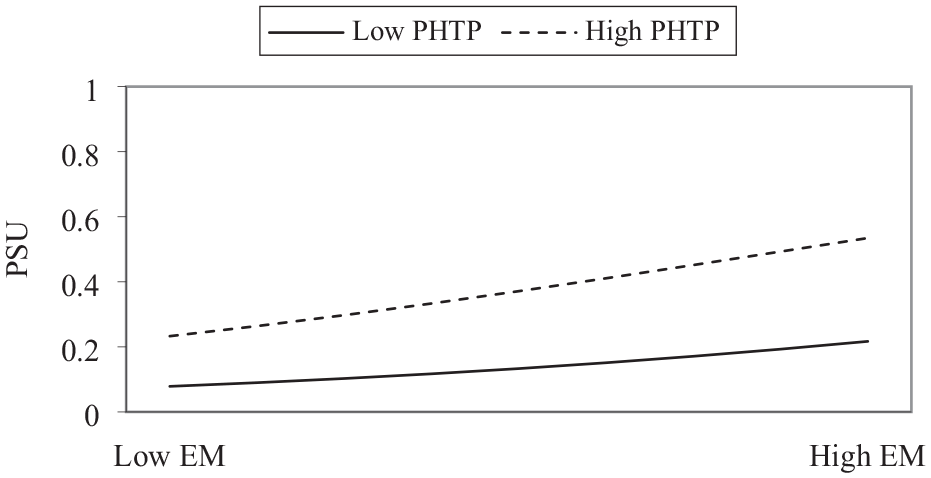
Moderating effect of present hedonistic time perspective.
Lastly, the moderating effect of present hedonistic time perspective on the indirect association between academic stress and problematic smartphone use through escapism motivation was examined with PROCESS MACRO (Model 14). Hayes (2017) has explained that the existence of a moderated indirect effect is confirmed if the bias-corrected 95% confidence interval of the moderated mediation index does not straddle a zero. As shown in Table 4, the bias-corrected 95% confidence interval of the moderated mediation index did not straddle a zero, indicating that the moderated indirect effect of academic stress on problematic smartphone use through escapism motivation is significant. This means that the indirect effect of academic stress on problematic smartphone use through escapism motivation varies across different levels of present hedonistic time perspective. Specifically, the indirect effect is stronger for undergraduate students with a higher level of present hedonistic time perspective. Based on these findings, H4 was supported.
Moderated Mediation Analysis.

Note. PHTP = present hedonistic time perspective; AS = academic stress; PSU = problematic smartphone use; CI = confidence intervals; SE = standard error; M = mean; SD = standard deviation.
Discussion
This study has empirically tested a moderated mediation model to shed light on “how” academic stress causes problematic smartphone use and “for whom” academic stress is more strongly associated with problematic smartphone use. The findings on these two objectives are discussed in the following subsections.
Relationship between Academic Stress, Escapism Motivation, and Problematic Smartphone Use
The association between academic stress and problematic smartphone use has been subject to multiple investigations in prior studies (Chiu, 2014; J. H. Kim, 2021; B. Shen et al., 2021; J. L. Wang et al., 2020; Xu et al., 2019; Zhang et al., 2022). However, the findings from these studies present inconsistencies; while some studies have reported statistically significant positive direct associations between academic stress and problematic smartphone use (J. H. Kim, 2021; J. L. Wang et al., 2020; Xu et al., 2019; Zhang et al., 2022), others have found the direct association to be statistically insignificant (Chiu, 2014; B. Shen et al., 2021). With the objective of providing supplementary empirical evidence to validate the link between academic stress and problematic smartphone use, this study undertook an examination of the direct association between these two factors.
In line with the findings of Chiu (2014) and B. Shen et al. (2021), this study discovered that the direct association between academic stress and problematic smartphone use is statistically insignificant. However, it is important to note that this study does not conclude that academic stress is irrelevant to problematic smartphone use. Some scholars have suggested that the relationship between academic stress and problematic smartphone use might not be straightforward and could be explained by other variables (Chiu, 2014; B. Shen et al., 2021; Xu et al., 2019; J. L. Wang et al., 2020). For instance, Chiu (2014) and B. Shen et al. (2021) found that the association between academic stress and problematic smartphone use is mediated by factors such as social efficacy and depression. Aligning with these findings, this study has identified escapism motivation as the mediator linking academic stress to problematic smartphone use. This discovery corresponds with existing research that has highlighted the significant mediating effect of escapism motivation on the relationship between psychological issues (e.g., loneliness, depression, anxiety, stress, and psychological distress) and problematic media/technology use (e.g., video games and smartphones) (Kim, Seo, et al., 2015; Li et al., 2021; Maroney et al., 2019; X. Shen & Wang, 2019). This outcome lends empirical support to the CIUT, which posits that individuals facing negative life situations and psychological distress would be inclined to use specific media/technology like smartphones as a means of temporary escape and emotion regulation, possibly leading to problematic use.
Collectively, this study’s findings highlight escapism motivation as the underlying mechanism that elucidates “how” academic stress leads to problematic smartphone use. Academic stress indirectly contributes to problematic smartphone use by motivating students to use smartphones as a temporary escape from academic challenges and as a way to manage their associated negative emotions.
The Moderating Role of Present Hedonistic Time Perspective
Although the findings of this study have demonstrated that students who are motivated by academic stress to use smartphones for temporary escape are inclined to engage in problematic smartphone use, the study also posits that not all students share an equal likelihood of engaging in problematic smartphone use. Specifically, this study has revealed that both the association between escapism motivation and problematic smartphone use and the indirect association between academic stress and problematic smartphone use through escapism motivation are positively moderated by present hedonistic time perspective. These findings underscore the notion that among students who resort to smartphone usage for a temporary escape from academic stress, those with a higher level of present hedonistic time perspective exhibit a greater tendency to engage in problematic smartphone use compared to those with a lower level of present hedonistic time perspective.
These results lend empirical support to the Social Cognitive Theory, which posits that individuals deliberately select behaviors that align with their life pursuits and values while avoiding behaviors that deviate from those pursuits (Bandura, 1999). In this context, present hedonistic time perspective emphasizes the pursuit of immediate enjoyment. Individuals with a higher level of present hedonistic time perspective are more inclined than others to prioritize immediate gratification without considering its future consequences (Zimbardo & Boyd, 1999). As a result, when confronted with behaviors that can fulfill their needs (e.g., playing online games on smartphones to fulfil the need for stress relief), individuals with a high level of present hedonistic time perspective are more likely to repeatedly engage in such behaviors, even when they recognize the potential adverse implications (i.e., problematic behavior) (Borisenkov et al., 2022; Koós et al., 2022; Unger et al., 2018). Indeed, aligning with the findings of this study, previous research has demonstrated a positive relationship between present hedonistic time perspective and various problematic behaviors, including problematic eating behavior (Borisenkov et al., 2022), problematic pornography use (Koós et al., 2022), problematic alcohol use (Loose et al., 2018), and problematic cannabis use (Apostolidis et al., 2006).
Taken together, these findings highlight present hedonistic time perspective as a potential risk factor for problematic behaviors, including problematic smartphone use. This empirical evidence supports the concept that present hedonistic time perspective can influence the likelihood and extent to which students, driven by academic stress to use smartphones as an escape, engage in problematic smartphone use. Building upon these concepts and corroborating the work of Xu et al. (2019), J. L. Wang et al. (2020), and B. Shen et al. (2021), this study identifies present hedonistic time perspective as a factor that can elucidate “for whom” the association between academic stress and problematic smartphone use is more or less pronounced.
Conclusion
Based on the findings delineated above, this study has not only identified escapism motivation as the mechanism through which academic stress contributes to problematic smartphone use but has also unveiled that the level of present hedonistic time perspective can reasonably elucidate “for whom” the association between academic stress and problematic smartphone use is more significant. These insights offer valuable guidance on how to mitigate the risk of problematic smartphone use among undergraduate students. First, given that escapism motivation has been established as the driving force linking academic stress to problematic smartphone use, it is imperative to consider two essential components when developing intervention programs: (1) offering students viable avenues for stress relief (e.g., exercise or entertainment facilities) and (2) educating them on effective strategies to cope with academic stress. Rather than seeking escape from academic challenges, students should be empowered to confront these issues and devise solutions. By addressing these factors, it is possible to curb the motivation of stressed students to turn to smartphones as a temporary escape, thereby reducing their susceptibility to problematic smartphone use.
Second, as discussed in the previous sections, the study has provided empirical support for the idea that among students who resort to smartphone usage for temporary relief from academic stress, those possessing a higher level of present hedonistic time perspective are more likely to engage in problematic smartphone use. Recognizing time perspective as a malleable individual attribute (Sword et al., 2015), it is feasible to explore psychological interventions that target the reduction of present hedonistic time perspective. For instance, employing time perspective therapy—an extension of cognitive behavioral therapy—may provide a viable option for intervening in problematic smartphone use among undergraduate students. Such an approach could suppress the tendency to prioritize immediate gratification without considering future consequences, ultimately decreasing the risk of problematic smartphone use
Limitations and Suggestions for Future Research
Despite these valuable contributions, the study has certain limitations. First, its cross-sectional nature means that all data was collected simultaneously, preventing inferences about the direction of causal relationships among the variables. Future research can enhance the literature by adopting a longitudinal design to discern the direction of causality. Second, the study’s samples consisted solely of undergraduate students from UTM, limiting the generalizability of findings to undergraduates in other contexts (e.g., other universities, countries) or to different age groups (e.g., primary/secondary school students). Future studies can contribute by replicating these findings with undergraduate students from diverse universities/countries or other student groups. Lastly, the reliance on self-reported questionnaires for data collection introduces the possibility of social desirability bias. Respondents tend to select answers they believe to be socially preferable, rather than reflecting their true thoughts or emotions. This could lead to the underreporting of socially undesirable attributes or behaviors, such as smartphone addiction or escapism motivation. Future research could verify the robustness of the findings by utilizing third-party observations (e.g., parents, peers) as an alternative data source.
Footnotes
Appendix
Measurement Items.

| Problematic smartphone use | |
| PSU1 | In the last month, I have missed planned work due to smartphone use. |
| PSU2 | In the last month, I have had a hard time concentrating in class or while doing assignments due to smartphone use. |
| PSU3 | In the last month, I have felt pain in the wrists or at the back of the neck while using smartphone. |
| PSU4 | In the last month, I could not stand not having my smartphone. |
| PSU5 | In the last month, I have felt impatient and fretful when I am not holding my smartphone. |
| PSU6 | In the last month, I have had my smartphone in my mind even when I am not using it. |
| PSU7 | In the last month, I could not give up using my smartphone even when my daily life was already greatly affected by it. |
| PSU8 | In the last month, I was constantly checking my smartphone so as not to miss conversation between other people on social media sites(e.g., Facebook, Instagram, WhatsApp, WeChat). |
| PSU9 | In the last month, I have used my smartphone for longer than I intended to. |
| PSU10 | In the last month, people around me told me that I use my smartphone too much. |
| Academic stress | |
| AS1 | In the last month, how often have you been upset because of something that happened unexpectedly in your academic life? |
| AS2 | In the last month, how often have you felt that you were unable to control important things in your academic life? |
| AS3 | In the last month, how often have you felt nervous and stressed because of your schoolwork? |
| AS4 | In the last month, how often have you felt confident about your ability to handle your schoolwork? |
| AS5 | In the last month, how often have you felt that things in your academic life were going your way? |
| AS6 | In the last month, how often have you found that you could not cope with your academic life? |
| AS7 | In the last month, how often have you been able to control irritations in your academic life? |
| AS8 | In the last month, how often have you felt that you were able to manage your academic life? |
| AS9 | In the last month, how often have you been upset because your academic life were out of your control? |
| AS10 | In the last month, how often have you felt your schoolwork were piling up so high that you could not overcome them? |
| Escapism motivation | |
| EM1 | In the last month, I have used smartphone to feel less stressful. |
| EM2 | In the last month, I have used smartphone to make myself feel better when I feel down because of academic problems. |
| EM3 | In the last month, I have used smartphone to forget about schoolwork. |
| EM4 | In the last month, I have used smartphone to get away from academic problems. |
| EM5 | In the last month, I have used smartphone to forget about worries elicited by academic problems. |
| Present hedonistic time perspective | |
| PHTP1 | I believe that partying with my friends is one of the most important pleasures in my life. |
| PHTP2 | I do things impulsively. |
| PHTP3 | When doing my favorite things, I often lose all track of time. |
| PHTP4 | I try to live my life as fully as possible, one day at a time. |
| PHTP5 | Ideally, I would live each day as if it were my last. |
| PHTP6 | I make decisions on the spur of the moment. |
| PHTP7 | It is important to put excitement in my life. |
| PHTP8 | I feel that it’s more important to enjoy what you’re doing than to get work done on time. |
| PHTP9 | Taking risks keep my life from becoming boring. |
| PHTP10 | It is more important for me to enjoy life’s journey than to focus only on the destination. |
| PHTP11 | I take risks to put excitement in my life. |
| PHTP12 | I often follow my heart more than my head. |
| PHTP13 | I find myself getting swept up in the excitement of the moment. |
| PHTP14 | I prefer friends who are spontaneous rather than predictable. |
| PHTP15 | I like my close relationships to be passionate. |
Acknowledgements
We are grateful to the anonymous reviewers for their insightful suggestions and constructive comments. We deeply thank the editors for their patient work on our manuscript.
Declaration of Conflicting Interests
The author(s) declared no potential conflicts of interest with respect to the research, authorship, and/or publication of this article.
Funding
The author(s) received no financial support for the research, authorship, and/or publication of this article.
Informed Consent
Informed consent was obtained from all individual participants included in this study.

Data Availability Statement
Data will be made available upon reasonable request.