




Abstract
This study aimed to adapt the Measuring the Quality of Prison Life (MQPL) survey for the Serbian language and culture, considering cultural variations in the quality of prison life. Following established guidelines, the researchers employed two approaches to assess content validity: a panel of prison research experts and focus groups with prisoners. Content validity indexes were calculated at both the item and scale levels. Terminology, phrasing, and sentence structure were adjusted, including changes from passive to active voice, to better reflect the realities of Serbian prisons. The final version achieved conceptual, semantic, idiomatic, and experiential equivalence with the original MQPL. Initial findings indicate that the adapted survey effectively captures prison-specific issues relevant to the contemporary Serbian context. The cultural adaption process reveals both similarities and differences between the Serbian penal system and those of more developed nations, influencing prisoners’ perceptions of their quality of life. Further validation with larger samples is needed to evaluate its psychometric properties.
Plain Language Summary
The idea of a good life in prison might differ in different cultures. Our study looked at how prisoners in Serbia experience life in prison and aimed to adapt a survey to understand their feelings better. This survey is called Measuring the Quality of Prison Life (MQPL). We translated and changed the MQPL survey to fit Serbian culture and language. We got help from experts and prisoners to make sure the survey made sense. We changed the words and phrases to match how things are in Serbian prisons. After all these changes, the Serbian MQPL survey was similar to the original version. This survey can help us see specific problems prisoners face in Serbian prisons so we can improve prison conditions and the experiences and well-being of prisoners. However, our study had some limits. We talked to a small group of prisoners, and not all types of prisons were included. We need to conduct more research with more people to ensure that our survey works well.
Keywords
Introduction
The concept of prison life is complex, multifaceted and challenging to assess accurately. It comprises several key elements: the social environment, opportunities for purposeful activity, physical conditions of the facilities, safety and security, and factors affecting health and well-being. These elements collectively shape the quality of prison life. However, this quality can vary significantly depending on the context and individual perspective (Liebling et al., 2012). While individual quality of life reflects personal well-being and life satisfaction, prisoners’ experiences are shaped by broader societal views on the purpose of imprisonment (Ilijić et al., 2020, 2022; Liebling et al., 2012; WHOQOL Group, 1993).
The connection between the quality of life and rehabilitation in prisons is evident. A higher quality of prison life, along with improved personal satisfaction and psychological well-being among inmates, is associated with better responses to correctional treatment, reduced violence, and lower rates of re-offending (Auty & Liebling, 2020; Harding, 2014; Park, 2018; Skar et al., 2019). However, understanding the key dimensions of prison life is essential for assessing their cross-cultural universality (Ross et al., 2008). In the context of the Serbian penal system, which faces unique challenges such as overcrowding, high prison population rates, and specific well-being issues for prisoners (Aebi et al., 2022), a reliable tool for measuring the quality of life within prisons could provide valuable insights and support policy reforms.
Understanding Prison Quality of Life: Theoretical Frameworks, Perspectives, and Concepts
The theoretical framework for prison quality of life research is grounded in various concepts and perspectives. A key aspect of this framework is the concept of ‘moral performance’ in prisons, as developed by Liebling (2004, 2011, 2014). This concept, closely tied to the quality of prison life, centers on prisoners’ perceptions of their treatment. It strongly emphasizes the interpersonal aspects of prison life, such as staff-prisoner relationships, fairness, safety, respect, and opportunities for personal development. These factors are critical in shaping prisoners’ experiences and well-being, often more than physical conditions and material goods (Auty & Liebling, 2024).
Although not originally focused on prisons, Social Climate Theory, developed by Moos (1968, 1970), examines how individuals perceive their social environment and its impact on their behavior, attitudes, and well-being. This theory highlights interpersonal relationships, personal growth, and system maintenance and its change (Wenk & Moos, 1972). Applied to the prison context, it provides a broader foundation for understanding how the social environment influences inmates’ quality of life. It recognizes prisons as complex social systems with multiple dimensions, including the overall experience of living and working within the institution (Ajdukovic, 1990; Gonzales et al., 2023; Mejovšek et al., 2007).
Furthermore, the concept of ‘liveability’ offers valuable insight into how environments meet their inhabitants’ physical, social, and psychological needs, supporting a good quality of life. It encompasses factors such as safety, health, access to resources, social interactions, and a sense of community (Stephens et al., 2019). While not widely applied in the prison context, the principles of liveability are relevant to understanding prisoners’ experiences (Codd, 2020). A livable prison environment should ensure safety, hygiene, and access to healthcare, while also promoting positive social interactions, meaningful activities, and opportunities for personal growth. Research has shown that factors such as overcrowding, access to green spaces, and leisure facilities significantly impact inmates’ well-being and rehabilitation outcomes (Baggio et al., 2019; Moran et al., 2022; Skar et al., 2019; Stephenson et al., 2021; Walker et al., 2014). Changes in perceptions of liveability can also be reflected in measures of prison climate (Green et al., 2023).
The Human Rights Approach is equally important in prison research, as it highlights the importance of upholding human rights standards within correctional facilities. This framework aligns with the concept of prison quality of life and complements research on moral performance, social climate, and staff-prisoner relationships. It sets minimum standards for humane treatment, providing a benchmark for assessing prison conditions and ensuring that research addresses fundamental human needs such as healthcare, safety, and rehabilitation opportunities (Coyle & Fair, 2018; McCall-Smith, 2016).
The Importation Model, described by Irwin and Cressey (1962), and the Deprivation Theory, first outlined by Sykes and Messinger in 1958 (Sykes, 2007), laid the foundation for understanding prison quality of life. These models highlighted two key factors influencing inmate adaptation and well-being: pre-prison experiences, individual characteristics, and institutional conditions and deprivations.
A recently proposed framework, the Well-Being Development Model (WBDM), focuses on understanding and promoting holistic well-being across various contexts, including prisons (Pettus et al., 2021). It directly addresses psychosocial well-being, a core aspect of prison quality of life, and considers factors such as positive thinking patterns, meaningful activities, effective coping strategies, and healthy relationships. These elements contribute to an inmate’s overall well-being within the prison environment and their successful reintegration into society.
In contrast to the Deprivation Model, which centers on the negative aspects of prison environments, the WBDM takes a positive and solution-oriented approach by identifying factors that promote well-being. That way, the WBDM aligns with the concept of moral performance in prisons by emphasizing positive staff-prisoner relationships and personal development opportunities. It also complements the Human Rights Approach by addressing psychological needs alongside basic human rights.
Cross-Cultural Adaptation of Prison Quality of Life Measures: Frameworks and Applications
Adapting quality of prison life measures for cross-cultural research requires careful consideration of several key factors to ensure the tool accurately reflects the experiences of prisoners in different cultural contexts (Ross et al., 2008). The first factor to address is equivalence, which may involve adjusting the tool to account for cultural differences in expression. Additionally, the language and format must be culturally sensitive to avoid bias or misinterpretations. This step may involve replacing culturally specific terms, such as ‘decent’, with neutral terms free from historical or moral connotations (Neubacher et al., 2023, pp. 9–11).
Moreover, validating the adapted tool within the new cultural context is crucial by assessing its reliability, internal consistency, and construct validity. The successful development and application of a culturally valid Serbian version of the MQPL survey would mark a significant step toward understanding and improving the quality of life in the Serbian penal system.
To ensure that a measure is culturally sensitive and relevant across different cultural contexts, both the etic (universal) and emic (culture-specific) perspectives should be incorporated (Berry et al., 2011; Iliescu et al., 2024; Triandis, 2002). Although later critiqued and refined, Brislin’s Model of Cultural Adaptation remains a foundational step-by-step framework for considering universal and culture-specific aspects when adapting instruments across cultures. This model involves translation, back-translation, expert review, and pre-testing (Brislin, 1970; Jones et al., 2001).
For instance, Beaton et al. (2000) proposed guidelines that provide a systematic framework for adapting self-report measures across different cultural contexts. The process of cross-cultural adaptation includes several key steps. First, initial translation into the target language is conducted by multiple independent bilingual translators. Second, the translated versions are synthesized to create a harmonized version that accurately captures the original meaning of the items. An independent translator then back-translates the synthesized version into the original language.
Next, an expert committee reviews the translations. This committee, composed of experts with extensive experience in adapting measures across cultures, is responsible for resolving discrepancies, ensuring cultural relevance, and verifying the accuracy of the adaptation process. The adapted measure is then pre-tested with a small sample of the target population to assess comprehension, relevance, and cultural appropriateness. Finally, the fully adapted measure should be implemented in the target population.
While there are no specific theoretical perspectives solely focused on the cross-cultural adaptations of prison quality of life measurement tools, researchers can utilize existing frameworks, such as prison social climate (Ross et al., 2008), and apply principles of cross-cultural adaptation, as well as linguistic and conceptual equivalence, to modify instruments for use in prison populations. Additionally, it is important to note that most surveys assessing subjective prison climate have a limited conceptualization of the construct and lack adequate theoretical grounding (Bosma et al., 2020; Tonkin, 2016).
However, cross-system comparisons provide valuable insights into the consistency of dimensions and the impact of both cultural and systemic factors on post-release outcomes. Moreover, such comparisons can reveal broader patterns through extensive collaborative studies. Relational, valid and comprehensive measurement tools are essential to explore the dimensions of prison life and their cross-cultural relevance. Measuring prison quality of life can also support rehabilitation efforts by offering external controls for behavior guidance and identifying environmental factors that foster internal change and personal growth (Ross et al., 2008).
Various tools, including the Measuring the Quality of Prison Life (MQPL) survey, aim to capture the essence of prison life and social climate, providing insights into prison dynamics and the effects of imprisonment (Bosma et al., 2020; Liebling et al., 2012; Tonkin, 2016). The MQPL survey, developed using Appreciative Inquiry and a self-reported questionnaire approach, prioritizes respondents’ perceptions of the prison social climate rather than the researchers’ prior judgments of what is important (Liebling et al., 2012). This approach makes the MQPL survey particularly relevant in prison research, especially when combined with in-depth qualitative methods like those used in the ‘MQPL+’ approach (Auty & Liebling, 2024; Liebling et al., 1999).
Moreover, the MQPL survey has become a standard procedure in prisons across England and Wales (Tonkin, 2016), and has undergone cross-cultural adaptations in various countries (Barquín et al., 2019; Favril et al., 2017; Harding, 2014; Johnsen et al., 2011; Park, 2018; Skar et al., 2019). This widespread adoption underscores its usefulness as a tool for prison staff to assess policy effectiveness, make informed decisions, and foster a more positive and supportive environment.
In summary, this survey has multiple purposes, including identifying areas for improvement, monitoring changes over time, informing policy and program development, and comparing results across different prisons. By utilizing the MQPL, researchers and prison staff can collaborate to improve prisoners’ quality of life and promote their well-being (Barquín et al., 2019; Büsselmann et al., 2021; Johnsen et al., 2011; Skar et al., 2019; van Ginneken et al., 2018).
Prison Quality of Life in the Serbian Context
Compared to the European average, Serbia’s prison system is overcrowded, with 93.9 inmates per 100 detention places and 4.4 inmates per cell. The inmate-to-officer ratio exceeds European norms, while state spending per convict is lower. In 2020, Serbia’s prison population rate stood at 153.4 inmates per 100,000 inhabitants, placing it among the countries with a very high prison population rate in Europe. Serbian prisons have more than five guards per socio-educational worker (Aebi & Tiago, 2021).
The country experiences relatively short imprisonment, averaging 6.4 months in 2020, and low escape rates, with 0.0 escapes per 10,000 inmates in 2020, and 0.1 in 2019. However, concerns arise from the high prison mortality rate of 55 per 10,000 inmates, mainly attributed to suicides (7.6/10,000 inmates in 2020), indicating an urgent need for targeted interventions to enhance inmate well-being and mental health (Aebi et al., 2022; Aebi & Tiago, 2021).
Despite these challenges, Serbia has maintained a stable prison population rate from 2011 to 2021, with a modest overall increase of 1.5%. Notably, the prison population rate decreased by 4.1% in 2020 and 2021, in line with Europe’s decreasing trend due to COVID-19 measures (Aebi et al., 2022; Aebi & Tiago, 2021). Globally, Serbia ranks 107th out of 223 countries, reflecting a medium incarceration rate (Fair & Walmsley, 2021). Furthermore, the country’s moderate level of institutional imbalance positions it between the two extremes of economic and noneconomic institutional strengths, suggesting a moderate incarceration rate. The collectivistic-cooperative national culture serves as a buffer, mitigating the positive association between institutional imbalance and high incarceration rates (Weiss et al., 2020).
The history of the penal system in Serbia reflects various historical and institutional changes, influenced by broader social and political factors such as the breakup of Yugoslavia, regional wars, and shifts in government. Legislative changes over time, including the abolition of the death penalty in 2002 and the introduction of prison sentences ranging from 20 years to 40 years for the most severe crimes, along with the implementation of alternative sanctions, have profoundly impacted the system. These changes demonstrate a commitment to aligning with international standards (Jovanić et al., 2020).
However, the introduction of life imprisonment in 2019, which did not specify conditions for serving a sentence and prohibited conditional release for certain serious crimes, has drawn criticism. This raises concerns about compliance with European standards for prisoners’ rights and the principle of effective offender rehabilitation (Ilić, 2019).
The penal system in Serbia is characterized by various types of prisons, including open, semi-open, closed, and maximum security institutions. These facilities differ in security measures; open prisons feature minimal physical barriers to escape, while closed prisons employ high walls and surveillance systems. Inmates are classified into different treatment groups within these facilities based on their behavior and level of risk, which determines their corresponding benefits and privileges.
Despite the construction of new prisons, predominantly maximum-security facilities, and the introduction of alternative sanctions, challenges such as overcrowding, limited resources, and restrictive parole conditions persist, significantly impacting rehabilitation efforts (Ilić, 2019; Jovanić et al., 2020; Jovanić & Petrović, 2017).
Based on a modified Irish Progressive System, the Serbian penal system prioritizes the promotion of inmates through parole and rewards (Jovanić et al., 2020). The primary purpose of criminal sanctions, as outlined in the Law on Execution of Criminal Sanctions (2019, art. 2), is the ‘successful social reintegration of convicted persons’. More specifically, imprisonment in Serbia aims to equip individuals with the skills and support necessary for successful reintegration into society through tailored treatment programs, rather than simply serving a sentence. The adapted Offender Assessment System – OASys (Crawford, 2007; Home Office, 2002), the official tool for assessing risk, capacity for change, and needs of convicts, guides these programs. The OASys helps classify inmates based on their specific needs and risks, enabling individualized interventions and adjustments to the program as circumstances evolve (Ilijić, 2016; Jovanić et al., 2020).
To summarize, the penal system in Serbia faces several challenges, including overcrowded prisons, high rates of prison population, and a significant ratio of inmates per staff member (Aebi et al., 2022). Reports indicate that prison staff experience an increased workload due to a focus on risk management (Vujičić & Karić, 2020). Recent research highlights the specific well-being challenges encountered by prisoners in Serbia, particularly among female inmates and recidivists, suggesting a necessity to reassess intervention strategies (Batrićević et al., 2023; Ilijić et al., 2024; Milićević & Gojković, 2024; Stevanović et al., 2024). If implemented, ongoing research and policy reforms can be crucial in improving the efficiency and humanity of the penal system. In this context, the quality of prison life is recognized as a measure of its moral performance. However, despite the growing global interest in prison quality of life, this concept has largely remained unexplored in Serbian criminological research and penal practices (Ilijić et al., 2020; Milićević & Stevanović, 2024).
Developing a Culturally Valid Serbian Version of the MQPL Survey
The MQPL survey has the potential to guide informed policymaking and system improvement. However, cross-cultural adaptation and validity testing are necessary for its application in Serbia to ensure its reliability and consistency. These adaptations can provide a broader understanding of prison experiences across various countries. Still, evidence suggests that language barriers can complicate the transfer of the meaning of imprisonment experiences across cultures, regardless of the legal framework (Neubacher et al., 2023). Misinterpretations of concepts can pose challenges for researchers, affecting survey development, administration, interpretation, and comparability across different countries (Kelle, 2006; Stevelink & van Brakel, 2013). Therefore, adaptation must ensure both cultural and content validity (Beaton et al., 2000). Cultural validity addresses the quality of translation and cultural sensitivity (Solano-Flores, 2011), while content validity ensures an accurate representation of the construct being measured across cultures (Beaton et al., 2000; Yaghmaie, 2012).
This study aims to create a culturally and content-valid Serbian version of the MQPL survey. We will use a systematic and dynamic approach to translating and adapting the MQPL survey. This process includes translating the instrument into Serbian, undertaking a cultural adaptation process to ensure content validity, and conducting pre-testing to assess the comprehensibility and relevance of the Serbian version of the MQPL survey. Our findings can significantly contribute to global comparative research on the quality of prison life by demonstrating the transferability of the MQPL survey instrument across cultural contexts and providing insights into the unique aspects of prison life quality in Serbia.
Methods
Procedure
This study was conducted from March to May 2022 as part of a larger research project assessing the possibilities for improving the quality of prison life in Serbia, which involved the intended use of a Serbian MQPL survey with convicted persons. This research project was supported by the Science Fund of the Republic of Serbia, Grant No. 7750249. All procedures adhered to the ethical approval granted by the Ethics Committee of the Institute for Criminological and Sociological Research (No. 103/2020, 38c/2022, 274/22) and the 1964 Helsinki Declaration, along with its later amendments. The author of the original instrument provided formal authorization for its cross-cultural adaptation into Serbian (Alison Liebling, personal communication, January 8, 2020). Colleagues from the Cambridge Institute of Criminology’s Prisons Research Center provided support and guidance for the project on request.
Written informed consent was obtained from all prisoners participating in the focus groups. They were fully informed about the study’s purpose and content, as well as their right to withdraw at any time. Prisoners were also assured that their participation was entirely voluntary and would remain anonymous. They were informed that the information collected during the focus groups would be used solely for this research project and that no identifying information would be collected or disclosed.
Measures
The MQPL survey is a self-reported, questionnaire-based measure that consists of 126 statements (items), rated on a five-point Likert scale (1 = strongly agree, 3 = neither agree nor disagree, 5 = strongly disagree), along with one global question assessing the prisoners’ overall rating of the quality of prison life (1 = lowest, 10 = highest). To minimize acquiescence bias, 72 items are worded positively (where agreement with the statement indicates a positive response) and 55 negatively (where agreement indicates a negative perception). The items are organized into 21 dimensions, which are thematically clustered into five overarching categories representing treatment and physical conditions: Harmony, Professionalism, Security, Conditions and Family Contact, and Wellbeing and Development. A composite mean score is calculated for each category. The original English version has demonstrated good psychometric properties, with reliability scores ranging from 0.56 to 0.89 (Barquín et al., 2019; Harding, 2014; Johnsen et al., 2011; Liebling et al., 2012). The dimensions of the Serbian MQPL version have shown acceptable to good reliability, with Cronbach’s α ranging from 0.60 to 0.97 (Međedović et al., 2024).
Translation and Adaptation Process
The cross-cultural adaptation of the MQPL survey followed the internationally accepted guidelines (Beaton et al., 2000) and was conducted in five stages (Figure 1). A committee of three content experts was established, all with professional expertise in prison studies, quality of life research, and cross-cultural adaptation, and fluent in both English and Serbian. The informed translator was a researcher knowledgeable about the study’s subject matter and proficient in both languages. Two certified professional translators were hired as uninformed translators.
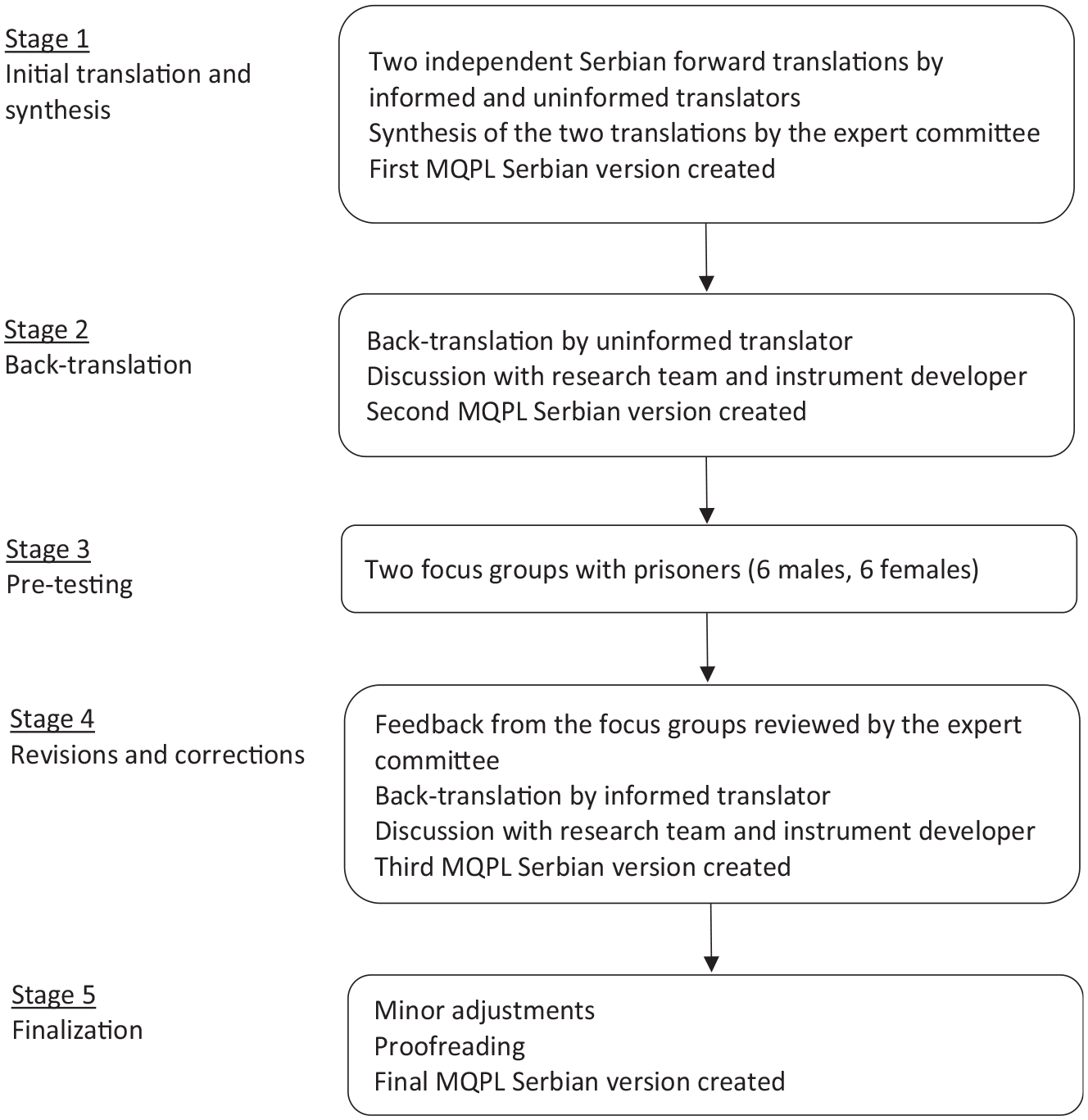
Flow chart of cultural and content validation of the Measuring the Quality of Prison Life (MQPL) survey for use in Serbia.
In Stage 1, the informed translator and one of the uninformed translators produced initial translations of the original MQPL survey into Serbian. The expert committee then reviewed and compared the two forward translations, synthesizing them into the first Serbian version. They selected the most appropriate translation for each sentence or provided alternate translations where the original versions were considered unacceptable at semantic, idiomatic, experiential or conceptual equivalence levels.
Stage 2 began with the back-translation carried out by the second uninformed translator. After discussions with the research group, the expert committee noted all discrepancies between the original version, the first Serbian version, and the professional back-translation. Clarification was sought from the survey author. Several sections were revised and retranslated into Serbian by the first uninformed translator, resulting in a new survey version. The expert committee approved this second Serbian version for preliminary evaluation through focus groups.
In Stage 3, the second Serbian version was pre-tested. Two face-to-face focus groups with convicted persons were conducted to identify ambiguities, irrelevant or compound items, and assess the clarity and comprehensibility of the language. Participants were invited to complete the survey item by item, assess its meaningfulness, and note any dilemma or raise a concern. A research assistant documented observations of the participants during MQPL completion (e.g., time spent, facial expressions, and verbal comments) for later use in interviews. The interview protocol included open-ended questions (e.g., Did the questions make sense? What was particularly difficult for you while completing the questionnaire? What did you find hard to understand? Which sentences were unclear to you?). The time taken to complete the MQPL ranged from 32 to 61 min, while the interviews, which were not audiotaped, lasted between 15 and 29 min.
In Stage 4, the expert committee revised the relevant parts of the survey based on aggregated participant feedback and discussion with the research team, resulting in the third Serbian version. The informed translator then conducted a back-translation of modified items.
In Stage 5, the expert committee consulted with the survey author to confirm the new wording. After final proofreading, the expert committee approved the fourth and final Serbian version of the MQPL survey.
Details of the revisions are specified in the results section. Any disagreements were resolved through consensus-based discussions.
Participants
Two 90-minute focus groups were conducted on a small sample of the target population: one group consisted of male prisoners (n = 6) and the other of female prisoners (n = 6). In Serbia, only a public prison system exists; therefore, the following two largest prisons were selected for this study: the Correctional Facility for Men in Sremska Mitrovica and the Correctional Facility for Women in Požarevac, which is the only dedicated facility for female convicts in Serbia.
Convenience sampling was employed to recruit participants. Eligibility criteria included voluntary with signed informed consent, serving more than 30 days of their prison sentences, and the ability to read and write in Serbia. While convenience sampling is a practical method, it is recommended to include a heterogeneous mix of wards and allow prison residents to respond anonymously to monitor the social climate within secure settings more effectively (Tonkin, 2016). To address this recommendation, a minimum of two participants were recruited from each prison ward (open, semi-open, and closed).
The study included 12 participants, with an average age of approximately 44 years (SD = 10 years; median value = 40 years; range 33–64 years). The average length of prison sentences was 6 years 4 months (SD = 6 years 3 months; median value = 3 years 3 months; range 2–20 years). Six participants had been incarcerated for 1 to 2 years, five for over 2 years, and one between 7 and 12 months. Two participants had previous convictions. In terms of main daytime activity, eight participants were employed, one was involved in education and vocational training, and two were participating in an offending behavior program. Four reported drug use before prison, while two had a history of psychiatric hospitalization and suicide attempts. All 12 participants received prison visits and maintained regular contact with their families, although eight mentioned that the prison was not close to their home area. No additional demographic or personal data were collected.
Analysis
For this study, we assessed translation equivalence and content validity (Milićević et al., 2023).
Assessment of Translation Equivalence
The translation process considered four types of equivalences (conceptual, semantic, idiomatic and experiential) in the items and response options to ensure adequate cross-cultural validity.
Conceptual equivalence refers to the meaning of words or phrases and the relevance of themes (Herdman et al., 1998; Kelle, 2006). When translating a measure, it is essential to ensure that the original construct is accurately represented in the target population. Addressing conceptual equivalence early in the adaptation process helps to avoid many operationalization and measurement issues, thereby justifying the instrument’s cross-cultural use (Kelle, 2006; Stevelink & van Brakel, 2013). Problems with conceptual equivalence arise when the expert committee or participants question the relevance of a concept or when there are discrepancies between the original and translated versions regarding the concept being evaluated (Beaton et al., 2000).
Semantic equivalence ensures that the meaning of the words, rather than their literal translation, is accurately conveyed in the translated version (Beaton et al., 2000). This process of transferring the essence of the content across languages begins with collaboration with the original instrument developer and continues through adherence to translation guidelines. It is important to address details such as the translation procedure, the meaning of key terms and phrases, and any issues or difficulties encountered during the translation (Stevelink & van Brakel, 2013). Semantic issues may arise when an item has multiple meanings, when there are grammatical difficulties in the translation, or when a term is not well understood by participants or fails to reflect the intended meaning. Expert should be able to identify discrepancies between the original and translated versions and suggest adjustments to ensure semantic equivalence.
The expert committee plays a crucial role in addressing idiomatic equivalence, which involves managing colloquialisms and linguistic expressions, as well as experiential equivalence, which ensures the relevance of individual items to the target population (Beaton et al., 2000). Their expertise is essential in identifying equivalent statements in the target language and modifying or replacing tasks or items that reflect situations unfamiliar or uncommon to participants (Beaton et al., 2000).
Assessment of Content Validity
Content validity refers to the extent to which a survey encompasses all the relevant elements necessary to represent the targeted concept (Cook & Beckman, 2006; Polit et al., 2007; Yusoff, 2019). In this study, content validity was assessed using both a quantitative approach (content validity index [CVI]) and a qualitative approach (experts’ feedback in the form of open-ended comments).
The analysis involved calculating the CVI for each item and the overall scale. Three experts individually rated each MQPL item on a four-point Likert scale (1 = non-equivalent item; 2 = item needs to be extensively revised so equivalence can be assessed; 3 = equivalent item, needs minor adjustments; 4 = totally equivalent item). The item-level CVI (I-CVI) was calculated as the proportion of experts rating the item as equivalent according to the formula: I-CVI = number of answers 3 or 4 divided by the total number of responses. The scale-level CVI (S-CVI) was calculated as the average I-CVI across all items.
The acceptable cut-off scores for I-CVI and S-CVI were set to 0.78 and 0.90, respectively (Polit et al., 2007; Polit & Beck, 2006). Any item with an I-CVI below the cut-off or rated by 1 or 2 was considered for removal or substantial revision. Qualitative feedback from the experts was used to guide the modification or removal of items.
Results
Table 1 presents the I-CVI and S-CVI data for the Serbian adaptation of the MQPL survey, focusing on Stages 1 (initial translation and first Serbian version), 2 (back-translation and revision), and 5 (final validation). Table 2 provides a comparison of the survey versions with the original instrument used during Stages 3 (pre-testing) and 4 (revisions based on feedback).
Item and Scale-Level Content Validity Index (I-CVI and S-CVI) for the Adaptation of MQPL to Serbian Versions.

Note: I-CVI – Item-level content validity index (the proportion of experts rating the item as equivalent); S-CVI – Scale-level content validity index (the average I-CVI across all 127 items).
Acceptable cut-off score for I-CVI was set to 0.78.
Acceptable cut-off score for S-CVI was set to 0.90.
Informed translator.
Uninformed translator.
The Comparison of the Original MQPL Survey, First Serbian Version and the Back-Translation.

Note: MQPL – The Measuring the Quality of Prison Life survey.
Back-translation by uninformed translator created in Stage 2.
Created for comparison purposes only.
In Stage 1, each item underwent a rigorous evaluation. A significant portion, 71 items (56%), had an I-CVI less than .78, indicating the need for further refinement. Twenty-eight items (22%) failed to reach conceptual equivalence, while 36 items (28%) were either semantically non-equivalent or required extensive revision. Additionally, seven items (5%) were not equivalent at the idiomatic level. The average S-CVI for the two Serbian versions, translated by the informed translator and the first uninformed translator, was 0.66 and 0.79, respectively.
Subsequently, the average S-CVI for the first Serbian version was high at 0.94. However, 24 items (19%) still had I-CVI scores below the acceptable threshold. Specifically, conceptual equivalence was not confirmed for eight items (6%), 11 items (9%) required extensive revision for semantic equivalence, and five items (4%) were not equivalent at the idiomatic level.
In Stage 2, four items (3%) from the second Serbian version required revision at the conceptual equivalence level, eight items (6%) at the semantic level, and two items (2%) failed to meet idiomatic equivalence. In total, 14 items (11%) had low I-CVI scores. Despite this, the second Serbian version reached an average S-CVI of 0.96.
In Stage 3, focus group participants provided valuable insight into the clarity of the language and the appropriateness of the translated concepts. In the subsequent stage, their feedback was used to simplify the language. For example, their suggestion to adapt the statement ‘Certain prisoners run things on the wings in this prison’ to ‘Some convicts have the main say in the wards of this prison’ was incorporated.
The wording of several items was slightly modified to better suit the sentence context. First, the term ‘prisoners’ was changed to ‘convicts’ or ‘convicted persons’ as this is a more precise and accepted term to refer to individuals legally convicted and subjected to criminal sanctions, or those held in a penitentiary with a valid custodial order (Law on Execution of Criminal Sanctions, 2019). Additionally, ‘looked after’ was changed to ‘taken care of’, and ‘talking to someone face-to-face’ to ‘talking directly to one of the employees’. The term ‘integrity’ was translated as ‘consistency’. Furthermore, the literal translation of ‘officers’ did not align with the term ‘security service members’, commonly used in Serbian prisons. Therefore, the item was revised to ‘security service members’ to ensure clarity for participants.
Similarly, the term ‘staff’ was changed to ‘employees’ to encompass all members of prison personnel involved in the daily life of prisoners. Additionally, we replaced the term ‘bullying’, which has no unambiguous parallel word in the Serbian language, with ‘violence and abuse’, a more recognizable phrase.
We also assessed the need to provide examples and timeframes for certain items. For instance, ‘Victims of bullying get all the help they need to cope’ was revised to ‘Those convicts who are victims of abuse (either before coming to prison or in prison) get all the help they need to cope with it’. A similar change was made to ‘Privileges are given and taken fairly in this prison’, which became ‘In this prison, extended rights and benefits are granted and taken away fairly (extended right to receive packages, number of visits, going out into the city, weekend leave, etc.)’. In short, we modified and expanded those items to convey the closest meaning, incorporating suggestions for alternative translations.
Semantic adjustments included changing sentences from passive to active voice, even for items with an adequate I-CVI, to enhance the instrument’s accessibility for Serbian speakers. For example, the sentence ‘I have been helped significantly by a member of staff in this prison with a particular problem’ was revised to ‘Some of the employees in this prison helped me significantly with a specific problem’.
The MQPL features a global question assessing the prisoners’ overall rating of the quality of treatment and conditions in prison. Participants indicated that significant discrepancies existed in their general assessment of prison treatment and conditions, making this item overly complex. Consequently, the phrase ‘treatment and conditions’ was replaced with ‘the quality of prison life’. The question was reworded for clarity and directness to avoid any ambiguity: ‘How would you generally rate the quality of prison life?’.
Certain items required further adjustments on several grounds to achieve cultural adaptation of the MQPL survey. For instance, in the item ‘This prison is poor at giving prisoners reasons for decisions’, the passive voice was changed to active, and the term ‘prisoners’ was replaced with ‘convicts’. Following feedback from the focus groups, we specified the decisions being referred to. The rephrased item now reads, ‘In this prison, the decisions are poorly explained to the convicts (about the treatment program, disciplinary punishments, the granting of extended rights and benefits, etc.)’. Key challenges were presented by items such as ‘In this prison things only happen for you if your face fits’, ‘This prison is good at placing trust in prisoners’, ‘I feel stuck in this system’, ‘In this prison, there is a real “pecking order” between prisoners’, ‘There is not enough structure in this prison’, and ‘The regime in this prison is constructive’.
As a result, the final version was produced in Stage 5. The expert committee confirmed the appropriateness of the cross-cultural adaptation procedure, the content of the items, and their theoretical concepts. The final Serbian version of the MQPL survey reached satisfactory equivalence, with an S-CVI of 1.00.
The instructions and response options were relatively straightforward and, therefore, easy to translate. During the cross-cultural adaptation procedure, no issue arose regarding experiential equivalence. No item was a candidate for deletion due to cultural inappropriateness, and no changes were made to the order of the survey items.
Discussion
The findings of this study regarding the adaptation and validation of the MQPL survey for Serbian cultural contexts are significant. The process involved a comprehensive review of the original survey, followed by consultations with experts and discussions with focus groups from the target population. Both the expert committee and focus group participants found the Serbian MQPL survey to be comprehensible and relevant. The adapted version of the MQPL survey for Serbia had its content validity confirmed, indicating that it effectively captures the unique aspects of the Serbian prison experience.
The prisoners in Serbia welcomed the research interest shown by the researchers and regarded the MQPL as a close-to-authentic reflection of their experiences and priorities. However, they expressed a preference for having open conversations, confiding in personal problems, or voicing complaints about their violated legal rights. This situation is not surprising, as previous researchers have reported similar findings (Liebling et al., 2012). The prisoners further emphasized the need for additional efforts to improve general conditions of imprisonment, including healthcare services, treatment, accommodation, overcrowding, food, leisure activities, and aftercare, as outlined in the Nelson Mandela Rules (McCall-Smith, 2016). Consequently, this underscores the importance of researching the lived experiences of prisoners to address these issues. Despite Serbia’s investments in the prison infrastructure and improvements in living conditions, as well as some reforms aimed at reducing overcrowding, the prisoners’ perspectives imply that much remains to be done to fully meet those standards.
Expert reviews (Epstein, Osborne et al., 2015) ensured the conceptual, semantic, idiomatic, and experiential equivalence of items, providing precise content for the target population. Participant feedback on clarity and relevance further refined item wording to enhance understanding. This feedback resulted in two significant revisions: adjustments to terminology for accuracy and to enhance clarity and cultural relevance.
First, we revised terminology: ‘prisoners’ was changed to ‘convicts’ or ‘convicted persons’ for legal accuracy, and ‘officers’ or ‘staff’ was replaced with ‘security service members’ or ‘employees’ to reflect the everyday language used in Serbian prisons. Secondly, we simplified phrases (e.g., ‘looked after’ to ‘taken care of’) and replaced ‘bullying’ with ‘violence and abuse’ to ensure participants clearly understood the behavior being addressed. These modifications ensured both accuracy and cultural relevance in the survey items.
As a result, an instrument with sufficient content validity was created for pre-testing, representing an important milestone in cultural adaptation (Arafat et al., 2016; Epstein, Santo, & Guillemin, 2015). Subsequently, several critical points related to the comprehensibility and relevance of the translated content were identified. These issues were addressed, making the instrument better suited to measure the intended variables within the Serbian prison population.
Moreover, our participants generally sought clarification on whether ‘staff’ referred to security, treatment, or healthcare personnel. They noted that they would also rate the overall quality of treatment and conditions at the opposite ends of the scale. This observation suggests that members of different types of prison services use authority and discretion differently, which can result in varying experiences of fairness, responsiveness, and respect during imprisonment (Liebling et al., 2021).
In Serbia, the prison treatment service follows a system of case management to assess the needs, capacity for change, and risk profiles of convicted persons. It then creates personalized programs aimed at reducing the likelihood of recidivism. In contrast, the primary focus of the security service is to manage prisoners’ behavior within the prison, ensuring their security and transportation, as well as participating in determining and implementing programs of action for convicted persons (Law on Execution of Criminal Sanctions, 2019, art. 20 and 21). While prison administrators develop policies and practices, prison officers are responsible for translating these policies into action. This responsibility positions them as the visible representatives of formal rules of conduct and can significantly influence prisoners’ perceptions of authority (Steiner & Wooldredge, 2018).
Given the contrasting experiences related to different aspects of prison life and among various types of prison services, it was justified to adopt a dynamic approach to measurement and refine the MQPL to accurately capture prison-specific issues reflective of the current state of imprisonment in Serbia. The primary advantage of this measure is its openness to revisions and the addition of new items (Liebling et al., 2012, 2021; Neubacher et al., 2023). Although partially related to the original MQPL’s Conditions and Family Contact dimensions, the updated framework incorporates two new themes specific to the Serbian prison experience: the quality of prison standards and the quality of prison treatment. The rationale for this decision is that degraded prison conditions can constitute an additional punishment beyond the one mandated by law (Alzua et al., 2010). Conversely, the behavior of prison staff can have a more significant impact than material or design factors on the quality of prison life, with positive staff-prisoner relationships being crucial for an effective prison system (Liebling et al., 2012). If prisoners perceive the prison as well-organized, decentralized, and less hierarchical, featuring a positive social environment and close social interaction among different levels, and receive valuable information, fair resource sharing, and respectful treatment from the staff, it can enhance their perception of the quality of prison life (Johnsen et al., 2011; Milićević & Gojković, 2024; Neubacher et al., 2023).
A few noteworthy difficulties arose during the development of the Serbian MQPL survey.
The idiom ‘(one’s) face fits’ refers to fitting in culturally, getting on with others, joining cliques, and being deemed suitable or unsuitable (Someone’s Face Doesn’t Fit, n.d.). In a prison context, its meaning is closer to being a preferred prisoner and personally liked by the informal network. Based on this explanation, the item ‘In this prison things only happen for you if your face fits’ was modified to ‘In this prison, things only work out for you if you’re a favorite’. This change better reflects the social context of the prison and the informal network that exists within it (Wheeler & Cline, 2020). It also emphasizes that it is not merely about fitting in but rather about being liked by those in power (Liebling et al., 1999). The new phrase sounds more natural and less formal, which is important since it is used in conversation.
The item ‘This prison is good at placing trust in prisoners’ was changed to ‘This prison is good because it restores confidence in convicts’. The idiom ‘(to) place trust in’ refers to the decision to trust someone or something, including the belief or having faith that (someone or something) is reliable, good, honest, effective, etc. (Put/Place Your Faith in Something/Someone, n.d.). In a prison context, this item is less about prisoners gaining confidence in the institution and more about prisoners feeling that they are given opportunities to be trustworthy or to demonstrate their trustworthiness. Trust is one of the most important aspirations in prison (Liebling et al., 1999); for example, giving a prisoner the chance to undertake a job or task independently. By changing this item, the focus now shifts to the prisoners rather than the prison itself. The collocation ‘restore confidence’ conveys the renewed trust someone has in themselves or their abilities (Confidence, n.d.). This wording implies that the prison is aiding prisoners in rebuilding their trust in themselves and their capabilities, allowing them to believe they can be responsible and capable individuals.
The expression ‘(to) be stuck in’ in the item ‘I feel stuck in this system’ can indicate being unable to move from a particular position or place or being unable to change a difficult or unpleasant situation (Stuck, n.d.-a; Stuck, n.d.-b). In a prison context, it can relate to bureaucratic legitimacy or administration frustration but also to the feeling that one’s attempts at rehabilitation are not being acknowledged or considered by the system. This item was clarified to read: ‘I feel that no matter what I do, my position does not change (I am not making any progress)’. This revision indicates a sense of feeling trapped and powerless in the face of the system, which can further lead to feelings of helplessness and a lack of motivation to enact changes (Kyprianides & Easterbrook, 2020).
The idiom ‘pecking order’ expresses the concept of a structured hierarchy between individuals or groups based on their importance or status (Pecking Order, n.d.-a; Pecking Order, n.d.-b). The expression ‘In this prison, there is a real “pecking order” between prisoners’ highlights the power dynamics between inmates. Those who occupy higher positions in the prisoner hierarchy often build relationships with prison staff and other prisoners, acquiring goods or services that can be exchanged through the informal system or sourced from outside the prison (Liebling, 2008). In this case, the concept can be clarified by incorporating the Serbian expression ‘the rule of the stronger’, which conveys a similar meaning (‘In this prison, the rule of the stronger prevails among the convicts’).
The term ‘structure’ encompasses both the state of being well-organized or planned, with all parts interconnected, and the quality of something that is carefully arranged, organized, and controlled (Structure, n.d.-a; Structure, n.d.-b). In a prison context, it relates to the consistency and predictability of the schedule. Accordingly, the item ‘There is not enough structure in this prison’ was changed to ‘The plan of appointed activities is not followed in this prison’. The revision retains the concept of organizational structure while more precisely capturing how activities are planned and executed within prisons, which are vital aspects of the prison experience (Auty & Liebling, 2020; Liebling, 2011).
The term ‘constructive’ implies assisting development or serving to improve or advance, with a positive and helpful effect rather than being negative or purposeless (Constructive, n.d.-a; Constructive, n.d.-b). Within a prison system, it refers to routines, treatment, and timetables designed to enhance the behavior of convicted persons. Consequently, the item ‘The regime in this prison is constructive’ was modified to ‘The regime in this prison encourages me to make positive changes and to progress’. The new statement is more accurate, as it emphasizes the prisoner’s behavior rather than the prison system as a whole. It also implies that the prisoner is taking the initiative to make positive changes and progress, suggesting that the regime encourages them to take responsibility for their actions and progress, which is beneficial for their rehabilitation (Harding, 2014).
The MQPL survey may not encompass all dimensions of prison life quality relevant to the Serbian context. There could be specific factors unique to Serbian prisons that are not adequately addressed in the existing survey. Since variations in prison routines and procedures extend beyond mere language differences, several items were adjusted to reflect local practices and protocols based on feedback from focus group participants. In Serbia, convicted persons have fundamental rights guaranteed by law. Those who demonstrate good behavior, diligence, and progress toward their treatment goals may receive extended rights and privileges as awarded by the institution’s warden and vice versa (Law on Execution of Criminal Sanctions, 2019, art. 115). For instance, to ensure fairness in the distribution of privileges, the most common incentives and earned privileges are explicitly listed in parentheses, allowing prisoners to recall the terms.
Another example is the concept of ‘decency’, originally used to assess a prison’s overall impression and its management’s correctness and impartiality at all levels (Neubacher et al., 2023). In Serbian, the term ‘decency’ encompasses descriptive concepts such as politeness, courtesy, modesty, correctness, principledness, consistency, and neatness or cleanliness. To capture the interpersonal and relational aspects of the prison experience outlined in the Harmony Dimensions, the item ‘This is a decent prison’ has been expanded to include the word ‘fair’. While the Conditions and Family Contact dimensions are the most straightforward and easily measurable category (Liebling et al., 2012), we specified ‘to look decent’ to ensure that the focus of the item ‘I am given adequate opportunities to keep myself clean and decent’ remains on the physical aspect or cleanliness.
Finally, in the UK criminal justice context, it is common practice to include a demographic section that asks about ethnic identity (Neubacher et al., 2023). This section was adapted to fit the local context in both the German and Serbian versions. In the German version, questions about nationality and origins were included, while in the Serbian version, questions on religiosity and the practice of religion were retained due to the small number of foreigners or migrants in Serbian prisons. Foreigners comprise 25.5% and 22.7% of inmates in German and UK prisons, respectively, compared to only 3.7% in Serbian prisons (Aebi et al., 2022).
Strengths, Limitations and Future Directions
The current study has several strengths. To the best of our knowledge, it is the first instrument designed to evaluate prison life within Serbian society, thereby addressing a significant gap in the literature. Furthermore, we ensured the cultural relevance of the study by adhering to standard best practice translation guidelines and employing two approaches to review the scale: an expert committee with professional expertise in the field and a focus group drawn from the target population. This comprehensive process enhanced the validity and reliability of our findings. Lastly, we adopted standard recommended methods for assessing translation equivalence and content validity. This adaptation is part of a larger study of the quality of prison life of convicted persons in Serbia and may be of particular interest to researchers and practitioners seeking to adapt the survey for their own jurisdiction.
While we made significant efforts to ensure cultural relevance, the cultural context in Serbia may still differ significantly from the original context in which the MQPL survey was developed. Certain concepts or experiences might not align perfectly, potentially affecting the instrument’s validity in Serbian. In terms of translation challenges, nuances of language and cultural differences could still impact participants’ understanding of some items, leading to potential biases or inaccuracies in their responses. Respondents in the focus groups might have been influenced by social desirability bias, providing more socially acceptable or positive answers. Variability in responses may stem from differing personal perspectives, emotions, and experiences rather than solely reflecting the prison environment. These biases could affect the accuracy of the feedback received during the adaptation process.
Furthermore, all prison facilities in Serbia are publicly managed. Although the practice of prison privatization does not demonstrate any clear advantage or disadvantage compared to government-run prisons in terms of costs and quality of service (Gaes, 2019; Lundahl et al., 2009), caution is recommended when considering this approach in jurisdictions that employ privately operated facilities. This caution arises due to reported variations in the quality of prison life within the private sector (Crewe et al., 2011, 2015). The study’s findings are based on a specific point in time and may not account for potential changes in the prison environment over time or broader societal, economic, and political factors. Changes such as policy shifts, alterations in staff, or variations in inmate populations could significantly influence prisoners’ experiences and perceptions.
Finally, the pre-testing sample size was relatively small, and the focus groups were conducted in only two of the nine correctional facilities for adult convicts. This limitation in sample selection may raise concerns about the generalizability of the findings to the entire Serbian prison population, as different facilities or populations might have unique experiences and perspectives. Additionally, the study did not assess the reliability of the scale. Future research should consider employing larger sample sizes and a wider range of correctional facilities to evaluate the measurement properties of the survey.
Conclusion
In conclusion, this study has addressed a significant gap in Serbian criminological research and demonstrated that the MQPL survey can be successfully adapted to the Serbian cultural context. The translation stages were carefully followed, with minor wording changes made based on feedback from experts and focus group participants to enhance clarity and accuracy. The content review process resulted in a culturally adapted instrument that is both conceptually and linguistically equivalent. The results indicated that the adapted version was understandable and relevant to the target population, making it suitable for measuring the quality of prison life of convicted persons in Serbia. These findings provide valuable insights into the potential of the MQPL survey for use in cross-cultural contexts.
Feedback from Serbian prisoners revealed the MQPL’s alignment with their experiences and emphasized the need for improvements in prison conditions, healthcare services, treatment, and post-release support. Despite some improvements in prison infrastructure, the prisoners’ responses underscored the necessity for further enhancements to meet international standards. By improving prison conditions and rehabilitation opportunities, our findings can contribute to a safer society in the long term through reduced recidivism, lower social costs, and a more humane prison system, while also significantly advancing global comparative research on the quality of prison life.
Footnotes
Acknowledgements
We would like to thank prison staff for their deep engagement and interest throughout this project, prisoners who generously shared their experiences with us and survey authors who kindly permitted us to use the MQPL survey in the PrisonLIFE project. We extend special thanks to Professor Alison Liebling and Dr Bethany Schmidt for their valuable comments on an earlier version of this manuscript. We are also grateful to Nikola Drndarević, MA, for his helpful insights that significantly contributed to framing this piece and Dr Olivera Pavićević for her generous support. Lastly, we acknowledge all team members who collaborated in data collection.
Declaration of Conflicting Interests
The author(s) declared no potential conflicts of interest with respect to the research, authorship, and/or publication of this article.
Funding
The author(s) disclosed receipt of the following financial support for the research, authorship, and/or publication of this article: This research was supported by the Science Fund of the Republic of Serbia, Grant No. 7750249, Project title: Assessment and possibilities for improving the quality of prison life of prisoners in the Republic of Serbia: Criminological-penological, psychological, sociological, legal and security aspects (PrisonLIFE).
An ethics statement
All procedures were performed following the Ethical approval granted by the Ethics Committee of the Institute for Criminological and Sociological Research (No. 103/2020, 38c/2022, 274/22) and with the 1964 Helsinki Declaration and its later amendments.

Data availability statement
The data that support the findings of this study are available in the Zenodo repository at https://doi.org/10.5281/ZENODO.8253602. Restrictions apply to the availability of these data (Milićević et al., 2023).